

We asked retailers, brands and industry leaders for their thoughts on everything from tariffs and direct-to-consumer sales to freight costs and how to invite new paddlers into the game. Here’s what some of you had to say.
21 Industry Leaders On Paddlesports’ Most Pressing Issues
Paddling Business: Will you change your manufacturing location or supply chain in response to tariffs?
No, we won’t. In 2018 we attempted to manufacture in North America and after going through three factories and wasting $100K and a year’s downtime on production, we were unable to get quality that’s even close to the high quality, and service, we get from our Chinese supplier. Instead, we are simply pulling out of the U.S.A. market and focusing on Canada and Europe.
— Corran Addison, Soul Waterman, Montreal, Québec
Not for now as we sell globally and the U.S. is in trade wars with a good part of the world. It would also cost us a lot more to produce in the U.S. and slow down our ability to innovate.
— Marc Pelland, Kayak Distribution, Montreal, Québec
The freight company is the biggest winner of the paddlesports industry.
— Colin Kemp, Jackson Kayak

There’s a big push here to buy Canadian and all the supermarkets are labeling what’s Canadian-made and what isn’t. But for us, if we didn’t have U.S. products we wouldn’t have anything.
— Simon Coward, AQ Outdoors, Calgary, Alberta
Most U.S. suppliers have brought in their seasonal inventories early in 2025 to avoid the tariffs, so for this year, it will be minimal exposure. 2026 remains unknown. As we move forward, we are looking for opportunities to move away from U.S. suppliers. The longer these tariffs remain, the more permanent our foreign relationships will be.
— Morten Fogh, Fogh Marine, Toronto, Ontario
All Pyranha and P&H kayaks are manufactured in the U.K. and as such are subject to the new 10 percent U.S. import tax. Our small size allowed us to act quickly as the threat of tariffs loomed and bring as many kayaks into the country as possible to supply our order book. The narrow margins in our industry forced us to adjust our U.S. pricing, and the tariff impact was distributed between Pyranha, our consumers and dealers. However, the saber-rattling and U.S. tariffs on Canadian goods resulted in a swift backlash toward U.S.-made products. As a U.K. brand we have a special trading agreement with Canada and were able to supply Canadian dealers and consumers to fill the vacuum. While our increase in Canadian business has been very positive, it does not come close to making up for the 10 percent tariff on the other side of the border, but it has allowed us to keep charging forward with product development and other exciting opportunities for the future.
— Chris Hipgrave, Pyranha US, Erwin, Tennessee
Some of the degradation in quality and service started when domestic manufacturers moved their manufacturing offshore. The tariffs shouldn’t have an impact on the paddlesports industry in the U.S.—and they wouldn’t if it weren’t for greed and sacrificing the essence of the industry for profits. I think if these tariffs kick anyone in the gut, then they probably deserve it for selling out.
— Pete Koerner, Adventures Up The Creek, Fernandina Beach, Florida
PB: What are the real cost of tariffs?
The uncertainty is a bigger factor than the prices currently. We’ve only seen a few increases so far, but we’ve certainly noticed people tightening their fiscal belts because of the uncertainty.
— Matt Gerhardt, 4Corners Riversports, Durango, Colorado
If these tariffs kick anyone in the gut, they probably deserve it for selling out.
— Pete Koerner, Adventures Up The Creek

Tariffs have been very bad for our business. We manufacture our products in China with trusted partners we’ve worked with for years. Beyond the obvious financial impact, the uncertainty surrounding tariff policy makes it extremely difficult to plan. We’re a relatively small company already stretched thin, and we’ve spent an enormous amount of time and energy strategizing, adjusting and re-strategizing around a policy environment that can shift week-to-week. It’s a massive distraction from what we should be focused on—designing great products and serving our customers.
— Mike Harvey, Badfish SUP, Salida, Colorado
We assemble our raft packages in-house but outsource materials, parts and other accessories from overseas. We have had to shrink the volume of our orders significantly to have a cushion protecting us from unexpectedly high tariffs. The worst part is the uncertainty. There is no way to anticipate costs and, in turn, what we should charge the consumer. I have an order set to arrive in early August, just after the 90-day pause. What will my tariff be when my shipment lands? No one knows for sure.
— Rich Stuber, Water Master, Stevensville, Montana
PB: Predictions for paddlesports economics?
The industry needs to consolidate as right now there are too many players for too few clients.
— Marc Pelland, Kayak Distribution, Montreal, Québec
One of the biggest problems the industry faces is that millennials have less discretionary income, and from observing my own kids, what discretionary funds they do have, they’re spending on experiences, not on stuff. Which is a problem for people who sell stuff.
— Darren Bush, Rutabaga Paddlesports, Madison, Wisconsin
We have a real ceiling problem in our sport. A $4,000 bike in Bend is a starter mountain bike, but a $1,600 recreational kayak is considered expensive. And that boat will last 30 years while the mountain bike lasts three.
— Ethan Ebersold, Independent Brand Rep, Bend, Oregon
We have undervalued our sport. Prices and profit margins have been too low since the beginning. On a positive note, paddling is still an incredible thing to do. First timers are still wowed. So are OGs.
— Tom Moore, Sierra South, Kernville, California
People are waiting for the world to calm down before they start buying paddle gear. With war in Ukraine and the Middle East, and Trump’s unpredictable interference in trade, people dare not spend their money.
— Lars Gram, Gram Kajak, Skoedstrup, Denmark
For anyone who is doing paddlesport retail, the highest and best use of whatever real estate they sit on is not paddlesports. So the business relies on passion. The passionate individuals who make it work are reaching the end of their careers, and who in their right mind is going to take over?
— Scott Holley, Eccles School of Business, University of Utah
A lot of what we’re seeing in the last two years has been venture capital people coming in trying to run a kayak company like a widget company. And that’s not how it works.
— Colin Kemp, Jackson Kayak, Sparta, Tennessee
Corporations have co-opted what was, at one time, more of a community than an industry and they’ve turned it into a machine with the primary function being the generation of profits at any cost.
— Pete Koerner, Adventures Up The Creek, Fernandina Beach, Florida
PB: How can we make paddlesports more accessible?
It’s not the most talked-about or glamorous part of the sport, but nothing gets more people into kayaks than livery. We’ve got clients with hundreds of our Rivieras in a fleet, and in some cases those boats go down the river two or three times a day. That’s one operator. On some rivers we have multiple operators.
— Colin Kemp, Jackson Kayak, Sparta, Tennessee
The low-use permit application period for the Gates of Lodore on the Green River lasted well under 60 seconds before every launch was claimed, and this has been the case for years now. Think about that for a moment, what it means concerning demand in general and the resource that is being asked to support that demand.
— Andy Neinas, Echo Canyon River Expeditions, Cañon City, Colorado
Accessible kayak and canoe launches should be deployed in appropriate locations whenever possible, to allow paddling access to those with mobility issues. We strive to make northwest Indiana the most accessible region in the world for paddlesports.
— Michelle Senderhauf, Indiana Dunes Tourism, Valparaiso, Indiana
Creating community is the only way to survive in this industry as a small business. Focus on instruction and community building to create and foster your customer base.
— Matt Gerhardt, 4Corners Riversports, Durango, Colorado
Many dealers are lazy when it comes to product diversity. They sell year in and year out the same products they always have. Stability is nice, and working with the same suppliers for years on end makes things easy, but customers have little reason to come in and browse when everything in a store is the same stuff they have seen for years.
— Corran Addison, Soul Waterman, Montreal, Québec
DTC is here to stay, but if we want a thriving industry, we need to work together to support brick-and-mortar retailers.
— Mike Harvey, Badfish SUP

PB: How can the industry manage DTC sales to support brands and retailers?
Retailers having to compete directly with their own brands via DTC sales is the biggest issue facing our industry today. Brands are inadvertently choking growth in our industry with DTC sales, along with excessive “pro” deals and MAP discounting in season. We need a collaborative, industry-wide effort to establish solutions that benefit both parties, such as DTC dividends, utilizing retailers as points of purchase for “pro” clients as opposed to direct sales, and more requirements on dealers to provide instruction and demos to help foster the sport. We need to make our industry flourish again from the ground up.
— Matt Gerhardt, 4Corners Riversports, Durango, Colorado
We have turned down the knob on people that sell DTC, and we’ve turned up the knob on people that don’t. That’s all.
— Darren Bush, Rutabaga Paddlesports, Madison, Wisconsin
It’s just not that hard to support local retail. But we got here by brands thinking they didn’t need retailers to build the activity, support the local community, and build the brand equity they’re burning in the dumpster out back with DTC discounting.
— Todd Frank, Trail Head and SOAR, Missoula, Montana
I said to my dealers, we’ll sell DTC and we’ll take the zip code or postal code of whoever buys the product and we’ll give that commission to whichever dealer is closest to that home. Dealers said, “Let me get this straight. We don’t have to buy this thing. We don’t have to handle it. We don’t have to ship it. We don’t have to do anything, and you’re going to send us a check for every stick you sell direct to consumer? Sign us up.” There has to be a new model where we share in the opportunities… It has to be a two-way, win-win partnership, or else it doesn’t work.
— W. Graeme Roustan, Roustan Sports Ltd., Brantford, Ontario
At the end of the day, if we’re not moving everything forward together, then we’re just all squabbling over the same scraps.
— Simon Coward, AQ Outdoors, Calgary, Alberta
PB: Now that Covid is in the rearview mirror, are you seeing sustained interest from people who came to the sport during the Covid boom?
Some paddlers stayed, while most drifted. We’ve kept the engaged ones by building story-driven trail content, focused paddling trips, and meaningful connections on and off the water.
— Dennis Vasey, Marsh Paddlers, Collier County, Florida
What really killed sea kayaking is it became like karate. It’s a discipline; you need to train. They don’t even call it going paddling. They call it going training. That’s going to turn off 80 percent of the people in this sport.
— Ethan Ebersold, Independent Brand Rep, Bend, Oregon
You were either bitten by the bug if you came into the river community during COVID, or you weren’t. If someone prefers golf or video games, that’s what they will do. Those who have found the beauty and passion of the river will make it part of their lives.
— Andy Neinas, Echo Canyon River Expeditions, Cañon City, Colorado
On a positive note, paddling is still an incredible thing to do. First timers are still wowed. So are OGs.
— Tom Moore, Sierra South

PB: What challenges of DTC sales remain?
It used to be a handful of e-commerce players that were big enough to pay attention to. Now you’re paying attention to REI. You’re paying attention to Amazon. You’re paying attention to Cabela’s, Bass Pro, Academy Sports. And now, all the brands as well.
— Brian Vincent, Appomattox River Company, Farmville, Virginia
DTC may prosper, but overall growth will slow due to lack of exposure through regional retailers that also provide demos, advice and classes.
— Tom Moore, Sierra South, Kernville, California
There is no substitute for qualified guidance at the beginning of one’s paddlesports journey. The wrong boat or gear can ruin your experience.
— Pete Koerner, Adventures Up The Creek, Fernandina Beach, Florida
We do sell accessories online but we will not ship boats because we don’t want to undercut our retailers. We don’t think it’s healthy and we don’t think it’s a responsible thing to do. And there are also challenges to DTC. The freight rates are just so high and it’s so easy for product to get damaged.
— Steve Jordan, Hurricane Aquasports, BIG Adventures
Our general consumer has no idea what freight on a kayak really costs. The published rates you see for dealers shipping to customers is highly subsidized. The thought of selling a $1,000 boat and eating real freight to the tune of $300 to $500 or more after shipping that product to your shop—it’s a losing proposition.
— Colin Kemp, Jackson Kayak, Sparta, Tennessee
Pyranha does not sell DTC. While the momentum in that direction seems inevitable, canoes and kayaks are likely to be the last part of our industry to make the move (if at all) given the logistical mountain we’d need to climb. You can’t ship a 20-foot sea kayak without massive expense and a huge chance of significant damage.
— Chris Hipgrave, Pyranha US, Erwin, Tennessee
People say brands just need to be off Amazon. We tried that and it turns out that’s the worst thing for everybody. Because if you’re off Amazon, that means unscrupulous people are selling your products on Amazon without authorization and you can’t police it.
— Mark Deming, NRS, Moscow, Idaho
Smart people are doing what they should have donein the 90s, which is trimming SKUs. One year Confluence had six colors of the same boat and I remember thinking, “What are you doing?”
— Darren Bush, Rutabaga Paddlesports, Madison, Wisconsin
What does the future look like? Big box selling undifferentiated entry-level products, and a few connoisseurs making shiny glass boats. The middle ground is a wasteland for brands and retailers alike.
— Scott Holley, Eccles School of Business at the University of Utah
As baby boomers age out and move on, the tech-savvy younger people will replace them and they are used to buying everything online. We know it’s not the best way to buy a kayak or canoe, but it’s becoming a bigger piece of the paddlesports market. Reviews, pictures, specifications, explanations and ease of buying are the online tools the industry needs to ensure are there for customers to join our recreational sport.
— Morten Fogh, Fogh Marine, Toronto, Ontario
PB: According to U.S. Coast Guard stats, 38 percent of fatal kayaking accidents involve paddlers with less than 10 hours of experience. Why do you think beginners are so vulnerable, and what can the industry do to stop it?
Paddlers often underestimate the risks and overestimate their abilities, which is a dangerous combination on the water. In our area, many don’t realize Lake Michigan behaves more like an ocean—with sudden weather changes, rip currents and high waves—so we focus on accessible education, promoting paddling as a skilled sport, and normalizing PFD use to help prevent tragedies.
— Michelle Senderhauf, Indiana Dunes Tourism, Valparaiso, Indiana
Safety and education have suffered as a result of this new industry model. When you had to go to a specialty store to get a kayak, you’d automatically come face-to-face with someone who was experienced and cared about the sport and the safety and education of people getting into it. That’s no longer the case. Now people know kayaks are supposed to be fun, and that they saw one at Walmart for $150.
— Pete Koerner, Adventures Up The Creek, Fernandina Beach, Florida
Creating community is the only way to survive in this industry as a small business.
— Matt Gerhardt, 4Corners Riversports

PB: Will the industry ever be satisfied with a single trade show?
If you have a stand-alone paddle industry show, you lose some of the retailers who can’t justify the cost of attending for the number of kayaks and canoes they sell in a year. Many retailers sell more than kayaks and that’s why they will show up at an all-outdoor industry show rather than a paddle-specific show. More opportunities.
— Morten Fogh, Fogh Marine, Toronto, Ontario
I’m not sure that trade shows are still relevant. In the last 10 years, we have picked up almost no dealers as a direct result of trade shows.
— Corran Addison, Soul Waterman, Montreal, Québec
Trade shows are a dying thing. No one can wait for a trade show to introduce new products. And if it is an end-user show, the sales are too limited compared to the time and money spent. If it is a B2B show, it’s much more effective to contact vendors directly.
— Lars Gram, Gram Kajak, Skoedstrup, Denmark
PB: What can the paddling community do to promote participation among young people, women and minorities?
We see a lot of interest from young people. We have always strived for a good mix of men and women in our ranks and we are seeing more and more minorities in our staff but also our clients. We have always been welcoming of anyone interested in learning about habitat, wildlife and of course river recreation. The cost of entry should always be nothing more than caring about these things. If you have that, I feel you have paid the price of admission, and it then becomes the obligation of those of us who are tenured to nurture that into the best it can be.
— Andy Neinas, Echo Canyon River Expeditions, Cañon City, Colorado
While it’s massively important to promote our sport to all demographics, the industry as a whole has shown little success at a national level. However, we have many incredible examples of growing our sport on a more local level. National organizations like the ACA and PTC should focus their efforts on supporting local organizations that are making a real difference on the water. They’re the real heroes bringing people into our sport.
— Chris Hipgrave, Pyranha US, Erwin, Tennessee
Inclusion doesn’t happen through messaging. It comes through invitation.
— Dennis Vasey, Marsh Paddlers, Collier County, Florida
Growing the sport means making sure everyone feels welcome. As a 50-year-old white guy from Colorado, I can say most of my customers look like me—but that’s slowly changing. We’ve partnered with groups like Diversify Whitewater and supported athletes who connect with different communities to help drive that change. I really believe the future of paddlesports depends on inclusivity. The outdoors is for everyone, and we have to be intentional about creating that space. For me, it’s personal—I make a point to introduce myself to as many people as I can when I’m out on the water. My family jokes that I’m the Walmart greeter of the eddys, and I take that role seriously. It might seem small, but small acts of welcome add up.
— Mike Harvey, Badfish SUP, Salida, Colorado

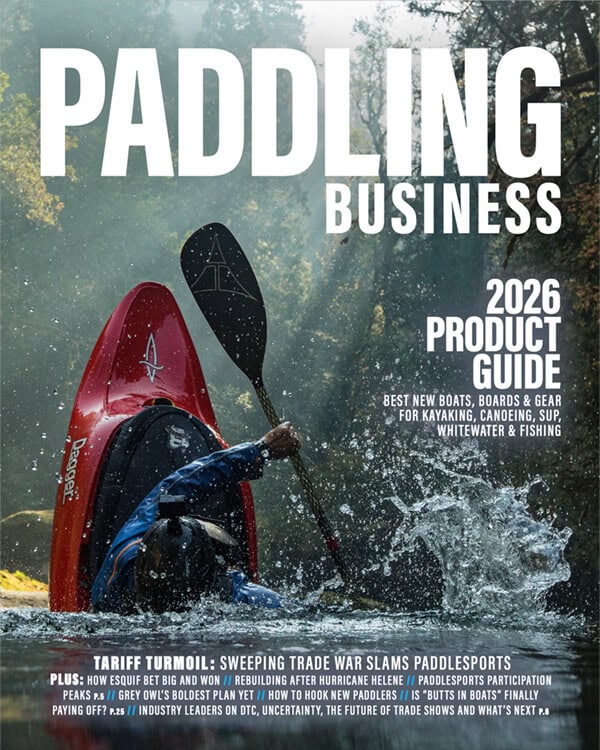 This article was first published in the 2025 issue of Paddling Business. Subscribe to Paddling Magazine’s print and digital editions, or browse the archives.
Looking to the horizon. | Feature photo: Nick Spooner








Maybe 5 years ago the technology to help customers find the product they want where they would pefer to buy it did not exist. Today the technology exists to do just that. I have brands in the outdoor space that have choices on there own web site. 1. Buy from us (the brand) online 2. Buy from this other online retailer. 3. Buy Local, some even say this retailer 1.3 miles from your house has that product in stock today. You can buy it or reserve it in my store on a brands website. Brands need to understand one thing very clearly….. so if I were speaking I would speak very slowly. Help reduce the friction for a customer to find your products. Focus less on making the sale (by pulling on the ONLY lever you have price) and focus on helping the customer buy it where they want to shop. This only works with price parity. If you do not figure out how to do it your competiors will. That much I can promise.
Darren Bush nailed it!
One of the biggest problems the industry faces is that millennials have less discretionary income, and from observing my own kids, what discretionary funds they do have, they’re spending on experiences, not on stuff. Which is a problem for people who sell stuff.
— Darren Bush, Rutabaga Paddlesports, Madison, Wisconsin
Ditto!
Thank you for posting this. Many good comments, but I found the nail on the head was about how younger people purchase everything online. This is the challenge for our sport.