

It was a miracle Jeff Landers was there at all. He’d just finished a slicey lap on the South Fork Payette River when Micah Barker caught up to him late that August afternoon, and that was on top of two sections of the North Fork he’d run earlier in the day. He was bushed, but despite a 30-year age difference—Jeff is 58, Micah is 28—Micah is his all-time favorite paddling partner.
“I told Micah I’ll go get on any section of the North Fork you want,” Jeff says. As Micah weighed the options, Jeff’s wife, Sarah, spoke up in favor of the fastest. Just do a Lower Five, she said. I’ll run shuttle and we’ll go eat at the Dirty Shame, she said, name-checking a boater bar almost as legendary as the North Fork itself.
Behind the rescue: Kayakers save family after car plunges into river
The Lower Five miles of the North Fork Payette is a slightly tamer version of the class V test piece just upstream. Jeff and Micah had run it together hundreds of times, but in all their years paddling the stretch, Micah had never once surfed the little wave between Juicer and Crunch. This time he did.
As Micah windmilled to catch the wave, Jeff looked for a spot to wait. Most boaters would have chosen the broad, calm eddy on the left, but traffic was bumper to bumper on Idaho State Highway 55, the slender two-lane road that snakes for miles along the North Fork, and Jeff likes to be seen. He whipped into a smaller eddy on river right.
Moments later he heard a sound like a train crashing and glanced up to see a line of brake lights and a blue sedan skidding out of control. It slid off the road, smashed squarely into a massive boulder and landed upside down barely 25 feet from him. “I almost got splashed by the car.” If he’d chosen the big river-left eddy, the car very well could have landed on him.
Jeff immediately ferried to the car, which had come to a stop in thigh-deep water. The horn was blaring, wheels still spinning. Jeff couldn’t see a thing through the car’s dark-tinted windows but he could hear someone pounding inside, trying to get out.
He scrambled out of his boat and tried the front driver-side door but it wouldn’t budge. Then he gripped the back door and “just yarded it open” through the soft sand bottom.
“The car is just full of smoke from the airbags going off, so I can’t see anything inside the car,” he says. “I’m just reaching around and I feel a hand grab my hand, and I pull this 250- or 300-pound guy out the back door. And that’s when he tells me that his disabled partner is in the other side of the vehicle.”

Sonya Valenzuela, 55, and her partner Will Flores were returning from Horsethief Reservoir, where they’d spent the day with family spreading her mother’s ashes at a favorite campground.
Sonya’s six daughters worried about their mother making the two-hour trip from her home near Boise due to a stroke that had left her completely paralyzed on the left side of her body. The ceremony had gone smoothly, but on the drive back along Highway 55 Sonya’s seatbelt began to bind. She unlatched it, and Will reached across to help. That’s when he lost control of the car. In an instant they were upside down in the river, surrounded by smoke and airbags.
Some of Sonya’s family were in the line of traffic that backed up for miles but none of them knew their mother was in the car that had hurtled off the embankment, or that her life now depended on the actions of the kayakers, raft guides and bystanders who rushed to help.
Micah was finishing his surf when the car’s movement flashed across the corner of his eye. He glanced up in time to see the sedan launch from the roadside, strike the boulder head-on, and tumble end-over-end into the river right eddy. He charged downstream wondering what he would find when he arrived.
“Your mind just starts spiraling with all these thoughts,” Micah says. “Is it a full family in there? Are there kids in the car?”
Micah scrambled out of his boat as Jeff, who arrived a few seconds earlier, heaved the rear door open and pulled a big man out of the car. The man was conscious and talking, seemingly uninjured, Micah recalls. “Jeff asks if there’s anyone else in the car, and he answers, yes, a disabled woman. And you know, in my mind I’m like, f**k.” As a raft guide with 10 years on the Middle Fork, Micah has seen things go sideways on the river plenty of times. But he’d never experienced anything like this.
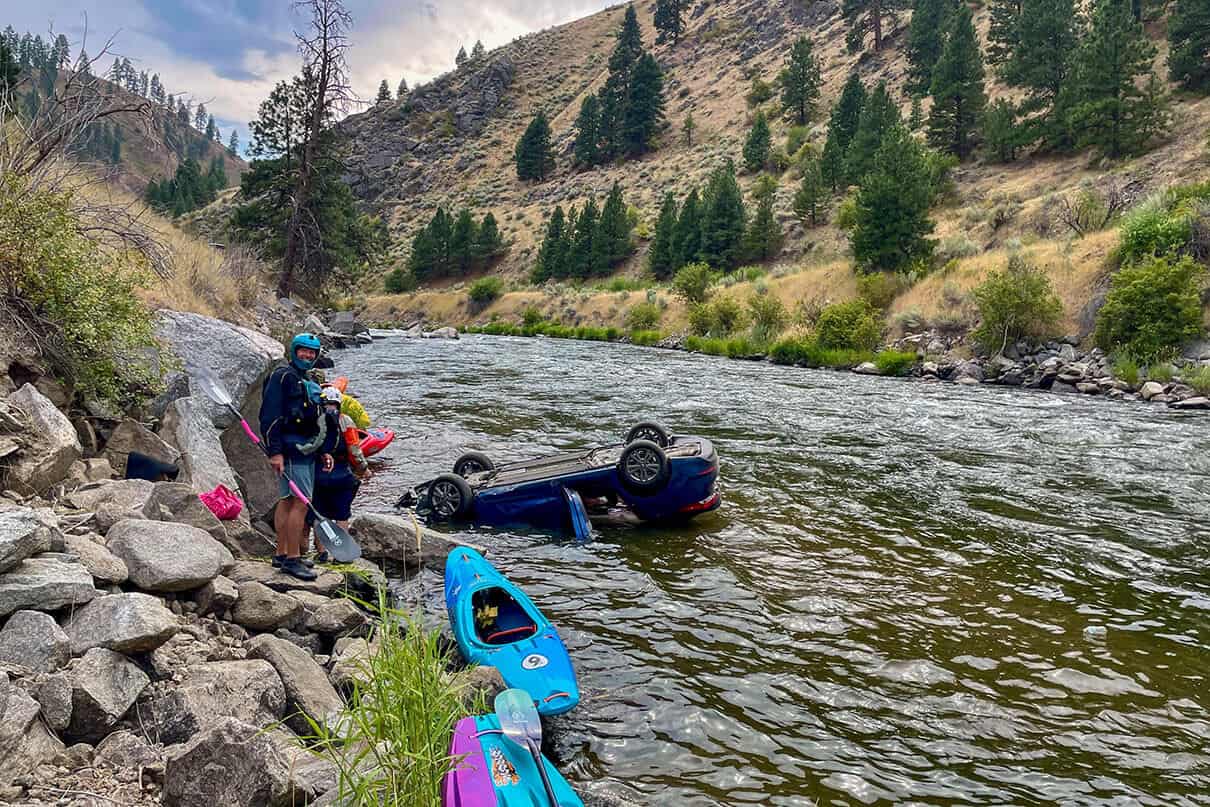
Micah clambered out of his boat and reached the front passenger door just as Jeff yanked open the rear. Inside they found Sonya trapped upside down, her nostrils just inches above the water. Jeff grabbed her gently by the chin and lifted her head out of the water so she could breathe.
“I thought she was blind because she was looking straight through me, just yelling, ‘Help! Help me! Help me!’” Jeff says.
Jeff reassured Sonya as he worked out how to free her from the car. Sonya is a big woman and completely paralyzed on the left side of her body.
Inside they found Sonya trapped upside down, her nostrils just inches above the water. Jeff grabbed her gently by the chin and lifted her head out of the water so she could breathe.
Her injuries were severe, including a broken femur and tibia on her good leg, a fractured T-4 vertebra in her upper spine and a broken nose. The immediate problem, however, was the seatback holding much of her head underwater. Jeff asked Micah to find the seat back lever and release it. When Micah pulled the handle, Jeff lifted the seatback, giving Sonya critical breathing room and a way out of the vehicle. Now Micah took her legs as Jeff guided her torso out of the car—a maneuver that required him to briefly push her head under the water. They pulled Sonya to shore and reclined her on a rock, legs dangling in the water.
Jeff estimates about 90 seconds passed from the time the car left the road until both victims were on shore. By now, bystanders on the road had joined the rescue effort. Micah scrambled up the bank, where a woman handed him a first aid kit and said she’d already sent someone to call 911. Micah told her to send more people. There’s no cell service on the North Fork, and if someone didn’t know to stop at Bear Valley River Company—maybe the only place in Banks (pop. 22) to call from a landline—it could take them half an hour just to sound the alarm.
As it happened, reinforcements arrived by river. A group of 10 paddlers had put on just behind Micah and Jeff, including Dr. Raleigh Anderson, a traveling anesthesiologist who splits time between river running hotbeds in Colorado and Washington. Raleigh quickly assessed the difficulty of the situation and the timeframe they were working with: A partially paralyzed and severely injured woman at the bottom of a steep scree slope. Given the spotty cell service and distance from the nearest trauma center, local boaters told Raleigh it could take 45 minutes for first responders to arrive. Sonya was already complaining of difficulty breathing, and Raleigh could see that she had injured her cervical spine. She could lose her airway at any moment.
“Jeff and Micah were clutch in getting her out of the car,” Raleigh says. “And then the question was, what do we do? It was pretty clear to me the state she was in and how long an ambulance was going to take. So I just made the decision: We’re going to move.”
By now there were a dozen experienced whitewater paddlers on scene, and more willing helpers on the road. While Micah, Jeff and Raleigh tended to Sonya, other paddlers began clearing a path up the 45-degree embankment, pushing aside loose gravel and shoring up unstable rocks.
“There was no arguing or talking over each other,” Micah recalls. “It was just all these people with two hands ready to help.”
The crew’s seamless reaction was a testament to their whitewater experience. The river regularly serves up tests that require cool heads, teamwork and personal initiative, all at once. Those situations also demand that each boater recognize their own strengths and weaknesses. And so, with barely a word, the boaters sorted themselves into their most useful roles. As the only physician on the team, Raleigh provided leadership and a welcome dose of confidence.
“She showed up and said, ‘Okay, I’ve seen somebody like this before and this is what we need to do,’” Micah says. “It was really good to have that kind of energy come onto the scene, because we were definitely feeling the holy-s**t factor.”
As Raleigh worked to stabilize Sonya, Micah noticed some familiar faces scrambling down the slope. A group of guides from Middle Fork River Expeditions had seen the commotion on the road and hustled to help. They brought with them the final piece of the extraction puzzle, a folding raft table. It would serve as a makeshift backboard, providing the stability to safely move Sonya up to the road.
As they carefully positioned Sonya on the table and secured her with NRS straps, Jeff remembers wondering how they were going to get the unwieldy package up to the road about 20 vertical feet above the river. That’s when a local paddler named Brant Smith shouted, “Form a bucket brigade!”
It was as if 20 light bulbs went off at once. All those who had gathered to help—a dozen kayakers, the raft guides, a few passersby and even Sonya’s partner Will—formed a fire line along the makeshift path. Slowly, the litter carrying Sonya passed from hand to hand toward the road.
The crux of the extraction came at the edge of the roadway, where the last five feet of elevation gain came in a 60-degree pitch, with nothing but loose scree underfoot. Years ago, before he started paddling, Jeff had put up some of the hardest rock climbing routes in Idaho. This was his terrain. He identified the one bit of solid purchase around—a corrugated drainpipe protruding from the roadbed—and scrambled onto it.
A law enforcement officer had just arrived on scene, a big man in a reflective vest who, in Micah’s estimation, wasn’t quite sure what to do. Jeff handed him the tether attached to his life jacket and told him, “When I say pull, pull!”
With that, Jeff squatted on the pipe, gripped the edge of the table and, with the officer pulling and boaters pushing from below, managed to get Sonya onto the road. The ambulance was just arriving. Jeff reckons the entire operation had taken no more than 15 or 20 minutes.
Sonya was transported to a hospital in Boise to begin a long and difficult recovery. A few days later she recorded a video to share with Jeff and Micah. “She just said thank you so much for saving my life. And you know, that hits hard.”
“I felt blessed,” he says. “I mean, I was placed there for a reason.”
Lessons learned
Like most successful days on whitewater, this North Fork rescue was all about teamwork. More than 20 people pitched in, each contributing their own strengths. Jeff got to the car before the wheels stopped spinning, and Micah was right behind him. Their swift action undoubtably saved Sonya’s life, and likely saved Will’s.
Critically, there was no clash of egos, says Dr. Raleigh Anderson, whose medical experience made her the de facto leader. “I’ve been in trauma bays with a lot more arguing,” she says. Of course, we can’t all count on a doctor being nearby when we get into a pickle, so Raleigh’s first piece of advice is to take a Wilderness First Responder course.
The best whitewater is found in the bottom of canyons, far from the hustle and bustle of so-called civilizations. Even roadside runs like the North Fork can be far from cell service. That’s why Raleigh recommends everyone keep a communication device such as a Garmin inReach in their life jacket for backcountry emergencies and, far more often, reassuring texts to loved ones: “Great day on the river, home soon!”
Jeff Moag is the former editor of Canoe & Kayak magazine and editor of Rapid Media’s trade publication, Paddling Business.
 This article was published in Issue 75 of Paddling Magazine.
 Boaters jumped into action to rescue two occupants when this vehicle flew off-road into the North Fork Payette River. | Feature photo: Josh King






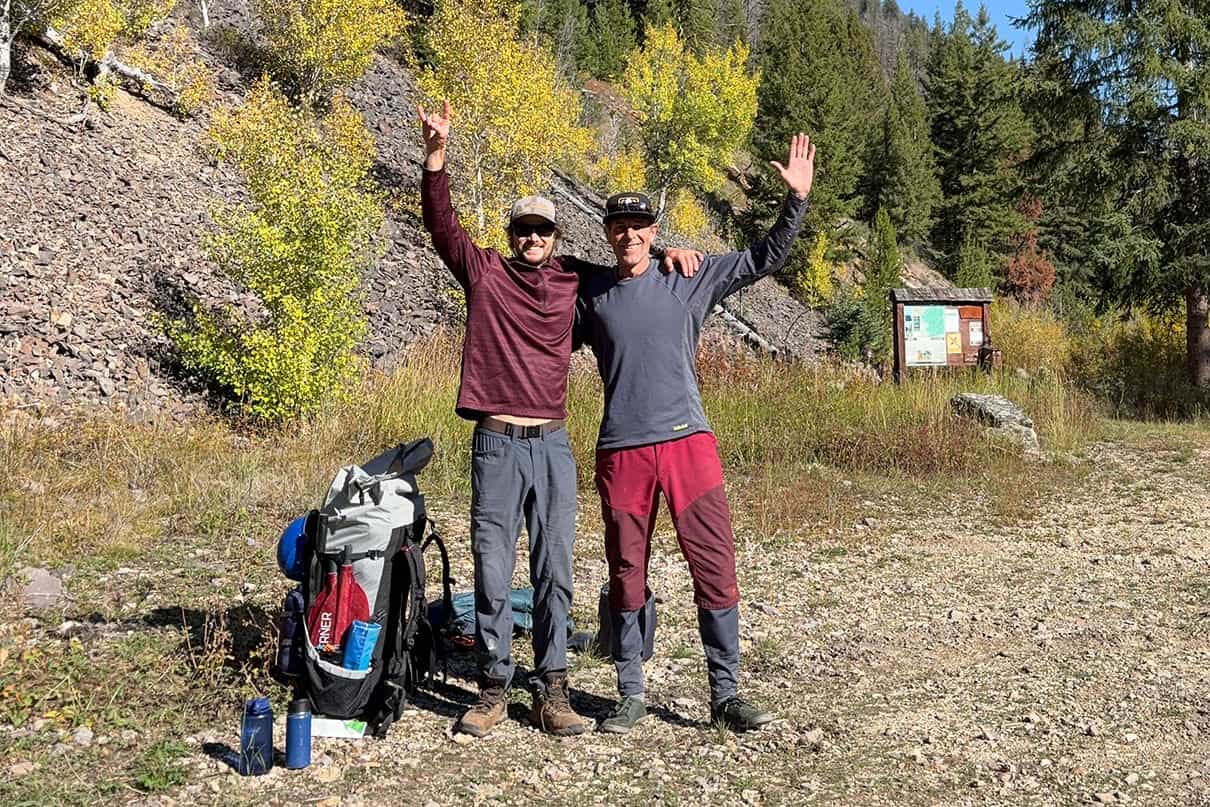
Still feel blessed for being in the right place.