Like most old skills, there’s something deeply satisfying about getting where you want to go with the humble compass. I remember the feeling of accomplishment upon completing a 10-mile crossing in dense, pea soup fog on Lake Superior using only this deck-mounted nautical tool on my sea kayak. I second-guessed myself constantly along the way, only to fall back on the mantra, ”trust your instrument.”
Putting your confidence in analog technology delivers the type of patience-based reward that’s increasingly rare these days, when a smartphone navigation app can identify your position with the tap of a finger. I’ve taught sea kayaking to budding guides and navigation for natural resource college majors for over two decades, and my students have always been captivated by the simple magic of planning and following a route by map and compass. A magnetic compass also forces you to be more observant and cautious, which ultimately keeps you safer. And, it’s your ultimate backup for when the S.H.T.F. (i.e., your phone battery hits zero percent). All good reasons why it endures as an essential tool for navigation.
With any physical tool, be it a mechanical watch, carpenter’s level, or, in our case, the compass, the best are built with quality, deliver accuracy, and are either intuitive to use or capable of our most elaborate needs.
Best Compasses: Our Top Picks
- Best kayak compass overall: Silva 70P
- Most versatile kayak compass: Silva 58 Kayak
- Best for everyday hiking and paddling: Brunton Scout EcoCompass
- Best for advanced orienteering: Suunto MC-2
- Best app: Apple iPhone Compass
Best kayak compass overall
Silva 70P
$139.99 USD
Buy from:
Why I love it
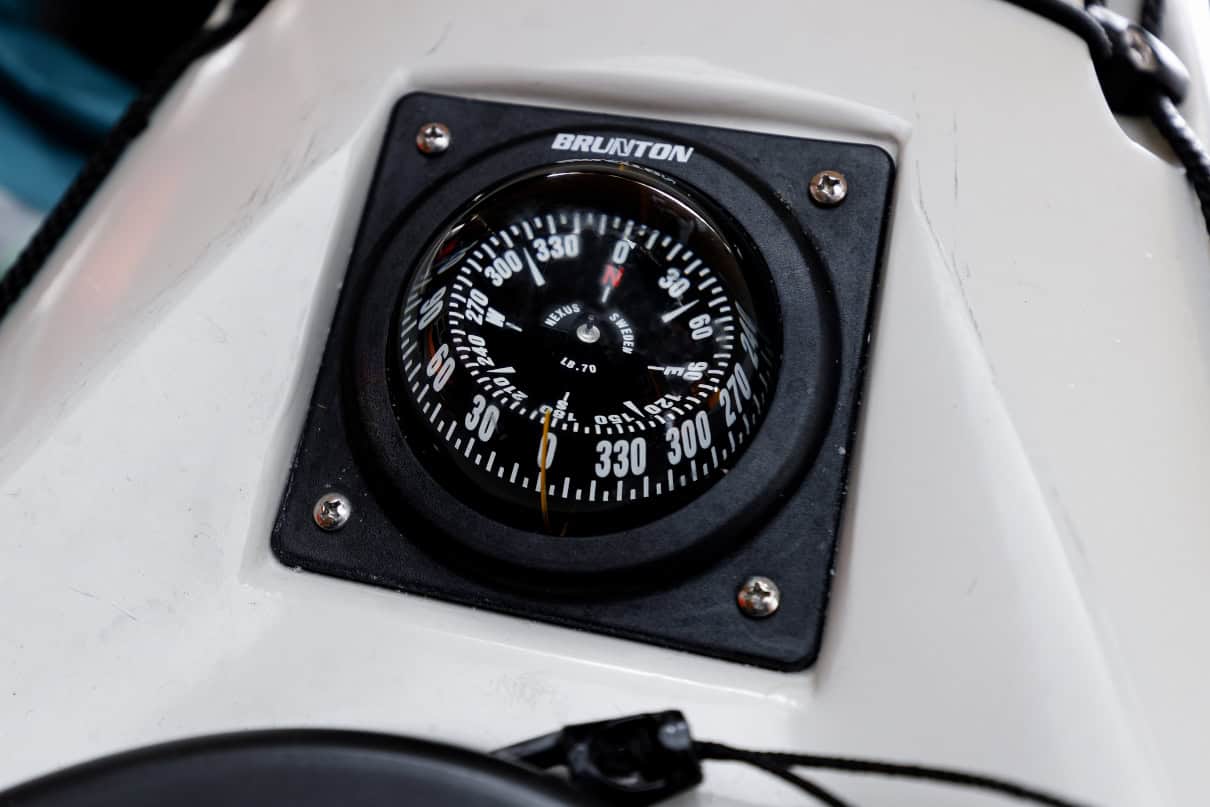
A deck-mounted 70P compass is a popular accessory on most British-built and Danish-style sea kayaks meant for expedition use. The style is designed to be installed with four screws into a recess moulded into the kayak deck, just ahead of the bow hatch, has had a variety of labels over the years, including Nexus, Comnav and Brunton. The reliable, time-tested 70P is currently produced by Silva and for sale in Canada and the United States.
A built-in marine compass like the 70P has a couple of distinct advantages over handheld orienteering compasses. It operates hands-free, so you don’t need to make any adjustments by hand. Instead, the dial reveals the direction (in degrees) that your bow is pointing. The forward placement of the compass recess mount may test your eyesight, but it also calms your stomach, allowing you to sight both the heading and the horizon to avoid seasickness.
Retrofitting your sea kayak with one of the 70P is easy once you get over the fear of drilling holes into the deck and installing the fasteners—each with a dab of marine silicone.
Reasons to buy
- Permanently fixes to your kayak
- Designed for marine use, meaning it’s accurate even when the boat is rocking
Consider another if
- Cannot be transferred from one kayak to another
- Placement toward the bow may make it difficult to see for the nearsighted
Bottom Line
A classic marine compass for serious expedition kayaking.
Most versatile kayak compass
Silva 58 Kayak
$99.99 USD
Buy from:
Why I love it
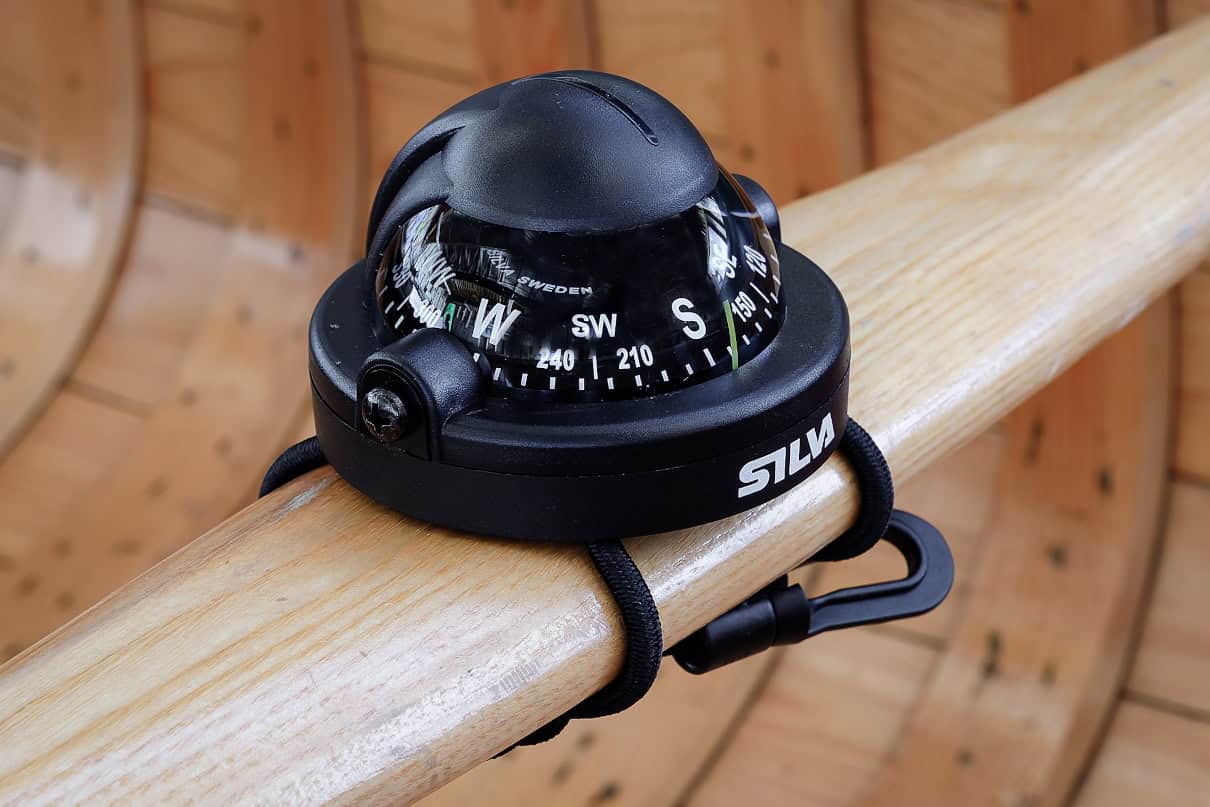
The Silva 58 is a marine compass that attaches to a kayak deck or canoe thwart with bungees, so it can be transferred from one boat to another and positioned where you like. The scratch-resistant dial has large, easy-to-read numbers, and the compass still works when it is tilted up to 30 degrees.
As someone who loves canoe expeditions as much as sea kayaking, the Silva 58 allows me to use the same navigational tool across different boats. For canoeing, I simply strap the compass to the stern thwart and instantly have a sense of which way the canoe is heading, which is helpful when navigating through island mazes on large lakes.
Reasons to buy
- Ideal if you own multiple boats
- A solid choice if your kayak lacks a recess for a 70P-style marine compass
- Still reads accurately when boat is tilted
Consider another if
- A removable compass is harder to line up on the kayak deck for accuracy
Bottom Line
A versatile marine compass that works on the entire fleet.
Best compass for everyday hiking and paddling
Brunton Scout ECOmpass

$49.95 USD
Buy from:
Why I love it
As much as I cherish my old and trusty Suunto MC-2 mirror compass for planning a route on a map and navigating through the bush, simple orienteering compasses such as the Brunton Scout ECOmpass have done the lion’s share of getting me from point A to B. For years, I’ve kept a barebones predecessor to the Scout in my PFD pocket. The updated model packs a key advanced feature: the dial can be offset to compensate for magnetic declination. This declination is the difference between true north and magnetic north, which varies from place to place on the globe and is often noted on maps. Unlike the larger Suunto MC-2, no tools are required to adjust the declination on the Scout. This allows for easy conversions between map readings and compass bearings.
What’s more, the Scout ECOmpass has a global needle that’s calibrated to work anywhere in the world. And a magnifying glass is handy for teasing out details on a map.
Reasons to buy
- Bridges the gap between a basic and advanced tool
Consider another if
- You need a cheaper option
Bottom Line
A solid choice for a do-everything compass.
Best for advanced orienteering
Suunto MC-2
$95.00 USD
Buy from:
Why I love it
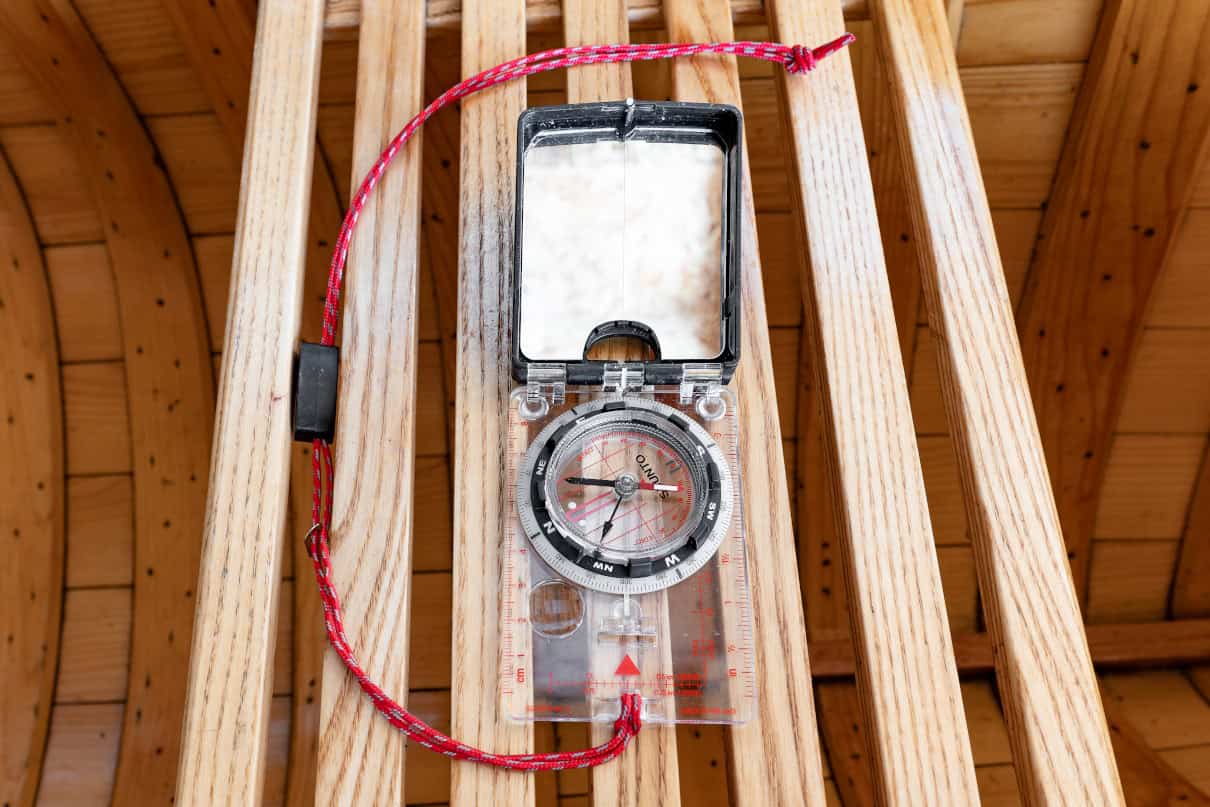
The Suunto MC-2 is a professional orienteering compass long trusted by outdoor enthusiasts and natural resource technicians.
The sighting mirror on the MC-2 increases your accuracy considerably in following a straight-line course through the forest or in identifying landmarks across open water. The dial can be adjusted to compensate for magnetic declination, and the needle is calibrated to work anywhere in the world. Most importantly, the made-in-Finland MC-2 is built to last with a lifetime warranty. I’ve had mine for nearly 25 years.
Teaching a college-level navigation course for natural resource students for over a decade means I’ve seen the good, the bad and the ugly when it comes to compasses. The Suunto MC-2 is the best of the best. It’s essential for anyone serious about working and playing in the outdoors. It’s an investment in a quality instrument that you won’t regret.
Reasons to buy
- Durable and precise, ideal for wilderness canoe tripping
- Includes an inclinometer for measuring slope, handy if your non-paddling hobbies include backcountry skiing in avalanche terrain
Consider another if
- A marine compass is more practical, such as for sea kayaking
Bottom Line
This orienteering compass is professional grade.
Best compass app
iPhone Compass App

Free
Buy from:
Why I love it
All modern iPhones come equipped with a convenient and effective compass app that’s generally more reliable and user-friendly than comparable Android apps. The free app means that if you already have an iPhone in your pocket, it is the most budget-friendly tool you’re going to find. The iPhone app is reliable and practical: it allows you to set and follow a bearing from point A to B, as well as measure the bearing to visible landmarks to compare with a map. Once you know a few tricks, you can also use it to take a bearing from a map.
The iPhone compass also differentiates between true and magnetic bearings and uses the phone’s onboard GPS to provide the latitude and longitude coordinates of your location. The only catch? It won’t work when your phone battery is drained.
Reasons to buy
- A practical, free compass built into your phone
Consider another if
- You want an all-around navigational tool that works with a map and without a charge
Bottom Line
If you’ve got an iPhone, you already have a reliable tool in your pocket.
Compass Buying Advice
As with any piece of outdoor gear, your aspirations and applications ultimately determine which compass is best for you. There are two main types relevant for paddlers: Orienteering compasses and marine/direct-read compasses.
Orienteering compasses
Orienteering compasses, such as the Suunto MC-2 and Brunton ECOmpass reviewed here, feature a rotating dial that allows you to measure a direction (bearing) from a map. To follow this bearing from point A to B in the real world requires you put “Red Fred in the Shed,” which means pivoting your body (or boat) so that the magnetic needle is aligned with the orienting arrow in the compass dial. This is easy when navigating on foot over land, but can be more complicated when paddling. However, if you can only afford one compass, an orienteering model will be the most versatile.
Marine/Direct-read compasses
In contrast, marine or direct-read compasses operate hands-free, showing the bearing of the direction you are facing (just like the compass in a car). This is especially convenient for paddling, but you’ll need an orienteering compass (or a navigational protractor or parallel rules) to measure a bearing from a map or chart. Marine compasses are designed to function when the dial is tilted, unlike an orienteering compass, which must remain flat. The compass app built into most smartphones operates like a marine compass.
With so many terms and numbers, navigation by compass seems complicated. But the skills are easy to develop with practice—and they will become solid and ritual with repetition, as your confidence grows. Most intermediate- to advanced-level sea kayak or canoe tripping courses include relevant navigation training. There are also many excellent books on the subject, including the classic Be Expert With Map and Compass, by Carina Kjellstrom Elgin and Bjorn Kjellstrom, which has been in print for decades.
Best compass brands
How we tested
Compared to other types of gear that see new releases annually, the compasses that are available today have been around for years with few changes. In developing my navigation skills as an expedition canoeist, sea kayak guide and instructor, I’ve had the chance to use many different products, which has allowed me to discover in the field what works best for myself and others. Over the past decade, teaching a course in outdoor navigation at a local college has further reinforced my opinions on the best compasses.

Why trust us
Using a compass is part of my day-to-day experience as a professional in paddlesports and the outdoors for 25 years. I prefer the challenge of using analog instruments instead of GPS units and smartphone-based navigation apps, so I usually keep my technology turned off and packed away on wilderness canoe trips and sea kayak tours.
My longest expedition was a self-supported, 55-day canoe journey across the Ungava Peninsula in Nunavik (northern Quebec), navigating a poorly documented route that included Hudson Bay, numerous rivers and hundreds of lakes—along with over 125 portages. I relied nearly exclusively on several of the compasses described in this article for planning and executing the trip.
 This article was published in Issue 75 of Paddling Magazine.
 Navigation you can count on. | Feature photo: Sheri Minardi