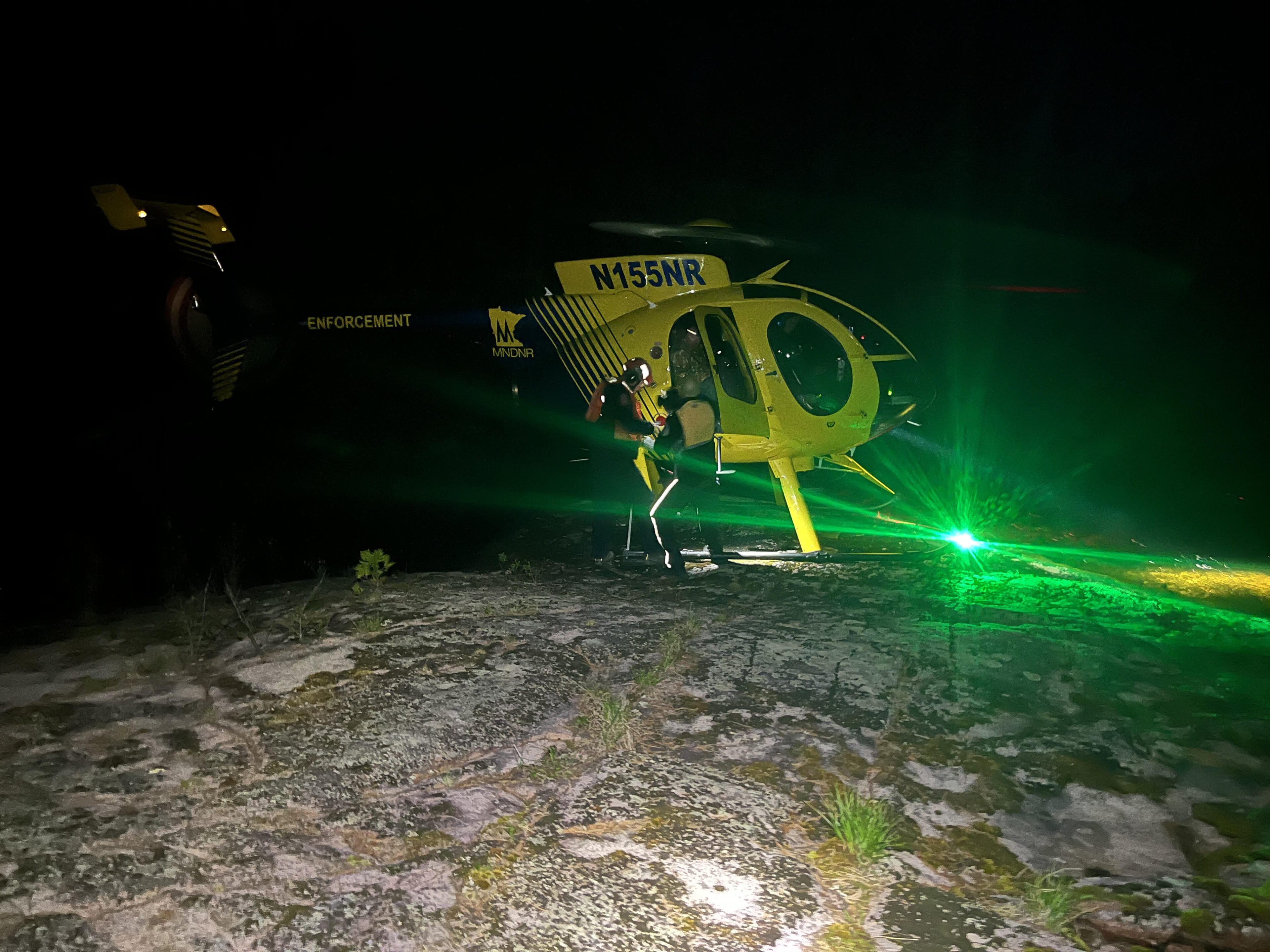
Dramatic video from the Minnesota Air Rescue Team shows a nighttime helicopter mission that extracted a pair of paddlers from the Boundary Waters Canoe Area (BWCA). Rescuers navigated darkness, rain and dense tree cover to reach the pair, who had lost their boat and lacked the gear needed to make it through the night.
First of-its-kind rescue in BWCA
The canoeists had been paddling near Morris Falls on the eastern side of the BWCA when their boat capsized in a rapid on May 14. While they were able to swim to land, they became separated from their canoe, leaving them soaked and stranded. As sunset approached, the paddlers were able to get enough cell service to contact 911.
High water levels and strong currents complicated a ground rescue, and the air rescue team was called in from St. Paul, Minnesota. Using night vision to navigate the wilderness in the dark, the team was able to fly directly to the pair of paddlers.
“We literally drove right to them, which saved us a ton of time,” pilot Dean Grothem said in an interview with KARE 11.
By the time the helicopter reached the paddlers, it was about 10:30 p.m., and they had been waiting in the cold for over three hours. Video shows the helicopter lowering rescuer Steve Merth into the darkness and then bringing the paddlers back up one at a time.
“There’s lights from the helicopter, but there’s tall trees and stuff. It can be kind of a sensory overload,” Merth told KARE 11.
The rescue was the crew’s first nighttime mission using a hoist system, which had been installed on the helicopter last year. Rescuers say it allows them to reach hard-to-access locations without having to wait for daylight, saving valuable time in high-risk situations.
“They were wet. It was colder that night, and the temperatures I think were forecast to get down into the low forties, if not lower. So the first thing you start to think about there is hypothermia, and are they going to get through the night if someone doesn’t get down there to them?” Grothem said in an interview with Northern News Now.
Cell service and starting a fire contributed to survival
While wet and cold, the paddlers were ultimately uninjured and were flown safely to Ely, Minn. In an interview with FOX 9, Merth said the pair was out on a day trip and had not planned to spend the night in the wilderness. The incident highlights the importance of bringing extra gear and an emergency kit on day trips in case of emergency. Merth says paddlers should always be prepared to spend longer than expected in the backcountry.
“Make sure you have the stuff—flashlights, a way to start a fire—so that if your original plan doesn’t go well, then you have that stuff with you. And then have a way to communicate,” Merth told FOX 9.
The stranded canoeists were able to get a text out to 911, but much of the BWCA does not have cell service. Merth encourages paddlers visiting remote areas to bring an additional communication device, such as a satellite messenger.
Rescuers praise the canoeists for starting a fire as they waited. In addition to helping them stay warm, the fire helped the helicopter locate the paddlers in the dark. If stranded, any light you have—a fire, a flashlight or even a phone camera—can help first responders locate you faster.
“They did a good job moving to where we could get to them and then having their lights and fire to bring us right in,” Merth shared.
Feature image: KARE 11/YouTube