As a local paddling shop was shutting down, I joined the steady pilgrimage of paddlers looking for deals. The drysuits and carbon fiber paddles had been picked clean, so I found myself rummaging through a pile of odds and ends.
Amongst random roof-rack components and cam straps, I found a faded yellow SealLine dry bag. I paid $5 for it, but I’d gladly have paid 10 times that. It’s a bit leaky, but it’s become one of my most treasured pieces of paddling gear. I bring it on most of my trips.
What’s special about the dry bag is the writing. Along the edge, it reads, “Jim and Jan Bollerman, 503-695-2499.” Jim died last winter. Jan passed away five years earlier.
Your gear will outlive you
Jim and Jan were canoeists who lived in my old neighborhood. Jim was soft-spoken and friendly when we’d bump into each other at the grocery store or paddling potlucks. But he’d transform, Clark Kent-like, into a snarling, intense, fierce competitor on the whitewater slalom course. I took a few photos of him and Jan, mid-gate, that prompted a mutual friend to ask if Jim had gone off some kind of medication.
Jim and Jan both passed in their 80s after a long life together. It wasn’t the tragedy of an early loss or a shocking river fatality, just the inevitable end of the journey we’re all on. But it made me wonder.

I started writing my name and phone number on my outdoor gear when I was a kid. It’s helped my paddles, helmets, and dry bags find their way back to me when they’ve been left in the back of the shuttle rig. It allowed me to pull my sprayskirt from a pile of identical black neoprene. Over the years, two paddles found their way back to me after being swept away by the current. That Sharpie writing habit is a standard paddler practice for keeping track of stuff. I never thought more of it until I found Jim and Jan’s old dry bag in the bin. Then I realized the same mundane habit might also be a source of a legacy.
Plastic, nylon and fiberglass, for better or for worse, last a really long time. Centuries. That’s why they’re the scourge of environmentalists (including me) who worry about the Great Pacific Garbage Patch and microplastics in the water. Sometimes our durable gear lasts longer than we do. When we write our names on gear, that gear may end up in someone else’s quiver when we upgrade or after we’ve stopped paddling and shuffled off this mortal coil.
I also recognize that when I’m too old to paddle, someone will end up with my stuff, too.
Bringing Jim and Jan’s dry bag along is one way I remember them. It’s a reminder that they ran rivers, drove shuttle, raced slalom, sat on the riverside sand, and shared in the stories and jokes at lunch. That they were part of the community.
As memory fades, we need those reminders. When my friends Dave and Carl both died too young, we kept their memory alive for several years with memorial paddles. But eventually those became less regular and then stopped. Sometimes the gear is what lasts. When another local paddler bought Carl’s kayak, seeing it on the water was one way I remember him, especially after I lost the fleece hat of his his partner had given me.
Now, when I pull another layer or lunch out of Jim and Jan’s dry bag, I’m not just reminded they were here. I also recognize that when I’m too old to paddle, someone will end up with my stuff, too.
Our gear is more than just the artificial substrate through which we experience rivers and the sea. It starts that way. But we combine the little things we do to our gear—like adding our name—with days and years and decades of camaraderie, adventure and friendship that imbue a leaky yellow dry bag, a green stuff sack, or a yellow and black NDK Explorer with meaning that goes well beyond nylon roll-top closures or fiberglass chop mat and gelcoat.
When I stop paddling, and eventually go the way of Jim and Jan, I hope whoever ends up with my paddle or dry bag or kayak is someone who shared many days on the water with me—and that I, too, will be remembered.
Neil Schulman writes and paddles in Portland, Oregon.

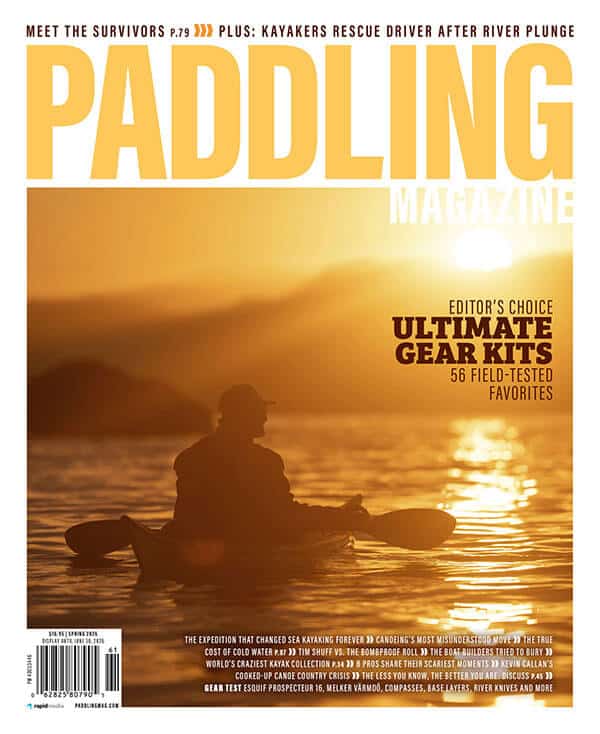 This article was published in Issue 75 of Paddling Magazine.
 A lifetime lingers in the stuff we leave behind. | Feature photo: Andy Zeltkalns