

Sure, it’s only been 25 years. But that’s a lot of water under the hulls of the world’s best whitewater paddlers. To help chronicle these notable expeditions, we reached out to some of the world’s best boaters for their take on the century’s most heralded expeditions to date. The only caveat: the missions must have been completed between the year 2000 and the present day, with the nominations coming from peers. Below is a handpicked list of nine of the most significant whitewater descents of the 21st century—journeys that stretched the limits of endurance, skill and what paddlers thought possible.
Greatest whitewater descents of the century (so far)
Tsangpo Expedition, Tibet
2002
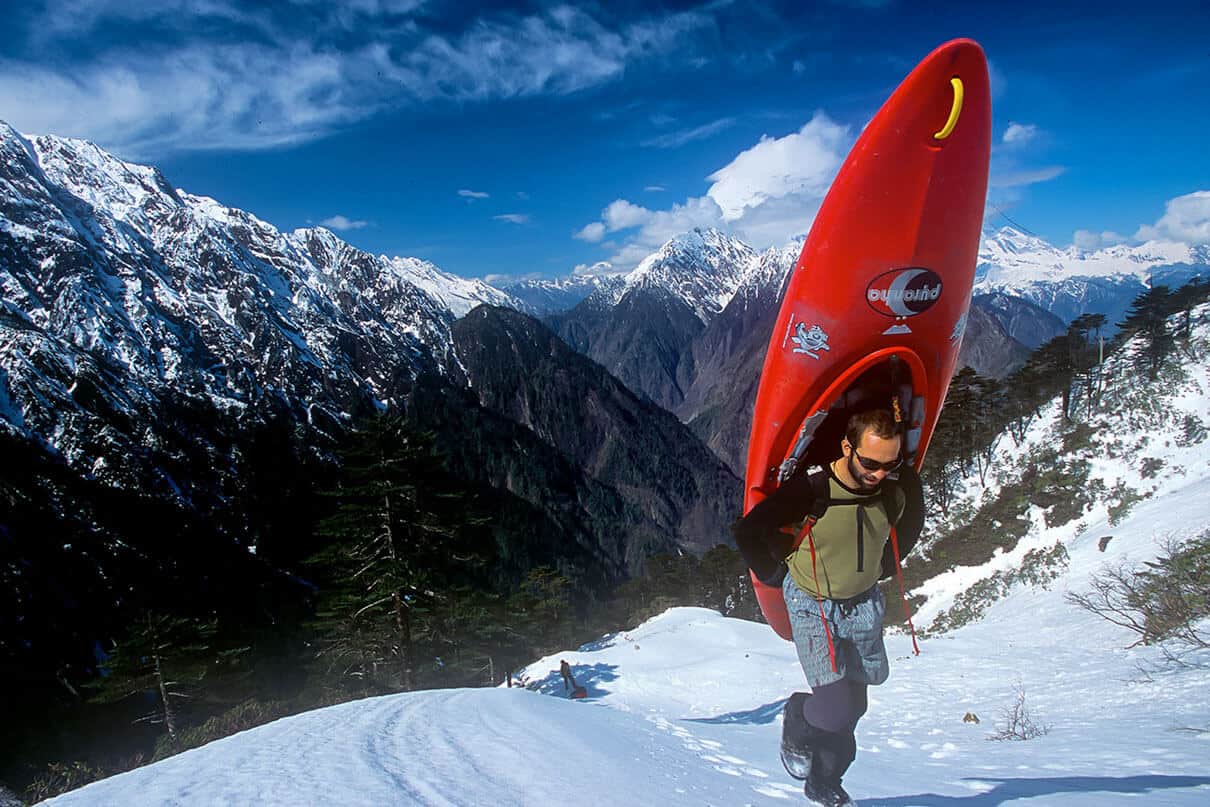
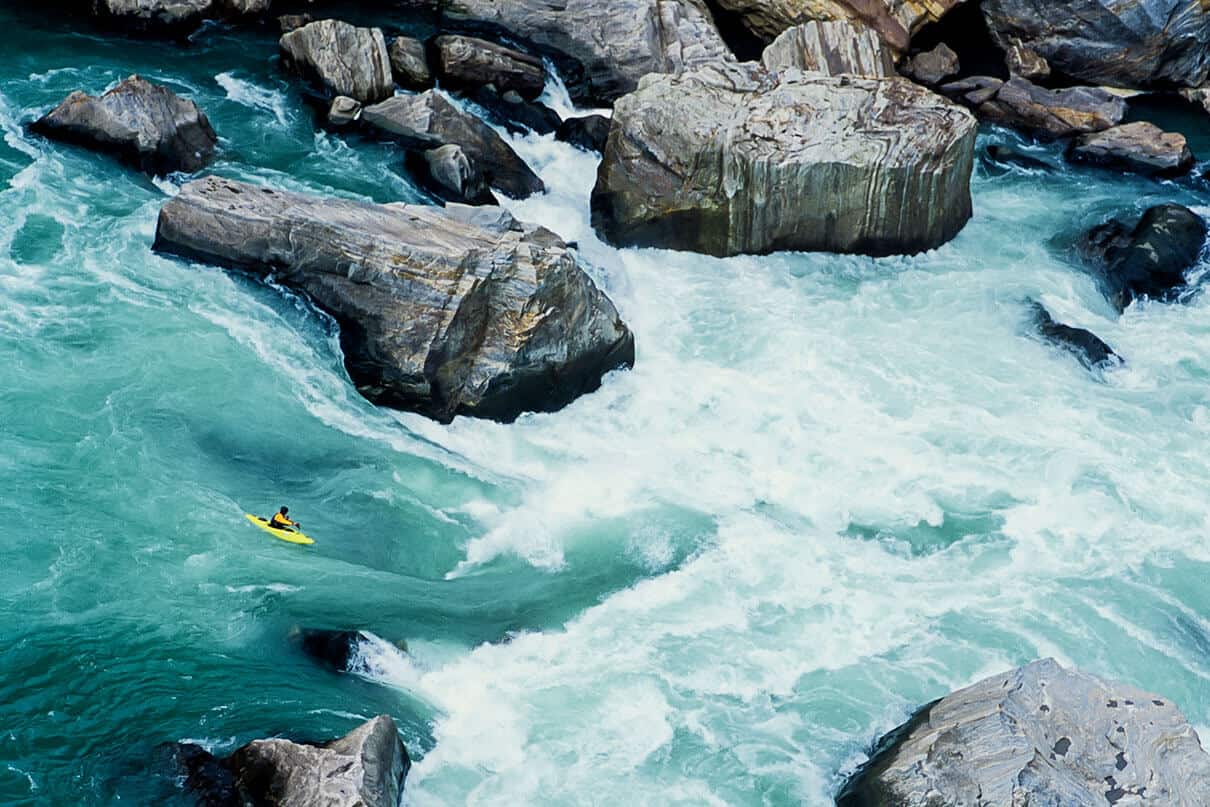
In February 2002, in the dead of the Himalayan winter, seven of the world’s top extreme kayakers attempted to paddle Tibet’s Tsangpo River, one of the most remote and deepest river gorges on Earth, three times deeper and eight times steeper than the Grand Canyon. The team included Steve Fisher from South Africa, Mike Abbott of New Zealand, Allan Ellard of England, Dustin Knapp of Oregon, twin brothers Johnnie and Willie Kern from Vermont, and expedition leader Scott Lindgren of California.
Flowing 700 miles east across the Tibetan Plateau, the Tsangpo (also known as the Yarlung in China) drains the north slope of the Himalayas before dropping into the jungles of India as the Brahmaputra. From the plateau, the river loses 9,000 feet of altitude in 150 miles. In 1998, U.S. Slalom Team member Doug Gordon drowned on an expedition attempting the first descent of the gorge, with the team making it only the first 27 of 44 miles.
The Lindgren team was 87 members strong, including five climbing Sherpas from Nepal, 68 Tibetan porters hauling 2,500 pounds of food and gear. When they put on near the remote Tibetan village of Pe, their spirits were high, with the river flowing an estimated 15,000 cubic feet per second and dropping 100 to 200 feet per mile.
“Most of us had paddled so much together we already trusted one another,” said Knapp. “We were confident that we would do what we could.” Still, the Tsangpo was more formidable than any other river expedition the team members had ever tackled.
Fourteen days and dozens of class V+ rapids later, they arrived at unrunnable Rainbow Falls, completing the first descent of the Upper Tsangpo Gorge. But they still faced a 96-hour portage around the falls, up and over 12,000-foot Sechen La Pass—never before attempted in winter—as well as a tense mutiny by their porters. The party eventually rejoined the river but, deciding the lower gorge was unrunnable due to a cataclysmic flash flood, they ended their expedition. Watch the action in Lindgren’s documentary, Into the Tsangpo Gorge.
Lukuga River, Democratic Republic of the Congo
2010
South African paddler Hendri Coetzee earned his place in whitewater history with a series of landmark expeditions in Africa. In 2004, he led a four-month, source-to-sea descent of the 4,130-mile Nile. Five years later, he completed a 1,000-mile solo descent of the Congo River, from Rwanda’s Lake Kivu to the Atlantic Ocean, portaging around Inga Falls (see his book, Living the Best Day Ever).
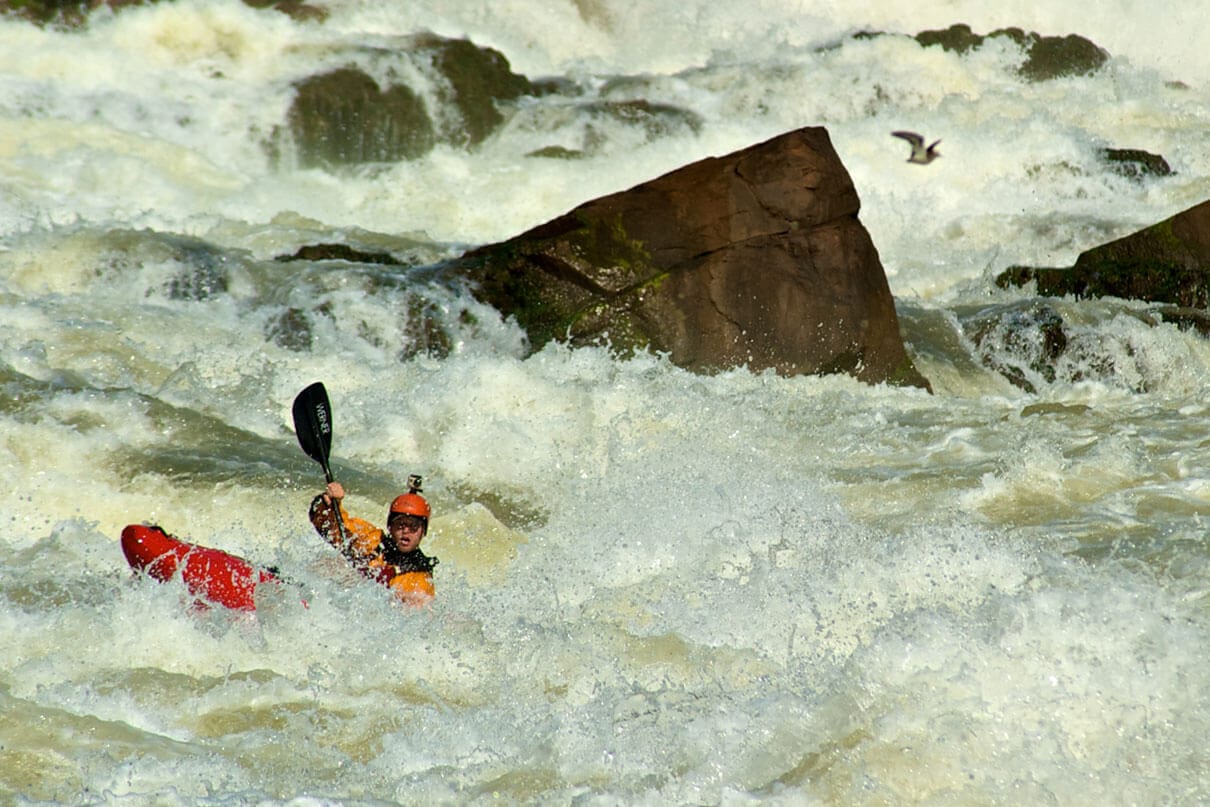
In 2010, Coetzee partnered with Ben Stookesberry and Chris Korbulic to kayak from the headwaters of the White Nile and Congo rivers, which he had skipped in 2009, into the DRC to document its whitewater and call attention to the clean water crisis in Central Africa. This first descent ended in tragedy. Seven weeks into the journey, Coetzee was leading Stookesberry and Korbulic down a section of the Lukuga River when a crocodile attacked his kayak, capsized it, and Coetzee was never seen again.
“Hendri was, without doubt, one of the greatest river explorers of our time,” said Fluid Kayaks owner and expedition sponsor Celliers Kruger. “Hendri was never a guy for half measures. When he decided to do a source-to-sea he chose the longest river in the world. When he decided to run the Congo solo, he spent a few months in the DRC to learn to speak Swahili. He did the Murchison section of the Nile solo in two days, a feat unlikely to ever be met. He was a true legend, even in his own lifetime.” Fifteen years later, Coetzee’s legacy continues to inspire paddlers around the world.
Grand Inga Rapids, Democratic Republic of the Congo
2011
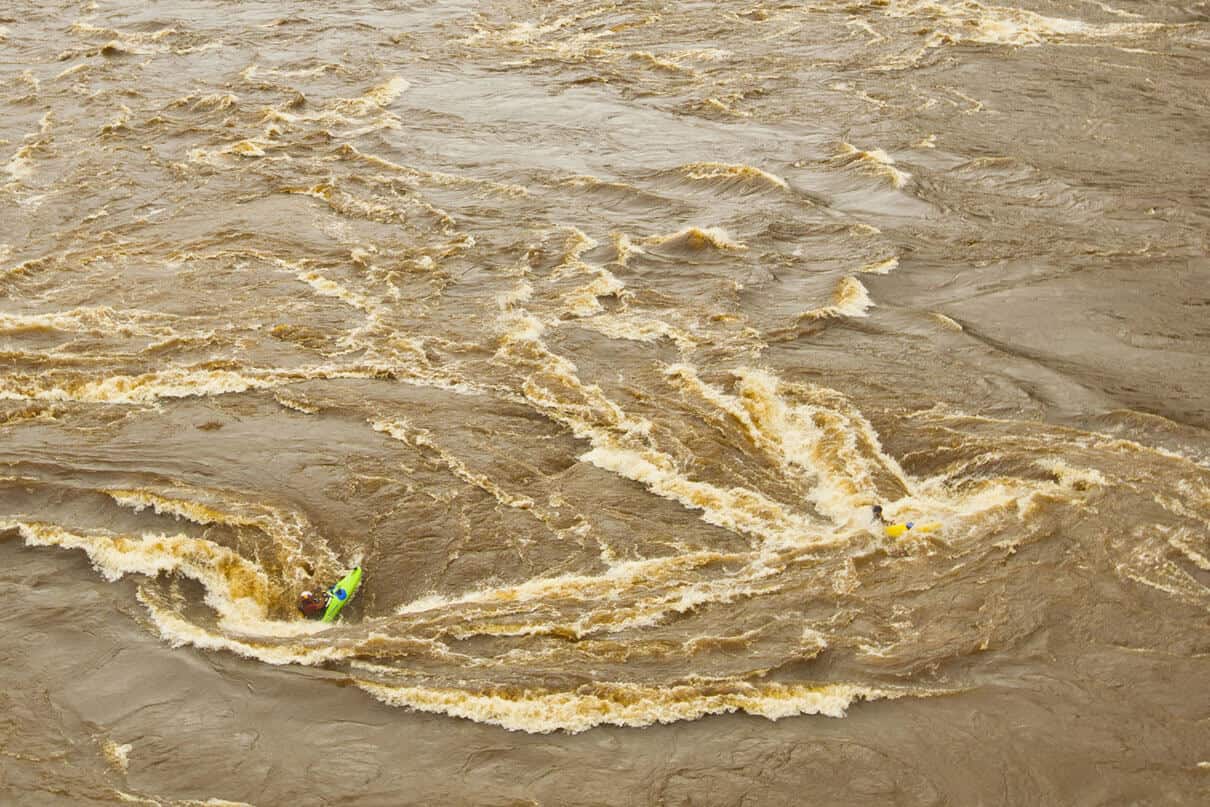
In 2011, after seven years of planning, four of the top expedition kayakers in the world—Tyler Bradt, Rush Sturges, Steve Fisher and Ben Marr—attempted to kayak the Congo River’s Grand Inga Rapids, the highest volume whitewater on the planet. The Congo flows at more than 1.6 million cubic feet per second and is the deepest and second-largest river on Earth. It’s also one of the most remote, with the 50-mile section these paddlers attempted having already claimed the lives of numerous explorers.
Led by South Africa’s Steve Fisher, with logistical help from Pete Meredith, the team first had to navigate the challenges and politics of the Democratic Republic of the Congo. During their five-day descent, they encountered 40-foot breaking waves, deadly whirlpools, semi-truck-sized hydraulics, and rapids 30 times larger than any found on the Colorado’s Grand Canyon.
“That’s the closest I’ve come to dying in my life,” Fisher said afterward. “This is a river like no other, and these rapids were a big step more difficult than we’d anticipated. When early explorers wrote that these rapids are unnavigable, they were dead right. We may have succeeded, but their statements are still accurate.”
No one got a better view of the carnage than expedition photographer Greg Von Doersten, who was high overhead in a helicopter documenting the descent. “These kayakers were among the best in the world and intended to paddle through the largest features, but their plans changed after inspecting the rapids,” he reported. “They’re class VI-plus. The wave in the Crystal Gorge is more than 30 feet high and 100 feet wide. It makes the Grand Canyon’s Crystal Rapid look inconsequential. I’ve never seen anything like it, and I’ve seen the Ganges and Zambezi at high water.” The expedition was captured with POV cameras and a team of three air- and land-based cameramen, and premiered in the film Congo: The Grand Inga Project. The team was named National Geographic’s Adventurers of the Year in 2013.
The Amazon
2013
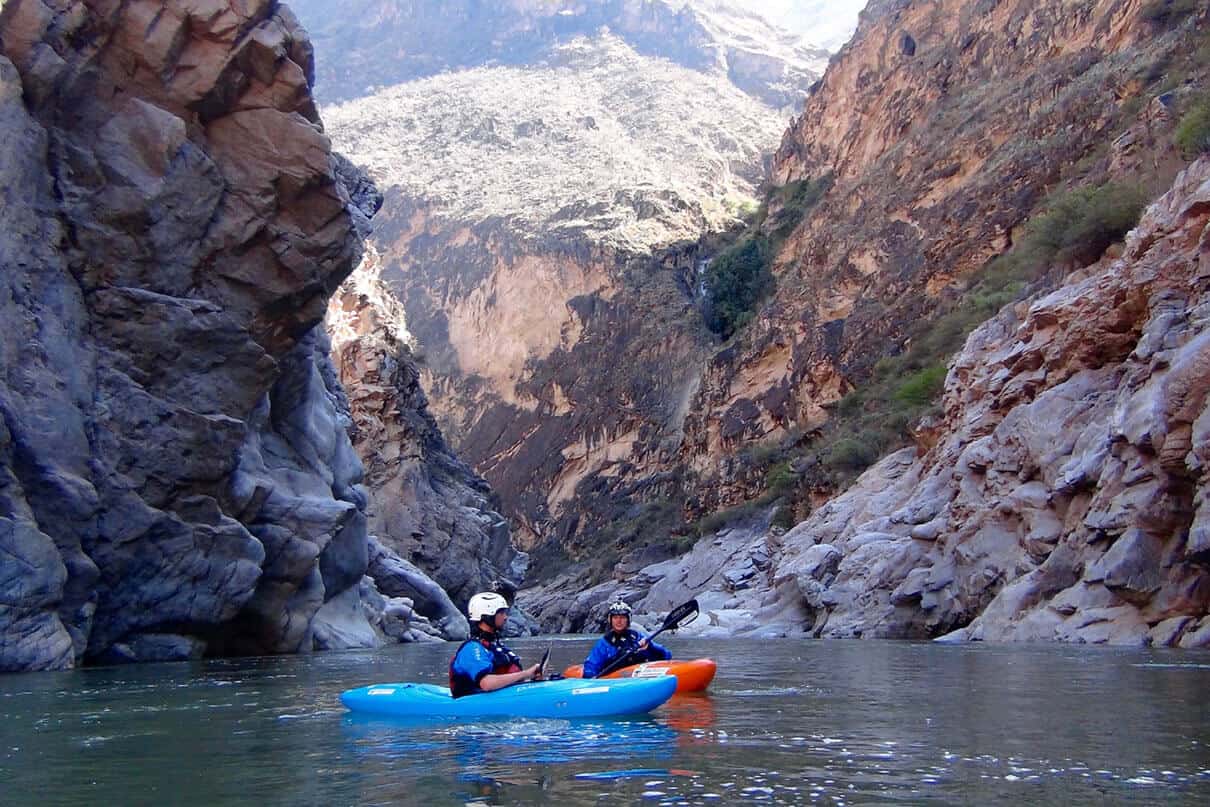
As co-owner of Small World Adventures, Darcy Gaechter leads kayaking trips throughout Ecuador and the world. However, her most challenging expedition came in 2013, when she kayaked the 4,300-mile Amazon River, from its source to the Atlantic Ocean, becoming the first woman to do so. The expedition built on previous descents by Piotr Chmielinski and Joe Kane (1987), West Hansen (2012) and Rocky Contos (2012), who championed the Rio Mantaro as its new source.
Gaechter’s 148-day journey began on her 35th birthday. Along with Don Beveridge, Gaechter completed the trip with David Midgley, a computer programmer from London. With blistering lips and skin, the trio tackled class V whitewater for 25 days straight in the upper headwaters of the Rio Marañon, high in the Peruvian Andes. As if the bitterly cold class V wasn’t enough, they barely survived a dynamite-filled canyon being prepared for a new hydroelectric plant. Farther downriver, they encountered illegal loggers, narco-traffickers, Shining Path rebels, and black market poachers working in the endangered species trade. When all was said and done, they reached the Atlantic exhausted five months later.
While the trip itself stands as a significant achievement—at its end just 12 people had paddled the Amazon source to sea, the same number as have walked on the moon—Gaechter has since used the trip as a platform to challenge outdated ideas of who belongs on river expeditions. Her memoir, Amazon Woman, continues to inspire a new generation of river women to chase bold goals.
Beriman Gorge, Papua New Guinea
2015
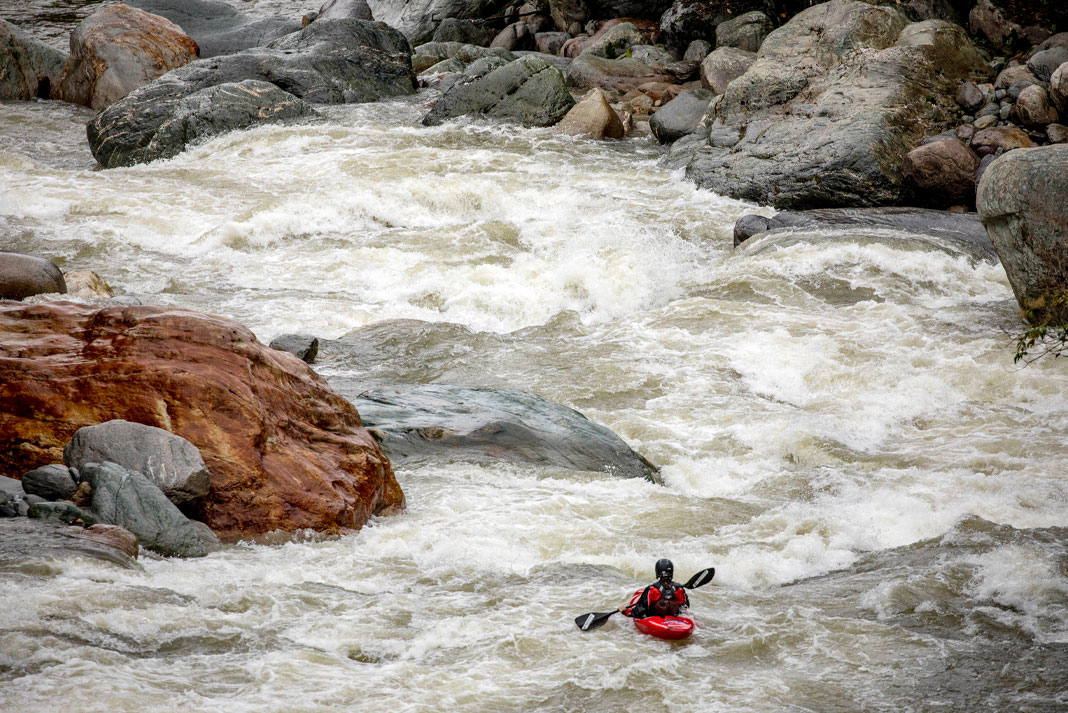
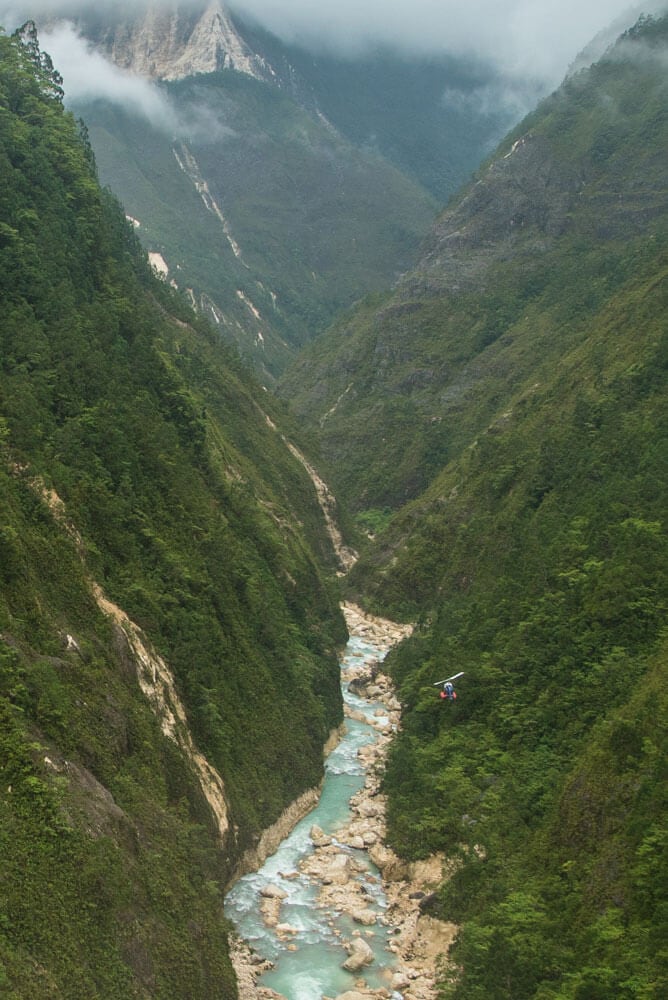
Lying just south of the equator, the island nation of Papua New Guinea is part of an arc of mountains stretching from Asia into the South Pacific, making it one of the most isolated countries on the planet. In 2015, Ben Stookesberry, Ben Marr, Pedro Oliva and Chris Korbulic headed deep into the jungle of its largest island, New Britain, to attempt the first descent of the Beriman River Gorge. Known as the Grand Canyon of the Pacific, the Beriman runs for 50 miles through 13 gorges in its 4,000-foot descent to the sea through narrow, jungle-lined limestone canyons.
The team took a week to scout the river by helicopter, using a high-resolution video camera to look at the water running through canyons so deep and narrow that they couldn’t be seen via satellite imagery.
“Once you’re in there, there’s only one way out, through some of the most committing whitewater on Earth, with no chance of rescue or resupply,” said Stookesberry.
Over the first days, they battled their way through three tight gorges, encountering blind sections of whitewater and class VI rapids requiring arduous portages. From scouting, they knew that eight of the 13 gorges were unrunnable, but you had to get through them to access the ones that were. After gorge four, they pulled their kayaks out of the water and hauled them up the canyon wall, spending the better part of a week carrying their heavily loaded kayaks through the dense jungle foliage. Then they began to run low on food and suffer from painful cases of foot rot.
In all, the team spent 13 days descending 3,600 vertical feet of the Beriman Gorge to the calm, turquoise water of the Solomon Sea. The expedition was captured in the film Locked In.
Twin Galaxies, Greenland
2016
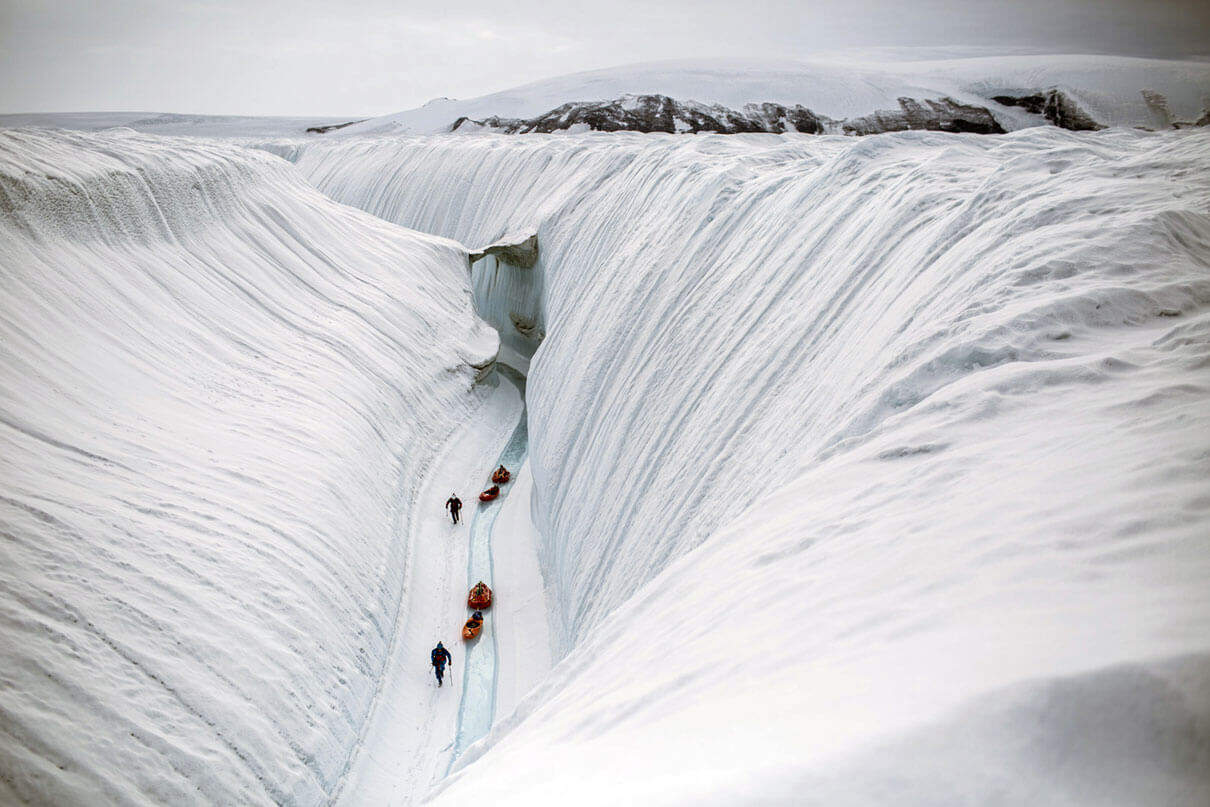
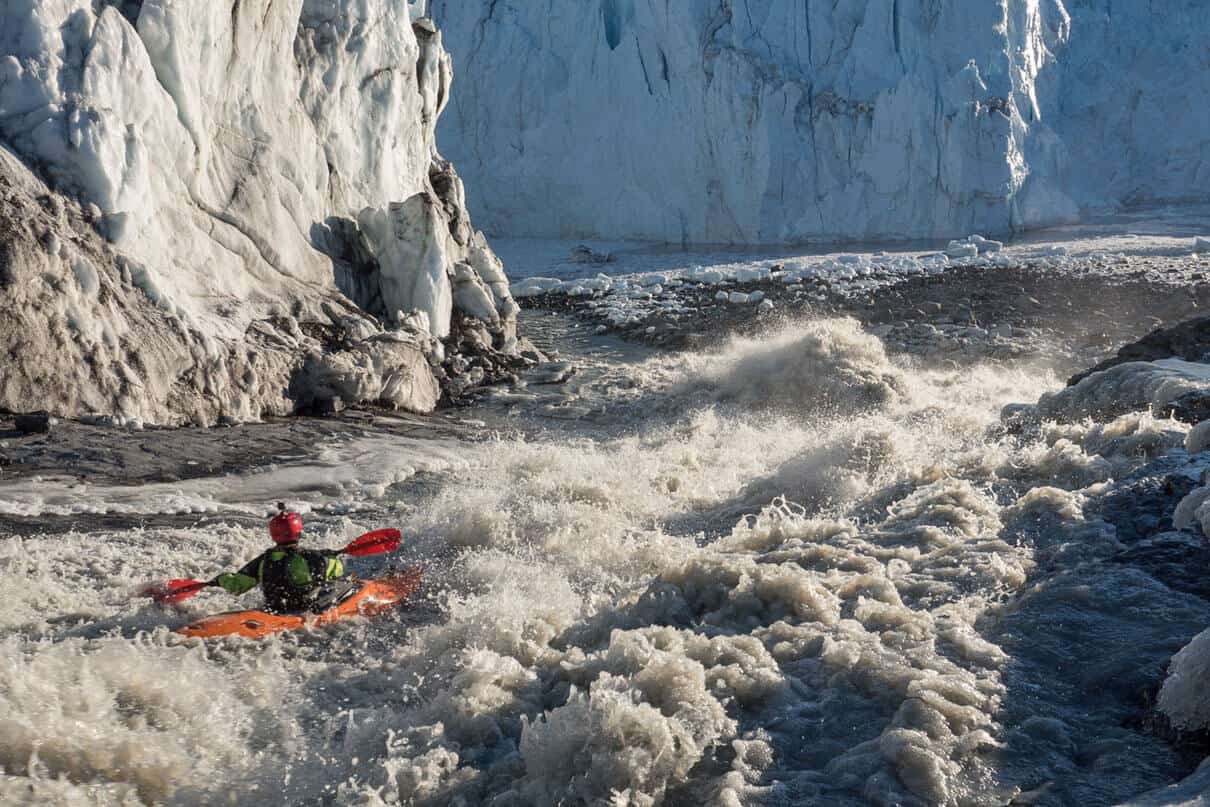
In 2016, kayakers Sarah McNair-Landry, Erik Boomer and Ben Stookesberry used Google Maps to find two barely known Arctic rivers in Greenland. The only problem was getting there, which required 30 days of crossing 600 miles of ice fields, towing their kayaks and 200 pounds of gear each behind them by foot and kite skis. On their first two days hauling gear, they only made it one kilometer—at that pace, the trip would’ve taken more than 10 years
“It was a crazy combination of beauty and punishment,” said Boomer. They eventually arrived at the ice cap, where the snow was smoother, and they could break out their kite skis, hauling their kayaks and sleds behind them. But that brought its own hardships: McNair-Landry—a veteran of five previous kite skiing traverses of Greenland—suffered a kite skiing accident. She continued with a fractured L7 vertebra, hauling gear across crevasses and traversing under dangerous snow bridges.
When they finally arrived at their destination 30 days later, they were chagrined to find their target river dry. So, they spent the next 16 days hoofing their gear up and over a ridge to the next adjacent river and paddling it to the ocean in Baffin Bay.
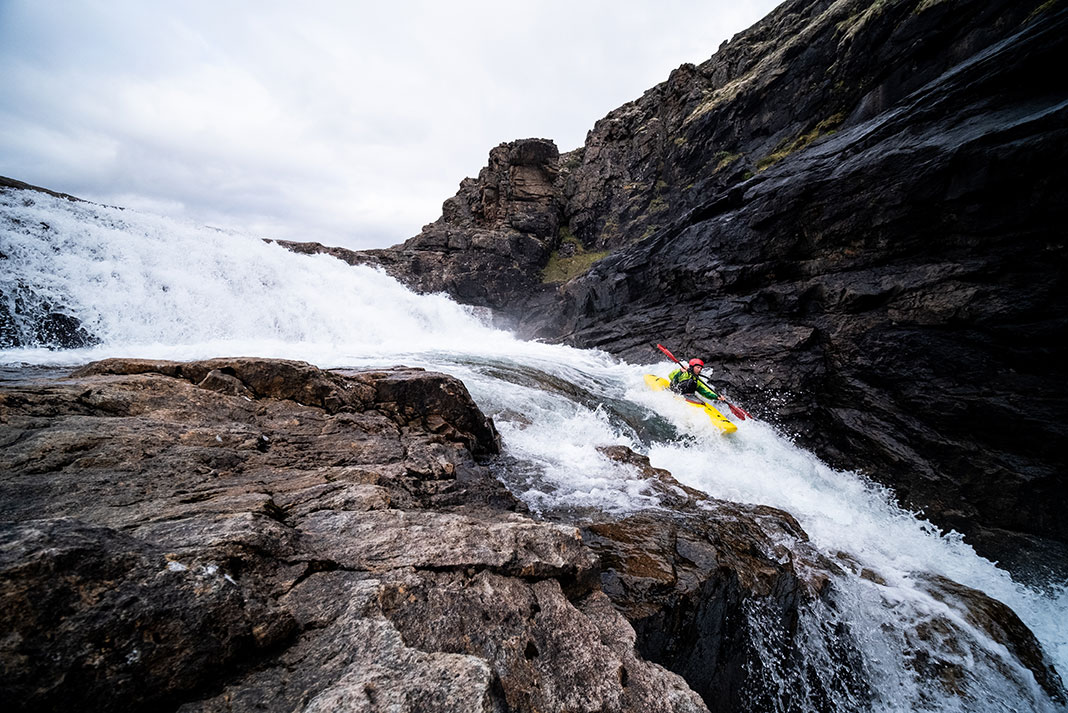
“It was an emotional roller coaster,” said Stookesberry. “We went from a super high to a super low, then back to high again when we could finally get in our kayaks.” On the river, they found an uncharted waterfall, which Boomer sent into an ice-lined gorge.
“The landscape surrounding the river was beyond our imagination,” said McNair-Landry. “The ice canyon was way bigger and deeper, and the mountains and terrain a lot more difficult to travel across than we’d initially predicted. The sheer scale of it all humbled us.”
“What they did was truly amazing,” said fellow expedition kayaker Rush Sturges. “It combined some of the hardest rapids ever run with an insanely remote and unforgiving environment—truly next level.”
Kwanza River, Angola
2018
Africa’s fourth-largest river, the Kwanza, originates in the Bié Plateau, which feeds the Okavango Delta and three of Africa’s four major river systems, including the Congo and the Zambezi. On its 600-mile journey to the Atlantic, the river drops over 5,000 feet through remote gorges before reaching the ocean at Barra do Kwanza.
In 2015, New Zealander Mike Dawson and fellow kayaker Aaron Mann first explored the river, with Dawson returning to run it in 2018 alongside South African Dewet Michau and Brit Jake Holland.
“The whole trip was about trying to find and run the whitewater section on the Kwanza—a river like the Zambezi, but unrun and unexplored from a kayak,” said Dawson, who later released a film about the expedition (see Paddling Mag TV).
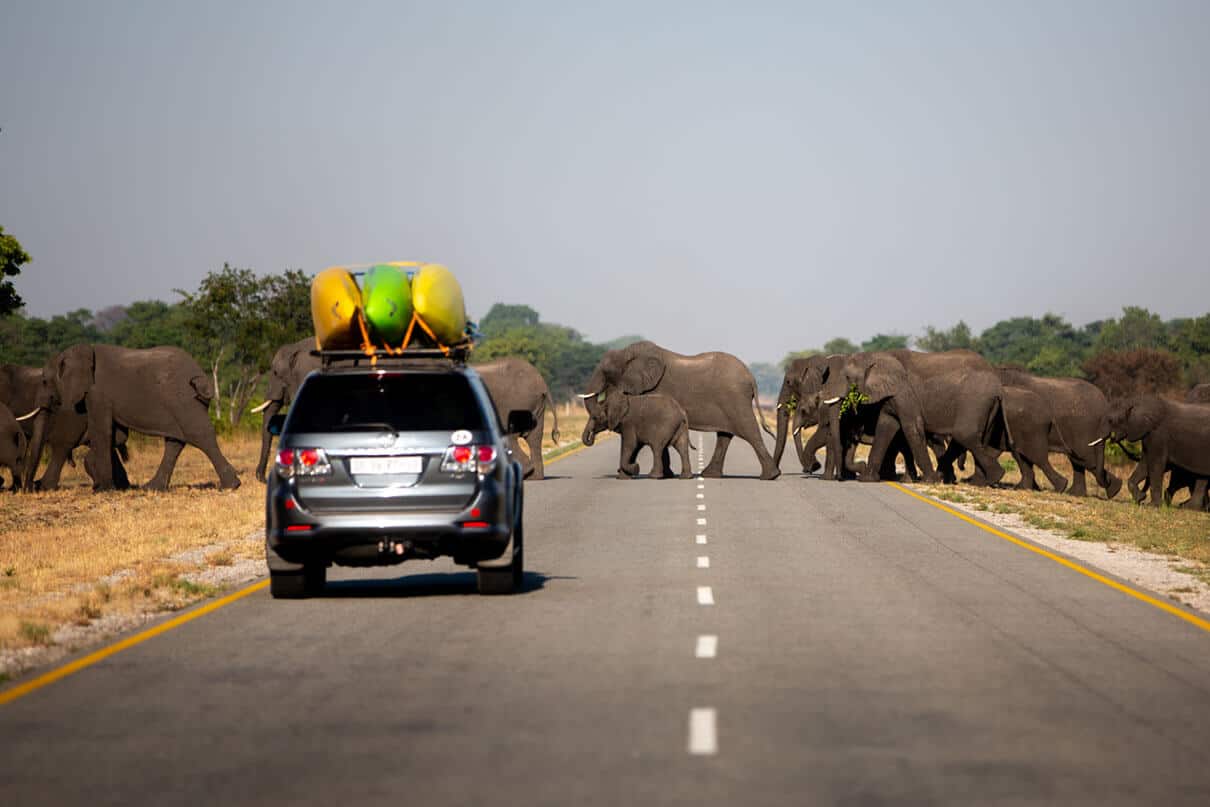
The river already had four hydroelectric projects on it, with a fifth one underway. The trio faced complicated logistical and political hurdles, not the least of which was heading straight into the aftermath of a 27-year civil war with bandits, corrupt officials, illegal mining and diamond smugglers. Crocs, snakes and landmines—leftovers from the civil war—added to the danger.
“We had no idea what to expect as there wasn’t any information at all about Angola—it’s notoriously difficult to enter the country unless you’re mining or drilling for resources,” said Dawson.
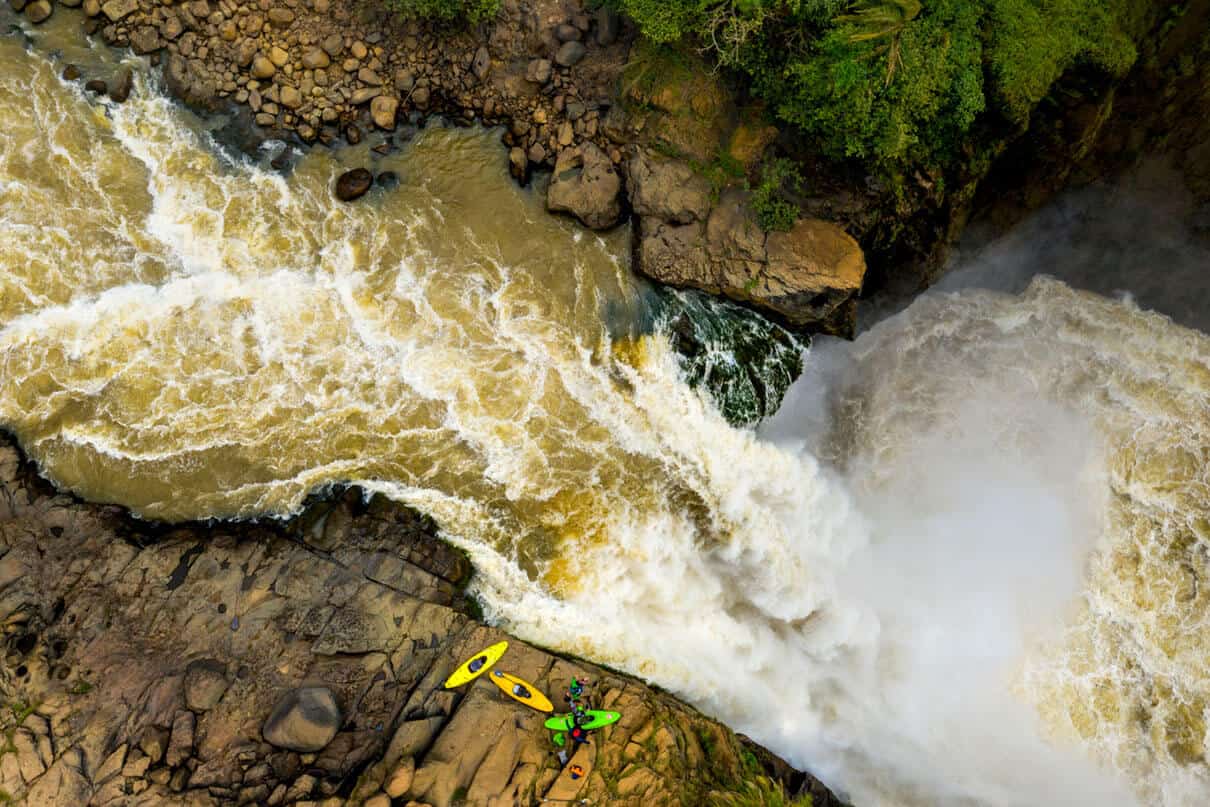
But hidden behind all that was its whitewater. Their plan took them to the Malanje Province north of Luanda, Angola’s capital, to run the Lucala Gorge, the final whitewater section on the Kwanza that is free of dams. In all, they ran two 40-mile sections, filled with big water class V rapids and plenty of mandatory portages.
“They were massive, massive days,” Dawson said. “There was a lot of unrunnable stuff, a lot of runnable, and a lot that would maybe go with a larger crew and more time. There is so much more there waiting.”
Rio Chalupas, Ecuador
2021
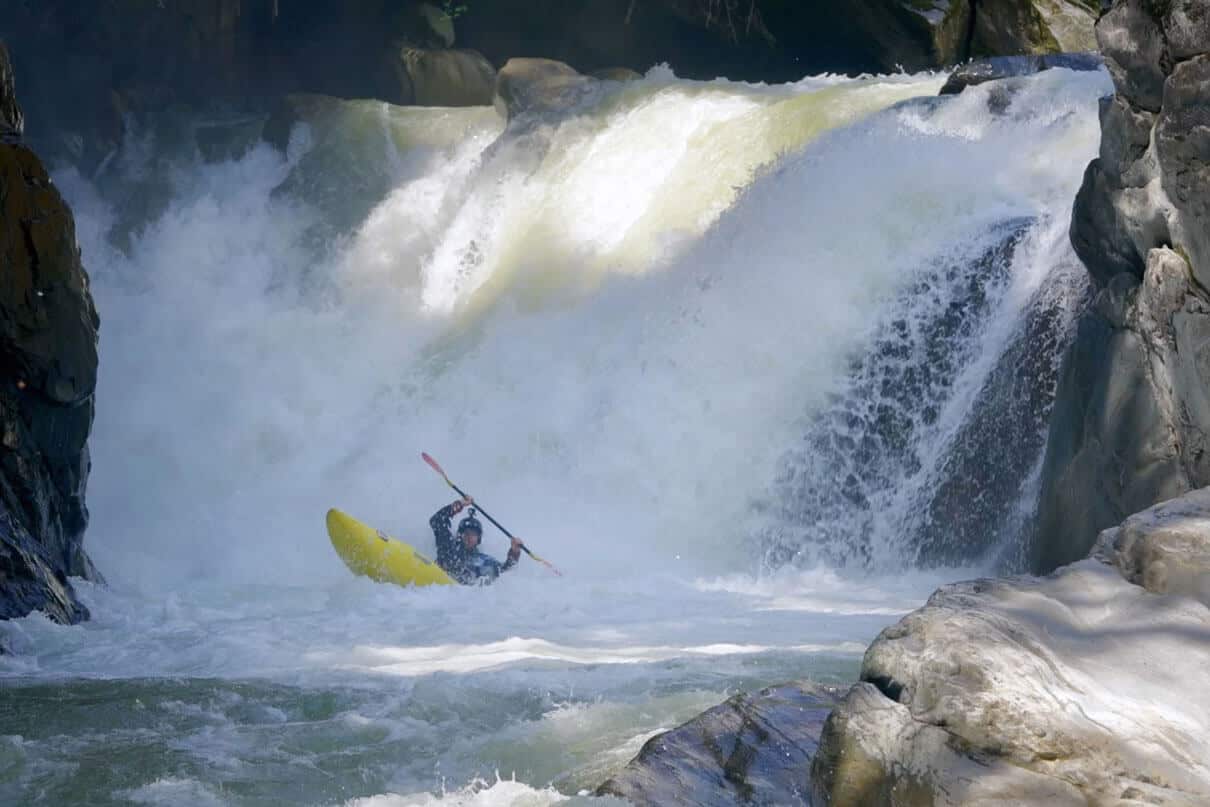
Sometimes, even the best-laid plans can still go awry. Such was the case with a team of kayakers attempting a first descent of the Rio Chalupas in Ecuador, a notoriously steep river located deep in the jungle gorges of the Andes Mountains.
In a project filmed for HBO’s Edge of the Earth documentary series, team members Eric Boomer, Nouria Newman and Ben Stookesberry—along with cinematographers and paddlers Chris Korbulic and Sandy MacEwan and logistical support from Ecuador’s Abe Herrera—tried to complete the upper section of the river in roughly eight days, planning to resupply food at a designated heli-drop location two-thirds of the way down. But things went downhill quickly, due to unpredictable and rapidly rising water, walled-in gorges, unscoutable lines, portages and more. In the end, they failed to complete the mission and had to be evacuated, but not for a lack of trying.
“Every time I saw someone have a line that was a bit scary, I was like, ‘Oh god, we got lucky,’” Newman said afterward. “You know, it’s just a flip, the paddle didn’t break, nothing bad happened. I look at that and I’m scared. I think for Ben and Boomer, they were like, ‘Okay, we made it through the rapid.’ I was maybe seeing more of the consequences than they were.”
But Boomer and Stookesberry weren’t finished. While the others headed home, they tried to finish it, teaming up with Diego Robles. That attempt fell short again, also due to high water. Robles and Stookesberry went for a third attempt, resulting in more mishap: a mid-jungle machete wound to Stookesberry’s leg that narrowly missed his femoral artery.
“I made a light chop through tangled vines and felt a strike on my kneecap,” he said. “I figured it wasn’t that bad, but I figured wrong. The cut was at least a quarter inch deep, and the tendon was protruding through. Luckily, we were able to hike downstream and evac from there.”
Last year, Stookesberry hiked and macheted five days into the Llanganates Mountains above Tena to retrieve the stashed boats. “Technically, Diego and I completed the entire Chalupas when we arrived at the Verdeyacu confluence back in 2021, but we didn’t reach our planned take-out near Tena, so the mission was almost but not completed.”
Stookesberry hopes to return to continue calling attention to the threats the area is facing. “My dream is to paddle the Chalupas again from the top in the páramo at 11,600 feet to at least the illegal miners’ camp at 3,000 feet without helicopter support to establish it as the most challenging self-support kayaking mission on the planet,” he said, adding the river remains threatened from a proposed road in Llanganates National Park. “I am extremely proud of our team. It took us over a month to paddle and portage 20 miles and 7,000 vertical feet. I have no other worthy examples to provide context for this mission.”
Philip’s Ladder, Svalbard Archipelago
2023
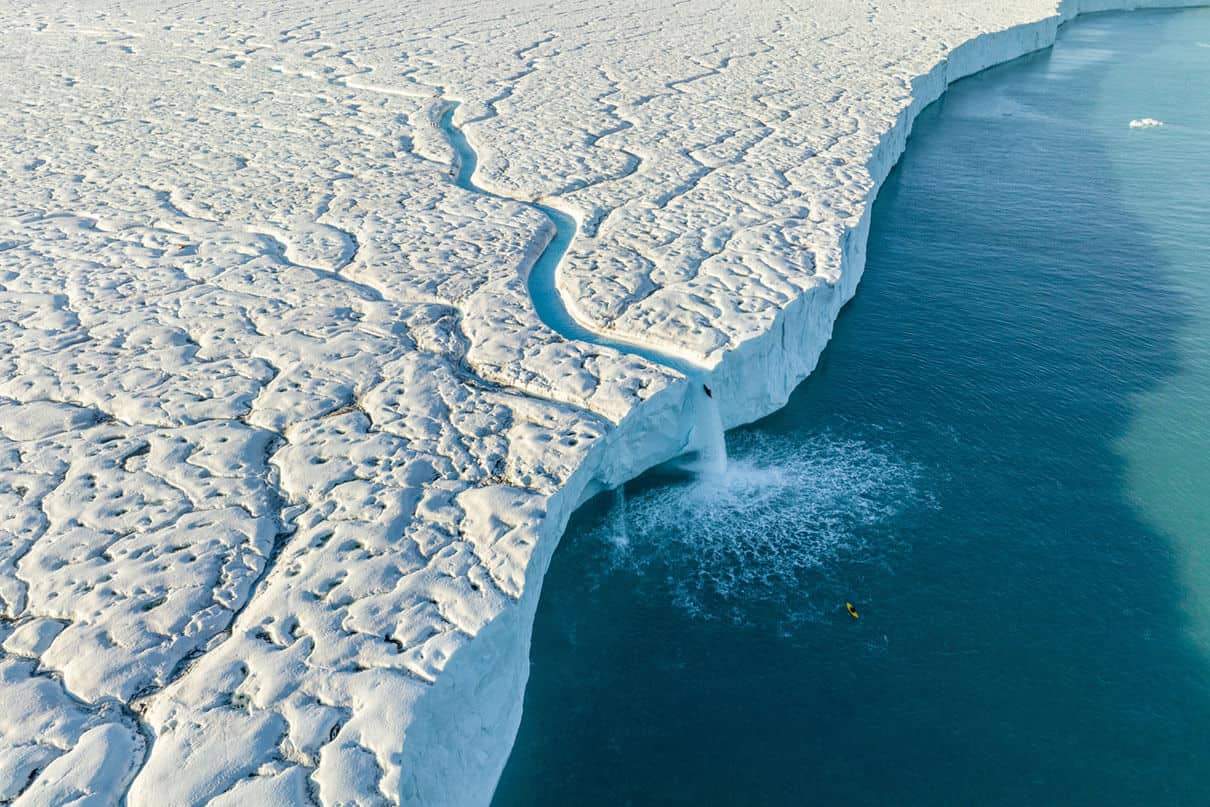
Kayaking on, in and off a glacier? You bet. In 2023, Aniol Serrasolses headed to Norway’s Svalbard archipelago to do just that, marking the highest descent of a glacial waterfall. After a 36-hour sea voyage from Longyearbyen to the Bråsvellbreen glacier, the team, including kayakers David Sodomka, Aleix Salvat and Mikel Sarasola, trekked six miles across the ice to access a river through the glacier that led to a 60-foot waterfall cascading off the ice into the sea. The journey included climbing treacherous ice walls, navigating across streams and crevasses, and handling the unpredictable whitewater rivers sculpted in the Arctic ice. While it might not match any of these other expeditions in scope, it eclipses them all in uniqueness.
“It’s hard to find the words to explain the feeling,” said Serrasolses afterward. “It’s like kayaking on another planet. Without a doubt, it’s the most unique kayaking I’ve ever done in my life.” The descent, named Philip’s Ladder, honors the team member who carried the ladder needed to cross meltwater streams on top of the glacier and symbolizes the team support needed to achieve the feat. Watch the Ice Waterfalls documentary at Paddling Mag TV.
Eugene Buchanan is a longtime outdoor journalist and former editor-in-chief of Paddler magazine. A former ski patrol and river guide, his work has appeared in The New York Times, Men’s Journal, Outside, National Geographic Adventure and more. He lives in Steamboat Springs, Colorado.
 This article was published in Issue 74 of Paddling Magazine.
 The Kwanza River in all its glory. | Feature photo: Mike Dawson



Really great article!
I would suggest that the first source to sea expedition of the Amazon should rank up there..
Running the Amazon by Joe Kane is an extraordinary account of the expedition. terrifying, technical whitewater, encounters with Sendero Luminoso and long, arduous flatwater as they neared the mouth of the river. The expedition leader was controversial, but the team, excellent.
Darcy is an amazing whitewater paddler with decades of experience under her belt, who deserves recognition for paddling the entire Amazon River. I’m not sure why Rocky Contos and James Duesenberry (not mentioned) weren’t given credit for their first descent of the Mantaro River, which they accomplished in 2012. If the sole, or primary, reason Darcy was given billing over Contos/Duesenberry, is because Darcy is a woman, then the standards by which this list contrived is severely flawed and sexist. Being a woman is not an obstacle to overcome when it comes to feet on the ground – or in the whitewater, in this case. I can assure you, Darcy is a far better whitewater paddler than I was and far better prepared and able to paddle the Mantaro a year later than I did. Please, give credit where it is due. Contos and Duesenberry went blind, headlong into this fairly uncharted territory and those of us who followed benefitted greatly from their notes.