

When I bought my first kayak, on the West Coast back in the early aughts, I was encouraged to get one of those inflatable paddle floats you stick on your paddle blade as an outrigger if you flip. These reassuring safety devices were everywhere then, spreading the tacit message not to worry, knowing how to roll wasn’t really expected or necessary. I immediately went out in a raging storm to practice with mine and discovered that it was impossible to get back in my kayak and pump it out in rough water without re-capsizing.
Nonetheless, like hikers wearing bells in grizzly country, kayakers would carry these floaty things like a sort of talisman to ward off the fear of flipping. I continued to hang onto mine just in case, but I also resolved that I must develop, per the bro-speak of the kayaking fraternity, a “bombproof roll.” A badge of honor that determines who is a real sea kayaker.
Myth of the bombproof roll
I sort of figured out the roll, but since I was terrified of what would happen if I swam—and had to rely on that infernal paddle float—I always paddled within my limits. And the more I got away with not flipping, the more the fear of swimming loomed in my imagination, the better I got at my panic brace, and the less confident I was to try rolling in real life.
I eventually mustered the courage to try rolling my fully loaded Current Designs Expedition and immediately bobbed back upright before I could even get my hair wet. My friend sat on the shore laughing hysterically. My hull was so crammed full of canned food, fresh water and books for the expedition we were on that it was as unflippable as the toy canoe with the lead keel in the movie Paddle to the Sea. We paddled all the way from Alaska to Victoria, and I can proudly say my roll never failed—but only because it was never put to the test.
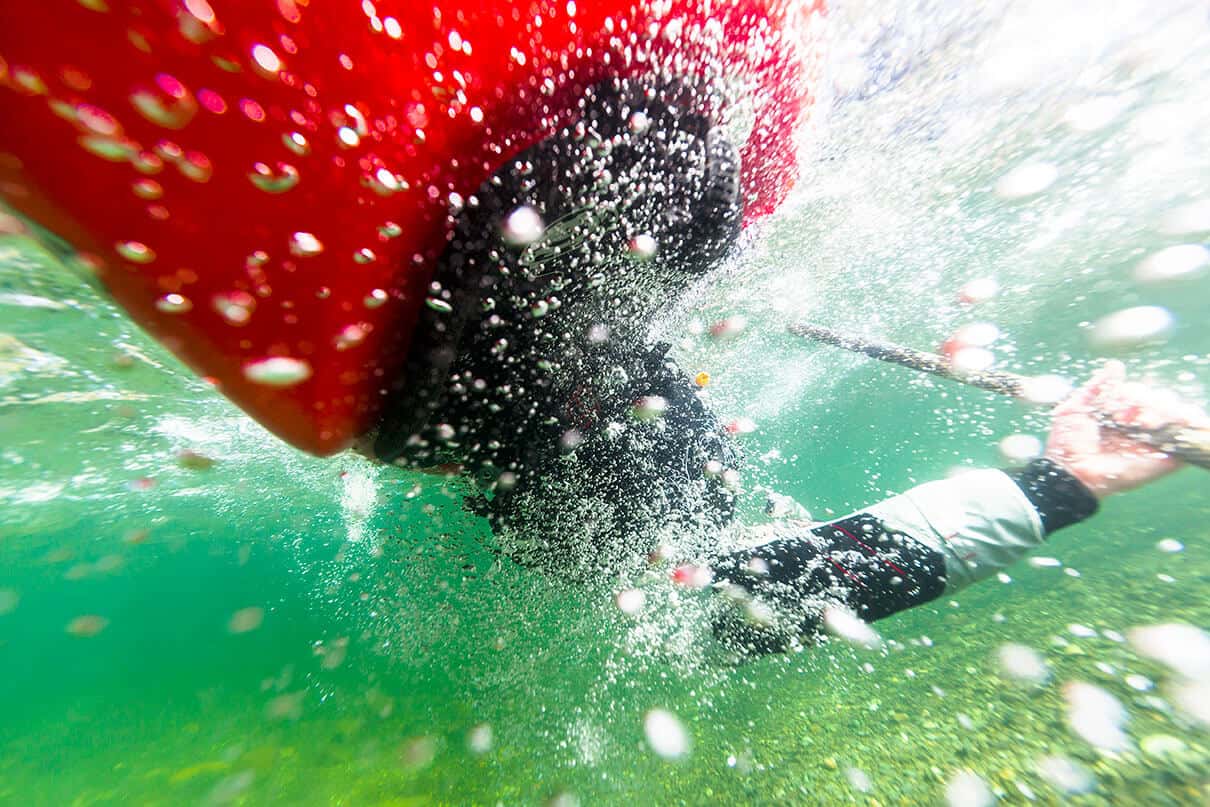
So, I watched with puzzlement as an online debate blew up about the importance of having a bombproof roll. The debate started when Belgian kayaker Dimitri Vandepoele posted a YouTube video of himself and Hugo Germonpre playing in a tidal rapid at Pointe du Raz, Brittany (paddlingmag.com/0200). Vandepoele paddles and rolls deftly but Germonpre capsizes twice and swims. Vandepoele cooly rescues him—at one point flipping mid-rescue and rolling back up—and the pair carry on.
“What are you guys doing in this situation without a combat roll?” was one of the first comments. A long debate ensued, with a raft of people piling on to assert that “there is no such thing as a bombproof roll.”
I actually did have a bombproof roll once. It was on a Saturday. Playing at the Gales of November gathering on Lake Superior, I was not hit by any aerial bombardment, but I did capsize in heavy surf and break a paddle. I rolled up on my offside with the other blade and surfed back into shore. That was the mic-drop moment of my rolling career. But it was a long time coming. And I never did master the hand roll, or any of those specialized Greenland rolls, like that one where you pass a lit cigarette around the boat as you do it. As a non-smoker, I never saw the point.
I don’t think anyone else seriously believes in the bombproof roll either—except one commenter on Facebook who suggested that the people who don’t have one are just too lazy to practice. But that didn’t stop a flotilla of commenters. The typical post began with a humblebrag about the gnarliness of the writer’s own years of rough water experience, as if to say that if anyone had a bombproof roll, it would be them, so they can attest there is no such thing.
“I settle for a roll that works 95 to 99 percent of the time,” said one.
“My own roll hasn’t failed since 1976,” said another, “but I definitely don’t believe that I’m immune.”
A refreshing comment was from a humble Andrew, who wrote, “My roll isn’t great, so I don’t go out in my sea kayak when it’s ridiculously rough like that. I don’t focus on practicing my roll anyway, as my back is messed up.”
A long debate ensued, with a raft of people piling on to assert that “there is no such thing as a bombproof roll.”
This is how most normal humans approach kayaking—as a fun activity and not an analog for war. Why are we using the words “bombproof” and “combat” anyway? In the future, I propose we leave the bombproof and dynamite rolls to the sushi menu and switch to a more reasonable term suggested by another commenter—“reliable roll.”
The thing is, the original question of what Vandepoele and Germonpre were doing in Brittany without a, ahem, “reliable” roll (and Vandepoele clearly does have one), is clear: they were having fun practicing skills. Rather than being shocked at the pair’s boldness, I was impressed by their competence and humility.
My years of problem-free paddling, the fear that my roll won’t be good enough, and a lack of confidence about what to do if I swim, have grown to keep me from testing my limits. The video reminded me we can transcend such fears, not by being rolling combat heroes but by having a broad repertoire of rescue skills that makes it perfectly okay to swim, just as Germonpre does twice.
With the right safety systems and paddling partners, the scenario in the video is not one to avoid. Paradoxically, it might be exactly where a reliable roll, to whatever extent it’s possible, is most likely to be learned and practiced. But first you have to be comfortable swimming and getting back into your kayak.
“We find self-rescue more important than rolling,” explains Vandepoele. “There’s absolutely no excuse” not to practice it every time you paddle.
That’s exactly what I’m going to do next time I go out—but this time without the paddle float.
Tim Shuff is a former editor of Adventure Kayak magazine.
 This article was published in Issue 75 of Paddling Magazine.
 Failure can be instructive. | Feature photo: Boomer Jerritt











The necessity of a proficient roll is a topic that always generates strong opinions. While I still believe having a reliable roll is essential—especially for whitewater paddlers and sea kayakers who surf—I’ve realized that the skills learned along the way to a proficient roll are perhaps even more valuable.
Specifically, learning to brace effectively helps avoid capsizing altogether. Additionally, learning to properly outfit your boat to ensure you are well-connected to the craft is key to staying comfortably upright in challenging conditions.
I took my first WW Class with AMC in 2009, I was the oldest student at 46, everyone else was 23 and younger. Fortunately for me, I had a proficient roll before I took the class. During the weekend the river flipped me six times, fortunately I swam zero. I was amazed at how the younger people were unphased by being dumped in 52 degree water and swimming a full boat to the shore, with only farmer johns. I felt lucky my immersion time was only 3-5 seconds, when the river showed me how novice I was.
The more tools you have in your paddlers’ tool box the more options and confidence you take with you on the water.
It is supposed to be fun, but having more tools can provide some safety benefits too, keep paddling, and always keep adding to your paddling skills. We are ALL between swims.
I still carry a paddle float. Reentry and with it in rough water is my most reliable self rescue. It gives me an outrigger for the pumping phase.
This is such a ridiculous article.. Bombproof roll means reliable; nobody thinks it means 100%.. and it’s absolutely the first , best defense against swimming. Yes, you ALSO need good seld rescue skills, but to say you don’t need a bombproof roll is so absurd.
Every kayaker regardless of what they think of their abilities is just between swims!