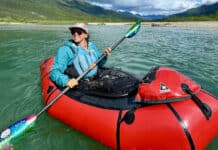
I was an innocent backpacker until the day friends showed me strange little boats that let them extend their hikes across rivers and lakes. At first, their packrafts looked to me like glorified pool toys. Then, I drove to a garage in East Anchorage where a former clothing designer was hand-welding packrafts of her own. I asked if she had any cosmetic seconds to sell at a discounted price. Just like that, I saw the world differently, and all of the blue ink on my maps became new trails.
Packrafts are not new technology; in fact, the first inflatable raft was invented within years of Goodyear’s 1839 discovery of the vulcanization process for rubber. Since then, packrafts have evolved to fill needs ranging from lazy fishing to harrowing class V rapids.
Is it a raft or is it a kayak?
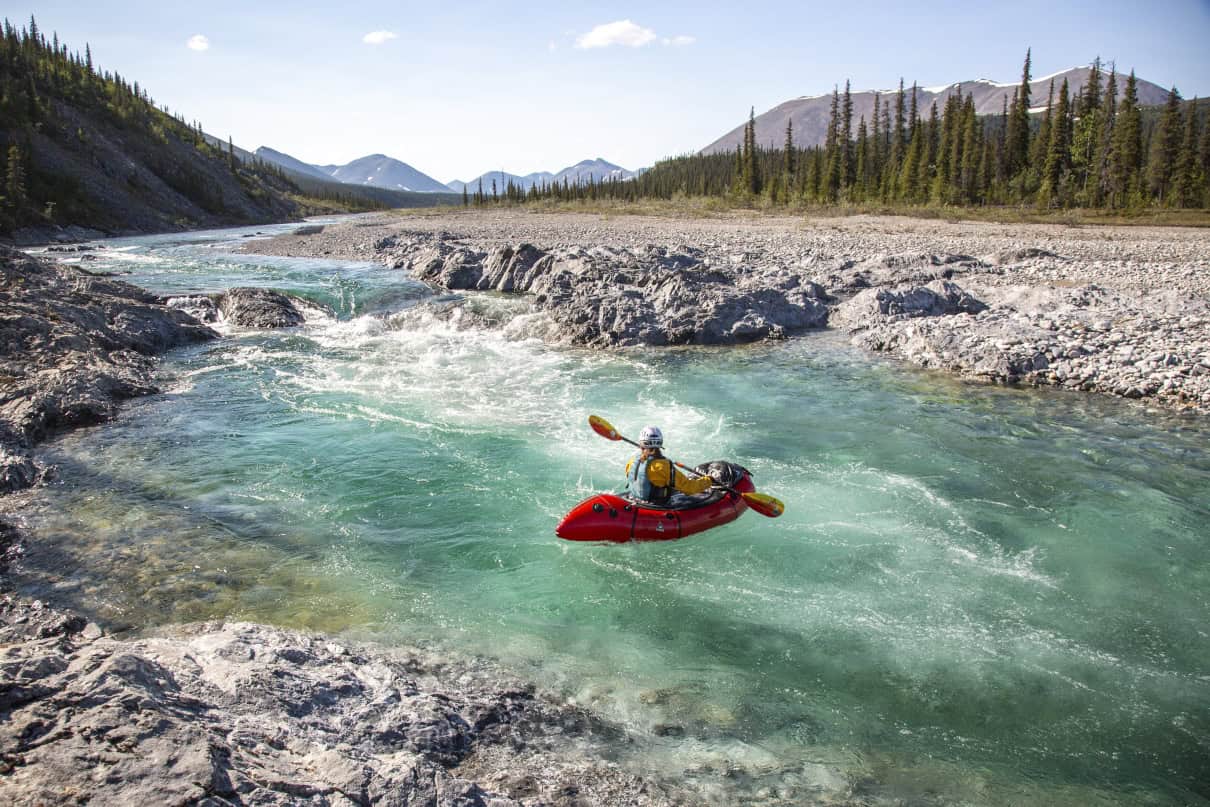
Packrafts are hard to categorize; they look like miniature whitewater rafts, but they handle like kayaks. They are a lighter version of an inflatable kayak or duckie, but this is an arbitrary weight cut-off. The point is that packrafts are the most portable boats in the world, weighing in the range of 2-15 pounds, and small enough to fit in a backpack.
Packrafts have been exploding in popularity since the early 2000s. Early proponents of the sport carried them to hard-to-access waters in Tasmania and Alaska. But as designs improved, packrafts have found eager owners in anyone who has limited storage space—you can store one in your closet, trunk, or the overhead bin on a flight. When I paddled the Grand Canyon section of the Colorado, we brought the requisite spare PFDs and paddles, but we also brought an extra packraft, inside the hull of another packraft.
Choosing a packraft
As packrafting has gained popularity, so have the options for purchase. There are a few overarching design considerations to understand as well before getting into different types of packrafts: total weight, open vs. closed cockpit, and cargo storage.
Total weight
A packraft’s weight is largely a function of design and materials. A heavier boat might be more capable in whitewater, more durable because it is PVC instead of coated nylon, or both. I carry my packraft as often as I paddle, and my personal sweet spot for durability and capability is in the 8-10 pound range. If you won’t be carrying your boat as far, you can justify a heavier, bulkier, and more affordable option. There is something of an optimization triangle here: weight, durability, and cost. You get to choose two, but will be penalized on the third.
Open vs. closed cockpit
The simplest packrafts (also the lightest and most affordable) have a “bathtub” design, an oval innertube hull welded to a floor. These basic packrafts are ideal for flatwater, calm weather, and carrying cargo. They can also be wet and cold. Adding a deck helps shed water, and a deck-coaming-sprayskirt sheds water and traps heat. When I’m paddling in warmer climates, I prefer the self-bailing models for their simplicity and the ease of getting in and out of the boat.
Cargo storage
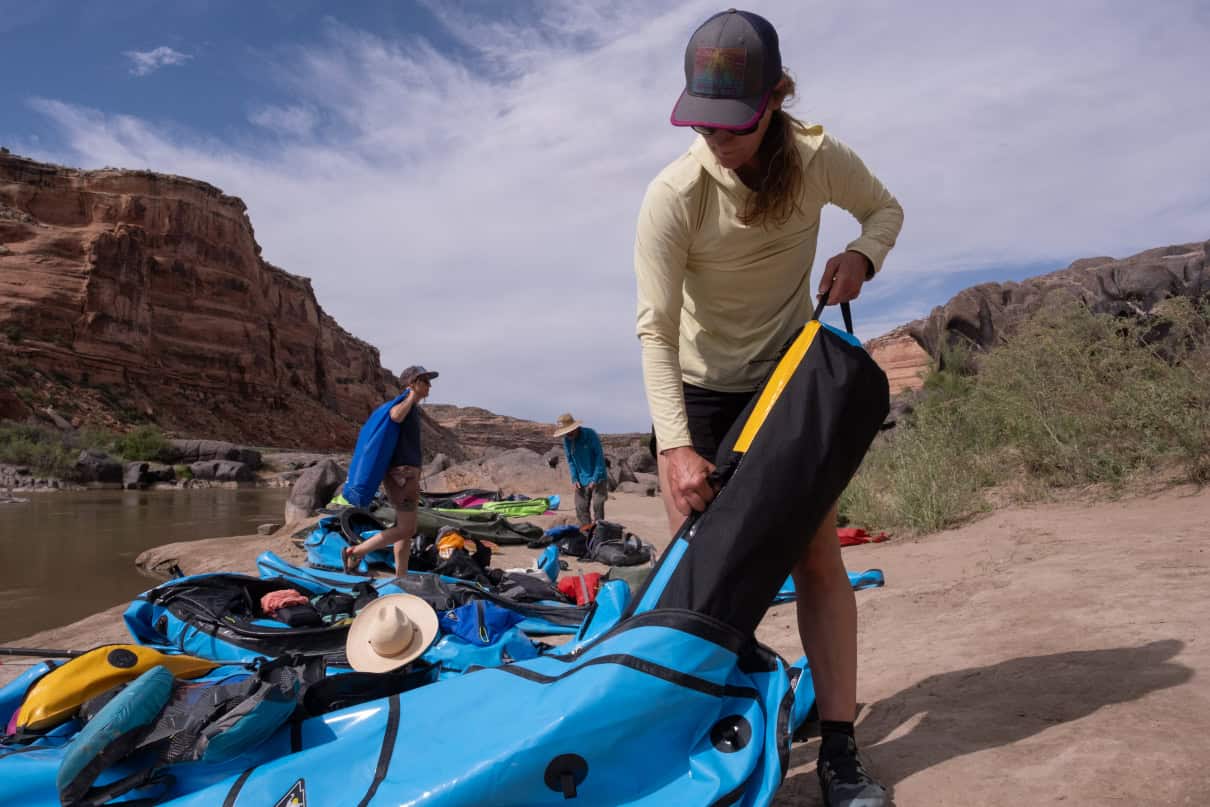
Because packrafts are so light, cargo significantly changes how the boat handles. In the early days, we strapped backpacks onto the bows, which created a high center of gravity and made class II rapids terrifying. If carrying cargo is part of your vision (overnight trips, hunting, etc.), the most elegant solution is a waterproof zipper that allows storage inside the hull before inflating the boat. In addition to keeping the gear dry, cargo in the hull lowers the center of gravity, which improves its performance in turbulent water.
Types of packrafts
Ultralight
The lightest packrafts weigh as little as 2 lbs and are ideal for lounging on a pond. It would be inappropriate to bring ultralight packrafts on moving water or longer open-water crossings.
Utility: hunting, fishing, bikes, and other cargo
Large volume packrafts built with more durable fabrics are good options for hunting, fishing, or carrying other cargo such as bikes or skis. Utility packrafts are typically heavier and less maneuverable, but they allow paddlers to travel deeper into the mountains for harvesting or multisport adventures.
Whitewater
Whitewater packrafts include outfitting that enables quick maneuvering in turbulent water. Whitewater boats are typically the most complicated to manufacture, and feature high-performance materials, all of which makes them more expensive. Modern whitewater packrafts are evolving, adding rockered bows that ride up and over holes, and crafting inflatable chines that replicate the secondary stability whitewater kayakers are used to.
Specialty
Other specialty packrafts are designed for marine paddling (long and skinny hulls, keels), adventure races (sleek, tandem), and multiple passengers.
Setting up your packraft
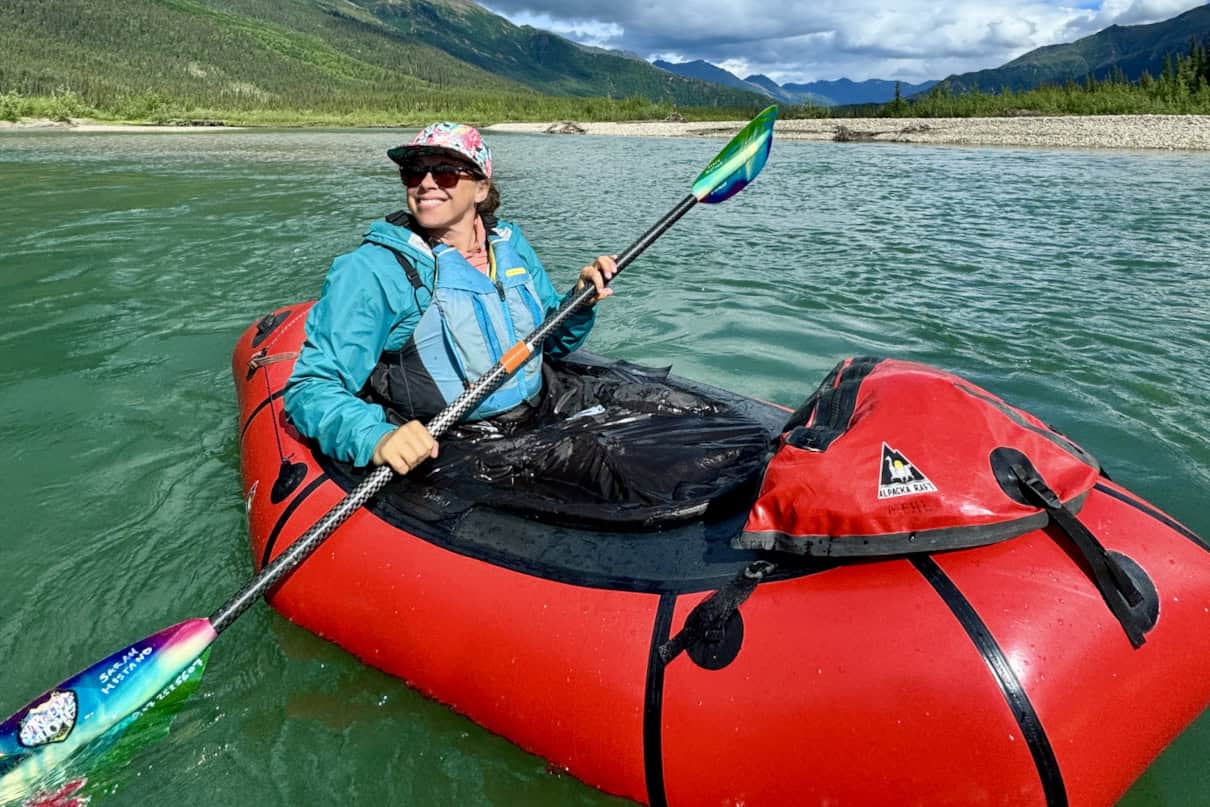
If your packraft arrives by mail, you will be surprised by the small package. But don’t take it to the water yet; you will want to adjust the outfitting for the right fit, and the rigging for safety.
Inflation
Packrafts are typically inflated with an air bag or an electronic pump. Higher air pressure produces better rigidity and performance. If you see wrinkles in the hull, add air. I always need to add air after getting the boat wet, because cold water reduces the air pressure (flashback to the ideal gas law, PV = nRT, from high school chemistry). Likewise, I let some air out when the boat will be out of the water for an extended break or portage.
Outfitting
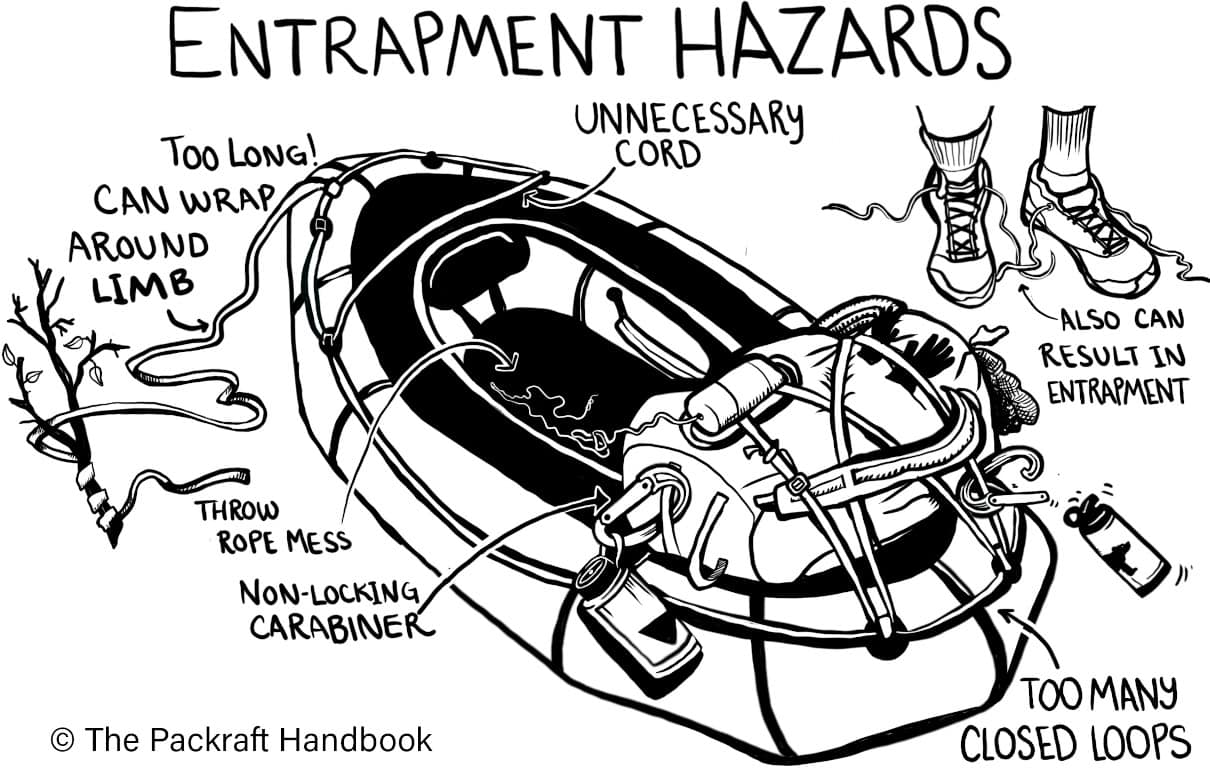
All but the most basic packraft models feature outfitting to adjust your comfort and fit. Outfitting creates a more secure paddling experience, but also introduces snagging and entrapment hazards. Follow the outfitting instructions that come with your boat or online recommendations, but assess the entanglement hazard of each component. Adjust your outfitting to reduce or eliminate closed loops and crossed lines. The same guidelines apply to our worn equipment and rescue systems.
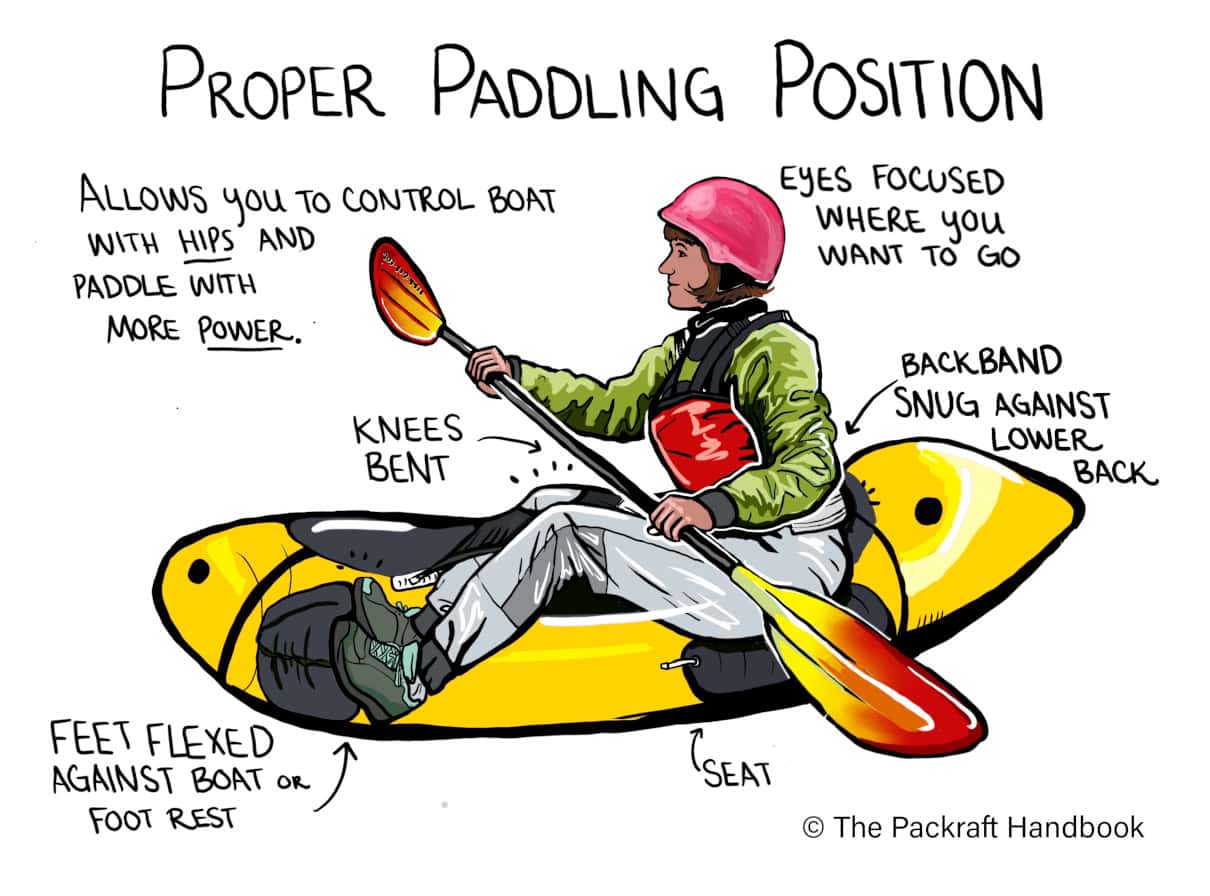
Good outfitting allows you to do more work with your larger muscle groups (legs and core) instead of your arms. The outfitting should support you in an upright posture with a slight forward lean.
Start by inflating the seat to a height that brings your butt above your feet and your elbows above the hull. Place the soles of your feet against the hull or foot brace with knees bent at a 45- to 60-degree angle, then pull the backband forward to your back. Thighstraps (optional) hold your knees against the hull so that when you lean, the boat does too.
Rigging
A perfectly clean boat poses the least entanglement hazard, but will be hard to recover if you capsize. Rigging is a tricky balance that should be re-evaluated with each new paddling objective. At a minimum, you should have a handle or cord at the bow and stern. These grab points allow you or a partner to secure the boat if you flip. It is generally preferable to leave the packraft’s side tubes clean, free of rigging, because rigging can snag your PFD while trying to climb back into the boat. Some packrafts can be rolled, but a wet re-entry is more common.
A short tail, similar to canoe painter lines, can be helpful for anchoring the boat and holding it during a swim. But the tail should be kept so short that it doesn’t potentially wrap a paddle or limb. A friend of mine got wrapped up in a longer tail, and I haven’t used one since.
Do not tether yourself to your packraft or paddle in rivers because the turbulent water can tangle you in the cord. However, I would consider a leash for an open-water crossing because the risk of separation while far from shore outweighs the risk of entanglement in the leash.
Basic paddling strokes for a packraft
Even if your intended outings are mellow, practicing whitewater strokes in your packraft are in your best interest. The skills to navigate rapids are the same as the skills to avoid surprises on mellow days, such as wind-generated waves or a tree around a blind corner. And learning how to connect with the water with paddle strokes and edge control is part of the fun.
Single packrafts are propelled with a double-bladed kayak paddle. As with whitewater kayaking, paddling efficiency and effectiveness are only possible if your outfitting places you in the proper paddle position with an upright posture and slight forward lean. Hold your paddle with a slightly less than 90-degree bend in your elbows, similar to the spacing for pushups or pullups.
Each of the following strokes has a specific application, whether it be propulsion, turning, bracing, or a combination of.
Forward stroke
This is the fundamental stroke for propulsion, and you will probably do it functionally well without any coaching. To hone your technique, keep the blade close to the boat, as vertical as is comfortable, and catch the water at your ankles, drawing the blade to your hips, and releasing it at your hips. Don’t over-bend your elbows. Instead, twist your torso to maintain a “paddler’s box” with your arms, like carrying a large exercise ball.
Sweep stroke
Sweeps are turning strokes. Reach forward to catch the water at your feet, then unwind your torso to trace a broad arc at a shallow depth—this is not a deep stroke. The farther you can reach and unwind, the better your rotation. You can turn the opposite direction by starting the stroke behind your hips and sweeping forward to your feet.
Draw stroke
Draws provide lateral movement. If I notice an obstacle and have plenty of time to avoid it, I can use side draws to move into water that avoids the obstacle. Rotate your torso to the side of the boat. Place the blade in the water, facing your hip. Draw the blade to your hip and then slice it out of the water. You can try keeping the blade in the water, slicing it back to the starting position (“in-water recovery”), and work up to slicing from side to side in a figure-8 (“sculling draw”).
Stern and bow draws
These advanced strokes are the key to class III and harder water. They provide fast turns and a quick transition from turning to propulsion. Start with the stern draw: Roll your wrists open and lower your elbows so that the paddle shaft is at sternum height and the blades face forward. Rotate your torso and place the blade in the water behind your hips. Leave the blade in place like an anchor and unwind your torso, pulling your feet toward the blade. A bow draw is similar; just place the stroke in front of your hips. The bow draw provides less rotation, but is effective when catching eddies and peeling out into the current.
Braces
Brace strokes provide stability when you are about to capsize. Any of the strokes above can be a brace, and there are two additional options: slapping the water with the blade’s face or back. Be sure to keep your elbows low; an extended arm is at risk of shoulder dislocation.
Rescue and equipment recovery
If you enjoy becoming a better paddler, or want to practice avoiding hazards, you are going to take some swims. Identify low-consequence learning environments where you can afford to make mistakes.
Self- and assisted-rescue
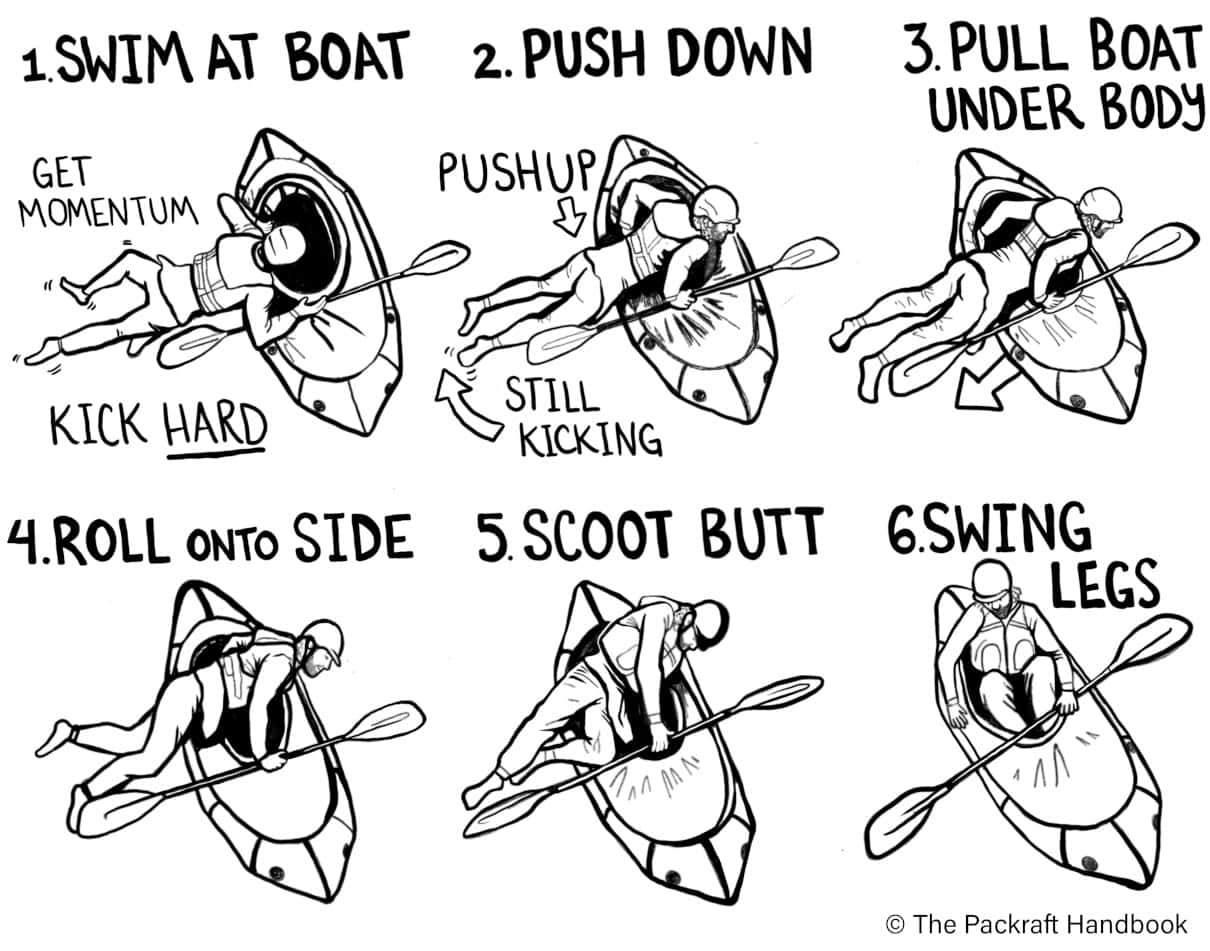
If you capsize, Plan A is to hold your packraft in one hand and your paddle in the other. Then follow these steps:
- Flip the boat upright, if needed, and brace the paddle across the hull.
- Raise your feet behind you so that your body is flat in the water—think flying like Superman.
- Kick your feet to propel forward while you grab the boat and pull it under your chest and PFD.
- Keep your butt low while returning to a seated position.
Never prioritize your equipment at the expense of swimming into rocks, wood, or other hazards. This is where Plan B comes in: if there are hazards downstream, or you are unable to re-enter your packraft, ditch your gear and swim to shore.
Not everyone can re-enter every packraft; wider boats, chests, and tube diameters all work against you. What really matters is your ability to help others, and be helped, back into your boats. Maneuver into a position across from a partner’s boat where you can stabilize it and hold their paddle. If needed, reach across their boat, grab your partner by their PFD’s lapel, and pull them in. If a partner capsizes in the middle of rapids, prioritize your own safety before assisting them or chasing loose equipment.
If a partner can’t get back in their boat, you might be able to coach them to swim to safety, provide a resting platform, or tow them to shore. A passenger can be towed on the bow by wrapping their arms and legs around the boat, or by holding onto the handle at the stern and kicking to help propel the boat.
Managing loose equipment
Whenever possible, I like paddling with a group of four because there is someone available to help with everything: me, my boat, and my paddle. And, if someone needs to hike out, we can split into two groups of two.
Loose paddle
If you have large hands, you might be able to nest a second paddle with yours and paddle both. Otherwise, throw the second paddle to shore. Even if the paddle doesn’t make it all the way to the shore, throwing it into slower current can buy you time to focus on higher priorities.
Loose boat
Flip an upside-down boat upright and bump it with your bow to drive it to shore. A partner can help, creating a wedge. Towing a loose boat with a tether is rarely my first choice. If I do, I hold the tether in my teeth or hand so that I can quickly release it. I don’t trust a releasable harness (cow-tail tether on a Type-V Rescue PFD) to release a packraft because it is so light, and I’m worried that if the packraft wraps around an obstacle it will change the pull direction into a locking orientation.
Above all, don’t risk your own safety to recover equipment.
Where to go packrafting
Congratulations. You now have an adorable boat eager to join you on your next vacation, fieldwork, or weekend adventure. Packrafts are amazingly capable boats, but there are a few things to consider when choosing where to take yours.
Even the most durable packraft can tear. Punctures are typically small and easy to repair, but slices can ruin your day, so avoid rivers with sharp rocks.
The biggest danger with packrafts is that they promote a false sense of ability. This was certainly the case for me. I “made it down” several class III rapids and thought that meant I was ready for class IV. In hindsight, I should have progressed more gradually into higher-consequence waters. It took the loss of a friend to learn that lesson.
Start small. Practice self-rescue, assisted-rescue, and recovering equipment in ponds or slow-moving rivers before going to lakes and faster water. Practice harder moves in easier water.
Use the river rating scale to guide your progression from class I, II, and III. Consider gauging your ability to help others in a certain class, rather than your ability to “get through” the hard parts.
What goes wrong
A review of what has gone wrong, close calls, and the known packrafting fatalities can help the rest of us stay out of trouble. The online packrafting incident record, tells us the following:
Don’t go alone: The number one factor in packrafting incidents is traveling alone. Being alone makes you more vulnerable if anything goes wrong.
Avoid high water: The second most significant factor in the incident record is choosing to go out in, or getting surprised by, high water. Refer to guidebooks or community forums to identify appropriate water levels, and honor your cut-off values, even if that means walking out. Fortunately, packrafts are likely the best boats to walk out with!
Choose the right conditions for open-water crossings: This one surprised me. A number of paddlers have been caught during open-water (flat) crossings. Wind-generated waves flipped the paddlers; they got separated from their boats and were unable to swim to shore.
Use the right equipment—all of it: Wear a PFD and paddle a boat designed for the water you are on. Wear a wetsuit or drysuit in cold water, a helmet in whitewater, etc.
Additional resources
In-person packraft-specific training and coaching is more available than ever. Mentors and peers can provide wonderful learning environments, especially if they are patient, prepared, and have your best interests in mind. Other river runners are also a huge asset on our learning journeys.
There are several packrafting books available. My favorite is the one that I wrote, The Packraft Handbook. Sarah Glaser’s illustrations bring the book to life and make the content accessible to visual learners.
Other resources include the American Packrafting Association, the excellent WaterWise video series coming out of New Zealand, and the world’s many paddling clubs, forums, and river communities. The packrafting community has intentionally learned from the successes of other paddling communities, and celebrates inclusion, mentorship, and the sharing of lessons learned. Welcome to the party.
Feature Image: Luc Mehl