

My first “walkie-talkie” was a G.I. Joe toy back in the ’80s. Sure enough, that two-way plastic radio let little boys like me conspire with the neighbor kids while we played war, cops and robbers, and capture the flag. But it sure wouldn’t let me communicate on the water while scouting a rapid, scouring the shoreline for a campsite, portaging a canoe, or trying to put my kayak fishing buddies onto a school.
Over the past two months, I’ve tested several of these specific types of two-way radios that can tackle typical paddling situations—and more. These walkies are mostly waterproof with miles of range, weather alerts, and other extras for kayakers, canoeists, and kayak anglers.
Here are the best walkie-talkies that we tested and reviewed.
Best Walkie-Talkies: Our Top Picks
- Best overall: Rocky Talkie Expedition Radio
- Most compact: Backcountry Access BC Link Mini
- Best with voice-activated transmission: Midland GXT67 PRO
- Best budget walkie-talkie: Cobra Trailblazer 450
- More than a walkie-talkie: Milo Action Communicator
Best Overall Walkie-Talkie
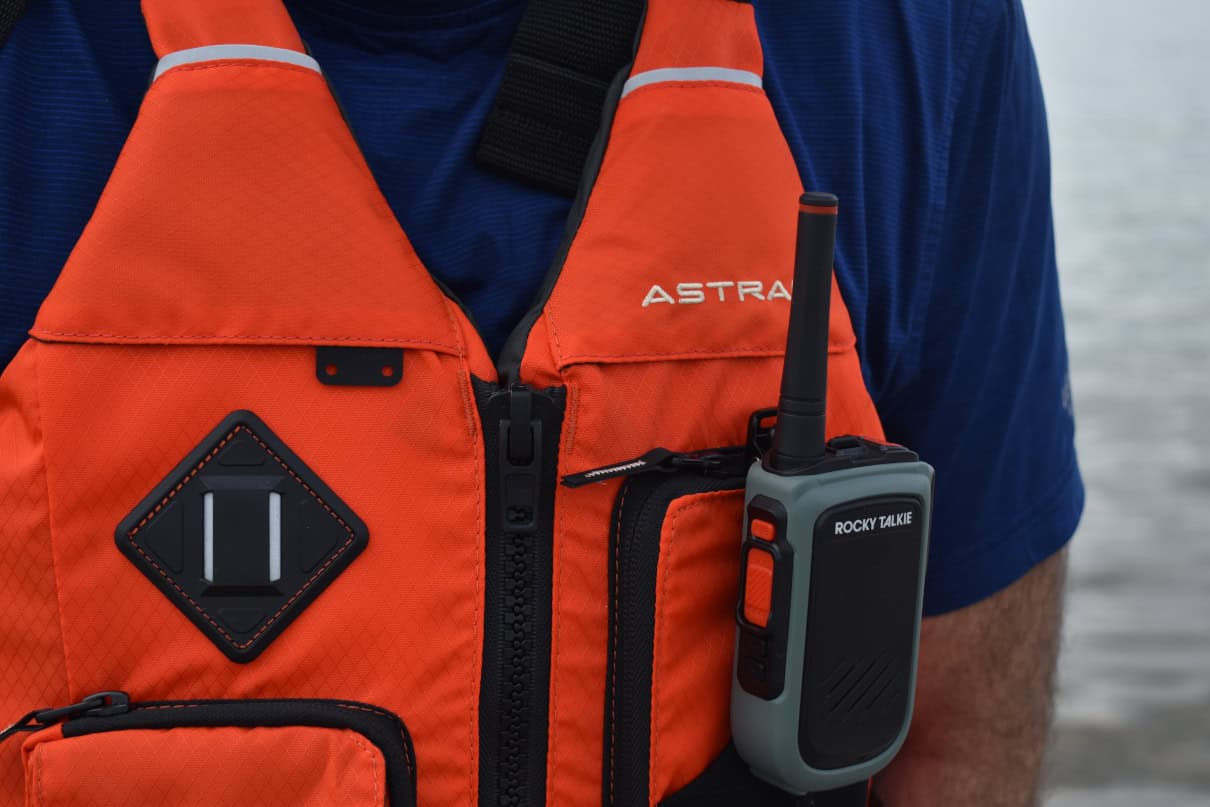
Rocky Talkie Expedition Radio
$180 USD
Buy from:
Why I love it
Submersible. Durable. 4-6 days of battery life. The Rocky Talkie Expedition Radio has plenty of benefits for both expedition and whitewater paddlers. I’d pick this walkie-talkie for my paddle trips in the desert Southwest.
This waterproof walkie-talkie with a shatterproof LED screen is specifically designed for outdoor adventure sports. With 5 watts of power, the Expedition’s range stands out with .5 to 3-mile range in rivers and canyons, 2 to 8 miles in mountains, and a max range of 35 miles with perfect line of sight. Plus, 8 GMRS repeater channels, the included 17mm antenna, and an optional whip antenna can boost transmissions further. If you’re worried about squalls, wind, or lightning, the Expedition radio can also pull forecasts and storm alerts from NOAA weather channels.
The Rocky Talkie Expedition is a bit heavy, doesn’t float, and requires an FCC license (which is inexpensive and easy to get). Plus, it doesn’t have voice-activated transmission, so you’ll need to take your paws off your paddle to use it. But Rocky Talkie clearly designed the Expedition Radio for wilderness users—and hand-tested it to IP67 waterproof standards (submersible to 3 feet for 30 minutes).
Reasons to buy
- IP67 waterproof (submersible)
- Outstanding battery life
- NOAA weather channels/alerts
- 5-Watt GMRS maximizes range
- Repeater capable
Consider another if
- An FCC license is too much of a hassle
- You prefer an ultralight or hands-free option
Bottom line
The Rocky Talkie Expedition Radio has the best balance of features for paddling more remote waters.
Most Compact Walkie-Talkie
Backcountry Access BC Link Mini
$119.95 USD
Buy from:
BACKCOUNTRY REI BACKCOUNTRY ACCESS
Why I love it
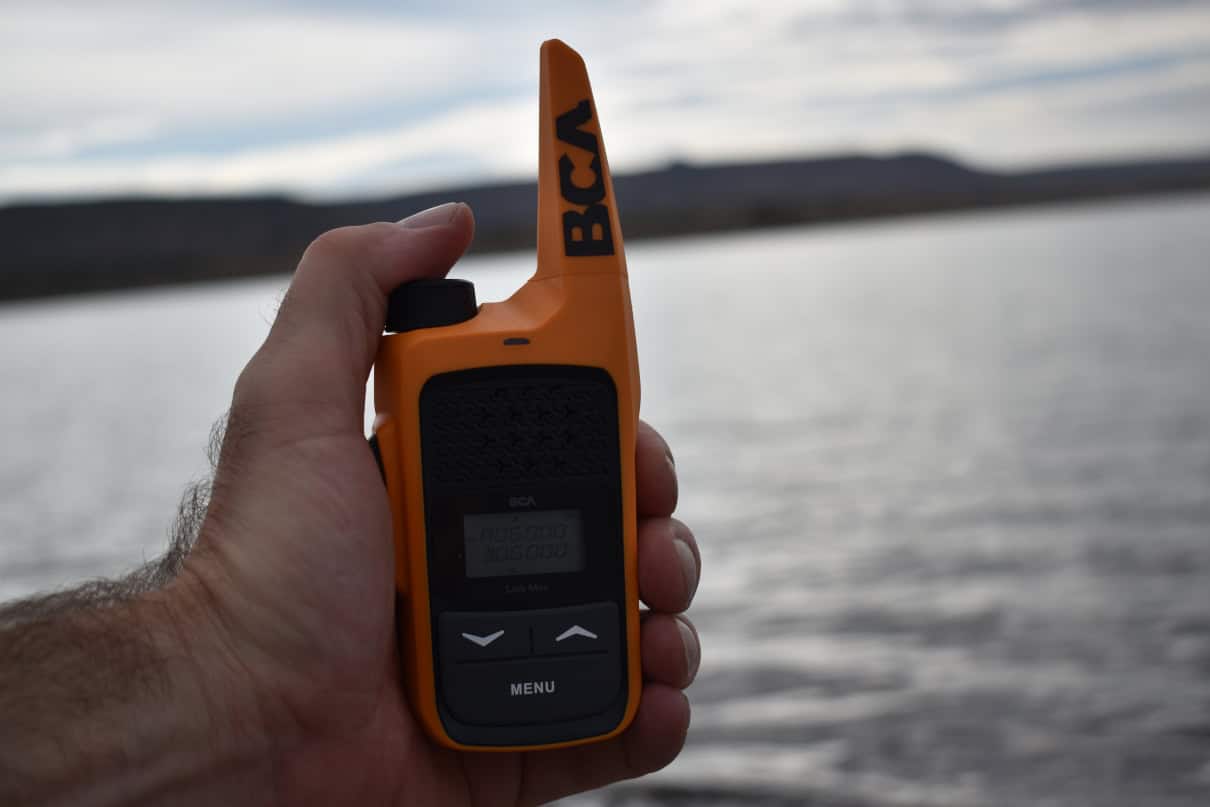
When testing walkie-talkies, the BC Link Mini stood out as the lightest, most compact two-way radio in the kayak. It felt natural in hand and only tipped the scales at 6 ounces. BCA also includes three attachment options—plus a leash—to secure this walkie-talkie to our PFD.
The BC Link Mini is an FRS walkie-talkie—not a GMRS radio. This means you don’t need an FCC license, but also that its transmission power lags behind the rest of this list. That said, its range should be enough for most paddling communication. Our testers could communicate clearly without any dramas. We also found its simple interface intuitive, which made it easy to use the BC Link Mini straight out of the box.
Best for backcountry skiing, the BC Link Mini isn’t as waterproof as the other walkie-talkies on this list. With an IP55 rating, it can survive some spray, sprinkles, and the occasional splash on a canoe trip or lake paddle, but not regular waves or a swim. You’ll need to baby it in a dry bag if you’re running rapids or paddling big waves.
Reasons to buy
- Lightweight
- Ease of use
- Multiple attachment options
- No FCC license required
Consider another if
- You need the range of a GMRS radio
- You expect your walkie to get wet
Bottom line
The BC Link Mini is compact, easy to use, and specifically built for the backcountry.
Best Walkie-Talkie With Voice-Activated Transmission
Midland GXT67 PRO
$219.99 USD
Buy from:
Why I love it
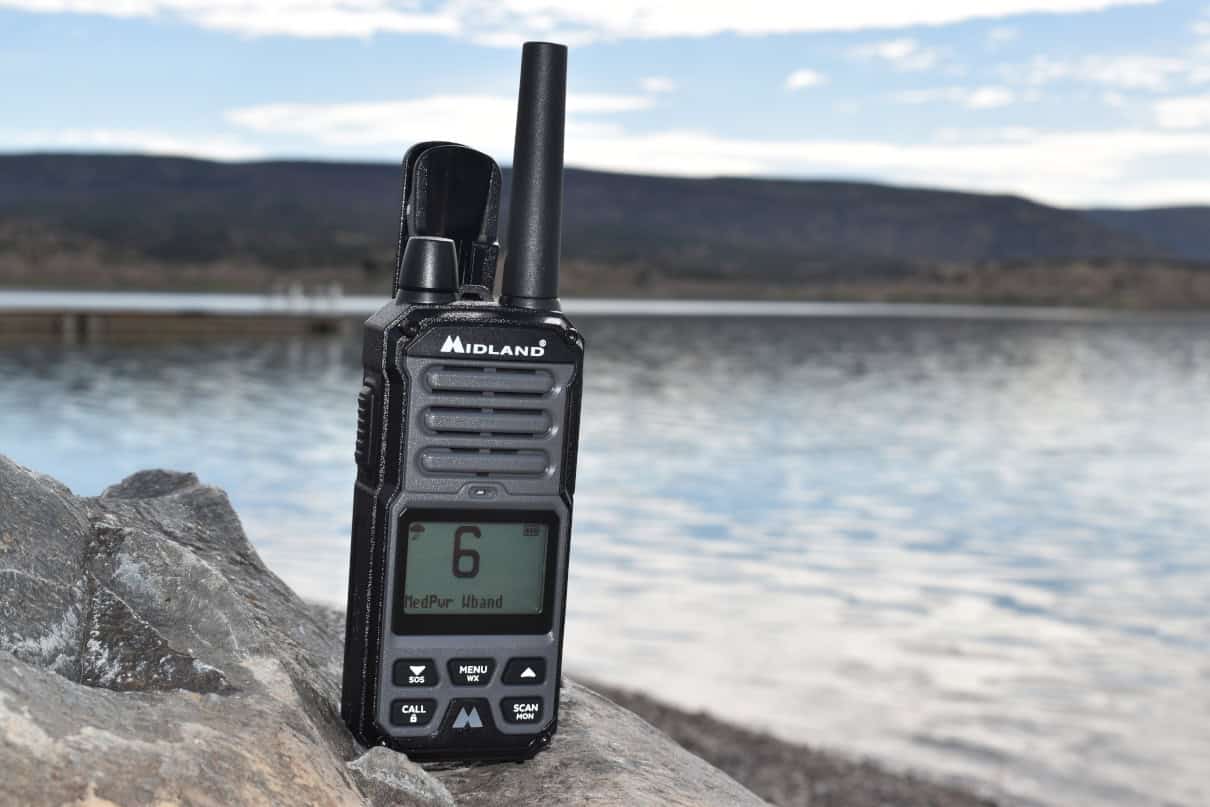
The Midland GXT67 PRO mostly mirrors the premium features of the Rocky Talkie Expedition Radio with one positive addition—hands-free VOX transmission. This voice-activated feature freed up our hands for paddling, which isn’t possible with the standard push-to-talk walkie-talkie.
Beyond the VOX transmission, the Midland GXT67 PRO has several premium features that are paddler-friendly, including an IP67 (submersible) waterproof rating, NOAA Weather Alert Radio, and an automatic noise-cancelling microphone. With 5 watts of power, this GMRS radio can transmit 5 miles in most conditions and can tap into a repeater (where available) to amplify your range.
The Midland unit is heavier and bulkier than other two-way radios I tested. But that was the biggest downside—along with the need to purchase an FCC license (again, this is no big deal). This walkie-talkie has plenty of bells and whistles for paddlers.
Reasons to buy
- 5-Watt GMRS maximizes range
- NOAA weather channels/alerts
- IP67 waterproof and dustproof
- Voice-activated transmission
- Repeater capable
Consider another if
- You want a light walkie-talkie
- You want a compact walkie-talkie
- An FCC license is a hassle
Bottom line
If you want a walkie-talkie with both push-to-talk and hands-free transmission, the Midland GXT67 PRO is a premium pick.
Best Budget GMRS Walkie-Talkie
Cobra Trailblazer 450
$129.95 USD
Buy from:
Why I love it
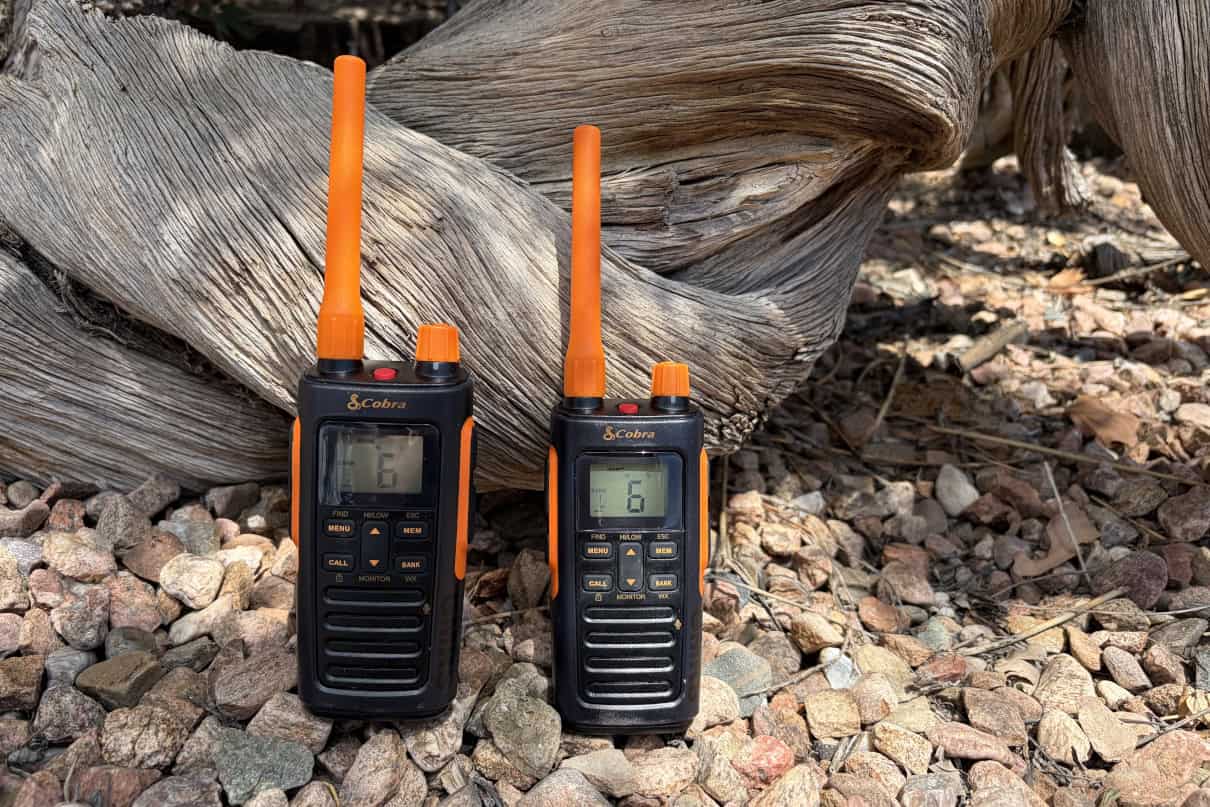
The Cobra Trailblazer 450’s standout feature is its price. This GMRS walkie-talkie costs less than half of the other GMRS walkie-talkies we tested and reviewed.
As a GMRS radio, the Trailblazer has a removable antenna and can access repeater channels to boost your signal. It also offers VOX (voice-activated transmission) to talk hands-free—a plus for paddlers. And it can access weather alerts. Plus, the Cobra Trailblazer 450 is relatively lightweight, which I appreciated in our field tests.
As you might imagine, though, there are tradeoffs for this price. More popular for off-roading and hunting, the Trailblazer 450 has a lower IP54 rating (splash-resistant but not submersible).
Its 16-hour battery life is safe for a day trip but well below the 4- to 6-day charge of the premium GMRS walkies. Similarly, its transmission power (2.5 watts) is greater than the typical FRS walkie-talkie (2 watts) but half that of most GMRS walkie-talkies (5 watts). Still, it’s nice to get into a GMRS walkie-talkie at this price point.
Reasons to buy
- GMRS walkie-talkie
- Excellent value
- Voice-activated transmission
- Weather alerts
- Dustproof and splash-resistant
Consider another if
- You need a submersible model
- You want a full 5 watts of power
Bottom line
If your budget is stretched, you can buy two Cobra Trailblazer 450 walkie-talkies for less than one of the other GMRS walkie-talkies on this list.
More Than A Walkie-Talkie
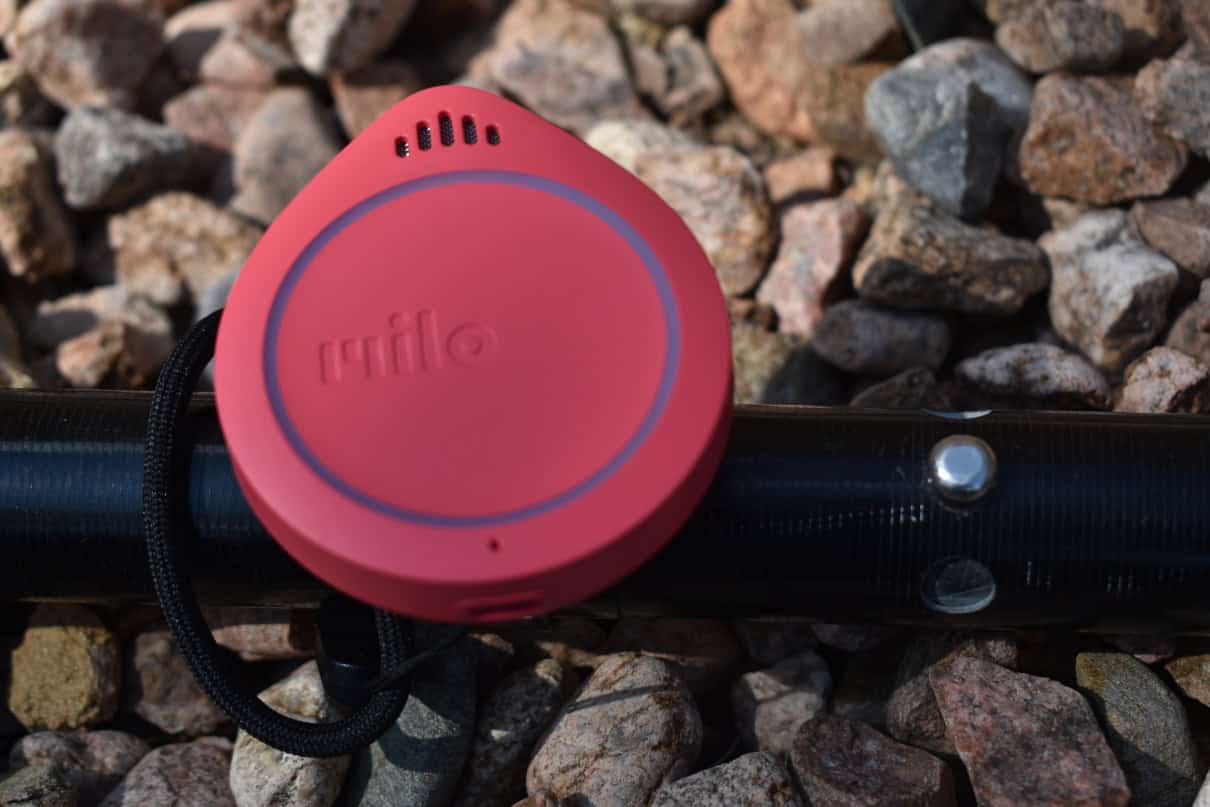
Milo Action Communicator
$249 USD
Buy from:
Why I love it
The Milo Action Communicator is more than a walkie-talkie. It allows everyone in your crew to talk at the same time. You simply sync your Milos, mount them to your upper body or paddle, and then talk with your paddle buddies—no need to push buttons or take turns. They’re easier to use than traditional walkie-talkies, even though they allow for simultaneous group chats, recordings, and more.
Two aspects of the Milo stand out for paddlers. First, Milos are IP67 waterproof, so they should survive rolls or swims on the surface as long as you plug the USB-C port with the included rubber cap. Second, you can mount them to your PFD, paddle, collar, or armband to talk hands-free. These two features make Milos more kayak- and canoe-friendly than traditional, two-way radios.
The biggest downside is range. The claimed range is 600 meters—well below the walkie-talkies above. Plus, sitting low to the water in a touring or whitewater kayak can reduce this range, especially in waves. When I’m kayaking, however, I’m rarely miles from my mates. The Milo Action Communicator can open up more social paddling and multi-way communications if your group keeps your boats clustered.
Reasons to buy
- IP67 waterproof (submersible to 1 m)
- Hands-free talking while paddling
- Convenient action clips and attachments
- Lightweight and easy to use
- Multi-way (vs. 2-way) communication
Consider another if
- Range is a priority
- You want a traditional walkie-talkie
Bottom line
The best “walkie-talkie” for hands-free, group conversations when paddling.
What To Consider When Buying A Walkie-Talkie
If you’re new to walkie-talkies, you only need to focus on a few specs to figure out which walkies are better suited for paddle sports and on-water use cases.
Waterproof rating
Obviously, waterproof rating should be high on your list for on-the-water use. The walkie-talkies we recommend above demonstrate different degrees of dust and water protection. To predict how any electronic device will fare on water, focus on its IP rating:
- IP67 Rating: Dust-tight and protected against temporary immersion (3ft water/30 minutes)
- IP55 Rating: Dust-protected and protected against water jets
- IP54 Rating: Dust-protected and protected against splashing water
None of the walkie-talkies above are rated for continuous immersion in water (IP68 rating).
FRS versus GMRS
Another key difference is FRS versus GMRS walkie-talkies:
- FRS (Family Radio Service) are two-way radios that are low power (up to 2 watts) with fixed antennas. FRS radios do NOT require an FCC license to operate.
- GMRS (General Mobile Radio Service) radios are higher power (up to 5 watts) with detachable antennas and repeater access to increase range. GMRS walkie-talkies require an FCC license.
Don’t let the phrase “FCC License” intimidate you. Yes, you do need to navigate the bureaucratic inefficiency of a federal website. But the FCC license application process only took me 20 minutes, and the license is inexpensive ($35 for 10 years) and covers your whole family. For more, see this helpful overview.
General consumer Walkie-Talkies versus a standard VHF handheld
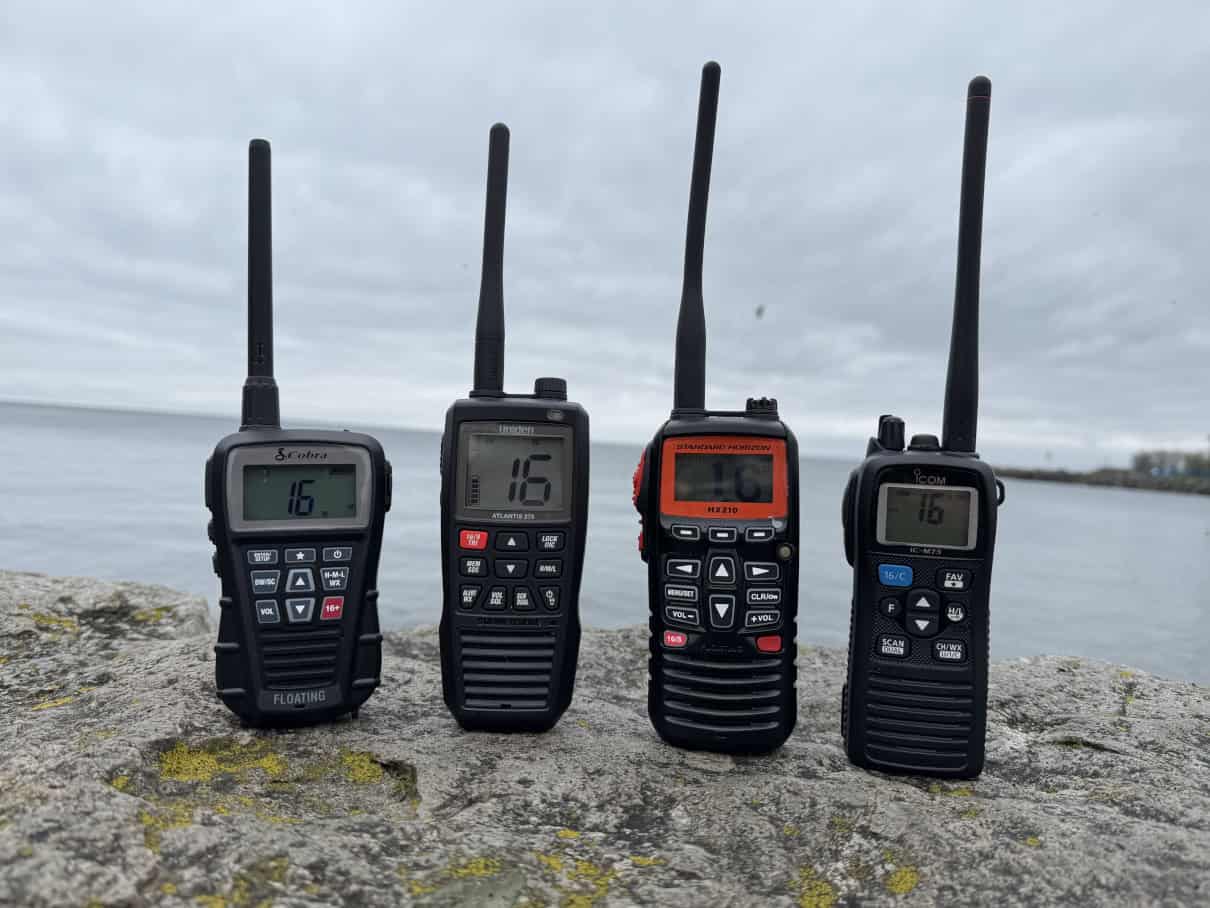
Something important to consider when purchasing a two-way radio is the capability of who you can reach with it. While the types of walkie-talkies in this review that operate on FRS or GMRS are a great way to stay in contact with your paddling party on a trip, they do not, however, reach the VHF (Very High Frequency) channels monitored by the Coast Guard and other vessels.
What this means is that these consumer two-way radios are no substitute for a handheld VHF radio. VHF channels are regularly monitored on coastal waterways, larger lakes, and major rivers.
VOX mode
Do you want to talk on a walkie-talkie while actively paddling? Look for a radio with VOX—Voice Operated eXchange—to communicate hands-free. In VOX mode, the radio microphone starts broadcasting when you speak without pressing the push-to-talk button. Wind and other loud sounds can trigger transmission in VOX mode (and clip your first word). But VOX and other types of these functions let you keep your hands on your paddle instead of your walkie-talkie.
Best Walkie-Talkie Brands
How We Tested
Each of the walkie-talkies on this list was tested on the water and in the foothills and mountains outside of Albuquerque, New Mexico. I weighed each unit, tested its range and sound quality in different environments, evaluated its water resistance, and considered how easily it handled while paddling.
Why trust Us
Jory Brass is a freelance writer who’s been paddling since 2005. Now based in Albuquerque, he enjoys kayaking canyon reservoirs and desert rivers across New Mexico, Arizona, and Southern Utah. He’s authored approximately 200 reviews of outdoor gear and apparel as the founding editor of Hiking Feet, freelance editor and gear analyst at CleverHiker, and copywriter at Backcountry.
Feature photo: Jory Brass






