Nothing kicks off a post-paddle debate like river rescue knives. Most of us have a favorite, put up with others we didn’t really like, have lost more than one, and, hopefully, never find ourselves in a situation where we have to use it. As part of the river paddler’s Big Three—PFD, whistle, knife—they are a life-saving device. When something absolutely needs to be cut, nothing but a trusty blade will do.
The best rescue knife though is subjective. This is because every paddler has their own needs, considering the type of paddling they do, the components they expect a knife to have, and the attachment options available on their PFD. With this in mind, here is our rundown of the top river knives available to help you choose which is right for you.
Best Rescue Knives: Our Top Picks
- Best Rescue Knife Overall: CRKT Bear Claw
- Best Workhorse Rescue Knife: NRS Pilot and Co-Pilot
- Best River Knife On A Budget: Gear Aid AKUA Blunt Tip
- Best Cutting Power: Spyderco Byrd Cara Cara 2 Rescue
- Best Lightweight Rescue Knife: Gerber E-Z Out Rescue
- Best Fixed-Blade Attachment Solution: Stohlquist Squeeze Lock
Best Rescue Knife Overall
CRKT Bear Claw
MSRP: $69 USD
Buy from:
Why I love it
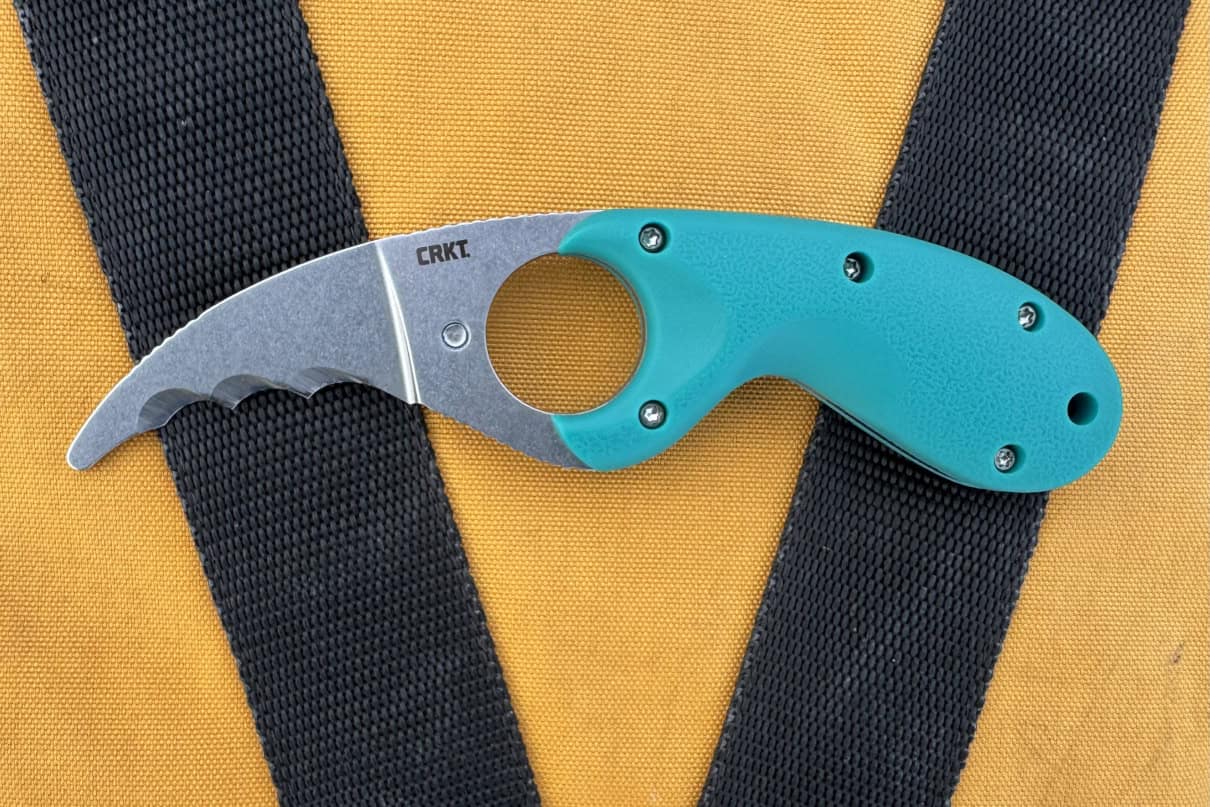
Imagine some worst-case scenarios: tangled in straps under a flipped raft, or a waist belt throw rope gets stuck. For those situations, this is the rescue knife you want on your PFD. The CRKT Bear Claw is all business, intended for only one thing: cutting rope.
The one-sided, curved and serrated blade of the Bear Claw is among the best rope cutters I tested, and it is uniquely shaped to slip under a rope and, with one rip, cut through it. The finger hole provides secure grip and is perfect for cold or slippery hands. It releases with a solid click and minimal force.
Reasons to buy
- You spend time in high-risk rescue situations
- Need a dedicated rescue cutting tool
Consider another if
- Left-handed paddlers may find the curved handle and sheath awkward
- You need more uses and wider utility from your knife
Bottom line
A serious rescue tool, though left-handed paddlers may find the curved handle and sheath awkward.
Best Workhorse Rescue Knife
NRS Pilot and Co-Pilot
MSRP: $59.95 | $54.95 USD
Buy from:
Why I love it
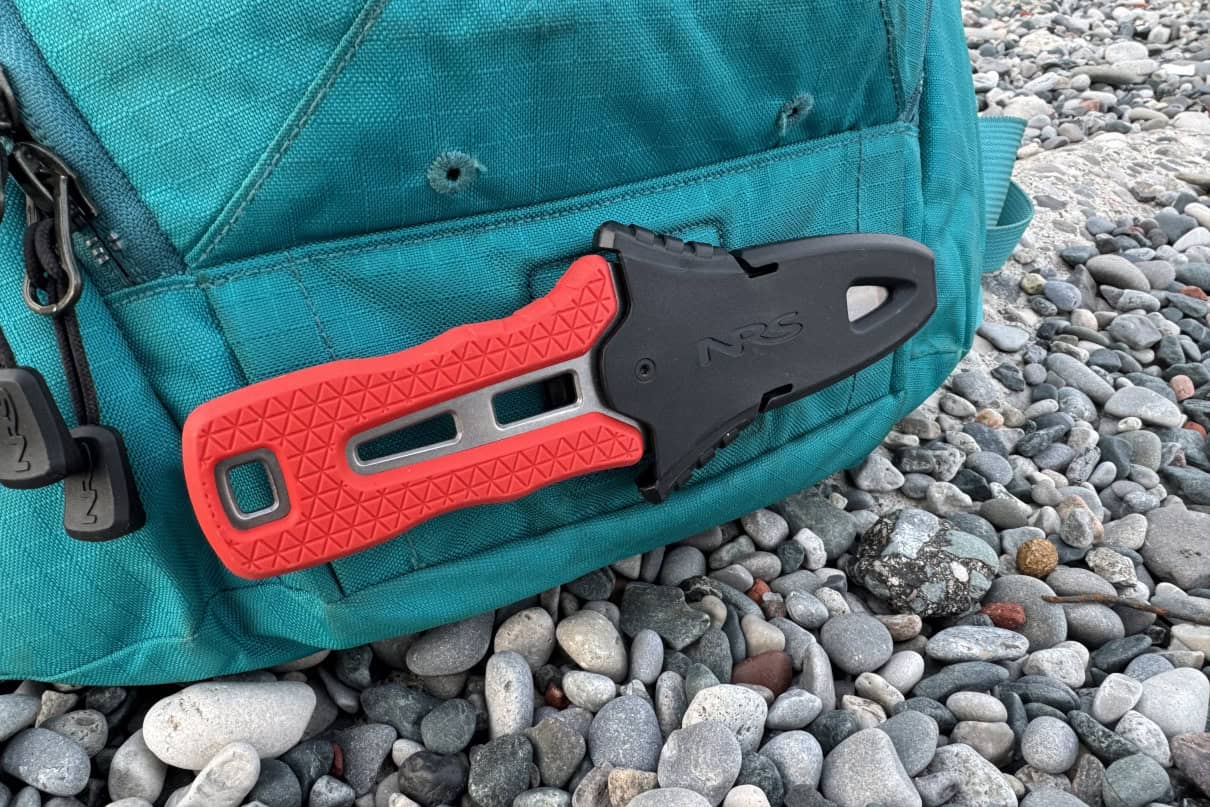
NRS river knives have been staples on guides’ and paddlers’ PFDs for decades. The only difference between the Pilot and Co-Pilot is the length of the grip and straight blade; both models have the same length serrated cutting edge, but the Pilot extends farther toward the tip with a straight blade.
I found the cutting power of the Pilot series is mid-range, taking a couple of saws to get through rope. Some post-purchase sharpening noticeably improved performance. The squared tip and dulled backside of the blade make this an all-purpose utility knife, suitable as a screwdriver, prying tool or peanut butter spreader.
NRS’s redesigned sheath has better release and less bulk than the original, but care is needed in sheathing the blade to ensure the sharp side is inserted away from the thumb release. For the Yank Test—a straight panic pull ignoring the release mechanism—the Pilot comes out with medium force, while the Co-Pilot will not release.
Reasons to buy
- Solid retention in the sheath
- Co-Pilot for those that want less weight and bulk protruding from their PFD
Consider another if
- Cutting power is your main priority
- Need an easier insert and release set up
Bottom line
These workhorse knives will take your river use in stride.
Best River Knife On A Budget
Gear Aid AKUA Blunt Tip
MSRP: $37.95 USD
Buy from:
Why I love it
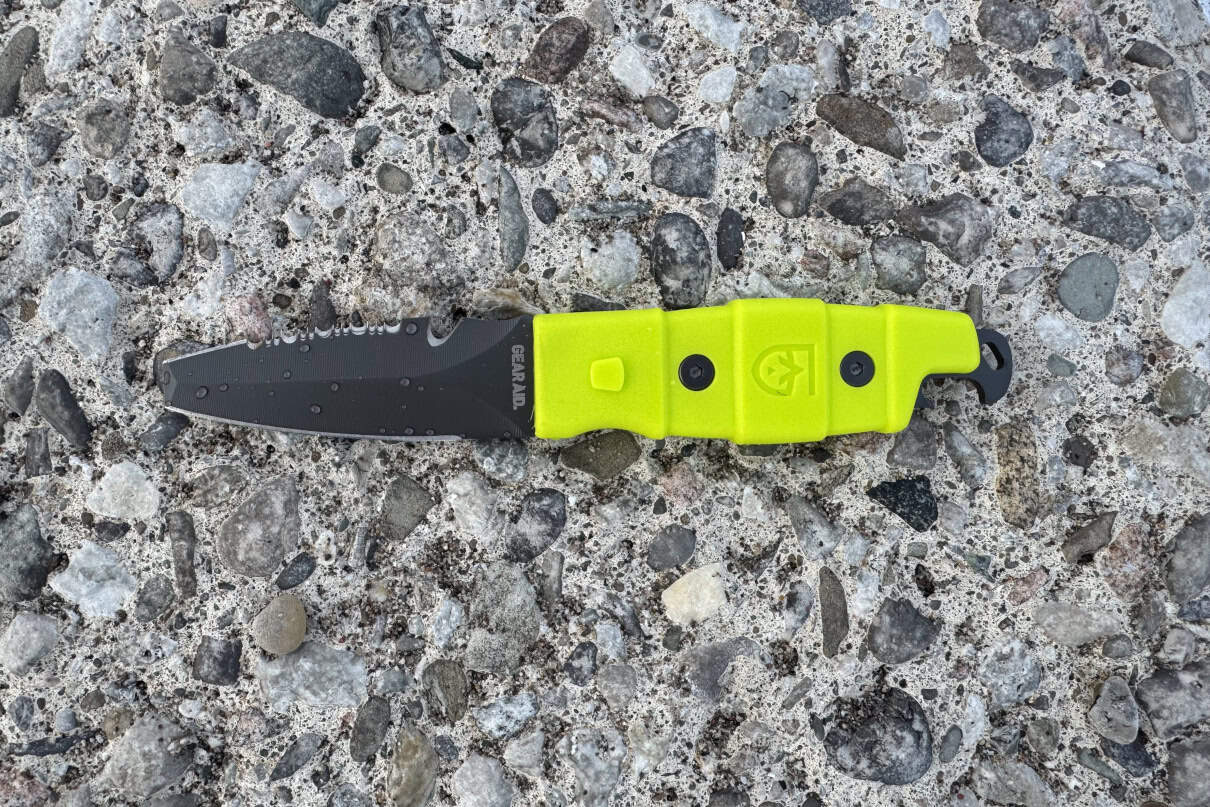
The AKUA from Gear Aid blends rescue and safety features with utility sensibilities. A serrated edge, straight section, line cutter and blunt tip provide every option you’re likely to need.
In my testing, the serrations on the AKUA shredded rope rather than sliced it. The plastic grip lacked the anti-slip features of a dedicated rescue knife but gained points for comfort and ease of use. The sheath felt intuitive and required little force to release, yet needed medium force under the Yank Test. Many mounting options work with this sheath, up or down, strap or knife tab.
Reasons to buy
- Widely functional knife with rescue capabilities
- Wide range of PFD attachment options
Consider another if
- Your knife is only pulled out for rescue situations
Bottom line
If you only carried one knife for all purposes, rescue or otherwise, this would be it.
Best Cutting Power
Spyderco Byrd Cara Cara 2 Rescue
MSRP: $59 USD
Buy from:
Why I love it
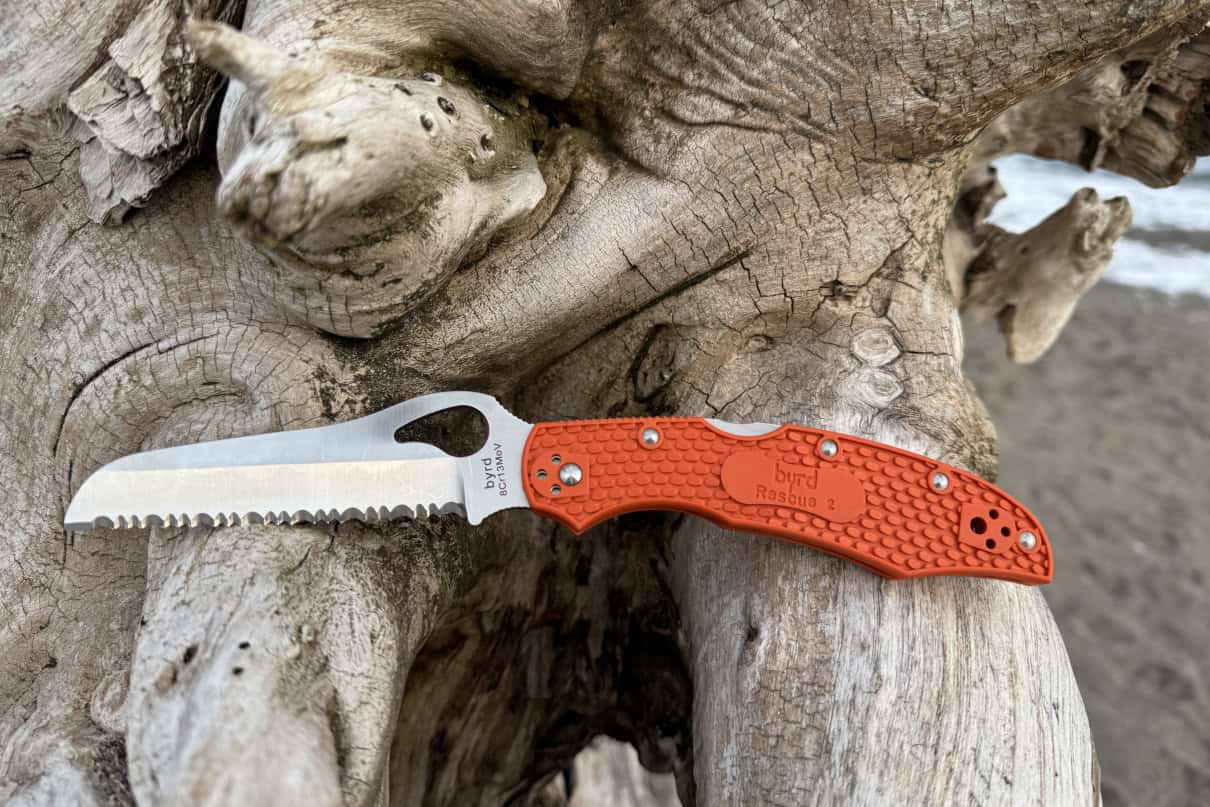
The Spyderco Byrd Cara Cara 2 Rescue knife slides through rope like butter. Its impressive cutting power comes from having the longest cutting edge among the knives reviewed here. One pull of the serrated edge cut 12-millimeter static rope—a big ask, and something most of the other knives needed steady sawing to achieve.
The Cara Cara 2 has the best feel in my hand, thanks to a longer grip for my bigger hands, and the right heft and balance. The flip action is smooth, and one thumb can easily activate the blade. As a folding knife, I found the attachment options limited, but the security clip can be installed for left- or right-hand carry.
Reasons to buy
- You work with rope and demand cutting efficiency
- Prefer pocket storage or need only basic attachment
Consider another if
- You find yourself in high-risk or high-stress situations that demand quicker access to a knife
- You need greater utility from your knife
Bottom line
Flip blades are not for everyone, but, wow, this thing can cut.
Best Lightweight Rescue Knife
Gerber E-Z Out Rescue
MSRP: $51 USD
Buy from:
Why I love it
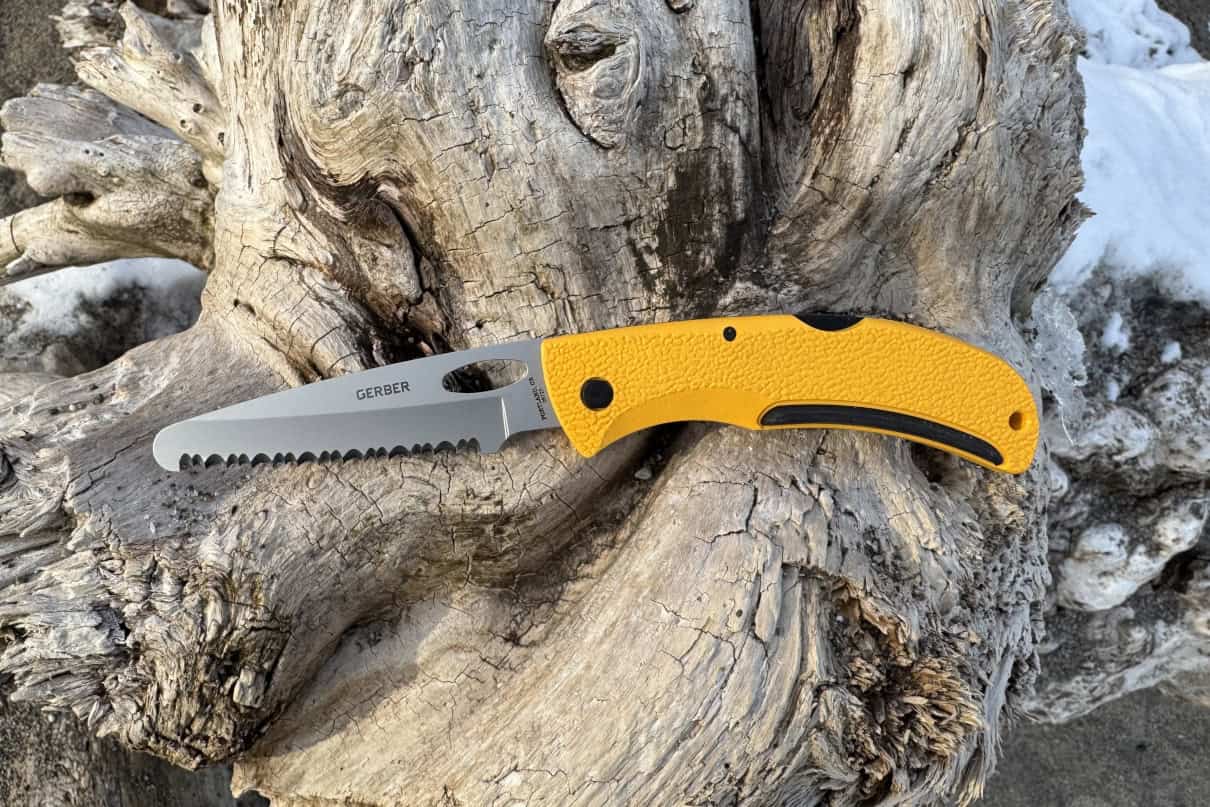
The Gerber E-Z Out comes in at just three ounces. It has the same serrations as the champion cutter Byrd Cara Cara, just an inch less of them.
I found the blunt tip and hook nose on the Gerber make this a versatile rescue blade, though the smaller blade area impacts the size of the thumb hole and ease of opening the blade one-handed. The non-adjustable clip made it best suited to easy-access pockets, simple attachment points and less demanding paddling situations that may dislodge it. Gerber knows how to make a knife, and the grip and hand feel are superb.
Reasons to buy
- Lightweight rescue cutter
- Prefer pocket storage or need only basic attachment
Consider another if
- You find yourself in high-risk or high-stress situations that demand quick access
- Have specific attachment points or needs
Bottom line
For those who want a lightweight knife that stores in a pocket, the E-Z Out delivers big cutting power.
Best Fixed-Blade Attachment Solution
Stohlquist Squeeze Lock
MSRP: $54.99 USD
Buy from:
Why I love it
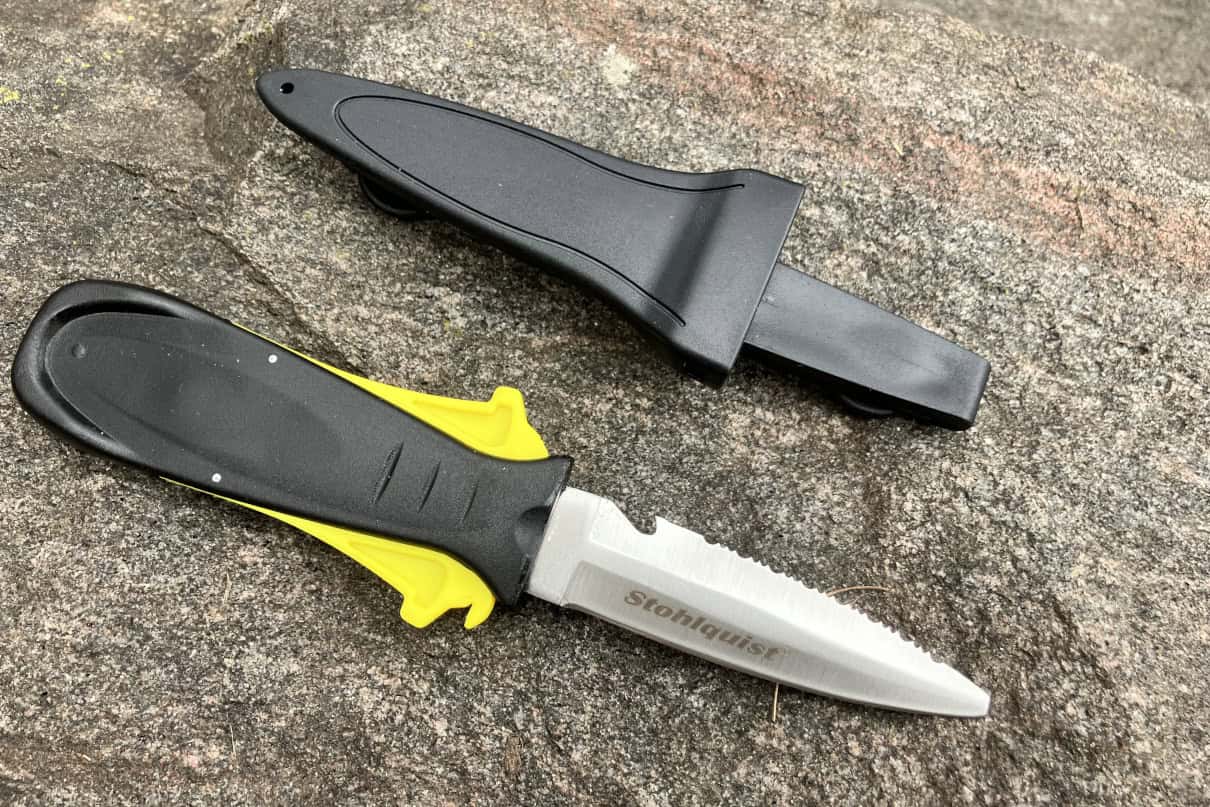
The Stohlquist Squeeze Lock looks somewhat dainty compared to the other bruisers in this review, but that means it is lightweight and low profile when mounted on a PFD.
The Squeeze’s straight edge, serrated section, line hook and blunt tip provide versatility. Out of the box, I found the cutting power underwhelming, but sharpening quickly fixed that. Those with smaller hands will appreciate the feel of this handle and smaller blade. This sheath offers the most flexible mounting options of any knife here, and comes with straps, clips and multiple mounting configurations and directions. The Squeeze’s lock can feel finicky, but the Yank Test frees it with modest force.
Reasons to buy
- Small hands will appreciate everything about this knife
- You have complicated attachment needs
Consider another if
- Big hands or big cutting needs
Bottom line
Ideal for complicated attachment needs and low profile on the PFD.
What to consider when buying a rescue knife
Deciding between attached fixed-blade or tucked-away folding knives
Before you launch into buying a river or rescue knife, the real question to consider is the relative importance of fast and easy access versus the security of the knife.
Pros and cons of an attached fixed blade
If you guide high-grade whitewater, row oar rigs, or run rivers where the throw bags come out often, then fast and easy access to a blade is a priority, given all of that rope around you.
This, of course, comes with a trade-off. Having any blade prominently mounted onto your PFD means there is a risk of losing it or it getting tangled itself. And, climbing onto a flipped raft with a knife mounted to your chest sucks.
Pros and cons of a stored folding knife
Conversely, if this is a rescue or utility tool expected for somewhat mellower applications, a flip blade stowed in a pocket or a fixed blade more subtly attached might make more sense, and be less obtrusive and risk inadvertent release and loss. Retention straps are used by some in case the knife falls out, but that carries a whole new set of issues.
Compromises are a part of the gig, no matter what you decide to prioritize or where you mount the knife.
The PFD test
I suggest bringing your PFD with you when you shop for a knife, as its attachment points and their orientation will affect how secure and efficiently a given setup releases. Know that beyond the PFD knife tab, many sheaths have options for straps or zip ties or can be attached to belts or straps.
Rescue-ready muscle memory
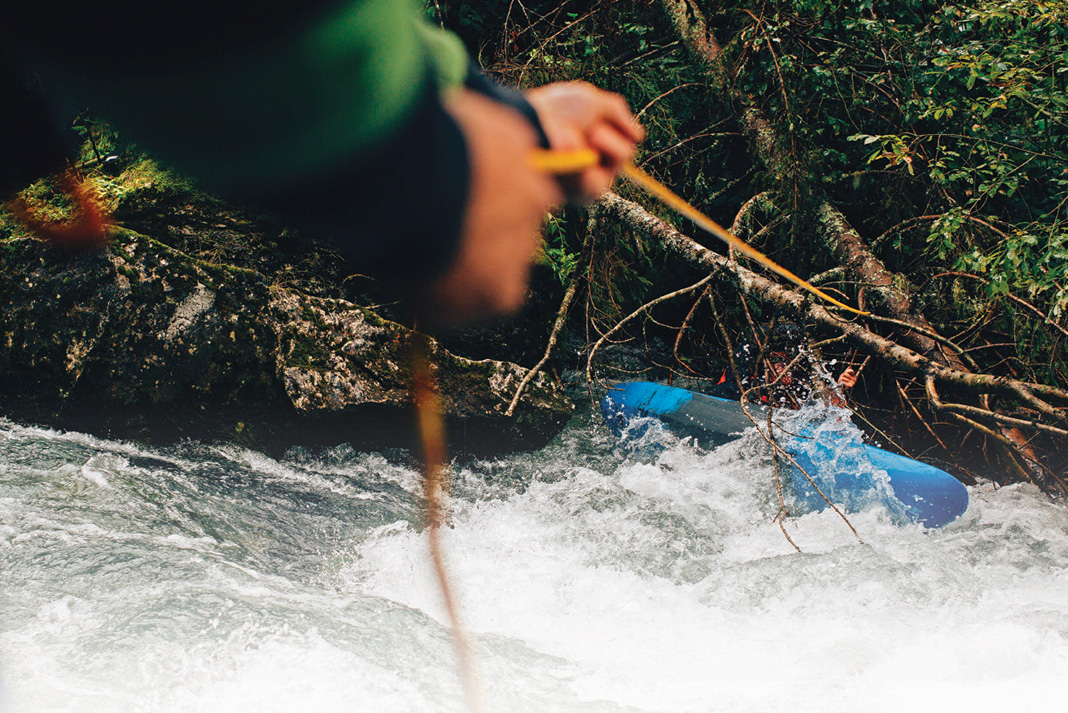
Practice. Regardless of where you attach or store your knife, clip and unclip it repeatedly, every time you put on your PFD, so that the motion becomes ingrained. When things get ugly, you want this knife to just appear in your hand without any thought.
Consider a blunt-tip knife
All of the blades reviewed here have blunt tips to reduce the chance of injury to you or your buddy or of damaging your gear, and are made of stainless steel.
Rescue knife care
Stainless steel does not mean rust proof, so drying and cleaning your knife is a good idea. If this knife will serve double duty near salt water, look for titanium or treatments specifically for ocean environments.
And this leads to the last thing: keep this thing sharp! After-market sharpening kits are readily available, so put them to use often. This gets a bit more complicated with the new families of custom serrations found on some of these knives (such as the CRKT) which require specialized hones. If your knife is truly reserved as a rescue tool, every time you cut a rope, I suggest going home and sharpening the blade again. Any blade can be brought to razor sharp; the best blades can hold that edge longer.
Best rescue knife brands
How we tested
Each knife featured here was evaluated for real-world usability, grip, retention and durability. Our picks reflect not only hands-on testing and side-by-side cutting tests for this review, but also years of accumulated experience and ongoing tailgate conversations with seasoned paddlers and rescue professionals.
Why trust us
Jeff Jackson headed the outdoor adventure program at Algonquin College for 25 years. He has been teaching on rivers even longer and has become a recognized expert in outdoor adventure risk management. Jeff started contributing to Rapid magazine with the very first issue in 1999. He has worked on rivers from the Yukon to Utah, but these days you’re most likely to find him casting a line as the owner of Algonquin Fly Fishing. His everyday carry river knife is an NRS folding Pilot.
 This article was published in Issue 75 of Paddling Magazine.
 Feature photo: Kaydi Pyette