As convenient as inflatable kayaks can be, they aren’t exactly praised for performance. That’s because almost every model out there hits certain limitations known all too well compared to their plastic and composite counterparts. Now, an emerging brand called Razor Kayaks has landed on the shores of the U.S. with the ambitious promise of producing not your typical inflatable but a high-pressure boat as capable as a hardshell.
Review of the Razor Kayaks Edge Pro Inflatable Kayak
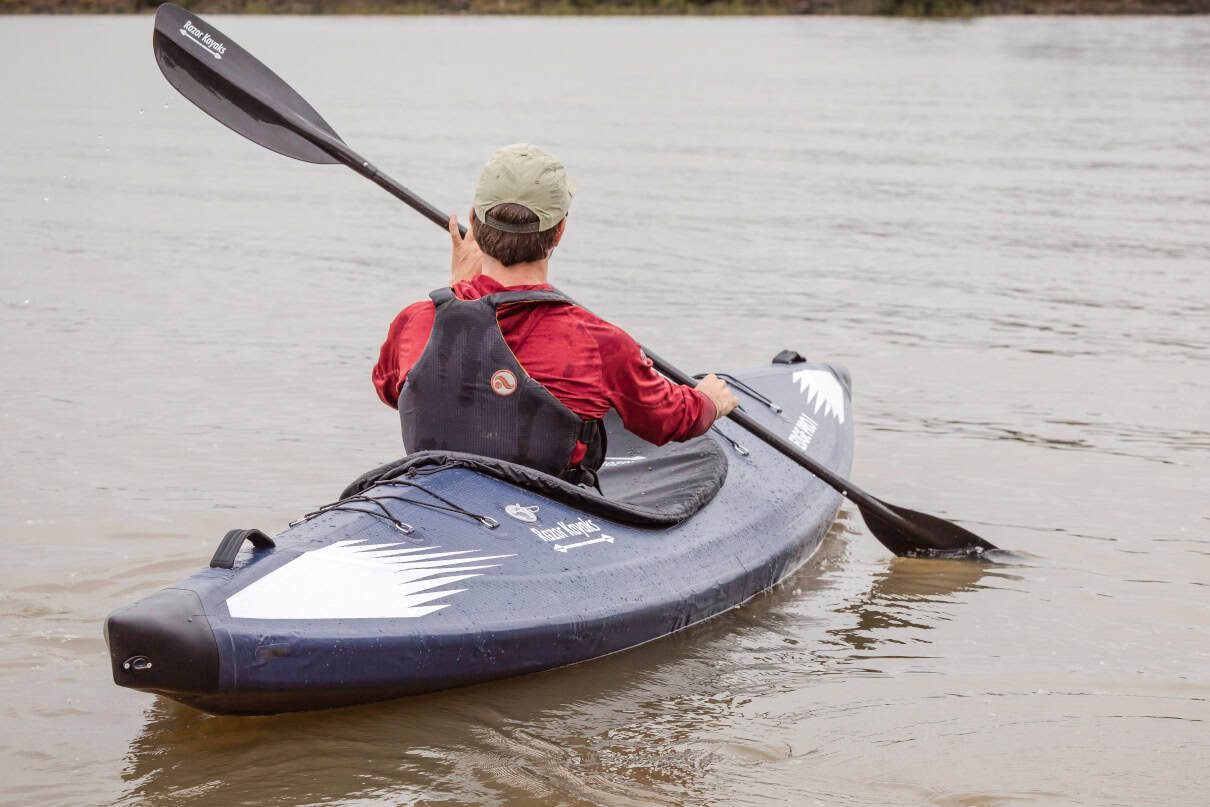
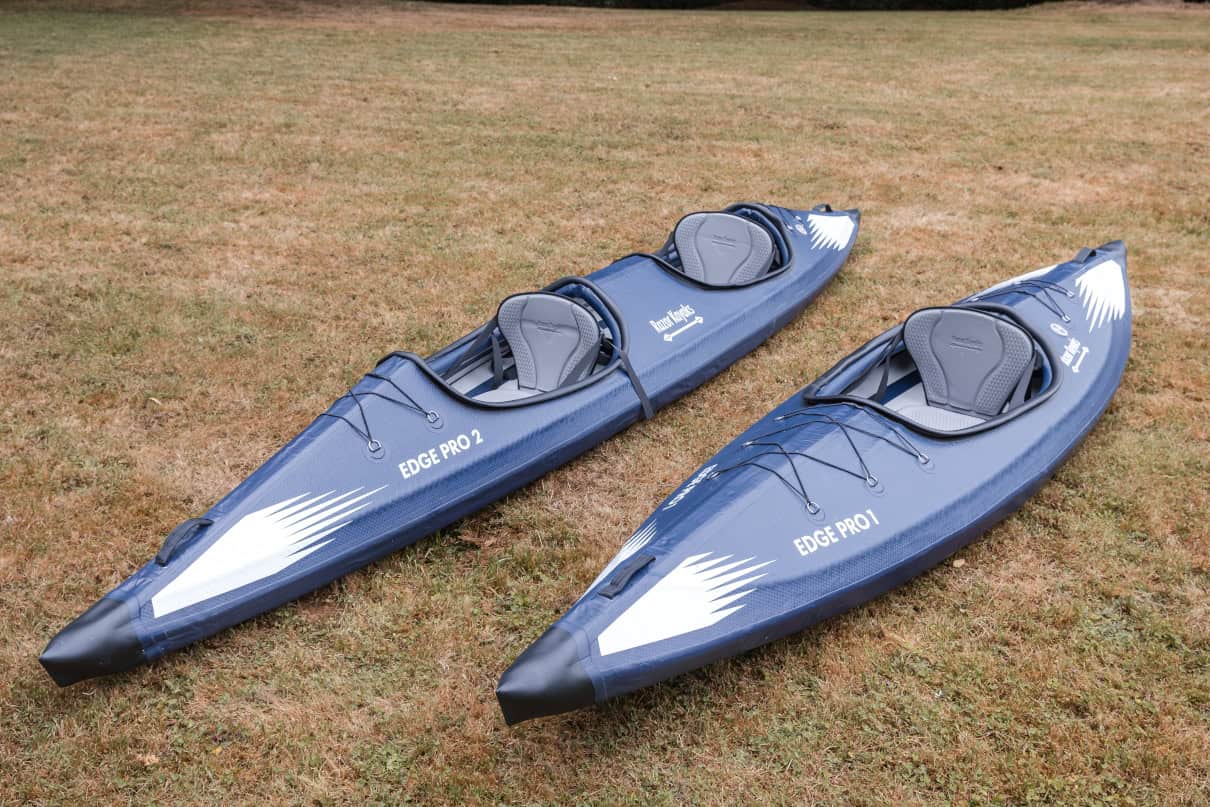
Razor Kayaks Edge Pro 1 | Edge Pro 2
Length: 13’1” | 16’1″
Width: 32” | 28″
Weight: 41 lbs | 45 lbs
Maximum Recommended Capacity: 375 lbs | 595 lbs
MSRP: $1,499 USD | $1,749 USD
razorkayaks.us
Razor Kayaks is the vision of founder Rob Fallon, a self-described “kayak tragic” with a dozen recreational boats lying around, who wanted to create something he actually enjoyed paddling. The seven-year-old company based in Australia has released multiple designs, but it’s one of their latest, a flagship boat years in the making, that they are most excited about. The series is called the Razor Edge Pro, and it has a unique construction that features dropstitch material around the entirety of the kayak, including a closed deck which is rarely found on an inflatable.
Edge Pro Design
The Razor Edge Pro is available in both single and two-person kayak models, aptly named the Edge Pro 1 and Edge Pro 2. One of the first things I noticed about these boats was their overall shape and layout. The Edge Pro 1, for example, is 13 feet long and has a tapered shape that narrows at the bow and stern and widens around the cockpit where the paddler is seated, just as many recreational and day-touring kayaks.
The boats also have the intriguing closed deck, which means the paddler sits with their lower legs partially enclosed inside the kayak on the foot brace. The cockpit is open enough that it still leaves ample room for the paddler to climb in and out easily, and situate themselves comfortably. Overall, I’d say it’s a similar cockpit to a closed-deck recreational kayak.
There is also an understated perk of the combination of the closed deck and light weight of the Edgo Pro 1: the ability to easily shoulder the boat and carry it to the water, which is not often an option for inflatables, and with hardshell recreational kayaks can be an awkward and cumbersome part of an outing.
Laser Cut Panels
The shape of the kayak’s hull and deck profile surprised me most. Inflatable kayaks regularly have either flat panels or round tubes. This tends to mean rudimentary hull shapes that don’t really let the paddler lean the boat edge-to-edge, and make for a kayak that plows over the water rather than glide through it.
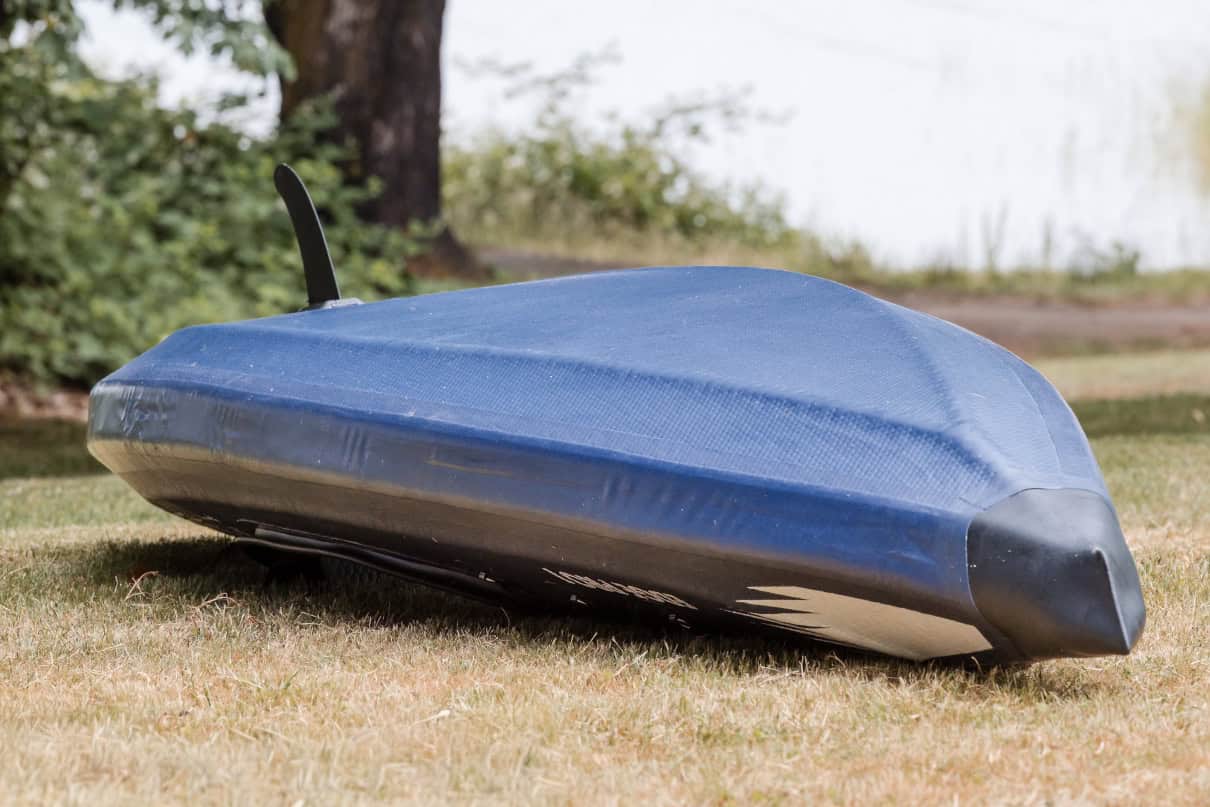
For the Edge Pro, Fallon and Razor brought in an engineer with a background from Boeing and an understanding of hydro and aerodynamics. They drew up the plans over years of testing, with the secret weapon of their design being the use of a laser cutting process to remove material and join sections of the PVC material together in multiple panels. This allowed them to create an inflatable kayak with more of what we see in hardshells—intricate bottom and deck shapes. If you look at the hull of the Edge Pro, you can see how the kayak transitions from the hull to the sides in multiple stages. Razor says this gives the boat roundness. What I see looking at the kayak is a flat-bottomed hull at the center under the paddler with transitions that equate to multi-chined edges. The result is that the hull design does in fact let you lean the boat side to side. The hull is wide and stable, however, on a section of moving river, I was able to lightly edge this inflatable kayak and actually carve in and out of eddies.
The hull also has a noticeable amount of rocker lifting the bow and stern from the water, which is helpful in paddling over waves and turning the boat.
There is a plastic fin included which can be attached to the stern to help the kayak track in a straighter line, however, I mostly paddled without it and had no issues feeling like I was getting spun out or thrown off course. If you are a newer paddler or plan on being in wavy or windy conditions where a skeg is generally useful, then you have the fin to throw on.
The deck of the kayak uses the same laser-cut panels to aggressively peak, letting water roll down the sides rather than into the boat. This peaked deck also plays a role in the next aspect of the Edge Pro’s drop-stitched construction—its rigidity.
Going to Another Level of Drop Stitch
Beyond boat shape, what has limited the ability and fun factor of inflatable kayaks when it comes to places like lakes or bays is largely the construction of the air bladders. Try as you may to top an inflatable off with as much air as your barrel pump can muster, the traditional raft tubes often used are only made for a maximum of a couple of pounds of pressure per square inch. This means even with quality materials, the tube will have some give that equates to a noticeable sponginess when you are sitting in it on a lake. That bit of sponginess means, at best, lost energy when you are trying to cross a headwind or cover miles, and at worst, a paddler sinking uncomfortably in their seat waiting for the outing to be over.
The use of drop-stitched high-pressure floors is ubiquitous on standup paddleboards, and makes a huge difference in capability. These boards can be inflated north of 10 PSI. Some can even be inflated beyond 20 PSI. This makes them extremely rigid, almost as if they were made of fiberglass. Inflatable kayak manufacturers have started incorporating drop stitch floors in their boats in recent years to provide stiffness, and it’s made a huge difference, but even with these floors, there remain the outer tubes, and also the fact that almost all inflatable kayaks are sit-on-top designs where there is no top deck to the boat.
What this means in theory is even with a stiff floor you are left with some amount of “tacoing” of the boat folding upwards from the paddler sitting in it, even if unnoticeable. What Razor set out to accomplish with the Edge Pro is something only a few manufacturers have done: make an inflatable kayak with not only a drop-stitched floor, but have a closed deck that is completely drop-stitched construction as well.
Why in Razor’s mind is this beneficial? Imagine the deck as the idea of a keystone in an arch. The piece at the top makes the architectural physics of an arch possible, because it not only braces the stones leaning into it, but redirects the force outward and down to give the structure its enduring strength. So the idea for Razor is that by having the drop stitch deck, the boat’s rigidity is increased by pushing back on itself. And generally speaking, rigidity equates to glide and responsiveness in a kayak.
Outfitting
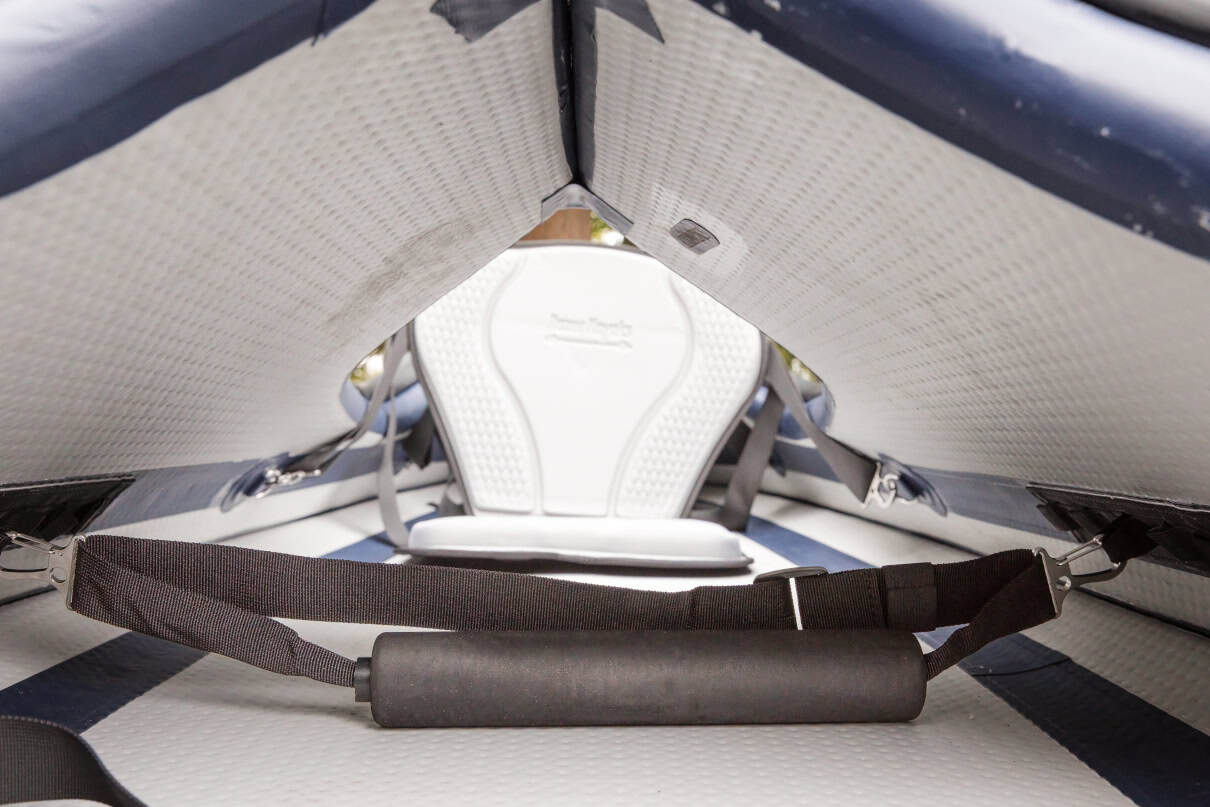
Razor kept the outfitting inside the Edge Pro streamlined. There is a foam seat that clips into the boat and attaches to the floor on a hook-and-loop fastener track. The seat on top of the inflated floor was perfectly comfortable. The foot brace is simplistic, made of plastic piping with a foam cover, and is clipped into webbing loops inside the boat.
I appreciate streamlined outfitting and felt overall that Razor has done a nice job with their setup. It’s intuitive to use, has few parts, and is comfortable.
Razor also has a sprayskirt for the Edge Pro, which can be worn and attached around the cockpit rim to keep water and a cool breeze out of the boat. The sprayskirt was a little tricky to attach around the rim on the first go, and I recommend a few practice runs on dry for newer paddlers before launching and trying to put it on while on the water. Razor also offers numerous other accessories, including paddles, PFDs, and electric pumps at reasonable prices.
On the water
I wasn’t sure what to expect when I set out to paddle the Edge Pro. It’s difficult to be wowed by an inflatable kayak, yet Razor’s design has taken a bold direction, and it’s been a fun boat to paddle.
At 13 feet long with the rigid drop-stitch shell, the boat is reasonably fast for its class, and I used it to paddle upstream against the current in stretches of moving river I wouldn’t have expected it to cruise up so easily. As mentioned earlier, the multi-chine hull makes the kayak capable of edging, which is not a term we tend to throw around with inflatable kayaks. The hull is wide, with good initial stability for leisure paddling even with the capability to do some edging. And the flat center of the hull combined with the lifted ends lets the kayak spin easily. Meanwhile, out on the lake, it seemed to have no issues holding a course and making ground in mild headwind and chop.
The Edge Pro could easily be a replacement for a hardshell plastic recreational kayak, or to an extent a day touring kayak. This is because Razor has delivered on creating a performance-minded inflatable kayak that feels much like you are paddling a hardshell. The Edge Pro is well suited for moving rivers with mild rapids, sheltered lakes and tidal waters. I am curious to push it into more adverse conditions or ambitious outings to see how it handles. It would also be interesting to see Razor take the Edge Pro design and tweak it with a smaller keyhole cockpit and pull in the width to further increase performance and put it up against true touring kayaks.
The Edge Pro is a refreshing newcomer to the scene with a unique take on the inflatable kayak. Considering the design effort and materials put into these boats by Fallon and team, the price is reasonable, and they are available now in the U.S. directly from Razor Kayaks.
Feature Image: Owen Roth