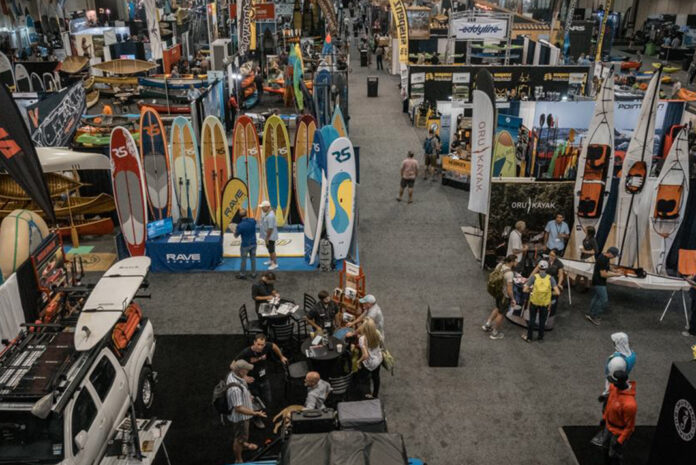
As of July 31, badge lists are available for retailers, exhibitors, media and non-profits on PSR’s website. Anyone planning to attend PSR, should verify his or her badge is accounted for and that the details and spellings are correct. Also, attendees representing large delegations should ensure that everyone on the team is accounted for, so everyone has badges waiting for them at either the Kick-Off party on Sunday evening at Bricktown Brewery or on Tuesday morning at the exhibition hall.
Hotel Deadlines
August 1 is also the PSR Room Block deadline and the last day to register for the retailer lodging incentive. Sunday through Wednesday room blocks are still available at Sheraton Oklahoma City Hotel and Residence Inn OKC Downtown Bricktown; use the links provided on the PSR website to book in the PSR block. PSR attendees have already reserved 115% of 2018’s total room block, promising increased attendance at this year’s event.
Onsite ordering with Cox Convention Center
Exhibitors have upcoming deadlines as well: they have until August 13 to place orders with Cox Convention Center catering staff for in-hall events, and August 13 is also the deadline to qualify for Event 1 Productions’ discount deadline on materials handling services. The vendor packet, electrical services form and other important exhibitor resources are available on the PSR website.
PSR 2019 attendees can also preview the exhibition hall floor plan at paddlesportsretailer.com, and exhibitors can preview our list of registered stores as well. Go ahead and reach out to your vendors and customers to set up appointments if you haven’t already. Also, please note that these lists posted at paddlesportsretailer.com are the most details PSR shares publicly (or privately) about attendees; we do not share contact info for any of our registered attendees (retailer, exhibitor, media or non-profit), though there are third-party vendors attempting to recreate and sell official-looking attendee lists.
Stay tuned for important show updates next week. The Demo Day event map is going through final revisions and will be ready for publication early next week along with the final seminar schedule and featured speakers.
About Paddlesports Retailer
Paddlesports Retailer is the national trade show of the paddlesports industry, endorsed by the Paddlesports Trade Coalition. The show provides exclusive on-water demo opportunities, an expansive marketplace and an unsurpassed cultural experience for exhibitors, retailers, media and industry advocates alike. For more information, visit www.paddlesportsretailer.com or contact info@paddlesportsretailer.com
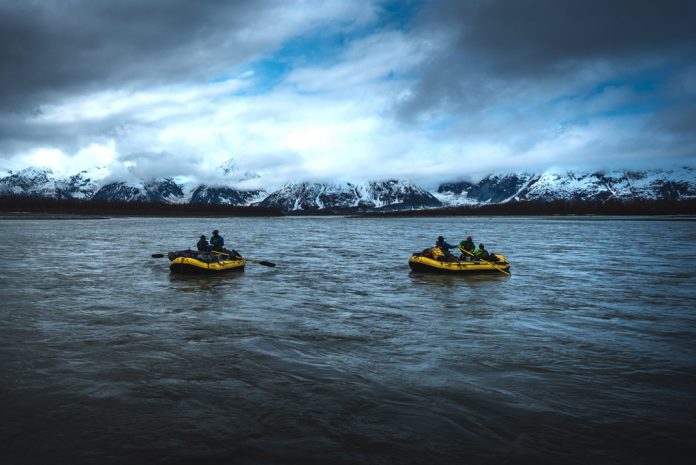
Darkness of the next storm cycle sets in on the wild Tatshenshini River. |Photos by Joey Schusler
Dirty chai latteeeee for Thomas!” he screamed in a high-pitched voice. We were a long, long way from a hipster coffee shop in downtown Seattle. Earlier that morning we had broken through the frozen headwaters of the Tatshenshini River, a 150-kilometer river tracking from the Yukon through British Columbia, to the ocean in Alaska.
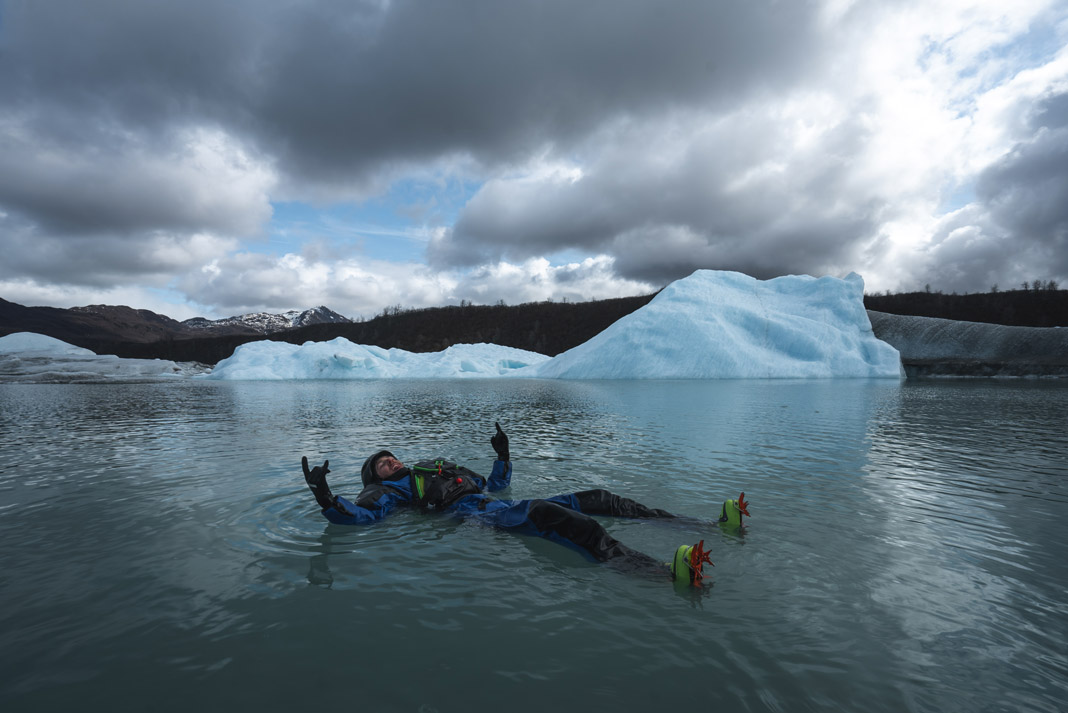
The zero-degree wind was whipping my face, and two-meter-thick walls of ice lined the banks. I was surrounded by nine soon-to-be best friends, bobbing in the frigid water in bright neon green and blue drysuits. A couple were preparing hummus wraps and chai lattes using Jet Boils, while others shot film with one of three drones.
I watched as refrigerator-sized ice chunks floated by our eddy, then glanced up to see Sam surfing one. I wondered what the pioneers and First Nations who originally used this river as a coastal trading route would have thought of this neon team of Teletubbies navigating their river, bantering and bullshitting for 21 days. I didn’t worry about it though—my abs were already too sore from laughing.
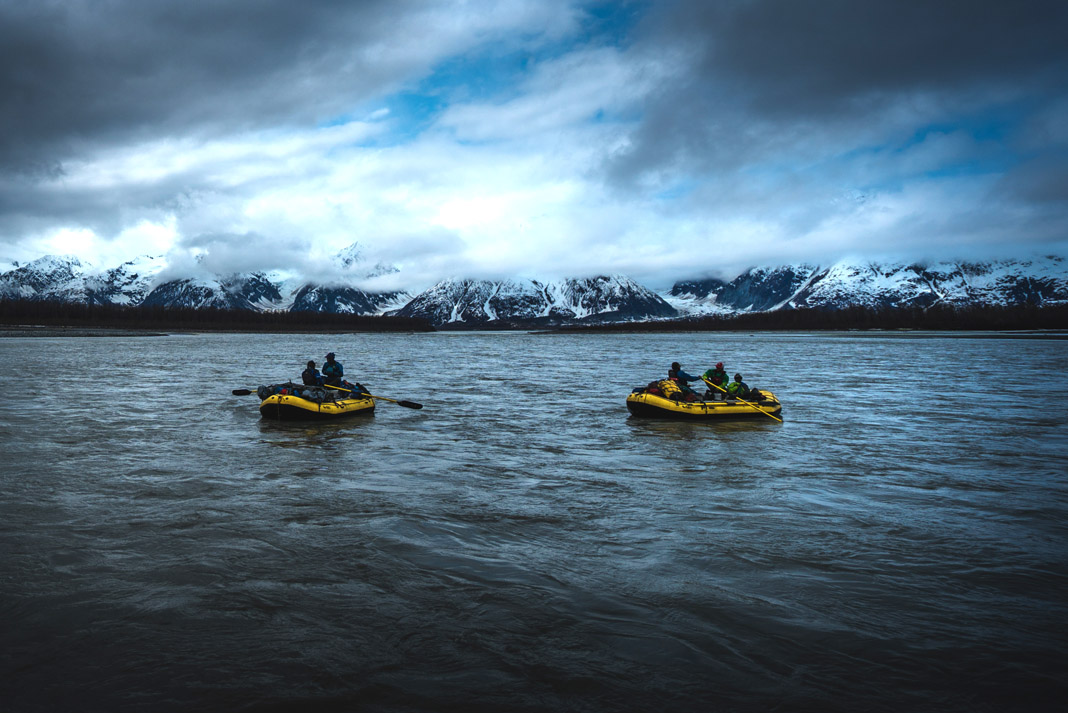
Darkness of the next storm cycle sets in on the wild Tatshenshini River. | Photos by Joey Schusler
Months prior, I had watched the gears turn in my friend Mason’s head as he pulled a tattered Tatshenshini guidebook off the shelf at a used book store in Bellingham, Washington. When Mason asked me to join him and eight other friends on this trip—what was essentially his bachelor party—my first thought was, “Mason is stupid for inviting me on this.” I am a professional forester and a mountain biker who spends a lot of time outside, but I was unprepared for a trip with this crew of superstar filmmakers, boaters, climbers and skiers, whose motto might as well be misery makes memories.
Nonetheless, I got down on my knees and begged for a month off work. The plan was to take three weeks over late April and early May to paddle down the Tatshenshini and Alsek rivers and ski the steep faces of the mountains directly into the waters. Joey Schusler, a professional adventure filmmaker and good friend, would document the trip and turn it into a film for Five Points Film Festival. Hours spent pouring over old guidebooks and Google Earth made it seem like our route was possible, though we also knew we were planning to put onto the river two months earlier than any other trip had.
My friends at home were encouraging and told me it was going to be the trip of a lifetime. What I didn’t mention were the fears bubbling up the more research we did—persistent frigid temperatures, spring storms, avalanche cycles, grizzly bears coming out of hibernation, raft-sucking ice bridges across the river, and most of all, the group dynamics in serious and unfamiliar terrain.
A week before the trip we were told by a bush pilot that large portions of the river were still frozen over. The group started mentally preparing for plan B, which involved dragging the loaded rafts using ski touring gear along or beside the frozen river until it was thawed enough to put in. All told, a fairly miserable prospect.
A day before arriving in Whitehorse we learned the river had thawed significantly, and there were now only a few ice bridges that could be an issue. We all breathed a sigh of relief.
I got to the put-in where the other nine guys waited without a clue about what just happened. What could go wrong on this trip, eh?
On D-day, the route to our put-in was four-kilometers long and covered in deep, soft snow. Bob and Kevin Daffe, owners of Tatshenshini Expediting, took care of us by assisting with a generation’s worth of knowledge about the river, nearly all of our gear and escorting us via school bus and snowmobile 240 kilometers from Whitehorse to the put-in.
The 10 of us dragged three rafts, 10 pairs of skis with accompanying backcountry gear, 21 days of food, all our paddling gear, and what seemed like a Hollywood production’s worth of camera gear down to the put-in using snowmobiles and hunting sleds. After hours of lapping back and forth, I felt at ease to be finally moving after the months of planning and anticipation.
On my final snowmobile lap, I slowed down a little to admire the sight of the sun dipping behind the mountains when the fully loaded sled with all of our food started passing me. I throttled as hard as I could on the steep downhill to whip the sled back behind me and maintain the tension on the rope. It swung back and forth violently, nearly tipping over as I leveled off, flying at 50 kilometers an hour. I got to the put-in where the other nine guys waited without a clue about what just happened. What could go wrong on this trip, eh?
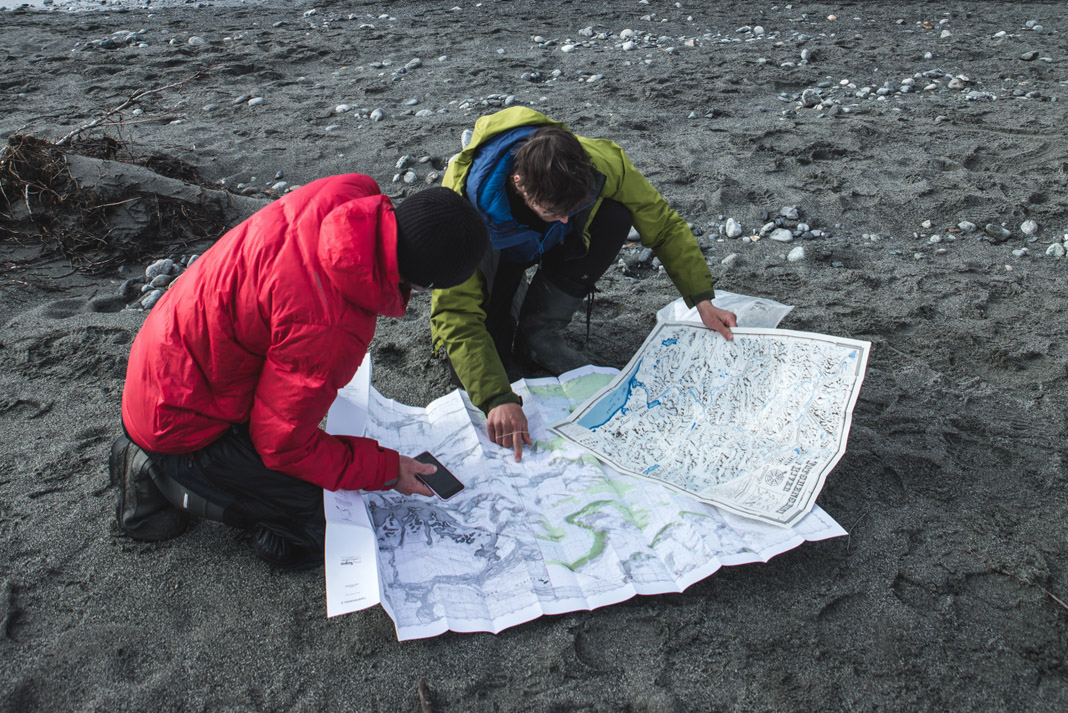
Mason Lacy and Sam Seward diligently poring over contour maps to plan each day. | Photo: Joey Schusler
Setting out on a true
cracker of a Yukon morning. | Photo: Joey Schusler
We apprehensively dipped our feet into the frigid water of the Tatshenshini on a clear, still Yukon morning. The sun was soft on the horizon, and the trickling river was covered in thick sparkling ice on both sides. Black cottonwoods and willows with small buds, still brittle from the long winter, dominated our peripheries. Less than a minute after boarding the raft and starting the journey, we were back out, wading through slushy water, trying to break up the frozen chunks in front of us, and squeezing our boats through the ice on both sides of the river. The rafts rumbled along cobbles in just a couple of inches of water. It was going to be a very long journey at this pace.
We pulled over occasionally to scout more turbulent rapids and ensure our rafts weren’t going to get sucked under the ice. As we got further in and the river opened up a bit, we were able to spend longer periods of time without having to manhandle the rafts. However, the air and water were so cold that if we didn’t have to push the rafts, we were frozen from not moving. I was wearing two fleece onesies beneath my drysuit and felt like a popsicle.
We coped with this by leaving one man on the oars of each raft while the remaining seven of us ran along the ice banks for kilometers at a time, warming our legs and bodies. Valuable—and hilarious—coping mechanisms emerged as we got into the flow of things: tea breaks, push-up breaks, the occasional on-raft-nap. My initial fears of the unknown on this trip eased, along with the rest of the team. We developed a rhythm of floating six to 10 hours a day and then setting up camp. We scouted rapids and potential ice bridges from over a kilometer out using drones paired with iPhones—a luxury the Tlingit traders on this route never had.
Our kitchen department was robust: rotations of wild rice gouda-cheese pancakes, nightly beers, and scratch-made brownies were a regular part of our diet. Good food was essential to keeping morale high in the cold.
Scouting ahead with the pack raft, Spencer Lacy get’s a feel what the icebergs have to offer. A true playground. | Photo: Joey Schusler
Mason Lacy leading the charge into a thick city of icebergs. | Photo: Joey Schusler
We ran the river at faster speeds than anticipated, and after less than a week we had powered past some of our planned campsites. Somewhere near the British Columbia border, the wide-open landscape of the Yukon gave way to the steep mountains of the Coastal Mountain Range. On another clear bluebird day, we drifted down the river to see glistening snow running from high summits right down to the river—time to go skiing and we were stoked. We had grand plans of skiing glaciers and claiming epic first descents on couloirs spitting out right on the river.
We spent our first day skiing and touring on the Netland Glacier amidst stunning terrain of a magnitude none of us had experienced before. We worked hard to get it, with a two-hour, spirit-breaking bushwhack through willows, slide alder, and thorny hawthorne on the approach. It was the perfect opportunity to work out how we would manage our group of 10—practicing crevasse rescue and rope skills, how we would split based on skill levels, and ironing out the rough bits of our soon-to-be-frequent skiing procedure.
We woke to a flooded camp, displaced rafts, river water just a few meters from our tents, and more roaring.
After our first learning day on the glacier, we spent the evening eyeing up more ski objectives, pouring over contour maps and old notes in our tents. And then the pitter patter of rain began. It rained hard through the night, and to our dismay, it kept on, hard and consistent for days. We passed the time reading, cooking and sleeping hard. I peered out from my tent one morning after what sounded like the roar of a jet engine taking off from just around the corner—it turned out to be a flock of a few hundred Canada geese, startled by someone taking a piss.
Getting the first ever turns down Gomer’s Delight above the floodplain. | Photo: Joey Schusler
Spencer Lacy is not one to turn down a pond skimming attempt.
This time it didn’t go so well. | Photo: Joey Schusler
As the rain continued, the mood started to dip amongst the crew, and on the second night of straight rain, the roar of what I thought were more geese seemed to go all through the night. We woke to a flooded camp, displaced rafts, river water just a few meters from our tents, and more roaring. As the light came into our deep valley, we saw that the roar was not geese but avalanches of saturated snow. Massive debris torrents ran down every mountainside.
When the weather let up, we finally made some moves. We were able to salvage some skiing by being creative, but a lot of our planned lines had been destroyed. We utilized the slide paths as access at times, and spent more time on glaciers instead of couloirs, staying on the flat and just skinning. A team worked hard to summit and ski a line proclaimed, “The Gomer’s Delight,” a mellow ridgeline on the horizon that we had spotted on Google Earth. I watched as the sun came out and the team ripped their skins. It was a magical feeling, sitting around our fire in the sand along the river, watching my ant-sized friends ski this visually stunning ridge, smoothly dancing their way down. We celebrated with a fire, burritos, and a Texas mickey of Crown Royal.
A desolate, quiet, martian landscape on route to a ski objective. | Photo: Joey Schusler
Sam Seward takes advantage of his drysuit in frigid water after attempting to free solo an iceberg. | Photo: Joey Schusler
As the trip wound down, we had become an efficient machine, learning how to communicate as a team of 10, keep morale high, and navigate the river. By the time we reached the Alsek confluence, the river was running at least 30,000 cubic feet per second—by no means a trickle anymore. The Tatshenshini is unique in that it starts in the flat plains of the Yukon plateau, and as you drop in elevation, the mountains become bigger, finishing in Alsek Lake, where snow-covered peaks and colossal glaciers surround the iceberg covered lake on nearly all sides. The Alaskan coastline sits just 10 miles to the west of this lake where we would be picked up.
Less than an hour after setting up our camp beside this picturesque lake, we utilized our iceberg playground to the fullest. Looking back, I think we all let our guards down a bit because we were so near the take-out, but everyone was just so riddled with joy. It resulted in 10 neon goons surfing down chunks of ice on paddleboards, doing backflips into the lake, having dance parties, and going on casual swims down the river. We spent a bit too much time doing this, and after a long, cold, hilariously fun journey, we paddled our way out to the take-out where we were picked up by a cargo plane the following morning to be taken back to Whitehorse.
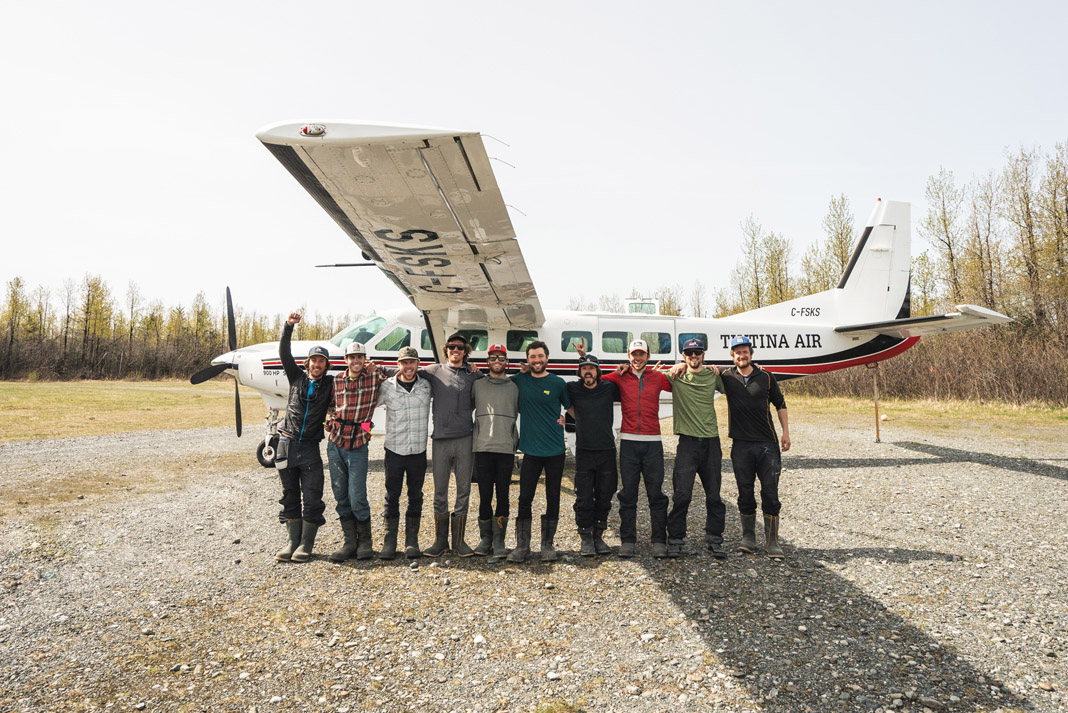
The team on pickup day. Flying over the river network brought a sense of closure to the trip. | Photo: Joey Schusler
When my friends and family ask me about this trip, I could probably pump out a lot of stories about overcoming adversity—the extreme cold, long days in the tent waiting out the rain, the risks of being way, way out there with nine others. But when I look back, an image comes to mind of Joey in his bright green drysuit, beer in hand, leading nine of us through a yoga class on the ice bank of the river, and I smile.
Misery makes memories? Sure, but that’s not what I choose to remember. I remember pure, type-one fun.
Evan Powell lives in British Columbia, where he’s a professional forester and lover of all adventures.
“A smart step,” Paul Brown says, “is one where you act quickly with only the means at hand.” Photo: Daniel Stewart
The Kipawa River spills under a bridge in the village of Laniel, a cluster of houses along the two-lane highway in northwestern Quebec. It’s roughly a six-hour drive from the Paddling Magazine office, which means if I leave after a full day of work, I’ll be rolling into town three hours after dark even on one of the longest days of the year.
It was around noon on Friday when my first trip to the annual Kipawa River Rally began to come together—around noon, 19 years ago. A chain of last-minute emails resulted in three of us able to drop everything, or nothing, and be on the road with six hours of notice.
Adrian was a river guide who was just off back-to-back seven-day trips. James had spent the week in a hammock rereading Corrections and was happy for anything else to do. I would have the early summer 2001 issue of Rapid off to printers in time to meet the boys at my place around six.
Paul Brown is a former editor at Business Week and he is the co-author of the business book Just Start: Take Action, Embrace Uncertainty, Create the Future, published by Harvard Business Review Press.
Based on his photo on Forbes.com, Brown doesn’t look like a paddler but if more of us followed his business advice, he would get us on the water more often. In his article, “If You Want To Be Successful, Don’t Spend Too Much Time Planning,” Brown suggests success begins with just two simple steps.
Brown’s first step toward success is desire. “You think of something you want. You don’t need a lot of passion; you only need sufficient desire to get started,” says Brown.
Getting started can be as simple as a one-liner email to a few buddies, “I’m thinking of heading to the Kip this weekend.” A common and mildly passionate plea to avoid mowing the lawn. But according to Brown, to be successful this is not quite enough.
There was nothing in the so-called convenience store except tobacco, soda, candy bars and preserved meats.
To make an idea happen one must, “Take a smart step as quickly as possible toward the goal,” says Brown. A smart step, he says, is one where you act quickly with the means at hand. No master plan, just immediate action.
I emailed again offering to drive and suggesting we meet at my place to load boats.
Brown says to take action, reflect and then build on what you’ve learned from taking the first step. Then, take another step toward the goal, reflect and build. Act, learn, build. Repeat until you arrive at the put-in of the Kipawa River.
The problem with planning, whether it is starting a whitewater paddling magazine at 26 years old with no journalism experience or heading off on a weekend adventure to a place you’ve never paddled, is the overwhelming list of shit we don’t know. What is the water level? How hard are the rapids? What boats should we bring? Is there camping? Are there restaurants nearby?
Planning, says Brown, “starts with the assumption that you can forecast the future with a high level of certainty.” The number of extremely predictable situations in everyday life is decreasing, not to mention the variables which make paddling rivers, lakes, and oceans so damn rewarding. Even the best-laid plans will get you only so far.
Waiting for the attendant to take the last few drags of his cigarette outside the roadside gas bar in the pulp and paper mill town of Témiscaming, I took note of the variety of beef jerky and an assortment of pepperoni stick flavors available. There was nothing in the so-called convenience store except tobacco, soda, candy bars and preserved meats. This was our last stop for supplies, and the real grocery store in town had closed hours ago.
If we’d taken the time to plan the perfect menu for the weekend, it would have passed us by. Are you spending too much time planning and missing out on fun adventures?
Listen to the advice of Paul Brown. With a little passion and one little action you can go now and figure the rest out along the way. This is bigger than just weekend festivals; his secret to success is the same for summer trips and bucket list expeditions. Kicking an idea into action gets the ball rolling, builds momentum and before you know it, you’re loading boats, packing gear and heading somewhere.
Almost 20 years later, I still believe piling into the truck late Friday night and stopping along the way to fill PFD pockets full of Mars bars and meat sticks is the key to success. Metaphorically speaking, of course.
Scott MacGregor is the founder and publisher of Paddling Magazine. He points out they stopped at a roadside French fry stand for dinner Friday night. Saturday night there was a river conservation fish fry fundraiser. He only ate Mars bars and meat sticks for two lunches and one breakfast. Mars bars were discontinued in the United States in 2002, replaced with the slightly different Snickers Almond. But you get the idea.
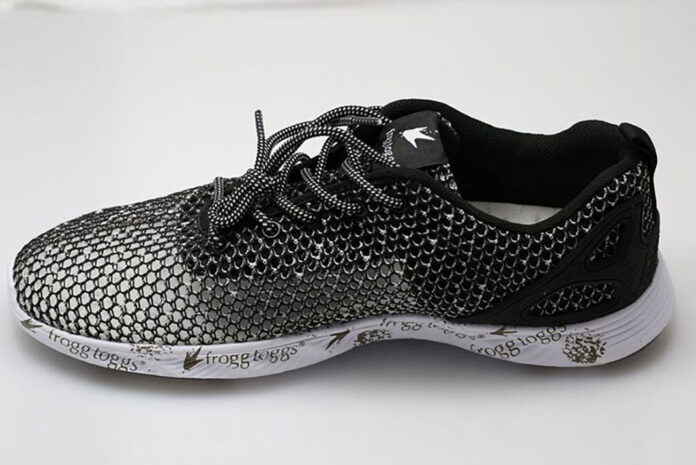
ARAB, Ala., July 12, 2019 — frogg toggs – the undisputed leader in lightweight, breathable, affordable rain gear – has become one of the most recognized names in the outerwear industry. During ICAST 2019, frogg toggs debuted its all-new shoe line and from the brand new performance footwear collection, “The Skipper” won “Best of Show” in the footwear category.
“frogg toggs has been in the game for many years but this is our first venture into the footwear industry,” said Will Fowler, frogg toggs®director of marketing. “Our commitment to producing quality products has always been the number one focus for the company and we made sure this stood true with the new performance footwear collection. Being named as the ‘best of’ during an established show like ICAST and amongst our peers is truly humbling.”
The Skipper is constructed with premium water drainage technology featuring a quick drying air mesh, breathable uppers “hold tight” elastic lacing system. With color options in mossy green or black, this high performing shoe contains cushioned midsoles with water expulsion release holes and lightweight outsoles featuring strategic slip grip rubber inserts.
“With this collection, we set out to build a line of shoes that could withstand the rigors of days spent out on the trails and water, all while keeping your feet dry and comfortable,” said Bob Hollenberg, frogg toggs vice president of footwear division. “The Skipper is truly unique with its premium water drainage technology that features a quick drying air mesh, breathable uppers “hold tight” elastic lacing system. Combine that with the FTX Aquaclearz drainage system bottom construction and you have the ultimate drainage shoe.”
Working with the best shoe factories throughout the globe, frogg toggshas produced the ultimate in fishing, boating, and hunting footwear for the entire family. This collection features high tech waterproof breathable materials, premium rugged leather uppers, rust proof metal hardware, memory foam cushioning, rip proof nylon uppers, moisture wicking linings, and slip resistant outsoles.
“The Skipper,” along with the rest of frogg toggs’new shoe line, will be available for purchase to the general public beginning in 2020. For more information about frogg toggs please visit froggtoggs.com, or check them out on Facebook and Instagram.
ABOUT FROGG TOGGS
There’s a simple philosophy at frogg toggs: Put the customer first. For more than 20 years, frogg toggs prides itself on providing first-class rain gear and accessories. frogg toggs doesn’t just love the outdoors, and it doesn’t simply respect the outdoors, the brand understands the outdoors – and what customers need to make the most of it. Its lightweight, breathable and affordable products are designed with quality materials and created with a single purpose in mind: top-of line performance. From hunting and fishing to golfing and simply enjoying nature’s wonders, frogg toggs’ shares its love for the great outdoors and offers products that enhance user experience.
Media Contact
Will Fowler, Director of Marketing will@froggtoggs.com
131 Sundown Drive NW, Arab, AL 35016
800-349-1835
Have Fun, Give Back and Make Memories in the 1000 Islands this Summer!
1000 Islands—Hammond, NY (July 11, 2019) —If you love adventures in the great outdoors, enjoy giving back to the community, desire to create and nurture great friendships and dream of living the best life possible along the St. Lawrence River, then join the fun in “Paddlers Paradise” this summer!
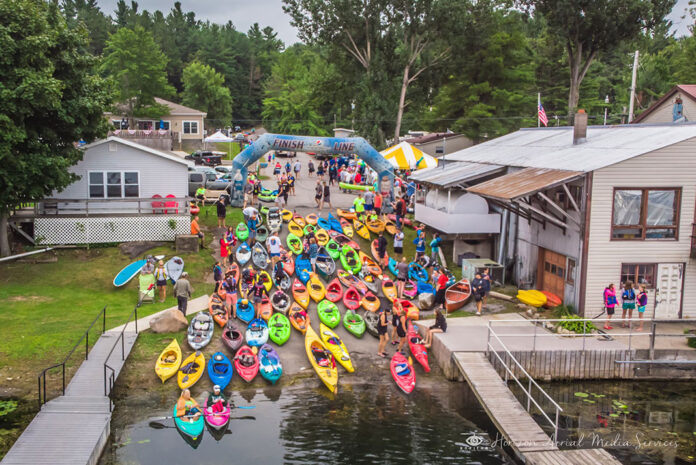
On Saturday, August 17th participants of all ages and skill levels are invited to experience the “Beauty of Betterment” in the Sanctuary of the 1000 Islands and Black Lake regions at the 6th Annual Paddle for a Purpose. People will do this for two reasons: 1) as an opportunity to have a great time in the outdoors with like-minded, fun and amazing people, and 2) to be part of a solution: to create an immediate, positive impact in the community. Hosted by The Foundation for Community Betterment all proceeds benefit organizations, community projects and individuals in need.
Erica Garlock, member of the organizing team said, “There is a serenity and camaraderie that exists when you’re with a group of people out on the water. It is beautiful to see and very special to be a part of. Our community is extremely proud to host this exciting event, which allows residents and visitors from around the world to experience the natural beauty of our region. All while creating a ripple effect of kindness that allows us all to have a direct and meaningful impact in the lives of others.”
Beginning promptly at 9 a.m. (rain or shine at Schermerhorn Harbor) hundreds of paddlers from near and far will climb into beautiful wooden and plastic vessels to venture out into Chippewa Bay. Participants will enjoy a short voyage through a picturesque riverside course in “paddlers’ paradise.” Paddlers travel from island to island in kayaks, canoes, skiffs or stand-up paddle boards to collect cards to be played in their poker hand. Incredible grand prizes are awarded to adults and youth with the best hands for 1st, 2nd and 3rd Place—including an overnight stay at world-famous
All paddlers are eligible to win amazing door prizes from local businesses! An awards ceremony complete with recipient acknowledgements, music and food immediately follows at Foster’s Harbor Inn.
Rebecca Hertzig, paddler from Baldwinsville, NY said, “This event is A MUST DO!! We had a blast! Such fun with so many friendly people. River life is the best!”
Online Pre-registration is highly encouraged by AUGUST 2nd at www.VisitHammondNY.com.By pre-registering, paddlers receive $5 off registration PLUS a FREE fitted t-shirt worth $15! Registration is open after the cut-off date and on event day for $35 (Adults) and $25 (Youth), but a free shirt is not included. Single and double seated kayak rentals are available online. This year’s exciting raffle item is a CRYSTAL CLEAR BOTTOM KAYAK worth over $2,500! Tickets are only $5 each or 3 for $10. Spectators welcome! Follow the event on facebook @ChippewaBayPokerRun.
ABOUT THE PADDLE & HOSTS:
The Chippewa Bay Poker Run—“Paddle For a Purpose”—is hosted by the Foundation for Community Betterment and volunteers in Hammond who wish to celebrate and promote business and tourism in their community (www.VisitHammondNY.com). Travelers and outdoor enthusiasts from near and far are invited to experience the beauty of Chippewa Bay’s islands and scenic vistas—while at the same time give back to “Community Betterment” initiatives. The Foundation for Community Betterment is a national and local network of generous individuals who believe a simple gesture that touches just one life can positively impact an entire community. As their logo symbolizes, it is our hope that simple actions can create a “Ripple Effect” of goodness in our community through the actions of the recipients we support. Since 2014, the event has contributed over $25,000 to the area community through generosity of its supporters.
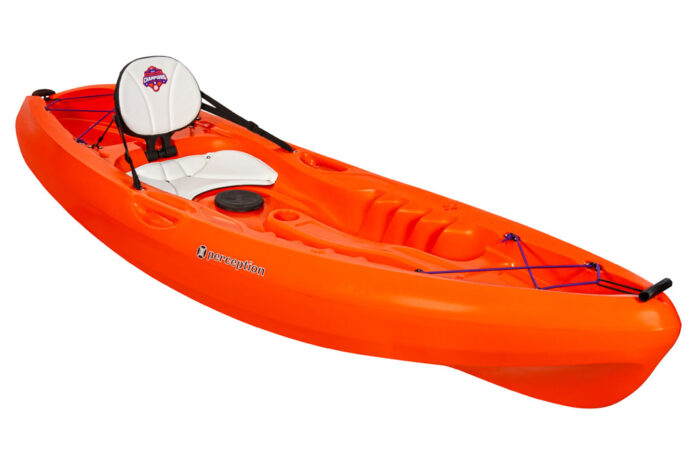
Greenville, SC (July 10, 2019) – Perception Kayaks, a global leader in kayak innovation and design, is proud to announce the first collaboration with higher learning institution Clemson University. The Greenville based company has received the exclusive rights to manufacture and sell the first and only Clemson University National Championship Tribe.
The University will be sending representatives from Clemson, the Clemson Tiger Mascot and the National Championship trophy to the Confluence Headquarters to kickoff production of the first Clemson University National Championship Tribe. Sporting the university’s iconic orange colors, Tiger paw logo and purple accents, this kayak is one for the true fans. Honoring the team’s historic two title victories in the past three years, with the Clemson National Championship logo highlighted squarely on the seat back.
The Perception Tribe 9.5’ was chosen for the Clemson National Championship collaboration because the series of sit-on-top kayaks is defined by their ultra-stable, yet quick and playful performance. The entire family will appreciate how easy it is to get on and off this stable sit-on-top. Featuring an extra-padded and National Championship branded adjustable seat, the Clemson Tribe is ready for full days exploring flat-water rivers, lakes, ponds, and coastal waters with light waves.
Perception Kayaks’ Clemson Tigers model is available in a limited quantity to Clemson fans nationwide at PerceptionKayaks.com, along with specialty retail locations. For more information, visit the site or follow the brand on Instagram at @perceptionkayak and Facebook at @PerceptionKayaks.
About Perception Kayaks®
As the world leader for kayak innovation, Perception® Kayaks has introduced more people to paddling than any other brand and pioneered the modern kayak design and construction over 40 years ago. Perception Kayaks is a company of passionate paddlers who design kayaks for comfort, stability, durability, safety, and performance. The proprietary resin and innovative rotational molding process used provides superior strength and light weight in a leak-proof one-piece construction. The result is a lineup of the most comfortable, versatile, and easy-paddling kayaks with unmatched UV, impact, and abrasion-resistant. Best of all, every Perception kayak is proudly designed, molded, and hand assembled in Greenville, South Carolina, USA.
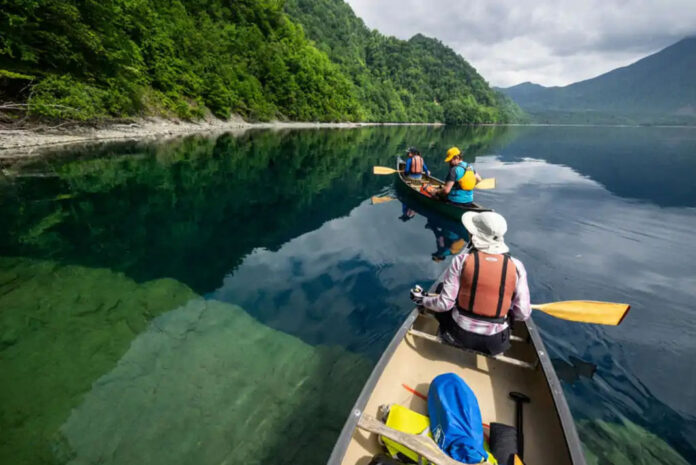
Sapporo City, Japan: New Zealand couple Rob and Haidee Thomson have announced a three-year ‘expedition’ to document over 50 canoe and packrafting routes in Hokkaido, Japan’s northern-most island. Along with former New Zealand whitewater kayak representative Chris Auld, the team will produce detailed route guides for the established lake and river touring routes to be posted on their popular Hokkaido outdoor website, HokkaidoWilds.org. These routes guides, produced during weekend and vacation trips across the island, will be the first of their kind to be produced in English in Japan.
“Hokkaido is Japan’s most wild and rugged island, with a number of pristine rivers and lakes, many perfect for overnight and multi-day canoeing trips,” explains HokkaidoWilds.org founder Rob Thomson. “These are no secret to local canoeists, with a number of Japanese guidebooks published in the 1990’s. We’re calling this project an expedition, but we have day jobs. So really, it’ll be three years of weekend and vacation micro-adventuring, making the most of the time we have off. We’ve already published over 100 ski, cycle, and hike routes, so we’re excited to add canoeing and packrafting routes to the site.”
Hokkaido Wilds canoe touring database features
GPX and KML route files for GPS navigation.
Printable PDF topographical maps and official topo map references.
Live river water level information including webcams.
Put in locations and public transport information.
Location-based search (find routes near you).
Route guide plus photos.
Onsen hotsprings nearby each route.
Safety tips and frequently asked questions.
Ainu place names
Along with canoe touring routes, new to HokkaidoWilds.org is the inclusion of Ainu river, lake, and mountain names on route guide posts. HokkaidoWilds.org is committed to acknowledging historical and contemporary Ainu heritage of Hokkaido.
Sponsors
The Hokkaido Wilds canoe route documentation project is supported by the following companies.
Guide House Canoa – Based in Lake Shikotsu Village in Hokkaido, Canadian canoe guiding company Canoa provided two Nova Craft Prospector 16’ canoes for the project.
MRS Packrafts – As one of the world’s leading packraft manufacturers, MRS provided Hokkaido Wilds with their two-person Barracuda R2 Pro packraft.
Day Two NZ – Based in Rotorua, New Zealand, Day Two has provided discounted gear.
About Hokkaido Wilds
The Hokkaido Wilds is a non-profit website that exists to inspire people to explore and enjoy Hokkaido’s extraordinary outdoors by ski, bicycle, foot, and canoe in an informed and responsible way. The site currently boasts over 100 ski touring, cycle touring, hiking routes, all accessible for free.
100% of revenue earned on the site through guide referrals and links goes to a fund to support local Hokkaido volunteer groups committed to sustainable access to the Hokkaido outdoors (incorporated non-profit status planned for early 2020).
Hokkaido Wilds founder Rob Thomson is no stranger to adventure travel and expeditions. He previously cycled from Japan to Switzerland, and still holds the Guinness World Record for the Longest Journey by Skateboard (12,159km). He has lived in Japan for 12 years (8 in Hokkaido), and works as an assistant professor of media and communications at Hokusei Gakuen University in Sapporo City. Chris Auld has completed a number of multi-day whitewater expeditions in North America and New Zealand. HokkaidoWilds.org visuals were designed by award-winning Polish graphic designer Dominika Gan.
The U.S. unemployment rate fell to 3.6 percent in April, a 50-year low. The figure in Canada is 3.8 percent, and young people throughout North America are spending less time than ever outdoors. It’s no wonder paddling shops are having a tough time finding qualified employees these days.
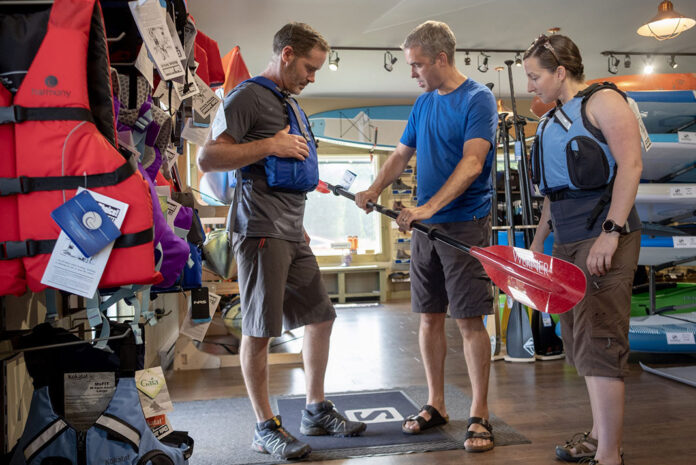
“I’ll tell you something everybody will agree with: It’s getting harder and harder to hire great employees,” says Darren Bush, owner of Rutabaga Paddlesports in Madison, Wisconsin, where unemployment is hovering at about 2.5 percent and McDonalds is paying $14 an hour. We asked retailers across North America how they manage to find and keep good staff in such a competitive environment. Their verdict: You can’t afford to be cheap.
“Rule number one is find out what the prevailing wage is in your town and pay it,” Bush advises. Good employees command higher wages, but they’re often worth the extra cost. “It’s better to have 10 people making $15 an hour than 15 people making $10 an hour,” he says. “We’re short-staffed right now, down maybe three people from where I’d like to be. But the people I have are great.”
Bush pays competitive wages and provides matching 401K and health benefits (he’s on the same insurance plan as his employees). It’s a big expense, but not as costly as staff turnover. “I don’t know why this is a secret,” he says. “At the end of the day it comes down to treating people like human beings. The owners I know who do that have very successful businesses and do very well.”
You don’t have to hire paddlers
“We try to hire paddling enthusiasts, but nowadays we don’t need enthusiasts. What we need is somebody with good communications skills and customer service experience,” says Mike Ong, owner of Southwind Kayaks in Irvine, Ca. The ideal shop employee is an avid paddler who is great with people, but the 14-year industry veteran says people who fit that description are harder than ever to find and keep. “If that’s what you’re looking for, good luck,” he says.
Know your customers’ needs
Knowledge helps sell, but it’s important to hire employees who have the right kind of knowledge, says Steve Marshall, owner of Paddleyax in Independence, Virginia. The bulk of Marshall’s business is in fishing kayaks, and his customers are moved more by fishing tips than kayaking jargon. “Given a choice between someone who worked in a big-city kayak store or someone who’s new to kayaking but familiar with the fishing here, I’d go with the local guy,” he says.
Good staff come in all ages
“I’ve had a couple really good young employees come through. Their communication skills and outdoor experience were fantastic, but after a year or so they move on with their lives,” says Sean Creary, owner of River and Trail Outdoor Company in Rothesay, New Brunswick. Creary was happy to have those flashy young stars, but his bedrock employees are older. “They’ve got kids and are at a point in their life where they’re happy working at the shop. I give them lots of flexibility and I pay them well.”
Resist the rush
Chances are, the perfect candidate won’t walk through your door as soon as you post a help-wanted ad. Creary prefers to hold out for the right candidate, even if that means picking up extra hours himself. “It’s more important to have the right person in the store, even if that means it’s going to be me for the next little while,” he says.
Know your weaknesses
Too many retailers look to hire a younger version of themselves, but the goal of hiring shouldn’t be to duplicate your own strengths. It should be to complement your team. Simon Coward, owner of Aquabatics in Calgary and Edmonton, Alberta, puts it more bluntly: “Realize what you suck at and pay people to do it for you.”
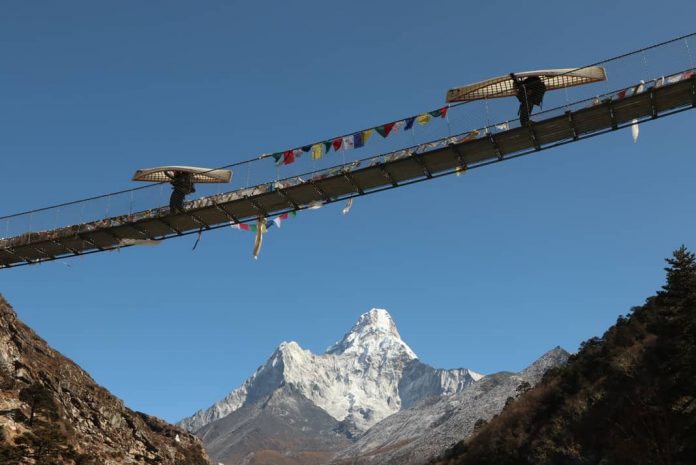
The brothers hiked from the city of Lukla at 8,383 feet above sea level to Everest Base Camp at 17,600 feet over 18 days. Gnarliest portage ever. Photo: Seton Roberts
Think back to the most difficult portage you’ve ever experienced. Maybe there was miserable weather, rugged terrain, unbearable distances or injuries along the way. You felt tired, overwhelmed and focused on just putting one foot in front of the other. Now, imagine that for 18 days. And, when the portage comes to an end, there isn’t any water in sight.
That was the reality for two brothers, Kyle Roberts and Tom Schellenberg, who took portaging to new heights on January 18 when they reached Mount Everest Base Camp in Nepal after a grueling 58-mile portage.
Why did the brothers portage canoes through Mount Everest?
The mission of The Weight We Carry, a non-profit organization founded by the brothers, is to carry canoes to the most unlikely places on earth in support of mental health.
Roberts and Schellenberg have friends and family who have suffered mental health illnesses, and the two 30-pound Cape Falcon Kayak skin-on-frame canoes they carried represented the extra burden people living with mental health issues face.
As a tribute to growing up camping and canoeing in Algonquin Park, they both have a map of Algonquin Park tattooed on their shoulders. Their love for camping in combination with their determination to help others is what drove them to start this unique non-profit.
Planning for a good cause
This expedition was two years in the making. The brothers took a hiking trip to Everest Base Camp in 2016, where they witnessed the devastation of the 2015 earthquake. This inspired the pair to raise money to support the local community.
Speaking with the brothers via satellite phone while they were in a tea house just below Base Camp, they agreed the most challenging parts of the climb came from high winds, cold temperatures and the rough terrain they were trekking on.
“Keeping our hands on the gunwales of the canoe was very difficult. Our hands were freezing but the winds were so strong we weren’t able to let go of the canoe,” said Schellenberg.
“It was a challenge to find a comfortable position to rest the canoe after carrying them for such a long period. We were constantly making adjustments to relieve pain where we could,” said Roberts.
In addition to carrying 60 pounds of gear and 30-pound canoes, Tom was fighting a pain on the big toe of his left foot.
“My toenail was being driven into my foot causing an infection with a lot of discomfort. It was likely from climbing all the elevation. I was soaking it in salt water in the evenings and had a few doctors evaluate it on the way up and decided I wanted to keep climbing,” said Schellenberg.
What is their goal?
The pair raised $75,000 and is continuing to fundraise back home with hopes of hitting their goal of $150,000. The money will fund the construction of The Women’s Mental Health Centre facility for Koshish, a Nepalese organization providing short-term care for women with mental health illness.
“The canoes grabbed a lot of attention. We found it difficult in some circumstances to communicate what it was we were trying to do. For those who did understand, everyone was very appreciative of us giving back to their communities” said Roberts.
After reaching Everest Base Camp, the pair turned around to begin a weeklong trek back down the mountain. In total, they hiked 115 miles with almost 70,000 feet of vertical altitude gain on the long portage to and from Base Camp.
Donations are still being accepted at www.theweightwecarry.com.
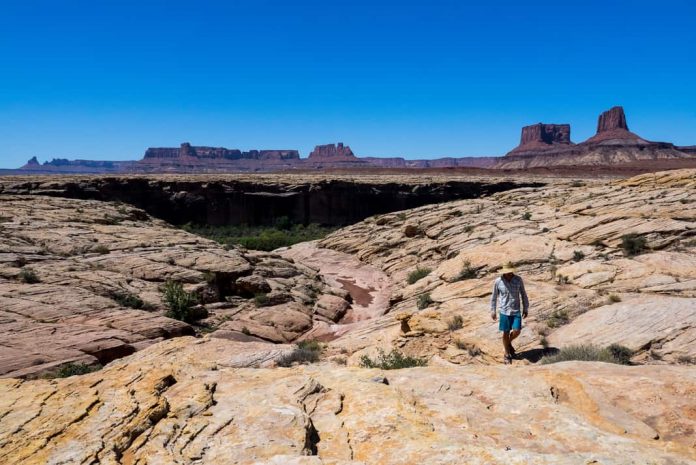
At 730 miles long, the Green River is the largest tributary of the Colorado River. Its headwaters are in the Wind River Range in Wyoming. | Photo: Mike Bezemek
In mid-July of 1869, John Wesley Powell and crew, in three wooden rowboats, spilled haphazardly out of Gray Canyon into a sandy basin near present-day Green River, Utah. They were down a man who had left the expedition after a boat was wrecked in the rapids of Lodore Canyon the month before.
Already they’d come about 400 miles—running, lining, and portaging hundreds of rapids. After 20 miles of easy floating, a new canyon appeared. Rising bluffs typically foretold trouble, but this canyon was different.
The river was calm as a lake, sweeping through great meanders between cliffs of orange sandstone. The circuitous route through colorfully changing rock formations became so tortuous, Powell named it Labyrinth Canyon. When spires and buttes rose overhead, this became Tower Park. And when the walls deepened into a more coherent gorge above the confluence, Powell reminded mapmakers about the slow current: Stillwater Canyon.
Today, these sections along 140 miles of the Green River offer some of the finest flatwater paddling in the desert Southwest. Given the remote region the river travels through, access points are few and distances between far. But if you’re in good paddling shape, comfortable with remote runs and interested in unreal scenery, this is for you. Mid-to late-spring and early-to mid-fall are preferred, while mid-summer is a real scorcher. Side hikes, ruins and rock art are just as good as the paddling.
Weather: Sunny with a slight chance of shade, if you have an umbrella. Be prepared for big temp swings, powerful winds and sudden thunderstorms. This is high desert.
Shuttle: Coyote Shuttle offers vehicle transfers and full-service shuttles for trips down Labyrinth and Stillwater. coyoteshuttle.com
Don’t Miss: Nearby Moab, Utah, is one of the top adventure towns in the U.S., with enough world-class mountain biking trails to make the most dedicated paddler consider (temporarily) switching sports.
Diversions: Winding above the river through Tower Park is the White Rim Road, a 100-mile unpaved loop through the Island in the Sky district of Canyonlands National Park. A National Parks Service permit is required.
Learn More: For a guide to 1,600 miles on the Green and Colorado Rivers, plus the dramatic story of the 1869 expedition, see Paddling the John Wesley Powell Route by Mike Bezemek.
If you have a half day
Upstream from Green River, Utah, the Daily is eight miles of easy, pool-drop class II-II+ through the stark but scenic Gray Canyon. It’s a somewhat popular stretch for beginner whitewater kayaking and warm-weather floats. Put-in is at the primitive Nefertiti Access. Take-out is at Swaseys Beach boat ramp. Self shuttle using the unpaved, riverside Beach Road.
If you have a full day
The shorter option is 12.5 miles, through irrigated farm fields, from Swaseys to Green River State Park. But the more ambitious and interesting option is 23 miles from the state park to Ruby Ranch, past the curious manmade Crystal Geyser, gypsum buttes, and the scenic beginnings of Labyrinth Canyon. The shuttle on I-70 and unpaved Ruby Ranch Road takes one hour each way.
If you have a weekend
Make it a long weekend, and paddle 45 miles from Ruby Ranch to Mineral Bottom through a landscape that will change your life—and possibly take years off your vehicle’s suspension. Highlights include Trin Alcove, Navajo Sandstone, Bowknot Bend, and much more. A self-issue permit is required for Labyrinth Canyon, available online from BLM.
If you have a week
Then, boy, you’re going to need it. Combine the Lab trip above with 52 miles through Tower Park and Stillwater Canyon in the otherworldly Canyonlands National Park—advance permit required, but no lottery or quotas. There’s no take-out, so arrange a jet boat extraction from Spanish Bottom just below the confluence of the Colorado River upstream to Moab. What else? Fort Bottom. White Rim. Upheaval Dome. Butte of the Cross. Dollhouse. Yeah, I’m just listing cool stuff—are you Googling yet? You should be sitting down when you do.
At 730 miles long, the Green River is the largest tributary of the Colorado River. Its headwaters are in the Wind River Range in Wyoming. Feature Photo: Mike Bezemek