Home Blog Page 241

Out of Place: Modern River Guiding

THE BEST RIVER GUIDES ARE ALSO GUARDIANS OF LOCAL KNOWLEDGE. | PHOTO: RYAN CREARY

August 16, 1899, is the date most historians point to as the start of North America’s adventure tourism industry. It was the day that Christian Hasler and Eduard Feus stepped off Cana- da’s newly completed coast-to-coast Canadian Pacific railway; seasoned Swiss mountain guides imported to lead vacationing gentleman into the unexplored Canadian Rockies.

Archived images of the two dressed in woollen blazers and hobnailed boots make it an appealing and enduring creation myth. But it’s all wrong.

Guiding dates to the earliest days of European settlement on this continent including First Nations guides, French voyageurs, America’s overland wagon train guides, and the celebrated timber raftsmen. Our geographic and industrial history is forged by the anonymous guide. However this history is about exploration and commerce, not recreation or tourism. Hence the myth of the Swiss guide. While their role in establishing mountain culture is undeniable, a substantial body of river guides were working eastern rivers a generation before Hasler and Feus stepped off the train.

At the end of the eighteenth century, the only people with time and money for recreation were gentleman industrialists and professionals. This privileged class brought with them their English sensibilities and ideals of sportsmanship. They enjoyed horse- back riding, trekking in the moun- tains and hunting for fox. These were noble pursuits, character building and rejuvenating.

As sportsmen explored outwards from the eastern seaboard’s growing cities in the 1830s, they knocked on fur trading post doors to request lodging and guiding down the rivers to the best hunting and fishing. Homesteaders saw this opportunity and turned from subsistence farming to outfitting, creating the backcountry lodge as we know it today.

With this movement toward outfitting came more and more guides. Local woodsmen and trappers found they could supplement their income by bringing sportsmen along.

They shared their previously unappreciated river running skills, such as poling up rivers and running rapids. Unlike their industrial guiding cousins employed in the fur trade, these early sports guides showed little fear of whitewater and enjoyed running rapids in an era long before life jackets.
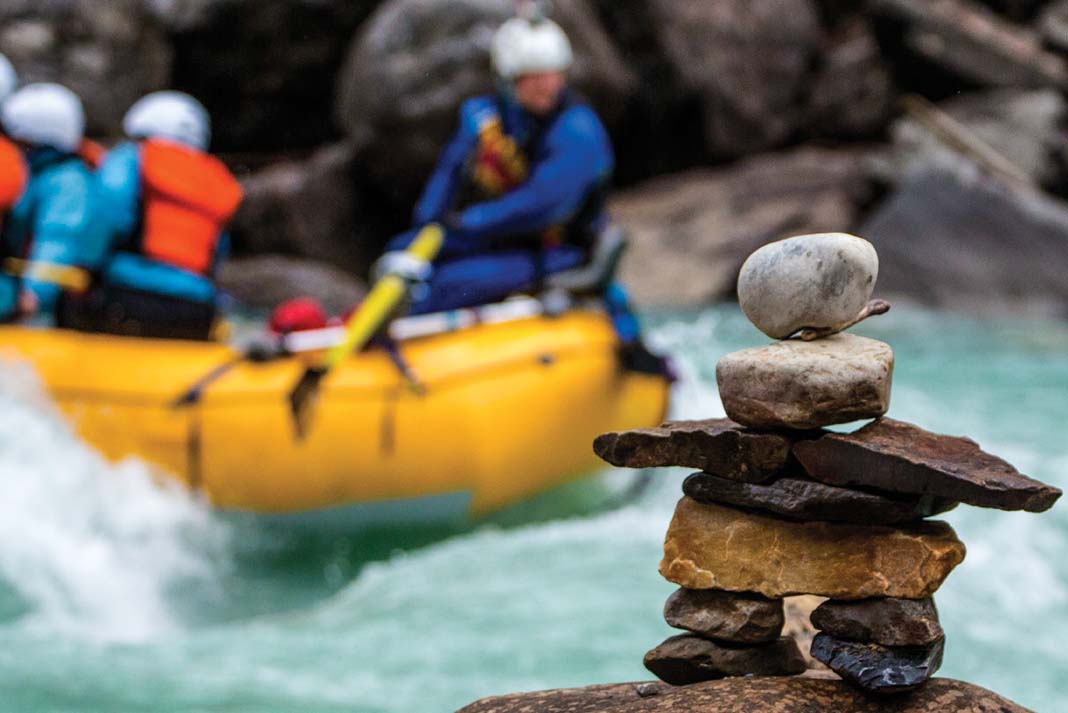
THE BEST RIVER GUIDES ARE ALSO GUARDIANS OF LOCAL KNOWLEDGE. | PHOTO: RYAN CREARY

Outdoor tourism remained more or less unchanged for nearly a century—affluent outdoorsmen hiring local experts to safely guide them to the best places. Guiding required real competency and intimate local knowledge. All of this was flipped on its head in the 1960s. Automobiles, highway systems and a burgeoning middle class saw the rise of the vacation.

Combined with an emerging environmental awareness, total novices were now heading for the wilderness for adventure. Outfitting became mobile, and traveling with it a new breed of guide anchored not to a place but to a particular set of skills. Guides became technical experts and activity supervisors, escorting tourists to places where they themselves where only visitors.

This paradigm is still prominent today. First hand local knowledge and our value of “place” has been shuffled aside and replaced by customer service standards and the importance of “experience.” Connection to place adds richness to experience. Guides as tourists just commodifies the wilderness, rather than making it the whole point of the adventure.

Of course this intimate knowledge of place—what makes guided wilderness trips so valuable—can be learned.

To do so, guides need to become students of the places in which they travel, rather than just showing up and imposing our skills upon them. River guiding has a long and honorable tradition, to which we can pay homage simply by immersing ourselves in the places in which we paddle. By striving to become the most recent iteration of intimate local knowledge, we create real value in the trips we run by attaching what our clients experience to a living, breathing river.

Jeff Jackson is a professor with Algonquin College’s Outdoor Adventure guide training diploma and the co-author of Managing Risk: Systems Planning for Outdoor Adventure Programs.


This article originally appeared in Rapid
Early Summer 2016 issue.

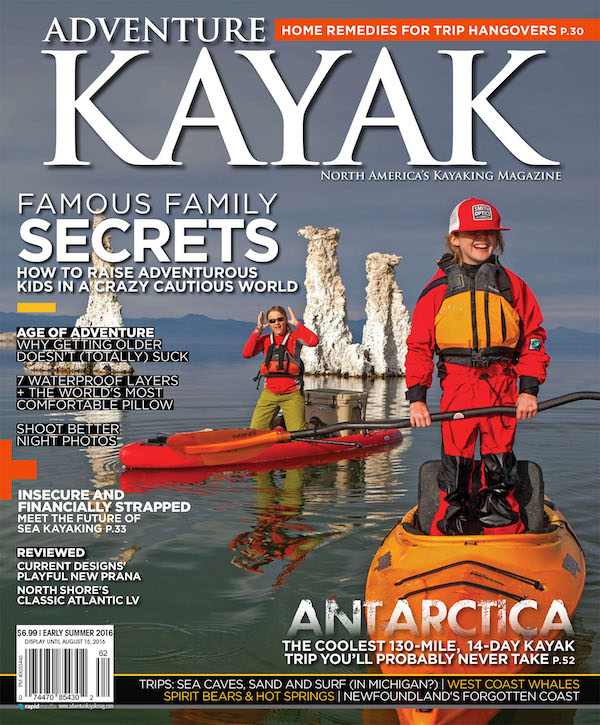
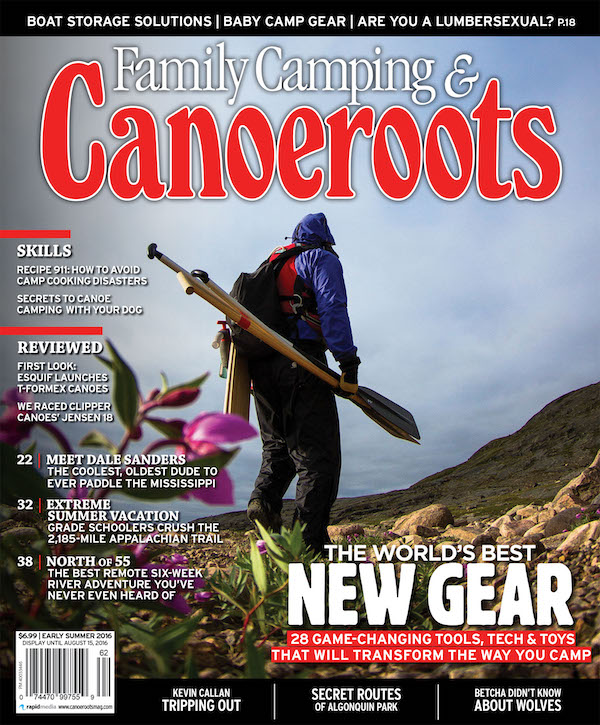
Subscribe to Paddling Magazine and get 25 years of digital magazine archives including our legacy titles: Rapid, Adventure Kayak and Canoeroots.
Confessions Of A Nervous Novice

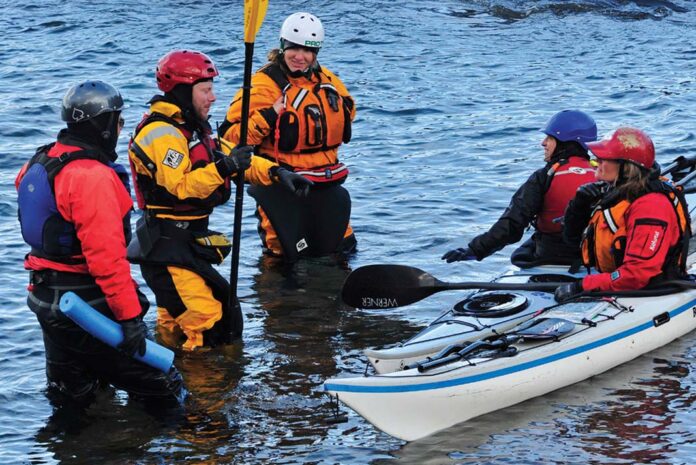
TODAY’S LESSON: UNDERSTANDING MILLENNIALS. | PHOTO: VIRGINIA MARSHALL

Full disclosure: I’m a millennial. I’m of the demographic this magazine once characterized as “pathologically anxious and dependent young adults.” I’m trying my hardest in a world where the generational divide can seem downright cavernous. And over the past year or so, I’ve become a kayaker. Still reading? Good on you for your willingness to listen to a Millennial.

Some veterans of the sport have suggested that many kayakers, especially those new to the community, get bogged down by all the training and certification hoops they’re asked to jump through. The wall of intimidating acronyms is large and seems to stand prominently in the newcomer’s path down to the water.

These longtime paddlers, most of them greying Boomers, understand that there’s another route to becoming a kayaker: the caveman route. The figure-it-out-as-you-go route. The option to quietly side-step officiality and simply trot down to the surf. So why don’t we Millennials take this simpler, nobler path?

The thicket of certifications and acronyms is so unavoidable that newcomers might not even see that other route. Or maybe they do, maybe they know the caveman route exists. But here’s the thing: that path isn’t free of barriers, either. It comprises a slew of obstacles that exist in the lives of us youngsters. There are emotional barriers. There are social barriers. There are financial barriers. We didn’t choose to put those hurdles there, but there they are.

“Certifications give me something I value above thrill: peace of mind.”

Yes, I am one of the earlier products of helicopter parenting. My parents were concerned for my safety, and wanted me to know that they were proud of me. And yes, I’m now rather insecure. I’m anxious, I’m timid, I’m nervous. I don’t blame my parents; I had a great childhood and I love the person I’m growing to be. Being helicoptered made me sensitive, thoughtful and honest. It also made me too terrified to buy a boat, drag it down to Lake Erie and hop in. What may sound like an adventure to some sounds like a cold and simply trot down to the surf. So why don’t we Millennials take this simpler, nobler path?

The thicket of certifications and acronyms is so unavoidable that newcomers might not even see that other route. Or maybe they do, maybe they know the caveman route exists. But here’s the thing: that path isn’t free of barriers, either. It comprises a slew of obstacles that exist in the lives of us youngsters. There are emotional barriers. There are social barriers. There are financial barriers. We didn’t choose to put those hurdles there, but there they are.

Yes, I am one of the earlier products of helicopter parenting. My parents were concerned for my safety, and wanted me to know that they were proud of me. And yes, I’m now rather insecure. I’m anxious, I’m timid, I’m nervous. I don’t blame my parents; I had a great childhood and I love the person I’m growing to be. Being helicoptered made me sensitive, thoughtful and honest. It also made me too terrified to buy a boat, drag it down to Lake Erie and hop in. What may sound like an adventure to some sounds like a cold and watery grave to me. Blame my upbringing, blame my generation, blamewhateveryouwant—still, I could never do it.

Certifications give me some- thing I value above thrill: peace of mind. They foster confidence in my ability to be safe, to live to paddle another day. This confidence allows me to actually relax and have fun while paddling, rather than worry with each stroke. At the end of the class, the instructor gives me the pat on the back that I need to feel secure. If it weren’t for a class, an instructor, a credential, I’d never have the gumption to get out on the water. Credentials empower the meek of heart to conquer the intimidating emotional barrier to paddling.

Classes help with the social barrier, too. You may be thinking that I don’t need an instructor for that—I should just go out and find some kayaking buddies. Well, maybe that’s feasible in mystical places where there’s a kayak shop on every corner and paddlers on every pond. The West Coast, perhaps, or maybe Minnesota? I live in Toledo, Ohio. There’s a paddling shop an hour’s drive away. There’s one small livery just outside of town, but they offer no instruction.

There is a relatively new kayaking club, but I wouldn’t have found it if it weren’t for the ACA class I joined. The class was a gateway to meeting the very few fellow kayakers in my area. And given what I’ve already told you about being helicoptered, you can probably guess that we Millennials prefer not to paddle alone. For those of us who live in places like Toledo, the social barrier is a real obstacle to paddling. It’s instructors and fellow students who welcome us into the sport with open arms.

TODAY’S LESSON: UNDERSTANDING MILLENNIALS. | PHOTO: VIRGINIA MARSHALL

Even if I could find paddling buds on my own, I’d still be up a creek without…well, you know. Like many of my generation, I was ushered directly off the high school graduation stage and into an expensive four-year program at a big, impressive university.

I graduated with a little over $33,000 of debt. I make about $23,000 per year. Although I live in one of the most affordable cities in the nation, if I want to make meaningful progress toward getting out of debt, there’s not much left over for buying kayaks.

So I’m left looking for a boat to borrow. The most economical option is to rent from the livery, but that one stretch of river will get old pretty quickly. Once again, credentials are my answer. I can go out with a certified instructor for a fraction of the cost of buying my own gear. I can take an ACA class, which is a bit more expensive but still within my means, and ultimately empowers me to explore other options. Of course I want to buy my own gear someday. But for now, these options are the only ones that make financial sense to this debt- saddled Millennial.

Yes, there are two routes to the water: taking the path through the certification jungle, or hurdling the emotional, social and financial barriers that exist in the lives of people my age. Sure, the certification route is time-consuming and bureaucratic and not right for everyone. But the other obstacles can be bigger, scarier and even more insurmountable. Certification isn’t the only way, but for some, it might be the best way.

Should we be admonished by certain elders of the sport for choosing the route that makes the most sense for us? I think not. After all, no matter what route we take, we’re getting ourselves down to the water. Whether it’s the fast and furious dash of the Boomer generation, or the slow, methodical crawl of mine—new people are paddling. Isn’t that what we all want?

When she’s not paddling or developing outdoor programs for Toledo parks, Lauren McCafferty blogs at www.loveandbirding.com. 


This article originally appeared in Adventure Kayak
Early Summer 2016 issue.

Subscribe to Paddling Magazine and get 25 years of digital magazine archives including our legacy titles: Rapid, Adventure Kayak and Canoeroots.
5 Tips For Backcountry Cooking

Photo: Jillian Lukiwski

Well-fed campers are happy campers. When you’re cooking at a campsite, your best approach is to prevent mistakes in the first place—not even hot sauce and cheese can make a charred lump of carbon palatable. Take the same pleasure and care in planning your meals as you do with your gear and route. Then use these simple tips to guide your cooking so you can enjoy your trip even more.


5 tips for backcountry cooking

1 Familiar territory

First and foremost, don’t try to learn a new recipe or technique while camping. Haven’t mastered the art of perfectly puffed soufflé or slow-cooked brisket? Now is not the time. Try your recipes at home using your camping gear to see if it works, how it tastes and whether you’ll be comfortable cooking it. A stressed-out chef casts a pall over a campsite.

2 Plan ahead

The first night out always seems to have far more tasks than time. Nobody likes cooking in the dark, and an awful first meal can set the tone for the trip. Prepare a meal at home you can reheat over a fire or on the coals for your first evening while you set up camp. Freeze a hearty soup or stew, or prepare a foil packet dinner by combining meat loaf, cooked potatoes and carrots with some onions and spicy tomato sauce.

Leave the complex and gourmet meals for mid-trip when time is a luxury. Save the simplest items for the last day, when breaking camp and traveling home will preoccupy mind and hands.

3 Manage your time

Cooking takes longer when outdoors. Fires and camp stoves burn less reliably than household equipment and are susceptible to the surrounding environment. Temperature, wind, altitude and rain are all factors that will change cooking times. To speed up cook times and avoid a pack of hangry campers, leave the lid on pots to allow the water to heat quicker. Consider one-pot meals rather than ones that require several pots and pans. Remember that small bits of food—whether noodles or diced veggies—cook quicker than large and dense pieces. Cook, then dehydrate rice to rehydrate at camp rather than cooking from raw, or simply rely on instant.

4 Follow instructions

Dehydrated meals often seem like an easy way to get food on the table, but if you rush the process and don’t allow the food to fully rehydrate you have a recipe for gut ache. Pack a measuring cup or mark volumes on a water bottle so you can be sure to use the right amount of liquid. Over-seasoning can also make a meal unpalatable, so if in doubt, under-season to start, taste-test as you cook and pack some dried herb blends, hot pepper flakes and salt to enhance flavor.

5 Stay engaged

A watched pot never boils, but an unattended pot will boil over. Whether using a burner or a fire pit, monitor the heat, and stir or turn the food when necessary. It’s the cook, not the equipment, who burns the outside and leaves the inside raw. Give your meal your undivided attention and reap the rewards—a full belly and compliments to the chef.

Jennifer MacKenzie and Jay Nutt are the culinary team behind The Complete Trail Food Cookbook.


This article originally appeared in the Canoeroots
Early Summer 2016 issue.

Subscribe to Paddling Magazine and get 25 years of digital magazine archives including our legacy titles: Rapid, Adventure Kayak and Canoeroots.
Gear Hacks For Multi-Day River Trips

Photo: Rapid Staff
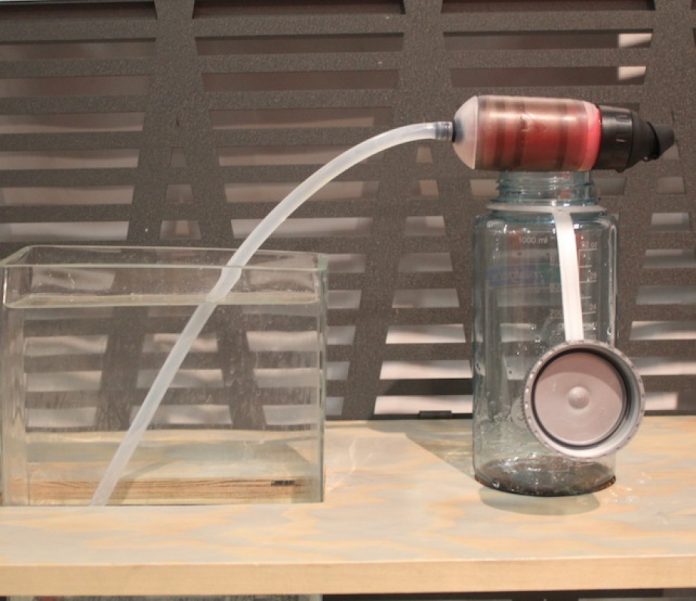
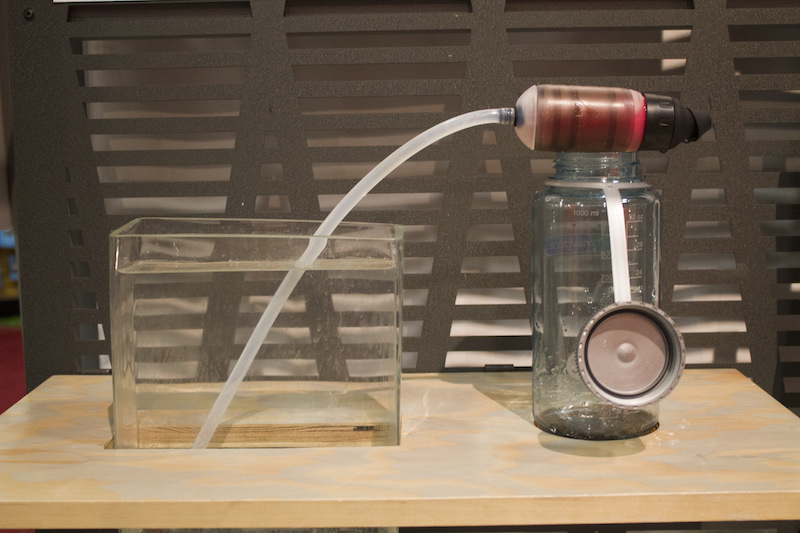
MSR Filter system seen at Outdoor Retailer

Multi-day river trips require careful preparation and organization not only to make sure you and your paddling team have everything you require, but to ensure it all fits in the kayaks. We scouted out all the coolest gear on display at Outdoor Retailer Summer Market 2016 and chose items that we think are necessary for your next multi-day river trip.

MSR Trailshot Microfilter

Having a solid plan for water treatment on your multi-day river trips is crucial, and having a super-effective and fast one is important. The MSR Trailshot Microfilter won an Outdoor Retailer Best of Show for it’s lightweight pocket-size design and quick functioning. The 142-gram filter can fill a one-liter bottle in 60 seconds, treats up to 200 liters and disappears inside a pocket. You can clean it simply by giving it a few shakes to restore flow rates while in the field. The best part? You can walk up to a stream and drink straight from it (or just lean over your kayak!). The Trailshot Microfilter will be released in 2017 and retails for $49.95.

MSR filter

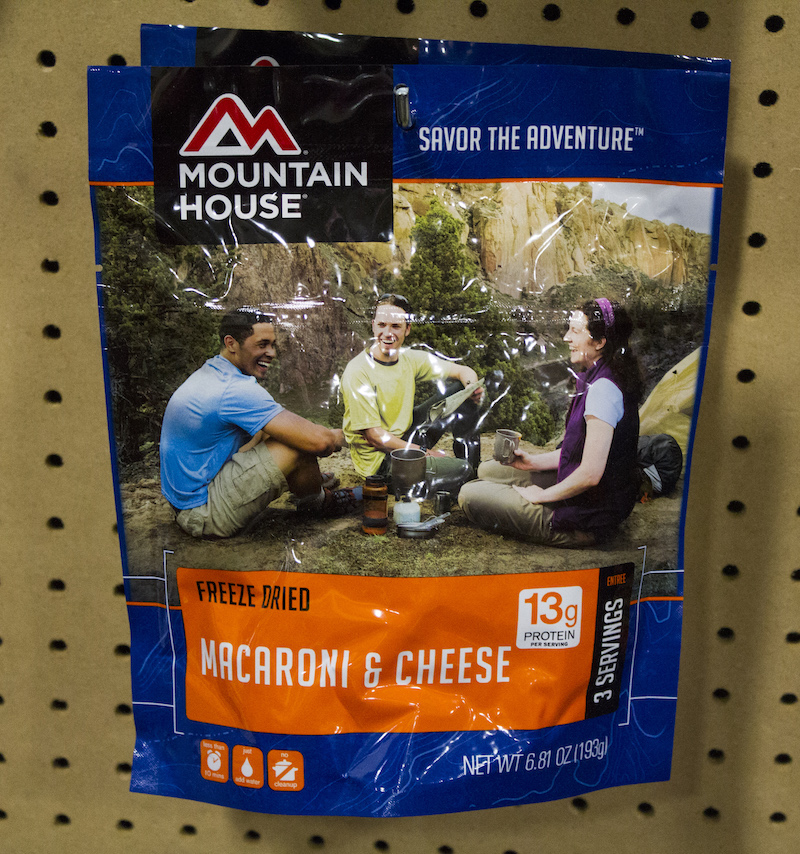
Mountain House Backcountry Meals

After a long day of scouting and paddling rapids, every kayaker will crave a nutritious and flavorful meal around the fire. If you are looking to reduce the weight in your kayak, want lightweight emergency meals or are simply stoked about good food, Mountain House’s freeze dried food packs should go with you on your multi-day trip. Our favorites we saw at Outdoor Retailer were the macaroni and cheese and beef stroganoff with noodles. If you really want to celebrate that killer drop you pulled off during the day, try one of their freeze dried ice cream sandwiches.

Mountain House meals

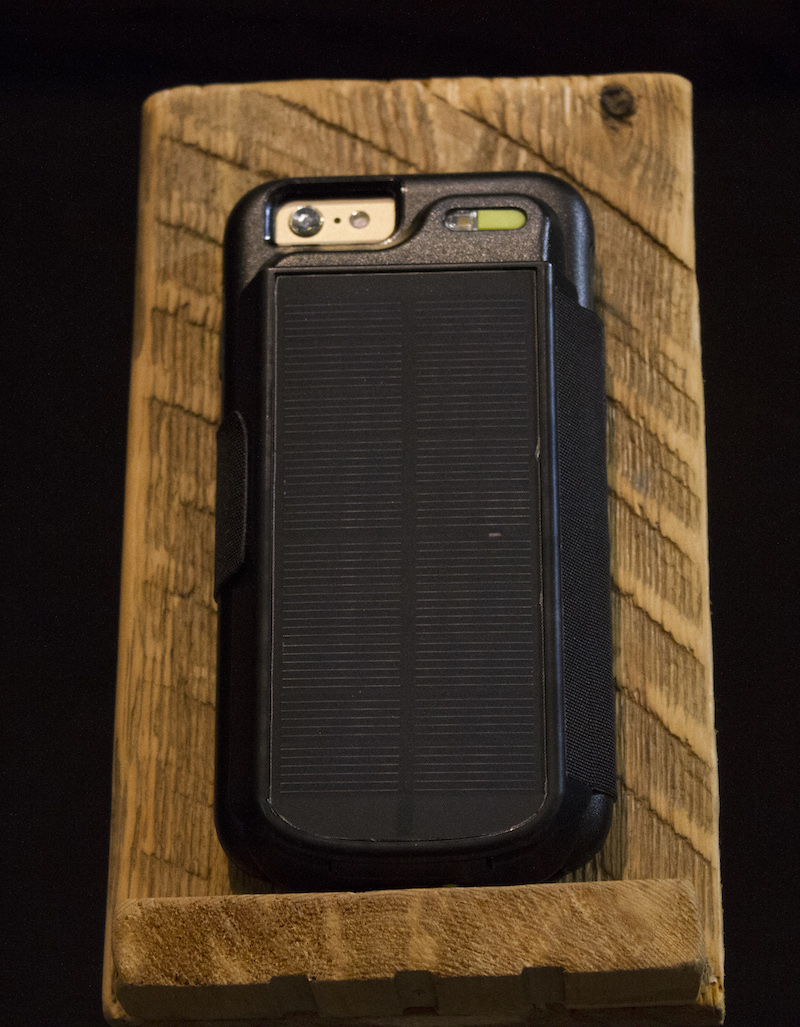
Goal Zero Slide Battery

Whether you are bringing your phone of the river with you to shoot photos of you styling the waves or as a just-in-case means of communication, Goal Zero’s Slide Battery will give your phone extra life. The Slide Battery is in collaboration with OtterBox’s uniVERSE case, and slips seamlessly behind the case and provides power for your phone. The Slide Battery gives your phone one extra battery charge and also comes with an integrated kickstand so you and your paddling friends can lean back and review video from the day’s whitewater fun. The Slide is available for iPhone 6/6s and iPhone 6 Plus/6s Plus and retails for $54.99 and $59.99 respectively.

Slide Battery from Goal Zero

New Whitewater Pro Stick And Oars From Sawyer

Photo: Sawyer Paddles & Oars
Sawyer Pro Stick Raft Paddle

Sawyer Paddles & Oars is introducing the Angler Pro Oar Blade, a design based on feedback from fishermen who desired a more buoyant oar. The Angler Pro is composed of carbon fiber laid over a hybrid Ash reinforced composite core with Dynel and Kevlar ProTip reinforced edges. Sawyer’s Zac Kauffman says fishermen will love the same high performance they know in other Sawyer blades combined with increased buoyancy.

The Angle Pro Oar Blade comes in a 30-inch and a 24-inch with two different profiles, and the shorter blade is intended for more shallow water. The blade retails for $169.99 and is a 2017 product but will be available this month.

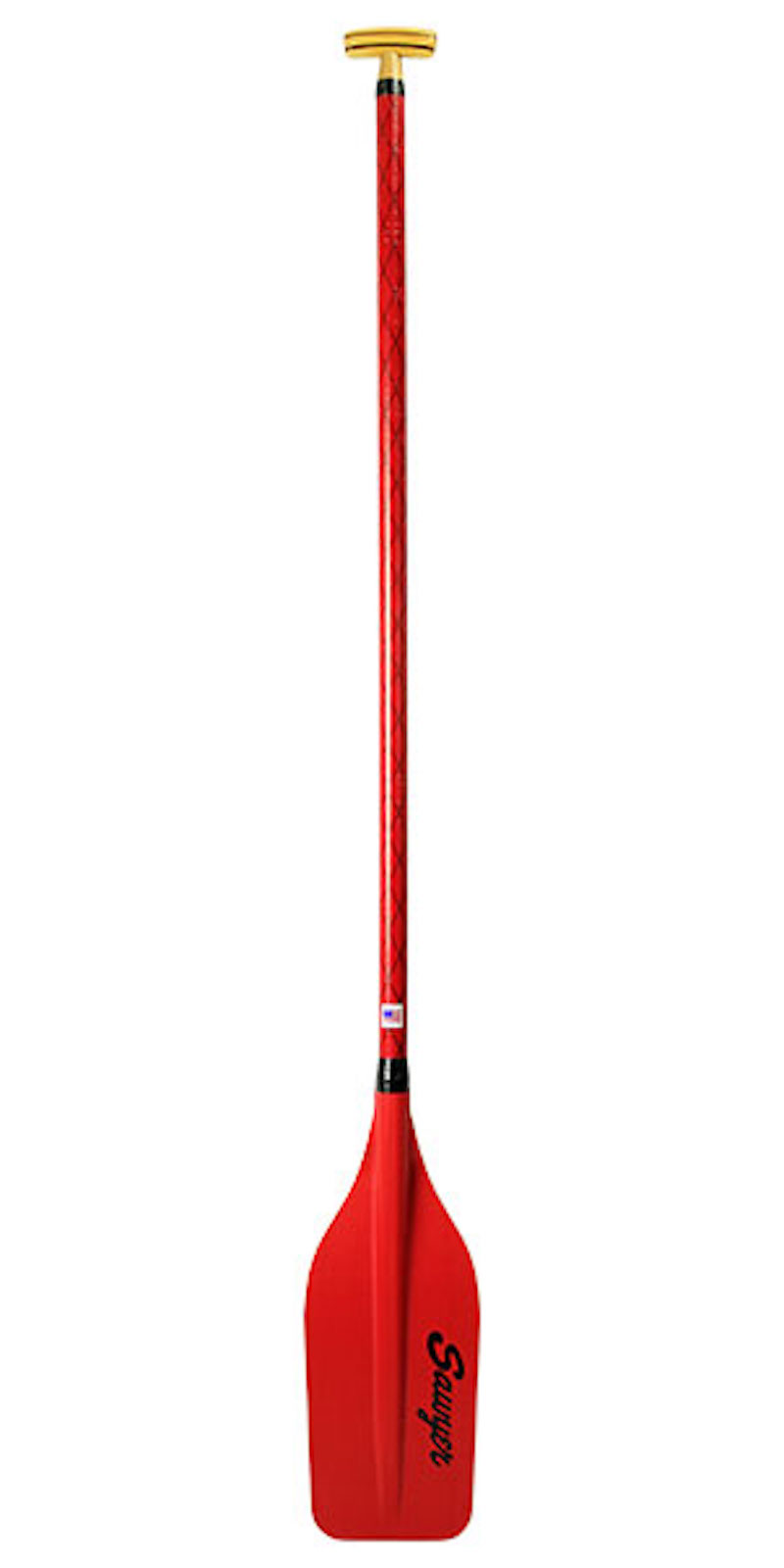
Sawyer is also excited about two new spring releases—the Pro Stick Raft Paddle and the Lightweight SST Oar. Kauffman says the Pro Stick is a guide paddle composed of continuous woven fibre and comes in red, black, or yellow blade and unlimited choices for shaft color. A unique feature is the option to have Sawyer laminate any fabric into the shaft—think of your favorite plaid shirt—for a completely individualized design. “It’s a simple way for people to have a one-of-a-kind product,” says Kauffman. An added bonus is that the customized shaft will make it more difficult to lose your paddle or have it stolen.

Pro Stick RED RED

The Pro Stick Raft Paddle

The Small Stealth Oar is designed for small prams, pontoon boats and fishing cats. It is built with a reinforced fiberglass shaft and continuous fiber reinforced blade construction. The shoal cut blade design makes it perfect for quietly sculling into fishing destinations.

Kauffman also spoke about the Freefall, a whitewater paddle designed for the extreme whitewater following. He explains that some paddlers in this category don’t want the scooped blade found on the Whitewater Pro Stick, and prefer the Freefall’s flat one. The Freefall has a solid Ash core and carbon fiber overwrap on both sides of the wood core blade. It is extremely stiff and responsive and has a reinforced ProTip.


River Jammin’

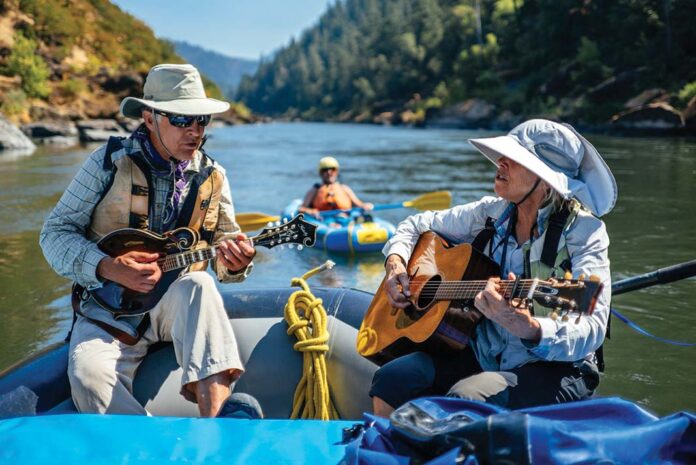
RIVER JAMMIN’ Slide| PHOTO BY NATE WILSON

Tom Rozum and Laurie Lewis, fixtures of the West Coast folk music scene, have been playing together for almost 30 years, and serenading river runners for more than 20.

“The combination of beautiful days on the water and nights under the stars mixed with acoustic music really grabbed me,” says Lewis of her inaugural rafting adventure, a run on the Rio Grand in Big Bend in 1992.

The trip led to a longstanding partnership with Northwest Rafting Company. Every year, the musical mates join for a trip down Oregon’s Rogue River or Idaho’s Middle Fork of the Salmon.

Jam sessions echo through the canyon walls by day, Lewis and Rozum play a set after dinner and, as the sun sinks below the rim, the stage is set for a talent show.

“There are no stage lights out there, so the group just gathers up in a big circle and we’ll add a campfire of lanterns as the sun goes down,” says Nate Wilson, long time Northwest Rafting Company guide and outdoor photographer. “It might not have the acoustics of an indoor venue, but listening to the music in a wilderness river canyon is hard to beat.”

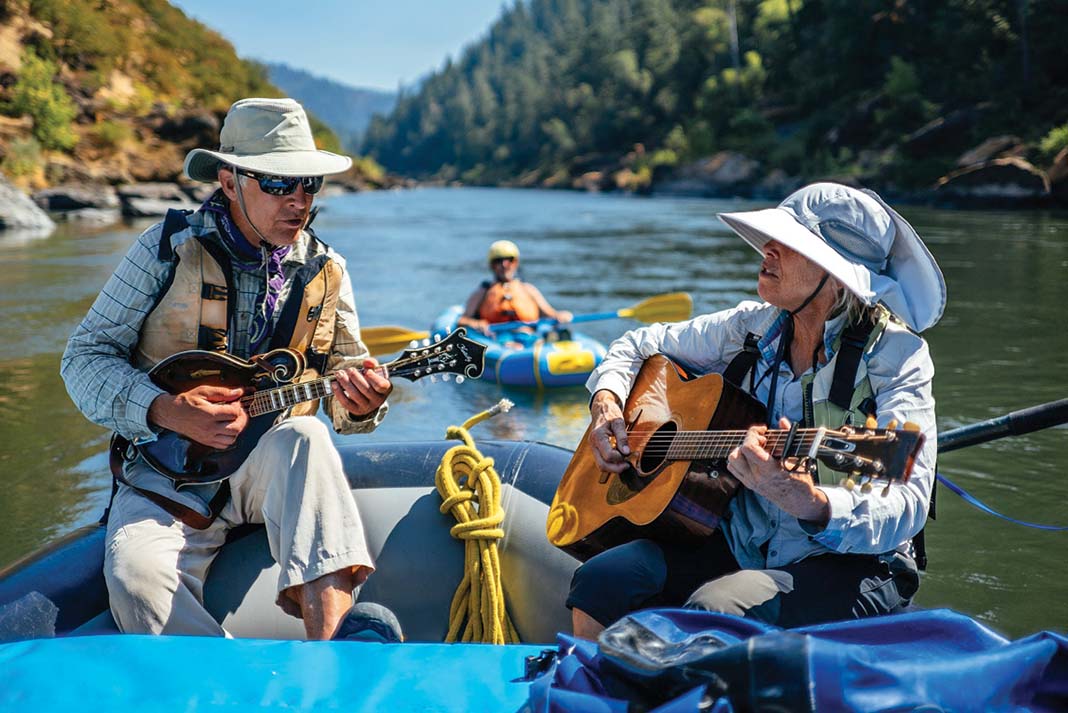
RIVER JAMMIN’
Slide| PHOTO BY NATE WILSON

“Every time down the river is a new experience,” says Lewis, whose acoustic tunes are brimming with vivid natural imagery. “I love the play of light on the water, the wildlife, the constantly changing scenery, and the interesting array of people who are drawn to rivers and rafting. Acoustic songs played on fiddle, mandolin and guitar seem to really fit in the setting of a river valley.”

Wilson captured this photo in Flora Dell canyon on the last day of a Rogue River trip, the final set before the take-out. “The tighter river canyon encountered upstream gives way to lush, rolling coastal mountains,” says Wilson. “We spent a few minutes strapping the rafts together into a big flotilla, and then headed on.

“Drifting through, we passed a few nice waterfalls and other guests on the trip jumped in the water or floated on inflatable kayaks to get closer to the music.” Emma Drudge

This image was the winner of the 2015 Guide Vibes photo contest by NRS, for perfectly illustrating the essence of the river lifestyle.


This article originally appeared in Rapid
Early Summer 2016 issue.

Subscribe to Paddling Magazine and get 25 years of digital magazine archives including our legacy titles: Rapid, Adventure Kayak and Canoeroots.

Living Sustainably with Bob Christensen

Photo: courtesy Bob Christensen

Sustainability visionary, brown bear whisperer, solo expedition paddler and Zen master of Lemesurier Island—where he’s lived alone for nearly two decades—Bob Christensen, 47, is a good candidate for the most interesting man in Southeast Alaska. Twenty-five years ago, Christensen built a traditional baidarka from modern materials and paddled it, alone, from Alaska’s Prince of Wales Island to Bellingham, Washington. The trip marked the first time he’d ever sat in a kayak. These days, Christensen can be found commuting by small boat to ports all over Southeast Alaska, helping develop more sustainable communities.

Who lives alone on an uninhabited island?

I did months-long, solo kayak trips for five summers throughout Southeast Alaska. Jigging for halibut in front of the historic Willoughby Cabin on Lemesurier Island, I hooked into a big one. The fish dragged my boat around the kelp forest. I had broken my pole and started wrapping the line around my arm when the people inside the cabin paddled out in their double Klepper to help land the fish. I ended up camping down the beach and we spent three days eating that halibut. The next year, they offered me the job of caretaker. Deep isolation like that leads to a lot of self-reflection and spiritual contemplation. It was the same on my kayak trips, but when I planted myself on the island that first winter, it was amplified tenfold.

What brought you to Southeast Alaska?

In college, I became interested in human-nature interactions and designing sustainable communities. The vision was, my college friends were sending me off to Alaska to find a piece of property to buy and send a note back saying, “Okay, let’s build it.” Of course, that never happened, but hiring on with a variety of wildlife projects was a way to continue studying nature while holding onto that vision. It was two years after the Exxon Valdez spill, and I took a job surveying the beaches of Prince William Sound. I met a biologist who invited me to Southeast Alaska to participate in cave exploration on Prince of Wales Island. Later, moving to Lemesurier Island seemed like an ideal short-term solution to the challenge of finding an inholding to develop into a sustainable community.

Photo: courtesy Bob Christensen
Photo: Bob Christensen

When did you overcome your fear of bears?

After the caving expedition, I paddled back to Bellingham. I had no experience in bear country. I remember stupid things like, after days of banging my pots and pans together in terror, finally figuring out the noise I was hearing in the shrubs was a winter wren. I focused on learning where not to camp, which started teaching me how to read bear sign. The fear turned into a personal study reading patterns of use. I’ve had many experiences that could have gone bad but didn’t. Once, on Chichagof Island, I was lying down with a migraine headache and a bear came up and sniffed my face.

Where do you find inspiration?

My inspiration comes from the beauty of nature, not just the aesthetic, but how eloquent the ecology, the interaction of life, is. It also largely comes from the people I’m working with. There’s a lot of angst in our culture right now about humanity. Whatever the nasty stuff is that we focus on in the news, it hurts our spirits. When I talk to people about their vision for sustainability in their communities, I see them light up.

Why focus on community sustainability?

In 2008, I was working with the Community Forest Project in Hoonah, Alaska. The Southeast Alaska Conservation Council, the Wilderness Society and other philanthropically funded entities were trying to get a big wilderness bill passed. It wasn’t working. Investors wanted to do something that addressed human wellbeing alongside conservation. The only thing that came close was the Hoonah Community Forest. We expanded to form Sustainable Southeast Partnership with a much more comprehensive vision that included food security, economic development, energy conservation and renewable sustainability as core elements. It’s the culmination of my life’s work.


This article originally appeared in Adventure Kayak
Early Summer 2016 issue.
Subscribe to Paddling Magazine and get 25 years of digital magazine archives including our legacy titles: Rapid, Adventure Kayak and Canoeroots.

One Young Family Takes On The Appalachian Trail

EXTREME SUMMER VACATION.| PHOTO: THE PORTLAND PRESS HERALD

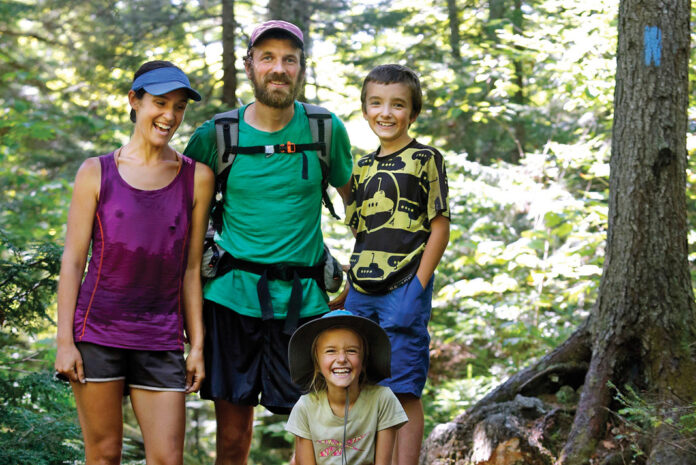
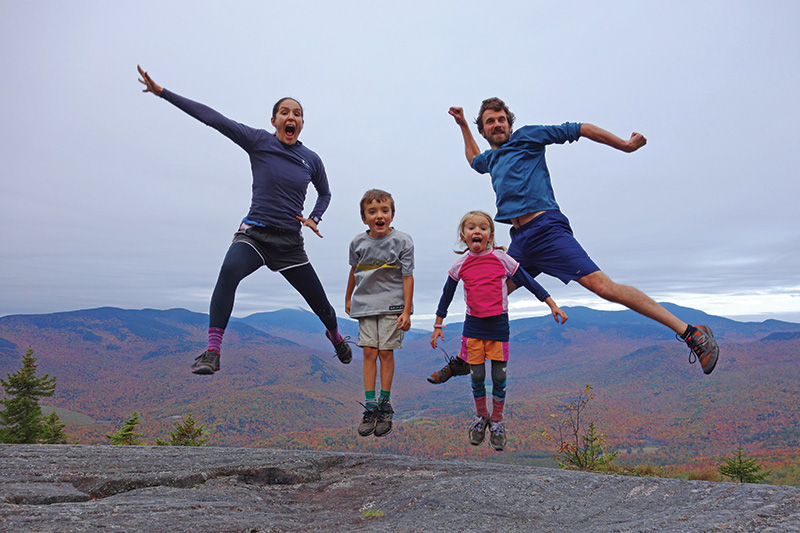
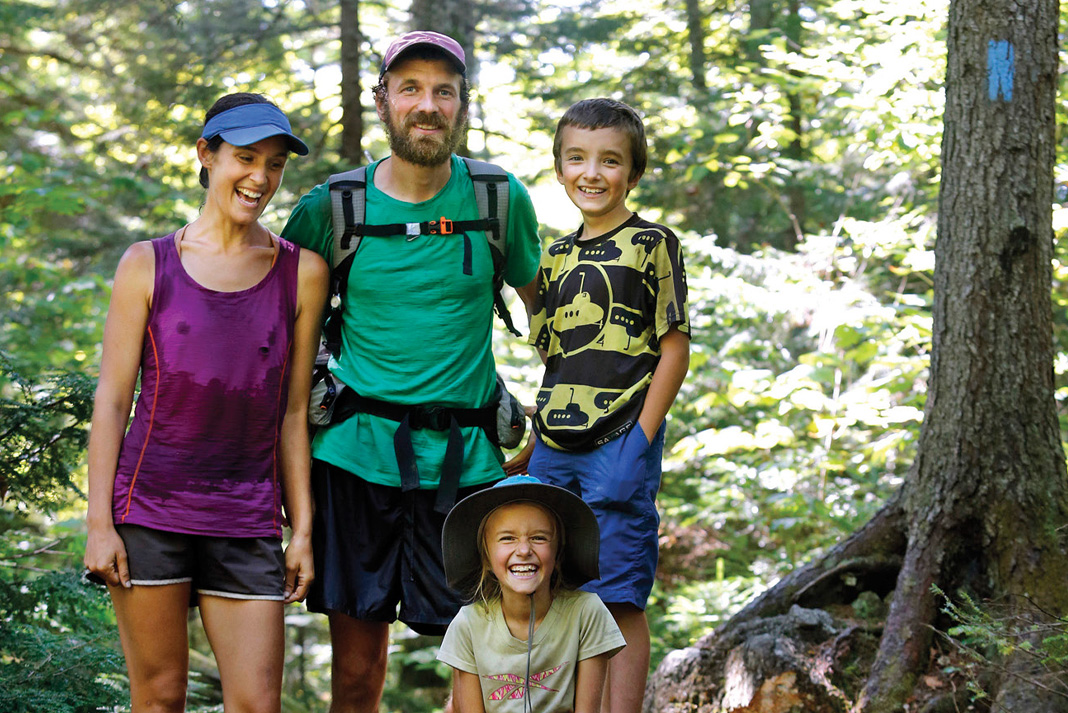
Over the course of five months, my seven-year-old daughter and nine-year-old son walked the entire length of the Appalachian Trail, from Georgia to Maine. For their short legs, those 2,185 miles measured somewhere around 10 million steps.

Of course, they didn’t walk all that way alone. My wife and I went with them—we even brought the family dog. When we started, the odds were we wouldn’t finish. In any given year, only one in four thru-hikers make it the whole way, and only 16 young families are known to have completed the entire hike in its 77-year history.

Five months of spending almost every minute of every day together is a whole lot of family together time. In the beginning, the kids were dependent on my wife, Emily, and I for everything. They needed us to cook and organize camp. When the climbs were too much, we’d take the kids’ packs, or let them use the dog’s leash as a towline off our backpacks. By the end of the trail though, they were carrying all their own gear, which included their clothes, their sleeping bags and even their shelter—about five to 10 pounds each.

Early on, we all struggled with the trail’s discomforts. The early spring and Georgia’s 5,000-foot peaks brought cold rain, turning to sleet, then hail, then snow all in a single day. Temperatures dipped into single digits, freezing solid wet socks and shoes. In the morning, it was the adults who thawed things out in our sleeping bags and got up early to build a fire to warm socks and shoes so we could get them back on our feet.

THE ODDS WERE WE WOULD NOT FINISH. IN ANY GIVEN YEAR, ONLY ONE IN FOUR THRU-HIKERS MAKE IT THE WHOLE WAY, AND ONLY 16 YOUNG FAMILIES ARE KNOWN TO HAVE COMPLETED THE ENTIRE HIKE IN ITS 77-YEAR HISTORY.

By the end of our hike, our daughter, Maddie, was wringing out her own wet socks the night before, and stuffing them into her own pockets so they’d be warm in the morning. By then, the kids were setting up their shelter in the evening and helping cook dinner. In the morning, they’d break camp and pack their own gear.

The kids were inspired to persevere by the people they met and befriended along the way. We watched our kids interact with adult hikers as peers, something that’s uncommon in our age-stratified society. They would walk up behind someone and set out to learn everything they could about the hiker in the uninhibited way only kids can, sharing their own life stories in the unfiltered way that kids do. What’s your name? Where are you from? Where did you start today? Do you like hiking? What do you do when you’re not hiking?

“My name is Nathan,” I once heard my son introduce himself. “The other day I caught a rainbow trout and we made fish tacos for dinner. I like hiking because it means I don’t have to shower. I wanted to go four states without showering but my parents wouldn’t let me.”

Unfortunately, our kids shared tidbits about us in the same unfiltered way. “The longest I went without showering wasn’t even on the trail, it was while my mom was away for work,” continued Nathan. “I went 17 days. My dad didn’t even notice!”

They received equal candidness in return. They earned the respect and friendship of the adults by hiking the same trail, doing the same miles and setting the same pace. Those hikers challenged their comfort zones in a way that we as parents never could.

A family trip on the Appalachian Trail.
Photo: The Kallin Family

Our first 20-mile day wasn’t my idea. It was inspired an the investment banker turned-long-haul truck driver on a downhill out of the 6,500-foot-high Smokey Mountains. He didn’t coddle our kids the next morning when they excitedly shared their accomplishment with him. Instead, he grinned and ribbed them: “That’s great! And no one will ever mention that it was all downhill!” The next night he taught them to play Texas Hold’em using Skittles—they cleaned him out.

Our first 27-mile day wasn’t my wife’s idea either. It was inspired by a substitute teacher-turned-long-distance hiker we met along the way. Wired was a star on the trail, having already hiked the Pacific Crest and Continental Divide trails. The kids wouldn’t accept her assertion that she wouldn’t see them again because she was going to get up early and hike a long day. Instead, they woke up throughout the night to keep watch. When one of them noticed that she was stirring, they sounded the alarm and sprang into action. When Wired was ready to go early that morning, there they were, their bags packed and breakfasts in hands. They stayed at her heels for all 27 miles, happily chattering away the whole time.

Our first—and only—30-mile day certainly wasn’t my idea. It was a goal the kids set for themselves, one they had heard other hikers aspire to, but which few actually accomplish. They didn’t give up, even when their friends hiked a shorter day to spend time swimming at a waterfall. They were deservedly proud at the end of that 30-mile day. Maddie was glowing as she rolled into camp and announced that until the last half hour, she didn’t think she would make it—but once she realized she could, those minutes were the best of the entire hike.

EXTREME SUMMER VACATION.| PHOTO: THE PORTLAND PRESS HERALD

Though we were constantly impressed by their resiliency and enthusiasm, the trail wasn’t about how many miles the kids could hike. Nor was it about watching our children grow to be self-sufficient and confident little people. Instead, it was a rare chance to enter a place where all distractions fell away. We could focus on where we were and who we were with; celebrate our connection with one another and the beauty of the world that surrounds us. As the miles of the trail transformed us, our family was brought closer together.

Early in the 20th century, conservationists Benton MacKaye and William Welch fought to create the Appalachian Trail and protect the wilderness surrounding it. Now, in the early 21st century, there are many similar fights to protect wild spaces raging across the continent. From my family to yours: Go find your wild places, protect them and embrace them together. And if it takes five months and 10 million steps to do so, all the better.

David Kallin is a Maine lawyer by day, who focuses his practice on land use and conservation.


v15-iss2-Canoeroots.jpgThis article originally appeared in the Canoeroots Early Summer 2016 issue.
Subscribe to Paddling Magazine and get 25 years of digital magazine archives including our legacy titles: RapidAdventure Kayak and Canoeroots.

10 Things That Happen When You Learn To Whitewater Kayak

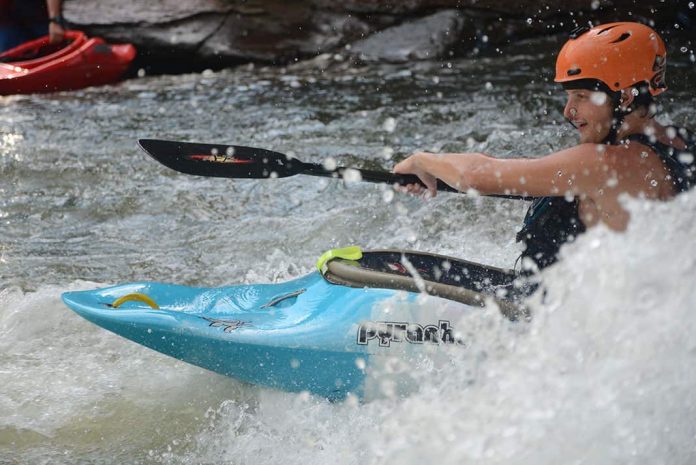
Man paddling whitewater kayak
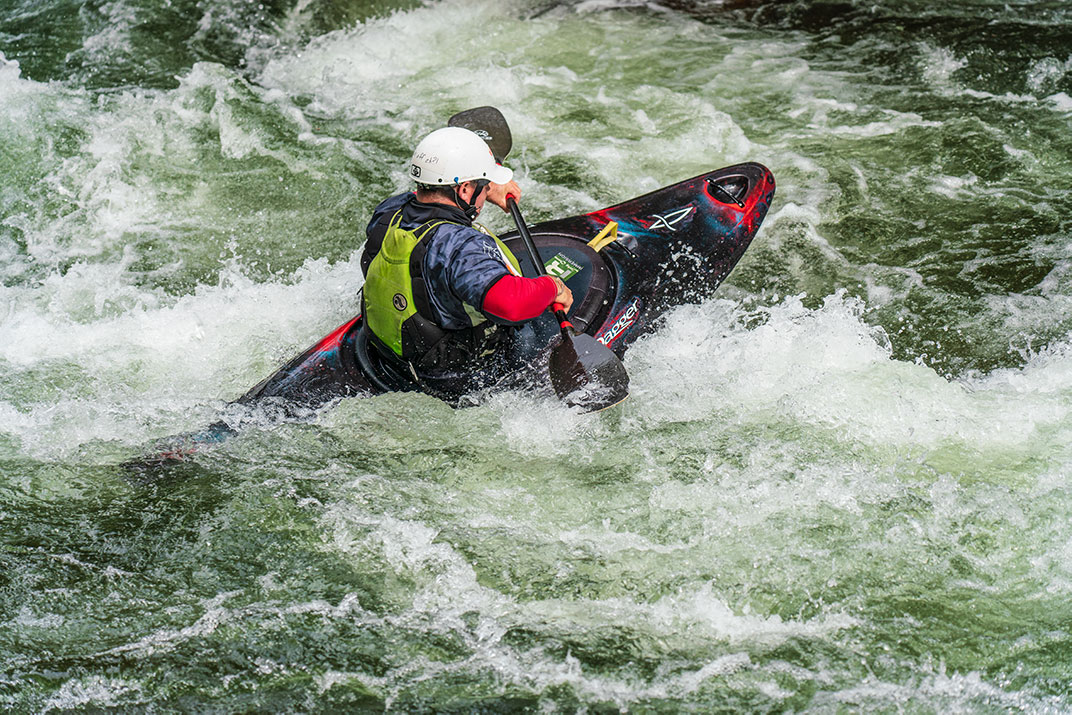
We all had to start somewhere. | Photo: Pyranha

Maybe you are a new paddler beginning the process this season, or perhaps you are a waterlogged pro with several decades of boofing, creeking and river booties behind you. No matter where you are in the life of your whitewater kayaking pursuits, you will be able to relate to these 10 whitewater learning moments.

1. You will get stuck in your drysuit

Drysuits and tops are amazing for cold weather kayaking missions, but they aren’t the most intuitive to wriggle out of. Flush wrist and neck gaskets make removing them an acquired skill, so don’t feel too bad if you spend most of your time at the take-out doubled over with your hands pulling at your collar trying to escape.

2. You will finally understand what boofing is

You hear those cool professional paddlers saying it all the time in kayaking films and spot the word in the pages of Paddling Magazine. Maybe you’ve been too nervous to ask your paddling friends for a definition of this kayaker’s verb. Once you launch over a small drop with a perfectly-timed stroke at the feature’s lip with your hips forward and hear the telltale sign of your kayak hitting the water, you’ll get it.

3. You will struggle rolling… until you don’t

Rolling is one of the toughest parts of learning to kayak, and even with great instruction it can be extremely difficult to conceptualize the technique from above the surface of the water. Many people spend days, weeks or even months working towards a solid roll. This can mean a lot of time swimming and chasing your boat, but once it clicks, the roll is hard to lose and will make kayaking incredibly fun.

4. You will learn why scouting is important

Deciding not to scout a new rapid can happen when you get overconfident or are with a group who know the area well. While it can be tempting to just wing it, a big swim or hanging out in a sticky hydraulic can remind you why it’s so important to view river features and plan your line pre-run.

5. You will get stuck in a hole

Before you start paddling whitewater, rapids all look the same. Once you enter the sport however, you begin to pick out holes dotting the rivers you love and know the best lines to choose to avoid them. Part of learning is making mistakes though, and you will definitely gain first-hand insight into the retentive power of holes.

6. You will learn why your team is so important in this “individual” sport

In many ways kayaking is an individual pursuit where your actions and maneuvers just affect you. It is also very much about the group you are with, and there is no quicker way to learn how dependent you can be on your kayaking buddies than by needing a rescue, losing your boat or spending a few minutes being recycled.

7. You will catch your first wave

Maybe it was planned. Or maybe you got spun around backwards on a rapid and ended up inadvertently pulling off a sweet surf. However you got on that wave, the unexpected stasis and floatiness you feel while water flies underneath you is addictive and will have you hitting up park and play spots in no time.

8. You will have a scary swim

When you begin kayaking and don’t yet have a bombproof roll, there is always the chance you will end up swimming the rapids you had hoped to style. Having a scary swim—cold, long, rocky or just full of big water features—can be terrifying, but it’s also a valuable experience for understanding our vulnerability on rivers and practicing proper swimming in whitewater.

9. You will struggle with your skirt

You stand at the river’s edge feeling prepared to kayak. Your PFD is snug. Your paddle is in hand. Helmet is securely fastened. Drysuit zips are up. As you sit in your resting kayak and get stoked to join your friends, you face the seemingly endless struggle for beginner kayakers: putting on your skirt. It may seem too small for your kayak, or not the right shape, or too slippery. Trust us—your arms will get stronger and it will get easier.

10. You will mess up the shuttle

The concept of a shuttle is simple. Leave one car at the put-in and one at the take-out to bring everyone back. But that simplicity can become muddled with all the gear necessary for kayaking trips. After one too many moments at the take-out realizing you have no shoes, towel or dry clothes, you may start meticulously organizing drybags or backpacks designated for each end of the shuttle.

Follow us on Instagram @paddlingmagazine to discover more about paddling and what other kinds of fun trouble you can get into.

Powerful Partnerships in the Whitewater Community

I’LL BE THERE FOR YOU. FOUR DAYS A WEEK. FROM 9-3:30.| PHOTO: KAYDI PYETTE

When dam operators are receiving thank you notes from the paddlers downstream, something is awry.

Flowing east out of Algonquin Provincial Park, the Madawaska River is an Ontario whitewater hot spot, famous for being one of the best places in the country to learn to paddle. Thousands of boaters got their start on the mighty Mad and, with its friendly class II to technical class IV, it draws kayakers and canoeists year after year.

It’s here that one of Canada’s best-known paddling families has taken things to the next level in terms of cooperation with the provincial power company.

It may come as a surprise that celebrated slalom paddler Claudia Kerckhoff-Van Wijk, who owns and operates the Madawaska Kanu Centre (MKC) with her husband Dirk Van Wijk, speaks highly of the folks at Ontario Power Generation (OPG), who control the dam upstream.

Following in the footsteps of her parents, who started the paddling school in 1972, Kerckhoff-Van Wijk has fostered a unique relationship with OPG that’s helped build and sustain the area’s thriving whitewater industry.

When her parents emigrated from Germany to Canada and set up their school on the Madawaska, the patchy and inconsistent flow made it difficult to build a business that relied on the river. They approached OPG and asked if they could condense the necessary 26 hours of flow per week—the minimum requirement to fulfill sewage demands, hydro production and environmental needs—into just four days a week, from May to August, so the flow would be substantial enough for good paddling on those days.

I’LL BE THERE FOR YOU. FOUR DAYS A WEEK. FROM 9-3:30.| PHOTO: KAYDI PYETTE

OPG agreed, at no cost. “Sometimes very small changes in when a power company operates their dams can have huge economic and social benefits that really are just no skin off the power company’s back at all,” says Kevin Colburn, the national stewardship director of American Whitewater.

South of the border, Colburn works long and hard to negotiate releases with power companies to guarantee water for paddling communities and the river ecosystem. However, he says it’s unusual for things to go as smoothly as they have at MKC—more often than not, interests do not align.

Understanding all the stakeholders involved is key, says Kerckhoff-Van Wijk. From there, it’s a matter of clear negotiation and constant communication. It doesn’t hurt that in her case, the relationship has some history. “My parents were way ahead of the curve,” says Kerckhoff-Van Wijk. “There was less red tape and fewer parameters then, but it is still possible today if you listen, do research and share your resource.”

Kerckhoff-Van Wijk encourages her students to send the dam operators thank you notes after they’ve enjoyed their time on the Madawaska. An OPG employee confirmed they have a stash of emails from athletes, adventurers and vacationers alike thanking them for their cooperation with the whitewater community.

OPG has 240 dams in numerous communities in the province, each of which has its own management plan. “It’s a balancing act,” says OPG spokesperson Neal Kelly. “It’s an ongoing relationship we have with businesses, community members and elected officials in communities where we operate.”

Of course there are many factors that will determine whether an arrangement like this one will work. The stars have to align for such anarrangement to be struck, says Colburn. But the MKC deal is a promising precedent.

“If you don’t have that conversation about interests and what people want and need,”says Colburn, “than you’ll never figure out those easy wins where interests actually do align.”


This article originally appeared in Rapid
Early Summer 2016 issue.
Subscribe to Paddling Magazine and get 25 years of digital magazine archives including our legacy titles: Rapid, Adventure Kayak and Canoeroots.