Home Blog Page 267

Frozen Assets

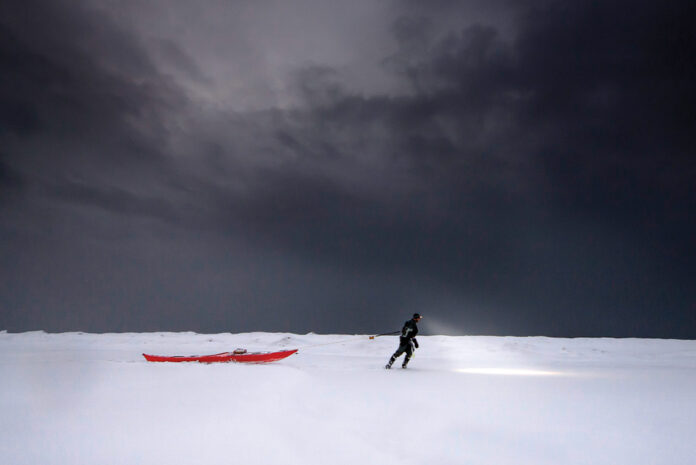
Watermelons are not in season. | Photo: Erik Olsen

It happens every year. Half the planet reels drunkenly away from the fire and the land stumbles like an old inebriate into the coldest season. As our 23.4-degree list inches us further away, the temperature plummets and the days grow shorter. The effect is exacerbated nearer the poles, where our cousins in the far north and south must strap on their headlights for several months of unbroken dusk. Winter has arrived.

On the coasts, ocean currents moderate temperature and saltwater stays stubbornly fluid. For the 35 million people residing mid-continent around the Great Lakes, however, a deep freeze is inevitable. In early winter, Arctic air masses charge across the lakes—still relatively balmy with residual summer heat—inhaling drafts of warm, moist air. The resulting storms clobber surrounding communities with spectacular lake-effect snowfalls, knocking out power and paralyzing transportation. Last November, Buffalo, New York, was inundated with a whopping six feetof snow in just 24 hours.

In the rivers, the current thickens and slows. Ice pans rub shoulders like jockeys on a track. Heavy snowflakes swirl from restless skies and ice creeps implacably outwards from the shorelines. A paddler loading his kayak in this weather must first sweep the snowfall from his roof rack. Scrape the ice from his saddles, precariously perch the boat like a luge at the top of its run.

Even as the snow drifts back over her Subaru, however, a petite woman in a white kayak rotates like a yogi in her cockpit, and falls purposefully into the water. For a moment, gravity and momentum win; water swarms over her face. Then the buoyancy of her body and the careful pressure she exerts inside the kayak bring her back to the surface, where she rests, smiling peacefully.

Around her, similar stunts are playing out: scantily clad kayakers scramble around their decks, practicing self-rescues; others set up for rolls or stand in the water, spotting friends. It’s mid-winter and the sky is pitch black a full hour before the afternoon commute, but the water is so crowded with kayakers, it’s almost impossible to turn around.

“Pool sessions have a fun, supportive vibe where you can maintain the momentum of spring, summer and fall,” says Dympna Hayes, who organizes sold-out winter clinics at community pools in snow-socked central Ontario through her company, Learn to Kayak.

Watermelons are not in season. | Photo: Erik Olsen

For a handful of even hardier paddlers, kayaking on the lakes lasts as long as there’s open water. When winter storms kick up the best surf of the year, intrepid Lake Ontario paddlers chase waves in the Western Gap near Hogtown’s Toronto Islands. And from late fall through early spring, Michigan-based paddling photographer Erik Olsen relies on his kayak to document the unique off-season landscapes of the upper Great Lakes.

The jaunty tilt of our planet’s axis has presented Olsen with such rare phenomena as last winter’s 15-foot-high ice caves on Lake Michigan. Another trip rewarded with a sunset paddle amongst icebergs. “I had to tow my boat an eighth of a mile to find open water, but it was well worth it,” he says. “Truly a rare treat of a hard winter.”

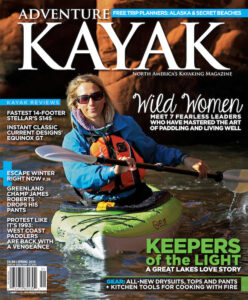
Virginia Marshall is the editor of Adventure Kayak magazine.


This article first appeared in the Spring 2015 issue of Adventure Kayak magazine. Subscribe to Paddling Magazine and get 25 years of digital magazine archives including our legacy titles: Rapid, Adventure Kayak and Canoeroots.

Base Camp: Higher Learning

Photo: Scott MacGregor
Base Camp: Higher Learning

We live in a small town.

How small is it? The public school has only 128 kids spanning from junior kindergarten to Grade 8. There are only nine kids in my daughter Kate’s Grade 3 class. This means when she graduates, she will have a choice of three boys for prom (there are actually five boys in her class, two of which we’ve already agreed would be poor choices). There are few of the extra clubs, sports and trips you’d find at larger city schools.

Mr. Roberts was the principal of the country public school I attended. He wore a suit and tie every day. He was all business, all the time.

My mom had sent me to school with a note letting my teacher know that my father would be picking me up early. I would be missing my afternoon classes.

“Sit down, Mr. MacGregor, please,” said Roberts pointing to a chair in his office. He looked both ways down the hall and shut his door. I was sure I was going to get it.

When he sat down at his desk, he leaned forward and whispered, “I wish more parents would take their kids to the Sportsmen’s Show.”

The secret was out and I waited for the catch. There wasn’t one.

“You’ll learn more this afternoon at that show than we can teach you in this place all week,” he said.

He told me how important he thought it was for his students to look outside school to experience different things.

Today, elementary teachers would say that Roberts understood cognitive theory and subscribed to schema learning. Children use schemas, an organized pattern of thought, to construct an understanding of the world around them. When they experience discrepancies between what they already know and what they discover, everything inside gets juggled and their understanding of the world changes. The more schemas or bits of information or experiences we’ve logged, the better.

Alpine skiing. Catching frogs. Portaging. Baiting hooks. Rock climbing. Playing in the ocean. Fire building. Summer camp. It all adds to their understanding of the world.

When I was home visiting my parents this past Christmas I was digging around in my old bedroom. Tucked in the back corner of my closet I found a plastic bag full of dog-eared canoe brochures and camping catalogs.

My dad is a hunter and fisherman, not a paddler. My mom has never slept in the woods. If not for the wisdom of a progressive school principal and my annual trips to spring tradeshows it’s unlikely I’d have had the interest to take an outdoor education credit in high school. It’s unlikely I’d have had the confidence to transfer from an engineering program to an outdoor recreation degree in university. It’s even more unlikely I’d have created Canoeroots magazine.

We know that direct exposure to nature is essential for healthy childhood development. What we don’t know is which little bits of knowledge or experience will be the building blocks for their futures. And really, who cares? That’s for them to figure out along the way. Our job as parents is to have fun with our kids sharing the things we love.


Screen Shot 2015 03 18 at 10.45.19 AMThis article first appeared in the Spring 2015 issue of Canoeroots and Family Camping magazine.

Subscribe to Paddling Magazine and get 25 years of digital magazine archives including our legacy titles: Rapid, Adventure Kayak and Canoeroots.

Jon Turk: Uncut

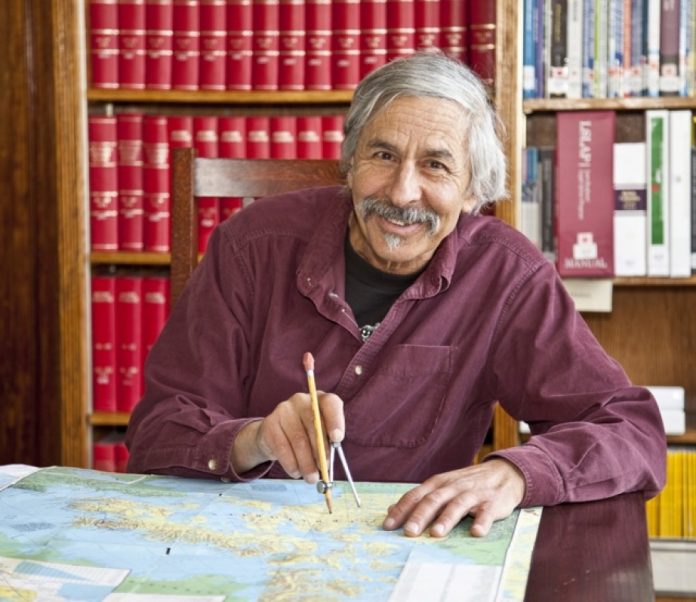
Photo: Henry Georgi
Jon Turk: Uncut
I had a recent opportunity to chat with Jon Turk, and our discussion began with failure—aborted missions, inconclusive findings, and the dangers of perseverance in the face of enormous physical risk. In all his writing, Turk portrays his disappointments and personal tragedies in painful detail, never with swagger but as motivation to keep pushing forward, to plan better and execute for success.—Edward B. Rackley

ER: Is mission completion necessary for success?

JT: We all fail in life. You aim big, you fail bigger. Every failure teaches us something. In wilderness adventure, if you don’t know when to back down from danger, you’ll die. So you always need to be ready to back away—and that isn’t failure. There’s no dishonor in it. On Ellesmere I pushed myself literally to the brink of death. EO Wilson writes that ‘The moral imperative of humanism is the endeavor alone, whether successful or not, provided the effort is honorable and failure memorable.’ So as long as you honor the aim of what you and your companions set out to do, you can’t be blamed for factors either within or beyond your control that determine mission outcome. I know that this is a cliché, but success is ultimately what you learn from a mission and what you enjoyed while doing it.


ER: How do you see current trends in social media and corporate sponsorship? While the Internet brings an unprecedented level of money and visibility to wilderness adventure, it brings certain compromises. Short-burst extreme feats or speed records of North Face climbs or Grand Canyon kayak descents seem to circulate daily online. Red Bull executives rejoice, but the older tradition of sustained endurance pursuits inspired by scientific inquiry seems at risk of extinction.

JT: First off, I have nothing but admiration for waterfall jumpers, big wave surfers, and extreme rock climbers. These aren’t fads; they’re serious athletic feats and require serious coordination, bravery, strength, and skill. I’m not coordinated enough to do that stuff. There’s an intensity there that I admire. However, long distance athleticism isn’t at risk of eclipse. There will always be such people.  Long-distance pursuits appeal to me because I love being out there for long periods of time. It’s a different scale of challenge. If this puts me at a disadvantage from a media and sponsorship perspective, that’s life.  I’ve done well enough with a mixture of sponsorship, writing, and public speaking, and so have my friends. There’s always a way around the money-thing.


ER: You’ve done one major solo voyage (Cape Horn), the rest were accompanied. What are the pros and cons of solo versus group adventure?

JT: Well, you’re safer with others. Alone there’s no backup. But it’s very exciting to be alone. It raises the stakes; you ratchet up the level of vulnerability. It puts you closer to the edge, and you’re more careful and aware. Solo is great. There’s no particular reason I haven’t done more of it. That said, had I done Ellesmere alone I would have died. I needed Boomer’s strength.  And traveling with others has other advantages. It speeds up many mundane processes; makes them safer. Dragging loaded boats over ice, or setting up and breaking camp. Plus, I like having company.


ER: Will you be writing about the Ellesmere circumnavigation? You’ve suggested in other interviews that you’re working on something.

JT: I’ll write about Ellesmere, yes. But it’d be boring to just recite details from the trip. I’m more interested in what grand journeys like Ellesmere, and the massive migrations undertaken by our ancestors—what do these teach us? What wisdom do they impart, and why have humans undertaken such journeys throughout history?

My Jomon book is about Paleolithic long-distance journeying and epic migration. Raven’s Gift is about shamanic healing.  But some readers get hung up on whether or not the magic and healing I undergo are believable. So this time I want to rephrase my thinking on traditional wisdom, and try to reach its core.  My new book is about ‘a Journey into Deep Wilderness’.


ER: Yes, there’s a refrain in your writing that hunter-gatherers have something to teach modern adventurers, and modern society generally. Is it their belief systems and cosmology, or their survival skills that are relevant to us today? Other endurance kayakers appropriate traditional practices by building their boats in the old ways, living off the land, and thus claim a kind of authenticity. That doesn’t seem to interest you.

JT: First of all, yes, I believe that the perseverance and skill of our ancestors has a lot to teach us in this internet-crazed, oil-soaked world.  It’s the “journey into Deep Wilderness” theme.  To answer the second part of your question, I have no criticism of revivalists. I am just not one of them.  Traditional people used the best materials they could find. So do I, but mine happen to be from modern industrial materials. I’m just not the kind of guy to make a walrus skin kayak, although it is wonderful to bring those skills back. Obviously we can’t all start making walrus skin kayaks; the walrus would disappear. I’m comfortable with my high tech gear.


ER: Your interest is more in interacting directly with indigenous communities where you find them, and expanding on the insights that result from those encounters.

JT: Yes. I guess my message, or main thing I’ve learned from living with traditional peoples, is to approach the world in a softer way: to live with less, in order for human existence to be sustainable on the planet. So while I’ve never adopted their survival methods, navigation methods, or kayak construction techniques, I’ve tried to learn their forms of wisdom, of how they understand their place within their landscape.


ER: What are some examples of this wisdom, relevant to our modern condition?

JT: We have to reduce our impact on the world, reduce our carbon footprint. This means learning to spend less, acquire less, and consume less. I’m not saying we need to forgo modern technology; that would be a stupid thing to say.  Modern technology improves our lives immensely. But if we listen to ancient wisdoms, perhaps we would not gorge on all that is available to us, to the point where we destroy our environment. In this society, we take and use way more than we need; the consequences are obvious.


ER: Why is that their wisdom and not just your philosophy; your view on how we ought to live?

JT: Good point. Aboriginal people lived in such a way that they must constantly communicate with nature. They needed to do that to survive.  Our way of life removes us from nature. But if we lived closer to nature’s rhythms, I honestly believe that we would live simpler, more meaningful lives.  We wouldn’t need to drive to the mall and buy a bunch of junk to have a good day.


ER: I agree that our consumerism and individualism take a toll on community and the commons. But we’ve chosen this retreat from nature, preferring near-total domesticity. Look at us—we seek permanent shelter from the elements with our dwellings, vehicles and clothing. My sense is that this insulation from nature and each other contributes to our alienation from nature and the dissolution of community. I don’t see how we can keep living this sheltered, buffered mode of existence and expect to understand nature or to restore any genuine, active community life. Think of Into the Wild (Jon Krakauer)—a young American enters the Alaskan wilderness unprepared and alone, and starves out of ignorance—and how well it captures our current state of alienation from wilderness and each other.

JT: You’re right— we can’t learn nature or traditional wisdom out of a book. But can the knowledge of traditional people correct the world’s failings? Well, it can help.  If you ask, can my vision and my writings solve the world’s problems, of course I laugh.  When Mother Theresa was asked if she thought was ending poverty in Mumbai, she answered something like: “That’s not the question I ask myself. Can I try to do something about it? Yes, I can.” So this next book I am writing is about how people reclaim control over immediate threats and risks, whether they’re hunter-gatherers in the Amazon, or citizens of the South Bronx.


ER: What do those two places represent to you; what’s so fitting about that contrast?

JT: Our individual impact on the way the world is evolving may be infinitesimally small, but we are still responsible for how we act, because collectively we have steered the world into a new geological epoch, the Anthropocene.  The people I visited in the Amazon were first contacted in 1964; today their refrain is ‘the powers shaping our lives are so powerful that we have no control over our destiny.’ Destitute Americans in the South Bronx say the same thing. I want readers to see what people share in these two ‘jungles’, to see that sanity at the personal level is still within our control. So any ‘return to nature’ or ‘traditional wisdom’ is, at one level, only metaphorical. What’s important is a thinking humanity whose choices are independent of the power elite.


ER: Another unique dimension of your writing and exploration is that you pursue historical questions about human development from a scientific perspective. I’m thinking of the marine migration theory you pursue in the Jomon book and the scientific validity of shamanic healing in The Raven’s Gift. Couching these interests within a grand kayak adventure, they become gripping narratives. But how have scientists and anthropologists reacted to your accounts of magic medicine and theories of how our ancestors first reached North America?

JT: Yes, a few people have gotten hung up on the ideas I developed in the two previous books— early marine migration and shamanic magic in medicine. These are very different things. On the migration thing, anthropologists were critical of my proposal that migration was sometimes conducted out of a “spirit of adventure” rather than out of pragmatic interests.  Actually, in retrospect, I think it is one of those arguments that you can get worked up about, but when you look at it closely, barriers and definitions break down.  The bottom line is that humans migrated out of Africa and settled in every habitable environment on Earth, while chimpanzees, to say nothing of hippopotamuses stayed back home in Africa.  That is an amazing story and part of our heritage.  I believe that we are a romantic species, even when we are being pragmantic; even if that sounds contradictory.

The second issue, about shamanic healing, is another question that remains unanswerable.  I think the important issue is that things do happen in this world, within and beyond human consciousness, which defy scientific logic.  Let’s not argue about it; let’s bask in the wonder.


ER: In the Jomon book you relate that while we know from artifacts that a migration path connects Hokkaido to the Kamchatka Peninsula and across the Bering Sea to Alaska, we don’t know why they chose this direction or what motivated them. It could have been catastrophe, cosmology, etc. Elsewhere you’ve stated that what today we call ‘outdoor adventure’ has gone by other names throughout history. At its core, I think this impulse is a reaction to the tedium of the familiar, or a wish to improve one’s lot by risking the unknown. Bruce Chatwin in Songlines uses the Latin shorthand: Solvitur ambulando (‘It is solved by walking’). And still we see human migration all around us today, usually some combination of ‘seeking’ (wealth, opportunity) and ‘fleeing’ (poverty, misrule). So instead of emphasizing what’s been lost or corrupted as we lose touch with nature, why not focus on our constants with traditional or pre-modern peoples—our shared need for forward movement, innovation, motion versus stasis?

JT: We know that early Polynesian islanders felled huge tropical hardwoods with stone tools, fashioned them into 60-foot double-hulled catamarans and sailed 2000 miles across the ocean to find a spot of land, Hawaii. They returned to Polynesia and initiated a trade route between the two places. Hawaiian obsidian is found throughout Polynesia. If we look directly at this ancestral past, certain strengths emerge that we share. We are them and they are us.

Mind you, there’s nothing to romanticize there—life was difficult in the Stone Age, full of violence and privation; people died young. I only say we have to learn from aboriginal knowledge because we’ve stepped away from this mode of knowledge: the self-reliance to learn from direct encounter with nature and with others. In traditional Inuit society parents never tell their kids what to do. They let them model the behaviors of other children or adults and learn by themselves. Let your relationship with the world and your environment be your primary teacher.


Jon Turk is the author of Cold Oceans, In the Wake of the Jomon, The Raven’s Gift, several environmental textbooks and numerous articles. When not out on adventure, he divides his time between Fernie, British Columbia and Darby, Montana.




Turk featureThis article first appeared in the Early Summer 2015 issue of Adventure Kayak magazine.


Skill: Remove a Tick

Skill: Remove a Tick
[iframe width=”560″ height=”315″ src=”https://www.youtube.com/embed/27McsguL2Og” frameborder=”0″ allowfullscreen ]

Just thinking about ticks makes our skin crawl. Learn the safe way to remove these creepy crawlies. University of Manitoba tick expert, Kateryn Rochon, explains the proper way to remove a tick to prevent transmission of viruses. 

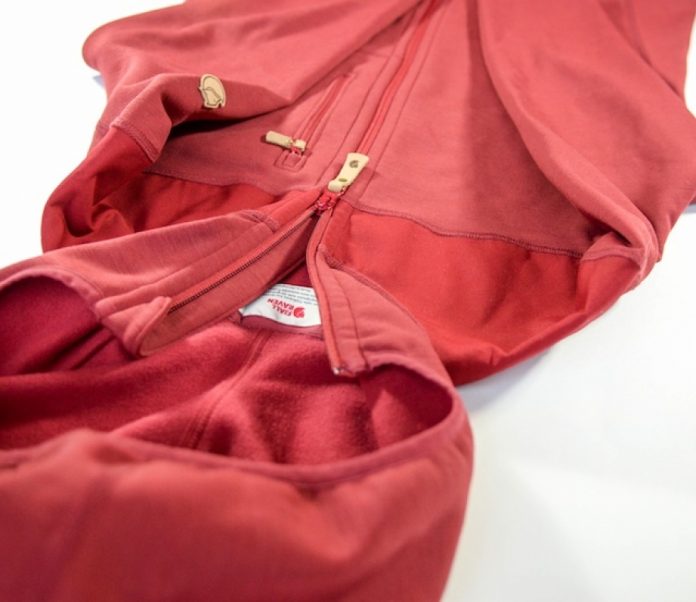
Fjallraven Keb Fleece Jacket

Photo: Dawn Mossop
Fjallraven Keb Fleece Jacket

For an ultimate layering item, choose Fjallraven’s stylish Keb Fleece Jacket W. A roomy fit and stretchy fabric means I can throw it over a puffy jacket and feel warm but not bulky. The wool blend fabric adds insulation and reinforced shoulders boost water and wind resistance.

$200 | www.fjallraven.us

RPv17 rgb


This gear review first appeared in the Spring 2015 issue of Rapid magazine.


Video: Unpin a Canoe with Walter Felton and the ACA

Video: Unpin a Canoe with Walter Felton and the ACA
[iframe src=”https://player.vimeo.com/video/88618491″ width=”500″ height=”281″ frameborder=”0″ webkitallowfullscreen mozallowfullscreen allowfullscreen ]

Unpinning a Canoe or Kayak with Walter Felton and the ACA from Unit4media on Vimeo.

This video features ACA Swiftwater Rescue techniques for unpinning a canoe or kayak with Walter Felton. This symposium was held in 2013 on the Tuckasegee River in North Carolina.

americancanoe.org
unit4media.com/whitewater-media

Learn How To Master the Sea Kayak Scramble Self-Rescue (Video)

James Roberts and Dympna Hayes of Ontario Sea Kayak Centre demonstrate the essentials for a quick and effective scramble—aka Cowboy or Cowgirl—sea kayak re-entry. If you’ve exited your kayak, the scramble self rescue will get you back in your boat in almost any conditions, no extra tools required.

Story Beneath the Shot: Illusion of Control

Story Beneath the Shot: Illusion of Control | Photo: Rowan Gloag

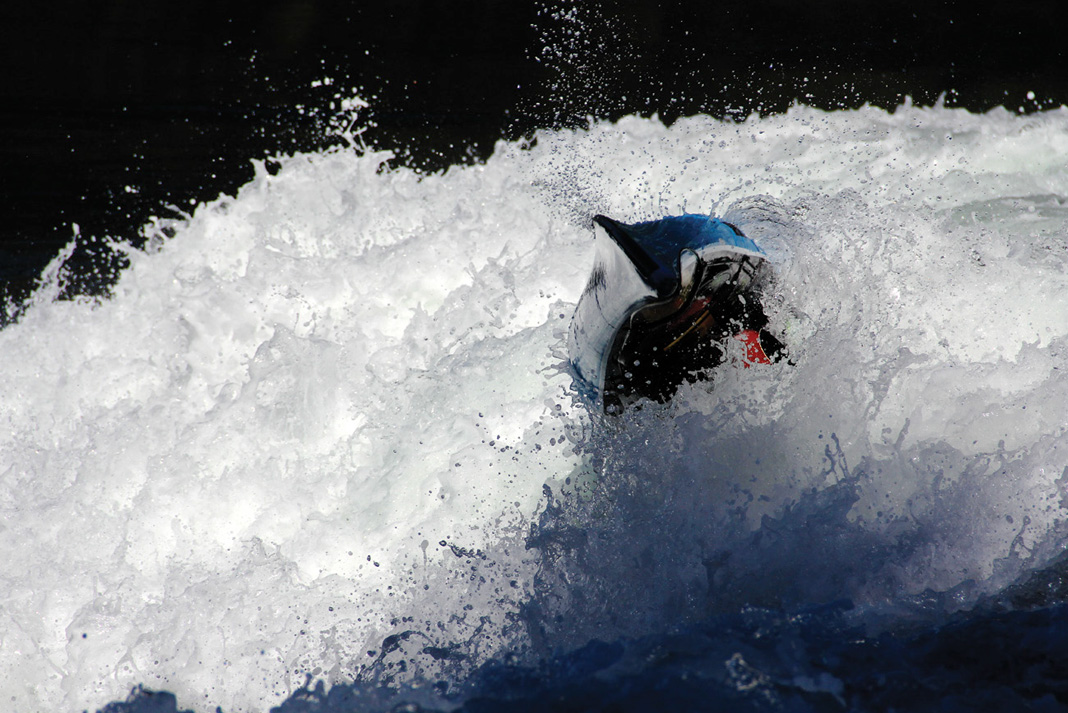
Longtime disciples of the capricious currents at Skookumchuck Rapids, rough water paddlers Rowan Gloag and Costain Leonard knew exactly where—and when—to look for the perfect foam pile.

“We’re interested in finding out how much control we can have in the foam, in a sea kayak,” explains Gloag, a mission that prompted a late summer visit to Skook in British Columbia’s Sechelt Inlet.

When the difference between high and low tide in the constricted passage at Skookumchuck Narrows is less than a meter, the modest current forms the sort of friendly green wave that is the stuff of surf kayakers’ wet dreams. But when the celestial bodies align and a large spring tide widens that gap to two meters or more, the flood of water can reach 16.5 knots—one of the fastest tidal currents in the world—and a menacing foam pile takes shape.

Story Beneath the Shot: Illusion of Control | Photo: Rowan Gloag

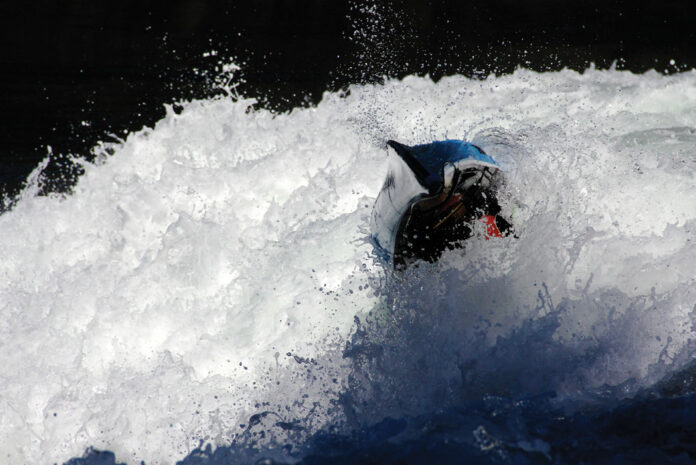
Charging into the recirculating maw of aerated water, Gloag says, develops skills necessary for playing safely in punishing ocean shore breaks. The length and shape of a sea kayak makes breaking free of all that foaming water a sticky proposition. Still, he says, “There are times during the chaos when we can gain control.”

Gloag took a timeout from Skook’s 10.9-knot current that day to shoot his hapless companion’s efforts to tame the hole. “In this picture, Costain has buried his bow in an attempt to launch himself free,” he recalls. “As you can see, it didn’t work, but you gotta try.”


This article first appeared in the Spring 2015 issue of Adventure Kayak magazine. Subscribe to Paddling Magazine and get 25 years of digital magazine archives including our legacy titles: Rapid, Adventure Kayak and Canoeroots.
Video: How to Build a Sea Kayak Contact Tow Line

A contact tow line is an easy to use, practical, multi-use line that can help make your sea kayak rescues faster and less complicated. Though its design is simple and easy to make, there are few shops that sell them.

In this short video, Leon Sommé of Body Boat Blade shows you how to build your own versatile contact tow line and how to effectively use one in the event that it is required. We believe you will come to love and appreciate how useful this piece of kit is and will find yourself wondering how you ever paddled without one.

Watch it, then build it!

Stay tuned for more skills videos with Body Boat Blade International in this series, presented by Adventure Kayak, and watch more techniques on our YouTube channel

Guide Training: A Multi-Day Whitewater Adventure With Tomorrow’s Outdoor Leaders

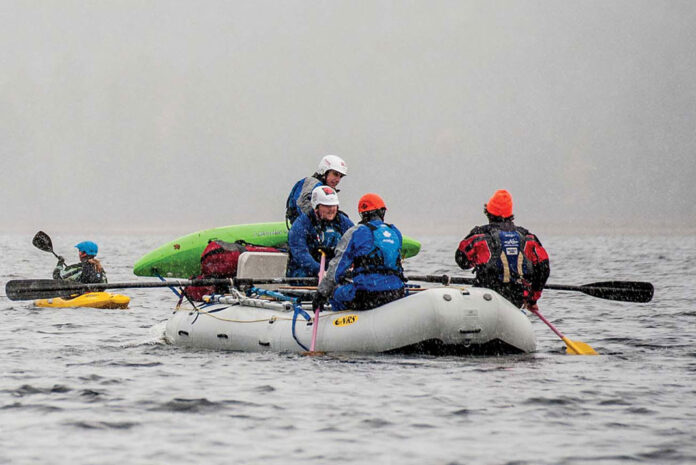
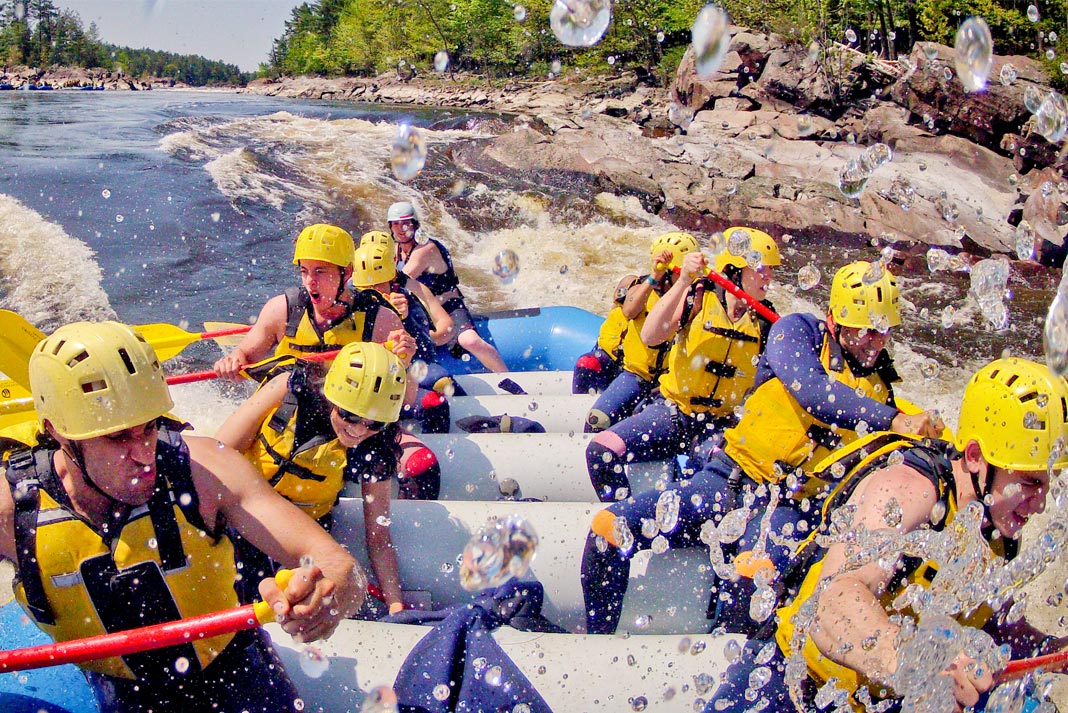
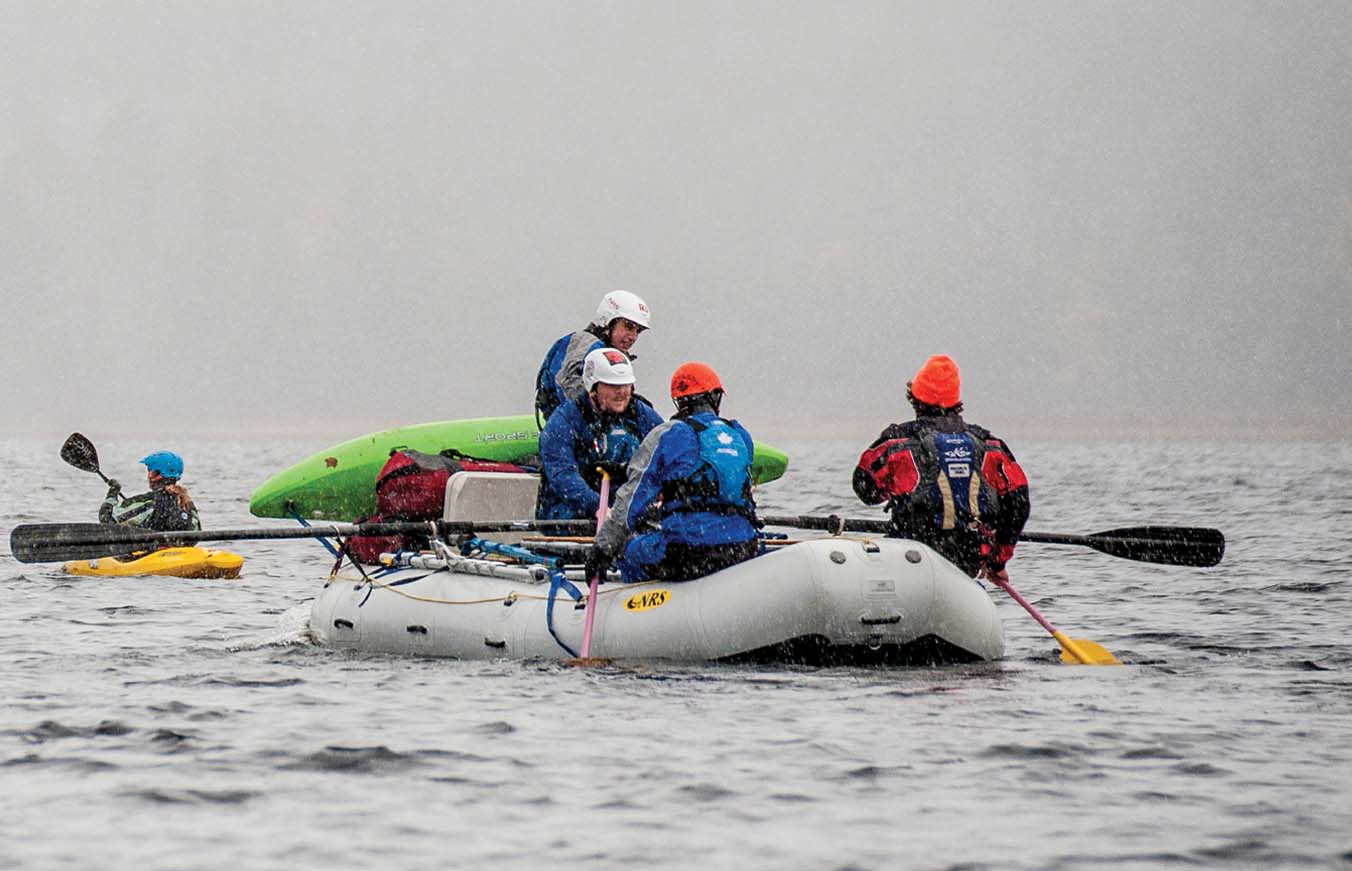
students on whitewater raft and kayak participate in a guide training program in the snow
Feature photo: Robert Faubert

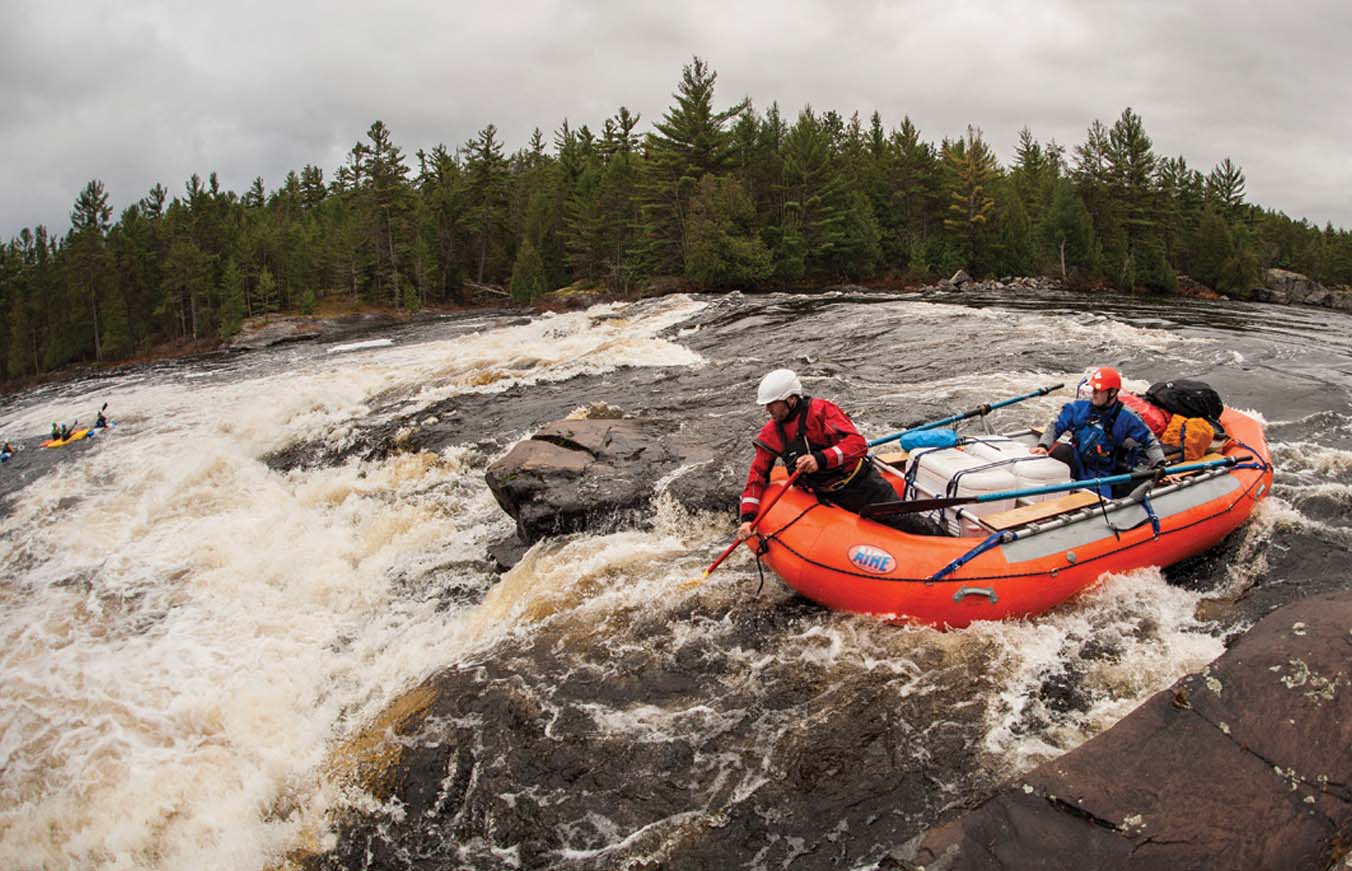
We knew Poplar Rapids could give us some trouble. Driving in the van we discussed the continuous 800-meter entry feeding over an eight-foot horseshoe falls fanning out over a shallow ledge with most of the water bending around against the left bank. At lower water on a warm lazy summer afternoon trip in creek boats we’d eddy hopped down to the lip, scrubbed up on an exposed piece of granite, had a look over the edge, shoved ourselves back into the current and launched the drop.

Guide training: A multi-day whitewater adventure with tomorrow’s outdoor leaders

On a high water multi-day raft and kayak trip with college students of varying skills we were considering our other options. We knew there was another channel to the left. We’d heard it lost the gradient more gradually through winding shallow class II. We’d expected to be lining and dragging rafts off rocks, not putting them on their roofs.

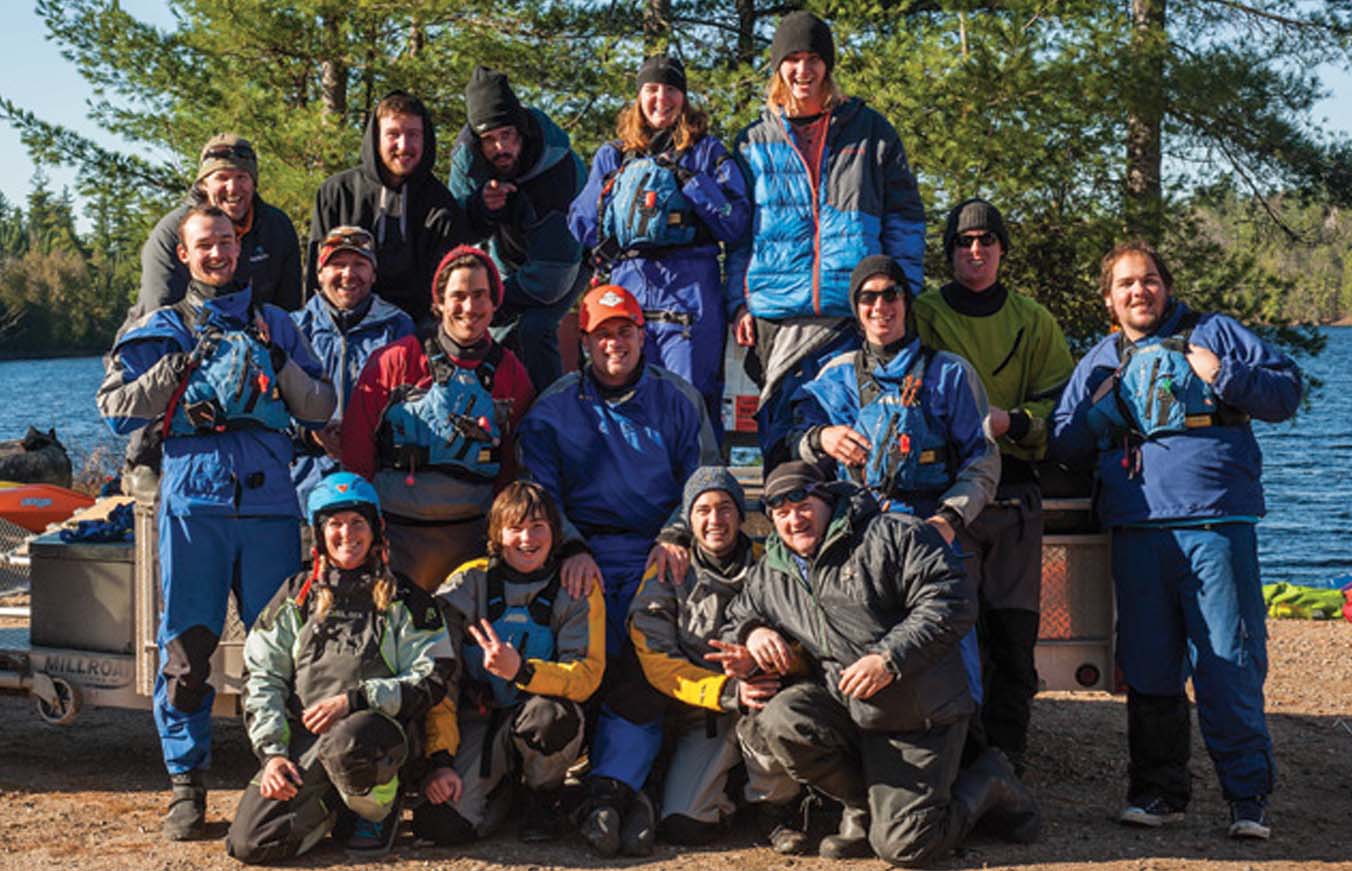
Louise Urwin was driving the van. She was the kayak guide and instructor. Lou is a strong, beautiful, no-bullshit Kiwi with long list of whitewater accomplishments. Photographer Rob Faubert and I were in the bench seat leaning forward to be part of the conversation. Behind us were the 12 college students who signed up for the multi-day whitewater guide elective. If not for the smell of river, they could be any other group of college students dozing, plugged into Taylor Swift, or trying to remember where they’d left a friend’s bike after last Saturday night’s house party.

Photo: Robert Faubert

Jeff Jackson was riding shotgun. He’s our trip leader and the Outdoor Adventure program coordinator. He’s in his early 40s, athletic and wise. His river resume reads like a dirt bag 20-something’s bucket list, while his professional resume would make any mother proud. He’s an educator and professional guide who is all business.

When Jeff got wind that Algonquin College was creating an outdoor leadership program, he returned home to the Ottawa Valley from guiding jobs on the Green, Yampa and Cataract Canyon of the Colorado River so that he’d be in town for job postings. He was hired in May of 2000 and went to work developing the new Outdoor Adventure program and recruiting the first class of 70 students to arrive four months later.

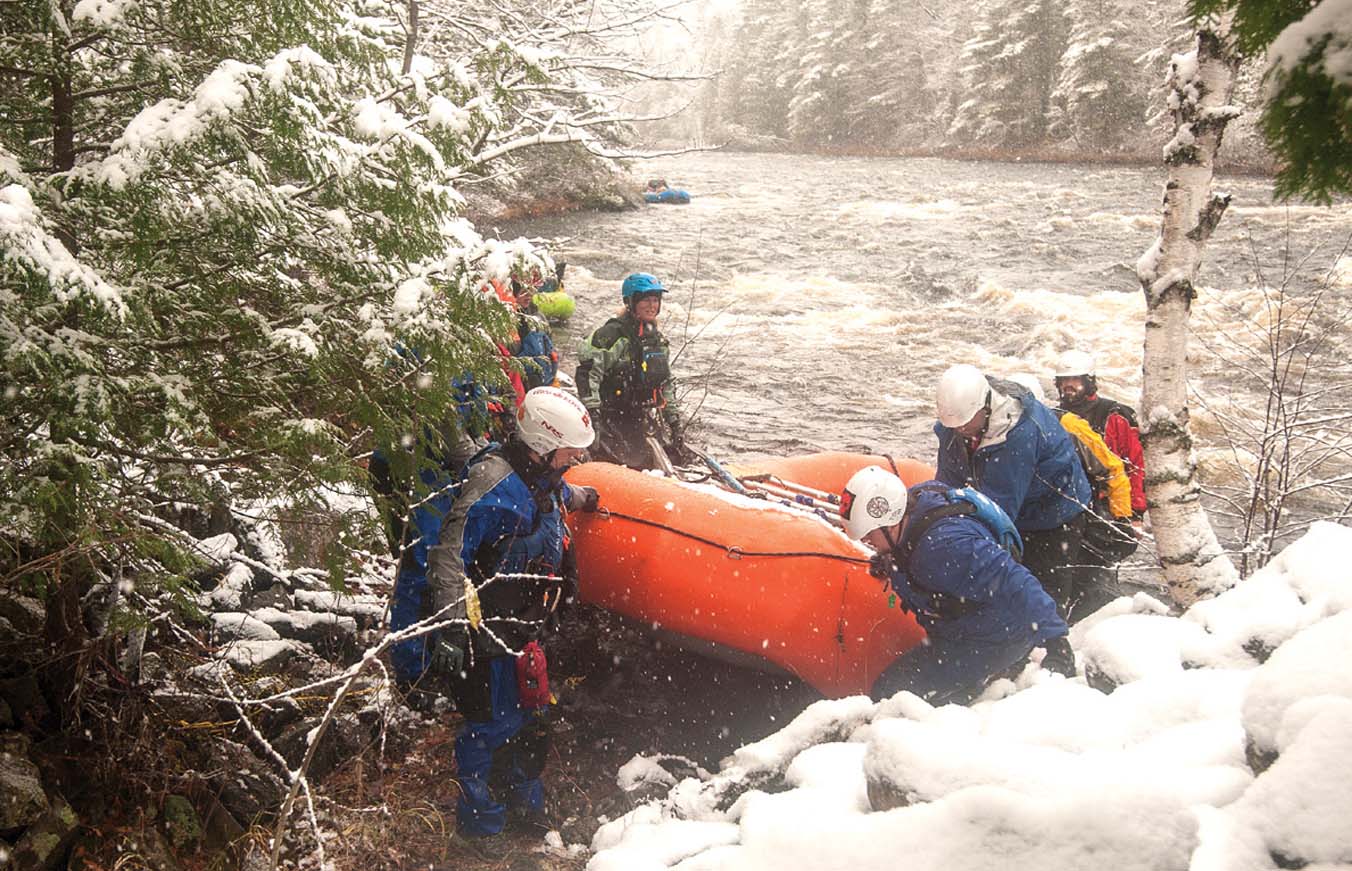
This group, Jeff’s fourteenth batch of second year students, had already completed their fall camp orientation, a 10-day sea kayak trip and two other six-day electives, two of which had to be whitewater canoeing or whitewater kayak certification courses and raft guide training programs—prerequisites for this trip. It’s a grueling schedule with back-to-back weekend electives and classes Monday to Friday. Not all of their outdoor training can be jammed into the late summer when the water and weather are warm. This river trip needed to be pushed deeper into the fall when the water levels on the Petawawa River could be higher and the temperatures much lower.

Petawawa proving ground

The Petawawa River flows almost all the way across Ontario’s Algonquin Provincial Park. Thousands of whitewater canoeists have cut their teeth on the Petawawa, most paddling the second half of our trip, the three-to-four day section below Poplar Rapids. Above this classic summer weekend section, above where Poplar Rapids spills into Lake Travers, flows a less accessible, steeper and more continuous section of whitewater.

Twelve years ago Jeff and I began dragging creek boats up the abandoned Canadian National Railway line that borders this upper section of Petawawa. Back in the ‘80s guides from nearby rafting companies rigged a railway jigger handcart to pump rafts and equipment up the rail line for early big water spring runs. Today the Petawawa is not a commercially viable rafting run. It is too remote. The logistics are too complicated and, this time of year, it’s too cold for paying clients. But the Petawawa is exactly what Jeff needed for the program’s new multi-day whitewater guide elective.

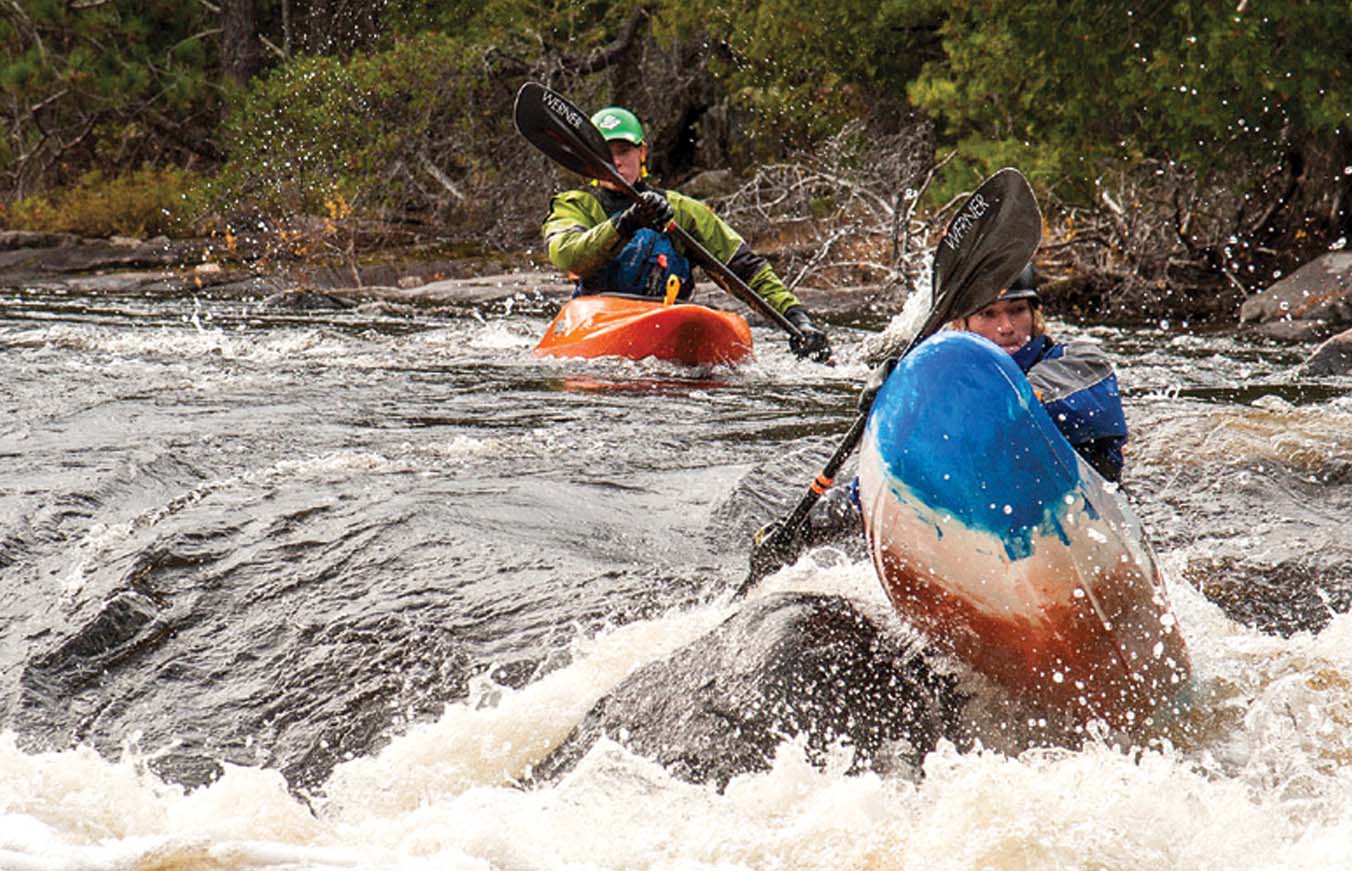
When we slid down the scree slope of the old rail line into the moving water above McDonald Rapids, it was obvious right way that the students had a wide range of skills and confidence. Adrian, Nevin and Holly had guided this past summer. Their lifejackets were faded from the summer sun. They wore throw lines with their names and cell numbers scribbled on them. Some of kayakers had their own boats. They hit the eddy above the first drop with plenty of room to spare. The rest—well, they have enjoyed a longer stretch of river before the first drop.

Photo: Robert Faubert

A prerequisite for this trip was a raft guide elective run on the Ottawa River, where commercial day trip rafting is a wham bam, thank you ma’am one-day affair. The Ottawa is big and deep and safe. The bigger the hits the bigger the tips, guides in my day used to say.

“Day guiding is so low consequence, the mentality is different. There is always a bail out to a road,” Jeff told the group as were scouting the first drop. “By taking away that access we add exposure to consequences. We need to look at every rapid differently. We need to always take the safest line possible.” We weren’t looking for big hits on this trip. We were looking to get down with all the people and equipment we started with.

Through McDonald Rapids, Devils Cellar and Rocky Chute they did a good job getting everyone down. Some of the lines weren’t pretty. We had some swimmers from the rafts. There were a couple wet exits from kayaks. The clean up and safety was quick and efficient. Kind of what I expected.

The bigger rapids we scouted from shore. Down the 1,000-meter series of six ledges known as the Temptations the students boat scouted with rolling cover looking out for the boats below and above you.

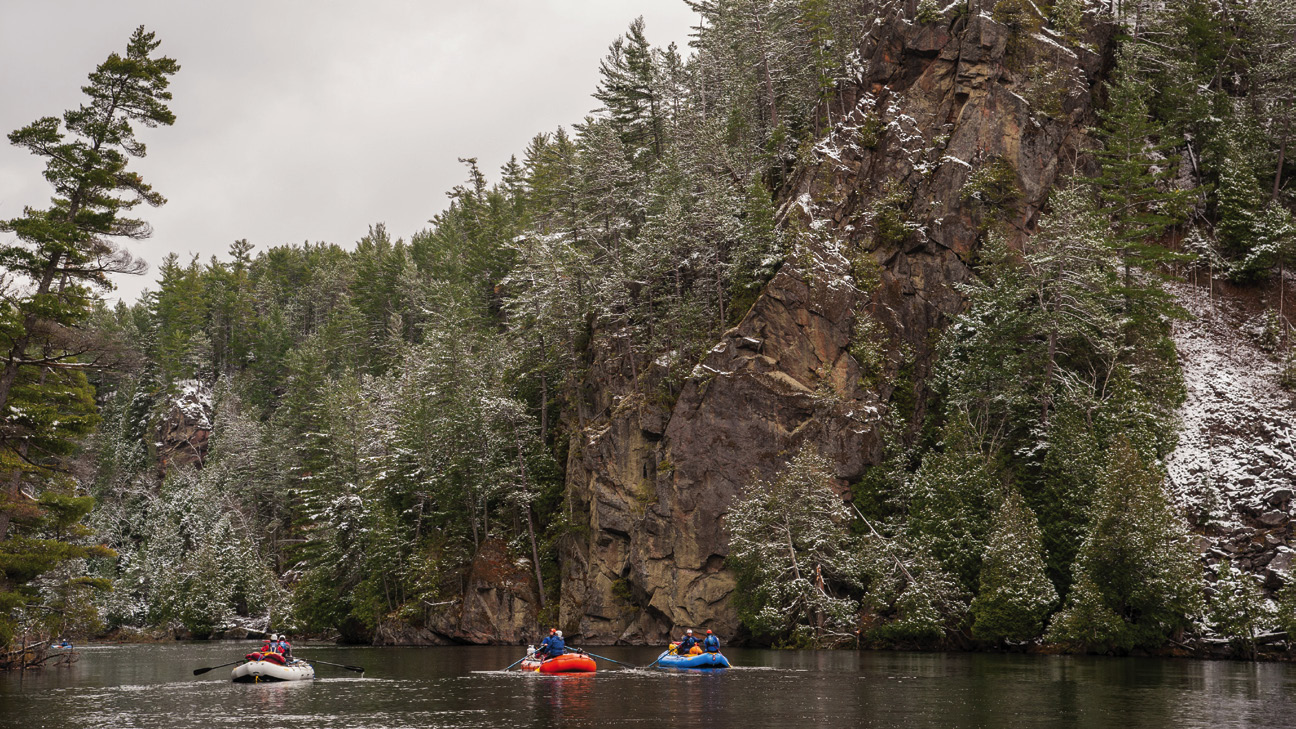
students paddle rafts past a snowy rocky outcrop
Photos: Robert Faubert

Lou ran mini clinics in the eddies along the way. Jeff took turns perching himself aboard student rafts. His ongoing narrative to them was, “What do you see? Where are you going?” Expedition rafting is all about controlling boat momentum and using the momentum of the river. “Pull down and slow down,” he reminds the students.

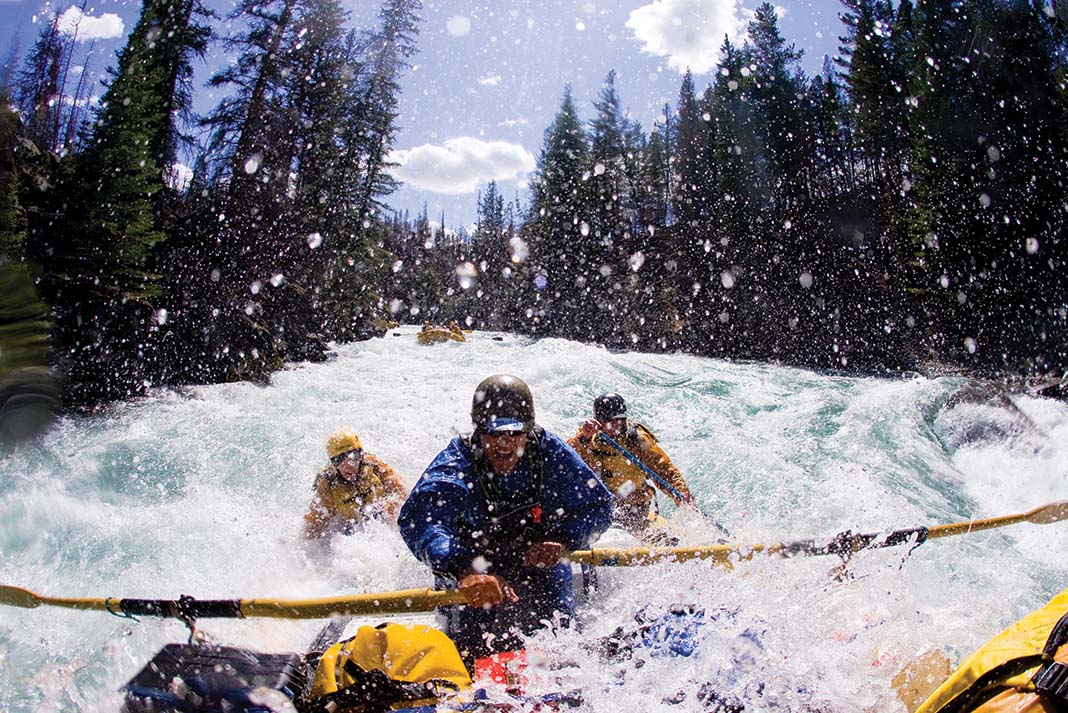
On multi-day rafting trips you don’t charge forward into meaty lines. You didn’t flip rafts on purpose. You try to never flip, ever. A full-loaded oar rigged raft on its roof is a dangerous mess of aluminum, oars and a truckload of food and equipment. A lost cooler on the Grand Canyon could be 21 days without bacon or beer—and no chance of tip for any guide.

Students gain hard-won experience

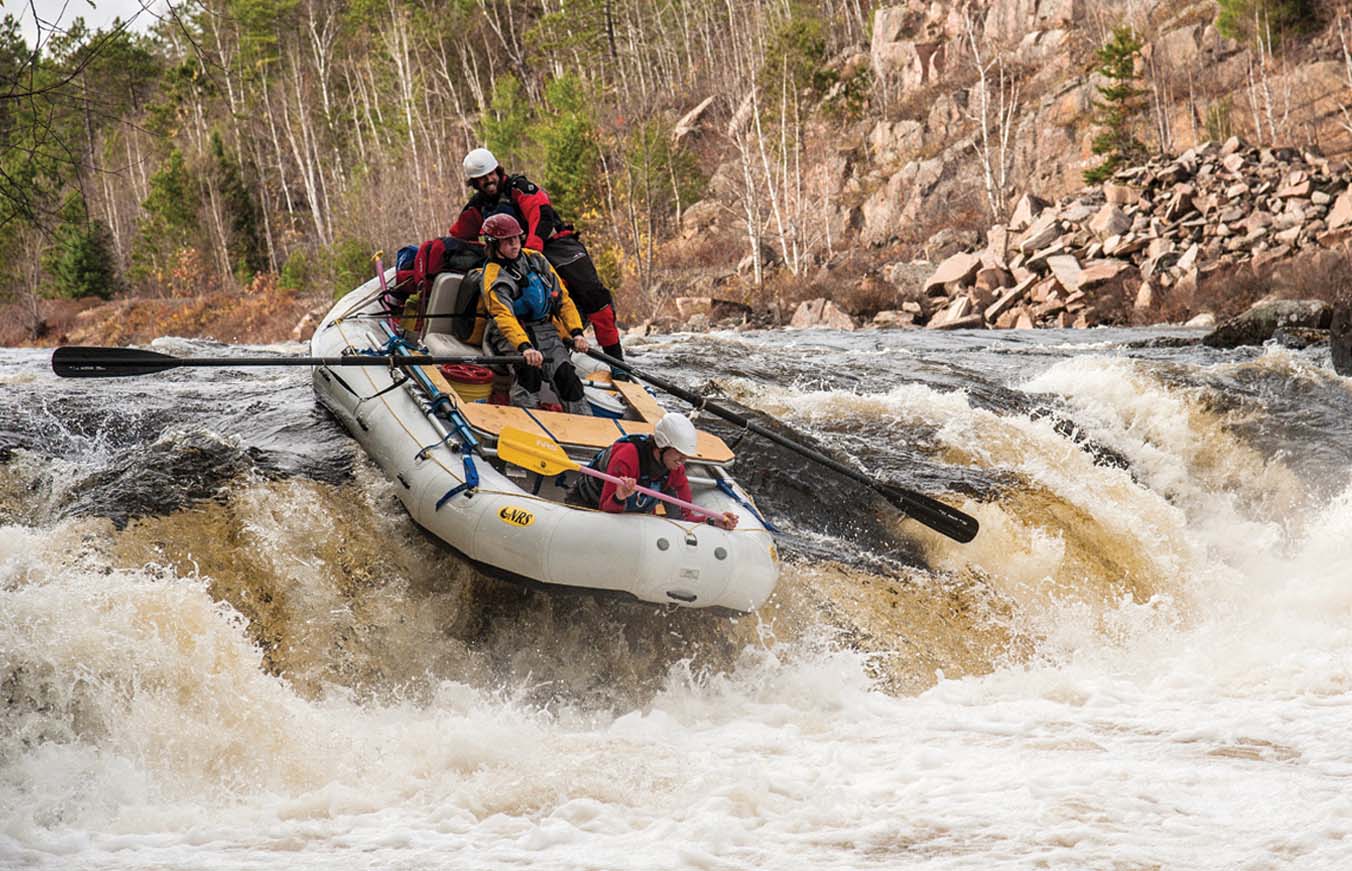
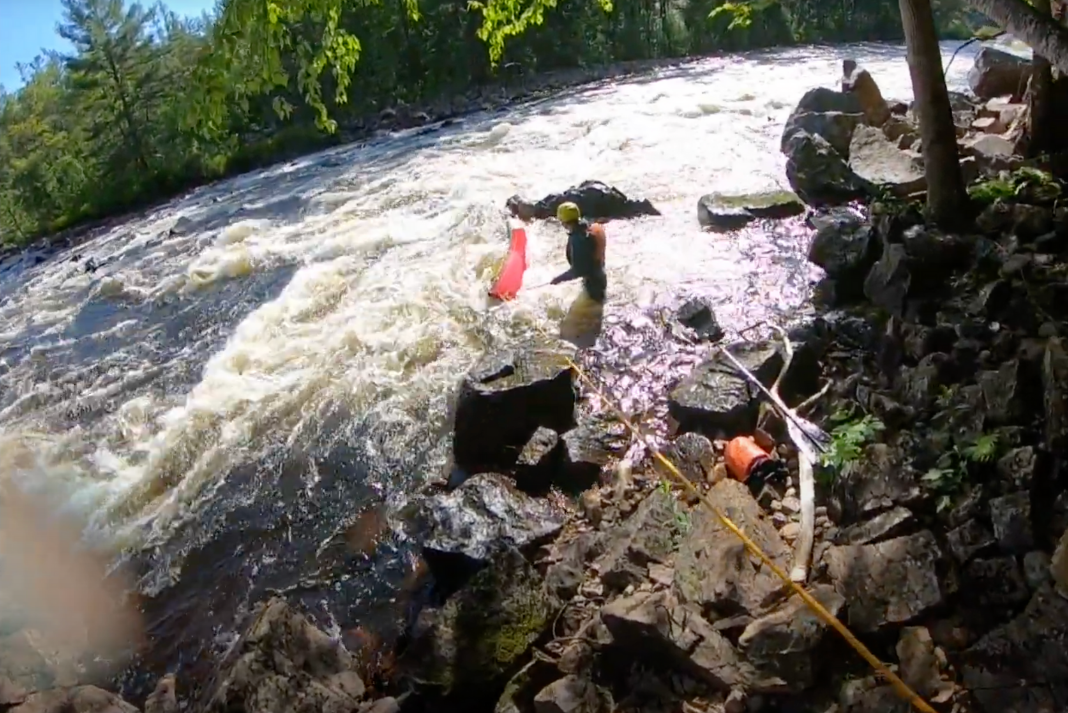
The Keeper is one of the last of the Temptation rapids. To the left it piles up into a small rock face. Most of the river goes straight through a maze of boulder islands and then over a ledge creating a smooth, shallow and deceivingly sticky recirculation—the Keeper. On a previous low water run a friend of mine swam out of her kayak in this sleeper of a hole. While this water level widened and deepened the lines, it also made the current pushier, and the hole munchier—munchy enough to flip our first raft. Half the group scurried around the river picking up swimmers and bits of gear—it seemed a perfect time for a cup of hot soup and a review lesson on rigging before Poplar Rapids.

Jeff wrote in the course outline: guides integrate paddling skills, on-river management and logistics planning in a multi-day whitewater trip format. Students learn logistics, planning for transportation, gear management and group travel. On-river group management integrates kayak and oar rig safety in a technical river setting. Multi-day trips take what they’ve learned in skills courses and plays it out in real life. We’d just had a little taste of that.

Photo: Robert Faubert

Twenty-five years ago my first guide manager told my group of trainees after an intensive two-week course that we didn’t know shit until we’d been guiding for at least two years. “You guys haven’t screwed up enough yet to know what you’re doing,” he shouted at us. “If you stick with it long enough you may eventually become competent river guides.” That was a tough pill to swallow when I was 21. If I ran into him today, I’d buy him a beer.

Jeff acknowledges the limits to technical training course electives. In a recent Outdoor Adventure program review, employers of graduates recommended that students have more expedition experience. They saw great value in expeditions for building leadership skills, judgment and competence. Competence is different than understanding. Competence is being able to apply what you know in whatever situations arise.

The left channel of the 800-meter-long Poplar Rapids began as we’d expected. Shallow and spread out. Boney. I cursed the tiny unavoidable pillows hidden everywhere just below the surface. They snagged the floor and bumped the blades of my oars.

Rob and I were way out in the middle when we both got the feeling. “I don’t like this,” was all Rob had to say. I didn’t either. We’d gotten the willies and started booking it for the river left shore. I looked upstream to signal the others; they’d already figured it out and were moving left.

Around the corner the wide channel came altogether. Our gentle class II sneak route was now constricted between the flooded riverbanks and a rock in the middle the size of the passenger van we rode in on. The approach from where we were tied up was sticky. The drop folded over into a hole with another hole right below stretching out past middle from the right shore. The rest below, as far as we could see, was shallow, fast moving and disappeared down and around another bend. We were way off the typical route and nowhere near a portage trail. Lou and her kayakers bushwhacked their boats through the thick balsam and cedar trees.

Rob and I ran our raft first. The slot was narrow so we removed our oars from the oarlocks and paddle guided our 14-footer over the drop. The front tubes buried in the seam throwing Rob forward over the front tubes and damn near in the drink. I held him in the raft by his PFD long enough for the boat to come back to level and drain so we could get left to avoid the second hole, get to shore and help set up safety.

Adrian was the strongest student guide with a keen eye for reading water. It was decided he’d run the next boat with Lou. The bigger 16-foot raft was pushed wide and off line at the top and it came over the lip sideways. The seam of the pourover swallowed the downstream tube and the momentum pushed the raft up and over on top of them. This could be really bad.

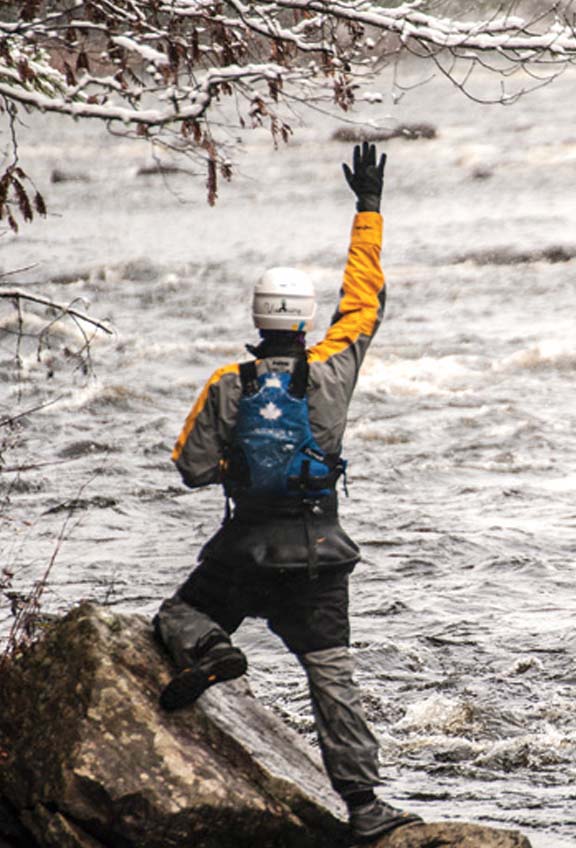
Whistles screamed over the roar of the water. At first we couldn’t see the either of the swimmers. It was shallower than we’d expected. The frame, and gear beneath, bounced off the river bottom and possibly off their heads. As the boat bounced past, Lou surfaced upstream and was trying to slow the raft down so Adrian could swim free.

I dove in the current and the two of us were able to stop the raft from carrying on further downstream. Adrian was still underneath. I feared that he was pinned between the raft and the rocky bottom. I hoped he was tucked up into one of the upside down compartments.

When he eventually flushed out he was pelted with throw bags. He had his river knife in one hand and with the other he grabbed a rope and was swung into the flooded cedars. Adrian, we learned later, had cut himself out of the bowline that had wrapped around his foot.

Time out to rest and take stock

When we finally made camp it was in the parking lot below Poplar where the Petawawa dumps into Lake Travers. It was almost dark. We’d hoped to be half way down the lake by now. When Adrian said he thought he bumped his head we knew this river day was over.

Photo: Robert Faubert

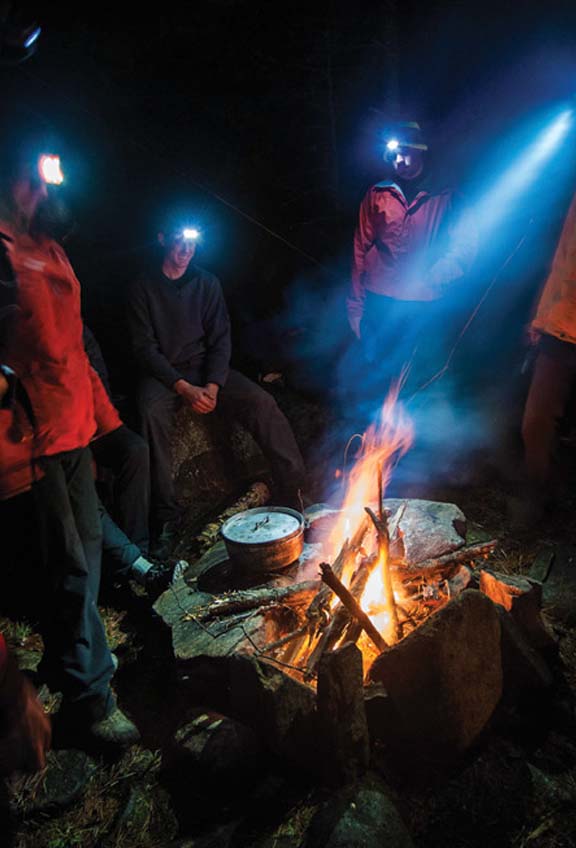
“That was too much,” Jeff told the group after dinner around the campfire. “We’d taken the most conservative choice presented to us but it was still too much exposure for me to be comfortable as the leader. I wouldn’t choose that level of exposure to consequences again with this group.”

We all were nodding agreement.

We discussed our decision to take the mystery channel and avoid the main line at Poplar. We reviewed the rescue and the clean up afterward. We discussed the environmental factors of high water level, short days and cold temperatures. Students shared stories from other trips they’d been on. We felt good about our decision to stay here for the night.

We were keeping an eye on Adrian. We’re camping in this put-in parking lot because it is the best point to get him out. If he showed any signs of trauma, we’d make a call and he’d be going home in the morning.

“I feel like we did everything right,” one student said. “I’m not sure what I would have done differently.”

Somebody suggested that next time Adrian should try harder to keep his boat off its roof. He seemed okay now, and it was okay to laugh. It felt good to laugh and blow off the stress of the day.

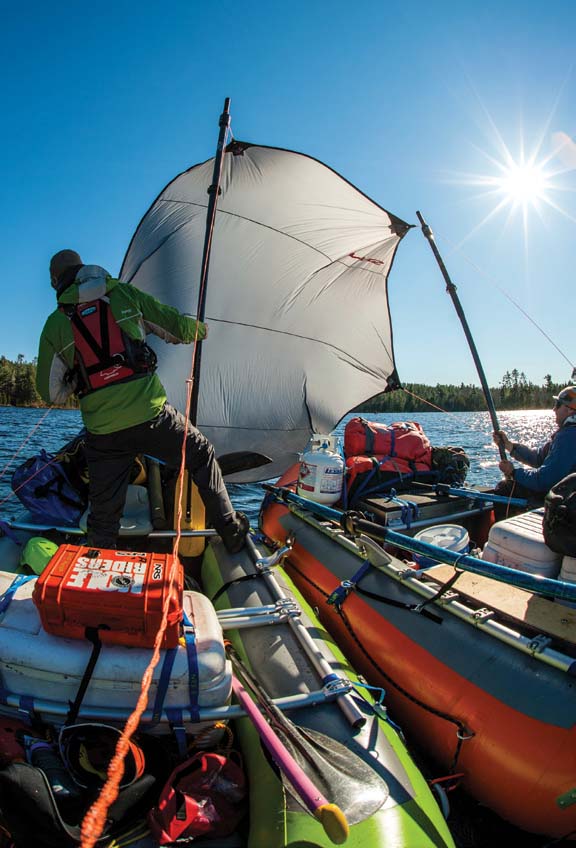
The Petawawa River would be better the other way around. It would have been nice if the swifty class II and III rapids were in the first few days. At least now the students had time to get comfortable in their kayaks. Those in the rafts would have three more days to finesse their oars. They’d practice moving slower than the current and they’d learn to take advantage of river features to assist their back ferries. They knew that now that we’d gotten to Lake Travers they could settle in for a few days of wilderness river travel and camping.

Guiding lessons extend beyond the final grade

The evaluation rubric for the course included leadership and behavior, boat management, group management, camp contributions and at the bottom of the chart was a lesson the students were to prepare and present.

Between river travel and meal preparation, building fires, tarps, the portage and shuffling about to keep warm in the snow there wasn’t time to present their mini lessons. Jeff and the students were okay with that. I’d all but forgotten this was part of their college course.

At first Jeff was running the show. Rob and I watched him take charge to organize the meals and call shots on the river. Over the next five days the students picked up the rhythm of big group multi-day river travel. This was part of his plan. Meals took half the time to prepare. Camp was set up and torn down, rafts were loaded and good decisions about the menu and river travel were all just happening as they should on a guided expedition.

To satisfy the college, Jeff must award a grade to each student. However, what these students truly learned will not appear on their transcripts. In fact they may not know what they’ve learned until much further down the road. If they stick with guiding long enough, if they screw up enough and if they face enough adversity, hard work and bad weather like we did on the Petawawa, a river manager I knew once would say they’d eventually make good river guides.

On our final morning the sun broke through the snow clouds. We layed our stiff wet gear in places the sun’s heat would thaw and soften the frozen fabric. The group decided on a simple breakfast to get us on the water and moving an hour earlier. When Jeff, Rob and I wandered over for coffee, the students asked if that would be okay, but really they were telling us what they’d already decided and what they had in store for us that day.

Scott MacGregor is the founder and publisher of Rapid magazine.

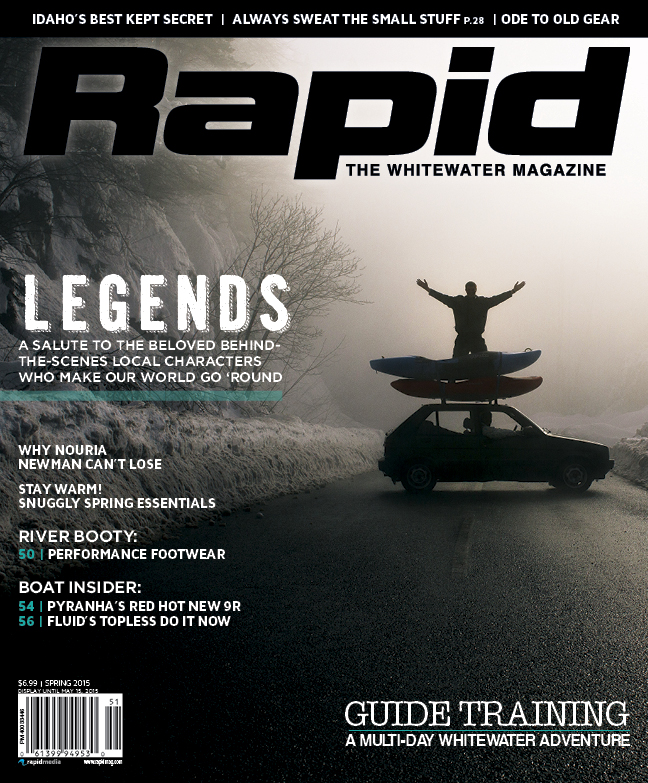
Cover of Rapid Magazine Spring 2015 issueThis article was first published in the Spring 2015 issue of Rapid Magazine. Subscribe to Paddling Magazine’s print and digital editions, or browse the archives.


Feature photo: Robert Faubert