Home Blog Page 324

Base Camp: Children, Do as We Do

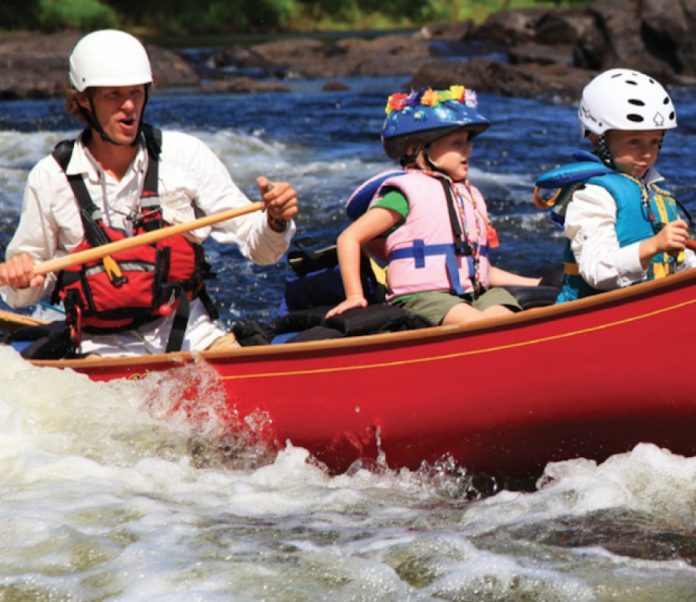
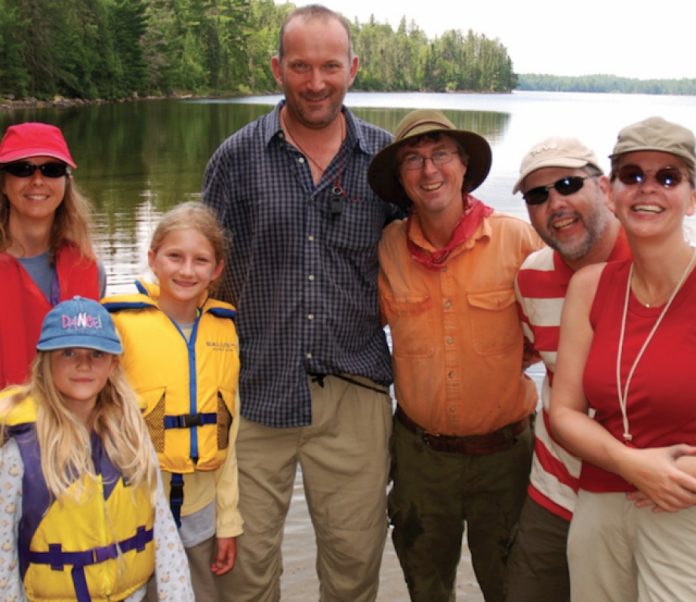
Photo: Tanya MacGregor
Base Camp: Children, Do as We Do | Photo: Tanya MacGregor

My best memories are of adventures most parents would tell their children not to do, but may have done themselves. Like the time I jumped on a freight train to get home from university. Or the 105-day sea kayak trip through the Great Lakes never before having paddled a day in a sea kayak.

I tell my kids all my adventure and misadventure stories. Why not? It creates in them a sense of adventure and helps develop their sense of judgment. Would I do it all over again? If the answer is yes, I tell them so. I want them to know their dad was a raft guide, canoe instructor and ski patroller, and that I kissed their mom on the first date. It is a side of the 40-year-old me they don’t see on the way to the school bus stop.

Since co-starring in the film, Dougie Down the Pet—the story of a four-day whitewater canoe trip with my four-year-old son—one of the most common questions I get from fans of the movie is, “How do I convince my mother-in-law?”

I always suggest that if you really want to go, don’t tell her until you get back.

Better yet, ask her what she really did with her parents as a child or with your wife when she was a baby. Like riding to the waterpark in the very back of the family station wagon lined with cushions from a sectional sofa. Stories like that make canoeing the Petawawa River with helmets and PFDs look rather responsible.

I recently met a very enthusiastic mother at the Outdoor Adventure Show. She was pushing a double stroller piled high with camping equipment. This was going to be their breakout year. She and her husband were at the tradeshow making plans and getting ready.

She asked me about paddling courses for her boys, asleep in the stroller. She said she and her husband weren’t all that comfortable canoeing and camping, so wanted them to receive professional instruction—I thought she was joking.

“I want them to learn proper strokes.”

I suggested she leave the kids with her mother-in-law and take a weekend skills course with her husband—they could call it a date. They probably needed one; we all did then.

I also suggested joining a club or taking a guided family adventure and sucking every last bit of knowledge from their experienced leaders or guides. There is really no better way to learn about gear, cooking, camping and paddling than go- ing with a professional guide.

We as parents need to feel confident in order to enjoy ourselves and to pass on our love of the outdoors. If we have great looking strokes, if we can cook over a fire and if we truly love being outside and are happy there, our children will do as we do, no matter what your mother-in-law has to say.

This article on getting families outside was published in the Early Summer 2012 issue of Canoeroots magazine.

This article first appeared in the Early Summer 2012 issue of Canoeroots Magazine.


Betcha Didn’t Know About… Canada Geese

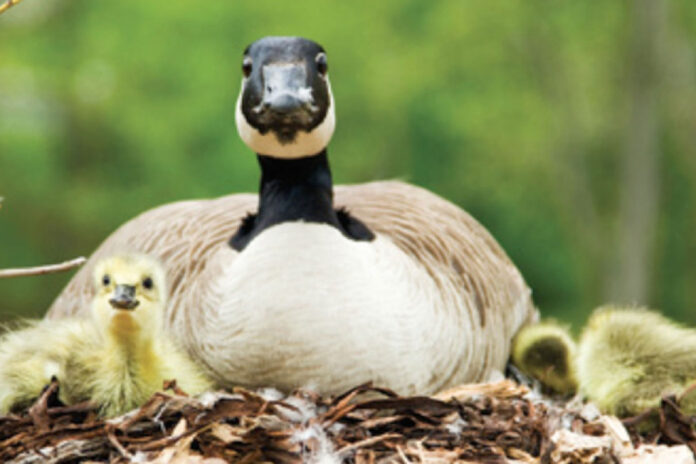
Canada goose on nest with young
Feature photo: iStock
  • The average lifespan of a wild Canada goose is 24 years.
  • While on the ground, a flock of geese is called a gaggle. In the air, a flock of geese is called a skein.
  • Canada geese have an enlarged bone at the end of each wing, similar to a wrist. Though unlikely, an adult Canada goose is capable of breaking a human limb with this part of its wing.
  • There are 11 subspecies of Canada goose. In general, they get smaller as you move northward and darker as you go westward.
  • Geese can cover 1,500 miles (2,400 kilometers) in just 24 hours with a favorable wind, but typically travel at a much more leisurely rate.
  • Geese fly in a V formation because it creates a current of air that makes flight more efficient and allows for better communication.
  • Goslings begin communicating with their parents while still in the egg and learn up to 13 different calls by adulthood. Female Canada geese have a deeper voice.
  • Canada geese are one of the most hazardous species associated with aircraft bird strikes. In 2009, U.S. Airways Flight 1549 struck two Canada geese six minutes after take-off and ditched into New York’s Hudson River. All 155 passengers survived the crash. The geese did not.
  • Canada geese have bills with serrated edges, which help them cut tough grass stems.
  • Loosely based on a true story, the film Fly Away Home depicts a father and daughter rescuing 16 orphaned Canada geese by escorting them some 1,000 miles from Ontario to North Carolina in ultralight aircraft decorated like mother birds. The truth? Bill Lishman spent five years training geese to follow him in flight as a biological experiment.


This article on Canada Geese was published in the Early Summer 2012 issue of Canoeroots magazine.

This article first appeared in the Early Summer 2012 issue of Canoeroots Magazine. For more great content, subscribe to Canoeroots’print and digital editions here.


Little Explorers: Tie One On

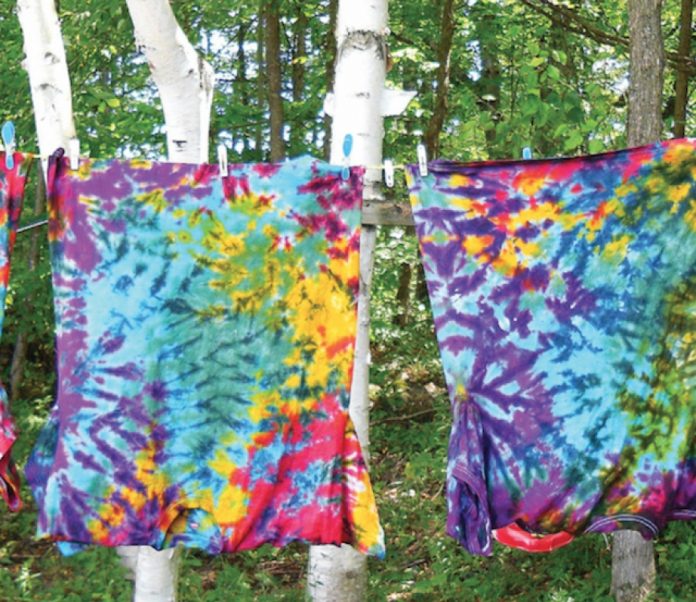
Photo: Kinds Hands Tie Dye
Little Explorers: Tie One On

It may bring back memories of Janis Joplin, shag carpet and lava lamps but tie-dye is actually an ancient art that’s been around for thousands of years. Making your very own tie-dyed clothing is the perfect backyard or lakeside activity because, like most things that are fun, it’s messy! 

WHAT YOU’LL NEED

  • A t-shirt or other plain white, 100% cotton cloth to decorate

  • Fabric dye

  • Soda ash

  • Elastic bands or string

  • Squeeze bottles

  • Rubber gloves and smock or apron

  • A disposable tablecloth or garbage bags and tape

  • Buckets or dish tubs

  • Sealable plastic bags

  • Marbles or smooth, round stones

    Keep in mind that the dye will stain everything it comes into contact with—clothes, skin, hair, table tops and buckets!

INSTRUCTIONS

Prepare your station. A picnic table is perfect for this. Cover it with the tablecloth or garbage bags and tape them in place.

TIE.

Soaking the shirt in water first will make it easier to work with. Try one of these tying methods for a classic design.

Classic Spiral

Lay your shirt out on a flat surface.

Pinch the cloth where
you want the center
of the spiral to be and turn it until it’s com- pletely wound, keeping it as flat as possible.

Using your ties, divide the spiral into pie-pieces.

Bull’s Eye

Place a marble or smooth rock on the shirt where you’d like the center of the bull’s eye to be.

Place a tie around the shirt with the marble inside.

Continue to place marbles and ties for as many rings as you’d like.

Stripes

Loosely scrunch your shirt into a long tube. The stripes will run perpendicular to the tube.

Place ties as far apart as you want the stripes to be. Make sure the ties are very tight. 

PRE-TREAT.

Dissolve the soda ash in a bucket of water and soak your tied shirts for 15 minutes. If your dye didn’t come with soda ash, pick some up at a craft store and mix one cup per gallon of water. This will help the dye bond and provide brighter, longer-lasting designs. Soda ash is caustic so be sure to protect yourself.

DYE.

Put on your gloves and aprons, mix your dyes according to the manufacturer’s direc- tions and fill your squeeze bottles. Squirt the dye onto the tied-off sections of your shirt.

Be creative mixing colors for a unique look. Try to avoid letting complementary colors touch—when they mix they’ll turn brown. Saturate the shirt completely without letting the dye pool.

BAG IT.

When you’re happy with your dye job, place the shirt in a sealable plastic bag and let it set overnight.

RINSE, WASH, REPEAT.

Put your rubber gloves and apron back on and remove the shirt from the bag. Rinse the shirt until the water runs clear, starting with warm and
then cool water. Remove the ties as you rinse. Machine-wash the shirt in cold water. When you’re finished, run an empty wash cycle with warm water and soap to ensure there’s no leftover dye in your washing machine.

You now have your very own, one-of-a-kind, cheerful, colorful masterpiece to wear on your next canoe trip! 

This article on tie dye was published in the Early Summer 2012 issue of Canoeroots magazine.

This article first appeared in the Early Summer 2012 issue of Canoeroots Magazine.


Butt End: In the Company of Strangers

Photo: Kevin Callan
Butt End: In the Company of Strangers

Most of the time, I like people and consider myself a social person. On a canoe trip, however, I usually find it distasteful to run into other paddlers. This aversion to human interaction leads me to seek out remote areas where no one else goes.

Recently, I launched my new film The Happy Camper’s Wilderness Quest and one of the first questions from the media was, “What was the most inspiring thing that happened to you while filming and canoeing around the remote interior of Quetico Provincial Park?” Oddly, I blurted out, “Meeting people out there.”

What’s with that? My answer surprised me and mystified the journalist. I’m sure he was expecting me to offer some poetic views on solitude and seclusion. The film is called “Wilderness Quest” after all, and has all the standard scenes of loons, sunsets, nasty portages, bugs, scary thunderstorms, beautiful landscapes and moonlit paddles.

In retrospect, however, it really was the grab bag of paddlers I met out on the portages and campsites who motivated me the most. Sharing in the diverse reasons of why they love the wilderness is what made the project truly worthwhile.

Some of the more memorable characters included two stoner chicks who proudly showed off the biceps they had gained from portaging; an interior maintenance crew boss who expressed his appreciation of wilderness travel with quotes from Thoreau; and a minister from Germany—wearing a pair of Lederhosen—who recounted pure moments of spiritual Utopia. Then there was the slothful teenager conveying how he had his best nap ever while canoeing in Quetico; the deep-thinking philosopher who wished for the simpler life of being a tree or a bird; and the retired dentist who loathed seeing anyone while out on trip—especially a film crew! 

The trip was a reminder of how temporary our time is and how we should be spending more of it in wilderness areas. 

The most inspiring interview was with a middle-aged couple whom we met after a very long day. The film crew was exhausted and needed a break, but I felt we should talk to the couple. So I offered to carry their canoe across the portage while producer Kip Spidell did the interview. 

When I returned, everyone was in tears. The woman had shared the story of how she was a breast cancer survivor and how she and her husband made the decision to head out on a wilderness canoe trip in Quetico to re-evaluate their lives. To them, the trip was like starting on a clean page, a reminder of how temporary our time is and how we should be spending more of it in wilderness areas.

Like many people, I suffer from an inability to articulate the intrinsic well-being I feel from spending time in the wilderness. But the candor and comments of the Quetico paddlers gave voice to these feelings and spoke to anyone else who has ever spent quality time canoeing in wild places. For that, I’m glad I met so many people out there on my wilderness quest.

If you see Kevin Callan in the wilderness with a camera crew, don’t run away…he may carry your gear across your next portage. 


This article on stories shared along the portage trail was published in the Early Summer 2012 issue of Canoeroots magazine

This article first appeared in the Early Summer 2012 issue of Canoeroots Magazine. For more great content, subscribe to Canoeroots’print and digital editions here.


School’s Out

Photo: Bryan Hansel
School's Out

“There’s a bear,” Amy Freeman whispered, pointing at the rocky shoreline. I scanned the Canadian Shield granite, hoping to see its hunched, black silhouette walking along the edge of the lake. It wasn’t until Amy and husband Dave’s Kevlar canoe clunked against a boulder at the portage that I spotted the bear. Unfazed by the sound, it poked its nose into the water and pushed around stones, looking for food before the long northern winter set in.

“I hope Fennell doesn’t see it,” said Amy. The Freeman’s 104-pound sled dog has accompanied them on the last 3,900 miles of a three-year, 11,700-mile journey across North America by canoe, kayak and dogsled. They call this trip the North American Odyssey.

I joined them in Voyageurs National Park in October 2011 for the last 20 days of the fourth stage of the expedition, which they hope to complete this year by paddling to Florida. Together, we would paddle to Lake Superior following the Minnesota-Ontario border through the Boundary Waters Canoe Area Wilderness (BWCA).

When we started portaging, the bear turned into the birch forest and ambled away over a ground covered with the season’s last fallen yellow leaves. According to the map, the campsite we wanted was on the opposite side of a peninsula in the exact direction that the bear headed.

By the time we paddled to the campsite, the low-hanging cumulus clouds covering the sky were turning pink with the setting sun. As Amy placed a foot on the sloping granite, I noticed the bear walking away from us.

“We can get another campsite if you want,” offered Dave. Too tired to paddle any more, I said no and we set up camp for the night. Following a routine that they developed over the last year and a half of travel, Amy set up their tent and rolled out their sleeping bags while Dave started cooking dinner. 

The North American Odyssey is a Wilderness Classroom Organization (WCO) expedition. Dave founded WCO in 2001 with the simple idea of sharing his expeditions with classrooms online. Now based in a suburb of Chicago, the nonprofit’s mission is to introduce elementary and middle school students to exploration and wilderness travel, and use those themes to help improve their core academic skills and appreciation for the outdoors.

Each year, the Freemans travel to a remote corner of the globe, from the Amazon to the Arctic. Once there, they interact with over 65,000 students and 1,800 teachers through journal entries, videos, podcasts, field interviews, lesson plans and interactive polls sent via their laptops and satellite Internet connections. 

“It is actually something we try to explain to the kids at our school assemblies—you can accomplish big things by setting smaller goals, working your way up to a big goal.” 

During my time on the North American Odyssey, Dave initiated a poll allowing students to direct the expedition team’s activities. For this poll, the students decided between sending us to Ely’s International Wolf Center, the North American Bear Center or to learn about the 92,000-acre Pagami Creek forest fire burning in BWCA—incidentally in the way of our route to Superior.

Another WCO goal is to get kids to pursue more outdoor activities. According to the Outdoor Foundation’s 2011 Outdoor Recreation Participation Report, participation rates for kids ages six to 17 have steadily declined since 2006. In some age brackets, participation rates have dropped by as much as 16 percent. The report also reveals that 37 percent of kids who consider themselves outdoor participants get outside less than twice a month.

Further reinforcing the value of the WCO’s mission, the report states that the number one reason that kids do outdoor activities is because “outdoor activities are cool” and the number one reason they don’t do more is because of “time spent at school instead.” For these students, it’s hard to imagine anything cooler than a three-year outdoor expedition used by teachers to improve academic skills while the kids are in school. 

Halfway across the BWCA a week later on a windy, damp day, we paddled south to Ely. The faint smell of smoke from the nearby Pagami Creek fire drifted through the air as my bow slammed into the trough of every wave. Water from the constant spray sloshed around the canoe’s bilge, soaking my rain pants.

By the time we landed in Ely, I was happy to stand next to a wood-burning stove trying to heat the October chill from my body while Dave and Amy sent out the week’s lesson plans. Dave checked the results of the poll; I had never been to the Wolf Center and Dave had never been to the Bear Center. We each hoped that the kids would vote for our pick. We were surprised to discover that 60 percent wanted us to find out more about the Pagami Creek fire.

The next couple of days were a blur of activity; we hitched a ride into the U.S. Forest Service incident command center to interview a backcountry ranger. Then we found ourselves helping pack three days worth of food for 32 hungry firefighters heading out into a remote campsite. We filmed everywhere we went to share it with WCO’s classroom followers. Then Dave and Amy spent an afternoon writing a lesson about the fire and editing video from Ely and a massive firestorm that they experienced on the Tazin River in the Northwest Territories earlier in the expedition.

One of the classrooms that voted for us to investigate the forest fire was Julie Doxstader’s third-grade class from Orion, Illinois, a rural town of 1,700 people. Doxstader has been following WCO since its inception 10 years ago. Her students conduct research and do writing projects based on Dave and Amy’s weekly journal entries.

Interested to see if I could measure whether WCO’s programs increase outdoor participation, I asked Doxstader if the program had caused her students to take any outdoor trips.

“I have a former student who is very involved in Scouting and camping, and is planning to study forestry in college,” she replied. “His parents have told me that he became interested in the wilderness in my third-grade classroom. Many high school students will still ask about Dave and the WCO when they see me, so I know it has left a lasting impression.” 

Doxstader’s students were surprised when they watched the videos about the fires, especially the footage from the northern fire- storm. Illinois doesn’t experience forest fires, so it was a foreign topic. The student’s further research turned up information on how forests benefit from and regenerate after a fire.

“The WCO brings a wonderful global perspective to my students,” says Doxstader. “Over the years, they have learned about many cultures quite different from their own. For example, they have watched students in the Amazon paddle canoes to their floating school.” 

Just after dark on my last night with the Freemans, the northern sky turned a dim green. As I retrieved my camera, the sky exploded into a dancing array of green and red northern lights. All three of us ran around the campsite trying to find the best view, and Dave and Amy laughed, cheered and clapped as the lights shimmered and changed colors and shapes. 

The following morning, we tackled the Grand Portage, an 8.5-mile slog that runs from the BWCA to Lake Superior. I had portaged it before and remembered feeling spent. Preparing for the trek ahead felt daunting. Reversing declining outdoor participation among kids feels the same way. But, we have to start somewhere.

On the Grand Portage, Dave came up with a plan to single carry all our gear and take 10-minute rest breaks every 30 minutes. We reached Lake Superior after about five hours and dipped our canoes into the cold, clear water. His plan had worked.

“It is actually something we try to explain to the kids at our school assemblies,” says Amy. “You can accomplish big things by setting smaller goals, working your way up to a big goal,”

Just a few students followed Dave’s first trip. Now, the WCO reaches over 65,000 students with its message. With that kind of reach, I have to believe that the Freeman’s approach of breaking a monumental task into manageable parts works. If there’s any hope of getting more kids to spend more time outside, this seems like the right strategy. After all, it got us down the Grand Portage.

To follow Dave and Amy’s adventures and learn more about getting your school involved, visit wildernessclassroom.com. 

This article on the wilderness classroom was published in the Early Summer 2012 issue of Canoeroots magazine.This article first appeared in the Early Summer 2012 issue of Canoeroots Magazine.


Granite Gear Superior One Gear Reivew

A review of the Granite Gear Superior One portage pack from Canoeroots & Family Camping magazine

The Superior One uses a harness reminiscent of a high-quality hiking backpack mounted onto a bag that’s sized for a canoe—a rare blend in portage packs. Its padded back panel forms for comfort and distributes weight evenly with help from wide, contoured shoulder straps and a cushy, interchangeable waist belt. Choose from two sizes to customize torso fit. Top load the colossal 121-liter capacity using dry bags for optimal protection—the Superior One is water-resistant, not proof. The Cordura and ballistic nylons used in the pack’s body bottom do, however, stand up to being dragged, snagged, tossed and sat on better than dryer, vinyl alternatives. The pack’s side pockets and lash points, features absent on lower-end models, make carrying loose items easy.

www.granitegear.com | $220


A VIDEO REVIEW OF THE GRANITE GEAR SUPERIOR ONE CANOE PACK FROM CANOEROOTS MAGAZINE


This article originally appeared in Canoeroots & Family Camping, Spring 2012. Download our freeiPad/iPhone/iPod Touch App or Android App or read it here.

Tumblehome: Life After Death

A fabulous new book called The Canadian Canoe Company and the Early Peterborough Canoe Factories (Cover to Cover Press, 2011) has got me thinking about reincarnation.

According to author Ken Brown, canoe building in Peterborough, Ontario, effectively died in the early 1960s with the Canadian Canoe Company ceasing operations in October 1961 and the Peterborough Canoe Company declaring bankruptcy soon after. But the presence of this book and a quick cruise on the World Wide Web indicates that the products of these venerable canoe companies are still very much on people’s minds.

The demise of industrial canoe building in Peterborough was real enough.

Companies that had skillfully grown from an emerging 19th century cottage and craft activity into seven or eight canoe-building factories with robust domestic and international markets, struggled after WWII. Aluminum and fiberglass building techniques—innovations honed in wartime aircraft manufacturing— lent themselves naturally to canoe building. But tooling up for new materials and new

Building techniques was expensive. And training or retraining a skilled woodworking labor force to make canoes out of plastic or metal was also costly. It was only a matter of time before the wooden canoe companies floundered.

Yet Peterborough thrived through nearly a hundred years of uncommon industrial success. Ken Brown tells us that in a country bordering three oceans, in 1930 a quarter of the 778 Canadians involved in the building of small boats were employed in the landlocked center of the continent by Peterbor- ough area firms, generating a third of the annual $2 million sales in this area of the economy.

After WWII, this tapered back and, after the closure of the Peterborough companies, passed to the skilled hands of later genera- tions of small builders and hobbyists who continue to keep the tradition vibrant.

Today, you can buy Peterborough canoes at auction.

Reprints of old catalogues are available for sale in hard and soft cover. The iconic company logos are available as decals for the growing corps of builders and rebuilders from Pacific to Atlantic and Arctic to Caribbean who still love Peterborough shapes in their shops.

And then there are the T-shirts and calendars, and the advertisers who for the past 50 years have freely employed canoe imagery. Selling charcoal, beer, milk or maxipads with canoe imagery cashes in on the fact that from explorers, surveyors, itinerant clergy, police and fur traders to modern day hunters, anglers and recreational paddlers, Peterborough canoes have been involved in just about every aspect of life beyond the fringe in North America. They are part of Canada’s heritage and, as Ken Brown reminds us, part of the history of the U.S., U.K. and countries even farther afield. Advertisers know that consumers are drawn to canoe imagery because this vessel—the Peterborough canoe in particular—is part of who we are.

James Raffan is thinking of coming back as an explorer, writer and executive director of The Canadian Canoe Museum. 

This article on the Canadian Canoe Company was published in the Spring 2012 issue of Canoeroots magazine.

This article first appeared in the Spring 2012 issue of Canoeroots Magazine.


A Fireside Chat with Becky Mason

Photo: Scott MacGregor
A Fireside Chat with Becky Mason

In 2011, Becky Mason toured Europe for six weeks celebrating the release of her third film, Advanced Classic Solo Canoeing. Bridging the cultural gap with canoes was an enlightening experience 11 years in the making.

Mason’s ongoing work with the global canoeing community is founded on a passion for teaching and her father’s legacy. 

Q: It’s been 11 years since you released your last film, but this one feels like it’s built on a lifetime of experiences. Tell us more about the person in the famous red cedar-canvas prospector. 

A: I’m a creative artist. That’s what i say when people ask me what I am. But there are lots of other hats that I wear in life. I’m a watercolorist. I love the creative side of canoeing, just doing all those gorgeous strokes. and, now, filmmaking—I’ve done three films. I do what makes me tick. 

Q: Instructing must make you tick, then.

A: I love teaching. I love sharing knowledge with people—how to go canoeing and how to go canoeing efficiently. People’s eyes light up when they see that they can make the canoe move more efficiently without much effort.

Q: Your path is similar to your father Bill Mason’s career in canoeing, filmmaking and fine art. Do you feel overshadowed by his legacy?

A: I miss my dad. People ask if it’s hard following in his footsteps and I say no because it’s really special. I have some characteristics of his and I’m good with that. When I was 18, I found it a bit difficult handling the whole fame thing. He was having dinner with the Queen, he was traveling, the phone was always ringing. People would come up to me and say, “You’re Bill Mason’s daughter, I can’t believe I’m meeting you.” I always thought to myself, “Yeah, but I’m a person too, in my own right.”

When I turned 19, I came into my own and realized that I could either divorce myself from his legacy or accept it and build on it. And that’s what I do. I’m building on his skills that he taught me.

Q: You share some of those skills in your new DVD.

A: Since I completed my last film, I’ve been building on that knowledge and my teaching technique has changed and improved because I’ve had a lot of interaction with people.

Every stroke covered—all 18 of them—I broke down into parts: first, an introduction covering why people need the strokes; then, I break them down in detail; the last part includes additional information like why I love the stroke and why people think it’s special. It is a neat way to cover the strokes. You’re getting a lot of information but it’s also enjoyable to hear the stories behind them.

You also get to see the thread of the stroke. It’s very important in advanced paddling to see the continuation of where you’re going and how the movement of your body and the blade are interacting.

Q: Not only do you package each stroke and present it well, the images are extremely pleasing to watch. How has your filmmaking evolved?

A: I really wanted to shoot my last film in 16mm, but it was too expensive in 2000. For this one, the digital age is upon us, so it was cheap. I filmed in high definition with a camera I rented. The color was beautiful, and I was able to pick the light levels. I’m a traditional filmmaker. I love picking light levels and letting the scenes breathe.

Location is the most important thing for a movie. I really felt strongly that i wanted to go up to Lac Vert in Quebec. When you look down, you can see up to 60 feet deep, clear as a bell. I wanted to capture that in underwater shots. It was amazing to pick a location that inspired me to get the underwater shots.

I tried underwater shots in my first movie. I dragged Jerry, my editor, around Meech Lake on a rope with a SCUBA diving apparatus and it just didn’t work. The camera blew up right when I was about to edit. This time around, I was bound and determined to get underwater shots. It’s just so beautiful to see underneath and above. 

Q: Does that enhance your ability to teach the stroke?

A: I’ve had so many comments from people who now understand what the blade is doing because they get to see it from below.

I also wanted to inset the canoeing in nature. With the underwater shots you see the beautiful white-bottomed lake. The calcium carbonate just shimmers. And then you have all the fish swimming in the lake. It’s great to show nature interacting with the strokes.

Q: This time around, you chose to launch your film in Europe first. How did that come about?

A: When I’m out canoeing, I dream a lot. It’s really beautiful canoeing at home on Meech Lake, but I like to share my skill, my love of canoeing. I get lots of requests from around the world asking me to come and teach. So, I went online to a European paddling forum and said I’d like to come to five countries and welcomed paddling clubs to invite me. Within a day, five paddling clubs piped up from the netherlands, Belgium, France, Germany and italy.

Q: Your reputation preceded you. Is there an established canoeing scene in those countries?

A: It was great! We were concerned there wouldn’t be enough paddlers in the netherlands, but I planned two classes during the day and a presentation at night, and we were able to go and teach in their beautiful country.

The Italians all knew Bill Mason’s Path of the Paddle. I teach a lot of people who have only learned from my dad’s books and it’s quite charming because some of the interpretations get a little interesting. They were so fixated. They thought the only canoe in the world was a prospector because Bill Mason said so. They followed his words to a T.

Q: Not too much culture shock then?

A: It was a good stretch. I learned to use pantomiming to teach canoeing. Canoeing is a universal language. I really learned that on the European trip because I was going through all the languages—Flemish, French, Italian, German.

The whole of Europe was so generous and kind to us. In France they laid out a huge long table with white tablecloths and champagne flutes. We were drinking champagne and eating paté all afternoon. It was great. 

Q: A far cry from a bagel with cream cheese and a bag of GORP. So what’s next?

A: My husband Reid, who coproduced the DVD with me, doesn’t know this yet but I’m going to go across North America this summer. I did it in 2006 and it’s about time I go again. I’ll take my DVD and do what I did in Europe, buzzing along the border between the U.S. and Canada, visiting all the clubs. I don’t know when I’m going to tell Reid. I’ll spring it on him; he tends to do better that way.

Interview by Scott MacGregor. Edited by Michael Mechan. 

Becky Mason’s Advanced Classic Solo Canoeing

The 43-minute film builds on Mason’s wildly successful instructional film Classic Solo Canoeing, taking paddlers for a spin in her cedar-canvas canoe on the crystal clear waters of Lac Vert, Quebec. She shares 18 expert strokes and maneuvers along with stories of nature, heritage and her past. Stunning underwater camera angles provide a unique view of techniques like the Canadian stroke, the Indian stroke and the Northwood—a stroke not covered in depth on video until now.

Special features include a six-minute bonus musical paddling video with folk artist Ian Tamblyn, outtakes from the main production and Mason’s complete original film, Classic Solo Canoeing.

Advanced Classic Solo Canoeing won the Best Instructional Paddling Film award at the 2012 Reel Paddling Film Festival.

Purchase the DVD online from redcanoes.ca 
 

This interview with Becky Mason was published in the Spring 2012 issue of Canoeroots magazine.

This article first appeared in the Spring 2012 issue of Canoeroots Magazine.

 

The Art of Trip

Photo: Frank Wolf
The Art of Trip

Wading through my gear stash last spring, my eyes eventually settled on the protective case that contains my video camera.

As an outdoor filmmaker, I feel a certain obligation to bring the camera along on any extended trip and attempt to craft a work of engaging cinema. Creating art from the wilderness experience is a Canadian tradition made internationally famous by emissaries like Emily Carr and Bill Mason. Inspired by these icons, I’ve done my small part through the medium of film by sharing stories set within the context of remote self-propelled expeditions.

More often than not, I travel by canoe. This summer, the plan was for my friend Todd McGowan and I to paddle through the deepest heart of Ontario’s Boreal forest via an 1,120-kilometer route that would span the length of Wabakimi Provincial Park and then continue north, eventually ending at the mouth of the Winisk River on Hudson Bay. But this trip would have one important difference: for only the second year in about a decade, I said no to filming.

Once committed to making a film, any situation on trip that is hard, beautiful, interesting or relevant demands that I pull out the camera and start recording—an all-encompassing task that inevitably changes the personal experience within the journey. After making back-to-back documentaries, it was time to let my artistic outlet lie fallow and rejuvenate. This summer the canoe trip itself—not the filming of it—would be front and center. 

If art is the expression of individual freedom, emotion and creativity, says Frank Wolf, then the canoe trip must be its highest form

I grovel up a side gully to reach the top. Peering over the edge, the looming gap between my precarious perch and the distant water takes my breath away. I inhale, step into space and let out a hoot before exploding into the liquid below. Under the surface, I look up through rising bubbles at the cliff as it bends like a Dali painting in the expanding ripples.

Experiences like this accumulate like dirt and calluses over the course of a canoe trip, eroding the thin veneer of a modern, vicarious iPhone life to reveal a basic, animal core that exists in each of us. They are moments of pure freedom. 

Painters are naturally drawn to certain processes and mediums—some choose oil, some acrylic, others go for watercolor. The key for the artist is to find something that feels right, the method and result that satisfies the creative self.

Similarly, individual canoe trippers approach the wilderness journey in their own unique ways. Some like to paddle to an island and chill out for a week. Others linger in camp, put in a few hours on the water and then linger in camp again. The beauty of canoe tripping is that it reflects the style of the individual and no matter how you go about it, the rewards are rich.

If a film or painting is considered to be art then canoe tripping is, in every sense, art.

Typical days on this journey have been 10 hours long with perhaps a half-hour break for lunch. We average almost 47 kilometers daily for the 24-day trip, including upstream, downstream, portages and dragging. I only sleep five hours a night because I’m so energized by every paddle stroke and aspect of this fresh environment that I want to jam as much action as possible into each moment. 

Todd is setting up camp when I double-back along a rough 1,100-meter portage on the Witchwood River. I hop fallen logs and zigzag through the forest as fast as I possibly can. It’s a game to test my speed and agility and see how quickly I can retrieve the last pack. Turning a corner, a knobby spruce branch wedges perfectly between my front and back leg, catapulting me headfirst into the moss. I curse the branch and look down to see a long, deep laceration on the calf of my left leg and an ugly gouge on the shin of my right. Blood pours instantly from both wounds.

I get up and continue to run, first at a hobble and then at a steady, rhythmic clip. My clenched teeth relax into a smile and everything clarifies. Blood, moss, spruce and movement in the heart of the Little North. Life is simple and I am extremely happy.

I’ve been affected by a strain of madness perhaps, but on reflection it makes perfect sense. People are hardwired for this—to physically struggle and push our bodies in nature for extended periods of time. Our ancestors ran down prey and traveled under their own power for most of the million years or so of human existence. If time is a gauge, we are only a blip apart from that way of life—a blip filled with La-Z-Boy chairs and cheesecake, but a blip nonetheless. Much like the artist whose need to create is passed to them from the DNA of prehistoric cave painters, our genetics retain that need to move. Canoe tripping is a portal that allows us to tap into this tribal call. 

Todd and I are in the Cree village of Peawanuck waiting for our plane to come and return us to urbana. In the meantime we’re hanging out at the house of the local Northern store manager, who generously offered us accommodation. I’m in the dining room hunched over a detailed map of Ontario, tracing a line over the blue veins and blotches of our completed route. I step back and admire the curves of the fresh line with a visual record of every campsite, lake and river etched in my mind.

I love making films about canoe journeys, but I realize now that making a film is simply adding another artistic layer to a thing that is itself utterly original and creative. Like an artist who is compelled to produce a painting on a blank canvas, the canoe tripper is compelled to step into a blank landscape, emerging at the end with the ultimate experience of a vision realized. If a film or painting is considered to be art then canoe tripping is, in every sense, art.

This article on art was published in the Spring 2012 issue of Canoeroots magazine.

This article first appeared in the Spring 2012 issue of Canoeroots Magazine.

 

Catching the Bug

Photo: Larry Rice
Catching the Bug

I really don’t know what made me want to explore the world, let alone in a canoe.

I grew up in a Chicago suburb where Wisconsin was considered somewhere far-off and foreign. Maybe it was my inexplicable interest in African wildlife; I visited Chicago’s stately Field Museum of Natural History, with its immense African Hall, every chance I got. Or maybe it was my penchant to devour classics like Robinson Crusoe, Treasure Island and The Adventures of Huckleberry Finn. Even the Mississippi River was exotic and enthralling to a city kid.

But, digging deeper, I believe it was my discovery of canoeing that helped rock my sheltered world. Seeking a means to commune with nature somewhere closer to home than Africa, I purchased an Old Town Tripper and ventured—often blundered—through places I had only imagined up to then: the Florida Everglades, Missouri Ozark rivers, spectacular canyons of the Rio Grande. My horizons quickly expanded far beyond the urban jungles and cornfields of Illinois.

Since then, I’ve been fortunate to canoe in 25 countries and on all seven continents, but I’m still humbled by how big our planet is and how precious little of it I have visited. Running my index finger over the smooth curve of a globe in my living room in central Colorado, my mind begins to wander. I dream about canoeing far-flung places with challenging waters, unfamiliar cultures and more unknowns than knowns: Botswana, Tasmania, Peru, Ellesmere Island, Vietnam, Moldova. The list goes on and on.

It’s impossible to see around the bend, which only raises the possibilities.

I like that about traveling, about paddling. Once you slip your bow into the current and let it usher you downstream, everything is possible, or seems to be.

When everything clicks on a paddling trip, I find not only the rugged wilderness I am seeking, but also a new way of appreciating the world. An appreciation of the unique qualities of the country I am visiting—its history, culture and the people I reach out to and meet along the way. Traveling by canoe allows me to discover my internal compass as well as be guided by an external one. By going with the flow, not fighting it, I find myself floating through life and oftentimes laughing along the way.

Following the path of the paddle these past 35 years, my passion for travel still burns as bright today as when I was that youngster fantasizing about tripping down Ol’ Man River.

This article on exploring the world by canoe was published in the Spring 2012 issue of Canoeroots magazine.

This article first appeared in the Spring 2012 issue of Canoeroots Magazine.