Home Blog Page 325

Freedom of the Hills

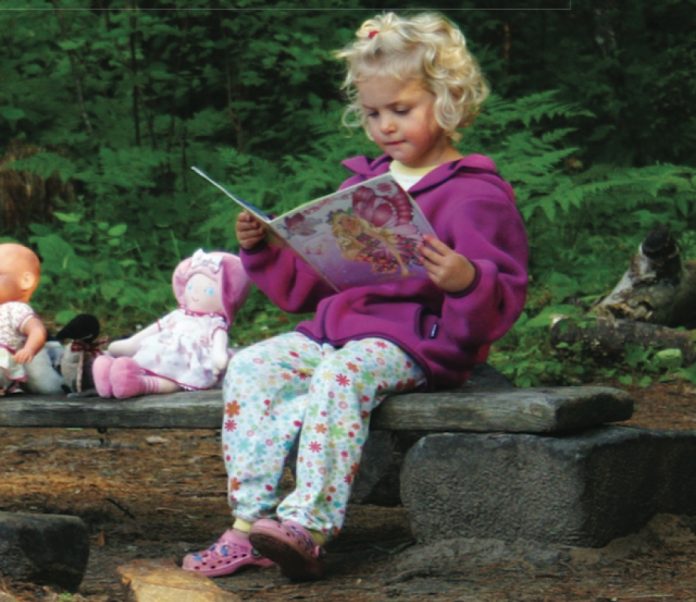
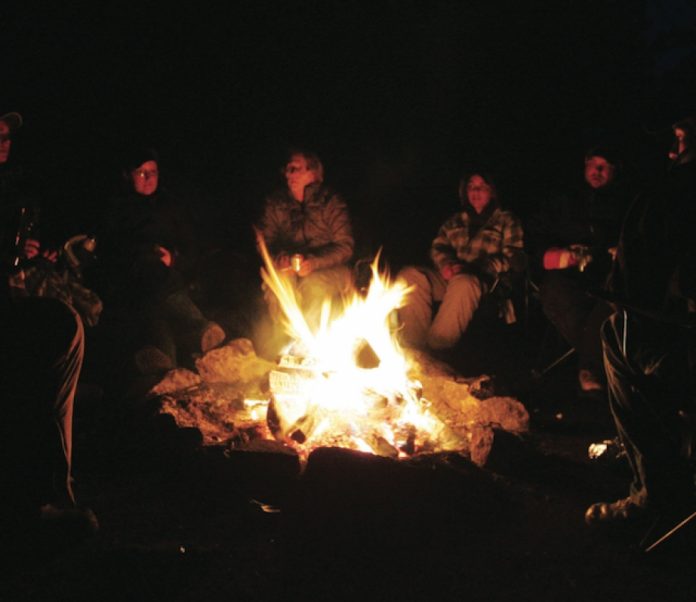
Photo: Scott MacGregor
Freedom of the Hills

“The greatest gift is a passion for reading,” wrote american literary critic, novelist and short story writer Elizabeth Hardwick. I think she was half right. The other half is a passion for the outdoors.

A paper produced almost 20 years ago by the University of Chicago on early childhood development and learning concluded that, “an infant’s brain structure is not genetically determined. Early experiences have a decisive impact on the architecture of a baby’s brain.”

This makes sense to me. I’m on the nurture side of the nurture-nature debate. I believe we are formed by life experiences.

There is plenty of other research that suggests the development of early literacy skills is critically linked to a child’s success in learning to read. Today, the benefit of reading to our children is drummed into us. Read to your kids, read to your kids, read to your kids. We get it from our parents, teachers and the media. Read. Read. Read.

“When we read to children, brain cells are turned on and new brain cells are formed, adding a bit more definition and complexity to the intricate circuitry that will remain in place for the rest of their lives,” says the university paper.

So if reading to our children is hardwiring them for life, I think we need to be more careful about what we’re reading. What’s happening in their little heads when we read them stories of huffing puffing wolves and thundering waterfalls?

We’re not born afraid of the woods. Mother Goose and Walt Disney scare us into being that way. and they do so without well-meaning parents thinking too much about it.

The comedian famous for one-liners Henny Youngman wrote, “When I read about the evils of drinking, I gave up reading.”

When I realized I was reading to my children about the evils of being outside, I did two things. I took them outside to read. And when we couldn’t go outside, I started reading to them about the fun you can have outside.

The children’s books suggested on the following page are a wonderful start, but I also like to pull from my own library. Like, Tom Brown’s Field Guide to Nature Observation and Tracking. We read a little Tom Brown and then practice sneaking around, we build sticky forts and poke at animal scat. Cool.

Another family favorite is Mountaineering, The Freedom of the Hills. Out comes the storage bins full of my old lead climbing equipment. We set up complex anchors out of clothes pegs and turkey string. lego mini-figures with ice axes leapfrog the three pitches it takes to reach the summit of the sofa. At least one mini-figure is consequently evacuated from the back cushion by the search and rescue helicopter. Too bad, but it’s better the kids work the bugs out of their rope systems this way than on everest.

Mark Twain wrote, “the man who does not read good books has no advantage over the man who can’t read them.”

Good books for children, in my book, are ones about the wonders of the natural world and ones that inspire adventure, not instill fear. Good books are freedom of the hills and the rivers, even if you have to read them inside. 
This article on children and reading was published in the Spring 2011 issue of Canoeroots magazine.

This article first appeared in the Spring 2011 issue of Canoeroots Magazine.
 

Line of Least Resistance

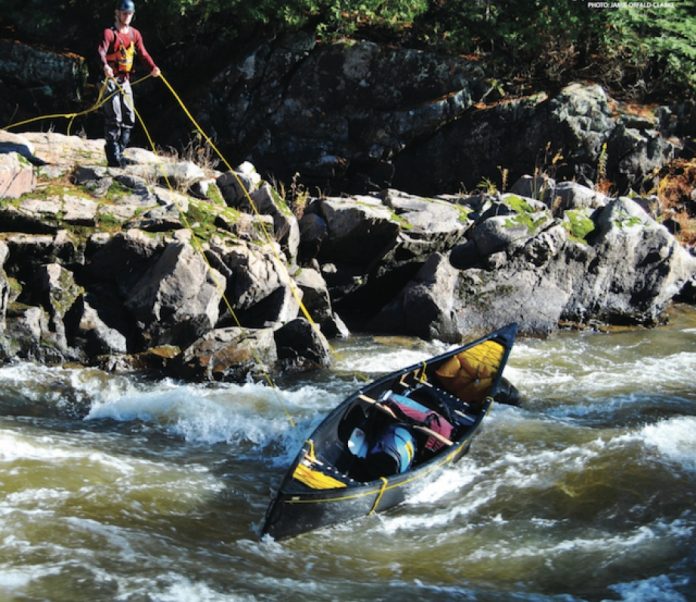
Photo: Jamie Orfald-Clarke
Line of Least Resistance

Using lines to control the descent of a canoe through moving water is an age-old art that can provide a welcome alternative to portaging. Once you’ve come to recognize its potential, you may find yourself lining rapids that you would normally have carried around.

First, you’ll need a pair of lines. The rope diameter should be large enough to afford good grip: 1⁄4- to 1⁄2-inch braided floating rope works well. the length of the lines is dependent on the river and personal preference. Shorter lines are easier to manage but may leave you grasping for a runaway canoe. Longer lines allow you to move the canoe further into the current but may result in tangles if you only use a fraction of their length. Thirty- to forty-foot lines are a good compromise. Storing them in throw bags will keep them free of tangles when not in use.

When confronted with shallow or slow moving sections of river, simply tie the lines to the grab loops at each end of the canoe. Be careful not to let the canoe slip broadside into the main current or it will capsize. Tying the lines high above the waterline like this makes the boat easier to drag over rocks but more susceptible to flipping over.

For deeper, more powerful rapids, the best way to tie onto the canoe is with a bridle system. This positions the lines’ attachment point underneath the canoe, helping to prevent capsizing.

Here’s a simple way to tie a bridle: start by folding back eight feet of rope on the end of your line. Next, tie a double overhand knot halfway up the folded section of rope so that you have a big ‘Y’. Then, tie each of the short ends of the ‘Y’ to either side of the canoe’s seat, positioning the center knot under the canoe at the keel line. With a bridle at both the bow and stern, and the load slightly rearranged so that the downstream end of your canoe is heavier, you will have a very stable setup.

Much like paddling rapids, lining is a mental game. Practising in light current with only a few obstacles present, you can learn with how the canoe interacts with the lines and the water. You need to work with the river rather than against it. the same can be said of lining with a partner—effective communication is essential.

To read more on the subtleties of this technique, check out Garrett Conover’s comprehensive book Beyond the Paddle and Bill Mason’s classic Path of the Paddle

This article on lining a canoe was published in the Spring 2011 issue of Canoeroots magazine.This article first appeared in the Spring 2011 issue of Canoeroots Magazine.
 

Monsters, Inc.

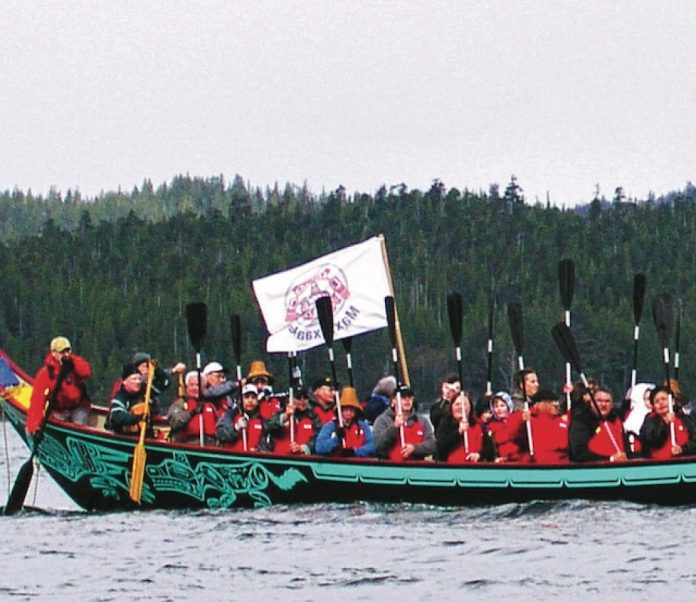
Photo: James van Nostrand
Monsters, Inc.

James van Nostrand had no grand ambitions when an outfitter from Prince Rupert, B.C., commissioned him to design and build North America’s longest canoe. In fact, the Chilliwack, B.C.-based designer of over 20 boats had his doubts that Seashore Charters’ proposed 65-foot, Pacific Northwest-style canoe would even work.

After studying photographs of a 63-foot Haida dugout built in 1878 and now hanging in the American Museum of Natural History in New York City, van Nostrand became convinced that such a monster would be too awkward to paddle. “It was the depth and flare of the hull,” says van Nostrand, who is best known for shaping most of Abbotsford, B.C.’s Clipper Canoes. “How would you sit there and paddle it comfortably?”

But van Nostrand didn’t give up. His research took him to the Museum of Civilization in Ottawa, where he saw a 57-foot Haida canoe that was built in 1908. The experience was a revelation. Here was a long, sleek craft that was of manageable depth for paddling, he recalls.

“It wasn’t until I met that canoe face-to-face that I knew I could build a 65-footer that would work.”

He set about drafting quarter-scale crosssections of the hull, basing his design on his experience shaping Clipper’s line of 22- to 36-foot Big Canoes.

Over a hectic six-week period concluding in January 2010, van Nostrand and a team of builders transferred his hand-drawn lines to a plywood building form, covered it with thin strips of foam and fiberglassed it inside and out. Off the mold, the 80-inch-wide canoe was finished with thwarts, seats and an on-board inflatable life raft. It was then painted by Metlakatla First Nations artist Mike Epp with the insignias of the four coastal clans: the raven, wolf, orca and eagle.

Christened Ha’nda’wit’waada—the canoe that brings people together—van Nostrand’s canoe does just that. In its inaugural year, groups of up to 48 people from around the world propelled it on day tours along the northern coast of British Columbia.

“It’s been 140 years since canoes this big paddled the coast,” says Seashore Charters guide Peter Loy. “People can really feel the spirit in it.”  

This article on canoe building was published in the Spring 2011 issue of Canoeroots magazine.

This article first appeared in the Spring 2011 issue of Canoeroots Magazine.
 

Editorial: Oil and Water

Photo: Melissa Stone
Editorial: Oil and Water

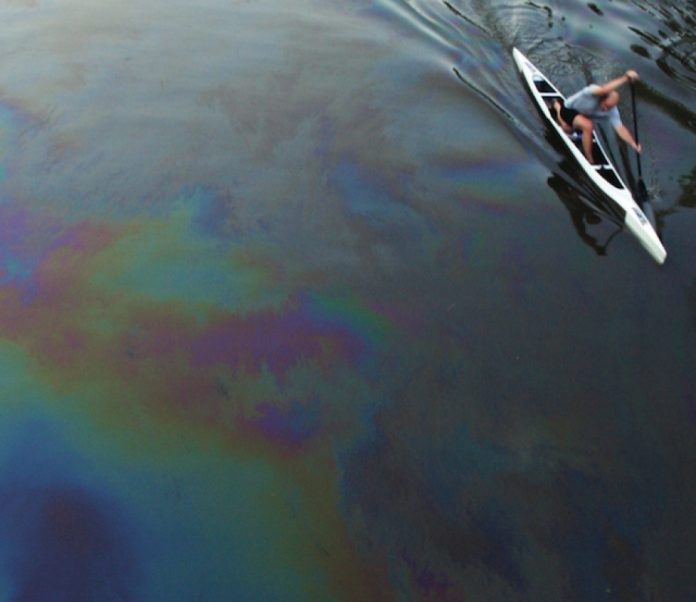
It seemed 2010 was a year filled with pe troleum-related disaster—the Gulf, Lake Michigan, the Niger delta, the Yellow Sea. Gushing crude made for dramatic headlines, but these stories were as much about water as they were about oil.

In North America, we have 11.5 percent of the world’s renewable freshwater resources. However, our surplus is no excuse for sloppy stewardship or lack of policy governing downstream rights, ownership and access to water.

The Upper Delaware—a designated National Wild and Scenic River—topped American Rivers’ 2010 list of America’s Most Endangered Rivers. This watershed, which provides drinking water for 17 million people in New York and Pennsylvania, is threatened by development of the vast Marcellus Shale natural gas field.

While our understanding of balanced development and conservation continues to expand, as canoeists, so should our awareness and responsibility for our waterways.

With the spike in natural gas prices, the region has the potential to become one of the U.S.’s most lucrative energy deposits. Exploration and extraction come at the cost of surface and groundwater toxicity along with soil and habitat contamination throughout the Upper Delaware catchment.

In northwestern Canada, the Mackenzie River basin rivals the scale of the Amazon and Congo rivers. The Mackenzie is fed by a set of waterways at the epicenter of the largest industrial project on earth, the Alberta tar sands.

Currently, between two and five barrels of water are required for each barrel of oil extracted from the sands. This means the tar sands draw enough water every year to meet the needs of a city of 2.5 million people. Much of that water comes from the Athabasca River, raising concerns of overdrawing the resource.

The release of tailings into the Athabasca and the surrounding groundwater supply further intensifies pressure on the area. Tens of thousands of miles of waterways are affected by this continual contamination of the North’s most significant watershed.

This year marks an opportunity to clean things up. While our understanding of balanced development and conservation continues to expand, as canoeists, so should our awareness and responsibility for our waterways.

When a project like the Canadian Heritage Rivers System (CHRS) hits a milestone like it has in 2011, it’s worth celebrating. The CHRS program operates under the notion that rivers have shaped our continent and its people. And, under its framework, the people—communities, rec- reational user groups and landowners—are responsible for designating waterways as Heritage Rivers.

So hats off to organizations like American Rivers and programs such as the CHRS for engaging North Americans, keeping us all from being left thirsty for more.

This article on freshwater resources was published in the Spring 2011 issue of Canoeroots magazine.

This article first appeared in the Spring 2011 issue of Canoeroots Magazine.
 

Migration Sensation

Photo: Courtesy of SkinBoats.org/Alaska Archives
Migration Sensation

In 2008, scientists made a rather exciting discovery at a cave in Paisley, Oregon—ancient human turds buried in 14,000-year-old rock strata.

Science has long assumed the first people to inhabit the Americas—the Clovis people—walked across Berengia, a land bridge over the Bering Strait, from Siberia and southward through the Rockies 11,000– 12,000 years ago.

The Paisley discovery rocked the scientific world. Says archaeologist David Meltzer, “The pre-Clovis genie is out of the bottle, and there’s no way of stuffing it back in.”

People before Clovis? Since the Ice Age was still in full swing, the high mountain passage that the Clovis are believed to have used would have been buried in ice.

These earlier settlers must have traveled by sea, and like the hunter-gatherers they were, followed marine animals living on rich coastal kelp forests. Enter the first paddlers in the New World.

Their route took them along the shore of Berengia, down the coast of Alaska and along the outside of the Queen Charlotte Islands, finally arriving at ice-free Oregon some 2,000 kilometers later.

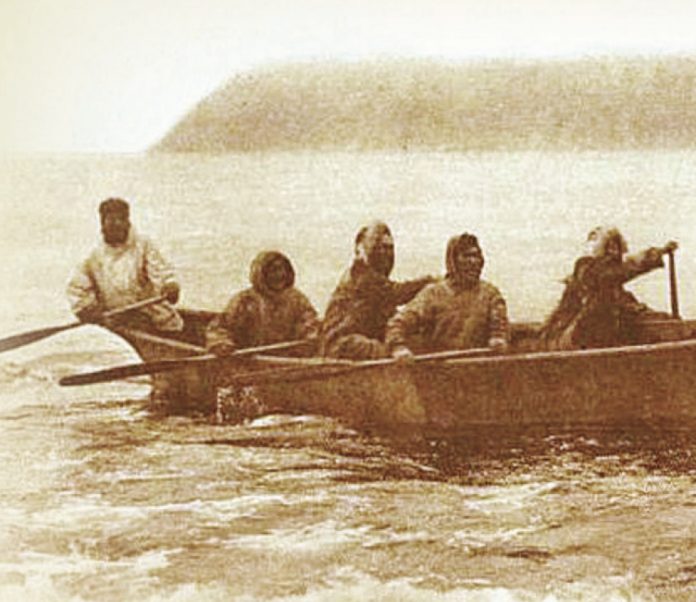
Anthropologist Dr. Niobe Thompson speculates in his recent documentary, The Code Breakers (CBC, The Nature of Things, January 2010) that these ancient mariners likely built umiaks—wide, open boats up to 40 feet long, powered by single blade paddles or oars and fashioned from walrus skin, driftwood and bone.

To envision these vessels, you need look no further than Arctic photo archives or the work of replica builders like Washington state’s Skin Boat School. Says Thompson, “We can only assume that what works in recent times—the structure of the modern Alaskan and Chukotkan umiak—is similar in function and appearance.”

Unfortunately, the sea long ago reclaimed the coastline these ancient boats traveled, which means scientists may never find hard evidence of their passage. Nevertheless, Thompson says, “Pieces of the puzzle…give us a sense that sea travel was the only way humans could have reached North America…before the Ice Age ended.”  

This article on new world explorers was published in the Early Summer 2011 issue of Canoeroots magazine.

This article first appeared in the Eary Summer 2011 issue of Canoeroots Magazine.
 

The Voyage Home

Photo: James Raffan
The Voyage Home

Four years ago, when then 15-year-old Angulalik Pedersen left Kugluktuk, Nunavut, to attend high school on full scholarship at Upper Canada College in Toronto, he brought with him a dream that one day he could take some of his southern class- mates north to visit his hometown on the Arctic Ocean.

In the summer before Pedersen’s final year, with the help of his geography teacher at UCC and the Kitikmeot Inuit Association, he finally pulled it all together—a canoe trip on the Coppermine River that would end at his house on July 9, Nunavut Day.

The goal of the expedition—named Atanigi, “when two things come together” in the language of Kugluktuk—was to bring together Pedersen’s new classmates with youth from his home in the North. Because paddling is part of the extra-curricular program at UCC, Pedersen had no trouble drumming up interest for the trip in Toronto. Back home, however, extra-curricular activities involved powerboats, snow machines and ATVs…but not canoes.

With the infectious enthusiasm of Kugluktuk High School counselor cum recruitment officer Kenny Taptuna, however, half a dozen northern youth signed up. They found a canoe and the will to start learning strokes. Unfortunately, it was May and nearly everything was still frozen. As a result, when the group gathered as a whole for the first time on Air Tindi’s wharf in Yellowknife, half had no real paddling experience on flatwater, let alone preparation for whitewater.

Incredibly, the northerners surmounted their inexperience with natural athleticism and a seemingly near-genetic familiarity with boats in general. Aided by the skill and determination of three wilderness guides, the group practiced strokes and maneuvers on the first hundred or so kilometers of calm water near the Northwest Territories/Nunavut border.

By the time the crew turned north at Big Bend and started into the current and class II–III rapids for which the Coppermine is known, cross-cultural paddling teams were working like reasonably well-oiled machines. On the more difficult rapids, lead guide Colin Smith lashed two canoes together to make a pontoon boat— a.k.a. the “party barge”—which created a super stable, almost relaxing whitewater experience for novice paddlers.

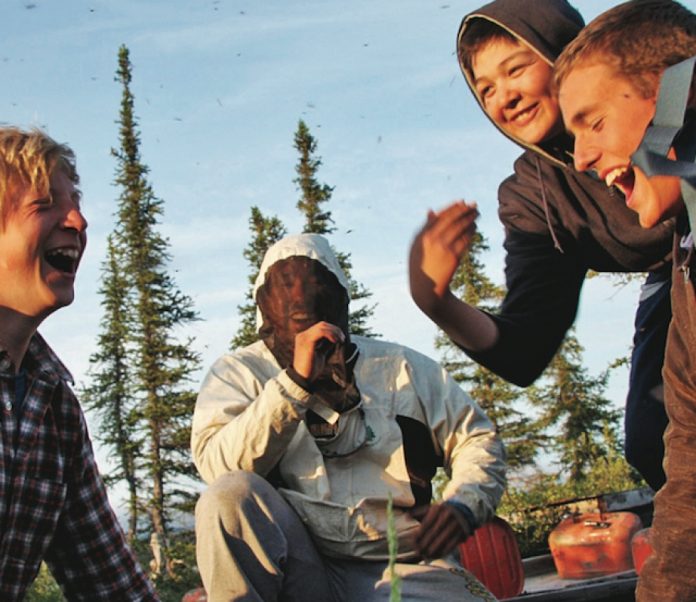
At the Coppermine campsites, Taptuna taught nightly lessons in Inuit language and traditional games. Others started string games, throat singing lessons and impromptu inukshuk-building workshops. Traditions from the north and south blended in the common experience of paddling to the Arctic Ocean under the midnight sun.

When the paddlers arrived cold, wet and happy in Kugluktuk on Nunavut Day, they were celebrated for coming together to accomplish something remarkable. Pedersen and the other northerners were recognized by the town as the first people ever from that community to arrive via the river.

Equally significant was the realization of one young person’s dream to make this land just a little bit smaller by bringing people together in canoes.

This article on the Coppermine River was published in the Early Summer 2011 issue of Canoeroots magazine.

This article first appeared in the Early Summer 2011 issue of Canoeroots Magazine.
 

Editorial: Ten Years

Photo: Scott MacGregor
Editorial: Ten Years

The year Rapid Media publisher and editor-in-chief Scott MacGregor was planning the launch of Canoeroots, Nissan kicked off its memorable ad campaign that promised, “Everything you want, nothing you don’t.”

At the time, drivers didn’t want to be sold another luxury SUV, so Nissan created the rugged Xterra and positioned it as a uniquely bold, utilitarian truck targeted at adventurous outdoor consumers. The campaign provoked a cult following—Xterra owners banded together to form clubs, undertake expeditions and host events. Nissan energized a group of people, cementing their identity around the simple concept that their beloved SUV had everything you want and nothing you don’t.

While putting together this issue’s retrospective, I looked through a decade worth of Canoeroots back issues. I read descriptions of canoeists forming clubs, undertaking expeditions and hosting and attending events. I quickly realized the success of Canoeroots is that it provides everything canoeists want and nothing they don’t.

The magazine was introduced as an annual canoe buyer’s guide. But instead of filling pages with endless tables and small print specs, details of the latest canoes were supplemented with colorful stories about the different types of canoes and the paddlers that enjoy them.

Never has there been a kayak featured in Canoeroots. To this day, remaining canoe-focused is something we—like you—take pride in. Canoeists are always talking about what canoes to buy, how to improve their technique and where to go paddling. So is Canoeroots.

“Everything you want, nothing you don’t.”

I recently spoke with a reader who told me that the reason he loves the magazine is because we feature authentic writers like Kevin Callan, James Raffan and Cliff Jacobson; real canoeists bringing with them a sense of tradition, humor and heritage lost in other magazines.

While black flies and uphill portages haven’t gotten any easier in 10 years, the way readers can access Canoeroots certainly has. The American Canoe Association provides the magazine to its members. You can read every issue on the web, with tablets like the iPad and on smartphones, as well as in print. Readers everywhere are finding Canoeroots and sharing their own stories with other canoeists on our Facebook page and online forum. We will never replace the real social networking of the campfire circle, but with Canoeroots’ blending of tradition and technology there are now more canoeists and stories to share.

Over the years, the editorial offices of Canoeroots have grown and some faces have changed. This being just my second issue as an editor, I find myself in the unique position of sharing admiration for the progression of this magazine with a sense of pride in being a part of something canoeists like myself can truly appreciate cover to cover. Inside I hope you continue to find everything you want, nothing you don’t. 

This article on the history of Canoeroots was published in the Early Summer 2011 issue of Canoeroots magazine.

This article first appeared in the Early Summer 2011 issue of Canoeroots Magazine.
 

Coming Clean

Photo: Courtesy of Proctor & Gamble
Coming Clean

Penny-pinching campers and green-washing skeptics who wonder at the environmental merits of camp-specific “eco” soaps over Sunlight and Pert Plus, read on. The differences run deeper than packaging. But remember, all camp suds must filter through soil to allow bacteria to biodegrade the soap. That means no washing your dishes (or your hair, Fabio) in the lake—fill the camp sink and take it up on shore, at least 200 feet from any water. 

Goat Mountain Skinny Dipper Delight Soap

Pros: Glows in the dark—never lose your soap again. Natural ingredients; also available in goat’s milk “wilderness” varieties with outhouse-humor names like Buffalo Patty, Skunk Scat and Beaver Butt.

Cons: The lather glows too.

Bottom line: Perfect for discrete, total darkness baths.

$5 CDN • www.goatmountainsoap.com

No-Rinse Shampoo/Body Wash

Pros: Biodegradable; rub in and towel dry— rinse-and fuss-free.

Cons: Seriously lacking in suds. Biodegradable doesn’t mean natural—contains chemicals and preservatives like propylene glycol, treithanolamine lauryl sulfate (tea) and methyl- and propylparabens that have been linked to serious helath problems in both people and aquatic life.

Bottom line: If you’re paddling in the Dead Sea or just hate bathing, this is the soap for you.

$1.50–$4.50 US • www.norinse.com

Dr. Bronner’s Magic Soap

Pros: contains nothing but organic fair trade coconut, olive, hemp, jojoba, lavender, peppermint and other natural oils; ingredients are sustainably grown and ecologically processed by coddled farm workers.

Cons: Slippery when wet.

Bottom line: Ideal for dreadlocked, barefoot, vegan, goji berry-scarfing, patchouli-scented, earth-first hippies…and anyone else who gives a damn.

$4.50 US • www.drbronner.com

Campsuds

Pros: Made with vegetable-based, completely biodegradable ingredients. Peppermint and lavender bath soap formulas smell delightful and moisturize.

Cons: Anything that “cleans hair, body, dishes, clothes and more” can’t do it all well.

Bottom line: The original green soap (literally and figuratively) since 1965 and still an acceptable, all-round option.

$3.75–$7.25 CDN • www.sierradawn.com

Sunlight Dish Detergent

Pros: Tough on grease.

Cons: Contains an arsenal of dangerous chemicals. can produce nitrogen and sulphur oxides—the same compounds responsible for acid rain—during decomposition.

Bottom line: Save it for the kitchen sink. Better yet, use a natural, eco-friendly alternative like simple green (www. simplegreen.com) at home, too.

$2 CDN

Ivory Soap

Pros: “The only soap that floats.” Most natural commercial soap choice.

Cons: Contains trace amounts of tetrasodium EDTA—a toxic, persistent organic pollutant. Avoid “moisture care” varieties of ivory containing a host of other nasty compounds.

Bottom line: “99 and 44/100% pure” since 1879, and still a safe, economical choice for campers.

$2 US (3 pack) • www.ivory.com

Apple Cider Vinegar

Pros: For a natural shampoo substitute, combine a baking soda solution wash with an apple cider vinegar rinse (1.5 oz/50 ml vinegar to 2 qt/2 l water).

Cons: Opinions differ on whether you can smell the vinegar, but if you need to smell like pomegranates and hibiscus you should probably just stay home.

Bottom line: One enviro maxim has it: if you wouldn’t eat it or drink it, don’t put it in the water. These from-the-pantry ingredients also taste great in bannock and salad dressing, something we can’t say about Beaver Butt.

$4.40 US 

This article on cleaning products was published in the Early Summer 2011 issue of Canoeroots magazine.

This article first appeared in the Early Summer 2011 issue of Canoeroots Magazine.
 

Adventures (not) by Disney

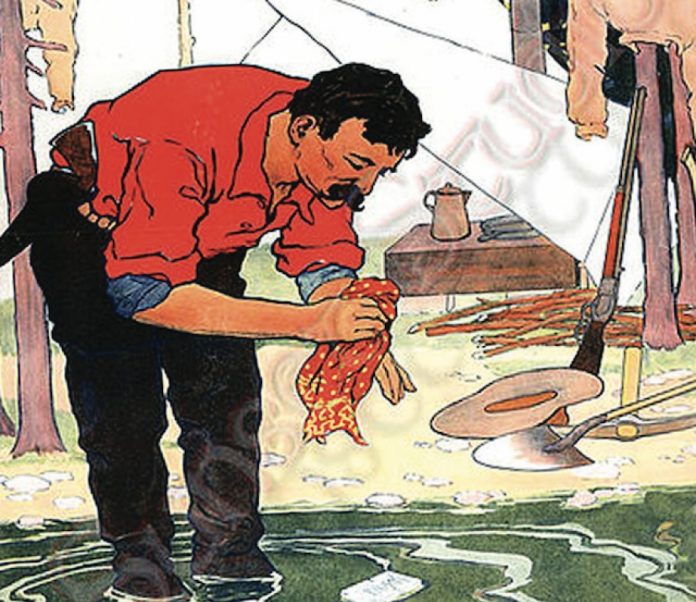
Photo: Tanya MacGregor
Adventures (not) by Disney

We hadn’t even backed out of the driveway and we were only going eight minutes to the general store for a bag of milk. This had to stop.

I could hardly blame them, the seven-inch LCD screen hung there from the ceiling. It was like taking a date to a sports bar and trying not to watch the game. Besides, it was far too easy to stop the whining by just pressing play.

For our family, this habit started innocently enough. We live a five-hour drive from both sets of grandparents. That’s a long way to be strapped into car seats. For long trips, Disney is a good way to pass the time. But, like most bad habits, you think you can stop whenever you want until you realize you’re pressing play on a drive to the corner store.

My problem with in-car entertainment systems is that pressing play turns me into a chauffeur. I may as well be rolling up the plexiglass of a limo: “I’ll drive. You kids enjoy the movie; help yourselves to the mini-bar.” This is not the way it’s supposed to be.

When I was a kid, getting to ride with my dad on saturday mornings was a special treat. I looked forward to it all week. The Silverado emblem on the red steel dash, the rumble of the diesel engine and the smell of Export A zregular smoke that didn’t escape out the triangular, no-draft window he’d crack for me. It was 1979 and I was eight years old, legs dangling from the bench seat and the Gatlin Brothers’ All the Gold in California crackling out of the AC Delco speakers. I don’t remember where we were going or what we did. It didn’t matter; those Saturday mornings I was riding with Dad.

My new DVD player rule—no movies on adventure days—came about last fall on a drive to Algonquin Park. We’d planned a hike, playing naked (them, not me) on remote beaches and then a bike ride for ice cream. It was the Daddy Day that we’d been looking forward to all week. and it began with, “Can we watch a movie?”

If all I can remember of the trips with my dad is the drive, this is likely to be true for my kids. I don’t want their memories of our Saturday adventures with me to be Finding Nemo piped through wireless headphones.

To make things easier, my new truck doesn’t have an on-board entertainment system. We play eye spy, tell stories, talk, sleep (them, not me) and watch the 3-D super-wide screen—looking out the windows. And, we listen to music.

To our adventures with Dad ipod playlist I’ve added All the Gold in California, but their favorite is Joan Jett’s, I Love Rock N’ Roll.

Now when we head to the ski hill or the lake, before we back out of the driveway I hear, “Dad, can we rock it out?”

Even if they don’t remember our canoe trips in the Barron Canyon, and all they remember is singing with their dad, I’m okay with that. 

This article on  was published in the Early Summer 2001 issue of Canoeroots magazine.

This article first appeared in the Early Summer 2011 issue of Canoeroots Magazine.
 

Of Fish and Friends

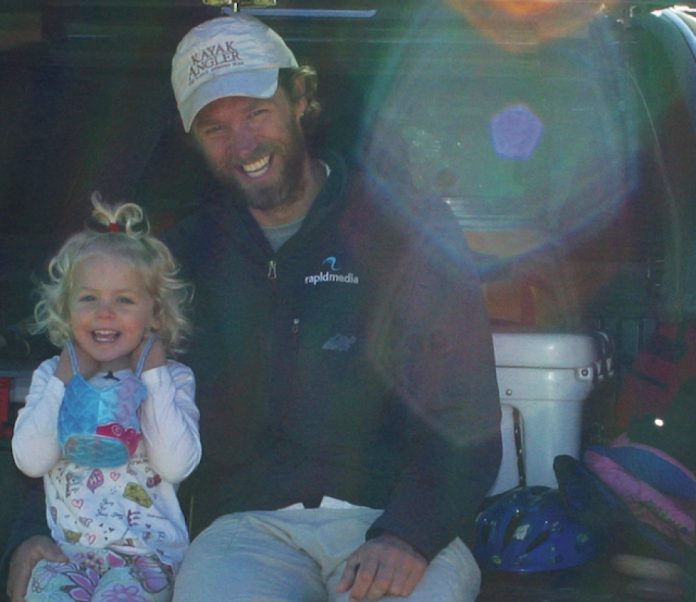
All Photos: Sarah McNair-Landry
Of Fish and Friends

From the riverbank, a family motioned for us to pull ashore. The mother, father, two teens and kid brother regarded us curiously. Their jean shorts and Nike t-shirts contrasted with the landscape behind them, a boundless expanse of forest, steppe and mountains rambling off to the horizon.

I glanced back at Eric on the stern seat. “Might as well go say hello,” he said, steering our heavily laden canoe toward shore. Ulysse and Elsa followed in the second canoe. Pulling ashore, we exchanged greetings, “Sain bainuu”—Mongolian for, hello. When we asked what they were doing, the family showed us a large pail filled with red currants and pointed toward the forest. We presented our own small bag of sad-looking berries that we had picked a couple days before.

The game of show-and-tell continued as the family matriarch unwrapped a newspaper containing five plump fish. Again, we displayed our modest catch: a six-inch fish that Eric had reeled in hours before. Surprisingly, it was the first fish of our trip. 

Screen_Shot_2015-08-21_at_11.24.28_AM.png

Half a year prior, preparations for our three-month journey through Mongolia and Russia had included shipping canoes, applying for visas, navigating a labyrinth of logistics and learning useful phrases in not one, but two languages. We scrounged for what little information existed on the route’s rivers and lakes. Among our research was rumor of the region’s piscine delicacies.

In Ulaan Baatar, Mongolia’s capital, we packed our food and purchased a few last pieces of gear. Back from shopping, Ulysse proudly showed me his two fishing rods and exclaimed,

“We will eat fish every night!”

His bearded face glowed beneath a hat that was stitched with the words, Serious fish. He had even brought along all the ingredients required to make sushi.

From Ulaan Baatar, we drove for three days over unmarked, rough tracts in an overloaded Chinese van. After getting stuck in a bog for five hours, our driver motioned he could go no further. We portaged and paddled the last 70 kilometers to the northern tip of Lake Khovsgol in far northwestern Mongolia.

From Khovsgol we could see the serrated peaks that formed the Russian border. Our destination, Lake Baikal, was just 200 kilometers east as the lammergeier flies, but we were following the natural flow of the water on a meandering, 2,000-kilometer semi-circle through the steppe and taiga forest.

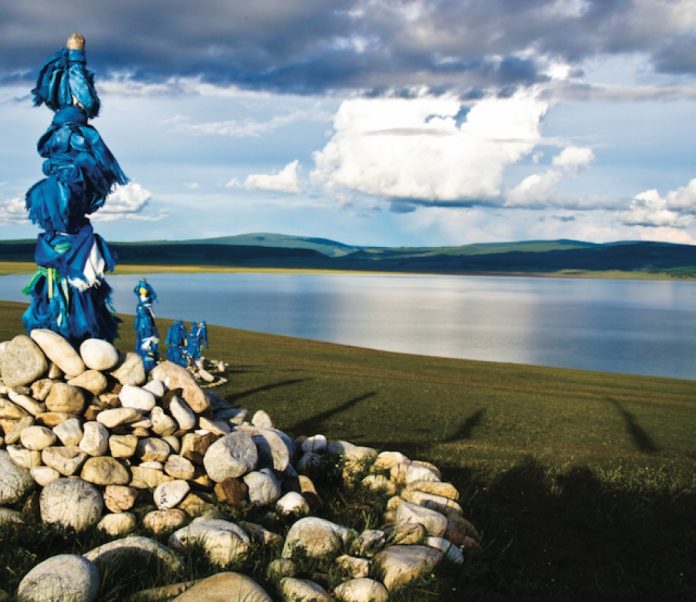
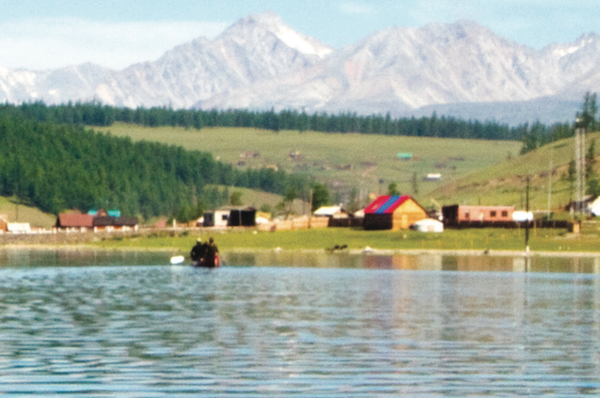
Khovsgol was nicknamed “the blue pearl” for its pristine, turquoise water—so clear that we could see the fish swim up to our hooks, and right on past. Situated in a transition zone between Siberian taiga and Central Asian steppe, the lake area is protected as a national park larger than Yellowstone. Rolling hills silhouetted the eastern horizon, while the high mountains on the opposite shore still carried snow.

The environment created dramatic weather patterns: in the morning we enjoyed warm July sunshine, but the afternoon skies frequently turned dark and stormy. We spent a week paddling 126 kilometers south to the lake’s major outflow, the Eg River.

We arrived at the Eg to find the river in full flood.

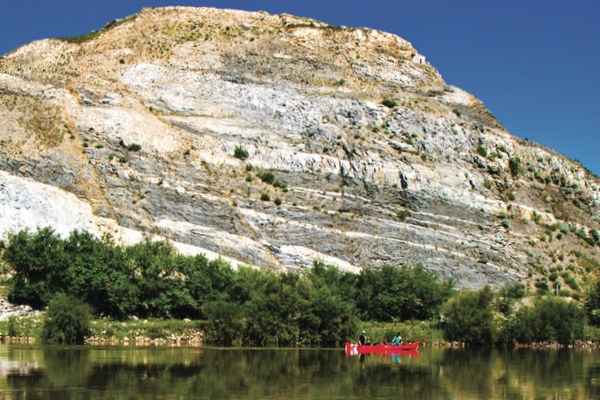
The narrow, braided channels caused more difficulties than we had expected. Strainers—fallen trees through which the stiff current flowed heedlessly—hid around every corner. Often just six meters wide, the river sometimes whipped us around a bend only to find a tangle of branches completely blocking our path. Our 17-foot canoes dumped and pinned on several occasions. Fishing rods lay forgotten at the bottom of the canoes as we focused instead on paddling 40–50 kilometers a day. The Eg, and the Selenge River into which it flowed, were hailed for their world-class sport fishing. Native taimen, members of the salmon family, grew up to 1.5 meters long and weighed up to 50 kilograms, making them some of the world’s biggest freshwater fish.

We didn’t see any elusive taimen in the Eg, or downstream in the equally murky Selenge. Where the rivers met, however, we remembered a local fisherman’s advice: “The best place to fish is at the confluence of two rivers.” Seizing the opportunity, Eric cast a line into the water and was rewarded with a bite. Not a giant taimen, but our hoots and hollers could be heard from miles away as he reeled in our first catch.

It is just a few hours later that we meet the Mongolian family. It’s not our first encounter with the locals who live along the riverbanks. A couple days earlier we had helped a sick man, his family and two doctors across the river to an ambulance waiting on the other side. Now, we notice the family seems more interested in our canoes than our puny harvest. They, too, are looking for a shuttle across the river.

By the time we have successfully ferried the family and their gear across, we have exhausted our Mongolian vocabulary and offer the mother our phrase-book. She rifles through the pages, pointing to key words: eat, food, sleep, house. She gestures downstream and we follow.

The family help haul all our gear up to their house, located just downstream in a village that shares its name with the river: Selenge. The small dwelling is a one-room log cabin equipped with two windows, a tin roof, a TV and a karaoke machine. The house sets them apart from a vast number of their countrymen—30 percent of Mongolians are nomadic herders, a greater number per capita than in any other country. The nomads live in gers, traditional Mongolian yurts that can be quickly dismantled and relocated from season to season.

Screen_Shot_2015-08-21_at_11.21.52_AM.png

We are motioned to join the family in sitting on the floor. Soon we are served traditional hot, salted goat milk tea and a stew of noodles and meat. The Mongolian diet is mostly derived from the animals they herd: meat, fat and a hard-dried, slightly moldy milk product they call cheese. Short, flat noodles are mixed with unidentifiable meat and cubes of fat in a big, cast iron pot and served for breakfast, lunch and dinner. Complementing this diet is Mongolia’s specialty drink, araig—fermented mare’s milk served warm. The family proudly pours us each a glass.

When it’s time to sleep, we move the remains of dinner aside and lay our mats and blankets on the floor beside those of the family. Six of us can barely lie shoulder to shoulder, the three children sleep in a space by the door and the dog curls up on the last available square foot. It’s very cozy.

For the next two days, the kids keep us busy touring the town, swimming in the river, hiking to a Buddhist statue, dressing up in traditional Mongolian clothing and playing soccer in the nearby fields.

The Selenge meanders into Russia, eventually branching out to create a delta that stretches 30 kilometers wide. The banks slowly give way to a swampy marsh. We inhale a cool breeze, eagerly awaiting our first glimpse of the lake we have heard and read so much about—Baikal. Finally it comes into view, a blue expanse stretching out to the horizon.

Baikal is literally a sea of superlatives. At roughly 25 million years old, it is the most ancient lake on Earth. Sometimes referred to as Russia’s Galapagos, it’s home to over 1,200 endemic animal species. Most famous of these are the nerpa seals, the planet’s only freshwater seals. We often spot them curiously watching our canoes from a safe distance.

Nestled in a rift between continental plates, Baikal’s depth reaches 1,637 meters, making it the world’s deepest lake. This incredible depth, combined with a surface length of 636 kilometers and a width of 60 kilometers, means Baikal holds more water than all five Great Lakes combined—20 percent of the world’s unfrozen fresh water.

The lake’s size makes it a daunting place to paddle. When the winds pick up the swell can grow to several meters in height.

An old fisherman spots us and rows his small wooden boat in our direction. A tattoo of a lighthouse is inked into the weathered skin of his right arm; his face is wrinkled from a lifetime spent under the screaming Siberian sun. He looks each of us in the eye, and through very animated sign language, warns us of Baikal’s violent storms: Never stray far from shore.

The lake marks the final leg of our journey. We’ll spend the next three weeks paddling around Baikal’s southern tip to its only outflow, the Angara River, and finish in the metropolis of Irkutsk.

We pull ashore on the first sandy beach we spot and celebrate our arrival Russian style: with a shot of vodka and a dive into the frigid waters. Tonight we’ll dine on omul, a delicious Baikal fish—courtesy of our generous fisherman friend. 


Screen_Shot_2015-08-21_at_11.06.47_AM.png

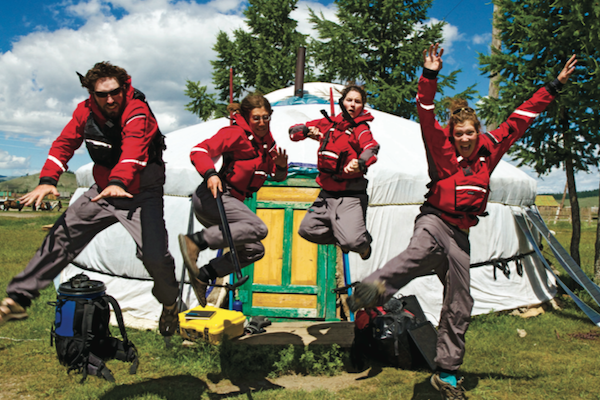
The Vada Canoe Team

(left to right)

ULYSSE BERGERON

Economic journalist by trade, Ulysse is passionate about nature, writing and traveling. He has voyaged to the far north, paddling the Yukon and Mackenzie rivers. A gustatory optimist, Ulysse always believes the meal he is currently eating is the “greatest ever.”

ERIC McNAIR-LANDRY

Brother and sister duo Eric and Sarah specialize in skiing and kite skiing expeditions to the cold, desolate parts of the world, including Antarctica, the North Pole and Greenland. Adventure seeking is in the McNair genes—Eric and Sarah were raised in Iqaluit, Nunavut, by renowned Arctic explorers Matty McNair and Paul Landry; their grandparents were three-time U.S. National Canoe Slalom Champions. A Jack-of-all-trades, Eric is able to build a flying machine with only a knife, duct tape and one shoe.

ELSA FORTIN-POMERLEAU

Elsa cut her paddling teeth on Quebec’s whitewater rivers. She’s just getting started, recently completing a degree in outdoor education and joining the team in Mongolia for her first big expedition. Trip mates revere Elsa’s five-star camp meals and her ability to stay incomprehensibly clean on trip.

SARAH McNAIR-LANDRY

Sarah is the youngest person to have reached both the North and South poles. Frequently traveling with brother Eric, she has an impressive résumé of skiing, dog sledding and kite skiing expeditions. Sarah was inspired to return to Mongolia after she and Eric became the first to cross the Gobi desert using kites and buggies. Allergic to the 9-to-5, she has directed several adventure and environmental documentaries. 

This article on the Vada Canoe Team was published in the Early Summer 2011 issue of Canoeroots magazine.

This article first appeared in the Early Summer 2011 issue of Canoeroots Magazine.