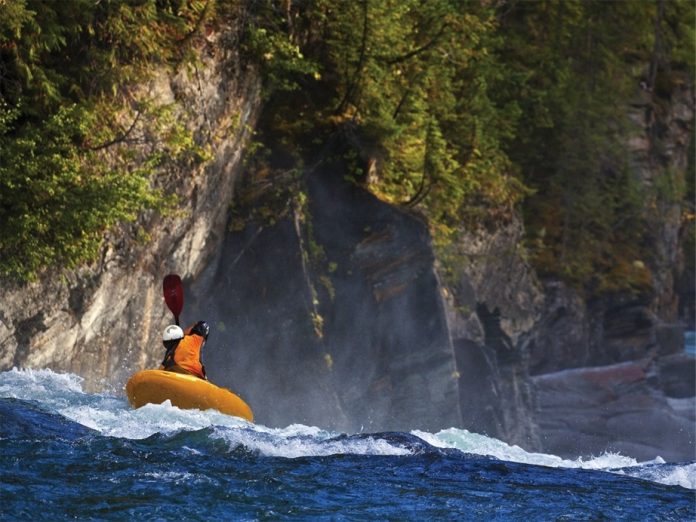
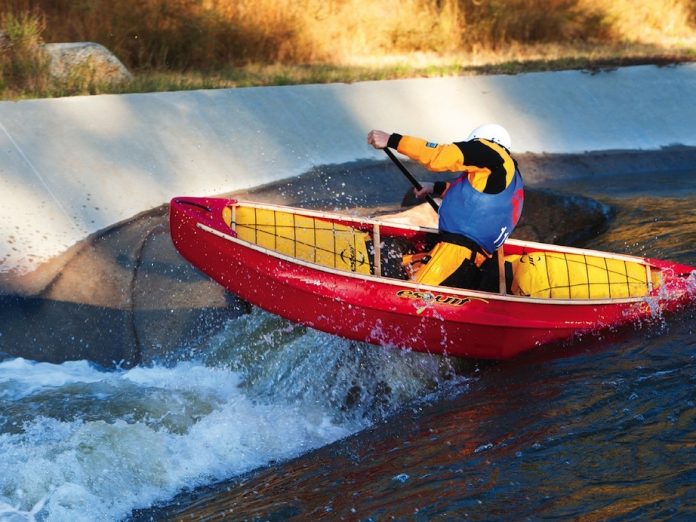
The Marmora and Area Canoe and Kayak Festival (MACKfest) just kicked off the paddling season in Ontario for it’s 4th season. There was a freestyle competition, extreme down river race, raffles, gear swap, live band, vendors, camping, good food, and great rivers. Here is a short highlight vid of what it’s all about and look for Rapid Media TV to be there again next year.
Paddling at MACKfest
Esquif L’Edge Canoe Review
The new Esquif L’Edge was in the concept and development phase for an unbelievable eight years. Designer Craig Smerda was originally inspired by the design innovations of the late Frankie Hubbard’s Spanish Fly—a freestyle boat much loved by southern creekers.
Smerda began building on this benchmark in 2002 and in the years that followed he designed and tested and eventually teamed with Jacques Chasse at Esquif Canoes to produce just two prototypes. One bounced around the 2009 Open Canoe Slalom Nationals and the other was shipped to the Ottawa River for renowned open boaters Paul Mason and Andrew Westwood. The feedback allowed Smerda, design collaborators Mark Scriver and Dave Proulx, and Chasse to dial in final specs for the long-awaited production boat.
The L’Edge is the first canoe available in both open and decked versions. We had the chance to paddle both and preferred the open one. Call us old fashioned, but we like our open boats…well…open. Eight pounds lighter than its decked counterpart and with ash gunwales, the open version feels and looks more like a canoe. The decked model is drier, but both are so much drier than anything we’ve ever paddled that it’s of little advantage.
When OC creeking, the wobbles should be the last thing on your mind. The L’Edge is very, very stable. While faster than the Spanish Fly, the L’Edge is definitely slower than the Prelude and Zoom. With so much stability, we’re inclined to monkey around with the L’Edge’s width to gain a little speed. With the open model, you can chop thwarts and suck it in. Smerda himself recommends cutting off one to one-and-a-half inches if you’re looking to make the boat snappier.
A foam bulkhead is the simplest, most universal outfitting system, though not the most precise. It fits more like athletic support than dentures. In the case of the L’Edge this outfitting is out of sheer necessity. The patch anchors needed for thigh straps don’t stick well to polyethylene. Also, the L’Edge is a creeker at heart. Emptying my boat in a micro eddy with only a few feet of water before the next drop, I’d rather slide quickly back into a bulkhead than wiggle around, cinching thigh straps.
The extreme rocker of the L’Edge allows it to boof anything. It rides high over reactionaries and pops over holes. The boat’s poly construction also makes it super durable if you’re into shallow slides and concrete rivers like the U.S. National Whitewater Center.
Eight years later, Smerda finally pulled it off—he designed a canoe that should swat the Fly. The L’Edge is our new favorite creek boat, but we’re not giving up our Zephyrs, Ocoees and Sparks as longer, lighter, big-river boats. The secret is to match the L’Edge with the two-stroke technical rivers and play spots for which it was designed.
ESQUIF L’EDGE DECKED/OPEN
Material: Polyethylene
Length: 9’2”
Width: 29.8”
Depth: 16”
Weight: 56/64 lbs
MSRP: $1,729 US / $1,900 Cdn
$2,033 US / $2,233 Cdn
This article originally appeared in Rapid, Spring 2011. Download our free iPad/iPhone/iPod Touch App or Android App or read it here.
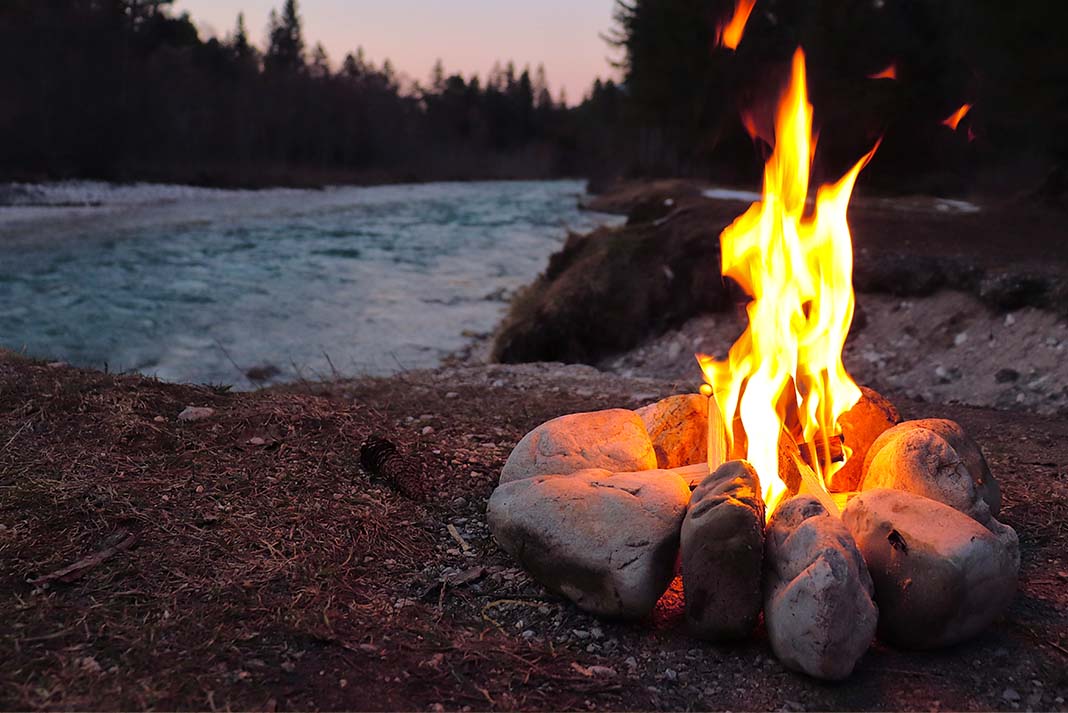
Considerate Camping: How To Build A Low-Impact Fire
Camping is synonymous with campfires. There is some atavistic aspect of staring into the dancing flames over a bed of embers that is primitively satisfying and deeply comforting.
Campfires are not, however, without their drawbacks. The scarring of land, harvesting of firewood and the residual trash not consumed by flames are apparent at nearly every campsite that sees even moderate use. So how can campfire impact be reduced?
Here are some tips for building a low-impact fire that will still allow you to partake in this timeless tradition.
Consider your foundation
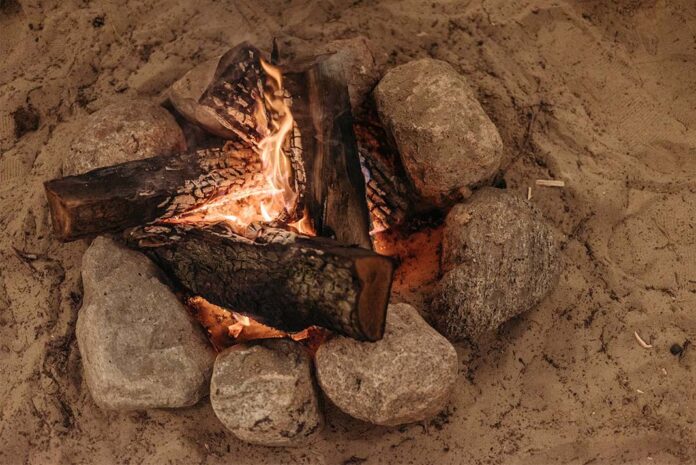
Where is the best place to build a fire? Use an existing pit where available. Make sure the fire is contained in a fire ring, or—even better—carry and use a metal fire pan or fire box to prevent ground scarring. You can also make a fire on a mound of sand or earth, and then scatter the mound and cooled grey ash so that you cannot tell a fire was ever burned there.
Build a small fire using small pieces of wood
Ideally, you should be able to break the wood with your bare hands. For most people, this means using sticks that are wrist-size or smaller. Small pieces of wood burn to grey ash more readily, leaving behind fewer unsightly pieces of charcoal and half-burned wood.

Collect wood from the ground, not from standing trees
At most campsites there is an abundance of fallen small wood overlooked by campers who scavenge for larger pieces. It is easy to gather and will keep even the most obsessive fire-pokers busy feeding it to the flames.
Keep trash out of your fire
Metal will not be consumed, lumps of uneaten dinner will not burn to ash and no one wants to sit around a campfire smelling the fumes from melting plastic.
Don’t leave your fire unattended
If you are not going to be close enough—or awake enough—to control it, put it out.
[ Paddling Buyer’s Guide: View all camping gear ]
Don’t have a fire
At least, not every night. Make having a campfire a special treat.
Enjoy your fire, but don’t take it for granted. Keep it clean and small and don’t use all the wood. The next campers will thank you.
Leg Drop Roll Kayak Technique
Add reliability and ease to your roll by incorporating an active leg drop. The active leg drop better uses your body to roll the kayak and moves you away from relying too heavily on your paddle.
The quick, powerful action of rolling a kayak with the hips—a hip snap/flick—is widely described as getting the upper body near the surface and supported by the water, while righting the boat with a rolling action of the hips. Most people are told to lock their knees under the deck and concentrate on the upward action of one knee.
Both legs pushing up against the deck creates resistance to the rolling action. A paddler will often compensate by pulling harder on his paddle. He is essentially trying to lift his body up underneath the still overturned kayak, resulting in a cumbersome or failed roll and additional stress on the upper body. Avoid these problems with an active leg drop.
Start your roll by actively driving your leg closest to the paddle down, transferring con- tact from the thigh brace to the hull. Roll that hip and sit bone down while lifting with your opposite knee, bringing the kayak underneath your body.
This opposition of forces results in the kayak rolling almost upright before your body lifts out of the water, which reduces the need to pull on the paddle. As the kayak rolls up, your lowered leg and hip create a solid platform to help prevent it from tipping back over.
Watch another roller who is incorporating an active leg drop and you will notice that the boat moves before she starts to move her paddle.
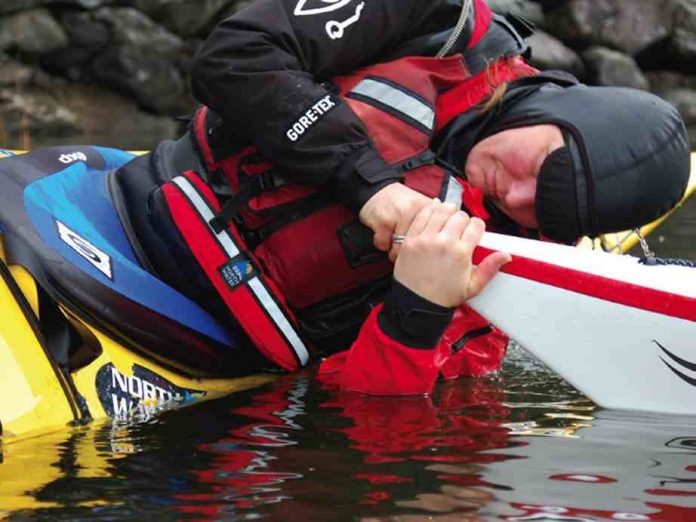
Practice the action with this exercise. Hold onto a fixed object—a pool side or a friend’s bow or hand—and lower yourself into the water by rotating onto your back and bringing your shoulders parallel to the side of your kayak. Keep your arms bent in a strong position. Roll the boat over on top of your body while keeping your head on the surface.
Drive the leg closest to your hands to the bottom of the kayak while increasing pressure against the thigh brace on the opposite leg. Arc your spine and leave your head on the water. You will feel the kayak roll easily into a more upright position. This is similar to what Greenland paddlers refer to as a static brace position.
Repeat until you start to feel the coordination of your opposing leg actions, and then incorporate it into your roll.
In addition to rolling your kayak more efficiently, the active leg drop can also be incorporated into edging and bracing to the same advantage.
Shawna Franklin is the co-founder of Body Boat Blade International, an award-winning kayak school located on Orcas Island, Wa. A BCU coach Level 5 aspirant, Shawna was the first woman in North America to achieve the BCU 5 Star Sea award.
Peer review
“Shawna’s article is a great isolation and description of an important component to the roll. The connection to using downward pressure is key. ” » Ginni Callahan, ACA level 5 instructor and BCU level 4 coach, Cathlamet, WA
“It is great to see a coach moving paddlers away from the hip flick technique. Instead, think of your hips as a relaxed and flexible joint separating upper and lower body. Remember the mantra “Boat first, body second, head last” for the timing of a successful roll.” » Doug Cooper, BCU level 5 coach, Aviemore, Scotland
“Try backward learning to reinforce the leg drop. Holding onto a solid object, use one leg to actively pull the kayak upside down. Use the other leg to right the kayak. As you build confidence and skill, try Shawna’s drill holding onto a paddle float or flutter board. This will force you to drive the roll with your legs. If you use your arms, you will sink.” » Michael Pardy, Paddle Canada level 3 instructor trainer, Victoria, BC
“Many Greenland kayak designs [have] a wooden bar that holds both legs flat. [In] whitewater kayak designs, the limited space forces knees up and out- ward. So there’s a group of paddlers rolling with both legs straight and another rolling with both legs bent. Conceptually, I welcome Shawna’s instruction to prevent adverse pressure against the deck, although it’s not always possible. ” » Nigel Foster, BCU level 5 coach, St. Petersburg, FL
“Make sure your boat fits you correctly so you don’t fall out when using this technique. A keyhole cockpit offers a much better fit than a more open style. ” » Christopher Lockyer, BCU level 4 coach and Paddle Canada level 3 instructor, Halifax, NS
This article originally appeared in Adventure Kayak, Spring 2011. Download our freeiPad/iPhone/iPod Touch App or Android App or read it here.

Boat Review: The Essence 17.0 by Airealite
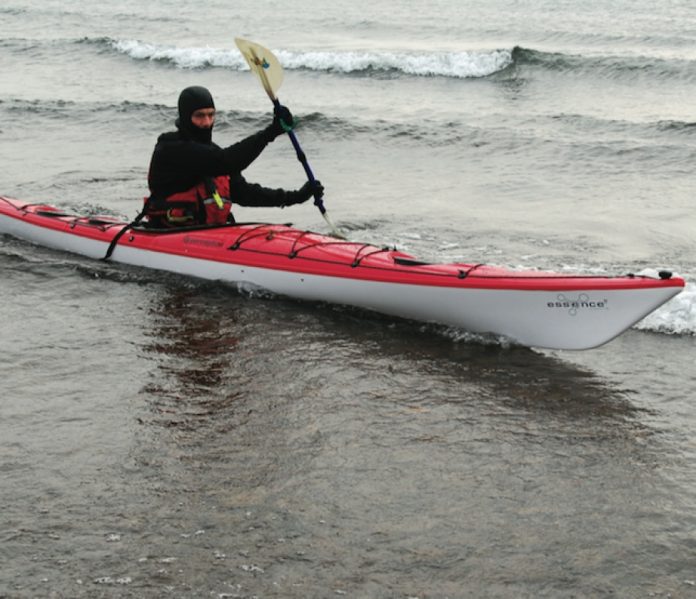
When people say the Perception Essence 17.0 Airalite is a “good looking boat”—as they inevitably do—they’re likely referring to the sexy lines of the long, slender bow. For it’s here that the Essence reveals its designers’ intentions to prolong the transition from bow to midsection to make for the finest possible entry lines.
The Essence is a sharp contrast to rough water designs that carry more volume in the ends for buoyancy in waves. Crafted by longtime Confluence Watersports boat designer Bob McDonough to be a friendly, high-performance tourer, it has a sporty feel and excellent capacity and speed for its length. This is achieved by the tapered bow and the Swede form shape, with the widest point rear of the midsection like a racing kayak.
The stern is stockier than the bow—a nod to packability. In McDonough’s words, “You’ve got to carry the volume somewhere.”
The result is capacity for long trips combined with excellent efficiency that is refreshing to find in a plastic boat. The Airalite we tested is the lighter, thermoformed version but the Essence also comes in more affordable poly, and both options are available in a 16.5 length for smaller paddlers.
A limited rocker plus the tapered bow’s emphasis on knifing the water equals strong tracking and minimal weathercocking. There’s perhaps less need for the skeg than for the optional rudder, which novices might appreciate for easier turning.
The hull under the cockpit is a shallower V than other popular British-style 17-footers like Confluence’s Wilderness Systems Tempest 170 and the NDK Explorer. It’s also about an inch wider and the chine is slightly softer, resulting in greater initial stability and more smooth, predictable edging.
For this new top-end touring boat, Perception has taken a winning British formula and expertly honed it to be a tad more welcoming to a wide range of paddlers and uses. And, dare we say, a little faster and more spacious.
With a distance swimmer’s heart for the straight and narrow, the Essence is perhaps not your first choice for a day in the surf. However, like the touring edition of a high-end sports sedan, this kayak is perfectly capable of dialing up the adrenaline and having some fun if opportunity booms. Which, in our books, is the definition of the perfect tripping kayak.
Rudder ready
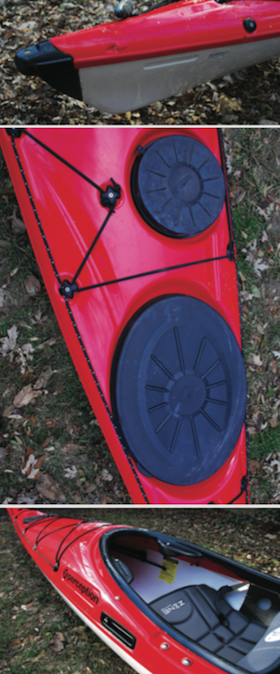
In addition to the standard hydrofoil- shaped skeg and easy adjusting SlideLock foot braces, the essence comes rudder-ready with a mounting bracket on the stern and routings for cables.
Handy hatches
The Essence includes a 10-inch bow hatch, 8-inch day hatch and an oversized stern hatch, all with tight- fitting kajak-Sport rubber lids.
Comfort outfitting
Perception touts its Zone eXp Seating System as “expedition grade.” It includes a long, padded seat bottom with adjustable height to promote circulation on extended outings, and adjustable padded thigh braces. a long, spacious cockpit accommodates tall paddlers.
Specs
- Length: 17 ft
- Width: 23 in
- Weight: 50 lbs
- Max. load rating: 350 lbs
- Price: $2,299 USD / $2,409 CAD
This article first appeared in the Spring 2011 issue of Adventure Kayak magazine. For more boat reviews, subscribe to Adventure Kayak’s print and digital editions here.