Home Blog Page 349

Rock the Boat: The Gods Must Be Seaworthy

Illustration: Lorenzo Del Bianco
Rock the Boat: The Gods Must Be Seaworthy

Recently I found myself wondering if I was leading a spiritually bankrupt existence. Should I have god in my life? And if so what god? Lord knows there’s a baffling selection. How could I possibly choose?

As with most things, I decided to relate my quest directly to kayaking, posing the following spiritual conundrum: which god (or the given religion’s representative) would make the best paddling partner?

Almost immediately, I ticked Buddha off my list. He clearly wasn’t in the best shape and he’d probably rather sit on the beach and chill than go for a paddle, which is cool, but I guess Buddhism isn’t really for me.

Next I considered Zeus. In Greek mythology he’s the god of the sky, and way too into thunder and lightning to be safe out on the water. He also has an incredibly checkered sexual history, having shagged just about everyone in ancient Greece. Renowned for his erotic escapades (including at least one pederastic relationship), he’s the last deity you would ever want to introduce to your partner, sister, grandfather…anyone. If I were looking for a horn-dog with a god complex, I would hire a kayak guide. Scratch Zeus.

Then I thought, what about Jesus? Great guy—the Son of God and an avid fisherman too. But picture it—you’re in big seas, a couple of miles offshore, desperately trying to get around a headland…and He keeps getting out of His kayak to stretch His legs. You’d feel ridiculous sitting there in your boat with Him striding around atop the angry seas in His goofy sandals. And what about all that kneeling to pray? Seems squarely aimed at canoeists, not kayakers. We sit, we don’t kneel. Forget Jesus.

Mohammed is terrific, but these days he always seems to draw an angry crowd of pissed-off Americans with guns, which is a huge drag. And besides, Islam is predominantly aniconistic, meaning that no visual representations of Mohammed are permitted, so holiday snapshots are right out.

EXPLORING THE INDIAN FAITHS

Next I started exploring Indian faiths: Vishnu and Shiva for instance are very groovy gods, but then it hit me—this was my personal epiphany. I know who the greatest paddling god is! It can be none other than Ganesha. In Hinduism, Ganesha is, according to my spiritual resources (i.e. the Internet) “the Lord of success and destroyer of evils and obstacles. He is also worshipped as the god of education, knowledge, wisdom and wealth.” This is one good guy to have on a trip.

Ganesha is described as having “an elephantine countenance with a curved trunk and big ears, and a huge pot-bellied body of a human being.” Okay, so like Buddha, he doesn’t live at the gym, but he’s the Lord of success, so no problem. And Ganesha has four arms, so we’re talking at least twice the power on a forward stroke, and bombproof braces. Imagine a combination of a low and a high brace both executed at the same time!

Even if he did capsize somehow, if he missed his first roll attempt, the second would be started before he even finished the first. Besides, if he wasn’t into rolling right away, he could just stick his trunk out of the water and breathe as long as he wanted. He could probably even reach his front hatch with that thing—definitely handy for getting at snacks.

Just imagine assisted rescues. While one set of arms would stabilize your kayak, the other would be manoeuvring the boats. He could pluck you from the water with his trunk, whip you back into your seat, and vacuum the water out of your cockpit with his trunk’s powerful suction. Ganesha must be the only paddler with his very own built-in snorkel and bilge pump. And remember, if a god rescues you, then brother, you are SAVED!

Not everything about paddling with Ganesha is going to be easy. It will definitely be a challenge to find a sunhat to fit that elephant head, and the four-armed paddling jacket is almost certainly going to be a special order, but for me, my spiritual journey is at an end. My personal paddling god is Ganesha, the “Lord of success and destroyer of evils”—and a wicked kayaker too. Amen!

Alex Matthews is a Canadian sea kayaker who contemplates the pantheon from a secret location where offended readers won’t be able to find him. 
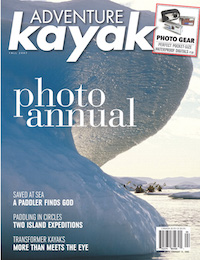
This article on finding a unique paddling partner was published in the Fall 2007 issue of Adventure Kayak magazine.This article first appeared in the Fall 2007 issue of Adventure Kayak Magazine. For more great content, subscribe to Adventure Kayak’s print and digital editions here.
Silent Sam: Sam Crowley on His Circumnavigation of Ireland

Photo: Tim Shuff
Silent Sam: Sam Crowley on His Circumnavigation of Ireland

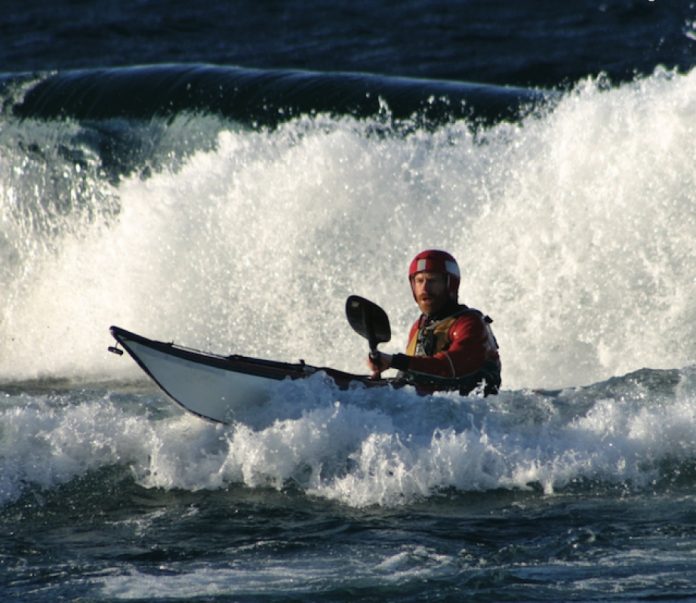
Midway through his solo attempt to circumnavigate Ireland, the scariest thing Sam Crowley had encountered didn’t involve big seas, surf or tidal races. It happened, in Crowley’s words, “on a two-way lane about the width of a bicycle path with a speed limit of 80 kilometres per hour.”

“In many ways it’s safer on the water than on the roads,” says Crowley, a sea kayaker from Marquette, Michigan.

Catching up to Sam by phone in July, it’s not hard to imagine the easygoing, soft-spoken Crowley sipping Guinness in an Irish pub as he talks (with a bit of prodding) about the first quarter of his 2,200-kilometre trip. Despite the fact that he’s been windbound on the southwest corner of the emerald isle for nearly two weeks—all told he’s paddled 18 kilometres in the past 12 days—he’s still optimistic he’ll complete his clockwise circumnavigation before the end of the summer.

If he ever gets back on the water, the next task is an arduous crossing to Skellig Michael, a cliff-bound island with an abandoned 1,200-year-old monastery. Crowley says getting ashore there will involve a “Derek Hutchinson-style seal landing on a concrete pier.” From Skellig Michael, Crowley will continue north up the west coast of Ireland.

If you can convince him to tell you about it, Crowley has an impressive paddling resume including countless British Canoe Union and American Canoe association awards. Crowley and his partner Nancy Uschold run a sea kayak instruction company in Michigan’s upper peninsula. But what really stands out are his many extended trips on lake superior, a crossing of the Baltic sea from Helsinki, Finland, to Stockholm, Sweden, and a circumnavigation of Moresby island in the Queen Charlottes of Canada’s pacific coast.

While Crowley says the Ireland trip was the culmination of five years of planning and “warm-up trips,” the logistics were quite simple: he shut down his sport massage business for the summer, picked up an explorer sea kayak from Nigel Dennis in Wales, took a ferry to Dublin and started paddling.

He says the biggest difference between paddling around Ireland and his previous trips are the people.

“I’m used to places where you don’t see anyone,” says Crowley from a barstool in the town of garnish. “Here you camp on a beach and it’s like a promenade. But the people are so friendly. Earlier tonight a fellow took pity on me and brought me up here for a pint.”

Crowley says the rural Irish people he’s met have taught him the most. “Mostly I’ve learned not to try to keep up with 70- year-old drinking Irishmen, even if they’ve had a head start.” 

This article on kayaking Ireland was published in the Fall 2007 issue of Adventure Kayak magazine.This article first appeared in the Fall 2007 issue of Adventure Kayak Magazine. For more great content, subscribe to Adventure Kayak’s print and digital editions here.
Editorial: First Comes Food, Then Comes Marriage

Photo: Steve MacDonald/Camp Cooking: the Black Feather Guide
Editorial: First Comes Food, Then Comes Marriage

With utmost respect for my favourite writer, I must disagree with his cranky opinion of backcountry cuisine.

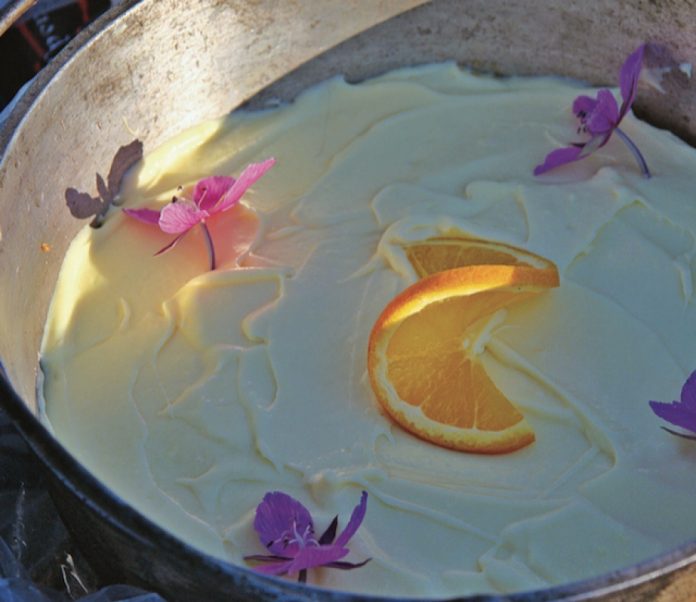
I admit you can take gourmet eating too far. In my restless twenties I went on a guided kayak tour and was appalled by the excesses of what surly guides call a “float and bloat” trip. I remember grilled steaks on the first night, fresh peach shortcake with real whipped cream for dessert. Lunch featured a spread of hard and soft cheeses, charcuterie and two kinds of smoked fish, followed by fresh fruit and homemade chocolate chip cookies. As if that weren’t enough, halfway through the trip the guides paddled back to base to restock the larder and returned with Häagen-Dazs packed in dry ice. With so much time devoted to cooking and eating, we spent all seven days within an hour’s paddle of our starting point. We ate more calories than we burned and put more mileage on our silver- ware than our paddles. i like eating more than most, but that’s not my idea of a sea kayak trip. Edward Abbey would have been appalled.

I respect the gustatory minimalism of the hard-tripping ascetic I once was, but as years go by and my trips get shorter, I am coming around to the gourmet camp. I still have good friends who subscribe to the “food is just fuel” philosophy, but my tastes are diverging from theirs. If you dropped in on a recent trip and watched us unpack our respective lunches, you would see me carefully preparing an open-faced bagel sandwich with smoked oysters and cream cheese while my friend is happily scarfing cold baked beans from a can (“No Name, 66 cents!”).

MAKING THE MEALS COUNT

I see gourmet eating not as an end in itself, but as a reward for a hard day’s paddle, a complement to the fine scenery and amiable company of a trip. Kayak trips are one time in my life when I’m working hard enough to be truly hungry, and since I spend a good half of my time on the water thinking about my next meal, I like to make those meals count.

If I once underestimated the importance of gourmet camping, that all changed six years ago when I went paddling for the first time with my girlfriend. Determined to impress, I pulled out all the stops and served marinated chicken and fresh-baked pumpkin pie on the first night. She still tells the story about how I won her heart with that meal (and complains how my cooking nowadays rarely measures up). We’re getting married a few days after this magazine goes to press. For our honeymoon we’re going on a paddling trip and bringing plenty of good food.

This article on eating well on trip was published in the Fall 2007 issue of Adventure Kayak magazine.This article first appeared in the Fall 2007 issue of Adventure Kayak Magazine. For more great content, subscribe to Adventure Kayak’s print and digital editions here.
Boat Review: Evergreen’s Solito

Photo: Scott MacGregor
Boat Review: Evergreen's Solito

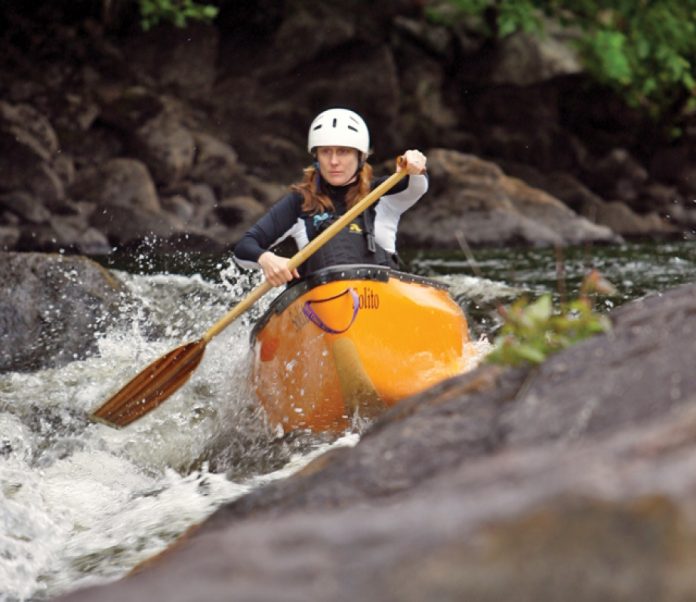
The name Solito for Evergreen’s latest whitewater solo boat was literally pulled out of a hat. Before the new solo boat was about to be released last spring, Mountain Equipment Co-op ran a contest for its members to suggest names, the prize being a shiny new Evergreen Whatchamacallit. More than 5,000 names were dropped in boxes across the country and then short-listed to eight by a panel of judges. Wakefield, Quebec, resident Patrick Hunt is the proud owner of the very first Solito.

Evergreen Canoe Company is more commonly known among whitewater canoeists for their Starburst, a highly rockered, 17-foot river tripper, than it is for solo playboats. Six years ago or so, Evergreen acquired the rights to produce the Starburst, Prowler and Sunburst II, formally Blue Hole Canoe models. Along comes canoe designer John Graye shopping a new boat design and Evergreen has themselves a solo boat.

The Solito falls into the same category as the Esquif Zoom and Pyranha Prelude, short but still a full-bodied open boat. These designs are great surfers, quick to pivot, ideal for small rivers and technical moves. It’s the type of boat you grow into with a little experience.

If you’ve hung around open canoes for a while you’ll take one look at the Solito and say “cut-down Ocoee.” When the Dagger Ocoee was the hottest boat, paddlers were cutting sections from the middle of the hull and joining the two ends back together with epoxy. Great idea except that it removes the widest, most stable part of the canoe. The Solito is flat-bottomed with sharp chines and sharp bow and stern like the Ocoee, but wider, less flared and 13 inches shorter. So maybe not really like the Ocoee, but closer to that than anything else.

Although our test model looked practically new you can see and feel that the wide, flat bottom is oil canning between your knees. Sitting in it you can push the hull down into the water, which means that the water pressure is pushing up on the hull. Roll upside down and your weight really draws the hull in. What this means for performance is hard to tell, as you can’t paddle the boat any other way. With a more rigid hull, the Solito should be faster, and should also be crisper handling. Evergreen has been adjusting the specification of the Royalex sheets they use to stiffen it up, and the new hulls are supposed to be much better.

If the Solito was ours, we’d try moving the thwarts toward the centre of the boat and try bringing them in an inch or so. Sometimes drawing a boat in at the gunwales will cause the bottom to flex, tighten up and be more convex, which in the Solito would be a good thing. A rounder hull should make it faster and being narrower at the gunwales would make it easier to paddle. But this will make it initially more tippy and reduce the amount of flare, robbing its secondary stability. We’d also drill out the rivets and screw on some ash or cherry gunwales.

It seems like we’re being picky, but not really. The Solito is a great little boat that will suit a large number of paddlers, we’re just dreaming of making it our own. And we know from the Ocoee days that this particular shape is tons of fun to paddle and play around with.

Specs

  • Material: Royalex
  • Length: 9’ 11”
  • Width: 28”
  • Depth: 14”
  • Gunwales: Vinyl
  • Weight: 45 lbs (as tested with available Mike Yee Outfitting and bags)
  • MSRP: $1,349 CAD, not outfitted

 CCC_PartnerBadge_Web.png

Watch THE CANOE an award-winning film that tells the story of Canada’s connection to water and how paddling in Ontario is enriching the lives of those who paddle there.


Boat Review: The Island by Hobie

Photo Victoria Bowman
Boat Review: The Island by Hobie

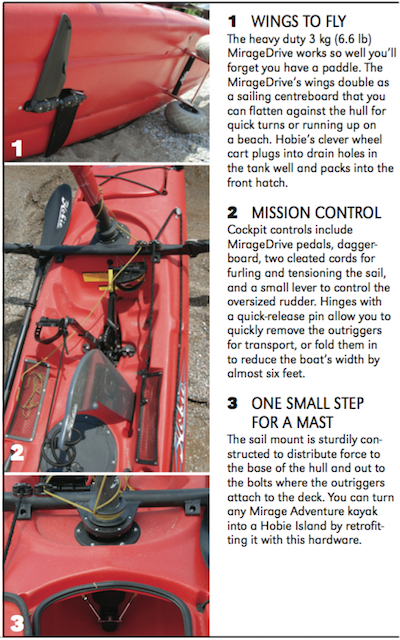
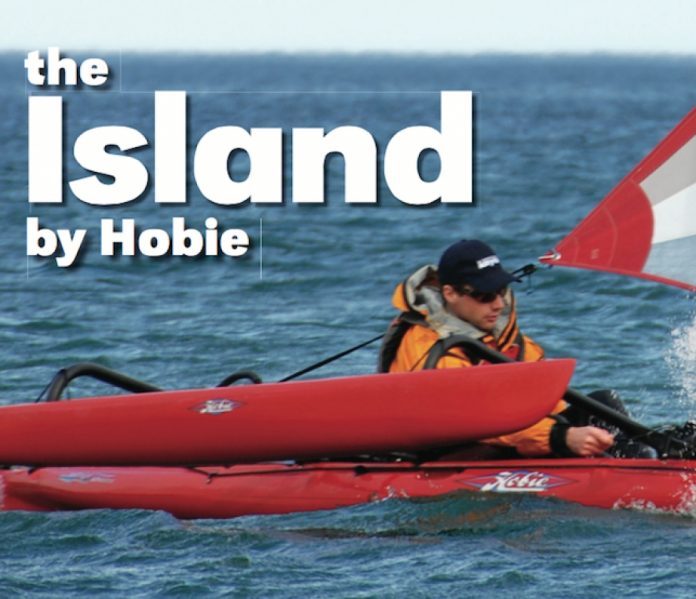
BEFORE YOU ASK what business this crazy contraption has in a kayak review, let me explain that the core of the Hobie Island sailing trimaran is a standard Hobie Mirage Adventure sit-on-top kayak (this boat’s full name is the Hobie Mirage Adventure Island). The Mirage Adventure is the fastest kayak in the Hobie lineup, designed for maximum speed, tracking and carrying capacity. So if you strip off the Island’s pedal drive, plug-in wheelie cart, twin outriggers, 15-foot mast and 54.5-square-foot sail, you’re left with this nice all-purpose kayak to paddle around or fish from. It even has three hatches and built-in fishing rod holders.

A cautious kayaker, I first climbed aboard the Island with my paddle firmly in hand, ready to resort to paddling if things went sideways. Pedaling with my feet, controlling the rudder with my left hand and working the two lines for the sail with my right felt a bit like learning to fly a helicopter at first. But within half an hour playing in moderate winds I went from complete sailing beginner to flying along at up to seven knots. When the wind died or I stalled trying to come about to tack, I simply threw in a few pedal strokes to get moving again. I had a blast chasing waves and surfing downwind, jacking up the speed with the pedals if I needed a little oomph to get over a wave crest. I soon stowed the paddle for good.

The sail system is the real deal with the same high-quality rigging as Hobie’s famous sail cats: Harken hardware, Delrin plastic bearings at the base of the mast, Spectra cord rudder lines. With the roller-furling mast, you can go from full sail to zero in about five seconds, and instantly adjust the amount of sail for varying wind speeds. Kicking back and enjoying the view while averaging four or five knots, I had dreams of loading up for a long coastal tour and effortlessly cruising 50 to 100 kilometres a day with a cappuccino in the cup holder and some Jack John- son on the—okay, so there’s no stereo.

The Island is nearly impossible to flip due to a self-limiting design: when the boat catches a lot of wind, it leans over and buries the downwind outrigger, automatically slowing down (soaking the paddler in the process) and turning safely upwind. As my confidence grew, I started fantasizing about having more floatation in the outriggers, more clearance for the outrigger arms, and a larger rudder with a more powerful control so I could suck more speed from a strong wind. But I’ll bet that would get me into trouble. And I doubt you could still call it kayaking.

Screen_Shot_2015-06-30_at_10.53.51_AM.png

akv7i4cover.jpgThis article first appeared in the Fall 2007 issue of Adventure Kayak magazine. For more boat reviews, subscribe to Adventure Kayak’s print and digital editions here.

 

Boat Review: The T-1600 by TRAK

Photo Victoria Bowman
Boat Review: The T-1600 by TRAK

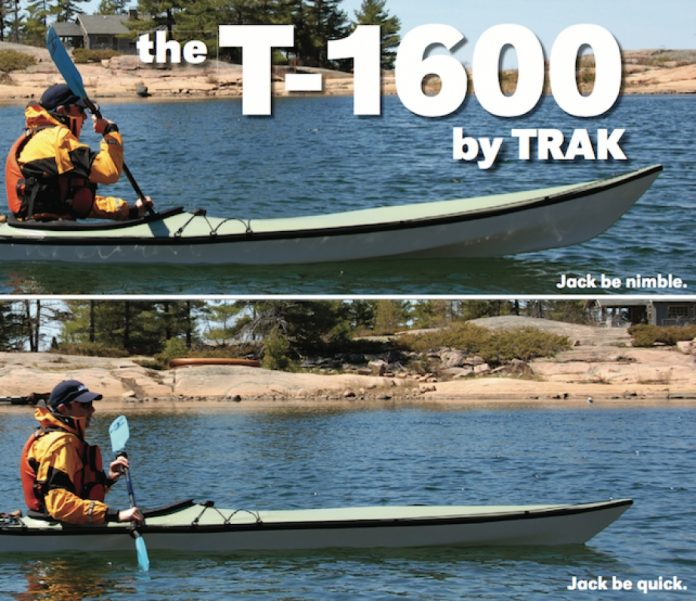
Have you seen The Kayak Transformers? This summer blockbuster begins not long ago in a galaxy not far away (Alberta), where a group of entrepreneurs quietly hatch a plan to create the most successful kayak company in the world.

By the end of 2005 our heroes have raised more than $2.4 million in startup capital and are angling for another $2 million from investors. In 2007 their top-secret invention, the TRAK T-1600, finally hits the water with a big splash. They boldly hype it as “the world’s only performance kayak that goes in a pack” and the media eats it up.

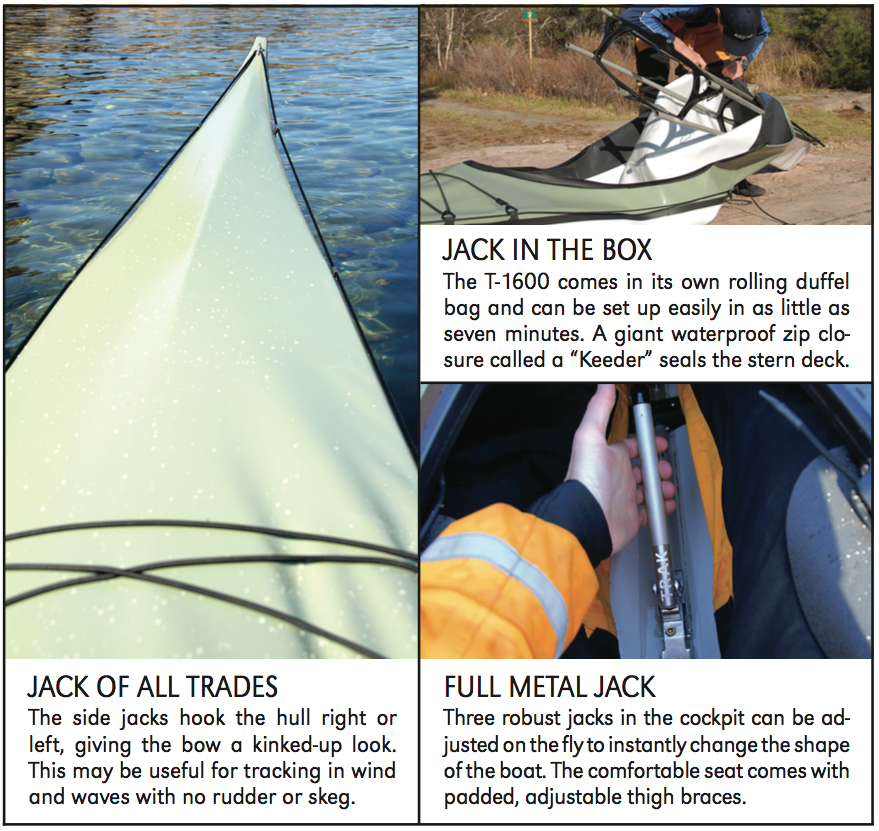
The action begins when the T-1600 rolls onto the scene in an attractive duffel bag with a plastic external frame and built-in wheels. Then it stuns its human owners by transforming into a medium-sized touring kayak in less than 20 minutes—faster than any other folding kayak in the universe. The one-piece hull and deck and aircraft-aluminum frame appear outstandingly engineered and constructed. A battle ensues for the hearts and minds of kayakers everywhere.

There is a dramatic climax when we discover that there are three hand-powered jacks built into the frame—one on each side of the cockpit and one along the keel between the paddler’s legs. These allow the T-1600 to change shape on the water. In an instant it switches from the flat profile of a rowing shell to the rocker of a whitewater canoe. Egads! Do you realize the implications? Here is a kayak that is immune to the classic tradeoff between speed and maneuverability! It can outrun play kayaks and outplay touring kayaks! Global market domination is virtually assured.

There’s a moment of doubt when we see that the side jacks are designed to hook the hull left or right to overcome turning in crosswinds (because the T-1600, in a gesture of elegant simplicity, has no skeg or rudder). The hard-chine, deep-V hull is not strongly affected by wind, so we wonder if this kinky feature is a strength or a weakness.
 As the saga continues, however, the TRAK T-1600 proves itself to be an awesome transformer. It holds its own against any other folding kayak for its construction quality and ease of assembly alone. Dueling with quality hardshell kayaks in their element is another matter. These old standbys do what they do really well, at a price that’s easier for the masses to swallow. So the battle rages and it will take more time to know if the T-1600 can fulfill its creators’ dream of revolutionizing kayaking the way parabolic skis swept downhill skiing. Things look rosy for now, but just like in Hollywood, you can pretty much bank on a sequel.

Screen_Shot_2015-06-30_at_10.46.18_AM.png

akv7i4cover.jpgThis article first appeared in the Fall 2007 issue of Adventure Kayak magazine. For more boat reviews, subscribe to Adventure Kayak’s print and digital editions here.
Drag-and-Drop

Photo: Steve Arnold
Drag-and-Drop

I set up for shallow slides much the same as I set up for any creek line. I start opposite the side I want to end up on and carry momentum into the rapid to cross the grain of the falling water. On shallow slides in an open boat carrying momewntum is even more important than in a kayak, since an onside forward stroke wants to spin the boat and any strokes in one inch of water don’t work very well.

On the Independence River in New York State I started down a narrow shallow slide that fanned out as it steepened, before dropping into a very tiny cauldron surrounded by sloping granite banks. With some surprise I found myself grinding down angled left as planned to cross the grain, but definitely not moving left. Matter of fact, as I was approaching the landmark rooster tail at the lip of the steeper bit, I was sliding even further to my right toward the cauldron—not at all where anyone would intend to go. Finishing the drop backwards seemed like the best of the worst, and even though there was so little water cascading over the rocks you could hardly call it a rapid, it was enough to drown out the laughter of everyone on shore.

It was several months before I came up with a plausible explanation of why I’d gotten so far off line.

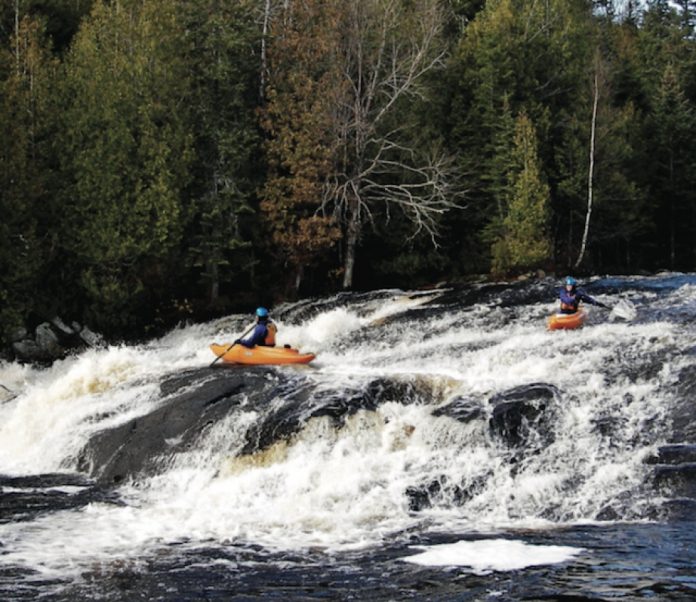
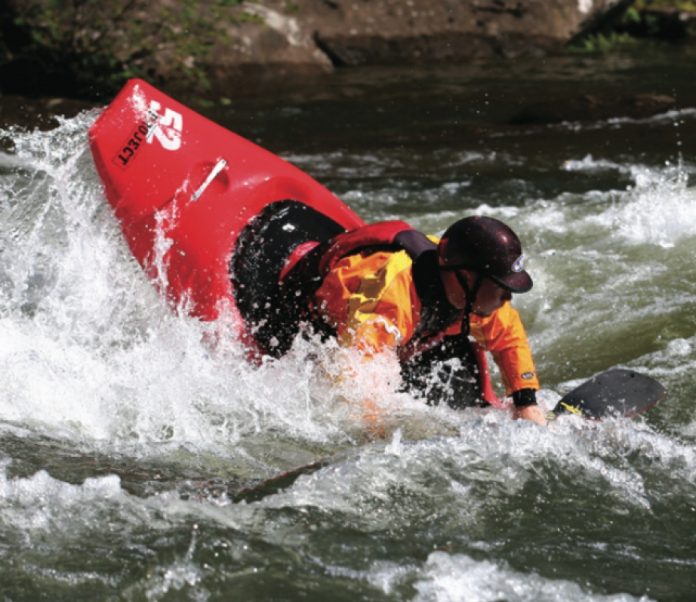
On the Doncaster, a classic Quebec spring run, I watched the same thing happen. In this photo, the boater is trying to drive river left but the water pushes him out towards the middle of the rapid. He either didn’t come into the rapid with enough forward momentum to begin with, or the drag on the bottom of the boat in the shallow water caused the boat to slow down and move slower than the water. Either way, if you’re not moving faster than the water, crossing the grain turns into a scary back ferry.

Think back to the old days when we all used the back ferry to descend rapids slowly. A back ferry works because the canoe is moving slower downstream than the current, due in this case to your backpaddling. The water pushes on the exposed side of the canoe moving the craft laterally across the river.

On a shallow slide you get the same effect when your creek boat is slowed by the friction of the river bottom.

As soon as you lose forward momentum the current begins to take your boat with it. Aligned perfectly with the current, you’re going where the water is going. Any angle in either direction and presto, you are in back ferry mode, whether you like it or not!

So far, I’m not setting up to back ferry down slides. I still much prefer maintaining forward speed and driving toward the direction I want to go.

However, understanding how the friction in shallow-water slides slows my boat, I can always try to claim I was back ferrying when I end up beached on shore.

Who knows, maybe it won’t be too long before we’re all back ferrying off waterfalls… you go first. 

This article on back ferries was published in the Summer 2007 issue of Rapid magazine.

This article first appeared in the Summer 2007 issue of Rapid Magazine.


The Macho Move

Photo: Tanya Shuman
The Macho Move

The macho move is one of the most impressive downstream freestyle moves known to mankind. Invented by Brad Ludden and named by Jay Kincaid, it became mainstream after Ludden and other pros displayed the new move at the 2002 IR Triple crown on the Nolichucky River in Tennessee.

The macho move is simply an air loop, which pops off the peak of a wave while moving downstream. Only two waves are required to get a nice aerial macho move. It is ideal to learn the move on high-volume rivers with medium-sized waves where you don’t have to worry about hitting bottom. The New and Gauley rivers in West Virginia are my favourites for doing macho moves since the potential spots to do this move are endless. Also endless are the potential variations of the macho move. One slight variation of the macho move was done for this particular photo sequence, with the boat popping off the peak with a twist to get more of a space Godzilla macho move. New ways are still being discovered.

The feeling of doing a massive air flip while travelling downriver at high speed is truly exhilarating. once you nail your first macho move the addiction will begin. You’ll never just float down a wave train again.  

How to macho move:

Step 1: Paddle at medium speed into a wave train with fairly consistent standing waves. The greater the spacing between the waves, the more downstream speed you’ll require. Proper timing is crucial for the macho move.

Step 2: The initiation is the classic double-pump technique, started at the peak of the first wave. The key is to lift your bow into the air while moving over the first wave peak, and to drive your bow as deep as possible into the trough between the two waves. This loading of your bow’s volume deep in the trough is where the pop of the macho move comes from.

Step 3: As you begin to travel up the face of the second wave, stand up on your foot blocks just as you would for an air loop. You should time this jumping action so that you are completely standing up just before the peak of the second wave.

Step 4: Snap your torso forwards as if you were flatwater looping off the peak of the wave. You will encounter much less resistance than a normal flatwater loop since the water is dropping away from you as you travel downstream off the peak of the wave. You know you’ve nailed your timing perfectly when you completely clear your stern of the water and you land flat on your hull in the next trough. 

Pro tips:

1. Practice both the flatwater loop and loops in holes, and concentrate on the timing of the jump to increase your pop into the air. 

2. The higher you pull yourself into the air off the initiation wave peak, the deeper your bow will go into the next trough. The deeper your bow goes in the trough, the higher you will be thrown into the air off the second wave peak. 

3. Approach the first wave at a slight angle from the side. This will help you face downstream while vertical on your bow, which will make your macho move loop finish straighter. 

This article on the macho move was published in the Summer 2007 issue of Rapid magazine.

This article first appeared in the Summer 2007 issue of Rapid Magazine.


River Alchemy: Random Beauty

Photo: garyandjoaniemcguffin.com
River Alchemy: Random Beauty

I stumbled on it some years ago on a rambling hike down a dry streambed in Driggs, Idaho. I found a perfect bend in a river. A 180-degree change in direction, carved from the alluvial plain. The gravel bank was perhaps eight feet high; it was plumb vertical, and had a perfectly walled arc, perhaps 100 feet in diameter. From every angle it was astoundingly geometrically perfect. It grabbed my eye and carried it around its curve. I had never seen such mathematical perfection in nature before.

Luna Leopold felt that same sense of awe in nature. As the son of Aldo Leopold, the famous pioneer of wilderness ethics and land protection in the United States, Luna Leopold was the first to set out to study rivers in a manner unheard of—he measured them… in great detail. In fact he spent a lifetime creating formulas to explain just how rivers work, and how it was possible for them to carve the perfect bend.

By and large, he was successful. 

He was the creator of what is now called quantitative hydrology, and in doing so re-established much of the fundamental assumptions of modern engineering.

Starting in 1953 with his obscure (to most readers) text, The Hydraulic Geometry of Stream Channels and Some Physiographic Implications, Leopold pulled rivers apart, feature by feature, and scratched out the formulas that explain their behaviours. Some of his findings are uncanny. Consider these, if you haven’t before: the wavelength a river meanders is, on average, 12 times its width; the Sine coefficient for those meanders is the same coefficient for the compression waves that form on a stream’s surface; and the riffle-pool interval is one half the wavelength of the meanders.

Fascinating.

He created formulas to explain helical flow, wave creation, hydraulics, sediment load and watershed flood rates. The list goes on and on. In my search to explain the perfect bend all roads lead to Leopold’s work. He was incredibly prolific and clearly a genius. While mathematically dazzling, his formula for the perfect bend left me spiritually unfulfilled.

A year later I was handed Barry Lopez in a used bookstore in Smithers, B.C., Lopez lives on the other end of the Sine curve from Leopold; if Leopold is pure science, Lopez is pure poetry. River Notes is Lopez’s river dissection, via a series of short stories so descriptive the book drips with water. His swirling eddies suck you in, carry you into the current, then delicately and surprisingly drop you in the literary ocean of deep thought with his famous single-sentence endings.

Lopez explores the idea of how a river can so seamlessly and completely change direction, while looking for instruction that may be useful to his own life.

Mired in depression, he laboured to examine every aspect of the bend in the river behind his home. If he could figure out this bend, then maybe he could figure out how to turn his own life around. Bed-ridden and feeling no hope at all, he hauls himself down to the stream and dips his hand in the water. The essence of the turn, he realizes, is not in the details (nor in any of Leopold’s formulas), but in some bigger connection between himself and the river.

Lopez’s exploration of the fine details of rivers is in a way an exploration of the human soul, but his life-changing river bend metaphor did not speak to me any more than Leopold’s algebra.

I’ve since returned to the sharp and blocky Canadian Shield rivers, rivers with turns seemingly unaffected by water and time pushing against them. In my lifetime I’m unlikely to find another bend so geometrically perfect.

With every new river I paddle I realize it was not the bend that was so intriguing, it was how the perfectly bending arc grabbed my eye, smoothly railing it around the corner in a new direction. It was not the bend in the river, it was what lay beyond that was so intriguing and so important. The perfect bend is not a complex equation. For me now, the perfect bend is the one just downstream, the one luring me to explore what is just beyond. 

This article on science and poerty was published in the Summer 2007 issue of Rapid magazin

This article first appeared in the Summer 2007 issue of Rapid Magazine.


Editorial: A Drop in the Bucket

Photo: Scott MacGregor
Editorial: A Drop in the Bucket

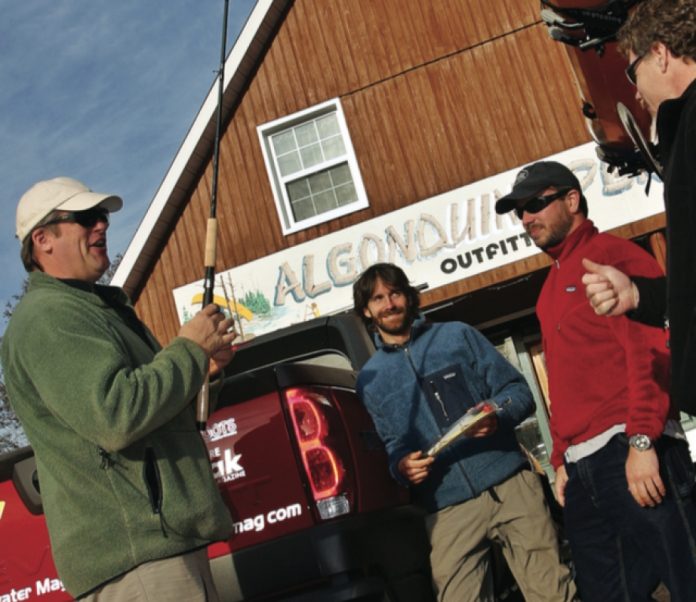
Driving home from a kayak fishing trip last week I realized I had done what most whitewater paddlers do every weekend—I filled my gas tank and cooler before I left home.

The week before, back at the Rapid office, I had been preparing an economic impact survey to measure the amount of money spent in Palmer Rapids during our Canadian Whitewater Instructor Conference and sixth annual Palmer Rapids River Festival. I’ll use the data from this to present a case to my local municipality, county economic development office and tourism association arguing that whitewater paddling is good for the area.

Meanwhile, the only things I left behind after my weekend in the abandoned-mining-town-turned-tourism-based fishing community were a couple of snagged lures and a case of empties.

For my fishing trip, I easily dropped $250 on gas, groceries and bits of tackle. Buying it all locally would have only cost me $18 more than it did at the highway gas bar and box store supermarket. With eight of us in our group and eight other cabins at the place we stayed, for an extra six dollars a day each, these guys at this one fishing camp could have injected $10,000 into the local economy simply by buying supplies at the Gowganda general store. And that doesn’t take into account the beer!

We need to stop thinking about our rivers as being free.

With increasing pressure on rivers for hydro development, river protection groups have to slap a sticker price on whitewater. These groups are standing up in public meetings across the country convincing local politicians and governments that paddlers will generate more business and more revenue than turbines.

I respect the efforts of groups like Les Amis who are committed to protecting the Kipawa River from hydro development. Unfortunately, this year Les Amis is officially cancelling the 21st annual Kipawa River Rally due to what vice President Peter Karwacki calls the “unsafe, unpredictable situation created by the punitive actions of [the federal government].” Karwacki recommends paddlers send letters of apology to local businesses in the host town of Laniel. Maybe the loss of revenue will spur local businesses to stand up and take notice. Sometimes you don’t know what you’ve got ‘til it’s gone.

We know that economic impact studies sway government decisions when it comes to whitewater paddling.

Whitewater parks are being built all across North America on the basis of their economic returns. Cities like Reno, Nevada and Wausau, Wisconsin have invested millions to create whitewater tourism and are reaping rewards. More complacent communities are letting developers shut off their natural rivers.

We simply have to stop thinking of rivers as being free and be conscious and proactive with our spending. We can pay for a shuttle instead of driving two cars from the city. Stay the night at a local campground, motel or bed and breakfast. Rent our boats locally. Shop at the local grocery store. Fill our gas tanks for the ride home. Plan to meet your friends at the restaurant for breakfast. Buy an ice cream cone. And if there’s a box at the take-out or campground, dude, put your money in the box.

We need to pay where we play. And if it costs us more to do so, it’s not an added expense, it’s an investment.  

This article on shopping local was published in the Summer 2007 issue of Rapid magazine

This article first appeared in the Summer 2007 issue of Rapid Magazine.