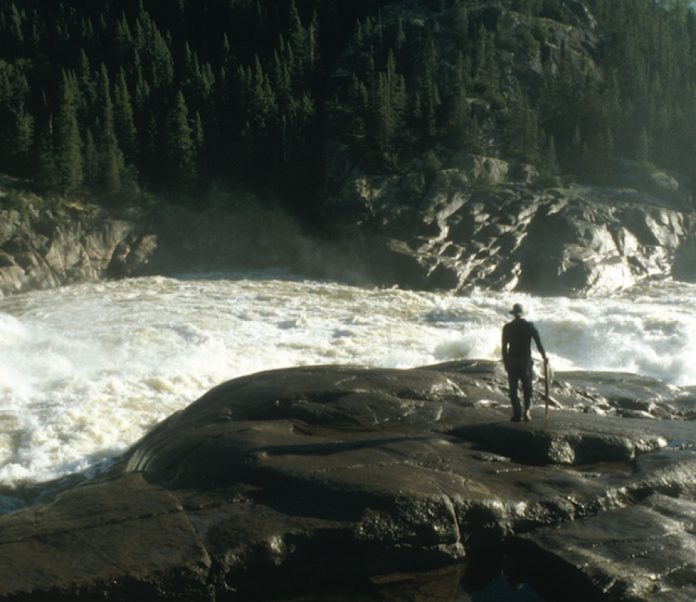
Though we may often take the vastness of our country for granted, I expect that deep down most of us are proud of our great landscape and the role it has played in shaping the history of our country. This pride shows itself as a fierce love for free flowing rivers, nearendless mountain ranges, and the vast boreal wilderness. And while it may be true that we are better positioned than others to gain a meaningful knowledge of the shape of the earth, it is a knowledge that still has to be actively sought. In Canada, a vague and passive appreciation of the land is easy, too easy.
From the seats of our little boats, we have reduced our rivers to a short section between put-in and take- out, a linked series of playspots and ledges. For us, a river becomes a familiar, sometimes memorized sequence of moves that hints at adventure. It is a snapshot, like a photo of a person that in no way indicates health, happiness or history. This limited knowledge weakens us as paddlers and members of a community. Who are we to speak for a river if we only know eight kilometres of it?
Sliding into the water at a put-in I can’t help but wonder what lies upstream, or where the river goes when it flows around a bend and out of sight at the take- out. Do Ottawa River paddlers know anything of the roaring Culbute Rapids, or the many drops at the Swisha? What about the mountainous waves of Clarke’s Folly in spring flood?
To really understand rivers requires commitment, time and even intimacy. To understand a river is to understand something about all rivers, and to understand rivers is to understand geography.
At one time I pursued an encyclopedic knowledge of rivers — wavelengths, gravel bar formation, erosion, particle capacity. This was an exercise in frustration. I came to see that, without connection to whole rivers, these facts are meaningless.
It was not until I explored my own river — not my local whitewater run, but the stream that runs through the culvert down my road — that I began to understand rivers, and therefore geography, in the broadest sense.
My stream is unremarkable in every way except that it is my own. It shapes the landscape I look onto every morning when I wake up and defines the place where I live. If we don’t really know where we live, then it doesn’t matter where we live.
Understanding local streams matters. We need to know our rivers to care for our rivers. News of dams on the Magpie or the Churchill, or a hundred other rivers, means more than the loss of whitewater runs, mere places to play. Dams portend a drastic alteration of geography, and with it an erosion of the knowledge that is our birthright. In backing up the water, dams dry up our sense of place.
Our predecessors travelled without maps and knew their rivers top to bottom. They understood flow through the seasons, the length, breadth and character of a river. Compare this to playboaters who have a bottomless depth of knowledge for a handful of features on a river, yet are oblivious to what lies 100 metres upstream or down.
It’s an oblivion that has to be recognized. Paddlers are the chosen ones. In a world of bulldozed suburbia we view the world with wet hands and water in our eyes. We feel the connection to the Earth through the grip of the current. We must not ignore the geography that created that current and the geography that the current creates.
Paddle past the take-out.
Jeff Jackson is a professor of the outdoor program at Algonquin College in Pembroke, Ont.
This article first appeared in the Spring 2005 issue of Rapid Magazine. For more great content, subscribe to Rapid’s print and digital editions here.
As long as humans have held whitewater paddles in their hands, they’ve asked the question, “At what angle should I cross an eddy line?” Some have said 45 degrees is the best angle, others argue an approach of 90 degrees is the only way to carve smoothly into an eddy pool. The controversy has spanned several generations of paddlers, yet remains unresolved. Until now.
The solution to this mystery lies in looking closely at the eddy line itself. When you do, you’ll see that the eddy line is not really a line at all. It is actually more like a wedge pointing upstream.
In the photograph, the widening area between line A and B is what we commonly refer to as the eddy line. This eddy line, or wedge, is an area of chaotic water made up of boils and vortices. The upstream end of this wedge, often immediately downstream of a rock, marks the origin of lines A and B. Line A is the current side of the increasingly wide eddy line and line B is the eddy side.
So, how do you decide on an angle to cross the eddy line when it is actually made up of two diverging lines? To answer this, it’s best to work backwards from the eddy pool. At the end of an eddy turn, your canoe should be in the pool pointing upstream. Prior to this, the last point where the canoe was in contact with the eddy line was somewhere along line B. The most efficient entry into the eddy pool is a 90-degree turn off of line B. Any angle larger than 90 degrees results in an unnecessarily wide turn, and any angle less than 90 degrees means front ferrying over the eddy line, which is entirely too much work. The 90-degree crowd is nodding and saying, “I told you so!”
So what about line A? Is it really so important what angle you use to approach this initial eddy line? Anyone who has ever spun out on an eddy line knows it can be very important because of the influence the boils can have on the path of a canoe. As soon as the bow of your canoe touches these boils it will want to turn and face upstream. The risk is that the canoe will face upstream before it makes it to the eddy pool.
The solution is to approach line A with an angle sharp enough to cut a path across the boils so that you can still cross line B at the magic 90 degrees. Since lines A and B diverge, your approach angle will depend on how far you are from the top of the eddy. If you are very close to the top of the eddy (where the lines are close together) you can approach line A at close to 90 degrees. If you are at the bottom of the eddy (where the two lines making up the wedge are further apart) then you should approach the eddy at an angle of 45 degrees. The 45-degree folks are smiling in satisfaction.
So, the whole angle debate boils down to how high or low you hit the eddy. Choosing an approach angle depends on which part of the eddy line you are aiming for. Look carefully at the eddy line and identify both the current side and eddy side of the wedge, break out a protractor and carve a perfect arc into the pool. Mystery solved.
Andrew Westwood is a frequent contributor to Rapid. He’s an open canoe instructor at the Madawaska Kanu Centre and member of Team Esquif.
This article first appeared in the Spring 2005 issue of Rapid Magazine. For more great content, subscribe to Rapid’s print and digital editions here.
Spencer Cox and Sean Allen stand on a moist ledge above a big drop in the steep Beauty Creek Canyon in Jasper National Park. It’s not the drop they’re concerned about so much as how the water below belches from the undercut.
Brock Wilson was thinking about the same thing in 1986 when he and, then Jasper local, Stuart Smith ran the drop. “I watched Stuart pencil in and get stuffed under the overhang,” Wilson remembers. “I wanted to land flatter, but I landed too flat and wrecked my back.” The waterfall became known around Jasper as Lumbarsis.
Eighteen years later, Spencer and Sean are weighing the pros and cons of boofing and compacted spines. Reflecting on the fortunes—and misfortunes—of the past is happening a lot around here these days.
Locals like Sean and Spencer, along with a handful of other paddlers born in, raised in, and forever tied to Jasper, are rediscovering its formerly-prized creeks and rivers and picking up where early kayaking pioneers left off.
Jasper, British Columbia: The second coming of a paddling town
As a birthplace of extreme kayaking in Canada, Jasper was as much an international whitewater destination in the 1980s as Squamish and Whistler are today. Paddlers can access at least 12 high-quality class III–V rivers within an hour of the national park’s tourist centre. Jasper offers everything from steep bouldery creeks to ledgy waterfall runs and big volume rivers.
In the 1990s, while playboating fervour engulfed North America, Jasper’s kayaking scene was caught in a whirlpool. The downward spiral began when Parks Canada closed a popular local river and accelerated with the death of a local paddler. Many paddlers had also reached a zenith in their paddling careers and shifted toward city life, chasing well-paying careers rather than first descents.
Feature photo: Ryan Creary
First descents were exactly what a group of Germans were looking for when they came to the Rockies with their boats in the late 1970s. In search of challenging Canadian rivers, members of the German Alpine Kayak Club had no clear idea of what they could run. The locals weren’t much help. Although skilled, the Jasper paddling scene was stuck mostly in fibreglass slalom boats.
The Germans were more interested in paddling class IV and V rivers than running gates. A vanguard film called Challenge the Canadian Rockies, produced in the early 1980s, featured these bearded kayakers, wearing wool sweaters and baby blue neoprene dropping 30-foot Overlander Falls accompanied by a symphonic score.
The falls look small compared to the steady stream of 60-footers on today’s techno-driven, small-boat paddle porn, but the Germans’ sense of adventure shook the locals out of their slalom slumber. Many started scouting the landscape with a magnifying glass, combing the mountains that surround Jasper and paddling everything they could. In 1982, a mixed-nationality team of Krauts and Canucks calling themselves the Suicide Six claimed the first descent of the cascading Bighorn River. The German blitzkrieg had succeeded. From the mid-80s to the mid-90s Jasper ranked high among world-class whitewater destinations.
Established as the National Park’s town in 1907, Jasper has long been a mixture of terra cotta souvenir-hocking buildings, 100 per cent genuine Alberta beef steakhouses and depression-era Parks Canada structures with faded cedar shake awnings. It hasn’t changed much since the Germans were here, except that now a McDonald’s restaurant stands brazenly in the middle of town. Tourists, it seems, are hungry for cheeseburgers after long days of discovery in the undisturbed scenery just outside town limits.
I’m leaning against the faux-log façade of McDonald’s when Sean Allen rolls up in his dented grey truck. With his pale complexion, fiery eyes and dark goatee, he looks like he belongs on the seat of a Harley. He traded in his motorcycle after hitting a bus. Now he throws himself off bus-sized pourovers instead.
On a motorcycle or in a kayak, Sean is a hard-living guy. He’s taken some big hits since he started paddling in 1999. During a one-week stretch, he took two of his most severe beatings. One of them happened on a high-water mission to the Bighorn when he landed slightly crooked under a waterfall. The river squashed him to the bottom as if being pressed to the pavement by the boot of a Hells Angel. That slowed him down for a while. His skill has since come to match his nearly fearless demeanour.
[ Browse the widest selection of boats and gear in the Paddling Buyer’s Guide ]
We leave the processed putridity of McNuggets behind to meet Spencer and take advantage of the long central Albertan day. Just five minutes outside town, the Maligne Canyon is the after-work creek run of choice. When I first came here a few days ago, the place was like an attraction at Disneyland. Swarms of tourists dangled themselves over the safety railings to capture a digital image of our show.
“Are these extreme kayakers?” inquired a voice from the mob. The eddy I paddled into certainly felt extreme. What should normally be a calm backwater was actually a boiling, spitting current. “There’s an underground cave system that drains Medicine Lake,” explained Sean as he watched me flail away. Cracks in the limestone walls fill the canyon about every 100 metres. The one-kilometre creek run starts out 10 feet wide, but by the end it’s a legitimate river.
We started running the canyon one drop at a time,” explains Spencer, the other prime mover behind Jasper’s himself. He tumbled around in the hole until he resurgence. “We ran the bottom drop one night then went home. Eventually we worked up to the class V Sickle. Now we run the canyon every night. I’ve probably run it a thousand times.” I assume he’s exaggerating, but his detailed knowledge of every rock and eddy tells me he’s not.
I think back to two days earlier when Spencer led us to a put-in that was crawling with signs of grizzlies, banging his boat with his paddle and brushing sun-bleached hair out of his eyes. Though he doesn’t let grizzlies keep him from paddling, Parks Canada has been a little more troublesome.
Just upstream of the canyon is one reason why Jasper’s kayaking scene went south. A steep and technical run flows between Maligne and Medicine Lake. It’s a two-kilometre tour de force of class V whitewater within a half-hour of downtown Jasper. In 1993, new park regulations prohibited boats on this stretch during May and June to protect harlequin duck nesting. By 1999, a restricted activity order completely shut down paddling between the lakes. Parks Canada cited a drastic increase in rafting traffic as a major disturbance of duck activities. While it is true that the number of rafts floating the river in a year had risen from 10 in 1986 to 1,600 in 1991, the ban included the lower behind-the-mountain run even though it wasn’t commercially rafted.
“We never did see any harlequins on the lower stretch,” commented Al Colwell, junior representative for the nearby Hinton Strokers Kayak Club, adding that the closure pulled their most important intermediate and advanced river right out from underneath them.
While the river is occasionally poached on stealth missions, the Strokers are adhering to the regulation and teaching in less ideal places.
With the closure, paddling in Jasper began its march to the basement, a trip sped up by a 1999 run down the McKale River that ended in tragedy. Jasper’s Mark Oddy was no stranger to high water or steep descents when he entered a sticky hole to knock his paddling partner loose. Though successful at bumping out his friend, Oddy was caught in the mess himself. He tumbled around in the hole until he disappeared. Despite extensive multi-agency searches, his body has never been recovered.
“The death of Mark Oddy had a big effect on the kayaking scene in Jasper,” explains Sean soberly as we wring ourselves out from the evening Maligne Canyon run. “Anybody that was halfway into paddling around here just pulled right back. There was hardly anybody left.” The Jasper River Runners, a club that once filled an entire CN Rail hangar, faced financial troubles and closed its doors soon after.
While many others lost their passion or moved away, Sean and Spencer, spurred on by the paddling pantheon that is Jasper, picked up a video camera and teamed up with locals Logan Rutherford and Mark Basso to film their favourite runs. After a summer of marathon paddling weekends all over B.C. and Alberta, they had enough footage to release the video Entropy. Circulated mainly in Calgary it quickly sold 200 copies and is now in its second printing. A fringe benefit of the video was its showcasing of the filmmakers—virtually unknown until then—as stellar paddlers from a forgotten corner of Alberta.
Entropy also spawned kayakwest.com, a website full of useful information about the runs around Jasper and the West. “Guidebooks only cover a tiny chunk of Western Canada,” says Spencer who runs the site that averages 1,500 hits a month. “Kayakwest encourages people to get out and explore or look at some pictures and river descriptions to see if any given run is something they want to try. There is life in Alberta and B.C. outside of the Kananaskis.”
[ Plan your next British Columbia paddling trip with the Paddling Trip Guide ]
One of the rivers featured on the website is the Fraser. One hour west of Jasper, carving sharply through the rotten rock below Mt. Robson, the Fraser is still 1,000 kilometres from its deltaic mouth in Vancouver but it’s already big and wide. the Fraser’s raft run put-in is the site of Fraser River Fest, a relaxed and fun event organized by Spencer to showcase his favourite backyard runs: a technical class IV series of boulder gardens with trashy surf waves, a terrifying canyon and a big volume play run. Attendance ballooned from just 12 paddlers in 2003 to more than 50 in 2004.
Energized with the same drive to explore whitewater as the Germans, Sean and Spencer are prodding Jasper’s paddlers toward a rebirth. They have outlasted a boom and bust kayaking scene, where ducks ruled rivers and paddling partners were scarce.
If you show up at Beauty Creek this year when the water is just right there’s a good chance you’ll see Jasper’s local boys standing above Lumbarsis, thinking about that undercut.
Raymont Schmidt is a writer living in Canmore, Alberta.
This article was first published in the Spring 2005 issue of Rapid Magazine. Subscribe to Paddling Magazine’s print and digital editions, or browse the archives.
Six months before I first sat in a sea kayak I was on the phone with harbourmasters organizing food drops along the shores of the Great Lakes. All our gear and charts had been ordered, and our new boats were scheduled to arrive in Thunder Bay the week the ice usually breaks up on Lake Superior. It didn’t seem that strange to me, but friends and family wondered what motivated me to plan a three-and-a-half month expedition without ever having paddled a sea kayak.
The inspiration for paddling home from university was surely a result of being enrolled in Lakehead’s Outdoor Recreation program and being surrounded by highly motivated, adventurous peers. Even the city of Thunder Bay is a mecca for enthusiasts: with its own chapter of the Alpine Club, a healthy ski community, and is a stop for travelling adventure road shows. The Banff Festival of Mountain Films is a sellout in the city’s largest auditorium; Waterwalker packs the first-year psychology lecture hall and Warren Miller is an annual social at the Exhibition hall. Outside after the shows, climbers are freeing 5.10a stonewalls and skiers are doing backscratchers off the roofs of cars. The motivational powers of motion pictures (and in the latter case, a dozen cans of Blue) is as strong as the commitment to outdoor adventure sports.
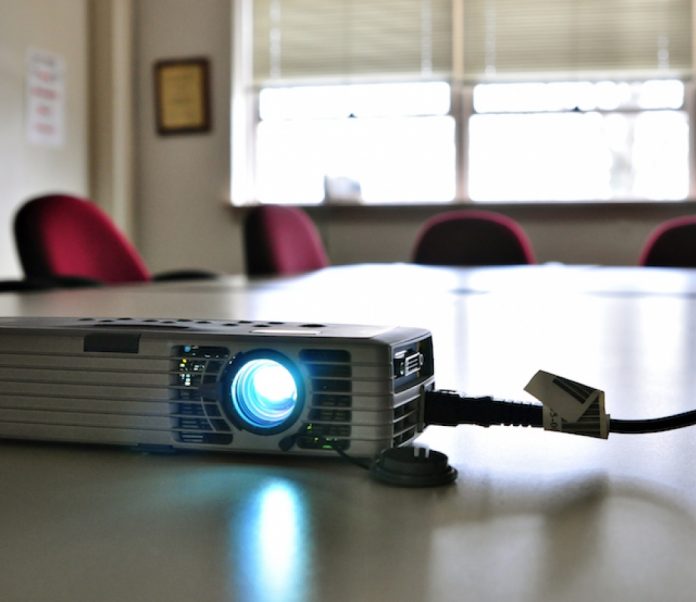
Also on campus are less glossy presentations, presentations announced by photocopied signs reading, “SLIDE SHOW TONIGHT… Room SN 210… Olav and Ali’s Trip”. Word spreads like water on GoreTex. It was these intimate presentations that best captured my imagination. Holding the projector clicker was a fellow adventurer, someone like me who decided that canoeing across Canada, sea kayaking around Lake Baikal, or skiing to the North Pole was something cool to try.
These humble presentations were relevant, and honest. Their high seas, minus 40-degree temperatures and 27 days of rain were real—not made for TV. More admirable than their attempted trips was that they took the time after- ward to share their experiences—to motivate hundreds of others. Adventure travel will never die so long as stories are told while photographs are projected on small screens. Many of these people write books; some just return to their daily routines of school or work.
When you open the first page of Adventure Kayak’s first ever photo annual, imagine that you are sitting down to watch a slide show. But, this slideshow is different: it has one photo from two-dozen trips, in almost as many countries. I suggest keeping a pen and paper handy, you’ll want to be jotting down notes, planning your next expedition.
This article first appeared in the Fall 2004 issue of Adventure Kayak Magazine. For more great content, subscribe to Adventure Kayak’s print and digital editions here.
Yes, I’m happier than I’ve ever been. I am more cen- tered and I know myself better than ever before. I am at peace with my goals and lifestyle. I have a life-partner. I am becoming a silver fox.
But forty years… Dude, I’m OLD!
Leonard Cohen once wrote in a song, “I ache in the places where I used to play”. Oh vey, was he right.
If you’re under forty, stop reading now. You don’t know. If you’re over fifty, don’t bother writing to com- plain that I don’t know what being old is: what, did you invent pain? I got pain I tell you. My back is so bent from sitting in a boat that I’m slowly taking the shape of a question mark and my large and powerful hump is becoming a distinguishing feature.
If you’re old and you’re still paddling, you’re going to hurt. However, there are a couple of strategies to help ease your aching back pain and allow you to continue as a prominent and respected member of your paddling community, long past your physical prime.
Self medicate
In the morning before heading out for a paddle, take ibuprofen. I like to fill a cereal bowl with capsules, add milk (or Lactaid if milk gives you gas) and maybe top with dried prunes. This go-getter pre-trip breakfast meal will have you play-wrestling with the young bucks in the parking lot before you even get in your kayak.
After a day of paddling I like to take the little red pills. I can’t tell you what they’re called. I’ve either got to get new glasses or longer arms to be able to read that ridicu- lously tiny print on the bottle. I can tell you the little red pills seem to complement a fine peaty single malt scotch.
Wear a nice cardigan sweater
After paddling, you’ll need to change into something dry and warm. A wool cardigan is unbeatable here. You want something in a conservative colour—you’re not put- ting on a show! In your later years, there’s nothing wrong with wearing your slippers to the coffee shop after a paddle. It’s good to be comfortable. Wrap a tartan blanket around your legs for the drive home.
Use heat on sore muscles
I find a hot après-kayak shower to be very soothing. But be careful not to fall in the tub, those things are a deathtrap. If you break a hip at forty, the bones just never knit the way they used to.
I also love Therapain spray-on liniment. This is a topical spray designed to produce heat; like a healing balm. However, extreme caution should be exercised on application. It’s best to have help when applying it to the lower back region in particular; it is all too easy to have an excessive amount of spray pool, and then run down the valley of the crack of your ass, resulting in liniment on your pee- pee, or worse… anus. The resulting heat generation is intense. This experience has come to be known in our house as “riding out the red dragon”. It’s actually proven to be somewhat addictive, with this same accidental appli- cation occurring with suspicious regularity. Think of a eucalyptus scented opium den and you get the picture.
Gripe incessantly about your back.
I like to go down to my local paddle store and complain. They know me there: you should see the youngsters scatter when they see me come through the door. I figure, they’re getting paid so it’s part of their job to listen to me whine on and on about how my back is sore. I like to try and corner one of them and hold forth on how we used to do it back in my day.
Do other things and paddle less
Simply cutting back on your level of activity is a sure way to reduce pain. Find other things to do with the time that you used to spend on the water. Whinging on about past exploits is always good. Gassing off in the library kills a few hours. And my personal favorite— start writing about paddling instead of doing it! This last one is a time-tested classic that has been well exploited by, oh, so many.
In the next issue, look for tips on adapting equipment for aging paddlers, such as how to convert carbon paddles into a super-stiff, high-performance, lightweight walker.
Alex Matthews is forty. He resides on Vancouver Island where he complains that everything keeps changing.
This article first appeared in the Fall 2004 issue of Adventure Kayak Magazine. For more great content, subscribe to Adventure Kayak’s print and digital editions here.
Even though I love cooking, there are those rare occasions when I’m looking for a quick fix with enough energy to get me through the day. At home this typically means picking up the phone and calling for some take-out, stopping for fast food or throwing a frozen entree into the microwave. Well, my wilderness-exploring friend, the fast food option is available to you in the great outdoors as well. You can boil water, pour it into a bag, wait 5-10 minutes and PRESTO— dinner is served. No muss, no fuss and you don’t even have to do the dishes. Just lick your spoon and belch!
Before the advent of refrigeration technology, dehydration was the most commonly used method for food preservation and it is still used with many food items today. Aside from preservation, dehydration allows a significant reduction in volume and weight— offering huge benefits with respect to the long distance transportation and storage of food.
Making food last longer and reducing bulk are the main concerns outdoor enthusiasts have to consider, especially when planning an expedition where re-supplying is not possible.
A seventeen-foot sea kayak has plenty of storage room for the average paddler packing a 10-day supply of food. However, once trips get into the range of a couple of weeks, you must start asking yourself what is absolutely necessary and what can be left behind to make more room for food? Let’s face it: we need energy to paddle.
Some fellow paddling guides and I prepared a variety of meals offered by the fol- lowing outdoor food companies: Alpine Aire Food, Backpacker’s Pantry, Natural High, Mary Janes Farm, Harvest Foodworks and Soft Path Cuisine. All brands are available at quality outdoor stores.
I have to say that we were blown away by the sheer variety of meals these companies are now producing—I’m sure a testament to their popularity. The variety included more traditional meals such as Beef Stroganoff, Chicken Pasta Salad and your standard soups like Cream of Broccoli. For those who like a little foreign variety, more exotic meals are available, including: Southwestern Smoked Salmon Pasta; Kung Pao Chicken; Santa Fe Pasta; and, winner of the meal-with-the-best- name contest, Barbie’s Dhal. There were also a plethora of appetizers and desserts like Chocolate Brownies, Peach Crumble and Banana’s Foster.
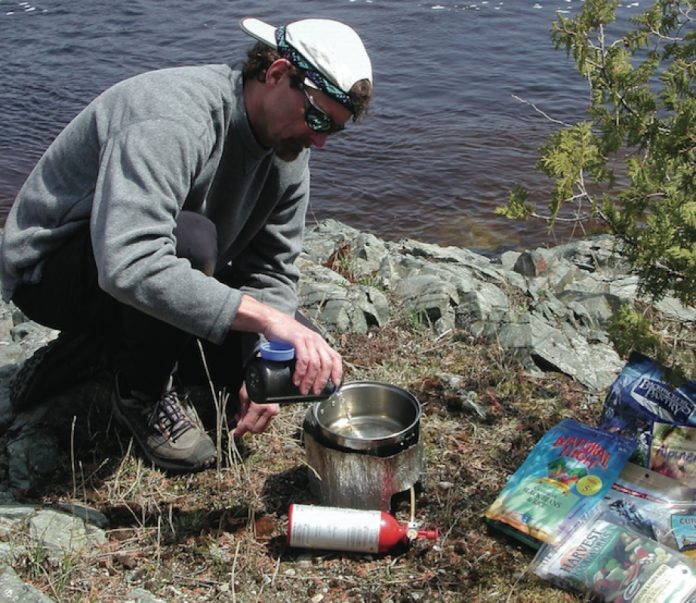
The variety was so huge I let the guides each choose one meal that appealed to them. They prepared it according to the instructions on the package; which in all cases was, “just add water”.
After a grand feast I asked my fellow chefs to speak about what they discovered. It is important to remember that all the meals were prepared following the manufacturers’ instructions to a tee. Here are some of our findings, in no particular order:
It was of the general opinion that the meals that required a little more preparation and cooking time (i.e. simmered for 10-15 minutes) had more general appeal. This was largely a result of texture—many of the meals that were pro- duced and eaten straight from the bag tended to be a bit crunchy and undercooked. In these cases, most of us agreed, they would have been much better cooked in a pot for a longer period of time rather than just adding water to the bag. Undercooked food can be a serious problem especially dehydrated foods that tend to cause bowel problems: not a particularly enjoyable medical condition on trip.
In almost all cases the meals tended to, as one guide put it, “smell much better than they actu- ally tasted”. Personally, I think many companies have reduced the amount of salt in their foods expecting you to add your own if necessary.
The more exotically named meals tended to be more flavourful.
The proportions indicated were not always satisfactory. Many meals seemed to be pretty slim once they were divided into the 2 or 4 portions recommended on the package.
We agreed that the major advantages these meals provide are reduced preparation time, reduced bulk, reduced cooking fuel needs and reduced gear needs—one pot. All important advantages when you are going long and hard.
Food additives and preservatives were also a concern for some paddling gourmets. Some of the ingredient lists included more chemical names than recognizable foods. However, I must say that a number of companies have embraced the organic foods market and their packages are preservative free.
Finally, the major concern for most of us was the actual expense of these meals. Most of the two-portion entrees run in the $6-10 range and the four-portion entrees in the $8-15 range. It wouldn’t take long to run up a tab on a 14-day trip.
Personally, I don’t think I would eat packaged meals three times a day, for a couple of weeks. However, as a paddler and guide, I would not hesitate to put half a dozen meals into a small dry bag for convenience and emergency purposes.
Tarmo lives in Wawa and guides sea kayak trips on Lake Superior.
This article first appeared in the Fall 2004 issue of Adventure Kayak Magazine. For more great content, subscribe to Adventure Kayak’s print and digital editions here.
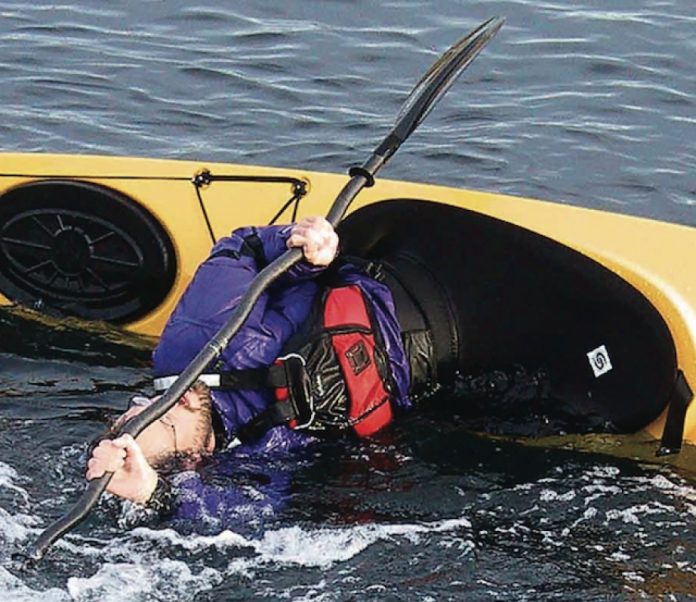
A sea kayaker practices the extreme scull technique for sea kayaking.
Sculling is a good way to maintain your balance in a kayak. A scull generates ongoing support over a far longer period of time than a brace will and therefore allows a greater sense of security when edging a kayak or navigating confused waters.
Sculling is usually practiced with the boat on a modest tilt. An “extreme” scull is a stroke where the paddler literally lies out on the water. While this is seldom used for any practical purpose other than showing off, extreme sculling is fun and a great drill. And, it looks cool!
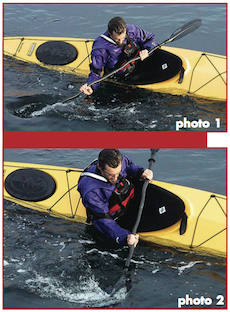
Sculling Basics (photos 1 & 2)
Start off practicing the scull with the kayak on a slight lean. Reaching out over the water in a high brace position, practice the sculling motion. Think of spreading butter on toast. Spreading the butter back and forth keeping the leading edge of the knife raised above the toast prevents it from diving and cutting into your breakfast. Similarly, setting this “climbing” angle on your blade ensures that the leading edge of the blade is always raised and on the surface of the water. The sweep is a long comfortable arc. Strive for minimal splash and a smooth rhythm.
The Extreme Scull
Mastering the extreme scull will greatly improve your ability to feather a blade in the water and lead to smoother transitions from one stroke to another. You will also gain a good feeling for leading edge lift and blade angle. An extreme scull is a natural springboard to kayak rolling or bomb-proofing your existing roll; it reinforces the correct posture and body mechanics used to finish a roll.
There are several tricks that will make the extreme scull a snap to master.
Photo 3
Lying way back onto the stern deck and committing fully to the extreme scull allows the buoyancy of your torso and PFD to help keep you floating at the surface. This is far easier than trying to scull with your body just above the water. When floating, only a light scull will be necessary to maintain the position.
Point your chest at the sky and stretch and rotate your torso in order to keep the kayak as upright as possible. Think about keeping your inside knee pointing upward to prevent the kayak from overturning.
Photo 4
Keep your outer hand low, while the inner “control hand” does the sweeping motion and sets the all important blade angle. The power face is open, leading edge up, as you sweep the blade forward toward the bow.
{loadposition PTG_AK_Midcontent}
Photo 5
As the blade reaches the end of its arc at the bow, stopping the motion will mean a momentary loss of support. No problem, quickly switch the leading edge and begin sweeping toward the stern. A smooth fluid scull is seamless support.
Photo 6
As the blade is swept back again toward the stern, the power face is closed and the leading edge angled up. This sculling action of opening and closing the power face, sweeping the blade back and forth can be maintained indefinitely.
When finishing the extreme scull and righting the kayak; it’s your body that will do most of the work. As you sweep from the bow toward the stern, drive your inside knee up— completely righting the boat—and draw your ribcage in laterally over the kayak. Leaning well back over your stern deck seems to be the easiest. Be sure it is your head that comes up and over the boat last.
Alex Matthews is an active and committed surf kayaker, whitewater paddler and sea kayaker based on Vancouver Island. He is a regular contributor to Adventure Kayak.
Photos on this page taken by Rochelle Relyea.
This article first appeared in the Fall 2004 issue of Adventure Kayak Magazine. For more great content, subscribe to Adventure Kayak’s print and digital editions here.
Get In, or Stay Out?: Knowing When to Abandon the Trip
Kyra’s left knee swelled up like a blowfish. She couldn’t put any weight on it; it was tender to the touch; the pain increased with any movement, and there was no way she could move around, let alone sit in a kayak.
We had landed on a surf-swept white sand beach at the end of day six, halfway through a trip on the west coast of Vancouver Island. Carrying the loaded kayaks up to the high tide line, Kyra slipped on slimy seaweed and wrenched her left knee.
We started all the basic first aid things we are trained to do—elevating the knee, icing it and pressure wrapping it in a crepe bandage. That part was easy.
The sun was starting to set and we were on a remote part of the coast: we had to decide whether or not to evacuate Kyra from the trip, and how we’d make it happen.
Evacuation is serious!
Evacuation is serious! There are many variables to consider with implications for all group members including frustration, financial costs, lost time and potential risks.
When deciding to evacuate, it is most important to clearly identify the level of urgency of the situation. There are three levels of urgency to consider.
Urgent evacuations are required in situations where there is an immediate and imminent threat to life or limb. Obvious examples include any ongoing problems with a person’s airway, breathing, circulation; or deadly bleeding. Also, ongoing deterioration in the person’s level of consciousness, high fever for more than 24 hours, recovery from a near drowning, or any traumatic event that involves large mechanism of injury, are situations you’d consider an urgent evacuation.
Situations where an injured person clearly needs medical or other services but whose situation is not deteriorating would be considered semi-urgent. Examples include: broken bones; dislocations; an episode of a chronic but stable medical condition such as epilepsy or angina; severe pain; worsening infections; and vomiting and diarrhea lasting more than 24 hours.
Finally, non-urgent evacuations are required in situations where there is no imminent threat to life or limb, but the participant cannot meet the objectives of the trip because of physical, emotional, or psychological limitations. Examples include acute and chronic tendonitis, debilitating blisters, anxiety or social behaviours that seriously undermine the safety and performance of the group.
How urgent is Kyra’s situation? Kyra is in a great deal of pain and experiencing stress and anxiety. She needs to get to a hospital for treatment, but her condition is stable. So we classified her evacuation as semi-urgent and set about planning the most suitable way to get her out.
Your options for evacuation will depend in large part on your methods of communication. All groups should have at least two types of external communication equipment including both one-way and two-way devices.
In many ways, urgent evacuations are the simplest in that they require immediate action, justifying the launch of a one-way distress signal such as flares, EPIRPs or PLBs or signaling mirrors. Or, using a two-way device, make a mayday call to the Coast Guard on a marine VHF radio, or a 911 call to the police or ambulance via a cell or satellite phone. In these cases, the authorities will decide for you what resources are available for the evacuation.
Our evacuation was not urgent; we felt we had the ethical responsibility and ability to resolve this situation ourselves. So we considered our non-emergency options.
For semi-urgent or non-urgent evacuations, water taxis and other boaters are a great resource. They can be contacted through a handheld marine VHF radio. VHF radios connect you to an entire network of boaters who can help you directly or pass on messages.
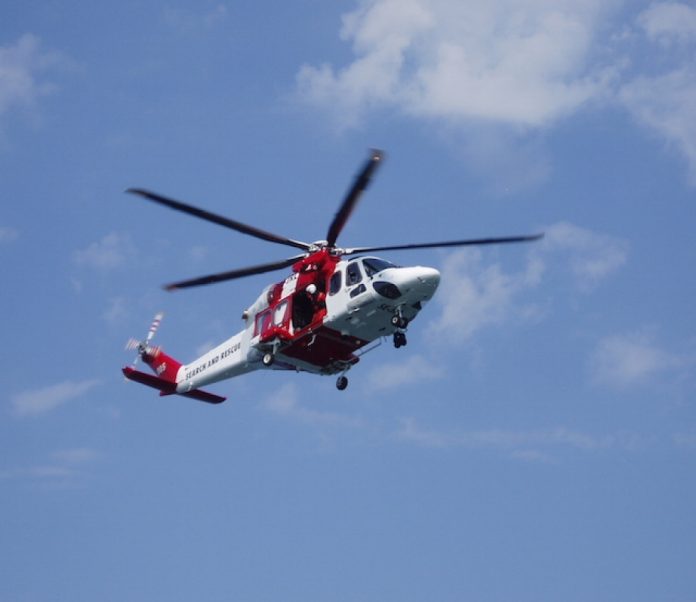
Planes are another option, weather and landing-site permitting. Most helicopters and planes use land-based VHF radio frequencies, which do not normally pick up marine radio VHF signals. In some coastal areas, planes and helicopters will also carry a marine VHF radio. Normally, however, you will have to contact the company office to arrange for a plane or helicopter.
Your final option is to paddle the person out. Typically this method is used in non-urgent evacuations, but may be your only option in urgent and semi-urgent evacuations if you are unable to make other arrangements. You are limited by weather, sea state and visibility, as well as the injured person’s ability to travel; if they are unable to wear a PFD or swim, be very judicious in your use of this method.
With Kyra, we managed to contact a fishing boat with our handheld VHF. The fisherman used his more powerful radio to reach the nearest marina. The marina staff arranged for a water taxi to come out in the morning. Kyra had an uncomfortable night and a bumpy ride out in the morning.
Our backup plan was to try to paddle Kyra out: if this was too painful, we would have arranged for two paddlers to head out and arrange for a water taxi. We had lots of food and water for several days.
It should be obvious from this example that preparation goes a long way toward planning a successful evacuation. Preparation includes getting first aid training to help you diagnose a situation and developing a multi-level evacuation plan that suits your destination. You will be much better off if you research before you leave. The more emergency information you gather before you face an evacuation decision, the better the odds of an appropriate decision and a positive outcome.
Michael Pardy is co-author of the Handbook of Safety and Rescue and a founding director of SKILS, Sea Kayak Instruction and Leadership Systems.
This article first appeared in the Fall 2004 issue of Adventure Kayak Magazine. For more great content, subscribe to Adventure Kayak’s print and digital editions here.
Editorial: Paddling away from the rat race. | Feature photo: Adventure Kayak staff
By the time you read this, I’ll have eaten my 33rd birthday cake. It doesn’t seem that long ago my winters were spent prostrate to a higher mind and my summers free on the water. From final exams to frosh week my only concerns were enough sunscreen and fresh water for the day. But at 33 I find myself living the rat race I swore I’d leave for other people.
One evening, age 25, Tanya and I were camping at the Whitby Yacht Club on the north shore of Lake Ontario. Camping might be a bit of a stretch; we’d been invited to stay aboard a sailboat in exchange for tales of our journey. After our talk we mingled and answered questions. A fellow got to telling me with unwavering certainty and pompous righteousness that the rat race—from which I’ve been running—is just life. I should get on with it, he said. He also mentioned there was a barbershop downtown, in case I was wondering. The salted rim on the drink he bought me stung my UV-burnt lips.
Feature photo: Adventure Kayak staff
I hope that I thanked him politely for the drink and his worldly insight, insight that tore at my free spirit still awash floating in the swells. I don’t remember what I said, but I do remember thinking of places he could park his Mercedes.
Responsibility comes calling?
Eight years later I’m living what he may have meant as just life. I’ve started a sometimes very hectic business with looming deadlines. I got married. I’m building a house and therefore signing a mortgage. I’ll admit this is a fine list of grownup things to do, by anyone’s measure.
I’ve followed a well-travelled path behind the forefathers of sea kayaking in Canada. There is a long tradition of making paddling part of life. The men and women who began the companies that build the boats we escape in just wanted to paddle, and when life came knocking they, like me and every other paddler over 30, built a life for themselves around the water.
Don’t let the shorter hair fool you
If that stodgy fellow is reading this, he’ll be pleased to know my hair is shorter now and my idealism very much alive but slightly more refined. I’m still paddling away from the rat race except my summer expeditions are now divided into daily lunchtime paddles and weekend trips. Which, looking at it at 33, is probably better—salted rims don’t sting my lips anymore.
[ Browse the widest selection of boats and gear in the Paddling Buyer’s Guide ]
This article was first published in the Late Summer 2004 issue of Adventure Kayak Magazine. Subscribe to Paddling Magazine’s print and digital editions, or browse the archives.
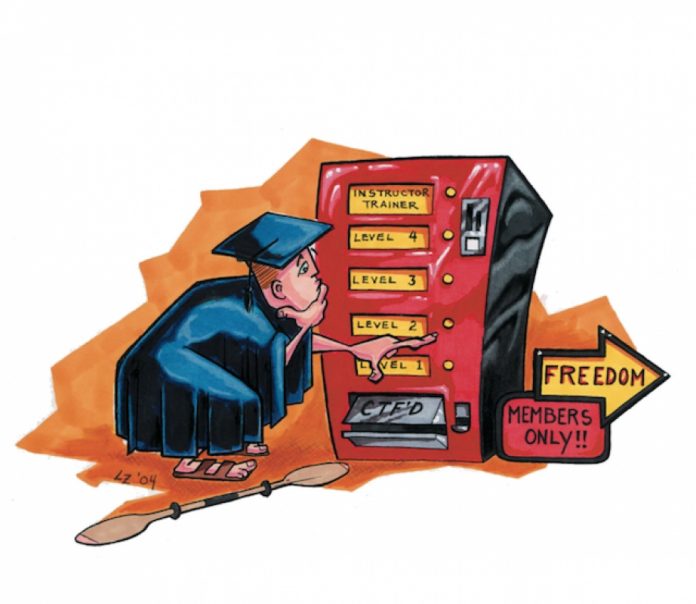
I recently did consulting work for a dive and kayak store. I asked the staff what they were really selling in the kayak section. The answer eventually came back that they were selling freedom. So what were they selling in the dive section? Everyone agreed they were selling belonging (to the club of divers).
What makes diving so different from kayaking is its emphasis on certification. Look around at what’s happening in the sea kayaking industry in Canada and you’ll see that formal certification is like a virus that has started to infect our sport too. The process gained momentum when Parks Canada recently demanded certification for kayak- ing guides, while in the field of kayak instruction, some companies are obliging their employees, who often earn little more than minimum wage, to pay up to $800 for in-house certification courses before they can work with clients on the water. And new schemes are cropping up everywhere to dole out certifications like boy scout badges to recreational paddlers.
Certification’s principal function, so far as I can tell, is to generate cash for rapacious bureaucracies. And the consequence for paddlers is that our favourite pastime shifts from a freedom activity to one of membership in an exclusive club administered by a hierarchy of bureaucrats with an inflated sense of their own importance and competence.
So what, you ask, is wrong with exclusive clubs? Well, a club divides us into two classes of people: those who are in and those who are not. Membership in these clubs depends upon passing a test. A layer of bureaucracy set- tles over the activity like a net, compromising freedom, which was the reason most of us took up sea kayaking.
“I’m free not to join a club if I just want to paddle,” you may say. Sure, but don’t count on it lasting.
Look at the dive industry. PADI, the Professional Association of Dive Instructors (a.k.a. Put Another Dollar In), controls every aspect of the sport by controlling retail outlets. You can’t buy or rent scuba equipment, or fill tanks, unless you have done one of their insidious modu- lar courses. Then every time you wish to advance, you have to pay for yet another module. Most dive shops won’t even sell you a drysuit unless you have done a drysuit course. By controlling and essentially taxing each step of the sport, they have virtually institutionalized personal responsibility!
Safety is usually the excuse for bringing in certification while fear, often combined with a sense of personal inade- quacy, are the base motivating emotions for going along with it. As a client to a kayak tour company, it may be reassuring to hear your guide is certified. If it could be demonstrated that the certification process produced bet- ter guides than non-coercive education through experienced-based training programs—something that NOLS and Outward Bound have proven can be done successfully—I might be more inclined to go along with it, but it doesn’t. There is no healthy reason for it.
Certification tends to emphasize what can be readily tested while neglecting less tangible yet more important issues like attitude and judgment that result from thought- ful responses to experience. Too often certification simply obscures a deficiency of real experience. Indeed because of the false sense of confidence the certificate generates and the deferral of institutional responsibility that results, it may actually make sea kayaking more dangerous.
Professional certification of guides and instructors acts as a mechanism for companies and land management bodies to avoid shouldering responsibilities that are right- ly part of their job description. For example, Parks Canada loves certification because it offloads responsibili- ty for assessing the competence of those who use the parks commercially. Insurance companies love certifica- tion because it covers their corporate asses and blurs legal responsibility. And some companies and colleges love certification because (they think) it lets them avoid taking responsibility for scrutinizing the competence of their staff—as in, “if he has a level four certificate he must be a competent guide/instructor.”
Professional certification is a golden opportunity for shrewd business operators and controlling personality types to hobble their competitors, artificially elevate their own personal status, and set up a toll bridge for guides and instructors. Good people reluctantly get dragged aboard out of their fear of being left behind or losing their jobs. Once certified, they are less likely to fight against it.
I foresee the day when, if we’re not careful, you won’t be able to rent or buy a recreational kayak unless you have your level one certificate, and if you want to buy a real sea kayak, you will need a level four certificate. No? Hey! Wake up! It happened to diving. It can happen to sea kayaking.
Resist certification while you still can.
John Dowd is one of the founders of the sea kayaking industry. The fifth edition of his book Sea Kayaking has just been published. He is currently working on a new book about freedom and responsibility in the outdoors.
This article first appeared in the Late Summer 2004 issue of Adventure Kayak Magazine. For more great content, subscribe to Adventure Kayak’s print and digital editions here.


 This article first appeared in the Spring 2005 issue of Rapid Magazine. For more great content, subscribe to Rapid’s print and digital editions here.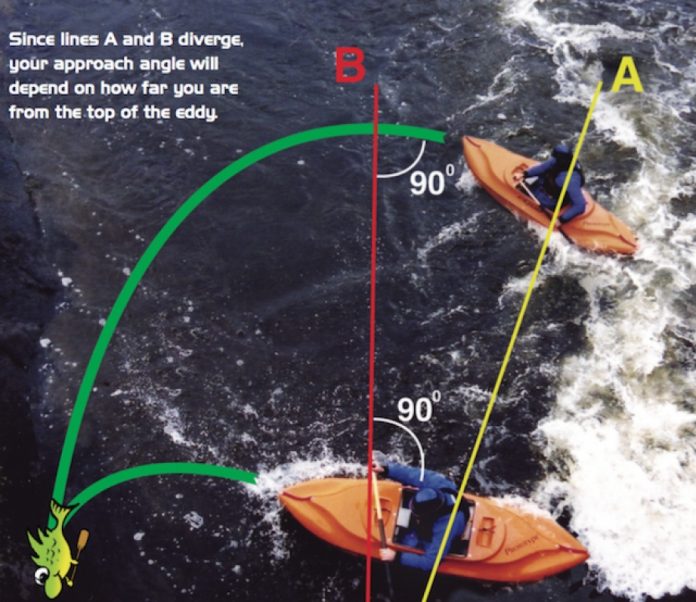
 This article first appeared in the Fall 2004 issue of Adventure Kayak Magazine. For more great content, subscribe to Adventure Kayak’s print and digital editions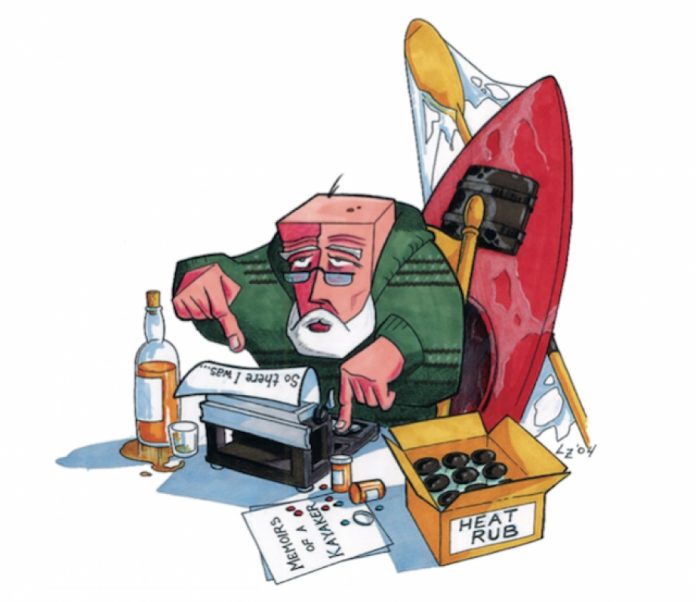
 Start off practicing the scull with the kayak on a slight lean. Reaching out over the water in a high brace position, practice the sculling motion. Think of spreading butter on toast. Spreading the butter back and forth keeping the leading edge of the knife raised above the toast prevents it from diving and cutting into your breakfast. Similarly, setting this “climbing” angle on your blade ensures that the leading edge of the blade is always raised and on the surface of the water. The sweep is a long comfortable arc. Strive for minimal splash and a smooth rhythm.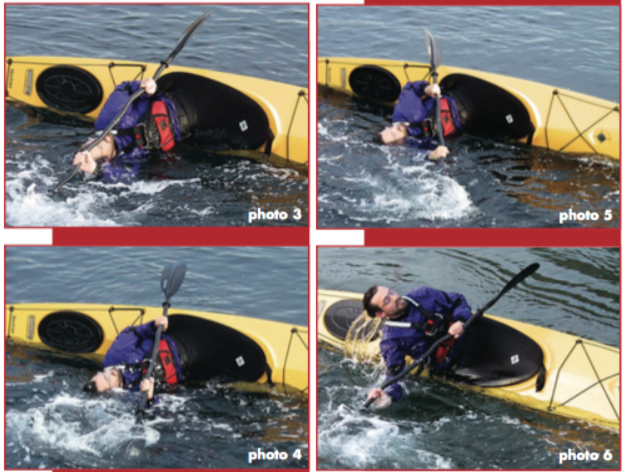
 This article was first published in the Late Summer 2004 issue of Adventure Kayak Magazine.