

Every paddler learns to avoid low-head dams, but to the uninitiated drifting above, this river hazard can look like smooth water.
Such is the case at the Lake Springfield Dam on the James River in Missouri. A horizon line runs bank to bank, so smooth and blended into the water beyond it that you might never guess you’re floating above a low-head dam, a manmade feature so dangerous it’s nicknamed the drowning machine among paddlers, anglers and rescuers.
“These structures are responsible for just under 10 percent of all whitewater deaths each year,” says Charlie Walbridge, a 30-year swiftwater rescue expert who maintains American Whitewater’s Accident Database. For reference, not wearing a PFD is attributed to about a third of whitewater deaths a year by the database.
The hidden dangers of low-head dams
A low-head dam spans the river and sends water pouring over its crest in one unbroken sheet. The flow drops, hits the base, folds back on itself, and builds a churning hydraulic. Most natural hydraulics break up on rocks and ledges, so a swimmer can catch a seam of downstream current and ride it out of the hole. A low-head dam gives nothing to catch: no rocks, no seams, only a hope and sometimes a log. The water turns white with aeration, and people caught in it lose their bearings, clawing toward a surface they can’t reach.
What makes low-head dams especially dangerous is how harmless they may look. In a natural rapid, water smashing over rock throws up spray and noise that make holes look chaotic. The uniformity of dams mean the currents that trap swimmers are hidden below the surface. From above, we mostly see foaming flatness.
On June 14, the James River rose fast after a night of rain, and a mother and her three daughters went over the Lake Springfield dam in inflatables. The Springfield Fire Department swiftwater team responded and motored their raft into the hydraulic to reach the youngest victim, 12-year-old Aurelie Stawny. The raft flipped against the base of the drop and threw the rescue crew into the boil, which was captured on video. The rescue team pulled Aurelie out before she was swept back into the water and had to be recovered a second time. She lived and the rescue team survived. Her two older sisters, Andrea, 19, and Sofie, 17, as well as her mother, drowned.
Speaking to Ozarks First after the incident, Aurelie said the family was pulled toward the dam by the current and did not realize the dam was there until it was too late. It was their first time on Lake Springfield. She survived until rescuers arrived by holding onto a log.
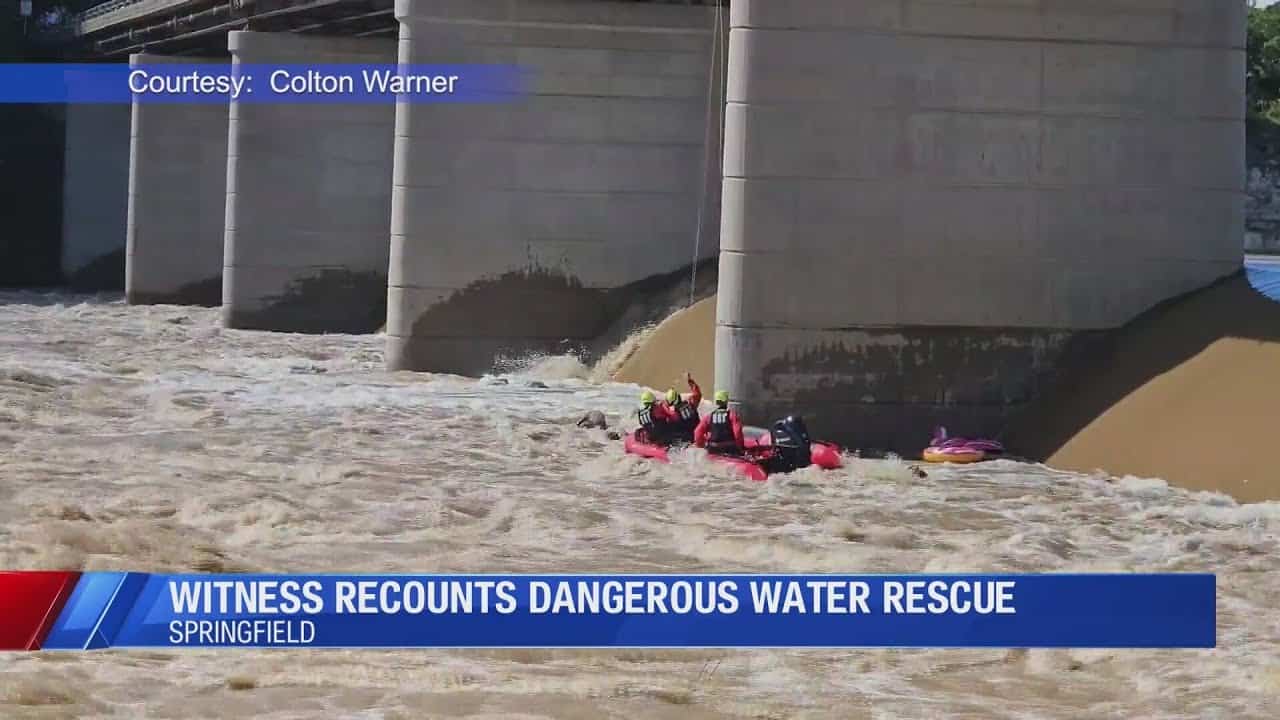
“If you look at the video of the motor raft, [at one point] it looks like they’re going the wrong way, away from the survivor, because the water is being pushed back toward the dam,” said Christopher Roush, EMS and Special Operations Chief for the Springfield Fire Department. Three firefighters were injured in the rescue.
Locals have asked for changes to increase dam safety following the Springfield accident, particularly additional warning signs. River flow speed changes with water levels, so 200 feet could be a safe distance at low flow, but still too close when the river is high.
Identifying low-head dams can be difficult from the water
Sometimes, even relentless warnings fail. Outside Calgary, Alberta, at a dam on the popular Bow River, signs pepper the river upstream. “And people were still going over the dam,” said Walbridge. “It’s very easy to say, ‘Oh, that’s really stupid,’ but I think any of us have been in a position where we’ve gone past signs just because we weren’t clued in.”
Mapping low-head dams is no easy task. Built decades and sometimes centuries ago to turn mill wheels, divert irrigation or pen fish, many have outlived the people and organizations that built them. Engineers now call them “deadbeat” or “non-jurisdictional” dams: no federal or state agency inspects them, maintains them or answers for them.
A national task force out of Brigham Young University (BYU), working with the American Society of Civil Engineers and the Association of State Dam Safety Officials, set out to map America’s low-head dams and has already logged more than 13,000 across the country. They expect the real count runs higher. The BYU research found that more than 1,000 people have drowned at low-head dams over the last 50 years.
For paddlers, the lesson is to know what lies downstream. Because low-head dams can be difficult to spot from the water, watch for warning signs, study your route before launching and talk to local boaters when possible. If you can’t clearly see what waits around a bend, get out and look.
Feature photo: Ozarks First






