

The sky was still dark on a Sunday morning in late March when I set my new solo canoe on the surface of the Mississippi River. I’d been thinking about this moment for years, dreaming of all the places I could paddle once I got this boat. Now, I was finally ready to launch on its maiden voyage.
I strapped my dry bag onto the crossbar, checked my pocket for my phone (which was also in a small dry bag), and waded into the river in my rubber boots, just north of the Ford Parkway Bridge between Minneapolis and St. Paul. I slid the boat out. When I stepped in, I noticed that it felt unsteadier than boats I was used to. Then I sat down, started paddling, and forgot about it.
Close call: How canoeist Frank Bures survived an early-season capsize
Spring had come early. The temperature the week before had been in the 70s, and the snow and cold felt like a distant memory, even though a week or so before ice floes had drifted past here. I knew the water was cold, but that seemed like more of an inconvenience than a threat.
The sun was rising. I paddled up the gorge section of the Mississippi, which runs between the high banks of the Twin Cities, with hills—cliffs, almost—on either side. To the east side, an owl called. From the west, another answered. I was in the middle of the city, but also very far from it.
Although I was a fairly experienced canoeist, I’d never owned, or even paddled, a solo canoe. I’d been to the Boundary Waters Canoe Area Wilderness many times, and I’d worked as the trips director for a YMCA camp in northern Minnesota. A few years earlier, my wife and two daughters had paddled down 125 miles of the Mississippi together on a five-day trip.
I was careful. I always stepped along the midline. In all that time, I’d never tipped a canoe, and I had no reason to expect today would be any different.
I grabbed my paddle and swam. I held my canoe and kicked for shore. My boots kept slipping off, and each time I tried to pull them back on. Because how—was the small question in my mind—could I walk down the rock shore without boots? Such are the mistakes we make in our final moments.
The air temperature was 31°F (-0.5°C), but it didn’t feel that cold. As I made my way upstream, the wind started gusting out of the northwest, though I was protected by the west bank. I moved along, making good time, staying close to shore. But when I came to the Lake Street Bridge, I decided to go around a footing in the middle of the river before heading downstream.
As I moved out into the main channel, the wind grew stronger. The canoe was light Kevlar, and as I tried to paddle left, it kept blowing me right. So I reached out for a big “C” stroke to correct my course. As I did this, the bow came up, and the wind seemed to catch it from underneath. Before I knew what was happening, the canoe was tipping slowly at first, then faster. I tried to shift my weight back to the middle but it was too late. I was past the point of no return. I looked up at the underside of the bridge as I sank sideways into the cold water.
Submerged to my neck, I was shaken but still calm. “Okay,” I said out loud, “just get to shore.”
I knew this was dangerous, but I didn’t know how dangerous. I’d never heard of cold shock. I didn’t know about the mammalian diving reflex, where cold water on your face causes blood to move out of your arms and legs to your core. I didn’t know that in waters this cold, I only had between five and 20 minutes before my body started shutting down.
In fact, most of what I knew came from an essay I’d read long ago by David Quammen called “The Big Chill.” It was about a troop of Boy Scouts who had tipped their canoes in a glacier-filled lake. They all died. Quammen thought hypothermia had killed them, but the autopsy concluded they’d drowned. Quammen tried, and failed, to answer the riddle of which one had really ended their lives—the cold or the water.
Now, years later, I was about to come face-to-face with the answer.
I grabbed my paddle and swam. I held my canoe and kicked for shore. A mile or so downstream was a dam, so I knew if I let go of the canoe it would be destroyed, which at that point was still my greatest fear. But it was already too hard to pull, so I pushed it ahead of me. My boots kept slipping off, and each time I tried to pull them back on. Because how—was the small question in my mind—could I walk down the rock shore without boots?
Such are the mistakes we make in our final moments.
My body temperature dropped. My right boot slipped off one last time. I let it go, and it was gone. “Get to shore,” I told myself, trying to focus on the one thing that mattered. “Just get to shore.”
I made some progress. The bank got closer, but it was still at least 50 feet away. It wasn’t enough. I kicked harder. I pushed the canoe. After about 10 minutes I started getting tired. My face dipped under the water. As a strong swimmer, this alarmed me. I had a life jacket on, but my armpits hung on the straps while I struggled to keep my head up.
My limbs felt heavy. Water came over my chin, into my mouth. Everything felt hard now. Then, in a moment of clarity, a thought came into my head. It was not a question. It was not a possibility. It was not panic. It was just a fact, solid as a stone: I am not going to make it to that shore.
Forty-two degrees
It was around 7 a.m. on a Sunday in March on the Mississippi River. I hadn’t seen another soul on the water. But suddenly there was a flash of red in the corner of my eye. It was another canoe, coming toward me. In it sat two young men. The one in the bow had a coiled rope with a float attached. They already knew I was in trouble.
“Can you guys help me?” I yelled.
He threw the rope. “How long have you been in here?” he asked. “Not long,” I said, without really knowing, except that it had been too long.
He handed the rope to his friend in the stern and started paddling toward shore. “Don’t worry about your canoe,” he said.
“We’ll get it.”
I let the boat go. The man in front paddled, while the one in back held the rope. I spied a small loop on the back of the boat and pulled myself closer. “I can hold this,” I said, and grabbed the loop.
Even with two paddlers, the current was hard to plow through. But eventually we got there. I felt my foot touch the muddy bottom, and I climbed out with one boot and one sock, then dragged myself onto shore. I turned back to them.
“Thanks, you guys. You’re a lifesaver,” I said, then added, “Literally.”
They turned downstream to retrieve my canoe, which was already far away. Onshore, I pulled my phone out of its dry bag and called my wife. She could tell something was wrong.
“Where are you?”
I told her what happened, and asked her to come. “Turn the heat on high,” I said.
I could see the men pulling my canoe onto a beach downriver. I knew I needed to get warm, so I started running down the rocky trail, over culverts, through the woods, until I came to the paddlers. I couldn’t feel anything on my bootless foot.
“We put your canoe up on the beach,” the man in front shouted. “Thanks, you guys,” I said. “I really don’t know what I would have done if you hadn’t shown up.” I didn’t know what else to say. How do you thank someone for saving your life?
“My name’s Jake,” he called.
“And I’m Hunter,” said the man in back.
I thanked them again. They asked if I needed a ride, but I told them someone was coming. They waved and paddled back upstream. I ran down the trail, found my canoe, hoisted it onto my shoulders, and ran up the stone stairs to the road, powered by fear and adrenaline.
When I got to the top, my wife and two daughters pulled up. They opened the back of our minivan. My limbs were stiff, but I climbed in the back and started peeling off wet clothes. The water temperature, I later learned, was around 42°F (5°C). Once in the van, my whole body started shaking. The heat was blasting, but I couldn’t feel it.
In a moment of clarity, a thought came into my head. It was not a question. It was not a possibility. It was not panic. It was just a fact, solid as a stone: I am not going to make it to that shore.
Back home, I drew a hot bath and stayed in it for an hour and stared at the ceiling. And as I lay there, a similar scenario was unfolding to the south. Just outside of Ames, Iowa, a college crew team made up of two young men and three women were rowing on a small lake when the wind—the same wind that tipped me—came up suddenly and flipped their boat.
The students tried to hold onto their boat, but the waves were too violent. They tried to swim too. Two girls were rescued by locals in kayaks. One girl made it most of the way to shore and was pulled out. Both young men died.
To answer Quammen’s question: when you die in cold water, it’s not either hypothermia or drowning. It’s both. Hypothermia paralyzes you. Then you drown.
Accident aftermath
The next day, my fingers ached from the cold. My head felt thick, but at the same time my thoughts raced. I pored over the details of what had happened: the way the canoe had tipped, slowly, then quickly; the shock of the freezing water; the struggle to get to shore. The sudden knowledge that I wouldn’t.
Then the red canoe. The two young men. The rope.
The second chance.
I ran this chain of events on a loop, cataloging my mistakes and miscalculations. I tried to stitch together a version of the story in which there was a good reason those two had arrived at that exact moment. But no matter how I moved the pieces of the puzzle, they refused to take that shape.
For weeks I felt in limbo between two timelines: the one where I’d lived, and the one where I hadn’t. My mind toggled back and forth. I kept thinking about those college kids, about how lucky I was, about Hunter and Jake. I woke up at night running through the events, examining the mistakes and miscalculations I hadn’t known I was making. I had nightmares. I was treading water, the shore in sight, knowing I would never make it.
It was nearly a month before I could accept the arbitrary terms of my survival. By then, the episode began to feel like something that had happened, rather than something that was still happening.
One thing I never forgot, though, was my rescuers. Who were they? What were they doing on the river at 7 a.m. in March? How did our paths converge at the last possible minute? Whenever I biked across the river, I looked down for a splash of red. But they were never there. At home, the internet just told me there were lots of hunters named Jake.
Saved by strangers
A year later, I published a story about the experience in the Minneapolis paper, the Star Tribune. It was embarrassing to put the whole affair—the foolishness, the hubris, the dumb luck—out in the world. But if it saved a life, I thought, a little embarrassment was worth it. Besides, there was a small chance someone who read it might know my rescuers.
The story went viral. It raced through the swollen streams of social media, racking up huge page views. Emails started to pour in, from friends, from strangers, from people who’d lost loved ones to cold water, and from those who’d nearly lost themselves.
Then, an email arrived:
Hi Frank,
Hunter and I read the story you wrote in The Star Tribune today. We also think about this experience quite often, we’ve wondered if we would cross paths with you at some point. After all, south Minneapolis isn’t that big. Would you want to grab a drink sometime? Would be great to meet under better circumstances.
Best,
Jake and Hunter
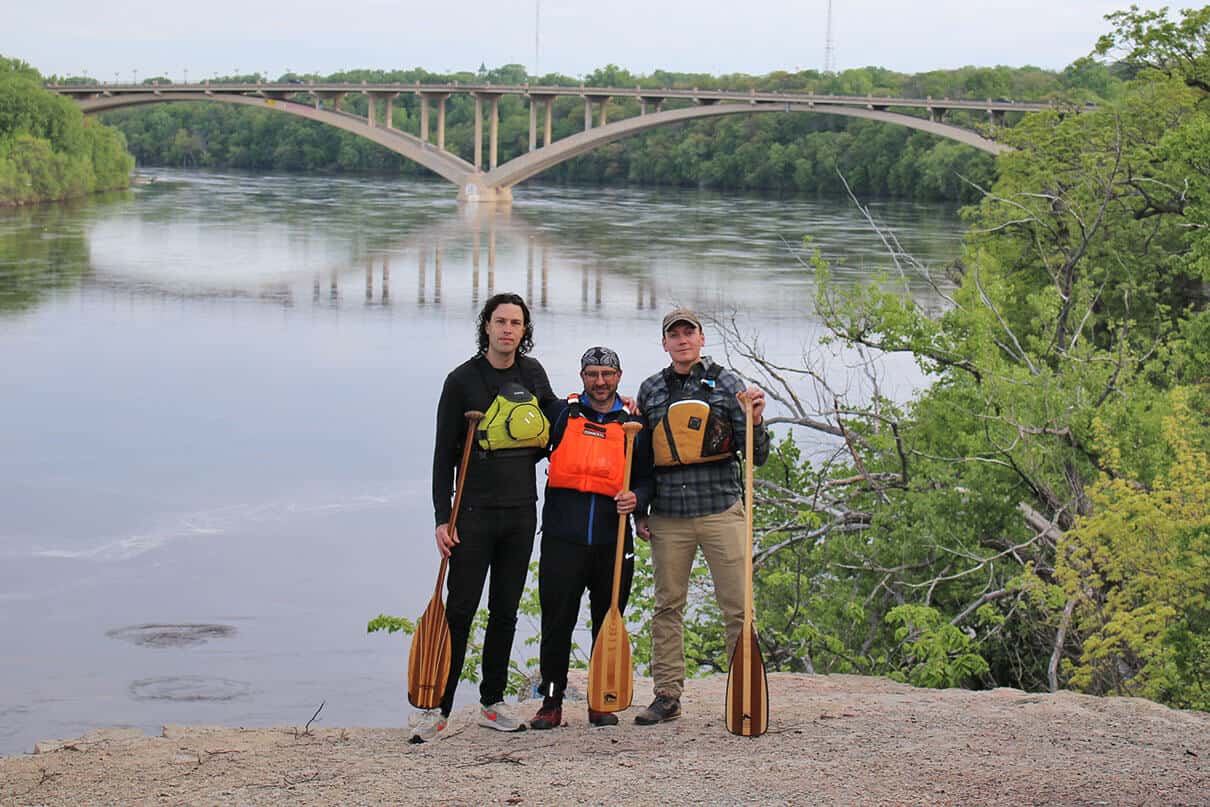
Not long after, we met at a bar within a mile of the river. I arrived early. Sitting in a booth, I felt oddly nervous. A few minutes later, the two walked in. We embraced like old friends.
We sat down and ordered drinks while they told me their story. For a few years, the two had been paddling the Mississippi in sections. After a long winter, they were eager to be out on the river. They’d planned to go later in the day, but Jake had to get back for a meeting, so they decided to go at dawn. As they were getting ready, Hunter, a whitewater kayaker, grabbed his throwline for rescues.
“I figured we had it, and it’s cold water,” he said. “So I threw it in at the last minute.”
Hunter picked up Jake around 6:30 a.m. Once on the water, they had a tailwind and sped downstream.
Near the Lake Street Bridge, they saw something up ahead. They thought it might be a log, but as they got closer they could see it was a canoe. At first, they couldn’t see anyone in the water. Then they saw me, but couldn’t tell if I was alive. When they got closer, they could see I was trying to make it to shore.
“When I saw you,” Hunter said, “I thought, he’s not going to make it.”
They knew the risk that a drowning person will swamp a rescue boat. After discussing this, they agreed if I got too close, they’d drop the line to keep all three of us from dying.
From the bow, Jake threw the rope. When they turned toward shore, he handed the line back to Hunter. By then, I was close to the stern. I saw a loop of rope drilled through the end of the boat.
“I can just hold this,” I said. Hunter paused and looked at the loop like he was trying to make a decision. But when I grabbed the loop, the boat stayed steady, so he picked up his paddle and helped power the boat through the spring current toward shore.
When my feet finally touched the mud, I climbed out while they hurried downstream to get my canoe. After calling home, I ran after them. Down the shore, we met and exchanged names. They also asked if I was okay. I said I was, and that my wife was coming. Then I ran down to get my canoe, and they paddled on.
Later, they regretted not staying to make sure I was actually alright. But I was running down the shore, and it seemed like there was nothing left to do. So they left.
For them, the day felt different now. They talked over the incident as they paddled on, the magnitude of it sinking in. Then they went to shore, portaged up the steep bank, and jogged back to get their car. They talked about it for the rest of the day.
Back home, they also read about the two college kids in Iowa who died that morning in cold water. “We knew it was a close call,” Jake told me. “But reading about the crew team later that day, it was like, oh, wow, this truly can kill people.”
The experience affected them deeply, and they struggled to make sense of it. Hunter said some people heard the story like a lesson in heroism. But he didn’t see it that way. They didn’t feel like heroes. For him, it was more about strange timing, or maybe something like fate.
“For a couple weeks,” he said, “if not a couple months, I thought about it quite a bit. One thing I couldn’t get over is how we ended up being on the river at that time. It was just this random sequence of events that led to us getting up at 6:30 in the morning on Sunday to go paddle, which is not a normal thing for me to do.”
“What are the odds that we would have been there?” asked Jake. “It just didn’t make sense. I still have a hard time wrapping my head around it. It just seems like we were supposed to be there.”
None of us knew quite what to make of the convergence, but I felt a deep gratitude for it. We stayed at the bar and talked for a long time: about canoeing, about the river, about their jobs and their families. Hunter had a two-year-old and another on the way.
We talked about things you don’t get to do when you drown in a river.
Finally, it was time to leave. As we stood up, Hunter made a suggestion. “We should go paddling sometime.”
“When it warms up,” Jake added.
I thought about the river, about the water, about the way things come together.
“Yeah,” I said. “I would love that.”
Frank Bures lives and paddles in Minneapolis, Minnesota, with his wife and two daughters. You can find his stories and books at frankbures.com. This tale is adapted from his new book, Pushing the River: An Epic Battle, a Lost History, a Near Death, and Other True Canoeing Stories.
 This article was published in Issue 75 of Paddling Magazine.
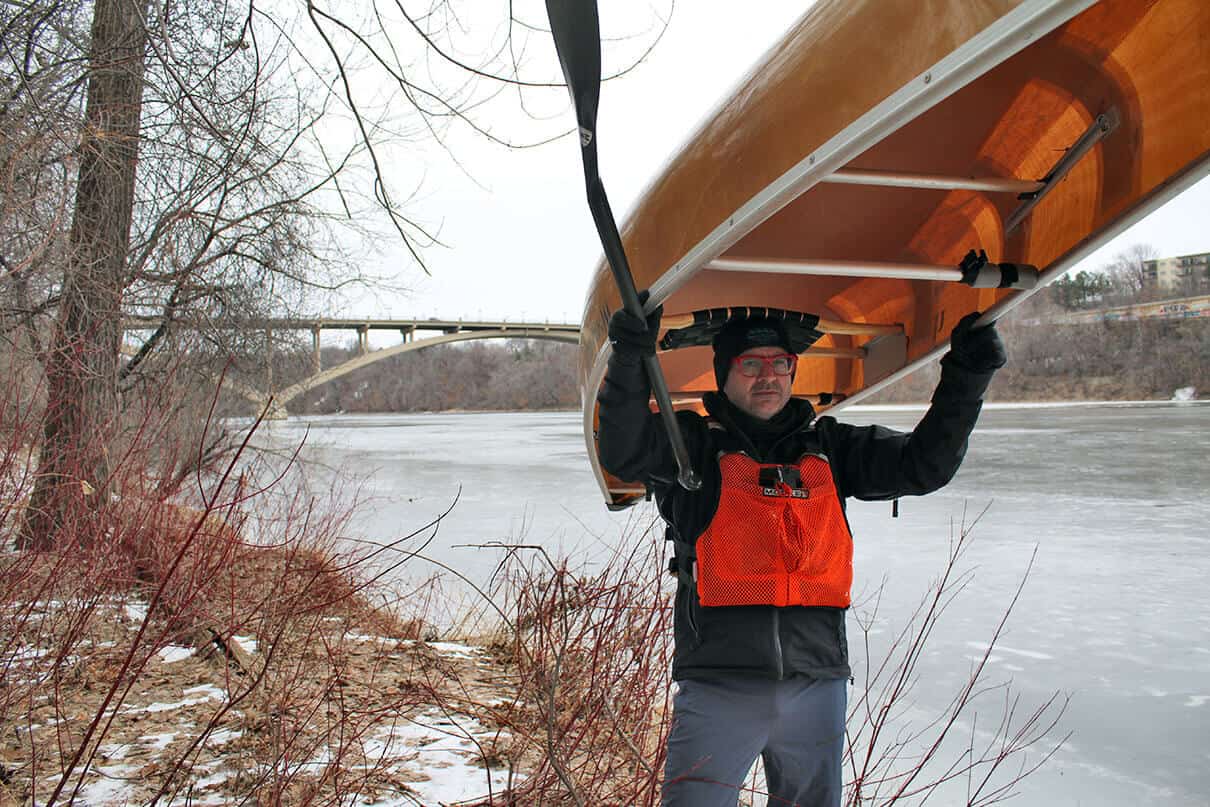
 Frank Bures back at the scene of the capsize. When he fell into icy current, survival came down to luck. | Feature photo: Josie Bures






I often paddle at this exact spot in my solo boat, so this really hits home. I got a semi-drysuit last year to extend the season, and I sometimes feel a bit self conscious portaging through the neighborhood to paddle there. I’ll definitely be thinking of this story when I do now, and appreciating the importance of of a bit of humility and preparedness.
I’m really glad of the odd coincidences that led to them being there to save his life! This is a really great lesson in cold water preparedness. Far too many people just don’t know about how to layer appropriately for that. Drysuits, or at least a full body wetsuit. He would’ve been totally fine in either of those.