

Sometimes, Paddling Magazine gets one of the very first production boats out of the molds. There are NASA-like logistics to get a still-warm hull onto a trailer headed to some river put-in somewhere. Other times, like with the Esquif Prospecteur 16, we wait so long it feels like surely we’ve written about it already. Did we? We must have. Turns out, no. So, 10 years after its release, we loaded Esquif’s second best-selling tandem canoe into a boxcar for a five-day end-of-season whitewater trip down the Spanish River in northern Ontario.
Canoe Review: Esquif Prospecteur 16
This Spanish River trip was originally planned back in 2023, which would have been clever timing for the 100-year birthday celebration of the Prospector design from the Chestnut Canoe Company, from which the Esquif Prospecteur was eventually shaped. Before we get into the nibbly bits of this review, can you think of any other piece of sporting equipment designed in 1923 you’d consider using today? A paddle, maybe.
Lots of companies claim to make the Chestnut Prospector. Historian Dan Miller’s website, The Wooden Canoe Museum, tracks the changes over time, revealed in fractions of inches in beam and depth. The shape of wood-canvas Prospectors evolved slightly over time as builders’ forms deteriorated and were modified or replaced. The Peterborough Canoe Company version, which went out of production when the company folded in 1961, was sleeker in the stems and less rockered than the Chestnut.
Esquif Prospecteur 16 Specs
Length: 16’0”
Width: 35”
Depth: 14”
Weight: 65 lbs
MSRP: $2,309 USD (vinyl gunwales)
esquif.com
In 1978, Bill Mason’s neighbor, Chris Frank, borrowed Mason’s river-scarred 16-foot cedar canvas Chestnut Prospector—the one seen in the film Path of the Paddle—to create a mold suitable for producing fiberglass and Kevlar hulls. The mold was passed along to Wally Schaber and Chris Harris, owners of the Ottawa-based paddling shop Trailhead, who began producing and selling composite Trailhead Prospectors.
Ten years later, Trailhead created its own version of the 17-foot Chestnut Prospector and, soon after, partnered with Mad River Canoe to create Royalex molds of both models. Eventually, these molds ended up at Esquif, which produced the Trailhead Prospectors until the end of Royalex. Esquif then purchased both the 16- and 17-foot molds, invented T-Formex to replace discontinued Royalex, and here we are.
A keen, historically accurate eye will notice both the 16- and 17-foot Prospecteur models have a flatter bottom than the original Chestnut cedar canvas versions. Maybe they were purposefully tweaked for more initial stability. Or maybe it was simply because the hulls didn’t need to be as rounded because they weren’t steaming and bending cedar ribs over a form.

On the water
I’ve spent a lot of time in the Prospecteur 16. I like its symmetrical shape. I like how the gunwale lines smoothly and evenly arc from the 14-inch depth at the center yoke to the bow and stern ends. The 2.75-inch of rocker bow and stern is enough for a whitewater canoe, but not too much to be squirrely in flatwater. The Prospecteur 16 won’t win races like the sharp-edged Boundary Waters rocket ships. You have to remember that in 1923, Chestnut was building these out of cedar and canvas for the Geological Survey of Canada, which needed high-volume and seaworthy canoes that performed well on both windswept lakes and whitewater rivers, like say the Spanish River.
We got off the train in the whistlestop community of Biscotasing. In a matter of a few minutes, our two canoes and gear were handed down from the boxcar, the conductor posed for a photograph, and the train rolled north. Founded in 1884 as a railroad construction town and later a Hudson’s Bay Company fur trading post, Bisco, as they call it here, is now home to only 22 permanent residents. It is the northernmost access point to the West Branch of the Spanish.

Leaving the trip until the middle of October limited the number of takers to just three. We agreed to take turns soloing the Prospecteur 16 in the flats and rapids.
Our beefier Prospecteur 17 is Esquif’s top-selling touring canoe, driven mostly by outfitter and livery sales. I have a 17-footer for big trips. But when people ask me what canoe they should buy, my answer is—if you can only have one—the canoe you should buy is the one you will paddle most often. And for lots of people, the 16-foot Prospecteur is one of those canoes.
Where the Prospecteur shines
Going on a weekend-to-weeklong whitewater canoe trip like the Spanish? The Prospecteur 16 is perfect, either tandem or solo. The same is true for a lakewater trip. I realize that at 65 pounds it’s far from the lightest canoe, but it’s still fine. The T-Formex my shoulders begrudge on portages is the same T-Formex durability my dry feet appreciate when I mindlessly ram the bow up on shore and step out. Slide the Prospecteur 16 off the dock at the cottage for a misty morning tootle around the lake? Sure, why not. I see no reason why you couldn’t round up an old phonograph, wicker picnic basket and parasol and escape with your true love from the watchful eye of your chaperones. And it’s sporty enough that for the examination run of my moving water instructor course, I got sick of waiting for a solo whitewater playboat to become available, so I jumped in a 16-foot Prospector and ran the Madawaska River’s class III Chalet Rapids.
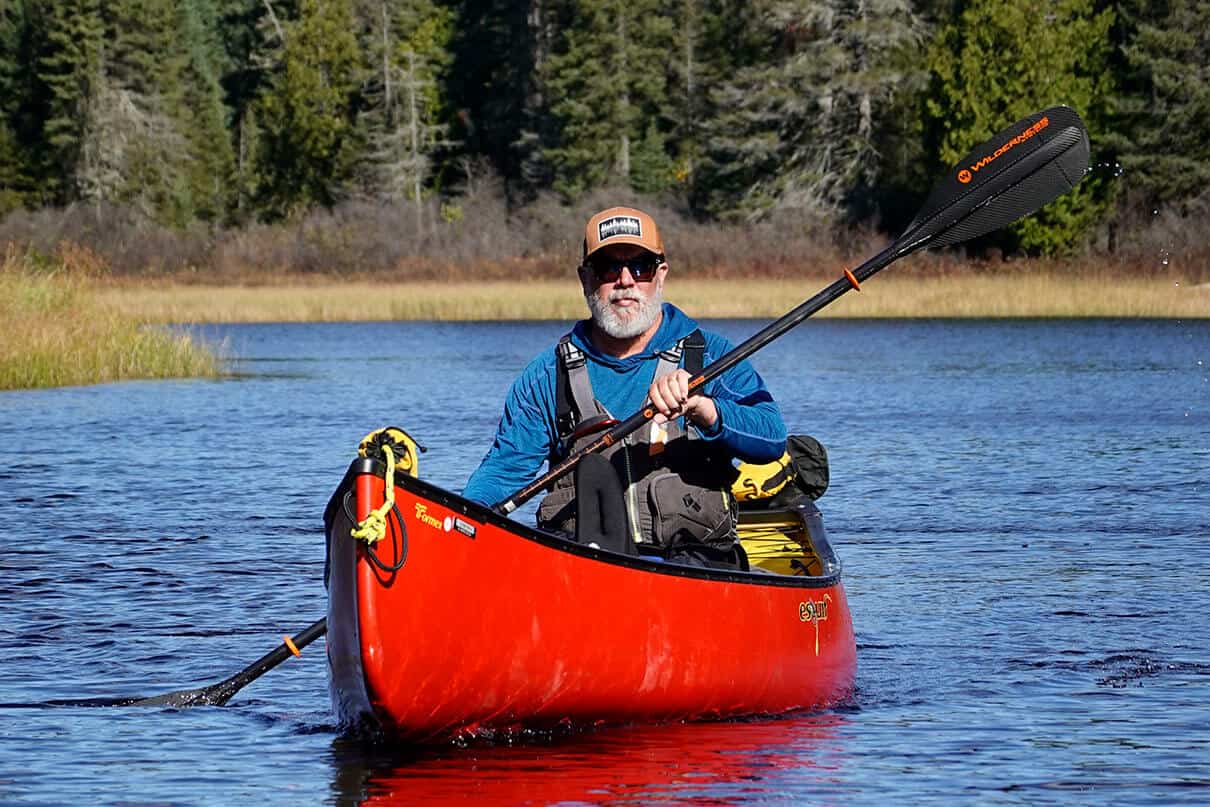
Some canoeists will argue over a half-inch here and there. If that’s you, builders like Headwater Canoes are still making cedar canvas Prospectors from the original Chestnut forms. For me, I’ll trade the authenticity of having to do pine pitch and birchbark canoe repairs for the modern-day durability and practicality of T-Formex.
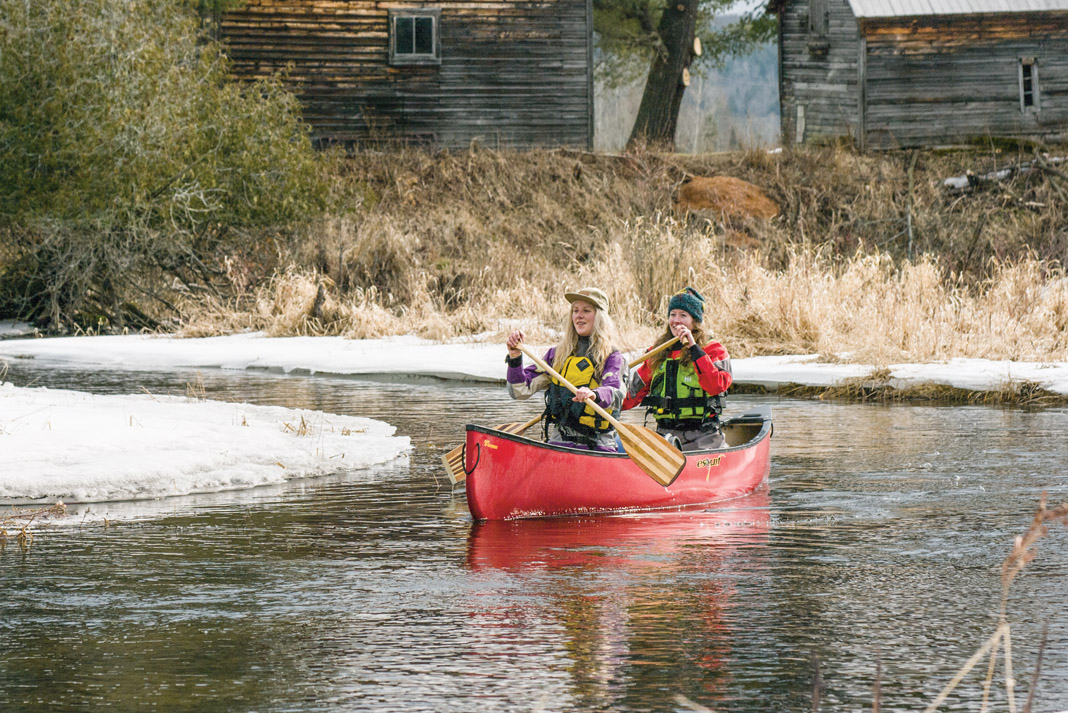
I’m not without a nostalgic bone, however. The Chestnut Canoe Company offered their Prospector canoes in two stock colors, red or green. Guess which of the two T-Formex Esquif Prospecteur 16 colors I think you should order. Red, of course. And while you’re at it, to celebrate more than 100 years on the water, I’d upgrade your Prospecteur from vinyl gunwales to Esquif’s ash trim package. It just feels right.
Scott MacGregor is the founder of Paddling Magazine. And yes, he passed his instructor level in the Prospector.
 This article was published in Issue 75 of Paddling Magazine.
 The Chestnut Prospector design has roamed windswept lakes and rivers for more than 100 years. Paddler Paul Brittain, not quite as long. | Feature photo: Scott MacGregor






