Unassumingly dry and never out of reach, or out of fashion. | Photo: Rob Faubert
I’ve been immersed in the river guide world for more than 30 years. I can’t even start to count how many pairs of river shoes, PFDs, sun shirts, knives and tubes of sunscreen I’ve gone through. Probably almost 30 of each, pretty much one every year. No surprise then, that like most river guides, I’m not particularly sentimental about my gear—we’re a pretty utilitarian bunch.
Except for my ammo box.
I still have my original, hastily spray-painted behind the raft gear shed with just a single coat of purple. The color was not so much chosen as it was the only can of paint I could find lying around. I purchased the box for $5 in my third year of guiding, which was my first season as a multi-day raft guide. As a day guide, I had no use for one and, like most day guides, did not even know they existed. Heck, unless you shoot machine guns for a living or run heavy oar rigs, there is no need to know they exist.
Ammo boxes are military-grade metal boxes designed to store ammunition. Up until World War II, machine gun bullets were kept in wooden crates. They had the nasty trait of being flammable and the cause of many explosions. Whole warehouses would go up at once.
Enter the metal ammo box: fireproof, waterproof, indestructible and, for a long time, very cheap. Army surplus stores used to sell these things for a couple of bucks each. River guides were partial to the 50-caliber sized boxes—about the size of a lunch box—and also the larger 40-mil version, used to make portable toilets affectionately known as groovers, but that’s another story.
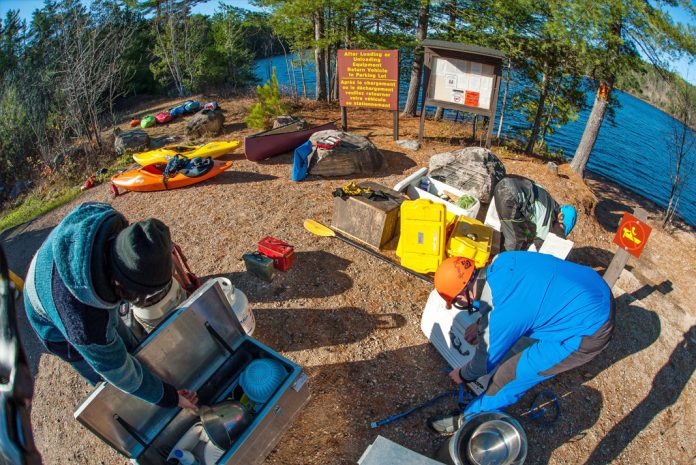
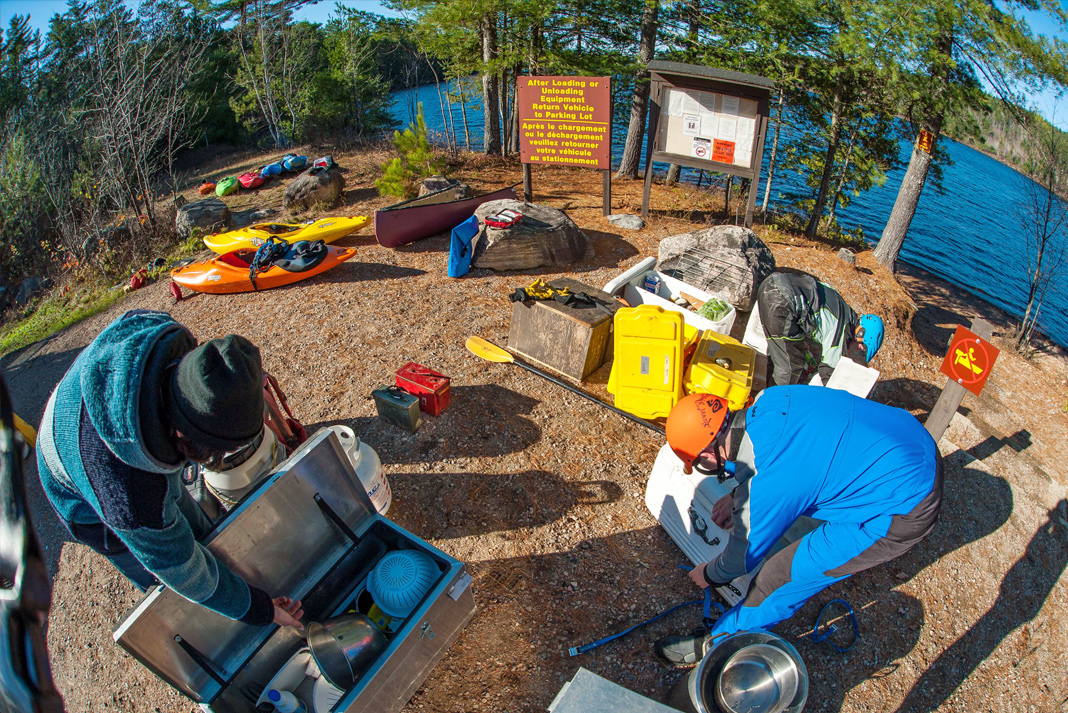
Ammo boxes have a hinged lid that snaps tight and a handle on top. Rigged into the raft properly, usually along the side rail of the rowing frame, they are easily accessible. A flip of the lid accesses sunglasses, binoculars, guidebooks, a toothbrush—whatever a guide might need to pull out during the day. Rafting clients are often fascinated by these boxes, given how guides rarely step off their boat without them in hand. They think they contain some kind of magic.
No magic here. Just the essentials. What they contain has always been pragmatic, but what the box represents is significant. This, I believe, is what clients sense. Sometimes the things we do or the things we own represent more than what they seem.
Unassumingly dry and never out of reach, or out of fashion. | Photo: Rob Faubert
A guide’s ammo box is private but also represents his or her identity and personality. It is not cool to go into another guide’s ammo box for any reason. If a guide wants something in your box, such as a river map, they should bring the box to you and ask for the map. The owner duly opens it and hands the map over. The same goes for sunscreen, a bird book, whatever.
Being indestructible, ammo boxes make ideal mini stools. As you can imagine, it is not okay to squat on someone else’s box. I never sit on mine. Sitting on it crushes the rubber gasket, compromising the waterproofness.
There was a time when ammo boxes were in decline. A move to plastic made them harder to get. Some guides also took issue with having sharp metal edges in their cockpit, although this concern is a bit moot in a loaded oar rig full of sharp metal edges and is a floating entrapment machine as it is.
Now ammo boxes are experiencing a bit of a resurgence. In this age of Alibaba, they are readily available again and cheap, if you are willing to order 500 at a time.
I think the metal ammo box is seen by new guides as a declaration of identity in a way plastic cases or drybags never will. The tradition it represents shows respect for the river guide lineage, present in the guides’ working world.
Metal ammo boxes have been on rafts since the beginning of rafting back in the ‘50s. As utilitarian as we are, we can imbue our few personal working tools with importance beyond their size. What’s inside a guide’s ammo box is less important than what it says.
Jeff Jackson is a professor at Algonquin College on the banks of the Ottawa River.
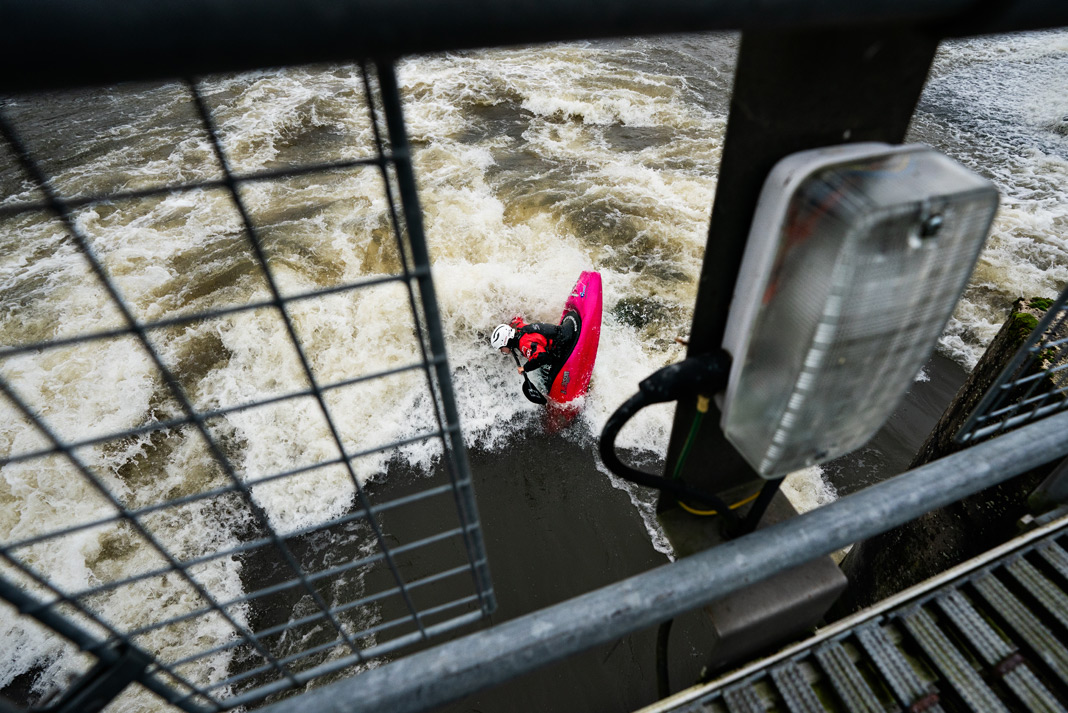
Ottilie Robinson-Shaw at Hurley Weir in the United Kingdom. | Photo: Peter Holcombe
Two weeks beforeGreat Britain’s team selections for 2020, 17-year-old Ottilie Robinson-Shaw was lying in bed, sick and hopped up on antibiotics. The day before the event, she still didn’t know if she was well enough to compete. On the morning of October 13, 2019, the day of the competition, Ottie made the call to compete in team selections and, despite not feeling her best, ended up making history.
Freestyle kayaking has always shown a gender gap between men and women both in participation numbers and competition scores. Competitions often see twice as many male entries as female, with top scores in the men’s category often doubling or tripling the top scores in the women’s category. Until now.
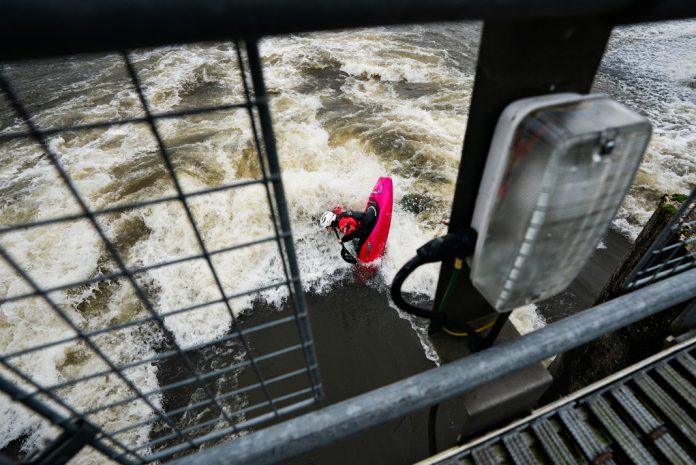
Not only did Ottie win the Junior Women’s category at the Great Britain team selections last October, but she broke the world record for the highest ICF-scored freestyle ride executed by a woman. 1,225 points for Ottie, making her the very first woman to break 1,000 points in an ICF-scored freestyle ride, a goal women in the sport have been working toward for years.
Ottie didn’t do it all by herself. Women like Tanya Faux, Tanya Shuman, Emily Jackson and Ruth Gordon Ebens have been pushing the sport and progressing the women’s division for decades. But even with these top women training and competing at the highest level, the evolution of women’s kayaking has been slower than that of the men’s.
Gordon Ebens, the winner of the 2007 Freestyle Kayaking World Championship and regarded as one of the top female kayakers in history, says strength-to-weight ratio favors men progressing in the sport faster than women. “Women have to learn more finesse to master a move, while men can often muscle it. Due to this difference, having sport-specific instruction has helped women make large gains,” says Gordon Ebens.
This sport-specific instruction has been instrumental in helping Ottie make her way to the top. Dennis Newton, the owner of Sweetwater Coaching, a freestyle-focused coaching service in the U.K., began coaching Ottie in 2015 and played a significant role in helping increase her physical and mental strength in the sport. “Den is amazing. He has allowed me to set goals, reach them, and enjoy kayaking and pushing the boundaries,” says Ottie. She isn’t Newton’s only protégé—he’s also coached 10-time world champion Claire O’Hara since 2009.
Ottilie Robinson-Shaw at Hurley Weir in the United Kingdom. | Photo: Peter Holcombe
“Den is a phenomenal coach. His understanding of the sport and his ability to individualize his coaching to his athletes is incredible. The time, energy and commitment he has given to me as an athlete is unbelievable and has been critical to our progression and success,” O’Hara says.
Through their achievements, both O’Hara and Ottie have proven that with sport-specific instruction focused on technique and finesse, women can progress in freestyle just as fast as men. For years, O’Hara has been throwing down moves most of her competitors can often only dream of. Now it’s Ottie who is leading the charge.
“What she has achieved is amazing and makes me so proud. Several years ago, I was the first woman to throw combos and hit complex tricks. Today, Ottie is putting them into competition routines,” says O’Hara.
[ Paddling Buyer’s Guide: View all freestyle kayaks ]
O’Hara attributes much of her success to Newton’s coaching. Ottie does the same, but also gives credit to her biggest role model in the sport. When asked who inspired her most to push boundaries within freestyle, Ottie doesn’t hesitate: “Claire O’Hara has always been a massive role model and inspiration for me. She is always prepared to take time out of her own training to help and encourage me and many other young paddlers.”
O’Hara isn’t done competing in freestyle, but if she were, she would be proud of the legacy she has left behind. “A few years ago, I was asked what I wanted my legacy to be, and to be honest, Ottie is it. I remember saying I wanted the next generation to see no boundaries, to push the limits further than we could imagine, and to be enjoying themselves every minute. Ottie is doing it every day, and I couldn’t be prouder.” A big-wave freestyle kayaker, Brooke Hess is from Missoula, Montana and a member of the U.S. National Freestyle Team.
Ottilie Robinson-Shaw at Hurley Weir in the United Kingdom. | Photo: Peter Holcombe
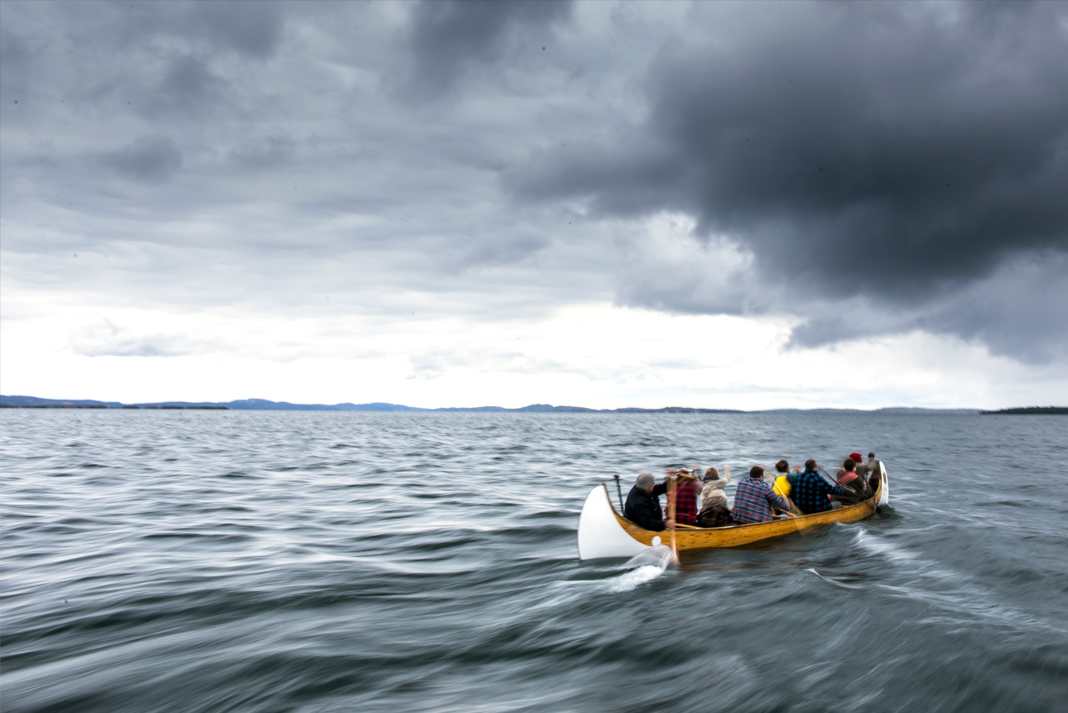
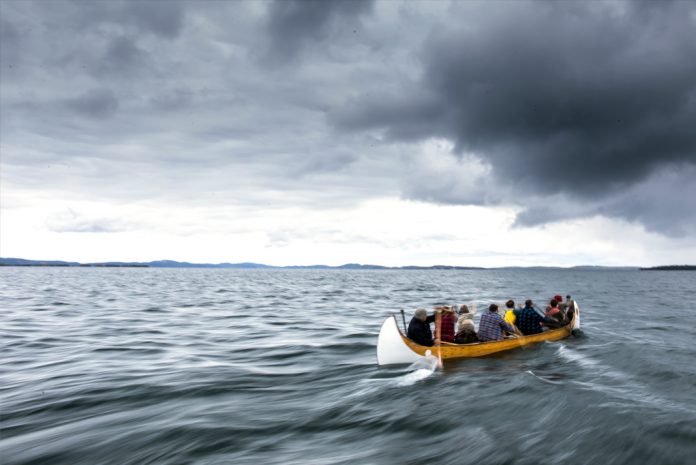
Many hands make light work and many strokes make fast travel. On the original Manitoulin Brewing Company beer run from Little Current to Killarney, pictured here, the paddlers donned their Algonquin dinner jackets over PFDs in the chilly weather. | Photo: David Jackson
Gently billowing in a light breeze, a Wikwemikong First Nation flag rises and falls as if dancing with the growing wind. Busying themselves in front of the Little Current marina on Manitoulin Island in northern Ontario, some 150 canoe racers check their gear, preparing for a race to the community of Killarney, 34 kilometers distant. Killarney was once referred to as Shabahonaning by Indigenous peoples, and then later French fur traders and voyageurs. It means safe passage for canoes. But today Georgian Bay is anything but hospitable.
From the northwest, a steady wind grows and everyone casts nervous glances in the chilly, mid-summer blow’s direction. If this were any other canoe race on any other day, the word would have already spread, race canceled, but not today. The inaugural Current To Killarney Race is something different. Instead of tandem teams racing in sprint-style canoes, the race will be conducted predominately in 30-foot North canoes, commonly called voyageur canoes. Despite the building weather, the show will go on.
Modern-day voyageur Mike Ranta [right] helped paddle the first batch of Killarney Cream Ale by Manitoulin Brewing Company from Little Current to the small community of Killarney, on Georgian Bay. This delivery inspired the Current To Killarney race. | Photo: David Jackson
Blair Hagman, co-founder of the Manitoulin Brewing Company (MBC) in Little Current, was serving up cold ones at the Killarney Music Festival in August 2018 when he caught sight of cross-Canada paddler Mike Ranta and his signature birchbark hat. The two got to chatting and dreamed up the idea of delivering the first batch of MBC’s soon-to-be-released Killarney Cream Ale to its namesake town. But they’d do it by paddle.
Two months later, in the chilly fall air, Hagman and a team of seven including the jovial Ranta along with his trusted canine, Spitzii, set off from Little Current in a 30-foot-long voyageur canoe with the beer stowed on board. They endured three-foot waves, rain, wind and even snow to cross the rough waters of Lake Huron. Fighting cold hands, rough seas and soggy butts, the team arrived almost a full day’s paddle later in Killarney, sporting smiles and sharing high fives as a token basket of Cream Ale was carried into the Killarney Mountain Lodge resort. It was later at the lodge, sitting fireside and enjoying a sip of this new brew, a race was born.
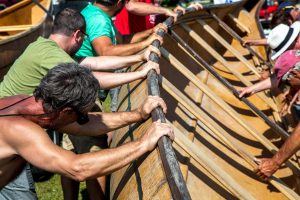
Each voyaguer canoe weighs between 200 and 600 pounds. | Photo: David Jackson
Less than one year later, on July 6, 2019, paddlers descend on Little Current. A provincial police powerboat circles out front of the marina, deep hulled safety boats ready their kit, and Mike Ranta arrives, albeit a little late, with a coffee in hand and a smile on his face.
“A little choppy!” he announces while sipping his coffee and looking out over the rough passage. Racers are anxious to hear from brewer-turned-race-organizer Hagman. When he huddles the 150 racers together, it’s a calming word and steady voice paddlers receive—the race will go on, but in a slightly altered course to play to the wind’s strength. Everyone is relieved.
[ Paddling Trip Guide: View all canoe trips in Ontario ]
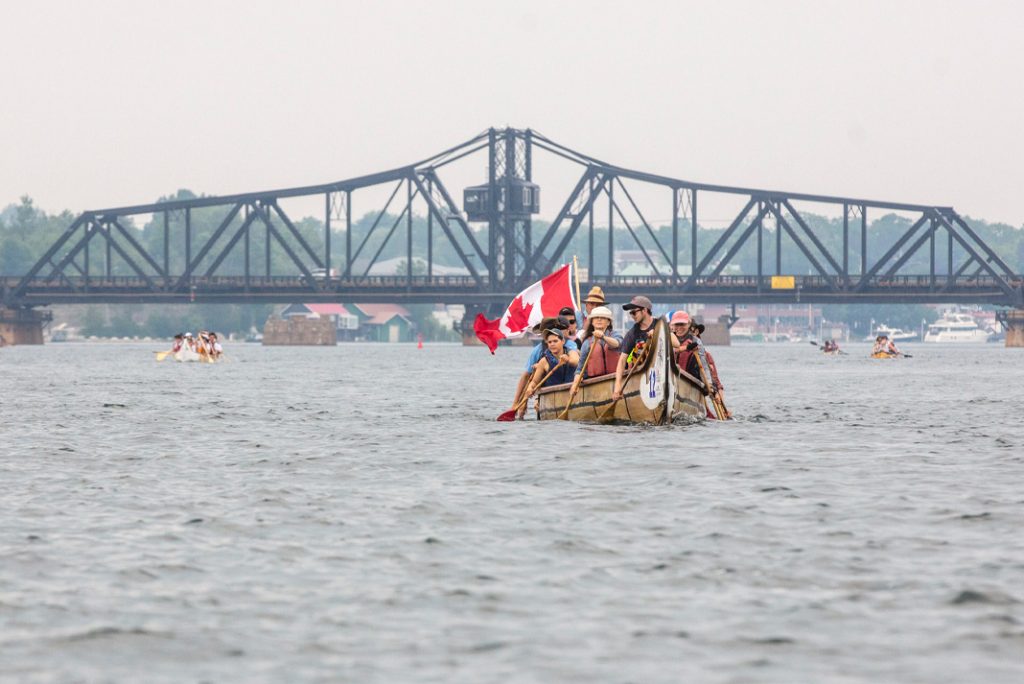
Racers huddle in close to Hagman to hear how they’ll start at Spider Bay Marina, paddle under the iconic Swing Bridge, head toward Strawberry Island Lighthouse then Heywood Island, and push south towards Landsdowne Channel leading to the quaint village of Killarney. As the address concludes, everyone hurries to a small beach in the lee of the wind and begins helping move a dozen voyageur canoes off the spit of sand where they are staged. In a race where there is no cash prize, no live updates, just good old-fashioned friendly competition and cold beers at the end, people are bursting with energy.
Mike Ranta, sporting his trusty birchbark hat, steers a canoe with Holden Rhodes, owner of Killarney Mountain Lodge, and his family through building seas on route to Killarney. | Photo: David Jackson
According to local lore, once you cross the swing bridge into Little Current, you’re on Island Time. | Photo: David Jackson
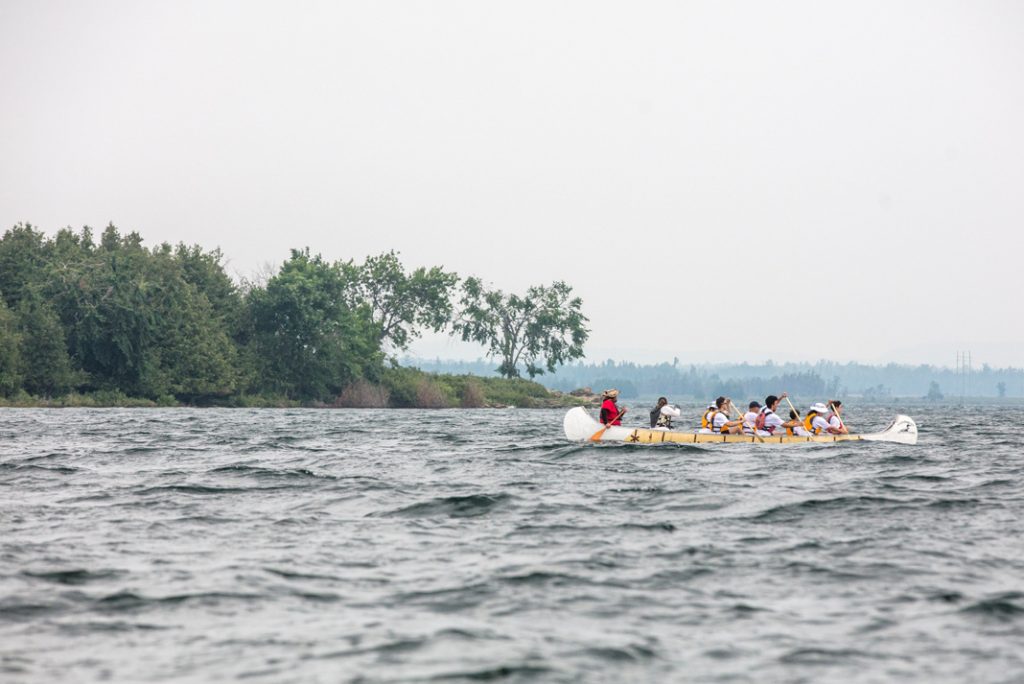
By the time the race is underway, the channel departing Little Current is a sight to behold. Voyageur canoes travel under the swing bridge, each with seven to 12 paddlers, while a few tandem canoes bob in between, and one lone sea kayaker paddles alongside. Cheers are heard and smiles seen in every hull. There isn’t the typical call to hut from the stern paddlers or the aggravated grunts of hard physical work common amongst marathon racers, though certainly everyone is pushing themselves as they paddle headlong into the building waters.
Safety boats circle and keep a watchful eye on every team, and it isn’t long before a few saves are in order. With a three-foot chop and quartering wind, some teams are blown off course, veering away from the safe passage and instead heading straight for the wrath of Lake Huron beyond protective islands. A few teams are plucked from their canoes and ferried back to the start, but the race continues.
Some teams bail water from rogue waves, others chant and sing to the rhythm of their strokes, others just laugh at the adventure. Ranta can hardly wipe the smile from his face as he steers his team’s boat along. Initially, he had planned to paddle his own solo canoe but opted to join a team at the sight of the conditions. For the man who crossed Canada twice alone by canoe, this is a walk in the park, but this time with friends.
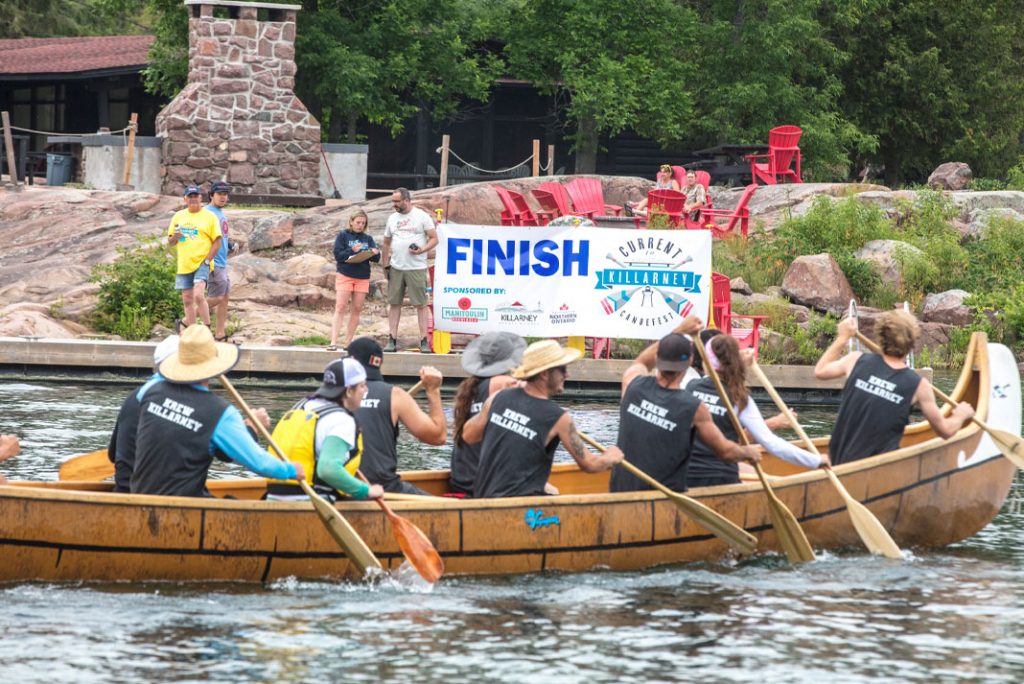
Aching hands were rewarded with a cold MBC brew at the finish line in Killarney. | Photo: David Jackson
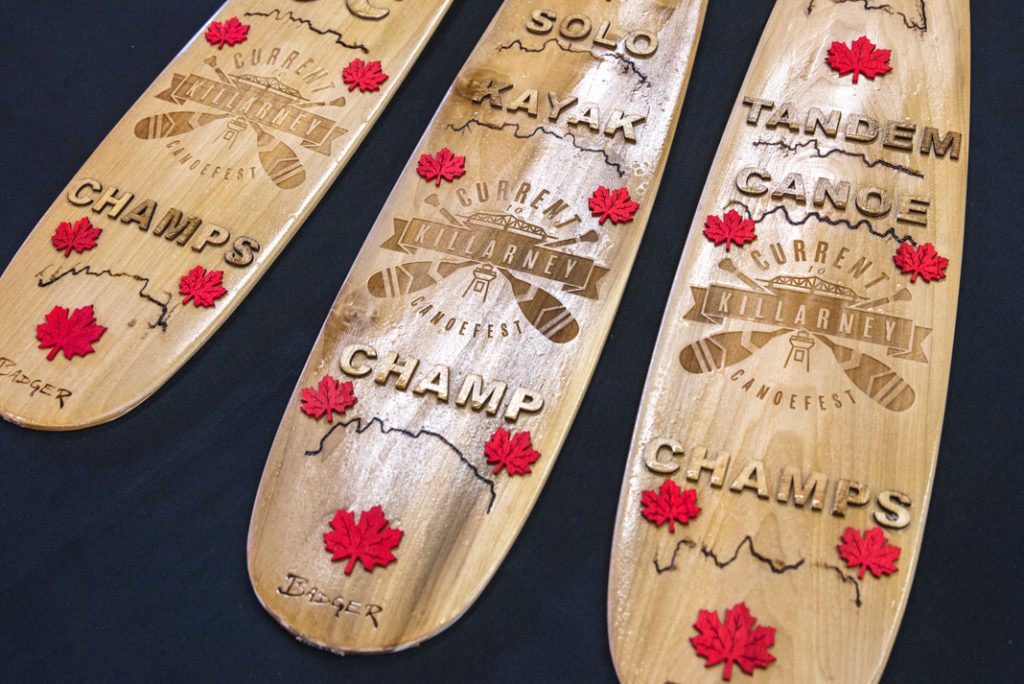
Mike Ranta decorated Badger canoe paddles for the winners. | Photo: David Jackson
By the time everyone reaches the sheltered inlet leading into Killarney, they are protected from the blow. It is a sprint in the final hours to reach the town’s finish line. Racers battle tired arms and sore backs, their muscles weary from constant exertion in the stiff winds. As teams near the finish line, cheers from supporters and fellow racers greet them. There is no podium to look forward to, only bragging rights and shared experience to build bonds lasting a lifetime.
In a world where faster and lighter dominate the playing field and rule the competition scene, here was a race pushing back against the norms. People wanted to brave the big lake to celebrate a piece of history the nation was founded on. Canoes are the oldest form of travel in the northern wilds, and long before voyageurs busted their way from coast to coast in search of furs, there were moccasin trails that connected these very same waterways. The seas might have been challenging, but this group wasn’t the first to challenge them. Their muscles might have ached, but these aches are a time-honored tradition. For half of a cold summer’s day, every racer was a voyageur seeking Shabahonaning, and at race’s end, everyone laughed at their toils.
A canoe filled with Manitoulin Brewing Company beer awaits the weary racers, a dinner completes the evening, and hand-crafted wood canoe paddles are awarded to the winners.
Despite its humble beginnings as an unconventional beer run, the Current To Killarney race has blossomed into a three-day festival to celebrate canoe culture in one of Canada’s best paddling destinations. Bringing people together for the love of water and canoes along a route steeped in history is an exciting addition to the Canadian paddling race scene. Though for 2020, glassy conditions and hot sun would be a welcomed reward.
David Jackson is a photojournalist living in Thunder Bay, Ontario. The next Current to Killarney race is scheduled for July 2, 2022.
Many hands make light work and many strokes make fast travel. On the original Manitoulin Brewing Company beer run from Little Current to Killarney, pictured here, the paddlers donned their Algonquin dinner jackets over PFDs in the chilly weather. | Photo: David Jackson
Many hands make light work and many strokes make fast travel. On the original Manitoulin Brewing Company beer run from Little Current to Killarney, pictured here, the paddlers donned their Algonquin dinner jackets over PFDs in the chilly weather. | Photo: David Jackson
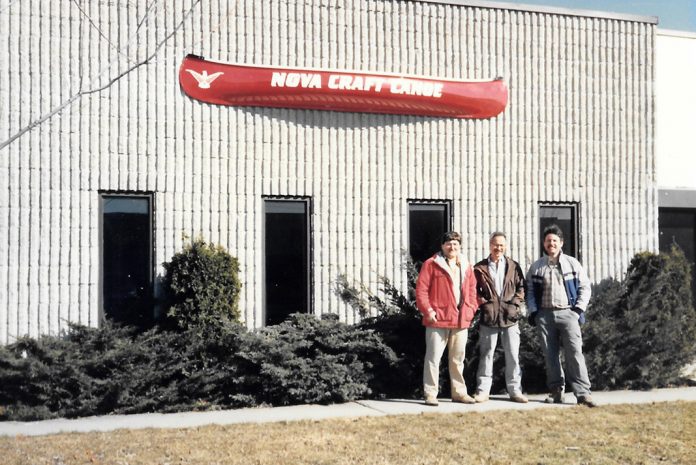
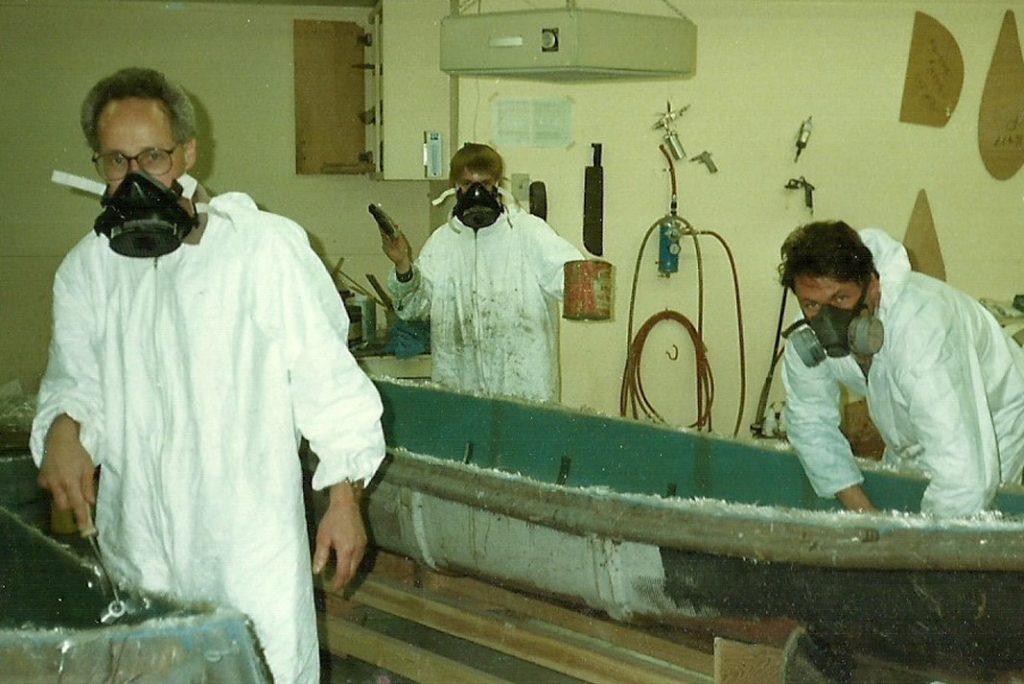
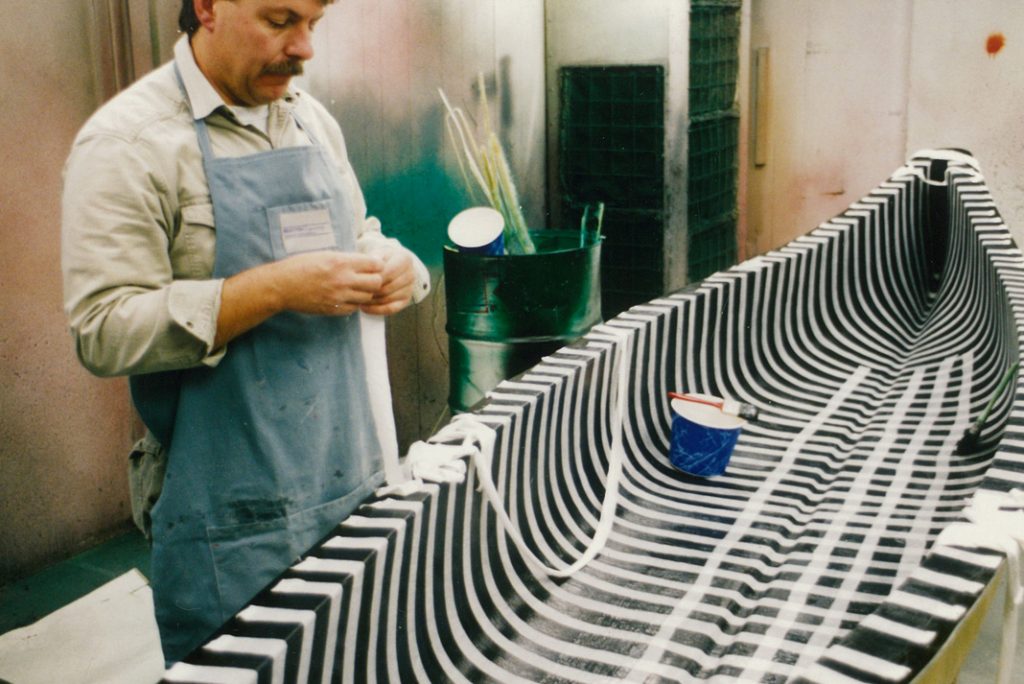
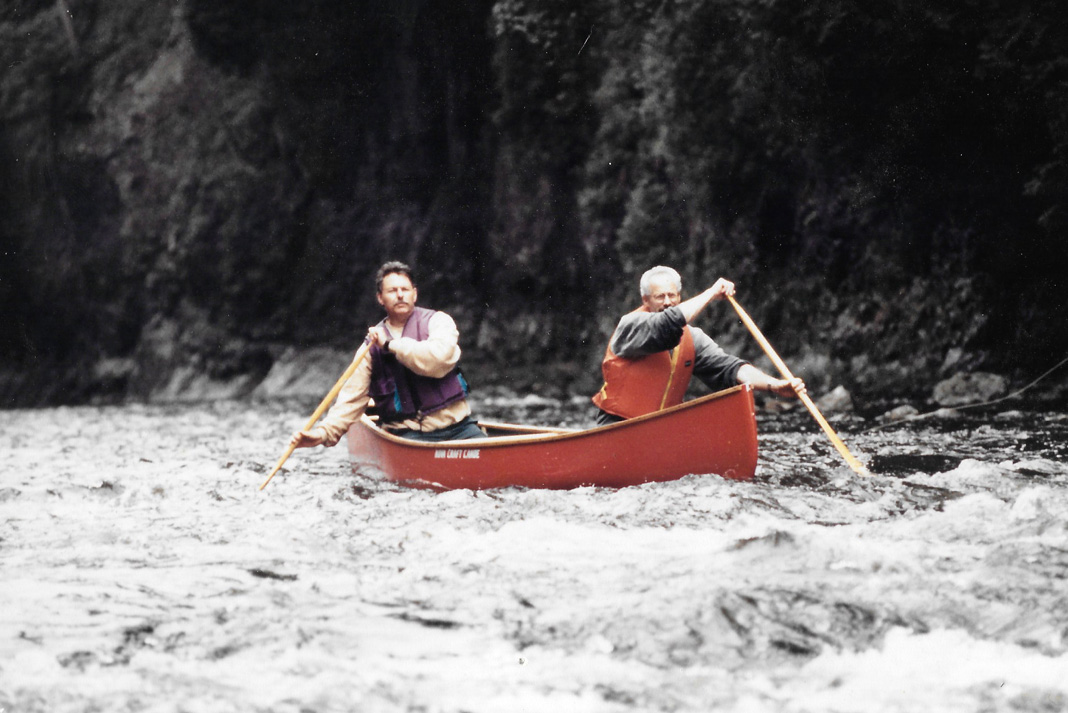
[Clockwise from top left] Tim, Pat and Zoltan at Nova Craft's original location; Working on an early layup; Tim working on a mold in the first London shop, circa 1988; original founder Ken Fisher; Tim and Pat paddling the Elora Gorge in southern Ontario. | Photos: Courtesy Nova Craft Canoe
In 1970, paddler Ken Fisher began building a limited selection of fiberglass canoes from his garage in Glanworth, a tiny hamlet outside of London, Ontario. Back in the 1960s, only two percent of North Americans were canoeing. But a decade later, eight percent of Baby Boomers were venturing into the backcountry in search of adventure and tranquility. Thanks in part to the popularity of the 1972 movie Deliverance, canoe tripping was suddenly cool. Grumman was manufacturing 50 canoes a day. As for Ken, well, he went along for the ride.
Ken was an electrician with a passion for canoe racing. His wife’s family worked for Munro Boats, makers of small motor crafts. To separate his business, Ken decided on the name Nova Craft—nova means new in Latin. Soon he expanded from building racing shells and flat-bottomed fishing scows to making one of the most beloved tripping canoes—the Chestnut Canoe Company’s Prospector. Not long after, he was the first builder to incorporate Kevlar and vinylester resin in canoe building.
[ Paddling Buyer’s Guide: View all Nova Craft canoes ]
Ken built Nova Craft boats from his garage until he sold the company to Tim Miller, Pat Malloy and Zoltan Balogh in 1986.
Working on an early layup. | Photo: Courtesy Nova Craft Canoe
Tim working on a mold in the first London shop, circa 1988. | Photo: Courtesy Nova Craft Canoe
The trio hatched a plan to purchase the business while on a canoe trip down Ontario’s French River. Tim had just moved to London from Calgary, and a canoe trip seemed like an excellent way to start a new life in a new province. They camped at the infamous Blue Chute, where Bill Mason filmed his opening act for Path of the Paddle. As a bottle of whiskey made rounds around the fire, Zoltan mentioned a canoe company for sale. Tim hadn’t secured employment yet after his cross-country move and owning a canoe company seemed like a good idea at the time.
That settled it. The three men ponied up the cash, purchased the business and moved the operation from Ken’s garage to a warehouse. They kept the name and the company’s thunderbird logo but innovated Nova Craft’s offerings with new designs and materials. In the 34 years since, Nova Craft made more than 30 designs—17 are currently manufactured—and produced between 1,500 to 2,000 boats annually.
Tim and Pat paddling the Elora Gorge in southern Ontario. | Photo: Courtesy Nova Craft Canoe
Like other canoe manufacturers, the brand weathered the boom of recreational kayaking and then standup paddleboarding, as well as the rise and demise of Royalex. It’s seen the paddling demographic change from older and primarily male, to younger and much more diverse.
Everything changes eventually. After more than three decades at the helm, Tim Miller retired last year and sold Nova Craft to Chris Rath, who was a corporate accountant for much of his career. Tim told me one of the first things he wanted to do after handing the driver’s seat over to Chris was to go back and canoe the French River. There he’d sit around the fire with some old friends at the Blue Chute, pass a whiskey bottle around and dream of what’s next.
Kevin Callan is the author of the bestselling The Happy Camper series and paddling guidebooks.
[Clockwise from top left] Tim, Pat and Zoltan at Nova Craft’s original location. | Photo: Courtesy Nova Craft Canoe
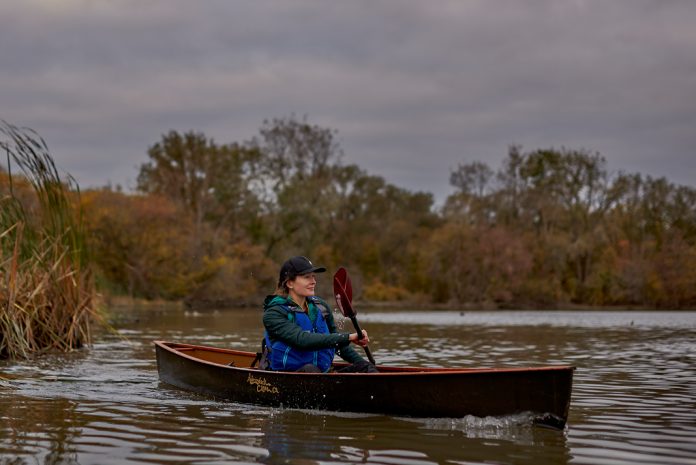
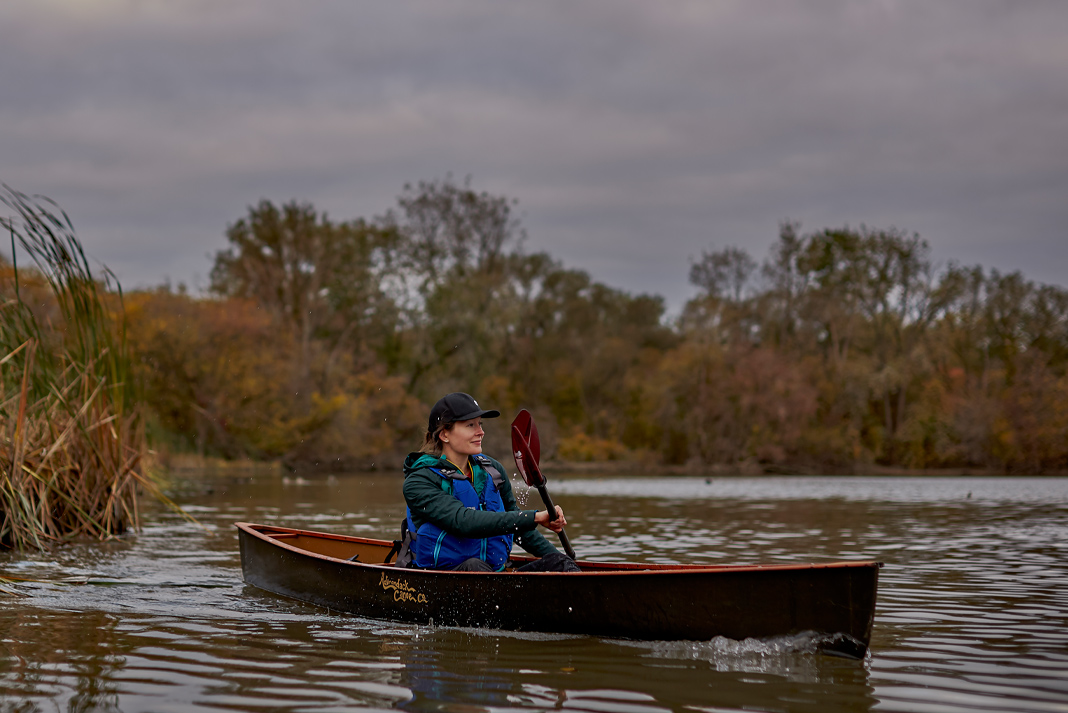
Go from lunchtime launch to weekend warrior with ease in the Boreas. | Photo: Wyatt Michalek
There’s a brief but particular full chassis shudder a 2003 Suburu Outback makes when its serpentine belt snaps. So, when the check engine light blinked on a moment later, I knew exactly what was up. My anniversary trip wasn’t going as planned. Then the rain started.
A long weekend hiking trip with my partner in the High Peaks region of the Adirondacks in upstate New York sounded like the perfect romantic getaway. Google Maps promised a manageable drivetime under six hours. And I’d be able to connect with a local boat builder, whose canoes Paddling Magazine had been trying to get our hands on for years.
Geoff and I enjoyed one glorious hike and stunning sunrise on Cascade Mountain, the 36th tallest peak in the Adirondacks at 4,098 feet, until car trouble—and rain—put a damper on the weekend’s plans.
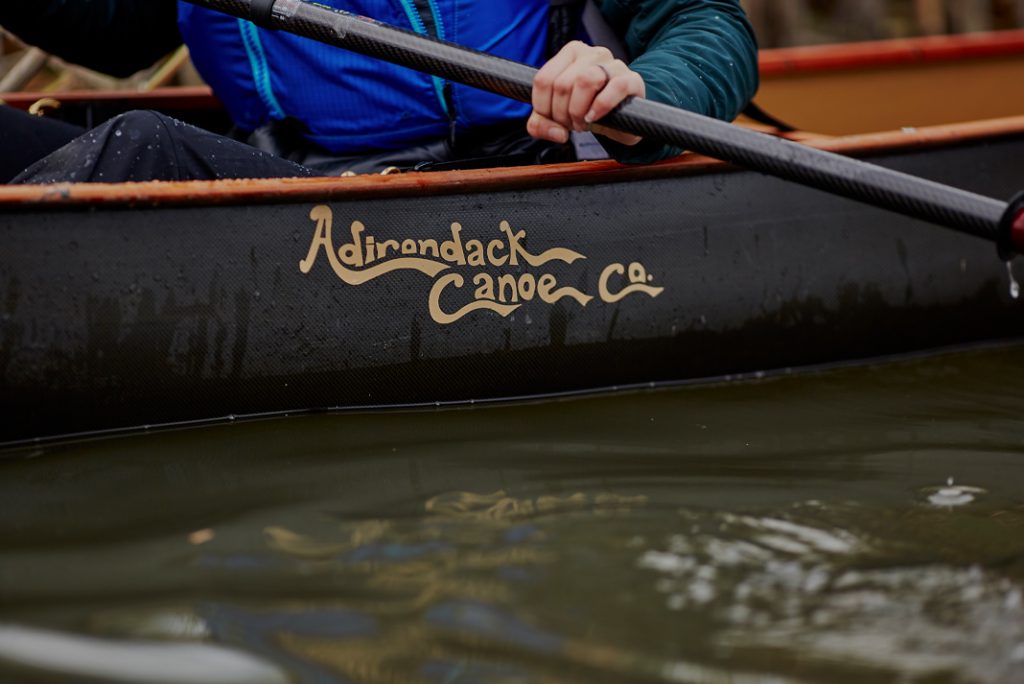
After 36 hours knocking around the ice cream shops of Lake Placid awaiting a new belt, we plucked our precious cargo from a hotel parking lot as we were heading back north. It was a black carbon-Kevlar 14-foot solo canoe called the Boreas from Adirondack Canoe Company. Four hours later, the guys behind the counter at Canadian Border Services very apologetically turned us around and sent us back to America. I’d incorrectly filled out the paperwork to temporarily import the canoe. We drove to a distant UPS store to reprint a single black and white page. Ninety minutes after that, standing at the border control counter for the third time in as many days, Geoff asked me to promise not to import any more commercial goods on a vacation.
Go from lunchtime launch to weekend warrior with ease in the Boreas. | Photo: Wyatt Michalek
After all the trouble to get the Boreas home—the return trip took 10 hours—I was really hoping this boat would be the bee’s knees. The anticipation to get it on the water was high.
Testing the waters
I was not disappointed. Lucky for me, this sweet little 14-footer was just the thing to have warming the canoe tree all fall. At only 24 pounds, it’s basically the weight of the five gallons of ice cream we ate in Lake Placid. My 85-year-old Nana could cartop it solo. I’d just pop it over my shoulder and walk down the street to the lakefront, seven minutes away.
The Boreas is made in the pack canoe tradition—light, low and lively. With its seat resting on the hull of the canoe, my center of gravity is right in the water and super stable. Solo on a big lake, I relish its shallow depth not being buffeted by the wind. It tracks well and keeps up a good speed for its length, but where I find a boat of this size shines is day trips toodling around on a local lazy river while watching for trumpeter swans and Mallards, and leaf-peeping photography as the mornings grew brisk and fall deepened.
The Boreas can be paddled with a single or double blade paddle. One of the benefits of a small and agile company like Adirondack Canoe Company is they can customize for you.
“If you prefer paddling with a single stick, we will keep the sides higher and mount a traditional seat,” says Adirondack Canoe Company co-founder Simon Gardner. “If your choice is a double blade, we trim the sidewalls, and mount a pack-canoe styled seat and foot braces.”
Gardner calls the two options the Upper Boreas and the Lower Boreas. The Upper Boreas is configured with a traditional canoe seat, caned or webbed, and is 13.5 inches deep, allowing a paddler the option of kneeling. The Lower Boreas is cut to 10.5 inches deep to accommodate sitting on the bottom of the canoe and comes with foot braces and the Seals seat.”The higher depth is too deep to comfortably paddle with a double bladed paddle for most folks,” adds Gardner.
Other specs and features
Released in 2018, the Boreas is Adirondack Canoe Company’s most recent design.
“We wanted to have something a little bit faster, with some asymmetrical rocker—one-and-a-half inches in the stern, a little bit more in the bow. It’s not sporty, but it’s easy to turn. And you can put a little bit more gear in for weekend trips,” says Gardner.
With a capacity of 500 pounds, the Boreas allows for a weekend’s worth of camping gear.
The Boreas joins Adirondack Canoe Company’s other offerings, which include a 16-foot tandem tripping canoe, and the 12-foot Skylight and 10.5-foot Haystack models, which are variations on the traditional Wee Lassie design.
Pack canoes have a proud heritage in the Adirondacks. Small, light, solo canoes are perennial favorites because paddlers often have to walk a quarter-mile or more to get to a shoreline, says Gardner.
“Having something easy to carry in the woods is a winner in the Adirondacks,” he adds. Paddlers will often go on group trips where everyone paddles their own solo canoe, which is slowly becoming a more common sight in other parts of North America too.
If you haven’t heard of Adirondack Canoe Company, Gardner won’t blame you. The boutique boat-building operation was founded in 2013 by himself and co-owner Chad Smith. They make just a few dozen boats a year. Based in Minerva, New York, they’re about an hour south of Lake Placid, on the other side of Mount Marcy, New York state’s tallest mountain.
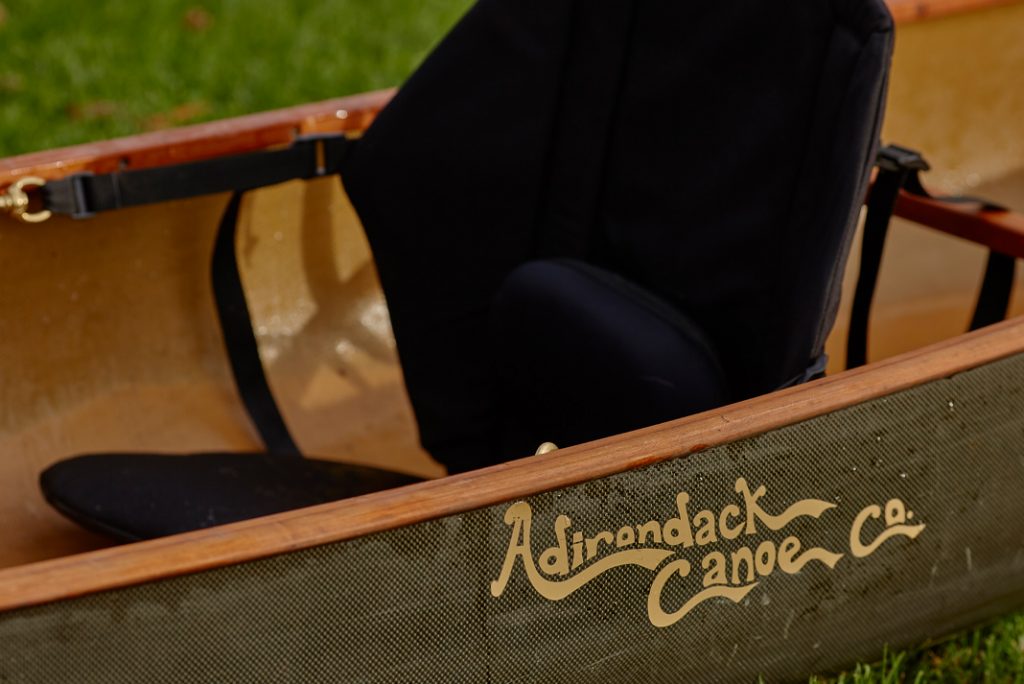
A Seals Deluxe Sit-On-Top Seat is an option with the Boreas. It features high back support with an extra thick seat cushion. It’s easy to install quickly with swivel hooks front and back, and six-way adjustment for maximum comfort. | Photos: Wyatt Michalek
Depending on your preference, the Boreas can be customized with a traditional bench seat or pack canoe-style seat with adjustable foot braces. With the pack canoe option, the sides are trimmed, and you’ll save three pounds on the overall weight. | Photos: Wyatt Michalek
Smith and Gardner met at Hornbeck Boats, where they worked as boat builders making lightweight pack canoes. Gardner’s experience with Hornbeck’s pack boats goes back even farther. Back to third grade, when Hornbeck Boats’ founder, Pete Hornbeck, was Gardner’s third-grade schoolteacher.
“He knew I liked being outside,” says Gardner. “Even as a young kid, I was always bouncing around in the woods.”
For Gardner’s ninth birthday, Mr. Hornbeck gifted him a canoe. The boat was a nine-foot reproduction of John Henry Rushton’s Sairy Gamp design. The Sairy Gamp was designed in the late 1800s to be a perfect little boat for trips in the Adirondacks. And it was the perfect little boat for a boy to find his calling.
Still, when Gardner graduated from high school, he says he ended up boat building by chance—“I thought I would be a chef.” After spending a combined 25 years learning the craft of building lightweight boats at Hornbeck, Gardner and Smith felt ready to strike out on their own.
“We got to a point where we wanted to branch off and do our thing. It was a little nerve-wracking. We saw the opportunity and decided to go for it,” says Gardner. “We feel there’s still room in this market—and we wanted to make some changes to these little canoes.”
The pair have been slowly building up the business. Both men have day jobs to support their boat building habit—Gardner is a paramedic and Smith works in a fiberglass shop building set pieces.
“At this point, the boat building doesn’t support our two families, but that’s the goal—to be full-time boat builders again.” The duo started with just 10 or 12 boats in their first year and made close to 30 last year.
Most of Adirondack Canoe Company’s boats are made to order. It’s just Gardner and Smith building, and completing a canoe typically takes a couple of days. Orders are ready within two weeks. The standard layup is carbon-Kevlar composites featuring carbon exteriors and Kevlar interiors. The boats have a core material in the hull to add rigidity. Ash is standard for the gunwales, but cherry is an option. Custom colors and materials are of course available upon request, because they can.
The temporary import permit on our loaner Boreas is up this September, and I intend to enjoy this extended rendezvous until then.
Go from lunchtime launch to weekend warrior with ease in the Boreas. | Photo: Wyatt Michalek
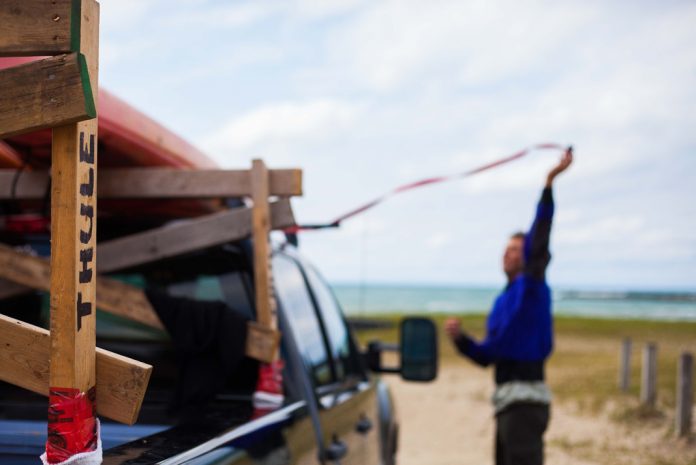
Pickup trucks are utilitarian, but the simple fact is canoes and kayaks don’t fit in them. Yes, you can tie a bunch of sketchy knots and dangle the boat out the back, bouncing and bending over every pothole, but it’s not ideal. Truck boxes aren’t long enough to support a 17-foot Prospector. And trucks really aren’t big enough for two Prospectors—believe me, I’ve tried. So, if you’ve got a truck and want to get boats on it, you’ll need a rack.
If you’re like me, the $1,000 price tag for a real rack might be too high, especially if you’re only driving to your local launch. A quick Google search of DIY truck racks will fill your head with all kinds of cockamamie ideas. You could buy a welder, learn to weld and build something beautiful. Personally, I prefer the old-fashioned wooden option. It’s cheap, easy to work with and you probably already have all the tools you’ll need. Plus, if you decide to upgrade to a sleek pro model, you can re-purpose the wood or chuck it in the campfire.
Every truck bed is a little bit different, but the steps you’ll need to follow are roughly the same. Here’s our quick and dirty guide for a DIY kayak or canoe rack for a pickup truck.
Materials
Pressure-treated 2x4s in eight-foot lengths are the obvious choice for the job. Grab a box of three-inch screws too. You’ll need to measure your truck bed and design your rack on paper before going to the hardware store; if you plan correctly, you’ll only have to make one trip. But you’ll probably make two.
Crossbeams
The end goal is two crossbeams slightly higher than the roof of your truck and as wide, or a little wider, than your truck bed. This is what you strap your boats to. The width of many pickup beds is just under five feet. The average width of a tandem canoe is between 32 and 35 inches. The width of your crossbeams is up to you. But do consider now how useful it will be to be able to fit two canoes on your truck, in which case you’ll need a crossbeam width of at least six feet.
Uprights
Each upright post sits in a corner of the truck bed. How you attach these to your truck varies on how permanent you want your rack to be and the shape of your truck box. You can use the stake pockets on the bed rails or build a frame sitting inside the box. If you don’t want to affix your rack to your truck bed permanently, I recommend creating extra stability by building out the bottom of the frame to run back to back and side to side, making the entire unit one frame-box unit you can lift out of your truck. Use ratchet straps with S-hooks in the receivers to secure.
The adage “measure twice, cut once” applies here. Make sure you cut the uprights the right length. Take into account the extra height the cross beams will add (if any), and the shear of your canoe gunwales. You want to be up enough the bow deck clears the roof of the truck cab.
The forces acting on a rack are strong. Simply building four uprights with two crossbeams might support a boat, but once you turn a corner or slam on the brakes, all your hard work will twist. Cut and screw 2x4s at diagonal angles from left to right of your uprights, with the goal of making an X. This will prevent your rack from folding. You may want stabilizers running from front to back as well.
Modify as needed
As with all things DIY, you may need to fine-tune your rack once built. Perhaps duct tape some pool noodles around the crossbeams to protect your boat. Black paint does wonders to spruce it up.
Footpaths of ancient portages are tattooed on the mossy ground along the Eastmain River. | Photo: Conor Mihell
Eighteenth- and 19th-century fur traders knew the vast network of waterways cascading over polished granite through endless black spruce on the Quebec side of James Bay as the Eastmain. Brigades of their freight canoes battled some of Canada’s mightiest rivers, pushing upstream to the hinterland trading outposts of Nemiskau, Neoskweskau, Mistassini and Nitchikun, and returning to the Bay laden with the continent’s lushest furs. But long before that, and still today, it’s known as Eeyou Itschee—“the People’s Land”—to the stalwart Cree who have made this wild country home since time immemorial.
[ Paddling Trip Guide: View all canoe trips in Quebec ]
Our monthlong trip into the heart of the Eastmain felt dystopian. I’d combed the Hudson Bay Company records, discovering how this region served as the focal point of Canada’s oldest enterprise until the 1960s. Just as the fur trade fizzled out, canoe trippers from Ontario’s legendary Camp Keewaydin reopened the old routes for recreational travel. I also knew about the plight of the Cree—how Quebec premier Robert Bourassa steamrolled Eeyou Itschee, ignorant of the Indigenous claims to the land in his intent to build the world’s largest complex of hydroelectric dams. Our route bridged the stark divide of then-and-now in a fractured wilderness mostly abandoned since Hydro-Quebec’s diversions, impoundments and powerhouses started reshaping the landscape in the 1970s.
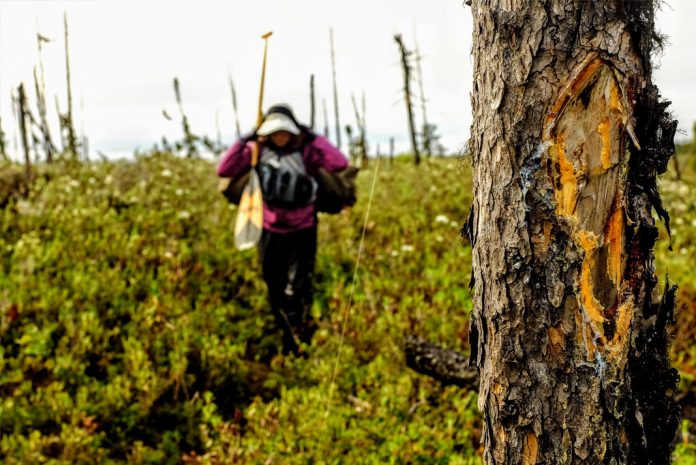
My wife, Kim, and I put-in on the Eastmain River north of Lac Mistassini, far upstream from the effects of the colossal dam. The first two weeks on the river included wonderful whitewater, stunning canyons, waterfalls and chutes. Just the two of us, we basked in a surprising sense of deep isolation. Where the riverbanks weren’t blackened by forest fires, the footpaths of the portages were tattooed on the mossy ground, with wizened spruce trees branded by ancient ax blazes. A few of our campsites were littered with rusty, decomposing tins—the remains of abandoned hunting camps. This was the Eastmain of old; it was hard to believe the steady current was drawing us into a drastically different world downstream.
The magic disappeared at the EM-1 Reservoir, a vast expanse of open-horizon floodplain, eroding sandbanks and drowned trees, buttressed by a dam the size of a city skyscraper—all in the middle of nowhere. The federal topographic maps we relied on for navigation have never been updated to reflect this massive hydrological change.
We paddled into a sterile, post-natural world. With the reservoir behind us, we faced the most recent phase of Bourassa’s legacy—an upstream leg on a diversion of the Rupert River, with high-volume rapids similar to those of the Ottawa and Colorado rivers.
This human-made waterway is barely 10 years old; the satellite imagery on Google Earth doesn’t even capture its flow. Ironically, our ancient topographical maps labeled this valley Ruisseau Caché—hidden creek—an apt description of what once was. That evening we wondered if we may have even been the first canoeists to ascend these waters. It was a heartbreaking revelation that made us marvel at the power of engineering and led us to consider the real impacts of green power, hidden in the hinterlands north of 50 and tethered to the south with humming 735-kilovolt transmission lines.
I love long canoe trips for the way they integrate physical and intellectual challenges. As much as the stimuli usually relates to the hardships and rewards of living small in a big land and sensing my place in the continuum of time, this trip imposed a different sort of reckoning.
Instead of the usual feelings of humility, here I was forced to acknowledge humanity’s immense power to reshape the land. It’s a notion that’s exceedingly hard to ponder from the seat of a canoe or sweating beneath the weight of a duffel on the portage trail.
Sault Ste. Marie, Ontario-based freelance writer Conor Mihell spends his summers paddling his wood-canvas canoe in northern Quebec .
Footpaths of ancient portages are tattooed on the mossy ground along the Eastmain River. | Photo: Conor Mihell
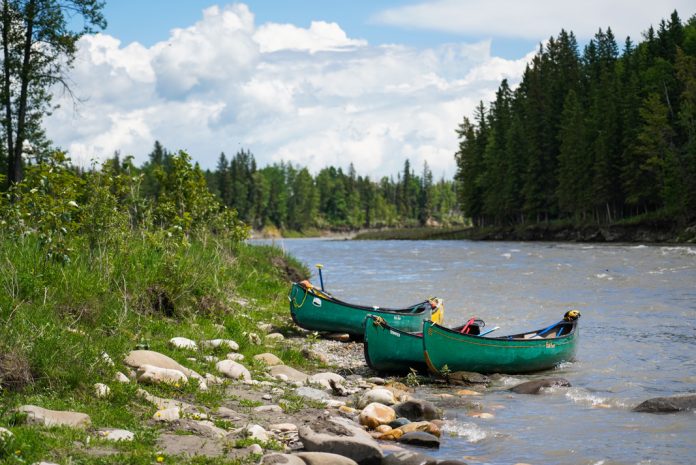
Say hello to some of the best river tripping in Alberta. | Photo: Brett Pawlyk
Historic Highway
Visit Rocky Mountain House National Historic Site and Fort Edmonton Park to discover the essential role the North Saskatchewan River played during the fur trade and for Indigenous peoples.
Wilderness Camping
With lots of crown land along the river, there are numerous camping opportunities available and no permits are necessary. Practice Leave No Trace.
Wildlife
Bring binoculars and brush up on your BearSmart camping practices as wildlife is abundant. Black bears, wolves, bald eagles, peregrine falcons, and numerous waterfowl are just some.
When To Go
There is enough consistent flow to enjoy the river between May and October. Be mindful of high-water events, usually in June. Immersion gear is recommended.
The province of Alberta is blessed with some of the most diverse landscapes in North America. From the world-famous Canadian Rockies, the immense boreal forest, the trembling leaves of the aspen parkland to the pastel skies and fields of the prairies, there is no other place like it.
[This article is part of our 7 Adventurous Things To Do In Edmonton series. Learn more about where to hike, bike, paddle and sightsee around Alberta’s capital city region.]
Get to know the North Saskatchewan
The North Saskatchewan River carves a path across the entire province, allowing paddlers to access and experience these distinct ecosystems. Alberta’s capital, Edmonton, sits right on the banks of the North Saskatchewan River, which offers local and visiting paddlers one of the best ways to experience the city’s natural heritage.
The river valley splits Edmonton in half and forms the largest urban park in Canada, creating an oasis for wildlife and great opportunities for fishing. This slow-moving section is excellent for all levels of paddlers. Few urban metropolia have wilderness right beside the high-rises of downtown.
Only a two- to three-hour drive west, upstream from Edmonton, gets you deep into the eastern slopes of the Rockies and the boreal forest. Fresh glacial water carves through sandstone layers creating a magnificent river valley, dotted with rapids and beautiful camping spots nestled in old-growth forest. Being so close to Edmonton and Calgary, with dependable access points, this river should be on every paddler’s list.
If you have a half-day
The 16-kilometer section flowing through Edmonton is an appealing escape from the hustle and bustle to enjoy the city skyline from a different perspective. The slow-moving water sets a tranquil pace. Stop in at one of the many urban parks for a picnic or search out eddies for surprisingly productive fishing holes. It’s hard to beat an Alberta autumn day where the golden aspen and red chokecherry leaves set the valley ablaze. Access at Sir Wilfrid Laurier Park and take-out at Gold Bar Park.
[ Paddling Trip Guide: View all paddling trips in Alberta ]
If you have a full day
Put in upstream of Edmonton at Devon’s Voyageur Park for a semi-wilderness experience that ends right back in the city at Sir Wilfrid Laurier Park. Experience grand vistas and soaring sedimentary cliff banks as you slowly meander 30 kilometers towards Edmonton. Millions of years of history are laid bare by the cutting forces of the river, and sure to delight any rockhounds.
If you have a weekend or more
Head west for numerous options from a couple of days to more than a week. The most popular three- to four-day trip is a roughly 75-kilometer run from Aylmer Provincial Recreation Area to Rocky Mountain House.
This stretch is the premier section for river tripping in Alberta. It offers beautiful foothills scenery, wilderness camping, whitewater and consistent flow rates, which makes for an extended paddling season. This stretch is rated class II but can be hazardous during high water events.
This article was first published in Issue 61 of Paddling Magazine. Subscribe to Paddling Magazine’s print and digital editions, or browse the archives.
Say hello to some of the best river tripping in Alberta. | Photo: Brett Pawlyk
COMING TO AN EMPTY CAMPSITE NOT NEAR YOU. | Photo: FOLLOW ME NORTH PHOTOGRAPHY
Last summer,my family went canoe tripping in Quetico Provincial Park, the vast wilderness connected to Minnesota’s popular Boundary Waters Canoe Area Wilderness (BWCAW) and long known as Canada’s canoeing capital. We did something unusual for Canadians. We entered through the United States, setting off from Ely, Minnesota, and portaging across the international border back into Canada at Prairie Portage.
Because Quetico borders the BWCAW and is closer to U.S. population centers like Minneapolis than it is to any Canadian cities, like my Toronto home a two-day drive away, it’s southern portion is busiest, sometimes notoriously so. Our guidebook warned us to expect hours-long wait times at the park entry station, and the sight of hundreds of canoes. We steeled ourselves for legions of Americans, just hoping we could escape deep into the park as quickly as possible. We were pleasantly surprised to arrive at the park office and find nobody, save one very relaxed-looking park ranger.
COMING TO AN EMPTY CAMPSITE NOT NEAR YOU. | Photo: FOLLOW ME NORTH PHOTOGRAPHY
“You’re the first Canadians I’ve checked in all season,” she exclaimed. This was late August. I explained how I’d expected to fight off hordes.
“Oh, it doesn’t get like that much anymore,” she said. “We don’t like to talk about it, but visitor numbers have been going down for years.”
Really?
A conspiracy to hide a precipitous decline in visitors to one of North America’s iconic canoe destinations? Sounded like a story I should dig into.
Changes in backcountry tripping
In the winter, I followed up with Quetico’s young and friendly park superintendent, Trevor Gibb. But I quickly discovered there’s no secret plan to hide plummeting visitation. Gibb freely admits numbers are down a tad over recent years, but not alarmingly so.
“Historically, there were more people who paddled in Quetico,” he told me over the phone. “The last half-decade or so it’s been relatively stable. There’s not currently a downward trend or an upward trend.”
What’s more likely is wilderness visits track other economic and demographic trends. It appears more people are piling into wilderness areas for short trips closer to home.
Ontario Parks provided me with backcountry visitor numbers for 17 parks over the decade leading up to 2018. Total backcountry visits were up about 16 percent in 2017. They dropped a few percentage points in 2018 due to wildfires. Still, this growth was overwhelmingly driven by parks within a few hours’ drive of major cities, while remote northern parks remained relatively stable or declined.
Quetico, the busiest northern park, reported 69,000 backcountry visits in 2009 and hasn’t caught up to this number since. Visits from 2009 to 2014 dropped a rather alarming 18.5 percent—possibly due to the 2008 financial crisis’ effect on the park’s majority U.S. visitors. After 2014, however, numbers climbed again, tracking a rise in the U.S. dollar, but only as high as 61,433 last year.
Meanwhile, The Massasauga, a backcountry canoe destination two and a half hours north of Toronto, is 36 times smaller than Quetico and booming, with visits up 71 percent in the 10 years ending 2018. Kawartha Highlands, a newly operating park even closer to the city, is up a whopping 186 percent since it started record-keeping in 2011.
All this supports what many of us would expect—that with our busy, hyper-scheduled lives, wilderness trips are getting shorter. While interest in backcountry travel remains high, people doing shorter trips don’t want to drive as far. You can’t blame them since, according to the Outdoor Industry Association, people already spend about 1.5 times as many hours preparing to paddle as they do paddling—the average paddle in 2018 lasted only four hours, with six hours of prep and travel time.
[ Paddling Trip Guide: View all paddling trips in the U.S. and Canada ]
Add to this the trend of YouTube tutorials and Instagram influencers making the wilderness more accessible and attractive, and population pressure appears to be overloading nearby destinations while the barrier to access farther-away wilderness remains too high to relieve the pressure. It’s a strong case for the importance of having large parks and wilderness areas close to where people live.
On a snowy Tuesday in early March, Ted East of Killarney Outfitters reports his phone is ringing off the hook. “I checked my phone log, we’ve had 92 phone calls today, and we’re closed.” Regarding the Killarney Provincial Park reservation website, he says, “Pick a date in mid-July and try to find an empty spot. It’s solid reservations across the board.”
“I bought 40 extra canoes this year. I have increased my canoe rentals by 5,000 days in 10 years. I think it’s happening industry-wide. If you want a finger on the pulse of what’s going on in ‘I want to sleep outside tonight,’ it’s increasing,” says East.
Meanwhile, across the border, U.S. outfitters in the busy Adirondacks Park—which offers backcountry camping in an area the size of Vermont and a four-hour drive from Boston and New York—are equally busy.
Dave Cilley publishes paddling guidebooks and has been running St. Regis Canoe Outfitters in Saranac Lake for 36 years. “Overall, the trend has not necessarily been fewer people but shorter trips. Our average trip right now is probably between two and three days.”
In nearby Tupper Lake, another veteran outfitter, Rob Frenette, has run Raquette River Outfitters for 38 years. “It’s just been one continual rise, every year more people,” he says. All the while, he’s been riding a roller coaster of changes brought on by technology and social trends. “Every year there’s some surprise, there’s a new demand you haven’t thought of before”—be it delivering boats to people’s Airbnb rentals or consoling smartphone-induced weather phobias.
“People are booking for the weekend on a Wednesday and canceling on a Friday based on what they see on their phone. If it’s 100 percent chance of rain, but it’s only 0.01 of an inch, all that means is there’s a shower going through at some point.”
The key to getting these people outside, he suggests, is to teach them how to read a forecast.
Amidst all these changes, Cilley says he wouldn’t be surprised if the interest in longer canoe trips starts to rebound. At home in the Adirondacks, he and Frenette both see the Northern Forest Canoe Trail, 740 miles of waterways stretching from New York to Maine which celebrates its 20th birthday this season, attracting more people with bucket-list aspirations, section-paddling the trail over years.
But as the demographic who embraced two- or three-week canoe trips—those back-to-the-land baby boomers—age out of activity, the key will be to replace them with a new generation of youth, which so far isn’t showing great interest in getting outside.
“The overall picture of outdoor participation was not promising,” concluded the Outdoor Foundations’ 2019 Outdoor Participation Report, which found kids went on 15 percent fewer outdoor recreation outings in 2018 than they did in 2012. “This historical downward trend indicates Americans will likely continue spending less time outdoors, especially with intensifying external barriers, such as work and family demands as well as technology and cost of entry.”
Hopefully, this will change, because as the outfitter Frenette observes, once families get outside, the cost-benefit ratio is huge.
“Take the kids to an amusement park and you’re shelling out money all day,” he says. “Put them in a canoe and it’s a relatively inexpensive way to do some cool things. Kids are putting the phone down, and they’re looking at flowers and snakes and frogs. It’s such a stress relief. People will come up in their city mode of mind, and after just three days, they’ll come back all smiling, happy and relaxed.”
COMING TO AN EMPTY CAMPSITE NOT NEAR YOU. | Photo: FOLLOW ME NORTH PHOTOGRAPHY
You’ve got mail. Now delivered to you with patented FORWARD-FACING EFFICIENCY. | Photo: Samantha Moss
Of all the thingsin the Canadian Canoe Museum, I’m often asked about my favorite item. It’s not a boat, strange as it may sound—although there are some very fine craft with stories yet to be discovered and some really crappy boats with amazing tales attached to them, and vice versa.
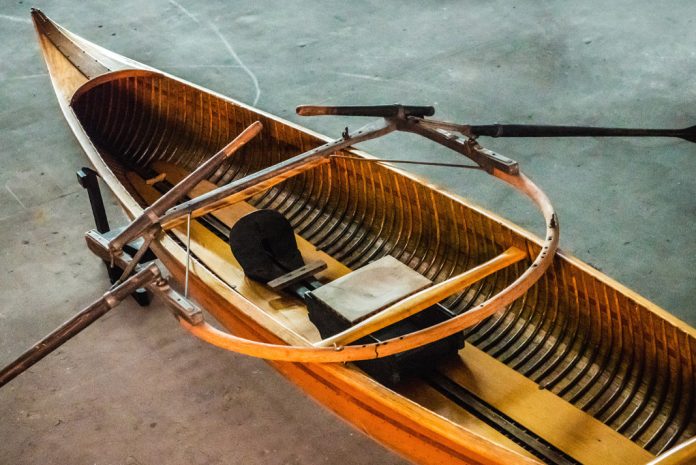
One of my absolute favorite artifacts is actually an aftermarket doodad. Specifically, it’s an item described in Letters Patent No. 169,277 and confirmed on October 26, 1875, at the United States Patent Office. It’s called: Improvement in Oars.
What is it about this gawky little spider of an invention that tickles me so? Let me explain with a brief story.
“[I’m] firmly committed to rowing,” she writes, “which does not allow any part of my body to ride for free.” By contrast, her husband, Doug, is a sea kayaker. “[He is] oddly committed to seeing where he is going,” Fredston writes.
Lest you think this difference trivial, here’s a brief description of the situation from Fredston’s book: “Doug asserts rowing has made me dyslexic. I call the bow of the boat the back because it is behind me. Along the same lines, the stern is the front. I steer off of a terrain feature ‘ahead’ of me, like a notch on a ridge or a snow patch, despite the fact it recedes as I row.”
You’ve got mail. Now delivered to you with patented FORWARD-FACING EFFICIENCY. | Photo: Samantha Moss
After something like 8,700 miles of sea travel in different boats, Doug eventually traded his sea kayak for an ocean-going shell and “reluctantly acknowledged the greater efficiency and speed afforded by a sliding seat and long oars. Doug and I skirmished a few times when he instructed me to go left or right, causing me to turn toward the obstacle we were trying to avoid. Seeking harmony, we adopted a color-coded system based on the red and green plastic collars on the oars. Now it is go green or go red.”
Among the other excellent tales Fredston writes is an occasion when they nearly come to blows over a disagreement on the water. Eventually, they realize the main difference in their perspective on what nearly killed them was that Jill, the rower, was facing one way and Doug, the kayaker, was observing from a position 180 degrees different than his wife.
The Improvement on Oars could have prevented this near field divorce.
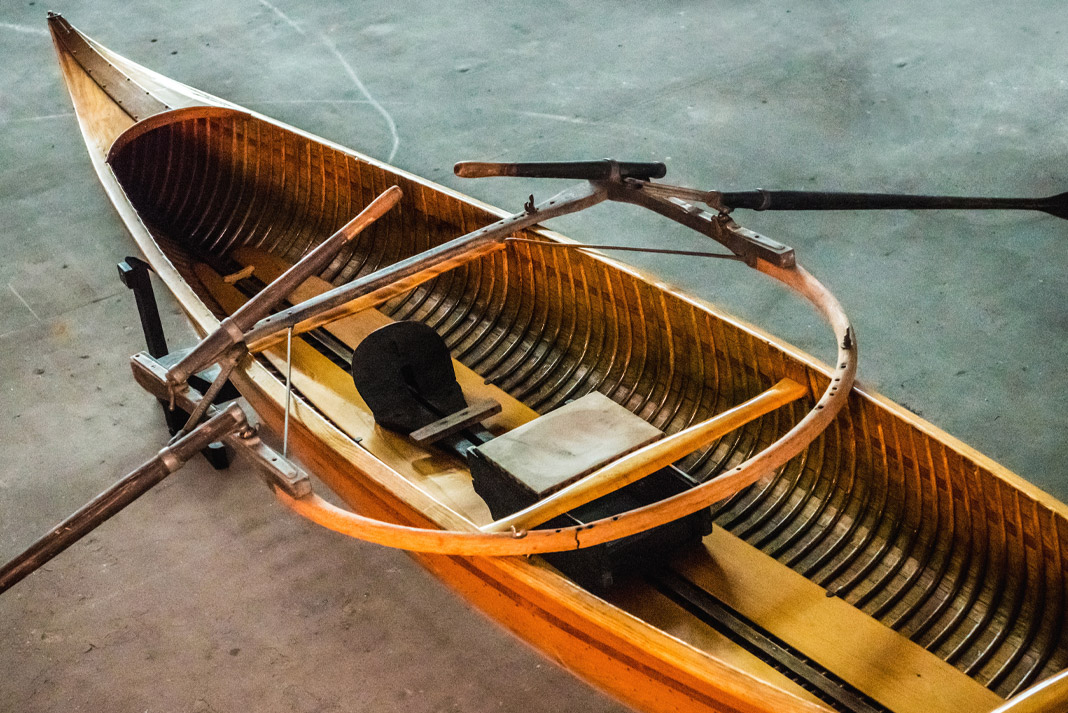
It’s an assemblage of wood and metal affixing to the gunwales of a canoe to allow the occupant to row on a sliding seat and to do so facing in the direction of travel.
Ingenious.
Records at the Museum indicate the Peterborough Canoe Company built this little mechanical gem with Mr. William Lyman of Middlefield, Connecticut’s patented design. It came to the Museum through its first executive director Jack Matthews.
Matthews detailed in his description of the device, submitted at the time of the donation, that he purchased it with the understanding it had been used by the postmaster in the w—ee burg of Bobcaygeon, Ontario, between Sturgeon and Pigeon Lakes on the Trent-Severn Waterway, to deliver mail to cottagers around 1900.
History does not record if the postmaster’s mistress was a paddler but, had she been, they would have delivered the mail in perfect matrimonial harmony on account of Mr. Lyman’s cool little invention.
Some things never die, especially when they find a forever home in a museum.
James Raffan is an author, explorer and former executive director of the Canadian Canoe Museum.
You’ve got mail. Now delivered to you with patented FORWARD-FACING EFFICIENCY. | Photo: Samantha Moss


![Modern day voyageur Mike Ranta [right] helped paddle the first batch of Killarney Cream Ale by Manitoulin Brewing Company from Little Current to the small community of Killarney, on Georgian Bay. This delivery inspired the Current To Killarney race. | Photo: David Jackson](https://paddlingmagazine-images.s3.amazonaws.com/2020/06/08155804/Hero_pg62_Current-to-Killarney2.jpg)