

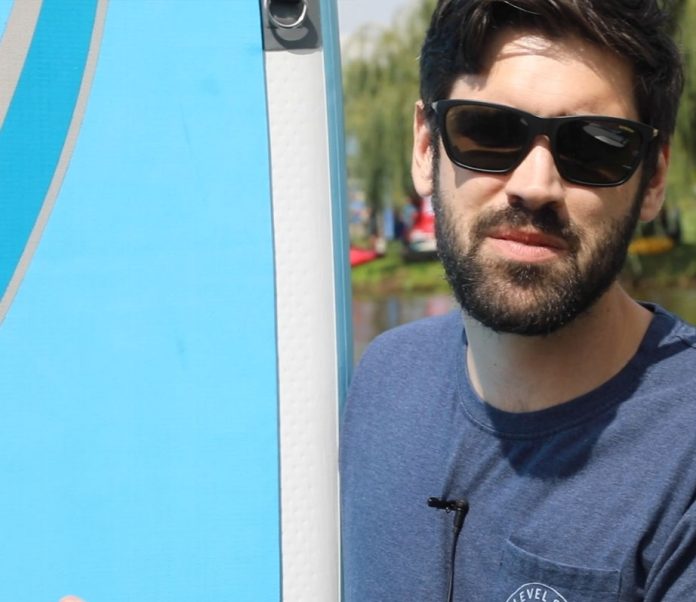
The new Luna SUP from Lexel Six is a well thought out board that is perfect for on-the-water yoga. Check out the video below.
Canyon Coolers Prospector
Canyon Coolers, who got their start in the rafting world, have created the only cooler in the market designed for rapids. It has a drain plug on the front for easy access. It also has a lip that is designed to perfectly sit in your raft frame, and the lip and bottom of the cooler has strap channels specifically designed for easy securing.
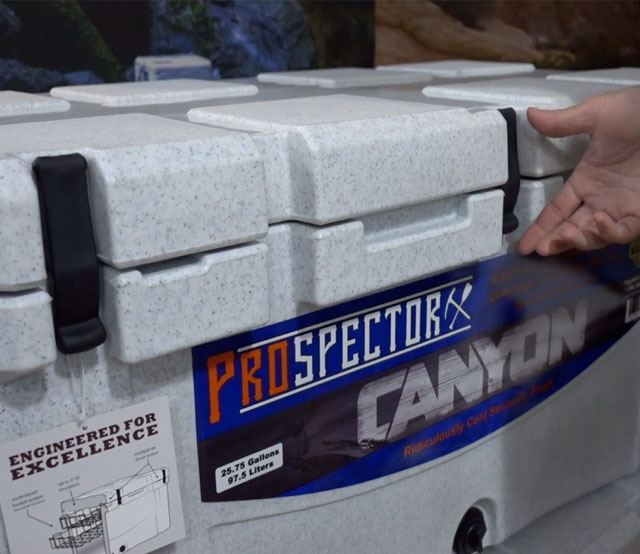
The Canyon Coolers Prospector
For more information check out the video below:
Industry Braces As Tariffs Take Effect
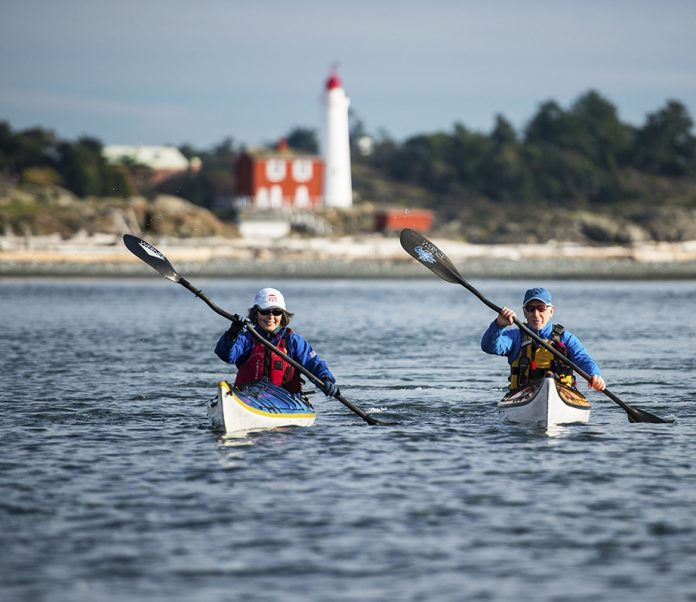
“Trump: Good or bad for paddlesports?”
We posed that question to industry leaders for last year’s Sound Off section of Paddling Business. It was a tongue-in-cheek query, designed to invite humorous responses to the surprise election of the brash new American president. Now the question doesn’t seem funny at all.
At the end of May, the Trump administration announced new U.S. tariffs on imported steel and aluminum, bringing the U.S. and its closest trading partners to the brink of trade war. Canada and the European Union immediately announced retaliatory tariffs, including stiff levies on kayaks and canoes. The European surtax is 25 percent on U.S.-made kayaks and canoes; Canada’s is 10 percent on U.S.-origin kayaks, canoes and inflatable boats.
To complicate matters, Chinese-made paddlecraft and inflatables will likely be subject to a 10 percent U.S. tariff set to take effect in September.
The full impact on paddlesports is yet to be seen, though sources throughout the industry agree the effects will be deeply felt, and the damage won’t be limited to American manufacturers and their employees. European and Canadian retailers are likely to take a beating, and U.S. retailers could feel the pinch if excess inventory puts downward pressure on prices.
While the 10 percent Canadian tariff imposes what business-school types call “headwinds,” the 25 percent European levy looks more like an incoming Category 5 hurricane. If the storm lasts into the 2019 season or beyond, it could blow some U.S. companies right out of the European market.
“A 25 percent tariff is hard to hide from the consumer,” says David Hadden, Watercraft Brand Director at Johnson Outdoors. “Fishing boats will probably have better success than touring boats because the U.S.-made products still exceed the quality and features of European kayaks, but for canoes and touring boats, this will create challenges and could price U.S.-manufactured products out of the market,” he says. “It will impact sales volume no matter how strong the brand or product.”
The outlook in Canada isn’t much better. The low Canadian dollar, which at press time was trading at 75 U.S. cents, has already driven prices up and margins down for U.S. manufacturers. The addition of a 10 percent tariff will exacerbate an already difficult situation.
“Following the imposition of the tariff, it could be some time before we ship to Canada,” says Wenonah Canoe Vice President Bill Kueper. Kueper, like executives at other major manufacturers we spoke to in late June and July, was still trying to assess how the tariffs would affect his business. That uncertainty is almost as confounding as the tariffs themselves. The majority of 2018 boat orders had already shipped when the Canadian and EU tariffs were announced at the end of May, and some manufacturers scrambled to fill orders before the tariffs went into effect June 22 for Europe and July 1 for Canada.
“We dedicated our factories to Canadian orders recently to finish and get what is possible across the 49 th ,” says Kueper. The full effect of the tariffs won’t be felt until next year, and a key indicator of that impact—pre-orders for 2019 delivery—will come into focus later this summer and fall. When Canadian and American retailers meet with manufacturers at Paddlesport Retailer in late August and Paddle Expo in early October, they will want to know how much of the added cost manufacturers will absorb. Sources on both sides of that equation agree producers will be hard-pressed to offset more than a fraction of the 10 percent Canadian hike. Compensating for the 25 percent European increase is out of the question. The margins just aren’t there. “Ultimately the cost will get passed on to consumers,” says NRS chief executive Bryan Dingel.
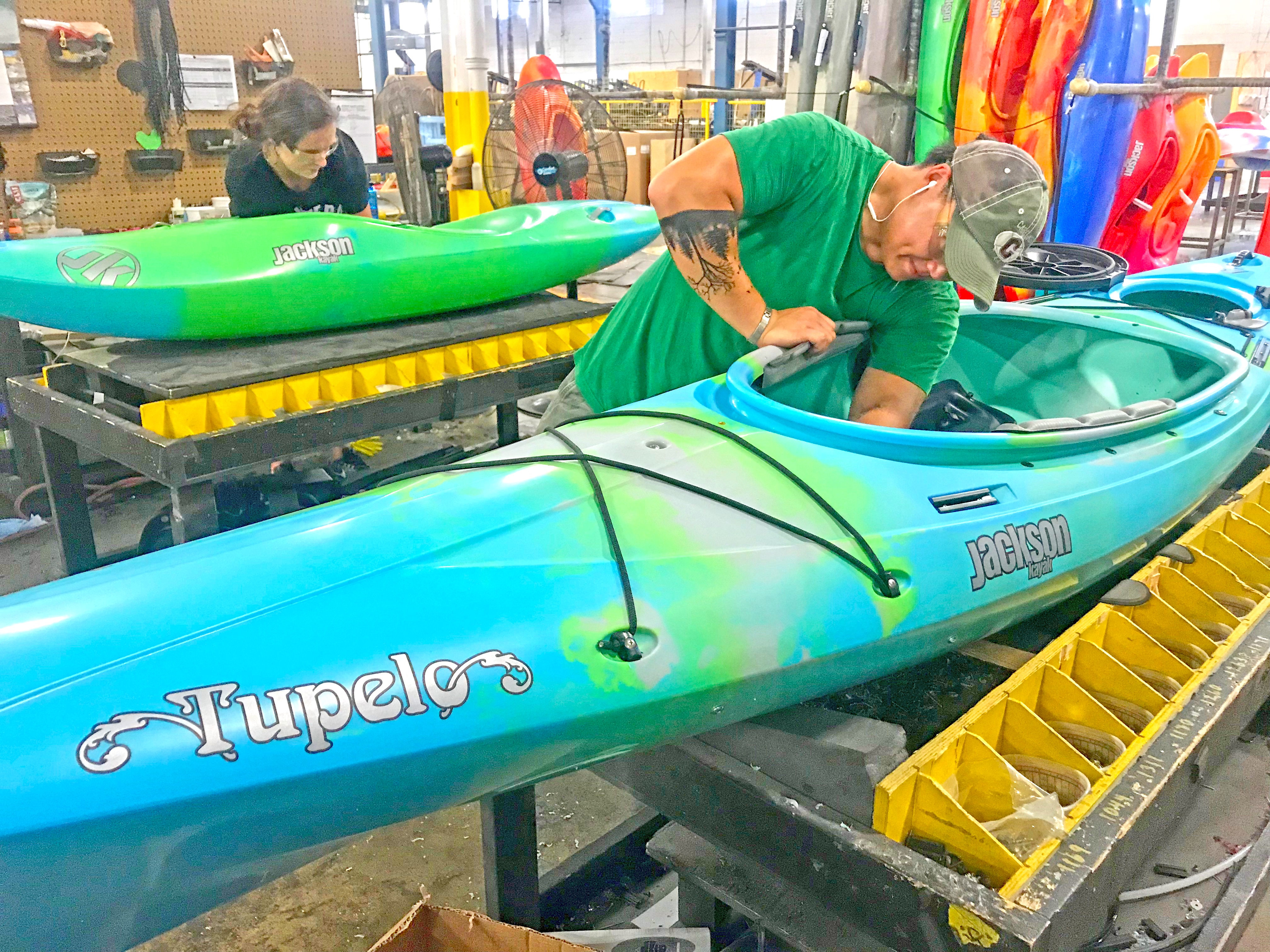
Workers assemble boats at Jackson Kayak’s Tennessee factory. Photo: Courtesy Jackson Kayak
Retailers are hedging their bets. No one wants to drop U.S. suppliers they’ve worked with, sometimes for decades, but they’re assessing their options just the same. One mid-sized Canadian retailer who stocks primarily Confluence boats booked his ticket to Paddlesports Retailer after learning of the tariffs. “I wasn’t planning to go,” he says, “but now I feel like I need to see what else is out there.” In addition to assessing their alternatives, retailers are likely to reduce their exposure. “I think retailers will keep display models on the floor but many won’t actually stock those boats,” says Johno Foster of Watershed Sales, an Ontario-based buyer for Native Watercraft and other U.S. brands. “They’ll be special-order for customers willing to pay the extra cost,” he says. The idea is to hunker down until the tariffs are lifted, though it’s anyone’s guess how long that will be. “How long is the current administration going to be in office?” NRS chief executive Bryan Dingel asks rhetorically. “Because that’s where this thing comes from. This administration came into office without a plan and now they’re playing checkers while the rest of the world is playing chess.”
Dingel’s frustration is understandable. His company will feel the pinch from both sides—Trump’s aluminum tariff will add 10 percent to the cost of forged aluminum raft frame components from Taiwan, and the completed frames (with U.S.-sourced tubes) will be subject to Canadian and EU tariffs on finished aluminum goods.
European and Canadian leaders have made clear that their tariffs are a direct response to the U.S. steel and aluminum tariffs, and will be withdrawn when the Trump administration removes those trade restrictions. That could still happen quickly; President Trump, after all, has been known to reverse policy quickly, and some observers believe the tariffs are a negotiating ploy. On the other hand, as Paddling Business went to press, the presidential rhetoric suggested just the opposite, with Trump threatening stiff new tariffs on European automobiles and components.
Meanwhile, hostilities are escalating on the trade war’s Pacific front, with the Trump administration releasing on July 6 an expanded list of proposed tariffs on Chinese goods, including 10 percent levies on Chinese canoes and inflatables.
Tariffs and Tea Leaves
European and Canadian leaders say their tariffs are proportional and crafted to put economic pressure on U.S. regions that supported Trump in the 2016 election, especially those that might flip to the Democrats in the 2018 midterms and 2020 presidential race. While some paddlesports manufacturers fit that profile—Hobie molds kayaks in California’s hotly contested 49 th Congressional District, for example—the simpler explanation is that canoe and kayak companies are innocent victims of the trade-war crossfire. Canoes and kayaks share an import code with other recreational watercraft, including motorboats—a much larger industry that uses a great deal of aluminum and steel.
“I think we’re just collateral damage,” Foster says. In fact, the May 31 tariff announcement from Finance Canada did not even mention canoes or kayaks by name. In the days after the provisional lists of Canadian and EU tariffs were released, paddlesports manufacturers, retailers and shipping agents scrambled to learn more about the import duties, which took effect July 1. Near the bottom of the three-page Canadian list of products targeted for reprisal, between washing machines and mattresses, was Canadian tariff code 8903.99.90, described as “other vessels for pleasure, outboard motorboats.” Looking deeper, paddlesports manufacturers and importers came to the heart-sinking realization that the code encompasses a range of recreational watercraft, including kayaks and canoes. “I checked my import documents and that’s the code they come in on,” Foster says.
A spokesperson for the Canada Border Services Agency confirmed to Paddling Business that the tariff applies to kayaks and canoes. Canada will also levy a 10 percent tariff on inflatable boats, import code 8903.10, which includes whitewater rafts as well as inflatable kayaks and canoes.
A source with the European Commission confirmed that EU import code 89039910, which is included on the list of EU tariffs that went into effect June 22, applies to U.S.-made kayaks and canoes imported to the European Union. They are now subject to a 25 percent tariff. The list of U.S. tariffs on Chinese goods includes U.S. import codes includes import codes 8903.10.00, defined as “vessels, inflatable, for pleasure or sports,” and 8903.99.05, “vessels, canoes, not of a type designed to be principally used with motor or sails.” While the word kayak is not included anywhere in the 205-page document, previous rulings by the Office of the U.S. Trade Representative (USTR) have classified kayaks under the code applying to canoes, 8903.99.05, which is on the list. At press time, the USTR had not responded to a request for clarification. (Under the Harmonized System Convention, the first six digits of tariff codes are “harmonized” internationally, and each country has its own code after the six common digits. Hence the Canadian, European and U.S. tariff codes relating to kayaks and canoes are slightly different.)
The list of proposed U.S. tariffs on Chinese goods is provisional. The USTR is seeking public comment and will hold a public hearing on the tariffs Aug. 20-23 in Washington. The tariffs are likely to take effect in mid-September, according to an import manager with a major U.S. importer of inflatable boats.
Standup paddleboards are not on the list of proposed U.S. tariffs on Chinese imports, and are not subject to Canadian or EU tariffs, according to customs officials in those jurisdictions.
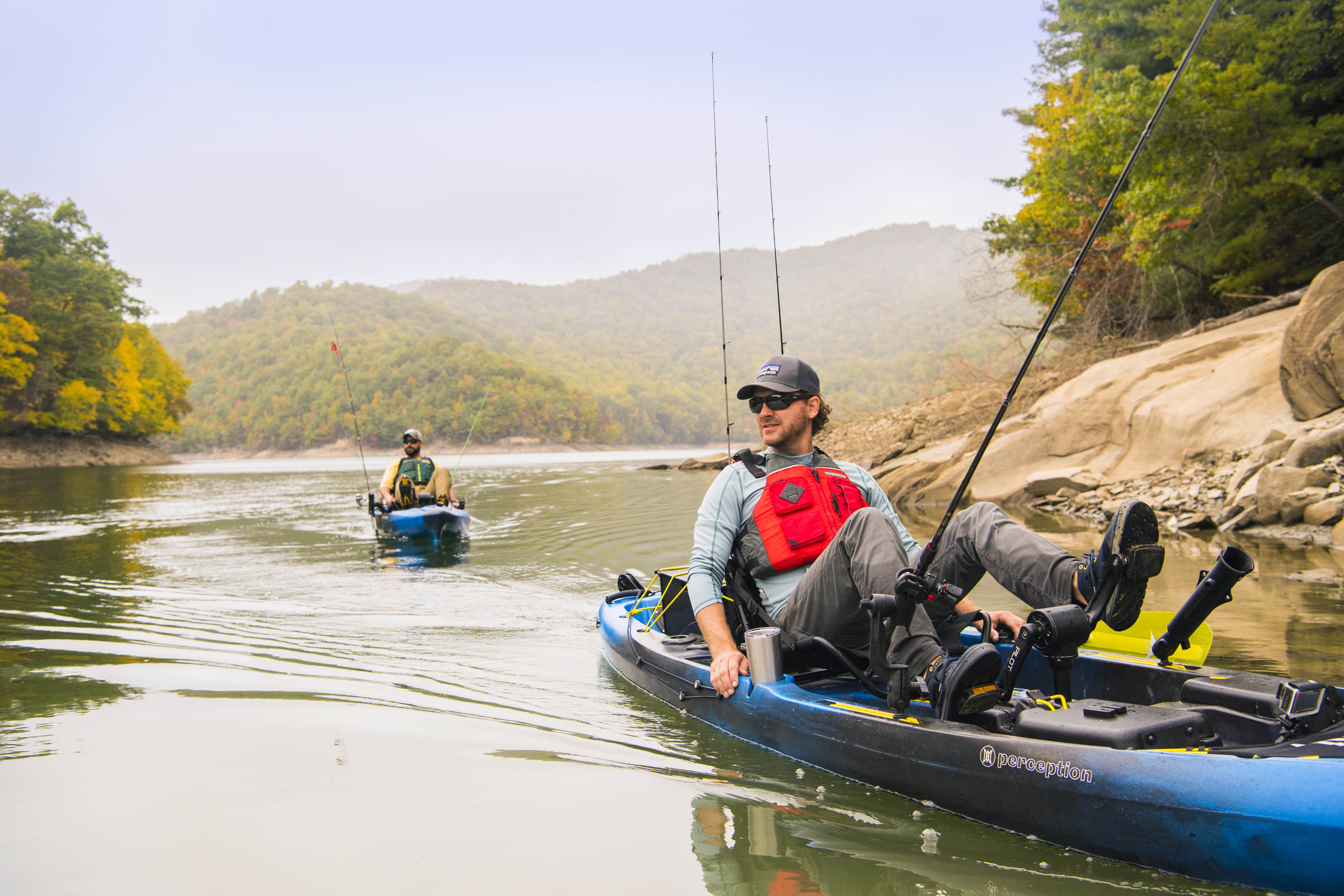
Full-featured fishing kayaks may weather the European tariff storm better than touring boats. Photo: Courtesy Perception Kayaks
Winners and Losers
The tariffs aren’t bad news for everyone in paddlesports. Companies that manufacture outside the United States will gain a competitive advantage in the EU and Canada, and only Chinese-made boats face a corresponding penalty on U.S. sales. “We will be blessed with increased sales since our already attractive selection and pricing is enhanced by the Great Wall of Europe tariff aimed at the U.S. manufacturers,” says Mark Hall of Quebec-based Kayak Distribution, which manufactures Riot and Boreál brand kayaks in China and ships them worldwide. That’s a bitter pill for companies that bet on U.S. manufacturing as competitors chose to move production overseas, particularly to China and other parts of Asia. Jackson Kayak, Confluence, Johnson, Legacy, Lifetime and Hobie are heavily invested in domestic factories. Outsourcing is not an option for them in the short-term.
Companies that contract their production are not so constrained, and at least one has already moved offshore. Soul Waterman CEO Corran Addison says the EU and Canadian tariffs reinforced his decision to move production from the U.S. to China. Addison, a South African-born designer who lives in Montreal and sells boats throughout North America and Europe, is emblematic of the paddlesports industry’s global nature. He says he moved his roto-molding operations to China after five different U.S. contractors failed to meet his requirements. Ironically, the inconsistency of contracted manufacturing, both in the U.S. and overseas, is one reason many U.S.-based kayak companies have invested in their own manufacturing facilities, where they maintain full control over production and quality. That’s been a winning formula for American paddlesports companies, especially as the cost of overseas production has risen to rival that of U.S. manufacturing.
None of the U.S. boat builders we spoke to want to leave the States, but the tariffs may force their hands. “In the short-term you do your best to compete and ride it out,” says John Maas, Product Marketing Manager at Lifetime Products and Emotion Kayaks, which makes blow-molded kayaks in Clearfield, Utah. “In the long-term, you evaluate expanding production within the E.U. to bypass the tariffs.”
SylvanSport Continues Advocacy For Growth Of Outdoor Industry
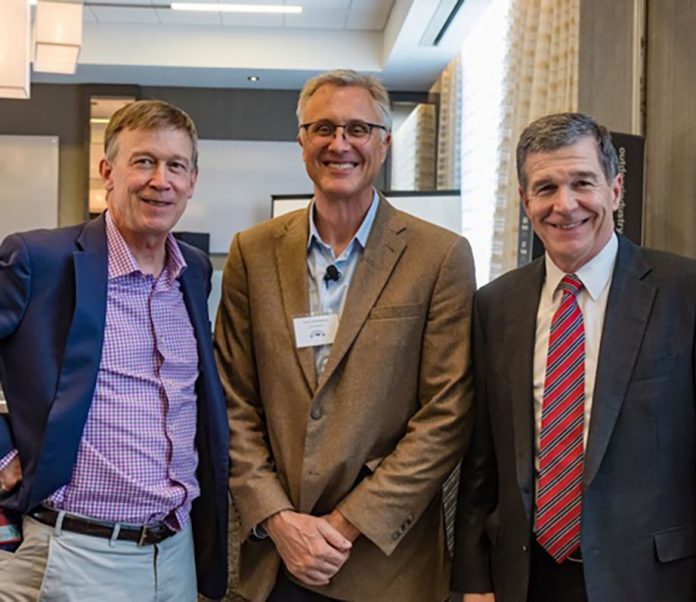
Brevard, NC — July 16, 2018 SylvanSport CEO Thomas Dempsey continues his advocacy efforts to support the importance of outdoor recreation for the overall vitality of our country and industry. Dempsey worked closely with state officials, other NC outdoor industry members and the North Carolina Outdoor Recreation Industry Office to host delegates from all 11 states with Outdoor Recreation Industry Offices last week in Asheville, NC.
One of the three-day conference’s highlights was an hour-long discussion with North Carolina Governor, Roy Cooper and Colorado Governor, John Hickenlooper moderated by SylvanSport’s Thomas Dempsey. The wide-ranging conversation allowed Confluence delegates to hear the two governors’ views on the outdoor experiences that helped shape their current positive outlook on the Outdoor Recreation economy.
The “Outdoor Industry Confluence,” brought together outdoor industry, natural resources and economic development leaders from North Carolina, Colorado, Kansas, Maryland, Michigan, Montana, Oregon, Utah, Vermont, Washington and Wyoming to collaborate on a vision for supporting and growing the industry. The accord finalized during these sessions established a set of principles across four areas: economic development, public health and wellness, conservation and stewardship, and education and workforce development.
“We’re humbled to be part of this growing national movement that recognizes the value of outdoor recreation and its sizable impact on the economy and the importance of public lands to its future,” said Dempsey at the three-day Outdoor Industry Confluence.
SylvanSport will continue to accelerate its growth in the outdoor industry economy from its new home in the Sylvan Valley Industrial Center, a $4.9 million project in collaboration with the Transylvania Economic Alliance. Ground was broken late last year on this 60,750 square-foot industrial center where production and the SylvansSport workforce will double when it opens later this year. “The driving force behind our innovative GO Adventure Camper, as well as our new camper and gear in development, is to make outdoor adventure accessible,” stated Dempsey.
About SylvanSport
SylvanSport is an outdoor adventure brand in Brevard, NC. The company currently manufactures the award-winning GO Adventure Camper and the revolutionary GO Easy Adventure Trailer. The GO has been called the the “Coolest. Camper. Ever.” by National Geographic Adventure magazine. The GO Easy is the most innovative and feature-packed bike, boat and cargo hauling, utility/camping trailer on the market. SylvanSport has a new line of breakthrough camping and outdoor gear products in development for release beginning later this year. For more information, visit the sylvansport.com or call 828-393-4927.
Stealth Rod Holders Hits The Scene With Smart Security
New in the kayak accessory game, Stealth brings high quality and unique solutions to their new rod holder. Their QR-2 adjustable rod holder has a pressure sensitive latch that locks the rod in place. When the rod is inserted in the rod holder, the latch closes to secure the rod. Remove the rod and the latch pops open. The pressure actually helps set the hook on a fish. We like that the rod can be inserted anywhere along the rod butt to secure the rod without the reel wedged into the holder. The QR-2 fits in a variety of Stealth mounts to install in gear tracks or directly to the kayak.
Scotty Keeps Innovating With New Fish Finder Mount And Bigger Ball Mount
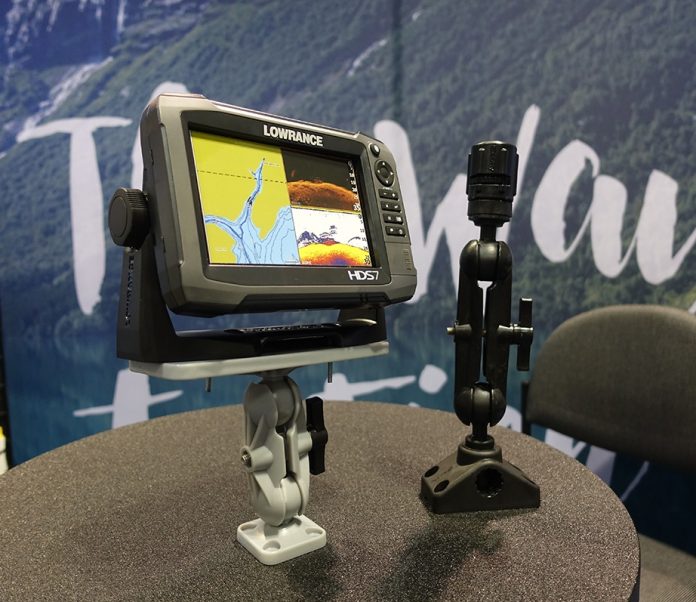
Scotty has been designing innovative accessories for anglers for decades and they continue to bring cool new mounts to the water. This summer, Scotty introduced a new fish-finder mount based on their 1 ½-inch ball-mount system with a tighter grip to hold a heavy display. The new 1 ½-inch ball is also offered with their Gearhead mount for more sturdy mounting options for a variety of applications. These small items offer users big options to secure larger gear to the kayak.
Power-Pole’s Ultra-lite Stake-out Pole Cuts Weight Without Sacrificing Strength
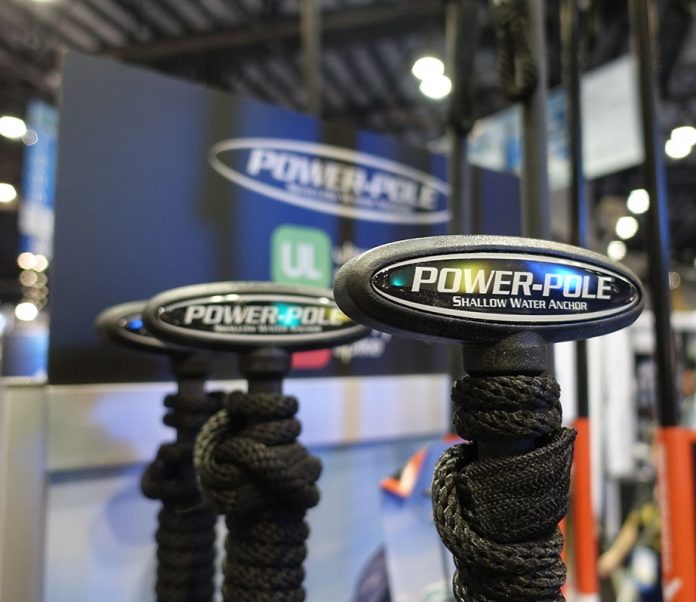
Power-Pole anchor systems are on almost every shallow-water tournament boat. Thanks to their Micro anchor, their systems are now on most tournament kayaks, too. This year, they’ve added the Ultra-lite stakeout pole weighing considerably less than their heavy-duty stake. Using Power-Pole’s Hollowcore technology the tubular pole can still hold 1500 pounds. A wide handle at one end drives the sharp point at the other into the sand or mud. Remove the handle, and there is a ¼ 20 threaded bolt to mount a camera. The pole includes a six-foot, 3/8-inch dock line to secure the kayak to the pole. The Ultra-lite is available in six and eight-foot lengths and works with the Micro anchor system.
My Only Prospect
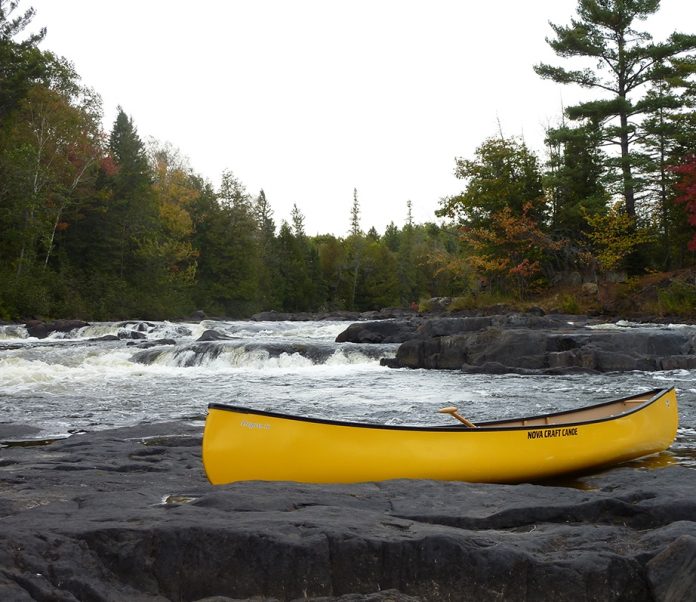
I found my first canoe at the dump. It was a prospector design, made of fiberglass, had three keels and no company logo on it—just a roadrunner sticker pasted on the bow. I brought her home and patched her up. The research for my first two paddling guidebooks was done in that canoe. Her name was Gertrude.
I eventually improved my canoe collection and bought a second-hand boat—also a prospector, and also made of fiberglass. I paddled it solo down the full 426 kilometres of the Missinaibi River. I was in my mid-twenties and knew little about running whitewater except what I had learned from watching Bill Mason’s National Film Board films over and over again. He too liked to paddle a prospector. Maybe that’s why I preferred that design. Or maybe it’s why I like cute bubbly brunettes that look like Bailey Quarters from WKRP in Cincinnati. The sophisticated Jennifer Marlowe played by Loni Anderson may be nice to take to a dinner party, but she wouldn’t be as fun or as practical for me in the long run.
Put in simple terms, the prospector is not perfect at anything, but it’s moderately good at everything. In my opinion, it’s the best all-around canoe design. If I could only own one canoe, then it makes good sense to make it a prospector. I’m also guessing that’s why actual prospectors chose to use it.
The shape of a prospector is symmetrical, meaning both ends are the same shape. This allows me to paddle tandem but it can easily be switched to paddle solo. I merely sit in the front seat, trim the boat by shifting ballast and then paddle stern first.
The prospector is good for short day-trips but also for my extended time exploring the wilderness. In fact, it has even better control when loaded with gear. It’s deep, wide and has a substantial arch in the bottom designed to carry heavy loads and deal with large waves on lakes and in rapids. The boat, however, has lots of rocker for maneuverability. When heeled over solo-ing, both ends rise proudly out of the water.
I upgraded to Royalex for my third canoe, also a prospector. I used it to write A Paddler’s Guide to Rivers of Ontario and Quebec. I was by then a little more skilled at whitewater and still young enough not to be overly concerned about the extra weight of the canoe. By the time I started writing A Paddler’s Guide to Algonquin and A Paddler’s Guide to Ontario’s Lost Canoe Routes, I moved on to a Kevlar canoe—a prospector. It weighed in at a sexy 38 pounds. I was getting older, my body getting weaker and the portages longer.
The Prospector was originally developed by Chestnut Canoe Company of Fredericton, New Brunswick in 1923. Though Chestnut Canoe Company closed their doors in 1979, their molds lived on. A good assortment of companies are out there still making the prospector design, some closer to the original than others. My favorite over the years has been Nova Craft Canoes’ Prospector 16’.
Loyalty has swayed a couple times. Variety is the spice of life after all. I have a Cronje design and a Bob Special. They’re sitting on the canoe racks in my backyard, getting wet mostly from the rain. Gertrude however still sees plenty of water. I’ve patched her up a few more times, even painted her red. Must be the Bill Mason influence. He preferred a red canoe, a red prospector canoe.— Kevin Callan
Kevin Callan is the author of 16 books, including the bestselling, The Happy Camper and Wilderness Pleasures: A Practical Guide to Camping Bliss. He is still presenting across North America and has been a key speaker at all major canoe events. Butt End first appeared in Canoeroots magazine 16 years ago. Kevin lives in Peterborough, Ontario.
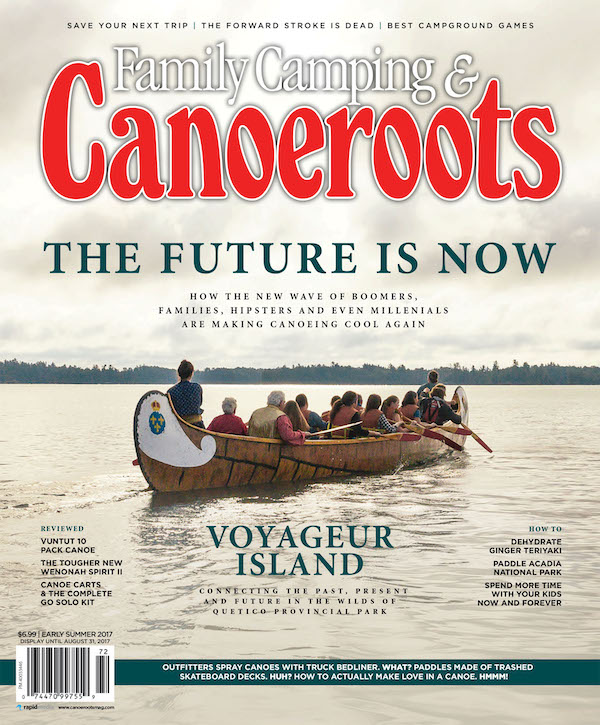 This article originally appeared in Canoeroots Early Summer 2017 issue.
Subscribe to Paddling Magazine and get 25 years of digital magazine archives including our legacy titles: Rapid, Adventure Kayak and Canoeroots.
Why Rivers Have No Patience For Multitasking
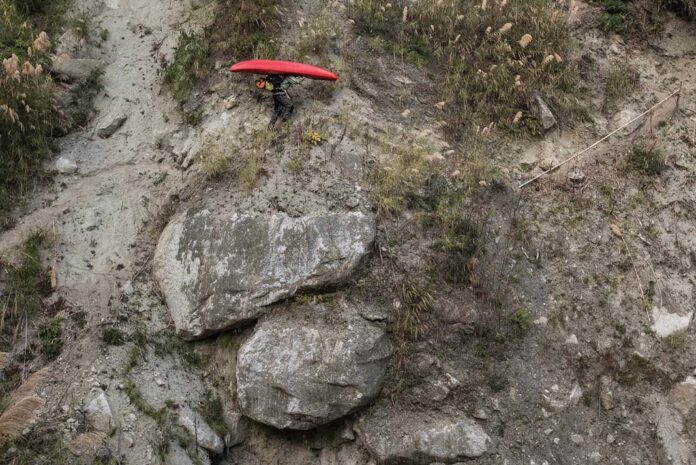
We live in a time where multitasking is king. Job postings call for applicants who can skillfully handle many duties at once. Families eat breakfast together while scrolling through photos on their phones, periodically tuning into the conversation. We answer emails while chatting on speakerphone and sneaking in a sandwich, all in the name of productivity. We are at the mercy of the notifications, pings and vibrations emanating from our numerous devices. The ability to manage many thoughts and ideas at once is seen as an asset, although there is mounting evidence to the contrary.
In their 2011 study “Juggling on a high wire: Multitasking effects on performance,” Rachel F. Adler and Raquel Benbunan-Fich found that while some multitasking improves productivity, too much has a negative effect. When performance is measured in terms of accuracy, the negative effects of multitasking are especially pronounced.
Rivers have no patience for mulitaskers. Experiencing the features they have to offer requires concentration, focus and a relinquishing of unrelated thoughts, worries and catwheeling attention spans. Sharp ledges and retentive holes demand to be the sole focus. It’s like skiing powdery slopes coated in tight trees, leaning into greasy switchback turns on a mountain bike trail or problem-solving an incredibly technical climbing route.
Last spring I went to a whitewater festival on a new river. It was dam controlled and the single release each year brought paddlers from hundreds of miles away to camp in an idyllic mint-green field where the river melted into a deep lake.
I’d just begun a new job and felt perpetually frazzled, always convinced I’d left some key detail unattended or forgotten to respond to an important email. During the two-day festival, the challenges of the river I faced during five-hour day runs were all I could think about. My obsession was how to navigate tricky holes and catch those crucial can’t-miss eddies. Driving home Sunday night through tiny riverside towns, my relaxed mental state indicated I had enjoyed a reprieve from rumination that weekend, but I wasn’t quite sure why.
After shooting photos of a new whitewater canoe with some other members of the Rapid team on a -5-degree Celsius January afternoon on our backyard river, we stood around the take-out. In between shedding helmets, reaching for beanies and clawing at gaskets with numb fingers, someone mentioned they felt way better than they had before paddling. Paddling the short section of whitewater ringed by sheets of ice required her to completely cease thinking about other things. In an unlikely place— the bow of a canoe in a rapid—she relaxed.
You don’t have the luxury of thinking about other things in whitewater. Maybe that is the luxury.
Hannah Griffin is a journalist, photographer, and mountain lover. She’s a NYU Journalism alum, and her work has appeared in The Guardian, Al Jazeera and Vice.
 This article originally appeared in Rapid’s Early Summer 2017 issue.
Subscribe to Paddling Magazine and get 25 years of digital magazine archives including our legacy titles: Rapid, Adventure Kayak and Canoeroots.
The Real Fight To Save America’s Public Lands
This past May, the Outdoor Industry Association released a report claiming outdoor recreation contributes $887 billion and 7.6 million jobs to the U.S. economy. The message is that the outdoor industry is all grown up, having matured into an economic powerhouse nearly twice the size of the automobile business and employing more Americans than the construction industry. Yet in political terms, the outdoor industry is still sitting at the kiddie table.
The real fight to save America’s public lands
Take for example the recent posturing over the Bears Ears National Monument, a 1.35 million acre reserve in southeastern Utah harboring the country’s densest concentration of Native American artifacts. Then-President Barack Obama designated Bears Ears a National Monument just 23 days before leaving office using his authority under the 1906 Antiquities Act, which empowers U.S. presidents to proclaim national monuments with the stroke of a pen. There isn’t a provision in the law for subsequent presidents to delist monuments once they are declared, but that did not stop Utah Governor Gary Herbert from urging incoming president Donald Trump to reverse the Bears Ears designation.
Emboldened by Trump’s election and a clear Republican majority in both houses of Congress, western lawmakers have begun toppling legislative dominos in a long-planned effort to transfer federal lands to state and local control. On the first day of the 2017 legislative session, the U.S. House of Representatives prohibited the Congressional Budget Office from reporting how much revenue the federal government would lose if U.S. lands were transferred to state and local governments. Utah congressman Jason Chaffetz then introduced a bill calling for the sale of 3.37 million acres of federal land in 10 states. Chaffetz later withdrew the land-transfer bill in the face of widespread public outrage, notably from the hunting and fishing community.
The Trump administration has been an enthusiastic partner in these efforts.
In April, Interior Secretary Ryan Zinke announced his department would review the status of 27 national monuments, including all those designated since 1996 and larger than 100,000 acres. Zinke’s expedited review of Bears Ears, completed in June, recommended reducing the size of the monument. The fate of others remains in the balance, including several of particular interest to paddlers, such as the Upper Missouri Breaks in Montana, Hanford Reach in Washington and Río Grande del Norte in New Mexico. The 87,000-acre Katahdin Woods and Waters National Monument in Maine—established in August 2016 on land gifted by Burt’s Bees co-founder Roxanne Quimby—is also under review.
All of this is happening despite the concerted and very public opposition of the outdoor industry.
Back in February of this year, Patagonia announced that if Herbert didn’t change his tune on Bears Ears it would boycott the Outdoor Retailer tradeshows in Salt Lake City. The show injects some $45 million into the Utah economy each year. Other outdoor companies followed suit. At a rally at the Utah state capitol on the opening day of the 2017 Winter Outdoor Retailer show, Black Diamond Founder Peter Metcalf said that if Utah politicians don’t change their land-grabbing ways, “We should respond with our dollars, with our conventioneers, with our money, and take this show to a state that is much more aligned with our values.”
It was the kind of political brinkmanship that only works when you have the economic cards to play and the outdoor business holds a strong hand in Utah. The state’s own website heralds OIA figures showing that outdoor recreation contributes more than $12 billion to the Utah state economy and employs more than 122,000 people there. That compares favorably to the petroleum industry, which extracted only $2.4 billion worth of oil and gas from Utah fields in 2015 and employs fewer than 7,000 people in the state.
In a February teleconference with Herbert, OIA Director Amy Roberts and a crew of outdoor industry heavy hitters representing Patagonia, The North Face, REI and Outdoor Retailer demanded Herbert’s administration stop seeking to roll back the Bears Ears designation and transfer federal lands to the states.
Herbert told them to pound sand.
Why did Herbert side with oil and gas when outdoor recreation generates 17 times as many jobs in Utah? The answer, not surprisingly, is money. Not just how much, but to whom it goes.
Recreation may contribute more to Utah’s tax base than oil and gas, but it contributes far less to the campaign coffers of Herbert and other politicians. Oil and gas interests donated $90,000 to Herbert’s 2016 reelection campaign; the OIA spends about $50,000 annually for all of its campaign donations, nationwide.
Money talks in American politics and the outdoor industry is simply not spending enough to be heard.
“In the past you had two arguments to use when you tried to protect public lands. The first argument is because protecting these places for future generations is the right thing to do. The second is that protecting public lands is good for business because they support the recreation economy,” says Seth Cobb, President of Chaco and board member of the Conservation Alliance. “With Trump coming into the presidency, the ‘right thing to do’ argument is off the table. So now we are left with the economic argument.”
If the $887 billion figure in the OIA’s Outdoor Recreation Economy report is accurate, outdoor recreation is the third-largest segment of the U.S. economy, behind only healthcare and finance and insurance. The OIA casts a very wide net to reach that number. For example, the report includes activities such as motorcycling and power boating alongside the full gamut of hook-and-bullet sports and traditional outdoor pursuits like hiking, climbing and paddling. Still, whether you count apples or oranges, there’s an awful lot of fruit in the outdoor recreation basket.
The outdoor lobby will soon have a new set of numbers to work with, thanks to a 2016 law that requires the U.S. Department of Commerce to calculate the industry’s contribution to the U.S. economy. The first report is due in 2018 and should provide ammunition in what is beginning to feel like an existential fight.
“If we don’t protect the places our consumers recreate and play then there is no outdoor industry,” Cobb says. “So the return on investment is a given.”
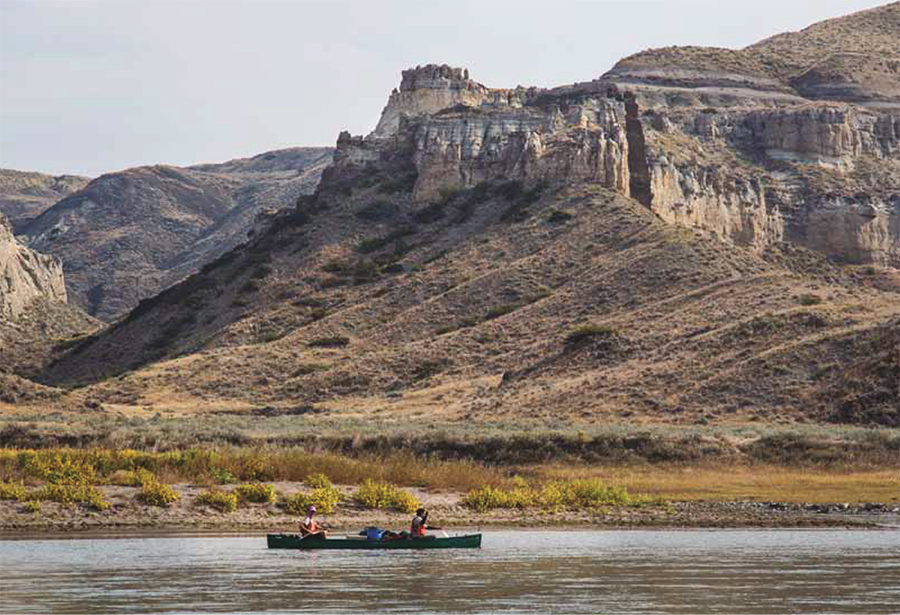
Glenn Monahan has outfitted raft and canoe trips on Montana’s Upper Missouri Breaks for 23 years. His business took off after then-President Bill Clinton declared the area a national monument in 2001, protecting a landscape that has been called an “American Serengeti.” But the region’s serene beauty is not what causes thousands of out-of-state tourists to book river trips. They come to see the national monument. If it were rescinded, Monahan doesn’t know what would happen to his business.
“We would still do everything we can to stay in business,” says Monahan, who employs six people, all native Montanans. His clients nearly all come from out of state.
According to a University of Montana study, tourism contributes $4.7 billion to the state economy, surpassing agriculture and all other sectors. Montana Gov. Steve Bullock, a Republican, supports access to public lands and reportedly lobbied Zinke to leave the Missouri Breaks monument alone. (As Paddling Business prepared for press, Zinke announced his department would not seek to change the monument’s status. Three other monuments had also been given reprieves as of August 9: Craters of the Moon, Hanford Reach and Grand Canyon-Parashant. Zinke’s report assessing all the monuments was due August 24.)
Small outdoor businesses aren’t the only ones threatened by the movement to transfer federal lands to the states. The biggest paddlesports outfitter in the United States also views the land grab as an existential threat.
OARS’s bread-and-butter is multi-day trips on iconic American waterways, including the Grand Canyon and the Middle Fork of the Salmon.The company also operates on the San Juan, a Class III desert canyon that marks the southern edge of the Bears Ears monument. The company specializes in the kind of paddling trips that change people’s outlook on life.
“It’s embedded in our culture to bring people into these places to help develop a sense of appreciation, so we’re constantly fostering new river and environmental advocates,” says Steve Markle, Vice President for Sales and Marketing at OARS. “Getting people down there to see these places is often what it takes.”
The outdoors lobby has always depended on the grassroots. The Conservation Alliance collects almost $2 million a year from member companies and distributes it to local activists. Now many of those activists are urging outdoor businesses to take a more hands-on role in conservation efforts, Cobb says. “They say, ‘We appreciate your funding, but far more impactful is when you can come to D.C. and advocate on our behalf.’ Because in the current political environment the business voice appears to carry more weight.”
Cobb travels to Washington about twice a year to lobby Congress and the executive branch. He says there’s a growing awareness in Washington that outdoor recreation has an important role to play in the overall economy. About half his visits are with members of Congress who support public lands.
Cobb says it’s important for those lawmakers to know businesses like his have their back on conservation issues.
Still, there’s no question conservation interests have been outgunned and outmaneuvered in the political sphere. American politics is a dirty and cynical process. Perhaps it’s time for the outdoor business to steal the playbook of the most effective player in the game, the National Rifle Association. The firearms industry has used money, a passionate constituency and a relentlessly single-minded focus to become one of the most feared and powerful lobbies in Washington.
Few dare to cross the NRA, despite the fact it represents a relatively small industry. The firearm trade association, the National Shooting Sports Foundation, produces an economic impact report remarkably similar to the OIA’s, straight down to the stock photos and bar graphs. What’s the difference? The gun folks claim only $51 billion in economic impact, to outdoor recreation’s $887 billion. The outdoor business is roughly 17 times bigger than the firearms industry, but when is the last time the outdoor lobby bounced from office a congressman who stepped out of line?
The NRA spent more than $36 million on campaign contributions in the 2016 election cycle. That’s a lot of money, but as James Surowiecki wrote in The New Yorker, “The NRA’s biggest asset isn’t cash but the devotion of its members.”
Surowiecki describes a study in which people who favor requiring permits for gun owners described themselves as more invested in the issue than gun-rights supporters did. Yet people in the pro-gun group were four times as likely to have donated money and written a politician about the issue. The outdoors has passion too. According to an analysis by the Center for Western Priorities, more than 98 percent of public comments on the national monuments issue support maintaining or expanding the amount of land under protection.
There are lessons here for those of us who care about wild places. The first is, money talks. If the outdoor industry truly wants a seat at the grownups table it must not only proclaim its economic power in flashy reports, it must wield it in the halls of Congress and the statehouses. The second lesson is to remember what we are fighting for and why it matters.
When Steven Quarles was a young staffer on the Senate Natural Resources Committee in the 1970s, there was talk of erecting a dam that would have flooded the Upper Missouri River Breaks, where Glenn Monahan now runs his outfitting business. The committee held a hearing on the river’s future in Montana. Afterward, Quarles and two other committee staffers paddled the Breaks with a Montana Fish and Wildlife ranger.
For several days and nights, the river champion said nothing about the potential impoundment, recalls Quarles, who is now a leading conservation lawyer in Washington. “Then on the last night around the campfire at sunset, he asked us to look up at the alpenglow near the top of a cliff face across the river and quietly said, ‘That’s where the water’ll be.’ I have never encountered a more powerful, truly heartfelt, and effective lobbying moment.”
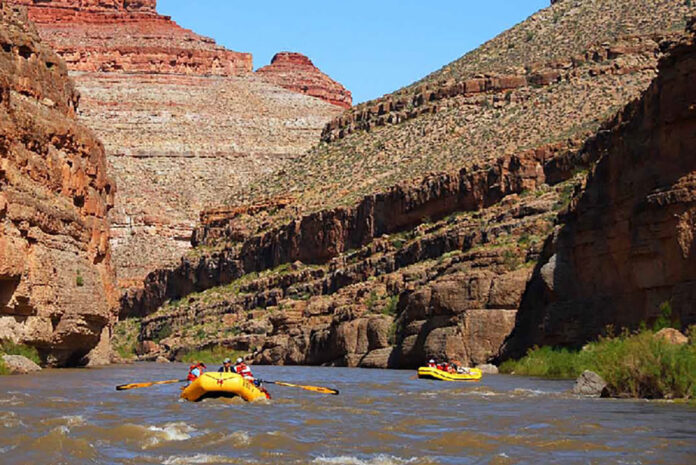
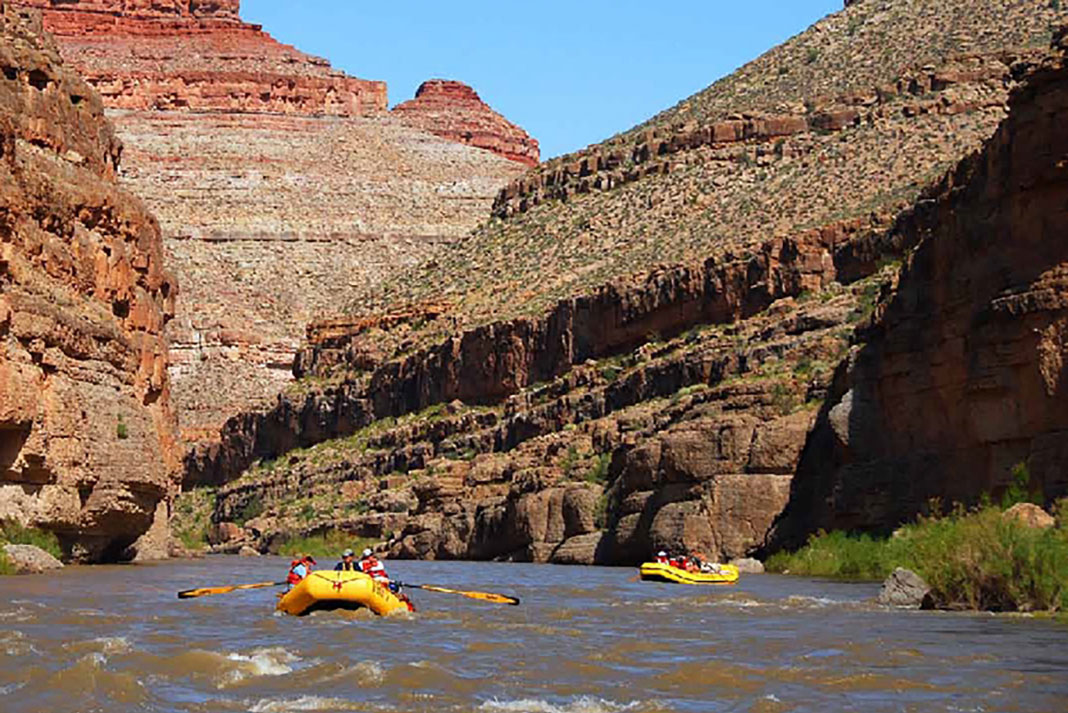
An Oars commercial rafting trip on the San Juan River, bordering the Bears Ears National Monument. | Feature photo: Courtesy David Hessell/Oars




