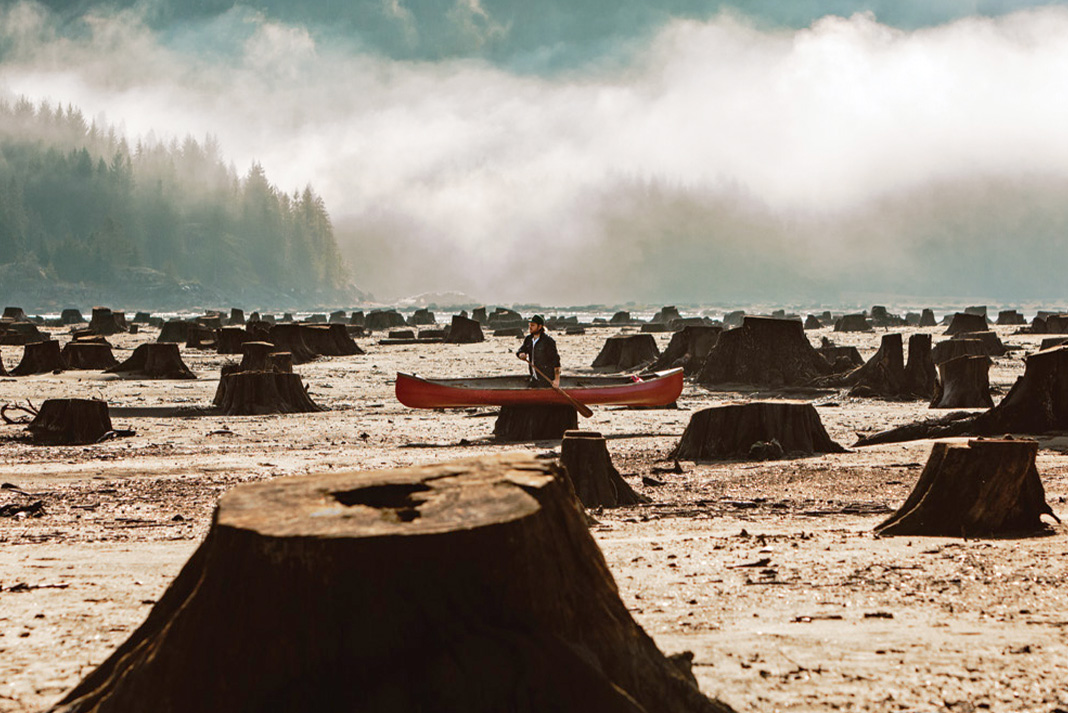
Walking on the bottom of Buttle Lake on Vancouver Island feels like walking through a graveyard. Instead of crosses and marble markers, there are one-ton giant stumps left as tombstones, their rings dating their origins back some 900 years.
More than six decades ago these trees were cut down to make way for BC Power Commission’s Strathcona Dam, harnessing a watershed more than 1,400 kilometers square. Today, that denuded forest floor is visible only when water levels are especially low. Usually canoeists only catch a glimpse of the ancient ghosts below as they paddle on the surface above.
I’ve put my canoe in the water here at the southern end of Buttle Lake many times. Each time I’ve been humbled by the giant firs on the shore at the access, and then by the apparitions that pass beneath my boat. Yet, it was when the lake was low that the most striking photos I have taken here were created.
Paradise Lost | Photo: Graeme Owsianski
I had come here to paddle and found a nearly dry basin instead. It felt unreal to be standing on ground that is sometimes several feet under water. Equally unreal was to imagine that half a century ago, this almost-dry lakebed was a pristine forest. I asked my friend to climb onto a nearby stump with the canoe and pretend to go for a paddle, freezing the surreal landscape and our experience in a single frame.
I’m not naive to the necessity of industry, yet this photo stirs a conversation about conservation. Stewardship of vulnerable ecosystems is crucial for the future. With less than 10 percent of old growth forests remaining on Vancouver Island, a fraction remaining around the world and logging continuing, these towering sentinels are becoming more and more endangered, and when they’re gone, it’s forever.
Graeme Owsianski is an outdoor adventure photographer based in Ucluelet, British Columbia. Discover more about endangered old growth forests at www.ancientforestalliance.com.
This article originally appeared in the Canoeroots Early Summer 2016 issue.
Subscribe to Paddling Magazine and get 25 years of digital magazine archives including our legacy titles: Rapid, Adventure Kayak and Canoeroots.
Moping around camp in a damp paddling jacket is poor substitute for shore-specific rain gear. The new Elite Cagoule offers decadent dryness in an ultralight (8 oz.), ultra-compact package. The secret lies in this cag’s extra-long cut and a sophisticated system of overlapping panels, awning vents and snaps that eliminate bulky zippers while maximizing coverage. $175 | SIERRADESIGNS.COM
Astral Rosa Flip-Flop
A technical flip-flop? You bet. Astral’s new Rosa (women’s) and Filipe (men’s) feature a removable heel strap to quickly convert from standard jandals to snug sandals for more demanding terrain. Combined with a non-slip foot bed and super grippy traction in and out of the water, we’re flipping out over these lightweight flops. $69.95 | ASTRALDESIGNS.COM
{loadposition PBG_AK_Midcontent}
Thermos Insulated Food Jar
Perfect for hot stew shore lunches, Thermos’ stainless double wall vacuum insulation keeps our afternoon pick-me-ups piping hot for up to eight hours. The 16-oz. food jar’s wide mouth makes it easy to stuff, scarf and scrub. The lid conceals a folding spoon, and doubles as an insulated bowl for your paddling buddy’s pity portion. $24.99 | THERMOS.COM
SOTO Helix Coffee Maker & Aeromug 450
Made in Japan using simple, elegant designs and gleaming metals, SOTO’s stoves and cookware are both functional and beautiful. Pop open the…
“SO WHAT SHOULD WE DO
NEXT YEAR?”
“I’D LIKE TO STERN.”
“CAMP OVER THERE.”
“BRING MORE BACON.” | PHOTO: SCOTT MACGREGOR:
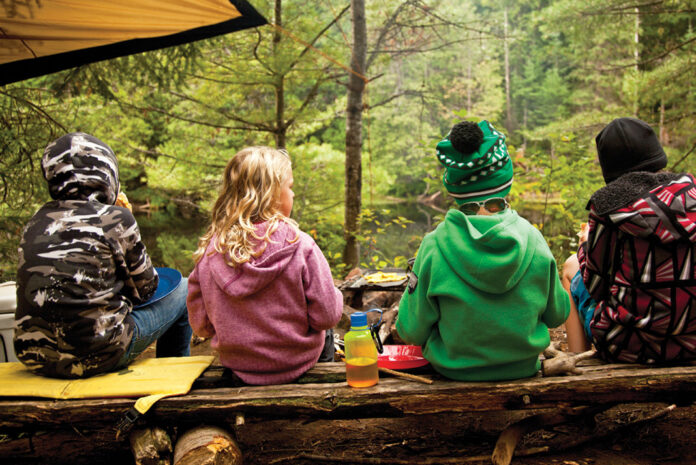
With so much focus these days on experiential learning, I sometimes feel to be a good parent I have to bombard my children with new experiences. Each new place and new activity adds to their memory banks, building their toolkits of knowledge so that the next new tidbit can be processed and filed in the appropriate neurological pigeon hole somewhere in the jam jars between their ears.
And so each spring, on Sunday mornings after we finish our pancakes, I pull out pen and paper to create a list of adventures we’ll have during that summer.
I have wild ideas. I propose rafting 21 days down the Grand Canyon. Flying in by de Havilland Beaver to Lady Evelyn Lake and seeing the ancient pines of Temagami. The five-month-long Kallin family hiking adventure is the type of thing I have in mind. Though hiking 2,185 miles of the Appalachian Trail through 14 states doesn’t fit between summer camp and the trade shows I attend for this magazine, it’s the type of grand adventure that I dream about when stuck in Chicago’s O’Hare International Airport at Terminal F, awaiting a delayed and overbooked 737.
More often than not, our kids write down places we’ve already been. They want to go back and do the things we’ve already done. I’m disappointed, so I bait them with my rich uncle game.
“If our rich uncle came to town and said we could paddle any river in the world, which would it be?” I ask. Again, they pick the Madawaska River, a 20-minute logging road shuttle from our home.
“SO WHAT SHOULD WE DO NEXT YEAR?” “I’D LIKE TO STERN.” “CAMP OVER THERE.” “BRING MORE BACON.” | PHOTO: SCOTT MACGREGOR:
If you flip through our family albums (who am I kidding, I mean click through our family albums), at a glance our first 10 years of memories look very much the same. It looks like we do the same activities in the same places, year after year.
Throughout university a climbing friend of mine had a poster on his wall of an old Indian and a proverb written below that read, “It is better to know one mountain than to climb many.”
The river the kids write on the list I have already paddled hundreds of times. I can close my eyes and picture every rock, every eddy and every wave I’d use to ferry a fully loaded canoe. This river is the reason we live where we do. I can see it right now sitting at my desk through the sliding glass doors of Canoeroots’ office. I tell my friends I know the Madawaska like the back of my hand.
I asked the kids why they like going down the same river over and over again. They said, “It’s not the same river.”
I asked the kids why they like going down the same river over and over again. They said, “It’s not the same river.”
Greek philosopher Heraclitus wrote, “No man ever steps in the same river twice.” He argued that change is constant, that everything in the world is always changing. Even a river that seems constant is always undergoing change. And so are our children. They are not the same as they were a year ago, a week ago, a day ago.
Looking more closely at our family photos, I see how Doug and Kate are bigger and stronger. They are paddling more and they are carrying more. They are now swimming further from shore and jumping from taller rocks.
Children are like the river that seems to stay constant yet is continually changing ever so slightly right before my eyes. They have been changed by their experiences and by every trip down this river.
And so, on the list on the refrigerator is written a new river: the Madawaska River. It is better to know one river than to paddle many.
Scott MacGregor is the founder and publisher of Canoeroots. On his fridge there are now two lists: one for new adventures and another for family traditions.
This article originally appeared in the Canoeroots Early Summer 2016 issue.
Subscribe to Paddling Magazine and get 25 years of digital magazine archives including our legacy titles: Rapid, Adventure Kayak and Canoeroots.
REMEDY #2: FIND YOUR NEXT FIX. | PHOTO: MIKE MONAGHAN
Trips to the wilderness are supposed to revitalize us. That’s why they call it re-creation. So why, after a week of paddling, do I feel so restless and irritable the moment the trip is over?
I’m not the first adventure-seeker afflicted by wicked post-trip hangovers. Paul Caffyn described a similar depression after he kayaked around Japan in 1985. “The worst side of sea kayaking for me was the immediate period following a successful trip,” he noted. “It was not one of elation and satisfaction, as you might expect.” Instead, Caffyn’s sudden lack of purpose left him feeling adrift.
I’ve even suffered from hangovers following weekend-long trips. After two or three days of steady exercise, nature and simple rhythms, I walk through my front door and quickly feel overwhelmed. I’m simultaneously trying to return to the outdoors, catch up with friends, clean my gear and read email. It’s a potent cocktail of regret, frenetic activity and fatigue.
Re-entry is abrupt. I remember talking with a paddler who finally arrived home after 1,500 miles and months away. Shifting his mindset from monitoring the tides to tracking the flood and ebb of Seattle traffic, he said, was the hardest transition of his life.
In the wilds, we return to our hard-wired evolutionary origins: small bands of nomads wandering an ecological landscape. In my kayak, I’m doing what our ancestors did on the plains of Africa. Of course checking email feels weird.
Pulling up to that last beach also adds social disruption. We’re suddenly among people who haven’t shared our experience. As a kid growing up near Manhattan, I returned from my first backpacking trip to the Rockies exploding with stories of jagged peaks, steep alpine passes, cobalt blue lakes and snow in July. The kids on the block weren’t impressed—they had their own experiences hanging out in the neighborhood. While you’re adventuring, others are simply getting on with their lives.
REMEDY #2: FIND YOUR NEXT FIX. | PHOTO: MIKE MONAGHAN
Snow specialist Matthew Sturm, veteran of Arctic science expeditions, describes returning from the Far North in blunt terms: “Your place has been filled like water smoothing the surface of a pond…returning from an expedition is a chance to see how little your world would change if you died.”
Transformational experiences matter to the people who have them, but are puzzling to everyone else. That’s why outdoor adventurers are so tribal: we seek people who understand our experiences even if we haven’t had them together.
The cure for a trip hangover probably isn’t longer or more frequent trips. Most of us struggle to clear decks for a two-week vacation—turning ourselves and our families into Kerouacian wilderness vagabonds isn’t likely. If we can’t spend more time in the wilds, we have to figure out how to keep the simplicity and clarity of the wilds with us when we return.
I once had a boss who spent her career studying wildlife. She lived next to a river where animal tracks and birdsongs were part of her daily life. When she moved into an urban condo, she began her day by opening the window and listening for whatever birds were singing. She kept a journal of nature observations as detailed as the one she’d kept by the river.
My own ritual is sitting on my front porch in the morning with a cup of coffee, regardless of weather, simply to feel the outside air. It’s not the same as coffee on a remote beach days’ paddling from another soul, but I find it helps. Trip hangover is a kind of heartache, and as Stephen Stills sang: If you can’t be with the one you love, love the one you’re with.
Neil Schulman celebrates kayaking’s diverse heritage in Reflections.
This article originally appeared in Adventure Kayak Early Summer 2016 issue.
Subscribe to Paddling Magazine and get 25 years of digital magazine archives including our legacy titles: Rapid, Adventure Kayak and Canoeroots.
Venturing off into the wild unknown with furry best friend in tow is a dream for many paddlers. Often, the reality falls somewhat short. Untrained, a canine canoe tripper is likely to disrupt your tranquil experience by barking during wildlife observations, dashing after chipmunks along portage trails and anxiously awaiting the return to shore.
Dogs aren’t born to act like stalwart Lassie, but you can train this behavior. A patient, controllable and confident dog will complement any on-water adventure. All that’s necessary to prepare a dog for canoeing is a bit of specialized training and a proper introduction to the activity.
LAYING THE FOUNDATION
To ensure your dog is ready to board a canoe, ask yourself whether your student can sit patiently and quietly for more than 10 minutes while you sit beside the dog. Often sitting down beside your dog results in a happy and playful response, which will be unwelcome afloat.
With both you and your dog sitting on the ground, provide distractions. Toss balls, have children run about, move a paddle side to side and then pass it over the dog’s head. Distractions will appear while paddling and your dog must ignore them. This stillness without restraint will take practice.
If your dog is easily excited by simple distractions, spend more time working on foundational obedience skills before paddling together. If your dog is able to remain quiet and calm, you’re ready to introduce the canoe.
WHEN HAIRY MET SALLY
Start by introducing the craft on land. Stabilize the canoe and teach the dog to confidently enter and exit on command. Many dogs won’t want to lie down in the craft and limit their field of vision until they feel more comfortable, and that’s okay.
Next, sit down in your boat with the dog and mimic paddle strokes. Tilt the canoe side to side to simulate movement. Exit the canoe and walk away, ensuring your canine pal stays in the boat. The dog should not exit until told to do so. Consider where the dog will sit to distribute weight properly with passengers and gear and teach the dog that this is his place. Have your dog repeat entering, exiting and waiting in the boat several times over different training sessions before moving to the water.
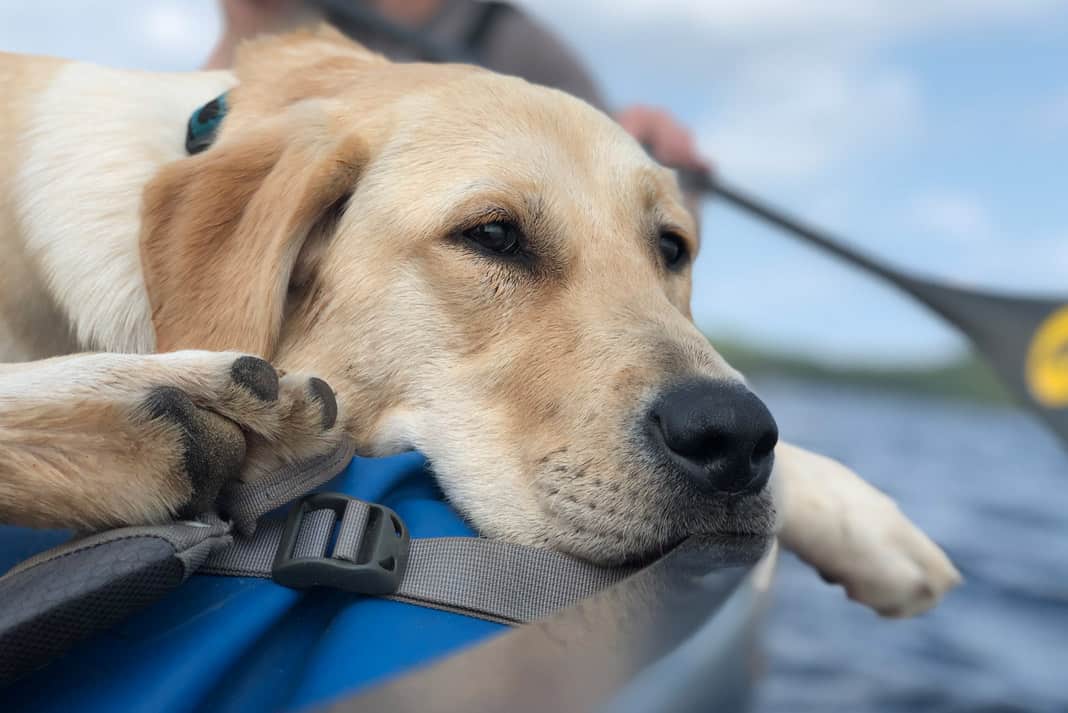
Love is a four-legged word. Aspen on Big Trout Lake during a weeklong trip in Algonquin Provincial Park. | Feature photo: Kaydi Pyette
WATER WORK
Move the lessons to shallow water and repeat entry and exit etiquette. Sit in the canoe, rock it gently and pass your paddle over the dog’s head. Add more movement by stepping out and gliding the canoe by hand around in the shallows. Dogs often react when the canoe hits a rock or the shore so practice pulling ashore while encouraging the dog to remain still as everyone exits. Reward good behavior verbally and with an occasional treat. You want the dog to associate the canoe with positive experiences.
After a few training sessions in the shallows, you can take to the water with a confident dog. Paddle on calm water before venturing too far from shore. Enter current only with sufficient river skills—a capsize in whitewater could easily turn a dog off of water adventures for life.
EXTRA TIPS
Some canines are not brilliant swimmers and even the best have limited endurance, so put a PFD on your dog. Never leave a loose-fitting slip collar or a long lead on a dog on the water because a capsize could result in the dog becoming entangled in gear or debris. Also, condition your dog to swim alongside the craft as if at heel. In an emergency situation the dog should be accustomed to staying with the canoe even if swimming is required.
Mike Stewart is one of the most sought-after dog trainers and breeders of sporting Labrador retrievers in North America. www.uklabs.com
This article originally appeared in the Canoeroots Early Summer 2016 issue.
Subscribe to Paddling Magazine and get 25 years of digital magazine archives including our legacy titles: Rapid, Adventure Kayak and Canoeroots.
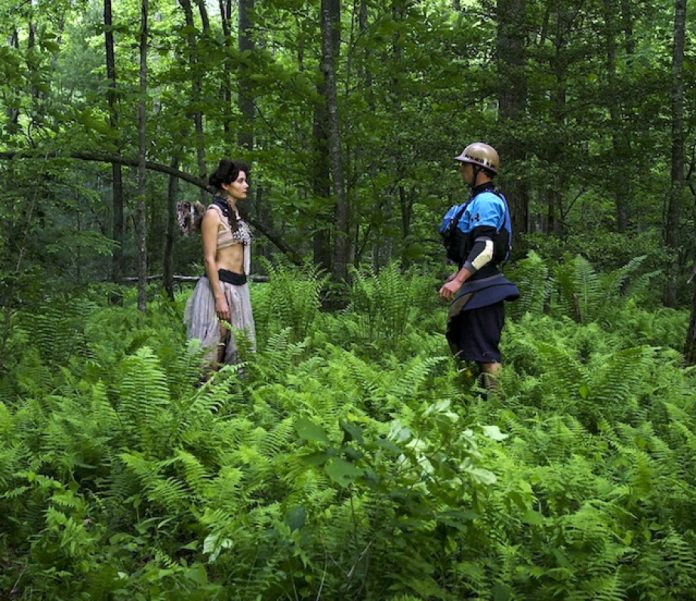
Pat Keller and a fairy face off in Steve Fisher's "With You" film.
Steve Fisher’s With You, part of REDirect’s Explore 2016
Video: Steve Fisher
Steve Fisher found himself in new territory as a filmmaker as he stood in the middle of the forest with spray skirt and helmet-clad Pat Keller and directed the kayaker to close his eyes and imagine he was there with a fairy.
The scene is part of With You, Fisher’s entry and one of eight films in the REDirect Explore 2016 contest that features captivating outdoor lifestyle stories.
Fisher, an accomplished expedition kayaker and filmmaker, was paddling North Carolina’s Green River several years ago with Keller when someone said, “Pat Keller knows this river so well he could run it blindfolded.” He asked Keller if that was true, and when he said yes, Fisher told him if he ever did he wanted to be the one to film it.
Over a three-year period Fisher and Keller shot some scenes together that centered around the idea of Keller—then working full-time in finance—bringing some of his work and experiences on the river with him. By the time Fisher was asked to enter the REDirect Explore contest, the idea for the eventual film had been evolving for three years.
The deep storytelling of the film is centered around the idea of Keller entering an enchanted wonderland and facing his worst fears while kayaking a set of Class V rapids blindfolded. As he confronts his demons, the narrative flows with poet Holly Coddington’s beautiful words read aloud by Sara Alford.
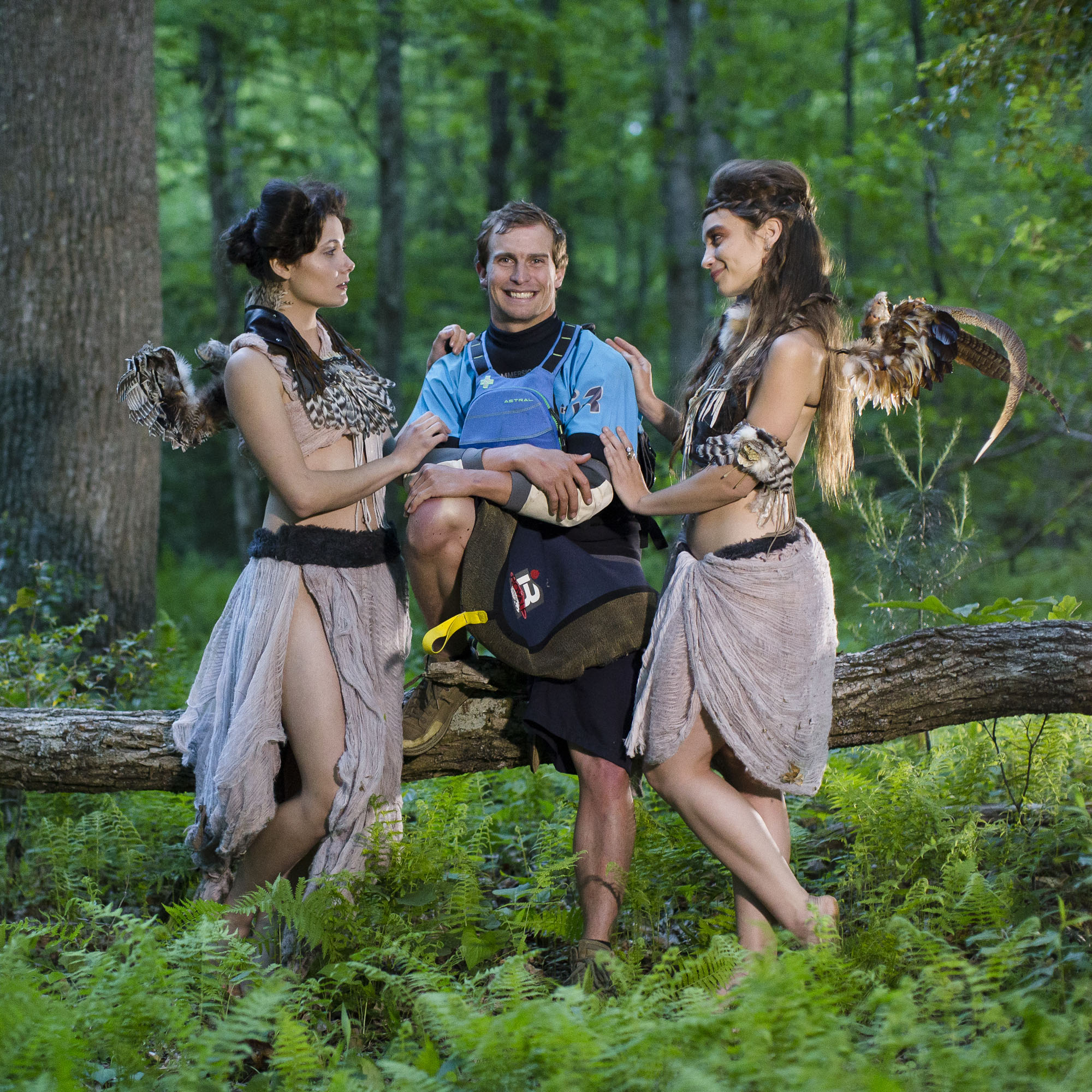
Pat Keller with cast on the set of With You. Photo: Steve Fisher/With You
Fisher struggled to find the right person to read the poem, and despite having multiple people do the voice over, it just didn’t sound right. The day before the clip was to be postmarked, his dissatisfaction led him to commit to not to submitting the film to the contest at all. “You wouldn’t believe the level of stress that built up,” he says. Right before the deadline, Fisher’s wife suggested he contact Alford, a musician they knew. They managed to find a narrow slot of time at an in-house studio, and a half hour and two takes later, the voice over was completed just in time.
Fisher was enthusiastic about Keller’s involvement in the project because of their history working together and Keller’s open-mindedness. He says Keller is incredibly in-tune with what he wants as a filmmaker, to the point that while hiking with his kayak he knows precisely where his foot should land in the shot. Directing eleven people he hadn’t worked with before, including the fairies and fire breathers, was a learning experience, especially explaining to them their emotional motivations in each shot.
The many different elements involved in the production led Fisher to work with a lot of efficiency, including laying the film’s seven tracks before a single scene was shot. An immense amount of thought went into each element of the film, including the beginning being composed in an aesthetically simple way, shot all mid-focal length, in real-time with the footage becoming increasingly more varied and complex as the four-and-a-half minute clip progresses. Combined with color grading changes and plot twists, this is a serious departure from your standard kayaking film. And for Fisher, that’s his style. “I’m willing and keen to be a little more out there with all the filming I do.”
Voting for the REDirect Explore 2016 contest closes August 8 and you can view all videos here.
Stoked to go on your own whitewater adventures? Explore our Paddling Trip Guide.
At the dawn of the new millennium, whitewater was having an identity crisis. River running, in the face of ever-evolving freestyle, was becoming incredibly uncool. Pro-Tec full coverage helmets, Salamander geek beak visors, striped polypro long underwear and woolen socks in Teva sandals. We were safe and we were warm, but goddamn we were ugly. I’m okay with ugly, but ugly and outnumbered is a serious problem.
In 2000, I coined the phrase whitewater freeboating. I had hats made and the term appeared on the cover of this magazine.
As I saw it, for whitewater to survive long-term we needed to make river running cool again. Like freeskiing was the new movement of all – mountain skiing, freeboating, as I proposed it, was top to bottom with play along the way. The name didn’t stick around but the concept did.
I was thinking about this last fall as I met up with a group of freeboaters. They were checking straps and pacing to keep warm. The temperature was hovering just above freezing, appropriate conditions for an annual gathering dubbed Chill Fest.
This paddling club has no elected president, no treasurer, no secretary and no fundraising bake sales. It is free to join. Joining—and I use that term loosely—puts your name on a mailing list used only to coordinate four weekends per year. To be removed from the list there is a $100 membership fee. To date, this river running whitewater club has never lost a member.
Chill Fest is nothing more than a river, a few suggested hotels, a Saturday night dinner and, ideally, cheap beer. Whoever shows up, shows up.
We meet at a general store, a parade of floats piled high with boats of every color, shape and size. I know a couple folks, recognize a few more faces. A round of handshakes and complete strangers begin mocking me for living the closest and being the last to show up.
FREEBOATING REVIVAL.| PHOTO: TEGAN OWENS
Mike McCaffin is a lab technician here with his teenage son. There are teachers, two husband wife teams and a couple university students who should be studying for exams. There are creek boats, freestyle kayaks and everything in between. At Chill Fest anything goes.
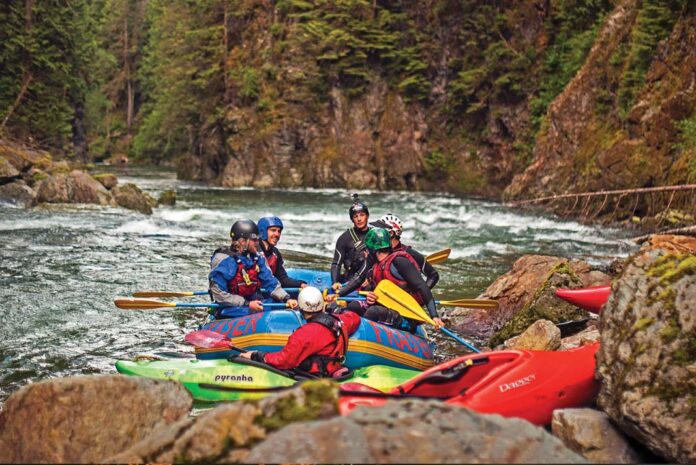
I’m testing the new Silverbirch Covert 9.3 Some guys practice bow stalls in the flats and two kayakers don’t have whitewater rolls. They swim all the sets they don’t carry around. We all put in at the top and make it to the bottom. This is exactly what I was talking about. This is freeboating.
Around the parking lot campfire we joke like old friends. As drysuits change into Carhartts and puffy coats, the fire burns up and talk turns to who has the longest drive home. We pile into each other’s cars for the ride to the top. The sweet smell of wet gear wafts from mesh bags, chipped paddle blades rub against my shoulder. Van Morrison sings, “Into the Mystic.” It occurrs to me that all these years we’ve been asking ourselves the wrong question.We’ve been asking, what does the future of whitewater look like? We should have been asking, what does the future of whitewater sound like?
The answer is not cowbells and roaring crowds. The future is not live streaming coverage from a concrete ditch in Rio. It’s not the roar of twice as many hydrogen as oxygen molecules crashing 198 vertical feet somewhere in the state of Washington. The future of whitewater sounds just as it
always has. It sounds like, “Hey [name of friend], want to run the [section of moving water] this weekend?”
Scott MacGregor is the founder and publisher of Rapid. He’s been wearing the same ugly shorty paddling jacket since forever.
This article originally appeared in Rapid Early Summer 2016 issue.
Subscribe to Paddling Magazine and get 25 years of digital magazine archives including our legacy titles: Rapid, Adventure Kayak and Canoeroots.
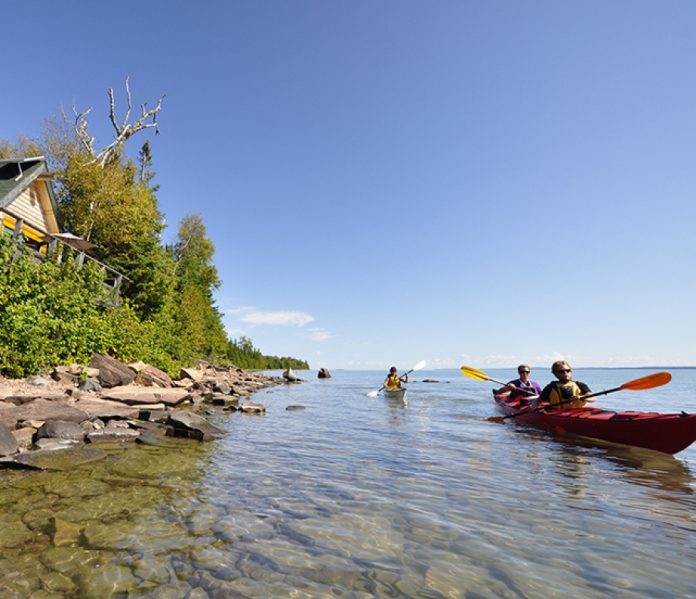
Kayakers enjoy paddling on an Ontario lake. | Photo: Ontario Tourism
1. What style of kayak should I rent?
Different types of kayaks may all look pretty similar to the newbie, but there are actually multiple different kayak designs intended for specific conditions and paddling styles.
For example, recreational kayaks are wide, and their stability makes them a good place to start for the new paddler. If you are renting a kayak for a few hours on a calm lake, this will be a good choice.
If you are renting a kayak for a longer trip, especially one in rougher or more open water, touring kayaks will be best. Touring kayaks have more space to store food and gear, and they are significantly longer and narrower than recreational kayaks. You will notice that many also come with a rudder or a skeg attached to the stern, a feature we will cover below.
Touring kayaks come in different sizes. Some are for multi-week expeditions and therefore much longer with extensive storage, while day touring kayaks will be shorter.
Sit-on top-kayaks feature a low, wide seat, and you don’t have the option of using a spray skirt. They are extremely stable due to a wide design. If you are a nervous kayaker, kayaking with a child, are a beginner or want something to fish from, they can be a great choice. With a sit-on-top kayak, you will be more exposed to the sun and water.
If you’re still not sure which kayak to rent, tell the outfitter about your trip. They’ll be able to recommend the best boat for you.
2. Do I want to kayak solo or tandem?
One of the more basic questions you should ask yourself before you rent a kayak is whether you want to paddle solo or tandem. The names are self-explanatory— solo kayaks are for one paddler and tandem kayaks are equipped for two.
Renting a tandem kayak can be a good choice if you or your paddling partner is nervous and the experience would be more confidence boosting with a buddy. Tandem kayaks can also be great if you are paddling with a child who isn’t ready to kayak alone.
If one kayaker’s ability or strength means they won’t do well paddling a solo kayak, having a stronger or more capable tandem partner is key. Some experienced kayakers also simply enjoy the companionship and teamwork that a tandem provides. See tandem kayaks here.
A solo recreational kayak offers more independence and freedom, and the paddler is solely responsible for the direction and performance of their boat.
Don’t worry about making the wrong decision. The beauty of renting kayaks is that you can try both. If paddling with your friend or partner doesn’t work out, the next time you go kayaking you can both try a solo boat.
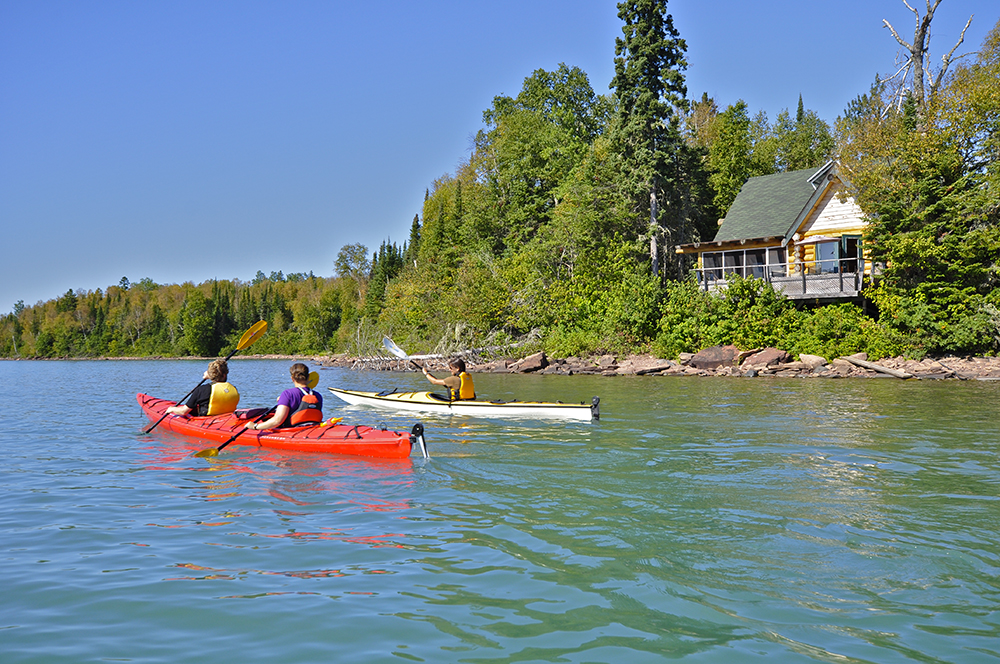
Bring a friend or do it yourself, kayaking is fun every which way. | Photo: Ontario Tourism
3. Do I want a kayak with a skeg or a rudder?
When you go to rent a kayak, you may have the option of choosing between a kayak that has a skeg and one that has a rudder. What are skegs and rudders, and what is the difference between them?
A skeg is a blade that comes down from a compartment near the kayak’s stern. A cable that the paddler can adjust from inside the cockpit, usually positioned by their leg, controls the depth that the skeg drops into the water.
The purpose of the skeg is to aid tracking and control the influence of waves, wind, and current on the kayak by allowing the stern to better stay in place on the water.
A skeg can aid tracking and trimming for wind, but doesn’t aid turning. Since you can use the cable to control how much of the skeg is actually in the water, you can adjust how much control you need based on conditions. View kayaks with skegs here.
Some people prefer skegs to rudders because of their simplicity. Skegs have less moving parts than rudders, and if your kayak rental day will be one of your first paddling, it may be good to keep it simple and avoid spending time dealing with learning how to use a rudder.
A rudder differs from a skeg because the paddler can move it side to side in the water. A rudder is usually outfitted to the stern of a kayak, with cables that connect to foot pedals the paddler controls with their feet from inside the cockpit.
Rudders are good for controlling the direction and if used properly can decrease the amount of time you need to spend using correcting strokes. A rudder can usually be flipped out of the water if the paddler doesn’t need or want to use it.
If you are renting a kayak to work on your beginner strokes and develop basic skills, you may want a kayak without a rudder to avoid relying on it instead of learning the correct techniques for turning.
Once at your kayak outfitters, ask about the specific mechanisms of the skeg and rudder systems on their kayaks, as they can vary depending on the age and make of boats.
4. Once I rent a kayak, will I take a lesson, be guided or paddle by myself?
Renting a kayak is simply a means to get you on the water. You will need to decide what you want to get out of the experience. Many places that rent kayaks will also offer lessons, ranging from beginner lessons to advanced and skill-specific clinics.
Even if you are an experienced paddler, combining a kayak rental with a lesson can help you greatly enhance your capabilities. You also may be able to have a lesson for half of the duration of your rental period and free paddle for the remainder.
If you want to explore but you aren’t quite ready to do so yourself, your kayak outfitter may also offer guided trips. Renting a kayak and then going on a guided tour, whether it is for a few hours or a week, can allow you to get instruction, learn about the area’s environment and history and enjoy the beauty of a new place.
If you are experienced in kayak touring, you may rent a boat and then go paddling on your own. You can use your kayak rental shop as a resource. Some may offer trip plans, pack your food for you, rent additional safety and equipment and shuttle you back from your take-out.
5. How prepared am I to go kayaking?
While renting a kayak, paddle and spray skirt may seem like the essentials for hitting the water, there are many other considerations to make sure you and your paddling partners are safe. If you decide to forgo the aforementioned guide or lesson, it is essential you are well prepared. Here are steps to make sure you stay safe on the water.
A float plan outlines all the details about your trip you want someone to know in case something goes wrong. It should include the full names of those on the trip, the make and colors of each member’s kayak, emergency contacts, launch time and location, your route, intended campsites, and map coordinates and the intended take out place and time.
This plan should be printed out and left with a reliable friend or an outfitter. Even if you are only going for a day, it’s good to leave an abbreviated version of this especially if you are in a new area.
Boat safety kit
Like in all outdoor activities, there is always the chance something can go wrong. In addition to your kayaking PFD, a safety kit onboard should include a whistle, a floating rope, a bailer or pump, a flashlight, flares, an extra collapsible paddle, and a compass. For longer trips, a VHF radio and GPS are a good idea too.
Maps and an understanding of the area’s water
Even if you are only taking your kayak rental out for an afternoon, ask the outfitter for a map in a waterproof case to take along. It is surprisingly easy to get lost in certain areas, especially when you are unfamiliar. If you are renting a kayak to go sea kayaking, speak with the rental company about the tides and currents and look at a tide chart if you know how to read one.
6. Have I made sure everything on the kayak is in working order?
Most rental shops and outfitters are honest and qualified, but before you take your rental kayak out use this checklist to ensure you don’t get dinged for damage you weren’t responsible for or find problems once your journey is underway.
— Check for dents, scratches or gouges on the hull and sides of the kayak. Scratches and minor dents are normal on a kayak, but a gouge or a major dent will affect the seaworthiness and function of the kayak.
— Make sure the outfitting inside works properly and is not damaged.
— Test the skeg or rudder if applicable to make sure cables and all parts function properly.
— Make sure your skirt doesn’t have holes or rips and the grab loop is intact.
— If your kayak has hatches, check they open and close properly.
— Check the deck rigging is in place, especially if you are going on a long trip and will want to have your map attached and in front of you as you paddle.
— Lastly, make sure at all times you have a PFD, either your own or rented along with your kayak and paddle.
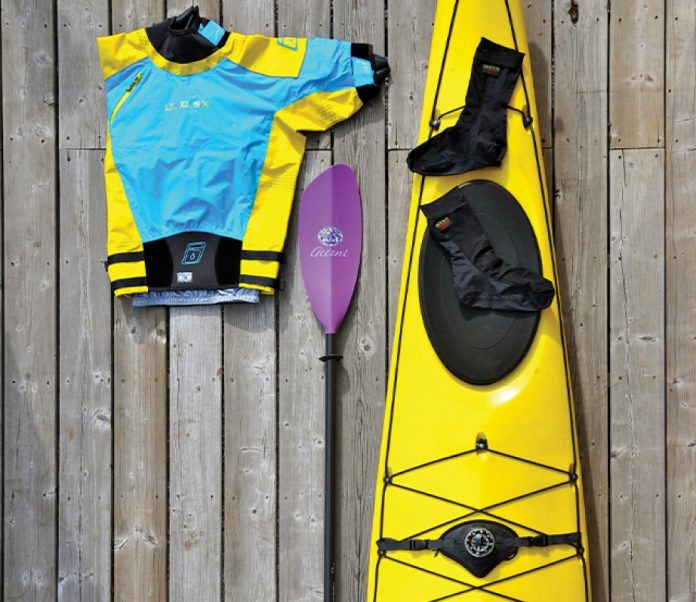
The short sleeve version of Level Six’s legendary Mack dry top gets updated for 2016, with new eye-catching colors and lighter 2.5-ply breathable fabric on the chest and back to keep us looking and feeling cool on hot summer days. Rolling geeks and rough water paddlers will appreciate the addition of latex bicep gaskets for an even dryer fit. $309.99 CAD | LEVELSIX.COM
Accent Paddles | Moxie
The Moxie’s funky purple blades are ample incentive to treat ourselves to this budget- friendly paddle, but pragmatists will find plenty of other great reasons. Pairing a carbon shaft with fiberglass nylon blades, the Moxie is stiff and surprisingly light. The mid-angle blades are perfect for all-around touring, and we love Accent’s Kingpin ferrule adjustment system—one of the slickest designs we’ve tested, providing a snug one-piece paddle feel. $159 | ACCENTPADDLES.COM
{loadposition MidContent}
KaYoke
Would-be interior kayakers have a champion in inventor and entrepreneur Scott Gill, who devised this clever universal portage yoke as a solution to backcountry kayaking’s biggest problem: carrying the damn boat. The KaYoke attaches to the cockpit coaming so paddlers can shoulder their boats across trails and terrain too rugged for a wheeled cart (caveat: you’ll want to empty heavy gear out of your hatches first). Clunky DIY versions notwithstanding, Gill’s compact, folding design is an overdue first. $119 CAD | WWW.THEKAYOKE.COM
Rocky | Gore-Tex Waterproof Socks
Soggy dogs are a familiar paddling discomfort, but they don’t have to be. We love pairing these stretchy Gore-Tex socks with wool socks and our favorite river shoes for dry and toasty toes. Goodbye booties. $64.99 | WWW.ROCKYBOOTS.COM
Seattle Sports | Sea Rover Deck Compass
While we think reliable navigation is a necessity rather than a luxury, the Sea Rover is a no less elegant solution for kayaks without a built-in compass recess. Quick-release buckles attach securely to decklines and the compass dome’s bold markings are easy to read even when mounted near the bow. $38.95 | WWW.SEATTLESPORTSCO.COM
This article was originally published in Adventure Kayak, Volume 16 • Issue 2.
STEEP TOPOGRAPHY TURNS
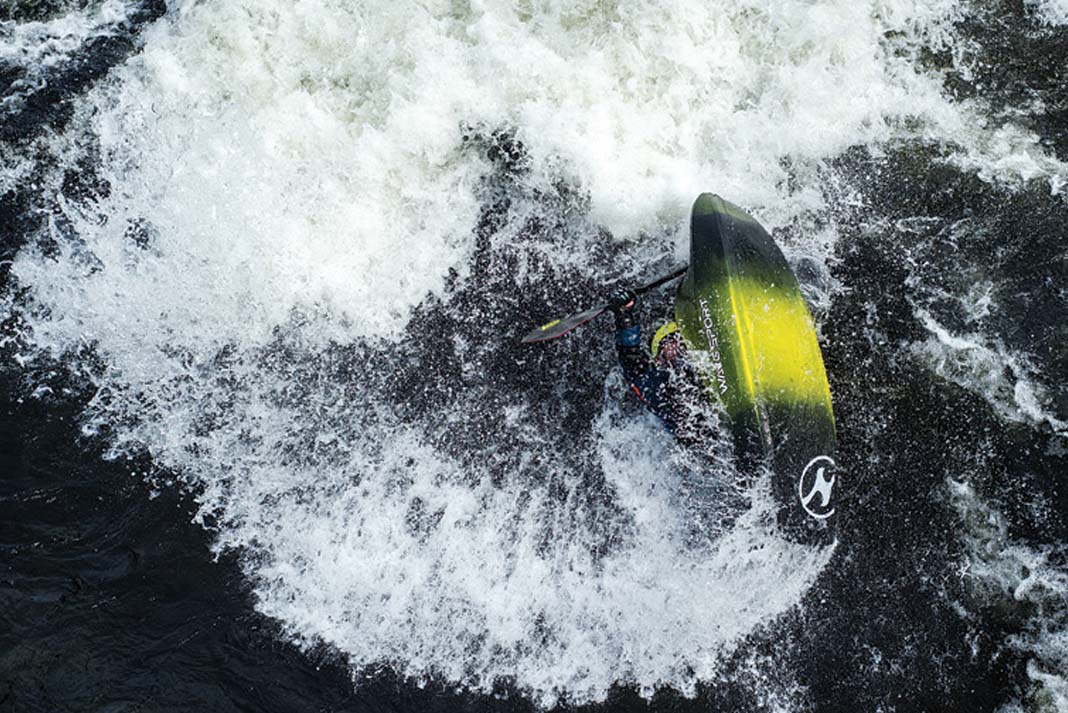
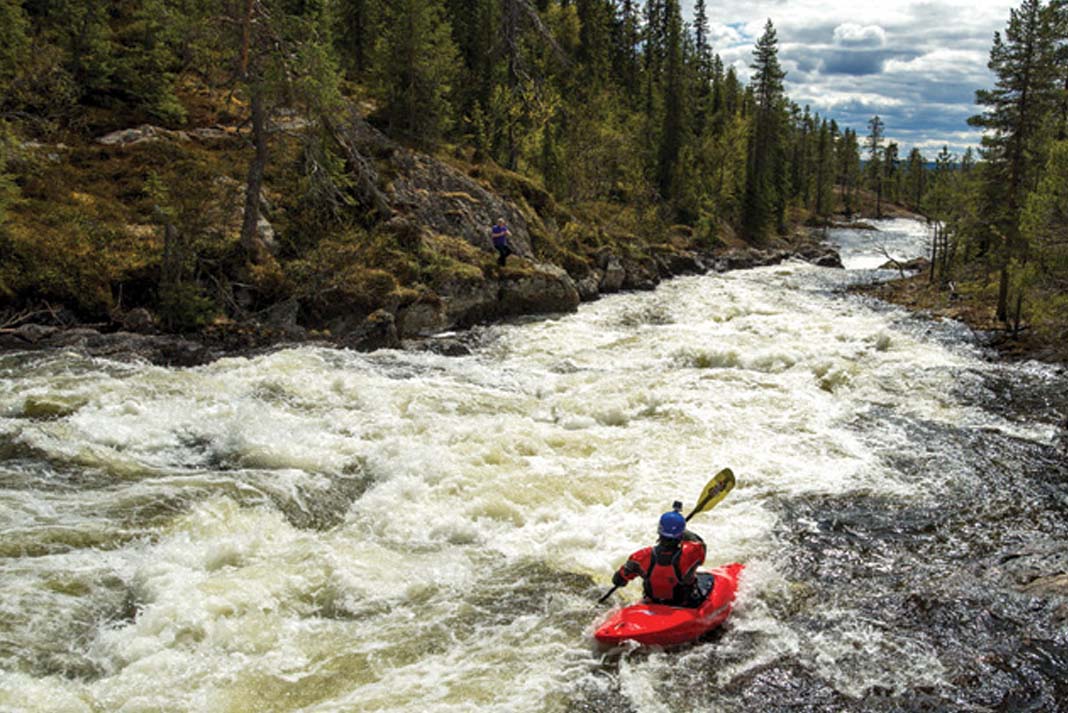
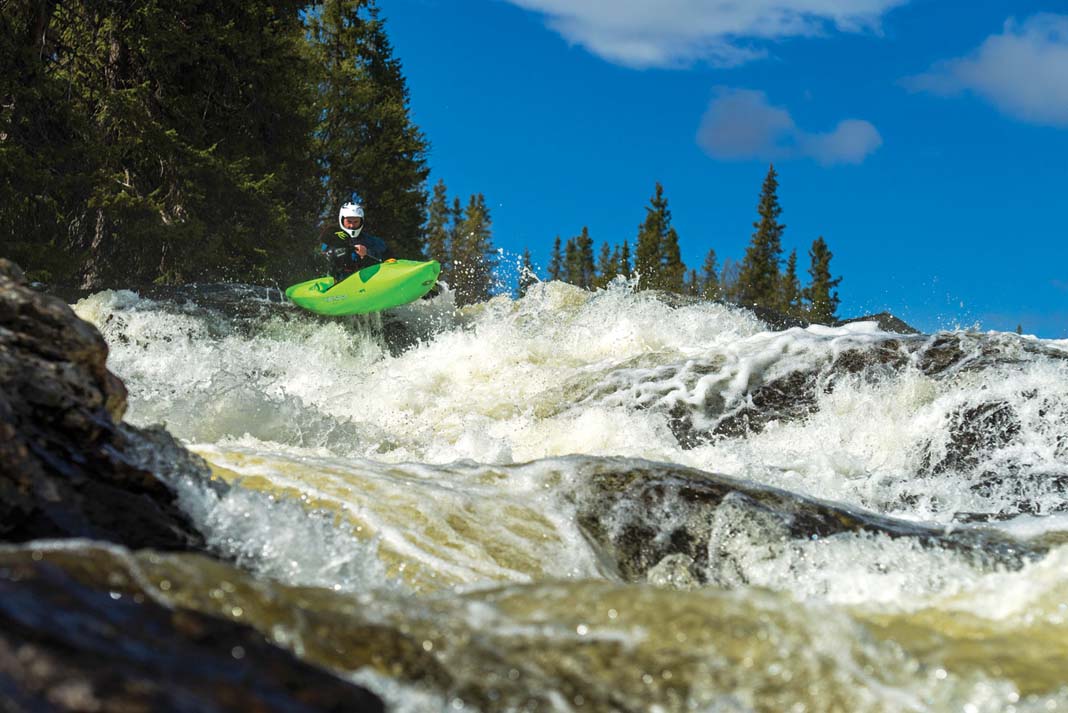
SMALL STREAMS INTO CLASS V CREEKS. | PHOTO: SCOTT MARTIN
Windblown snowdrifts dappled by the soft light of the midnight sun make the winding, wilderness roads of rural northern Sweden look like a painting from the front of a Christmas card. Instead of a tree tied to the roof, this car carries bright green and red kayaks.
Tyler Curtis slams the brakes as a reindeer wanders out of the forest and into the road. “Is that real?” asks Scott Martin, from the passenger seat.
The outskirts of the quiet mountain town Kittelfjäll couldn’t feel further from home.
Growing up in South Africa, Martin spent holidays at the beach—the reindeer may as well have been a unicorn.
INTRODUCING HIDDEN GEMS TO THE WHITEWATER WORLD
It’s springtime in Sweden. Buds are bursting open on roadside aspens, giving the forests a fresh and fuzzy, deep-green coat. Snow banks linger in town and there’s still a sprinkling in the mountains, but Curtis is packing his skis away.
A five-time Canadian National Champion kayaker, Curtis has traveled the world, winning extreme races and freestyle events. He moved to Kittelfjäll, Sweden, in 2011 with his partner, Lisa, to start a family and live, work and play in the mountains of Scandinavia’s North. The lifestyle allows them a seasonal migration back to Canada with their newborn daughter, Tove.
After spending a few winters charting undiscovered rivers carving through northern Sweden’s mountainous landscape, Curtis is itching to introduce the area’s gems to the rest of the whitewater world.
Just kilometers to the west is Hattfjelldal, the region in Norway that has become a mecca for elite paddling, drawing crowds of traveling kayakers and exploding in popularity in recent years. While Norway has larger cities near the Swedish-Norwegian border, most of Sweden’s population centers are far to the east along the coast or in the country’s interior.
A FREESTYLE STOP BETWEEN CREEK RUNS. | PHOTO: SCOTT MARTIN
“As soon as you cross the border, it feels a bit like the Wild West,” says Curtis. The isolation of the region means few paddlers bother to make the hour-long drive into northern Sweden’s little-known class V playground.
Curtis wants to change that.
“I’ve been testing out water levels for a couple springs now,” he says, “and getting beta from paddlers here in Sweden.”
This trip with Martin is the first time a friend from outside of Sweden has flown in to kayak with Curtis, and their mission is clear: paddle and document the region’s untouched whitewater to make it more accessible for the international kayaking community. Martin, a seasoned whitewater photographer, is the perfect partner in crime.
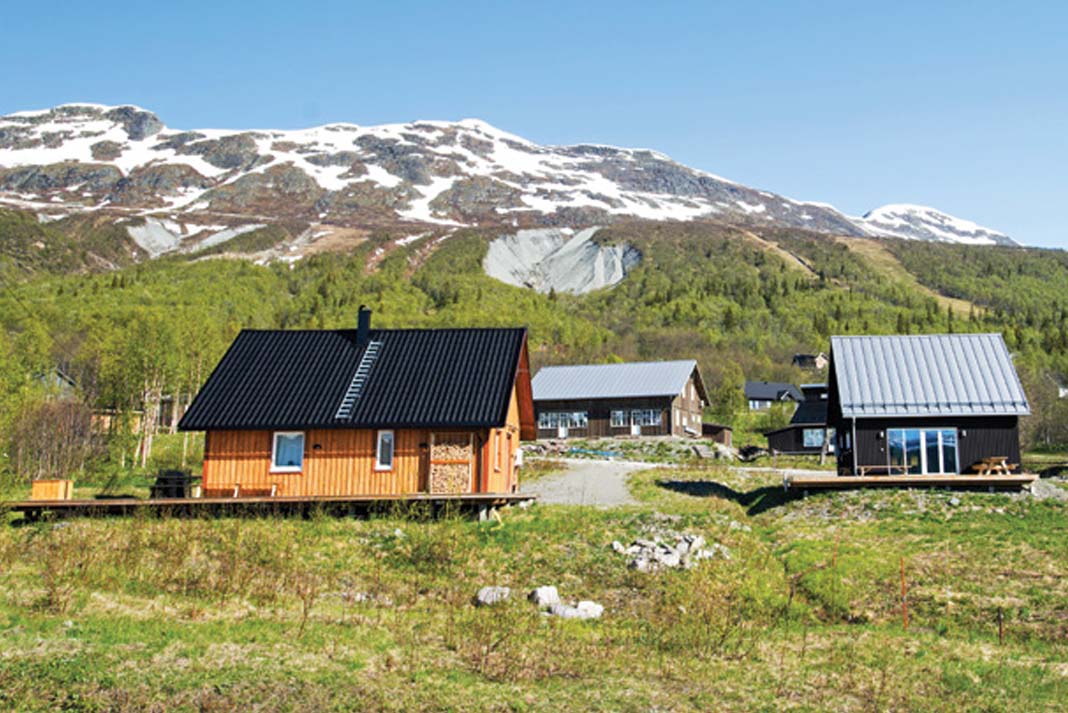
The steep sides of Kittel Mountain meet the small town of Kittelfjäll near the tree line, where traditional red-painted timber cottages are scattered amongst the lanky birch and spruce. Fishing, hunting and reindeer herding are primary activities for the hundred yearround locals. To the rest of the world, Kittelfjäll is known as a ski town. Winter tourism plays a major roll in the town’s economy, with a resort that employs locals and draws an influx of out-of-town employees and customers during the ski season. With no real downtown, Kittelfjäll contains a couple scattered stores, the rustic Hotell Kittelfjäll and a single restaurant serving quality local food. One lonely road curves through the village and valley with a gas station and general store aptly named SistaUtposten—Last Outpost.
“Kittelfjäll is the epicenter of the mountains,” says Curtis, “and it’s my home.” Using his cabin, a typical Swedish-style clapboard cottage, as home base, they are able to eat well, dry clothes and keep camera gear charged. Natural light floods the cabin where Curtis and Martin sit with maps spreadout on the thick wooden dining table. This is how they plan their whitewater exploration of the surrounding South Lapland area. The potential for paddling is greatly defined by geography. The varied topography and subalpine climate create a whitewater wonderland where the movement of melting snow can be followed as it travels from its source, high in the mountains, down to the Baltic Sea.
PHOTO: SCOTT MARTIN
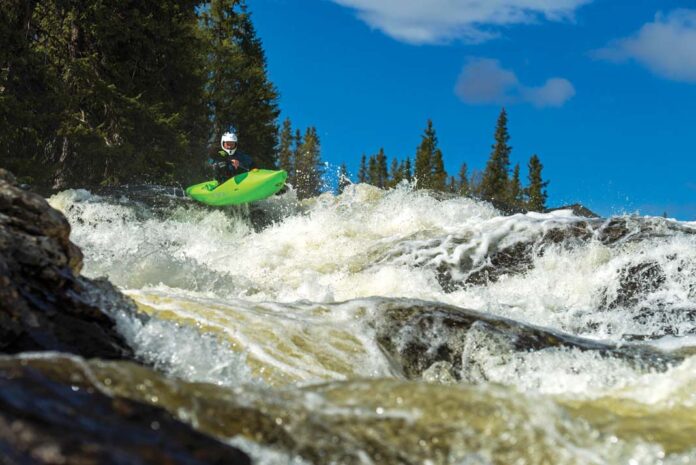
With little human impact, save for a few small communities and hydroelectric dams the region is pristine wilderness. “We paddled a small zone in a big country and were able to do everything within an hour-and-a-half drive,” says Curtis. And by everything, he means steep creeks, drop pool rivers, park ‘n’ huck waterfalls, continuous whitewater runs, big water and quality freestyle and surf waves.
Sweden is the land of plenty.
Jumping up and down on the bank of the Vojmån River, Martin pulls his hands from his armpits where he’s been attempting to thaw them. Fumbling his camera with frozen fingers, he aims at Curtis who’s easing his way down a long, cruisey rapid. Just seven kilometers from the cabin door, the Vojmån is a breezy backyard run, dropping through two scenic lakes and passing by Gömda Vågen or Hidden Wave. One of the only easily accessible standing waves in the area, Vågen is a favorite spot for the handful of local paddlers. In its current super-flood stage, the Vojmån is a perfect warm up.
Warm being used loosely—getting used to frigid water is the biggest adjustment in this northern destination. “After our first day, I was really happy to get off the water and wrap my hands around a warm cup of coffee,” says Martin. Most rivers in the region originate to the west, in the mountains that form a natural border between Sweden and Norway. “They start as small streams and quickly turn to creeks with steeper sections as they flow out of the mountains toward the interior of the country,” explains Curtis. The start of spring’s thaw provides a cycle kayakers can follow: catch the snowmelt runoff in the west and follow it east as the high water moves downstream.
“You can see the heart of the change from winter to spring,” says Curtis, and the changes are quick and tangible. Leaves spring out of trees that have been bare all winter as runoff pushes new life through cold creeks. Paddlers everywhere know these are the signals to start following flow, and in Sweden steep topography speeds up the process.
“We wanted to push to get some of the smaller creeks that run for a shorter amount of time,” says Curtis. “You need to get certain runs on optimal days when they have the perfect level.”
With the knowledge Curtis has accumulated during his time as a local, tracking down the best water levels is tricky, but not a frenzied rush. Only on a couple occasions during a two-week period did Curtis and Martin re-visit runs, mostly seeking to explore new territory.
For photographers like Martin, the golden hour is a magical time when the sun, low in the sky, casts warm, soft light across a subject, be it a landscape or a boat on the water. As Martin blinked sleepy, jet-lagged eyes on one of the first nights in Sweden, it caught him by surprise that the clock read 2 a.m. Warm sunset hues filled the room as the midnight sun dropped gently towards the horizon. Jumping up, Martin frantically, quietly—so as to not wake the snoozing baby—set up a time lapse.
“This was the furthest north I’d ever been,” he says, awed at the fact that at this time of year in Sweden, shooting in the golden hour would mean being on the water all night. Another challenge to documenting South Lapland’s rivers is the fact that Curtis and Martin are a party of two. As Martin positions himself on the edge of the Gardsjöbäcken River’s frothy blue-green water, his camera is in one hand as he keeps the other free to grab the throw bag at his side.
STEEP TOPOGRAPHY TURNS SMALL STREAMS INTO CLASS V CREEKS. | PHOTO: SCOTT MARTIN
With a backdrop of 200-year-old pines and a series of slides, technical boofs and drops, the Gardsjöbäcken is a photographer and paddler’s dream. It’s a short run—around three kilometers—and it’s stacked, dropping a couple hundred meters over that distance. Running it on what Curtis calls “the high side of good,” means every rapid is a scout. “We had to get out and check if it was runnable before we even thought about getting the camera out,” says Curtis. Safety dictated the day. “Knowing that our goal was to document each run instead of just getting down it meant we moved slow,” says Martin. “It meant camera angles had to be sacrificed to set up safety.” Every shot was hard-earned.
From drysuits on the water to board shorts at the BBQ, Curtis and his family prepared a traditional Swedish meal of pickled herring, boiled potatoes, boiled eggs and sliced, dried meats to celebrate Midsommar. Next to Christmas, Midsommar is the most important celebration in Sweden, signifying the start of summer and, for many, a five-week summer break from school. For Martin, connecting with local traditions is an important part of exploring a new region.
“It helps me get a feel for the people of the area,” Martin says, “and a sense of how the landscape has shaped them.”
Joining the Kittelfjäll community for festivities around the maypole in a local park brought this element into their whitewater adventure.
One of the last days of exploration took the team in search of big alpine water. “Our aim was to hit the leftover snowmelt in the higher terrain and ride out some of the more pushy, full-on whitewater,” Curtis says.
Above the tree line, they put on the Skalmodal River in the open tundra. Surrounded by snow-covered peaks in all directions, the alpine river drops into a zone of azure sky, green tundra and cold grey rocks framing roaring whitewater. Plunging down toward the tree line, birch trees take on a twisted, bonsai-like form, gnarled by the harsh mountain exposure. Running deeper into the dense forest, Curtis looks up from his creekboat to towering spruce and skyward peaks. It’s easy to feel isolated here, and impossible to imagine that a gravel road runs parallel to the river just 800 meters away.
Reaching the Skalmodal’s take-out at the Norwegian border, exhilarated from a breathtakingly scenic run, Martin finds a sign that sums it all up: “Welcome to Sweden.”
Having earned the respect of the Swedish kayaking community, Curtis is developing a reputation amongst local paddlers for his knowledge of the area’s rivers. “I get Swedish paddlers messaging me asking about water levels and runs,” he laughs. Encouraging paddling in northern Sweden is exciting for Curtis, and as Martin defrosts from this trip, he’s already planning their next adventure, hoping to add to the list of discoveries they can share with others who hunt for whitewater gold.
CLASSIC SWEDISH CLAPBOARD COTTAGES. | PHOTO: SCOTT MARTIN
RIVER BETA
SWEDEN HAS MANY GREAT AREAS for intermediate and beginner kayakers. The Vindelalven River—located near larger cities Umeå and Övik along the east coast—offers perfect destinations for learning to paddle and raft. In northern Sweden, other than some sections of the Vojmån River, the Kittelfjäll area is a destination for experienced boaters.
VOJMÅN
Big water run with long rapids, a few drop pool runs, and one big cascade. Home of the popular surf wave Gömda Vågen.
KVARNFORSEN
Giant two-stage slide with a park ‘n’ huck option. Could be called the “Graceland” of the area. Curtis made the first descent two years ago.
GARDSJÖBÄCKEN
Can be paddled at lower water levels and has a little bit of everything: long slides, technical drops, a great waterfall and breathtaking scenery. A three-kilometer shuttle makes it easy to lap with a car or on foot.
SKALMODAL
Creek run with technical whitewater and big cascades and drops. Clear, cold water. Starts above the tree line, and drops deep into a valley of pristine forest with a view of snow-covered mountains.
VOUVOSJOKK
A lower volume ride running lake-to-lake with quality creeking and a few unrunnable rapids that can be portaged.
STEKKENJOKK
One of Curtis’ favorite runs, but timing is tricky: the put-in road is closed from November to June 5th, when it opens for through traffic. However roadside stopping—therefore river access—is illegal until July 5th, to protect the falcon nesting area from poachers. If water levels maintain, this gem is worth the wait with unmatched scenery and crystal clear water carving through the open tundra. Waterfalls, long multi-stage slides and technical rapids.
PITEÄLVEN
Home of the well-known Palt Wave, located at Trollforsen (Troll Rapid), which was host to the 2010 European Freestyle Championships.
PHOTO: SCOTT MARTIN
If You Go…
TRANSPORTATION
Fly into Stockholm and hop on a bus or train—both offer good access to the countryside. Rental cars are available in airports and large cities—prices are comparable to what you’d pay in North America.
TIMING
Go in June. Flow peaks in late May, when levels are likely to be too high. By July many creeks get too low. June is also pre-bug season and has 24-hour daylight.
ACCOMMODATION
Bring camping equipment—accommodations are scarce in rural areas. Ads in local grocery stores or at tourism kiosks provide info on guesthouses, rustic cabins on residential properties available to rent from the owner. More information at www.stugknuten.com and www.swedishlapland.se.
LANGUAGE
English is spoken in highly populated areas but in rural northern regions, a few Swedish words go a long way: Forsen means “rapid.” Älven means “the river.” Bäck means “creek.”
EVENTS
Norlandsturen Midsummer Tour and Week of Waves are paddling events gaining momentum in Sweden. Check out the Week of Waves Facebook page for more info.
GEAR
Renting can be quite difficult. Unless you are coming specifically for a festival or have a personal connection, bring your own boat and equipment.
MAPS
Paper maps are easy to find at gas stations and are quite detailed. Swedish boater board www.forspaddling.se also contains river information and map options.
ACCESS
Allemansrätten translates to “Right of public access” and is legislation that grants use of land, public or private, for no-trace recreation. Be respectful, and walk, swim, bike and paddle anywhere.
This article originally appeared in Rapid Early Summer 2016 issue.
Subscribe to Paddling Magazine and get 25 years of digital magazine archives including our legacy titles: Rapid, Adventure Kayak and Canoeroots.


 This article originally appeared in the Canoeroots Early Summer 2016 issue.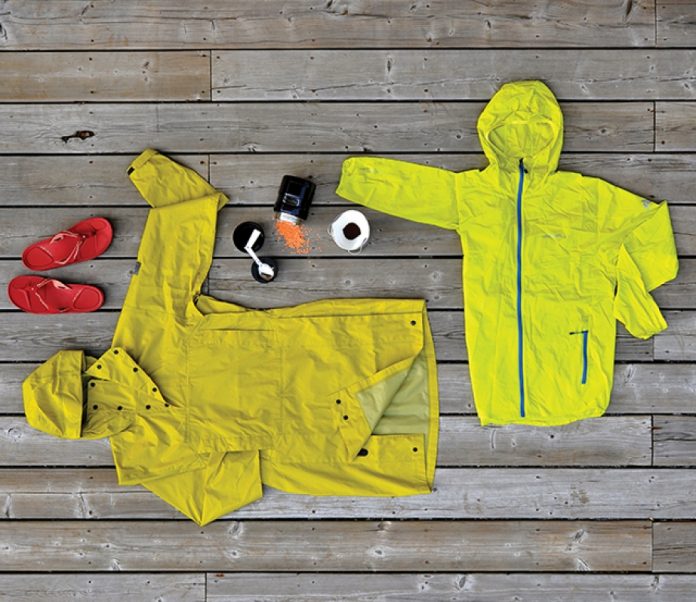

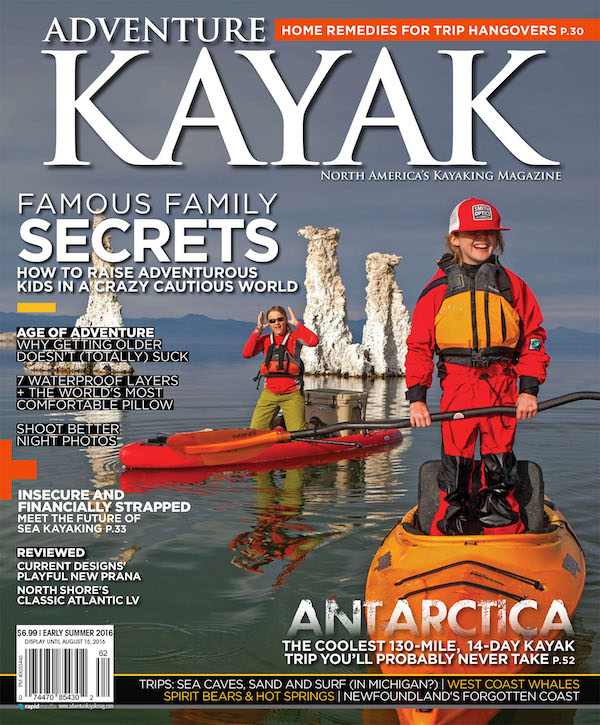 This article originally appeared in Adventure Kayak Early Summer 2016 issue.
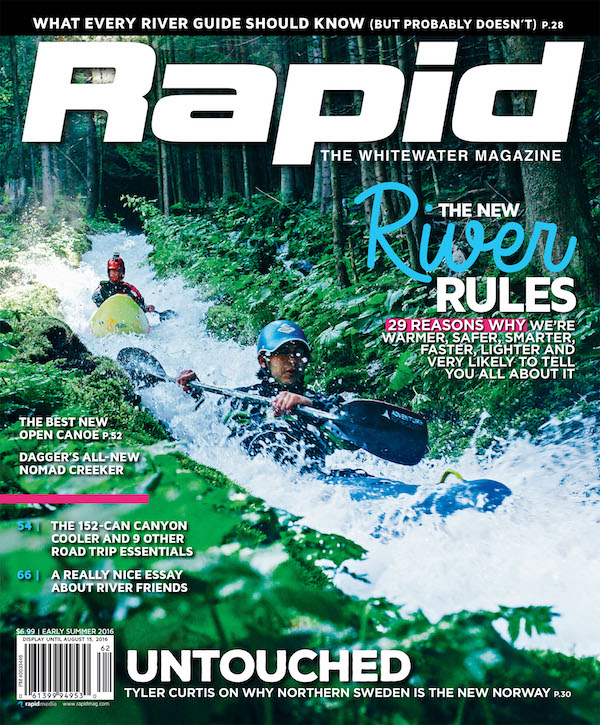 This article originally appeared in Rapid Early Summer 2016 issue.