Home Blog Page 246

4 Non-Profits That Are Using Paddling To Help People Heal

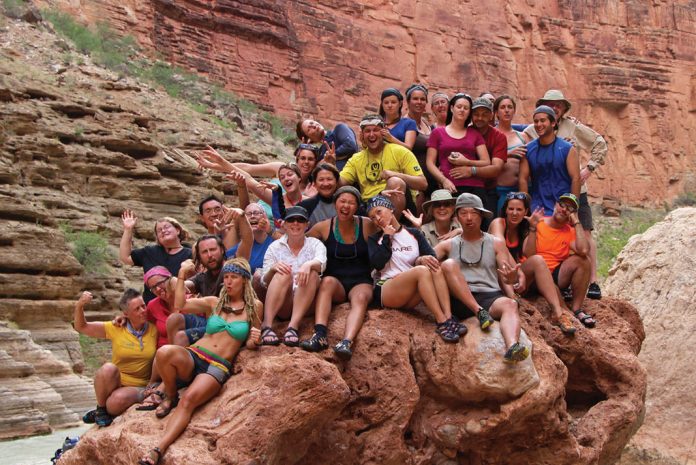
Group of people sitting on a boulder by a river.
A cancer survivor himself, founder of Survive and Thrive, Mike Lang, knows the importance of community. | Photo: Survive and Thrive

Every boater knows that time on the river is the best cure for everything from a hangover to a messy breakup to the loss of a loved one. It makes sense that paddling can also help treat cancer, recover from war wounds, and manage autism spectrum disorder.

Across North America, these four non-profits are using paddling in transformative ways, and proving whitewater’s ability to form powerful friendships.
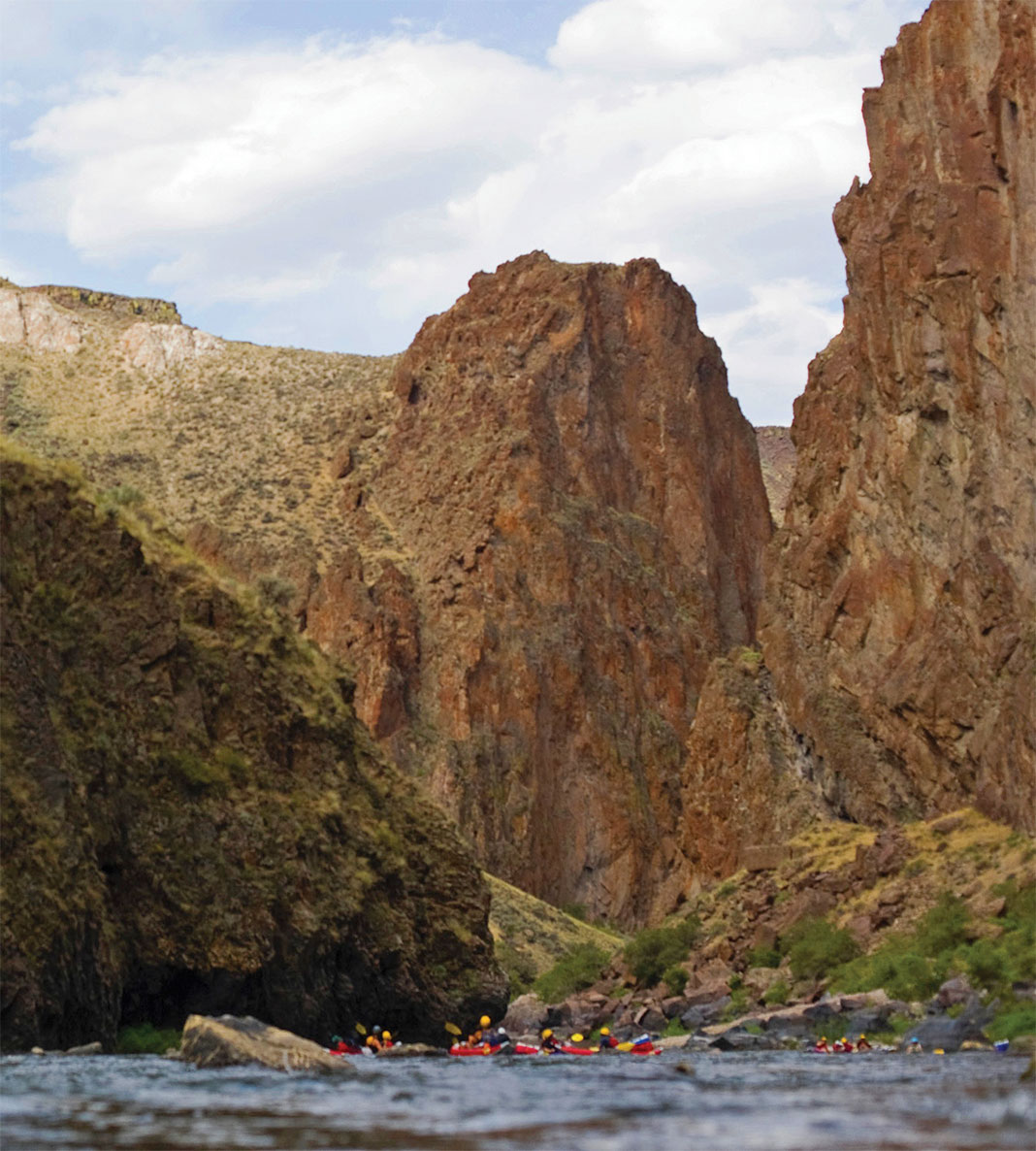
Kayakers paddling at base of canyon walls
Cancer survivors find context and community in the canyons of Oregon’s Owyhee River. | Photo: courtesy of Survive and Thrive

Whitewater Healing

Look up the definition for “ideas guy” and you might see a picture of indefatigable whitewater canoeist and entrepreneur Jim Coffey. So when Coffey’s family was touched by autism spectrum disorder (ASD), Ottawa-based videographer and open boater Mike McKay knew his friend would see the challenge as an opportunity to change lives. Still, McKay didn’t know what to expect last August when Coffey invited him to serve as a photographer at the first-ever Whitewater Healing program on the Ottawa River.

Coffey modeled his brainchild after Surfer’s Healing, an American program that introduces over 4,000 people with autism to surfing annually. Whitewater Healing creates a relationship between people with ASD, their parents or friends, and a professional whitewater paddler, known as an ambassador. Ambassadors connect with their pairings at least a month before the event to develop a friendship. On river day, activities include canoeing, kayaking, rafting and standup paddleboarding. Some people living with ASD are drawn to water, and Coffey predicted that whitewater would have profound therapeutic effects.
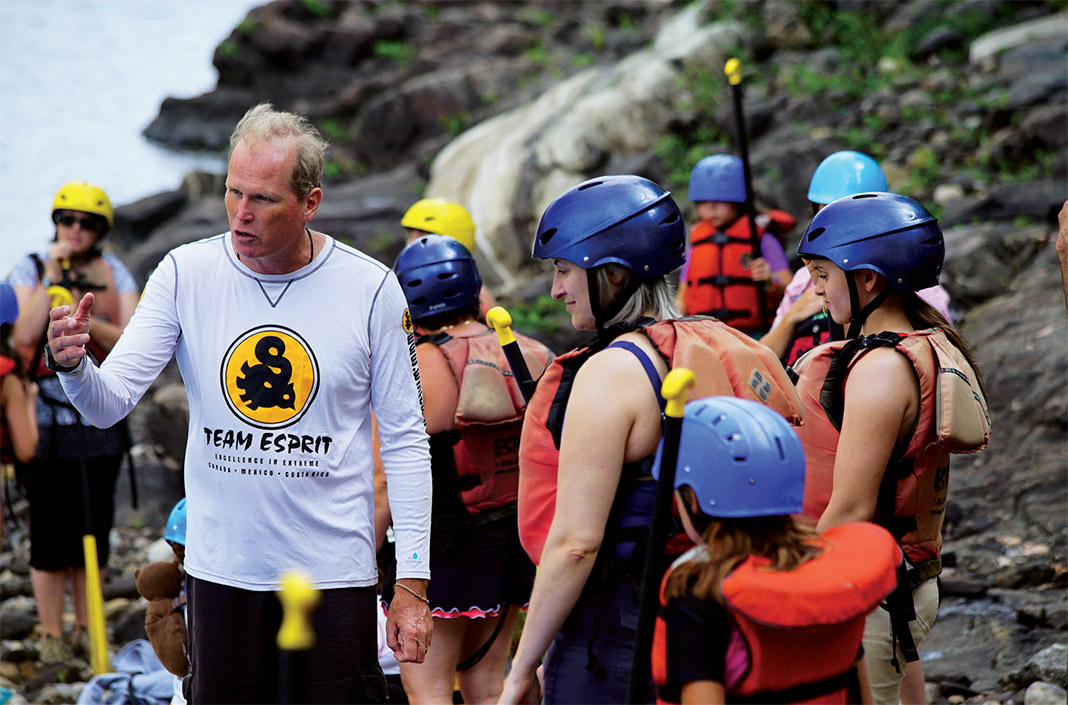
Instructor explaining concept to people about to go rafting
Founder Jim Coffey at the first Whitewater Healing event on the Ottawa River. | Photo: Mike McKay

“The river is a great equalizer,” he says. “On the water, the challenges that the ASD participants face are the same that everyone faces when they try a new and exciting activity.”

Forty people gathered on the Ottawa River for Coffey’s inaugural event, and the day unfolded flawlessly, just as McKay envisioned. “In the moment, Jim has this crazy ability to pull it together better than anyone could,” says McKay. “In the end you realize his master vision; he really knew what he was doing.”

Behind the lens, McKay was struck by how rewarding the day was for parents. “There’s so much mystery involved [in ASD],” he says. “Here was a great opportunity for people to get together and share their experiences.”
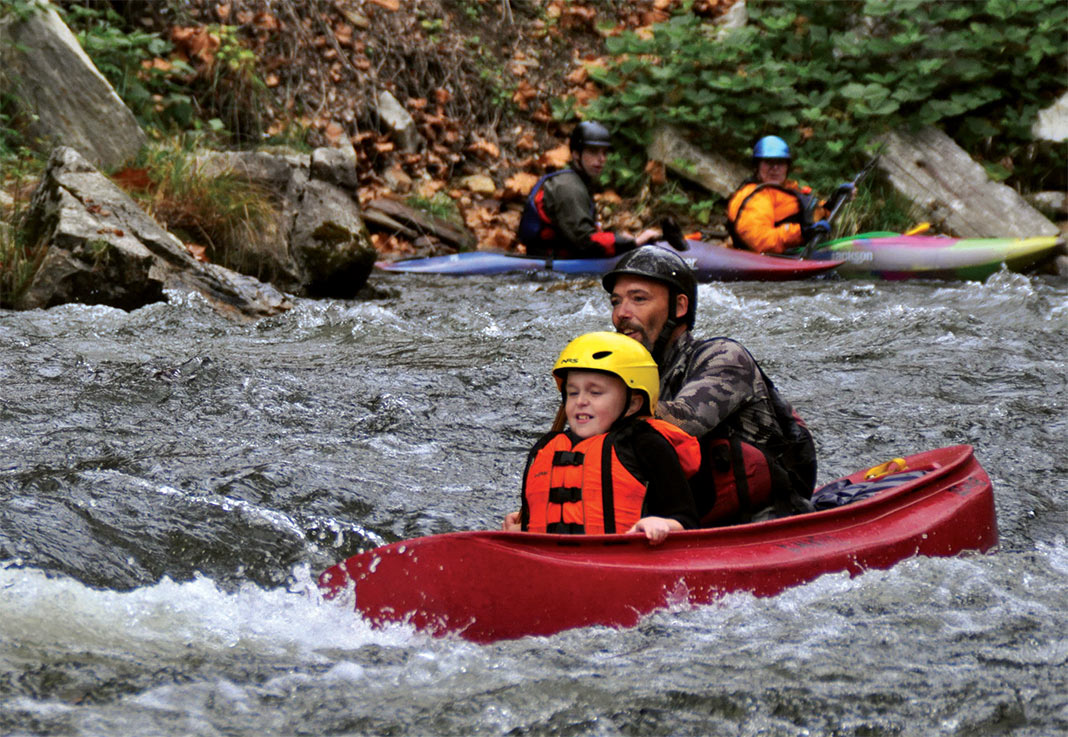
Young boy and man in open boat.
Will Brittian and ambassador Shawn Malone on the Nantahala River. | Photo: courtesy of Whitewater Healing

In October, Coffey hosted a second event on the Nantahala River in North Carolina. William Brittain learned about Whitewater Healing on Facebook and registered his son for the event. Paired with open boater Shawn Malone, Brittain says his son, Will, had the time of his life. “I sat behind Will in the raft and I actually felt his smile without being able to see it,” notes Brittain. “The trust we had developed for the Whitewater Healing team in such a short time was amazing.”

After the third program in Mexico in December, Coffey says Whitewater Healing touched nearly 150 people in 2015. This year, he hopes to deliver 10 non-profit programs on rivers in four countries. “It has been said, ‘The meaning of life is to find your passion. The purpose of life is to give it away,’” says Coffey. “This statement truly embodies what we’re all about.”


First Descents

When Brad Ludden decided to become a professional kayaker instead of going to college, he made a pledge that belied his youthful 18 years of age. Ludden, who became the first-ever Nike-sponsored kayaker, graced the cover of Outside magazine and won Cosmopolitan magazine’s “hottest bachelor in America” title, vowed he would give something back to the sport and to society. He discovered his true reason for paddling when he volunteered at a camp for children with cancer in Montana. “It was such a stark contrast for me,” recalls Ludden. “At the time, I was always focused on the extreme. Yet there I was, having fun with kids on a flatwater pond.”
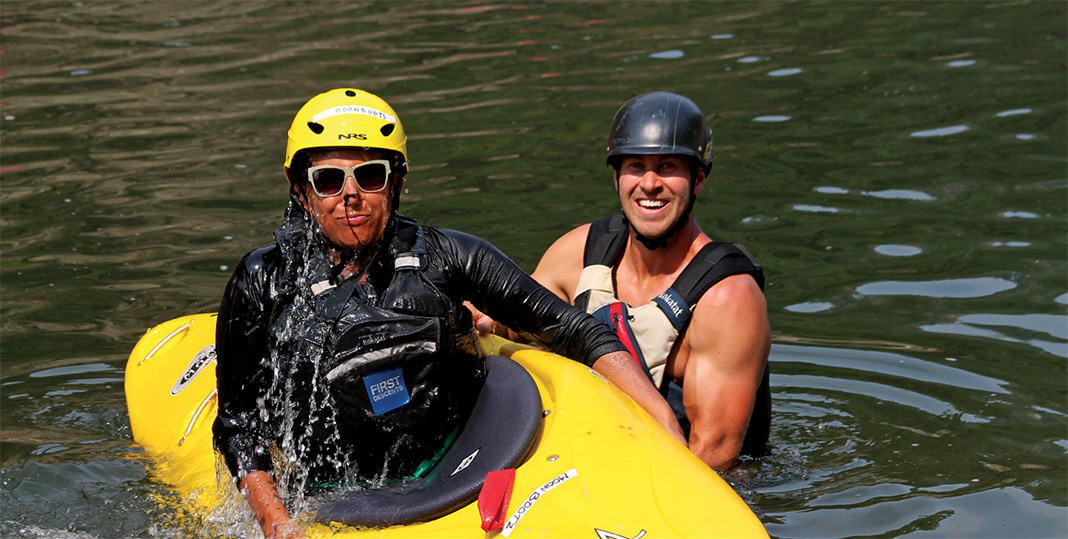
Man in water helping woman in whitewater kayak do a roll.
First Descents founder Brad Ludden was only 20 years old when he organized his first camp for cancer patients. | Photo courtesy of First Descents

This experience, combined with watching his aunt struggle with cancer, sparked a desire to introduce patients to paddling. Ludden was only 20 years old in 2001 when he organized his first kayak camp for 19- to 39-year-old cancer patients on the Colorado River. “My biggest takeaway was how impactful and transformative it was,” says Ludden. “I knew it would be fun and people would enjoy it, but I didn’t realize just how much of a psychological impact it would have on young people.”

Ludden discovered he was supporting a unique demographic. With the shock of being diagnosed, young cancer patients are more likely to feel isolated by the physical and psychological turmoil of the disease. First Descents alleviates this stress by creating community, says Ludden. “They’re together with people of the same age who are facing the same challenges. That in and of itself is extremely healing.”

The free weeklong whitewater camps introduce basic safety and paddling skills and progress to a “pinnacle challenge,” says Ludden. First Descents also offers programs in other outdoor sports like climbing and surfing. Participants include people like Caryn Roach, who was 32 years old when she was diagnosed with Hodgkin’s lymphoma. Chemotherapy caused her to lose her hair and sapped her energy. She signed up for a First Descents camp, marked the dates on a calendar and made it an incentive to persevere.

Initially, Roach was afraid to try kayaking on the Clark Fork of the Columbia River in Montana. “When I went through my first rapid and felt the cool water splash around me and the rush of adrenaline, I knew I was hooked,” she says.“The experience also showed me that I am much braver than I ever imagined. Since First Descents, I have gone on three more whitewater kayaking trips. Each time I go kayaking I wonder if I am crazy. Then I find myself grinning ear to ear as I paddle down the river. It is like I am a different person when I am on the river—and I really love who that person is.”

Starting up, Ludden’s notoriety helped him leverage sponsorship dollars from Nike, Dagger and Kokatat. Being recognized as a professional kayaker lent authority to First Descents. “We broke the mold on cancer therapy,” notes Ludden. “I was able to reassure the medical community that this was a safe experience.”

In 2015, First Descents delivered 50 weeklong camps around the world, sharing the therapeutic benefits of adventure sports with over 1,000 cancer patients. “I really believe in the change in perspective of facing a challenge in the outdoors,” says Ludden. “All of those lessons and rewards translate very clearly to people with cancer. They restore self-confidence, destroy feelings of fragility and give an identity to these people other than being a cancer patient.”
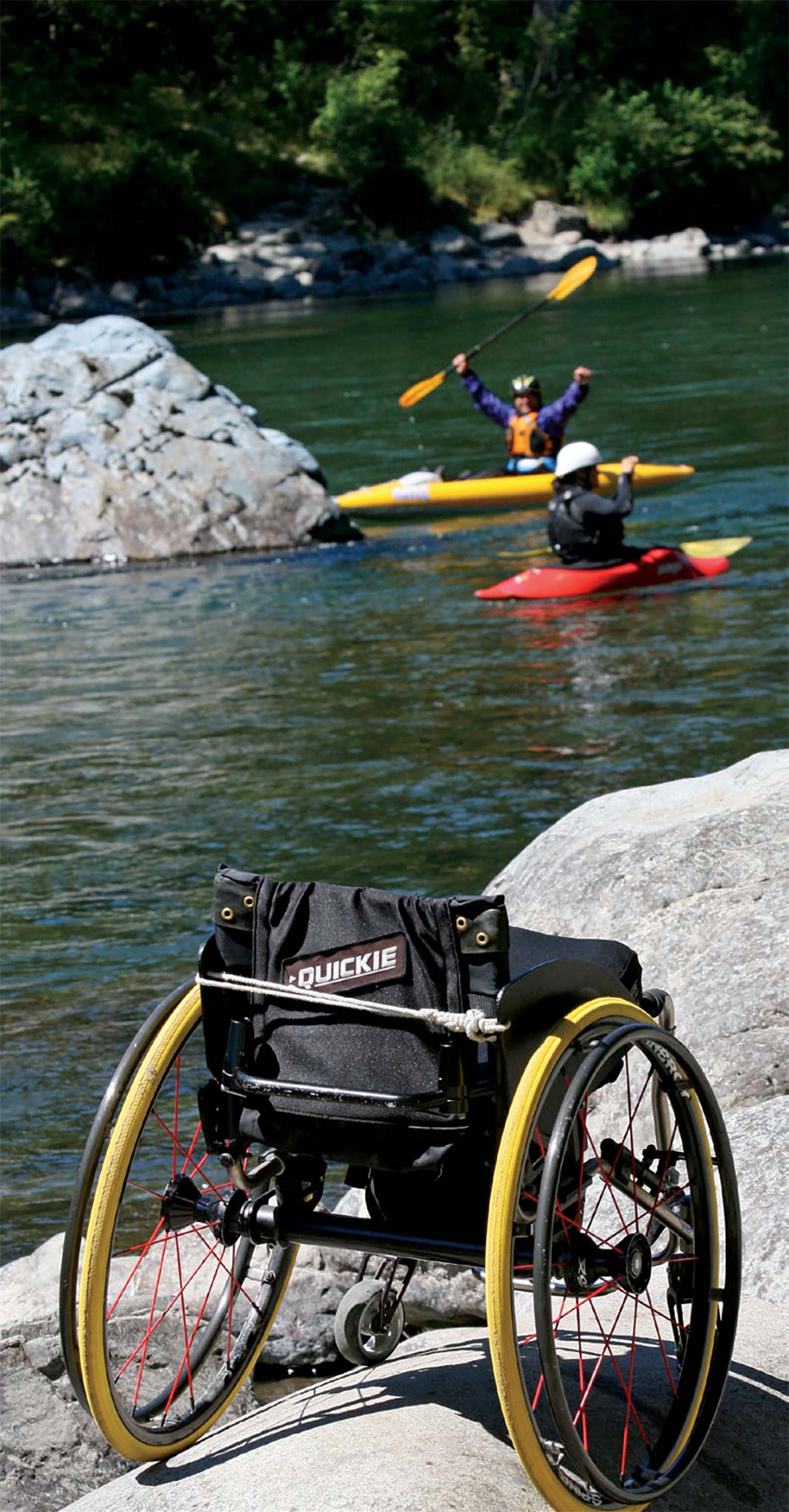

Wheelchair in foreground with two kayakers on river in background
Team River Runner sponsors more than 2,000 paddling events across America each year. | Photo: courtesy of Team River Runner

Team River Runner

For as long as he can remember, special education teacher Joe Mornini’s favorite way to battle stress has been an evening whitewater session on the Potomac River. In 2004, with the United States military engaged in missions in Afghanistan and the Middle East and the nation still feeling the impact of 9/11, Mornini and his paddling buddy, Mike McCormick, brainstormed ways to support the recovery of wounded and disabled soldiers. Their solution: Get as many as possible into kayaks.

After a chance encounter with a doctor at the Walter Reed Military Hospital in Washington, D.C., Mornini and McCormick made contact with the amputee ward. Soon, the friends assembled a few boats for a pilot program on Tuesday evenings. “It turned out every soldier wanted to participate,” says Mornini. “We just blew up from there.”

Mornini and McCormick’s first goal was to be inclusive to all veterans. Their “get butts into boats” crusade was the beginning of Team River Runner, a non-profit that now consists of 51 volunteer, veteran-coordinated chapters across the United States. Each year, the program sponsors more than 2,000 paddling days across the country. Perhaps the most accomplished Team River Runner alumnus is disabled Navy veteran Lonnie Bedwell, who in 2013 became the first blind paddler to kayak the entire Grand Canyon.

Mornini first met Bedwell at a Team River Runner-organized “Out of Sight” clinic for blind veterans. He says Bedwell’s sense of adventure is indicative of most veterans—and a big reason why paddling is such effective therapy. “No matter what era, no matter what conflict, veterans understand what their peers are going through,” says Mornini. “We’re paddling, but we’re also connecting people and forming a community.”

As a non-profit, Team River Runner’s funding strategy is to attract many small donations from individuals and corporations. Instruction is based on the American Canoe Association’s adaptive paddling training stream; Mornini insists he can accommodate all levels of disabilities, with the exception of people with severe neurological impairments and tracheostomies.

Despite Team River Runner’s overwhelming success, Mornini wants more. Florida has over 10,000 visually impaired veterans, he notes, and conflicts in Afghanistan and Iraq wounded over 3,000 members of the armed forces. “We’ve only skimmed the surface,” he says. “The disabled are the largest minority in America. We have to get them out of the shadows. Today, it’s not abnormal to see a wheelchair at a ski resort. But how many blind paddlers do you see? I had no idea what I was getting into, but I’m still learning and still seeing the rewards. My feeling is, how can I not work my ass off for this?”
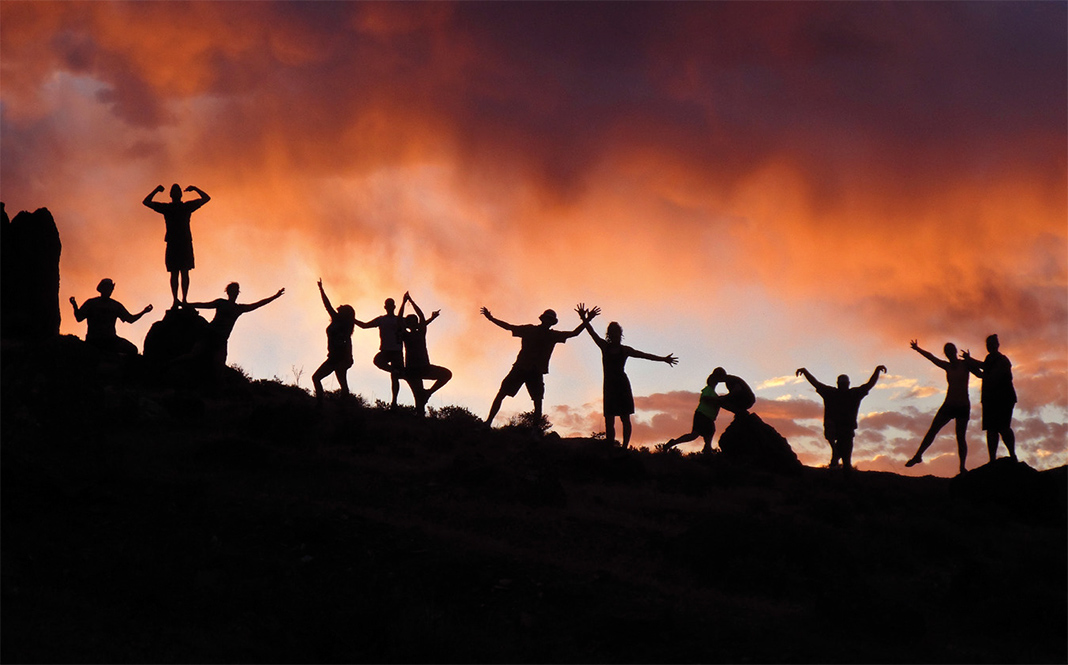

People standing on hill silhouetted with sunset in background
Survive and Thrive keeps their programs small and intimate, serving around 50 clients each year. | Photo: Survive and Thrive

Survive and Thrive

Eight years ago, cancer was the last thing on Mike Lang’s mind. At 25, Lang was the archetypical dirtbag, alternating seasons as a ski patroller and raft guide in western Canada and the Pacific Northwest. Then he discovered a conspicuous grapefruit-sized lump on his chest. Soon after, Lang was diagnosed with Hodgkin’s lymphoma, a form of cancer. Suddenly his life was turned upside down.

In the rigors of his treatment, Lang was stricken by intense apathy. Before cancer, “I was healthy,” he says. “I didn’t drink too much or do drugs. Nothing I did brought this upon me.” What’s more, he felt utterly alone. None of his friends knew what it was like to have cancer, and the health care system seemed focused on supporting the psychological needs of juvenile and older patients.

By chance, Lang’s oncologist put him in touch with seven other young adults with similar health issues and common interests. Lang was itching to get back on the water, and he petitioned his peers with an audacious plan. “It was like, ‘I have cancer, you have cancer, let’s go kayaking,’” he recalls. Lang was six months out of treatment when the group floated inflatable kayaks through the stunning canyons of Oregon’s Owyhee River. “It helped me process what I’d been through,”notes Lang. “There was no need to censor conversations. That trip helped me place my cancer experience in the context of my life.”

The Owyhee float left Lang convinced “there’s nothing as effective as a wilderness trip—in particular a river trip—to draw people together and build community.” The experience inspired Survive and Thrive, Lang’s Calgary-based non-profit that brings young cancer survivors together on the water.
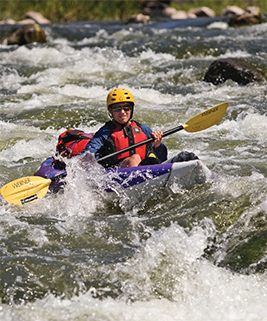
Person in inflatable kayak on a river
Photo: Survive and Thrive

Lang and his wife, Bonnie, take part in each Survive and Thrive trip, which range from whitewater adventures to canoeing and sailing. In between adventures, the couple works tirelessly to promote their adventures to the medical community. Participants are recruited through word of mouth, with 90 percent referred by oncologists and nurses.

Matt Frank signed up for a Survive and Thrive rafting trip on the Colorado River’s Grand Canyon after treatment for brain cancer interrupted his university studies. “As survivors, we all come back from a diagnosis of cancer fundamentally changed,” says Frank, who went on to complete a nursing degree, encouraged by his experience as a patient and conversations with his tripmates on the Colorado. “Survive and Thrive opened a door for me. It helped me find direction in my new life.”

[ Paddling Trip Guide: View all paddling skills and instructional clinics ]

Lang says he wants his programs to stay small and intimate, so Survive and Thrive caters to around 50 participants annually. Meanwhile, Lang’s experience convinced him to pursue graduate studies at the University of Calgary in community health sciences, investigating the life changes cancer imposes on people. “After cancer, it’s easy to feel like you’ve missed out on a year of life,” says Lang. “On a wilderness trip, you start to realize that the things that were important to you before cancer aren’t necessarily important anymore.

“People tend to change their lives to reflect what’s important to them. For me, seeing that change is the most rewarding part.”


This article originally appeared in Rapid
Spring 2016 issue.

Subscribe to Paddling Magazine and get 25 years of digital magazine archives including our legacy titles: Rapid, Adventure Kayak and Canoeroots.
The Importance of Chores

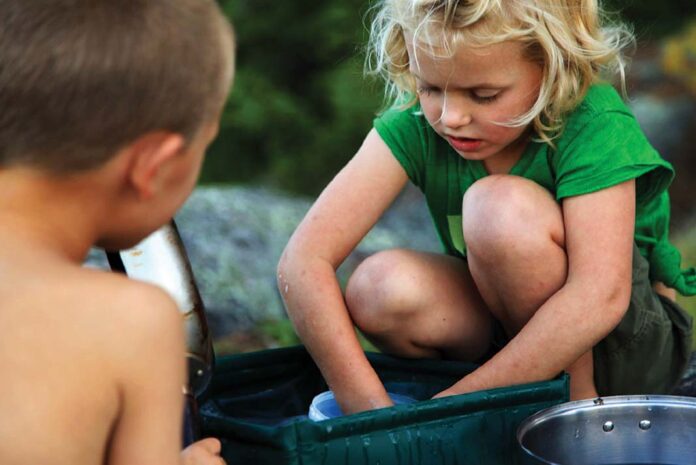
IF WE COOK, THEY CLEAN.| PHOTO: SCOTT MACGREGOR

Research from the National Center for Physical Development and Outdoor Play has shown that children who play outdoors regularly are happier, healthier and stronger. I’ve read Richard Louv’s much-praised book, Last Child in the Woods. I get it. In fact, we set a section of Canoeroots aside to inspire families to get outside.

I believe, however, that there has been too much emphasis on play and not as much on development. You know what else kids are not doing as much of outside? Working. Chores like mowing the lawn, chopping wood, raking leaves and setting up their own tents. And as it turns out, it’s not just in the outdoors where kids today are slacking when compared to their parents.

According to a 2014 survey by Braun Research, 82 percent of grown-ups polled said they had regular chores when they were growing up, but only 28 percent of us reported asking our children to do any.

Marty Rossmann of the University of Mississippi used data collected over 25 years to discern whether asking children to help with household chores starting at three or four years old was instrumental in predicting the children’s success as young adults. Turns out, those who had done chores as young children were more likely to be well-adjusted, have better relationships with friends and family and be more successful in their careers.

Why?

Because they are less likely to run off and play when it comes time to set up tents, cook dinner or complete the important client presentation that’s due on Tuesday—don’t think we don’t know who you are.

IF WE COOK, THEY CLEAN.| PHOTO: SCOTT MACGREGOR

It’s challenging for kids to understand all the work involved in running a household. Our lives are busy and we often find ourselves driving off in different directions. On the other hand, camping trips offer fewer distractions. We eat and we sleep. If we’re hiking or canoe tripping there is packing, unpacking and traveling to be done.

Compared to everyday life, camping offers a much simpler routine with a more immediate and obvious list of what needs to be done. Too often parents are doing the camp chores while kids, thanks in part to Louv, have been released to go play.

When it came time to send our kids to summer camp they’d been helping with camp chores since they were old enough to gather sticks for a fire—they may still have been in diapers. Even though holding the canoe didn’t really make it more stable for me to step out, I still asked them to do it. Even though the tent pegs were hardly more than an inch in the ground, I asked the kids to hammer them in with rocks. Even if my wife and I had to sometimes rewash an evening worth of dishes, we had the kids do them when it was their turn.

On my son Doug’s first overnight with his camp cabin group, he was allowed to build the fire after three failed attempts by his counselors. Guess what? While the other kids were off whipping each other with wet towels instead of gathering wood, his teepee fire sparked into flames. That night the group roasted hot dogs on sticks instead of eating raw wieners out of the package. Doug didn’t exactly thank me, but the research suggests that someday he will.

Scott MacGregor is the founder and publisher of Canoeroots.


This article originally appeared in Canoeroots
Spring 2016 issue.

Subscribe to Paddling Magazine and get 25 years of digital magazine archives including our legacy titles: Rapid, Adventure Kayak and Canoeroots.

7 Ways to Lighten Up on Your Next Trip

EMPTY THE BOAT. FILL THE MIND.| PHOTO: MICHAEL DEYOUNG

It’s true that money can help save weight with the latest and greatest gear, but there are much less expensive ways to do more on your canoe trip with less. Everyone knows that opting for a wafer-thin canoe and dehydrating meals can shave major pounds off your camp kit. So where is a burgeoning ultra-light canoe camper to focus their efforts next? Let the famous words of Canadian bushcraft icon, Mors Kochanski, guide you to enlightenment: “The more you know, the less you carry.” Mastering campcraft skills means carrying fewer things—here’s how.

1) DO YOUR RESEARCH.

The more familiar you are with your environment, the more resources you will have at hand. If there isn’t a fire ban and you know deadfall is accessible, go stoveless (a backpacker’s stove averages 14oz, plus fuel). Familiar with the local flora and fauna? Plan to supplement your diet with berries and other wild edibles, and bring only lures that are attractive to the local fish. Forage for birchbark or old man’s beard, leaving synthetic firestarters at home.

[ Looking for some trip suggestions? Find more adventures in the Paddling Trip Guide ]

2) PLAN FOR MORE TIME EN ROUTE.

Do this so fishing and foraging to supplement your carefully planned meals is enjoyable instead of stressful. With less weight in the boat and fewer items of gear to manage, you’ll make and break camp faster and cover more distance. By stretching your explorations out over the day you’re less likely to notice the camp comforts left behind.

EMPTY THE BOAT. FILL THE MIND.| PHOTO: MICHAEL DEYOUNG

3) SKIP THE TENT.

Even lightweight and high-quality two-man tents typically weigh four pounds. Master your tarpology skills and strategy and you can continue to sleep dry in inclement weather for just over a pound in your pack. Buggy time of year? Take netting, a bivy or an enclosed hammock.

4) BRING GEAR THAT HAS MORE THAN ONE USE.

Pre-trip organize the gear you want to bring into two piles; one of equipment that serves double duty and another of single-purpose tools. Now get creative. The carabiners in your pin kit can also be used in the bear hang. A bush knife makes sparks, kindling, fillets fish and preps food. Do you need the whole mess kit, or will a single pot and utensil do? Carefully cull from your pile of single-use items.

5) SPEND MORE—OR NOT.

By purchasing only high-quality, field-tested, lightweight and multi-use clothing and equipment you’ll save ounces upfront. You’ll save money in the long run because there’s no need to replace gear and garments each season. Opt for brands that promise warranties on their products.

[ Browse the widest selection of boats and gear in the Paddling Buyer’s Guide ]

6) MAKE CHOICES.

The easiest way to cut down on pack weight is to leave things behind. If it needs batteries, do you really need it? Ditch the GPS (5oz+) and use a map and compass. The backs of maps are great for journaling. If you’re not guiding, do you really need communication devices (4oz+)? If you’re a skilled navigator sticking to your route, you will be found if anything waylays you, so long as you filed a detailed float plan. Learn how to signal for emergency help with items that don’t need batteries.

7) CHANGE YOUR MINDSET.

Don’t pack for an apocalypse—bring only gear that can assist in emergencies you’re likely to face. Accept that what you might want in the moment is different than what you need. A few days of minimalism is good for the soul.

Laurel Archer is a 25-year canoe guiding veteran and writer of guidebooks for paddlers in Saskatchewan and British Columbia. 


This article originally appeared in Canoeroots
Spring 2016 issue.

Subscribe to Paddling Magazine and get 25 years of digital magazine archives including our legacy titles: Rapid, Adventure Kayak and Canoeroots.
Video: Turn Your Canoe Quickly and Effectively With One Stroke

Learn to turn your canoe easily and quickly with the cross-bow draw technique. Chad Casey at The Lodge at Pine Cove (frenchriver.com) in French River, Ontario shows off this stroke that can be used by solo paddlers or a tandem team.

Author: Paddling Magazine Staff

Finding The Real Florida

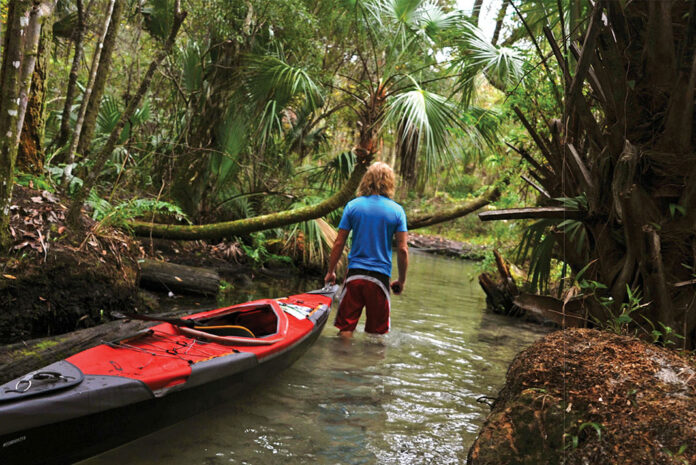
man wades while pulling kayak through a Florida state park
No artificial ingredients in this Florida state park. | Feature photo: Virginia Marshall

As I paddled up the beach I was greeted by a sign that read, “State park boundary—welcome to… the Real Florida.”

In a hyper-politicized world where some people get piqued by things as insignificant as a not-festive-enough holiday red Starbucks coffee cup, I’m surprised that a government sign would be allowed to suggest something as controversial as the idea that this natural area is somehow any more real than the heavily built-up tourist zone down the beach, especially here in this most fantastical of states.

Finding Florida’s real magic kingdom

I was in Florida for a family vacation, and after a few days in the super-artificial Disney World Magic Kingdom, we’d come to this beach to wind down and relax before jetting back north to the winter cold.

For me it was also a last chance to dip my paddle in some unfrozen water. There was a laid-back, long-haired, middle-aged dude with a Florida perma-tan at a shop on the strip who rented me a boat and delivered it to my beach house in his cargo van. I saw the state park on a map and knew that’s where I had to go—always pointing the bow towards nature, like a compass needle seeking what I’d always thought of as the real world. But this was the first time I’d seen it labeled that way on a sign.

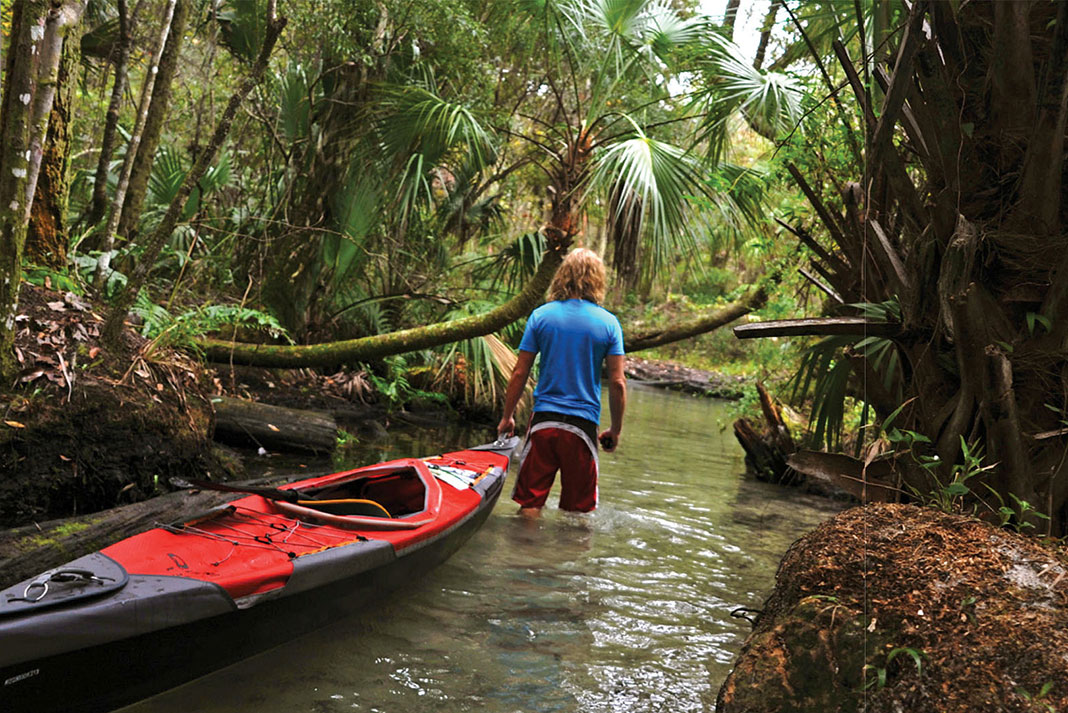
man wades while pulling kayak through a Florida state park
No artificial ingredients in this Florida state park. | Feature photo: Virginia Marshall

As I paddled north from the congested commercial strip of tacky surfwear shops and coral-colored stucco high-rises, where the beach had been literally bulldozed of all signs of vegetation, I noticed the dune grasses, palm trees and mangroves growing thicker and closer to the water. The houses got lower and squatted further back from the beach. Everywhere evidence appeared, suggesting how the beach had looked for thousands of years before the recent history of human intrusion: fewer footprints and tractor tracks and more shells, more slender silver fish darting below the surface and stingrays skimming away from my shadow.

The artificial can be enjoyable for sure. At Disney World, my family stayed in the Animal Kingdom Lodge where, from our balcony, we could watch zebras, wildebeest and giraffes roaming a “savannah”—with a chain-link fence unsubtly keeping Africa in, and the forest and fauna of inland Florida out. The setting of the lodge was lovely, but it occurred to me that seeing tortoises and armadillos roaming a native forest of palms and pines outside my window would have been no less appealing (and that had we wanted to see “the Real Africa” we probably could have flown to Kenya for about the same price).

The artfully crafted world inside the Magic Kingdom was certainly an escape, right down to the steel-and-composite Swiss Family Robinson “tree.” The substrate of nature upon which this vacation paradise was built was buried under so many layers of artifice that I couldn’t even begin to guess what reality might have been left. On the other hand, the Disney experience was so much like life in the big city—complete with strictly regimented schedules, bus commutes, long lineups, crowds, stress and its own rush hours—that I’m surprised it felt like a vacation at all.

Amusement at a slower pace

Having gone to such effort and expense to experience artificial entertainment, the slower speed and perspective of paddling reminded me how much beauty and serenity and wonder and excitement there is all around us, for free.

After Disney’s high-octane thrills, all-you-can eat buffets and high-tech entertainment, the quiet beach was surprisingly compelling. I marveled more at a tiny shriveled sea horse the size of my thumbnail than at the Day-Glo animatronic animals of Under the Sea—Journey of the Little Mermaid.

I’m pretty sure that when my six-year-old daughter sighs, “I miss Florida,” she is thinking of sitting in my lap on the sand watching a pair of osprey diving for their breakfast at sunrise, not sprinting to be the first in line for selfies with Ariel the mermaid in her grotto of painted concrete.

[ Plan your next Florida paddling trip with the Paddling Trip Guide ]

A pragmatist might argue that our so-called natural world is now so influenced by human activity—right down to the species in the ocean and the temperature of the air that has been altered by human climate change—that there is no valuable distinction to be made between what I find here on the beach and the engineered kingdom that is Disney World. It’s all artificial now.

Still, I think we need to remember and live as if there is something that came before us, a world shaped by forces much larger, the one kayaking puts us in touch with. That to me is the real Magic Kingdom. But don’t take my word for it. It says so right there on the sign.

Waterlines columnist Tim Shuff is a firefighter, freelance writer and former editor of Adventure Kayak. He doesn’t care what color cup his coffee comes in. 

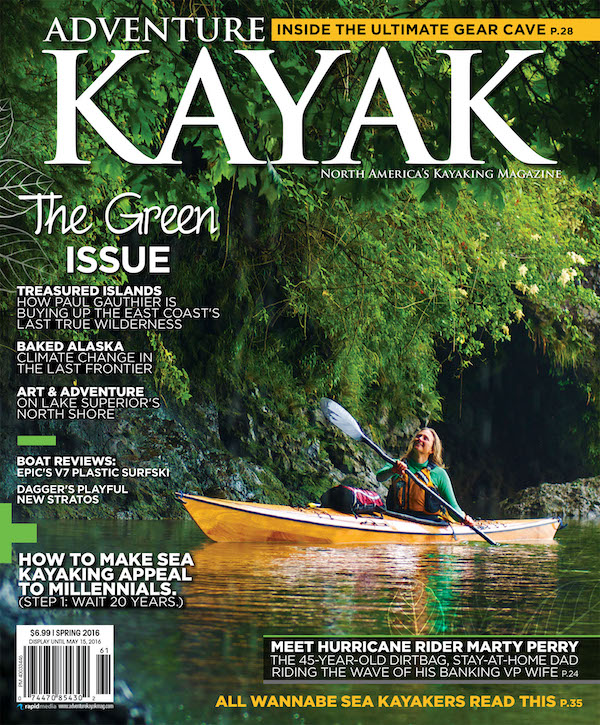
Cover of the Spring 2016 issue of Adventure Kayak magazineThis article was first published in the Spring 2016 issue of Adventure Kayak Magazine. Subscribe to Paddling Magazine’s print and digital editions, or browse the archives.


No artificial ingredients in this Florida state park. | Feature photo: Virginia Marshall


River Reading: The Last of the Wild Rivers

A WILD RIVER IN A QUIET MOMENT.| PHOTO: PETER BOWERS

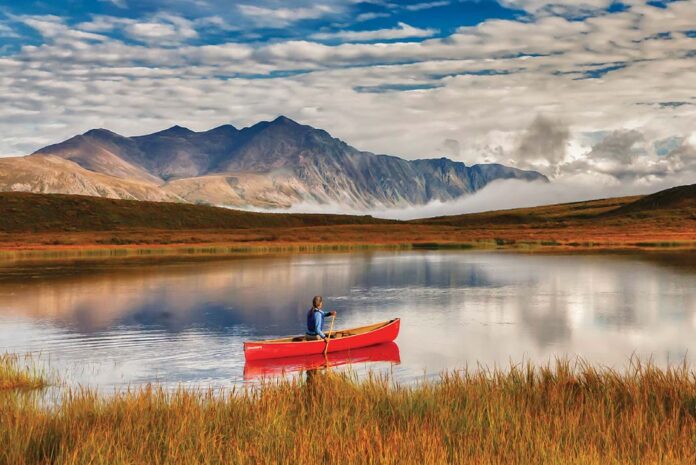
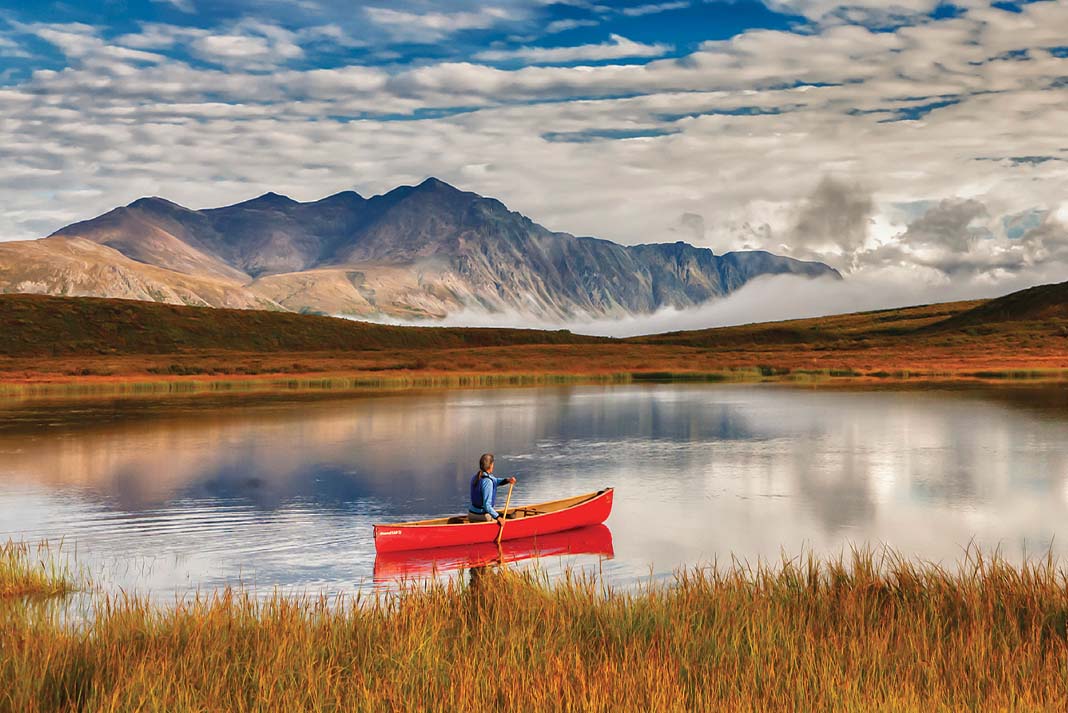
Although Wally Schaber is just 65, his legacy looms large enough to be considered in a column dedicated to canoe heritage. A longtime outfitter, outdoor retailer and founder of Black Feather Wilderness Adventures, he’s seen more of North America’s wild country than most of us ever will. His favorite of all places, however, is the valley of the Dumoine River, the subject of his charming new book.

The wild Rivière du Moine (Dumoine) and Deux Joachims portage have been noted for centuries in the journals of great explorers as they made their way across Canada. Today, the Dumoine is the last of 10 major Quebec fur trade routes and tributaries of the Ottawa River to avoid industry and modern colonization.

Full disclosure: Wally and I have been friends for years. Our initial encounter in the 1970s took place on a riverbank not far from the Canoeroots office, and was described by one wet-suited flibbertigibbet as a “chance meeting between two bears from the Moscow Circus.” We took that as a compliment.

On one level, Wally’s debut, The Last of the Wild Rivers, is a well-researched cultural history of the last undammed river flowing south from the high country of West Quebec. Many locals know the Dumoine as a go-to short-excursion whitewater river. Indeed, it was the canoeing potential of the Dumoine that brought Wally into the watershed for the first time in 1969. Having spent time year-round in the area for nearly half a century, the place has written itself into this paddler’s soul. The book is much more than a river biograpy, it’s a river elegy and love story between a man and a very special place.

A WILD RIVER IN A QUIET MOMENT.| PHOTO: PETER BOWERS

As powerful and personal as his story is, at its core the book is a plea for paddlers and anyone who cares about wildness in any form to recognize the rarity of the Dumoine River and what it represents. This watershed remains in more or less the same state as experienced by the entire march of human history. Set in a continental, or even global framework, the Dumoine holds values and virtues that are all but gone elsewhere—free flowing, clean, unfettered, undeveloped land and water.

Having considered all of the options, and recognizing that instruments for river and watershed protection vary from jurisdiction to jurisdiction, Wally is recommending protection in the form of Du Moine Aquatic Reserve. With threats from every possible source still looming—threats that have compromised just about every other significant watershed in the world—he knows that without substantial public support from all types of valuers of rare and wild places, other interests may well prevail in the Dumoine watershed too.

“The raw wilderness must not change,” he writes. “[To survive, humanity needs] clean water, plentiful wildlife, mature uninterrupted forests, peace and tranquility, and a beautiful, wild, free-flowing river.” Amen.

Like a splash of fresh, cold water, The Last of the Wild Rivers is a call for us to imagine the river, indeed all remaining undammed, undeveloped rivers, and their futures—to imagine them whole—and to take action on their behalf, to take action now.

James Raffan is the former executive director of the Canadian Canoe Museum. Get your copy of The Last of The Wild Rivers at burnstownpublishing.com.


This article originally appeared in Canoeroots
Spring 2016 issue.
Subscribe to Paddling Magazine and get 25 years of digital magazine archives including our legacy titles: Rapid, Adventure Kayak and Canoeroots.

3 Camping Dessert Recipes for Backwoods Adventures

All photos this page: Nikki Fotheringham

Nothing will help you to win friends and influence people quite like a little something sweet after a hard day’s paddling. If you master the art of the campfire dessert, you will never have to eat a meal alone. Here are some easy ones to get you started.

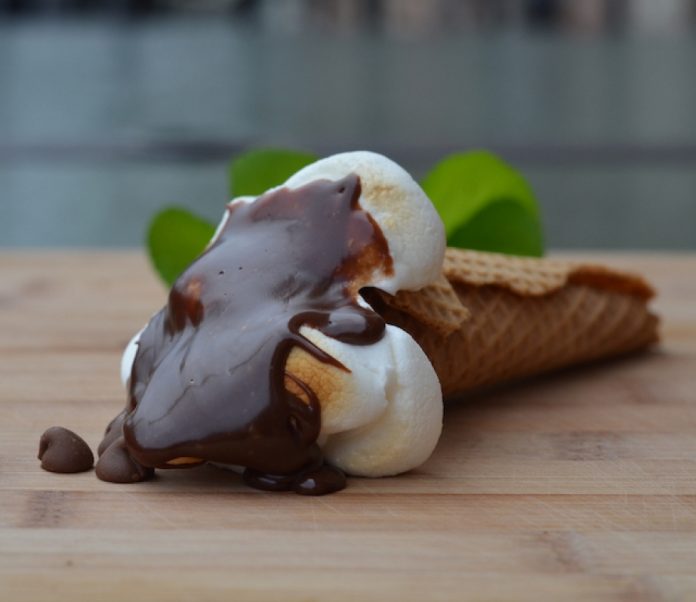
Campfire Smores in a Cone

  • 6 Ice cream cones
  • ½ Cup chocolate chips
  • ½ Cup mini marshmallows
  • Foil

Take the ice cream cones and sprinkle a layer of chocolate chips in the bottom. Cover with a layer of mini marshmallows. Continue to layer chocolate chips and marshmallows until the cone is full. Now wrap in foil and cook over the coals for 3-5 minutes or until the marshmallows are melted.

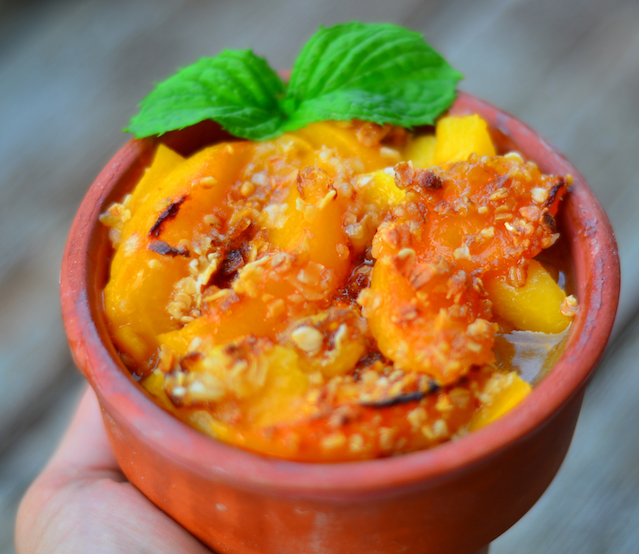
Peach_Cobbler2.jpg

Peach Cobbler

  • 4 Peaches halved and pitted
  • 4 Tbsp. brown sugar
  • 4 Tsp. butter
  • 4 Tsp. oats
  • Foil

Place the peach halves on the foil and top with butter and oats. Sprinkle brown sugar on the top. Wrap and place on the hot coals for 10-15 minutes until peaches are cooked through.

Tip: For a more decadent dessert, add chocolate chips, nuts or substitute granola for the oats.

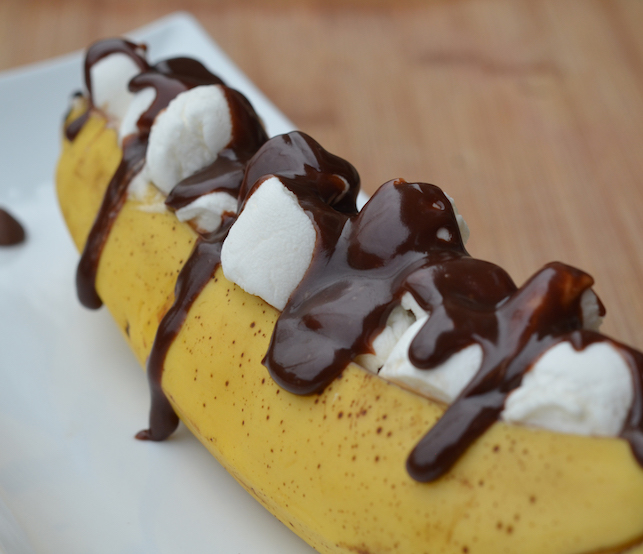
Banana_Boat3.jpg

Banana Boats

  • 4 Ripe Bananas
  • 4 tsp. chocolate chips
  • 4 Tbsp. marshmallows
  • Foil

Lay out a sheet of foil and place a banana on the foil. Slice the banana along the inside curve, leaving about an inch on both sides uncut. Spoon in the teaspoon of chocolate chip and top with a tablespoon of marshmallow. Fold the sides of the foil up around the banana so it can stay upright; leave the top part exposed so the marshmallows can brown. Cook for 10 minutes on the coals.

Nikki is an author specializing in green living, and adventure travel. She’s traveled the globe, swum with sharks and been bitten by a lion (fact). Catch her adventures here.

Spring Fever: Get Ready for Summer With These Early Season Paddling Events

Photo: Virginia Marshall

From coast to coast, early season paddling events offer great opportunities to refresh and refine skills before that big summer trip. Think of it as the ultimate spring training—after all, if you can master wet exits and rescues in May, imagine how easy they’ll be in August.

“Spring is really the best time to get people excited about kayaking,” says James Roberts, co-owner of Ontario Sea Kayak Centre (OSKC) and, with partner Dympna Hayes, founder of the annual Paddlepalooza Kayak Festival, held in May on Georgian Bay.

Early season events provide an opportunity for participants to engage with coaches and potential new paddling partners through an accessible, social chan- nel while months of paddling pleasure lie ahead—and spring fever is at its worst. Brush up on skills rusty from a long winter, swap gear that lay untouched last season, and trade stories around the campfire to find your next best paddling trip.

While northern paddlers will need wetsuits or drysuits to brave spring’s chilly waters, further south, spring offers an idyllic alchemy of air and water temperatures seemingly made just for paddlers. Whether April showers or May flowers, check out these great spring paddling events near you.

TRADITIONAL INUIT PADDLERS OF THE SOUTHEAST

May 13–15; Summerton, South Carolina| www.traditionalpaddlersretreat.com
This third annual weekend fosters friendships, skills, knowledge and gear all built around traditional and Greenland paddling techniques and culture. This year, join renowned mentors Helen Wilson, Christopher Crowhurst and Dubside to hone your strokes, rescues and rolling.

GEORGIAN BAY PADDLEPALOOZA

May 20–22; Parry Sound, Ontario | www.ontarioseakayakcentre.com
Featuring top coaches, superb scenery, great camping and a Saturday night party with live music and a limbo contest, the festival includes on-water clin- ics in strokes, rescues, rolling and more, plus dry land lessons on risk manage- ment, cooking, campcraft and navigation.

WOMEN ON WATER

June 10–12; Parry Sound, Ontario | www.ontarioseakayakcentre.com
This fun, all-women paddling festival is perfect for beginners to advanced paddlers, featuring kayak, canoe and standup paddling (SUP) skills sessions. Plus, don’t miss slipping into a mermaid tail for a twist on aquatic adventuring.

Screen_Shot_2016-04-26_at_3.40.35_PM.pngThis article first appeared in the May issue of Paddling Magazine. To read more from Paddling Magazine, click here.
Video: How To Punch Holes In Your Whitewater Kayak

Learn proper technique for punching holes on the river with Brendan Kowtecky with AO Boatwerks (http://boatwerks.com/) at Burleigh Falls, Ontario.

Author: Paddling Magazine Staff

What’s In the OSKC Gear Cave?

Photo: Virginia Marshall

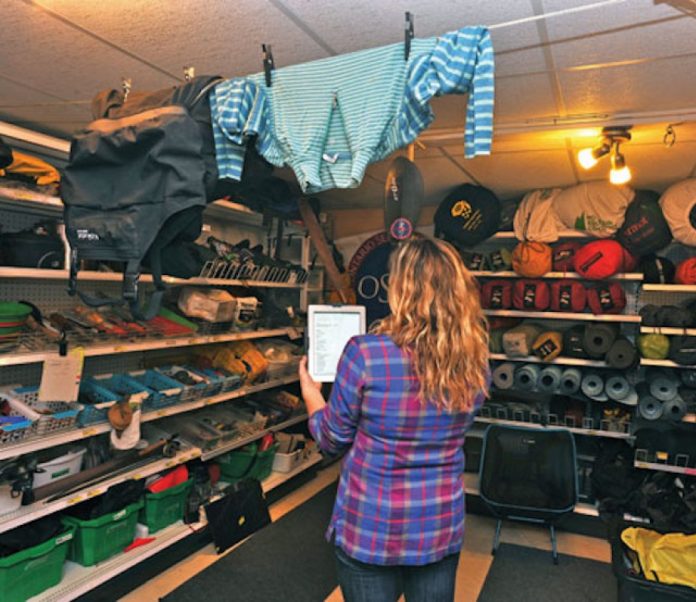
This is where the magic happens. Ontario Sea Kayak Centre co-founders Dympna Hayes and James Roberts have transformed their cozy home and 16 acres of rugged Canadian Shield into one of the country’s premier kayak schools and outfitters. From their 400-square-foot basement gear room, the couple outfits trips in their home waters of Georgian Bay as well as Baja, Norway, Saguenay and Vancouver Island. What’s their secret to managing all that gear? “Every season, look at the gear you have and what you actually used. Then get rid of the gadgets that you didn’t,” Hayes pauses and exhales her contagious, rapid-fire laugh, “so you can buy more gear!”

1. Commercial shelving from a defunct Target store is the ultimate gear room pick. “It was the day before they were closing for good and there was nothing left except the store fixtures,” recalls Hayes. “The store manager was so taken with our story, she let us have two aisles—$6,000 worth of shelving—for $60.”

2. Hayes uses a dive slate to teach dead reckoning, and to record departure and arrival times for her own navigation. It’s equally useful for writing tidal information, making student notes during on- water lessons, and jotting down ideas that pop into her head on long tours. “Plus it works in rain and waves and cleans quickly with a handful of sand.”

3. “If I’m sore and damp, I can’t be cheerful and take care of other people’s comfort,” Hayes says of her favorite camp luxury, a Helinox chair. Roberts offers his own creative recommendation: “Use it in your tent for sleeping. Just fold the legs and leave the chair sling assembled—it cradles your pillow holding it under your head, makes a perfect cubby to keep your headlamp and book close at hand, and keeps wet tent walls and polar bear jaws off your head.”

4. Hayes has half a dozen pragmatic uses for yoga mats on kayak trips. “They’re perfect for kneeling when loading your kayak, can be used as a heel pad in your boat, make a fine welcome mat for your tent, and add insulation and dryness under your sleeping mattress.” She’s also a yoga instructor and offers yoga kayak trips on Georgian Bay throughout the summer. “I’m going to get all hippy yoga freak on you now,” she teases. “After sitting all day on the water, it feels great to plant your feet and ground yourself to the Earth.”

5. “The Outback Oven works just like a real oven—we’ve done seared beef tenderloin, baby potatoes and baked brie in these babies.” And, of course, it’s perfect for baking. “You can have fresh, warm bread on the last day of a two-week trip, or on any cold, rainy day to lift spirits.”

6. “Ladies, do yourself a favor—get a Freshette and a drysuit with a front relief zip. From behind, it’s so discrete that you’ll look like a dude.”

7. Roberts recommends the Evernote app to keep meticulous lists and impress grannies in the grocery store. “I cut and paste menu plans and gear lists from trip to trip—it adjusts the amounts for the number of participants and generates custom shopping lists.”

8. Hayes and Roberts spend some 50 nights per year in their Hilleberg Staika tent. “It’s our all-time favorite tent. It stays put in squalls on Georgian Bay’s bare rock islets, keeps us bone-dry in West Coast rainforests, and didn’t buckle under insane winds in Norway’s fiords.” After years of scrimping on shelters, the couple took a cue from their well-heeled, Hilleberg-equipped guests. “What a difference,” says Hayes, “seriously the best money I ever spent.”

9. These 10-year-old merino long underwear represent Hayes’ favorite thing about outdoor gear. “It isn’t throwaway—because it has to be something that you can fix while you’re out on trip, it’s made to last, and it’s made to be repairable.” She says of her stripy Smartwool, “I can’t see these ever falling apart—I think I’ll have them for 20 years.”

CCC badgeThe Ontario Sea Kayak Centre is located in Parry Sound, Ontario. Every September they run Canada’s longest running traditional paddling event, Ontario Greenland Camp. Watch THE CANOE, an award-winning film that tells the story of Canada’s connection to water and how paddling in Ontario is enriching the lives of those who paddle there. #PaddleON.



This article originally appeared in Adventure Kayak
Spring 2016 issue.

Subscribe to Paddling Magazine and get 25 years of digital magazine archives including our legacy titles: Rapid, Adventure Kayak and Canoeroots.