


I was chanting the serenity prayer before I’d even gotten off the train.
“Grant me the serenity to accept the things I cannot change,
The courage to change the things I can,
And wisdom to know the difference.”
I’d left my New Hampshire home behind and was headed north to paddle 250 miles of the Moisie River. Solo.
As the train approached my stop—a debris-filled dirt lot beside a pothole-ridden, one-and-one-half lane dirt road—the conductor explained that the road was engulfed by forest fire and I could not disembark.
Learning from an elderly passenger that I could access an easily navigable tributary and cut my expedition down to a four-day paddle back to my car, I hopped off the train and settled into a six-by-12-foot shack next to the all-but-abandoned tracks.
To get to the river the next morning, I trekked through a hellacious forest packed with downed conifers and foot-entrapping marshland with rapacious mosquitos easily infiltrating my head net.
As I approached, the horizon line that came into focus caused a sinking feeling of fuck-my-life.
The 100-foot cascading waterfall landed on rocks before descending into a continuous section of gorged-in whitewater. There was no way I could paddle out from here.
It took three hours to trudge back to the shack.
Since the next train wouldn’t pass for days, I turned to my satellite communicator—this was still a situation I could control. A quick message would tell my mother and two kayaking friends I was in need of non-urgent help to get out.
“ERROR,” was the device’s only response, until six hours later when I heard an unmistakable sound.
Shooting up over the horizon, the helicopter hovered over my head before landing softly by the tracks.
Shit.
My message had sent, and while my buddies were working on a plan, my mom had called the police.
The pilot explained that I already owed a substantial fee and, though he wouldn’t elaborate on the amount, if I got on the helicopter the price would go up. And he couldn’t carry my boat.
Declining the ride, I begged him to ensure the next train would stop for me.
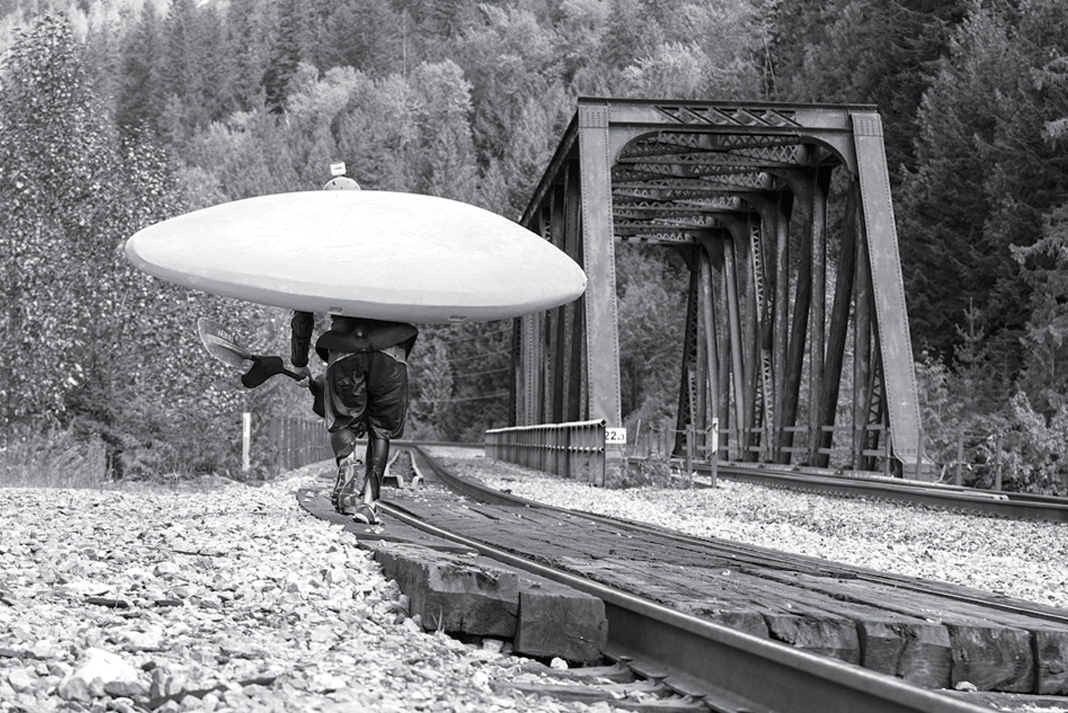
UTTERLY POWERLESS
For three days I rotated between chanting the serenity prayer and cursing the mountains, skies and blackflies.
Had my text cost me $10,000 or $50,000? The realization that I was utterly powerless did little to quell my rage.
On the day the train would come, I prepared for its 4 p.m. arrival, awaiting the steel stallion that would save me from myself.
I paced the tracks—100 yards south of my gear, then 100 yards north, back to check the time, then another lap. Then another and another. As the sun set after 8 p.m., I threw my head back and screamed.
Grant me the serenity to accept the things I cannot change.
Returning to my shack, I started reading my only book, Paulo Coelho’s The Alchemist, for the third time.
Then I saw the light. About a mile up the rails and heading towards me.
Scrambling onto the tracks, I flashed my dying headlamp and yelled to the conductor as if he’d hear me. Screeching, it slowed and a cargo door opened.
Perpetually failing, stranded, in debt and scaring my friends and family, I had been forced to accept my reality and adjust my mind to each change in circumstance. Tensing up and fighting a situation only makes it worse. Through the uncertainty, monotony and solitude, the same lessons I’d learned many years prior as a beginner paddler had been tested outside my boat.
In the year since his Moisie misadventure, Nathan Warren has mastered the art of serenity under stress. Now he’s just trying to hold on to it for more than five seconds. He was billed $2,000 for the visit.
 This article first appeared in the Summer/Fall 2014 issue of Rapid Magazine. Subscribe to Paddling Magazine’s print and digital editions, or browse the archives.




 This article was first published in the Summer 2014 issue of Adventure Kayak Magazine.



 This article first appeared in the Early Summer 2014 issue of Rapid Magazine.


 Get the full article in the digital edition of Canoeroots and Family Camping, Spring 2008, on our free




