Home Blog Page 288

Outdoor Retailer-Day 2

Keep track of your heart rate, route, the weather...and the time. Photos: Ben Duchesney
Keep track of your heart rate, route, the weather...and the time.

Suunto

The Ambit3 series (above) of GPS watches from Suunto are perfect for paddlers who like to keep track of everything. The Peak model, not only keeps track of heart rate, has weather functions and is bluetooth compatible with Suunto’s new, Movescount mobile app. The app lets you decide which features are shown on the face of the watch and allows the watch to display notifications while you’re on the go. 

The Movescount app works with the watch to help you create The Suunto Movie. This feature visualizes your route on a 3D map, which includes key metrics, and you can add photos from your adventure to tell the whole story. The Peak model will be available this September, starting at $500. 

Level Six

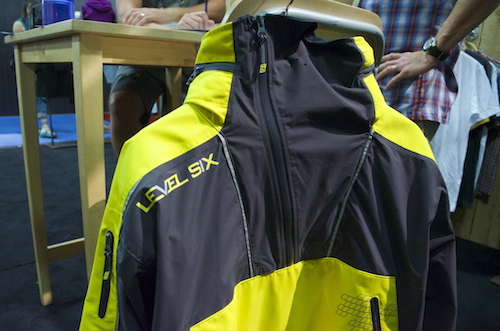
Level Six redesigned their popular Superior paddling jacket to make it more comfortable and efficient. The Superior 2.0 features a new Sidewinder zipper ensures neck comfort and a venting collar system keeps breathing heavily in the really rough weather comfortable.

A tuck away hood system has vents in the back so heavy winds can travel through the hood instead of being blown off your head. Fleece lined hand warmer pockets keep you toasty at the launch and the Dual Fabric construction lightens the jacket and keeps it more breathable in key areas. 
Level Six

ExtraSport

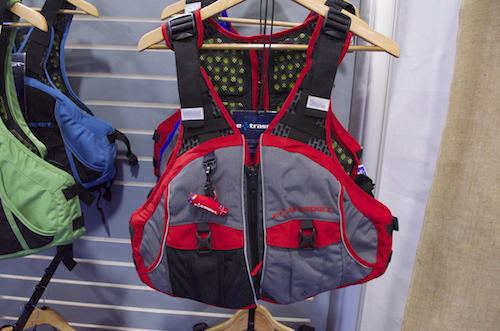
Using Extrasport’s new Bump Foam comfort system, their latest PFD, the Eon, is designed for ultimate comfort and gear storage. A mesh Baja back nests above kayak seats to deliver all day comfort. Pleated top load, fleece lined Kangaroo hand warmer pockets and multiple safety features round out the package.
Extrasport

Pyranha

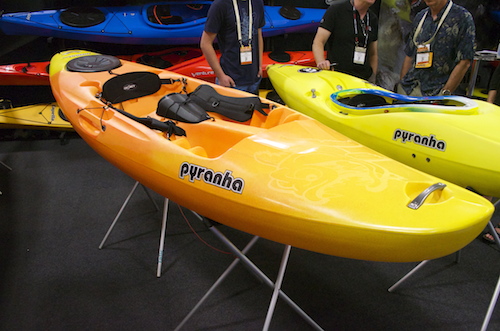
A new Fusion sit-on-top from Pyranha lests paddlers get a whitewater hull and features in a recreational kayak package. Unlike most sit-on-tops the new Fusion has a skeg to assist with tracking. Leg straps allow paddlers to tilt and carve the boat, while the open deck prevents them from feeling trapped. The hull is wider to increase stability for beginner paddlers. 
Pyranha

Goal Zero

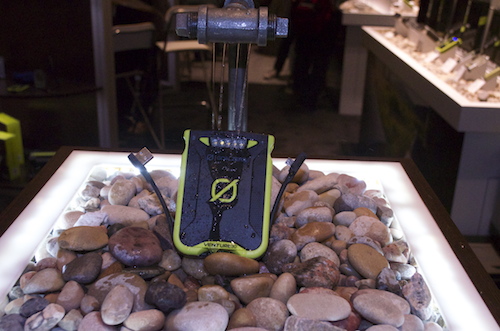
Keep your phones, tablets, cameras and other important devices charged and ready with the new Venture 30 from Goal Zero. Charge your smartphone 2-3 times or your tablet once at camp after charging the Venture via solar panels. The unit starts at $99 without the solar panels, or $169 paired with the Nomad 7 panel

The charger is weatherproof, which means “you could take a shower with it, but not a bath,” said Lisa Janssen of Goal Zero. A USB cable and micro sd cable are both built in so you never have to worry about forgetting to pack cords. There are 2 USB ports as well, and the Venture can charge two phones at 2.4 amps, at the same time, without losing ampage once the second is plugged in. The Venture will also talk with your device to deliver the ampage at a speed that won’t overcharge it. 
Goal Zero

Stellar Kayaks

Stellar Kayaks has released a new 14 ft surfski, the S14S, designed for the recreational paddler looking for racing style. The steering system on the boat is similiar to Stellar’s other racing style systems, and the short length and low weight (starting at 26.9lbs), make carrying the boat to and from water a breeze. There are four grades available in the series, Ultra, Excel, Advantage and Sport, starting at $1,950 with the Sport.
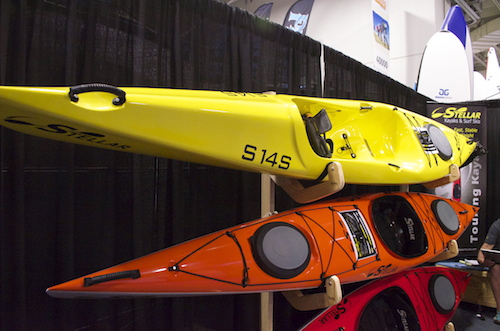
Stellar Kayaks

Stay tuned for more of the greatest new products from Outdoor Retailer. Be sure to follow along with Adventure Kayak on our Facebook and Twitter pages!

Great New Gear

Scroll down to see the new NRS Siren. Photos: Emma Drudge
Great New Gear

Here are some canoeing and camping products on display at Outdoor Retailer:

Frost River

Frost River is displaying their beautiful canoe packs in the pavilions at Outdoor Retailer. Their portage-style packs are heavy water resistant waxed canvas, have solid brass buckles, harness leather reinforcements, a durable double bottom and tumplines and adjustable backpack straps. All of Frost River’s products are made in Duluth, Minnesota.

Frost river packs

Sierra Designs

Ultra-light is an understatement when it comes to the new tent from Sierra Designs. Weighing in at two pounds, nine ounces, the Tensegrity is a non-freestanding design that relies on trekking poles or sticks to stand in place. It’s a rethink of tent design altogether: the tent is wider up top to give extra shoulder and head room; it has a giant vestibule that can be adjusted down for a classic gear storage vestibule or pulled up to create a tarp-style living and cooking space. The silicone fabric is tear-resistant despite its paper-thin weight. 

Sierra Designs tent 

L.L.Bean

L.L.Bean’s new products integrate new, fast drying, lightweight synthetics without compromising the classic look and feel of their clothing. The Polartec Thermal Pro Sport Jac is a throwback style with a cottony feel that’s great for both the backcountry and bar.

LL Bean

Goal Zero

The new Venture 30 is a battery that can handle the elements. Charge it using the small built-in USB cord and then bring it into the backcoutry to keep your headlamp, camera, smartphone or tablet powered up. Pair it with one of Goal Zero’s solar panels to stay charged while you’re off the grid. Stop worrying about babying your electronics—the Venture 30 won’t be harmed by splashing or sand.

Goal zero charger

NRS

The Siren PFD from NRS is a new version of their basic Vapour PFD with a women’s specific cut and a few added features. It has a big front pocket for easily-accessible storage and a hand warming pocket for even more all-day comfort. It trims all extra weight and bulk by sticking to the basic essential features and combining them into a slim, sleek design. The Siren will be available in Spring 2015. 

NRS Siren


Kayakers Lose Control in Drainage Ditch

River Roots GoPro footage of Ben Marr and Rush Sturges losing control at 72 KMH (45MPH) down a drainage ditch near Vancouver, British Columbia.

From Rush Sturges.

How The River Gives Us Things Money Can’t Buy

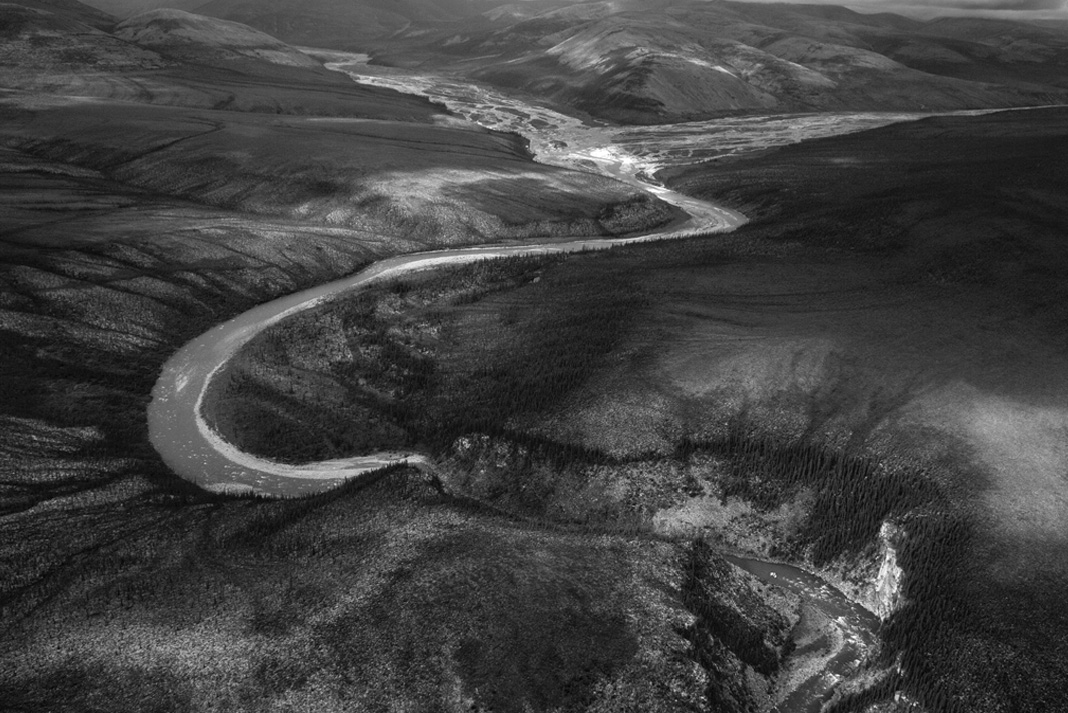
Overhead black and white photo of a river winding through a rocky valley
A friendship never to sever. | Feature photo: Ryan Creary

After delivering a keynote address on risk and choice at a Laurentian University kinesiology conference, my host walked out to join me on stage and presented me with a penny. Standing center stage in front of an audience of professors and practitioners, I found myself completely confused.

He promptly asked for the penny back and, in return, gave me an elegant, custom-built, long-bladed knife wrapped in a handmade birch bark sheath. The gift was beautiful. The penny exchange was very strange.

I learned later that in many cultures around the world there is a tradition, or superstition, about the giving and receiving of knives.

A knife as a gift brings with it the symbolic risk of severing a friendship on the knife’s sharp edge. The same tradition says trading as little as a penny for a knife brings good luck and assures one will never cut oneself on the blade.

How the river gives us things money can’t buy

For paddlers, a quality knife can be a key piece of personal protective equipment. Guides who spend long seasons out on the river know it’s a certainty that at some point their knife will be dropped and lost forever.

What is less certain is what the river will offer in exchange.

A friendship never to sever. | Feature photo: Ryan Creary

I lost one knife at the tail of Cataract Canyon on the Colorado River as I was rigging an outboard motor to plow our raft barge across Lake Powell. Adjusting the idle screw on the waterlogged outboard motor, my knife slipped from my black oily fingers and sunk out of sight. The engine fired to life the very next pull and the trip proceeded as planned.

In my first season as a raft guide, I got my feet tangled in my flipped raft’s bowline. I impressed myself by calmly unzipping a pocket, flipping open a hinge-blade and sawing my feet free of the rope, all while underwater and being dragged downstream. When I surfaced, I had to decide between climbing aboard the overturned raft and keeping my knife in my hand.

“The truth I’ve realized is that rivers are true to tradition—my knives were not lost but accepted in an exchange.”

Another knife of mine plopped into the Middle Fork of the Salmon as the rookie guide who borrowed it to adjust his oars at the put-in gapped the hand-off. Mortified, he turned pale as we watched the knife flutter in the swift current, then bounce along the bottom and out of sight in the crystal clear mountain stream. I laughed. We became fast friends and worked together for the next three years.

[ Paddling Buyer’s Guide: View all knives & tools ]

A penny for a knife; a knife for a richer life

In total, I’ve lost six knives to the river, each time cursing an unholy sentiment while calculating how much of my daily wage would go towards replacing it. The truth I’ve realized is that rivers are true to tradition—my knives were not lost but accepted in an exchange.

In return, the river has given me things that coins cannot buy. My knives were traded for good fortune, for friendships and for life itself.

Cover of the Summer/Fall 2014 issue of Rapid magazineThis article was first published in the Summer/Fall 2014 issue of Rapid Magazine. Subscribe to Paddling Magazine’s print and digital editions, or browse the archives.


A friendship never to sever. | Feature photo: Ryan Creary


New Canoeing and Camping Gear

Photos: Emma Drudge
New Canoeing and Camping Gear

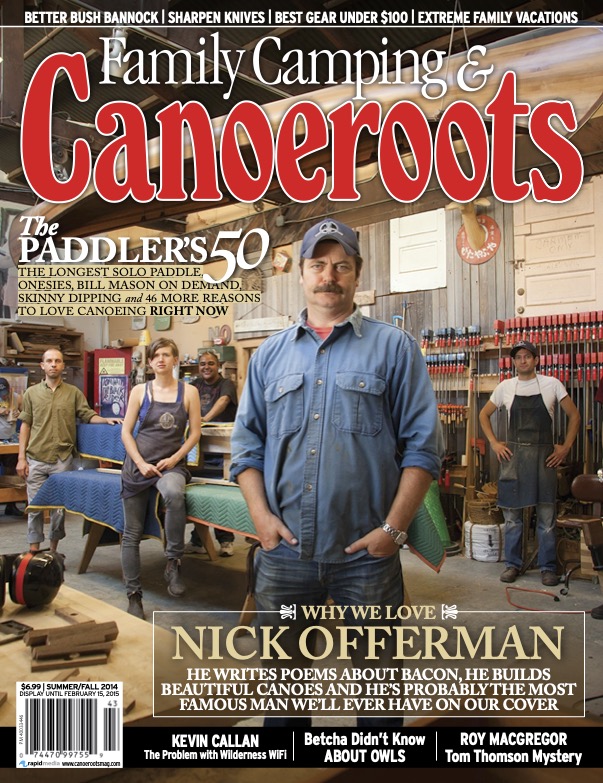
Outdoor Retailer’s 2014 Summer Market kicked off with an Open Air Demo Day, where hundreds of brands shared their latest and greatest in boat design and new gear—some of our favorite finds are listed below. Stay tuned to Canoeroots all week as we cover everything Outdoor Retailer has to offer. 

Old Town Canoes and Kayaks

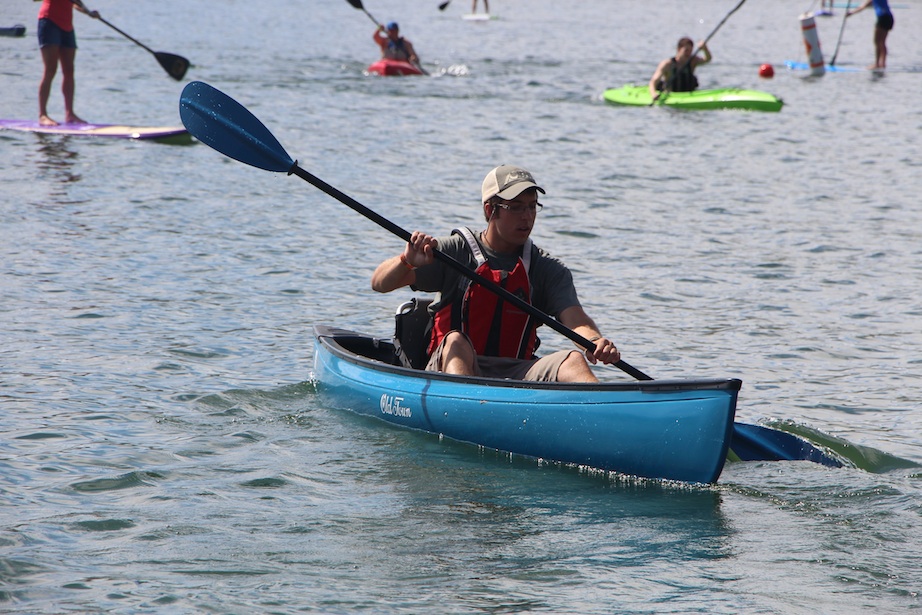
Old Town Canoes and Kayaks made a splash today with the introduction of the NEXT, a brand new canoe that joins their lineup as an accessible, entry-level design seeking to draw new paddlers into the sport and make canoeing more convenient for those who are already committed. The NEXT is lightweight, stable and very easy to maneuver with a double bladed paddle—traditionalists will enjoy it with a single blade as well.

It accelerates quickly, can carry gear and is a breeze to load on the car for spontaneous paddle sessions. Stay tuned for more on the NEXT at Canoerootsmag.com. 

Old town next copy


GoPro

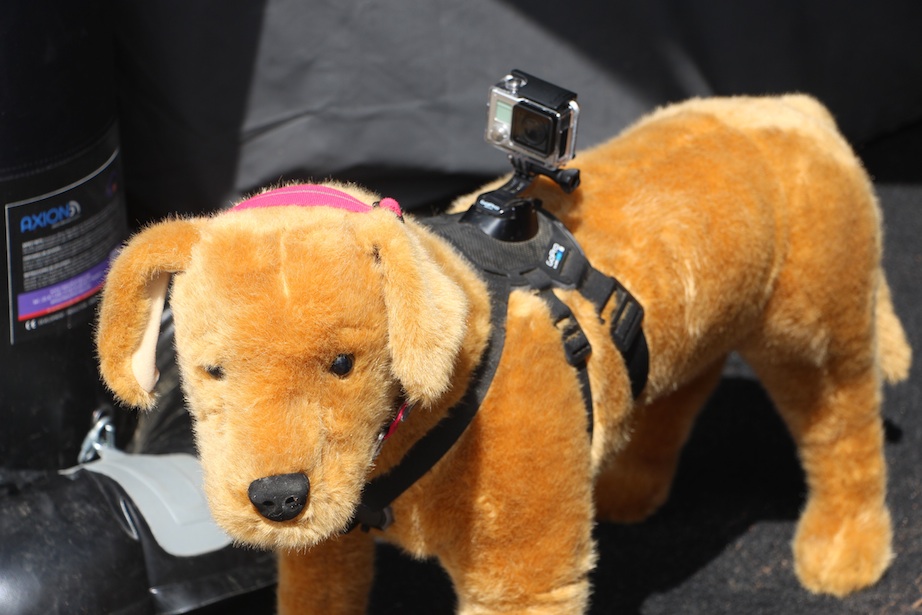
Canoeroots and Family Camping got a sneak peek at the Fetch today, a new dog harness camera mount from GoPro that is yet to be released. After years of seeing customers strap human harnesses to their furry friends, GoPro responded with a dog-specific harness that fits animals of all sizes. The harness has a chest mount and reversible back mount for GoPro cameras. 

gopro fetch


Sony

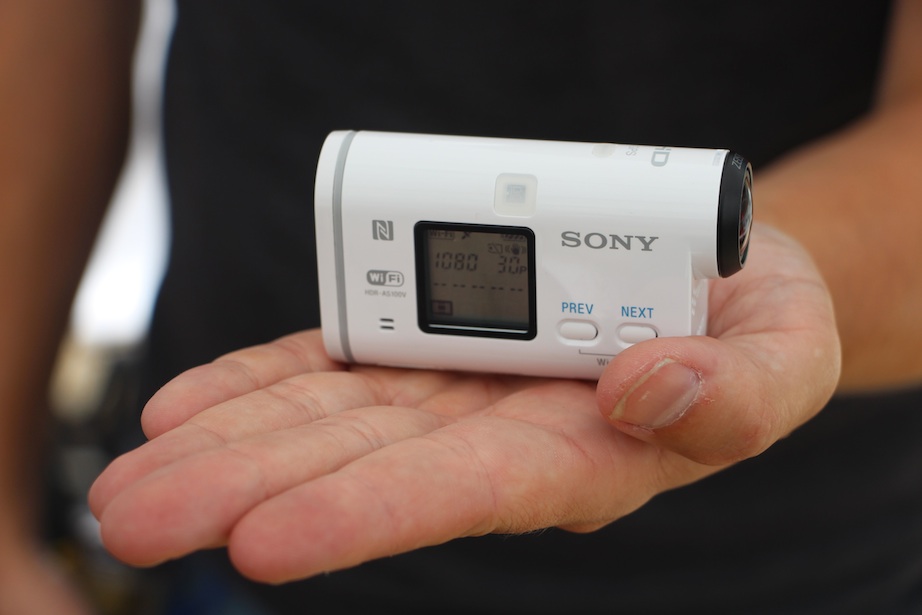
The AS100 is the new addition to Sony’s lineup of action cams. The new model has a bigger and better sensor for higher image quality. The splash proof camera can handle some moisture without any housing, and can be totally waterproofed with plastic housing for full submersion. The AS100 has streaming capability and fits in the palm of your hand.

Sony A100


Chapul Cricket Energy Bars

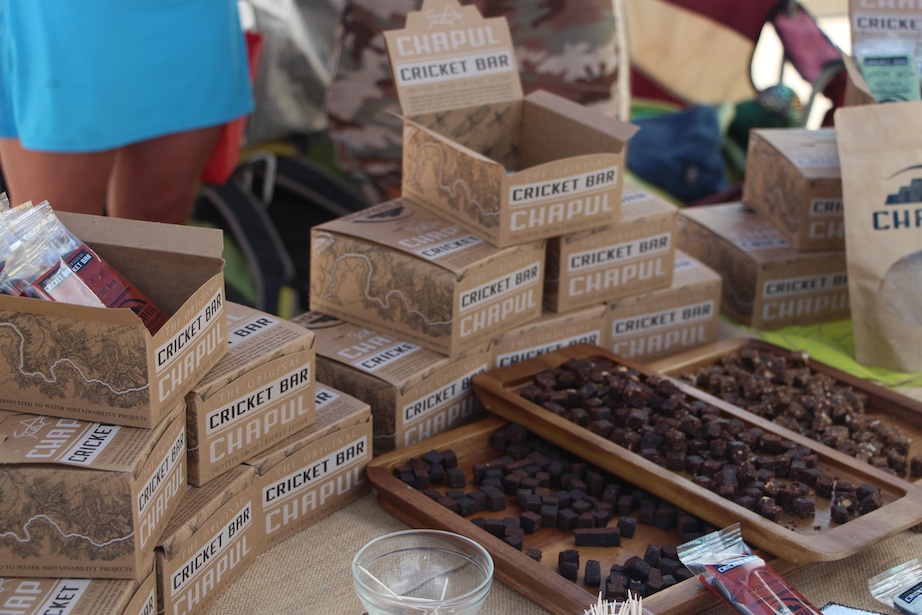
Chapul Cricket Energy Bars are new, packable snack or meal replacement bars that come from a sustainable protein source. As Chapul describes it: “Insects require less land resources, emit fewer greenhouse gases, and have a much smaller water demand than livestock and animal substitute such as soy, corn and rice.” Bonus: They’re delicious.

crickets


Primus

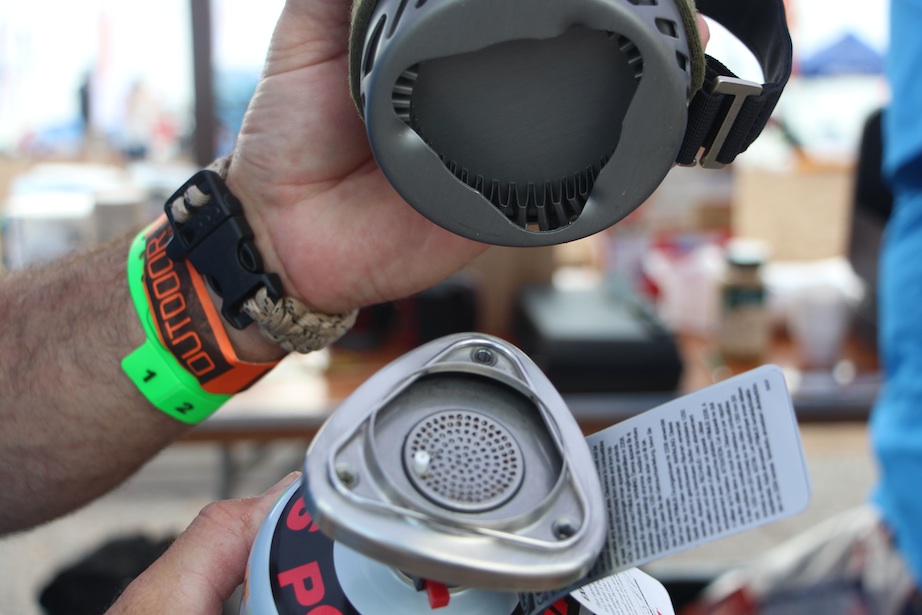
Primus is building on its already-excellent lineup of stoves by adding one handy new feature: a way to attach the pot you’re cooking in to the stove you’re cooking on. The two pieces are built to fit together and connect and detach easily so hot pots can’t slide around while you’re cooking. Additional screws help you attach other cookware to the Primus stoves.

Primus stove


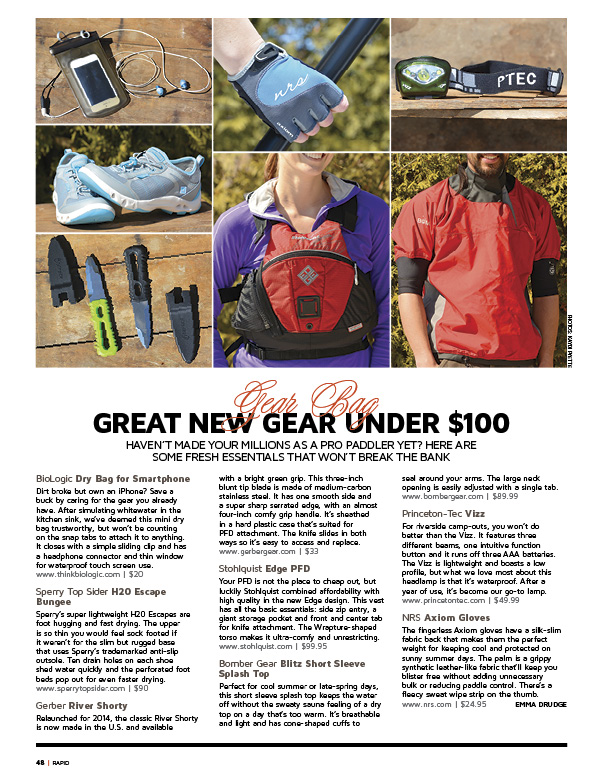
Bomber Gear Blitz Short Sleeve Splash Top

Photo: Kaydi Pyette
Bomber Gear Blitz Short Sleeve Splash Top

Perfect for cool summer or late-spring days, this short sleeve splash top keeps the water off without the sweaty sauna feeling of a dry top on a day that’s too warm. It’s breathable and light and has cone-shaped cuffs to seal around the arms. The neck opening is big and easily adjusted with a single tab.

www.bombergear.com | 89.99


RPv16i2-48

Click here to find great new gear under $100 in the free online edition of Rapid, Early Summer 2014 or download our free app for Apple or Android.


Call of the Wireless: Why Technology Is The End Of Camping As We Know It

Photo: Kristian Olauson
There's no app for this.

Should campers be able to get online from the comfort of the fire pit? I recently spent three days debating this question on national media. The media frenzy was stirred up by Parks Canada announcing a plan to provide WiFi at as many as 150 national parks and landmarks over the next three years. The digital world and natural world are colliding. It was only when Toronto mayor Rob Ford checked himself into rehab that the media moved on and my life returned to normal.

Even after the dust settled, I couldn’t get the WiFi issue out of my head. I’m fascinated by the strong reactions it stirred. Again and again, I heard campers and paddlers say that is was the beginning of the end; this will be remembered as the moment when true wilderness values were lost forever.

Parks Canada’s decision isn’t without precedent. A 2013 pilot project in the United States saw a handful of national parks offer up free WiFi services. The project received outcry from backcountry users and some environmental groups, but the hotspots were a hit with campers.

Parks Canada is losing customers at an alarming rate. WiFi makes good business sense it seems. The number one complaint from visitors over the last few years was not being able to get online.

Blanketing swaths of wilderness with Internet access isn’t up for discussion—that’s way too expensive. WiFi will only be provided in limited areas, such as visitor centers and gatehouses—the same as it is in some American parks. It reminds me a little of the good old days when we used to walk to the campground phone booth to call home.

With RVs sporting satellite dishes the norm in most car campgrounds, I find it hard to get riled up about an unobtrusive, invisible signal in the air—so long as it stays out of the backcountry.

That’s the heart of the matter. People are afraid of technology invading the one sacred place we can escape from the modern world. Of course, it’s a particular type of technology that makes paddlers wary—we’re big fans of cooking on tiny camp stoves and portaging lightweight Kevlar canoes, less so of a Blackberry ping interrupting the call of a loon or photos from LOLCats.com passed around the fire.

When we head into the woods, we’re looking to make more of a natural connection. Like with other addictions though, we crave our next hit, which is why we’re often found glancing at our screens when we could be present in the moment.

Photo: Kristian Olauson
There’s no app for this.

The core of this debate isn’t whether natural spaces and technology should mix, it’s that we don’t trust ourselves to mix them.

If we all had the self-control to simply turn off our devices—to stop checking email, updating Facebook or getting tomorrow’s weather forecast, even in the face of a five-bar-strong connection—and just immerse ourselves in the outdoors, there wouldn’t be anything to get riled up about.

The old idiom is true: If you stand in the way of progress you’ll just get run over. So why fight it? What’s wrong with eventually being able to read Aldo Leopold on your tablet, Google a rare bird species, or watch a John Denver special on Netflix at your secluded island campsite, if that’s what you want? To each and every camper, the choice may soon be in your hands.

Kevin Callan plans to keep his hands firmly wrapped around a dog-eared copy of the Sibley Field Guide to Birds of North America. www. kevincallan.com.


Get the full article in the digital edition of Canoeroots and Family Camping, Summer/Fall 2014.Subscribe to Paddling Magazine’s print and digital editions, or browse the archives.

Dirty Jobs, Beautiful Boats: Kayak Manufacturing in the UK

All photos this page: Alex Bloyd-Peshkin
Dirty Jobs, Beautiful Boats: Kayak Manufacturing in the UK

Every time we settle into
our kayaks, we see the stickers announcing their provenance: Anglesey, Wales, for our Sea Kayaking UK Pilgrim; Nottingham, England, for our Valley Avocet LV. The place names conjure images of rugged coast and rough water, of grey skies and green meadows. So when the opportunity arises, we jump at the chance to actually visit the birthplaces of our boats.

It’s not exactly Sherwood Forest or the Shire. Valley
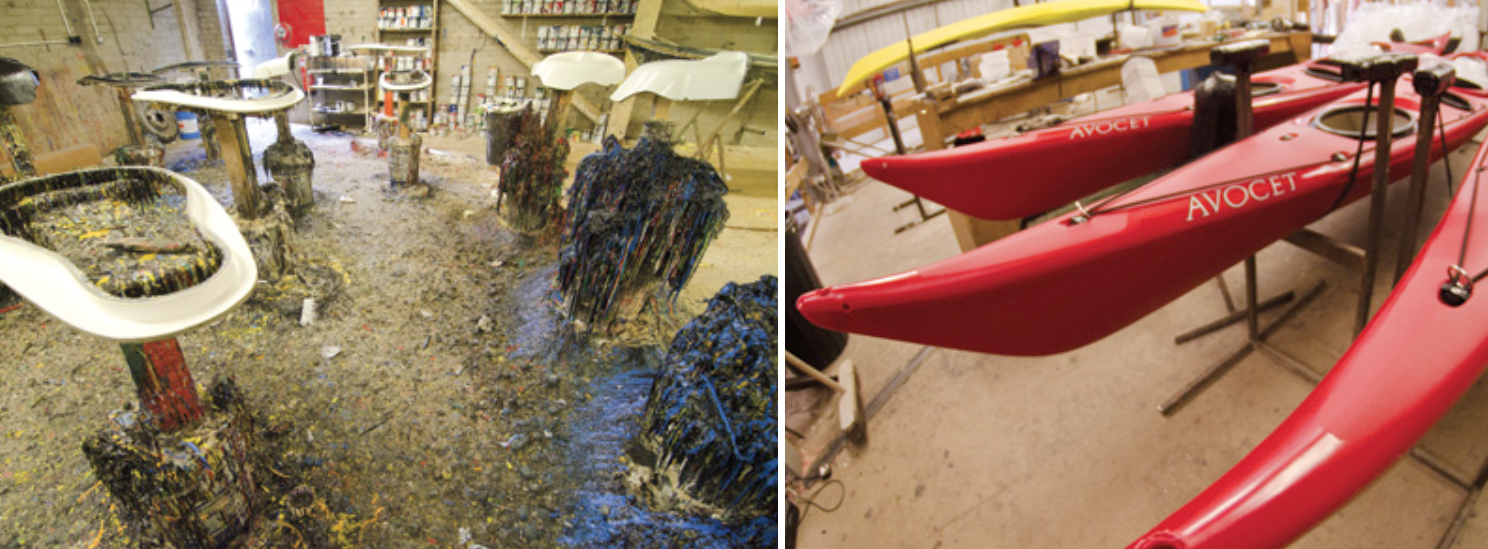
and Sea Kayaking UK both occupy factories in nondescript industrial areas. But don’t let the term factory mislead you. These aren’t cavernous buildings with deafening, automated machinery cranking out identical objects at a frantic pace. Rather, they are modest metal sheds where kayaks are handmade by skilled workers in a labor-intensive, multi-step process.

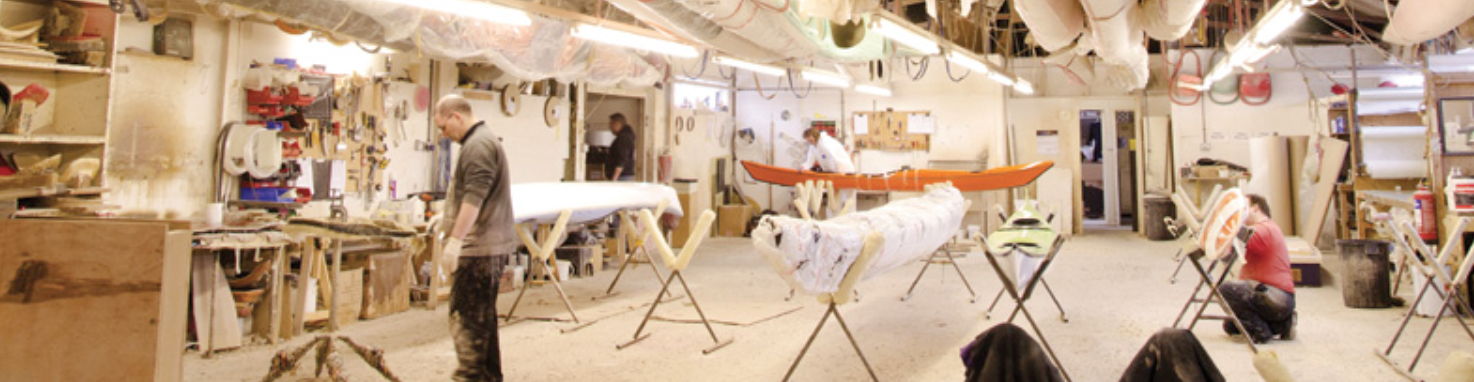
Nottingham lies landlocked in the middle of England. On the outskirts of the bustling city, where the nearby River Trent winds out of crowded suburbia into a lush quilt of tidy fields, tinny Black Sabbath plays over too-small speakers in the Valley factory. Boats-in-progress rest on sawhorses and the sharp smell of solvents fills the air. Cans of gel coat and resin line the shelves and tools, brushes and tape hang from the walls.

Many of Valley’s 20 full-time employees have worked here for more than two decades. A Mick Jagger look-alike leans intently over a brilliant orange kayak. Several other men in gel coat-stained coveralls or spotless white Tyvek suits move the kayaks through their stations: painting the molds with gel coat, layering in the fiberglass and resin, glassing in the coaming, bulkheads and skeg box. For composite kayaks, the time from mold to final inspection is about a week.

Inside a kayak workshop in UK

PRIDE IN KAYAK CRAFTMANSHIP

Three hundred kilometers to the west, surrounded by cliffs and currents, Holy Island lies like a severed pinky off the mitt of Anglesey Island. The Sea Kayaking UK factory sits just south of Holyhead’s Old Harbour and the town’s busy seaport. Inside, seat and coaming molds stand amid years of resin stalagmites, like a Technicolor petrified forest. Reels of fiberglass hang above workstations, where work orders list each kayak’s customization and destination: Japan, Finland, Israel.

At both factories, there’s tremendous pride in production, and a lot of cross-pollination of technique, shape, process and even people. Valley co-owners Jason Buxton and Peter Orton are both former members of the British freestyle team. Buxton went on to work for Pyranha and Orton for P&H. When the two companies merged, Buxton and Orton found themselves colleagues once more. They later purchased Valley, which produced its first boat, the Pintail, for Nigel Dennis’ paddling center. Dennis, in turn, founded Nigel Dennis Kayaks, now Sea Kayaking UK.

While the owners are serious long-time paddlers, the dedicated workers who built our kayaks—and perhaps yours as well—generally are not. Rather, they are craftsmen who appreciate the steady work creating respected products. It might 
be a dirty job, but the result is undeniably beautiful.

“It’s quite nice to create something,” says Buxton. “We’ve lost more workers to retirement than anything else—we’re passionate about what we do.”

Inside a kayak workshop in UK

Sharon and Alec Bloyd-Peshkin are the founders of Chicago-based Have Kayaks, Will Travel Paddlesport Coaching (www.havekayakswilltravel.com).


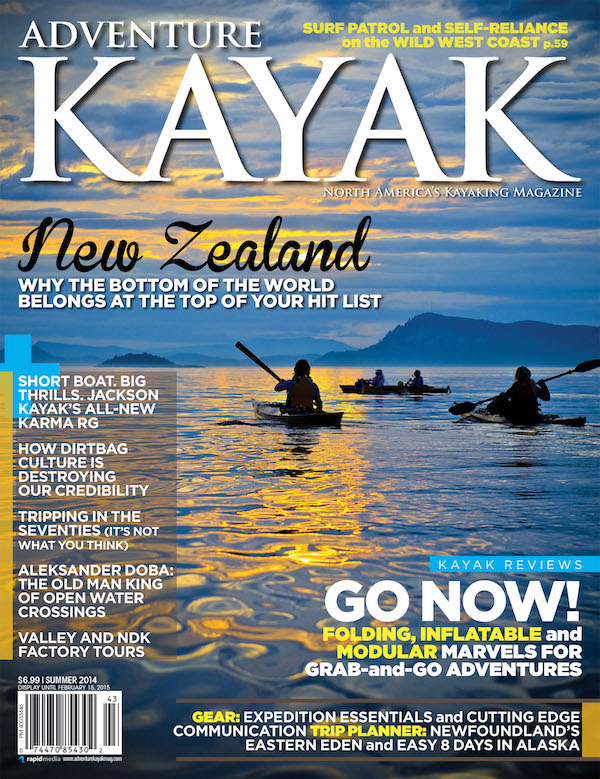
This article first appeared in the Summer 2014 issue of Adventure Kayak Magazine.  Subscribe to Paddling Magazine and get 25 years of digital magazine archives including our legacy titles: Rapid, Adventure Kayak and Canoeroots.

Chasing Waves: Hunting For Surf In British Columbia

person paddles a sea kayak in British Columbia's Kyuquot Sound while towing a board for surfing
Feature photo: Ben Haggar

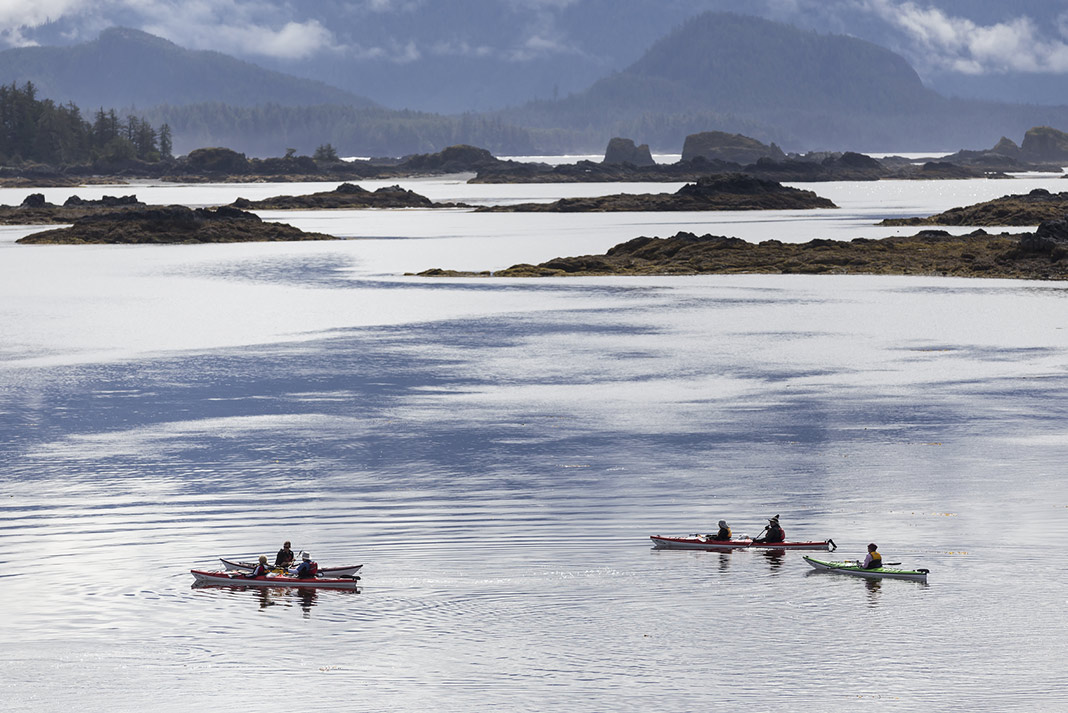
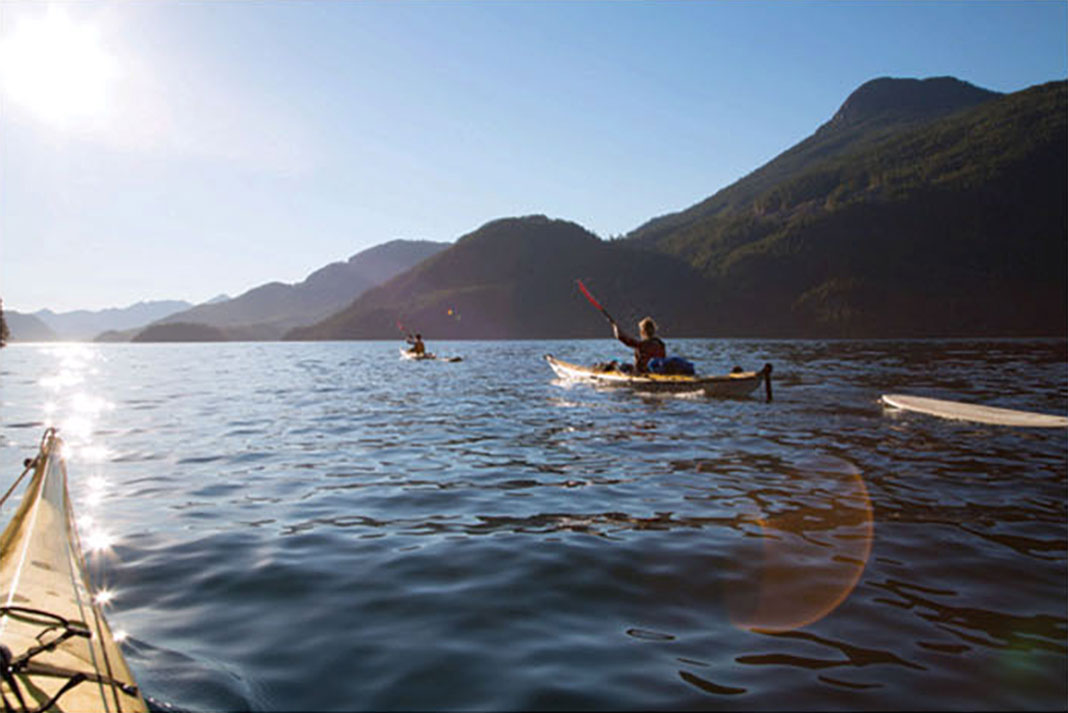
For some paddlers, kayaks are both a means and an end—a vessel to access the best surf and then play in it. But for me and three friends, it was a love of surfing boards, not boats, that drew us to a remote stretch of northwest Vancouver Island coastline in search of untapped breaks. Rather than zipping back and forth in a powerboat blitzing waves and disrupting the region’s natural vibe, we wanted a more adventurous, eco- and budget-friendly trip. Sea kayaks were the obvious choice. Our journey focused as much on self-reliance and careful scouting as it did on scoring new surf.

Chasing waves: Hunting for surf in British Columbia

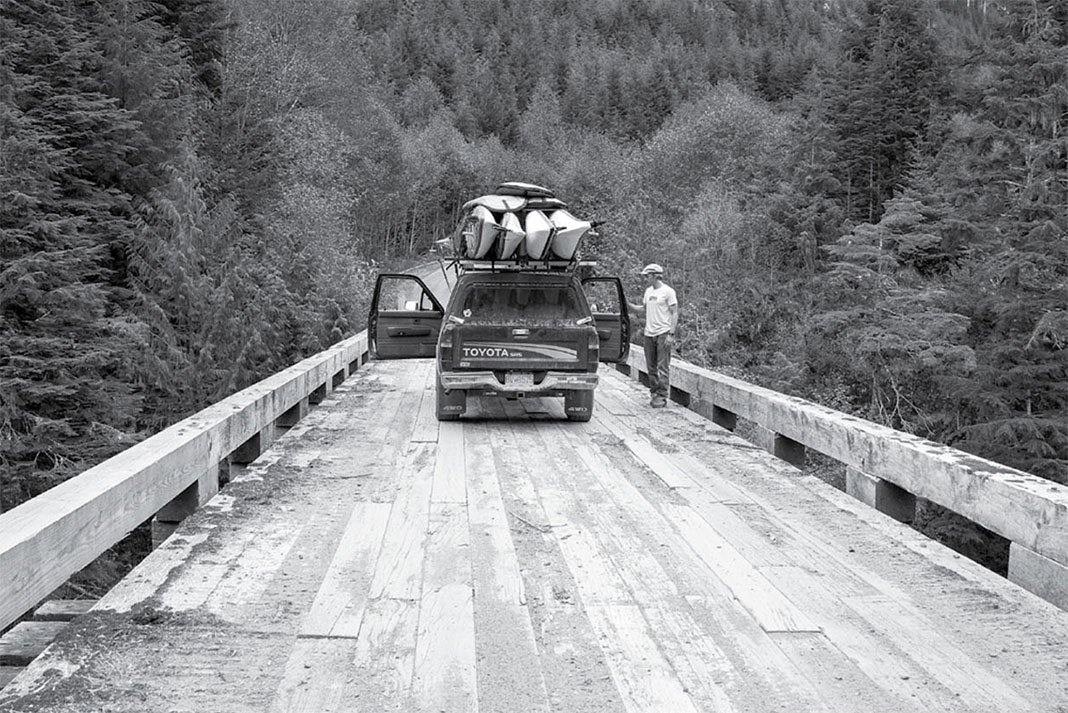
vehicle with kayaks on top on bridge
Photo: Ben Haggar

Onwards to Kyuquot Sound

A loud crack breaks the concentration needed to navigate the harrowing tentacles of the Artlish River valley’s forestry roads. More than seven hours and nearly 500 kilometers out of Tofino, we pull to the roadside to take stock of my 20-year-old Tacoma. Loaded with four people, a canopy full to the brim with food and gear, and four kayaks and surfboards strapped to a homemade wooden rack, it’s difficult to tell from where the ominous sound originated. Fortunately, the aged truck’s protests are merely a bluff and we continue our laborious descent to the coast.

Logging trucks piled high with old growth cedars speed past, trailing choking clouds of dust. Where the once towering trees have been felled and hauled from the rolling slopes of these coastal mountains, alder thickets crowd the narrow trail of washboard gravel that leads to the innermost reaches of Kyuquot Sound.

Much of Vancouver Island’s outer coast is rugged and remote, and Kyuquot Sound—where our trip begins—is no exception. With virtually no land access to its outer extremities, a boat is a necessity.

Although we can cover less water than a powerboat, our kayaks provide the flexibility to search out new breaks on offshore reefs and islands as well as those tucked in along the unforgiving coast. Crossing the exposed mouth of the sound provides the first gentle rise and fall of a small groundswell, hinting at the waves we are hoping to find hiding beyond Rugged Point on the storm-battered outer coast.

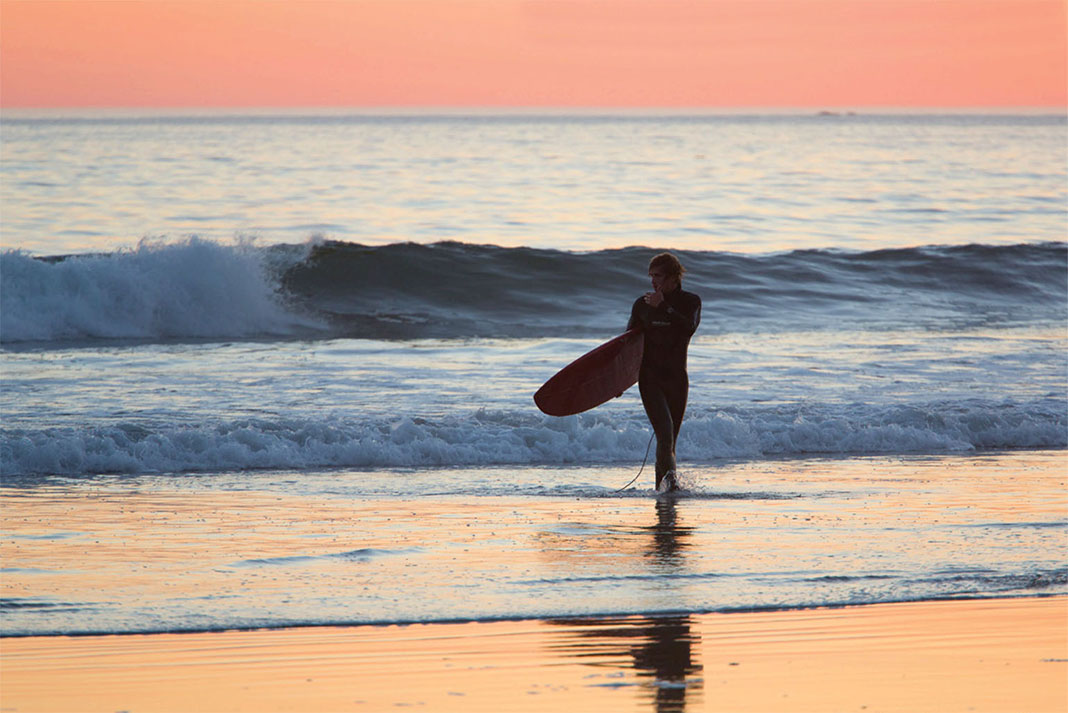
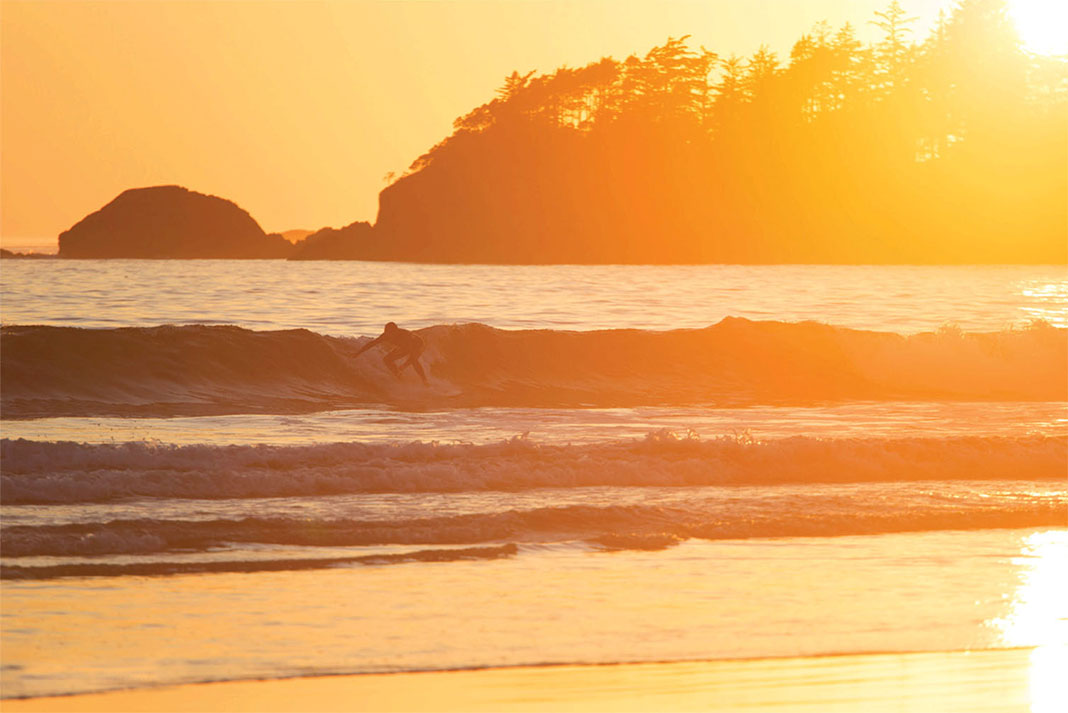
surfing at sunset on remote Vancouver Island
Photo: Ben Haggar

Rewarded with good weather

Landing on a golden sandy beach on the protected eastern side of the point, we race excitedly down the narrow trail through thick waxy leaves of salal, dodging bear scat and scrambling up steep, muddy slopes. Bursting from the cloak of dense old growth forest into the brilliant afternoon sun bathing the outer coast, we gaze upon a natural surfing paradise. With the vast Pacific as a sparkling backdrop, small clean peaks peel off a sandbank in the middle of a crescent-shaped bay ringed by white sand and bleached driftwood.

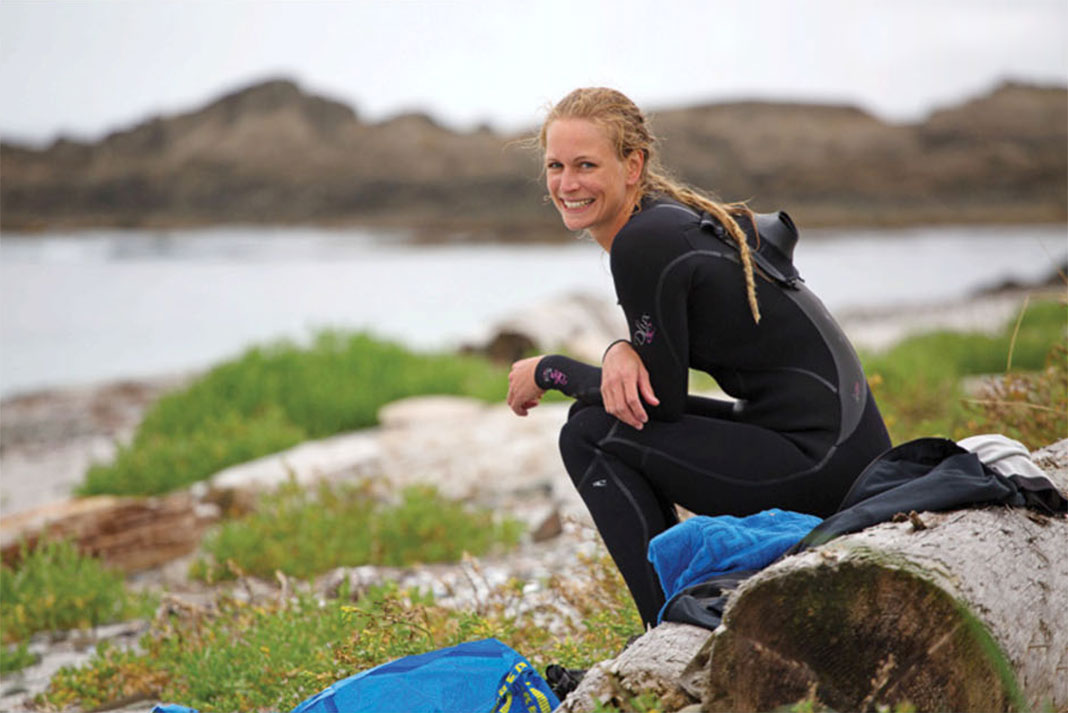
The warm waters of Kyuquot Sound have wrapped around to the outer coast and amazingly, at nearly 50 degrees latitude, we can surf sans wetsuit, unheard of in our backyard surf playground of Tofino. Our first evening rewards us with a short, playful surf session as the unseasonably hot September sun sets and an amazing orange moon and bright Milky Way rise over our camp.

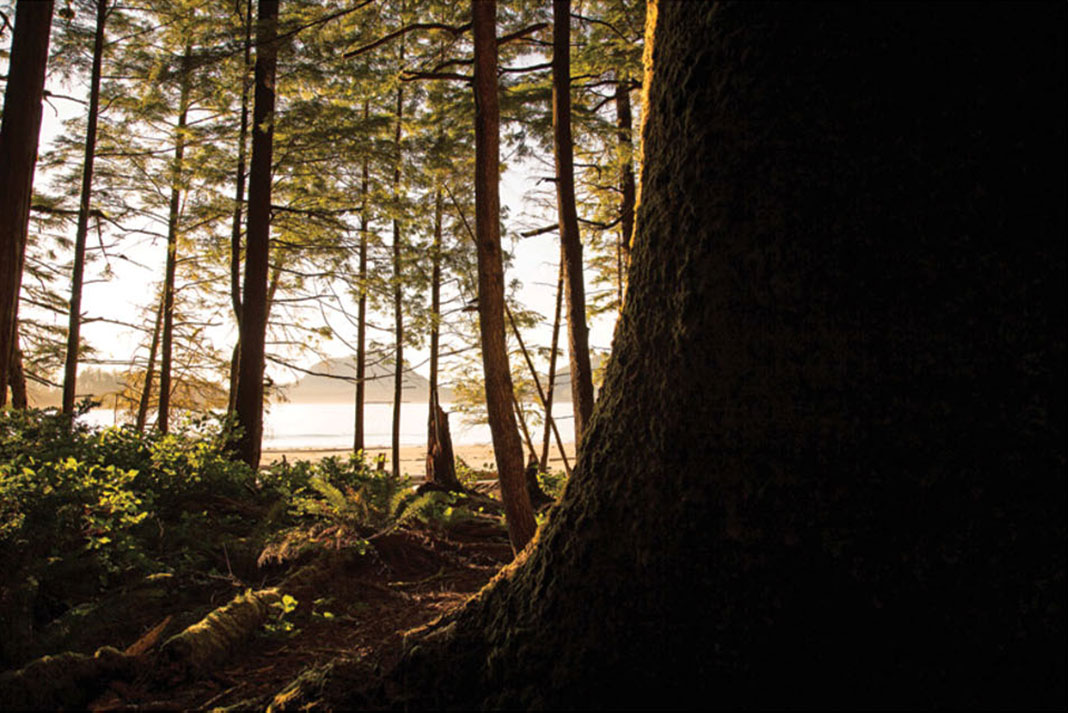
sun through trees leading to beach
Photo: Ben Haggar

The multi-day trip routine: surf, fish, explore

The beauty of a multi-day kayak trip is that it sharpens your sense of adaptation and self-reliance, leaving you more in command of your own experience. This journey was the first time any of us had kayaked on the open coast, but our surfing experience served us well.

Reading the waves, I learned to time a burst of paddle strokes to safely land my boat through surf. Once ashore, I could wade out into the water and assist my girlfriend, Caroline, as it was her very first kayaking adventure. Meanwhile, our German companions, Anja and Uwe, handled their long boats like seasoned veterans, gliding effortlessly onto the exposed beaches.

The days blurred as we settled into a routine of surfing, fishing and exploration. One of our daily activities involved identifying fresh animal tracks in the sand including bear, cougar and, one morning, translating a story involving a deer and a very large timber wolf.

With the kayaks, we scoped potential reef breaks and other beaches for waves. The swell filled in as forecasted and the extra size opened up a speedy river mouth right-hander. But we had yet to explore the outer reef shelves that had piqued my interest while pouring over marine charts and Google Earth months earlier.

person surfing at sunset on Vancouver Island's Kyuquot Sound
Photo: Ben Haggar

Loving the unknowns

The roulette wheel of searching for remote surf spots by kayak could be a fickle affair. Re-checking a break on a different tide wasn’t really an option with the large distances between spots, but when you hit it right, you could hit it big.

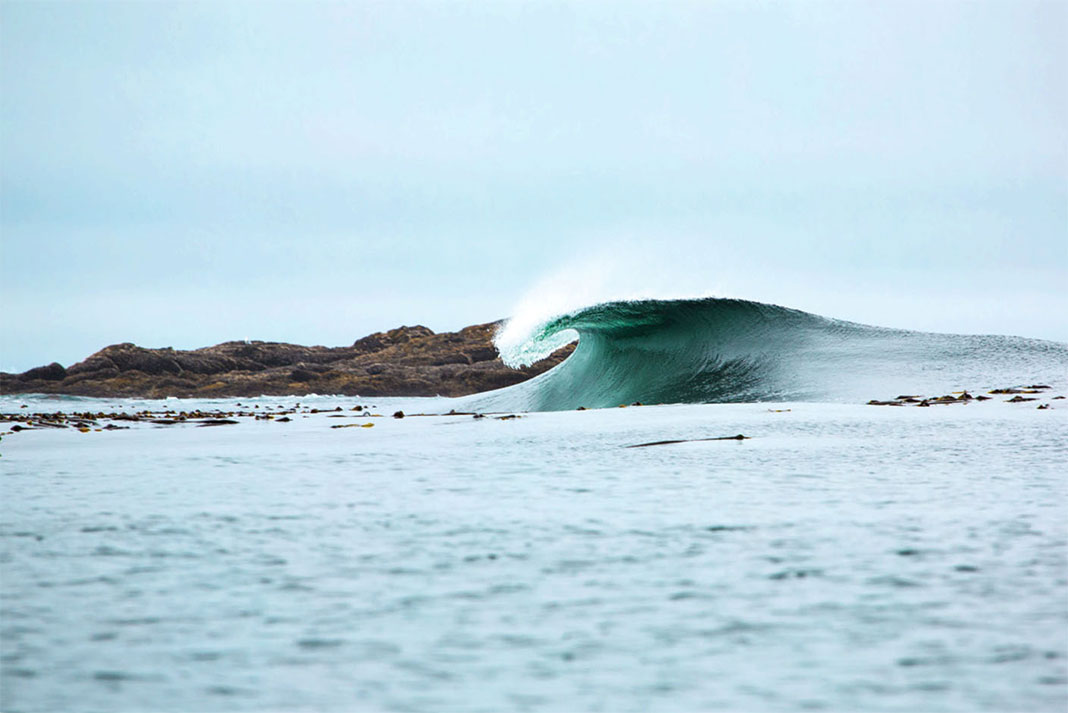
We paddled past plenty of reefs when the tumultuous variables of swell direction and tide failed to produce surfable waves. Then we saw them: the reeling green backs of waves jacking up on the horizon. On closer inspection, the slabby left-hander sucked most of the water from the reef, threw a thick green lip and carved an angry path through a dense mat of bull kelp.

I love the unknowns of surfing a new break and one this remote and wild had me nearly jumping out of my kayak. The only information we had was what we were staring at in that very moment.

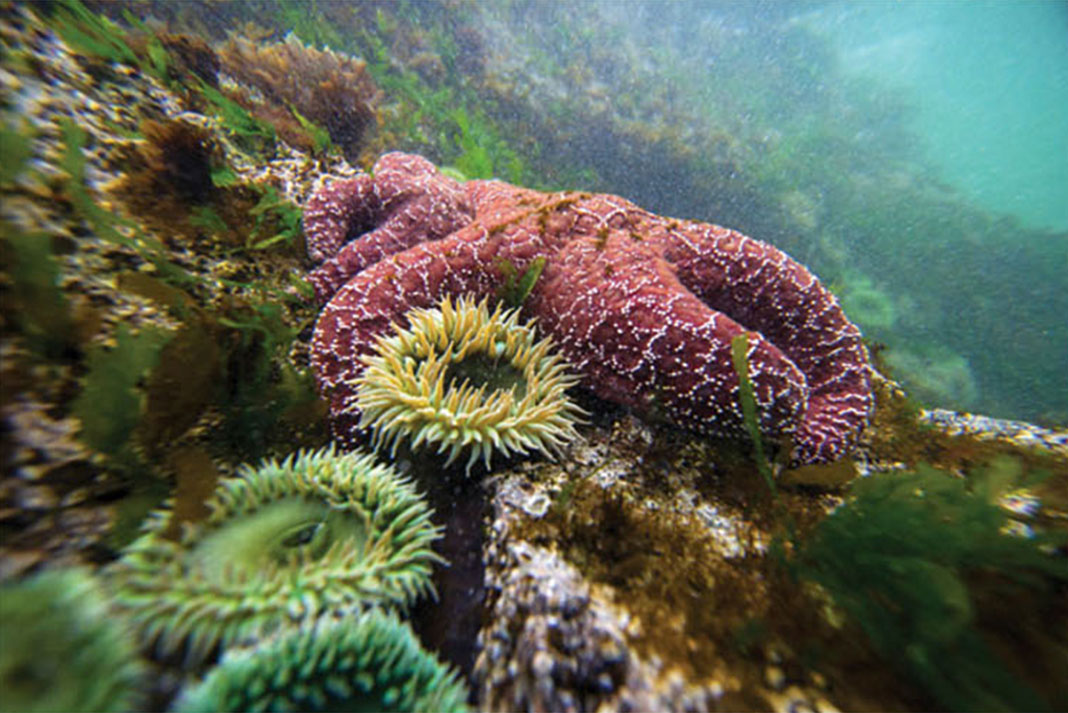
Now I know a lot more: I am intimate with the impenetrable beds of mussels covering every inch of the treacherous rocks. I can picture the brightly colored eelgrass, sea stars and anemones that crowd the reef. And I know that if you miss your drop, you’re going to get a closer look at the creatures below and battle through foamy kelp on your way back to the surface.

waves on coast
Photo: Ben Haggar

One final treat

Inevitably, dense coastal fog rolled in, obscuring the peaks and the sun and seeming to add hours to the 25-kilometer paddle back into the sound. Mother and calf grey whales escorted us for much of the morning, and the silence was absolute apart from our rhythmic paddle strokes and the whales’ sharp exhalations echoing between the islands.

As night fell on our last campsite, one final treat came in the unexpected form of bioluminescent phytoplankton glowing bright blue in the shallows and on the seawater-saturated pebble beach. With childlike excitement, we skipped luminous blue stones and ran with electric footprints down the beach.

Cover of the Summer 2014 issue of Adventure Kayak magazineThis article was first published in the Summer 2014 issue of Adventure Kayak Magazine. Subscribe to Paddling Magazine’s print and digital editions, or browse the archives.


Feature photo: Ben Haggar


Growing the Sport of Whitewater With Friends

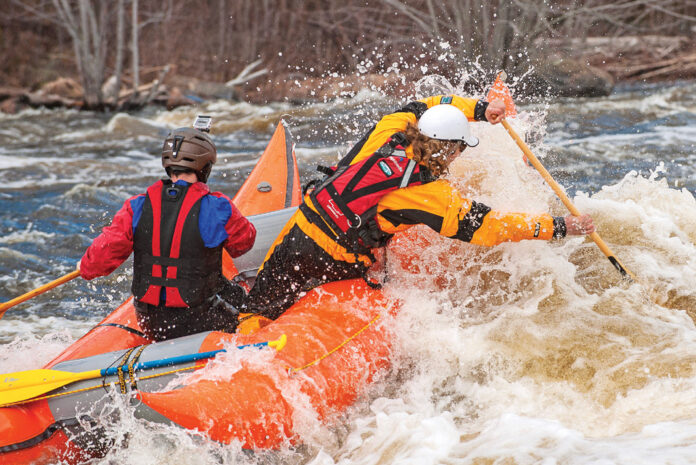
Inflatable Friends | Photo: Robert Faubert

The guy beside me in this photo is Patrick Hagg, a web analyst at the federal Institute of Health Research. He has a degree from a good school. He is married and has three beautiful children. His family runs, skis, snowshoes, spins and is training for alpine trekking. They are going to climb Bishorn, a 4,153-meter mountain in the Pennine Alps in Switzerland where he will celebrate his 40th birthday.

Demographically speaking, the Haggs should be a whitewater family. Except Patrick’s never paddled whitewater before.

Patrick followed my friend, photographer and longtime raft guide, Rob Faubert out of the city. Rob and Patrick work in the same department, two desks away from each other. I’d roped Rob into coming to the Hell or High Water festival to shoot some photos and help me test the new Aire Sabertooth.

Patrick spent his youth dreaming of being a National Geographic photographer and came along to shoot the action to add to his portfolio. At the last minute he threw in his diving wetsuit and a downhill ski helmet.

Where the Petawawa River snakes through the town of the same name, there’s a perfect venue for a large-scale whitewater event. The municipal walking and biking path winds past a perfect amphitheater rock right beside Lovers—the most exciting and biggest rapid of the section.

Crowds gather to cheer racers, secretly hoping for carnage in the Windigo Hole or the three raft-munching waves below.

After Rob and I had ran the Sabertooth inflatable cataraft down a few times we told Patrick to get his gear out of his car.

Inflatable Friends | Photo: Robert Faubert

GROWING THE SPORT OF WHITEWATER

We paddlers talk a lot about growing the sport and getting new people into whitewater. Truth is, it’s not easy.

You either take them to quiet class I and II and spend your precious weekend teaching strokes and maneuvers in a friendly, safe and boring environment, or you run them down bigger sections of rivers you’d rather paddle. They swim lots. Anxiety and exhaustion overrides excitement and exhilaration. Real learning is low. Very few return.

Patrick, however, is hooked.

“I think first hand exposure is what did it. Being able to go down these huge rapids in a small two-person raft as a newbie gave me an incredible feeling. I played a role in successfully riding the rapids.”

We ran him through big rapids, but didn’t send him by himself. He learned about reading water, because I was right there to teach him. It was exciting for him, yet not too scary.

Whitewater tandem canoes in capable hands can work the same way.

Inflatable ducky kayaks are very stable and confidence inspiring. No cockpit means no skirt and no fear of being stuck inside. Self-rescues are easy.

We just received for review a shipment of Fluid Kayaks’ Do It Now sit-on-tops, which offer this same freedom but paddle like hard shell whitewater kay- aks. Industry rumors suggest we’ll see more of this type of boat on the market in 2015. I don’t care if we’re creating a whole new category of whitewater boats or if they’ll be stepping stones.

If not for the Sabertooth, Patrick and his family wouldn’t be joining us at the Upper Gatineau Whitewater Festival. If not for a boat that made him feel safe enough and excited enough, he would still only be dreaming of riding the rapids.

Scott MacGregor is the founder and publisher of Rapid magazine. Soon he will let Patrick know that we don’t call it riding the rapids. Baby steps. 


This article on introducing friends to whitewater was published in the Summer/Fall 2014 issue of Rapid magazine.This article first appeared in the Summer/Fall 2014 issue of Rapid Magazine. Subscribe to Paddling Magazine’s print and digital editions, or browse the archives.