Home Blog Page 295

Editorial: One Fifth is Waiting

Photo: Virginia Marshall
Editorial: One Fifth is Waiting

72 hours. That’s the longest I’ve been pinned down on shore, waiting for a break in the weather. Back on those wind-lashed cobblestones, three days felt like an eternity.

When I was guiding sea kayaking trips full-time, one of my most inspiring—and exasperating—clients was a septuagenarian from Germany named Max. Athletic and high-strung, he was not in the habit of waiting for anyone or anything. Our weeklong trip together was plagued by high winds and we were often driven ashore miles short of our planned camp, waiting for safer conditions.

Max grew restless as soon as we’d hit shore. Pacing the beach, heedless of the foaming seas, his eyes fixated on some distant headland. “We’re going now?” he’d ask before long, the words sounding more like a command than a question.

At my earlier suggestion, the other members of our group had already set up their tents and immersed themselves in books or beachcombing. But Max’s Feathercraft—purchased especially for this trip—remained at the water’s edge, fully packed and ready to launch.

Worried he might make a solo break for it, I tried reasoning with him. Max was a retired engineer, so I assured rationally, “The forecast is for lighter winds tomorrow—it won’t be any trouble to make up lost miles.” When that failed, I appealed to his inquisitive nature, “The map indicates a waterfall on this creek…why don’t you hike up and try to find it?” Nothing. I tried empathy, “You’re a strong paddler Max—I know you could handle these waves but we must wait until it’s safe for the entire group.”

Still, Max moped around our island like a prisoner. Finally, I could take no more. “Max!” I pressed him, “What’s the hurry?”

That’s when I learned that my elderly German guest, having literally waited a lifetime to paddle in the Canadian wilds, was not interested in waiting a moment longer. “One third of life is sleeping and one fifth is waiting,” he said by way of explanation. With Max, some things got lost in translation. But I understood his meaning perfectly—he simply couldn’t afford to squander the rest.

I waited seven years to road trip to British Columbia with my kayak (a trip that yielded the itinerary in “Hit the Road,” page 64 of this issue). If there’s one regret I have about those two blissful months of exploring, it’s that I didn’t do it sooner.

For this special issue of Adventure Kayak, we asked correspondents, friends and readers what adventures and experiences top their life lists. Then we took all those inspiring plans and aspirations and packed as many as we could into a single year. Because why wait a lifetime to live your dreams?


When she’s not waiting for next issue’s drafts, Adventure Kayak editor Virginia Marshall lives her dreams one paddle stroke at a time.


 AKv13i1-01webThis article originally appeared in Adventure Kayak, Spring 2013. Download our free iPad/iPhone/iPod Touch App or Android App or read the rest of the issue here for free. 


Practice the Dump

Photo: Body Boat Blade
Practice the Dump

So you have a solid roll and you know how to self-rescue after a swim? The next step is typically the time-consuming, tippy and treacherous process of pumping out your flooded cockpit. But there is another, faster way to a dry boat.

Practice the Dump to quickly empty water from your cockpit after a cowboy self-rescue (aka scramble—learn it here) or reenter and roll. Using the same principles as a standard T-rescue, the Dump empties water from the cockpit with the rescued paddler sitting inside his or her boat. According to Body Boat Blade International’s Leon Somme and Shawna Franklin, who shared this video of the technique, “The Dump is a fast, simple way to empty a boat for someone with a solid roll and a helpful friend.”


To see more kayak technique videos, visit Body Boat Blade’s YouTube channel here.

Nail the Sea Kayak Back Deck Roll

Photo: Rochelle Relyea

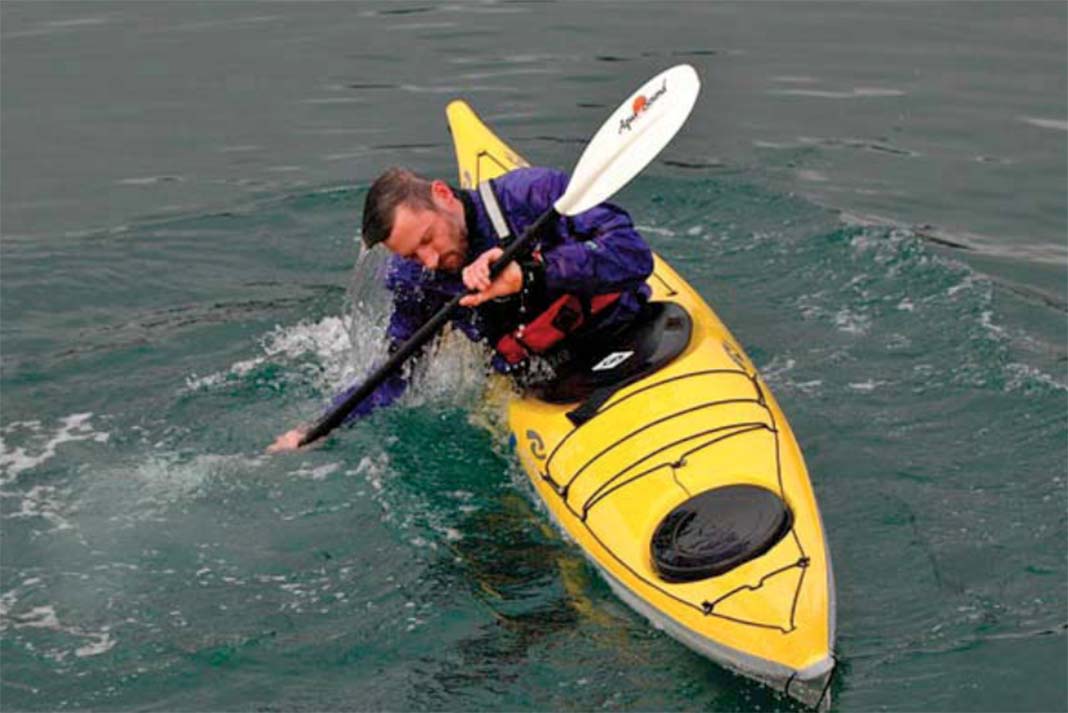
While the back deck roll is far less common than the sweep or C-to-C roll, in some situations it’s the fastest because it skips the setup step required by some other rolls. It’s particularly useful for surfing situations where you often flip in a stern rudder position, which sets you up perfectly to execute a quick back deck roll. It’s so fast, you may even be able to keep riding the same wave.

Some paddlers say the back deck roll puts undue strain on the shoulder and leaves the face exposed to injury, but in reality, if you keep your hands in front of your body and don’t overextend your arms, the back deck roll doesn’t present any additional risk to your shoulder. The primary restriction for this roll is the boat—high stern decks and tall seatbacks prevent you from lying back far enough.

If you use an offset paddle with a right-hand control feather, it will be easiest to perform the back deck roll flipping to the left, with your right blade doing the work as shown here. If your blades are unfeathered, it won’t make any difference which direc- tion you choose to roll.

Photo: Rochelle Relyea

11 Begin by sitting upright with your paddle held comfortably in front of your chest, elbows low and wrists cocked back so that your right paddle blade is facing down, parallel with the water’s surface. You’re now forming a rectangle with your arms, paddle and chest. This rectangle should stay relatively intact throughout the roll. From this position, start to lean back onto the stern deck and aggressively turn your head and upper body to the left.

2Think about trying to kiss the stern deck of your boat as your head leads the way through the twisting motion of this roll. Plant the power face of your left paddle blade at the stern of your boat. As you continue to flip, keep turning your body and get your right blade in the water as quickly as possible. This right blade will provide the support to roll the kayak. You are now effectively lying on the back deck with the kayak upside down above you.

3Continuing to lead the way with your head and body, push your right blade out in a wide arc above your head, past your stern and out to the opposite side coming back toward to your toes.

4As the blade clears the stern and sweeps toward the bow, hip snap the boat upright by driving your right knee skyward. Your wrists must remain cocked back throughout the sweep to maintain a sculling angle on the blade, keeping it near the surface and providing the high brace that your hips need to roll the kayak upright.

5Maintaining the rectangle between your arms, chest and paddle, continue to swing your body forward through the last part of the roll, raising your head last. When your right blade finally reaches your toes, your boat should be completely upright and your body in a good position to take the next stroke.

Cover Shot of the Adventure Kayak Magazine featuring articles on mastering the kayak roll.This technique feature originally appeared in Adventure Kayak, Early Summer 2007. To learn more self-rescue skills, download our free iPad/iPhone/iPod Touch App or Android App or continue reading here for free.

Editorial: The Three Types of Fun

Photo: Mike Monaghan
Editorial

This editorial about the outdoor Fun Scale originally appeared in Canoeroots and Family Camping magazine.

It happens to me on most trips. Usually on a portage, the yoke grinding against my collar bones; the unevenly packed food barrel on my back pulling just enough to one side to make me miss every third step; the drone of mosquitoes inside the overturned hull reminding me that if I swing an arm to swat, I’m going down. It’s the moment when I question whether I’m having fun.

It’s no wonder I’m often met with a blank stare after trying to convince non-paddlers that this stuff is enjoyable. Sometimes I feel like telling people that if they have to ask, they probably won’t understand. But I want to share the good feeling I get from canoeing and writing people off is unproductive.

So, my strategy has been to use the Fun Scale. If you’re into mountain climbing, you may have heard of the scale before. A mountaineering guide first introduced me to the concept and it applies just as well to canoeing as it does to climbing.

Type I fun is the purest type of fun. It’s fun while it’s happening. It would be great if it never ended, and when it does end, it can’t happen again too soon. It’s bluebird days, skinny-dipping, long weekends, s’mores or stopping for a cold beer and a hamburger on the way home. It’s the moments you hope for when planning your trip. Curiously, the giddy feeling Type I fun instills rarely lasts long enough to sustain me until my next trip.

In the moment, you’d be hard pressed to call Type II stuff fun. You might be glad when it’s over and you’re probably not looking forward to it happening again. For me, Type II usually includes long portages, five a.m. wake-up calls, weather-bound days, collecting firewood, plain oatmeal and blackfly season. This type of fun makes for great campfire stories and inspires me to plan my next trip. It may involve rattled nerves and frustration while it’s happening, but it builds character and makes us better paddlers and better people.

Type III fun isn’t fun at all. Not while you’re doing it, not afterwards. It can’t be over fast enough and you look forward to the day when you forget it ever happened. Examples of this one are limited only by the imagination. I’ve had my share of Type III moments. In fact, the guide that shared the Fun Scale with me did so as I was being evacuated from an Alaskan mountainside with a perforated lung. The old saying “what doesn’t kill you makes you stronger” applies here. And while that might be the case, it doesn’t mean I want to relive those moments and it’s difficult to look back on them with a smile.

When doubt creeps into my head, I make an effort to recognize it’s probably just a Type II moment. Type II fun is, after all, still fun. And when the trip is over, I can relate my experiences, making fellow paddlers smile around a campfire and helping those who have to ask understand a little better.

Michael Mechan has developed a knack for turning Type III moments into Type II fun.


This article appeared in Canoeroots & Family Camping, Spring 2012. Download our free iPad/iPhone/iPod Touch App or Android App or read it here.

Why We Paddle

Photo: Virginia Marshall
Why We Paddle

It was already afternoon and we had yet to launch the boats. I had been duped—this wasn’t a paddling trip with friends! The strange thing is, I didn’t care. It was, after all, still a trip with friends.

Paddling can be many things to many people. Tripping with friends. Soaking up afternoon sunshine. Exploring new places and revisiting favorites. Sleeping under the stars. Living well outdoors. Fitness. Therapy. Adventure. Challenge. I noted this on Facebook after my trip and asked readers, why do you paddle?

Some cited the ability to get away from the urban clamor. “It gets me into the outdoors to explore nature,” shared Penny Swisher Hartlaub. “You can enjoy nature without really intruding on it,” wrote Mira Chambers Robins. “The nearly complete silence—I can ease up along the shore and watch turtles and ducks nesting,” agreed Garrett Martin.

For Rod Bailey, “It is the independence to do whatever I want on the water.”

Many echoed Farid Silman Winstanley, who replied, “Peace, freedom and sometimes adrenaline.” Denise Hexum confided, “It gives me peace—sometimes I run to the water.”

One of the last posts reads: “It’s my Zen!” My mind reaches back to an image of Seinfeld’s Frank Costanza raising his hands to the sky and yelling “Serenity now!” in a tone that was anything but serene. I look at the Zen author’s profile picture. She certainly looks relaxed.

Paddling has an alchemist’s transformative touch. Exercise and exposure to sunlight, both common ingredients in time on the water, stimulate production of serotonin, the happiness hormone. Increased physical fitness contributes to a host of health benefits too numerous to name.

Further, the act of discovery and exploration, and the challenge of developing new skills, can actually grow your brain. Acquiring a complex motor skill—like learning to roll a kayak—exercises our brains as well as our bodies, stimulating new neural growth and pathways and increasing cognitive function.

And, of course, there are the people we meet and the relationships we develop through our aquatic passions. “I kayak with a great group of people,” attested Shar McCoy Mallory on the Facebook poll.

Moving around the country has left me with friends scattered far and wide. Many I met through paddling, and most often it’s this activity that continues to bring us together. Even if we spend more time sharing stories around the campfire or lounging in the sunshine than we do making miles on the water.  

PaddlingMag Dec13 Cover

This article first appeared in the December issue of Paddling Magazine.


Better Feathers

Photo: Virginia Marshall
Better Feathers

As paddlers, we clearly love the water, but when it comes to our camping gear, we’re among the most hydrophobic of outdoor aficionados. We have to be—we spend large portions of our day immersed in the wet stuff. Which probably explains why many paddlers are still sleeping synthetic.

For years I heeded the warm-when-wet wisdom of touring with a synthetic fiberfill bag. My transition to down was cautions—first, a hybrid bag with synthetic bottom and feathers on top (you’re only likely to get damp on the bottom, right? Right?). But, once experienced, a night spent ensconced in goose or duck down is not soon forgotten.

Forget warm when wet; down insulation has unrivaled warmth to weight. A perfectly toasty three-season bag packs down to the size of a small melon—no more cramming that oversized synthetic bolus into your canoe pack or stern hatch and then using the Jaws of Life to retrieve it. Feathers also breathe better, keeping you comfortably cool on warmer nights.

You do need to be careful to keep your down dry. Unlike soaked synthetic fibers, soggy feathers lose their loft and therefore their insulating warmth. Happily, many down bags now feature DWR-treated feathers to resist dampness and hasten relofting. Either way, however, we don’t recommend sleeping wet—just be sure to avoid storing your sleeping bag on the bottom of your boat, and always pack it in a heavy-duty dry bag.

Properly cared for, a down sleeping bag is also longer-lived than a bag filled with man-made fibers. Our MEC Merlin is an economically priced, -3°C-rated down bag that has withstood seven springs, summers and falls of abuse with only a few stray feathers to show for it. For colder shoulder-season paddle camping, we love the strategically placed, space-saving insulation and roomy cut of Therm-a-Rest’s -7°C Antares down bag. Whichever sleep season you’re shopping for, remember, feather makes it better.


$240 and up | www.mec.ca | www.thermarest.com


Paddling Jan2014coverThis Field Test gear review originally appeared in the January 2014 edition of Paddling Magazine. Download our free iPad/iPhone/iPod Touch App or Android App or read every issue of this new monthly magazine here.


Small Talk

Photo: Dave Best
Whitewater kayaking

 “So what is it that you do?”

I hate that question. Not because I find it offensive and intrusive. It’s just that, unless the person who asked is a paddler, he won’t understand the answer.

Most people consider the question to be about work—a separate question from what you do for fun. Since paddling has been both my work and play for the last decade, my answer throws people off.

I used to answer truthfully, trying to capture the essence of what we do and why we do it. Explaining what we do isn’t that difficult. Explaining why we do it—not so easy.

The more I try to explain that we paddle for the feeling of focus we get when being tossed around by powerful currents, the sensation of flying when our boats plane out on glassy waves or the blissful state of being when we glide across the mirrored surface of a lake on a misty morning, the more perplexed they become.

It’s around this point that the person regrets asking the question in the first place. Head cocked to one side, staring at you with a squinty gaze and uncomfortable silence are all common signs the person wishes they had chosen instead to talk about the weather, Hollywood celebs or the rising price of gas.

What vexes me the most is that, if I had answered with golf, hock­ey, knitting, soccer, juggling, photography, football, running, biking, playing guitar or dog training—they’d nod and smile.

How is it that smacking a dimpled ball into a tiny cup a few hun­dred yards away makes sense and paddling doesn’t? Trying to keep a hunk of pigskin off the ground while a dozen giants attempt to make you a greasy spot on the grass seems reasonable but getting up to watch the sunrise from my boat is too crazy?

I’ve decided over the years that paddling isn’t just something that can be justly described to the unknowing. It has to be experienced. That’s why I developed a system for dealing with the, So-what-is-it-you-do? question. It’s simple. When someone whose company I enjoy asks, I offer to show them. It’s the best—and maybe only—was for them to truly understand why we do what we do.

For the benefit of all the others, I answer, “I’m a doctor.” My raft guide bullshitting skills allow me to fake it through most situations. Unless, of course, you’re a doctor or familiar with my system.

Dan Caldwell plays doctor on the banks of the Ottawa River. 

This editorial originally appeared in the 2013 Paddling Buyer’s Guide. Download our free iPad/iPhone/iPod Touch App or Android App or read it on your desktop here. 


Seaward Chinook TX Kayak Review

Photo: Victoria Bowman
Seaward Chinook TX Kayak Review

We didn’t know that our demo kayak would be sold out from under us while we were paddling it. We returned the Seaward Chinook five hours late from a multi-day trip in Clayoquot Sound to learn that its frustrated buyer had long ago quit waiting for us to bring his boat back and had gone home.

Now, you can define kayak performance in various ways. For some, performance is being able to put a boat on an aggressive edge so it’ll spin on a jellyfish and feel as stable sliding sideways down a wave as it does on a trout pond. Others define high performance in arguably more practical terms. Like being able to throw the entire contents of a minivan into the hatches, plop first-timers in the cockpit and send them onto the ocean without a worry—or buy it off the rack and know that you’re sure to find it comfy and easy to paddle. That’s the Seaward Chinook TX: a beginner-friendly, outfitter-friendly, “buy it on spec” friendly craft.

The Chinook started life as the now-discontinued Tyee TX, a boat intended for outfitter fleets that turned out to be too tippy for beginners. The redesign emerged as the Chinook, a “stable, capable cruiser” with the exceptional primary stability that beginners and outfitters crave.

With the classic 17-foot by 24-inch dimensions of an all-purpose West Coast tourer, the Chinook stands apart for its depth and volume. The cockpit is roomy and the coaming and thigh braces are very high for big paddlers. The bottomless hatches turn this boat into any trip’s packhorse.

Seaward’s recyclable ZY-TX thermoformed ABS plastic makes for a hull that’s lightweight for its size and pleasing to the eye. Thermoform plastic is a soft material and we noticed some hull flex in the cockpit on the water, but with no noticeable effect on performance.

On-water performance is predictable and well-suited to the intended outfitter use. Tracking is excellent. The Chinook takes effort to edge, let alone flip, when loaded. The rudder counteracts a slight tendency to weathercock in wind and adds maneuverability.

A lot of things conspired to make us late coming home from Tofino, including bad weather, a sick paddler who needed to be towed, opposing tidal currents, and an ice cream break at the country market with the goats on the roof in Coombs, British Columbia. The Chinook handled them all. Although we don’t recommend anyone buy a kayak while it’s still being paddled by someone else, we do recommend the Chinook for large beginner paddlers looking for comfort, rock-solid stability and expedition capacity in a thermoformed kayak.

Wide-bodied Watercraft

The shallow-arch hull is deep and full for maximum carrying capacity and nearly flat-bottomed for rock solid initial stability.

A Rudder in Disguise

Seaward’s new and improved cockpit includes a height-adjustable seat, angle-adjustable rudder pedals and a rudder-deployment system that uses a slider, more like a skeg control than a rudder’s usual deck-top pull cord.

Foolproof Hatches

Seaward excels at friendly features that seem so obvious you wonder why every manufacturer doesn’t copy them: like bow and stern directional arrows on the neoprene hatch covers.

Seaward Chinook TX Specs

Length: 17 ft
Width: 24 in
Weight: 56 lbs
Price: $2,650 CAD


AKv9i3 coverThis article first appeared in Adventure Kayak, Summer/Fall 2009. To see more boat reviews, download our free iPad/iPhone/iPod Touch App or Android App or read it on your desktop here.

Sailing Through Europe

He calls himself the “Flying Northman.” Born and raised in Germany, Hendrik Lepel has lived in Ireland for the past eight years. As he explains in this video, he dreamed of sailing from his adopted home to his birthplace, but lacked the means to buy and crew a sailboat… until two years ago when he came across a Hobie trimaran sailing kayak. This summer, Lepel plans to depart Kinsale, Ireland, on a  2,500-kilometer voyage to Rostock, Germany, where he hopes to arrive 4-6 weeks later, in time to join 200 other (much larger!) sailing vessels from around the world for the Hanse Sail event.

To learn more about Hendrik’s daring voyage, visit www.the-flying-northman.com

Lockbox Honor System

Photo: Kathleen M. Voigt
Lockbox honor system

In 2010, the summer after I (finally) finished my undergraduate de­gree, I went on a road trip. In four and a half weeks, I drove over 10,000 miles in my ‘96 Volvo wagon. The trip took me from the Ot­tawa Valley through five provinces, one territory and nine states to the Yukon and Alaska, south to Oregon and back east again.

When I couldn’t crash with family or friends along the way, I pitched my tent at state, provincial and national parks. I would often arrive at the campgrounds long after dark and fill out my name and point of origin on the visitors’ cards at the self-serve fee stations. If I didn’t have exact change for the envelope, I was faced with the moral dilemma of either over- or underpaying. I soon got in the habit of stashing a supply of small bills and coins in the center console of the wagon.

It was nice to see the honor system alive and well across the conti­nent—that cynicism hasn’t completely taken over. But is an iron ranger as effective as a real, live campground attendant? How many people short change or fail to pay altogether? What is it that makes us pay?

This honor system pay method exists all over. A lockbox on the private land of tolerant landowners who allow paddlers to access a put-in from their property. The stands selling farm fresh eggs, ber­ries or honey that dot the countryside, accompanied by a pickle jar for money and a sign; no farmer to confirm payment. Even coffee shops have jars for line jumpers—those who just want to drop in their change and help themselves to a simple coffee, rather than waiting in line at rush hour.

The farmer’s time is better spent tending fields than sitting on a wooden crate by his stand on the side of the road. Likewise, a park ranger is more useful protecting wildlife or maintaining trails than stuck in an outhouse-sized booth waiting for me. Assuming people comply, the honor system is a much better use of resources.

Feeling guilty for being dishonest is one reason why we pay. Fear of getting caught is another. But I think it’s about more than avoiding negative emotions. Something positive comes from the trust shown on behalf of the seller. Not only do I get to buy something—a night’s stay, access or a basket of fresh produce—I also get a good feeling knowing I’ve done the right thing by putting my money in the box.

Scientists say that being honest in situations like this can have a pos­itive physiological effect caused by the release of Oxytocin, a hormone linked to social bonding, anxiety relief and happiness. This explains the warm and fuzzy sensation that comes from abiding the iron ranger.

When I arrive at a put-in in a park and there’s an iron ranger in the parking lot, I have the opportunity to calm my nerves, release stress and increase confidence, all before I even hit the water.

I never would have thought the honor system would make me a better paddler but a few bucks in an envelope leaves me upbeat, free to focus on my strokes, the river and my trip unfurling in front of me.


Michael Mechan is a former Rapid Media editor. He drove about 1,100 miles on that road trip for every year it took him to complete university. Do the math. No, he’s not a doctor. 

This editorial originally appeared in the 2013 Paddling Buyer’s Guide. Download our free iPad/iPhone/iPod Touch App or Android App or read it on your desktop here.