Home Blog Page 321

How to Hang a Hammock

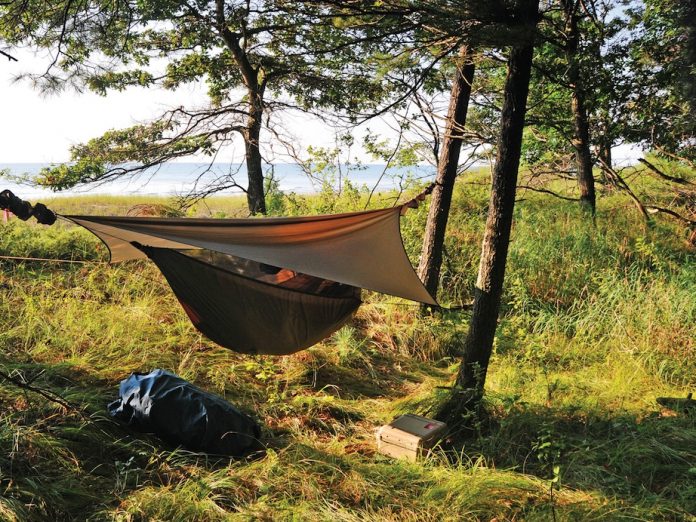
Sleep right in a hammock. Photo: Stephen Brede
Catch a breeze in a hammock.

The best reason to move up to the trees is the elevation in comfort. The logistics of hammock camping are similar to tarp camping, except the sleeping area is off the ground. Gone are problems with uneven or wet rain, roots and rocks. The cocoon structure is cozy, and lying diagonally flattens the hammock so you can sleep on your back or side.

The basic setup is simple: You need two trees, 12 to 15 feet apart. They should be alive with no overhanging widow makers. They need diameters of at least six inches, as the force exerted isn’t simply your weight divided by two, but hundreds of pounds at each end. The hammock attaches to the trees with 1-to-1.5-inch nylon straps, which prevent damage to the bark.

Hammocks ideal for this application are sewn of lightweight nylon. A high-tensile line stretching from the head of the hammock to the foot establishes the hang. It also forms a ridgeline for draping an attached or removable bug net. Access is usually through a zipper or Velcro opening along the hammock/net interface, or through a slit in the bottom. Guy lines can be rigged from each side to keep the net from sagging, and to reduce swing. A tarp suspended from the pair of trees and guyed out over the hammock weatherproofs the setup.

The downside of hammock camping is, well, the downside. It’s colder sleeping in the air than on the ground. Your body compresses the bottom of your sleeping bag to the thickness of a tortilla, so you need to insulate. Some campers use traditional sleeping pads, but these slide around and most are too narrow to hug your hips and shoulders. One fix is to attach a second layer to the hammock bottom, into which you can sandwich a wider pad, clothing or tortillas. Another option is to suspend a down quilt—known as an underquilt—beneath the hammock.

It’s usually easy to find a pair of suitable hammock anchors. But what to do if the trees don’t cooperate? If you have to go to ground, suspend one end of your tarp from a paddle, trekking pole, stick or single tree, and stake and guy the rest. Then hang the hammock underneath, attaching the head to the vertical support and staking the foot. A hammock with attached netting will keep the bugs at bay. The ridgeline will be slack, so shorten it with a loop to keep the netting from sagging.

Before you pitch your tent, Google “hammock camping” or ask around at your local outfitter—you’ll find several hammock manufacturers and lots of uplifting advice.

Stephen Brede honed his hammock hanging skills during a three-month canoe circumnavigation of Lake Michigan. He prefers cedar trees, with a view of the water.


This article originally appeared in Canoeroots & Family Camping, Spring 2012. Download our freeiPad/iPhone/iPod Touch App or Android App or read it here.
Smooth Dock Landing Canoe Technique

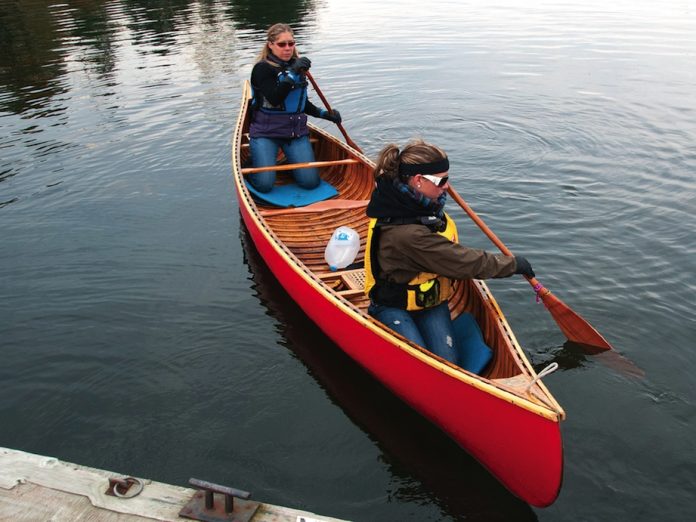
Smooth dockside landings. Photo: Marty Tannahill
Smooth dock landings.

This article on smooth dockside landings from the seat of your canoe was  originally published in Canoeroots and Family Camping magazine.

Gracefully bringing your canoe to rest adjacent to a dock or deep rocky shoreline is the aim of a well-executed landing. In this position, paddlers can more conveniently exit the boat, stabilizing themselves by using the dock or shoreline for support.

The ideal landing is completed with the canoe under constant motion, stopping it snuggly against the dock. To make this happen, approach a fixed target on the dock in a straight line, roughly 45 degrees to the landing. As the boat nears the landing point, the stern paddler initiates the turn by using a draw or pry. If the landing is on the stern person’s paddling side, he or she should use a draw. The stern person should use a pry to initiate the turn if the landing is on the opposite side. 
Immediately after the stern paddler initiates, the bow paddler reciprocates with a complementary stroke. If the stern paddler uses a draw, the bow paddler can assist with a draw or bow cut. If the stern paddler uses a pry, the bow paddler should choose from a pry, bow jam, crossbow draw or crossbow cut. Just before reaching the target, both paddlers provide well-timed reverse strokes usually followed by some subtle draws or pries to stop the canoe at the intended spot.

Practice the timing of your strokes. Initiating the maneuver too soon will leave you too far from your target. However, waiting too long could result in a collision with the dock.

As you develop this skill, communication be- tween paddlers is important, especially when changing partners. Plan the landing out verbally before you begin. It’s best to start at slow speeds so you don’t ram the dock or damage the canoe. Increase the speed only after you can competently complete the maneuver. Try slightly different approach angles to see what works better for you and your partner. Knowing how your boat responds to the strokes is important as all canoes maneuver differently.

Marty Tannahill is a Master Canoe Instructor with the Ontario Recreational Canoeing and Kayaking Association. When he’s not paddling you’ll find him fly-fishing Ontario’s remote rivers.

This article originally appeared in Canoeroots & Family Camping, Spring 2012. Download our freeiPad/iPhone/iPod Touch App or Android App or read it here.
Wave Wheel Kayak Technique

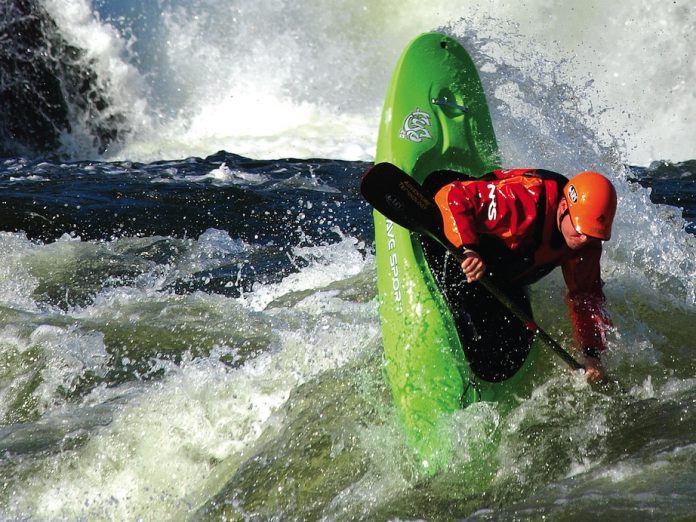
Demonstrating the wave wheel. Photo: Kelsey Thompson
Demonstrating the wave wheel kayak technique.

Learn how to perform a wave wheel with this technique article from Rapid magazine.


The wave wheel lets you style almost any wave train and is one of the most basic downriver freestyle moves you can add to your arsenal. Resembling a downriver cartwheel, it involves using the face of a standing wave like a ski jump to throw your boat vertically into the air.

Find a steep standing wave that is deep on its backside—wave wheeling into shallow water can be extremely painful. Choose a green wave, as breaking waves will slow your downriver momentum too much. Although it’s possible to wave wheel on any sized wave, a larger wave will make this move easier.

Approach the steepest part of the wave with speed; the faster you go, the higher you’ll launch. Speed also helps your boat break free of the water, making the move easier.

As you reach the wave and begin climbing its face, take a powerful forward stroke with your boat edged toward the blade you’ve planted. Time your stroke to finish when the peak of the wave reaches your hip. This will wind your body up for the next step and pull your stern underwater, allowing your bow to rise off the backside of the wave.

Keeping your boat on edge, begin reversing your forward stroke into a back stroke on the wave’s peak—this pushes your bow down into the trough behind the wave and your stern free of the water into the air. The power for this move comes from unwinding your torso to bring your bow under your body. Rotate your upper body down towards the water, thinking about getting your paddle shaft parallel with an imaginary plane extending off the wave’s face.

Timing is everything. If you unwind too early, you’ll drive your bow into the face of the wave; too late and you’ll plant your paddle into thin air.

As you back stroke, think about pushing your feet under your body and keeping constant pressure on your planted blade. If you finish your stroke before your boat reaches vertical, your momentum will end abruptly and you’ll fall back to the water.

As your boat approaches vertical, lift your knee to flatten your boat and switch to the other edge. Keep your weight forward as you fall onto your hull facing upstream. Finish the move with a back stroke that acts as a brace to assist in returning your boat and body to an upright position.

Wave wheeling is an excellent way to spice up a mellow section of river or drop into a wave or hole to front surf. Once you’ve mastered wave wheeling forwards, try it backwards. On bigger waves you can even wave wheel your creek boat. 


 This article originally appeared in Rapid, Spring 2012. Download our free iPad/iPhone/iPod Touch App or Android App or read it here.
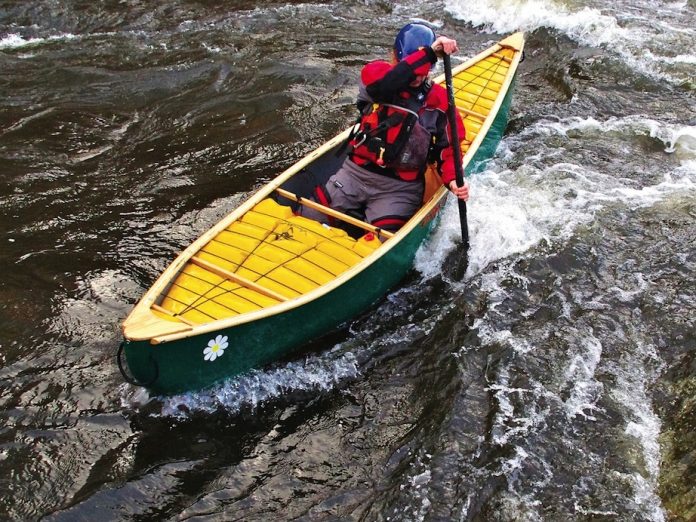
Jet Ferry Open Canoe Technique

Demonstrating the jet ferry technique. Photo: Andrew Westwood
Open Canoe Technique Jet Ferry

I’ve long used the jet ferry as a reliable meth­od for crossing wide expanses of current, or reaching mid-river surf waves. But the incred­ible speed and efficiency of this move wasn’t fully revealed to me until last summer.

Paul Mason and I were teaching out West on Alberta’s Red Deer River and were impressed with the many spectacular surf waves. Front surfing, back surfing, spinning on waves—on this river you could do it all! Paul commented curiously on the remarkable speed of his jet fer­ries. Could it be that there was something differ­ent about these waves compared to ours back east, or was there something different about Paul? (Some of you may know the answer al­ready if you’ve read his Bubble Street cartoons.)

To solve the mystery, I watched Paul and oth­ers tackle some challenging jet ferries. Most kept an active paddle or ruddered throughout their move. But not Paul. He kept his paddle vertical, practically side slipping on a draw. When I asked him to rudder instead, he claimed the magic was gone and the surf felt slower. It turns out that the secret to Paul’s accelerating jet ferry is to use the paddle blade as a foil to sail across the wave. When he ruddered, the blade no longer had the foil effect, making the move feel sluggish in comparison.

To understand how this works, imagine a min­iature sailboat upside down on a jet ferry wave. The inverted boat would have its sail catch­ing the current instead of the wind. A paddle blade acts in much the same way. Just as with a sail, a paddle catches the rushing current and redirects it behind you toward the stern of the canoe. With the water deflected to the stern, the paddle is propelled forward increasing the speed of a jet ferry—just like a sailboat tacking across the water on a windy day.

Similar, too, is how the hull of a sailboat or ca­noe tracks the boat to prevent sideways move­ment. A sailboat needs a keel to grip the water so that the force of the wind will move the boat forward. A canoe uses its chine in the same way. The edge of the canoe carves aggressively into the wave face—that plus gravity pulling the canoe down the wave keeps the canoe on a for­ward path so it doesn’t slide downstream and off the wave.

To gain the most momentum from the paddle sail, angle the blade so that the leading edge points slightly in the direction of the ferry. Simi­larly, point the canoe across the wave but with just enough upstream angle to cause it to surf down the wave face. For sailing, the best jet ferry waves are ones positioned perpendicular to the flow of the current.

Mystery solved. As it turns out, Paul is differ­ent, at least in how he jet ferries.


Andrew Westwood is an open canoe instruc­tor at the Madawaska Kanu Centre, member of Team Esquif and author of The Essential Guide to Canoeing. www.westwoodoutdoors.ca.


 This article originally appeared in Rapid, Spring 2012. Download our free iPad/iPhone/iPod Touch App or Android App or read it here.
Feathercraft Heron Kayak Review

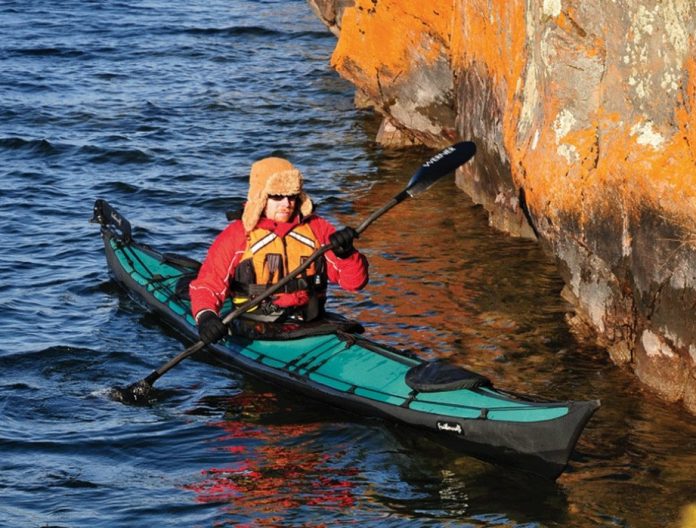
Photo: Virginia Marshall
Feathercraft Heron Folding Sea Kayak. Photo: Virginia Marshall

A review of the Feathercraft Heron folding sea kayak from Adventure Kayak magazine.

Feathercraft’s first new long haul tripper since launching the K1 Expedition in 1981, the Heron is for paddlers “with a weeklong or multi-week expedition in mind who want a high performance boat in terms of speed and agility,” says designer and company founder Doug Simpson. Hand built on Granville Island in Vancouver, B.C., it’s positioned as the new premier choice for travelers needing a fast, high volume folding kayak capable of handling the world’s most demanding environments.

With tent pole-style, aluminum bow and stern frame assemblies, six donut-shaped crossribs, nine additional frame poles and a myriad of subsidiary pieces, it isn’t the quickest to assemble folding kayak on the market. Nor is it the cheapest. But the Heron does benefit from the same full-featured outfitting and durable construction as the legendary K1.

Three dry bag-style, roll closure hatches access two cavernous storage compartments; there’s enough capacity for several weeks worth of food, fuel and gear. No day hatch means you’ll likely want a deck bag for on-water essentials. Like its Feathercraft forebears, the Heron doesn’t have bulkheads and utilizes a sea sock—a waterproof cockpit cocoon that attaches to the coaming—to keep the storage areas dry, and an unloaded boat floating in the event of capsize.

Our six-foot-plus testers enjoyed the roomy fit and accessibility of the deep, extra-long cockpit and found the slender thigh brace tubes adequate for a dialled in fit. At 5’6”, the high coaming and backrest hindered my torso rotation, and just my kneecaps made contact with the thigh braces. Adding foam or an inflatable booster seat improves fit for smaller paddlers, but this is really a big-boy boat. Simpson recommends the capable, lower volume Feathercraft Wisper for petite paddlers (see Inside Out, Spring 2006, www.adventurekayakmagazine.com/0035 for a full review).

The long waterline combined with a Swede form shape and clipper bow make the 17’7” Heron significantly faster than the shorter, beamier K1 Expedition. It accelerates quickly to a cruising speed comparable to many composite touring kayaks.

The hard-chine, V-shape hull provides less initial stability but edges with aplomb. Rock solid secondary stability is enhanced by small-diameter, integrated sponsons above the chines. When inflated, the sponsons fill out the skin, stretching it drum-tight and adding a cushion of support when the boat is edged aggressively.

Dropping the rudder or heeling the hull onto its windward edge easily corrects weathercocking. Rough water paddling is a pleasure, with the generously rockered hull dampening rather than slapping the waves. For those coming from a plastic or composite kayak, paddling a Feathercraft is a unique way to experience an even closer connection with the water.

The capacity of the Heron favors long distance touring over day paddling. It’s ideal for medium to large paddlers whose travel plans demand mile-chewing performance, proven durability and unparalleled portability.


ELBOW GREASE
Assembly is straightforward, but significantly easier with a helper. Our first attempt took one and a half hours. Practice and watching the provided DVD—which we neglected to do in the spirit of a remote field assembly—would cut this in half.
MISSION CONTROL
Gas pedal-style rudder controls adjust to a wide range of leg lengths and provide a solid platform for power transfer and bracing. Comfort touches include an inflatable backrest and calf plates for under-leg support.
TOTALLY TUBULAR
A combination of long waterline, Swede form shape, pronounced V hull, hard chines and internal sponsons stretch the cruising speed of the hardwearing, reinforced welded urethane hull while enabling aggressive edging and surprisingly nimble turning.


A VIDEO REVIEW OF THE FEATHERCRAFT HERON FOLDING SEA KAYAK


FEATHERCRAFT HERON SPECS

LENGTH: 17′ 7″
WIDTH: 24″
WEIGHT: 54 LBS
PACKABLE SIZE: 36″ x 18″ x 12”
MSRP: $6,200 CAD / $6,112 US
www.feathercraft.com


This article originally appeared in Adventure Kayak, Summer/Fall 2012. Download our free iPad/iPhone/iPod Touch App or Android App or read it here.
Mohawk Maxim Canoe Review

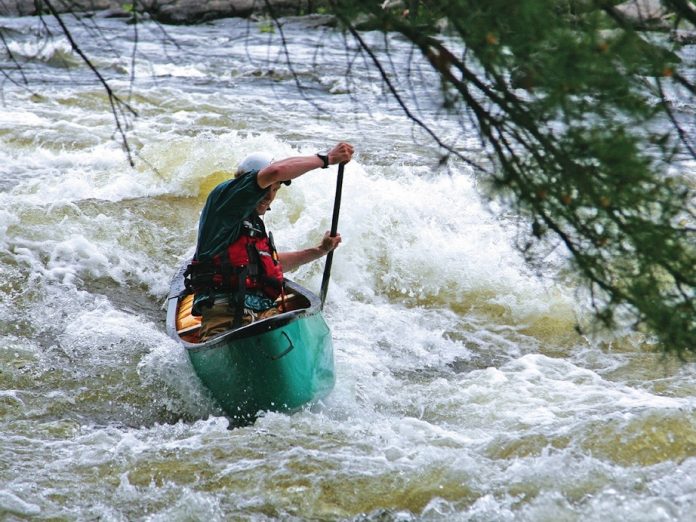
Photo: Neil Wright
Mohawk Maxim whitewater canoe review.

Ten years ago I met Maxwell Johnston testing a prototype of the Maxim. He told me that Mohawk Canoes was going to build a production model. I should have jumped in it then, I had no idea how much fun it would be and how long I’d have to wait for another chance.

Before the Prelude, Taureau and L’Edge came along, Johnston was paddling the Gull River, a pushy technical run.

“I loved catching the very last eddy right at the top of Whitehorse Falls, but it’s a tiny eddy, requiring a very fast entry and exit,” remembers John­ston. “I wanted a boat that was quick to roll so I could play in Earl’s Hole above the falls. It needed a high-volume, blunt bow to keep dry when running the dam and the first drop.”

At just under nine feet with sharply rockered ends and a flat bottom, the Maxim’s top speed doesn’t begin to approach that of, say, an XL 13, but it gets there so much faster. The Maxim takes only a stroke or two to reach its top speed. It also hops on small waves and planes across small currents, giving you the illusion of greater hull speed. On steep creeks, all of these elements are more important than speed, which just slams you into micro eddies harder.

Our Maxim came ready to go with Mohawk’s factory outfitting includ­ing a Mohawk saddle, lap belt, thigh wedges, knee pads, foot braces and PVC bags and lacing. Mohawk told me that 95 percent of the boats they sell are ordered with factory installed outfitting.

This was my first go with Mohawk outfitting and I’m afraid I’m not a big fan, especially in a high performance boat like the Maxim. I’m not weirded out by a lap belt for safety reasons, I’ve used a similar rig in my C1 outfit­ting for 15 years. I have long legs and this lap belt system didn’t keep my hips or knees down in the boat. To take advantage of the performance of the Maxim, I’d suggest spending the extra $80 and an afternoon to install Mohawk’s Extreme Outfitting or another double strap system.

I asked Richard Guin, the production manager at Mohawk, why they install such ridiculously beefy thwarts and deck plates in the Maxim.

“I build boats to take a licking and keep on ticking,” Guin explains. “I am a class V creeker and if my boat won’t handle what I like to paddle, then it’s a sucky boat.”

Okay, time for full disclosure. I love the Maxim, but you may not. At least not at first.

The secondary stability is awesome. You can hang it out there with the gunwales in the water. The bad news for some is, with very little primary stability, that’s the way the Maxim likes to be paddled; you’re either carv­ing one way or the other.

The sharp chines are wicked for snapping offside tilt turns to kill for­ward speed and sticking small eddies. The rocker profile allows you to boof almost anything and, combined with the carvey edges, makes the Maxim one of the most fun boats to surf.

The boys at Mohawk know they have a winner and are working on another—the Phiend. Guin stretched the Maxim four inches longer and two inches wider in the center, and softened the chines to make it more user-friendly. Mohawk plans to blow-mold this polyethylene boat, which they say will be stronger and lighter than rotomolded boats like the Pre­lude and L’Edge.

“I feel that the canoe has not hit the limit of what it can do but has been restricted by the manufacturing process,” says Guin. “We plan on chang­ing that.”


MOHAWK MAXIM

MATERIAL: Royalex

LENGTH: 8’10”

WIDTH: 27.6”

HULL/OUTFITTED WEIGHT: 32/41 lbs

ROCKER: 4.5”

DEPTH: Center 15.5” Ends 18”

MSRP: Hull only $1,233 Factory outfitted $1,563

www.mohawkcanoes.com

Septuagenarian Tony Shaw Realizes a 40-Year Dream

Photo: Laurel Shaw
Photo: Laurel Shaw

Northern British Columbia’s Finlay River is seriously testing our skill and experience. Good thing Tony Shaw, my 70-year-old bowman and friend, has plenty of both. A legendary B.C. paddler with a sly sense of humor, huge heart and diminutive voyageur build, he has dreamed of this trip for over four decades.

The Finlay is at record-breaking high flows for September, making the beta gleaned from the few written sources on the route—one being Finlay’s River by R.M. Patterson, the book that inspired Shaw’s dream to paddle the Finlay—almost useless. Reef Canyon in 2011 looks nothing like the photo in the insert.

We see why the river got its reputation of being too difficult to travel, experiencing our own versions of passages from HBC explorer Samuel Black’s 1824 journal and R.G. Swannell’s 1914 survey notes. Black’s guide breaks down at the sight of more endless rapids; flat ground is non-existent in the gorges and Swannell’s surveyors bivouac tied to trees.

When we scramble up the base of crumbling 100-meter cliffs to try and scout blind corners, my legs shake. Shaw is in awe, “Imagine, Black running these canyons in a birchbark canoe!”

It’s one thing to be a very good canoeist and it is another to be a very good person when the going gets tough. Literally carrying his weight on portages, joking and smiling, Shaw’s inextinguishable enthusiasm and thankfulness for being on the river inspires our team. No surprise he’s participated on numerous boards and committees over his long career, including the Recreational Canoeing Association of British Columbia and Paddle Canada. He’s also raised six kids, three adopted, and spent decades as a schoolteacher and canoe instructor.

Like R.M. Patterson, the author and explorer who ignited Shaw’s fascination with the Finlay, Shaw moved to Canada from England in search of adventure. He fell in love with canoeing northern rivers in 1967 while teaching near the Yukon border in Lower Post, B.C. Eventually, he set up Red Goat Lodge and outfitted Stikine River canoe trips for the likes of Pierre Trudeau. Both Patterson and Shaw retired on Vancouver Island and even met there in 1983.

Yet Patterson’s Finlay’s River, his last book, published in 1968, is really an account of others’ journeys on the Finlay. Even Swannell never paddled the entire river. But we are getting close. Shaw and I run Old Man Rapids perfectly; it’s the last whitewater of the trip.

Construction of the massive W.A.C. Bennett Dam was completed the same year Finlay’s River was printed, flooding much of Deserter’s Canyon beneath the sprawling waters of Williston Lake. When we reach this last historic landmark, Shaw’s eyes fill up.

After 43 years of dreaming and 257 kilometers of paddling and portaging, he struggles to describe how it feels to finally run the Finlay. “Elated. Sad. To live this moment, how I feel is beyond description.”

This story originally appeared in the Early Summer 2012 issue of Canoeroots & Family Camping.


Shadow Captain

Photo: Virginia Marshall
Shadow Captain

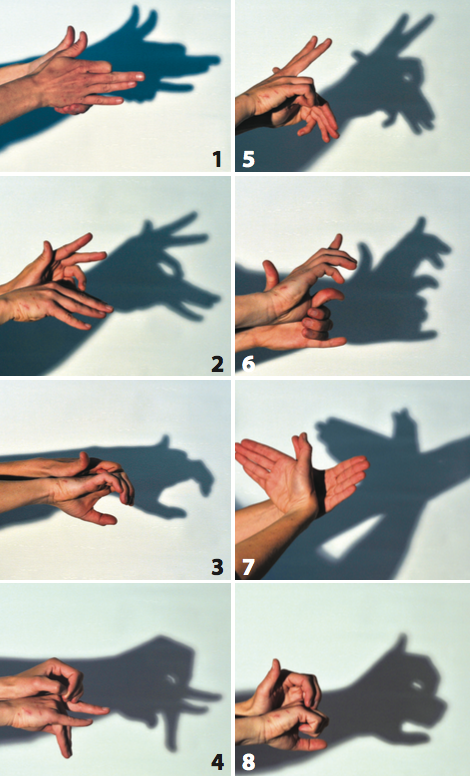
People of all ages have entertained each other using hand shadow puppetry for hundreds of years. Complex shadow puppetry is a true art form, but there are many simple characters that kids can perform easily after just a few tries—all you need is a flashlight, a tent wall or smooth rock face and a little imagination.

With creativity and patience, you may even dream up a new shadow creature.

But as Henry Bursill, creator of many of the figures illustrated here, wrote in 1858, “By what pains they were invented…is known to my tortured digits alone.”

Tip: Sit just a couple feet away from the tent wall and raise your hand between the wall and the light. Check to make sure the shadow is dark and crisp. The closer the light source to the backdrop, the more accurate the shadow puppet’s shape will appear. 

Name that Shadow

Can you match animals listed below to their shadows pictured?

  • Deer [  ]
  • Coyote [  ]
  • Kangaroo [  ]
  • Pitbull [  ]
  • Robin [  ]
  • Cougar [  ]
  • Billy Goat [  ]
  • Elephant [  ]

Shadow_Puppets_Animals.png


Answers: 1) Coyote, 2) Deer, 3) Cougar, 4) elephant, 5) Billy Goat, 6) kangaroo, 7) Robin, 8) Pitbull

This article on puppetry was published in the Fall 2011 issue of Canoeroots magazine.

This article first appeared in the Fall 2011 issue of Canoeroots Magazine.


Profile: Birchbark Builder

Photo: Tim Foley
Profile: Birchbark Builder

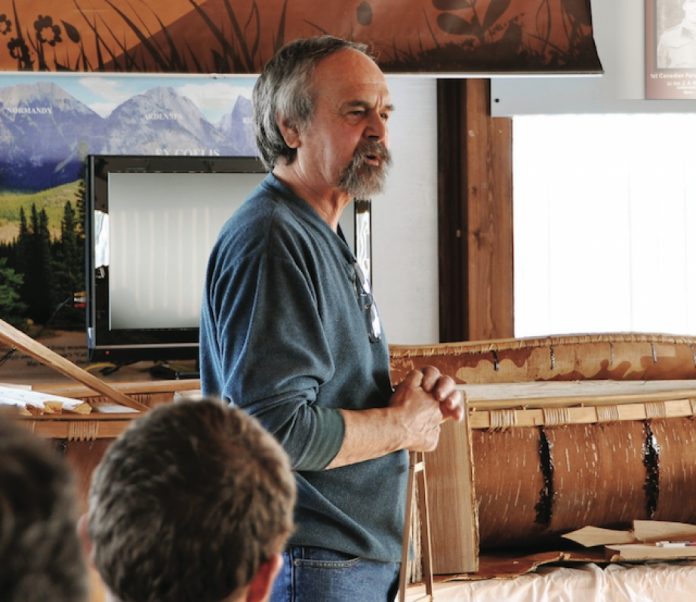
“I don’t paddle unless I have to,” says Pinock Smith with his characteristic wry smile.

For the Algonquin Indian, canoe building is all about the process, not the reward. It seems counter-intuitive that a builder who doesn’t paddle could possess the know-how and inspiration, but spend a day at one of Smith’s workshops and he’ll have you convinced.

Smith grew up surrounded by community on a reserve in western Quebec. “I was never formally taught,” he says, “but I’m not self-taught either.”

He learned to build birchbark canoes through hands-on experience and exposure— the same way he shares his craft with audiences across North America.

Smith worked as a guide, trapper and carpenter until one day he decided to build a birchbark canoe for himself. “That was some 11 years ago,” he laughs, “and I still don’t have my own boat.” Each unique canoe is sold or shared with his pupils.

Since his uncle first took him through the building process step-by-step, Smith has built hundreds of birchbark canoes using the traditional methods and materials of his ancestors. “We complicate our lives so much today,” he muses, surrounded by yards of birch bark, lengths of spruce root and tin pots filled with fragrant pine resin. “I don’t see why we need complicated tools and materials and exact measurements.” With no measuring tapes or rulers anywhere in sight, Smith admits, “I couldn’t make two canoes the same if I wanted to.”

Smith’s art is in many ways about simplicity, appreciation of beauty and a connection to nature. “Listen to what the bark tells you,” he coaches his students. While Smith is seeing a decline in the availability of quality, naturally occurring materials, he believes that the spiritual experience of building is worth his efforts to preserve and promote the craft.

In an age filled with new and improved, high tech and exacting standards, Smith’s attitude is as contagious as his smile. “If you make a boat and it floats pretty well, I’d say that’s a damn good canoe.”

This article on Pinock Smith was published in the Fall 2011 issue of Canoeroots magazine.This article first appeared in the Fall 2011 issue of Canoeroots Magazine.


Random Acts of Canoeing

Photo: Ian Scriver
Random Acts of Canoeing

I paddled the Dumoine River once—from the bridge above Lac Benoit to its outflow at the Ottawa River. It’s definitely a trip best done at a nonchalant pace to fully appreci- ate the rough-hewn landscape. That’s the approach Canoeroots publisher Scott MacGregor and his family took on their trip down the Dumoine. That’s not how my trip went. It was never really supposed to.

A few years ago, my crew of three made a deal with our employer, a local outfitter, to help drive the Dumoine’s punishing shuttle. In return, we could familiarize ourselves with the route by running the river. The group we shuttled was scheduled to take the standard five days. When we started the drive, we had just 36 hours until we had to be back in the city and back at work.

The bullet trip went off without a hitch. We took advantage of much of what the river had to offer, albeit at a much swifter pace than most canoeists with banked vacation days.

I’ve talked with scores of paddlers, new and seasoned, and it never takes long for the conversation to turn to practical canoeing advice, trip anecdotes and yarns. But all too often, when I ask about personal exploits, people bow their heads and write off their experiences as insignificant.

I mull this over when I find myself compromising trip plans to satisfy relatively mundane commitments.

Constantly bombarded with stories of dramatic canoeing accomplishments, I get caught up in the desire to hold a candle to those making larger waves than my own.

Like many of the modest folks who blush when asked about their past on the water, my canoeing career has been arguably less than monumental. I have no first descents. I’ve never paddled across the country. I’ve never been hit by lightning.

After some 20 years paddling, my canoeing resume is filled with a disproportionate number of seemingly random acts of canoeing like that trip down the Dumoine. Even spending most days eating, sleeping and breathing paddling, I remain in the camp of canoeists unspectacularly accomplished on the water. Still, I keep my head up when people ask how my season is progressing.

Here and there I develop a technique, pass a weekend with friends in a canoe or head out after work for a quick tour. My status may be hovering somewhere in the neighborhood of Weekend Warrior but I’m proud that it has developed well beyond Armchair enthusiast.

When I consider my trip down the Dumoine, I wonder if I did it right. There’s so much to see on this river that by rushing downstream, missing things was unavoidable. Then I realize that given my alternative, there’s no doubt the run was worth doing. Any canoeing is better than no canoeing. 

This article on paddling the Dumoine River was published in the Fall 2011 issue of Canoeroots magazine.

This article first appeared in the Fall 2011 issue of Adventure Kayak Magazine.