Home Blog Page 329

Lost Moves: Canoe Stunts Were Once Must-Have Skills

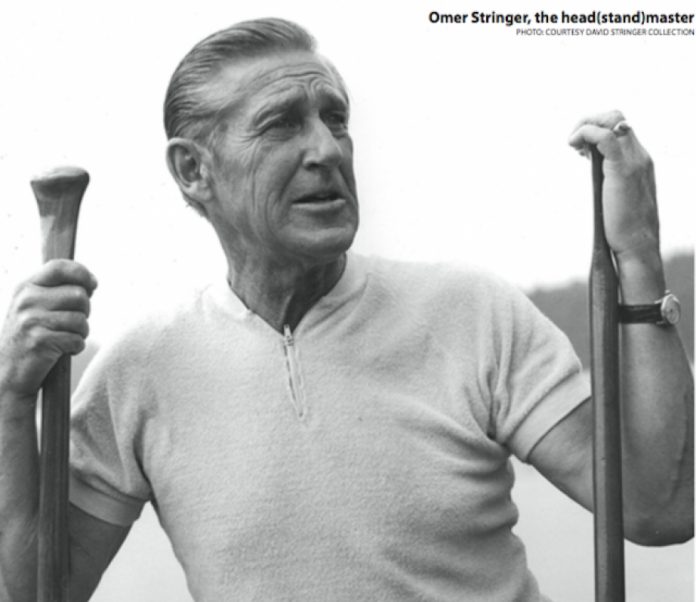
Photo: Courtesy of David Stringer Collection
Lost Moves: Canoe Stunts Were Once Must-Have Skills

Since the passing in March 2011 of canoe guru Captain Kirk Wipper, I’ve been thinking about one of the first amazing things I ever saw him do in a canoe—a headstand on the center thwart of a 16-foot, wood-canvas Peterborough Canadian.

Back when most rivers flowed the other way because the ice age had yet to come, proficiency in a canoe included a variety of novelty moves that any novice hungered to learn from the masters.

Take Omer Stringer, a contemporary of Wipper’s, and his mesmerizing effect on young paddlers.

Stringer mastered all the functional canoeing and portaging skills as a guide and general factotum in Algonquin Park.

But in the 1960s he crisscrossed the province demonstrating canoe stunts—a kind of canoeing that is all but gone today, lost in the rush of getting certified and carded up.

I vividly remember Omer standing on the dock at Camp Kandalore, describing headstands and shakeouts and all the cool stuff you could do in a canoe. As he was talking, his canoe, which floated behind him untethered, drifted gently away from the dock. Kids in the audience got agitated, pointing and calling out to Omer: “Your canoe is floating away!”

Totally unconcerned, he kept talking. Then, with the power of a gymnast and the timing of a circus showman, he did a standing broad jump from the dock into the moving canoe, clearing a couple yards or more without missing a beat in his discourse. Howls of approval pealed out from the audience.

There were other tricks as well. Canoe over canoe is a rescue technique, of course. But the term also referred to a stunt performed regularly during free canoeing at camps throughout the ‘40s, ‘50s and ‘60s.

The stuntman or woman sat behind the stern seat and paddled like crazy toward a willing participant in another canoe. Lining up for a T-bone collision, the stunt involved ramping the moving canoe as far as possible over the mid-ships of the stationary canoe. Next, in one fluid motion, the paddler stood and ran up the moving boat until it balanced over the stationary canoe, and then see-sawed down on the other side. At this point, the paddler settled in and continued on his or her merry way. Canoe over canoe.

The spectacular headstand was something that many Kandalore campers felt compelled to learn if ever they were to paddle like a master. Training for the headstand included the monkey walk—turning 360 degrees in a canoe with hands and feet on the gunwales—and progressed to the flip—spinning the canoe on its longitudinal axis, above the water, without sinking it.

Adding a second person opened doors to gunwale bobbing, jousting and the double headstand.

Since Kirk and Omer were doing their stunts, and encouraging others to do the same, canoeing has evolved. The glamor of these tricks has faded, lost to historic irrelevance. Maybe today’s leaders should sit down and delineate a curriculum for Flatwater Stunting levels I, II and III certification. A flashy badge could be awarded to those who achieve Master Stuntman status.

Why would you want to do a headstand in a canoe on flatwater? It’s a bit like practicing Zen. A path to enlightenment known only to the great canoe masters of old and those willing to wade in and give it a whirl. 

James Raffan mastered the monkey walk in graduate school and is still working on his headstand. 
This article on canoe stunts was published in the Fall 2011 issue of Canoeroots magazine.

This article first appeared in the Fall 2011 issue of Canoeroots Magazine.
 

Random Acts of Canoeing

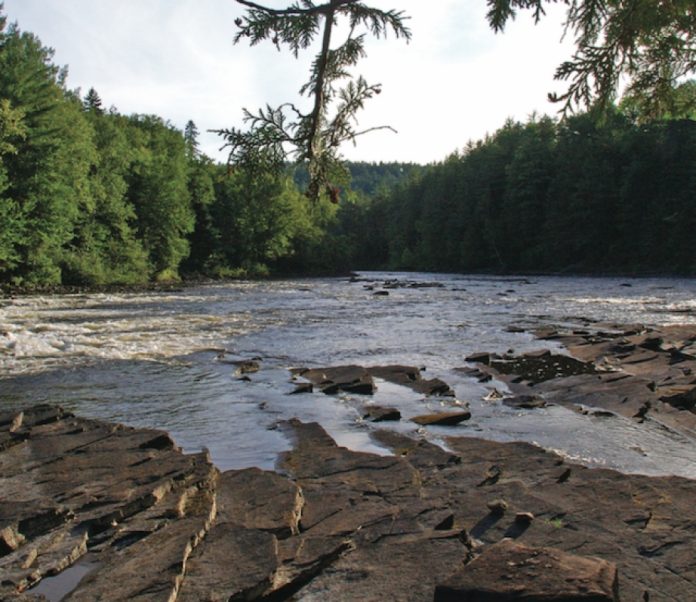
Photo: Ian Scriver
Random Acts of Canoeing

I paddled the Dumoine River once—from the bridge above Lac Benoit to its outflow at the Ottawa River. It’s definitely a trip best done at a nonchalant pace to fully appreci- ate the rough-hewn landscape. That’s the approach Canoeroots publisher Scott MacGregor and his family took on their trip down the Dumoine. That’s not how my trip went. It was never really supposed to.

A few years ago, my crew of three made a deal with our employer, a local outfitter, to help drive the Dumoine’s punishing shuttle. In return, we could familiarize ourselves with the route by running the river. The group we shuttled was scheduled to take the standard five days. When we started the drive, we had just 36 hours until we had to be back in the city and back at work.

The bullet trip went off without a hitch. We took advantage of much of what the river had to offer, albeit at a much swifter pace than most canoeists with banked vacation days.

I’ve talked with scores of paddlers, new and seasoned, and it never takes long for the conversation to turn to practical canoeing advice, trip anecdotes and yarns. But all too often, when I ask about personal exploits, people bow their heads and write off their experiences as insignificant.

I mull this over when I find myself compromising trip plans to satisfy relatively mundane commitments.

Constantly bombarded with stories of dramatic canoeing accomplishments, I get caught up in the desire to hold a candle to those making larger waves than my own.

Like many of the modest folks who blush when asked about their past on the water, my canoeing career has been arguably less than monumental. I have no first descents. I’ve never paddled across the country. I’ve never been hit by lightning.

After some 20 years paddling, my canoeing resume is filled with a disproportionate number of seemingly random acts of canoeing like that trip down the Dumoine. Even spending most days eating, sleeping and breathing paddling, I remain in the camp of canoeists unspectacularly accomplished on the water. Still, I keep my head up when people ask how my season is progressing.

Here and there I develop a technique, pass a weekend with friends in a canoe or head out after work for a quick tour. My status may be hovering somewhere in the neighborhood of Weekend Warrior but I’m proud that it has developed well beyond Armchair enthusiast.

When I consider my trip down the Dumoine, I wonder if I did it right. There’s so much to see on this river that by rushing downstream, missing things was unavoidable. Then I realize that given my alternative, there’s no doubt the run was worth doing. Any canoeing is better than no canoeing. 

This article on paddling the Dumoine River was published in the Fall 2011 issue of Canoeroots magazine.

This article first appeared in the Fall 2011 issue of Adventure Kayak Magazine.


Profile: Birchbark Builder

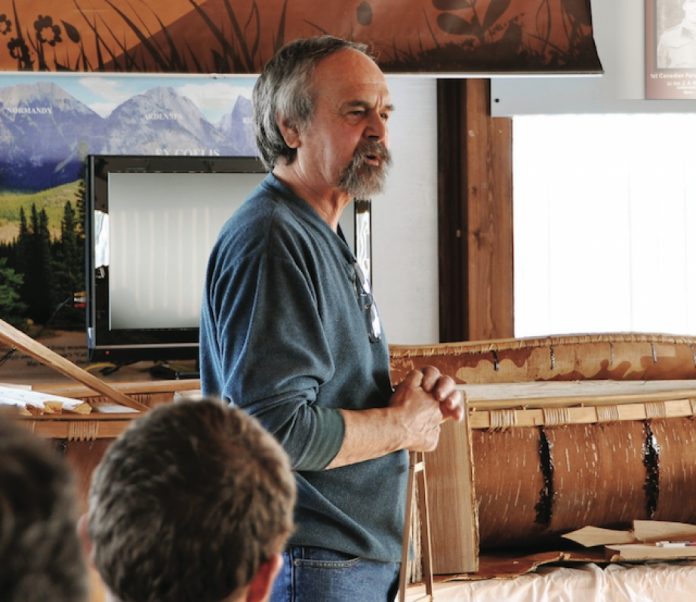
Photo: Tim Foley
Profile: Birchbark Builder

“I don’t paddle unless I have to,” says Pinock Smith with his characteristic wry smile.

For the Algonquin Indian, canoe building is all about the process, not the reward. It seems counter-intuitive that a builder who doesn’t paddle could possess the know-how and inspiration, but spend a day at one of Smith’s workshops and he’ll have you convinced.

Smith grew up surrounded by community on a reserve in western Quebec. “I was never formally taught,” he says, “but I’m not self-taught either.”

He learned to build birchbark canoes through hands-on experience and exposure— the same way he shares his craft with audiences across North America.

Smith worked as a guide, trapper and carpenter until one day he decided to build a birchbark canoe for himself. “That was some 11 years ago,” he laughs, “and I still don’t have my own boat.” Each unique canoe is sold or shared with his pupils.

Since his uncle first took him through the building process step-by-step, Smith has built hundreds of birchbark canoes using the traditional methods and materials of his ancestors. “We complicate our lives so much today,” he muses, surrounded by yards of birch bark, lengths of spruce root and tin pots filled with fragrant pine resin. “I don’t see why we need complicated tools and materials and exact measurements.” With no measuring tapes or rulers anywhere in sight, Smith admits, “I couldn’t make two canoes the same if I wanted to.”

Smith’s art is in many ways about simplicity, appreciation of beauty and a connection to nature. “Listen to what the bark tells you,” he coaches his students. While Smith is seeing a decline in the availability of quality, naturally occurring materials, he believes that the spiritual experience of building is worth his efforts to preserve and promote the craft.

In an age filled with new and improved, high tech and exacting standards, Smith’s attitude is as contagious as his smile. “If you make a boat and it floats pretty well, I’d say that’s a damn good canoe.”

This article on Pinock Smith was published in the Fall 2011 issue of Canoeroots magazine.This article first appeared in the Fall 2011 issue of Canoeroots Magazine.
 

Shadow Captain

Photo: Virginia Marshall
Shadow Captain

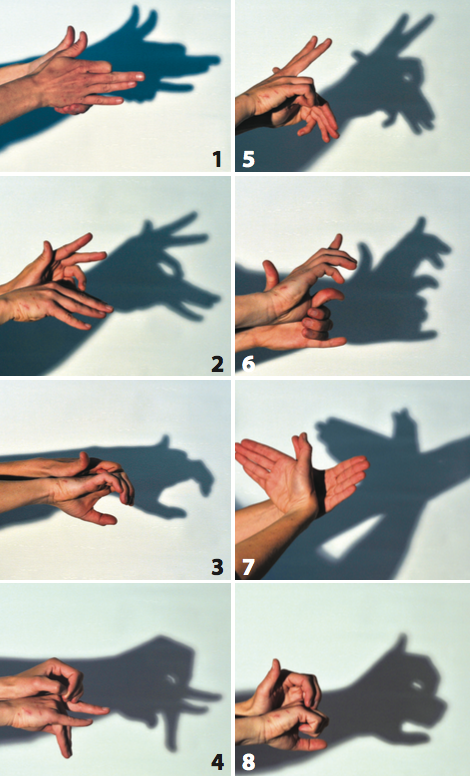
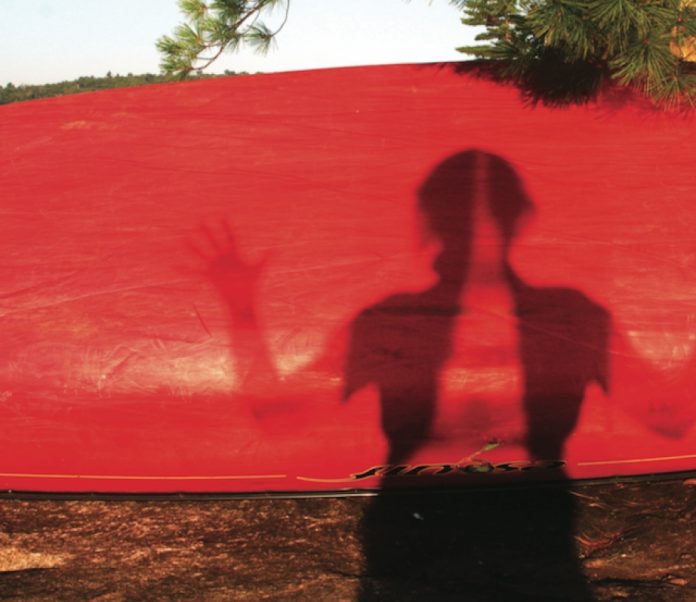
People of all ages have entertained each other using hand shadow puppetry for hundreds of years. Complex shadow puppetry is a true art form, but there are many simple characters that kids can perform easily after just a few tries—all you need is a flashlight, a tent wall or smooth rock face and a little imagination.

With creativity and patience, you may even dream up a new shadow creature.

But as Henry Bursill, creator of many of the figures illustrated here, wrote in 1858, “By what pains they were invented…is known to my tortured digits alone.”

Tip: Sit just a couple feet away from the tent wall and raise your hand between the wall and the light. Check to make sure the shadow is dark and crisp. The closer the light source to the backdrop, the more accurate the shadow puppet’s shape will appear. 

Name that Shadow

Can you match animals listed below to their shadows pictured?

  • Deer [  ]
  • Coyote [  ]
  • Kangaroo [  ]
  • Pitbull [  ]
  • Robin [  ]
  • Cougar [  ]
  • Billy Goat [  ]
  • Elephant [  ]

Shadow_Puppets_Animals.png


Answers: 1) Coyote, 2) Deer, 3) Cougar, 4) elephant, 5) Billy Goat, 6) kangaroo, 7) Robin, 8) Pitbull

This article on puppetry was published in the Fall 2011 issue of Canoeroots magazine.

This article first appeared in the Fall 2011 issue of Canoeroots Magazine.
 

Freedom of the Hills

Photo: Scott MacGregor
Freedom of the Hills

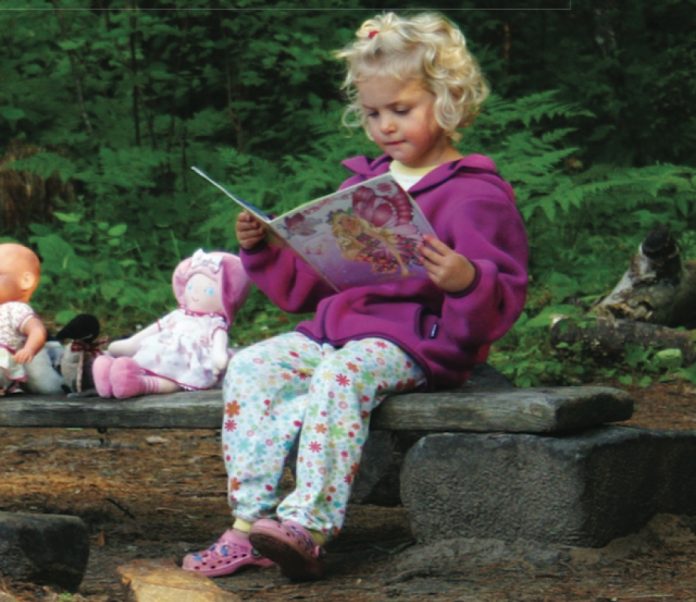
“The greatest gift is a passion for reading,” wrote american literary critic, novelist and short story writer Elizabeth Hardwick. I think she was half right. The other half is a passion for the outdoors.

A paper produced almost 20 years ago by the University of Chicago on early childhood development and learning concluded that, “an infant’s brain structure is not genetically determined. Early experiences have a decisive impact on the architecture of a baby’s brain.”

This makes sense to me. I’m on the nurture side of the nurture-nature debate. I believe we are formed by life experiences.

There is plenty of other research that suggests the development of early literacy skills is critically linked to a child’s success in learning to read. Today, the benefit of reading to our children is drummed into us. Read to your kids, read to your kids, read to your kids. We get it from our parents, teachers and the media. Read. Read. Read.

“When we read to children, brain cells are turned on and new brain cells are formed, adding a bit more definition and complexity to the intricate circuitry that will remain in place for the rest of their lives,” says the university paper.

So if reading to our children is hardwiring them for life, I think we need to be more careful about what we’re reading. What’s happening in their little heads when we read them stories of huffing puffing wolves and thundering waterfalls?

We’re not born afraid of the woods. Mother Goose and Walt Disney scare us into being that way. and they do so without well-meaning parents thinking too much about it.

The comedian famous for one-liners Henny Youngman wrote, “When I read about the evils of drinking, I gave up reading.”

When I realized I was reading to my children about the evils of being outside, I did two things. I took them outside to read. And when we couldn’t go outside, I started reading to them about the fun you can have outside.

The children’s books suggested on the following page are a wonderful start, but I also like to pull from my own library. Like, Tom Brown’s Field Guide to Nature Observation and Tracking. We read a little Tom Brown and then practice sneaking around, we build sticky forts and poke at animal scat. Cool.

Another family favorite is Mountaineering, The Freedom of the Hills. Out comes the storage bins full of my old lead climbing equipment. We set up complex anchors out of clothes pegs and turkey string. lego mini-figures with ice axes leapfrog the three pitches it takes to reach the summit of the sofa. At least one mini-figure is consequently evacuated from the back cushion by the search and rescue helicopter. Too bad, but it’s better the kids work the bugs out of their rope systems this way than on everest.

Mark Twain wrote, “the man who does not read good books has no advantage over the man who can’t read them.”

Good books for children, in my book, are ones about the wonders of the natural world and ones that inspire adventure, not instill fear. Good books are freedom of the hills and the rivers, even if you have to read them inside. 

This article on children and reading was published in the Spring 2011 issue of Canoeroots magazine.

This article first appeared in the Spring 2011 issue of Canoeroots Magazine.
 

Story Time

Photo: Kathleen Wilker
Story Time

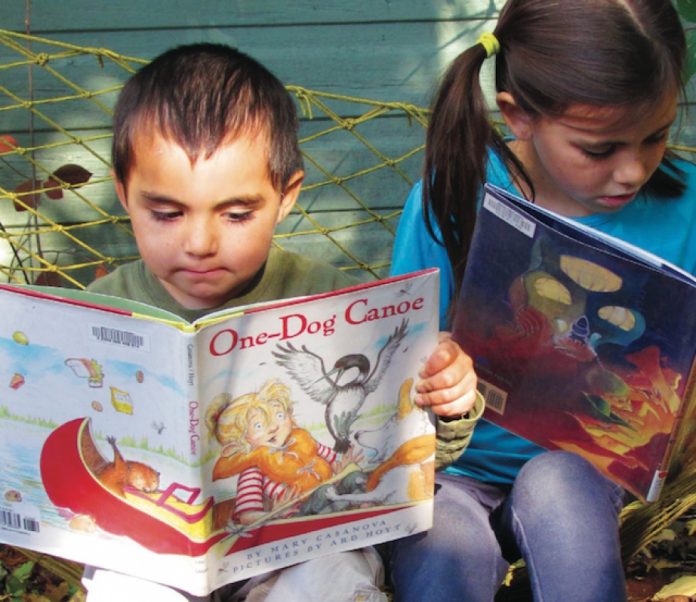
Whitewater isn’t the only thing young paddlers are good at reading. When it’s too cold to paddle or spring showers are falling, snuggling up with a good book about canoes is almost as fun as getting out on the water. We’ve picked four great books to get your paddling library started. 

One Dog Canoe

Story by Mary Casanova. Pictures by Ard Hoyt • Published by Melanie Kroupa Books, 2003 • Ages 2–7

A light-hearted story of how a young girl’s paddle with her faithful dog, “a trip for two, just me and you” turns into a multi-animal pile-up. Fun poetry and great pictures are found on every page. A dog, a beaver, a loon, a wolf, a bear and a moose all jump into the little red canoe that sinks lower with each new animal.

Whatever You Do, Don’t Go Near That Canoe

Story by Julie Lawson. Pictures by Werner Zimmermann • Published by North Winds Press, 1996 • Ages 4–9

Captain Kelsey McKee warns two children and their stuffed kangaroo to stay away from a magical canoe. Unable to resist, the kids hop aboard and soon find themselves swept up “through fast racing currents, through slow moving tides, far into the fading light” and right into a pirate adventure with Big Bart, gin- ger beer and gleaming doubloons.

Shin-chi’s Canoe

Story by Nicola I. Campbell. Pictures by Kim LaFave • Published by Groundwood Books, 2008 • Ages 6 and up

This story is about two children, Shin-chi and his big sister Shi-shi-etko, who are taken to residential school. It’s Shi-shi-etko’s second year, so she tells her brother what to expect—“My english name is Mary. Your english name is David. And don’t forget, we aren’t allowed to talk to each other until June.” She also tells him to comfort himself with memories of their home. At school, Shin-chi holds tight to the little cedar canoe his father gave him and dreams of the dugout canoe that he and his sister will paddle when they finally return home.

The Red Sash

Story by Jean N. Pendziwol. Pictures by Nicolas Debon • Published by Groundwood Books, 2005 • Ages 6–9

A young Métis boy waits for his voyageur father to return to the busy trading post north of superior, where there is to be a rendezvous. A rabbit hunt on a nearby island becomes more of an adventure than the boy, his sister and her suitor intended when a sudden storm hits. at the end of the story, the boy’s courage is rewarded when his father hands him his very own red sash, like a true voyageur.

This article on books for kids was published in the Spring 2011 issue of Canoeroots magazine.

This article first appeared in the Spring 2011 issue of Canoeroots Magazine.
 

Are We There Yet?

Photo: Virginia Marshall
Are We There Yet?

Road tripping is a state of mind. Just ask Jack Kerouac. Don’t let an unwieldy and rebellious payload of kids, gear, boats and pets dampen your spirit. Even though road trips frequently require as many hours in the car as you’ll spend at the destination, highway miles provide an excellent opportunity to share some memorable time together. Enjoy the journey with these stress-saving strategies. 

Navigation

North America’s classic road trip routes boast some serious mileage. The famous Route 66 stretches for 2,451 miles from Chicago to Los Angeles and the TransCanada Highway connects the Pacific and Atlantic coasts over 8,030 kilometers of roadways. 

Reviewing online directions and road maps before you head out is a no-brainer. Folks that are familiar with your destination can also provide valuable info on the condition and location of elusive back roads and shuttle routes—details even a good map can’t provide.

En route, a GPS makes life easier. There is road map software available for many handhelds out there that allows your device to do double-duty, helping you navigate both the front and backcountry.

Teach your kids how to read a map and give them their own copy with your driving route and trip highlights marked. This is a great way to learn map-reading skills and will help minimize backseat boredom. 

Pit Stops

Modern rest stops offer a wide variety of amenities but are seriously lacking in culture. Stopping away from the fast food and concrete of commercial pull-offs lets road trippers enjoy the local way of life.

Despite bypasses on modern interstates and major highways, the fun roadside attractions from the heydays of Route 66 are still out there.

Why not stop at the massive mosquito in Komarno, MB, the life-sized Jolly Green Giant in Blue Earth, MN, or the world’s largest buffalo in Jametown, ND? Drivers can take a deserved break and kids can burn off energy, making the next leg of the journey safer and more comfortable for everyone.

Letting children take charge of an inexpensive digital camera allows them to join in the fun of recording your family experience on the road and at roadside stops.

Hazelmail.com offers a wonderful service that turns your photos into postcards, then prints, stamps and mails them for you. Find a place to stop with wireless Internet connection—plan ahead with listings at Wififreespot. com—and you can easily send a custom postcard from the road. 

Tummy Check

Nothing kills the road trip spirit like motion sickness. Passengers prone to car sickness should avoid reading the latest issue of their favorite canoeing magazine—or anything for that matter—while on the road…save it for the campsite.

Focusing on a point in the distance outside of the vehicle helps the brain settle the stomach—a good reason to leave video games and portable DVD players at home. Rotating passengers to make it easier to see out the front windshield also aids in alleviating motion sickness. Who doesn’t love riding shotgun? 

Pack ginger snaps, peppermints and saltines—all are proven to help with upset stomachs. And remember, while it may slow you down, it’s in everyone’s best interest to stop the care before you hear these for words: “Mom, I’m gonna barf.”

Hauling Your Stuff

Did you know that it’s illegal to tie a dog to the roof of your car in Alaska? Or that Massachusetts law states that you’ll get pulled over if you have a gorilla in your backseat? With these exceptions, it’s easy to ensure a safe, secure and legal load.

Don’t cheap out—a good roof rack is worth its weight in gold. Getting an aerodynamic, durable system makes hauling canoes and gear safer and easier. Many quality systems outlive today’s cars and can be adapted to different vehicles when it’s time for a switch.

Most aftermarket roof rack manufacturers offer lock systems that allow you to secure your gear to your rack and your rack to your car for peace of mind while you’re feasting at Bonanza. A long, steel cable bike lock also works for many applications.

Rooftop bag systems are a versatile, affffordable and easier to store alternative to pricey hard-shell rooftop boxes. Bag systems that attach to the rear od many vehicles free up roof space for bikes or boats. 

Entertainment

The first commercially successful car radio rocked dashboards in 1929. Onboard sing-a-longs to Queen’s Bohemian Rhapsody can be traced back to 1975. Since these milestones, most family auto excursions have been made with musics. 

The best way to share the time with your passengers rather than losing them to their headphones is to listen to something together. Before you depart, gather an equal selection of every family member’s music and make one big playlist or multiple CD mixes. On the road, set the player on random. Hey, at least it’s shared suffering.

Local radio can give road trippers a taste of the region they’re vis- iting as well as local weather and road condition updates.

If trying to agree on music threatens Windstar warfare, listen to an audio book. It’s amazing how quickly a good story passes the time on a long trip. Thousands of titles are now available online.

Podcasts are another option. Download Road Trip USA, NPR’s This American Life or CBC Radio’s Vinyl Café for family oriented, road worthy entertainment. 

This article on tips for family road trips was published in the Spring 2011 issue of Canoeroots magazine.

This article first appeared in the Spring 2011 issue of Canoeroots Magazine.
 

Butt End: Fool on the Hill

Photo: Kevin Callan
Butt End: Fool on the Hill

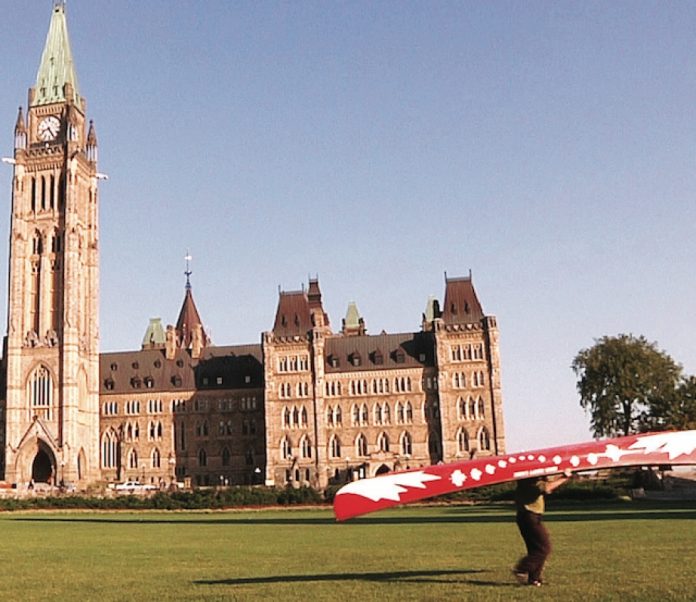
“Get that canoe off the pavement,” the Royal Canadian Mounted Police officer bellowed from the window of his patrol car.

Panic set in. The camera crew about to film my triumphant portage across the grassy lawn of Ottawa’s Parliament Hill froze mid-step. We had no filming permit. We didn’t even ask permission prior to the shooting.

It was just a silly, spontaneous stunt—my Canadian flag-emblazoned canoe beneath the copper-spired towers of democracy and sovereignty; patriotism afoot—while we waited for better lighting to film an Ontario Tourism segment at the Rideau Canal.

The adrenaline that jolted through our bodies—urging us to fight or, more likely, flee to the inviolable freedom of the swift-flowing Ottawa River below—dissipated when we heard the officer chuckle. He suggested we put the canoe on the grass so it wouldn’t get scratched.

“So, is it okay if we film this scene?” the producer asked.

“Can’t see why not—it’s your grass,” came the good-natured reply.

The camera began to roll. A second and third officer appeared to wish us well with our project. A small crowd of tourists gathered, camera shutters clicking in the bright sunshine. Kids playing Frisbee on the grass and a gaggle of middle-aged women gathering for an early morning yoga class moved aside to give us more space.

Then a fourth officer—a supervisor— rolled up in a shiny cruiser. He demanded we remove ourselves from the area immediately. We apologized for filming without a permit, grovelling for forgiveness from this pillar of the law. The officer clarified, “You can stay and film all you want, but you can’t portage across Parliament Hill.”

Panic and pleading derailed into dumb founded silence. A shocked bystander yelled, “Democracy is dead!” 

The film crew and I retreated behind the wrought iron gates of Parliament with the canoe slung low, open, non-threatening between us, its red and white hull turned to the ground. The Frisbee game resumed over the Centennial Flame and lululemon-clad figures resumed downward dog on the front steps of the Peace Tower.

We managed to film the segment before getting kicked out, but in capturing a light-hearted homage to cultural identity and national pride, we got more than just our shot that morning. We got an unpleasant reminder of how the Canadian government has disconnected itself from its people, its idea of fundamental freedom and, most of all, its nation’s iconic symbol—the canoe. 

This article on portaging across parliament hill was published in the Spring 2011 issue of Canoeroots magazineThis article first appeared in the Spring 2011 issue of Canoeroots Magazine.
 

Act Now To Save Gunwale Bobbing Before It’s Gone

Gunwale bobbing has been a staple for older generations playing on the water in canoes and is lamented by some as becoming a lost art with modern youth. This may sound a little melodramatic to those raised in a generation of careless, youthful pleasures (or those who question this generous assignment of the term “art”), but query a group of kids, teens or even outdoorsy 20-somethings about this classic canoe game and you’ll elicit a host of puzzled expressions.

“Is that, like, when you rock side-to-side and see how far you can dip the gunwales?” wondered one college outdoor adventure program student. “Is it like bobbing for apples?” guessed another.

Hey, at least give them credit for knowing what a gunwale is.

[ Paddling Buyer’s Guide: Find your perfect canoe for gunwale bobbing ]

It’s not the fault of the youth. In the late ‘90s, this cherished summertime tradition simply fell out of favor in camps and school programs across the country. “It’s not a written policy,” says YMCA Wanakita Camp Director Andy Gruppe. “Gunwale bobbing is one of many things camps are just not supposed to do anymore for insurance and liability reasons.”

Gruppe says no specific incident flagged gunwale bobbing’s demise. Rather, it was singled out for how dangerous it looks, not how dangerous it actually is. “More kids probably get hurt playing Capture the Flag in a given day than gunwale bobbing in an entire summer,” he says.

There’s still time to reverse this tragic loss.

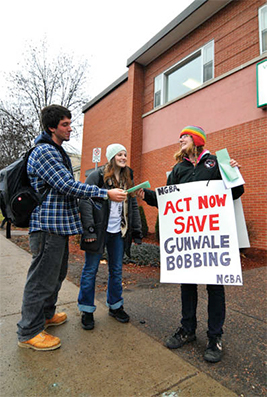
Woman standing with sign that says "Act Now Save Gunwale Bobbing"
Grassroots activism at work. Corynne McCathy educates fellow students Tom Coker and Elly Squires. | Photo: Virginia Marshall

Now a new organization wants to bring gunwale bobbing back into the toe grasp of hordes of hyperactive campers. The 62-member National Gunwale Bobbing Association (NGBA) is gradually spreading the gospel of gunwale bobbing at waterfront parks, community pools and even on street corners.

At a recent Save Gunwale Bobbing on-water event, NGBA ambassadors reported over a dozen eager kids perched astride bobbing canoes, even as protectivist parents protested from the solar-, water- and sand-shielded safety of their SUVs. “We received a score of disapproving text messages,” reported one NGBA instructor.

Hand-wringing parents aren’t the NGBA’s only worry, however. A secretive organization led by a shadowy figure known only as Gunwale Bob has been raising awareness of gunwale bobbing’s plight with less-than-legal gusto.

Infiltrating camps and posing as canoe instructors. Posting incendiary notes and photos on kids’ Facebook walls. Even demanding that hapless paddlers pass the “gunwale bob test” before leaving the dock at rental outlets in Boundary Waters, Algonquin, the Adirondacks and dozens of other popular canoeing destinations across the continent.

Canoeroots couldn’t find Gunwale Bob for comment, but an undisclosed whistleblower at his organization states, “The time for passive promotion is past.”

Meanwhile, a shrinking minority of recreational canoeists and families who never heard that gunwale bobbing is too dangerous continue to enjoy this graceful and precarious dance. Some of canoeing’s best known advocates are ardent bobbers.

“Gunwale bobbing is a canoe game we played as children—and one we still play,” write Joanie and Gary McGuffin in Paddle Your Own Canoe. In fact, the McGuffins encourage bobbing as an exercise to develop balance in a canoe.

So, what is the uncertain future of gunwale bobbing? Will the enthusiastic efforts—public or subversive—of the NGBA and Gunwale Bob resurrect this classic canoe game at children’s camps? Or will over-protective zealotry deliver it the same fate as wooden playground structures, cliff jumping, bare feet and the other regrettably forgotten but unforgettably fun pleasures of previous, more risk tolerant generations?

Act now to save gunwale bobbing. Grab a partner or go alone. Straddle bow or stern, grip the gunwales between bare toes, feel leg muscles flex and extend rhythmically. Stand up, bob and be counted.


Get gunwale bobbing

Keep the tradition alive with these fun-for-all-ages games.

Gunwale Bob Races

Two or more players

Players line up canoes side-by-side, about a canoe’s length apart. Race to the finish by standing on the stern gunwales, facing the bow, and bobbing the canoes forward.

Gunwale Bob-Off

Two players

Players stand on the gunwales at either end of the canoe, facing each other. Alternate deep-knee squats to set the canoe bobbing. See how high you can bob your opponent. The goal is to send your opponent for a swim while maintaining your own balance. For an extra challenge, wiggle the canoe side-to-side as you bob.

Volley Bob

Four or more players

Pairs of players stand on the gunwales as above. The goal is to be the canoe that bobs the longest. Make sure each canoe has plenty of space and use a moderator to see that every canoe bobs with equal vigor.

This article was first published in Canoeroots & Family Camping‘s Spring 2011 issue. Subscribe to Paddling Magazine’s print and digital editions here , or browse the archives here.


Up, down. Gunwale bobbing is an allegory for life. | Feature photo: Virginia Marshall

Renaissance Man

Photo: Conor Mihell
Renaissance Man

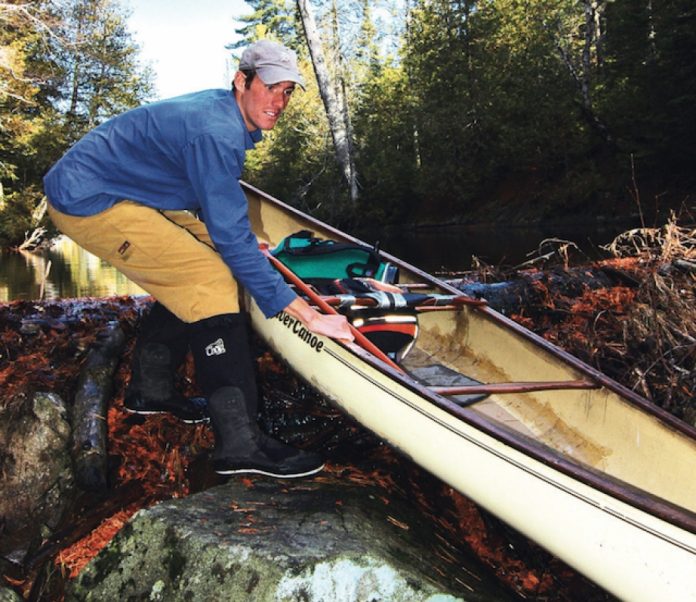
The online classified’s glorified details set my dreams in motion: a couple hundred bucks for a 15.5-foot, slender solo tripping canoe; 45 pounds of fiberglass adorned with ash trim. Just the ticket for independent trips on sprawling lakes and placid rivers. I mailed the seller a check sight-unseen and had a friend deliver the canoe to me a few weeks later.

“It’s a little rough,” my friend James reported, as we carefully lifted the canoe off the roof of his SUV. Only a skilled carpenter like James would so rashly understate the deplorable condition of my new canoe. Its weatherworn, desert tan hull was webbed with spidery cracks, the worst of which were coated in ugly, snot smears of epoxy. Rotted gunwales were spongy to the touch. After a few short outings where I observed steady streams of river water infiltrating the hull, the canoe—and my dreams—were shelved and almost forgotten.

But here’s the thing with a once-pretty canoe: It can’t help but catch your eye. A year later, when common sense still urged me to look the other way, the canoe spoke to me. Its sparsely upturned stem and stern screamed speed across open water, and its graceful tumblehome cried the promise of thousands of efficient, comfortable strokes. I caressed its fractured chines and conceived of a rehabilitation plan involving orbital sanders, fiberglass cloth, polyester resin and gelcoat. I would grind, glue and paint life into this aged spectre, and celebrate its rebirth with an autumn trip.

Putting my priorities in order, I thoroughly researched and planned a 70-kilometer lake circuit months before I set about rebuilding the canoe in which I would do it. When I finally chose a late-August heat wave to begin the restoration, it quickly became apparent that my old electric sander was no match for the canoe’s craggy skin, so I borrowed a friend’s stone-wheeled angle grinder. The grinder fervently tore into the job, creating clouds of caustic dust and ripping holes in the rotted fiberglass.

In 30 minutes of hot and dirty work I managed to obliterate most of the cracks. The result was a heinously holey, splotchy and morale- crushing canoe. I threatened to dump it in a landfill or, better yet, scuttle it with a final rock-bashing run down my local class III river. 

Here’s the thing with a once-pretty canoe: it can’t help but catch your eye

Unwilling to accept defeat, I summoned visions of gliding across steaming lakes rimmed with fiery forest and silent stone. Intent on the objective, I laid strips of resin-saturated fiberglass cloth along the inside of the canoe wherever I had gored the exterior. Then I sealed the hull with gobs of milky gelcoat, and chopped out and replaced the punkiest pieces of gunwale.

Figuring it would be wise to travel in the company of a capacious tandem on my solo’s maiden voyage, I recruited my wife Kim and friend Brad to come along. Kim, who’d been privy to all the peaks and valleys of the reclamation debacle, expressed her doubts when sunlight shone through the clear-coated hull as we affixed it to my truck’s racks. “But think of how fast we’ll travel three to a canoe,” she teased.

Shoving off from a sand beach on Lake Wanapitei, kneeling amidships, I gradually heeled the gunwale closer and closer to the water, growing accustomed to the tender stability. Bow pierced morning mist, trees burned with color and, amazingly, the canoe remained dry. For the next five days, canoe and I followed a J stroke course across the lakes, rivers and streams of my dreams. 

This article on a solo canoeist was published in the Spring 2011 issue of Canoeroot magazine.

This article first appeared in the Spring 2011 issue of Canoeroots Magazine.