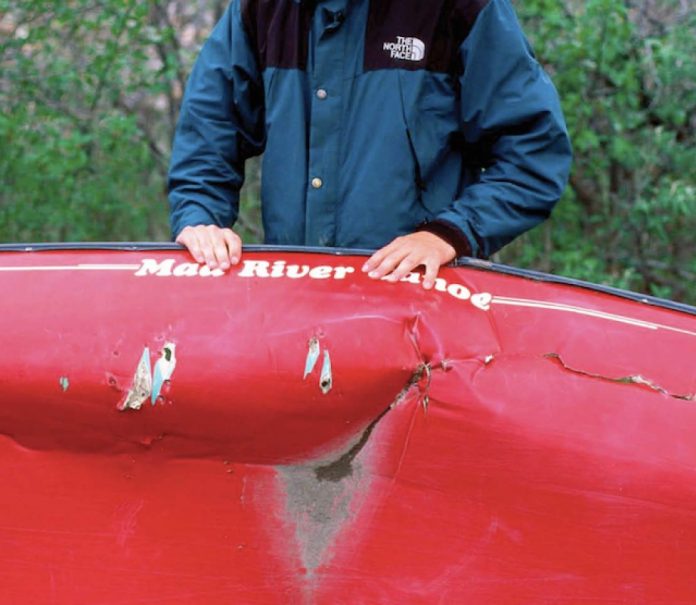
Nothing causes panic on a remote river trip like serious damage to your canoe. However, with a black bag of just five items and the skill of a drunken surgeon you can repair even large, gaping gashes in whitewater hulls.
Even though Royalex boats have a toughness approaching elephant hide, they can rip if a loaded or water-filled boat meets just the right knife-edged rock.
To patch a small tear you need heavy-duty duct tape, which means at least 13-mils-thick with a tensile strength of 45 pounds (look for Polyken by Covalence Adhesives). Normal duct tape is weak, barely adhesive and readily delaminates.
Clean the torn area inside the hull and flip the canoe over so you can slide your camp stove under the canoe below the tear. Apply the duct tape to the inside once the damaged area is clean, dry and very warm. Applying the tape to the outside of the hull or to the inside if the hull isn’t warm is just a waste of great tape.
If your ABS canoe wraps on a rock in fast current your hull will likely only become hideously creased, but it is possible that the hull will rip in an even more dramatic way.
WHAT YOU NEED IN YOUR TEAR KIT
Assuming you can drag the carcass off the rock, the repair requires a spool of 19-gauge stainless steel wire (from most hardware stores) and a four-inch nail. Kick out the hull to its normal shape the best you can. Heat the nail and melt holes on either side of the tear, then stitch the boat together with the wire. Cover the fine stitching with proper duct tape on the inside after first warming the hull. With this unbraided stainless wire you can fix any number of things: seats, broken hanger bolts, thwarts, paddle shafts. Don’t leave it at home.
For chemists, there is a way to actually plug the hole left by a tear or puncture. Black ABS plumbing pipe will initially dissolve in acetone before setting to become hardened plastic once again. Before the trip, reduce a section of pipe to shavings with a rasp and pack a small amount of acetone in a can or padded glass jar. If you need to plug a hole on the trip, mix acetone and ABS shavings until they reach the consistency of gravy. Fill deep gashes with a few consecutive layers, allowing the acetone to evaporate and the ABS to harden between coats.
This gunk is about the only material you can use on the outside of ABS boats. Make your job easier by first backing it up with a warm application of duct tape on the inside.
With this tear kit you can float your way out of situations that would otherwise end your trip.
 This article first appeared in the Early Summer 2009 issue of Canoeroots Magazine. For more great content, subscribe to Canoeroots’ print and digital editions here.



 This article first appeared in the Spring 2009 issue of Adventure Kayak Magazine. For more great content, subscribe to Adventure Kayak’s print and digital editions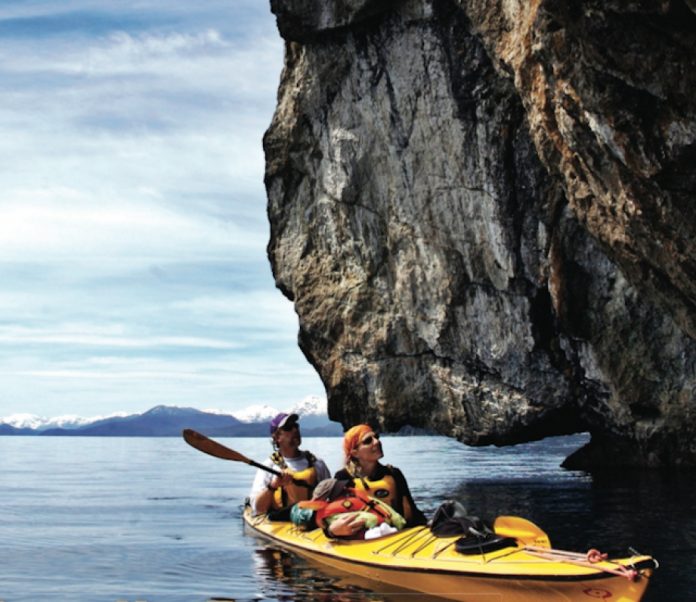
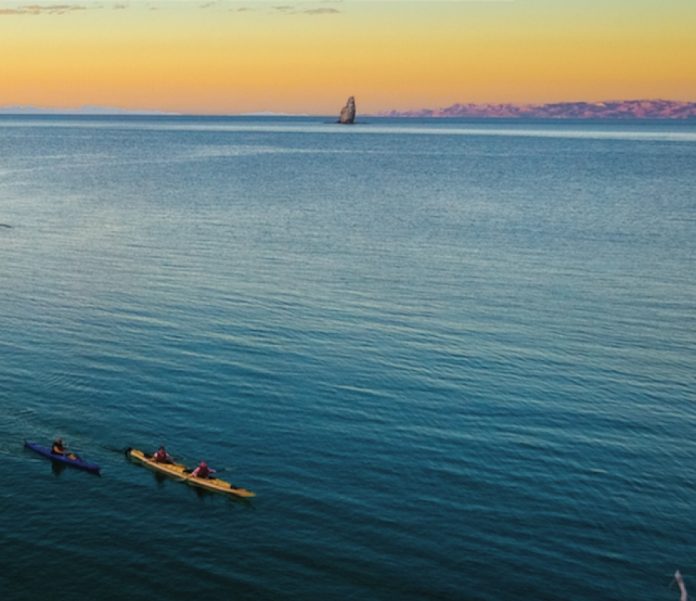
 Destination trips are the most straightforward, where you launch and land in roughly the same place and paddle around for a week or so in between. popular destinations include three national marine parks with islands: Bahia de Los angeles—or Bay of L.A. — (1,013 km or 630 road miles from Tijuana), Bahia de Loreto (1,700 km or 1,100 miles) and Espiritu Santo (near La Paz, 2,414 km or 1,500 miles). Recently protected for their uniqueness, fragility and abundance of life, these parks also manage kayakers. Permits can be bought in the park office in the respective towns.
 Expeditions commit serious time to travelling by sea. Paddling the length of the sea of Cortez often begins in unremarkable san Filipe. “The only reason people start at san Filipe is to say they did the whole thing,” declared expedition paddler Dan Kennedy after starting there three times.
 This article first appeared in the Spring 2009 issue of Rapid Magazine.