Home Blog Page 352

Skills: Making the Bands

Photo: Carole Westwood
Skills: Making the Bands

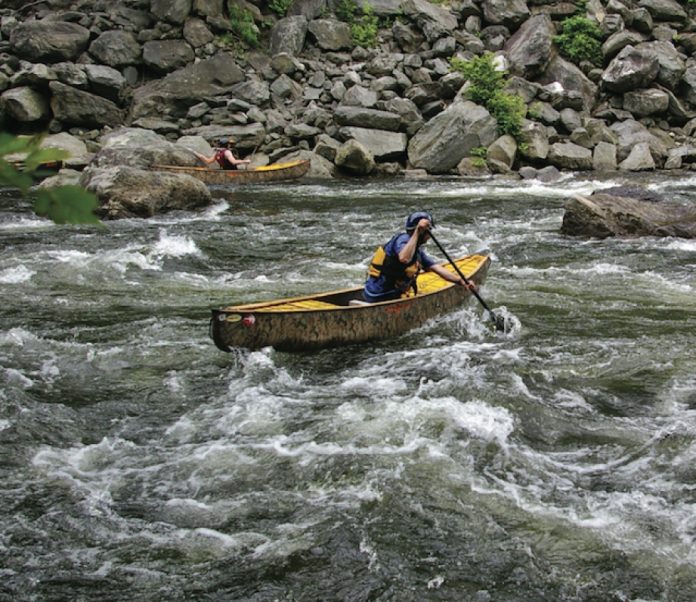
Shallow water ferries can present an interesting water-reading challenge to canoeists. As the current flows over rocks or boulder gardens it is divided into bands of fast-and slow-moving water. Like lanes on the highway, these ribbons of water appear as parallel lines of traffic. Fortunately, these bands of current can be used to your advantage to assist in doing effortless ferries. The key is recognizing the currents and applying varying ferry angles that work with the water to move you quickly and easily across the river.

Identifying the bands of fast- and slow-moving water is actually quite easy. Reading water is simply observing the changes in colour and texture of the water as it flows over and around obstacles in the riverbed. In shallow water, look across the river for alternating bands of colour to show the different speeds of current. For example, colour changes from light–dark–light may indicate currents ranging from fast–slow–fast. Do the same for texture. Wavy–flat–wavy would also indicate current changing from fast–slow–fast.

The fun of shallow water ferries is selecting ferry angles that work with the currents to significantly reduce the number of paddle strokes needed to cross the river.

Why? Because it is always better to use the water to your advantage, and specifically in shallow water ferries, fewer strokes mean you are less likely to trip over your blade.

Here’s how: choose a ferry angle that points across the fast water and enter the current. This strategy helps to pull you quickly into the flow and jets you toward the adjacent band of slow water. Allow your angle to open until you are pointing across the boundary with the neighbouring band of slow water. Next, as you enter the slow current, allow the current to point the canoe upstream, which it will try to do, sort of like coming into an eddy. The momentum you carry from exiting the fast water will assist in your ferry up and across the slow current. As you approach the next band of fast water, open your angle to jet through the rapid flow. The changes in the speed of the current actually assist the changes of angle and direction of your canoe; it just takes some getting used to because we usually open our angle in slow water and close it when we enter fast moving water. On shallow water ferries we are doing the opposite.

This strategy, although untraditional, has a couple of advantages. First, it minimizes your exposure to fast current so you don’t have to waste energy duking it out in a losing battle against the river. Second, each transition between currents allows the boat angle to follow the current, practically eliminating correction strokes. Third, opening your angle promotes efficient glides by capturing momentum from fast water and carrying it into the slow currents. And finally, it gives you the opportunity to attain in the slow current to better position your boat for subsequent manoeuvres.

Shallow water ferries across bands of fast and slow moving water allow paddlers to tap into the power of the river to move across the river with very little effort. Effective water reading, choosing ferry angles that work with the water and, of course, practice make it easy. 
This article on open canoe ferry was published in the Summer 2007 issue of Adventure Kayak magazine.

This article first appeared in the Fall 2007 issue of Rapid Magazine.
 

River Alchemy: Hockey Night in Utah

Photo: Matt Leidecker
River Alchemy: Hockey Night in Utah

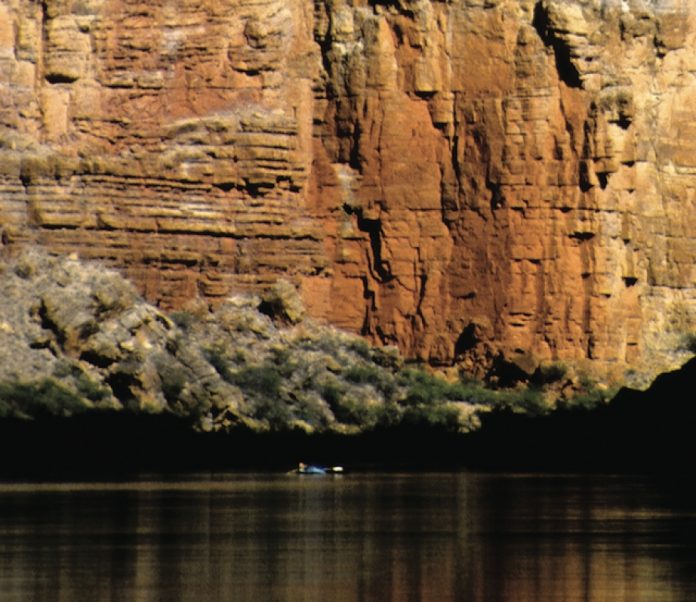
It’s a seemingly simple move when done correctly: launch from behind the oars at a run with your coiled bow line and a sand stake; leap to the beach with your raft still in the current; drive the stake into the ground and tie it off like a rodeo calf roper. When done just right, the rope stretches taut and pendulums the raft up onto the sand bar coming to rest where no eddy exists. Miss the timing of the jump, carry too little bow line, or tangle the calf roper loop and the loaded raft keeps on trucking, dragging the boatman down the sandbar on the end of the bow line, heading into the very rapid he intended to scout.

This time the boatman nailed it. She buried the stake with authority and had the rope wrapped and tied in seconds—long before the line came taut. She watched with quiet satisfaction as her raft swung up on the beach, just like it was supposed to. We were above Triplet Falls on the Green River in the desert southwest, the water running high, with her deftly herding passengers off her rig and onto the scout trail. She wasn’t messing around–I was impressed. There was something familiar about this young dynamo of a trip leader. As the last boat on her trip skidded onto the beach and easily tied to her stake, I asked another guide “Is that a young Brown in your lead boat?” He nodded and smiled admirably.

This sense of home, belonging, and ownership will do more for our rivers than anything else in the world. Take care of our rivers.

It was well over 10 years ago when I first landed in Vernal, Utah, to guide the canyon rivers. Vernal was the birthplace of western river running 75 years earlier, but is now all oil drilling and ranching. I had been in town only a couple of days when a rumbly, full-size Ford F350 pickup truck rolled up in a cloud of dust. Out dropped a small, serious-looking man—worn western boots, Wranglers, handlebar mustache and a cowboy hat as big as the grill of his truck. He’d heard there was a Canadian in town. I ran for cover.

Turns out that Cowboy Al loved hockey. He’d come looking for the Canadian kid to come and watch the playoffs with him. It was 1995, New Jersey was playing Detroit.

Al Brown is a legend. He ran rivers for decades in the early days and ended up a dude rancher. In the wintertime he flooded his horse arena and hosted a kids’ hockey league, turning his tack shed into the dressing room, using equipment donated from his wealthy eastern seaboard clients (at the time you couldn’t buy ice skates in Utah).

Cowboy Al was a serious hockey fan in the middle of a hockey desert. As the puck dropped, we became fast friends, meeting in his living room for the playoffs every second night. On off days we’d take shots in his hay barn, blasting pucks at his plywood goalie, Al in his boots and Wranglers, me in sandals and river shorts. While I was on the river he would tape the games and have an edited highlight reel waiting for me when I got back.

Watching hockey at the Brown’s house was serious business too. No one was allowed to talk during play, his three young kids’ eyes glued to the tube. When the game stopped for commercials chaos would erupt with kids brawling and crawling all over each other, shrieking and laughing. When the puck dropped again… silence.

Something I learned from spending my summers on the rivers and at the Brown ranch was Al’s deep love for where he lived. He’d spent most of his life on the Green River, in the canyon of Lodore and Split Mountain, his ranch now on its banks and within view of the take-out. His family was firmly planted, and it was a joy to be invited in.

Named after the canyon where she now guides boats, young Lodore Brown was the trip leader up the trail scouting with her group—the one who nailed the sand stake and the same kid who years earlier pretended to drop her gloves and pull my jersey over my head during breaks in the hockey game.

As she returned her clients to her boat, I introduced myself in the way river guides do—an old-timer nodding and exchanging first names with the new generation, as she focused on her run and getting her rig in order. I didn’t mention watching hockey at her house or taking shots with her dad.

I had just returned to the Green after a long absence and my brief, chance encounter with Lodore made my summer. The sand anchor she so deftly buried and the skill and authority with which she drove it in were symbols of her family history and connection with the place. It is more than “being at home” on the river, this river is her home. I could see it in the depth and clarity of her eyes as she looked over her shoulder at the rapid’s entry in the midst of our brief introduction.

I wish this for all people who travel rivers; I wish them the true feeling of home and connection with a place. The ability to nail a stake into the river bank and know “this is my river.” This sense of home, belonging, and ownership will do more for our rivers than anything else in the world. Take care of our rivers. 

This article on Cowboy Al was published in the Fall 2007 issue of Rapid magazine.

This article first appeared in the Fall 2007 issue of Rapid Magazine.
 

Peer Pressure: Kayak Bungee Jumping

Photo: AJ Hacket Bungy
Peer Pressure: Kayak Bungee Jumping

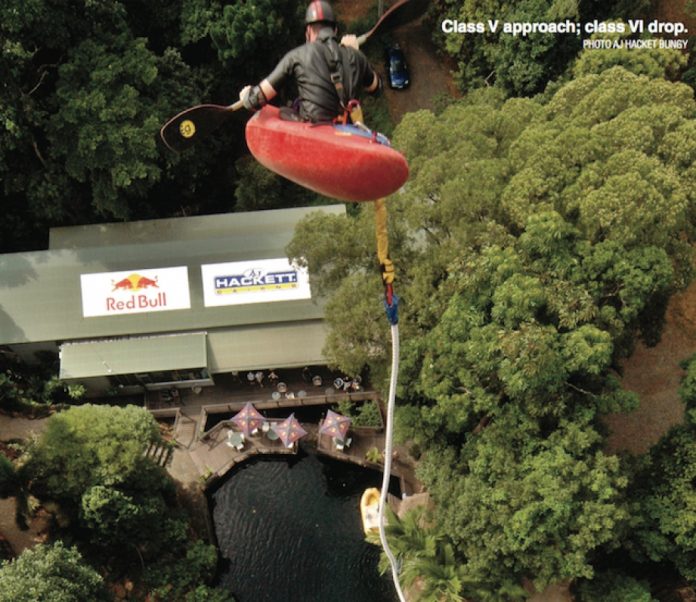
You’d think an Australian cop would be better prepared to deal with peer pressure. However, while on location this spring for their upcoming film We’re Going There Anyway, the Skippy Film crew convinced Jackson kayak’s down-under paddler Jez Blanchard to hurtle himself in his Rocker well more than 50 metres (164 feet) into oblivion for some truly sick bigdrop footage.

Simply known as Jez, the Sydney riot squad officer is a four-time national champion, multi-time OC1 World Cup finalist and creator of the Jackson kayak Camp Instructional Tour. After a quick phone call to the operators of AJ Hacket Bungy, who immediately went about setting up safety and erecting a ramp for a little added vertical spice, he was whisked off to North Queensland.

Rigged into a full-body harness, then strapped into his kayak, Jez was placed several metres higher than the usual 50-metre-high bungee platform. At the very top of the tower the ramp had been added, allowing him to reach 200 kilometres per hour as he launched into rarified air.

“I wasn’t feeling too bad considering I knew what was about to take place,” says Jez.

“A jump like this is fine at the start as all you can see is the horizon line of the roof, however, as soon as I got to the edge I realized how ridiculous this was.

The ground is a very solid thing, and when it comes towards you at terminal velocity you do tend to get a little freaked out.”

He went into an uncontrolled spin, but kept paddling, “partly because it’s a normal reaction to being in a boat and partly because the film crew thought it would look sweet.”

With the recoil at the bottom, Jez scuffed up his shoulders on the harness and says he felt an uncomfortable squeeze in his manhood, but the bow of the boat successfully kissed the surface of the pool below and he even added a little slap of his paddle before bouncing back up.

“It is the ultimate park and huck,” Jez said. “But if you’re ever asked to kayak bungee, it’s like drugs, just say ‘no’.”

This article on kayak bungee jumping was published in the Fall 2007 issue of Rapid magazine.

This article first appeared in the Fall 2007 issue of Rapid Magazine.
 

Copycat Creeker

Photo: Ryan Creary
Copycat Creeker

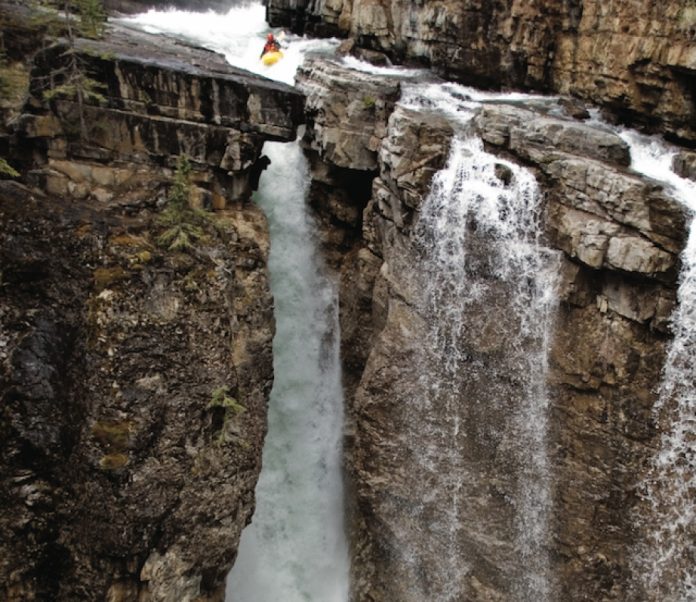
No waterfall drop is more revered than Tao Berman’s 1999 descent of Banff National Park’s Upper Johnston Falls. It was the first to approach the 100-foot mark and undoubtedly the most recognizable event in extreme kayaking, breaking the previous record by 20 feet and still standing as the highest falls run without swimming. The event was witnessed by 100 sightseers and several camera crews and was almost immediately broadcast across the world. Even without most of the fanfare, imitation is still the highest form of flattery, and for Canmore, Alberta’s Logan Grayling, it may also be a 98.4-foot steppingstone to something higher.

Nineteen-year-old Grayling was a Grade 6 student who had never paddled when Berman set the world waterfall record just 25 minutes from his house. John- ston Falls was a common school class trip.

“I didn’t even know what whitewater kayaking was at the time. I had seen the falls dozens of times, but had no idea anyone had gone over it or even what that meant,”

Grayling said. “I do now.”

Since Grayling began paddling the big stuff a little more than two years ago, he’s been hiking into the park, trading in math quizzes for real life calculations. He says as his skills improved, so did his confidence that this tourist attraction could be “knocked off” so that a new, younger generation of paddlers could emerge as leaders.

“Since [Berman’s drop] no one has been able to step up and run it, and let me tell you, it’s huge and f-ing intimidating. But I wanted to do this for myself, to prove to myself I could; to show that people can still push the limits of the sport and see what comes next,” Grayling said.

With only a couple of cameramen and about half the spectators of Berman’s drop, Grayling ran Johnston Falls on June 13. He estimates the flow was about two feet higher at the top and only a foot higher in the basin than in 1999. So technically, this could be some sort of new record, though he admits it is difficult to prove. The only hitch to the descent was that Grayling grazed his cheek on a jutting rock about 75 feet down, the very same rock that broke Berman’s paddle eight years earlier.

Most importantly for Grayling is what’s next.

“Now I know what my body can handle, we’re moving on. I’ve got a couple of spots that I can’t tell you about that are waaaay higher than Ed’s,” he said, referring to Ed Lucero’s 2003, 105.6-foot record drop of Alexandra Falls, NWT, which he swam. “Hopefully this September we’ll have a new record to talk about.”  

This article on Logan Grayling was published in the Fall 2007 issue of Rapid magazine.

This article first appeared in the Fall 2007 issue of Rapid Magazine.
 

Editorial: Not Quite Like The Other

Photo: Lauren Watson
Editorial: Not Quite Like The Other

Three of these kids belong together

Three of these kids are kind of the same

But one of these kids is doing his own thing

Now it’s time to play our game 

In that 1970’s Sesame Street skit, I remember the jingle but not the point. Was I just to notice that one kid was playing soccer while the other three base ball, or was I supposed to respect the kid who was stepping out of the crowd and doing his own thing?

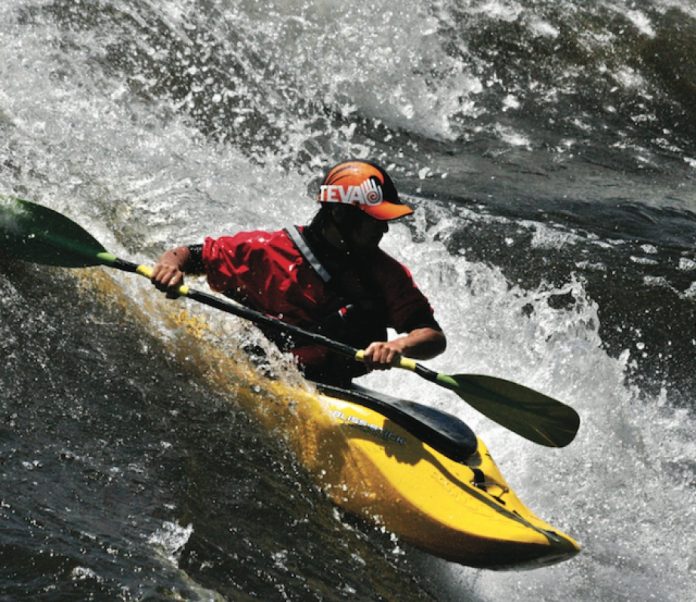
Under many circumstances, doing your own thing is quite admirable. Paddling without a helmet and PFD, however, isn’t one of them. Or at least that’s more or less the consensus of the paddlers weighing in on a thread on Boatwerks’ Boater Board Internet forum.

A group of high-profile, 20-something hotshots are surfing Bus Eater on the Ottawa River—site of the 2007 World Freestyle kayaking Championships— without helmets and PFDs.

One of them feels this is a real-risk versus perceived-risk issue, arguing that the deep wave (albeit one that can beat you down like the Hart Foundation), warm water, pool below and safety in numbers are enough: “We’ve been boating this wave for a long time, we know what we are doing and we aren’t putting ourselves or others in danger…this isn’t a big deal.”

Based on six pages of debate and 4,000 paddlers following along, this is a big deal to a great number of paddlers. The threads of responses weave in and out of “It’s a free world, man” and “What are you thinking you irresponsible ass.”

With 89 paddlers contributing opinions (and the usual stupid comments) I was surprised that no one asked the most obvious question:

Why wouldn’t you wear a PFD and helmet?

I’m a pretty good driver. Been at it 21 years now, six of which I was a professional truck driver hauling petroleum to gas stations. I still put on over 60k each year travelling to rivers and events. Accident free, knock on wood. I wouldn’t think of jumping in my pickup without putting on my seatbelt. First of all it’s the law everywhere in north America, except new Hampshire, where their license plate also reads “Live Free or Die.” Secondly, I don’t even notice it; a seatbelt doesn’t hinder my driving experience, nor is it cool not to wear it. Most importantly, if I do go into the rhubarb, however unlikely that might be, I know that I’m better off with it on than without. I feel the same way about my helmet and PFD.

In skiing and skateboarding helmets are progressively being accepted as a good idea and becoming part of the uniform worn by kids in the parks and by the pros. Paddling, in this way, is far ahead of other adventure sports.

Show me one whitewater kayaker who wasn’t handed a PFD and helmet before he climbed into a boat. Never in a welcome-to-whitewater chat has an instructor said, “Here’s the essential safety equipment—a helmet and PFD— that we will always wear in and around whitewater, or at least until you’re really good and surfing one of the largest waves in the world.”

Life jackets and helmets are already part of our uniform and have been since before Sesame Street. Now it’s time for these kids to play our game. 

This article on helmets and PFDs was published in the Fall 2007 issue of Rapid magazine.

This article first appeared in the Fall 2007 issue of Rapid Magazine.
 

Weighing the Risks

Photo: Scott and Dougie MacGregor
Weighing the Risks

As parents we walk the tightrope, balancing potential risks and benefits all the time. If I let my daughter stick a screwdriver in the electrical socket, the benefit of improving fine motor control would be zapped by the risk of being electrocuted. Whereas falling off a bicycle on a soft lawn is worth the risk of a stained knee for the benefits of learning to balance and enjoying childhood freedom. As parents we make these kinds of decisions all the time. Learning to cut paper versus losing a finger. Having fun fishing versus getting hooked in the scalp. Exercise and adventure from hiking versus getting lost or poison ivy.

In the world of outdoor recreation and education this is called risk management. My friend Matt Cruchet runs Direct Bearing Risk Management Consulting, a very successful business helping organizations manage risk in their adventure programs. Unfortunately, our society is quick to point fingers at the risks involved with outdoor activities, making educators and some parents scared to take kids outside—especially with the ever-looming threat of legal action. Matt works with schools, camps and organizations like the Girl Guides of Canada to help quantify the benefits, identify the hazards and minimize the risks involved in their outdoor programs. 

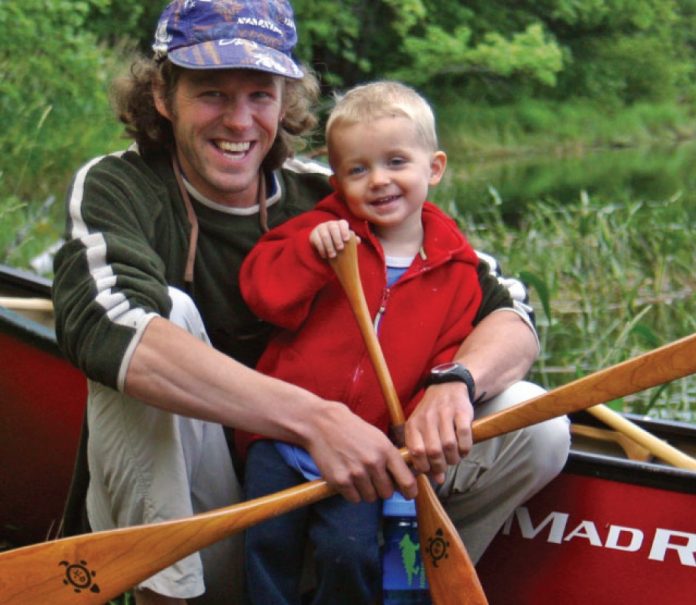
As camping parents we know that summertime is perfect for being outside and being active with our kids. This Canada Day long weekend I took my two-year-old son Dougie on our first father-son whitewater canoe trip. The reaction of other canoeists fell into two camps: one group, “I wish I’d started paddling that young”; and the other group, “What in God’s name do you think you’re doing with a baby in the rapids?” One couple actually paddled over and asked me this…it turns out they are teachers.

My friend Matt uses a diagram to help his clients think about risk. One axis is the likelihood of something bad happening, and the other axis is the severity of the consequences. Mosquito bites, for example, are very likely but result in only minor bumps or itching; the chance of getting struck by lightning is quite low but the consequences are severe. The worst kinds of risk are the ones that are very likely to happen and have severe consequences. And in the first quadrant is where Dougie and I paddle the Madawaska River—the chances of us flipping are quite low, as are the consequences with warm, low water, helmets and PFDs. 

In March, a Commons health committee report concluded that 26 per cent of Canadians between the ages of two and 17 are overweight or obese. Overfeeding and lack of exercise increase the risks of preventable life-threatening diseases such as diabetes and heart disease. Watching Dougie playing in the sand, scrambling over rocks, swimming in the shallow eddies and climbing into his sleeping bag at 7:30, I’m sure I’ve found the cure. For my family, the benefits of being outside and canoeing, hiking (see this issue’s hiking feature) and camping far outweigh the risks—so long, of course, that those risks are well managed.

By noon on our second day Dougie and I had caught up to the teachers. They were scouting Raquette Rapids, a 100-metre-long class II that flows over some shallow ledges and between two rock islands. I’ve run this rapid a hundred times. Dougie and I drifted into the current chatting about sitting still and pointing out rocks to avoid. I could feel glares of disapproval burning through the foam of my lifejacket as we floated past the teachers and down the last little chute into the lakewater pool. A perfect run.

A few minutes later, whistle blasts chirped to get our attention. Guess who was in the water? Their canoe was upside down and their gear was strewn around the rapid like a yard sale hit by a tornado. I’d normally have jumped up from our lunch spot on the rocks and helped them, but I couldn’t leave poor little Dougie on these dangerous rocks by himself. What kind of irresponsible parent would that make me? So I sat there spreading cream cheese on my “baby’s” bagel, wondering if they now think they should have started paddling when they were two. 

This article was originally published in the Fall 2007 issue of CanoerootsThis article first appeared in the Fall 2007 issue of Canoeroots Magazine.
 

Butt End: Danger Zone

Photo: istockphoto.com/Suzann Julien
Butt End: Danger Zone

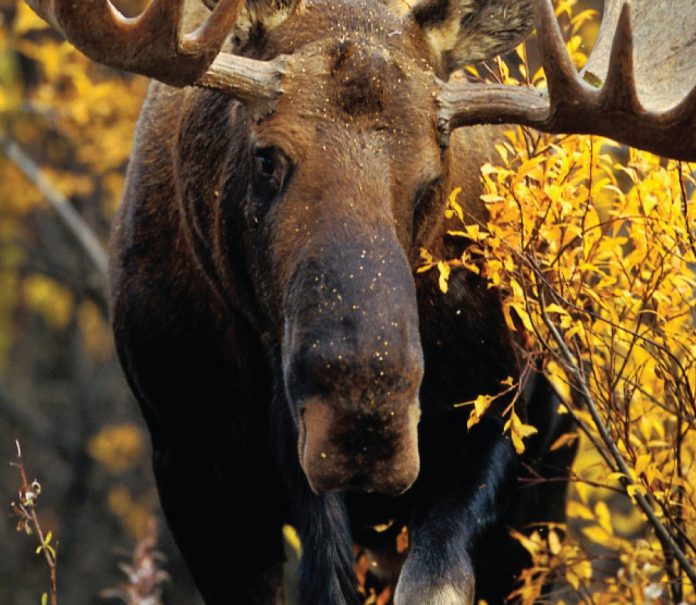
I stood my ground when the moose started to charge, not believing it was a real threat. When it changed its gait from a gallop to a sprint, I reassessed the situation and ran my ass off toward the truck. 

What was I thinking? If I had come across the same animal while out on a trip instead of by the side of the highway I would have admired it from a distance, not blindly walked up to it snapping photos as if it were a supermodel. 

A few seconds into the chase I realized that being part of the high school running club was far behind me, but the moose wasn’t. He was closing in and the only thing to do was to start zig-zagging in hopes of confusing him. 

It was the blast of a passing truck’s horn that saved me in the end. Not my buddy Andy. He was too busy trying to turn on his video camera. The moose jolted at the sound of the horn, zigged when I zagged and gave up the chase.

You don’t have to tell me I’m an idiot. I’m well aware. But it’s not all the time. I’m a safety fanatic while out on a trip. It’s an approach that has saved my hide many times out there. The moment the trip is over, however, I forget all those over-the-top safety measures, as if being reconnected with civilization means I can turn my brain off. 

Prior to the moose attack I had spent two full weeks paddling the Kopka. It’s a remote river in northern Ontario that’s challenging enough in normal conditions but was in high flood during our trip. It was the most testing route I’ve ever done—and at no time did I let my safety slip into question. We scouted every rapid prior to running it. We hunkered down during a wind storm rather than take a chance surfing breaking waves. We encountered 10 bears and gave them all a respectful berth. We even used safety harnesses while portaging an incredibly steep portage around Kopka Falls. We were the poster paddlers for safe canoe tripping. 

It wasn’t long after starting our drive home that we passed the moose feeding along the roadside. We hadn’t seen a moose on the trip, so I pulled over to take a picture. I took the lens cap off and transformed from safety boy to idiot tourist. You know the rest.

And what happened to the moose? He went back into the woods where it was safe, perhaps questioning how humans survive in the civilized realm we call the real world. If I were an evolutionary biologist I’d be worried about us.

Kevin Callan has never been to Pamplona, Spain, but hears it is an exciting place.

This article was originally published in the Fall 2007 issue of CanoerootsThis article first appeared in the Fall 2007 issue of Canoeroots Magazine.
 

Editorial: A Drop in the Bucket

Photo: Scott MacGregor
Editorial: A Drop in the Bucket

Driving home from a kayak fishing trip last week I realized I had done what most whitewater paddlers do every weekend—I filled my gas tank and cooler before I left home.

The week before, back at the Rapid office, I had been preparing an economic impact survey to measure the amount of money spent in Palmer Rapids during our Canadian Whitewater Instructor Conference and sixth annual Palmer Rapids River Festival. I’ll use the data from this to present a case to my local municipality, county economic development office and tourism association arguing that whitewater paddling is good for the area.

Meanwhile, the only things I left behind after my weekend in the abandoned-mining-town-turned-tourism-based fishing community were a couple of snagged lures and a case of empties.

For my fishing trip, I easily dropped $250 on gas, groceries and bits of tackle. Buying it all locally would have only cost me $18 more than it did at the highway gas bar and box store supermarket. With eight of us in our group and eight other cabins at the place we stayed, for an extra six dollars a day each, these guys at this one fishing camp could have injected $10,000 into the local economy simply by buying supplies at the Gowganda general store. And that doesn’t take into account the beer!

We need to stop thinking about our rivers as being free.

With increasing pressure on rivers for hydro development, river protection groups have to slap a sticker price on whitewater. These groups are standing up in public meetings across the country convincing local politicians and governments that paddlers will generate more business and more revenue than turbines.

I respect the efforts of groups like Les Amis who are committed to protecting the Kipawa River from hydro development. Unfortunately, this year Les Amis is officially cancelling the 21st annual Kipawa River Rally due to what vice President Peter Karwacki calls the “unsafe, unpredictable situation created by the punitive actions of [the federal government].” Karwacki recommends paddlers send letters of apology to local businesses in the host town of Laniel. Maybe the loss of revenue will spur local businesses to stand up and take notice. Sometimes you don’t know what you’ve got ‘til it’s gone.

We know that economic impact studies sway government decisions when it comes to whitewater paddling.

Whitewater parks are being built all across North America on the basis of their economic returns. Cities like Reno, Nevada and Wausau, Wisconsin have invested millions to create whitewater tourism and are reaping rewards. More complacent communities are letting developers shut off their natural rivers.

We simply have to stop thinking of rivers as being free and be conscious and proactive with our spending. We can pay for a shuttle instead of driving two cars from the city. Stay the night at a local campground, motel or bed and breakfast. Rent our boats locally. Shop at the local grocery store. Fill our gas tanks for the ride home. Plan to meet your friends at the restaurant for breakfast. Buy an ice cream cone. And if there’s a box at the take-out or campground, dude, put your money in the box.

We need to pay where we play. And if it costs us more to do so, it’s not an added expense, it’s an investment.  

This article on shopping local was published in the Summer 2007 issue of Rapid magazine

This article first appeared in the Summer 2007 issue of Rapid Magazine.


River Alchemy: Random Beauty

Photo: garyandjoaniemcguffin.com
River Alchemy: Random Beauty

I stumbled on it some years ago on a rambling hike down a dry streambed in Driggs, Idaho. I found a perfect bend in a river. A 180-degree change in direction, carved from the alluvial plain. The gravel bank was perhaps eight feet high; it was plumb vertical, and had a perfectly walled arc, perhaps 100 feet in diameter. From every angle it was astoundingly geometrically perfect. It grabbed my eye and carried it around its curve. I had never seen such mathematical perfection in nature before.

Luna Leopold felt that same sense of awe in nature. As the son of Aldo Leopold, the famous pioneer of wilderness ethics and land protection in the United States, Luna Leopold was the first to set out to study rivers in a manner unheard of—he measured them… in great detail. In fact he spent a lifetime creating formulas to explain just how rivers work, and how it was possible for them to carve the perfect bend.

By and large, he was successful. 

He was the creator of what is now called quantitative hydrology, and in doing so re-established much of the fundamental assumptions of modern engineering.

Starting in 1953 with his obscure (to most readers) text, The Hydraulic Geometry of Stream Channels and Some Physiographic Implications, Leopold pulled rivers apart, feature by feature, and scratched out the formulas that explain their behaviours. Some of his findings are uncanny. Consider these, if you haven’t before: the wavelength a river meanders is, on average, 12 times its width; the Sine coefficient for those meanders is the same coefficient for the compression waves that form on a stream’s surface; and the riffle-pool interval is one half the wavelength of the meanders.

Fascinating.

He created formulas to explain helical flow, wave creation, hydraulics, sediment load and watershed flood rates. The list goes on and on. In my search to explain the perfect bend all roads lead to Leopold’s work. He was incredibly prolific and clearly a genius. While mathematically dazzling, his formula for the perfect bend left me spiritually unfulfilled.

A year later I was handed Barry Lopez in a used bookstore in Smithers, B.C., Lopez lives on the other end of the Sine curve from Leopold; if Leopold is pure science, Lopez is pure poetry. River Notes is Lopez’s river dissection, via a series of short stories so descriptive the book drips with water. His swirling eddies suck you in, carry you into the current, then delicately and surprisingly drop you in the literary ocean of deep thought with his famous single-sentence endings.

Lopez explores the idea of how a river can so seamlessly and completely change direction, while looking for instruction that may be useful to his own life.

Mired in depression, he laboured to examine every aspect of the bend in the river behind his home. If he could figure out this bend, then maybe he could figure out how to turn his own life around. Bed-ridden and feeling no hope at all, he hauls himself down to the stream and dips his hand in the water. The essence of the turn, he realizes, is not in the details (nor in any of Leopold’s formulas), but in some bigger connection between himself and the river.

Lopez’s exploration of the fine details of rivers is in a way an exploration of the human soul, but his life-changing river bend metaphor did not speak to me any more than Leopold’s algebra.

I’ve since returned to the sharp and blocky Canadian Shield rivers, rivers with turns seemingly unaffected by water and time pushing against them. In my lifetime I’m unlikely to find another bend so geometrically perfect.

With every new river I paddle I realize it was not the bend that was so intriguing, it was how the perfectly bending arc grabbed my eye, smoothly railing it around the corner in a new direction. It was not the bend in the river, it was what lay beyond that was so intriguing and so important. The perfect bend is not a complex equation. For me now, the perfect bend is the one just downstream, the one luring me to explore what is just beyond. 

This article on science and poerty was published in the Summer 2007 issue of Rapid magazin

This article first appeared in the Summer 2007 issue of Rapid Magazine.


The Macho Move

Photo: Tanya Shuman
The Macho Move

The macho move is one of the most impressive downstream freestyle moves known to mankind. Invented by Brad Ludden and named by Jay Kincaid, it became mainstream after Ludden and other pros displayed the new move at the 2002 IR Triple crown on the Nolichucky River in Tennessee.

The macho move is simply an air loop, which pops off the peak of a wave while moving downstream. Only two waves are required to get a nice aerial macho move. It is ideal to learn the move on high-volume rivers with medium-sized waves where you don’t have to worry about hitting bottom. The New and Gauley rivers in West Virginia are my favourites for doing macho moves since the potential spots to do this move are endless. Also endless are the potential variations of the macho move. One slight variation of the macho move was done for this particular photo sequence, with the boat popping off the peak with a twist to get more of a space Godzilla macho move. New ways are still being discovered.

The feeling of doing a massive air flip while travelling downriver at high speed is truly exhilarating. once you nail your first macho move the addiction will begin. You’ll never just float down a wave train again.  

How to macho move:

Step 1: Paddle at medium speed into a wave train with fairly consistent standing waves. The greater the spacing between the waves, the more downstream speed you’ll require. Proper timing is crucial for the macho move.

Step 2: The initiation is the classic double-pump technique, started at the peak of the first wave. The key is to lift your bow into the air while moving over the first wave peak, and to drive your bow as deep as possible into the trough between the two waves. This loading of your bow’s volume deep in the trough is where the pop of the macho move comes from.

Step 3: As you begin to travel up the face of the second wave, stand up on your foot blocks just as you would for an air loop. You should time this jumping action so that you are completely standing up just before the peak of the second wave.

Step 4: Snap your torso forwards as if you were flatwater looping off the peak of the wave. You will encounter much less resistance than a normal flatwater loop since the water is dropping away from you as you travel downstream off the peak of the wave. You know you’ve nailed your timing perfectly when you completely clear your stern of the water and you land flat on your hull in the next trough. 

Pro tips:

1. Practice both the flatwater loop and loops in holes, and concentrate on the timing of the jump to increase your pop into the air. 

2. The higher you pull yourself into the air off the initiation wave peak, the deeper your bow will go into the next trough. The deeper your bow goes in the trough, the higher you will be thrown into the air off the second wave peak. 

3. Approach the first wave at a slight angle from the side. This will help you face downstream while vertical on your bow, which will make your macho move loop finish straighter. 

This article on the macho move was published in the Summer 2007 issue of Rapid magazine.

This article first appeared in the Summer 2007 issue of Rapid Magazine.