Home Blog Page 355

Sea Kayak Review: Current Designs Rumour

P
Boat Review: The Rumour by Current Designs

Ever noticed that as the population’s girth gets larger, the coolest kayaks get narrower? We thought we’d seen the end of this irony, yet here’s a bold new sub-20-inch-wide offering from Current Designs, a company whose management fortunately missed the movie Super SizeMe.

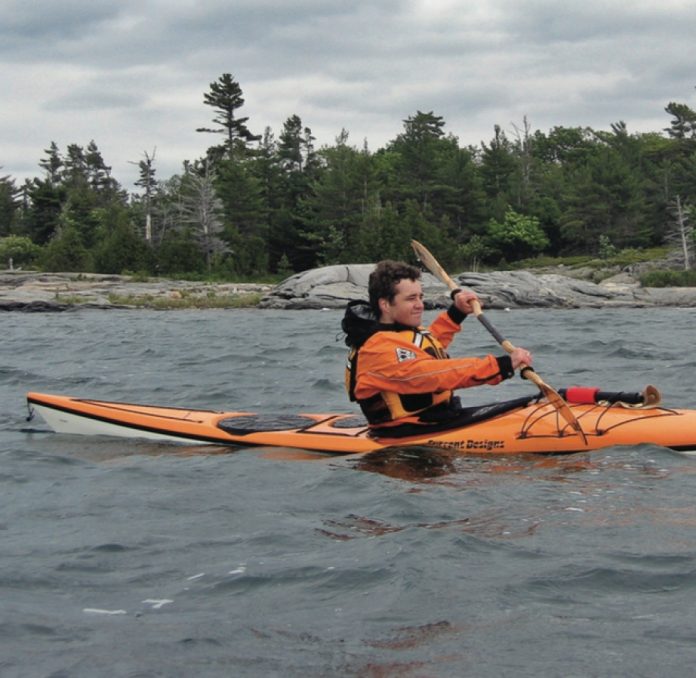
Designer Nigel Foster calls his Rumour a “day-boat/play-boat” for the smaller paddler.

“I wanted to shape a small boat that would serve the small paddler in the same way a larger kayak serves the larger paddler in terms of initial stability, secondary stability and speed,” says Foster.

Not only is the length nearly two feet shorter than Foster’s most popular design, the Legend, the Rumour is also narrower and lower-volume overall—and of course much lighter and easier to schlep.

Current Designs Rumour Specs
Length: 16’5″
Width: 19.75″
Depth: 12″
Weight: 44 lbs
Cockpit: 25″ x 15″
Bow hatch: 9.5″
Stern hatch: 17.5″ x 10.75″
Total volume: 263 L
MSRP: $2,849 USD fibreglass; $3,249 USD Kevlar

cdkayak.com

Foster designed the hard-chine, shallow-arch hull to let bantam-weight paddlers effortlessly dial in an outside-edge turn. The quick transition from edge to edge will intimidate novices, but offers experienced paddlers easy and precise carving that’s especially fun in surf.

Indeed, Foster, who is big for the boat at six feet and 165 pounds, keeps a Rumour in his quiver for short paddles and surf play.

The buoyant bow provides a dry ride and reasonable capacity. Ignoring the 150-pound max recommended paddler weight, we crammed our demo full for a four-day weekend and gave the keys to a 175-pounder.

Low-profile, speedy and easy to steer with the hips, the Rumour was a pleasure to paddle in all conditions, even overloaded, and seemed capable of handling any size paddler it can fit.

Small paddlers with advanced skills should rejoice that there’s a new boat built especially for them, and medium-sized paddlers should not overlook the Rumour for day trips and play trips—not to mention it being a great reason to stay slim.
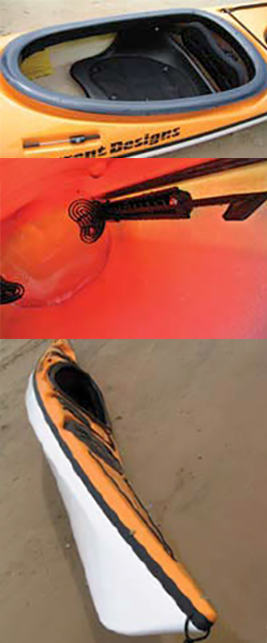
Different parts of orange sea kayak

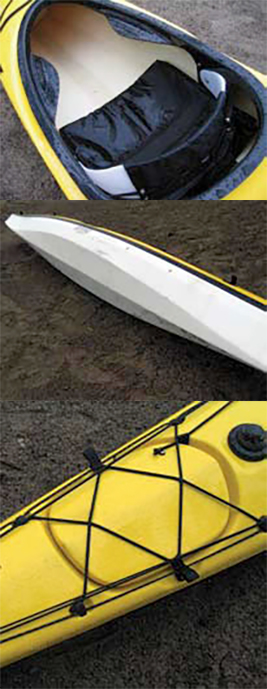
Mini-size me (top)

The padded, moulded plastic seat has a slim, low-slung backband for minimalist support, backed by a curved and sloped bulkhead. The cockpit opening is small—a cross between an ocean cockpit and keyhole—but has plenty of legroom inside for six-footers.

Bean there (middle)

Bean-shaped Sea Dog plastic foot braces, instead of the more common aluminum Yakimas, provide on-the-fly adjustment with a release tab that you can reach while sitting in the cockpit. At Nigel Foster’s request, CD installed fibreglass bulkheads.

Left leaning (bottom)

Skeg control and day hatch are on the left. Foster explains, “Take any group out onto choppy water and ask them to brace with one hand and raise their other hand, and almost without exception people raise their left hand.” Who knew all those builders that put day hatches on the right are doing lefties a favour?
This article originally appeared in Adventure Kayak‘s Summer 2006 issue. Subscribe to Paddling Magazine’s print and digital editions here, or browse the archives here.

Sea Kayak Review: Seaward Quantum

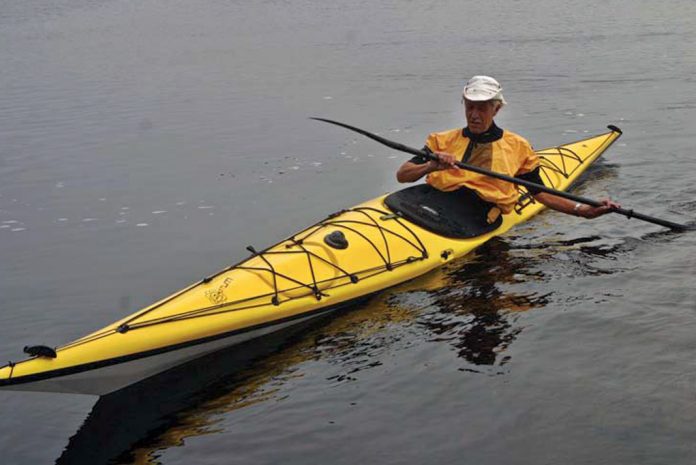
Man paddling yellow sea kayak
Beat that, Brits! | Photo: Tarmo Poldmaa

A couple years ago in the pages of this magazine (read: Long Live the Homegrown Boat), columnist Alex Matthews argued for an end to the black and white separation between British and North American boat designs.

“Let’s keep Brit boats British and take what we learn from them and others, and put it through our own unique filters in order to make something that is truly ours,” writes Alex.

[ Paddling Buyer’s Guide: View all sea and touring kayaks ]

Seaward has answered his call for a mashup. In stealing from the British to create the Quantum they opted to abscond with the skeg but took an “if it ain’t broke” approach to hatches, resisting the temptation to slap on a day hatch and rubber covers just because that’s what they do in Britain.

Seaward Quantum Specs
Length: 17.3′
Width: 21.75″
Depth: 13″
Weight: 54 lbs
Cockpit: 31″ x 16″
Bow hatch: 96 L
Stern hatch: 128 L
Total storage: 224 L
Total volume: 408 L
MSRP: $3,855 CAD fiberglass; $4,445 CAD Kevlar

seawardkayaks.com

Seaward’s design team is clearly a restrained and thoughtful bunch, and it shows in the Quantum’s on-water performance too. Initial and secondary stability are moderate.

The multi-chine, shallow-V hull edges more predictably than a single hard-chine, shallow-arch hull.

Surfing a following sea is fun because you can rock the boat from edge to edge to steer without ever feeling like you’re going to overdo it and capsize.

On the level, the Quantum tracks rail-straight despite having more rocker than Seaward’s other multi-chine offering, the Chilco.

In wind, she gives you just what you want from a skeg boat—weathercocking mildly with the skeg up, trending mildly downwind with the skeg down, tracking across the wind with the skeg deployed halfway.

The Quantum is slim without being cramped, predictable without being dull, responsive without being skittish. Neither completely British nor completely North American, it’s a cultural identity complex waiting to happen.

In other words, it’s Canadian, and who wouldn’t love that?

Comfortable, eh? (top)

We’re always struck by the comfort of Seaward’s simple foam seats, er, we mean Seaward’s exclusive SRS™ (Self Rescue System). That’s right, the seat cushion pulls out and doubles as a paddle float. Handy, but did we mention that they’re darned comfortable?

Parts of a yellow sea kayak
Photos by: Tim Shuff

Newer Quantums may features a flashier fiberglass bucket seat and Immersion Research backband, but we hope the good ol’ SRS remains an option

Nice compromise, eh? (middle)

The multi-chine, V-bottom hull edges predictably like a soft-chine hull, yet grabs the water to carve a turn like a hard-chine hull. It makes edging performance accessible to paddlers of all levels.

Hoser proof, eh? (bottom)

One of Seaward’s many proprietary features, the safeHATCH™ system is both functional and foolproof. The fiberglass outer cover and airtight neoprene inner cover—which is labelled with “bow” and “stern” directional arrows—are both tethered to the boat so you can’t lose them. And if you do, the hatch seals with a plastic bag instead. Beat that, Brits!

This article was first published in Adventure Kayak‘s Fall 2006 issue. Subscribe to Paddling Magazine’s print and digital editions here , or browse the archives here.

Rehabilitating the Rattler

Photo: Patricia Kerr
Rehabilitating the Rattler

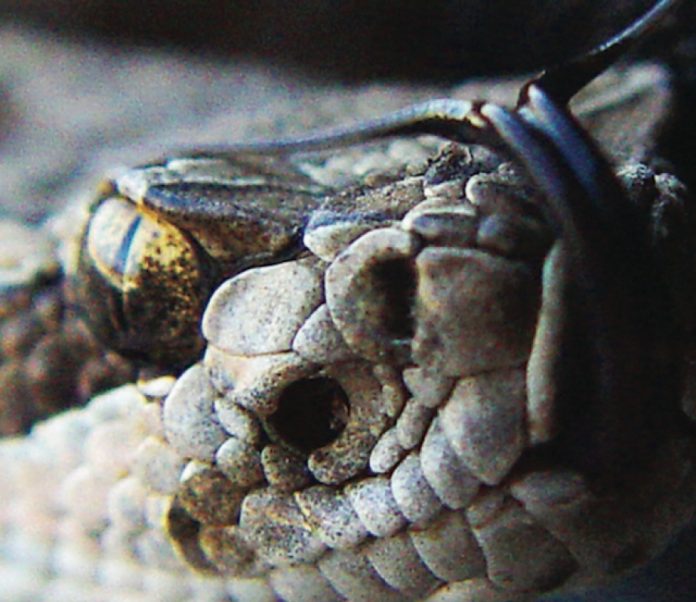
In the 1960s, when hippies were singing about free love and protesting the seal hunt, Ontario’s provincial park officials were clubbing massasauga rattlesnakes to death. But today, Kenton Otterbein, the head naturalist at Killbear Provincial Park, says campers are learning to live peacefully with Ontario’s only venomous snake, a species he describes as “darn cute.”

Most people wouldn’t think of massasauga rattlesnakes as cute. But then, most people don’t know much about them. They are less than three feet long with a dark and light blotchy pattern. Baby rattlesnakes are born alive without a rattle. At about 10 days of age they will rub against a rock and pull out of their first skin. The skin will catch on a knob at the end of their tail and the first segment of the rattle will form. They will add another segment two or three times each year when they shed their skin.

When camping and travelling in Ontario’s rattlesnake country it is rare to ever hear the rattle of a massasauga. They want nothing more than to avoid contact with humans. Being cold-blooded, they are only active within a narrow temperature band, one only reached between the hours of noon and 4 p.m. during the spring and between 4 and 10 p.m. during the summer.

Nonetheless, persecution by humans has relegated massasauga rattlesnakes to only a few pockets of habitat in Ontario, the most notable being the eastern shore of Georgian Bay. Statistics kept by the staff at Killbear Provincial Park indicate that, though incidents are rare, the people most often bitten by a massasauga rattlesnake are 18- to 30-year-old men, who’ve been boozing and are acting like the Crocodile Hunter—the guy from the television show of the same name who travels around the world catching poisonous reptiles and insects to impress his female co-stars. The other recorded snake bites are the results of people accidentally stepping on a snake in the dark. Otterbein at Killbear says the chances of being bitten are very low,

“There is a greater risk of drowning in a bathtub at home than being bitten by one of our rattlesnakes.”

In those rare cases that a snakebite does occur, first aid is the same as it is for any small puncture wounds says Lorraine Vankoughnett, the acting director of acute care at West Parry Sound Hospital. Parry Sound hospitals treat up to six bites per year and provide medical research and education across Canada. Vankoughnett says the best thing to do is to stay calm, clean the wound, bandage it loosely and seek medical help. “And do not bring me the snake,” she adds, in the hopes of dispelling a myth.

At the hospital, Vankoughnett and her team would perform blood tests and observe the patient for up to 24 hours. They have found that in one out of every four snakebites there is no venom injected into the wound. From the snake’s perspective, biting a human is defensive and a waste of its precious venom. They need to save their venom for mice.

Researchers for the Metro Toronto Zoo estimate the massasauga rat- tler population in Ojibway Park near Windsor to be fewer than 200 snakes in an area less than one square kilo- metre. Paul Pratt, a naturalist for the City of Windsor, says the snakes are a good indicator of the health of the environment: “A top-of-the-line predator like the massasauga rattler makes the ecosystem intact. If there are only a few types of plants and mice, the area is not complete.”

For a long time, people living in massasauga rattlesnake country believed that the only good snake was a dead snake. Although most wanton killings have stopped, humans are still the only real threat to the massasauga rattlesnake, and Pratt points out that we are much more of a hazard to their survival than they are to ours.

With educational programs like Killbear’s Brake for Snakes motorist-awareness campaign, The Metro Toronto Zoo’s Save our Snakes educational effort and the Ojibway Nature Centre’s live snake display, people are slowly warming up to this cold-blooded cutie, allowing the shy massasauga rattlesnake to get on with hunting its prey of mice, not men. 

Venom Vitals

  • Seven people were bitten by massasauga rattlers in Ontario last year.
  • The massasauga rattler’s fangs are 5–6 mm long.
  • A lethal dose of massasauga venom for humans is 30–40 mg.
  • One bite injects up to 6 mg of venom (do the math… you’d have to be bitten five or six times to be in danger).
  • Mice die as quickly as three minutes after a bite.
  • Massasauga rattlesnake venom is not a true poison, it is a hemolytic that prevents blood from clotting.
  • Most human rattlesnake bites are associated with the consumption of alcohol (by the human, not the snake).
  • No one in Ontario has died of a snake bite in the last 45 years. 

This article on rattle snakes was published in the Summer 2006 issue of Canoeroots magazine.

This article first appeared in the Summer 2006 issue of Canoeroots Magazine.


The Tandem Sideslip

Photo: Gary and Joanie McGuffin
The Tandem Sideslip

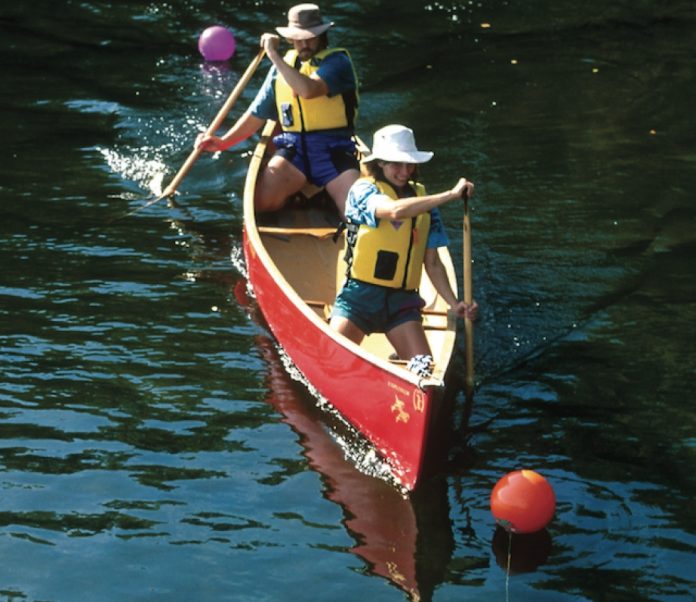
A sideslip is an elegant way to shift your canoe sideways while underway. It is an efficient way for both solo and tandem paddlers to avoid obstacles while maintaining forward speed because it avoids the drag associated with turning or spinning the canoe. Sideslips employ static strokes—the paddle stays stationary and the pressure of the water against the blade produces the force that moves the canoe laterally.

The same strokes—the static pry and static draw—are used for tandem sideslips in either direction. In this sequence, with the bow paddler paddling on the left, a static bow pry and stern draw are used to sideslip the canoe to the right. To sideslip to the left, a static bow draw and stern pry would be used.

A sideslip is an elegant way to shift your canoe sideways while underway.

1. Approach with forward momentum. Since the strokes are static they rely on water pushing against the blade to influence the path of the canoe. Tilt the canoe away from where you want to go to keep from catching the canoe’s leading edge once you start to slip.

2. The bow paddler places a static pry while the stern paddler places a static draw. Both blades are angled 15 to 20 degrees away from parallel to the centreline. Aim the leading edge of the blade where you want to go.

3. The bow paddler should adjust her blade angle so the bow does not sideslip faster than the stern. The stern paddler adjusts his blade angle so the canoe remains pointed in the intended direction.

4. Once the canoe has slipped far enough or lost the momentum necessary to slip further, follow up with forward strokes. 

This article was adapted from Gary and Joanie McGuffin’s Paddle Your Own Canoe

This article on the tandem sideslip skill was published in the Summer 2006 issue of Canoeroots magazine.

This article first appeared in the Summer 2006 issue of Canoeroots Magazine.


Bancroft Rocks

Photo: Carter Hammett
Bancroft Rocks

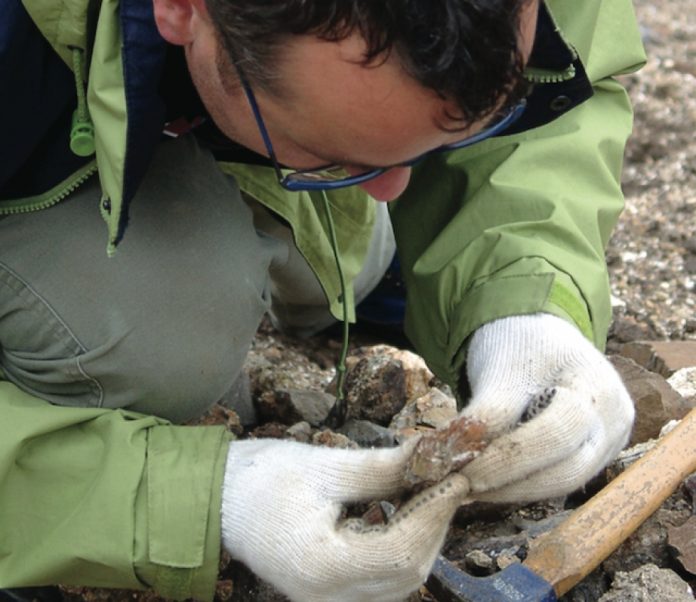
Buried miles beneath our feet in the cavities and caverns of the earth are thousands of untold tales that date back millennia. When you know what to look for, sagas of glacial shifts, continental collisions and seismic activity can be read in the stone.

Modern versions of those stories are given expression in objects that we take for granted every day. Gardeners fortify their soil with lime. Cooks enliven their food with salt. We purify our water with carbon. In fact, minerals can be found in batteries, computers, televisions, kitchen appliances, cancer treatments, X- ray machines, vitamins and cosmetics. It’s something many of us don’t think about often, but the same can’t be said of the 13,000 rockhounds who descend on Bancroft during the August long weekend.

Long known as the mineral capital of Canada, Bancroft is a haven for rockhounds the world over.

Famous for its annual Rockhound Gemboree, now in its 43rd year, Bancroft has a rich history of mining that dates back more than a century.

Since that time, the town of 4,000 has gone through various peaks and valleys of commercial production booms in feldspar, soaps, paint and glass. Marble production marked another peak in the town’s mining history, resulting in the mineral’s use in such landmarks as Ottawa’s Parliament Buildings and Toronto’s Union Station. The last great boom occurred during the 1960s when uranium reached its zenith in world markets.

Bancroft’s first Gemboree coincided with the closure of the Faraday Mine in 1964. Since then, the town has capitalized on its rich history and geological diversity to attract a steady stream of tourists to the area. Chief among the region’s tectonic oddities are the large number of pegmatites that lay hidden beneath the earth.

Pegmatites contain an inner core of quartz and an outer shell sometimes speckled with radioactive materials such as uraninite. Pegmatites occur when volcanic activity is diverted by substantial barriers—such as the vast Canadian Shield. When the diverted lava cools underground it hardens and remains riddled with dazzling minerals such as sodalite.

The pegmatites are one of the major attractions that lure rock-hounds to the Gemboree says Christine Hattin, the events coordinator with the Bancroft Chamber of Commerce. “Exhibitors and dealers come from as far away as Europe, Iraq and Pakistan,” she says. Visitors are offered field trips to more than 30 collecting sites, have opportunities to hear lectures from geological experts and even pan for gold.

Although you don’t require a background in geology to collect minerals, it is important to outfit yourself with the appropriate gear prior to venturing out to collection sites. A basic rockhound survival kit includes safety goggles, boots, sample bags, a backpack, water, a pry bar, a compass and a small sledgehammer or pick. More experienced collectors often carry a hand lens, gloves, hardhat, guidebook and identification kits.

Commonsense safety guidelines should also be adhered to. Collect with a partner, tell someone where you’re going and stay out of abandoned mines, as these can be particularly hazardous.

Hattin suggests starting your rockhounding experience with a visit to the Gemboree to speak with other mineral enthusiasts.

“You find a diversity of minerals here and lots of people simply don’t have that where they live,” says Hattin. “For them, the experience is unique.”

Bancroft Area

BERYL PIT Minerals include: beryl, clavelandite, tourmaline, quartz, garnet, apatite.
BEAR LAKE Diggings in Monmouth township of- fers titanite, and rare quartz. Bring a shovel.

MACDONALD MINE in Monteagle township, is located in a zoned pegmatite dyke with a massive centre of quartz. Also: granite, calcite, feldspar, pyrite, zircon and galena. Visitors are warned to enter mine at their own risk.
 

Thunder Bay

Amethyst Mine Panorama boasts the largest deposit of amethyst in North America. Amethyst, a coloured crystalline variety of silica mineral quartz, is the official gemstone of Ontario. 

Cobalt

Cobalt, a former silver mining hotspot, is replete with silver ore and cobalt. The mining museum on site offers specimens from around the world.

Sudbury

Sudbury is famous for its nickel production. Science North runs a “Path of Discovery” tour to major mining sites and operates a rock swap. The city hosts its own gem and mineral show in mid- July. Minerals: Garnet, staurolite, chlorotoid. Don’t forget to visit Dynamic Earth, the interactive earth sciences centre.

Timmins Underground

Timmins Underground offers a gold mine tour that allows visitors to sample the mining life. 


This article on geology was published in the Summer 2006 issue of Canoeroots magazine.

This article first appeared in the Summer 2006 issue of Canoeroots Magazine. For more great content, subscribe to Canoeroots’ print and digital editions here.

Butt End: Uncivilized Behaviour

Photo: Rick Snowdon
Butt End: Uncivilized Behaviour

True, proper wilderness trip preparation should plan for a range of eventualities, but I’m not feeling too badly about the reason we’re stranded on this beach. The bush pilot scheduled to pick us up today was arrested yesterday for being involved in a pornography scandal. I’m not sure I could have seen that one coming.

Now our crew of six paddlers is waiting as patiently as the cold and wet will allow for another pick-up, which we were told could be two or three more days. Our food supply consists of half a bag of GORP, a package of instant potatoes, a dozen prunes, and, possibly, a trusting cottontail who’s hanging around our camp looking for companionship.

I hope the float plane pilot is a law-abiding Baptist minister with a family filter on his web browser 

The battery in our satellite phone is on its death bed because one of our group insisted on calling his wife twice a day throughout the trip for conversations that usually ended in heated marital discussions at four dollars a minute; another is green from trying to drown his sorrows with the majority of our spirits; and we were informed by the air service that the tires on both shuttle vehicles we left parked at the end of an 80-kilometre dirt road were slashed by some local militants who had a dislike for canoeists intruding on their secret fishing grounds. 

It’s not a good day. The truth is, it’s not been a good week. We’ve been paddling upstream the entire trip, when there was enough water to actually paddle. Water levels were low enough that we left a trail of Royalex shavings on the river bed like Hansel and Gretel leaving bread crumbs through the Black Forest. The only way out is to paddle six more days or wait for another float plane to arrive. I hope it’s flown by a law-abiding Baptist minister with a family filter on his web browser. 

I spend a lot of time travelling the bush, and I spend my fair share of time worrying about marauding bears, violent storms and becoming hopelessly lost. Never have I worried about being stranded in the wilderness with an overly communicative husband and a tapped-out drunk due to a pervert and some insecure fishermen.

I guess it just goes to show you that the ugliness you’re trying to escape back home can still reach you out here. I think I’ll stop worrying so much about bears, storms and getting lost. 

This article on trip preparedness was published in the Summer 2006 issue of Canoeroots magazine.

This article first appeared in the Summer 2006 issue of Canoeroots Magazine.


Betcha Didn’t Know About… Bats

Photo: www.super3.net
Betcha Didn't Know About... Bats
  • Bats are the only mammals that can fly.
  • There are 900 species of bat worldwide. Seventeen can be found in Canada.
  • The little brown bat inhabits all U.S. states and Canadian provinces and territories except Nunavut.
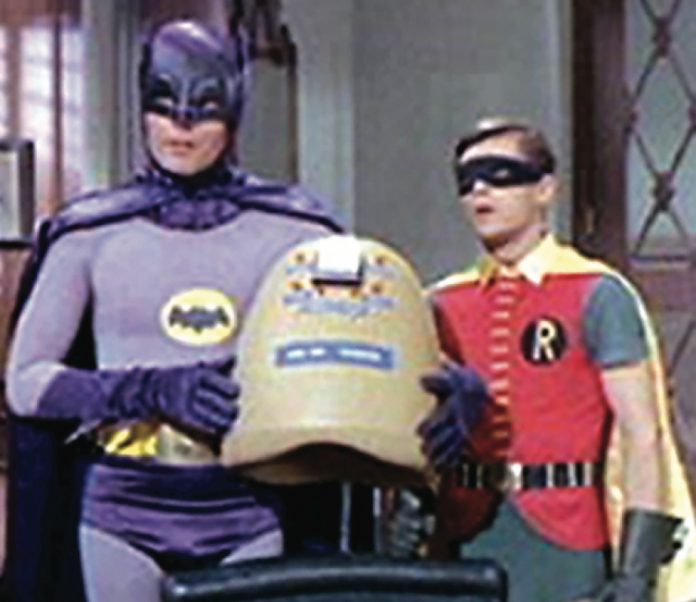
  • Batman is a DC Comics superhero who first appeared in 1939. His true identity is Bruce Wayne, a bumbling billionaire philanthropist who created his crime-fighting alter-ego after his parents were murdered.
  • Bats rest hanging upside down so they just have to let go to take flight.
  • The term “corking a bat” usually refers to something baseball players do to lighten their bats and speed up their swing.
  • An average little brown bat weighs only 8 grams but has a wingspan of 22 centimetres.
  • The not-so little penis of the little brown bat is nearly a quarter of its body length.
  • Bats hunt by emitting high-pitched screeches and honing in on prey by listening for the echos bouncing off flying insects (hence the big ears).
  • The little brown bat eats by flipping insects into its mouth with its wings. It can catch and eat 10 insects a minute and consume an amount equal to its own weight in one night.
  • Bruce Wayne took in a 16-year-old orphaned circus acrobat named Dick Grayson, who became his sidekick, Robin.
  • Ten years is an average lifespan for the little brown bat, but one banded specimen in Ontario reached an age of 35 years.
  • Disturbing a hibernating bat costs it the energy it would use during 60 days of hibernation.
  • Unlike many superheroes, Batman does not possess superpowers. To wage his war on crime, he employs his keen intellect and has trained himself in chemistry, criminology, forensics, martial arts, gymnastics, disguise, escapology and ventriloquism, or so says Wikipedia. 

This article on bats was published in the Summer 2006 issue of Canoeroots magazine.

This article first appeared in the Summer 2006 issue of Canoeroots Magazine.


Editorial: Travel With Loaded Canoes, Not Paddles

Photo: Don Stanfield
Editorial: Travel With Loaded Canoes, Not Paddles

Earlier this spring the Lawrence & Memorial Hospital in New London, Connecticut, was locked down while police searched the building for an armed man. Apparently, an emergency department nurse had spotted a double-barrelled shotgun poking out of the top of a worn and tattered backpack. She alerted hospital management, management notified the police, the police called in the SWAT team and the SWAT team took the building—like the final scene in a Bruce Willis action movie.

Meanwhile in the lunchroom, two hospital employees chatted about their weekends. One pulled a black, carbon fibre breakdown kayak paddle from the suspect backpack and thanked his friend for loaning it to him. Then they rinsed their coffee mugs and walked into the hall to start their shifts.

The hospital officials and the authorities called it an honest mistake. Surely the nurse did the right thing reporting what she thought was a shotgun. No charges were laid, though the two hospital workers were asked to leave their paddles at home.

Soon after hearing this story, I was flying from Vancouver to Toronto. I travel light and seldom check any bags. I had just a carry-on, a laptop bag and a canoe paddle. I’d broken the shaft on a river trip last summer and shipped it west for repair; I picked it up while I was in Vancouver to save shipping costs. At the security corral I placed my bags, shoes, keys, coins and my repaired paddle on the conveyor belt and walked through the doorframe to the lady with the wand.

Maybe our new heritage minister should launch a national program designed to put our youth more in touch with this country’s heritage.

Big signs are posted all over the airport, signs showing the items banned from air travel. You can’t board an airplane carrying jackknives, mace, chainsaws, or fire extinguishers. For the record, paddles are not on the sign.

Soon I was kneeling on the carpet in front of a half-dozen security staff who’d gathered around me in a semicircle. None of them knew what I was doing. I said it was the J stroke. Empty faces.

The conveyors were stopped, no one was checking through. People were going to miss flights. “Oh for Christ’s sake,” some guy in a suit shouted from the lineup. “He’s canoeing.”

Now here’s some wonderful irony. Canada’s national carrier doesn’t allow you to carry on a paddle. Yet, for hundreds of years the canoe was the national carrier. I had to explain to the staff of Air Canada that my so-called weapon was not a weapon but a canoe paddle. How sad.

I wonder how Pierre Trudeau, our paddling prime minister, or Beverley J. Oda, our new federal heritage minister, would feel about this. There is no symbol more Canadian than a canoe and paddle.

Maybe our new heritage minister should launch a national program designed to put our youth more in touch with this country’s heritage. After a full royal commission it would be written in a 600-page document that children should go away for a couple of weeks each summer and learn to paddle and explore, by canoe, nearby lakes and rivers. The report would recommend that they go to summer camp, a place where rows of canoes line the water’s edge and racks of weapons, just like mine, are for children to play with so that someday when they are standing in an airport they’ll remember that there are at least two ways to travel across Canada.  

This article on paddles as a flight security risk was published in the Summer 2006 issue of Canoeroots magazine.

This article first appeared in the Summer 2006 issue of Canoeroots Magazine.


In Parting: The Kayak Cure

Photo: Greg Shea
In Parting: The Kayak Cure

Looking for me on a non-paddling day? I’ll be the one huffing in the bathroom with my finger up my nose.

Let me explain. I recently took a stroll through the land of Google and learned all about negative ions. Negative ions are negatively charged oxygen molecules that are concentrated outdoors in places where water and air get mixed around—surf, whitewater, and most of all waterfalls. The places, that is, where we most like to paddle.

Inhaling these little zingers does good things to our brains and makes us feel relaxed, happy and energized. Apparently these miracle molecules also kill germs and alleviate depression, allergies, asthma and pretty much every other ailment known to medicine while also—try this one on your spouse—boosting sex drive.

In other words, if you have a problem—any kind of problem—you can make a strong case for treating it with regular doses of the kayak cure.

One study found that albino rats breathing more negative ions did a lot more laps on their “activity wheels.” This could be your ticket to an afternoon off work. Just practice saying, Kayaking is proven to enhance workplace productivity, and be sensitive when you explain the part about the pale rat on the wheel to your boss.

Recognize there is some info out there that could weaken your case, like the fact that you can get negative ions from a machine, but don’t worry. Just point out that a good ion generator costs several thousand dollars and a new kayak will seem like a bargain.

More troublesome is the news that that mini-waterfall in your home, the bathroom shower, also produces negative ions. And one “doctor” claims you can increase negative ion intake by breathing really hard through your nose while plugging one nostril (left or right depending which brain hemisphere you want to boost). I figure the negative ion excuse should be good for a few paddling sessions. If that fails, then we can try the nose thing.

Screen_Shot_2015-07-23_at_1.03.01_PM.pngThis article first appeared in the Summer 2006 issue of Adventure Kayak Magazine. For more great content, subscribe to Adventure Kayak’s print and digital editions here.
Skills: Build Your Own Beach Sauna

Photo: Dave Aharonian
Skills: Build Your Own Beach Sauna

Step 1. Choose site

The ideal sauna site is right next to a good deep-water jumping spot or swimming beach. You also want to be as close as possible to the spot where you will heat your rocks.

Step 2. Collect rocks

Gather several rocks that will withstand extreme heating and cooling. Rocks with moisture-containing cracks or pockets can explode dangerously when heated. For this reason, and to avoid blackening local rocks in a fire, the Bureau of Land Manage- ment in the U.S. advises campers to pack in their own sauna rocks. If gathering your own, look for crystalline igneous rocks or metamorphic rocks that are formed from igneous rock. For the geologically fluent, experts recommend peridotite, olivine, vulcanite and basalt. Stay away from sedimentary rocks such as sandstone or shale and collect your rocks from a dry area.

Step 3. Build sauna

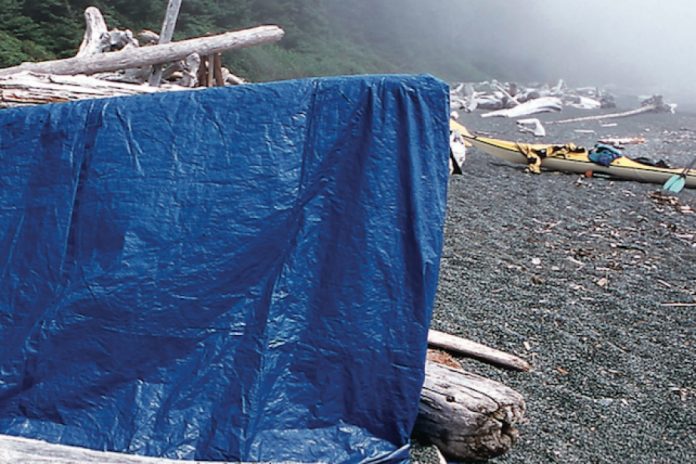
Using a cheap plastic tarp that you don’t mind getting dirty, set up your sauna so there is just enough room for your group to sit inside without touching the hot rocks. Anchor the edges with rocks, logs or sand to create a good seal. Dig a pit in the centre for your rocks. Aim to have only one opening that you can quickly roll closed to keep the heat and steam inside.

Step 4. Light fire

Collect a lot of firewood and light a large fire in an existing fire pit or a low-impact spot. Let the fire burn down to a good bed of hot coals and place your rocks in the coals until they are red hot. Transfer the hot rocks into the sauna using a metal pot or bucket or pairs of strong, forked sticks.

Step 5. Get high

Strip down as bare as you dare, crawl into your sauna and seal the door. To make it a sweat in the native tradition, enter clockwise and exit the way you came in. Don’t forget to bring in water for drinking and extra for sprinkling on the rocks. When you’re ready for a break, make a dash for your swimming spot to complete the thermotherapy routine—hot and cold immersion gives you a natural high and is said to strengthen the immune system. The hot rocks should be good for two or three repeats. If it’s cold out, crawl back inside the lukewarm sauna to dry off after your final plunge.

Step 6. Erase evidence

The beach sauna is not a low-impact technique. Save the sauna for special occasions and suitable places—think ocean beaches, not alpine lakes. Make sure you’re getting rocks from a place where they won’t be missed and throw any blackened or cracked rocks out of sight into deep water. Burn your fire down to white ash and put it out before you leave.

Screen_Shot_2015-07-23_at_1.03.01_PM.pngThis article first appeared in the Summer 2006 issue of Adventure Kayak Magazine. For more great content, subscribe to Adventure Kayak’s print and digital editions here.