Home Blog Page 362

Betcha Didn’t Know About… Bats

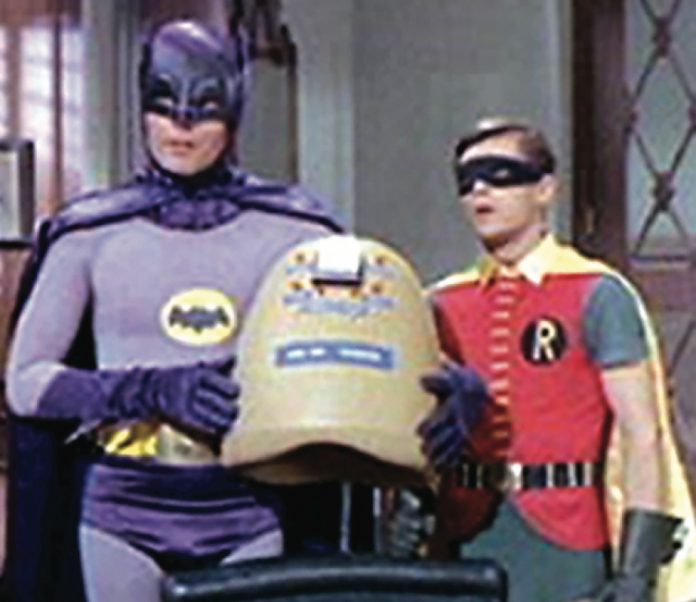
Photo: www.super3.net
Betcha Didn't Know About... Bats
  • Bats are the only mammals that can fly.
  • There are 900 species of bat worldwide. Seventeen can be found in Canada.
  • The little brown bat inhabits all U.S. states and Canadian provinces and territories except Nunavut.
  • Batman is a DC Comics superhero who first appeared in 1939. His true identity is Bruce Wayne, a bumbling billionaire philanthropist who created his crime-fighting alter-ego after his parents were murdered.
  • Bats rest hanging upside down so they just have to let go to take flight.
  • The term “corking a bat” usually refers to something baseball players do to lighten their bats and speed up their swing.
  • An average little brown bat weighs only 8 grams but has a wingspan of 22 centimetres.
  • The not-so little penis of the little brown bat is nearly a quarter of its body length.
  • Bats hunt by emitting high-pitched screeches and honing in on prey by listening for the echos bouncing off flying insects (hence the big ears).
  • The little brown bat eats by flipping insects into its mouth with its wings. It can catch and eat 10 insects a minute and consume an amount equal to its own weight in one night.
  • Bruce Wayne took in a 16-year-old orphaned circus acrobat named Dick Grayson, who became his sidekick, Robin.
  • Ten years is an average lifespan for the little brown bat, but one banded specimen in Ontario reached an age of 35 years.
  • Disturbing a hibernating bat costs it the energy it would use during 60 days of hibernation.
  • Unlike many superheroes, Batman does not possess superpowers. To wage his war on crime, he employs his keen intellect and has trained himself in chemistry, criminology, forensics, martial arts, gymnastics, disguise, escapology and ventriloquism, or so says Wikipedia. 

This article on bats was published in the Summer 2006 issue of Canoeroots magazine.

This article first appeared in the Summer 2006 issue of Canoeroots Magazine.


Butt End: Uncivilized Behaviour

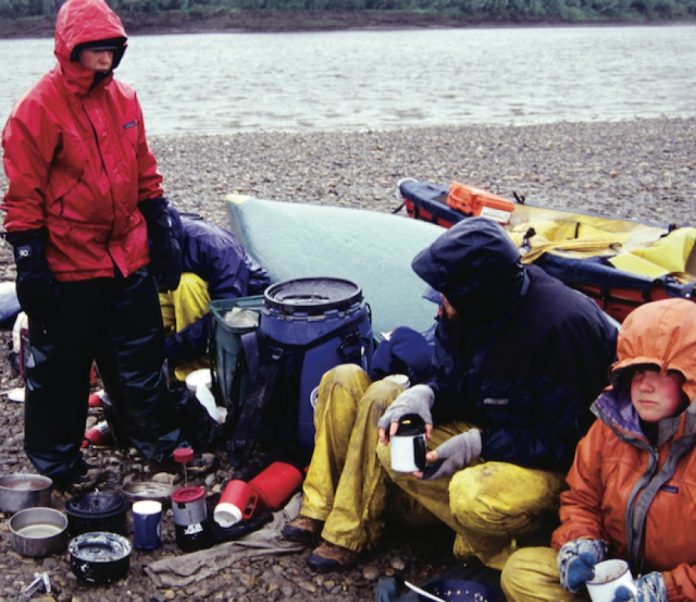
Photo: Rick Snowdon
Butt End: Uncivilized Behaviour

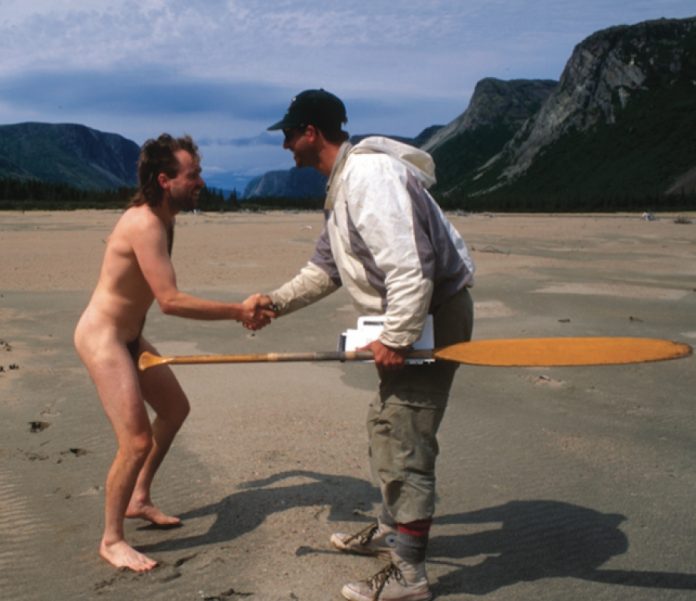
True, proper wilderness trip preparation should plan for a range of eventualities, but I’m not feeling too badly about the reason we’re stranded on this beach. The bush pilot scheduled to pick us up today was arrested yesterday for being involved in a pornography scandal. I’m not sure I could have seen that one coming.

Now our crew of six paddlers is waiting as patiently as the cold and wet will allow for another pick-up, which we were told could be two or three more days. Our food supply consists of half a bag of GORP, a package of instant potatoes, a dozen prunes, and, possibly, a trusting cottontail who’s hanging around our camp looking for companionship.

I hope the float plane pilot is a law-abiding Baptist minister with a family filter on his web browser 

The battery in our satellite phone is on its death bed because one of our group insisted on calling his wife twice a day throughout the trip for conversations that usually ended in heated marital discussions at four dollars a minute; another is green from trying to drown his sorrows with the majority of our spirits; and we were informed by the air service that the tires on both shuttle vehicles we left parked at the end of an 80-kilometre dirt road were slashed by some local militants who had a dislike for canoeists intruding on their secret fishing grounds. 

It’s not a good day. The truth is, it’s not been a good week. We’ve been paddling upstream the entire trip, when there was enough water to actually paddle. Water levels were low enough that we left a trail of Royalex shavings on the river bed like Hansel and Gretel leaving bread crumbs through the Black Forest. The only way out is to paddle six more days or wait for another float plane to arrive. I hope it’s flown by a law-abiding Baptist minister with a family filter on his web browser. 

I spend a lot of time travelling the bush, and I spend my fair share of time worrying about marauding bears, violent storms and becoming hopelessly lost. Never have I worried about being stranded in the wilderness with an overly communicative husband and a tapped-out drunk due to a pervert and some insecure fishermen.

I guess it just goes to show you that the ugliness you’re trying to escape back home can still reach you out here. I think I’ll stop worrying so much about bears, storms and getting lost. 

This article on trip preparedness was published in the Summer 2006 issue of Canoeroots magazine.

This article first appeared in the Summer 2006 issue of Canoeroots Magazine.


Bancroft Rocks

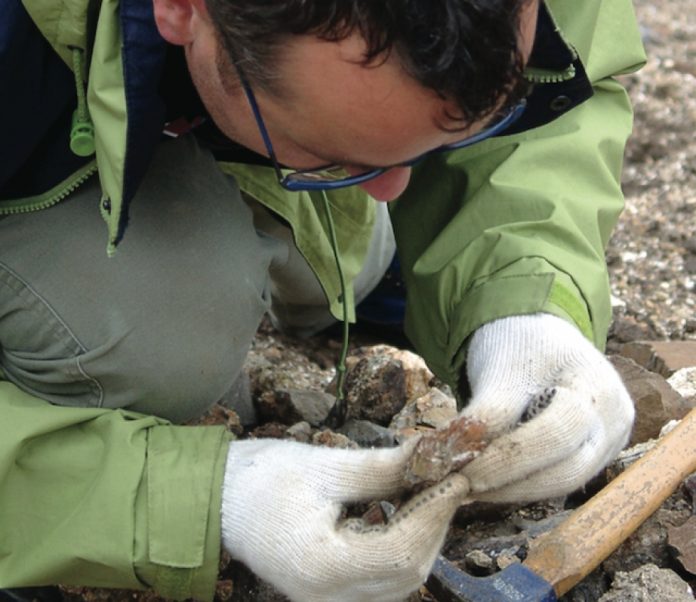
Photo: Carter Hammett
Bancroft Rocks

Buried miles beneath our feet in the cavities and caverns of the earth are thousands of untold tales that date back millennia. When you know what to look for, sagas of glacial shifts, continental collisions and seismic activity can be read in the stone.

Modern versions of those stories are given expression in objects that we take for granted every day. Gardeners fortify their soil with lime. Cooks enliven their food with salt. We purify our water with carbon. In fact, minerals can be found in batteries, computers, televisions, kitchen appliances, cancer treatments, X- ray machines, vitamins and cosmetics. It’s something many of us don’t think about often, but the same can’t be said of the 13,000 rockhounds who descend on Bancroft during the August long weekend.

Long known as the mineral capital of Canada, Bancroft is a haven for rockhounds the world over.

Famous for its annual Rockhound Gemboree, now in its 43rd year, Bancroft has a rich history of mining that dates back more than a century.

Since that time, the town of 4,000 has gone through various peaks and valleys of commercial production booms in feldspar, soaps, paint and glass. Marble production marked another peak in the town’s mining history, resulting in the mineral’s use in such landmarks as Ottawa’s Parliament Buildings and Toronto’s Union Station. The last great boom occurred during the 1960s when uranium reached its zenith in world markets.

Bancroft’s first Gemboree coincided with the closure of the Faraday Mine in 1964. Since then, the town has capitalized on its rich history and geological diversity to attract a steady stream of tourists to the area. Chief among the region’s tectonic oddities are the large number of pegmatites that lay hidden beneath the earth.

Pegmatites contain an inner core of quartz and an outer shell sometimes speckled with radioactive materials such as uraninite. Pegmatites occur when volcanic activity is diverted by substantial barriers—such as the vast Canadian Shield. When the diverted lava cools underground it hardens and remains riddled with dazzling minerals such as sodalite.

The pegmatites are one of the major attractions that lure rock-hounds to the Gemboree says Christine Hattin, the events coordinator with the Bancroft Chamber of Commerce. “Exhibitors and dealers come from as far away as Europe, Iraq and Pakistan,” she says. Visitors are offered field trips to more than 30 collecting sites, have opportunities to hear lectures from geological experts and even pan for gold.

Although you don’t require a background in geology to collect minerals, it is important to outfit yourself with the appropriate gear prior to venturing out to collection sites. A basic rockhound survival kit includes safety goggles, boots, sample bags, a backpack, water, a pry bar, a compass and a small sledgehammer or pick. More experienced collectors often carry a hand lens, gloves, hardhat, guidebook and identification kits.

Commonsense safety guidelines should also be adhered to. Collect with a partner, tell someone where you’re going and stay out of abandoned mines, as these can be particularly hazardous.

Hattin suggests starting your rockhounding experience with a visit to the Gemboree to speak with other mineral enthusiasts.

“You find a diversity of minerals here and lots of people simply don’t have that where they live,” says Hattin. “For them, the experience is unique.”

Bancroft Area

BERYL PIT Minerals include: beryl, clavelandite, tourmaline, quartz, garnet, apatite.
BEAR LAKE Diggings in Monmouth township of- fers titanite, and rare quartz. Bring a shovel.

MACDONALD MINE in Monteagle township, is located in a zoned pegmatite dyke with a massive centre of quartz. Also: granite, calcite, feldspar, pyrite, zircon and galena. Visitors are warned to enter mine at their own risk.
 

Thunder Bay

Amethyst Mine Panorama boasts the largest deposit of amethyst in North America. Amethyst, a coloured crystalline variety of silica mineral quartz, is the official gemstone of Ontario. 

Cobalt

Cobalt, a former silver mining hotspot, is replete with silver ore and cobalt. The mining museum on site offers specimens from around the world.

Sudbury

Sudbury is famous for its nickel production. Science North runs a “Path of Discovery” tour to major mining sites and operates a rock swap. The city hosts its own gem and mineral show in mid- July. Minerals: Garnet, staurolite, chlorotoid. Don’t forget to visit Dynamic Earth, the interactive earth sciences centre.

Timmins Underground

Timmins Underground offers a gold mine tour that allows visitors to sample the mining life. 


This article on geology was published in the Summer 2006 issue of Canoeroots magazine.

This article first appeared in the Summer 2006 issue of Canoeroots Magazine. For more great content, subscribe to Canoeroots’ print and digital editions here.

The Tandem Sideslip

Photo: Gary and Joanie McGuffin
The Tandem Sideslip

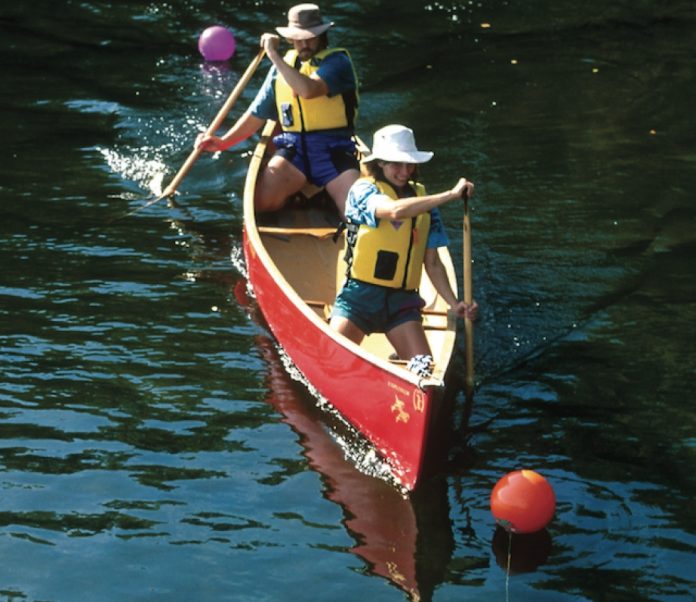
A sideslip is an elegant way to shift your canoe sideways while underway. It is an efficient way for both solo and tandem paddlers to avoid obstacles while maintaining forward speed because it avoids the drag associated with turning or spinning the canoe. Sideslips employ static strokes—the paddle stays stationary and the pressure of the water against the blade produces the force that moves the canoe laterally.

The same strokes—the static pry and static draw—are used for tandem sideslips in either direction. In this sequence, with the bow paddler paddling on the left, a static bow pry and stern draw are used to sideslip the canoe to the right. To sideslip to the left, a static bow draw and stern pry would be used.

A sideslip is an elegant way to shift your canoe sideways while underway.

1. Approach with forward momentum. Since the strokes are static they rely on water pushing against the blade to influence the path of the canoe. Tilt the canoe away from where you want to go to keep from catching the canoe’s leading edge once you start to slip.

2. The bow paddler places a static pry while the stern paddler places a static draw. Both blades are angled 15 to 20 degrees away from parallel to the centreline. Aim the leading edge of the blade where you want to go.

3. The bow paddler should adjust her blade angle so the bow does not sideslip faster than the stern. The stern paddler adjusts his blade angle so the canoe remains pointed in the intended direction.

4. Once the canoe has slipped far enough or lost the momentum necessary to slip further, follow up with forward strokes. 

This article was adapted from Gary and Joanie McGuffin’s Paddle Your Own Canoe

This article on the tandem sideslip skill was published in the Summer 2006 issue of Canoeroots magazine.

This article first appeared in the Summer 2006 issue of Canoeroots Magazine.


Rehabilitating the Rattler

Rehabilitating the Rattler | Photo: Patricia Kerr

In the 1960s, when hippies were singing about free love and protesting the seal hunt, Ontario’s provincial park officials were clubbing massasauga rattlesnakes to death. But today, Kenton Otterbein, the head naturalist at Killbear Provincial Park, says campers are learning to live peacefully with Ontario’s only venomous snake, a species he describes as “darn cute.”

Most people wouldn’t think of massasauga rattlesnakes as cute. But then, most people don’t know much about them. They are less than three feet long with a dark and light blotchy pattern. Baby rattlesnakes are born alive without a rattle. At about 10 days of age they will rub against a rock and pull out of their first skin. The skin will catch on a knob at the end of their tail and the first segment of the rattle will form. They will add another segment two or three times each year when they shed their skin.

When camping and travelling in Ontario’s rattlesnake country it is rare to ever hear the rattle of a massasauga. They want nothing more than to avoid contact with humans. Being cold-blooded, they are only active within a narrow temperature band, one only reached between the hours of noon and 4 p.m. during the spring and between 4 and 10 p.m. during the summer.

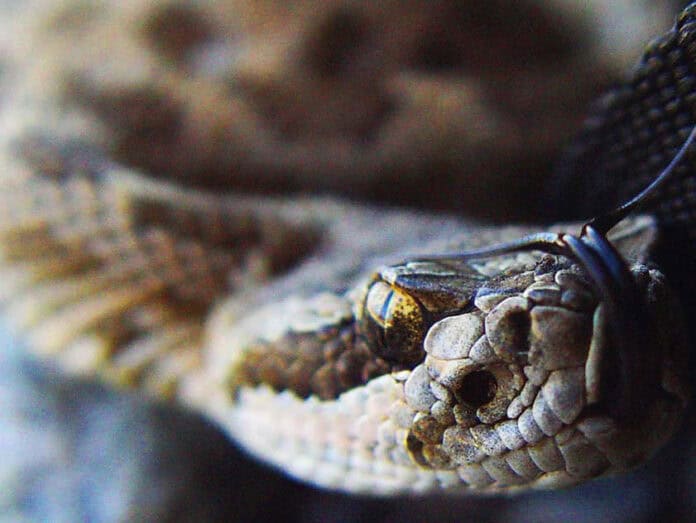
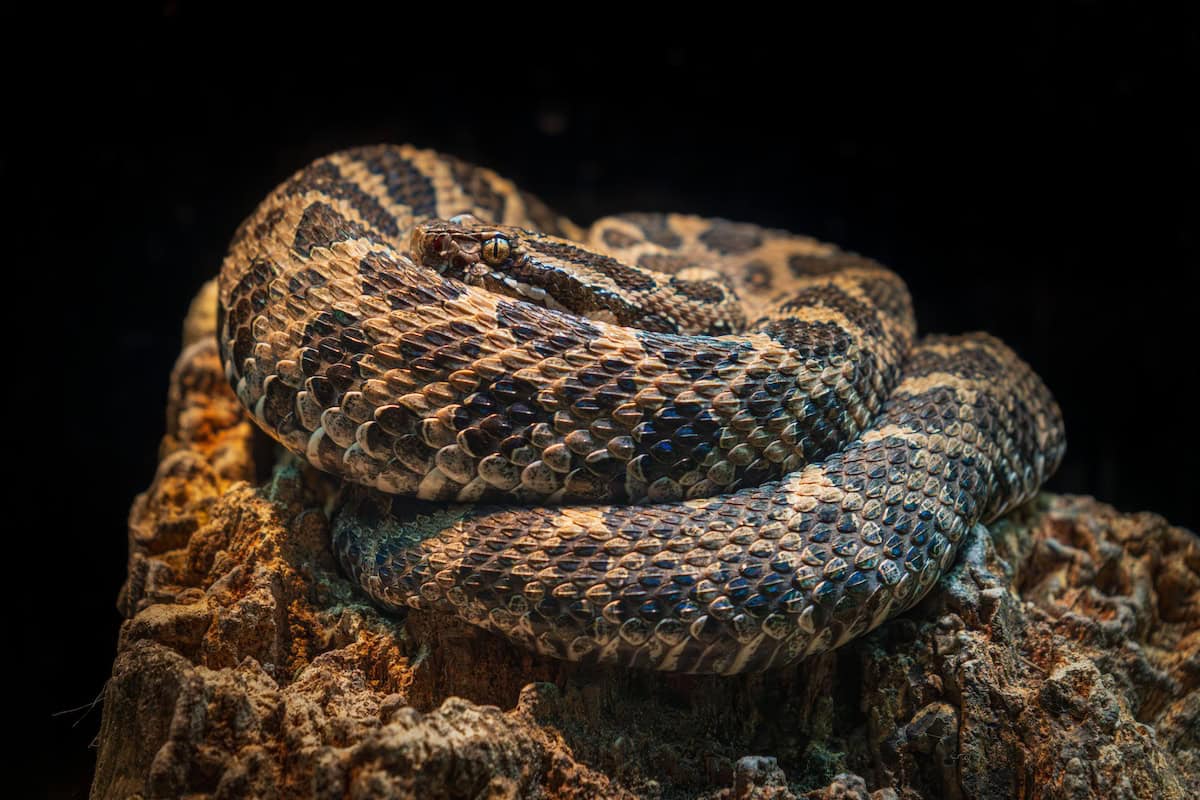
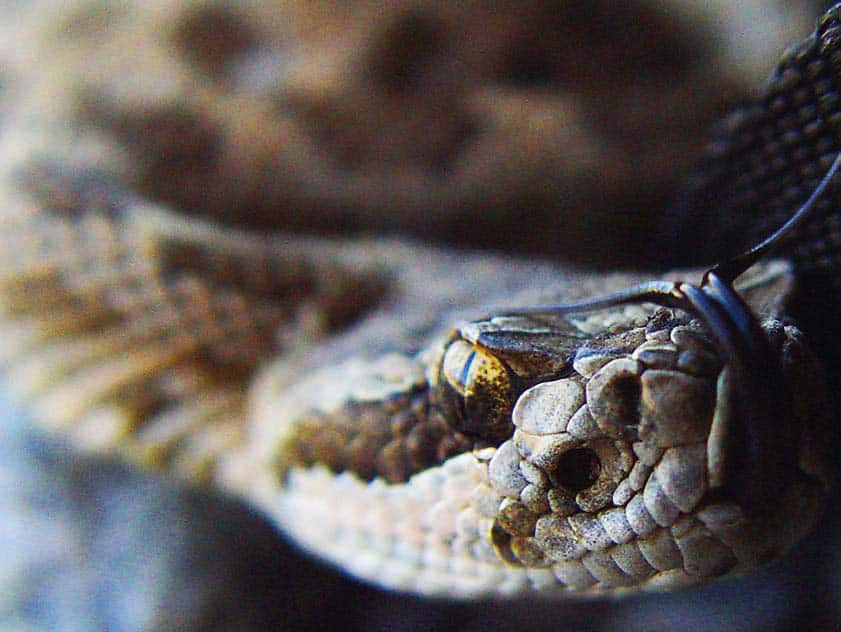
Macro photo of coiled Eastern Massasauga rattlesnake displaying scales and patterns
Eastern Massasauga rattlesnake | Photo: Abhishek Navlakha via Pexels

Nonetheless, persecution by humans has relegated massasauga rattlesnakes to only a few pockets of habitat in Ontario, the most notable being the eastern shore of Georgian Bay. Statistics kept by the staff at Killbear Provincial Park indicate that, though incidents are rare, the people most often bitten by a massasauga rattlesnake are 18- to 30-year-old men, who’ve been boozing and are acting like the Crocodile Hunter—the guy from the television show of the same name who travels around the world catching poisonous reptiles and insects to impress his female co-stars. The other recorded snake bites are the results of people accidentally stepping on a snake in the dark. Otterbein at Killbear says the chances of being bitten are very low,

“There is a greater risk of drowning in a bathtub at home than being bitten by one of our rattlesnakes.”

In those rare cases that a snakebite does occur, first aid is the same as it is for any small puncture wounds says Lorraine Vankoughnett, the acting director of acute care at West Parry Sound Hospital. Parry Sound hospitals treat up to six bites per year and provide medical research and education across Canada. Vankoughnett says the best thing to do is to stay calm, clean the wound, bandage it loosely and seek medical help. “And do not bring me the snake,” she adds, in the hopes of dispelling a myth.

At the hospital, Vankoughnett and her team would perform blood tests and observe the patient for up to 24 hours. They have found that in one out of every four snakebites there is no venom injected into the wound. From the snake’s perspective, biting a human is defensive and a waste of its precious venom. They need to save their venom for mice.

Researchers for the Metro Toronto Zoo estimate the massasauga rat- tler population in Ojibway Park near Windsor to be fewer than 200 snakes in an area less than one square kilo- metre. Paul Pratt, a naturalist for the City of Windsor, says the snakes are a good indicator of the health of the environment: “A top-of-the-line predator like the massasauga rattler makes the ecosystem intact. If there are only a few types of plants and mice, the area is not complete.”

For a long time, people living in massasauga rattlesnake country believed that the only good snake was a dead snake. Although most wanton killings have stopped, humans are still the only real threat to the massasauga rattlesnake, and Pratt points out that we are much more of a hazard to their survival than they are to ours.

With educational programs like Killbear’s Brake for Snakes motorist-awareness campaign, The Metro Toronto Zoo’s Save our Snakes educational effort and the Ojibway Nature Centre’s live snake display, people are slowly warming up to this cold-blooded cutie, allowing the shy massasauga rattlesnake to get on with hunting its prey of mice, not men.

Rehabilitating the Rattler | Photo: Patricia Kerr

Venom Vitals

  • Seven people were bitten by massasauga rattlers in Ontario last year.
  • The massasauga rattler’s fangs are 5–6 mm long.
  • A lethal dose of massasauga venom for humans is 30–40 mg.
  • One bite injects up to 6 mg of venom (do the math… you’d have to be bitten five or six times to be in danger).
  • Mice die as quickly as three minutes after a bite.
  • Massasauga rattlesnake venom is not a true poison, it is a hemolytic that prevents blood from clotting.
  • Most human rattlesnake bites are associated with the consumption of alcohol (by the human, not the snake).
  • No one in Ontario has died of a snake bite in the last 45 years.

This article on rattle snakes was published in the Summer 2006 issue of Canoeroots magazine.

This article first appeared in the Summer 2006 issue of Canoeroots Magazine.


Kevin Callan’s Black Bear Bust-Up

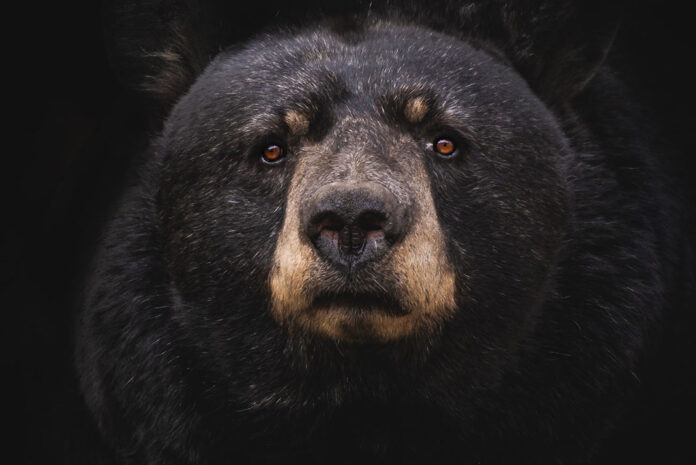
close up of a black bear face
What’s cooking? | Feature photo: Marc Olivier Jodoin/Unsplash

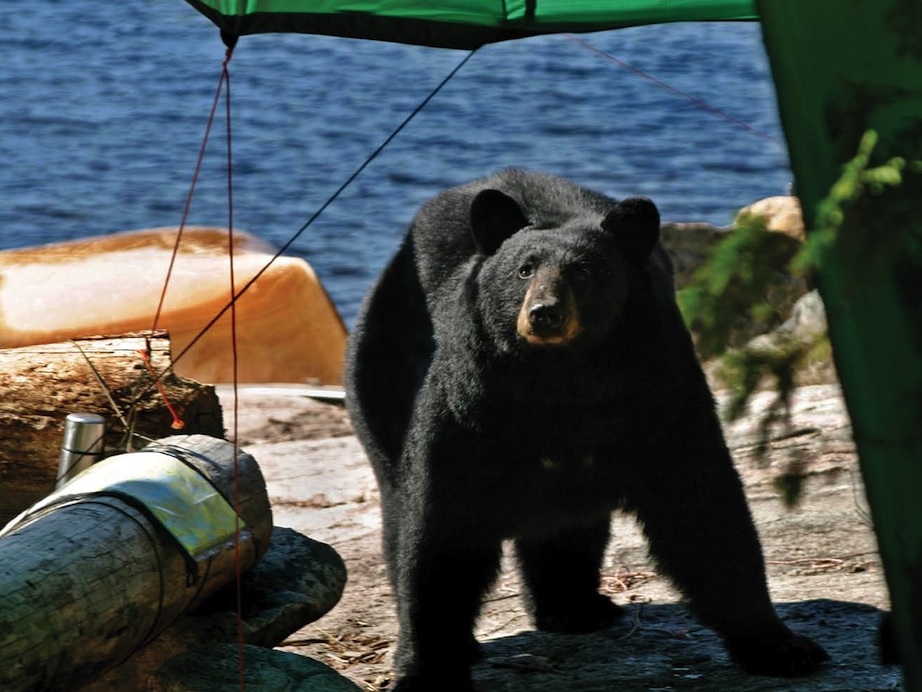
It was a relief to reach the takeout after fighting headwinds for the last three days of the trip. The rowhouse campground at the provincial park was crowded, but I was glad for the company and ready to relax. Relaxing was difficult, though, thanks to the black bear that kept dropping by looking for a snack.

Kevin Callan’s black bear bust-up

I couldn’t understand why he was picking on me. I had the cleanest site in the campground. Charlie, the bear biologist camped beside me, told me it was because the bear could sense I was scared of him.

But I was more exasperated than scared when the bear ambled into my site the second night after my peaceful dinner of mac and cheese. I grabbed a pair of pots and banged them together. The pots made a racket but it didn’t scare the bear off. It probably made the situation worse when the remnant cheesecaked noodles flew out of the pots and across the campsite.

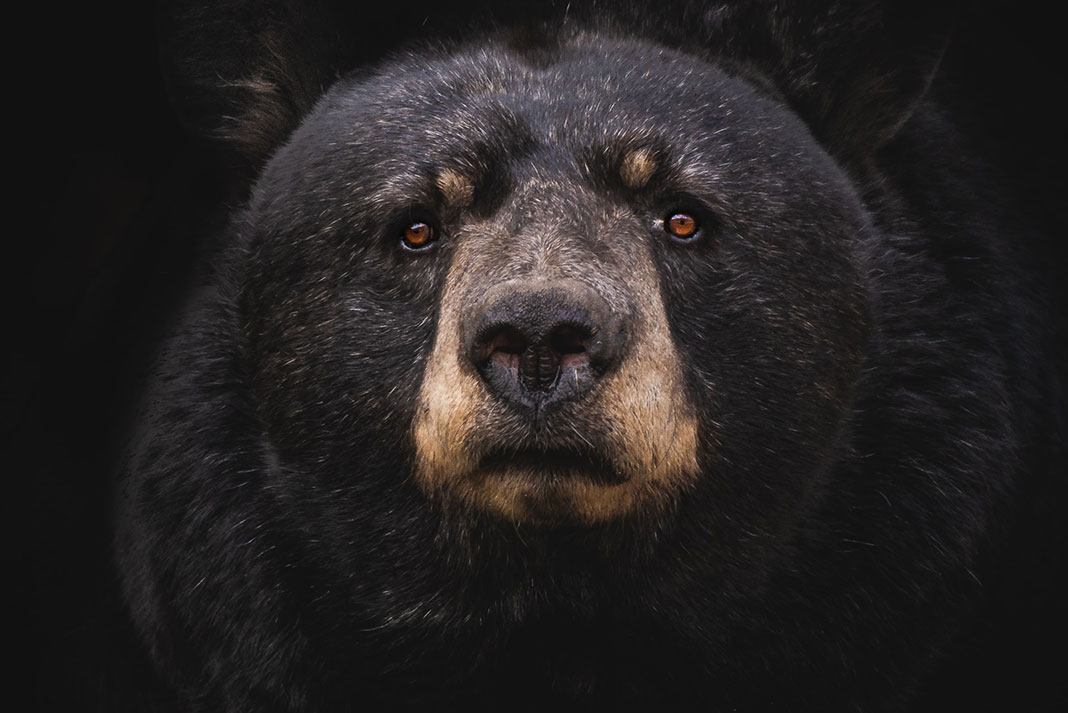
close up of a black bear face
What’s cooking? | Feature photo: Marc Olivier Jodoin/Unsplash

I threw down the pots, grabbed a rock and tossed it at him. He gave me a stare that said, “That was stupid!” and charged.

The bear bore down on me like a freight train, pulling up only five feet from me before rising up on his hind legs, snapping his teeth and growling.

My mouth hung open in fright, but the lessons from a dozen bear safety manuals leapt to mind and I waved my arms up in the air and yelled surprisingly creative things about his mother.

They must have hit home. He turned on his heels and ran to the edge of the site.

He who laughs last

That’s when I should have called it quits. But I was buzzing on fear and adrenalin and, what’s more, I was angry. Long suppressed rage from years of being picked on in grade school playgrounds welled up from somewhere deep inside me and burst out. I wouldn’t be bullied anymore. I had chased the bear out of my campsite and now I would beat him at his own game of intimidation.

Photo: iStock
The middle of your campsite is not where you want to encounter a black bear. | Photo: iStock

I advanced wild-eyed on him, snapping my teeth and making as fearsome a growling noise as a 150-pound weakling can make. The look he gave me told me he was very unimpressed. He turned and scampered down the shore, but he couldn’t be said to be running scared.

The bear swung close by a row of boats, passing two Grummans and one kayak before digging in his heels as he came to my canoe resting innocently on the beach. He gave it a sniff, and immediately went to work on it, tearing at the bow with his claws and ripping off part of the deck plate.

With a final snort in my direction he skipped off, leaving me in a macaroni-strewn campsite with unpleasant memories of schoolyard bullies once again bouncing around in my head.

Kevin Callan has gone back to banging pots nervously when confronted by bears.

Canoeroots Spring 2006 coverThis article originally appeared in the Early Summer 2006 issue of Canoeroots. Subscribe to Paddling Magazine and get 25 years of digital magazine archives including our legacy titles: Rapid, Adventure Kayak and Canoeroots.


What’s cooking? | Feature photo: Marc Olivier Jodoin/Unsplash


Connected People

Photo: Dan Stanfield
Editorial: Connected People

Almost all the tents had been taken down and paddlers had moved on to different rivers to enjoy the last day of the Victoria Day long weekend. Palmer Fest, Ontario’s largest whitewater paddling festival, was a huge success by all accounts, except one.

As the event organizer I’d been running on only about three hours of sleep, sleep I had caught after the second band finished their second encore and we drained the last keg, sleep I had snuck in before 5 a.m. when I got up to cook pancakes for 400 people, before getting on the water to teach my morning clinic. Looking back on it, I might have been feeling a little sharp and not in the mood for her constructive feedback. However, I did ask if she had a good time at the festival.

She said I should have facilitated a framework for better communication. She told me that she didn’t meet anyone at Palmer Fest and that as the host I was missing a wonderful networking opportunity, that I was really only halfway to really connecting paddlers. I told her it sounded like she wanted me to organize a children’s birthday party.

I couldn’t image a better way of connecting paddlers than hosting Palmer Fest. We hired 30 of the friendliest instructors to teach clinics. We invited an alleyway of paddling schools, boat companies and clubs to share information and skills. We put on a supper, a breakfast and a sat- urday night party. There was even free day-care so parents could get out on the water. We even partnered with a non-profit co-operative paddling school to host the event.

I walked down to the late-night bonfire by the water and saw bongos, guitars and some dude drumming on a blue barrel while others danced crazy dances around the largest white-man fire I’d ever seen. The social scene at paddling fes- tivals is like an extended family reunion—we know we are all related but are too busy having fun to figure out how exactly.

The ease with which paddlers strike up con- versations about rivers and form instant bonds with each other is the reason I’ve built my life around paddling.

Paddlers don’t “connect” in boardrooms and don’t need to play name games to get to know one another; no, we’re more like cowboys. I remember sitting at a roadhouse establishment in Hamilton. It was 1996 and the Edmonton Eskimos were playing the Toronto Argonauts in the 84th Grey Cup CFl football championship. In walked two cowboys, real cowboys, with worn boots, saddle coats and stetsons. There was the usual hush as the locals eyeballed the new guys. The cowboys didn’t sit down alone in the corner waiting for the bartender to ask them to share their names and their favourite flavour of ice cream with everybody in the bar. no sir, they were in town for the game and were surrounded by like- minded football fans. They walked up to the bar: “Howdy, I’m Troy and this here’s my brother Bob. We’re from Alberta, and we’re here for a good time.” They shook hands with everyone, sat down and ordered 50 long necks for their new friends. By halftime they knew everyone in the joint by name. We all had a great time.

With a firm handshake, I promise you can walk up to any group of paddlers at any festival, in any campground, around any campfire, at any put-in and you will have your connection. You could try and put a label on it, call it a positive, mutually- supportive communication between contributing members of a similar community. or you could pull up a log at the fire, introduce yourself and discuss who’s running shuttle in the morning.

Screen_Shot_2016-01-13_at_12.32.57_PM.pngThis article first appeared in the Summer 2006 issue of Rapid Magazine. For more great content, subscribe to Rapid’s print and digital editions here

Fake Rivers Ringing Up Real Profits

Photo: Kent McCracken
Fake Rivers Ringing Up Real Profits

Whitewater paddlers are shedding their reputation for being dirtbags and may soon be better known as moneybags, according to speakers at a recent symposium where promoters of manufactured whitewater dis- cussed the economic benefits of urban paddling parks.

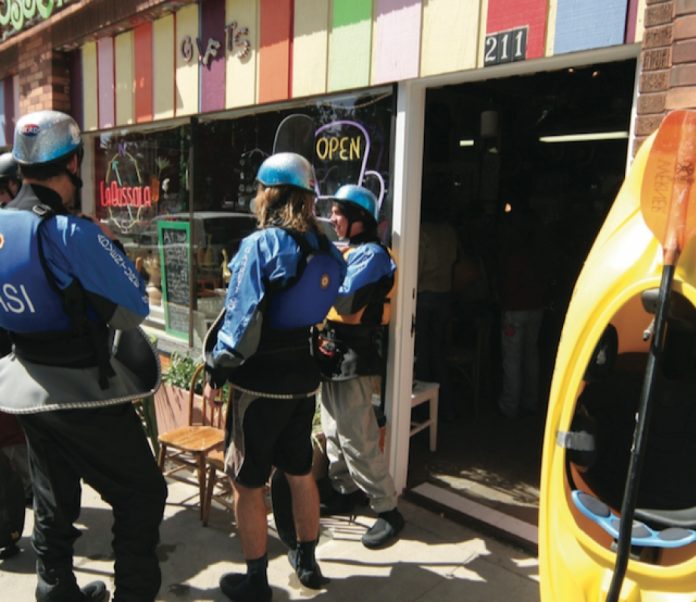
With whitewater parks located in downtown cores, paddlers have no choice but to trade cooking on campstoves and sleeping in vans for fancy restaurant meals and cozy hotel rooms. At the symposium in Colorado, city councillors from Golden, Colorado, said paddlers visiting its whitewater park—which cost $170,000 to build—spent $3 million at local businesses last summer; and in Vail, Colorado, retailers estimated ringing up $1 million in sales during just one week of rafting and whitewater events in 2005.

The first whitewater park in the United States was built in Denver, Colorado, in 1978. Since then, they’ve sprung up in droves—from Reno, Nevada, to Charlotte, North Carolina—according to Scott Shipley, a three-time U.S. Olympic kayaker and now an engineer with a firm that builds the parks.

Shipley estimates that there are currently 40 to 60 parks in the United States, many in downtown cores, but in Canada the closest thing to a whitewater park remains the altered flows and rearranged features of natural waterways like Alberta’s Kananaskis River, Ontario’s Gull River and British Columbia’s Rutherford Creek—none of which are in what you’d call a metropolitan area or within walking distance to a sushi bar.

Now several Canadian cities are consider- ing cashing in on the flow from human-made whitewater. Next year, Calgary will begin construction of a $6-million downtown facility that will divert the Bow River into an after-work pad- dling hotspot. In Saskatoon, Saskatchewan, a proposal to remove an 11-foot weir and create a multi-channel, 300-metre whitewater park on the South Saskatchewan River is working its way through the design stage. There’s early speculation about a project in Nova Scotia that would unearth the long-buried Sawmill River and make Dartmouth an urban whitewater destination. And in trying to salvage some benefit from Toronto’s failed Olympic bid, the Niagara Whitewater Park Association is negotiating with Ontario Power Generation and property owners for water rights and land access to create a park on St. Catharines’ Twelve Mile Creek.

Brock Dickinson, St. Catharines’ director of economic development, says the local business community is behind the proposal. Dickinson believes cash benefits would ex- tend beyond the construction, hotel and restaurant sectors and might open doors for St. Catharines to become a regional or national training centre.

Of course, obstacles remain in many cities. With a price tag of $6 million, Dickinson says the city won’t be able to make the park happen on its own and he doesn’t know where the money will come from. As the proposals are studied further, paddlers who want to paddle right in their home towns will have to wait and hope their politicians realize that it takes money to make money. 

Screen_Shot_2016-01-13_at_12.32.57_PM.pngThis article first appeared in the Summer 2006 issue of Rapid Magazine. For more great content, subscribe to Rapid’s print and digital editions here

The Search Continues: the Theme in Wilderness Tripping Journals

Photo: Toni Harting
The Search Continues: the Theme in Wilderness Tripping Journals

There was a logbook, covered in dust with the spine worn bare, that for years greeted expedition canoeists when they reached Fort Albany. The register was an end-of-trip ritual for canoeists who had finally made it to James bay. Sign your name, enter the date, and add a comment or two. The entries ranged from expressions of gratitude for being finished, to remorse for a trip that had ended.

But it’s what’s not written down, the story that isn’t told, that speaks louder than the pencil scratch on the page.

Bruce Hodgins—author, historian, retired professor and, with a personal canoe resume that reaches back to the 1950s, one of the architects of Canada’s canoe culture—is a man who knows about what is and isn’t found in canoeing logbooks and trip journals. Hodgins teamed up with fellow historian Gwyneth Hoyle to research the recent history of canoe travel and put it in one place. The result is the remarkable Canoeing North into the Unknown, A Record of River Travel: 1874 to 1974 (Natural Heritage, 1994), a seminal collection of the who, what, when and where of canoe tripping history.

You would not sit down and read hodgins’ and hoyle’s book from cover to cover. It’s a resource, a list of dates and names, with minimal description or qualification. entries receive equal billing and range from the famous:

“1789 Alexander Mackenzie, on his fifth crossing of the Methye Portage, travelled north, all the way down the Mackenzie River to the Arctic ocean.”

To the mundane:
“1974 Camp kandalore: John Fallis and guy Delaire led a boys group down the Missininaibi River to Moose Factory.”

To the epic:
“1930 Eric Sevareid, 17, and Walter Port, 19, canoed from their home in Minneapolis to York Factory—a total of 2,250 miles.”

I spoke with hodgins this spring. He was preparing to run the Irondale River in Ontario’s Kawartha region, even though at 75 years of age and with heart problems, his doctor no longer allows him to portage his own canoe.

I wanted to ask him about something that was missing in Canoeing North into the Unknown. It’s the same thing missing from the Fort Albany register, and that was why. Why did all those people take to the north at a time when access was difficult, trips were expensive and canoeing for pleasure was considered foolhardy? The names and dates share little of what the trip was about; the motivation, the experience as it unfolded, the stories, and the memories. What was it these people were seeking?

As Hodgins points out, in the early days of recreational tripping, canoers didn’t know much about the rivers they were travelling until they got on them. They were heading somewhere, unsure of what they would find. Hodgins thinks this is at once the reason they didn’t explain their motives, and also their motivation for going.

I prompted him with a line from the introduction to his book: “For some, the long northern river voyage is part of a quest pattern, a challenge, an exploration…a journey into the unknown.”

“Absolutely,” said Hodgins. “There is an emotional element to tripping on rivers, a re-experiencing of wonder as you discover something that was un- known to you. gwyneth was right to put “unknown” in the title. It’s the seeking out of something unknown that engages the individual.”

Hodgins’ book is intriguing because in it you don’t actually read about the quest for the unknown, but you know it is there. You can feel it from the lack of information that describes the simple trip details. For each entry there is a profound story left untold.

While the early explorers were charting vast wilderness, today’s paddlers are on their own search for something unknown to them. Pouring over a map, watching the weather, and nervously anticipating what’s around the next bend is part of the discovery on a canoe expedition. It is a personal quest, that can be discerned in trip journals, but only if you know what to look for. A camp’s map coordinates could be meticulously logged, followed by a scrawled, “The most beautiful place on earth.” Notes on an unplanned portage are followed by, “The hardest day of my life.” while short on detail, these simple lines speak volumes about the writer’s motivation; the why. The desire to challenge oneself by confronting the unknown is ultimately personal, and can only be hinted at in a few short sentences in a dusty register.

I asked Hodgins if the theme of a quest to explore the unknown persisted intact over the course of the last century and a half of canoe travel.

“Ah, yes, I still believe that the quest for the unknown is an element of why people do it,” hodgins replied, as he buckled the strap on his canoe pack and placed it by the door. It would be ready for him to pick up in the morn- ing as he went out again to experience something, something he wasn’t quite sure of yet. Those who wrote journals in the past, or will keep one in the future, likely would not admit to this emotional quest—it certainly isn’t written down anywhere in the Fort Albany journal— but it is there, between every line.

Jeff Jackson is a professor of outdoor adventure at Algonquin College in Pembroke, Ontario.
Screen_Shot_2016-01-13_at_12.32.57_PM.pngThis article first appeared in the Summer 2006 issue of Rapid Magazine. For more great content, subscribe to Rapid’s print and digital editions here

Anyone Who Wants to be a Open Boater…Raise Your Hand

Photo: Rick Matthews
Anyone Who Wants to be a Open Boater...Raise Your Hand

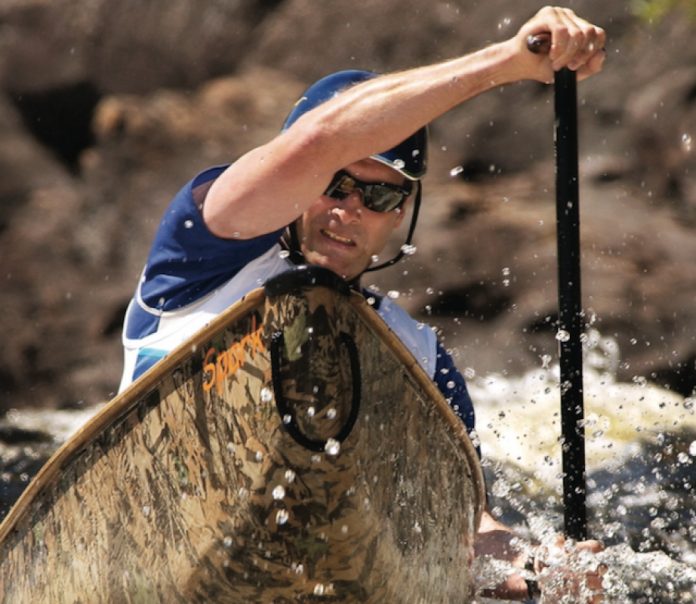
In his book Gestures, author Roger Axtell has catalogued body language from around the world. He found that similar gestures mean different things depend- ing on where you live. For example, raising your hand and extending your thumb and little finger is the sign for “cool” in hawaii, while in Mexico the same gesture will get you a drink, and in Japan it means the number six. Perhaps with increased globalization lifting your hand in this manner will get you six cold beers at bars around the world. In canoeing, the similar gesture of raising your grip hand shows that you respect the river enough to stay ready to react to anything it might throw at you.

When your grip hand is high, your paddle shaft will be vertical, next to the canoe and close to your knee—right where you want it to be.

Correction strokes are a short reach back to your hip and you need only slice the blade forward to the catch position for a power stroke. If you need a quick righting pry, no problem, your paddle is already at your side and ready for action. With your grip hand held high you can instantly twist your paddle shaft and use the blade as a bow rudder for shifts left and right.

Since most strokes originate with a vertical paddle shaft, there is rarely a reason to drop your grip hand to link different strokes. 

A high grip hand will also improve your posture and balance by keeping the paddle shaft and your arms close to your body. With your paddle next to the canoe, you are positioned to rotate at the waist to perform paddle strokes without reaching or leaning. Less leaning means fewer braces and more time for power and correction strokes.

The next time you are on the river, look around at other canoeists who are moving smoothly and appear to be paddling with little effort. You’ll probably see that their grip hand rarely drops down toward the gunwale. Paddlers that do drop their hand often appear to be bobbing their bodies while their boats twitch and lurch awkwardly from one eddy to another. Dropping your grip hand leads to poor paddling posture, a lack of stability and rushed strokes that are executed too late to be effective.

So raise your grip hand to the river. Among canoeists, this gesture will be recognized as the key to linking effective strokes, smooth paddling, great posture and, ultimately, a deep respect for the river.

Andrew Westwood is a regular contributor to Rapid. He’s an open canoe instructor at the Madawaska Kanu Centre and member of team Esquif. 

Screen_Shot_2016-01-13_at_12.32.57_PM.pngThis article first appeared in the Summer 2006 issue of Rapid Magazine. For more great content, subscribe to Rapid’s print and digital editions here