Home Blog Page 377

Skills: How to Shoot Wildlife (With Your Camera)

Photo: Rick Matthews
Skills: How to Shoot Wildlife (With Your Camera)

Wildlife photographers are often envisioned dressed in camouflage suits, spending countless hours stalking big game and carrying monster 12-pound lenses. Not so for kayakers who photograph wildlife. As a paddler your secret weapon is not a 600 mm lens, it’s your boat. Your kayak allows you to move silently and approach animals from the water, the side where they least expect a threat. You can get much closer to animals than you can from land, and often a standard 80–200 mm zoom lens is more than adequate.

Given that many mammals, amphibians and water- fowl spend a great deal of time in or around rivers and lakes, paddlers have unique opportunities to get great wildlife shots. So get up before the sun, get out in that secret weapon, and be prepared to grab some great wildlife shots sans the camouflage suit. 

Capture movement
You’ll often want to use a high shutter speed to reduce blurring when shooting from a moving platform. Try not to get locked into static wildlife portraits, however. Experiment with shutter speeds and panning effects to illustrate motion. Kayaking the coastline of Alaska close to Cordova, we came upon a huge flock of gulls feeding on a school of small fish. Initially I shot at a fast shutter speed. Gradually I slowed it down to 1/15 to 1/30 of a second. This captured the movement and chaos of the feeding frenzy. 

Getting close to wildlife
To get close to wildlife, I use quiet paddle strokes and a dark-coloured paddle—a white paddle blade will alert an animal much more quickly. Paddle upwind if possible to avoid the animal catching your scent. And paddle close to the shoreline and be ready to shoot when coming around bends or into open areas in reed beds. While exploring the wetlands and creeks of Riding Mountain National Park in Manitoba, we heard a loud splash and came around a bend to see a young moose going for a swim. We followed at a safe distance for several minutes and I was able to fire off two or three frames before he loped off into the bush. The huge cloud of insects may explain why he stayed in the water for so long. 

Use fill flash for bright backgrounds
Along the California coast near San Simeon, we came upon a herd of elephant seals sunning and trying to attract the attention of the females. When paddling, I try to keep the light coming from behind, over my shoulder, but this isn’t always possible.  I use the fill flash to offset the bright surf behind and bring out some detail. Using the flash to enhance what might be your only good shot has to be weighed against the chance of scaring off the animal. 

The early bird gets the shot
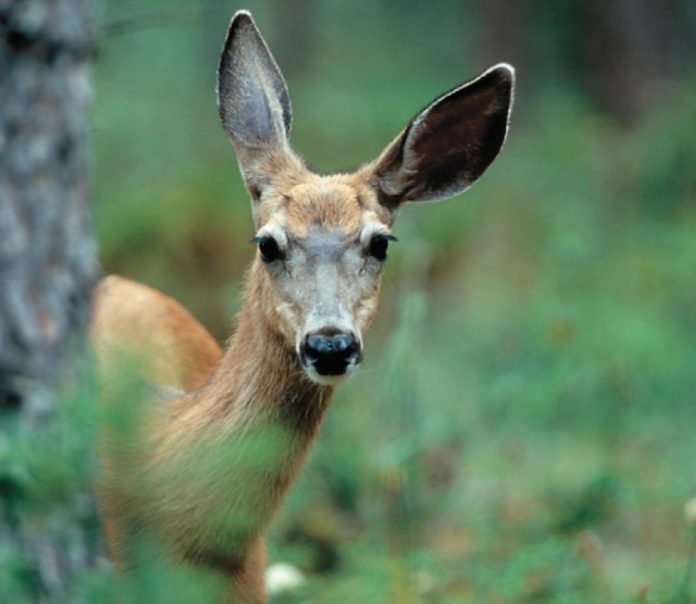
Getting up early in the mornings or taking an early evening paddle will increase your chances to see wildlife. Use 200–400 speed film to shoot in the low light. On one early morning paddle I was able to closely approach a small group of deer near our campsite on Maligne Lake in Jasper National Park, Alberta. Drifting very quietly, I waited until the doe peeked out from behind a tree before firing off three frames. The third one was the only sharp one. For sharper images when shooting from a stable kayak, try using a monopod resting on the floor of the boat and brace the camera against your forehead. 

Use fill flash for catch light
Getting out of the boat and wading in the tidal pools at low tide is a great way to discover starfish and other kinds of marine life. In the early evening on the Pacific shoreline near Morro Bay, California, I was able to get quite close to a snowy egret while he was focused on catching supper. Fill flash really helps to bring out detail in eyes and feathers especially in birds with black eyes and dark feathers. If you are shooting skyward at flying birds, use a flash to fill in the shadows underneath. 
akv3i4cover.jpgThis article first appeared in the Fall 2003 issue of Adventure Kayak Magazine. For more great content, subscribe to Adventure Kayak’s print and digital editions here.
 

Guide To Backcountry Kayaking On Alouette Lake, British Columbia

Photo: Paul German
Urban Adventures: Alouette Lake BC

With the Pacific Ocean on the front doorstep, many West Coast paddlers forget there’s great paddling in the backyard too, a mountain wilderness with freshwater lakes perfect for trips ranging from a couple of hours to a long weekend. Alouette Lake is one such place where we can paddle right into the Coast Range. It’s a manmade jewel that gleams like a natural emerald in the cradle of the snowcapped peaks.

Alouette Lake is in Golden Ears Provincial Park, a 55,000-hectare mountain playground nestled into the northern rim of the broad, fertile Fraser River Valley. The park is only about an hour’s drive east of Vancouver and a three-hour drive north of Seattle.

[ Paddling Trip Guide: View all paddling trips in British Columbia ]

As we drive through the park gates, signs direct us to the popular boat launch, just 10 minutes inside the park at the southwestern tip of the lake. To skip the boat ramp queues, we can put in at the day use area instead or, if we’re paying to car-camp, at Alouette, Gold Creek or North Beach campgrounds about 4 km farther up the west shore. These options require a few minutes’ portage, but can save time when the ramp’s busy.

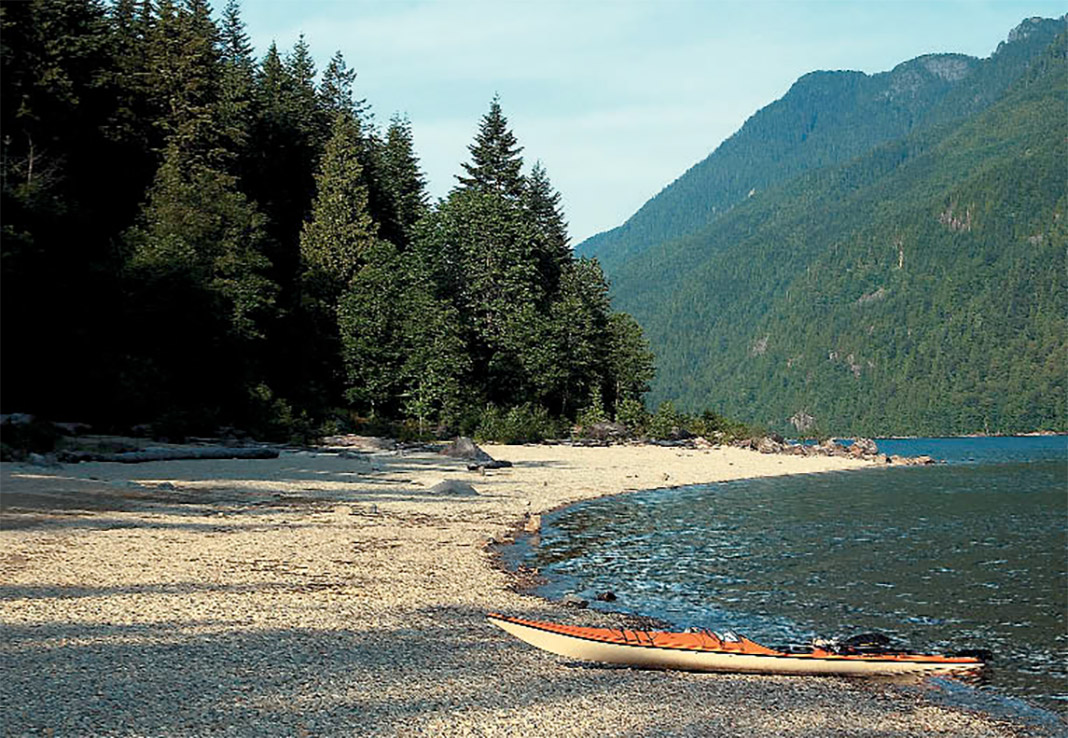
Orange sea kayak pulled up on the beach
Beautiful beaches like this one, a short paddle from the main campground, make great lunch spots. | Photo: Paul German

Pointing like an arrow from southwest to northeast, Alouette is 17 km long, but only about a kilometer wide on average. We cross the lake and paddle along the eastern shore, close to the land where the air is rich with the scent of cedars and evergreens. Landing to answer nature’s call, we discover wild raspberries. We keep our ears open for noises— because the black bears love berries too!

Back on the water, we pass a large stream that cascades down from the hills to feed the lake. The late afternoon sun backlights the cold, damp air that follows the water down the creek bed, causing the vapour to glow like a spectral second stream that spirals just a foot or two above the lake.

After about 10 km from the boat launch (or about five from the car campgrounds), we reach the Narrows. Also known as the Cut, this constriction marks both a physical and a psychological gateway.

The lake briefly tapers to less than 25 meters wide, and shallows from dozens of meters deep to just a meter or two.

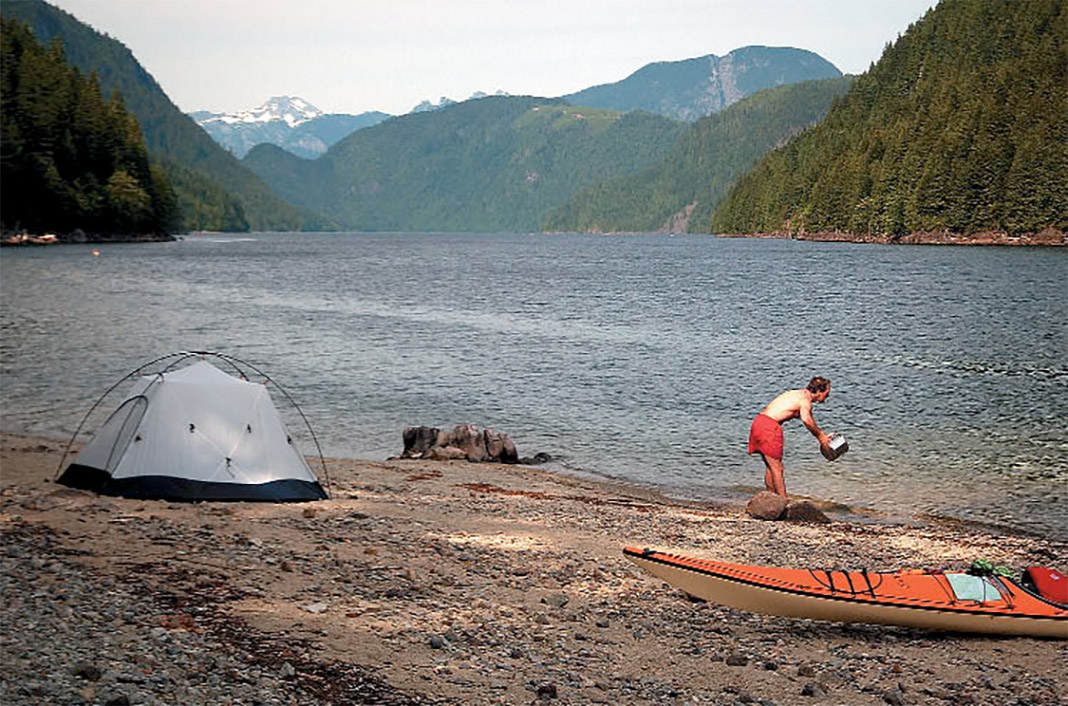
Man standing at edge of lake with kayak beside him and tent on beach.
The narrows divide the north and south ends of the lake and make a great small campsite for overnighters looking for a quiet getaway and views of the peaks. | Photo: Paul German

The lake was formed in 1926 when developers dammed a river to create a hydroelectric reservoir, connecting and vastly enlarging two existing smaller lakes. The Narrows is a reminder of the swamp that separated the two natural bodies of water. On either side and beyond, the mountains rise steeply out of the water, creating the feel of a wild freshwater fjord. Very few powerboats venture beyond here.

Just beyond the Narrows, we turn left and land at a small beach at the southwest end of the lake’s second segment. Hidden in the trees above the beach are several levelled earth pads built especially for tents, as well as an outhouse. If we were on a day trip, we would stop for lunch at this point, then head back. But we’ve brought camping gear, so we bathe in the lake, then dry out and cook supper over a small fire.

The next morning, we set out on a day trip to the far north end of the lake, about 7 km away as the crow flies. As we paddle, we can trace with our eyes the journey of water from the slowly melting snowfields on the surrounding mountaintops to the white plumes that fall dozens of meters down sheer rock faces, and finally to the streams that merge into the lake.

Along the eastern shore, not far from the end of the lake, is a grey concrete arch reminiscent of a medieval gate tower. It marks the intake of a long, manmade tunnel that feeds water right through the mountain down to Stave Lake and its hydroelectric generators.

At the very head of the lake, the Alouette River, sweeping into the lake across a cobblestone delta, offers a tantalizing glimpse along a mountain valley that seems to recede forever toward the horizon. If we were trained and equipped for it, we could land, find the trail by the river’s edge, and follow it to the peaks of Mount Robie Reid thousands of feet above. But this alpine adventure will have to wait for our return to Alouette. This time we turn around, soon to enjoy one of the best parts of paddling a freshwater fjord: not having to rinse our gear when we get home!

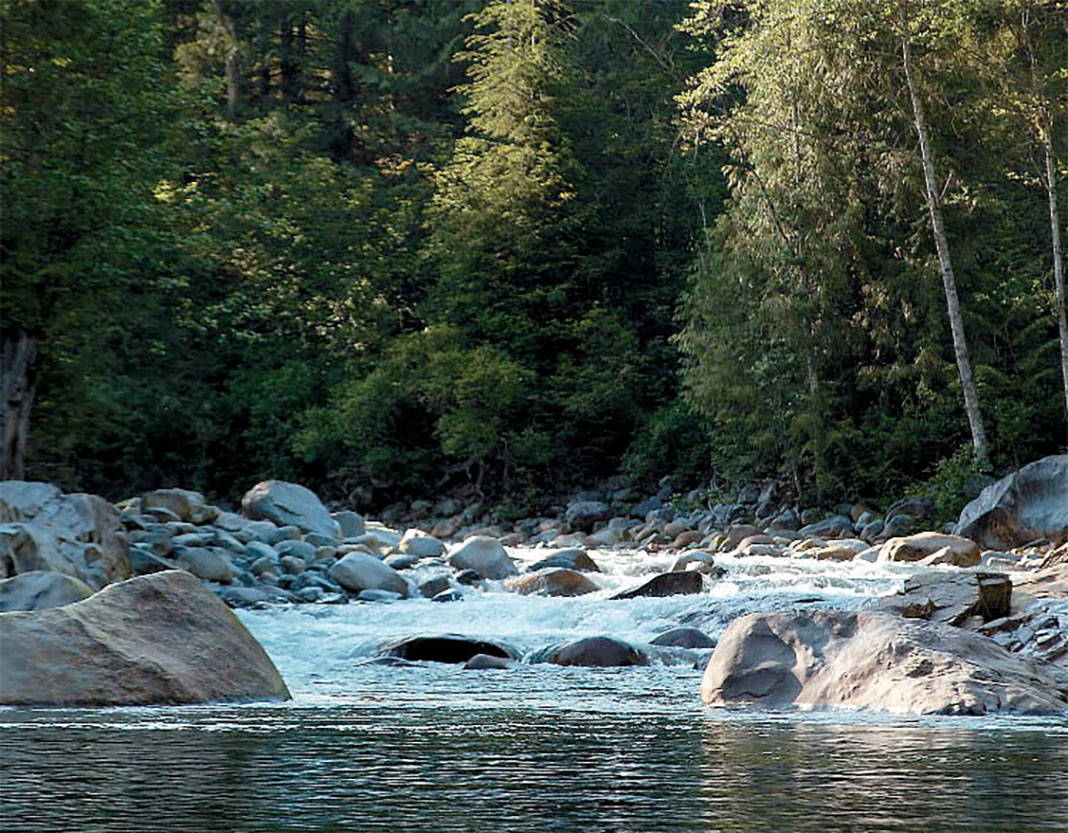
Quiet rapids on river
Gold River flows into Alouette Lake beside a beautiful sandbar. You can paddle into the river mouth to the rapids, watching salmon and trout swim in the clear waters below. | Photo: Paul German

How to get to Golden Ears Provincial Park

From Vancouver, take Highway 7 to Maple Ridge and turn left on the Dewdney Trunk Road. Turn left again on 232nd Street and follow the signs to Golden Ears Park.

Golden Ears Provincial Park campsite reservations

You can reserve your campsites at Cold Creek, Alouette and North Beach campgrounds and purchase backcountry camping permits here.

Special considerations

Tree stumps, relics of pre-flood logging, lurk at or just below water level in some near-shore areas—keep a watchful eye, especially in rough water. Inflow and outflow winds can pick up quickly, so plan any crossings accordingly.

Boat rentals

During the summer months, canoes and kayaks are available for rent at the day use area at the southwest end of the lake. Contact Rocky Mountain Boat Rentals.

This article was originally published in Adventure Kayak‘s Fall 2003 issue. Subscribe to Paddling Magazine’s print and digital editions here, or browse the archives here.


Philip Torrens has been an avid touring kayaker, on both fresh and salt water, for more than 15 years. 

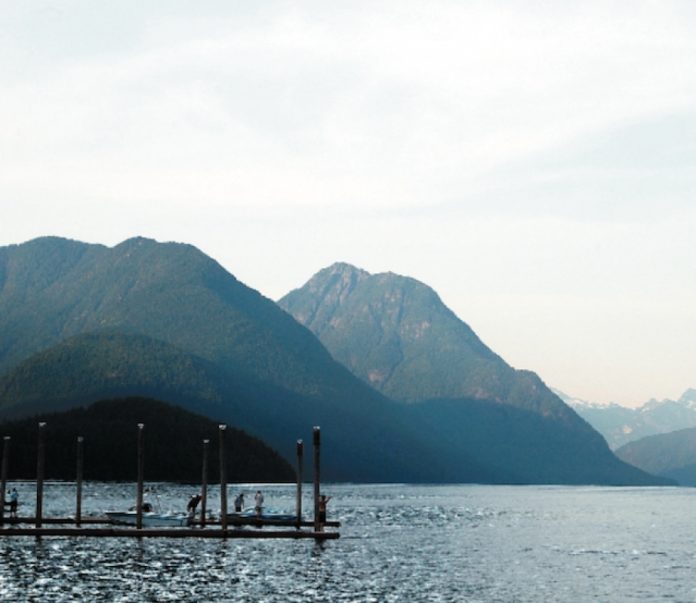
Looking north from the popular boat launch on a quiet weekday, you can sense the solitude at Alouette’s north end. | Photo: Paul German

Revenge of the Bird Nerds

All photos Scott MacGregor
Revenge of the Bird Nerds

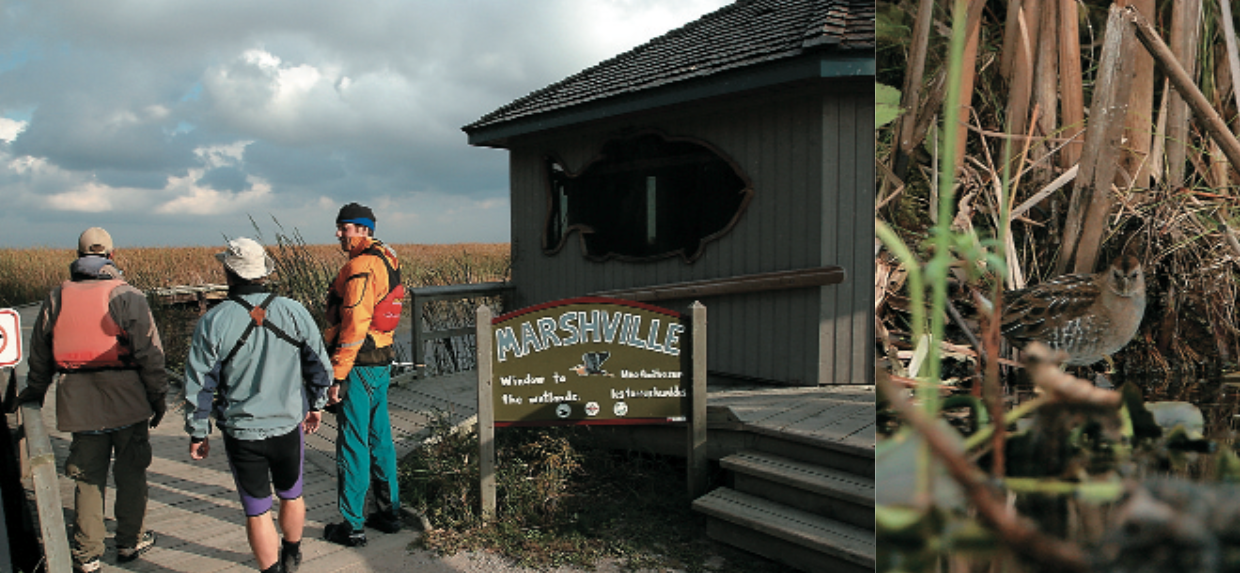
Lucas Foerster is not what we’re looking for at all. Wiry and tanned from a summer spent outside as a researcher in Point Pelee National Park, he starts off by making it perfectly clear that just because he likes looking at birds doesn’t mean he isn’t a normal, active 27-year-old guy. Lucas knows he doesn’t fit the nerdy profile of the usual birding suspect: retired, hefty disposable income, khaki safari pants and questionable social skills. He tells me right away that he’s also into surfing. He even drives a vintage 1970s VW camper van. His mountain bike is parked just outside. 

Scott MacGregor, Adventure Kayak’s publisher, has joined me in Point Pelee to photograph our kayaking mission to one of the world’s premier bird-watching destinations. On the drive we tallied up our limited knowledge of birders and birding and jokingly came up with a comical vision of Revenge of the Nerds characters and Nature of Things conventioneers in press-on David Suzuki beards and multi-pocketed vests rocking to the soundtrack from Hinterland Who’s Who. We concluded that birdwatching is boring, but we might get a good story if we could find one of these oddball aviphiles to satirize. I was crushed when the park managers at Point Pelee present- ed us with Lucas the surfer, a guy way too much like ourselves.

If you picture Ontario as a funnel of land channelled by the Great Lakes into the southwestern corner of the province, the outlet at the bottom of the funnel is Point Pelee. Canada’s southernmost tip, Pelee juts out into Lake Erie at the same latitude as Rome and northern California.

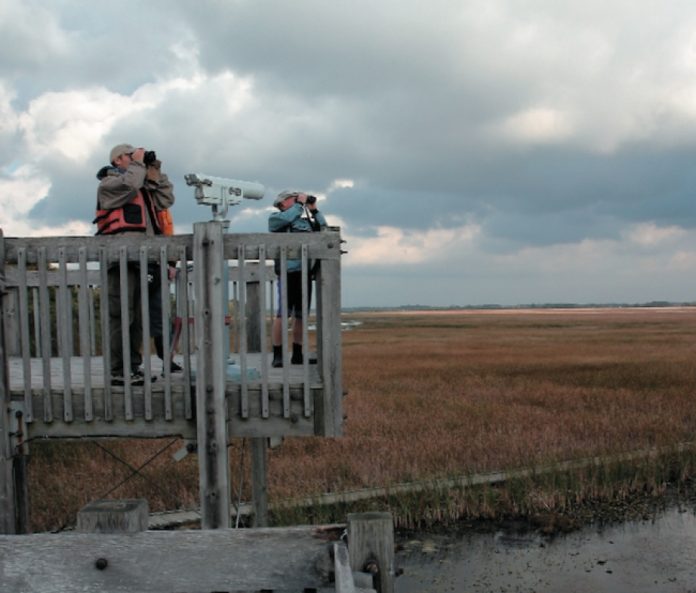
Pelee is a funnel for nature—”the best migrant trap in inland North America.” Birds migrating through southern Ontario concentrate at the Pelee bottleneck, resting and feeding at the point’s vast wetlands before moving on to northern Canada in spring, or across Lake Erie to wintering grounds in the tropics each fall. One of the best ways to see wildlife on this continent is to sit at the bottom of this funnel and let it all come to you. The total number of bird species recorded here is 372, almost 80 percent of the Canadian total. A dedicated birder can see 100 species in a single day.

The bird migration route is left over from a former land bridge across Lake Erie. Now the birds island-hop the same route from the point and across the leftover bits. The vestiges of the land bridge also make for good sea kayaking: wetlands inside Point Pelee; wave-washed beaches on the outsides of the point; challenging shoals and currents off the tip; and Pelee Island, a quaint land of inns and vineyards, 13 kilometres to the south. Paddlers occasionally cross the whole 50 kilometres from Point Pelee to Port Clinton, Ohio, braving Lake Erie’s unpre- dictable winds and rough shallows that hide the wreck- age of over 100 ships.

Point Pelee is the perfect place for a kayaker to get an education in birding, which is why Scott and I packed our kayaks and funnelled down the busy Highway 401 toward Windsor one cool weekend in October—an ideal time to see birds.

The spring migration, which peaks in May, is famous because the birds sing loudly and are easy to spot in bright mating plumage. But in the fall, after the breeding season, there are more of them, and more rare species. With the northbound race for sex behind them, migrants doddle and wander off course on the way back down south. Others blow in from out of region on weather systems driven by seasonal hurricanes in the tropics. Birders from nearby cities keep an eye on the storms and come out to track these rarities. They post sightings on the Internet complete with driving directions to the nearest farmhouse, picket fence or oak tree.

These are the nerds we came to see.

Screen_Shot_2015-07-21_at_2.06.38_PM.png

We find Lucas at the park’s staff residence, flipping veggie burgers for dinner. He tells us of his conversion to birding. He was a nature lover all his life. Whether it was hiking up a mountain with his buddies to track down a particular type of snake, or taking the path less travelled in search of a rare plant.

Working in Pelee, it wasn’t long before his attention turned skyward. He resisted at first. “I once swore I’d never be a birder,” he said. “I became a closet birder.” Before long, he caved totally. Now he wears his binocu- lars with pride and wishes more people were birders.

Lucas believes that bird-watchers care more about the environment than non-bird-watchers. They are more respectful of nature. Not all of them—not the listers who treat bird sightings like hockey cards or stamp collections—but the real birders, the ones who understand birds because they notice everything, who go out in hik- ing boots and kayaks and lose themselves in the natural world. The soul birders.

It’s all just an excuse to be outside, getting close to nature. That’s all that birding is about. “Like surfing,” Lucas shrugs. “It’s the same thing.”

When Lucas recounts his lifelong love of nature, I compare his passion to my own. When people asked me as a kid what I wanted to be when I grew up, I said “naturalist.” I only grabbed this term because I knew that I wanted to live and work outside in wild places. The only people I met who did that were the provincial park natu- ralists I met on family camping trips.

In the world of “higher education,” however, there is no such thing as a “naturalist,” only biologists with their microscopes and textbooks. So I became an outdoor recreationist instead. My world was a playground, not a museum, library or science lab. Some people are in awe of the matrix of life; some of us are just out there to have fun. If the natural world is wine, Lucas is the connoisseur and I am the one who just likes to get drunk, damning the details. 

But sooner or later you wake up in a strange place and learn you have a problem.

Screen_Shot_2015-07-21_at_2.07.10_PM.png

During a three-month kayaking trip last summer, my paddling partner and I were haunted night after night by the same mysterious cry from deep in the West Coast rainforest. It sounded like someone hyperventilating over the neck of a soda bottle—hoo-hoo-hoo.

“What the heck is that sound?” one of us would ask. Upon which the other would act like a smart-ass and say, “That’s the cry of the bird that goes ‘hoo-hoo-hoo.’” Then we would laugh and go on to other subjects, like what flavour of Jell-O we’d packed for dessert that day.

This silliness went on for weeks, as dumb trip jokes between kayakers often do, growing less and less funny, until I felt melancholy looking out at the natural world. Day by day, nature was becoming more and more familiar, impressing me with its permanence and pervasiveness. And the cry of the bird we never saw continued to taunt us—hoo-hoo-hoo—scolding me for being so self-centred and ignorant, for having the audacity to know nothing of the natural world I’ve spent hundreds of days paddling through, for daring to be bored by Life. 

“To the extent that each person can feel like a naturalist,” writes Harvard biologist E.O. Wilson in his book Biophilia, “the old excitement of the untramelled world will be regained.”

Sarah Rupert, a lifelong birder and Pelee park interpreter, explains that birders—known amongst them- selves as field ornithologists—can be divided into a few basic types. There are novices, who get a kick out of idention was confirmed down the barrel of a gun.” But W.E., figuring he wasn’t much of a hunter anyway, was per- suaded by the spectacle of migration to lay down his arms and observe nature instead. His actions led to the designation of Pelee as Canada’s ninth national park in 1918.

Duck hunting dwindled and was finally banned in Pelee in 1989. Canon and Nikon have replaced Remington and Smith & Wesson. The new hunters come to tick golden-winged warblers off their life lists, or to see the Henslow’s sparrow, the rarest bird in Ontario. They hunt with $2,000 binoculars, cameras and flashbulbs. The unscrupulous play back illegal recordings of bird mating calls on portable CD players, or carry shears to coif the bushes to frame a perfect photo, or flout the rules by walking off trails and “pressuring” the birds by their sheer numbers—2,500 a day through the park gates in May. 

Out on the pond in a kayak you can escape this madness. Very few birders use kayaks, even though the kayak is traditionally a hunting tool, built for stealth, and one of the only ways to fully explore Pelee’s marshes. 

“The naturalist is a civilized hunter,” E.O. Wilson writes. “He goes alone into a field or woodland and clos- es his mind to everything but that time and place, so that life around him presses in on all the senses and small details grow in significance.”

Looking at nature closely, you inevitably find out that it’s disappearing. The wetlands outside the park boundary, which once extended far inland, have been drained to grow onions, soybeans, tomatoes. If not for W.E. Saunders and Parks Canada, the whole peninsula would be drained and sprouting onions and condos by now. 

I’ve learned that inside the survey-straight line of the park boundary, there are more “species at risk” than in any other national park in Canada. All this on a meagre 16 square kilometres, a few minutes’ drive from Canada’s busiest highway, at the heart of a region that supports a quarter of the nation’s human population.

Lucas explains that his studies show the average age of the pond’s turtles is much older than in previous studies. Mike says the bullfrogs are completely gone and nobody knows why. Zebra mussels are changing the ecology of Lake Erie faster than scientists can measure. And on and on. This is the one-way story of the nature funnel. Pelee is just a dribble of land balancing a tide of civilization— nature inside, civilization outside. It’s tempting to give up hope.

One thing I’ve noticed about kayaking: you move slowly, suspended in the middle where the boundary between civilization and nature dissolves. And the result—what some people call boredom—is also a kind of mindfulness. It follows naturally to have questions about what you see. No longer satisfied not to know the bird that goes hoo-hoo-hoo, you start to connect.

Maybe we are all naturalists. In Biophilia, E.O. Wilson explains that our fascination with other life forms is innate, two million years in the making. Survival once depended on identifying what we were going to eat for dinner. So it is not odd to be obsessed with nature. It’s more odd that we could ever not be obsessed by it. Birding is in our blood and our genes, and among inane human pastimes it carries a moral trump card. 

“To explore and affiliate with life,” Wilson says, “is a deep and complicated process in mental development. Our existence depends on this propensity, our spirit is woven from it, hope rises on its cur- rents.”

Out on the marsh, I notice a bird drop from the sky to the water and then fly up, circle around and drop again. To me, it’s a just another boring black speck. With Lucas and Mike along, the black speck becomes a peregrine falcon trying to capture a blue-winged teal. The teal averts death by diving each time, until the peregrine gives up. Lucas tells me that the falcon will set out across the lake some day soon, a black speck bound for South America.

“Wow,” I say. That’s not boring at all.

Adventure Kayak editor Tim Shuff now bird watches from his office window and recently learned the difference between a yellow finch and a bobolink. 

akv3i4cover.jpgThis article first appeared in the Fall 2003 issue of Adventure Kayak Magazine. For more great content, subscribe to Adventure Kayak’s print and digital editions here.
Mediterranean Sunrise: Kayaking Comes to Croatia

Photo: Guillaume Fatras
Mediterranean Sunrise: Kayaking Comes to Croatia

It’s been a long time since western visitors last wandered the Croatian coast—before the decades of Marshal Tito’s communism and the Croatian war years from 1991 to 1995. But now Croatia has opened up again to tourism. The old Gorgon Mediterranean has shed her grim politics to reveal another one of her faces, this one notable for its beauty and untapped potential for kayak touring. 

Croatia is a long, maritime country, across the Adriatic Sea from Italy. Starting at the northern border near the Italian town of Trieste, it stretches along the seacoast as far as Dubrovnik in the south, adorned by 1,000 arid, rocky islands. That Zagreb, the capital city, hides in the inland region of Slavonia is the only characteristic that denies the country’s pas- sionate affair with sea. The rugged coast is lined with villages. Every village has its little harbour, and every family once had a fishing boat. Fishing has now been replaced largely with tourism, but this is still a land best experienced via the sea.

Many areas of the island-studded Croatian coast are ideal for kayaking trips. I chose to visit the coastal province of Dalmatia, at the south end of the country, because of its cultural interest, harbour towns and easy paddling. The palace of the Roman emperor Diocletian in the city of Split as well as the old city of Dubrovnik are both UNESCO World Heritage sites. And Dalmatia’s three elongated islands—Brac, Hvar and Korcula— allow for sheltered paddling even when the infamous Mediterranean winds pick up.

Dalmatia has names for all of its winds, of which the notori- ous bora is the most powerful. Named for Bureaus, the God of the North Winds, the bora comes from the north and inland, blowing down with gale or storm force through gaps in the Dinaric Alps, the half-desert limestone mountains that form the steep rim of the Adriatic bathtub. The bora can last for days and ruin any plans you have of paddling windward. But the bora occurs rarely in the summer months. The southerly wind, the jugo or scirocco, is also weak during this hot, humid time of year. In summer, the welcome, cooling breeze of the northwesterly maestral prevails. 

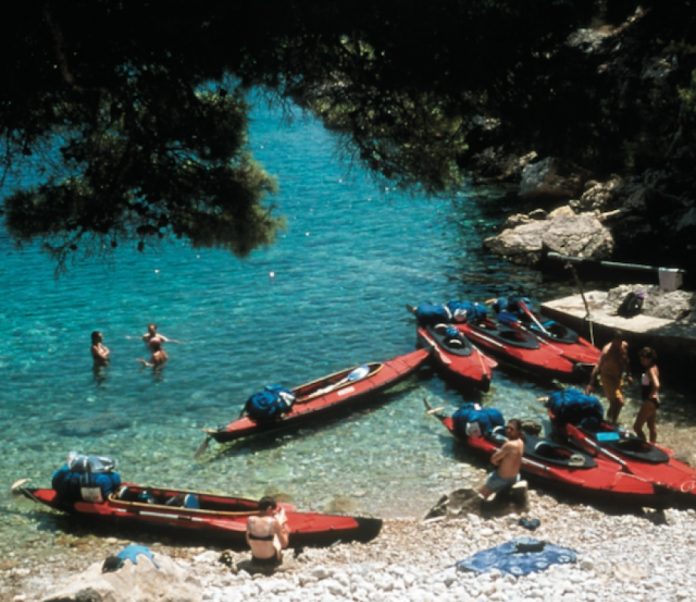
Sea kayaking was not yet popular the last time Croatia was a tourism destination, and today, kayak renting is only just beginning. We brought our own folding touring kayaks, flying into the international airport of the harbour city of Split, Croatia. The boats were to be our camels, carrying water to sustain us between infrequent refills on days reaching 40 degrees C. The Hypalon hull material would cope well with the hard stone beach landings that we would find everywhere. The boats’ lack of speed was only a minor sacrifice.

Split is the largest settlement in the north of Dalmatia and a good place to fly to because you can almost jump from the plane to the water. Thanks to the ferry service, we saved our strength crossing the 19 kilometres to the island of Brac. Our muscles were better used paddling out in the islands, far from the motorboat traffic.

Brac has the steepest shores of the Dalmatian islands, formed by a singular white stone. For centuries, the stone of Brac has been highly valued by masons. The Berlin Parliament, monuments in Vienna and even parts of the White House are made from the bricks of Brac.

You can easily get into wild areas along these islands, spared from crowded shoreline housing by the absence of roads. Camping is permitted along the shore, even on private beaches as far as three yards above sea level.

A day of leisurely paddling passed and a tiny inlet welcomed us for a quiet, mosquito-free night—no tent required, although the stony ground is a bit harsh. We ended the day with an evening bath in the sea, which often reaches 27 degrees C.

The crossing from Brac to the neighbouring island of Hvar only takes an hour by kayak. But we had some novice kayakers along and rode the ferry instead. The ferries among these islands are as common as bus service and a tempting option for lazy paddlers. We saved face by claiming our friends’ inexperience as an excuse.

Hvar is the longest island on the Adriatic Sea, and it’s not very developed. You’re even likely to find deserted houses, which our guide, Tome, told us were probably Serb summer homes. “They don’t dare come back,” he said. His statement could only come from a Croatian, for we cannot imagine having war on the mind in these paradisiacal surroundings.

Where the ferry stops in the town of Stari Grad, we left our kayaks with no worries of theft and hopped on rented mopeds to visit Hvar’s eponymous capital. Although it’s less than an hour by scooter, the town is on the opposite, southern coast and would have been more than a day by kayak, around the distant promontory of Cape Pelegrin. We motored over the middle of the island past fields of lavender protected by stone walls, with views of open sea to the horizon.

In the town of Hvar, we found a fine spot with a plaza looking like a small version of Venice’s Piazza San Marco—a sign of Croatia’s history as a colony of the Venetian Republic. A newer attraction of the town is its clubbing, which is renowned all over Europe. 

Clubbing is something that you certainly won’t find on the third island, Korcula. Like Hvar, Korcula is the name of both an island and a town. The bora started blowing the same day the ferry dropped us at Korcula’s quays. The 35-knot wind kept us from paddling for two days, so the town kept no secrets from us. We had time to learn that the locals are proud of the town’s claim as the birthplace and early home of Marco Polo, though history often records his provenance as Venice. Meanwhile, our kayaks, left at the foot of the town’s ramparts, provided housing for a cat and its brood that were not so happy when the time came for us to leave.

Our trip of 15 days gave us plenty of time to tour the sights as we paddled the rugged, arid-looking coast down to Dubrovnik. We would sometimes stop at seaside restaurants where the owners were happy to fill our jerry cans with water and give us a break from our usual fare by serving local cheese, a type of ham called prsut, and fruits and vegetables fresh from the market. And we once saw two dolphins, a rare occurrence along this coast where colonies of German naturists are the more common mammalian life form.

The “pearl of the Adriatic,” Dubrovnik is a bigger town than Split and Hvar and is a gem indeed. Attacked by Vikings, Turks, and more recently Serbs, it is now the tourists that overrun its streets, churches and ramparts. You’re best to get an early start to explore, taking to the gleaming white streets at 6 a.m. You walk along the tiny, deserted lanes of the old town, pass matronly ladies tak- ing sea baths in the harbour, and reach the ramparts where you look out at the Adriatic in the rising sun.

This is the old face of the Dalmatian Med, made over as a kayaker’s paradise.

Guillaume Fatras is a freelance writer, photographer and former whitewater slalom kayaker based in Lyon, France. 

akv3i4cover.jpgThis article first appeared in the Fall 2003 issue of Adventure Kayak Magazine. For more great content, subscribe to Adventure Kayak’s print and digital editions here.
Rock the Boat: Strategies to Score

Illustration: Scott Van de Sande
Rock the Boat: Strategies to Score

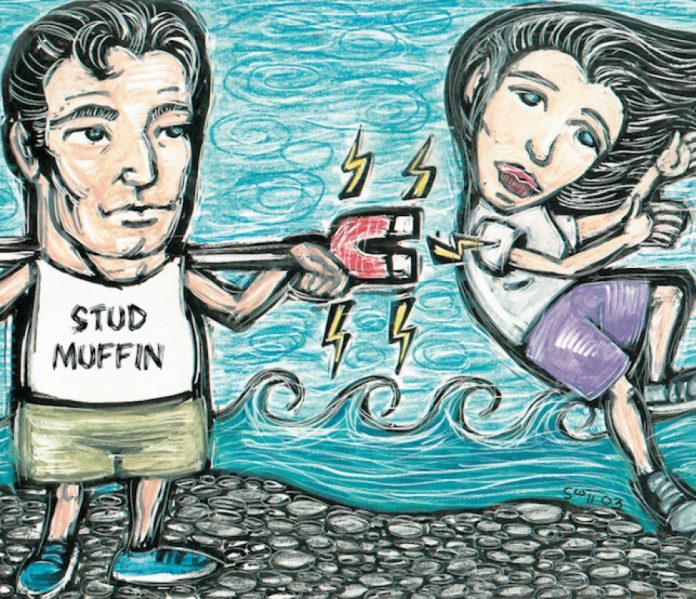
The primary goal of any guide worth his or her salt is to keep clients safe. The second goal is hooking up with someone on the trip. Most companies have strict policies regarding guides dating customers: generally it is mandatory to share all juicy details with the management and other guides in order to ensure an accurate tally of the season’s totals for each guide. As with safety procedures, it’s vital to document the best methods and pass them on for the professional development of our colleagues. Many varied strategies to score can be employed, some subtle, others less so:

1. Strive for consistency. If at all possible, you should try to kiss the girl for the first time in the same (geographical not anatomical) location on every trip. This way you’ll never have trouble remembering where that “perfect first kiss” hap- pened with every client over several seasons. What if she comes back next year? You may think that you’ll remember, or that it won’t come up, but the inability to accurately recall this salient detail can derail any possibility of repeat business.

2. Keep notes. Palm Pilots are excellent for this purpose, and they make you look professional and organized. It may appear as if you’re checking the guest list for any possibly dangerous food allergies in the group while you are actually seeing when Trish/Cindy/Whoever was born. This way you know you’ll be right when, on the first night beneath a spray of stars, you shyly ask her if she’s a Virgo. Yes? “Ah,” you smile ruefully and quietly say. “I knew it just by watching you.” Point out her constellation.

3. Increase your odds: eliminate competition. The greatest risk may appear to be getting “shot down.” Incorrect—the greatest risk is your guiding partner scoring while you remain solo. If you are working with another male guide, and he has a significant other, always go on and on about how much you like his mate. It doesn’t matter how briefly you met this person (if at all), or how little you know her, just keep nattering on about how special she is and how lucky your fellow guide is. Expand on how you would love to be able to be in a stable relationship like your coworker; how lucky they are and how you can’t wait to become best friends with his girlfriend. Do this in front of the group. Do it often. This will go a long way to dissuading your partner from hitting on anyone, leaving the field open to you, with the implicit threat that you would sing like a canary should he even flirt with a customer. It also sends the mes- sage that you are a sensitive guy looking for a relationship while he is a cheating, lying scumbag if he doesn’t appreciate the great girl that you have incessantly harped on about.

4. Play one romantic prospect against another. Once you have acquired your primary target, you will be surprised how flirting with one customer may egg another one on. You are the guide, and as such the alpha male in the group. Try to bag both. Don’t underestimate the power and illusion of alpha-maledom. It can gloss over otherwise glaring faults, like chronic emotional immaturity, insensitivity and low intelligence. Believe me, I know! And remember you only have to maintain the act for five to ten days, max. Anything beyond these performance limits virtually guarantees recognition of your real worth. This is bad.

5. Plan and then create an emergency. Staging your own crisis is the only way to ensure that you will be prepared, react swiftly and effectively, and impress everyone with your cool self-possession. This is a turn-on for women. If the company policy is for customers to share in the cooking while on the trip, wait until your target’s breakfast day. The night before, bleed all the propane from the camp stove. In the morning when Chrissy/Tracy/ Whoever tries to start her breakfast for the group, she will be horrified to find that the stove isn’t working. She will be stressing out big-time. Suddenly you are there. In seconds you seem to have somehow prepared pre-cut dry wood for a fire, the grill is in your hand. The crisis is manfully handled, the breakfast is cooked, she is indebted to you for saving her bacon, and she is impressed. You are so prepared!

Sabotaging the rudder on a boat is an easy way to spend a few minutes rescuing her. She’ll be thrilled with you having just the right-sized tool. If she is really hot, you may even consider putting a hole in her boat. Get swimsuit pictures and her panties and your boss will understand. It is a great system.

6. Stage a party for the night the trip ends. Guiding companies like to have guests all stay in a hotel in the nearest city on the final night of the trip. Let it slip that you and the other guides have planned a private party.

“Where’s the party?” someone will ask.

“Oh, sadly it’s not here in the little port town,” you lament, “but back in the city, in the lounge of hotel X.”

“But we’re staying at hotel X tonight! Your boss booked us all in there.”

“You’re kidding! We asked him to book us a place for the party. He must have done both at the same time.” Happy days! It was meant to be. Funny how life works out sometimes.

7. Get dressed up. When you get to the hotel, go from rugged outdoorsman to sleek well-groomed urbanite. Shave. You will be much better dressed than everyone on the trip. Be as confident and as in-control in this setting as you were on the water (it’s only one night, you can do it). Keep the lounge permanently booked. Christen it “Hotel L’Amour”….

Alex Matthews lives in Victoria with Rochelle Relyea, who picked him up on a kayak trip. He hadn’t had a date in years. She thinks that it’s adorably cute that he would even try to write an article about scoring with girls. 

akv3i3cover.jpgThis article first appeared in the Summer 2003 issue of Adventure Kayak Magazine. For more great content, subscribe to Adventure Kayak’s print and digital editions here.
Put Out That Fire: The Case Against Campfires

Photo: Scott Card
Put Out That Fire: The Case Against Campfires

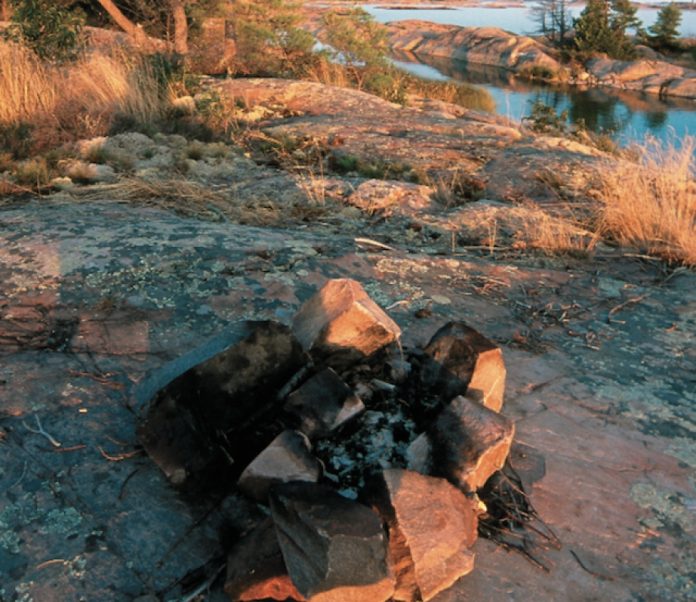
Amidst Canada’s vast wilderness playground of trees, rocks and water, it seems incredible that our cozy, marshmallow-roasting campfires could have an impact. Unfortunately, campfires are among the most damaging practices in the ecosystems we escape to when we go camping. Fires deplete topsoil nutrients, scar the ground, pollute the air and introduce a risk of forest fires. 

Campfires have a significant impact because there is very little topsoil on the scenic rocky coastlines of popular paddling areas such as Ontario’s Georgian Bay Islands. What little soil there is comes primarily from the decomposing wood of fallen trees, branches and leaves. The removal of deadwood for fires removes the nutrients available for plants.

Fires have also left scars on the rocks of many beautiful campsites. When I was a graduate student in archaeology, I learned that the signs of fire—be they carbon deposits on rocks, layers of ash in the soil or rock heat fractures—are among the longest-lasting markers on a campsite, remaining visible for thousands of years.

Sand will also hold a fire trail for future campers to find. Sand will melt or scar, and on popular beaches the sand is full of unburnt and partially burnt wood. Unless the fire is below the high-tide line, turning the sand under only hides the fire pit until someone tries to build a sandcastle there.

Fires also emit a lot of particulate matter. The air pollution from campfires mimics the smog of city air that so many of us are trying to escape when we head out on a kayak tour.

The risk of forest fires is almost too obvious to mention, but still a very important reason to forego the evening blaze. I recall paddling along a wilderness shoreline and smelling smoke—not directly from a camper’s fire, but pouring from the ground 50 metres away from an old fire pit. The fire had travelled through the tree roots below the fire pit. The firefighters who eventually subdued this blaze said such root fires were all too common.

Combine the potential impacts of fire with the increase in the number of people camping in an ever-shrinking wilderness and the results are obvious. In many parts of the world, fires have been banned due to limited wood supplies and heavy recre- ational use. In Canada, we are fortunate to be self-regulated with the exception of fire bans during extremely dry weather. To continue enjoying this freedom we must minimize or eliminate our fire use.

Doing without fires is simple. For cooking, camp stoves are easy to use, reasonably inexpensive and far easier to control than a campfire. Plus, your pots stay nice and shiny.

Once you get used to camping without fire, you’ll wonder why you ever bothered to spend hours of your precious vacation collecting deadwood. You’ll use that time for swimming or just relaxing. You’ll see the stars much more clearly and enjoy north- ern lights, sunsets and the serene change from dusk to dark. And when looking back at a campsite you’ve left, you’ll feel good to see no evidence, not even a fire ring or scar on the rock, to mark your stay. The next camper can enjoy the pleasure of feeling like they’ve discovered the place for the first time.

But if you must…

  • Use an existing fire pit if available.
  • Build beach fires in sand or gravel below the high-water mark.
  • Better yet, use a fire pan that you carry with you—essentially a piece of sheet metal with the edges turned up to contain the ashes. Place the pan over a bed of sand about 5 cm thick on top of solid rock, or perch it on top of smaller rocks.
  • Always keep your fires as small as possible—20 cm across for cooking.
  • Use small pieces of wood and use only dead, fallen wood.
  • Burn your fire completely so you have minimal ash and charcoal left over. 

Jonathon Reynolds is co-author of Kayaking Georgian Bay and The Soft Paddling Guide. He and partner Heather Smith own and operate Nomadic Adventures. 

akv3i3cover.jpgThis article first appeared in the Summer 2003 issue of Adventure Kayak Magazine. For more great content, subscribe to Adventure Kayak’s print and digital editions here.
 

The Garden of Annie: Paddlers Paradise in Tofino

All photos: Josie Boulding
The Garden of Annie: Paddlers Paradise in Tofino

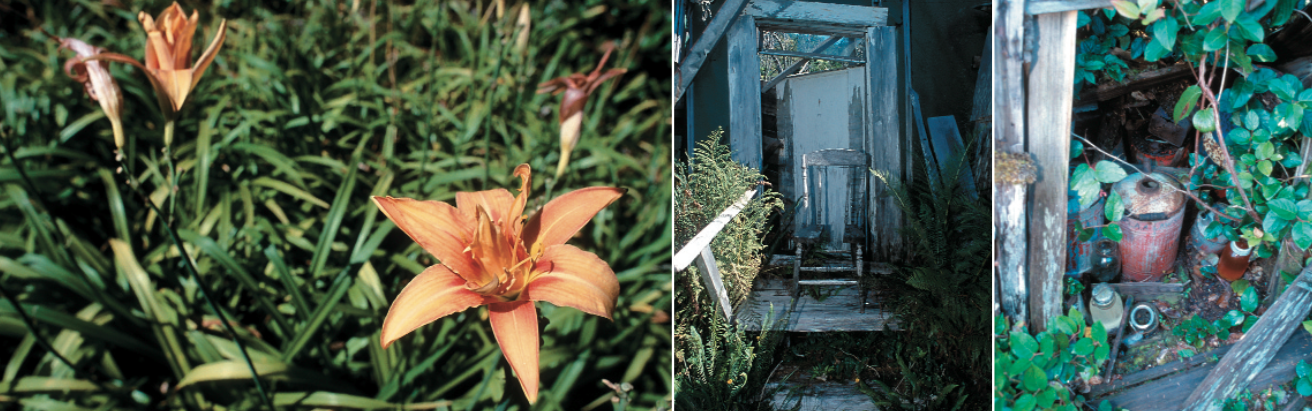
On Vancouver Island’s West Coast, stories grow as fast and tall as the fat red cedars and amazon Douglas firs they’re told under. The characters grow larger than life and their feats beyond human. Take the tales of Cougar Annie, who is rumoured to have shot a cougar one-handed, dealt with more than one husband by force, withstood the shelling from a Japanese subma- rine and cultivated a garden of exotic plants amidst the wild coastal rainforest. Tall tales indeed, except these stories are true. Cougar Lady really did earn her name from her ability to dispatch meddling big cats and black bears and she made a life and a horticultural career for herself far from civilization in an environment where it rains almost every day from October until April. 

So says Margaret Horsfield in her book Cougar Annie’s Garden. By the time I finished reading the introduction I was inspired to visit the storied garden and see for myself if the rumours were true that after years of neglect, Annie’s exotics were blooming once more. 

So I planned a seven-day kayak trip. Beginning in Gold River, a remote West Coast logging town deep in Vancouver Island’s Nootka Sound, I would make my way to the exposed outer coast, paddle south around the noto- rious headland of Estevan Point to Hesquiat Harbour and visit the famed garden at Boat Basin. Then I would zigzag my way further south through the forested islands of Clayoquot Sound to the resort town of Tofino. On the way would be plenty of solitude to give me a taste of Cougar Annie’s life on the edge.

At the docks in Gold River, I loaded my gear aboard the Uchuck III, a former World War II minesweeper that now runs goods and people out to the coast’s remote lodges, homes and camps. With my kayak on board, the Uchuck motored west through the channels leading to Vancouver Island’s outer coast. The forested mountain- sides opened up to reveal snowcapped peaks behind them, fishermen fighting salmon and the odd curious

gaze of a sea lion or seal. Nearing the Pacific, the boat began to roll on a light swell. The Nootka Lighthouse appeared, marking the southern tip of Nootka Island and the entrance to the mouth of the sound. The Uchuck docked nearby at the historic coastal village of Friendly Cove. Today the settlement contains little more than a church, a graveyard, a single house, derelict foundations and a fallen totem pole. It is the landing site of Captain James Cook, the first European to set foot in B.C., and once an important summer residence for the local Mowachaht people. That was back when there were thousands of First Nations spread along the coast in pros- perous communities, and the way it was in 1915 when a woman named Ada Annie Rae-Arthur arrived on the coast with her husband Willie for a clean start and a new life.

The drug problems of today’s Vancouver were problems 90 years ago, and Willie was addicted to the city’s opium dens. The community of Boat Basin, a full day’s travel from Tofino, was remote enough to be free from temptation. Like few others, Annie stayed long enough to witness the decline of the Mowachaht. Until 1986, long after her neighbours had dwindled to none and she had gone blind, Annie stayed at her garden, not leaving for years at a time. She spent 70 years out here; I would spend seven days.

Icrossed the channel from Friendly Cove to the southern edge of Nootka Sound with the waves splashing at my side, glad to be alone on the ocean. I felt like a coastal explorer, with empty beaches, wave-washed cliffs, crashing surf and dense forest on one side, and open ocean, the odd sea otter, seals and sea birds on the other. I made camp at one of the many white sand beaches. Wolf, deer, and bear tracks dimpled the sand in lines that disap- peared into piles of bull kelp. I expected to see hand-sized cat-tracks too, here on Annie’s turf.

Screen_Shot_2015-07-21_at_1.19.46_PM.png

Cougar hunters were held in high regard amongst the pioneers of old, and Annie was the big-cat hunter’s queen. The animals were regular visitors to her garden, and she is reputed to have trapped and shot 70 to 80. Sometimes she would bait them with young goats; other times she would find them treed. She even shot them one-handed in the dark. When she heard the traps snap at night she would check them with a lamp in one hand and a gun in the other. Despite failing eyesight, she never missed a shot.

Annie’s cougar hunting was a profitable business— cougars earned bounties until the late ‘70s, plus there was always demand for hides. Annie was never one to miss a chance to make money—she also sold bulbs and plants from her garden and tended a store and post office. The exotic shrubs, bulbs, fruit trees and flowers Annie culti- vated were not adapted to this rainforest climate, yet her plants flourished and found buyers as far away as Manitoba.

The next stage of my journey took me around the headland of Estevan Point into the protected waters of Hesquiat Harbour and Boat Basin, Cougar Annie’s home. Estevan Point sticks out of Vancouver Island’s western profile like a pimple on a teenager’s face, bearing the brunt of every storm. It also bore the brunt of the only military attack on Canadian soil in recent history. One day during World War II, Annie spotted a submarine in Boat Basin. That night it opened fire on the Estevan Point Lighthouse. Shells were found all over the area for 30 years. Canadian military officials played down the attack, but everyone assumed it was a Japanese submarine.

Puzzling to many was, and is, why the Japanese would sail across the Pacific to attack a lighthouse in the middle of nowhere. Conspiracy theorists argued that it was actually an American submarine, that the States bombed their ally to keep Canada’s resolve firmly in the war. 

Luckily I had calm conditions for paddling around this proboscis-shaped war zone into Hesquiat Harbour. Boat Basin lies at the harbour’s far end. I camped on a long, curving stretch of sand scooped out of the backside of Estevan Point, one hour’s paddle from the garden. I fell asleep that night trying to picture the garden and imagine what I would find the following day. I woke early with a nervous anticipation usually reserved for competitions and first dates. I packed, and tore up the four knots to Cougar Annie’s in record time.

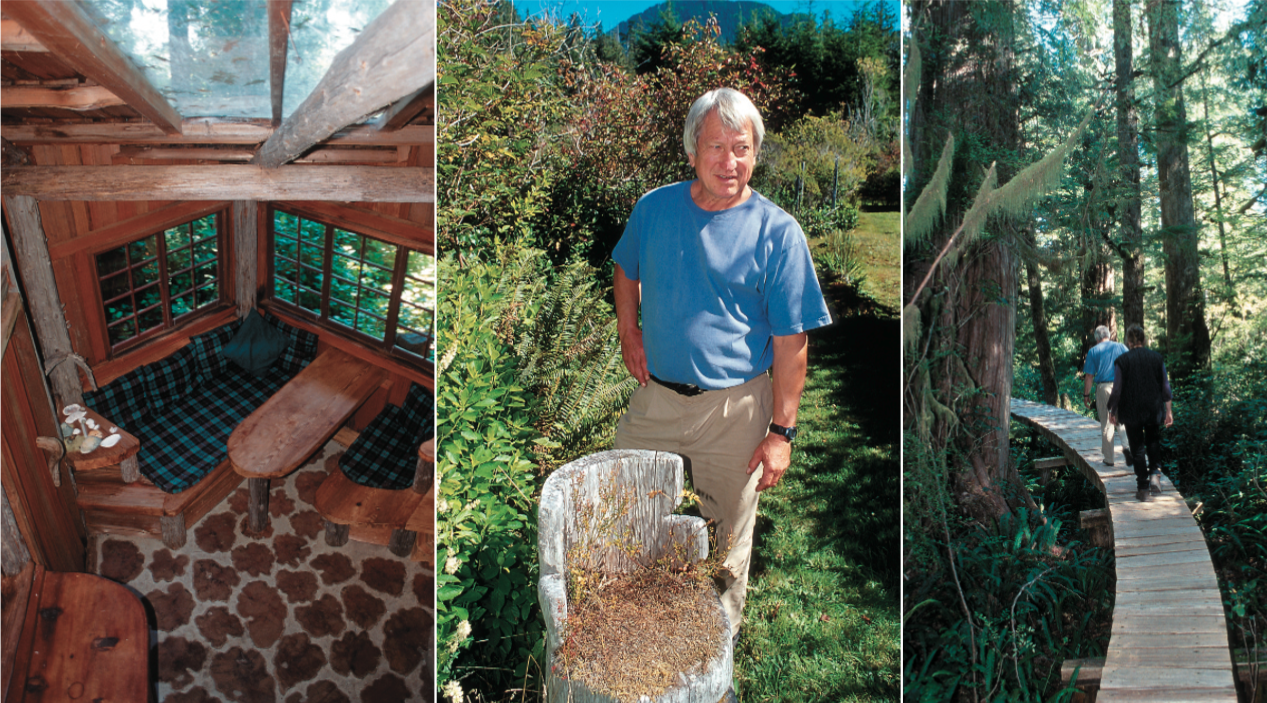
A new boardwalk leads from tidal water through a cedar swamp and up a short hill to the garden. Once only a rare few stopped here, but the garden is becoming famous. Float planes and sightseeing boats now drop in with tourists. But I was the only one around in the early morning hours this day.

I marvelled at the small room that was a post office and store. I walked down plant-lined boardwalks that beckoned me farther into the garden. I gazed in awe at the size of some of the old-growth beams and boards used for building. My eyes were distracted by the hundreds of exotic shrubs, trees and flowers blooming in pocket gardens. Wind whispered in the trees and bugs and birds hummed their tunes. And I was reminded of Annie’s reputation by the rusty traps hanging from trees.

One building, sinking into the ground, was obviously Annie’s home. I looked inside the one-room house. “Eleven kids,” I whispered. Over 70 years Annie raised 11 children and had four husbands come and go—either by death or desertion. After Willie died, Annie advertised for a husband alongside her nursery ads in two western- Canadian newspapers. George Campbell was one of those who replied and came to live at Boat Basin. Evidence suggests he beat Annie, and, not long after arriving, Campbell died suspiciously of a gunshot wound. Annie’s explanations varied between “it went off accidentally while he was cleaning it” to “it went off accidentally when he threatened to kill me.”

Screen_Shot_2015-07-21_at_1.18.54_PM.png

In Annie’s early days the area was busy with a thriving aboriginal, missionary and immigrant pioneer com- munity—enough to make a store and post office viable. Later on, Annie’s only customer was herself. Somehow she was impervious to the multiple forces that drew everyone else away. Today the only residents are a few Mowachaht at the remote reserve on Hesquiat Harbour’s northwest shore and Peter Buckland, who lives full-time at the garden.

Buckland was no stranger to life on the West Coast. He built a small prospector cabin close to Nootka Sound and spent his share of alone time there, whenever he could get away from his law profession in Vancouver. In Annie’s later years, he visited the garden to help out. He stayed for as long as he could spare before returning to his practice in the city.

In 1987, after Annie’s death, Buckland bought her homestead, moved in and began rescuing the garden from the encroaching forest. Partway through my visit I bumped into Buckland, a handsome grey-haired man of the woods. He was friendly and welcoming but not in a “tell all your friends to come here too” kind of way. He just seemed glad to have someone to chat with for a few minutes while pointing out the sights with his work- worn hands. I complimented him on the state of the gar- den, the flowers blooming, the orderly paths and under- control shrubs and trees.

“I practice what I call chainsaw gardening,” he said. Using a chainsaw, axe and machete as gardening tools, he has been reclaiming the former garden. Under the salmonberry and salal, he found the garden struggling to survive. He discovered the fruit trees still bore fruit and most of the shrubs, perennials and other flowers still bloomed despite the heavy cloak of the intruding forest. After 15 years of hard work he still turns up forgotten sections of garden and the plants hidden in them.

Buckland has built himself an incredible abode from the surrounding forest and he plans on being here for many years to come. He has built new cabins, constructed two kilometres of boardwalk and opened the garden to the public. He recently turned the garden over to the not-for-profit Boat Basin Society to ensure its preservation. For the cost of a $50 Society membership, anyone can come to the garden, wander through the oasis protected by towering stands of fir and cedar, and contemplate the tenacity of two modern-day pioneers.

What Cougar Annie and Peter Buckland had done inspired me. I had commitments back home and packed up to head for Tofino, but I was already working out a plan to come back and carve a living for myself out of the coastal rainforest. I paddled south and pulled up on a pocket beach for the last night of my trip, eyeing the forest for a spot to build a cabin and set up a garden as I unrolled my sleeping bag on the sand.

Sleep came easily but during the night I woke to the breaking-twig sounds of an animal hunting in the dark. I stayed awake nervously waiting for a cougar to pounce and shred the few layers of nylon that encased its next meal. A quote from Horsfield came to mind: “When you shoot a cougar, sight fast and aim for its chest. That way you’ll hit the giant cat’s heart,” Annie advised a newspaper reporter in 1957.

I didn’t have a gun but I did have a knife. In a sleep-deprived lunacy, I grabbed my headlamp and the knife, took a deep breath, and turned to face the cougar. Two red eyes flashed in the bush, then turned and ran. With a sharp dose of reality my fears dissolved, but so did my dreams of a life in the bush. Like many before me I realized that it takes a rare type of person to make it out here. I woke the next morning and, like the mouse that had disturbed my slumber, high-tailed it home.

When he’s not exploring the mountains and shores of Vancouver Island, Ryan Stuart lives, writes and enjoys human company in Courtenay, B.C.

akv3i3cover.jpgThis article first appeared in the Summer 2003 issue of Adventure Kayak Magazine. For more great content, subscribe to Adventure Kayak’s print and digital editions here.
Editorial: Stand Up and Save Our Rivers

Photo: flickr.com/albertoog

On my way home after a surprising low-water spring run on Ontario’s Upper Black, I stopped at the Sandman Inn and Restaurant for coffee. The only thing keeping me awake was thinking about how I was going to explain the fist-sized dent I put in the bow of Andrew’s new open boat. I suppose I could have been more to the right going over the drop, but where was the spring run-off that usually makes this class IV falls a clean run?

We ran out of water at our house this past winter. A dry fall and no mid-winter melt must have lowered the water table below the reach of our drilled well. Melting snow on the wood stove for tea is romantic at first, but after months of lugging around five-gallon jugs, the Little House on the Prairie feeling quickly dries up.

In North America we use an average of 1,400 gallons of water per capita per day. Industry and agriculture suck 90 percent of this, but still, each person carries 28 five-gallon jugs of river into their home each day. We didn’t require this many jugs of course because in Quadeville you can still slip into your Sorels and piss off your front porch. Not everyone is so lucky.

Back behind the wheel, coffee in one hand and dicta-phone in the other, I began brainstorming the framework for the next national environmental campaign: Stand Up and Save Our Rivers—the instal- lation of urinals in every household.

It might be slow to catch on, like Blue Box and composting, but soon urinals would make it into every home.

It would become a political issue of course and one sure to pass—what man would vote against mandatory urinal use?

My favourite: If “urinal” not part of the solution, you’re part of the problem.

No more “leave it up or down” domestics, and think of the water we’d save. Water that would flow in our rivers. Water that would have cushioned my landing and saved the bow of my borrowed boat. I was sure that I was onto something, but like all credible green movements I needed some statistical research to support my campaign.

There are roughly 330 million flushers in the United States and Canada and 50 percent of those are men using, on average, five gallons per flush and five flushes per day. North American men flush a grand total of 4.1 billion gallons per day. Now, let’s say that four out of five of these 4.1 billion gallons could be urinal-based. Using only one gallon per pull of the stainless handle, men alone would save 3.3 billion gallons of water per day.

Dividing per-day use by hours, minutes, seconds and converting gallons to cubic feet, it works out that by installing urinals in every home in North America we’d prevent a staggering 5,812 cubic feet of water per second from flushing into our sewers. That’s the equivalent of five Ocoees, one and half Frasers and six raging Upper Black Rivers flowing day and night, 365 days a year.

So you see Andrew, it’s not really my fault. If this urinal thing had caught on five years ago, there would have been plenty of water that day and I wouldn’t have dented your boat.

Screen_Shot_2016-04-19_at_2.23.46_PM.pngThis article first appeared in the Summer 2003 issue of Rapid Magazine.
 

Big Tips for Big Drops

Photo: Scott Harding

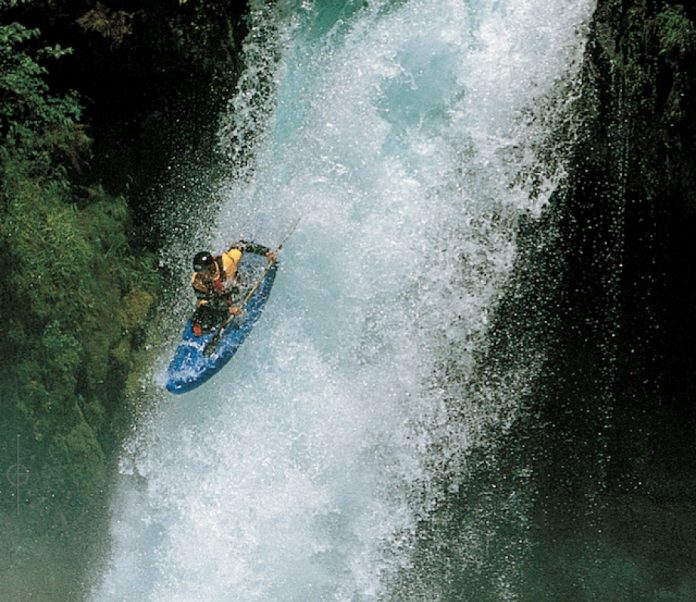
Your goal when running big drops is to find the entry angle that will keep your back and body safe from impact but not hit any submerged rocks or the river bottom. The best way to learn to run waterfalls is to start off on smaller, relatively safe drops and work up to harder and bigger. The higher the drop, the more likely you are to want to pencil.

Pencilling is when your boat pitch matches that of the falling curtain of water and you drop into the pool vertically, rather than flat like a boof. It will take time and practice to confidently line up, launch and safely land big drops, but what feels at first like a big blur will soon become familiar and slower. You’ll develop the consciousness to open your eyes, make fine adjustments and enjoy the ride. 

SCOUTING THE DROP

You should be scouting and running safety for all big drops. Look through the whole drop to see if there is any one part that is obviously unrunnable. If this is the case, begin hiking around or decide if you can either put in just below or get out just above the nastiness.

Be sure of your landing zone and that you can hit it. A safe landing zone is often the reason a drop is runnable or not.

Generally, the more aerated the water the higher you can get away with landing flat. Is your landing big, foamy and soft or is flat, green and hard? Is it too high to boof?

How deep is the pool? Is it deep enough to pencil? The best way to find out is to actually go down and check with a pole or a big stick, or even get into the water and look around. However, this is not always realistic and is rarely necessary. With practice and experience you will be able to roughly gauge the pool depth and location of rocks by looking at the foam pile and boils. Another good way to know for sure is to check when the water’s not flowing and return the next season or, in some cases, the next day when the dam releases.

What other dangers are there? Often wood and other debris will collect in the pool below large waterfalls. On sheer drops the river may not only pound away and erode the base of the falls but also the wall behind it creating a cave hazard. Be sure that you can

either get out from behind the falls or be positive you will finish on the downstream side.

Consider the water depth at the lip of a drop. If you barely scrape over the lip of a sheer drop, it is very easy to get hung up and go over vertical, not so gracefully flopping your 30 footers onto your head.

Be sure you’ll see your intended line from your boat at river level. Use whatever landmarks are avail- able: bridge pilings, tiny breaking waves or even a friend standing by running safety. Many paddlers (even good ones) have, in the excitement, quickly scouted a drop from shore, hopped in their boat and totally lost sight of a perfect and relatively simple line.

OFF THE LIP

To pencil off a big drop, go off at roughly the same speed as the water using only smooth correction strokes to keep the boat on line. Carrying a lot of speed off a drop may launch you ahead of the water and free of the falls, and maybe over the hole or a rock at the bottom, but it makes setting your pitch far more difficult. You want your boat to fall off the brink,

match the pitch of the water and enter the pool at the same angle as the falls.

For the most part, your body position at the brink of the drop sets your angle for the rest of the ride. Keep your body relatively neutral, leaning neither too far forward or back. On the way down, pulling your legs to your chest will cause the bow to rise and your boat to flatten. Conversely, pushing your legs away will drop the bow or cause the boat’s pitch to steepen—become more vertical. 

These sound like great tricks but in reality are very difficult and take lots of practice.

What to do with your paddle? You do not want your paddle at the same level as your face or neck when hitting the water. Some boaters put their paddles to the side, parallel to the boat, and tuck their heads at the last minute. Others simply keep their blades low around their hips. Avoid the ever-popular and danger- ous skull and crossbones. Throwing your arms above your head leads to: losing at least one hand from the paddle; getting slammed to the back deck; and likely damaging a shoulder.

TOUCHDOWN

Where there is even the slightest chance of hitting rock, using anything other than a creek boat is asking for trouble. Creek boats will by no means make you invincible but are far better equipped to protect you and make the lines you choose easier to hit.

Lean forward as you pencil into the pool. This helps stop the boat from back looping and sheds some of the impact of the fall from your body.

Accidentally landing too flat? Lean forward to help protect your back. And reach for a stroke upon landing to help you move downstream away from the curtain. When landing inadvertent big boofs, turn your head to help you steer clear of a broken nose compliments of your cockpit rim.

Be comfortable surfing in holes. Playing and practicing in holes makes for a fast and bomber roll, teaches you how to manoeuvre and more importantly how to get out if that’s where you end up. 

PRACTICE AND JUDGEMENT

Running big drops is a lot of fun but takes practice and good judgement. There are as many ways to get into trouble as there are ways to run waterfalls. Take rescue courses and always paddle with like-minded boaters whom you trust.

If you cannot set up adequate safety for a big drop, don’t run it. Remember, there is no hurry. The waterfall you are so intent on running today will be there to run next season, or the next. 

Screen_Shot_2016-04-19_at_2.23.46_PM.pngThis article first appeared in the Summer 2003 issue of Rapid Magazine.

 

Northwest Territories’ Highway of Waterfalls

Photo: Keith Morrison

Open a northern tourism brochure and there they are, along with pictures, heights and distances to the nearest city hall. Eleven waterfalls just sitting by the road in the Northwest Territories. All within a five-hour drive of each other, complete with parking, camping, toilets and boardwalks to scenic overlooks. Drops ranging from three metres to 33 metres. And only three had ever been run.

That left eight first descents, something that my pal Stu and I were determined to change. Out of money and with nothing to paddle all winter, we hatched a plan: Run them all, smallest to largest, with me learning as we went. We would get famous bagging the first descents, maybe even make some money. It was a plan bred of desperation and boredom. By the time it collapsed around us, my good friend Stu would be forever one centimetre shorter.

I’d learned to paddle on the Slave and the Ottawa Rivers and was pretty comfortable with churning masses of foam and two-storey waves. My “local river hero” mentality got a bit of a shock, however, when I went to B.C. and paddled rapids that didn’t have ten-metre-wide lines down the middle or monster eddies at the bottom. It was then that I realized I couldn’t creek for balls and, much to my regret, had never run a waterfall. Fortunately, Stu was quite the opposite, a true B.C. paddler. He knew steep and he knew continuous and he was willing to teach me.

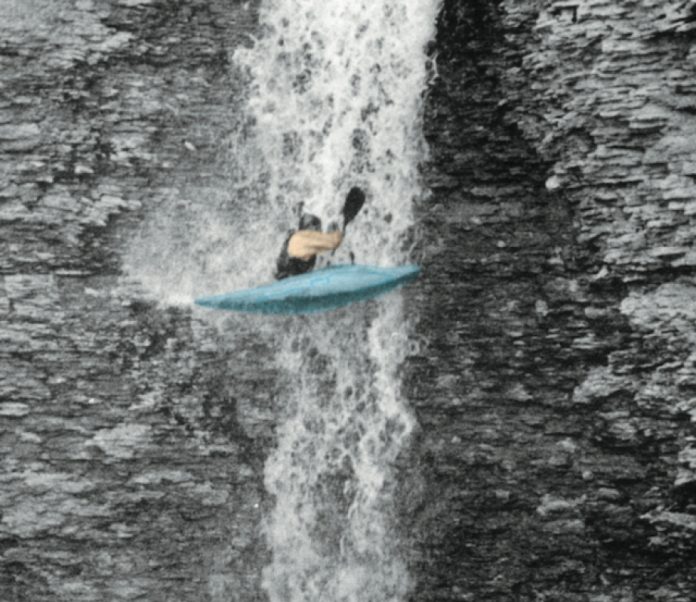
By June the water was running and we were on our way up north. Stu took the opportunity to bring me up to speed on the fundamentals. He explained that you can go at drops in two ways: boof them or pin-drop them. Boofing involves landing your kayak flat or at a slight angle to the water. The term “boof” comes from the sound that the bottom of your boat makes when it hits the water: “BOOF.” Pin dropping is just that, Stu said. Dropping over the edge bow-first and falling…just like a dropped pin.

What dictates which way you go is a combination of waterfall height and water depth at the bottom. “You don’t want to land anything flat that’s over nine metres high. Imagine strapping a door to your ass, jumping off the high board at the local pool and landing flat on the door. Vertebrae compress, disks pop, things twist, other things snap, crackle and pop—not a pretty thought!” Stu noted that one may even want to reduce that nine- metre rule of thumb if getting on in years or feeling particularly brittle that day.

So why boof at all, I wondered. Well, I learned that boofing requires a lot less bottom depth than does pin dropping. I also found out that it allows you to retain some of your forward speed and gives you more con- trol over where you wind up at the bottom—a good thing if there’s a nasty hole or some obstacle below that you want to avoid.

The first two waterfalls on our list were close to Fort Smith on the Slave River and a logical place to start. While the Slave is renowned for its big water, the east side of the river is laced with small channels and two three-metre waterfalls of note: Slop Drop and Patrice’s Falls. There are smaller falls on the Slave but, to paraphrase Nealy, a waterfall is defined as a vertical fall over 2.5 metres in height. Anything smaller is just a ledge.

Slop Drop and Patrice’s Falls provided a good training ground for Stu to teach me how to boof. I learned how in order to get your kayak to ramp off a waterfall, you need to throw in a strong forward stroke just as you reach the lip. This boof stroke, combined with an upward pull by your knees and a slight forward movement of your torso, causes your bow to leap for- ward and up and initiate the boof. I practiced this stroke on flat water and perfected it on small ledges before hitting the bigger stuff. I learned that the tendency of water to accelerate as it nears the lip of a waterfall will affect the timing of the stroke, and to be ready for this or be doomed to screw up. 

BOUND FOR FIRST DESCENTS

After our successful practice runs on the Slave we set off from Fort Smith on a three-hour drive bound for some first descents. In the process we drove past Little Buffalo Falls on Highway 5, a 12-metre ogre that required technical expertise that I didn’t have, at least not yet.

The highways of southern N.W.T. traverse vast dis- tances between the minute enclaves of iconoclasts that comprise the culture of the North. In this otherwise tedious landscape of tortured spruce trees and mosquitoes, ancient glacial action has created a huge escarpment over which pretty much all the region’s water tumbles. Government engineers bulldozed Highway 1 along the escarpment’s periphery. Tourism marketers named it the Waterfall Route. The road provides easy access to six waterfalls: Louise Falls at 15 metres, Alexandra Falls at 33 metres, the twin falls of Escarpment Creek at eight metres and 12 metres, Lady Evelyn Falls at 15 metres, and McNally Creek. Only Lady Evelyn Falls had ever been run.

Mileposts every two kilometres along Highway 1 mark off the kilometres from the Alberta border. McNally Creek Falls, at kilometre 120, is a seven-metre straight shot only 100 metres from the road. McNally Creek had a lot less water in it than when we had looked at it a few months earlier, but after a dummy run with an empty kayak we deemed it safe and Stu took the first shot. Unfortunately, Stu didn’t take as nice a line as did the empty kayak. He wound up hitting the large flake of rock that dominates the lip of this waterfall and was kicked to the right and rotated onto his side. The landing was brutal and the impact of the water onto the side of his head knocked all the foam out of his helmet.

It was here in my short but dynamic waterfall running career that I learned it is sometimes harder to go second. Assembling all the nerve I could, I charged straight ahead and hit a perfect boof, landing flat on non-aerated water seven metres below. It was also at this point that I coined the term “nut slap” and added it to the list of reasons not to boof, somewhere between compressed vertebrae and popped disks. Insulted ‘nads aside, I was chuffed at having bagged the first in what we were determined was to be a long series of first descents.

We chose to leave the other, more intimidating falls of the Waterfall Route for the end of our tour and explored up Highway 1 toward the Trout River, which crosses the highway at a place called Somba Deh, a territorial campground at kilometre 320. Armed only with a handful of tourism pamphlets, we went in search of Coral Falls, Whittaker Falls and Wallace Creek. 

Whittaker Falls is an ungodly maelstrom that unleashes all of its fury right below the highway bridge and makes one never want to enter the water again. This evil beast is more of a monster slide than a falls and is pumping into a hole at the bottom so big that it ejects jets of water vapour 15 metres into the air. Petrified, we scratched Whittaker off our list.

Fortunately, one kilometre upstream from the campground on a well-worn river-right trail is Coral Falls, a beautiful four-metre drop into a nice deep pool. We ran that puppy ever which way from Sunday, if only to purge our fear of Whittaker Falls by excessively boofing everything in sight.

DARK AND INTIMIDATING

Drunk on the victory of our second first descent, we headed to Wallace Creek at kilometre 290, parking at a small rest area located by the creek’s bridge. A trail on river left leads to the falls, but we opted to paddle the two kilometres downstream, a pleasant class II with two two-metre boofs along the way.

When we got to Wallace Creek Falls we were a little taken aback. On the surface it looked to be no problem, about an eight-metre drop into a deep pool below. But it was hard to judge the height, as the creek dropped from an 18-metre-deep canyon into a 30-metre-deep canyon with overhung walls. Dropped might not be the right word; dribbled was more appropriate. There was hardly any water in the creek and I was reminded of the Bugs Bunny episode with the intrepid cartoon hero jumping off an impossibly tall tower into a tiny bucket of water. 

We fixed a rope into the canyon above and rappelled in with a throwbag to measure the height. Turns out that the falls were more like 12 metres high. Standing at the lip, that glassy, non-aerated water far below looked pretty dark and intimidating.

It’s after these pivotal moments of your life that you look back and wish that you’d properly answered the question, “Am I more afraid of the waterfall or of my friends thinking I’m chicken?” Beside me, Stu’s mind was churning through the same testosterone-laden thought process. We looked at each other. “I’ll go first,” I heard myself say. The idiocy had begun. 

NOT AS FAMOUS AS PLANNED

We fixed a rope below the falls and Stu rappelled down to provide safety and take pic- tures. I gathered my courage, drove myself over the lip and hucked my weight forward, putting myself into the kayaking fetal position with my paddle at my side. I knew that I didn’t want to land this one flat and that not too much could go wrong as long as I went in pointy end first. Eyes closed, I hit the water slightly over-vertical and got immediately ejected from my craft when my boat slapped into the water upside down. I bobbed to the surface with my stomach in my throat, a roaring in my ears and the faint echoes of Stu’s laughter reverberating off the canyon walls. Later, when Stu got the film developed, there must have been ten shots of me swimming around the base of the falls, looking pissed off.

Now it was Stu’s turn. Not wanting to hang up at the lip or over-rotate like me, he put in a bit of a boof stroke at the top. In my slow-motion, frame-by-frame recollection of the carnage, his kayak floated off the lip of the falls, flattened out, turned sideways and proceeded to flutter 12 metres down to the base of the falls. The hull made a hollow “boof” sound when it landed, flat as a pancake onto the black water. 

Two kilometres from the road, 250 kilometres from the nearest hospital, at the base of a 30-metre-deep, overhung canyon, Stu was floating around in his boat with a broken back. We would later learn that it was a compression fracture of the T-12 vertebra, but to Stu at this moment it was a world of hurt. Fortunately, very fortunately, the only damage was to the bone and not to the spinal cord inside.

Stu would have nothing to do with my intricate plans for spinal boards improvised from paddles and kayak bottoms, let alone let me haul him up a 30- metre cliff with jury-rigged harnesses and mechanical advantage systems. In fact, Stu was able to ascend up the rope 30 metres, walk the two kilometres to the truck and rattle down two and half hours of dirt road to the hospital in Hay River.

And to such ignoble ends come the dreams of men. We are not famous as planned (although perhaps infamous in some circles, especially with our girl- friends) and certainly not rich. But I know a lot more about waterfalls. Stu, although forevermore a little less than his original 6’ 8″, was leading 5.10c rock climbs on gear by October. And there are still five first descents to be bagged in the Northwest Territories, just sitting by the road.

Keith Morrison runs the Slave Kayak Lodge on the Slave River in Canada’s Northwest Territories and has spent the past 10 years exploring the nooks and crannies of the Far North. 

Screen_Shot_2016-04-19_at_2.23.46_PM.pngThis article first appeared in the Summer 2003 issue of Rapid Magazine.