Home Blog Page 380

Boat Review: The Cortez by Dagger

Photo: Dagger
Boat Review: The Cortez by Dagger

The Cortez is Dagger’s highest performance polyethylene touring boat. The Cortez is sixteen and a half feet long with a narrow softly multi-chined hull. The deep hull is topped with a slightly rounded deck with little rise in the bow or stern giving the boat an overall pleasing but sausage-like like.

A rudder is standard, along with full deck rigging of thick stout lines. The carrying toggles are burly, comfortable pieces with a clever bungy system to keep the bow toggle tightly retracted against the deck when not in use. This prevents that annoying rattle during transport or in crashing waves.

The compartments store considerably large amounts of gear. One-piece, Sure-Seal rubber hath covers roll on easily and keep water out. The narrow hull allows for only a small hatch in the bow. Anything bulkier than a 5 litre drybag will have to go in the larger stern hatch. The bulkheads are welded plastic and proved to be solid and dry.

Boat performance

Climbing into the Cortez, we note the large comfortable seat. Our bigger paddlers loved the roomy fit but some of the smaller paddlers would build up the hip area and add foam to the thighbraces. The adjustable backband is attached to the boat independently from the seat but doesn’t tighten forward enough to provide maximum lumbar support in an upright seating position. The cockpit is very long allowing for easy entry and exit but also contributes to an awkward forward placement of the thighbraces that take a little getting used too. The rudder cables run close to the leg area, noticeably coming in contact with the legs when working the rudder.

When putting the boat on the water it feels tippy or unstable initially. Paddlers used to wider kayaks may find getting into the Cortez is a little tricky requiring careful balance at first. Fear not, the wobbly initial stability quickly blends with rock solid secondary stability. With a moderate tilt of thirty degrees or so the boat stabilizes comfortably. But don’t stop there…the deep multi-chine hull allows you to confidently tilt the Cortez almost completely on its side making it feel extremely playful. The multi-chined hull reacts incredibly quickly to its tilts. When tilted it spins quickly—responding effortlessly to sweeps. This is by far one of the fastest turning boats of its class. Under power the Cortez carves through turns on both inside and outside tilts making for outstanding performance. Remarkably, the turning performance does not compromise the speed of the boat making it easily the fastest in Dagger’s plastic fleet.

The quick, playful performance comes at a cost to tracking ability. The Cortez weather-cocks almost instantly in the slightest quartering breeze. The weather cocking or turning into the wind is caused by a lack of lateral resistance at the trialing end of the hull—the same lack of resistance that lets the boat turn so quickly. Dagger went out on a limb with this design creating a boat that would always be equipped with a rudder. This way designers could concentrate on an alternate hull formation that performs as a non-tracking sporty day tripper with the rudder up and as a load bearing cargo hauler with the rudder down. The rudder deploys easily with a firm tug and instantly prevents weather-cocking. The rudder stows easily, retracting into a molded groove on the deck. The pedals operate smoothly and run freely on the standard adjustable sliders.

Dagger stepped out of the mold with the hull design of the Cortez. They’ve produced a sporty plastic boat that holds its own as a day tripper, wave surfer, and multi-day touring boat. Dagger markets the Cortez to intermediate and advanced paddlers but it should not be overlooked by the ambitious novice who sometimes prefers to play with tilts and strokes rather than rudders.

Specs

  • Length: 16 ft 6 in
  • Width: 21.625 in
  • Weight rotomold: 54 lbs
  • Cockpit: 19 x 34 in
  • Rear hatch: 17 x 12 in
  • Forward hatch: 10 in round
  • MSRP: $1,995

This article first appeared in the Summer 2001 issue of Adventure Kayak magazine. For more boat reviews, subscribe to Adventure Kayak’s print and digital editions here.

 

Boat Review: Riot Groove C1

Photo courtesy Riot
Boat Review: Riot Groove C1

In 1994 while most of us were paddling displacement hull kayaks Ian Thomson and Paul Danks set out on a long drive to Florida fantasizing about and scribbling designs of a boat that could do more than ever before. They wanted it to be a C1 for the advantage of leverage and the total lack of C1 designs on the market. Four glass prototypes later the C1 Groove revolutionized paddling forever. Thomson and Danks pioneered the distinct planing disk, the clean release principal, hull concavity and the foil or airplane shaped deck coined new moves such as the green grind and the counter clock wheel (cartwheeling towards the pile). Now, seven years later, Corran Addison at Riot has tweaked the original shape slightly and the plastic C1 Groove sits among Riot’s concept prototypes.

What did we think of the Riot prototype? The most incredible plastic C1 ever built! The Groove measures in at 7’9”, is incredibly stable and has a familiar asymmetrical C1 feel. The cockpit is a true C1 racing shape, supporting your lower legs with the top of the deck, ah the good old days. Going from converted kayaks back to a real C1 is a revelation in stability – it’s like it’s supposed to be when you’re sitting seven inches off the water. The hull is twenty-nine inches wide at your hips, producing a planing surface that is almost three feet long and two feet wide. Remember riding those Flying Saucer toboggans? That’s the Groove on a wave, get it going down hill and hold on until you’re dizzy. The Groove has very little rocker and a long water line make it the fastest boat I’ve paddled in years. I enjoyed the simple pleasure of smoking past kayakers on the flats between sets. On a short, steep wave you need to keep this long, fast boat carving or spinning to avoid burying the bow and wide stern. At 165 pounds, I found ends in a hole and on flatwater to be no problem, incredible fast but less stable and smooth than newer kayak designs with more cockpit volume and more symmetrical hull shapes.

Coming from paddling converted kayaks it was pleasing to experience the characteristics that different a yak from a true C1. The Groove is a fast, stable, traditional feeling C1 that spins like a top. The market potential for C1’s is small and whether or not Riot will produce a plastic Groove is unknown. The Groove was so far ahead of its time that even seven years later, if released, it would be the hottest production C1 on any river. If they build it, people will come.

This article first appeared in the Early Summer 2005 issue of Rapid Magazine. For more great boat reviews, subscribe to Rapid’s print and digital editions here.
Single Post BG Template – Background Position Top – How To Rescue A Kayak In Whitewater

Everybody swims—it’s part of the sport, and whitewater kayaking is more of a team activity than we may credit it for. You want to strive to be a strong teammate on the river and know others have your back too. Among essential rescue techniques is the ability to wrangle a friend’s boat, and here to help is Simon Coward, owner of AQ Outdoors (AQ Outdoors is a paddling shop and school with locations in Calgary and Edmonton). The following is a transcript of Coward’s kayak rescue method of choice.


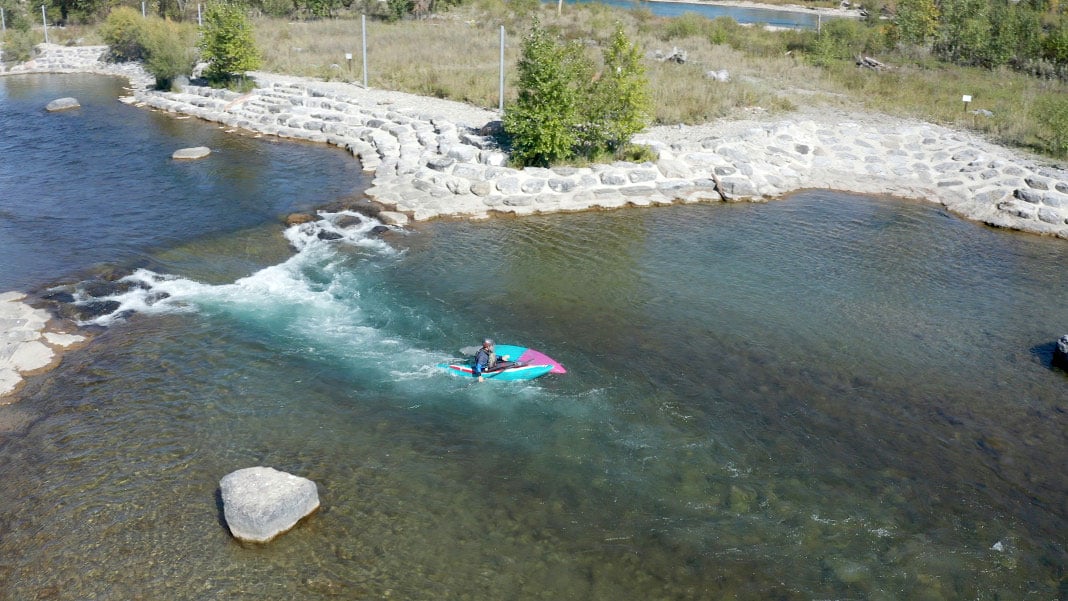
paddling out of the eddy to reach the kayak in the rapid
Timing your rescue to meet the kayak at the bottom of a rapid. | Image: AQ Outdoors

How to perform an effective kayak rescue in whitewater

Simon here from AQ Outdoors, just checking in with a little tutorial on some best practices and the easiest ways to rescue kayaks. Over the last 20-odd years of teaching and such I’ve made lots of mistakes, I’ve learned from others, and I’ve seen others make mistakes, and some do really great rescues.

Basics of rescuing a kayak

This is very much about how to keep it as simple as possible. We’re going to start in flatwater how we might address this. My personal preference is to not clip the boat and to get the boat upright as soon as possible. If I get the boat upright and it has float bags in it, it’s much easier to manipulate—whether you’re clipping it, pushing it or bumping it. Ideally we want the boat upright and empty. It’s very easy to rescue at that point but you don’t always get that good of a bounce, well we usually don’t because people are usually upside down.

[ Paddling Trip Guide: View classes at AQ Outdoors ]

After someone swims, the boat is going to be upside down and have a bit of water in it, right, so with this, the most common way I see people try and right the boat is essentially to lean across, grab the gunnel on the other side, push down with this hand and right the kayak. And that works, however, once you get into moving water and it’s a bit more dynamic, that becomes a lot harder. Especially with larger boats and smaller people, it becomes very difficult.

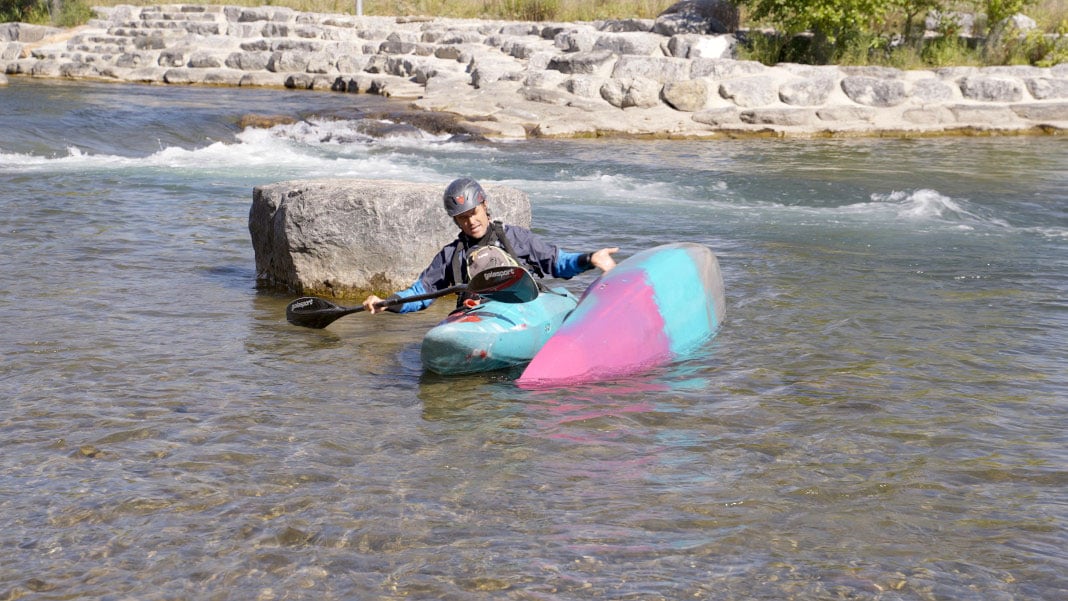
man demonstrates how to perform a kayak rescue in whitewater
Simon Coward’s chosen method of righting a kayak. | Feature image: AQ Outdoors

A straightforward rescue technique

My preferred way of righting the boat if it is upside down, is just essentially to get alongside it, grab the inside gunnel, and slowly start to right it. Then, I lean away and push away. This way I actually have contact with my paddle the whole time—I don’t have to let go of it. And, it’s very quick and very easy to get the boat back upright again. Now we have a kayak, presuming there are float bags in the back, that’s very easy to push and manipulate and move around. It’s not always going to cooperate, sometimes it’s going to flip back over again.

So, super simple: get alongside it, grab, lean away, push the gunnel away, the boat’s right again and you’re off to the races.

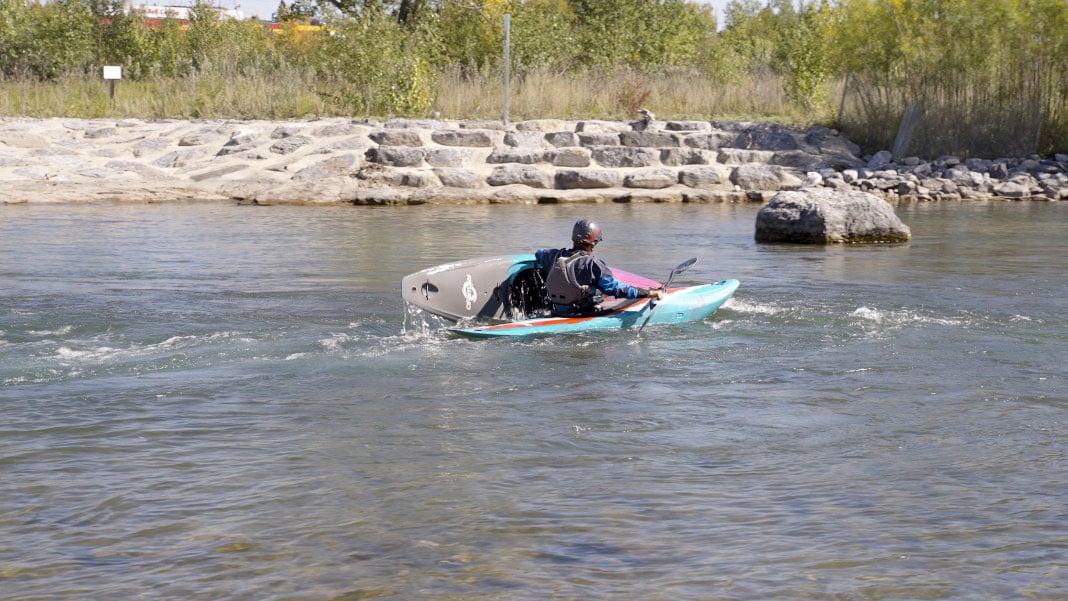
directing the kayak while performing a rescue
A final push to right a fellow paddler’s kayak. | Image: AQ Outdoors

Rescuing a kayak in whitewater

Okay so I’m presuming I’m running safety at the bottom of this little drop. We’ve got our swimmer out, and this boat’s coming down. The first thing to think about is timing. When am I going to go out and get myself to the boat? I pop out [of the eddy] and I get alongside it. Now I’m going to grab the inside of the kayak and then push. I can spin it [the direction I want it to go] then I push the boat [toward shore]. It’s going to spin. It almost flipped there but there’s not that much water in it so it stayed upright.

I haven’t had to clip the boat at all. So if there were any hazards I’m not at risk of flipping over and getting hung up. Basically I’ve got the boat to shore very quickly, very simply. Now I can get out, and I can empty the water out off the kayak and we can get the paddler back going again.

[ Paddling Buyer’s Guide: View kayaks at AQ Outdoors ]

That’s it, a quick and simple way to rescue a whitewater kayak that doesn’t have a rider anymore. Obviously, it’s ideal that there are float bags in the back, but this method doesn’t require you to let go of your paddle. It doesn’t require you to clip onto the boat. It’s a quick flip push get it into the eddy and you’re off to the races.

AQ Outdoors offers retail and kayak instruction in Calgary and Edmonton. Learn more about their school and stores at AQOutdoors.com.


Simon Coward’s chosen method of righting a kayak. | Feature image: AQ Outdoors


Single Post BG Template – Background Position Bottom – How To Rescue A Kayak In Whitewater

Everybody swims—it’s part of the sport, and whitewater kayaking is more of a team activity than we may credit it for. You want to strive to be a strong teammate on the river and know others have your back too. Among essential rescue techniques is the ability to wrangle a friend’s boat, and here to help is Simon Coward, owner of AQ Outdoors (AQ Outdoors is a paddling shop and school with locations in Calgary and Edmonton). The following is a transcript of Coward’s kayak rescue method of choice.


paddling out of the eddy to reach the kayak in the rapid
Timing your rescue to meet the kayak at the bottom of a rapid. | Image: AQ Outdoors

How to perform an effective kayak rescue in whitewater

Simon here from AQ Outdoors, just checking in with a little tutorial on some best practices and the easiest ways to rescue kayaks. Over the last 20-odd years of teaching and such I’ve made lots of mistakes, I’ve learned from others, and I’ve seen others make mistakes, and some do really great rescues.

Basics of rescuing a kayak

This is very much about how to keep it as simple as possible. We’re going to start in flatwater how we might address this. My personal preference is to not clip the boat and to get the boat upright as soon as possible. If I get the boat upright and it has float bags in it, it’s much easier to manipulate—whether you’re clipping it, pushing it or bumping it. Ideally we want the boat upright and empty. It’s very easy to rescue at that point but you don’t always get that good of a bounce, well we usually don’t because people are usually upside down.

[ Paddling Trip Guide: View classes at AQ Outdoors ]

After someone swims, the boat is going to be upside down and have a bit of water in it, right, so with this, the most common way I see people try and right the boat is essentially to lean across, grab the gunnel on the other side, push down with this hand and right the kayak. And that works, however, once you get into moving water and it’s a bit more dynamic, that becomes a lot harder. Especially with larger boats and smaller people, it becomes very difficult.

man demonstrates how to perform a kayak rescue in whitewater
Simon Coward’s chosen method of righting a kayak. | Feature image: AQ Outdoors

A straightforward rescue technique

My preferred way of righting the boat if it is upside down, is just essentially to get alongside it, grab the inside gunnel, and slowly start to right it. Then, I lean away and push away. This way I actually have contact with my paddle the whole time—I don’t have to let go of it. And, it’s very quick and very easy to get the boat back upright again. Now we have a kayak, presuming there are float bags in the back, that’s very easy to push and manipulate and move around. It’s not always going to cooperate, sometimes it’s going to flip back over again.

So, super simple: get alongside it, grab, lean away, push the gunnel away, the boat’s right again and you’re off to the races.

directing the kayak while performing a rescue
A final push to right a fellow paddler’s kayak. | Image: AQ Outdoors

Rescuing a kayak in whitewater

Okay so I’m presuming I’m running safety at the bottom of this little drop. We’ve got our swimmer out, and this boat’s coming down. The first thing to think about is timing. When am I going to go out and get myself to the boat? I pop out [of the eddy] and I get alongside it. Now I’m going to grab the inside of the kayak and then push. I can spin it [the direction I want it to go] then I push the boat [toward shore]. It’s going to spin. It almost flipped there but there’s not that much water in it so it stayed upright.

I haven’t had to clip the boat at all. So if there were any hazards I’m not at risk of flipping over and getting hung up. Basically I’ve got the boat to shore very quickly, very simply. Now I can get out, and I can empty the water out off the kayak and we can get the paddler back going again.

[ Paddling Buyer’s Guide: View kayaks at AQ Outdoors ]

That’s it, a quick and simple way to rescue a whitewater kayak that doesn’t have a rider anymore. Obviously, it’s ideal that there are float bags in the back, but this method doesn’t require you to let go of your paddle. It doesn’t require you to clip onto the boat. It’s a quick flip push get it into the eddy and you’re off to the races.

AQ Outdoors offers retail and kayak instruction in Calgary and Edmonton. Learn more about their school and stores at AQOutdoors.com.


Simon Coward’s chosen method of righting a kayak. | Feature image: AQ Outdoors


Style 5 – How To Rescue A Kayak In Whitewater

Everybody swims—it’s part of the sport, and whitewater kayaking is more of a team activity than we may credit it for. You want to strive to be a strong teammate on the river and know others have your back too. Among essential rescue techniques is the ability to wrangle a friend’s boat, and here to help is Simon Coward, owner of AQ Outdoors (AQ Outdoors is a paddling shop and school with locations in Calgary and Edmonton). The following is a transcript of Coward’s kayak rescue method of choice.


paddling out of the eddy to reach the kayak in the rapid
Timing your rescue to meet the kayak at the bottom of a rapid. | Image: AQ Outdoors

How to perform an effective kayak rescue in whitewater

Simon here from AQ Outdoors, just checking in with a little tutorial on some best practices and the easiest ways to rescue kayaks. Over the last 20-odd years of teaching and such I’ve made lots of mistakes, I’ve learned from others, and I’ve seen others make mistakes, and some do really great rescues.

Basics of rescuing a kayak

This is very much about how to keep it as simple as possible. We’re going to start in flatwater how we might address this. My personal preference is to not clip the boat and to get the boat upright as soon as possible. If I get the boat upright and it has float bags in it, it’s much easier to manipulate—whether you’re clipping it, pushing it or bumping it. Ideally we want the boat upright and empty. It’s very easy to rescue at that point but you don’t always get that good of a bounce, well we usually don’t because people are usually upside down.

[ Paddling Trip Guide: View classes at AQ Outdoors ]

After someone swims, the boat is going to be upside down and have a bit of water in it, right, so with this, the most common way I see people try and right the boat is essentially to lean across, grab the gunnel on the other side, push down with this hand and right the kayak. And that works, however, once you get into moving water and it’s a bit more dynamic, that becomes a lot harder. Especially with larger boats and smaller people, it becomes very difficult.

man demonstrates how to perform a kayak rescue in whitewater
Simon Coward’s chosen method of righting a kayak. | Feature image: AQ Outdoors

A straightforward rescue technique

My preferred way of righting the boat if it is upside down, is just essentially to get alongside it, grab the inside gunnel, and slowly start to right it. Then, I lean away and push away. This way I actually have contact with my paddle the whole time—I don’t have to let go of it. And, it’s very quick and very easy to get the boat back upright again. Now we have a kayak, presuming there are float bags in the back, that’s very easy to push and manipulate and move around. It’s not always going to cooperate, sometimes it’s going to flip back over again.

So, super simple: get alongside it, grab, lean away, push the gunnel away, the boat’s right again and you’re off to the races.

directing the kayak while performing a rescue
A final push to right a fellow paddler’s kayak. | Image: AQ Outdoors

Rescuing a kayak in whitewater

Okay so I’m presuming I’m running safety at the bottom of this little drop. We’ve got our swimmer out, and this boat’s coming down. The first thing to think about is timing. When am I going to go out and get myself to the boat? I pop out [of the eddy] and I get alongside it. Now I’m going to grab the inside of the kayak and then push. I can spin it [the direction I want it to go] then I push the boat [toward shore]. It’s going to spin. It almost flipped there but there’s not that much water in it so it stayed upright.

I haven’t had to clip the boat at all. So if there were any hazards I’m not at risk of flipping over and getting hung up. Basically I’ve got the boat to shore very quickly, very simply. Now I can get out, and I can empty the water out off the kayak and we can get the paddler back going again.

[ Paddling Buyer’s Guide: View kayaks at AQ Outdoors ]

That’s it, a quick and simple way to rescue a whitewater kayak that doesn’t have a rider anymore. Obviously, it’s ideal that there are float bags in the back, but this method doesn’t require you to let go of your paddle. It doesn’t require you to clip onto the boat. It’s a quick flip push get it into the eddy and you’re off to the races.

AQ Outdoors offers retail and kayak instruction in Calgary and Edmonton. Learn more about their school and stores at AQOutdoors.com.


Simon Coward’s chosen method of righting a kayak. | Feature image: AQ Outdoors


Style 4 – How To Rescue A Kayak In Whitewater

Everybody swims—it’s part of the sport, and whitewater kayaking is more of a team activity than we may credit it for. You want to strive to be a strong teammate on the river and know others have your back too. Among essential rescue techniques is the ability to wrangle a friend’s boat, and here to help is Simon Coward, owner of AQ Outdoors (AQ Outdoors is a paddling shop and school with locations in Calgary and Edmonton). The following is a transcript of Coward’s kayak rescue method of choice.


paddling out of the eddy to reach the kayak in the rapid
Timing your rescue to meet the kayak at the bottom of a rapid. | Image: AQ Outdoors

How to perform an effective kayak rescue in whitewater

Simon here from AQ Outdoors, just checking in with a little tutorial on some best practices and the easiest ways to rescue kayaks. Over the last 20-odd years of teaching and such I’ve made lots of mistakes, I’ve learned from others, and I’ve seen others make mistakes, and some do really great rescues.

Basics of rescuing a kayak

This is very much about how to keep it as simple as possible. We’re going to start in flatwater how we might address this. My personal preference is to not clip the boat and to get the boat upright as soon as possible. If I get the boat upright and it has float bags in it, it’s much easier to manipulate—whether you’re clipping it, pushing it or bumping it. Ideally we want the boat upright and empty. It’s very easy to rescue at that point but you don’t always get that good of a bounce, well we usually don’t because people are usually upside down.

[ Paddling Trip Guide: View classes at AQ Outdoors ]

After someone swims, the boat is going to be upside down and have a bit of water in it, right, so with this, the most common way I see people try and right the boat is essentially to lean across, grab the gunnel on the other side, push down with this hand and right the kayak. And that works, however, once you get into moving water and it’s a bit more dynamic, that becomes a lot harder. Especially with larger boats and smaller people, it becomes very difficult.

man demonstrates how to perform a kayak rescue in whitewater
Simon Coward’s chosen method of righting a kayak. | Feature image: AQ Outdoors

A straightforward rescue technique

My preferred way of righting the boat if it is upside down, is just essentially to get alongside it, grab the inside gunnel, and slowly start to right it. Then, I lean away and push away. This way I actually have contact with my paddle the whole time—I don’t have to let go of it. And, it’s very quick and very easy to get the boat back upright again. Now we have a kayak, presuming there are float bags in the back, that’s very easy to push and manipulate and move around. It’s not always going to cooperate, sometimes it’s going to flip back over again.

So, super simple: get alongside it, grab, lean away, push the gunnel away, the boat’s right again and you’re off to the races.

directing the kayak while performing a rescue
A final push to right a fellow paddler’s kayak. | Image: AQ Outdoors

Rescuing a kayak in whitewater

Okay so I’m presuming I’m running safety at the bottom of this little drop. We’ve got our swimmer out, and this boat’s coming down. The first thing to think about is timing. When am I going to go out and get myself to the boat? I pop out [of the eddy] and I get alongside it. Now I’m going to grab the inside of the kayak and then push. I can spin it [the direction I want it to go] then I push the boat [toward shore]. It’s going to spin. It almost flipped there but there’s not that much water in it so it stayed upright.

I haven’t had to clip the boat at all. So if there were any hazards I’m not at risk of flipping over and getting hung up. Basically I’ve got the boat to shore very quickly, very simply. Now I can get out, and I can empty the water out off the kayak and we can get the paddler back going again.

[ Paddling Buyer’s Guide: View kayaks at AQ Outdoors ]

That’s it, a quick and simple way to rescue a whitewater kayak that doesn’t have a rider anymore. Obviously, it’s ideal that there are float bags in the back, but this method doesn’t require you to let go of your paddle. It doesn’t require you to clip onto the boat. It’s a quick flip push get it into the eddy and you’re off to the races.

AQ Outdoors offers retail and kayak instruction in Calgary and Edmonton. Learn more about their school and stores at AQOutdoors.com.


Simon Coward’s chosen method of righting a kayak. | Feature image: AQ Outdoors


Style 6 – How To Rescue A Kayak In Whitewater

Everybody swims—it’s part of the sport, and whitewater kayaking is more of a team activity than we may credit it for. You want to strive to be a strong teammate on the river and know others have your back too. Among essential rescue techniques is the ability to wrangle a friend’s boat, and here to help is Simon Coward, owner of AQ Outdoors (AQ Outdoors is a paddling shop and school with locations in Calgary and Edmonton). The following is a transcript of Coward’s kayak rescue method of choice.


paddling out of the eddy to reach the kayak in the rapid
Timing your rescue to meet the kayak at the bottom of a rapid. | Image: AQ Outdoors

How to perform an effective kayak rescue in whitewater

Simon here from AQ Outdoors, just checking in with a little tutorial on some best practices and the easiest ways to rescue kayaks. Over the last 20-odd years of teaching and such I’ve made lots of mistakes, I’ve learned from others, and I’ve seen others make mistakes, and some do really great rescues.

Basics of rescuing a kayak

This is very much about how to keep it as simple as possible. We’re going to start in flatwater how we might address this. My personal preference is to not clip the boat and to get the boat upright as soon as possible. If I get the boat upright and it has float bags in it, it’s much easier to manipulate—whether you’re clipping it, pushing it or bumping it. Ideally we want the boat upright and empty. It’s very easy to rescue at that point but you don’t always get that good of a bounce, well we usually don’t because people are usually upside down.

[ Paddling Trip Guide: View classes at AQ Outdoors ]

After someone swims, the boat is going to be upside down and have a bit of water in it, right, so with this, the most common way I see people try and right the boat is essentially to lean across, grab the gunnel on the other side, push down with this hand and right the kayak. And that works, however, once you get into moving water and it’s a bit more dynamic, that becomes a lot harder. Especially with larger boats and smaller people, it becomes very difficult.

man demonstrates how to perform a kayak rescue in whitewater
Simon Coward’s chosen method of righting a kayak. | Feature image: AQ Outdoors

A straightforward rescue technique

My preferred way of righting the boat if it is upside down, is just essentially to get alongside it, grab the inside gunnel, and slowly start to right it. Then, I lean away and push away. This way I actually have contact with my paddle the whole time—I don’t have to let go of it. And, it’s very quick and very easy to get the boat back upright again. Now we have a kayak, presuming there are float bags in the back, that’s very easy to push and manipulate and move around. It’s not always going to cooperate, sometimes it’s going to flip back over again.

So, super simple: get alongside it, grab, lean away, push the gunnel away, the boat’s right again and you’re off to the races.

directing the kayak while performing a rescue
A final push to right a fellow paddler’s kayak. | Image: AQ Outdoors

Rescuing a kayak in whitewater

Okay so I’m presuming I’m running safety at the bottom of this little drop. We’ve got our swimmer out, and this boat’s coming down. The first thing to think about is timing. When am I going to go out and get myself to the boat? I pop out [of the eddy] and I get alongside it. Now I’m going to grab the inside of the kayak and then push. I can spin it [the direction I want it to go] then I push the boat [toward shore]. It’s going to spin. It almost flipped there but there’s not that much water in it so it stayed upright.

I haven’t had to clip the boat at all. So if there were any hazards I’m not at risk of flipping over and getting hung up. Basically I’ve got the boat to shore very quickly, very simply. Now I can get out, and I can empty the water out off the kayak and we can get the paddler back going again.

[ Paddling Buyer’s Guide: View kayaks at AQ Outdoors ]

That’s it, a quick and simple way to rescue a whitewater kayak that doesn’t have a rider anymore. Obviously, it’s ideal that there are float bags in the back, but this method doesn’t require you to let go of your paddle. It doesn’t require you to clip onto the boat. It’s a quick flip push get it into the eddy and you’re off to the races.

AQ Outdoors offers retail and kayak instruction in Calgary and Edmonton. Learn more about their school and stores at AQOutdoors.com.


Simon Coward’s chosen method of righting a kayak. | Feature image: AQ Outdoors


Style 1 – How To Rescue A Kayak In Whitewater

Everybody swims—it’s part of the sport, and whitewater kayaking is more of a team activity than we may credit it for. You want to strive to be a strong teammate on the river and know others have your back too. Among essential rescue techniques is the ability to wrangle a friend’s boat, and here to help is Simon Coward, owner of AQ Outdoors (AQ Outdoors is a paddling shop and school with locations in Calgary and Edmonton). The following is a transcript of Coward’s kayak rescue method of choice.


paddling out of the eddy to reach the kayak in the rapid
Timing your rescue to meet the kayak at the bottom of a rapid. | Image: AQ Outdoors

How to perform an effective kayak rescue in whitewater

Simon here from AQ Outdoors, just checking in with a little tutorial on some best practices and the easiest ways to rescue kayaks. Over the last 20-odd years of teaching and such I’ve made lots of mistakes, I’ve learned from others, and I’ve seen others make mistakes, and some do really great rescues.

Basics of rescuing a kayak

This is very much about how to keep it as simple as possible. We’re going to start in flatwater how we might address this. My personal preference is to not clip the boat and to get the boat upright as soon as possible. If I get the boat upright and it has float bags in it, it’s much easier to manipulate—whether you’re clipping it, pushing it or bumping it. Ideally we want the boat upright and empty. It’s very easy to rescue at that point but you don’t always get that good of a bounce, well we usually don’t because people are usually upside down.

[ Paddling Trip Guide: View classes at AQ Outdoors ]

After someone swims, the boat is going to be upside down and have a bit of water in it, right, so with this, the most common way I see people try and right the boat is essentially to lean across, grab the gunnel on the other side, push down with this hand and right the kayak. And that works, however, once you get into moving water and it’s a bit more dynamic, that becomes a lot harder. Especially with larger boats and smaller people, it becomes very difficult.

man demonstrates how to perform a kayak rescue in whitewater
Simon Coward’s chosen method of righting a kayak. | Feature image: AQ Outdoors

A straightforward rescue technique

My preferred way of righting the boat if it is upside down, is just essentially to get alongside it, grab the inside gunnel, and slowly start to right it. Then, I lean away and push away. This way I actually have contact with my paddle the whole time—I don’t have to let go of it. And, it’s very quick and very easy to get the boat back upright again. Now we have a kayak, presuming there are float bags in the back, that’s very easy to push and manipulate and move around. It’s not always going to cooperate, sometimes it’s going to flip back over again.

So, super simple: get alongside it, grab, lean away, push the gunnel away, the boat’s right again and you’re off to the races.

directing the kayak while performing a rescue
A final push to right a fellow paddler’s kayak. | Image: AQ Outdoors

Rescuing a kayak in whitewater

Okay so I’m presuming I’m running safety at the bottom of this little drop. We’ve got our swimmer out, and this boat’s coming down. The first thing to think about is timing. When am I going to go out and get myself to the boat? I pop out [of the eddy] and I get alongside it. Now I’m going to grab the inside of the kayak and then push. I can spin it [the direction I want it to go] then I push the boat [toward shore]. It’s going to spin. It almost flipped there but there’s not that much water in it so it stayed upright.

I haven’t had to clip the boat at all. So if there were any hazards I’m not at risk of flipping over and getting hung up. Basically I’ve got the boat to shore very quickly, very simply. Now I can get out, and I can empty the water out off the kayak and we can get the paddler back going again.

[ Paddling Buyer’s Guide: View kayaks at AQ Outdoors ]

That’s it, a quick and simple way to rescue a whitewater kayak that doesn’t have a rider anymore. Obviously, it’s ideal that there are float bags in the back, but this method doesn’t require you to let go of your paddle. It doesn’t require you to clip onto the boat. It’s a quick flip push get it into the eddy and you’re off to the races.

AQ Outdoors offers retail and kayak instruction in Calgary and Edmonton. Learn more about their school and stores at AQOutdoors.com.


Simon Coward’s chosen method of righting a kayak. | Feature image: AQ Outdoors


Single Post Template 25 font – How To Rescue A Kayak In Whitewater

Everybody swims—it’s part of the sport, and whitewater kayaking is more of a team activity than we may credit it for. You want to strive to be a strong teammate on the river and know others have your back too. Among essential rescue techniques is the ability to wrangle a friend’s boat, and here to help is Simon Coward, owner of AQ Outdoors (AQ Outdoors is a paddling shop and school with locations in Calgary and Edmonton). The following is a transcript of Coward’s kayak rescue method of choice.


paddling out of the eddy to reach the kayak in the rapid
Timing your rescue to meet the kayak at the bottom of a rapid. | Image: AQ Outdoors

How to perform an effective kayak rescue in whitewater

Simon here from AQ Outdoors, just checking in with a little tutorial on some best practices and the easiest ways to rescue kayaks. Over the last 20-odd years of teaching and such I’ve made lots of mistakes, I’ve learned from others, and I’ve seen others make mistakes, and some do really great rescues.

Basics of rescuing a kayak

This is very much about how to keep it as simple as possible. We’re going to start in flatwater how we might address this. My personal preference is to not clip the boat and to get the boat upright as soon as possible. If I get the boat upright and it has float bags in it, it’s much easier to manipulate—whether you’re clipping it, pushing it or bumping it. Ideally we want the boat upright and empty. It’s very easy to rescue at that point but you don’t always get that good of a bounce, well we usually don’t because people are usually upside down.

[ Paddling Trip Guide: View classes at AQ Outdoors ]

After someone swims, the boat is going to be upside down and have a bit of water in it, right, so with this, the most common way I see people try and right the boat is essentially to lean across, grab the gunnel on the other side, push down with this hand and right the kayak. And that works, however, once you get into moving water and it’s a bit more dynamic, that becomes a lot harder. Especially with larger boats and smaller people, it becomes very difficult.

man demonstrates how to perform a kayak rescue in whitewater
Simon Coward’s chosen method of righting a kayak. | Feature image: AQ Outdoors

A straightforward rescue technique

My preferred way of righting the boat if it is upside down, is just essentially to get alongside it, grab the inside gunnel, and slowly start to right it. Then, I lean away and push away. This way I actually have contact with my paddle the whole time—I don’t have to let go of it. And, it’s very quick and very easy to get the boat back upright again. Now we have a kayak, presuming there are float bags in the back, that’s very easy to push and manipulate and move around. It’s not always going to cooperate, sometimes it’s going to flip back over again.

So, super simple: get alongside it, grab, lean away, push the gunnel away, the boat’s right again and you’re off to the races.

directing the kayak while performing a rescue
A final push to right a fellow paddler’s kayak. | Image: AQ Outdoors

Rescuing a kayak in whitewater

Okay so I’m presuming I’m running safety at the bottom of this little drop. We’ve got our swimmer out, and this boat’s coming down. The first thing to think about is timing. When am I going to go out and get myself to the boat? I pop out [of the eddy] and I get alongside it. Now I’m going to grab the inside of the kayak and then push. I can spin it [the direction I want it to go] then I push the boat [toward shore]. It’s going to spin. It almost flipped there but there’s not that much water in it so it stayed upright.

I haven’t had to clip the boat at all. So if there were any hazards I’m not at risk of flipping over and getting hung up. Basically I’ve got the boat to shore very quickly, very simply. Now I can get out, and I can empty the water out off the kayak and we can get the paddler back going again.

[ Paddling Buyer’s Guide: View kayaks at AQ Outdoors ]

That’s it, a quick and simple way to rescue a whitewater kayak that doesn’t have a rider anymore. Obviously, it’s ideal that there are float bags in the back, but this method doesn’t require you to let go of your paddle. It doesn’t require you to clip onto the boat. It’s a quick flip push get it into the eddy and you’re off to the races.

AQ Outdoors offers retail and kayak instruction in Calgary and Edmonton. Learn more about their school and stores at AQOutdoors.com.


Simon Coward’s chosen method of righting a kayak. | Feature image: AQ Outdoors


Single Post BG Template – Background Position Center – How To Rescue A Kayak In Whitewater

Everybody swims—it’s part of the sport, and whitewater kayaking is more of a team activity than we may credit it for. You want to strive to be a strong teammate on the river and know others have your back too. Among essential rescue techniques is the ability to wrangle a friend’s boat, and here to help is Simon Coward, owner of AQ Outdoors (AQ Outdoors is a paddling shop and school with locations in Calgary and Edmonton). The following is a transcript of Coward’s kayak rescue method of choice.


paddling out of the eddy to reach the kayak in the rapid
Timing your rescue to meet the kayak at the bottom of a rapid. | Image: AQ Outdoors

How to perform an effective kayak rescue in whitewater

Simon here from AQ Outdoors, just checking in with a little tutorial on some best practices and the easiest ways to rescue kayaks. Over the last 20-odd years of teaching and such I’ve made lots of mistakes, I’ve learned from others, and I’ve seen others make mistakes, and some do really great rescues.

Basics of rescuing a kayak

This is very much about how to keep it as simple as possible. We’re going to start in flatwater how we might address this. My personal preference is to not clip the boat and to get the boat upright as soon as possible. If I get the boat upright and it has float bags in it, it’s much easier to manipulate—whether you’re clipping it, pushing it or bumping it. Ideally we want the boat upright and empty. It’s very easy to rescue at that point but you don’t always get that good of a bounce, well we usually don’t because people are usually upside down.

[ Paddling Trip Guide: View classes at AQ Outdoors ]

After someone swims, the boat is going to be upside down and have a bit of water in it, right, so with this, the most common way I see people try and right the boat is essentially to lean across, grab the gunnel on the other side, push down with this hand and right the kayak. And that works, however, once you get into moving water and it’s a bit more dynamic, that becomes a lot harder. Especially with larger boats and smaller people, it becomes very difficult.

man demonstrates how to perform a kayak rescue in whitewater
Simon Coward’s chosen method of righting a kayak. | Feature image: AQ Outdoors

A straightforward rescue technique

My preferred way of righting the boat if it is upside down, is just essentially to get alongside it, grab the inside gunnel, and slowly start to right it. Then, I lean away and push away. This way I actually have contact with my paddle the whole time—I don’t have to let go of it. And, it’s very quick and very easy to get the boat back upright again. Now we have a kayak, presuming there are float bags in the back, that’s very easy to push and manipulate and move around. It’s not always going to cooperate, sometimes it’s going to flip back over again.

So, super simple: get alongside it, grab, lean away, push the gunnel away, the boat’s right again and you’re off to the races.

directing the kayak while performing a rescue
A final push to right a fellow paddler’s kayak. | Image: AQ Outdoors

Rescuing a kayak in whitewater

Okay so I’m presuming I’m running safety at the bottom of this little drop. We’ve got our swimmer out, and this boat’s coming down. The first thing to think about is timing. When am I going to go out and get myself to the boat? I pop out [of the eddy] and I get alongside it. Now I’m going to grab the inside of the kayak and then push. I can spin it [the direction I want it to go] then I push the boat [toward shore]. It’s going to spin. It almost flipped there but there’s not that much water in it so it stayed upright.

I haven’t had to clip the boat at all. So if there were any hazards I’m not at risk of flipping over and getting hung up. Basically I’ve got the boat to shore very quickly, very simply. Now I can get out, and I can empty the water out off the kayak and we can get the paddler back going again.

[ Paddling Buyer’s Guide: View kayaks at AQ Outdoors ]

That’s it, a quick and simple way to rescue a whitewater kayak that doesn’t have a rider anymore. Obviously, it’s ideal that there are float bags in the back, but this method doesn’t require you to let go of your paddle. It doesn’t require you to clip onto the boat. It’s a quick flip push get it into the eddy and you’re off to the races.

AQ Outdoors offers retail and kayak instruction in Calgary and Edmonton. Learn more about their school and stores at AQOutdoors.com.


Simon Coward’s chosen method of righting a kayak. | Feature image: AQ Outdoors