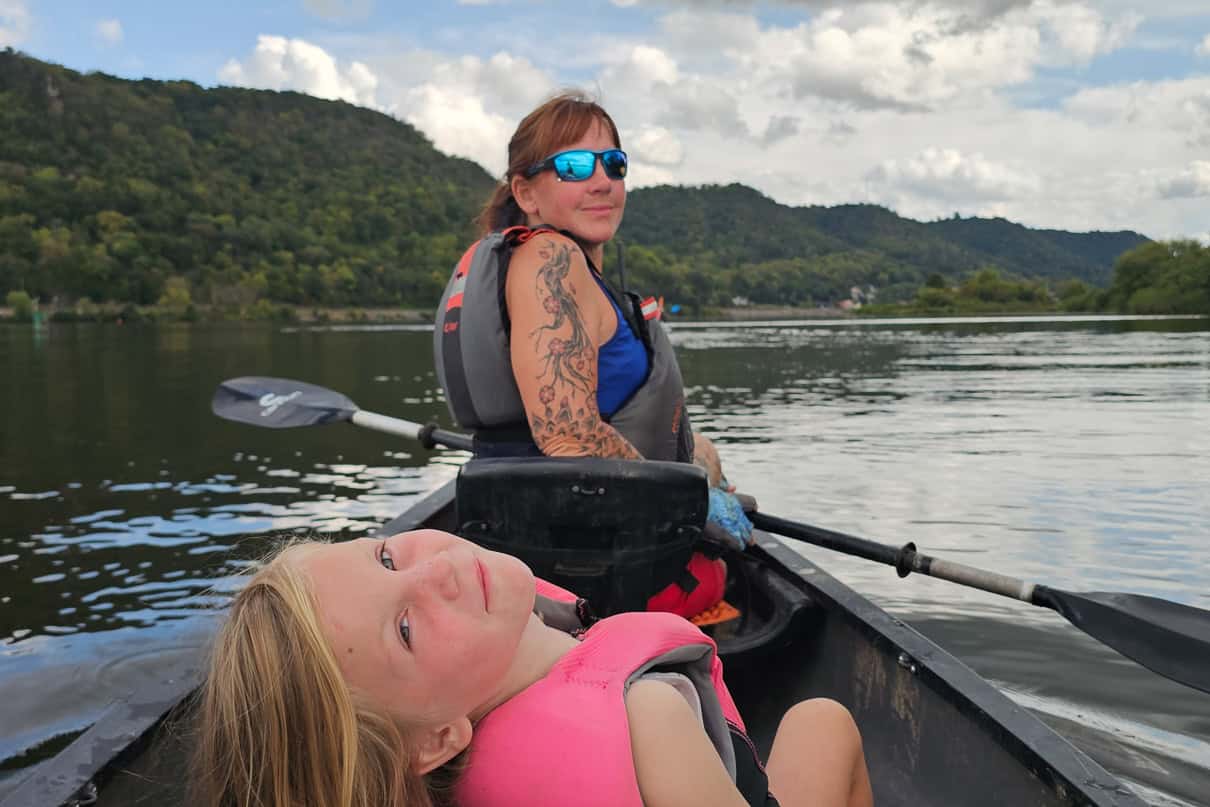
For the next three weeks we’re sharing the finalists from the Paddling Kids Story Contest. Read their stories and vote for your favorites to crown a winner! Comment below, or like and comment on Facebook and Instagram to register your support (maximum one comment per week per user). Voting for “First Canoe Camping” is open from now until 5pm ET on Thursday, November 6.
First Canoe Camping
By Owen Morris, age 7, from London, Ontario
Listen to the story here:
Hi, my name is Owen. I’m seven years old and I really like beef stroganoff.
This summer I went on my first canoe trip to Algonquin Park with my grandpa, my sisters Emily and Kaitlyn and my dad. We went on a five-day, four-night trip. It was lots of fun. The only thing I didn’t like about it was the bugs.
Photo: Courtesy Owen Morris
We started on Canoe Lake. It was raining a lot, but it got nicer as we paddled. The hard part was getting used to the different strokes. I loved exploring the campsite we stayed at on Tom Thomson Lake.
Photo: Courtesy Owen Morris
The next day, we had breakfast sandwiches. Then we got in the canoes again. We portaged into Kooy Pond. It really didn’t have much water in it, so we had to walk around it. So muddy! After getting out of Kooy Pond to get away from the bugs, we decided to have lunch in the canoes in the middle of Willow Lake.
On the second and third night, we stayed on an island at Sunbeam Lake. We saw a bunch of catfish. I got my lure under a rock, but they didn’t go for it. The island was the best. We explored and named parts of it. We had our own little table and benches.
I loved climbing on the rocks. We went and explored a waterfall, then an underwater beach. I was able to walk out so far.
On the fourth day, we paddled through Vanishing Pond. There wasn’t much room to paddle. We crashed the canoe a few times against the edge of the channel.
On the last night we stayed on the east arm of Joe Lake. It was hot, so we swam a lot. The rock in the water was so slippery, but we made it. After dinner, we watched the sunset and the stars.
On the last day, we paddled out and had lunch at the canoe store. I had chocolate milk, a hamburger and ice cream. It was so yummy! Then we drove home. It was so good to sleep in my own bed again.
Photo: Courtesy Owen Morris
Vote for your favorite Paddling Kids finalists to crown a winner! Comment below, or like and comment on Facebook and Instagram to register your support (maximum one comment per week per user). Voting for “First Canoe Camping” is open from now until 5pm ET on Thursday, November 6.
Jacques Chassé at Esquif’s factory in Frampton, Quebec. | Feature photo: Francis Vachon
One summer in Maine,as I hoisted my canoe for the quarter-mile portage around Allagash Falls, I noticed the stones at the landing were covered in streaks of dark green and red. Continuing over the rise, blinking sweat from my eyes, I stared vacantly at the trail scrolling beneath my boots. It was rugged and steep and full of rocks, every one of which was marked with red or green, or both, even at the height of land where I stopped to catch my breath. On the way down there were even more colorful streaks, which makes perfect sense because it’s easier to drag a rented canoe downhill than up.
From that day on, I’ve been a believer in Royalex, the green (sometimes red) miracle material that dominated the middle of the canoe market from its introduction in 1972 until 2014, shortly after plastics giant PolyOne acquired Royalex manufacturer Spartech and shuttered the Indiana factory where it was produced, citing insufficient demand from the canoe industry.
T-Formex: Esquif’s long-shot bet on a replacement for Royalex pays off
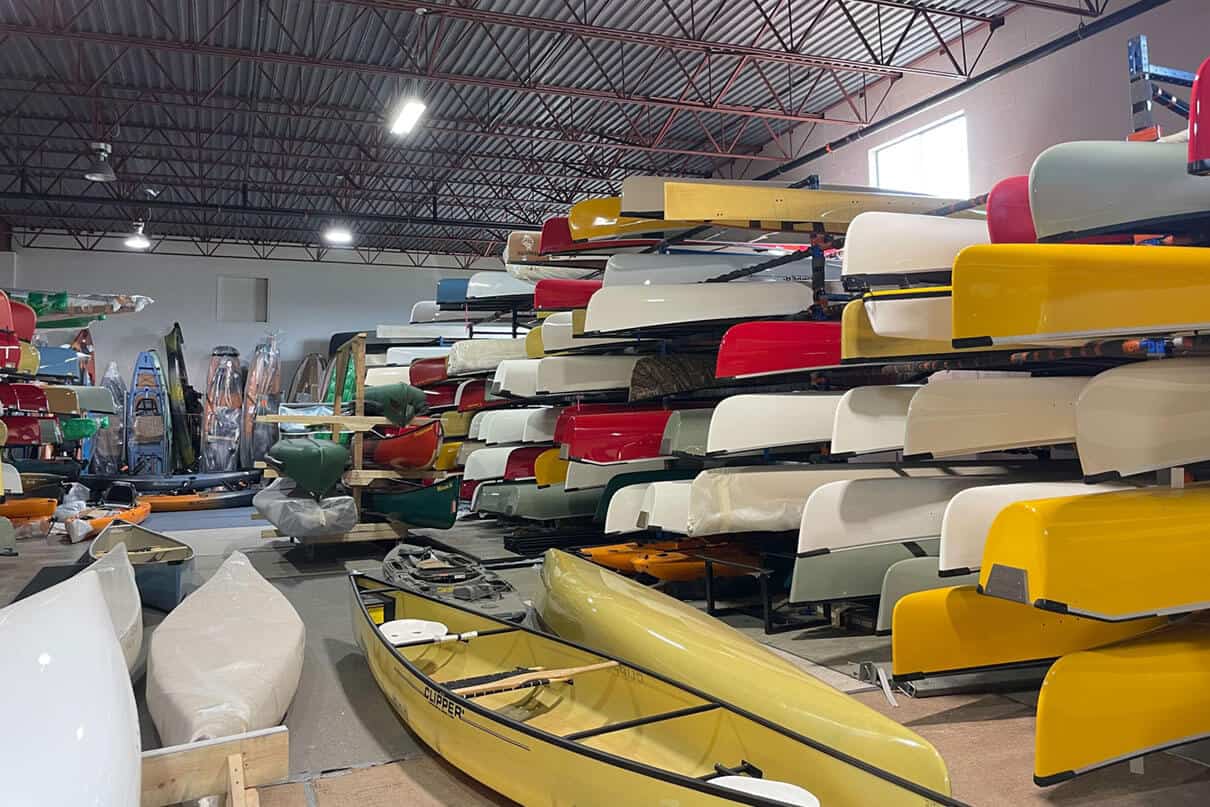
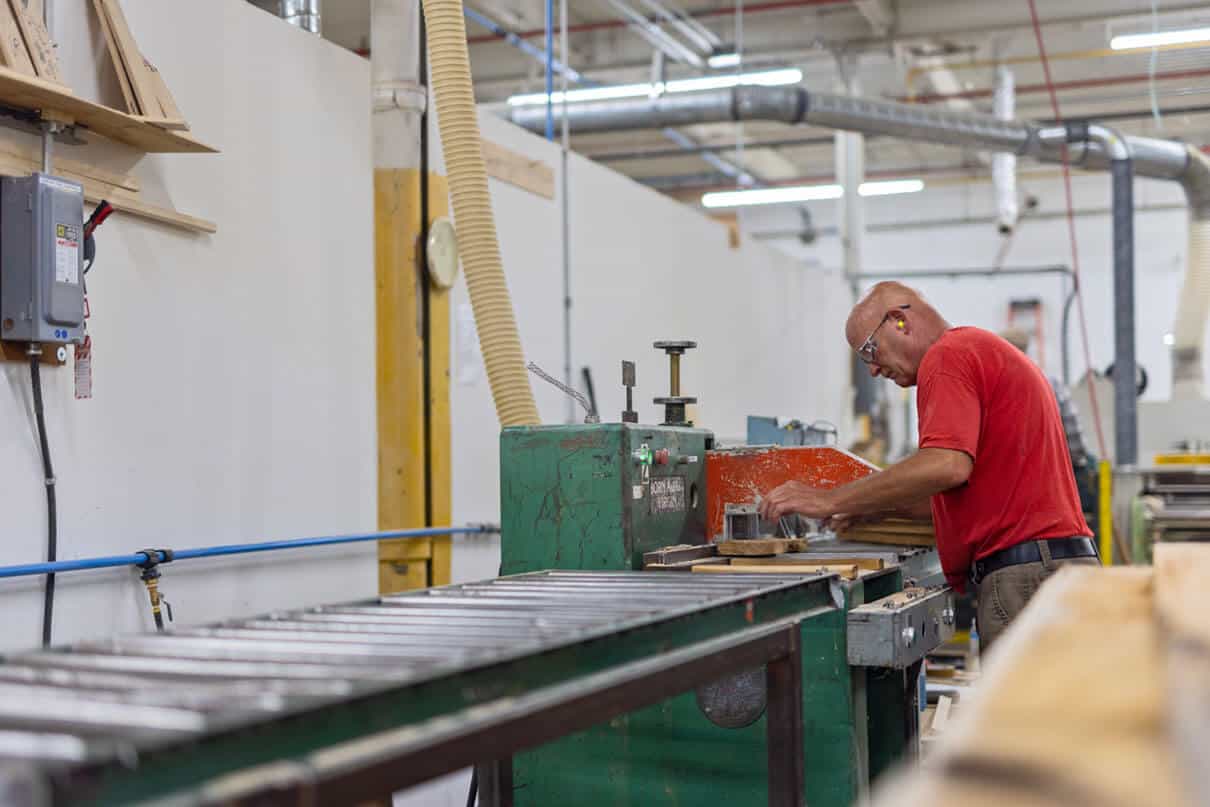
Jacques Chassé is also a believer. So much so that he gambled his company, Esquif, on creating a replacement for the famously durable material. While other canoe companies looked to fill the gap with high-end composites or rotomolded boats, Chassé never saw those materials as an option for the canoe company he founded in 1997 with an order of five sheets of Royalex. While Esquif had grown to employ about 20 workers at its Frampton, Quebec, factory, it never moved away from Royalex.
“The other manufacturers already had composite boats in their pocket or rotomolded boats in their pocket, so they were able to survive with that,” Chassé says of the years after PolyOne ceased deliveries. “We did not have that. For us, developing T-Formex was a question of survival.”
Jacques Chassé at Esquif’s factory in Frampton, Quebec. | Feature photo: Francis Vachon
Royalex consists of a foam core sandwiched between layers of ABS plastic, with a very thin outer skin that provides UV protection and a slick surface that tends to glance off rocks and slide over shallow river bottoms. Those qualities made Royalex a favorite of canoeists for more than 40 years, particularly expedition paddlers and rental liveries who valued its nearly indestructible nature and middle-of-the-road price point.
Manufacturing Royalex, or any viable replacement for it, requires sophisticated chemistry and machinery to produce each layer of material, and still more complex equipment to bond them together in a process called vulcanization. Chassé was somewhat familiar with the final step, because he had proposed to Spartech that Esquif could take over the vulcanization to expedite delivery during the busy spring season. He knew nothing about Royalex’s real secret sauce—the formulation and manufacture of the three component layers. He decided to go all-in anyway.
“There are things that you will do when you are a believer, no matter the challenge,” he says now.“When I received the letter from PolyOne saying they will cease their operation, instead of panicking or feeling destroyed by that news, I saw it as an opportunity.”
Chassé bought up every sheet of Royalex he could put his hands on, expecting it to bridge the gap until he could introduce the replacement laminate he would call T-Formex. He spent 2014 working to reproduce the Royalex recipe. Chassé read everything he could find about plastics and began working with Polytechnique Montréal, a research university with a pilot plant where Chassé pursued his own version of the Holy Grail: A trio of materials that, when bonded together, will hold its shape after impact, slide over rocks and resist the sun’s ultraviolet rays—a material that won’t weigh too much and can be made in sheets with reinforcements where needed, such as the places that will become the bow and stern when the material is draped over a mold and thermoformed into the timeless shape of a canoe.
Chassé ran out of Royalex, and cash, in early 2015.
“I didn’t pay myself for six months, but I kept my longtime workers until I had to tell them one morning, I can’t pay you anymore,” Chassé recalls. He eventually let all his employees go, and Esquif went bankrupt.
Still, he believed. He gathered a few friends and investors and bought Esquif out of bankruptcy. He was convinced he could bring T-Formex to market, and that when he did the company would thrive like never before.
A void, and an opportunity
In the early post-Royalex years, Chassé remembers talking to paddlers at shows like Canoecopia or on his favorite local runs. “Quebec rivers are tough and rocky, and it’s part of our DNA to paddle them,” Chassé says. “We are involved in whitewater as well, and paddlers were telling us they really needed a material that is durable enough for that.” Those conversations gave Chassé the confidence that there was a strong market—more than that, a real need—for T-Formex, if only he could deliver it.
After more trial and error he developed what he calls an evolution of the Royalex formulation, and found a processor in the United States that could produce the core and the skin. Then he bought the shell of an autoclave in Texas, shipped it to Quebec, and spent months making it operational and converting it from steam to electric heating. This solved one of the problems that had plagued Royalex, Chassé says.
“Moisture doesn’t fit very well with plastic, so our equipment allows us to control the process much better. ”
By the 2016 model year, Esquif was shipping a full line of canoes in T-Formex and was soon thriving like never before. In the Royalex years, Chassé says, Esquif had always been in survival mode. That changed with T-Formex. “It became the second profit center we needed to support our growth,” he says.
Esquif has made T-Formex available to other canoe manufacturers and Chassé has explored its use in different industries. Finally, he says, because a canoe manufacturer owns the formula, the paddlesports industry is no longer vulnerable to the whims of a multinational corporation.
The path hasn’t always been a smooth one. When a factory fire halted production during the peak of the pandemic boom in 2021, Chassé gathered his employees and told them they would be making canoes again in a matter of weeks—and they did.
“If you want your team to follow you, you need to be inspiring. You’ve got to feel the confidence that you’re going to make it,” he says. “You’ve got to believe.”
This article was first published in the 2025 issue of Paddling Business. Subscribe to Paddling Magazine’s print and digital editions, or browse the archives.
Jacques Chassé at Esquif’s factory in Frampton, Quebec. | Feature photo: Francis Vachon
Kayaking through spooky fog on an island. Feature Image: Maddy Marquardt.
The water covers up mysteries, breaks down evidence and obscures footprints, so it’s no surprise that paddlesports harbor a few mysteries. From unexplained phenomena at sea to potential Sasquatch encounters, here are five of the strangest paddling mysteries.
Five of the spookiest paddling mysteries of all time
1 The Tom Thomson canoe mystery
In July of 1917, famous painter Tom Thomson disappeared on Canoe Lake in Algonquin Park. His body was never found, and many point to foul play. Meanwhile, Winne Trainor, one of Thomson’s girlfriends who Thomson often stayed with never recovered from his death and was rumored to be pregnant with Thomson’s child.
She never married and she died at 77, leaving behind a strange note that read “If I saw you I could say things that I will never write.”
A century ago, John “Hermit of the North” Hornby and British financier John Critchell Bullock set out to paddle the Barren Lands, find the then believed to be extinct muskoxen, and capture it on motion picture. In 1925, the expedition had become a battle for survival and the men chose to lighten their load, leaving behind a cache containing the movie camera and 10,000 feet unused motion picture film.
In 2015, Bullock’s journals resurfaced. Polish paddler Michal Lukaszewicz and his wife, Karolina Gawonicz pored over the journals, maps and satellite images, making it their mission to find the cache.
In 2023, the couple climbed into a canoe at Yellowknife and headed into the wilderness to find the cache in an expedition that solved one of the greatest paddling mysteries of the century.
On February 8, 2007, with just 120 kilometers (100 miles) between him and New Zealand, expedition sea kayaker Andrew McAuley sent a text to his wife and son reading, “See you 9 a.m. Sunday!” McAuley was nearing the end of a 1,600-kilometer (1000-mile) open ocean crossing of the Tasman Sea from Australia to New Zealand.
McAuley had weathered nightmare storms with nine-meter (30-foot) waves and spent a decade preparing for the trip. With shore within sight and a relatively friendly weather forecast it was then that McAuley disappeared, leaving behind a kayak in nearly perfect condition missing only its cockpit canopy.
Paddler and explorer Sander Jain had kayaked into a remote cabin on Clayoquot Sound when the woods and seashore went silent. Then, Jain heard a strange sound in the distance as if boulders were being thrown followed by owl-like vocalizations, punctuated only by silence.
Enter Sasquatch. A stomping noise began on the ground near the front porch.
“The stomping was joined by the most horrifying vocalizations— disturbingly erratic and deliberate at once, tribal, not quite like human speech but similar enough to recognize certain elements. It sounded as if something was trying to speak, shout, articulate itself without quite mastering the language,” wrote Jain, in one of the more compelling—and unsettling—accounts of potential Sasquatch encounters.
Kayaking through spooky fog on an island. | Feature photo: Maddy Marquardt
5 Mystery collision in Mid-Atlantic
Thirteen days into his transatlantic solo journey from Portugal to French Guiana, paddler Micheal Walther had settled in for the night when his modified paddleboard collided with an unidentified object in the ocean.
The collision caused Walther to call off his expedition. The mystery object remains an Unidentified Floating Object—a UFO.
Think this is big? Try teaching a beginner to roll. | Feature photo: Eli Castleberry
“Idolizing hard whitewater leaves out what the vast majority of whitewater paddlers do,” expedition kayaker and author Doug Ammons wrote 10 years ago in this same column. He’s not wrong. The article was titled “Why Going Bigger Makes the Whitewater World Smaller” and it’s one of the most popular whitewater essays ever written in this magazine—and for good reason. It challenged a culture of bravado that sometimes alienates new paddlers and diminishes the quieter joys of the river.
But I’ve been stuck on the title ever since.
Does going bigger really make our little whitewater world shrink? I don’t think so. Going big can inspire and expand the community—when we tell the story right.
Hey, whitewater boaters: This is why no one understands you
Big moments get so much attention because they captivate and inspire us. Epic, viral clips of kayakers aren’t bad for our sport any more than the X Games are bad for snowboarding and skateboarding. Spotlighting big moments is good for sports. With the acclaimed HBO series 100 Foot Wave in its third season, surfing is poised for another boom, projected to grow into a whopping $5.3 billion industry by 2032, according to Surfer magazine.
Free Solo, with its 2019 Academy Award win for Best Documentary Feature, highlighted one of the most extreme moments of climbing. The number of climbers in the United States increased by five percent the following year, according to the Outdoor Industry Association, and reached a total of over 10 million in 2021.
Think this is big? Try teaching a beginner to roll. | Feature photo: Eli Castleberry
Just watching the biggest moments in kayaking can inspire us to challenge ourselves. We all go big in our own ways. That’s where the magic is.
For most of us so-called thrill seekers, connection and flow are the goals, not adrenaline. For me, adrenaline is the enemy. It means I wasn’t prepared. But when I take a reasonable step up, my skill takes over, and I feel like a better, clearer me. I paddle away transformed, forever changed by the accomplishment. I learn about myself, how I handle fear and what I’m capable of. That stays with me and spreads to other aspects of my life. As an instructor, I’ve watched countless students find personal growth and connection through safely approaching their own big moments.
We rarely take the time to share the skills learned, failures earned, safety considerations or how it feeds the soul.
Going big is not the whole story, and it’s time kayakers share it. Whitewater paddling is a small, niche sport in a hyper-connected world. On social media, we may find a spotlight—but without context, the non-paddling public often misunderstands what they’re seeing. They catch glimpses of massive waterfalls and viral clips but rarely see the years of preparation, training and calculated risk behind those feats. Or they see headlines about so-called experienced kayakers drowning on easy streams—often with no training, skill or safety equipment at all. They can’t distinguish a well-earned kayaking accomplishment by an expert paddler from a lucky hold-my-beer moment with a kayak from a big box store.
We discount ourselves, too. Within our own community, we disparage practiced skills with statements of bravado, such as “just send it” and downgrading a waterfall to “plop and drop.” Kayakers frequently showcase spectacle, discomfort, danger and trauma over personal growth, connection and well-earned accomplishment. We rarely take the time to share the skills learned, failures earned, safety considerations or how it feeds the soul. And when we highlight our accomplishments, we rarely share why it matters to us personally. Maybe we’re afraid of vulnerability.
We undermine our own sport and its credibility when we downplay the true breadth of skill and journey toward big moments. Every kayaker will tell you paddling makes their life better and can articulate why. Whether it’s the feeling of being on the river, the connection with nature, the flow that comes with challenging your skills or the friends we make along the way, it’s what makes pushing through the inherent danger, challenge and discomfort worth it.
We all go big in our own ways, whether stepping up to a class II rapid, a reasonable personal first descent or earning your stamp for sending a monster waterfall. It’s time to showcase and appreciate the dedication and training required, as well as the value, connection and heart that come with it. Going big can make the whitewater world grow larger, but it comes down to how we share those moments and the stories we tell.
Boyd Ruppelt is whitewater paddler of more than 30 years, a longtime athlete for Jackson Kayak, and a global kayaking instructor and guide. You can find him at CleanLineKayaking on YouTube or at boydruppelt.com.
This article was published in Issue 74 of Paddling Magazine. Subscribe to Paddling Magazine’s print and digital editions, or browse the archives.
Think this is big? Try teaching a beginner to roll. | Feature photo: Eli Castleberry
For the next three weeks we’re sharing the finalists from the Paddling Kids Story Contest. Read their stories and vote for your favorites to crown a winner! Comment below, or like and comment on Facebook and Instagram to register your support (maximum one comment per week per user). Voting for “San Juan Madness” is open from now until 5pm ET on Thursday, October 30.
San Juan Madness
By Asa McCallum, age 9, from Weybridge, Vermont
The water flies into my face. I hear cheering from the shore. I feel like I am going down a roller coaster.
Right, left, right, left.
Then I feel the boat hit something huge. We lurch to a stop.
“What is going on?” I hear Pinky yell over the roar of the water. Grampa looks at me.
Twenty minutes before:
I get out of my kayak. I walk over to the rocks where Grampa is standing.
I start to hear a roar. It sounds like a dragon.
“That’s it. The Government rapids.”
Photo: Courtesy Asa McCallum
When I first see it, I am surprised. The water is low like it has been the entire trip, but I expected that the main attraction of the trip would be a little more… I don’t know. Main attraction like. It is pretty spectacular though. I watch as Grampa shows everyone the safe routes, and the routes that you should not take.
“First, Max will go down, then he will take Erin’s boat. After that, I will take it down with Asa. Then I will go down again with the one raft left. Asa if you want to come again, you can.”
Max gets in his kayak and pushes off. He starts to paddle. He doesn’t have to, though. The current sucks him in. He starts down. He takes a hard left, then goes straight until the end, where there are rocks. He goes right, and water flies into his face. He lets off a “whoop!” as he gets off the rapid. Then Max takes down Mom’s boat. After he finishes with that, it’s my turn.
Everyone helps push us off because ours is the first big raft. Grampa starts to paddle. We pick up speed. Then it happens. Water flies into the front where I am sitting. We take a left when I see a huge rock in front of us. Max had taken a right at the rock. That is what Grampa does. At least tries to.
I feel the boat stop. “What the” are Grampa’s first words. Everyone is confused. Grampa is paddling as fast as he can. It is no use. After about two minutes Pinky yells something. We can’t hear her over the roar of the water, but then she uses her hands to show what she is saying.
“I think she wants to bump us,” I yell over the current.
“No,” Grampa shakes his head. A minute later Grampa starts to pile stuff on the front of the boat so the weight shifts to make the boat move.
Weight starts to pile on me. I try to endure it. I imagine the boat tipping, then try to get the image out of my mind. Grampa starts to paddle. He tries to catch the paddle on a rock. Finally, the oar hits bottom.
He leans on the paddle with all his might. We don’t budge. Soon, he starts to make progress. I get a good feeling, then we break free.
Photo: Courtesy Asa McCallum
We start down. Then the back of the raft gets stuck AGAIN.
Water pounds the boat. Now we are at a new angle, so the water is pouring right in the part of the boat that I am in. It is being flooded. Water is pounding against me. I make a shield with my arms, but the water breaks over the wall onto my head.
All I can do is sit there. I think about what could happen if the boat does not make it. Will it tip, leaving Grampa, and me in the water? Will the boat ever move? I hope so. Thoughts swirl through my mind.
I see my mom on the shore. Max and Pinky are getting a rope below.
They all look worried. I just don’t get it. How did this happen? It worked for Max. Twice!
Photo: Courtesy Asa McCallum
Grampa puts down the paddles. He probably needs a rest. I can’t blame him. He pulls out something from his pocket. A Coke! At this time he drinks a Coke. He puts it back in his pocket after taking a sip.
“Okay. You got this,” I hear him whisper to himself. He stacks more things in the front. I wedge myself in a corner to give him more room to put things.
I want to help, but what can I do? I can barely get out of this cramped place.
All I can do is stay quiet and not interrupt.
All I do is listen. The roar of the water. Pinky, Max and Mom yelling on the shore, trying to ask Grampa things.
All Grampa does is shake his head no.
I hear him groaning as he pushes on the oar. I hear the oar pushing on a rock, trying to break free.
Then in one final lean. With all his might, Grampa moves the oar.
We move down the river. Water splashes in my face. I hear cheers from the shore. Best of all…
Mom got it all on camera. We get to the shore, and everyone is coming down the hill to greet us. “That may have been the longest two minutes of my life,” I say.
“Two minutes! That was fifteen!” My mom says.
“What!” I exclaim!
“Well then, that was the shortest fifteen minutes of my life,” I emphasize shortest, and fifteen just to make a point.
My mom laughs. I hear Grampa telling Pinky and Max about it. He was saying how good I was on the boat, and that I was calm, understanding, and able to go with the worst flow of all time. I don’t get how he thinks that, though. I was not calm at all.
I was freaking out all over. I mean ALL over. Still, it feels good to get the compliment.
We walk over to the boats. I got a lemonade. I did some kid math to figure out I could get two every day. I sat down next to Mom. All I can think is O.M.G. That was really awesome.
Photo: Courtesy Asa McCallum
Vote for your favorite Paddling Kids finalists to crown a winner! Comment below, or like and comment on Facebook and Instagram to register your support (maximum one comment per week per user). Voting for “San Juan Madness” is open from now until 5pm ET on Thursday, October 30.
He shoots! he scores! Roustan Sports Ltd. Chairman W. Graeme Roustan acquired Grey Owl Paddles in the brand’s 50th year. | Feature photo: Patrycja Hyrsz
For decades, Grey Owl Paddles has been a fixture in canoes across Canada. Now, as the brand marks its 50th anniversary, it’s found a new home. The acquisition is the perfect off-season match to complement an already thriving hockey stick manufacturing business, says new owner W. Graeme Roustan, executive chairman of Roustan Sports Ltd.
Grey Owl Paddles set for expansion under new ownership
“Here was the challenge: Hockey is a winter sport, so six months of the year, we were very busy making hockey sticks. But the other six months, we were slow,” Roustan says. Roustan Sports is the only commercial manufacturer making hockey sticks domestically in Canada or the U.S. and produces more than 250,000 sticks annually.
Grey Owl Paddles was founded by canoeist Brian Dorfman in 1975. He started the company in his garage after he’d fled the suit-and-tie life of Bay Street. After being an industry stalwart for decades, Dorfman, now 80 years old, began searching for a buyer for Grey Owl two years ago. The hockey stick and paddle businesses were already acquainted, having once shared wood—and even employees—when both operated in the Ontario city of Cambridge.
He shoots! he scores! Roustan Sports Ltd. Chairman W. Graeme Roustan acquired Grey Owl Paddles in the brand’s 50th year. | Feature photo: Patrycja Hyrsz
Roustan is no stranger to dealmaking. A former Wall Street banker, he led a group that acquired Bauer Hockey from Nike for $200 million in 2008.
“Two years ago, I sat down with Brian and I said, ‘I hope I’m worthy.’ And he said to me, ‘I’ll talk to your employees. I’ll talk to your suppliers. I’ll think about it,’” says Roustan. Dorfman waited until Grey Owl’s milestone anniversary before retiring.
Roustan officially took over Grey Owl on July 1. “I’m going to do my very best to continue on the legacy of Brian and his life’s work,” says Roustan. Dorfman remains involved as an advisor.
Roustan spoke with Paddling Magazine in early August, just four days after the first paddle was made in Roustan’s 130,000-square-foot mega-factory in Brantford, Ontario. Relocating Grey Owl’s specialized equipment to the nearby city cost half a million dollars, says Roustan. The price of the sale was not disclosed. Consolidating operations eliminates much of Grey Owl’s overhead, and because Roustan Sports buys wood in greater volume for its hockey sticks, Roustan anticipates substantial cost savings on materials.
In 2024, Grey Owl made more than 30,000 paddles. In the first 12 months after acquiring the business, Roustan aims to make 50,000 paddles, with plans to double that within three years. Roughly half will go to the 145 dealers worldwide, with the other half sold direct to consumer (DTC).
Behind the scenes inside Roustan Sports LTD.’s 130,000-square-foot factory in Brantford, Ontario. | Photo: Patrycja Hyrsz
Photo: Patrycja Hyrsz
DTC will be new for the brand, which recently launched a Shopify-powered site on greyowlpaddles.com. Of the 7,000 paddles in acquired inventory, 4,000 were sold in July, says Roustan, mostly direct to consumers, boosted by advertising in The Hockey News magazine and website, where Roustan is the owner and publisher.
This isn’t Roustan’s first foray into launching DTC. In 2019, he launched stix.com, selling hockey sticks online. To overcome retailer concerns about DTC, his model used the postal codes from online buyers to assign commissions to his dealer network.
He plans to do the same with paddles, supporting dealers while embracing DTC. His message: DTC isn’t going away, but retailers can still win.
“There has to be a new model where we share in the opportunities because the dealers are our partners. It has to be a two-way, win-win partnership, or else it doesn’t work,” says Roustan.
It’s a model he believes will help Grey Owl build on its 50-year legacy. “When kids put a hockey stick in their hand, a smile goes on their face. When someone has a paddle and they’re in a canoe, it puts a smile on their face,” says Roustan. “We live in a time when not too many smiles are going around. I’m in the business of putting smiles on people’s faces. It’s a privilege.”
This article was first published in the 2025 issue of Paddling Business. Subscribe to Paddling Magazine’s print and digital editions, or browse the archives.
He shoots! he scores! Roustan Sports Ltd. Chairman W. Graeme Roustan acquired Grey Owl Paddles in the brand’s 50th year. | Feature photo: Patrycja Hyrsz
The Sermilik Fjord’s Greenlandic name means “place with glaciers.” | Feature photo: Chris Christie
We awake early in the tent, mentally prepared for the daunting crossing of the Sermilik Fjord. My partner, Julie, and I dismantle the polar bear perimeter guard, grab the rifle and walk out to our launch point to reassess the crossing.
Chris Christie dodges icebergs in East Greenland
The marine fog is burning off, revealing a fresh coating of sea ice. A village-sized iceberg has drifted onto a reef, blocking our intended route to the planned rendezvous point later in the day. We’ve come to expect the unexpected on this multiday trip along the rugged, remote Ammassalik coast in eastern Greenland. We pivot our agenda to respect the environment and tip the scales in favor of a safe passage.
Purposeful thought-out movement is our safety net. This region offers some of the most dramatic landscapes in the Arctic. We travel each day with hours in mind as our guide, not kilometers paddled. Distance means nothing while being in the moment connects us to this wild place.
The Sermilik Fjord’s Greenlandic name means “place with glaciers.” | Feature photo: Chris Christie
We recalculate our time to paddle the exposed crossing in time for the pickup, which will bring us back to the village of Kulusuk, 100 kilometers away. Departure is a compromise between waiting for midday warming to melt the thin ice on the water and moving into action before tides and wind erase our chosen route.
“We need to push off by noon,” Julie says. I bet it’s 15 kilometers across, factoring in weaving through the icebergs. There is no room for error if conditions deteriorate and slow our progress. This is the first time we have felt pressure to move quickly during this self-supported trip.
“That iceberg must be 30 meters high and two kilometers long,” Julie says when we’re finally standing on the shoreline with our boards loaded. “We need to stay at least half a kilometer away in case it calves.”
What sounds like artillery fire echoes in the distance, and a large section of ice breaks off, reinforcing our safety margins. The last thing we need is to be hit by a block of ice or a rogue wave created by a rolling iceberg.
Our observations from sea level show no route through the ice—it appears impassable—so pushing off has a daunting, foreboding feeling. But photos taken from a high point map a route through the maze. The paddleboards give us a height advantage for route-finding; we can see the route more easily than sitting low in the water.
Our observations from sea level show no route through the ice—it appears impassable—so pushing off has a daunting, foreboding feeling.
Julie points to a section ahead where we would be sandwiched between towering icebergs, and this solidifies the need to move fast. She pushes off with few words, and the hull of her paddleboard carves a narrow path through the water. We alternate leads, stagnated by friction, while the sounds of breaking ice add to the anxiety of uncertainty as we strain for momentum to reach the open ocean.
Our eyes focus on the most direct line across the fjord while we are conscious of the towering sculptures of ice that could shift at any moment.
Soon, the worst is behind us, and our accomplishment overrides earlier doubt. The crossing is said to be a rite of passage for human-powered craft, and we are now ahead of schedule. Julie and I look at each other. We’ll carry this crossing with us long after we’ve returned home.
Chris Christie is a retired first responder who photographs and writes about his adventures from his home base in Squamish, British Columbia. Pirhuk of Greenland Mountain Guides inspired this journey and mentored Chris’ knowledge of the Arctic.
This article was published in Issue 74 of Paddling Magazine. Subscribe to Paddling Magazine’s print and digital editions, or browse the archives.
The Sermilik Fjord’s Greenlandic name means “place with glaciers.” | Feature photo: Chris Christie
Around nine in the evening on October 1, 2025, paddler Micheal Walther had just turned in for the night, crawling into the cabin of his modified expedition paddleboard when he heard a loud banging sound. Just 13 days into his transatlantic solo journey from southern Portugal to French Guiana, the paddlecraft had collided with an unidentified object in the Mid-Atlantic.
Stuck by a UFO (Unidentified Floating Object)
Walther’s modified paddleboard suffered damage to navigation gear and the antenna, as well as the cabin. Walther, a German athlete and environmental activist, was attempting the journey as part of a mission to raise awareness about climate protection through the Zero Emissions Project, which Walther and Thomas Reinke began in 2007.
“Good evening, or well, medium evening for me,” Walther said in the video taken shortly after the collision. “I just went to bed about half an hour ago to get some sleep.”
It was then that the collision occurred according to Walther.
“It banged one or two times…I was laying in the cabin. It was a really loud bang. I flew through the cabin once.” Walther shared that the modified paddleboard tipped to lay completely on its side and he hit his shoulder on the ground. Then, the paddlecraft straightened up and Walther crawled out of the cabin to assess the damage.
“I’ve completely lost my navigation lamp, i.e. my posi light… and what’s even worse, it’s completely torn open up here,” added Walther, gesturing through the dark to a missing chunk of the modified paddleboard, torn completely off. Walther also shared that his antenna was missing.
“I now have a huge hole in the cabin here… the entire exterior is completely scratched. I have no idea what that was in the water,” said Walther.
Luckily, Walther himself was not injured seriously and he was able to make his way back to safe harbor.
“I think I probably got hit by a wave and rolled over halfway,” said Walther. “I can’t imagine it any other way. I have no idea what happened there.”
Walther was 13 days into his expedition, which he ultimately called off due to the damage to his paddlecraft. On October 2, 2025, Walther reached Puerto del Rosario, a city in the Canary Islands, at one in the morning.
“After having contact with a UFO (unknown floating object) around nine pm, I am happy to be in a safe harbor now,” Walther wrote on Instagram.
Micheal Walther makes a video documenting his experience after experiencing the collision. Feature Image: Zero Emissions | APT YouTube
Dubbed the Barren Lands by early European explorers, the treeless region is rich with wildlife and has sustained Indigenous communities for thousands of years. | Feature photo: Michal Lukaszewicz
When a husband-and-wife paddling team set out on a 1,000-mile, 64-day unsupported canoe trip through Canada’s northern Barren Lands to solve a century-old mystery, they knew success would be like finding a needle in a haystack.
One hundred years prior, John “Hermit of the North” Hornby and British financier John Critchell Bullock set out on a bold expedition. Their goal was to paddle into the Barren Lands and capture the first motion picture footage of muskoxen, believed to be extinct back then.
By the expedition’s second summer in 1925, their trip had turned into a fight for survival. The men were exhausted, starving and still 500 kilometers from the nearest outpost. In desperation, they decided to lighten their load.
“On a small island in the middle of the Hanbury River, we dumped 10,000 feet of unused motion picture film and a £1,000 movie camera,” Bullock wrote. “We were too starved to carry it.” He snapped a photo of the cache: a mound of rocks against a barren landscape.
Then his journal disappeared for 85 years.
The needle in a haystack. | Photo: Archives of J.C. Critchell Bullock
In 2015, a school clerk in England found Bullock’s writings tucked in a drawer. Two years later, they were published in the book Letters from the Barren Lands.
“For us, it was a fantastic Indiana Jones puzzle to solve after 100 years,” says Polish paddler Michal Lukaszewicz. He and his wife, Karolina Gawonicz, were captivated by the idea of finding the cache. “We thought, how hard could it be?”
The couple pored over Bullock’s journals, satellite imagery and maps. They cross-referenced their research with other canoeists who had paddled the same route. One location emerged as the cache’s most likely hiding spot.
In 2023, Michal and Karolina launched their expedition to unearth the cache: a two-month-long self-supported canoe trip from Yellowknife to Baker Lake, following Hornby and Bullock’s path through the tundra.
“It was amazing but punishing as well,” Michal said. “When we read Bullock’s letters, we felt his pain and dilemmas. And when we traveled through the Barren Lands, we experienced them firsthand.”
On day 42, the couple reached Grove Rapids on the Hanbury River, the suspected cache site. Most paddlers portage past this area, which could explain why the cache had remained undiscovered. They climbed to the highest point for a panoramic view and scanned the landscape.
Dubbed the Barren Lands by early European explorers, the treeless region is rich with wildlife and has sustained Indigenous communities for thousands of years. | Feature photo: Michal Lukaszewicz
What would not have changed in 100 years? In the blurred background of the photo, they noticed a cube-shaped erratic boulder. Behind it, a small lake matched Bullock’s photograph.
“When I looked through my binoculars, I saw this massive cube-shaped erratic boulder,” says Michal. “I thought, come on, this is probably it.”
Thirty minutes later: “There it was. A mound of boulders human hands hadn’t touched since Bullock and Hornby laid it down,” says Michal. “The entire scene matched Bullock’s photograph 99 percent—we felt chills rushing down our spines.”
Beneath the boulders, they found rusted metal, a piece of wood and the lid of a film canister; proof this was the cache Hornby and Bullock had built a century earlier. But the camera was gone.
Hornby had returned to the region with two companions on a famously ill-fated journey (all three died of starvation on the Thelon River in 1927). Michal and Karolina now believe Hornby retrieved the camera during that trip, likely hoping to sell it.
Though disappointed the camera was missing, Michal and Karolina say the real reward was the connection they felt across time, terrain and human experience. “By reaching the cache site, we felt that strong connection with Bollock and Hornby through the land,” says Michal.
This article was published in Issue 74 of Paddling Magazine. Subscribe to Paddling Magazine’s print and digital editions, or browse the archives.
Dubbed the Barren Lands by early European explorers, the treeless region is rich with wildlife and has sustained Indigenous communities for thousands of years. | Feature photo: Michal Lukaszewicz
For the next three weeks we’re sharing the finalists from the Paddling Kids Story Contest. Read their stories and vote for your favorites to crown a winner! Comment below, or like and comment on Facebook and Instagram to register your support (maximum one comment each week per platform per user). Voting for “Iron Ring Rapid” is open from now until 5pm ET on Thursday, October 23.
Iron Ring Rapid
By Tove Curtis Lind, age 10, from Beachburg, Ontario
I always hear my dad say that kayaking can be fun and scary at the same time. After another summer playing in the rapids, I think he’s right.
My name is Tove and I’m 10 years old and I kayak. I’m lucky because I get to spend my summers on the Ottawa River. If you haven’t been here, you should come. It’s awesome. In the summer the water is warm and there are kayakers everywhere. I get to kayak almost every day. The best part is I can practice in small rapids during the week and on weekends I can paddle down the river with my family.
Photo: Courtesy Tove Curtis Lind
My most memorable kayak moment this summer was when I finally ran Iron Ring rapid. Iron Ring is the first rapid on the Middle Channel, and I was always too scared to do it. Every time my dad asked me what I thought, I got nervous and sometimes even cried. I don’t really know why I cried. I think it was because part of me wanted to run it, but the other part didn’t. It just looked too scary. So every time we got there, I walked around it. That made me feel frustrated.
Sometimes when I played in the small rapid near my house, I felt the same way. I was scared to paddle into the mini surf wave. I knew I could do it, but I was afraid to flip over. I did not know what it would be like. I was afraid to fail. Then I realized that feeling bad about not trying was worse than trying and messing up. So one day I took a deep breath and paddled into the wave. Water splashed in my face and I surfed the wave with a big smile. I DID IT!
Photo: Courtesy Tove Curtis Lind
That gave me courage for Iron Ring. In August, we went to the middle channel again. This time I didn’t say I would walk around it. I got out of my kayak and looked at the rapid. At first, I was scared again. The water spinning on the right side looked really bad. But on the left side there was calm water, and the middle looked smaller than I remembered. I told myself that even if I flipped, the water was deep and I could get out or maybe even try to roll. My dad gave me a high five, and I got back in my kayak.
I paddled toward the rapid, nice and steady. The first wave splashed my face, but I kept going. My family cheered as I paddled through. I was SO happy. I finally ran Iron Ring!
This summer I learned more about kayaking, but I also learned about being scared. Messing up or flipping over is how we learn and get better. The hardest part is the mental game. Now Iron Ring is my favourite rapid, and I can say for sure: kayaking is both fun and scary at the same time.
Photo: Courtesy Tove Curtis Lind
Vote for your favorite Paddling Kids finalists to crown a winner! Comment below, or like and comment on Facebook and Instagram to register your support (maximum one comment each week per platform per user). Voting for “Iron Ring Rapid” is open from now until 5pm ET on Thursday, October 23.