Officially named the Commonwealth of Pennsylvania, this beautiful state includes the Appalachian, Great Lakes, Northeastern and Mid-Atlantic regions of the United States—but, thankfully, it’s normally referred to as just “PA” for short.
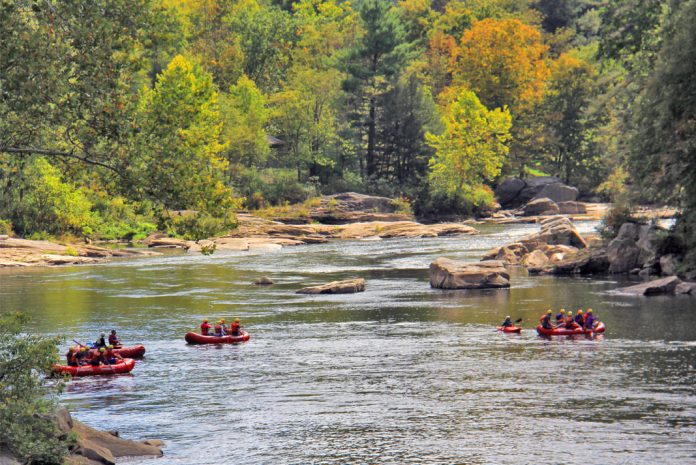
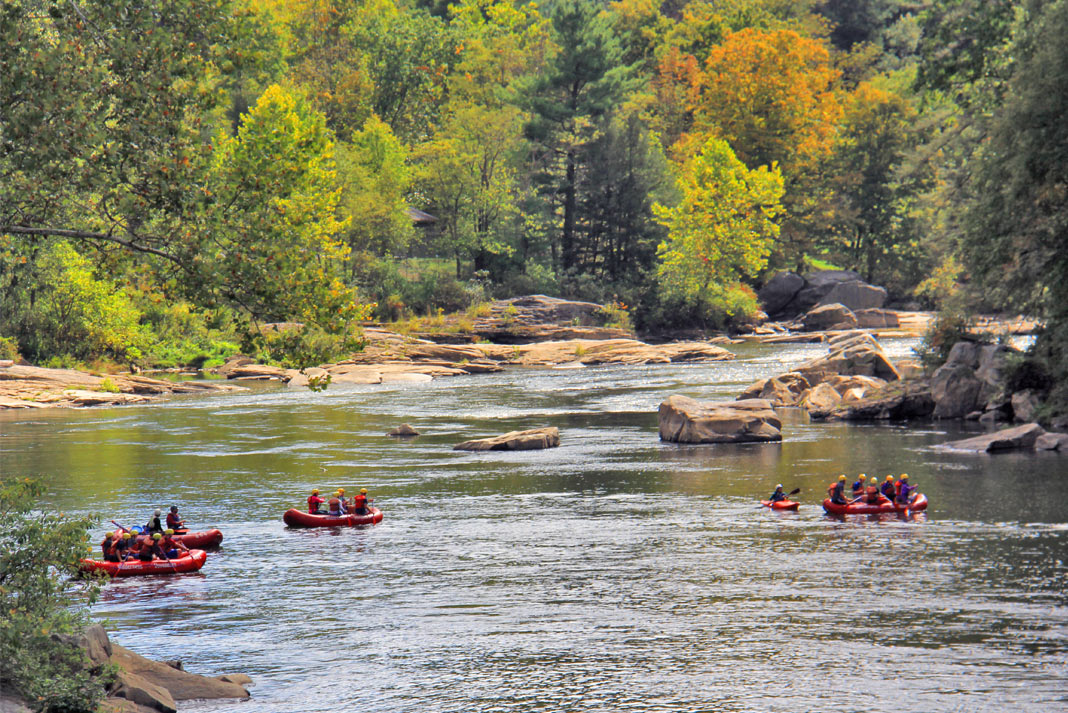
Whitewater rafting in PA is found on the Lehigh, Youghiogheny, Delaware and Susquehanna rivers, as well as Pine Creek. Wherever you choose to visit, rafting in PA is a picturesque and exciting adventure.
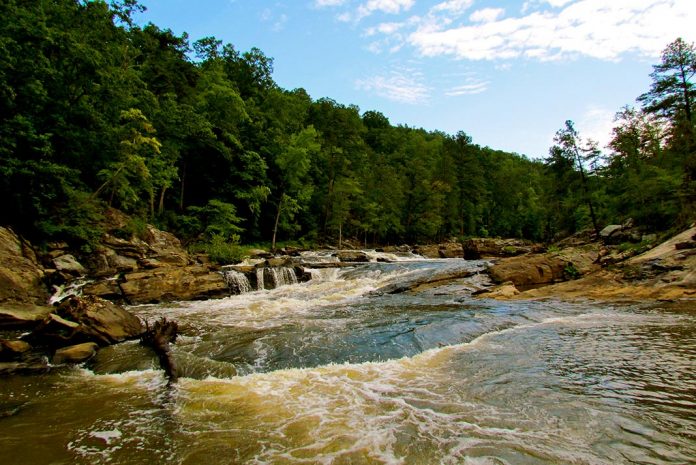
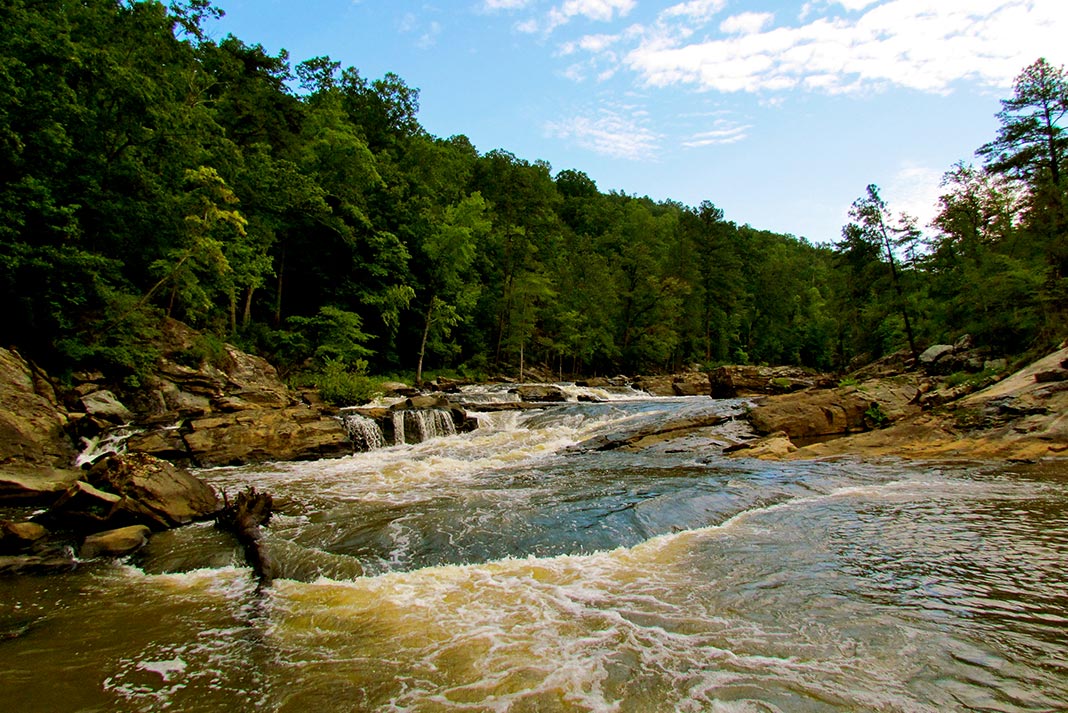
Take a rafting trip in Ohiopyle State Park.
Where to go whitewater rafting in Pennsylvania
Ohiopyle State Park / Youghiogheny River
The Youghiogheny River is the gem of Ohiopyle State Park, which is found in Southeastern PA and is a beautiful spot with a variety of activities to do. Whitewater rafting in this part of PA is generally split into the Lower, Middle and Upper Yough. Middle Yough contains class I to II rapids, and trips down this section are great for little ones or those who are just discovering the thrilling world of whitewater rafting and want something exciting but easier.
Lower Yough is the intermediate section, with class II to IV rapids that will pump up your adrenaline. The Upper Yough is one of the best spots for serious whitewater rafting in PA. Class V rapids, heart-stopping drops and narrow twists in the river make this section an amazing adventure for experienced paddlers.
American Whitewater has a super detailed and informative site with descriptions of all of the rapids found in Ohiopyle, any warnings in the area, etc. They’re a great resource to use when you’re planning your whitewater rafting trip in PA.
Prices vary based on desired level of oversight from guides.
Pittsburgh
Good news if you’re in the Pittsburgh area—you’re also less than 1.5 hours from Ohiopyle and whitewater rafting trips down some of PA’s best rapids on the Youghiogheny River. From Pittsburgh, you’ll wind your way southeast through Murrysville, New Stanton and Mill Run. Ohiopyle is close enough to Pittsburgh that you should have no problem fitting in a full day of whitewater rafting at the various outfitters outlined above.
The Delaware River is an important waterway, its watershed providing drinking water to 6% of the U.S. population. In PA, rafting on the Delaware is a calmer experience than the Yough or Lehigh rivers. The Delaware is wider and slower moving, perfect for a more relaxed day on the river. Because the river is the border between New York and Pennsylvania, rental and tour companies operate on either side of the river.
The stretch of the Delaware near Point Pleasant, PA isn’t heart-pounding like other spots, but it’s a fun and memorable option for families and those looking for a quieter day. Check out Bucks County River Country for rentals. They’re a local company that can provide you with rafts for a quiet, calm water day floating on the Delaware. Similarly, Indian Head, PA is a popular put-in for group-friendly rafting expeditions, both single-day and overnight, that are relaxing, fun and great group adventures.
The Pennsylvania Poconos boast exciting and challenging whitewater rafting adventures with a variety of rapids to suit most skill levels. Jim Thorpe River Adventures offers three levels of whitewater trips ranging from laid-back and family-friendly to adrenaline-filled, heart-pounding big water. In this area you’ll be on the Susquehanna or Lehigh, depending on your pick of whitewater trip.
Pine Creek Gorge is home to truly breathtaking scenery and exciting whitewater rafting. This gem of a spot is sometimes called the “Grand Canyon of Pennsylvania,” and that moniker doesn’t disappoint. Found in the gorgeous Tioga State Park, if you can plan a trip here in the fall you’ll be treated to a riot of oranges, reds, and yellows in the surrounding woods. Whitewater rafting trips on Pine Creek are run by one tour company, so they are a bit more expensive than some of the other trips on the Lehigh or Susquehanna Rivers—but this unique experience is worth it!
While PA is icy and snowy during the winter months from November to February, the whitewater season still runs for seven to eight months of the year. April generally marks the beginning of the season because the rivers are high due to the runoff from snowmelt. Most rivers are at their highest during the spring months. There are some exceptions, mainly the Lehigh River, that are reliable from April to November due to scheduled dam releases.
PA enjoys a humid climate, with warm spring months and summers that can be very hot. The time of year that you plan your whitewater rafting trip in PA will dictate what your best clothing choices will be. In the spring months, bring layers for the mornings and be prepared to wear a wetsuit—they are required by PA State Parks until the end of April. You’re welcome to bring your own, but most tour companies that require them also provide rental options.
Non-cotton athletic clothing will suit well for this type of trip. Synthetic fabrics dry more quickly, which will keep you more comfortable during your whitewater rafting day. Long pants made of a durable fabric will be your best bet in the late-spring and fall seasons.
Footwear is important for any type of river trip—the last thing you need to worry about is injuring your feet or toes on loose rocks or debris in the water. Wear a shoe that will stay on your foot and cover your toes—no flip flops! Outdoor apparel companies sell water shoes made from neoprene or hydrophobic materials that are designed for the river.
Neoprene shoes are comfortable and will keep your feet warm; if you’re purchasing shoes specifically for this trip, this type of shoe will be the most economical option. Neoprene shoes generally run $25+. More technical water shoes are generally in the $100+ range and are very useful if you’re going to be using them more regularly.
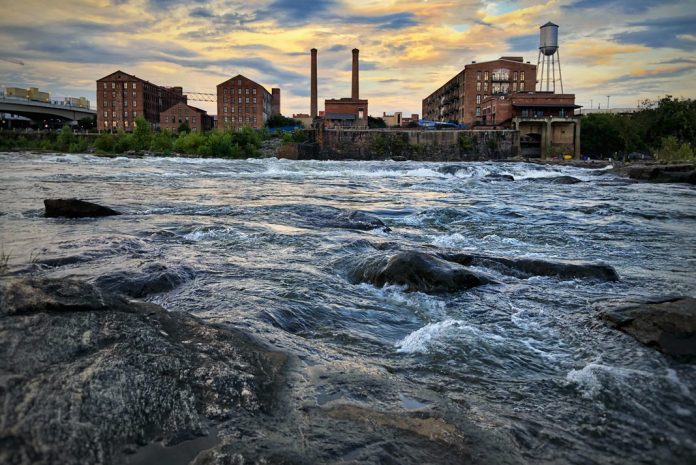
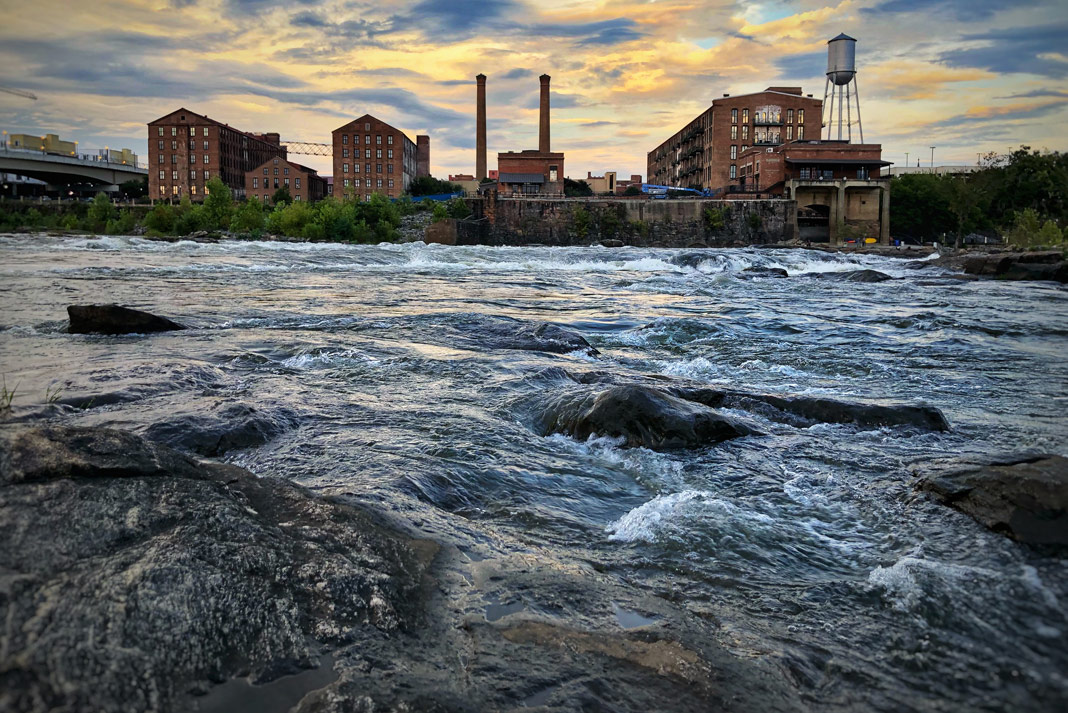
For whitewater close to the city, check out the Chattahoochee River, Columbus GA. | Photo: Shelby L. Bell
The state of Georgia is as rich in its natural diversity as it is in historical significance. From its highest elevation, found at 4,784 feet in Brasstown Bald, to the sea-level coastline, the state of Georgia is full of sights to see.
Whitewater rafting in Georgia can be found in several locations in the north and central regions of the state. From Atlanta, head north on highway 985 to Helen, where you’ll enter into the beautiful Chattahoochee National Forest. From Helen, a short drive either east or west will find you near Blue Ridge or Hiawassee, respectively. If you want to drive south of Atlanta, take the I-85 to Columbus, Georgia, where you’ll find some beautiful whitewater on the Chattahoochee River.
Best whitewater rafting in Georgia
Helen
If you’re driving from Atlanta, Helen is your gateway into the Chattahoochee Forest. Whitewater rafting in this area is on the Chattooga River. There are two sections of river that offer exciting and engaging rafting in this area: Section III and Section IV (note that these are the names of the sections, not the class of rapids on each section).
Section III is suitable for families and beginner whitewater paddlers with class II to III rapids and one class IV at the end, making for a beautiful day trip on the river for paddlers ages eight and up. Section IV is more intense, with class IV sections and the famed Five Falls, where the river descends 75 feet through a quarter-mile flume through five named rapids. 12 is the minimum age for Section IV trips, although tour companies and guides reserve the right to read the river each day and decide when it is safe for minors.
Day trips are popular in this area, and there are also guided overnight trips that allow paddlers to get the best of the whitewater rafting in this area of Georgia on both Section III and IV of the Chattooga River. Overnight trips make a great weekend getaway for groups of friends or families looking for adventure, and are fully geared up by the tour companies—no camping equipment required!
Columbus, Georgia is under a two-hour drive from Central Atlanta and is directly across the Chattahoochee River from Phenix City, Alabama. Columbus boasts the longest urban whitewater stretch in the world. Run some of the best whitewater in the United States when you kayak Columbus, Georgia, on class II to class IV rapids—both on the same 2.5-mile stretch of river, thanks to the dam-controlled water levels that rise in the afternoons.
In the mornings, when rapids are class I to III, whitewater trips are suitable for anyone over age seven, while the bigger afternoon runs are best for age 12 and up.
For whitewater close to the city, check out the Chattahoochee River, Columbus GA. | Photo: Shelby L. Bell
Atlanta
Atlanta is a historic city and worth visiting for the scenery, but it also provides great access to two rivers: the Chattooga and the Ocoee. Within two hours of Atlanta, some of the Southeast’s best whitewater rafting awaits. The Chattooga has great whitewater centered around Clayton (close to Helen), while rafting on the Ocoee can be found in neighboring Tennessee, beginning in Ducktown.
If you want to stay in the metro Atlanta area, your best bet for a day trip will be kayak, tube or SUP on the Chattahoochee.
Georgia falls within the humid subtropical climate classification, which means its summers are normally hot and humid, and winters are generally above freezing. For whitewater rafting in Georgia, this means that you can pack lighter clothes for spring and summer—while mornings are cooler than midday, you won’t normally find a frosty morning in July here!
The best type of clothing for whitewater rafting in Georgia will be athletic clothing made with non-cotton fabrics. Typical gym clothing will do great in this setting; just try to stick to synthetic fabrics as they’ll dry out faster and keep you more comfortable. If your hair is longer, make sure to tie it back before you hit the river so it doesn’t get in your eyes while you’re navigating rapids.
As always when you’re paddling on a river, closed-toe shoes are a must-have. You don’t necessarily need to have water shoes specifically, but ensure you’re wearing a sport sandal or running shoe that will stay securely on your feet and cover your toes. The last thing you want to worry about is losing a shoe downriver, or catching your toes on debris under the surface.
When does whitewater rafting run?
Head to Georgia for the unforgettable whitewater rafting scene from April to October each year. Explore Georgia is a great resource for trip planning and provides visitors with seasonal information about each area.
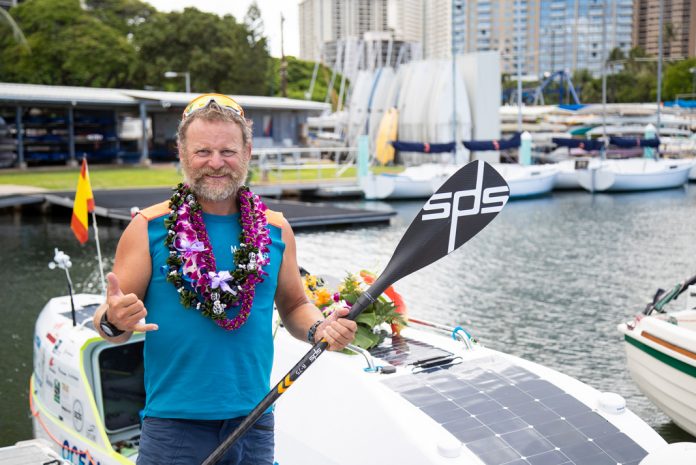
Antonio de la Rosa arrives in Waikiki after more than two months at sea on his paddleboard, Ocean Defender. | Photo: Tony Heff
Antonio de la Rosa had no clue he was attempting to retrace one of the greatest paddling voyages of all time when he arrived in San Francisco last June. He was preparing to paddle a custom-built, 24-foot standup paddleboard across the Pacific Ocean to Hawaii.
Only two days before his departure did de la Rosa, a Spanish adventure athlete, learn about Ed Gillet’s legendary 1987 sea kayak journey. Gillet was battered by storm waves and pushed off course by currents, before an extended period of calm dashed his hopes for making up distance by sailing. Long before the advent of satellite messengers, the San Diego-based Gillet was all but given up for dead. Then, miraculously, he touched down in Maui, fueled only by toothpaste after his provisions ran out. Even with the benefit of seriously modified equipment and modern communication technology, all recent attempts to match Gillet’s mythic 64-day crossing have failed—some more spectacularly than others.
Enter de la Rosa, 50, who got the idea of paddleboarding to Hawaii after winning the 2014 Rames Guyane, a grueling solo, unsupported trans-Atlantic rowing race, which marked the Spaniard’s first taste of open ocean travel.
To tackle the Pacific, he commissioned the construction of a 24-foot-long, 154-pound carbon-composite board—shaped like a peanut to facilitate paddling—yet with watertight storage and sleeping compartments fore and aft, respectively. The oversized SUP was equipped with a 65-pound daggerboard, a locking rudder and three solar panels, which were primarily used for charging a water desalinator. De la Rosa called it Ocean Defender—referencing his overarching expedition goal of documenting and raising awareness about ocean pollution.
A powerful ebb tide pulled de la Rosa seaward on his departure day, June 4, 2019. Launching in Marin, California, he was whisked by four-knot currents through the imposing gauntlet of the Golden Gate. De la Rosa, who completed a circumnavigation of the Arctic Circle by inflatable SUP in 2016, admits most of his efforts in preparing for the 2019 Pacific crossing went into the construction of his custom SUP.
“The technical preparation on this occasion was more important, along with the psychological gifts I was lucky to be born with,” de la Rosa says with a chuckle. He packed hundreds of pounds of freeze-dried and canned foods and trained his mental resolve for “absolute loneliness and self-sufficiency.”
Early on, de la Rosa was stifled by the California Current. He recalls several days of “great problems,” making incremental gains only to be pushed backward and off-course by the relentless southbound current. Once he escaped to the calmer waters of the open ocean, de la Rosa’s journey became easier. He was thrilled by the comfort of his custom board. “It was a 10,” he enthuses. “Without a doubt, it was the best design and construction we could do.”
[ See the largest selection of paddleboard in the Paddling Buyer’s Guide ]
As days turned to weeks and weeks turned to months, de la Rosa cleaned barnacles off the underside of his SUP three times. He admits he found “too much plastic”—sighting fishing nets and gear and other flotsam and jetsam every day. Finally, after 10 weeks at sea, de la Rosa glimpsed the mountains of Hawaii. It was a milestone signifying more challenges as the paddler was forced to endure sleepless nights maneuvering his board in high winds and waves towards an unforgiving coast.
Gillet was mistaken for a bedraggled bum when he limped ashore in Maui in 1987. De la Rosa, who regularly updated his Instagram feed with videos taken at sea, landed at Oahu’s Waikiki on his 77th day with much more fanfare.
His 2,950-mile crossing is second only to South African Chris Bertish’s 93-day, 4,050-mile SUP transit of the Atlantic Ocean in 2017. “I am feeling so good after 76 days in the middle of the ocean,” de la Rosa told a CNN reporter in Hawaii. Then he revealed his immediate plans to his 6,000 Instagram followers: burgers and beer.
Antonio de la Rosa arrives in Waikiki after more than two months at sea on his paddleboard, Ocean Defender. | FeaturedPhoto: Tony Heff
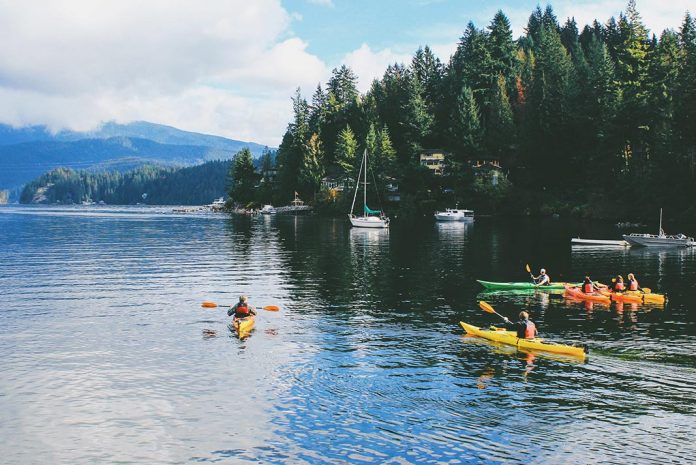
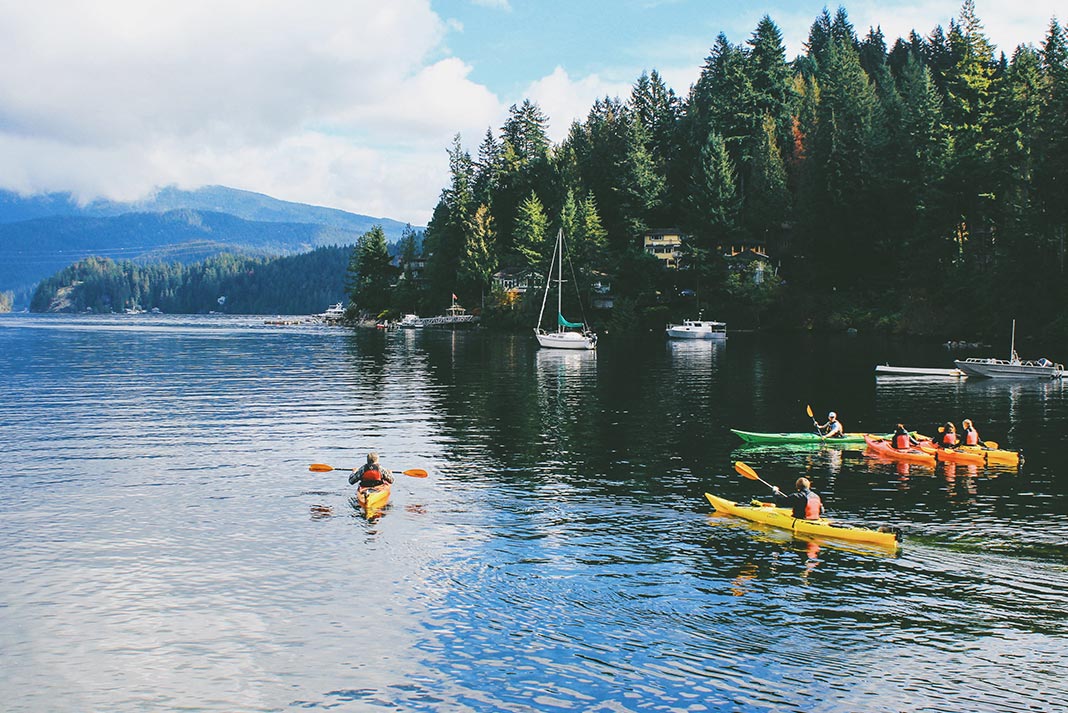
The coast of Vancouver offers some truly spectacular paddling. | Photo by: Wallpaper Flare
Vancouver is one of Canada’s most popular destinations to visit in the summer months, for good reason. Just a 45-minute drive from the U.S. border with Washington state, Vancouver sits in one of the most temperate locations in Canada. This is a city that’s easy on the eyes in addition to being a cultural center with an urban feel.
The lifestyle in Vancouver is centered around the outdoors, and the locals here are exuberant about their beautiful city. Much of the shoreline that hugs the city and wraps around the famous Stanley Park is accessible by beach path, with excellent access to the water for paddlers from almost any public beach. If you happen to be here in late June, keep your eye out for the Dragon Boat Festival—it’s a unique sight that locals and visitors alike gather to watch.
Vancouver is a port city, and provides an entrance for international cargo ships, many of which travel from Asia and spend days sitting in Burrard Inlet, patiently waiting for their turn to unload and chug away. Aside from adding to the trade and commerce in Vancouver, these ships also make great photos facing west, especially in the evenings! If you’re looking for activities during your time off the water, check out Daily Hive Vancouver—there’s always something happening!
Dip your paddle in the salty west coast waters at Granville Island, Jericho Beach, False Creek, Yaletown, Stanley Park, or Deep Cove. There’s a place to kayak in Vancouver everywhere you turn.
You might have to make some tough choices if you’re not visiting Vancouver for long as kayaking opportunities here are bountiful—it’s a good problem to have! Vancouver has an extensive coastline on the Pacific Ocean and, as such, nearly all kayaking from Vancouver proper is sea kayaking.
[ Paddling Trip Guide: View all paddling trips in British Columbia ]
Deep Cove
Kayaking Deep Cove is a Vancouver classic; ask any local and it’ll be on the top of their must-do list. Day trips meander along the coast with views of Stanley Park, Vancouver Harbour, and North Vancouver, and overnight trips will take you up Indian Arm.
Coastal Vancouver is home to an incredible array of biodiversity; it fascinates nearly everyone who has the chance to experience its charm and intrigue, and is the location of countless scientific studies and explorations. From marine life like seals and sea lions that are nearly always visible lounging on rocks, bellowing calls, and sunning themselves, to more elusive dolphins and whales, to land-dwelling creatures like eagles, bears, deer, wolves, and sea birds, the ecology of this area is vast and majestic.
Deep Cove Kayak
Single kayaks: $39 per two hours; $99 per day; $139 per two days
Double kayaks: $59 per two hours; $135 per day; $189 per two days
Almost any beach in Vancouver provides paddlers with stunning sunset views. Head out from Jericho or Granville Island for the best views in Vancouver while you play among the sailboats, cargo ships, and plenty of other paddlers out for an evening tour.
If you’re staying downtown, there are a couple of rental companies that operate out of the Yaletown area as well. While this is less popular than the other side of the bay for outfitters, it’s a quick jaunt (safely obeying navigational rules) across the bay or up the shoreline toward Sunset Beach and Stanley Park. Once you get out into the channel, facing west the only thing between you and Japan is Vancouver Island!
Jericho Beach Kayak
Single kayak: $39 to $85
Double kayak: $59 to $115
Vancouver Water Adventures
Single kayak: $25 per hour
Double kayak: $35 per hour
Kayak Vancouver
Single kayak: $20 per hour
Double kayak: $30 per hour
Creekside Kayaks
Single kayak: $20 per hour
Double kayak: $30 per hour
Glacier kayaking
Glacier kayaking is next-level in all respects—price included. Trips are customizable and vary by season according to permits to access British Columbia’s crown land, but generally are in the $5,000-range. You’ll fly out of YVR Airport in Vancouver or nearby Abbotsford, BC and into the Coast Mountains where you’ll kayak in channels of aquamarine glacial meltwater. This is a truly once-in-a-lifetime experience!
Compass Heli-Tours
Prices TBD for the 2020 season
Night kayaking
Kayaking at night will give you the opportunity to see the ocean in an entirely different way—watch the kelp sway, paddle through the green glow from your kayak lights, and watch the Pacific Ocean sunset give way to inky indigo skies as you take in the quieter city from the water.
Kayaking on Vancouver Island is a special experience. You’ll be in awe of the cliffside scenery and coastal islands as you dip your paddle in the Pacific Ocean by Victoria, or paddle the rugged coast further north from Tofino or Ucluelet. Sea kayaking is peaceful, meditative and beginner-friendly, but be prepared to battle some choppy waves, current and wind if need be— this is nearly open ocean, so conditions can vary quickly and drastically. It’s true what they say about island life; the pace of things is slower here, so get ready to relax!
Victoria Kayak
Single kayak: $43 per two hours
Double kayak: $64 per two hours
A Paddle in the Park
$40 to $90 per day
Tofino Sea Kayaking
$60 to $100 per day
Multi-day rates available
Kayaking with whales
If all of the natural wonders of the Vancouver area already mentioned weren’t enough to draw you in, kayaking with orcas and other whales should do it! Few things give you perspective on your size and place in the animal kingdom like seeing a marine creature the size of a whale from atop your kayak. Vancouver Island is a great spot for these tours; while you may happen upon a pod of orcas or a humpback whale on your own, guiding companies use radios to communicate the location of whales in the area, so they’ll have the best scoop on where you’re most likely to see these giants of the sea.
Most whale-watching sea kayak tours are multi-day because it’s tough for guiding companies to guarantee a sighting by kayak. Even motorized whale watching tours aren’t 100% guaranteed, but most companies will give you a discount, or a free trip if yours is a complete bust.
North Island Kayak
Three-day tour: $500 to $560 per person
River kayaking
Sea kayaking dominates in this area due to the availability of coastline and the abundance of marine wildlife, but if river kayaking is what you’re after, they have that, too!
The Chilliwack River is home to incredible kayaking and fishing. While the water levels get high in the winter due to rainfall, you can kayak here year-round given the right conditions.
Vancouver Island river kayaking is a bit more temperamental. Most rivers in this spot are flash rivers—great whitewater kayaking opportunities, but only right after heavy rainfall. The Cowichan River is a local favorite.
If you head to Vancouver Island for the river kayaking and the weather doesn’t cooperate, there’s always the very adventurous option of tidal kayaking! This is a very niche activity, and not for the inexperienced or faint of heart, so only head out onto tidal surf waves if you’re a very experienced whitewater paddler and are familiar with tidal waters, or if you are with a local guide.
What to wear
Vancouver has a temperate climate; if you’re coming from the United States, it’s akin to the weather in Seattle or Portland. It can be wet, so pack trusty rain gear and wear layers no matter the time of year. Go with a base layer, insulating mid-layer, and waterproof outer layer, and you’ll be happy no matter the weather!
Sturdy shoes that keep your feet safe from rocks, barnacles, shells and other potential hazards on the ocean floor are a must. There are some incredible sandy beaches in the Vancouver area to launch your kayak from, but there are also lots of rocky spots that will quickly scrape up your feet.
There are endless opportunities for exploring in Vancouver and you’ll see paddlers out year-round. Visitors, however, would be best sticking to sunnier summer months, as the winters can see rain nearly every day. Pack for warm rain during the summer months as well; while there are plenty of sunny stretches, it can get damp in July and August.
Bring your rain gear, learn your umbrella etiquette (just in case), prepare to meet relentlessly outdoorsy locals on your adventures, make sure your phone and camera are charged—you can’t miss with a paddling trip in this dazzling city!
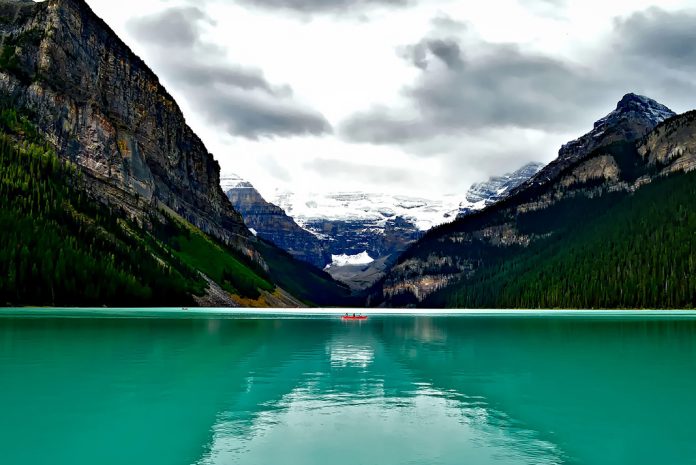
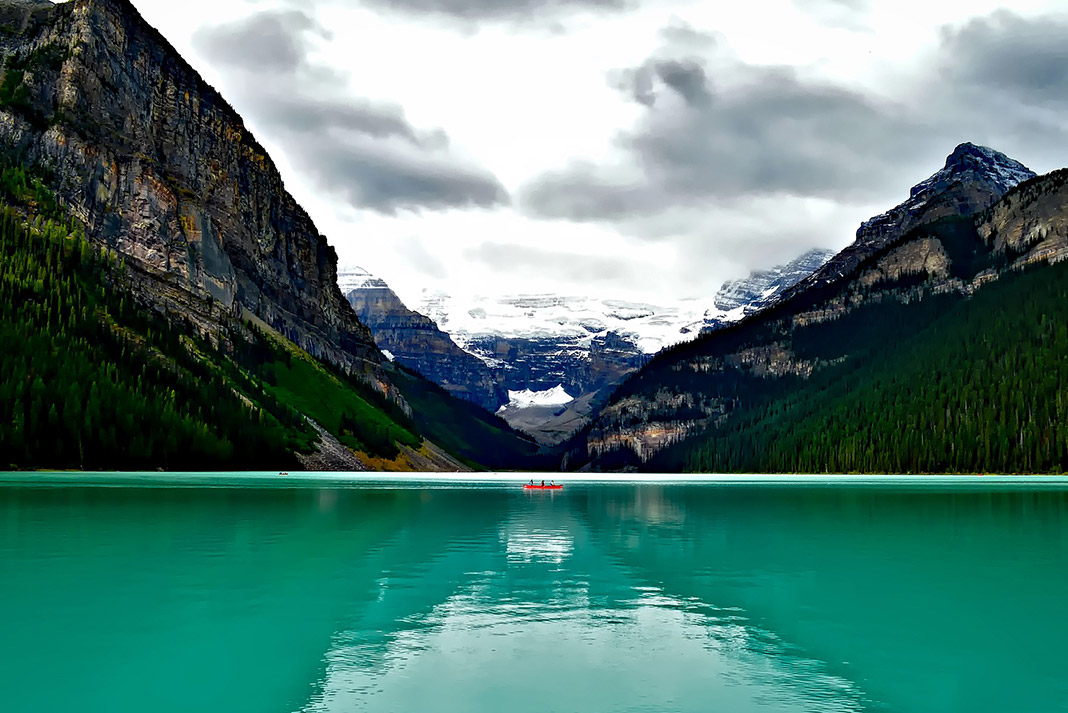
Paddling across the turquoise water in the shadow of the Rocky Mountains is an unforgettable experience.
Lake Louise, Alberta is a major tourism destination, for good reason. Lake Louise is a tiny hamlet in the Canadian Rockies, located about an hour drive west of Banff on the Trans-Canada Highway. The village is not on the lake itself, but is well worth a separate stop for its unique coffee shops and local businesses.
The majestic expanse of Lake Louise sits perfectly tucked between famous Rocky Mountain peaks. Local legends aside, the stunning turquoise color of Lake Louise that entices so many visitors to this magical spot is a product of light reflecting off of tiny rock particles that are carried into the lake by the glacial melt from the peaks high above.
The Fairmont Chateau Lake Louise is a gem of Canadian history where you can take in stories of the past, enjoy a hot chocolate while gazing out the massive windows that frame the lake, or get fancy and book a reservation for high tea in the elegantly decorated dining room. While in winter you can walk and skate on the frozen lake, take horse-drawn sleigh rides, and ski at the nearby resort, summer hosts perhaps the most entrancing activity of all: canoeing.
Canoeing on Lake Louise provides a wholly unforgettable experience. If this place is stunning from the shore, it’s awe-inspiring from the water. Canoeing Lake Louise is entirely worthy of your bucket list! Here’s what you need to know to experience it for yourself.
Paddling across the turquoise water in the shadow of the Rocky Mountains is an unforgettable experience.
Lake Louise canoe rental
The Fairmont Chateau Lake Louise is the only game in town for renting a canoe to paddle the lake. The Fairmont runs a boathouse on the west shore of the lake where you can rent canoes by the hour, or choose a guided tour.
Canoe times
Lake Louise is high in the Alberta Rocky Mountains, and that means the lake stays frozen longer into the spring. Canoe season depends on when the ice thaws on the lake, which can be variable each year depending on the winter season and spring temperatures. Mid-June is normally a safe time to start planning your trip. Likewise, the close of the season will depend on fall temperatures and the amount of snowfall. October might provide paddlers with a beautiful and crisp fall paddling experience, or perhaps be a bit too snowy and icy for an enjoyable time on the lake.
Summer in Alberta is reliably warm and sunny, with summer thunderstorms sometimes rolling in through the mountains in the late afternoons. Boat staff at the Fairmont are very aware of the weather conditions each day and will make sure you’re not on the water if it isn’t safe.
The Fairmont does not currently have Summer 2020 hours posted, however in past years the boathouse has been open 11 a.m. to 7 p.m.
Canoe cost
Again, the Fairmont does not currently have rates for Summer 2020 posted, but in past years the cost for non-hotel guests has been $125 plus tax per hour and $115 plus tax per half-hour. For hotel guests, the rates are $85 plus tax per hour and $75 plus tax per half hour. Please keep in mind that these are likely to change for the 2020 season, and check back with the Fairmont’s website for updates as we move closer to the opening of the season.
Lake Louise canoe tours
In addition to hourly canoe rentals, the Fairmont also offers three tour options. The guides who operate these tours are passionate and knowledgeable paddlers and will fill you in on all kinds of fun facts and history as you canoe Lake Louise.
Sunrise Canoe Experience
If you’re a morning person, or willing to be a one-time morning person for this incredible experience, you’re in for a treat. This is the best time to avoid crowds on the lake as you watch the purple and pink sunrise hit the peaks around you, and sink down toward the calm surface of Lake Louise. After your adventure, enjoy your well-earned breakfast as the rest of the world slowly wakes.
Summer 2020 prices are not posted yet, please check back soon for rates.
Voyageur Canoe Experience
Voyageur canoes are an incredibly unique way to experience Lake Louise. These crafts are steeped in Canadian history. The Fairmont describes the experience as follows: “As you journey across the lake, your guide will share local stories about the wildlife, the indigenous people and the early explorers.”
Adults $55, Children (8-12 years) $30
Evening Canoe Experience
Evening Canoe Experience tours leave the boathouse at 8 p.m. and provide guests with an hour of calm, crowd-free time canoeing Lake Louise. Evening in this spot is a special time. Not dark yet at this time of year, the light is fading into sunset and the air is softly colored and warm around you.
Summer 2020 prices are not posted yet, please check back soon for rates.
[ Paddling Trip Guide: Browse all canoe trips and rental services in Alberta ]
Rules
You can paddle your own canoe on Lake Louise and on all lakes in Banff National Park. The catch is that there are no public boat launches available on Lake Louise, so you’ll have to find your own spot to launch from the shore.
Can you swim in Lake Louise?
Temperatures in Lake Louise are normally no warmer than 10 degrees Celsius (50 degrees Fahrenheit), but can be much colder than that! Lake Louise is fed directly from Victoria Glacier, so at all times of year the lake is, quite literally, glacially cold. Most lakes in the Canadian Rockies are glacier-fed, so be careful dipping your toes in!
Lake Louise canoe trips
While canoeing on Lake Louise itself is the main paddling experience people associate with the town, there are other paddling opportunities in the town and nearby. Check out the Parks Canada paddling site when you’re trip-planning.
Lake Louise to Castle Junction/Banff
If you’re looking for more of a whitewater canoeing or kayaking experience in Lake Louise, the Bow River from Lake Louise to Castle Junction is a great half-day section, followed by Castle Junction to Banff. If you do these two sections together, be ready for a very full day on the river.
The Bow River is a favorite for local paddlers due to its challenging watercourse and dynamic characteristics. If you’re an experienced paddler, this is absolutely worth a trip! This is not a trip for beginner paddlers.
There are many factors to keep in mind when paddling The Bow; hazards pop up quickly and can change day to day. There are high numbers of sweepers, strainers, logjams, and submerged boulders. In addition, tight corners make river hazards hard for less experienced paddlers to see and avoid, and water flow can change quickly.
If you’re paddling the Castle Junction to Banff section, you will encounter Redearth Rapids. If you’re not prepared to run the rapids, this is an area that must be portaged around, and there is no set portage area. Preparation is key for this stretch of river. Parks Canada has a comprehensive guide to make sure you stay safe while enjoying one of Alberta’s favorite rivers!
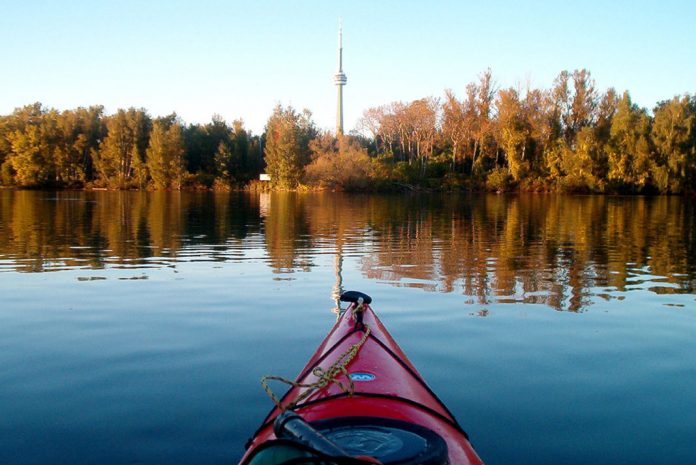
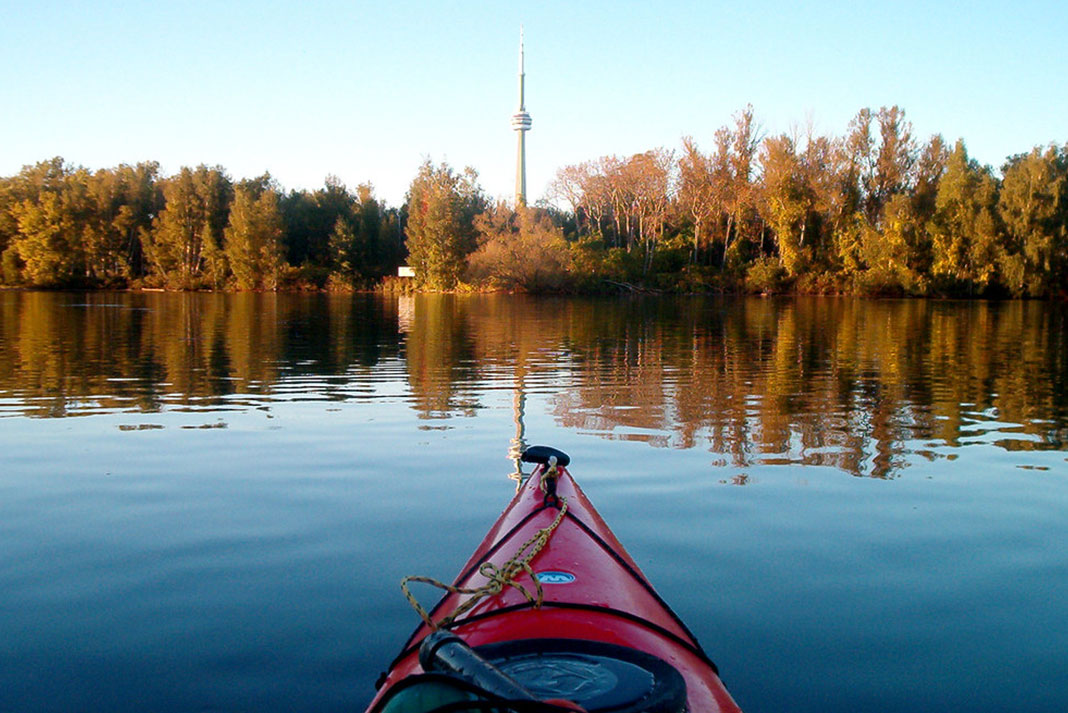
Despite being an urban centre, there is lots of great access to kayaking opportunities in Toronto. | Photo by: Flickr//John Vetterli
Home to the largest urban population in Canada, a thriving diversity of cultures, NBA, MLB and NHL teams, as well as an array of lifestyle activities and greenspaces, Toronto’s reputation as a hub of Canadian life and culture is well-earned.
The heart of downtown Toronto might not immediately bring to mind exploring nature, but venture toward the shores of Lake Ontario and you’ll be surprised at the opportunities to dip your paddle into one of the Great Lakes. Curious where else you can paddle when based out of Toronto? Read on and discover some of our top finds!
[ Paddling Trip Guide: Find rentals and guided trips in Ontario here ]
Despite being an urban centre, there is lots of great access to kayaking opportunities in Toronto. | Photo by: Flickr//John Vetterli
Where to go kayaking in Toronto
Humber River
The Humber River runs through the heart of the city and empties into the majestic Lake Ontario. You can paddle the section from Old Mill Station to the lake in an easy day trip where you’ll feel tucked away in the wilderness as you paddle past gentle banks, deciduous trees, small creatures like minks, and all manner of native birds.
There are a couple of places you can put-in near Old Mill Station.
Etienne Brulé Park
Etienne Brulé Park is located at 10 Catherine Street, Toronto, on the east side of the Humber River. Parking here is free. It’s a short walk down to the water, although there is no official ramp or boat launch located here.
Humber Boat Put-In
The Humber Boat Put-In is located off Humber Valley Road, just north of the intersection with Riverwood Parkway, on the west side of the Humber River. There is free parking here and a boat ramp, making it simple to access the water.
It’s an easy paddle to Lake Ontario from both these launch points. If you have two vehicles, you can park a second at the Humber Bay Park Boat Ramp (225 Humber Bay Park Road W., Etobicoke), near the Humber Arch Bridge. Otherwise, you can paddle back upstream to the starting point.
Don’t have a kayak? Toronto Adventures offers two-hour canoe, kayak and SUP rentals on the Humber River. You can also check out their guided tours and lessons.
Keep in mind that water levels on the Humber vary throughout the year, running high in the spring and low in late summer. Track water levels here if you’re curious about the ebbs and flows of the Humber.
Lake Ontario
Paddle your way from Woodbine Beach to the towering Scarborough Bluffs for some spectacular photo ops and beautiful kayaking in Toronto. Rent kayaks from Toronto Beach Kayak and float your way along the shore. This spot is one of the most recognizable landmarks in the area, and won’t disappoint regardless of the weather. In the right sunlight, the water lights up turquoise and the beaches contrast in lighter colors, evoking thoughts of Caribbean seascapes. On gloomier days, your thoughts will drift to the legendary cliffside beaches of Scotland.
If you want to stick to inland waters, make your way to Sunnyside Park. The park itself is on Lake Ontario, off Lake Shore Blvd, but there are breakwaters to keep the potentially choppy waters of the lake a bit calmer. This is a great option for a day of kayaking in central Toronto.
Credit River
Just west of Toronto in Mississauga, Ontario, you’ll find the Credit River, where you can meet local paddlers taking advantage of urban whitewater. While the section from Streetsville to Erindale Park runs class I and II rapids year-round, things get more exciting here in the spring with higher water levels. Continuing down to Port Credit is also an option.
Those looking for a shorter, flatwater paddle may choose to start at Port Credit and paddle upstream to the QEW and back. There is a boat ramp located just after the Port Credit Lighthouse. It can be accessed at a public parking lot located at 16 Front Street S., Mississauga.
Toronto Island
Toronto Island can be a bit of a misnomer to visitors, because it’s actually an interconnected group of 15 islands, the largest of which is called Centre Island. The other 14 islands have different names, but are all part of the Toronto Island group and are connected by pathways and bridges.
You can kayak to Toronto Island from Harbourfront Centre in downtown Toronto. Head to Centre Island, which is easy to see because it’s also the location of Toronto’s downtown airport, Billy Bishop. From there you can traverse the islands along their shores, or on foot if you’d like to explore the interior. The Boat House is a kayak rental service that’s on Toronto Island; take a 13-minute ferry ride from downtown Toronto to take advantage of Centre Island kayak rentals if you don’t want to paddle across. Grab a bite to eat and relax for a while—this is a great spot to spend a day kayaking in Toronto!
One of the great advantages of being in Toronto is that you’re within a few hours’ drive, at most, of a plethora of paddling options for all skill levels.
Take a drive out of the city, and in an hour and 45 minutes you’ll be at the north end of Lake Simcoe, in McRae Point Provincial Park. Tour around in a kayak acquired from a Toronto rental company, or stop at Happy Paddling rental company on your way through Barrie, Ontario. One-hour kayak rentals here will run you $30.97 for a single sit-on-top kayak and $44.25 for a tandem. If your timing allows, get out for a sunrise paddle on the lake—the colors are spectacular.
If you’re feeling adventurous and have a bit more time to travel outside of Toronto, consider heading to Palmer Rapids, Ontario, where you’ll find some challenging and exciting paddling on the Lower Madawaska River. If you’re looking for a guided trip on the Madawaska, check out Paddler Co-op or Madawaska Kanu Centre. For rentals, nearby Barry’s Bay Outfitters is your best bet. Rent a kayak here for $26 to $33 per day, with options for multi-day rentals as well.
When to go
When it comes to entry-level kayaking in Toronto, summer is the best time of year to visit. Summer in the city is hot and humid, making being out on the water all the more inviting. Keep in mind, of course, the risks of sun and heat exposure and take the necessary precautions to ward against heat stroke, dehydration and sunburn.
It’s also a good idea to check weather reports before you head out, especially when planning to paddle on Lake Ontario. Many rental companies will cancel bookings if wind and waves are creating dangerous conditions on the water. If you’re paddling independently, keep an eye on forecasted wind speeds, and be mentally prepared to change your plans on arriving at the launch point if it’s choppier and windier than you’re comfortable with, or head back to shore once you’re out there if conditions worsen.
While many rental shops open during May or June and close for the season in September or October, paddling doesn’t stop altogether in the winter months. Lake Ontario rarely freezes over, so many paddlers still choose to get out on the water. Doing so requires experience and the appropriate gear, however. Learn what cold water paddling essentials you need and connect with local groups (such as Credit River Paddlers) to find out more about winter water conditions in the GTA.
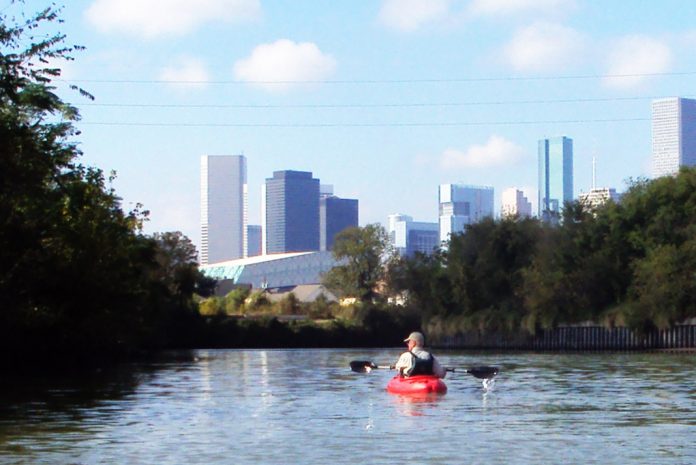
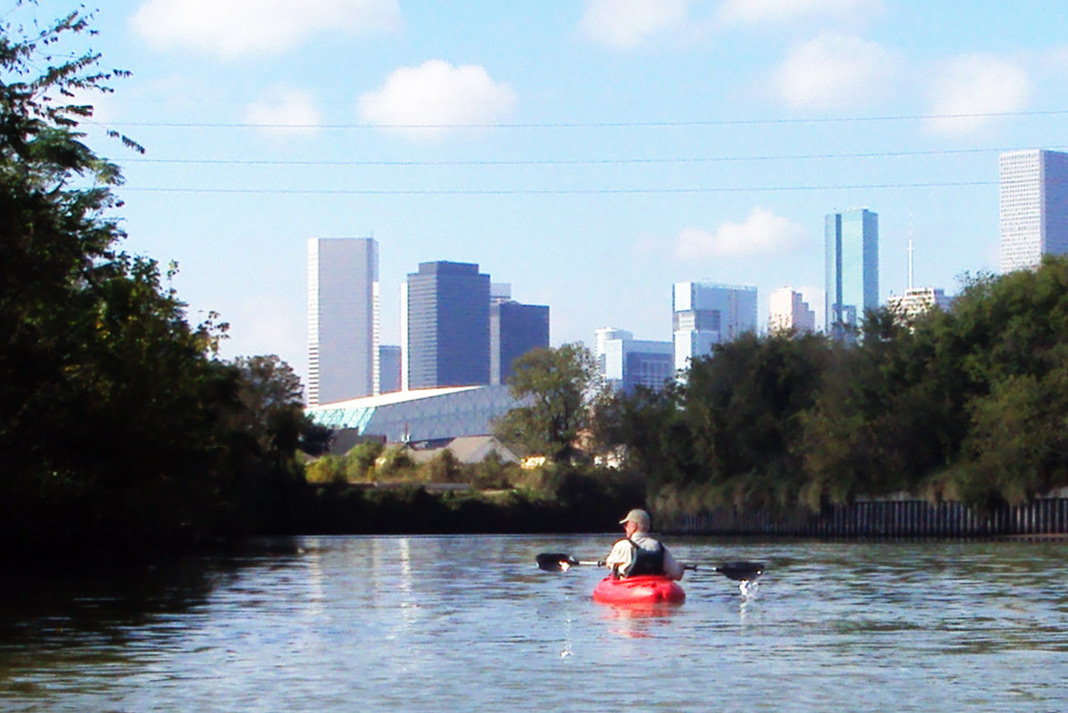
Buffalo Bayou will take you right through the heart of downtown Houston. | Photo by: Flickr // Patrick Feller
Deserts and dry weather may first come to mind when you think of Houston due to Texas’ southern position. However, this bustling metropolis abounds with paddling opportunities, from short beginner jaunts around its city parks to lengthy overnight trips along the Brazos River.
One of the best parts of paddling in the Houston area is that it has not taken off yet in popularity like in other major cities around the country, making its waterways the perfect place to unwind from the rush of city life. Let’s take a look at some of the best places for novices and experts alike to get started kayaking Houston.
Buffalo Bayou will take you right through the heart of downtown Houston. | Feature photo: Patrick Feller/Flickr
Where can you kayak in Houston?
As mentioned, there are plenty of locales for kayaking in and around Houston. From calm, beginner-friendly ponds and lakes to multi-day trips for the adventure enthusiast, Houston’s waterways offer something for everyone. Here are a few of the most popular paddling destinations in the area.
Downtown Houston
If you’re staying in the downtown area, these are the paddling opportunities closest to you.
Discovery Green
If you’re looking for a very beginner-friendly or short paddle in the city, Discovery Green park is your best bet for kayaking downtown Houston. You can rent a kayak through Bayou City Adventures for $5 per person for a quick 15-minute paddle on Kinder Lake. The calm, shallow waters are a great place for first-timers to get comfortable with kayaking.
Buffalo Bayou – from the North York Boat Launch
Located at Marron Park, the North York Boat Launch is a convenient spot on the east side of the city to launch your kayak on Buffalo Bayou. This is a slow-moving waterway, but if you plan for an extended trip toward Galveston and the Gulf of Mexico, you should be familiar with sea kayaking and paddling with large barges. A shorter trip would be to Hidalgo Park (about three miles). You can find more launch points on Buffalo Bayou outside of the downtown area below.
Buffalo Bayou – from the Lost Lake Boat Launch
If the west side of town is more convenient, launch into Buffalo Bayou from the Lost Lake Boat Launch. Again, with the leisurely pace of the water, you can paddle west toward downtown or east to get away from the busyness of downtown.
Brays Bayou Park
Located on the south side of town near the University of Houston, Brays Bayou Park provides easy access to many other locations through the city center via Brays Bayou, including MacGregor Park (5.5 miles point to point) to the east and Braeburn Glen Park (a little over 10 miles point to point) to the west.
Buffalo Bayou
As you may have gathered from above, Buffalo Bayou kayaking is one of the more popular paddling options around Houston. There are several trip options to choose from
You can launch your vessel under the bridge on Sabine near Buffalo Bayou Park and paddle upstream to River Oaks (about 3.5 miles) or Lost Lake, or downstream to Marron or Hidalgo Park. Here is an excellent map to help you plan your trip. You can also rent a kayak in the park near Sabine Street from Bayou City Adventures. Prices start at $30 for a single kayak.
For an extended trip, check out the 26-mile Buffalo Bayou paddling trail. Due to the length of the trail and its proximity to the city, this waterway will have to be paddled in sections. Fortunately, there are 10 access points. The trail begins at Highway 6 and runs to Allen’s Landing Park within the city. You can learn more about the trail and find a more detailed list of section ideas, as well as a map with access locations and coordinates, on the Texas Parks & Wildlife website.
One word of caution: It should go without saying, but never go kayaking after heavy rains. While the bayou is normally very slow-moving, torrential rains can cause unsafe conditions.
Brazos River
The Brazos River is another popular paddling option in the area. There are several paddling trails on the river, including the 35.4-mile Stephen F. Austin paddling trail and the 8.3-mile Columbia Bottomland trail. Although the river flows slowly for the most part, it is recommended for intermediate and advanced paddlers due to some of the access points being up to 20 miles apart and many access points themselves being steep and covered with soft dirt.
Closer to the city, one nice trip starts at I-10W and heads southwest to SW 59. This is a good option for multi-day trips.
If you don’t mind the difficult put-in conditions and would enjoy something a little farther away from the city, try Rosenberg to Sugarland to the southwest of Houston. This is about a 20-mile trip, so be prepared to leave early in the morning.
Lake Houston
Many locals wonder, “Can you kayak in Lake Houston?” and the answer is yes! This sizable lake has a surface area of 18.5 square miles and a maximum depth of 45 feet. It is especially popular among local fishermen, making it a great place to do some kayak fishing.
For a relaxing trip away from powered watercraft, put in at the Red Grove Park boat launch and head right, past the island directly across from the launch. Further on there are some coves and inlets on either side where you can explore and avoid the wakes from motorboats and jetskis. This is a great area for two-mile round-trip excursions and provides great wildlife viewing opportunities as well.
The park near Kings River Parkway is also a good launching point for a relaxed 2.5-mile trip. Although there is no formal boat ramp and you will need to haul your kayak about 200 feet to the water’s edge, the bird- and nature-watching along your paddle makes up for it.
Both of these paddles are suitable for beginners and veterans alike looking for some relaxing time viewing nature on the water.
Woodlands
For another calm lake paddle just north of the city, you can’t beat kayaking the Houston Woodlands. Lake Woodlands is about 200 acres in size and, other than man-powered vessels, only allows trolling motors, so your biggest concern is high winds.
If you need to rent a kayak anyways, perhaps the easiest way to gain access to the lake is through the Riva Row Boathouse facilities (kayak rentals start at $15 for a single for the first hour). This is technically located on The Woodlands Waterway, but you can reach the lake by paddling northwest.
Lakes Edge Boathouse in Hughes Landing is another option if you’re looking to rent a kayak on the lake for a day (single kayaks start at $15 for the first hour here as well). This boathouse is located near the northern end of the lake.
You can also put in at North Shore Park, located near the Lake Woodlands Drive bridge.
Aside from the rental companies already listed, there are several other outfitters in and around Houston to choose from.
Austin Kayak
In addition to their wide selection of kayaking, canoeing and other related water gear, Austin Kayak also offers daily rentals. This is a great option if you are looking to paddle somewhere nearby that doesn’t have a boathouse or rental service. Plus, you’ll receive 15% off if you buy certain items with rentals, such as a PFD, bug repellent or a drybag. Call the Houston location at 713-660-7000 for prices and more details.
Southwest Paddlesports
Southwest Paddlesports is another local outfitter that offers not only kayaks and related gear for sale, lessons, and tours, but daily rentals as well. From single sit-on-tops to whitewater kayaks, you can rent for one, three or even seven days. You can contact Southwest Paddlesports by clicking on the link above or calling 281-292-5600 for prices.
Pinky’s Kayak Rental
If you’re looking for something a little farther from the downtown area, Pinky’s Kayak Rental may be the right choice for you. Located southwest of the city, Pinky’s offers single and tandem kayaks so you can paddle Taylor Lake, which they are located right next to, as well as a shuttle to Armand Bayou just a few miles away. Taylor Lake single kayaks start at $25 per hour.
When to go
Houston weather can be tricky with hurricane season, which mostly coincides with their unique rainy season. This normally falls between May and October. Aside from this, summer can get busy with tourists and beach-goers, being so close to the Gulf, and is blisteringly hot. Average summer highs range in the 90’s.
Your best bet is to plan a trip between February and April. Average highs range from 64 to 76°F and February also happens to be the driest month of the year. October and November also provide nice temperatures and fall outside of the tourist season, but can be unpredictable with late-season hurricanes and tropical storms.
What to wear
Kayaking in Houston requires the typical clothing and gear you would expect when paddling in warm regions, although you may wish to bring a drysuit along if you plan on kayaking in the cooler months. Here is a list of items you won’t want to forget at home for your trip.
Sunscreen
Baseball cap or wide-brimmed hat
Sunglasses
Water shoes, sandals or tennis shoes you don’t mind getting wet
Light-colored, breezy clothing
Extra clothes to change into after your time on the water
Whether you are planning a trip to the area or are a local just discovering the joys of paddling, there are plenty of spots in and around town for kayaking Houston.
Buffalo Bayou will take you right through the heart of downtown Houston. | Feature photo: Patrick Feller/Flickr
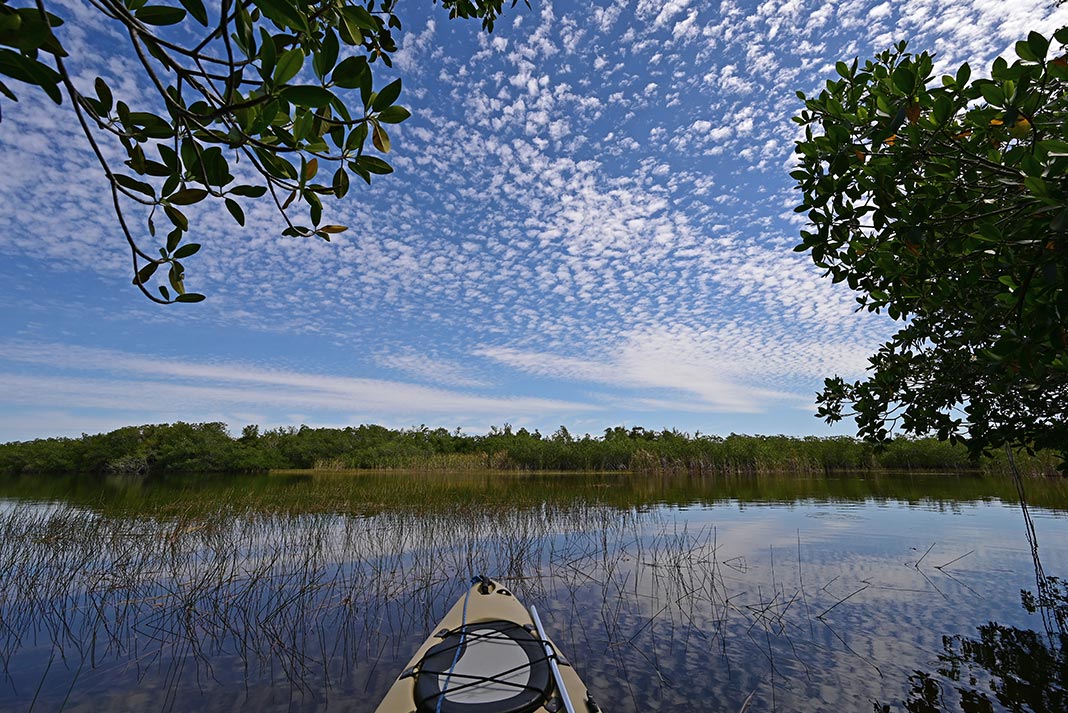
The Everglades are just one example of the incredible paddling opportunities on offer all over Florida. | Photo by: Adobe Stock // Francisco
Eight thousand four hundred and thirty-six miles of coastline. 68 water trails. 33 natural springs. 7,800 square miles of Everglades. With so many water sources, it goes without saying that the state of Florida is a haven for veteran paddlers and novices alike. From the crystal-clear springs inland to the Atlantic Ocean on the east coast, kayaking in Florida offers something for everyone.
The Everglades are just one example of the incredible paddling opportunities on offer all over Florida. | Photo by: Adobe Stock // Francisco
Best kayaking in Florida
With such a variety of areas to kayak, from lakes and ponds to saltwater trails, you’re sure to find great paddling points anywhere in the state. Here are a few of the best places across the state to get you started.
North Florida
Cedar Key
If you’re looking for a laid-back paddle on the Gulf Coast, head to Cedar Key. Explore the 13 barrier islands, float by grass flats, or enjoy some open-sea kayaking on the Gulf. Cedar Key is touted to be what Key West was half a century ago before it became the bustling vacation spot it is now. This island is perfect for beginner and intermediate paddlers.
Amelia Island
Heading across the state to the east coast you’ll find Amelia Island. Located in the popular vacation destination county of Nassau, there are tons of places to paddle around this barrier island, including the Amelia River or Cumberland Island National Seashore. Whether you are in the mood for something leisurely or something more adventurous, you’re sure to have a good time on the water here.
Central Florida
Orlando
Even if you’re not planning on taking a trip to Disney World, you can still have a lot of fun on the water in the Orlando area. With trips perfect for beginners, get up close and personal with manatees at Blue Springs State Park, enjoy even more wildlife viewing of alligators, waterfowl, manatees, and more on the Wekiva River, or head out for a night-time bioluminescence trip on the Indian River.
Said to be one of the top spots for paddling the Gulf Coast, St. Petersburg has no shortage of water adventures. If you’re an experienced kayaker with good navigational skills, check out the winding maze called 17 Runs on the Hillsborough River. For beginners wanting to try out a local river, the Little Manatee River offers a 10-mile paddling trail with great kayak fishing opportunities as well. Head up and out to Caladesi Island for a short, novice-friendly paddle in the Gulf of Mexico.
South Florida
The Florida Keys
The Keys are one of Florida’s most popular vacation spots and it’s easy to see why. You don’t have to be an expert paddler to enjoy any number of the area’s most popular tours, including mangrove sightseeing, moonlight paddles, or even taking a charter out to the backcountry for some kayaking and snorkelling fun.
Everglades National Park
No trip to South Florida would be complete without a stop in the Everglades. Known for its alligators, swampy terrain, and huge surface area, the Everglades has just about any kind of kayaking tour you can dream of—including a beginner-friendly trip through mangrove forests and an overnight camping trip in the 10,000 Islands Natinoal Wildlife Refuge for the truly adventurous. There are also around 12 water trails throughout the park to explore.
[ Paddling Trip Guide: View all paddling trips in Florida ]
Best springs to kayak in Florida
Florida’s freshwater springs are truly a natural wonder. Fed from underground aquifers, most of these springs average 72°F water temperatures year-round and can be so clear that you can see the bottom of them perfectly, even at 20+ feet down! Read on for some of the state’s best natural springs to check out by kayak.
Weeki Wachee
Just an hour north of Tampa lies Weeki Wachee Springs and River. Begin your journey down this ultra-clear waterway in the identically named state park; you can paddle for 5.5 miles in the shade of palms and cypress as you scout for manatees, otters, pelicans and more spring-dwelling creatures. You can bring your own vessel or rent one within the park for up to four hours on these calm, beginner-friendly waters.
Near Dunnellon, Florida, you will find the state’s fourth-largest “first magnitude” spring: Rainbow Springs. Paddle the crystal-clear, six-mile section of river through the center of town before reaching the Withlacoochee River south of Highway 484. Rainbow Springs State Park can be quite busy during the summer months, so plan accordingly for your best chance to see turtles, hawks, alligators and more.
Ichetucknee Springs
Begin your leisurely paddle down the Ichetucknee River within the boundaries of the similarly named state park. You will feel like you’re paddling through an oasis on your six-mile journey along blue-green waters fed by not one, but eight different springs. Cool off in the shade of oaks, cypress and pines as you search for beaver, gar, wood ducks and more along the way.
Mangrove kayaking in Florida
Perhaps one of Florida’s most well-known natural highlights, other than beaches, is its mangrove forests. It is estimated that 469,000 acres of mangrove forest occupy the southern portion of Florida. These unique forests will have you feeling like you’re paddling through a secluded woodland maze. Best of all, they are the perfect place to explore no matter your skill level.
John Pennekamp Coral Reef State Park
The Keys are arguably one of the best spots in the state for mangrove tours. Rent a kayak at John Pennekamp Coral Reef State Park and explore 50 miles worth of mangrove trails. Their kayak rentals are amazingly inexpensive at $30 for four hours.
Lido Key
Escape the bustling Sarasota area and head down to Ted Sperling Park at the southeastern edge of Lido Key. This area features the red mangroves, the roots of which sprawl above the waterline, creating an important ecosystem for many water-dwelling animals as well as birds. The west Indian manatee and dolphins are common visitors to this area.
Don Pedro State Park
If you find you really enjoy paddling through the mangrove tunnels of Florida, head about an hour and 20 minutes south to Don Pedro State Park in Placida. This park boasts all four of the different types of mangrove trees the state offers and tons of marine life. The passageway at Don Pedro is especially neat because it leads to a secluded lagoon in the middle of the island. This trip may be slightly better suited to intermediate paddlers as the tunnel gets pretty narrow. It is also important to check the tides before you go (you will want to avoid going at low tide).
Kayak camping in Florida
With so many water trails and as such a paddler friendly state, it should come as no surprise that there are plenty of backcountry paddle camping trips to be had. Whether you choose to plan your own route or go with a guide, here are several of the most popular and exciting spots to kayak camp in Florida.
Suwannee River Wilderness Trail
Although this trail technically begins in the Okefenokee Swamp of Southern Georgia and runs across the state until it empties into the Gulf, you’ll find some particularly nice accommodations at the camps along the river in the Mayo area. These sites can only be reached by paddlers and camping is free. You can even take a hot shower and cool off under a ceiling fan in the screened-in platform at some of these sites! The Suwannee River is one of the largest in the state and its slow-moving waters make it acceptable for beginner trips.
Everglades National Park
For a truly immersive experience in the Everglades, check into one of the several overnight kayaking tours Florida Outdoor Adventures offers. There is one for every skill level and desired trip length. Experiences range from exploring the Gulf and 10,000 Islands area on the western side of the Everglades to paddling the entire 99-mile length of the Wilderness Waterway.
Peace River
For an easy paddling trip perfect for the novice kayak camper, the Peace River in Central Florida is the place to go. The river itself runs for 106 miles north to south with 67 miles of designated water trail from Bartow to Arcadia. You’ll drift past cypress swamps and hardwood forests as you make your way down. Kayak fishermen will love this trip too.
If you haven’t gathered by now, running into a manatee or two while on the water is a staple of any great paddling trip in Florida. If you’re ready for your own encounter with these gentle giants, check out some of the following places.
Little Manatee River
With a name like that, you know you’ll have a high chance of getting up close and personal with some “sea cows.” Head to Little Manatee River State Park and start off in the swampy, narrow area of the river in the north and make your way down to the wider, sunnier blackwater portion in the south of the park. A visit during the summer will afford you the best chance to view manatees.
Manatee Park
Manatee Park, located in Fort Myers, serves as a non-captive refuge for the manatees during the cooler winter months. You can rent a kayak within the park and head out for hours at a time on their waterways in search of these creatures. Be sure to go in December, January or February for your best chance to view them at this park.
Merritt Island National Wildlife Refuge
Head to Merritt Island National Wildlife Refuge on the east coast, near Kennedy Space Center, and explore the waters of this 140,000-acre park. The best place to look for manatees here is near the Haulover Canal and Bairs Cove area. The gentle giants frequent the area year-round, but spring and fall are your best bets.
Bioluminescence kayaking in Florida
For a truly unique night-paddling experience, you won’t want to miss out on a bioluminescence tour while you’re kayaking in Florida!
BK Adventure Tours
Head out on the “Bioluminescent Bay” with BK Adventure. They offer several different bio tours in the Indian River Lagoon, including a sunset and bioluminescence tour for a romantic night on the water, and clear kayak tours.
Get Up and Go Kayaking
For another fun adventure in the Merritt Island Wildlife Refuge, take one of the popular bioluminescence tours with Get Up and Go Kayaking. Their clear kayaks make this experience even more enjoyable. Tours fill up fast, especially during new moons, during which time viewing is optimal, so be sure to book in advance.
Blue Planet Kayak Eco-Tours
For a bioluminescence paddle in the Florida Keys, you can’t beat Blue Planet. Located in Key West, their Sunset and Starlight tour will give you amazing views of the bioluminescence in the mysterious mangroves. Tours are offered seven days a week.
Clear kayaks are becoming all the rage, especially among popular vacation spots, such as Florida. They offer great views of marine life and, as mentioned above, bioluminescence on night paddles. Here are some particularly fun spots to hit up around the state in a clear kayak.
Hunter Springs Kayak
To enjoy the beautiful blue waters of yet another popular Florida spring, head out on an eco-tour with Hunter Springs Kayak to the Three Sisters Springs. Their clear kayaks will give you great peaks at the manatees and other marine life swimming beneath the surface.
Get Up and Go Kayaking
Even if you’re not taking a bioluminescence tour with Get Up and Go Kayaking, you can still enjoy their clear kayaks. Depending on what you’re in the mood for, you can paddle the clear waters of Rock Springs or meander through the tree-lined tunnels of Winter Park Chain of Lakes.
Clearly Unique Charters
For a daytime eco-tour of Key West, check out the island’s only guided clear kayak tour providers, Clearly Unique Charters. This tour is great if you want to do some snorkelling as well. Once their powerboat takes you to the Great White Heron National Refuge, you’ll have time to do just that as well as paddle around to explore the coral reefs, marine life and even shipwrecks.
Sea kayaking in Florida
What Florida kayaking trip would be complete without at least a little bit of sea kayaking? Whether you want to stay close to shore and paddle for a couple of hours or go on an epic quest along the entire coastline, you’re sure to find a sea kayaking excursion for you below.
Marathon
For a leisurely introduction to Florida’s sea kayaking in the Keys, check out the plethora of trips offered by Marathon Kayak. You can paddle just about anywhere, from mangrove forests to isolated beaches off the coast. Half-day and full-day tours are offered.
Big Bend Saltwater Trail
If you are already experienced with sea kayaking, taking a trip along the Big Bend Saltwater Trail may be just the adventure you’re looking for. On this 153-mile route, you will pass by and through state parks, Fish and Wildlife areas, and national wildlife refuges, before finally ending up at the mouth of the Withlacoochee River.
Vero Beach
Vero Beach, on the Atlantic side, is another great place for beginners to “get their feet wet” with sea kayaking. Take one of Paddles by the Sea’s kayaks out to the Breconshire shipwreck or go sea turtle spotting as they love this area, especially in the spring.
Florida kayak trails
With 68 water trails, it’s hard to know where to begin if you are visiting or new to the state. Here are a few of the best ones to get you started.
Florida Circumnavigational Saltwater Trail
Perhaps the state’s most well-known water trail, this circumnavigational trail is waiting for the truly adventurous. It flows for 1,515 miles from Big Lagoon State Park in the panhandle to Fort Clinch State Park on the Atlantic coast. If you want to take in all of the diverse natural areas Florida has to offer, you’ll love this trip.
Calusa Blueway
If you’re looking for something a little less intense than a months-long paddling trip around the entire state, check out the Calusa Blueway. It’s composed of several different waterways, but the slow-moving waters and mile markers along the way make it much more beginner-friendly.
Blackwater River
Beginning north of Okaloosa in the Blackwater River State Forest and winding its way to Blackwater River State Park, this 56-mile trail will take you through secluded backwoods. There are plenty of access points along the way and the calm waters make it the perfect trip for a novice.
Florida kayak tours
Let’s face it—we all have our own definition of “fun,” but some guided tours are just more fun than others. Here are some of the most interesting kayak tours you can find in the state, regardless of your paddling skills.
Manatee Encounter
Head to Blue Springs State Park with Adventures in Florida for one of the best guided manatee-viewing trips in the state. Home to one of the largest populations of manatees in the state, you are sure to see plenty of these amazing creatures as they head from the refuge in the morning in search of breakfast. You will also learn a lot about the flora and fauna of the area from the Master Naturalist on your trip.
Bugeye Backcountry Adventure Eco Tour
Set sail on a schooner to the Key West National Wildlife Refuge with Sebago Watersports. There you will be able to explore the mangrove islands via kayak before diving in for some snorkelling. Keep an eye out for sea turtles, dolphins, rays and more.
Full Moon Kayak and Paddleboard Tours
For a truly illuminating experience on the coastal waters of Florida, head out with the Virginia Key Outdoor Center for a moonlight paddle and spectacular views of the Miami skyline.
Florida kayak laws
Due to some of its unique marine residents and aquatic habitats, there are a few special laws to be aware of while kayaking in Florida.
Since manatee populations are on the decline, they are protected by state and federal law. If you do anything to “disrupt a manatee’s normal behavior” you can be fined up to $50,000 or even spend a year in jail.
Seagrass beds are also protected by Florida state law in some areas. Be sure to avoid these areas at all costs so as not to damage them, or you may be fined up to $1,000.
It is also worth noting that all children age 6 and under must wear a PFD at all times while in a kayak (though of course we recommend everyone always wear one while paddling). It is not necessary to register kayaks in the state of Florida.
Whether you’re looking for an adventurous paddle on the ocean or a relaxing float down a spring-fed river, Florida has a kayaking trip for everyone from beginners to experts.
Sea kayaking opportunities abound in the Bay Area. | Photo by: Adobe Stock // Stephen Finn
San Francisco, California is a well-known city across the globe for many reasons: the Golden Gate Bridge, foggy summers, cable car rides up steep hillsides and unique architecture, to name a few. The City by the Bay also offers an interesting and varied coastal life. From calm rivers to rocky island skimming, peaceful wildlife sanctuaries to bustling wharves, San Francisco offers paddling opportunities to kayakers of all skill levels.
Sea kayaking opportunities abound in the Bay Area. | Feature photo: Stephen Finn/Adobe Stock
Kayak rentals in San Francisco
Being situated next to the ocean, kayak rental companies abound in the area. Here are a few of the top companies to check out.
City Kayak
City Kayak rents a variety of types of kayaks, including single and double open top and touring kayaks, polymer and carbon surfskis, and take away single and double inflatable kayaks (as well as roof racks). All of the above are priced by how many hours or days you plan on taking them out and range from $35 to $424.
Sea Trek
If you are planning a trip during the winter and don’t want to worry about limited business hours, Sea Trek may be the right rental company for you. They are open daily, excluding Mondays, from early December to March. You can find both single and double sit-on-top and sit-inside kayaks ranging from $25 to $45 per hour. These are one-hour minimums and fees are prorated on each additional 15 minutes.
California Canoe & Kayak
California Canoe & Kayak also offers hourly and take away rentals. Their hourly rentals range from $25 for a single to $50 for a double Hobie Mirage. One-day take away rentals of single sit-on-top kayaks start at $75 per day. Be sure to check out their plethora of classes as well, including kayak rolling and whitewater.
Kayak tours in San Francisco
With so many different sights to see in and out of the water, San Francisco offers an interesting range of guided kayak tours. Here are some of the best ones to check into, regardless of your skill level.
San Francisco Kayak & Adventures
SF Kayak offers a variety of sea-going adventures, including the popular Sausalito Waterfront, McCovey Cove, and Sunset/Moonlight paddles. Group tours range from $80 to $150 (not including private tour group rates). Note that all of their guided tours are held in tandem sit-inside kayaks to ensure the comfort and safety of participants. Solo sit-inside kayaks are only an option for those who have wet exit and re-entry certification in a traditional sit-in style kayak.
Half Moon Bay Kayak Co.
No matter what time of day you’re looking to take a guided tour, Half Moon Bay has you covered. Go for a morning paddle through Fitzgerald Marine Reserve ($160), spend the afternoon in Pillar Point Harbor ($95), or enjoy the calm waters of the harbor on a sunset paddle ($95). Bringing the family? They have the perfect trip for you too! After a short safety briefing and period of time getting accustomed to your boat, you and your family will explore the calm waters of a protected harbor and possibly check out some tide pools, depending on tidal conditions. This three-hour tour runs $95 per adult and $60 per child (under 14).
Blue Waters Kayaking
BWK offers an assortment of unique tours you won’t want to miss out on. These include a Tomales Bay morning paddle ($88), Birding by Kayak tour ($128), and even a Lake Sonoma Full Moon camping trip ($175). If you’re into night paddling, another fun tour to check out is their bioluminescence night paddle (prices range from $98 to $118 depending on the season)—you can enjoy the underwater light show as tiny, bioluminescent dinoflagellates flicker when disturbed and schools of fish create phosphorescent trails behind them.
With roughly 1,600 square miles of bay to explore, it goes without saying that there is no shortage of places to kayak San Francisco. Let’s take a look at some of the must-see areas to explore by kayak.
The Golden Gate Bridge
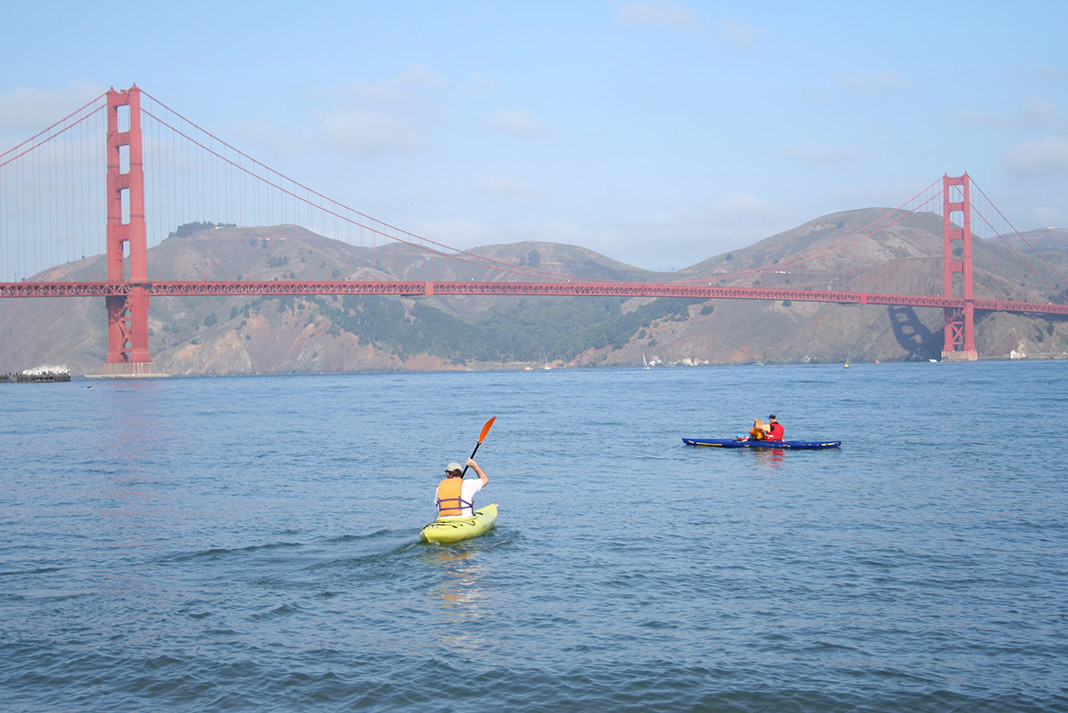
No kayaking trip in San Francisco would be complete without venturing under the Golden Gate Bridge. Enjoy views of the Sausalito coastline as well as the Marin Headlands on your paddle out.
Elkhorn Slough
If you’re looking for something a little more laid-back and quiet, take a two-hour drive down the coast to Elkhorn Slough. This estuary offers calm waters—perfect for families with young kayakers—as well as wildlife viewing opportunities. Expect to find sea otters, seals and waterfowl aplenty.
Tomales Bay
If you’re not looking for full-on sea kayaking, Tomales Bay may be the place for you. This popular 15-mile-long inlet is located about 1.5 hours north of downtown SF. Be sure to visit the bay during the summer for the best chance to view the bioluminescent plankton.
Oakland Estuary
Close to the hustle and bustle of the main city, Oakland Estuary provides easy access to city dwellers for a quick trip on the water. Though you will initially view many of the restaurants along the waterfront, if you head about 10 minutes south you will find a much calmer area with more chances to view local marine life, such as bat rays, leopard sharks and seals.
McCovey Cove
Located a short 10 minutes from downtown San Francisco, McCovey Cove is also easy to access and a local favorite. In fact, Giants baseball fans have been known to kayak into the cove during games, hoping to catch a runaway home-run ball.
Russian River
More accustomed to river kayaking? No problem! A bit out of the way at two hours north of the city, the Russian River is a local favorite for river kayaking. Enjoy a relaxing day paddling the lazy waters, the quality of which makes it great for stopping for a swim or to cast a line out. Be sure to pack a picnic lunch to replenish your energy along the tree-lined shore.
Special considerations when kayaking in the Bay Area
Whether you are an experienced sea kayaker or have never seen the coast, keep the following in mind when planning a kayaking trip to the Bay Area:
Some areas receive big tidal swings and strong currents. Check online or with locals before heading out on the water.
It can become very windy in certain areas, especially in the early afternoon, so it’s important to pay attention to which way the wind is blowing from and take note of changes.
Fog, which is particularly abundant during the summer months, can hinder bigger boats from seeing you, so use caution. The fog can also be very disorienting out on the water.
Water temperature averages range from 52 to 61°F year-round. It may be prudent to wear a wet or drysuit. Always wear your PFD.
BASK, or Bay Area Sea Kayakers, offers a list of off-limits areas.
Kayak fishing in San Francisco
Several types of fish can be caught regularly near San Francisco, including striped bass, sturgeon, halibut, salmon, rockfish, sharks (leopards are the most common) and sea trout (some people also enjoy crabbing in the area). Fishing near SF can be tricky as fish activity is based on tides. Naturally, each type of fish prefers certain areas at certain times of year.
Here is a general list of places to cast out according to fish species:
Halibut: Crissy Field, Paradise Beach, Angel Island | Spring
Sturgeon: San Pablo Bay, China Camp, Alameda | Winter
Piers are said to be great places to find perch and rock crab
Safety considerations
In conjunction with the general safety precautions to consider listed previously, here are some special ones to keep in mind when kayak fishing in the area.
Be sure to check regulations on what you are allowed to catch, how many, legal size, etc. and have an appropriate fishing license, tags, and more for the type of fishing you will be doing.
Consider attaching a safety light to your rig to make yourself more visible to larger boats.
Consider bringing an anchor.
Wildlife you might see
From sea to sky, there is a diverse mix of wildlife you may find on your San Francisco Bay adventures.
Aquatic animals: Harbor seals, California sea lions, sea otters, bat rays, bottlenose dolphins, harbor porpoises, sharks and crabs. If you’re lucky, you may also spot migrating humpback or gray whales at the right times of year.
Birds: Gulls, great blue herons, egrets, cormorants, terns, pelicans, grebes, killdeer, osprey, American coot, Ridgeway’s rail and common goldeneye.
Check out Bay Wildlife on the San Francisco Bay Area Water Trail website for more information.
Best time of year to kayak in San Francisco
With its temperate year-round climate, pretty much any time of the year is a good time to go. In terms of temperature, high averages range between 58°F and 71°F from the coolest month (January) to the warmest (September). Fall and spring are arguably the best times to visit if you are looking to avoid the peak of tourist season (July and August) and prefer to avoid the rainy winter months as well. Plus, fall is a great time to visit if you are into bird-watching since many migratory species pass through the area.
Here is a basic packing list of what you’ll need and several things that will come in handy for your Bay Area kayaking excursions:
Sunscreen and sunglasses
Wide-brimmed hat
Warm hat (for cool months)
Water shoes (warm months) or tennis shoes, and wool or synthetic socks (cool months)
Wet or drysuit
Layers: Wool or synthetic blends for under layers, a sweater, fleece jacket, or rain-resistant jacket (and possibly pants) for outer layers
Waterproof camera
Dry bag to secure valuables
Lightweight gloves (think bicyclist gloves) to prevent blisters from paddling
Important things to know
Again, checking the winds, tides and weather before heading out in the Bay Area is vitally important. These factors can mean the difference between a pleasant, easy outing and a bad time trying to fight currents and wind conditions to get back to your launch point.
If you’re unaccustomed to sea kayaking, it may be prudent to go on a tour first or take a class to learn any important information for the areas you will be paddling, or skills you may need to know to stay safe.
With so many bays, coastlines, estuaries and more to explore, it’s no wonder locals and tourists alike flock to kayak San Francisco.
Sea kayaking opportunities abound in the Bay Area. | Feature photo: Stephen Finn/Adobe Stock
Unwind from city sightseeing at Sweetwater Creek State Park. | Photo by: Flickr // Jeff Gunn
If you’re looking for a place in the United States with numerous paddling locales for kayakers of any skill level, look no further than Georgia. The Peach State offers rivers ranging from calm flatwater to raging class V rapids, coastal salt marshes, serene lakes and reservoirs, and secluded swamps. There are at least 18 water trails currently in existence with more in development.
With so many options from state parks to popular Atlantic coastal destinations, you’re sure to find the perfect place for kayaking in Georgia.
Unwind from city sightseeing at Sweetwater Creek State Park. | Photo by: Flickr // Jeff Gunn
Best places to kayak
Chattahoochee River
If you’re looking for a relaxing solo trip or leisurely family paddle, Chattahoochee River kayaking is a good option. The river is located on the Alabama-Georgia state line near Columbus and is home to a 48-mile water trail. The trail is mostly made up of calm, slow-moving waters, but there are a few spots with class I rapids and one class II rapid located at the northern end of the river.
The Chattahoochee River National Water Trail is easy to navigate with its mile markers along the banks. With 17 access points, you can make your trip as long or short as you like. However, don’t plan for any overnight trips here as camping is not allowed anywhere along the NPS-controlled river. As far as interruptions, it should also be noted that you will need to portage your boat around Morgan Falls at mile marker 312.5.
Broad River
The Broad River in Georgia, located near Athens in the northern part of the state, has similar waters to that of the Chattahoochee. You’ll find mostly easy-going waters along this 70-mile stretch; however, like any river, there are some faster-paced areas as well (up to class II rapids, though during high water times these can get as high as class III or IV). Other than around possible downed trees, you shouldn’t need to portage anywhere as it is one of the few free-flowing rivers left in Georgia.
Even if you don’t want to practice whitewater techniques in the quick areas of the river, the Broad is also a great place to visit if you enjoy kayak fishing and wildlife viewing. You can expect to find blue herons, kingfishers, osprey, bald eagles, numerous species of turtles, beavers and otters. For fishing, bring your gear for bass, catfish and redhorse. If you just enjoy taking in nature in general on your paddling trips, one particularly scenic section you may wish to check out runs for 6.5 miles, starting at SR 281 and ending a half-mile south of SR 172.
[ Paddling Trip Guide: View all paddling trips in the Southern U.S. ]
Toccoa River
At 13.8 miles, Toccoa River kayaking makes for a great weekend paddle and camp trip. The river is rated with class I to II rapids, with a small class III near the midpoint of the trail. Many people report the entire length taking five to six hours to paddle, but there are plenty of opportunities to shorten your trip.
This is another fun trip if you enjoy fishing, wildlife viewing and some fun rapids mixed in to keep things interesting. Float past thick forests and pastoral lands while you try to catch some mountain trout for dinner. You might consider bringing extra provisions if you’re planning on paddling the entire way as there is no access for five miles between Margaret and Butt Bridge.
Altamaha River
For the ultimate Georgia kayaking trip, you can’t beat the 138 miles of the Altamaha River. Known as “Georgia’s Amazon” or the “Little Amazon,” the Altamaha is one of Georgia’s other undammed rivers and houses the second-largest watershed on the east coast of the United States.
Being such a large river, there are no rapid areas to note, so you can truly enjoy the wildlife viewing along the way. You may catch glimpses of bald eagles, mink, otters and even the endangered west Indian manatee as you paddle through tidal swamps and bottomland forests on your Altamaha River kayaking trip. If you care to do some kayak fishing, you may have some luck catching catfish, sunfish, crappie, bluegill and bass.
Access points are available in each county along the water trail, making it easy to plan the perfect length of trip for you. If you plan on fishing, you will be happy to know there are bait and tackle shops along the way. You can also stop for a picnic at numerous sites and even go for a hike in some spots on marked trails.
Savannah
Being located on the coast of the Atlantic and near the confluence of several rivers, it comes as no surprise that there are plenty of places for kayaking in Savannah, Georgia.
Tybee Island
A popular tourist spot, Tybee Island offers three miles of beaches and salt marshes for kayakers to explore. Be sure to get an early start to catch a beautiful sunrise.
Skidaway River
Part of the Atlantic Intracoastal Highway, this 8.4-mile tidal river begins at the southern end of the Wilmington River and passes by Skidaway, Dutch Islands and the Isle of Hope.
Ebenezer Creek
Located 40 minutes north of Savannah in Effingham county, Ebenezer Creek offers a unique look at the swamps of the south. Paddle through a cypress- and Spanish moss-lined waterway that flows slow enough to be paddled both ways.
South Georgia
For some remote paddles through the wilderness or challenging sea adventures, head downstate for kayaking in South Georgia.
George L. Smith State Park
For something slow-paced, but scenic, check out George L. Smith State Park. Take in the signature Spanish moss-covered cypress and tupelo trees, covered bridge, and gristmill while angling bass and bream.
Ocmulgee River
Looking to put in at any spot that strikes your fancy? The 200-mile Ocmulgee River Water Trail should suit. This river is great if you’re planning an overnight trip as it has several spots to stop for the night (no reservations or fees required). The Ocmulgee is mostly flatwater with some class I rapids to keep your attention.
Okefenokee Wilderness Canoe Trail System
This canoe trail system provides multiple paths for kayakers of all skill levels and options for one- to five-day trips through the cypress swamps of Southern Georgia. If you’re really into remote wilderness, this is the trip for you with the chance to view alligators, black bears, sandhill cranes and more.
Georgia Coast Saltwater Paddling Trail
Intermediate and advanced paddlers with sea kayaking experience won’t want to miss out on sections of the Georgia Coast Saltwater Paddling Trail. Here, you can enjoy paddling through plenty of salt marshes and past wild barrier islands. It is worth mentioning, though, that Georgia experiences the greatest tidal amplitudes along the east coast, so be aware of tidal changes and take your charts.
North Georgia
If your idea of the perfect vacation involves sightseeing and paddling, stick to the Atlanta/Augusta area for some kayaking in North Georgia.
Savannah River
For something a little more fun, check into a Savannah River trip from the Savannah Rapids Park to the North Augusta Boat Landing for some class II and III rapids. Rentals can be had at Savannah Rapids Kayak Rental.
Sweetwater Creek State Park
If you’re interested in doing some sightseeing in Atlanta as well as spending time in nature, head over to Sweetwater Creek State Park. Located just 15 miles from downtown, here you can unwind from the city scene and set out for a relaxed paddle or some fishing on the 215-acre lake.
Chattooga River
Head to the Chattooga River Gorge, near Clayton, for some excitement. Ranging from class II to IV rapids with features such as Seven Foot Falls and Five Falls, you know you’re in for a fun whitewater time. For guided rafting trips, check out Wildwater White Water Rafting.
Lake Sinclair
Located between Atlanta and Augusta, this 15,000-plus-acre man-made reservoir offers a peaceful place to do some kayak fishing and calm waters to get your family accustomed to kayaking.
Don’t feel like bringing your kayak along or don’t have your own? Not to worry. Here are just some of the kayak rentals in Georgia to get you started on your Southern paddling adventure.
Sea Kayak Georgia
Tybee Island
912-786-8732
Broad River Outpost
Danielsville
706-795-3242
Savannah Rapids Kayak Rental
Martinez
706-832-5323
Blue Ridge Mountain Kayaking
Morganton (Toccoa River)
706-258-2411
Three Rivers Outdoors
Uvalda (Altamaha River)
912-594-8379
Shoot the Hooch
Roswell (Chattahoochee River)
770-650-1008
Altamaha Coastal Tours
Carlton (Southeast coast)
912-437-6010
Kayak fishing
Kayak fishing has become very popular in Georgia over the past several years. There are even several kayak-only bass fishing tournaments held around the state each year.
Having a multitude of lakes and rivers to choose from as well as over 100 miles of coastline, you can catch an array of both fresh and saltwater fish on your Georgia kayak fishing trip. Whether you’re into the thrill of the catch or more focused on catching a tasty dinner, here are some great angling spots around the state to try out and what you can expect to catch there.
Jekyll Island: redfish and trout
Tybee Island: flounder, Jack Crevalle, tarpon, trout, Spanish mackerel
Ocmulgee River: striped bass, channel and flathead catfish, sunfish
Chattahoochee River: bass, trout, perch, pike
Kayak laws
Georgia kayak laws are pretty standard as far as laws in the United States go:
Children age 13 years and younger must wear a PFD at all times.
Although you don’t have to wear it, people age 14 and older must have a Coast Guard-approved PFD on their vessel at all times (though we still recommend wearing a PFD at all times on the water).
A marine whistle (or any sound-making device) is required for travel on federally regulated waters.
You must use a light at night.
While it does state that you can be charged with BUI (Boating Under the Influence) in Georgia while helming a motorized boat, including personal watercrafts, it doesn’t explicitly state anything about smaller, non-motorized boats, such as canoes and kayaks. Regardless, it is always wise to err on the side of caution and use good judgment.
No matter what you enjoy—offshore kayak fishing, calm lake paddles or whitewater adventures—you are guaranteed to find a kayaking trip you’ll love in Georgia.