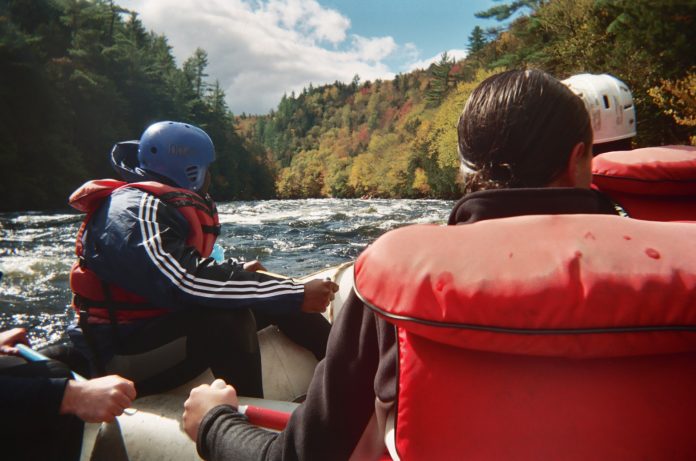
With three main rivers, each winding for over 100 miles and one boasting the longest course of continuous whitewater in the Eastern U.S., it comes as no surprise that Maine offers some of the best whitewater rafting opportunities in the Northeast. With rapids ranging from beginner-friendly class II to thrill-seeker class V, you’re sure to have an exciting time whitewater rafting in Maine.
Best rafting in Maine
Kennebec River
Running for 170 miles north to south through the middle of the state, the Kennebec River offers everything from mild class II rapids for beginners and families to thrilling class IV for adventure enthusiasts.
Crab Apple Whitewater, based in West Forks and within driving distance of Caratunk, offers several Kennebec whitewater trips, including a family-friendly option you can read about in the “Family Rafting” section below. Their regular 12-mile trip tackles class III and IV rapids, is suitable for ages 10+, and costs $81 to $122 per person.
Dead River
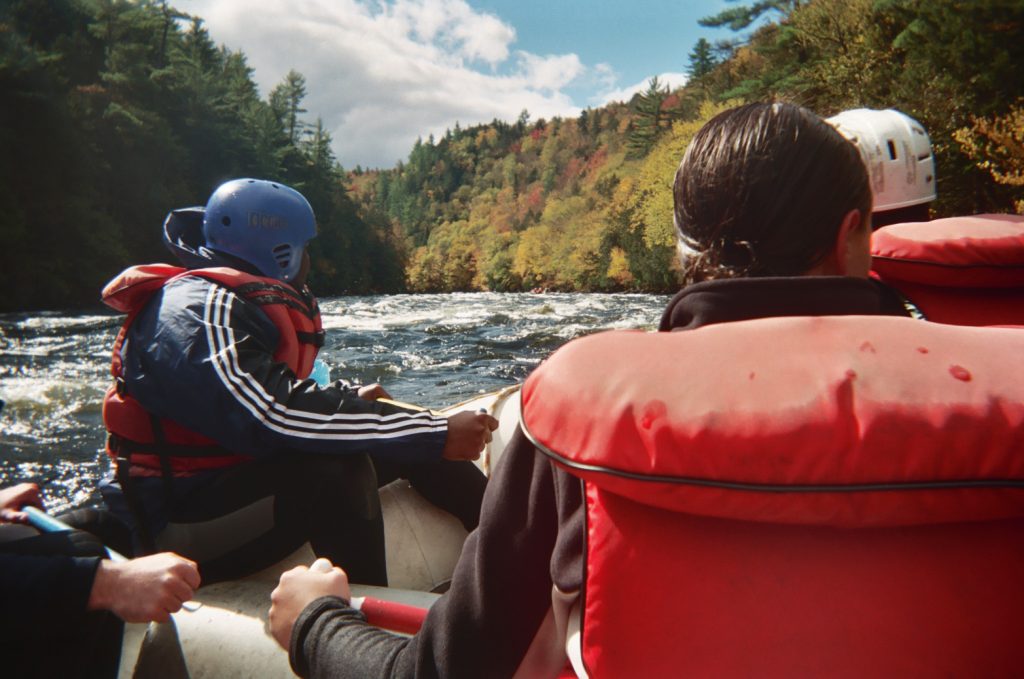
Don’t let the shortness of this river fool you. At only 43 miles in length, the Dead River holds the longest continuous track of whitewater on the east coast. It’s not “tame” whitewater either. The Dead River traverses class II to V rapids (more on the end of IV and V), making it an adrenaline junkie’s dream.
If shuttle rides to and from launch sites bum you out, take a trip with Magic Falls Rafting Company, also based out of West Forks. They are the only outfitter with a base camp and takeout on the river. For an extra exciting tour in one of their small 13-foot rafts, take a trip down the river on the same day as a scheduled big water release from the hydroelectric dam. The minimum age is 12 and the cost is $90 per person.
The Forks
Although not technically a river, this area where the Kennebec and Dead River intersect is worthy of its own category. Within driving distance of Caratunk and Jackson, The Forks is arguably one of the best (and most popular) places for whitewater rafting in Maine. The two swift, powerful rivers converging makes for incredible rafting!
Three Rivers is another great outfitter in the area that offers one- and two-day trips, as well as high-water day trips like the ones mentioned above. You can find more information on all of their trips on their website.
Penobscot River
Beginning in North-Central Maine, the 109-mile Penobscot River is another popular whitewater destination in New England. You can expect to battle class III to V rapids, including the infamous class V rapid “Exterminator” and “Lose Your Lunch Falls,” the steepest drop on the river. When you’re not paddling like crazy, enjoy the stunning views of Maine’s highest peak, Mount Katahdin, as you skirt by its base as well.
Millinocket is a popular base among local outfitters due to its proximity to the Penobscot. Check out these two below to get you started.
Join Northern Outdoors for a 14-mile, all-day run of the Penobscot. Prices start at $69, a grilled lunch is included, and you must be at least 14 years old due to the strenuous nature of the rapids.
Maine Rafting Expeditions is another local outfitter offering extreme, mild and overnight rafting trips on the Penobscot. Prices start at $79 for the main river run where you’ll tackle a class V section of the river, and participants must be 14 or older.
Androscoggin River
Somewhat overlooked due to the popularity of the main three rivers already mentioned, the Androscoggin offers some tamer river rafting in Maine with its class II and III rapids. The 164-mile-long waterway begins in New Hampshire and eventually meets up with the Kennebec near Brunswick, ME. There are several outfitters just on the other side of the state line in New Hampshire, a short half-hour drive from Bethel and one hour and 50 minutes from Rangeley, ME.
Head out with North Woods Rafting for a half-day trip in the morning or afternoon for some fun on the splashy rapids with the whole family. Children 6 to 9 are $45, while adults (10+) begin at $79. Both prices include a barbecue lunch.
Rafting near major cities
Unfortunately, most of the major cities—such as Augusta, Bangor and Bar Harbor—are a bit of a drive from the nearest opportunities to go river rafting in Maine. Many of them are closer to the Atlantic coast where sea kayaking dominates the water scene.
For the Bangor and Bar Harbor area, check out North Country Rivers and Northeast Whitewater. Both outfitters are located about an 1.5-hour drive northwest from Bangor. Both offer trips on the Kennebec, Dead and Penobscot Rivers. Northeast Whitewater also offers overnight excursions on the Kennebec and Penobscot, as well as the option to raft on high-water release days (only four times per year) on the Kennebec if you’re looking for some extra thrills.
Located along the southwest coast and within a 40-minute drive or less of one another, Kennebunk, Saco and Portland also all require a bit of a drive to get to whitewater. Your best bet is to head northwest to the previously mentioned Androscoggin River near Bethel and Rangeley. Raft NH and ELC Outdoors take about two hours to reach from Portland.
Family rafting
By now you have probably figured out which rivers in the area are more family-friendly than others. In general, parts of the Kennebec and Androscoggin rivers are going to be your best bets if younger children will be joining you. Here are several outfitters and trips to peruse to find your perfect family whitewater rafting trip in the Pine Tree State.
- Three Rivers’ full-day rafting trips on the Kennebec River are suitable for ages 10+. Prices start at $94 and include 12 miles on the river, swimming and sightseeing stops, and a snack and drink on one of your breaks.
- For ages 8+, enjoy class III and IV rapids along a 14-mile stretch of the Kennebec with Northeast Whitewater. Prices begin at $84. You can find more details and a map of the river on their website.
- For a nice mix of whitewater excitement and calm afternoon paddling, check out the day trip from Northern Outdoors. After tackling class III and IV rapids leading up to the famous Magic Falls, enjoy some lunch on the bank. Then head back out on the less wild, lower section of the river for some relaxed paddling in inflatable kayaks that even the kids can participate in! Prices start at $69 per person.
- For a calmer trip that younger kids can enjoy, splash through the Errol Rapid section of the Androscoggin River in nearby New Hampshire. It’s a great introduction to whitewater rafting for ages 5+ and beginners alike on class II and III rapids. Prices begin at $55 from ELC Outdoors.
What to wear whitewater rafting in Maine
Here are some suggestions for what to wear on your whitewater rafting trip in Maine.
- Swimsuit
- Quick-drying clothing made of synthetic material (no cotton as it holds onto water, causing your core body temperature to drop from prolonged exposure)
- Sunscreen and sunglasses (with strap)
- Fleece jacket, raincoat, or other jacket made of synthetic material if you are a naturally “cold” person or the weather warrants it
- Water shoes or sandals with straps (no loose flip-flops)
- Towel and change of clothes
- Many outfitters will offer wetsuits, dive booties and splash jackets for rent (in some cases, the jackets may be included in the cost of your trip)
How much is whitewater rafting in Maine?
As with any rafting trip, the cost is largely dependent on location, length and difficulty. At the lower end, expect to pay $79 to $89 per adult during the week and for tamer trips along the Kennebec and Androscoggin rivers. Prices will be around $100 for weekends and Dead River high-water trips. During peak times, expect to pay $100 to $120 per person.
When to go
Rafting season starts in May and runs through mid-October, at the latest. Based on Millinocket’s annual average highs, temperatures start at 64°F in May, rising to 79°F in July, and slide back down to 55°F by October. Luckily, tourism also peaks in the hotter months of July and August, so any time in May, June, September or October should be good (especially in the fall when you can view the wonderful fall foliage as well!).
It is also worth noting that Maine’s rivers are dam-controlled, giving whitewater guides and rafters alike predictable water conditions any month throughout the rafting season. Unlike other Northeast states, Maine’s water levels stay high enough for rafting in even the driest summers.
How safe is whitewater rafting in Maine?
Safety is always a concern when it comes to whitewater rafting. There is an inherent risk involved, which is why you are required to sign a waiver before heading out on the water with any outfitter. Compared to, say, Colorado, another popular rafting state in the U.S., Maine sees far fewer whitewater rafting deaths. Between 2007 and 2017, there were only four fatalities.
Many, if not all, popular and top-rated outfitters across the state have been in business for decades and their guides are well-trained with the proper certifications, including swiftwater rescue and first aid. Again, accidents are always possible no matter how experienced a guide you have. Here are some good safety tips for planning your whitewater rafting trip from the New England Outdoor Center.
Whether you’re looking for some extra excitement on a family vacation or looking to tackle some of the hardest rapids in the Northeast, you’re sure to have a great time whitewater rafting in Maine.