Home Blog Page 209

7 Essential Items For Kayak Road Trips

7 Essential Items For Kayak Road Trips

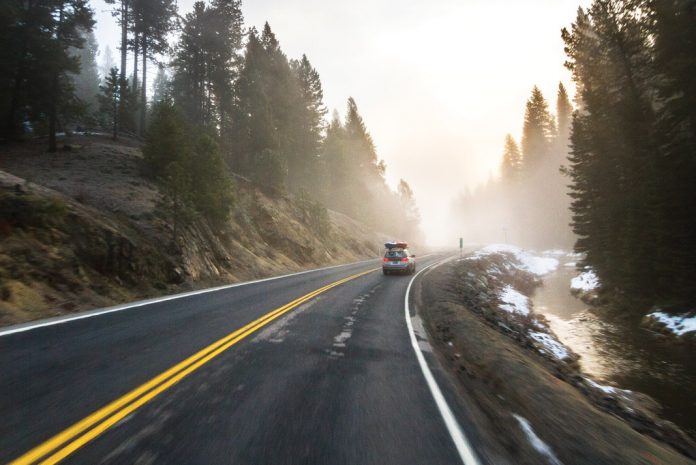
Sometimes the best trips happen on a whim. Get home from work Friday afternoon. Pack your car and head out on the open road. Long days on the water do not always require an isolated overnight campsite. Park, open the car doors and unpack these seven items for a weekend to remember.

1. SEA TO SUMMIT 90L DUFFLE BAG

$159.95 | www.seatosummitusa.com

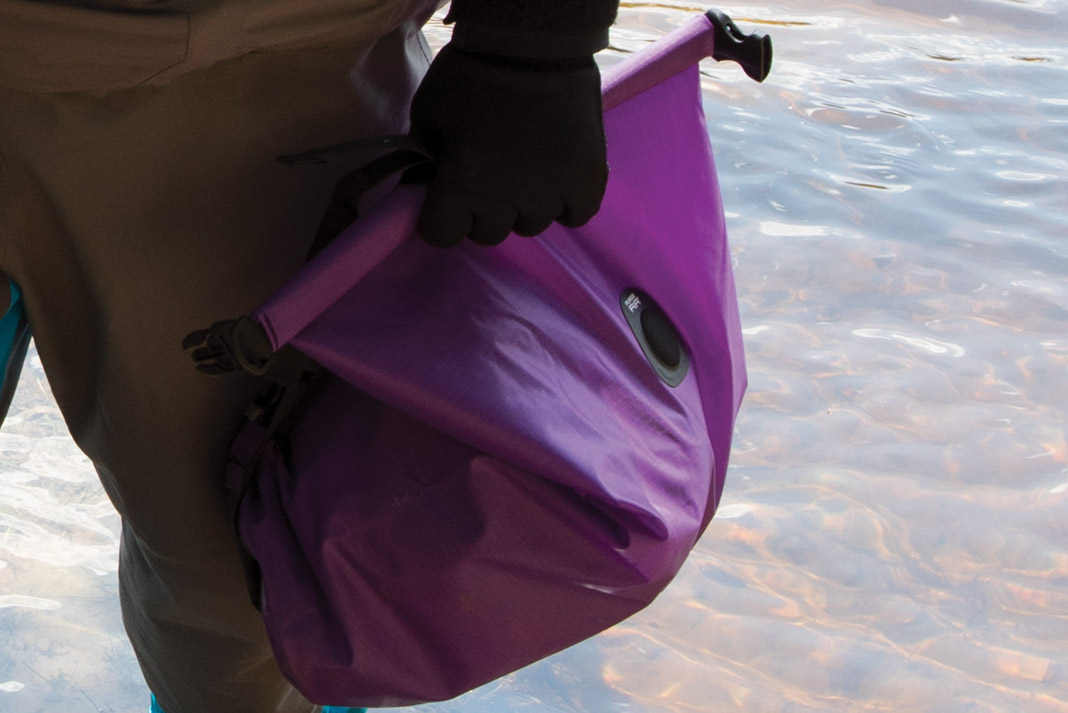
I am a duffle bag groupie. This Duffle Bag is no exception. Sea to Summit’s Duffle Bag comes in three colors and four sizes from 45 to 130 liters. Sea To Summit clearly took time thinking about how most of us adventure with our bags. The shoulder straps can be configured in a classic style, as a backpack, shoulder sling or as lash-downs. Impressed yet? Anyone who uses a duffle in their travels knows that having handles drop down into snow, puddles or mud is a pain in the ass. Not any more—magnets have been sewn into the strap handles. They simply snap together. With a reinforced bottom and top, the 90L Sea to Summit Duffle Bag is ready for everything. Waterproofing used in the bag’s robust material does not extend to the dual-zipper—so keep it out of more than 12 inches of water and you will be fine.

2. GSI PINNACLE SOLOIST COMPLETE

$89.95 | www.gsioutdoors.com

The Pinnacle Soloist Complete is the answer to your attempts at mix-and-match camp cooking setups. Step one: Open the box. Step two: add any size of isobutene fuel canister to the included Pinnacle Canister Stove. Step three: attach the standard windscreen. Step four: place the 1.1-liter pot on top. Step five: with 9,600 BTUs pumping out, you’ll be eating or drinking something hot from the nesting bowl in no time. My Soloist collapsible pot and straining lid has held up to substantial abuse for years and is still going strong. This nesting pot accommodates the insulated bowl, micro stove, spork and a fuel canister up to 220 grams. The waterproof containment stuff sack doubles as a bailer and a washbasin.

3. HYDRO FLASK 12 OZ. FOOD FLASK

$29.95 | www.hydroflask.com

Imagine your day starting with coffee and breakfast. Then boiling water for a dehydrated lunch

and arriving back in the evening for a dinner. I get it—it’s not hard to imagine because you probably do it often—but imagine you ate it all out of the same container. Hydro Flask has spent the last eight years focused on perfecting temperature control. Its double-walled construction extends to the lid for keeping your cold beverages cold and your soup or coffee piping hot for hours. Compact and easy to open, the durable finish is ready for any length of adventure. Available in three colors, the 12-ounce version is BPA and Phthalate free and is constructed from 18/8 pro-grade steel.

4. THERM-A-REST SLACKER HAMMOCK PAD AND HAMMOCK HOUSE

$159.95 / $259.95 | www.thermarest.com

Therm-a-rest has packaged up the appeal of an integrated three-pound hammock, bug-net and tarp all in one. The Slacker Hammock House has two webbed suspenders to make for easy installation. Included are four stakes and attached cord tensioners. The setup is versatile—starry night in June and the three options for the bug-net will keep you protected and gazing up. Have one or two friends on trip? Tension up the rain fly and you have a cover from any weather. Throw in the Slacker Hammock Pad and you will have a night you won’t remember. The Slacker Hammock Pad a self-inflating mattress specifically designed for the Slacker and to fit two in the Slacker Double. The patented AirFrame construction provides almost two inches of loft and comfortable insulation for three-season use while allowing for maximum compressibility. The stuff sack can be packed during hammock pad use to elevate the knees or as a pillow. The baffled edges of the pad flare to 26 inches in the middle and provide extra support in the sides of the hammock. The days of your sleeping pad ending up beside you at night are over.

5. VSSL FIRST AID

$66.50 | www.vsslgear.com

I am a certified Wilderness First Responder. We train to respond to emergencies with whatever there is on hand. For $66 I can buy enough supplies to stabilize a catatonic patient, in shock with a compound inferior fracture—and then drive them a few hours to the hospital. Enough left for coffee on the way? I digress. The VSSL First Aid is not designed for severe medical emergencies. I must say it packs those 66 bucks into a very impressive 14 ounces. The 200-lumen flashlight lasts 40 hours, with three AAA batteries included and butt-ends the compass on either side of the First Aid canister. At night you can use the compass by simply unscrewing the flashlight cap or vice versa and illuminating your path and the needle. The emergency contents inside the two-inch by nine-inch iodized aluminum tube are more than enough for most minor day-trip incidents. The VSSL First Aid’s innovative design and versatile function will make for easy inclusion in my day bag.

6. THULE SLIPSTREAM

$499.95 | www.thule.com

Call me lazy but as the years tick by I am constantly looking to be more efficient with my body. If I start now, maybe I will still be able to paddle and have a use for the Thule Slipstream in 30 years. The simple design allows for easy loading and unloading of any style of kayak under 75 pounds—pretty much anything other than a fishing kayak. The roller extends out to protect the back of your car and is capable of supporting over 50 percent of the kayak’s weight. Four saddles pivot to accommodate your stable day-tripper or surfski. Using the Thule Slipstream is really as simple as lifting and sliding your kayak into place. At only 22 inches wide the Slipstream is narrow enough to accommodate two carriers on any standard roof rack. Remember to strap the kayak to the roof racks themselves and not just to the Slipstream frame. The Thule Strap Kit also includes tensioners for bow and stern. Total load time on first try? Three minutes. Scratches left on my car? None.

7. KOKATAT POSEIDON PFD

$165 | www.kokatat.com

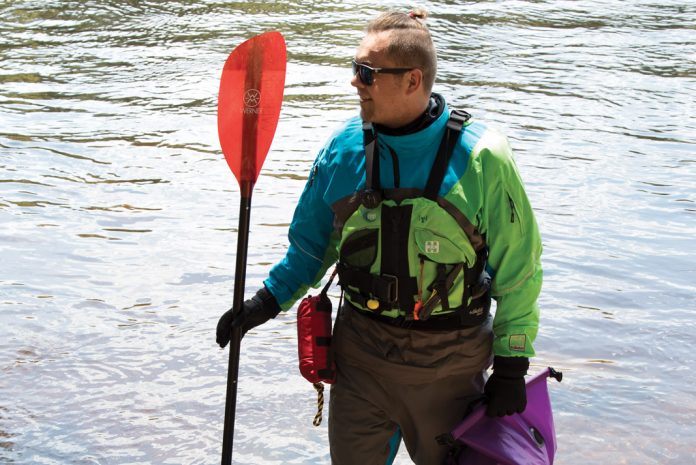
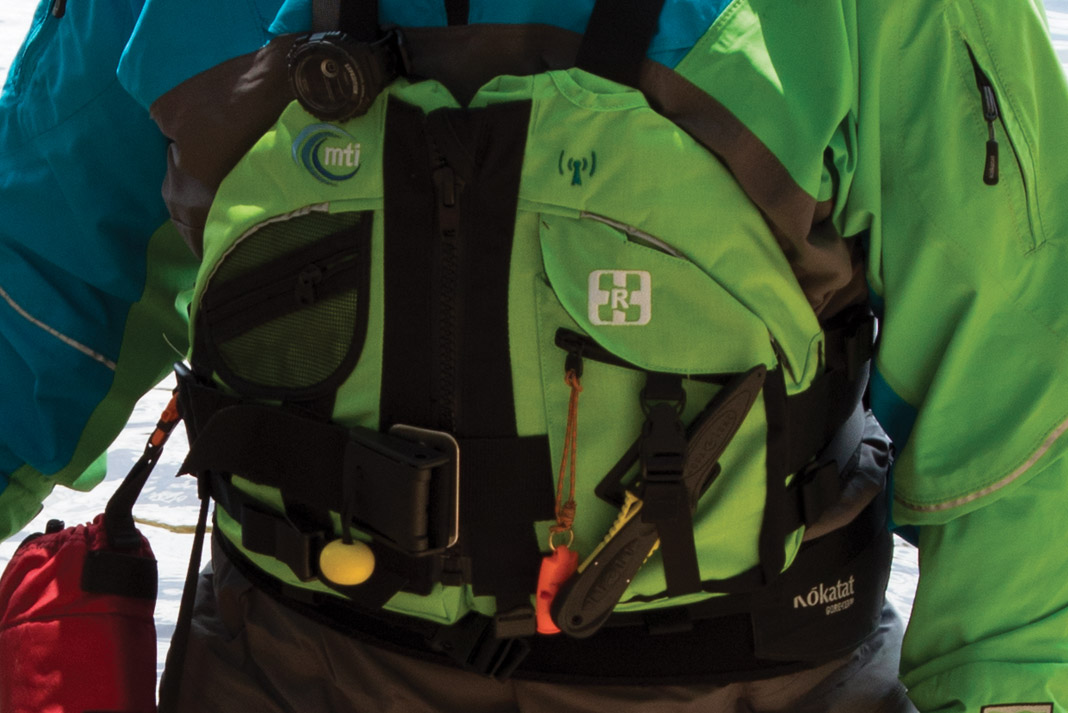
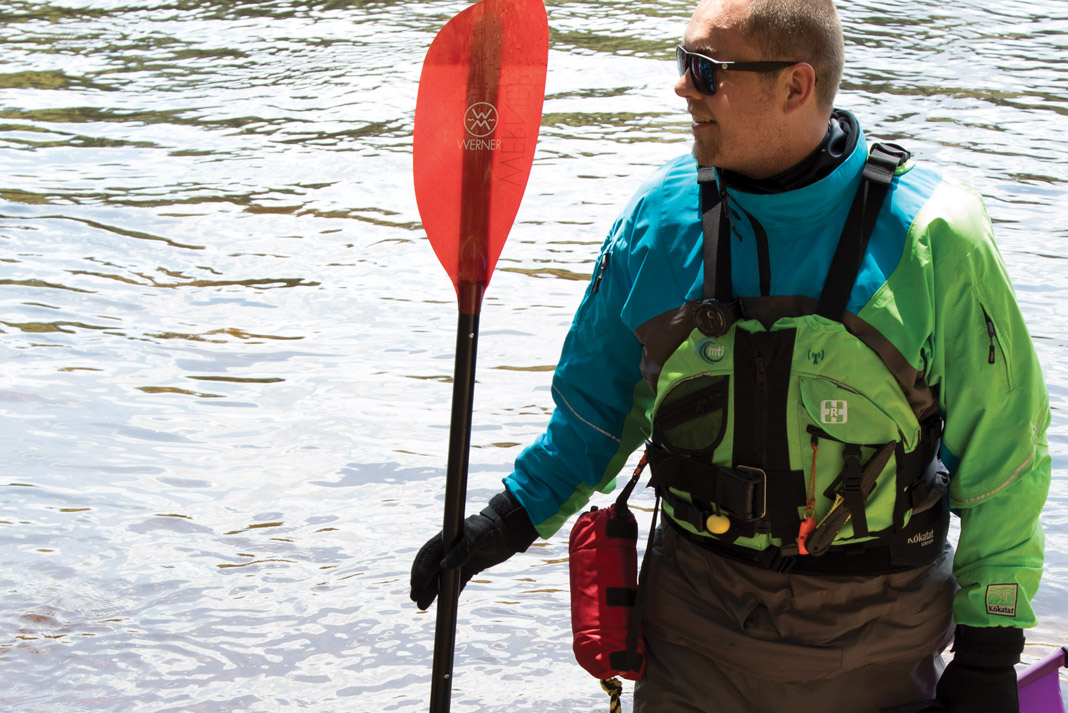
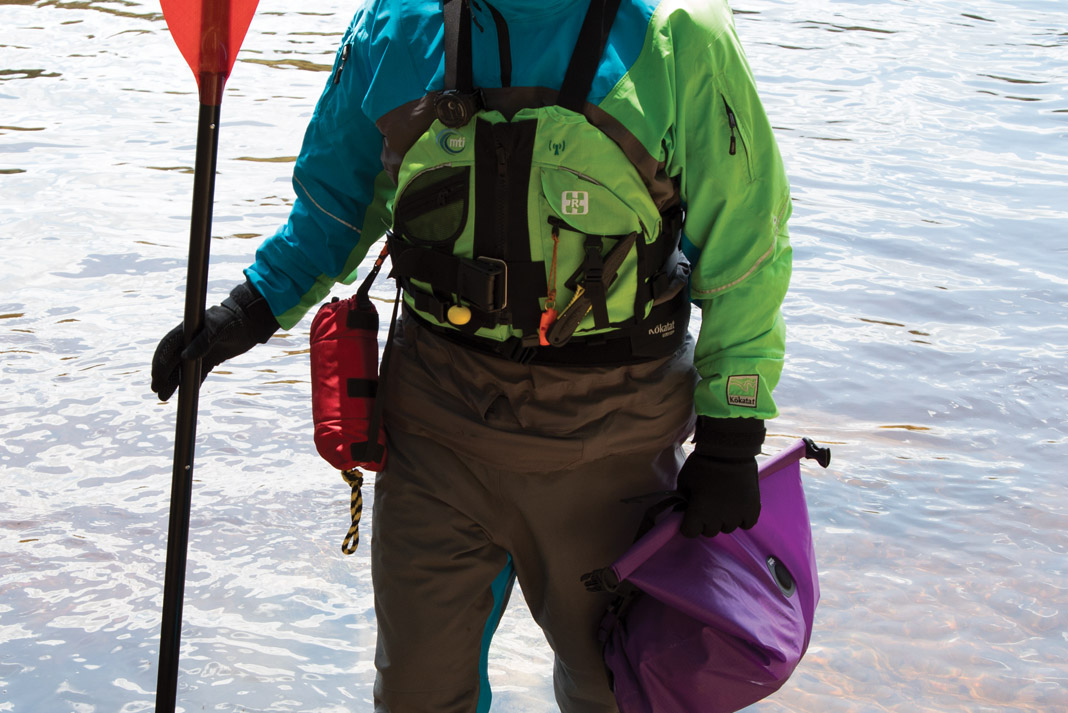
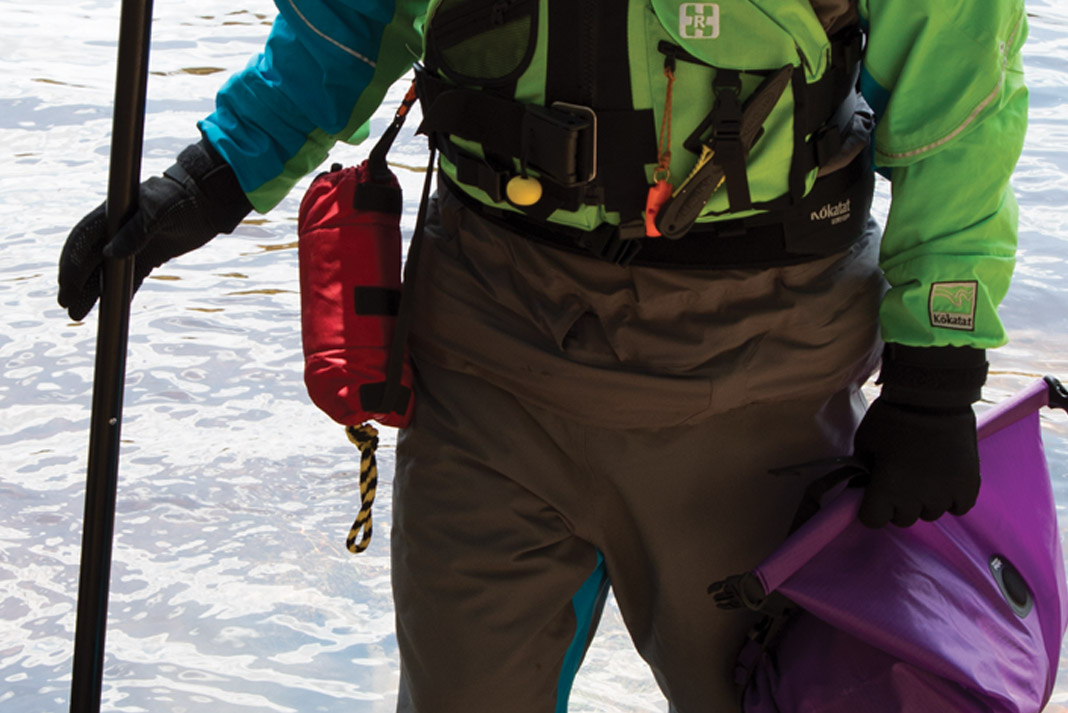
Looking at the front-zip Poseidon you may think it’s overkill for a weekend or day trip. That said, if you want to spend your valuable time focused on exploring and paddling, allow me to expound. The unisex design starts with a great fit and is available in three sizes. Now the fun part—customization of the Poseidon PFD extends from front to back. Couple it with accessories from the Kokatat Poseidon Expedition Kit. Store a day’s worth of snacks in the front along with a first aid kit and cellphone. On the back clip the 1.5-liter Hydrapak on the back for a sleek fit and easy access to your water. Rest assured the Kokatat Poseidon PFD will eliminate the need for most excess gear to roll around unsecured. This isn’t overkill. It will carry everything you need for a weekend paddle.

Kayak Review: Pyranha Machno

What do you get when you take a little bit of the 9R and combine it with the Shiva? | PHOTOS: HANNAH GRIFFIN

I’m looking forward to telling you what I think of the new Machno from Pyranha. But first I’d like to invite you to take a brief pop quiz. What is the Machno named after? Is it a) a merger of mach no (short for number) indicating it has super sonic speed and is a machine of superior ability? Or is it answer b) Machno Carwyn—regarded by some as the best show jumping pony in Europe, and perhaps the world? Or lastly, could it be c) a tributary of the fabled Fairy Glen that was the spawning grounds of this new river running machine? Before you commit to an answer, read on.

Pyranha Machno
Size Medium
Length 8ft 8 in
Volume 308 L
Cockpit 35.6 in x 19.5 in
Weight 47 lbs
Weight range 132-220 lbs
pyranha.com

I’ve tested some of Pyranha’s other river running boats, including a few editions of the Burn with its playful hull, precise edges and the long, narrow and race-ready 9R. I was curious as to where the Machno would fit in Pyranha’s lineup.

“The Machno is a river running creeker that replaces the Shiva building on a few design cues from the 9R and Shiva,” says designer Robert Peerson. From the Shiva it takes its softer edges, round side walls and high volume. Pyranha incorporated some of the extreme rocker of the 9R bow to the Machno’s bow and stern for a dry ride that is meant to keep you on top and moving over features.

Cockpit of blue kayak
The Machno’s 35.6” x 19.5” cockpit is outfitted with Stout 2 Outfitting and includes a new thigh brace compatible with optional hooker attachment | Photo: Hannah Griffin

Pyranha’s Machno is available in medium and large sizes. The medium we tested is 8’8”, about six inches longer than a medium Burn III and with 10 gallons more volume. Compared to a 9R it has a bit more volume but is three inches shorter. Peerson explains they’ve designed the Machno with a wide and mostly flat semi-planing hull, with soft rails and highly rockered ends. So what does this mean on the water? Predictability and confidence.

The Machno is kitted out with Pyranha’s second generation Stout system, including robust, adjustable thigh grips, oversized, deep fill padded hip pads and an add on thigh hook that gives additional outside thigh support. If you need more inner thigh hook you can rotate the thigh brace to accomplish this, a feature Pyranha added to serve a wider range of paddler sizes. It is simple and effective and feels solid all around.

Slipping into the boat and looking at the bow I immediately noticed a few things. It’s not a stubby little nub like a playboat but also not so far away you couldn’t see it without binoculars. It’s always a tradeoff between speed and maneuverability. Long goes fast, but doesn’t turn. Short turns but doesn’t go fast. I think Pyranha hit the mark perfectly for a Class IV/V river runner.

Front of blue kayak
A wide and mostly flat semi-planing hull, soft rails and highly rockered ends. Notice the molded wave deflector. | Photo: Hannah Griffin.

While not as fast as its 9R racing sibling, it has more than enough get-up-and-go to zip around the river with confidence. In high water, on pushy spring sections of the Petawawa River I could hold my line well but was still able to quickly change course when needed thanks to the highly rockered bow. The rocker effectively shortens the boat and gives me the spinning and turning ability I want when navigating those tighter creeks.

I also love the ease in which I could move around the river. When boats get a bit too long it can make ferries challenging as once you lose your angle it’s impossible to get it back. The Machno was easy to control, its angles ensuring I ended up where I wanted to. I was also able to use the semi-planning hull to catch small features and surf across the river without losing any ground.

The Machno is a very stable boat when sitting flat and it’s not the kind of design you need to tilt over very far to tap into its carving ability. The Machno has soft rails along the edges of the boat so don’t expect aggressive hard carves like in a playboat. Instead I found nice, smooth eddy turns that were quite predictable. The edges aren’t grabby which means less chance of catching on chaotic currents or tripping over rocks. Both are features I appreciate on my river runners.

Handle on blue kayak
Peaked decks on the Machno are designed to shed water, allowing you to resurface quickly in burly water and after a drop. | Photo: Hannah Griffin.

The Machno also does a fine job of dealing with large waves and holes. Where some boats excel at punching through, the Machno seems to glide up and over and keeps the water from ending up in your face. The rocker certainly plays its part in this but so do the wave deflectors. Located in the bow, Pyranha claims they help generate lift to get through features and help deflect spray away from the paddler.

[ Paddling Buyer’s Guide: See all Pyranha kayaks ]

The Machno includes an inline bow handle, which I find more comfortable for dragging and carrying along the river. The peaked decks shed water, keeping you upright and allowing quicker resurfacing after drops. A sleek, smooth feel along the cockpit means it’s easy to pull  hard fast strokes without catching any bumps or humps in the plastic. This is not something I’ve thought about before but came to appreciate while paddling the Machno. “We try to keep the cockpit as straight as possible to ensure a good seal with the skirt. The more bends the rim makes the more opportunity water has to come in,” explains Peerson.

Let’s return to our quiz. If you picked c)—and you should always pick c)—you nailed it. Although I’d still accept the other two answers because the Machno is also a fast, high performance machine that can jump over obstacles with elegance and grace. If you’re a paddler looking for a boat that can handle steeper and bigger runs or something that doesn’t punish you for little mistakes, then the Machno is your answer.


This article originally appeared in Rapid
Early Summer 2017 issue.

Subscribe to Paddling Magazine and get 25 years of digital magazine archives including our legacy titles: Rapid, Adventure Kayak and Canoeroots.

Canoeing The Broken Skull River

Photo and video by Caleb Roberts.
Two groups of canoes paddling the broken skull river.

This film by Caleb Roberts shows the beauty of the Broken Skull River in the Northwest Territories of Canada.

In Caleb’s own words, “Class 5 scenery with days of class fun whitewater is how I would describe this river. Breathtaking landscapes with beautiful water weaving through it.

“Nááts’ihch’oh National Park Reserve is home of this river and many others. But in my biased opinion, this is the gem.”

The Broken Skull River – NWT from Caleb Roberts on Vimeo.

Moose Hunting In The Yukon From A Canoe

Inspired by the memory of good friend Andrew Brose, Aaron Hitchins and Will O’Brien take to the Yukon wilderness in pursuit of Moose, Arctic Grayling, and adventure.

Flying in upstream of dangerous whitewater, without a guide, they find themselves up against harsh elements and unknown circumstances. Lacking the capabilities to do it on their own, they must rely on each other to succeed, and survive.

Read the full story here, and watch the film below.

Why All Paddlers Feel Like Imposters

Photo by Alyssa Lloyd
A woman paddling a canoe in an overgrown forest.

Successful individuals unable to consciously assimilate their accomplishments, live in constant fear of being found out as a fraud. This condition is so common that as far back as 1978 clinical psychologists describe these over-achieving employees as suffering from “imposter syndrome.”

Before working as Canoeroots’ assistant editor, I was a grungy freelancer living out of the bed of my pickup truck. Driving from one boat launch to the next, chasing every angling and outdoors story I could find. Just me and my truck White Lighting, a canoe and fishing gear.

Now you must be thinking, if I truly believe in imposter syndrome, I must be a fraud. Hang on there—I hear that enough from myself. While my life on the road appeared glamorous to others, I knew it was just a string of bad food choices and mishaps. Again, stop putting words in my mouth, I’m not saying it was awful. There was just room for improvement—and curtains.

According to Forbes, “Apart from serial narcissists, super low achievers and outright crazies, no one is immune to the self-doubt that feeds imposter syndrome.” What matters according to Forbes, is not whether we occasionally fear failing or looking foolish, it’s whether we give these fears the power to keep us from taking the actions needed to achieve our goals.

Guilty.

This state of mind has driven me to the brink of uselessness. Paralyzed by self-doubt, I find myself unable to think up an original thought for

this column.

Now you probably expect me to transition into a transcendental wilderness adventure in the backcountry that recently changed my outlook on all of this right? Wrong.

But since you brought it up, my latest backcountry trek was a couple weeks ago. A good friend and I decided to cart a canoe into an alpine lake loaded with all of our camping and fishing gear.

Two missed alarms, a one-hour trek up the wrong trail and another threehour trek down the right trail and we weren’t even close. But we knew the brook trout were on the highly elevated horizon, so we pushed on.

After several fallen trees we gave up trying to find paths around and either went through the branchy strainers or lifted the canoe over. A few respectable bruises and scratches later, we at last made it to the crest where gravity would be on our side.

The trees were puny, like that of the tundra, the vista views spectacular and spirits were just as high as we started a small, albeit steep descent to the lakeshore. More trees had fallen. We didn’t know it at the time, but this was a blessing. We started unloading the canoe getting ready for another lift over a spirally dead evergreen’s undergrowth. My friend, a good foot taller than me, got a quick glance ahead at the lake.

“Alyssa,” he said precariously. “We may want to take a walk down first.”

Ice.

The entire lake aside from a thin strip where the sun beats on the farthest shoreline was sprawling white ice.

If anything, this backcountry excursion that finally settled my utter loathing for the all too often excuse used to soften failed attempts, “It’s all about the journey, man.”

Much like that frozen alpine lake however, I know I will not live in this consolidated state of paralysis forever.

How To Get The Hardest Whitewater Shot Ever

Photos and video my Michael Clark and Red Bull
A man repelling off of a cliff side taking a picture of a waterfall

How do you get the hardest whitewater shot ever? Easy, you just repel down a cliffside, use a flash that’s 800-times brighter than an Iphone and have one of the best whitewater paddlers go off a massive waterfall over and over. Ok…not easy at all. But that is exactly what Michael Clark and Rafa Ortiz did to some of the most unique whitewater camera shots ever.

Check out how they did it in the video below:

The Birth Of A Dugout Canoe

Photo and video by Northmen
A hand using a chisel to dig out a canoe.

Having the newest and most technologically advanced canoe is really cool. But, nothing is cooler that having a canoe that you carved yourself out of a tree trunk. 

Watch this short film by Northmen on the birth of a dugout canoe. It will make you want to go cut down a tree and carve out your next paddecraft.

The Birth Of A Dugout Canoe by Northmen from Northmen on Vimeo.


Kajak Sport Components Deck Pod

All paddlers are looking for a safe, dry place to put their phone and other pocket items. Kayak Sport Components of Finlad have created a solution that doesn’t require drilling holes in your kayak.

The Kayak Sport Components Deck Pod is a watertight pod for all kinds of touring boats. All you need to do is put your valuables in the pod and tighten it under the bungees of your kayak. The shape of the pod is made to perfectly fit securely under the bungess

For more information, check out the video below:

Hurricane Kayaks Sweetwater 126

Photos and video by Rapid Media
A man standing next to the Hurricane Kayaks Sweetwater 126 sign

Hurricane Kayaks are known for their lightweight kayaks. The Sweetwater 126 is no exception. This boat is a little more than 12-foot long and 33-inches wide and has a great high/low seat position.

Though their sister company Native Watercraft is releasing a fishing specific version, the Hurricane Kayaks Sweetwater 126 is a great boat for beginners and experience paddlers alike to get out and paddle safely.

For more information, check out the video below:

Shore Tee Footstake

photos and video by Rapid Media
The shore tee footstake

Shore Tee has created a great solution for keeping your kayak off of the sand after a long paddle. The Footstake has a stake on the bottom, shaped like the soldier’s shovels in WW2, that firmly plants in the ground. On top is a normal kayak rack. 

For a closer look, check out the video below.