Home Blog Page 226

Backcountry Brushwork Part II: Lorenzo Del Bianco

Lorenzo Del Bianco
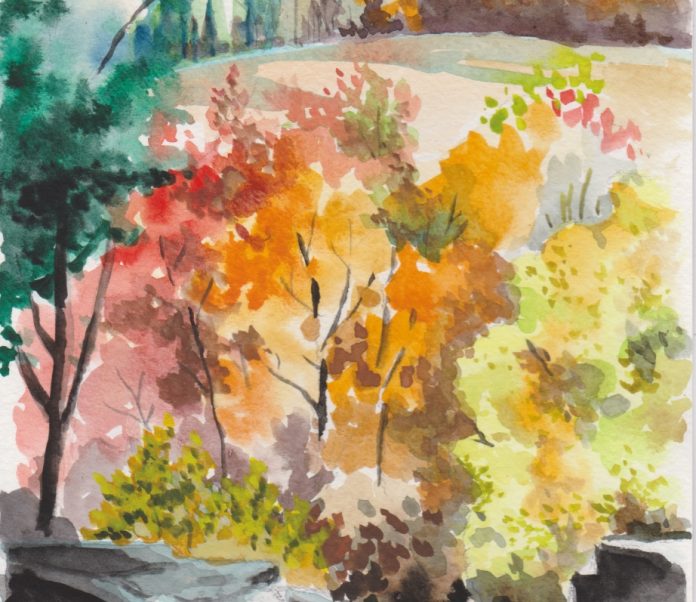
colourful trees painted by Lorenzo del Bianco

Lorenzo Del Bianco has been a long time illustrator here at Rapid Media, he’s contributed to our sister brands including, Adventure Kayak, and Kayak Angler. On top of that, Lorenzo has spent many a trip painting from shorelines. Here are some tips he’d recommend for painting en plein air. 

“I prefer working in watercolour out of doors because it’s easier to throw everything I need together quickly. “

“I pack a small paint box; a variety of brushes even though I seem to only ever use the same two brushes; watercolour paper blocks in usually two to three different sizes; charcoal sticks; an X-acto knife and water.”  

Most importantly, I asked Lorenzo how he keeps everything secure between the gunnels. 

“The paints are in a little paint box and the smaller paper block fits nicely inside of it, also works well as a makeshift easel. The brushes, charcoal and knife are tightly rolled in a bamboo brush holder, a large sheet with pockets that can rolled up for storage and rolled out to be used as a work surface.”

“The larger paper sizes are a bit of a pain but, conveniently, come in a block or stack that is glued on the longer edges, this keeps the paper stretched and resists buckling when wet. The water is in a leak-proof container.” 

Britton Tract Nassagaweya Line low res

So, how does he keep it all safe from water outside of the canoe?

“The whole kit goes into a silicone-treated top-loader backpack. The finished pieces get put into plastic zip-loc bags to protect them from accidents. The backpack is also bright orange so that I won’t lose it.”

The real challenge comes to play when you have a fully finished piece of art that you need to get home without compromising it. Lorenzo seems to have it all lined up, right down to how fast his artwork dries. 

“Because I use watercolour, it dries fairly quickly, which makes transport very easy. This allows me to either place it in a plastic bag or even nestle it between the cover and block of the watercolour pad.”

 In all of his years painting plein air, Lorenzo admits he never seems to be as prepared as he’d like to be. But thats okay, if you are resourceful. 

“As much as I try to be prepared, I find that I’m never as prepared as I thought I was. Sometimes you have to make due with what you have and be spontaneous! Once, on a kayaking trip to the west coast, my wife reminded me to bring a sketch pad and pencils, but I didn’t bother. It didn’t take long before my surroundings summoned the muses. I was scrambling for anything to draw on and with. I found some scrap paper and burnt cedar twigs in a fire and then honed the ends into points.”

“After a few sketches, a wonderful couple from Alaska saw this and offered me the use of their watercolour paper and watercolour pencils. From the cockpit of my kayak, I painted a waterfall using these borrowed tools. I simply sketched with the pencils and dipped my finger into the surrounding waters using it as my brush. The trick is to always be inventive.”

waterfall 

When asked what his number one tool would be in the backcountry, Lorenzo had a few nuggets that may work for others, but for him, it’s a good old fashioned notebook and pen, not pencil. 

“I thought my number one tool, aside from the obvious, might be a camera to record detail, but I don’t really enjoy working from photographs; I find them too factual, too restrictive, too much like work. Perhaps some wine then; a crusty baguette and some old sharp cheese? Very enjoyable but also increases the possibility of balance being tipped more in favour of fun. Then I thought, my notebook, yes!”

“The importance of field sketches and notes; thoughts, feelings, details, memory. Edvard Munch felt that one should not paint as one sees, but instead as one remembers. Note taking helps me remember how I ‘felt’ at that moment, at those times when I can’t stay long enough to finish, but still want to later retain that feeling in my painting. A notebook and a pen. Not a pencil. As one of my college professors once offered, “use a pen, make a commitment.” I always have those two things with me, always.”

Though Lorenzo has been painting and illustrating for as long as he can remember, he admit there is a balance between focus and soaking in the moment. Other times, it’s just a matter of staying comfortable in your element. 

“Sometimes I add a little vodka to the water to keep it from freezing if it’s cold out, sometimes I add a little vodka to me if it’s cold out too”

“Work can be enjoying and enjoyment can be work. Painting out of doors requires a certain discipline and focus, but also demands that you be aware of the beauty of your surroundings. A balance needs to be struck. A nonrestrictive discipline.”

“Another trick I’ve learned is not to worry about finishing a piece on the spot. Sometimes you only have enough time to capture the emotion or impression of the scene. That’s probably the most important thing, though. You can always finesse it later at camp or at home.”

CCC PartnerBadge Web

Among many other outstanding accomplishments, Lorenzo has worked with Walt Disney Animation Canada, illustrated two children’s books one of which, Dirty Science, written by Shar Levine and Leslie Johnstone went on to win the Canadian Science Writer’s Associations Outstanding Youth Book Award in 2013, and of course, Lorenzo has worked with us here at Rapid Media. 

Watch THE CANOE, an award-winning film that tells the story of Canada’s connection to water and how paddling in Ontario is enriching the lives of those who paddle there. #PaddleON

{loadposition EndContent}


Hooked Up: The Boat And Accessories You Need To Catch The Big One

Locked and loaded.| PHOTO: MARK VLASKAMP

I’m an accessories guy.

My dad, not so much. All he thinks he needs is a canoe, a paddle, a Thermos of coffee, and the same silver spoon he’s been throwing since his big walleye on the Rupert River in 1985.

Fortunately for me, the innovation of fishing accessories is catering to my gear affinity. Accessory companies are developing clever ways to mount, store, tie on, and plug in anything and everything. If it’s shiny, packs down small or can be clamped onto a gunwale, it’s mine.

Somewhere between an over-loaded gear junkie and an old-school minimalist there is a perfectly rigged fishing vessel, not to cumbersome but equipped to find and land fish. Start here.

THE CANOE

Almost any canoe can make a good fishing platform. However, if you’re buying a boat specifically to chase trophies you’ll want to keep a few factors in mind. Chief among them is stability. Beamier boats tend to feel more stable, giving anglers the confidence to battle with deep lake leviathans. Some anglers even break the golden rule and stand to cast. Another factor to consider is weight. One of the big advantages of fishing from a canoe versus a typical fishing kayak is the opportunity to portage to distant lakes and hard to- access fishing grounds. The lighter the canoe the farther you’ll carry it to less pressured fishing waters. Finally, if you like to fish in rocky rivers and creeks, opt for a material that will slide over rocks, logs and gravel bottoms.

Locked and loaded.| PHOTO: MARK VLASKAMP

ROD HOLDERS 

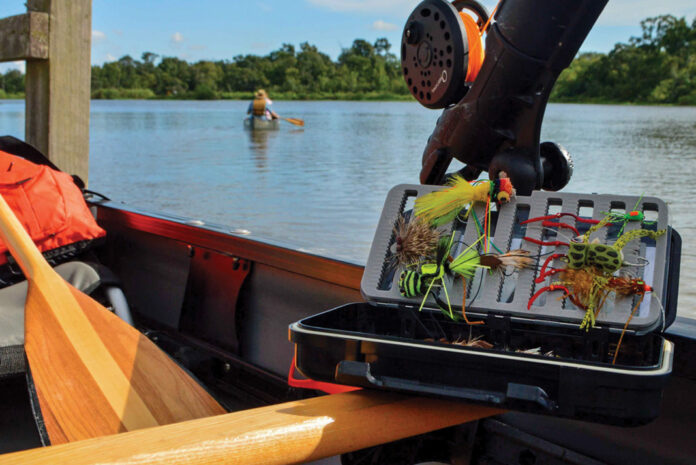
Rod holders do exactly what the name implies. Without rod holders I’m always only one movement away from stepping on my rods, knocking them overboard or running them into a rock. My rods’ relative fragility compared to the rest of my gear means I like to know  exactly where they are and paddle assured that they are out of harm’s way. There is no reason a $200 rod should be sliding around the bottom of a canoe when you can take out $25 gunwale-mounted insurance policy.

DEPTH FINDERS 

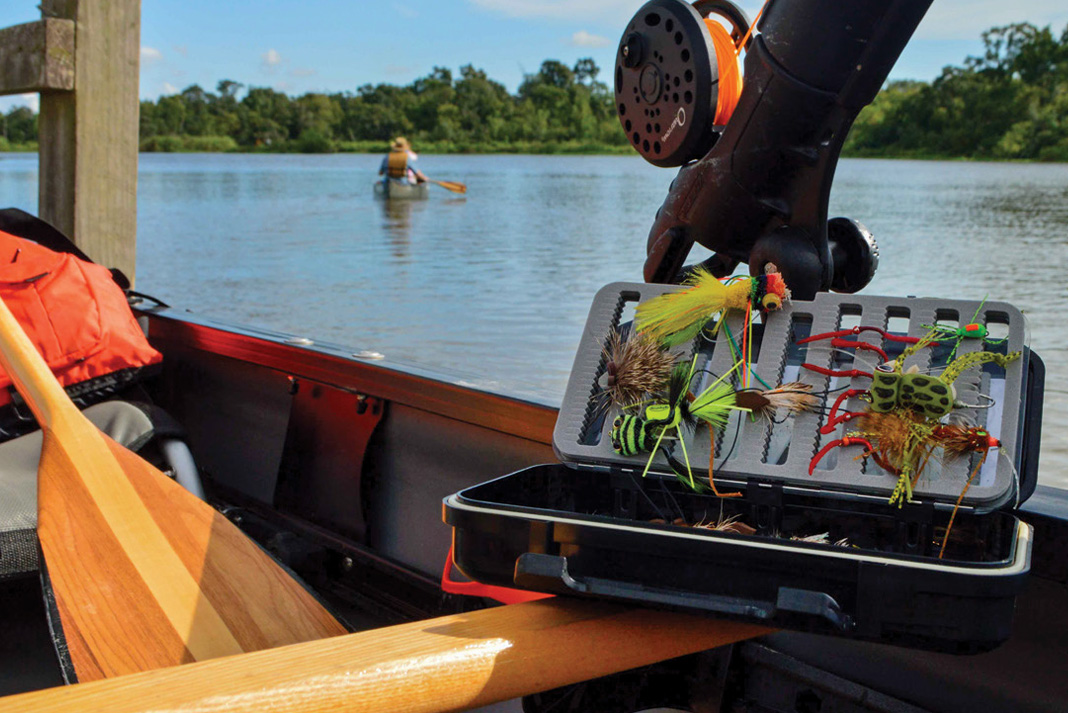
Once a luxury only compatible with powerboats, today’s compact new depth finders are not the typical hard-mounted captain’s rig of the past. Mine is portable, comes in a carry-bag and sits under the yoke and next to my fly boxes. Its counterpart, the suction cup transducer arm, is stuck to the outside of the hull just below the gunwale. The transducer flips into the water making structure and water conditions now easy to find, leaving only the fish left to be uncovered.

CAMERA MOUNT 

Welcome to the selfie generation. A gunwale-mounted, single-pod camera arm extension provides fully adjustable options in all directions for mounting and positioning a camera. You can capture the glory of every catch. On solo trips or when I’m catching up to Dad after a late start organizing all of my gear at the launch, this simple rig is my personal camera man that never misses a shot.

EXTRA POWER 

John Jacob Astor and the other American Fur Company voyageurs are rolling over in their graves right now, but it’s true. I don’t leave the dock without extra power. Whether it’s a 150-watt expedition charger to run my depth finder, GPS and iPhone, or a simple camera battery backup, I stay safe and connected on the water with extra power. No matter how many times he rolls his eyes, I know Dad appreciates the new-tech power backup when I use it to recharge my camera before getting his grip-and-grin trophy shot.

Mark Vlaskamp is a fisherman, paddler and adventurer. He recently quit his day job to embark on a six-month road and fishing trip across the USA.

Dawn Patrol: Why You Need To Paddle In The Morning

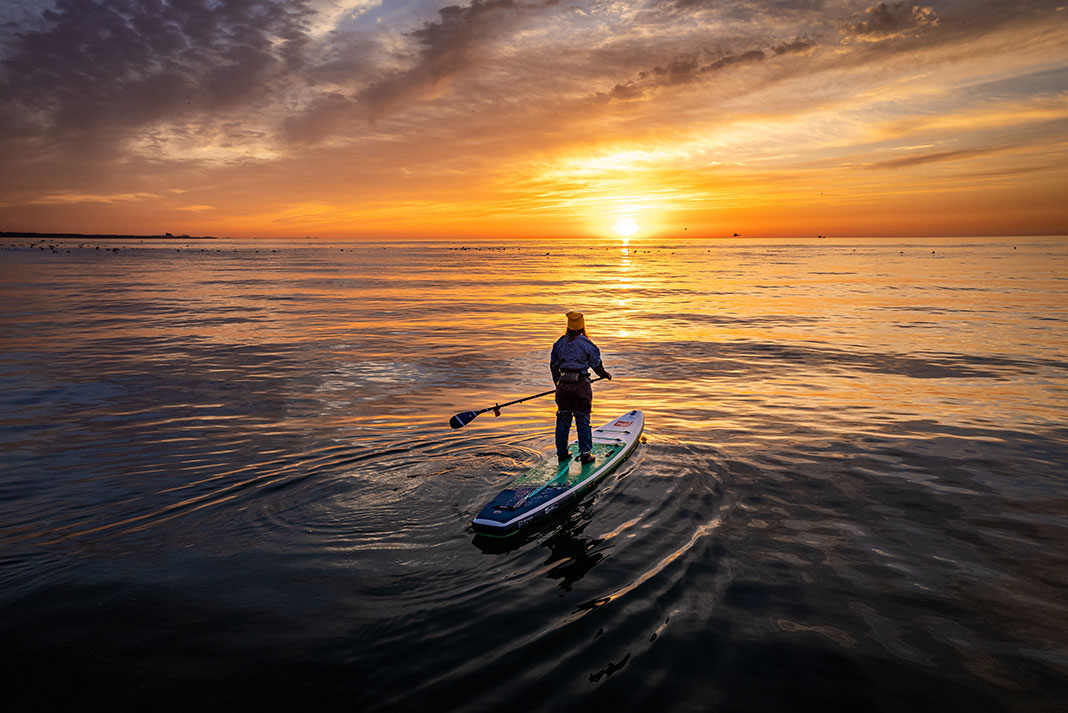
a person standup paddleboarding in the morning
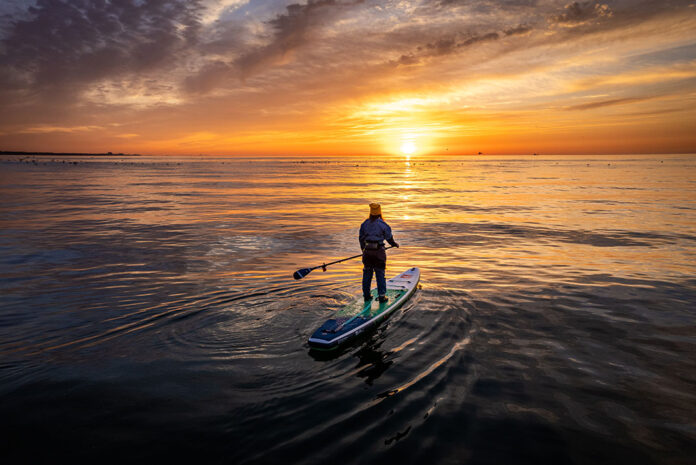
Get up early and you’ll be able to capture awesome photos like this—along with a host of other lasting benefits. | Feature photo: Tony Felgueiras Photography

Every morning, along your local shoreline, some brave soul is pioneering the day with a paddle in hand. Cooking up miles for breakfast is a powerful form of nourishment, promising benefits for everyone who can keep their finger off the snooze button. Sound too good to be true? Believe it or not, that silhouette on the horizon could be you.

The many benefits of a good morning paddle

“Getting in a paddle before most people are awake gives me a sense of accomplishment that carries me through my day,” says dawn patrol enthusiast and competitive racer John Beausang, co-founder of the popular Paddle Monster community. “Regardless of what I face, I’ve already ensured that at least part of my day was my own, enjoyable and challenging.”

a person standup paddleboarding in the morning
Get up early and you’ll be able to capture awesome photos like this—along with a host of other lasting benefits. | Feature photo: Tony Felgueiras Photography

Early activity wakes your brain

New research suggests that getting out on the water in the golden hour has lasting benefits on your physical and mental capabilities throughout the day. A study by PHIT America measuring performance by students in Illinois saw a 93-percent improvement in math scores and a 56-percent increase in reading scores after exercise.

“What’s good for kids has to be good for adults, too,” says Jim Baugh, founder of PHIT. “Getting active in the morning wakes up the brain, improves concentration and gets the brain ready to learn and be productive.” Plus, it fires out mood-boosting endorphins that stay with you for hours.

“By going out at sunrise you’re putting yourself first,
and that’s a powerful thing.”

Dawn patrol also offers greater opportunities for consistency. Evening paddling sessions risk being delayed, interrupted or abandoned entirely due to working late, running errands and getting blindsided by unexpected to-dos. There are fewer obstacles to getting on the water at 6 a.m. than at 6 p.m.

“I love getting that jumpstart on the day,” says Julian DeSchutter, co-founder of Vancouver-based outdoor group Chasing Sunrise, which organizes 4:30 a.m. adventures that have attracted as many as 800 participants. “Everyone else is still sleeping. By going out at sunrise you’re putting yourself first, and that’s a powerful thing.” The phone isn’t ringing, and there are no distracting emails or texts. “There is energy at the beginning of the day. A silence,” DeSchutter adds.

Morning exercise leads to sounder sleep

Research also shows that morning fitness promotes a better night’s sleep. Appalachian State University’s Dr. Scott Collier studies the effect of exercise on blood pressure. “Much to our surprise, 7 a.m. exercise was better in terms of reduced blood pressure throughout the day and greater sleep benefits than exercise at 7 p.m. There was little blood pressure or sleep benefit when exercise was done at 1 p.m.,” he says.

[ Browse the widest selection of boats and gear in the Paddling Buyer’s Guide ]

“We don’t yet know the physiological mechanisms that result in these changes, but we do know enough to say if you need to decrease your blood pressure and if you need to increase your quality of sleep, 7 a.m. is probably the best time to exercise,” Collier adds.

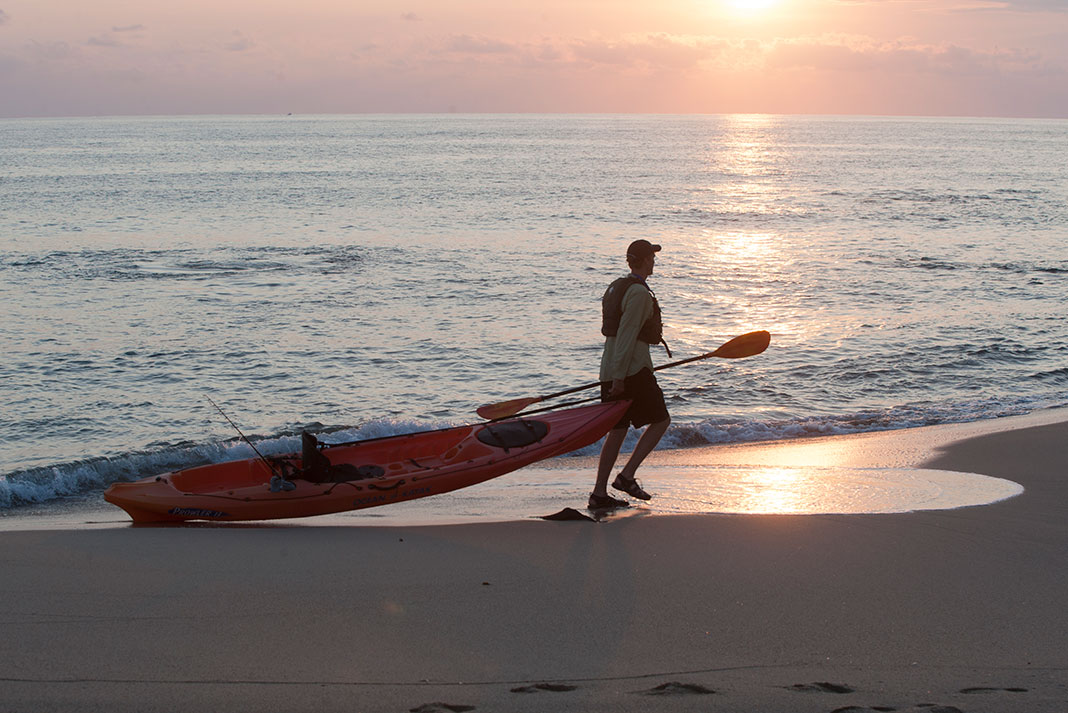
man drags a fishing kayak and paddle along the beach in the morning sunrise
Get a jump on the day to jumpstart your health and vitality. | Photo: Courtesy Ocean Kayak

Slim down and wake up on the water

Finally, for fitness paddlers who are as motivated by losing weight as setting a new personal best, exercising in the morning boosts your metabolism and keeps it elevated for six to 10 hours afterward—you’ll burn more calories throughout the day thanks to a morning workout. Exercising on a pre-breakfast empty stomach has been shown to burn a greater percentage of fat for fuel, rather than carbohydrates.

Kaydi Pyette joined the team as managing editor for the Spring 2013 issues of Adventure Kayak, Canoeroots and Rapid.

Cover of the 2023 Paddling Buyer’s GuideThis article was first published in the 2017 Paddling Buyer’s Guide and was republished in the 2023 Paddling Buyer’s Guide. Subscribe to Paddling Magazine’s print and digital editions, or browse the archives.


Get up early and you’ll be able to capture awesome photos like this—along with a host of other lasting benefits. | Feature photo: Tony Felgueiras Photography


Mariann Saether’s Firsthand Advice For Kayaking While Pregnant

Silhouette of pregnant woman with sunset in background.
Do what makes you happy. | Photo: courtesy of Mariann Saether

On September 4, 2016, I gave birth to my son Benjamin, my first child. The nine months of pregnancy were surprisingly easy and allowed me to kayak up until 10 days before birth. More of a surprise was the fact that I felt comfortable with trail biking and paragliding up until month seven. Furthermore, in the eighth month I went hiking for seven hours in the vicinity of Svartisen glacier, and in general was feeling very good as the little man grew happily inside.

I felt blessed and stoked that I could keep up my activity level, and the future seemed bright. But as I was soon to find out, not everybody liked the fact that a woman still goes down a hill on a bike or jumps in the kayak to paddle Class IV as soon as the belly can be seen.

Before pregnancy I repeatedly heard comments such as, “Women have to decide for themselves when to slow down and put on the brakes,” and “Pregnancy is not an illness—it is really good to keep staying active.” “Your body will tell you when to slow down,” was also one I heard a lot.

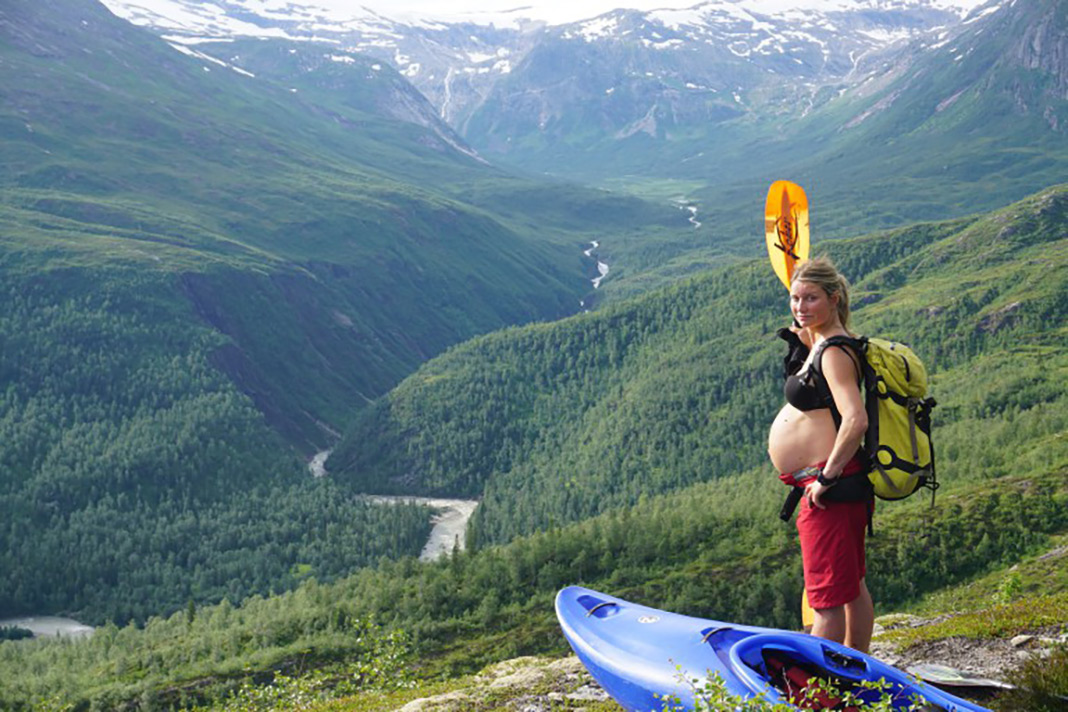
Pregnant woman looking out over valley with whitewater kayak next to her
Eight months pregnant. | Photo: courtesy of Mariann Saether

So what happened when my body and mind actually did not tell me to stop until 10 days before birth? People got angry. Annoyed. Negative.

I guess I should not have been so surprised to realize that whitewater kayaking and trail biking is not really looked upon as “normal activity” for pregnant women. However, to be able to stay so active made the mental aspect of my pregnancy extremely easy—I was happy and active, which I think made my baby boy happy.

One of the main points here is that I am not pointing my finger at other women that find it hard to be active while being pregnant—it is truly their body and mind—and I trust everybody to do whatever is best for them. Here are some facts to consider before you start judging:

When I got pregnant I was not just normally fit

I was as fit as I have ever been in my entire life—coming straight from high-end athlete performances at World Cups and World Championships the months before, and a hard training regime leading up to those competitions.

My mind did not play tricks on me

I still trusted myself to make the smart decisions on the water and on the biking trails. Why would I suddenly start screwing up just because I was pregnant?

Kayaking is like walking

I have close to 15,000 hours on the water. That is 625 days (24/7) or 1.71 years.

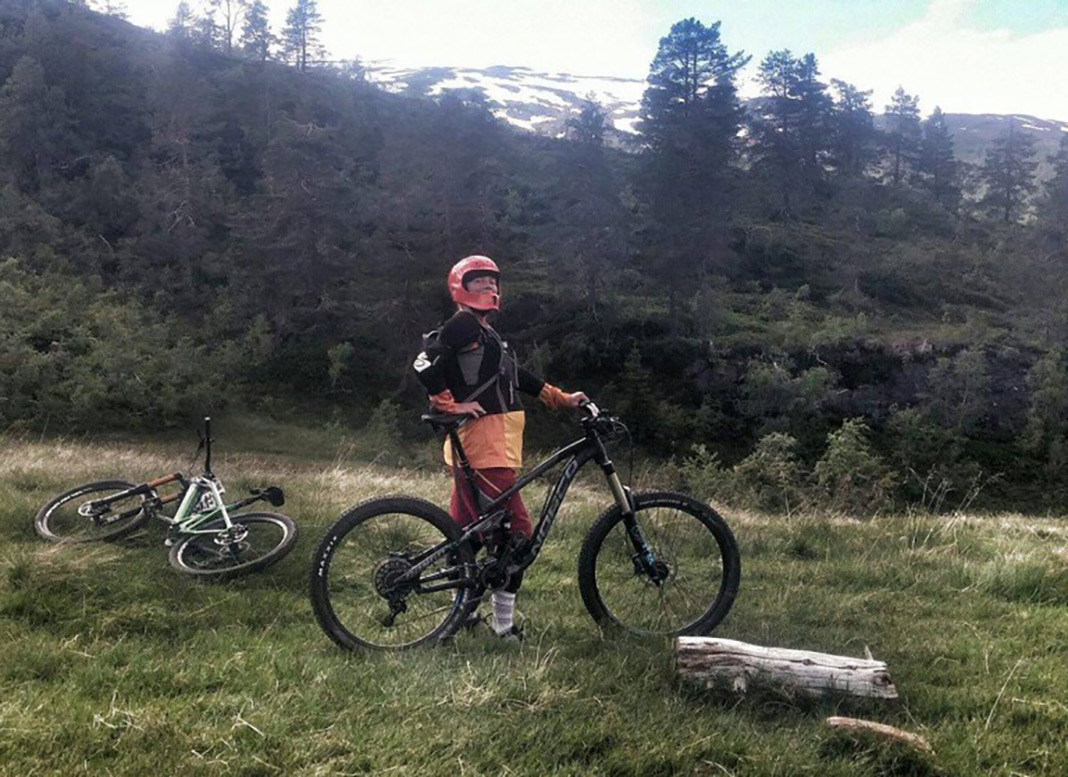
Pregnant woman riding mountain bike
Seven months pregnant. | Photo: courtesy of Mariann Saether

But what really has surprised me is that it is not just strangers remarking on my activity level during pregnancy months. Some of my closer friends have also found it appropriate to point the finger at times. It seems like the tolerance for so called “extreme sports” while being pregnant is quite low—and lower than I actually thought up front.

That brings me to the key topic of this text: TOLERANCE.

Perception is the key to it all. I do believe that many of the negative remarks come from not truly understanding the world an extreme sport athlete walks in. One of my friends commented “But what if you get the paddle in the stomach when you run this?” The section in question is one I consider very easy, and one I have done hundreds of times without anything happening. Ever.

I just replied: “Why would something happen now?” It is all in the mind. And to be able to control your mind, trust yourself and your abilities. In a way, pregnancy is not unlike running Class V rapids. Go figure.

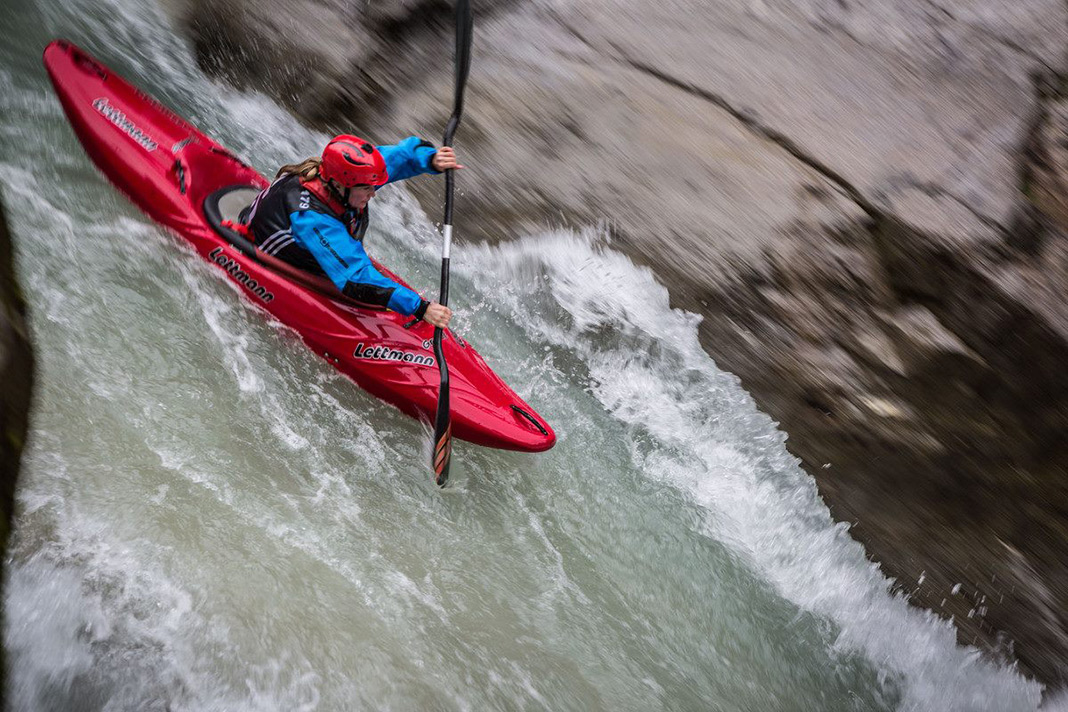
Woman paddling red whitewater kayak
Competing at the Sickline World Championships 4.5 weeks after giving birth. | Photo: courtesy of Mariann Saether

I furthermore have been blessed with a man who trusted me 100 percent while carrying his child. He never once told me to not get on the river, to not run a rapid or to not go biking. He even once or twice suggested I should rather run a rapid than walking around with my big belly! He did however tell me that I might be wise to not paraglide during the last two months—something I agreed with as soon as I gave it a second thought. His trust in me has been the biggest sign of love ever, and I am forever grateful for his support.

Being pregnant has been a wonderful journey. As I have explored new depths of my own being and ability to love, I have also learned more about the people around me and the world I live in. It only encourages me to walk my own steps, making myself and thus my little family happy.

Here is some advice for the pregnant extreme sport athlete:

Try to follow your gut instinct—not just your brain

The brain will tell you to slow down or to keep going—but it is really the body that will tell you how active you should be while being pregnant. I stopped kayaking when I was too uncomfortable in the kayak—easy as that.

Try your best to not listen to anybody telling you what to do or not—be your own being

This is truly difficult, but very empowering when you manage to.

If you are happy, the child will also be happy

You will never cause him or her any harm or risk—it is your child after all, and you should trust yourself and the power of your love.

Kayaking safely while becoming heavily pregnant really comes down to having good balance, good edge control in the boat and a good back-deck roll

I had all three and thus enjoyed endless trips on easy whitewater the last month of waiting.

I thought being fit would help me in delivering the child—but I was partially wrong

(Thank God I did not know up front!) Strong core muscles sometimes can cause a hard delivery because the muscles tend to cramp and hinder the cervix getting dilated enough to start pushing. I spent 30-plus hours of labor before the mid-wife told me I could push. Then it only took 20 minutes, and the mid-wife said she had never seen a firstborn being pushed out that fast or so determinedly before. Especially not after 30 hours of labour.

So in the end my strength was helping me. Also, the fitness level put me back on the bike four days after birth, and in my kayak seven days after birth, so I daresay the benefit of being active is huge after all.


Mariann Saether is a whitewater kayaker from Norway and the 2015 World Champion in extreme kayaking. Learn more about her here.

The Beauty Of Idaho’s Main Salmon River

“How do we save more rivers? I honestly think it starts with love.” That’s the first line we hear in this beautiful short film from O.A.R.S. The words are spoken by Amy Kober of American Rivers, who narrates the film and shares her thoughts on the need for young people to love rivers in order for conservation of them to continue. Kober has dedicated her 18-year career to saving waterways and is passionate about Americans being able to enjoy and build relationships with public land.


Level Six’s Stig Larsson On Turning Passion Into Profit

RBC
Stig Larsson of Level Six in a video speaking to RBC about his company's path to success.
Stig Larsson of Level Six in a video speaking to RBC about his company’s path to success.

http://www.youtube.com/watch?v=X5XrQ_CWvVk

RBC

Level Six’s Stig Larsson sits down with RBC to explain how his company was born. Larsson explains that in the summer of 1997, while in Costa Rica training with the World Cup Kayaking Team and going on surf trips, he realized there was a lack of a lifestyle brand for paddlesports. 

He began Level Six and travelled around on the world selling his shorts and t-shirts on the World Cup circuit. He say it was six or seven years before he was able to draw a salary from the business, but he persevered. Today Level Six products are sold in 428 stores worldwide. Larrson’s advice for young entrepreneurs? “Have a passion for what you do and be all in.”

Princess and the Portage

Like father, like daughter.| PHOTO: ONTARIO TOURISM

It was going to take us a good hour to make the big water crossing. The wind was blowing straight into our bow and every third or fourth wave capped before rolling. My daughter, Kyla, helped prepare for the rough paddle by shifting the packs and the dog to better trim the canoe. She tightened her chin strap on her rain hat, braced her knees to the sides of the boat, and begged me to tell her one of my silly stories to make the time go by more quickly—and ease our anxiety.

“Once upon a time, in a place far, far away there lived an evil toad and a princess with very hairy armpits,” I began.

It was a proud moment for me. Even though my daughter recently mutated into a pre-teen, she still thinks it’s cool to listen to one of my farfetched yarns—for now, anyways.

A lot has changed over the first 10 years of tripping together. Now Kyla carries her own pack, paddles even when no one tells her, sleeps with only one stuffy, does at least half her camp chores and whittles her own marshmallow sticks.

There are some downfalls, of course. She leaves her bras hanging from the clothesline, gets dramatic over the slightest things, continues to tell me I don’t understand, shaves her legs in my cooking pots and wants to sleep in every morning.

I’ll take a few negatives, however. Kyla is great company. We tripped more days together this past summer than her friends spent at the beach—and she’s proud of it.

I know I’m a lucky single dad.

Like father, like daughter.| PHOTO: ONTARIO TOURISM

Enjoying wilderness canoe trips together means juggling the roles of protective father, knowledgeable wilderness guide and goofy camp counsellor. We sing songs, play games, and bake birthday cakes for no reason. We get down on our hands and knees to look at tiny seedlings and insects on the forest floor, sometimes referencing our field guide if we don’t recognize them. And I try to swallow my parental instincts and let her make her own mistakes.

I do all this because Kyla has grown up loving the wilderness and canoe tripping, and I want to keep it that way. The joys and miseries of backbreaking portages and 50-kilometer days can wait until she’s older. I want canoe tripping to be fun so she keeps wanting more. And, so far, it’s working.

Most importantly, Kyla is part of each trip we go on from planning to completion. She’s not just tagging along. She’s invested in the adventure. I think it’s this small bit of ownership in her world, which is otherwise largely dictated by adult-enforced rules, that keeps her so in love with it.

On that big open water crossing my tale grew until our anxieties were forgotten. I told her of a stone castle guarded by a giant, venomous toad and a clever princess who braided her hairy armpits into lengths of rope to escape the tower. When we reached the far shore I paused the story until we had carried over to the next lake. Then I continued the tale, adding a caramel lake surrounded by a wild forest populated with emus and a wizard with a candy cane wand.

“And the princess and the wizard went on to have many more adventures together. And they all lived happily ever after,” I finished as we arrived at the take-out. “Except for the toad—he died.”

Stepping on land, I was rewarded with a big hug.

“I love you, Dad,” Kyla whispered to me. “I can’t wait for our next trip.”

Kevin Callan is a wilderness guide and author, and considers himself the luckiest dad in the world. Butt End is a regular column in Canoeroots.


CCC PartnerBadge WebWatch THE CANOE an award-winning film that tells the story of Canada’s connection to water and how paddling in Ontario is enriching the lives of those who paddle there. #PaddleON.


The Happy Camper at the Outdoor Adventure Show in Toronto

Kevin Callan
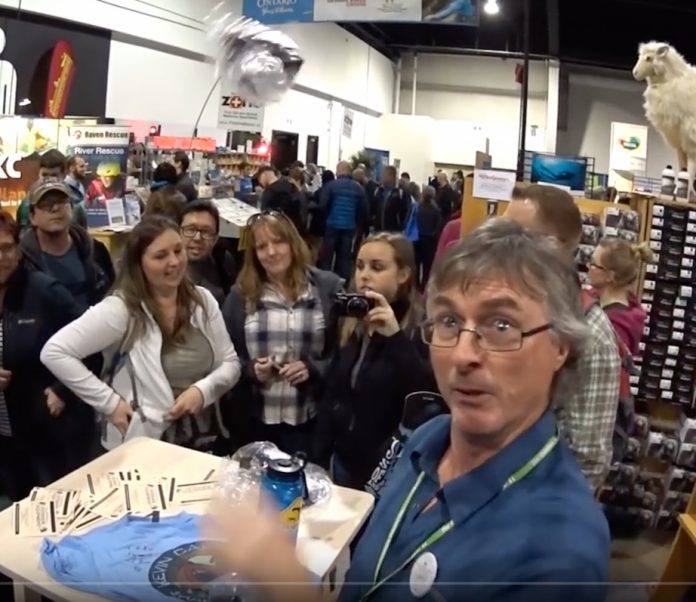
Kevin Callan throws hats at the Outdoor adventure show in Toronto Ontario for happy camper promotions

We could do a long, drawn out wrap up of our time at the Outdoor Adventure Show in Toronto last weekend, or we could let a wild Kevin Callan who parades around throwing hats sum it up for us. 

In this light hearted video, (we expect nothing less from the Happy Camper), Kevin Callan, visits vendors, spectators, fellow outdoorsmen and women to discuss some the latest happenings in the outdoors world. 

Expect to see representatives from Ontario Travel, Wild Rock Outfitters, KIHD Stoves, and some very happy representatives of winter camping.

Kevin’s seminars at the Adventure in Paddling Stage drew large crowds of engaging fans. We should know, we were there too. 


CCC PartnerBadge WebKevin Callan is a seasoned columnist here at Canoeroots Magazine, he is however, not a seasoned stove etcher. 

Watch THE CANOE, an award-winning film that tells the story of Canada’s connection to water and how paddling in Ontario is enriching the lives of those who paddle there. #PaddleON

Why Slow Change Is Good For Sea Kayaking

Same as it ever was. | PHOTO: ERIK BOOMER

Rene beams at his new kayak like a proud parent. We take turns hopping between his ride—this year’s hot new ocean play kayak—and my 18-year-old Nigel Dennis Kayak Explorer, which is older than one of the paddlers on our trip. Rene asks the predictable question: “So, when are you going to replace that thing?” No time soon, I tell him.

While whitewater kayaks undergo almost annual redesigns, careening into outlandish shapes—anyone remember the Perception Mr. Clean?—sea kayak hulls by comparison have evolved at a snail’s pace. A new Explorer’s hull is the same as my old one. Rene’s hot new ride isn’t that different from my Valley Avocet. The Avocet was released in 2000.

It’s tempting to chalk up the slow pace of change to the sport’s love of heritage, but I beg to differ. Design consistency is about the perfection of what sea kayaks do: navigate mixed conditions in a single voyage. They must do a decent job at everything: speeding over flats, managing wind, gear-hauling, rough-water stability and playfulness. This restricts how far design can go in any one direction. After all, just an 11-percent difference in waterline turns an 18-foot expedition boat into a 16-foot day-tourer. Designers have only tiny margins to play with: a little more rocker here, a tad less volume there.

This demand for versatility imposes what evolutionary biologist Stephen Jay Gould called the “right wall of evolution.” In stable parameters, the first set of big innovations provides major advantages. For sea kayaking, I’d say that was back in the ‘80s and ‘90s. After that, innovation comes in tiny increments with high costs in other functionality. Build up any one factor and you’ll have boats like the Valley Rapier or P&H Hammer: great at one thing—racing and surfing, respectively—but not so great in other waters. In competition, where a tiny advantage shaves off a fraction of a second, these advantages matter. However, for mixed conditions, design can only push the right wall so far.

Same as it ever was. | PHOTO: ERIK BOOMER

It’s actually a huge benefit to paddlers that kayak hulls remain so similar. We can’t help but become better.

Elena Moon, a professional user-experience designer, and expert fly fisher Amy Hazel nailed this in a recent TED Radio Hour talk. Fishing rods, like sea kayaks, have been unchanged for years—which Hazel loves. “When your tools don’t change, you have time to learn the soft stuff,” she says. “In fly-fishing it’s the study of insects, and the habitat of the fish. You don’t worry, ‘I can’t cast on this rod because it’s so different from the rod last year.’”

Moon chimed in: “You learn your craft at a higher level when you’re not spending a good portion of your energy re-learning your tools.” The same is true of kayaks. The infinite varieties of water, current, swell and wind are plenty to keep us occupied. We don’t need a new boat to figure out, too. Like sharks that evolved millions of years before dinosaurs, sea kayak designers figured out the steep part of the innovation curve long ago. Play around with a quarter inch of stern rocker if you want. I’m going paddling.

A regular contributor to Adventure Kayak, Neil Schulman writes, photographs and does conservation work in Portland, Oregon. 

Shit Kayakers Never Say

iStock
A kayaker sits in an eddy in an orange creek boat.

“I can’t wait to get a boyfriend/girlfriend/husband/wife who doesn’t understand my kayaking obsession.”

“I have so much money these days.”

“I’ll go with the small poutine instead of the large.”

“Duct tape can’t fix that.”

“Station wagons are so lame.”

“I never bother to boof.”

“I never get scared anymore on the river.”

“I’m so tired of having a mullet.”

“I can’t wait to get an office job.”

“These gaskets are just too flush.”

“There were so many girls at that kayaking party.”

“I never mess up the shuttle.”

“Gas prices are awesome right now!”

“I’m super organized and never leave my gear strewn on the ground like an explosion went off in my van.”

“Beer tastes so good from my booties.”

“I wish I could trade these Chacos for some sharp-looking penny loafers.”

“I’ve never struggled once putting on my skirt.”

“I’m not really into stouts.”