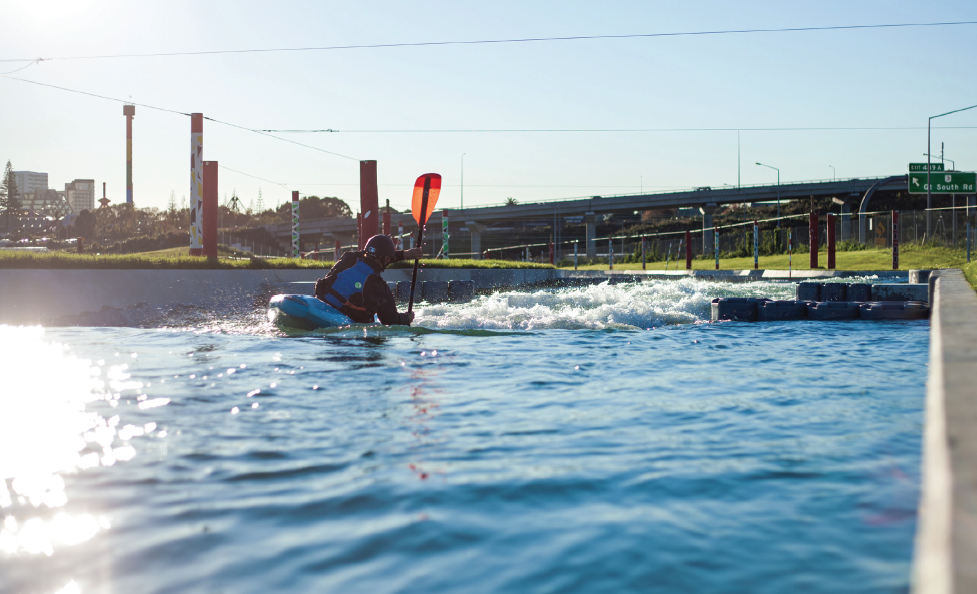
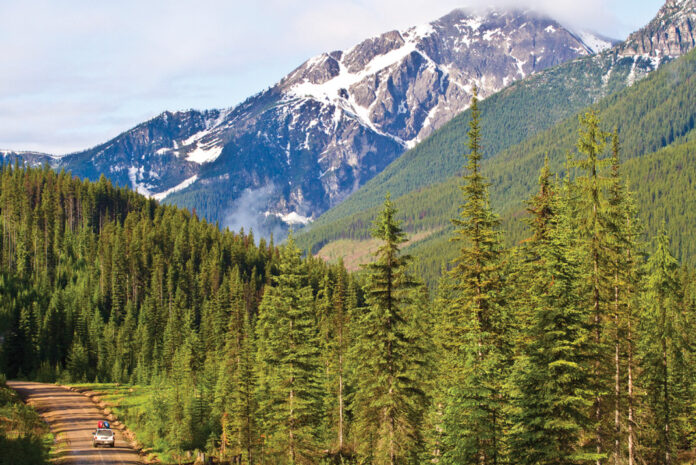
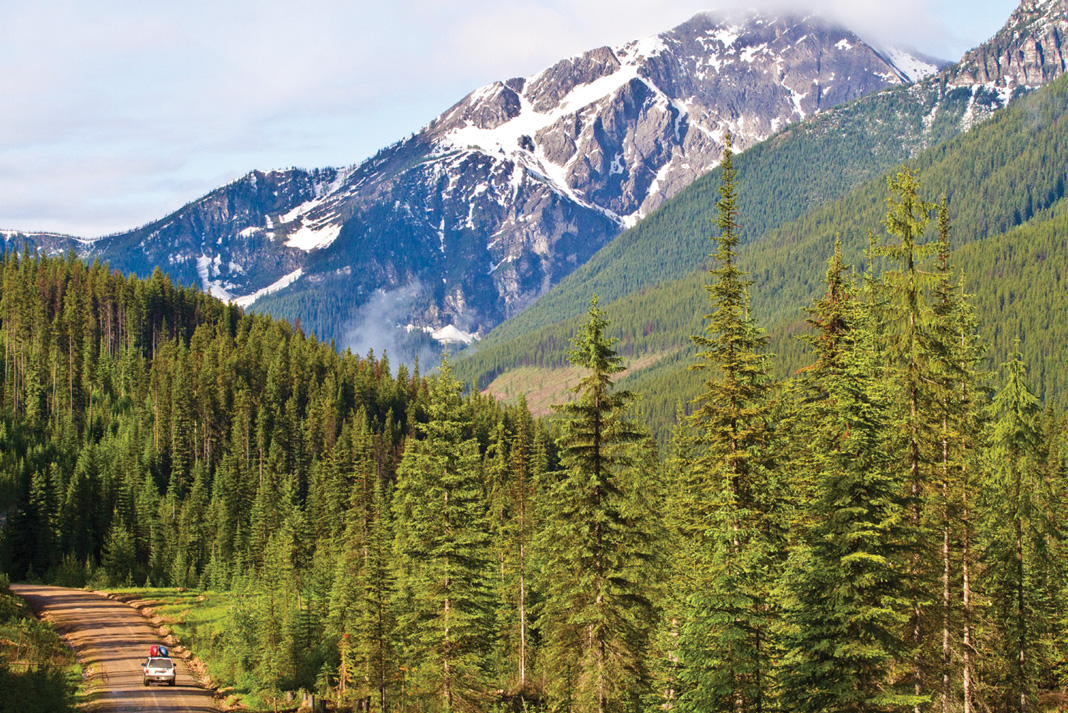
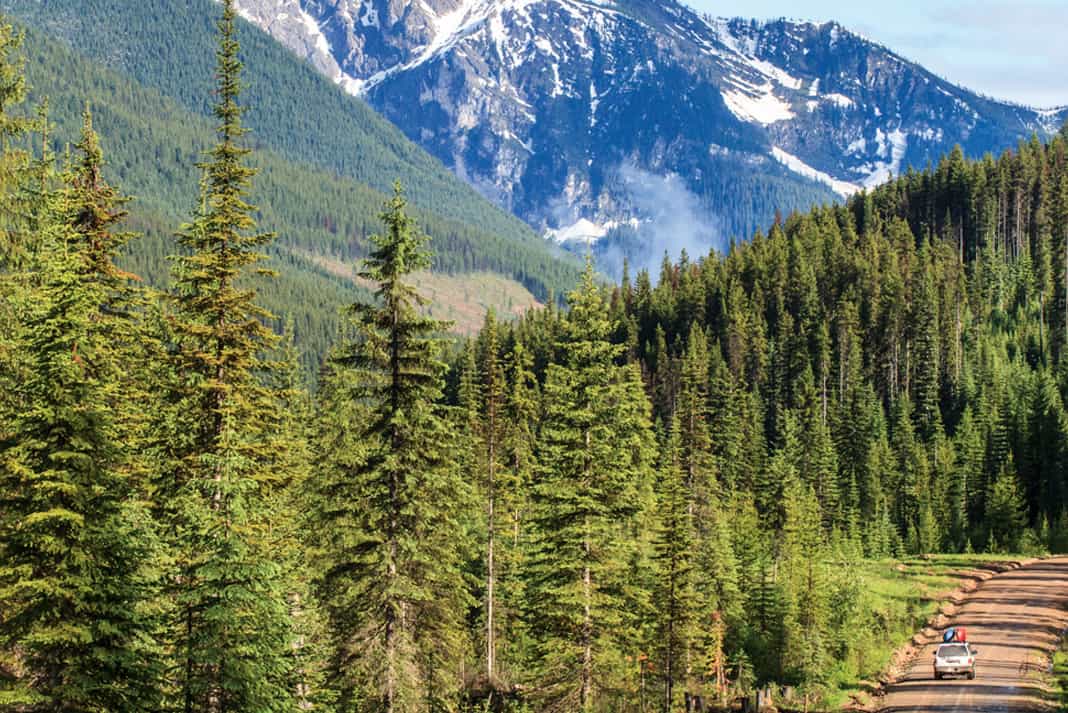
Google, please save me now. | Feature photo: Ryan Creary
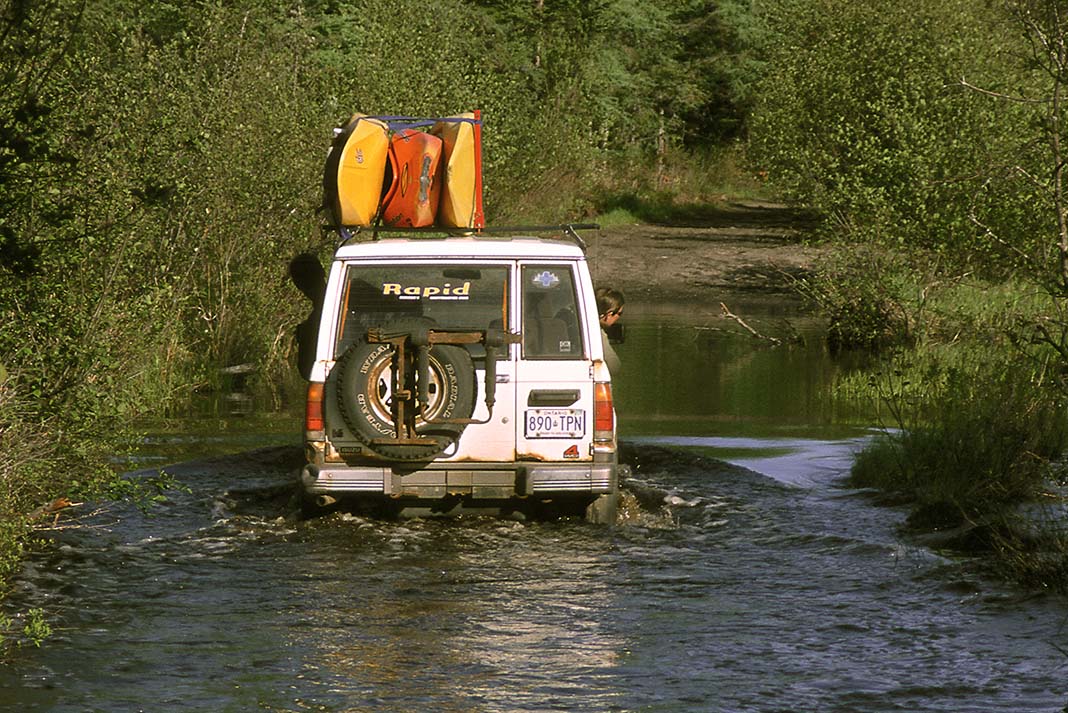
Dave glares at me. Chris rolls his eyes. My sprayskirt is at the take-out, Dave’s gear is piled on the ground and I just locked his keys and phone in his car. The three of us are instructors, but we can’t get our act together for a short run down the White Salmon River. At least no students are witnessing our incompetence at arranging this whitewater shuttle.
Navigating the tricky waters of a successful whitewater shuttle
Shuttles are my Achilles heel and I know I’m not alone. Keys get left in cars. Take-out vehicles have no straps. Gear gets lost. Adults squash into kids’ car seats. No amount of paddling experience or number of graduate degrees seems to help.
Even technology has hung us out to dry. For decades I simply hid a spare key on my car and tossed my keys in the trunk. But in the era of electronic smart keys, I’ve got an expensive gizmo that automatically unlocks my car if I do that. And if it gets wet I won’t be able to drive home.
Google, please save me now. | Feature photo: Ryan Creary
A test of patience, planning and people skills
Shuttles put human nature’s flaws on public display. Machiavellian freeloaders concoct plans that somehow always place themselves riverside and drinking beer while others drive (assuming the beer ended up in the correct vehicle). Inattentive paddlers plop soaking posteriors onto nice leather seats, or, conversely, OCD new car owners fret over each grain of sand in their trunk. Some people take an hour to change clothes. Others offend locals by stripping down in the parking lot. Every once in a while a Lord-of-the-Flies-type shocks us all and simply heads for home from the take-out.
Even exotic shuttles are fraught. Anyone who’s run Utah’s Stillwater Canyon knows that the only way out is a jetboat up the Colorado. Jetbacks beat driving, but it’s disconcerting to ascend a river in two hours that took a week to descend with the current. Bush-plane shuttles, a staple of the far north, require extra rations in case weather delays your flight out. One friend, eager to see his dear wife after a long solo trip in the Arctic, spent an entire week waiting for weather to clear.
[ Plan your next fly-in adventure with the Paddling Trip Guide ]
Truly the worst are the really long drives. Shuttles on Idaho’s Salmon River take 12 hours. It’s one thing to spend quality time on the river with someone. Being wedged next to them in a van, unshowered and inhaling the fragrance of their neoprene booties for the same amount of time it takes to fly to China is another thing entirely. Groups that act like Nobel Peace Prize winners through weeks of stressful whitewater can fall to bickering on long shuttles home.
For relief from the perpetual shuttle scourge, I look to Google. All this brouhaha will be rendered moot when our self-driving cars can drop us off at the put-in and drive themselves to the take-out. They’ll scan our retinas or recognize our voices and we won’t ever have to worry about lost or waterlogged keys. Heck, after the car automatically fires up the butt warmers and turns towards the Interstate, we can nap all the way home.
Neil Schulman lives in Portland, Oregon, where he’s impatiently awaiting the self-driving shuttle revolution.
This article was first published in the Summer/Fall 2016 issue of Rapid Magazine. Subscribe to Paddling Magazine’s print and digital editions, or browse the archives.
Google, please save me now. | Feature photo: Ryan Creary
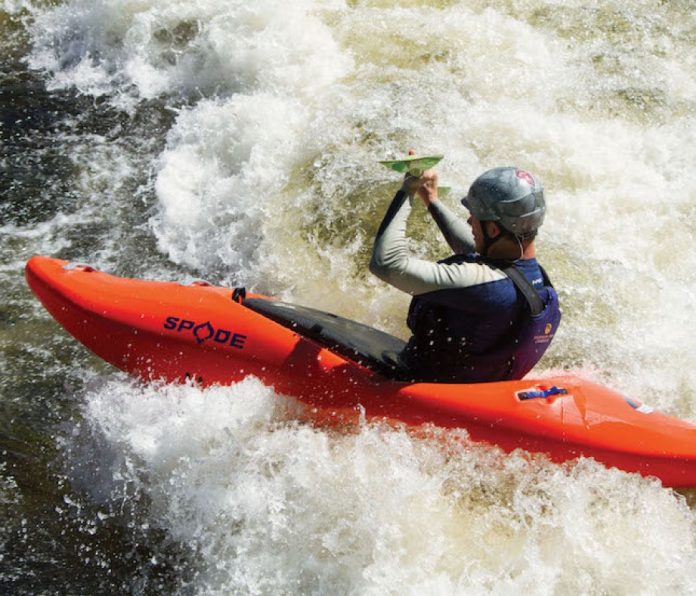
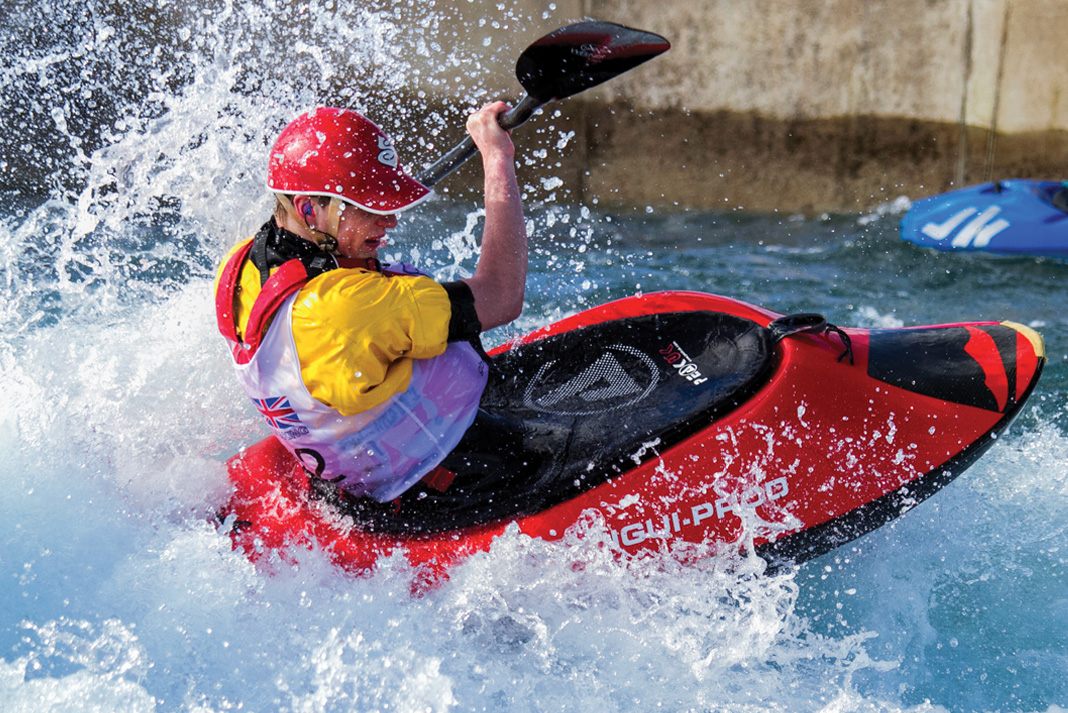
To call a spade a spade is to tell it like it is. Some people might be offended by this straight talk and consider you rude, but I usually like to lay all my cards on the table. So what is my initial assessment of the Ace of Spades from German start-up Spade Kayaks? If I were heading out on a class II or class V run in this boat I’d come back smiling.
The Ace is the first offering from Spade Kayaks, a small company made up of five paddlers turned entrepreneurs (read more about this well-known quintet on page 38). Currently the Ace is offered in only one size, though a smaller version is in the works, and with three different outfitting options—Basic, Whitewater and Pro.
I got my hands on the Pro version, which features a beefy middle rail to keep the hull rigid and a footrest that is extremely comfortable and takes up all the space in the bow to prevent any issues with a foot getting caught. The bow also contains the frontbone, an alternative to a foam front pillar, that makes the cockpit stiffer and gives you lots of room.
The seat is comfortable with easy-to-add Velcro foam shims on the hip pads and a rope and cleat system, similar to Jackson Kayak, to adjust the backband. The cleats face the paddler, meaning you pull the rope towards you to tighten it. I found I couldn’t get things as tight quite as easily as the Jackson system but I still like it more than most traditional ratcheting systems.
On the water, the Ace feels sleek and more compact than it looks. Its smooth rocker profile keeps the bow and stern up for quick spinning and clear of any boils and grabby eddylines when in bigger water. Putting it over on edge you can zip around the river and carve deep in and out of eddies with speed. Beginners will love that you don’t need to edge very far to get that responsiveness out of the Ace and that it has rock solid secondary stability. Even though I can carve with ease, the edges don’t feel grabby like some flat-bottomed play boats.
This gives me even more confidence in harder whitewater as well as those runs where I want to slide off, over and around lots of rocks. With all the design features that make this boat maneuverable and agile it does give up a bit of speed. While the Ace certainly isn’t a slow boat, I doubt it will be on top of the podium for many downriver races where longer, less rockered boats tend to dominate.
The Ace is manufactured using a blow molding technique. Spade claims that this makes for a lighter and stiffer hull that is more durable than the more common rotomolding techniques. It does feel very stiff. I didn’t piton into rocks to test durability.
The Ace is a boat that beginners will be able to grow with and take skills to the next level with confidence. The expert paddler who pushes class V will also love the quick and snappy ability to rip into eddies and work down a rock-choked creek. I hope Spade expands their lineup because they’ve certainly dealt a winner with this kayak— it’s one of the best all-round boats I’ve paddled in a while.
This article originally appeared in the Rapid Summer/Fall 2016 issue.
Subscribe to Paddling Magazine and get 25 years of digital magazine archives including our legacy titles: Rapid, Adventure Kayak and Canoeroots.
Driving across the heartland of America, you’d be hard pressed to notice the exit for Main Street, Charles City, Iowa. Nestled in the endless cornfields of the Midwest lies a quintessential small American town, just off the freeway. A grid work of streets supporting some 7,500 friendly residents runs parallel to Main, and trees form a sinuous green sheath along the Cedar River, which wanders through downtown.
Ten years ago, Charles City council identified 28 acres of flood mitigation property to rehabilitate along the riverfront. Architect Larry Kurtz suggested the usual options to improve urban green space—playgrounds, picnic areas and walking trails—but he also encouraged Charles City to consider the advice of his friends Steve Williver and Ty Graham, who happened to be pad- dlers. “I think they strong-armed Larry into adding a whitewater feature,” laughs Bob Kloberdanz, Charles City’s park board chair.
Welliver and Graham pointed to towns in Colorado, where whitewater parks frequently show up at the center of successful urban renewal projects. For all its cornfields and negligible topography, Iowa has a surprising surplus of water. In Charles City, a decrepit, seven-foot-high low-head dam on the Cedar River could be dismantled to provide enough gradient for waves and holes. “We had no idea about whitewater,” says Kloberdanz. “It was totally not on our radar.”
That quickly changed.
“There was a realization that [kayakers] were exactly the type of people we wanted to attract to our town,” adds Ginger Williams, Charles City’s tourism coordinator.
Today, Iowa is an unlikely whitewater oasis. Charles City completed its project in 2011, and the nearby towns of Manchester and Elkhader followed suit with parks of their own in 2014. Williams gets a kick out of gazing at the license plates of the vehicles that roll down Main Street with boats strapped to their roofs. Boaters come from all around the Midwest to paddle the Cedar River’s three engineered features. Admission is free, the Cedar flows year- round, and city lights on bridges enable 24-hour surfing. “People come from all over to paddle here,” says Williams. “It’s really put our town on the map.”
A half-century has passed since paddling enthusiasts worked with the U.S. Army Corps of Engineers to create a whitewater run in Kernville, California, and over 40 years since concrete channels were poured for the 1972 Summer Olympics in Augsburg, Germany. Best estimate is that there are perhaps 60 whitewater parks in the United States today. These range from Charles City’s $2.8 mil- lion remodeled riverfront to Oklahoma City’s brand new Riversport Rapids, a completely artificial, pumped water park that cost over $45 million to build. Proponents of engineered whitewater proclaim these facilities to be bastions of vibrant communities and inspiration for the next genera- tion of slalom and freestyle boaters. But are they truly worth the cost? Is there something wrong with turning the age-old river experience into a theme park?
Typical urban renewal projects focus on so- called “in-stream” projects, lower cost options that convert dull, dammed, dangerous and sometimes polluted waterways into whitewater playgrounds by adjusting the river’s slope and working with natural and engineered structures to create perfectly shaped waves, ledge drops and eddies.
An in-stream project with all the bells and whistles—several engineered waves and holes as well as a restaurant, water fountain, outdoor concert venue and multi-use trails—costs around $3 to $4 million, or about the same as a twin-pad ice arena.
This genre was popularized in Colorado, where kayaker and engineer Gary Lacy created BoulderCreek Park in his hometown of Boulder in 1990.
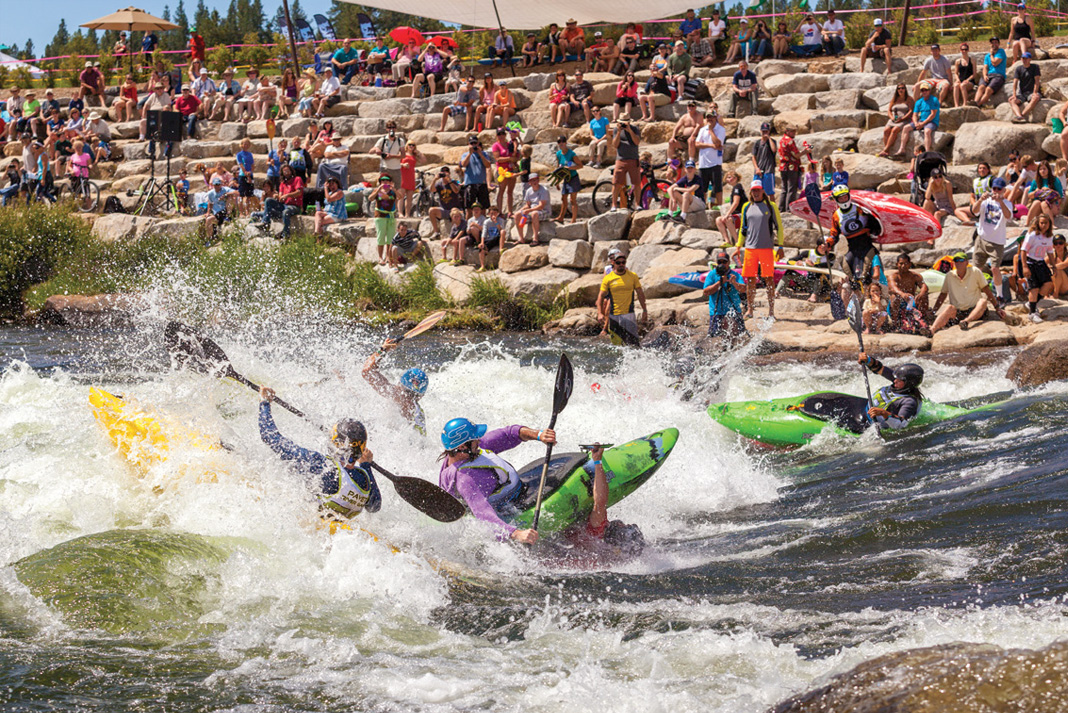
CARNAGE DURING THE PAYETTE RIVER GAMES AT KELLY’S WHITEWATER PARK. | Photo: Mike Leeds
The $165,000 Golden whitewater park, built by Lacy in 1996, was the nation’s first publicly funded project. Since then, Colorado has emerged as the global epicenter of in-stream whitewater parks, accounting for around half the total number in the United States; and Lacy’s Recreation Engineering and Planning has designed the lion’s share.
“He’s the godfather, there’s no question about that,” says Shane Sigle, a former competitive slalom boater and water resources engineer who first practiced his trade under Lacy. “A lot of the design technology that happened in the first 15 years of whitewater parks came from Gary.”
Sigle, whose Durango, Colorado-based Riverwise Engineering works closely with Lacy’s firm, explains there are three components to turning an existing river into a whitewater park: Slope, depth and water volume. He says that the best designers, like Lacy, have an innate sense of flowing water, gleaned from countless hours of paddling. “An engineering background is important,” says Sigle, “but I’d say 40 percent of getting it right is based on intuition.”
River restoration has been at the heart of some of the West’s most vibrant small communities, including Salida, Colorado, whose riverfront has gone through multiple phases of improvement, San Marcos, Texas, and Buena Vista, Colorado, where pro paddlers turned developers Jed Selby and Katie Urban created an idyllic neighborhood on the Arkansas River. A new whitewater park on the Deschutes River has the outdoor community buzzing in Bend, Oregon.
Testimonials to the economic potential of river parks are convincing. For instance, the Vail Whitewater Park on Gore Creek hosts freestyle and downriver events for the GoPro Mountain Games each June. The 2015 festival attracted over 60,000 spectators and contributed nearly $5 million to the local economy in one weekend alone. An economic study in Golden pegged the value of the town’s whitewater park at up to $2 million annually with 40,000 visitors; and Reno, Nevada’s reclaimed Truckee River generates up to $2.5 million in commercial rafting revenue per year.
Essentially, urban whitewater attractions on natural waterways are an extension of the long paddling tradition of negotiating deals with utility companies and scheduling events for water releases. The difference, says Sigle, is that properly engineered river upgrades offer better access, optimized conditions for freestyle and downriver boating, and greater safety.
Surf waves and slalom gates comprise only part of the typical whitewater park experience. Most include some combination of bike paths, play areas, fishing holes and outdoor concert venues and restaurants. In fact, a 2011 study revealed that a full 75 percent of visitors to whitewater parks don’t venture on the water. They come to introduce their children to nature, to get a dose of fresh air over lunch hour, or to simply enjoy the sight and sound of flowing water. That only 25 percent of users paddle isn’t a concern to Sigle.
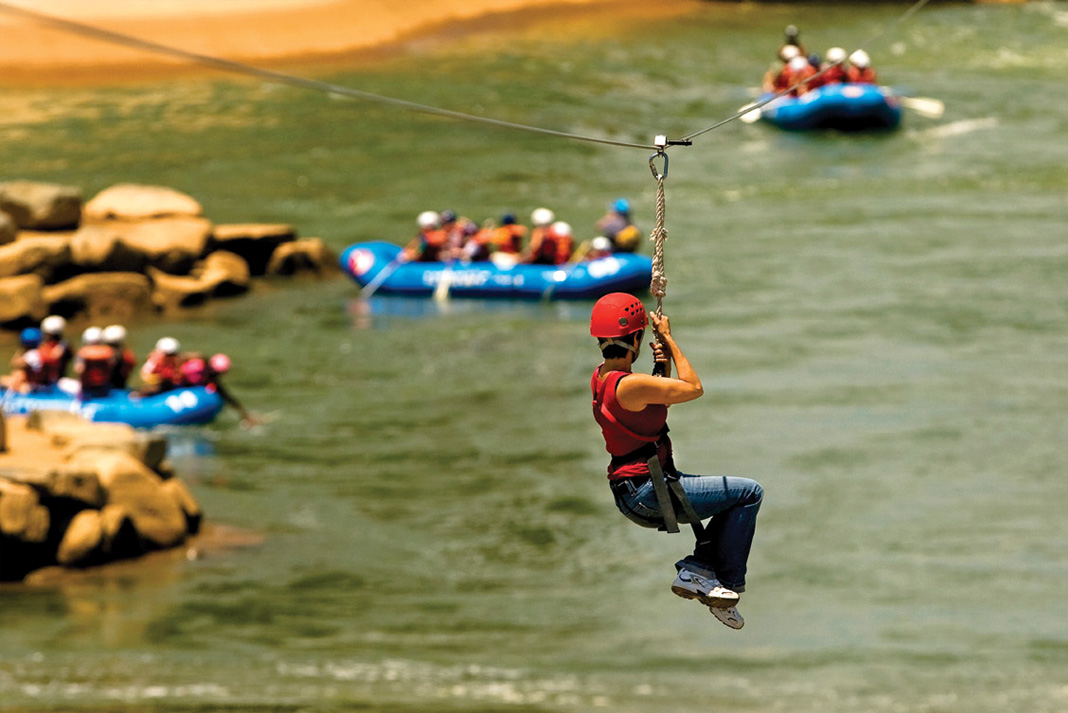
ZIPPING THROUGH THE U.S. NATIONAL WHITEWATER CENTER IN CHARLOTTE, NORTH CAROLINA. | PHOTO: PATRICK SCHNEIDER
“When I show up to talk about whitewater parks in small town Iowa,” says Sigle, who drew up the plans for both Charles City and Manchester, “there’s always a bunch of people in the audience ready to throw tomatoes at me. But the sell isn’t exclusively whitewater. It’s about providing a beautiful amenity downtown, with trails and places for people to sit and fish. In the end, we find that the people who at first opposed the project come back with the biggest cheers.”
Adjusting for inflation, the cost of whitewater parks has remained consistent over time. All things considered, artificial whitewater facilities like the new park in Oklahoma City and the U.S. National Whitewater Center in Charlotte, North Carolina, come with price tags 10 times larger than the most elaborate instream design.
For Scott Shipley, another former Olympic slalom paddler, engineer and Gary Lacy protégé, the greatest thrill in whitewater design is dreaming up a river from scratch. With eight full-time employees, Shipley’s Lyons, Colorado based S2O Design is the largest whitewater park firm in the world. After training under Lacy, Shipley’s first big project was designing the entirely artificial facility in Charlotte. His modular “Rapidblocs”—fully adjustable, engineered structures to create river features—were critical in the design of England’s Lee Valley White Water Centre, a venue for the 2012 London Olympic Games.
Shipley is a huge proponent of whitewater parks—especially big projects like Charlotte and Oklahoma City, his latest creation, which are marketed as adventure theme parks. Both use pumps to recirculate tap water through specially engineered channels of varying degrees of difficulty, with a conveyor belt eliminating the need to portage back to the top of the run.
“Charlotte makes $22 million per year,” notes Shipley. “There are so many activities”—including mountain biking, rock climbing and outdoor concerts—“that once people find it, they keep coming back. Revenues grow every year. That shows it’s become a destination.”
Glenwood Springs, Colorado-based consultant Bob Campbell, director of Whitewater Parks International and a former coach with the U.S. whitewater team, has applied the same large-scale, futuristic model in designing Olympic facilities. He stumbled into the industry nearly two decades ago, when he partnered with Aussie John Sultan to design an artificial whitewater course for the 2000 Sydney Games.
ONE WAY TO PUT YOURSELF ON THE MAP. | Photo: Lawrence Simpson
Just like any piece of Olympic infrastructure, Campbell says the challenge is to meet world-class standards, but also to ensure the venue will be appropriate for elite training, weekend warriors and families after the main event wraps up. It’s telling that the Sydney whitewater park is the only 2000 Olympic venue that steadily operates in the black.
“The big idea is that these large facilities can be used for recreational paddling,” says Campbell, whose firm was the lead designer at Lee Valley and recently completed the whitewater venue for the 2016 Summer Games in Rio.
Another Campbell brainchild is the Vector Wero Whitewater Park in Auckland, New Zealand, whose claim to fame is a 15-foot waterfall that’s commercially runnable in rafts.
In Sydney and London, “people can sign up for a rafting program without any whitewater experience,” adds Campbell. “How many different sports can you imagine where people can experience the same venue used by Olympians?
Even without the Olympics card, it’s an exciting, real, authentic kind of outdoor experience that’s accessible in an urban environment.”
Shipley cannot wait for the day he’s asked to build a whitewater park in a U.S. megalopolis like New York, Dallas or Miami. “Charlotte and OKC aren’t huge population bases,” he says, “but they show the potential. People are tired of rollercoasters.
They want to get active at home. With a whitewater park, you don’t have to go on a trip to the Rockies. You can have an adventure experience downtown.”
As the story goes, Michal Smolen was afraid of water when his family moved to Charlotte about a decade ago. After a few false starts, Smolen got hooked on kayaking at the U.S. National Whitewater Center. The rest of the story demonstrates the impact of whitewater parks: By the age of 16, Smolen was competing on the World Cup junior slalom circuit; in 2014 he was crowned the under-23 world champion; and now, heading into Rio, Smolen is America’s best shot at an Olympic medal in whitewater.
PHOTO: SETH ASHWORTH
According to Risa Shimoda, International Whitewater Hall of Famer and chair of USA Freestyle Kayaking, this is the greatest benefit of whitewater parks. They “soften the edge of what has otherwise suffered from whitewater porn,” says Shimoda, by bringing paddling to the masses. In Charlotte, home of U.S. whitewater paddling program, Shimoda says slalom athletes like Smolen have been recognized in the community for their achievements in the same way as mainstream basketball and football stars.
Meanwhile, competitive slalom and freestyle paddlers benefit from accessibility and predictably. It’s no surprise that most international competitions are hosted on engineered water. When the 2015 World Freestyle Championships were held on Canada’s Ottawa River, pundits predicted it would be the last time the event would be held on a natural feature. Mother Nature is just too unpredictable and incompatible with spectator events.
Instead of paddling two or three times per year when the conditions are right, recreational paddlers across the country can now paddle after work, practicing the same skills they can put to use when, say, the steep creeks in Colorado’s Front Range are running. “Paddlers used to be pioneers,” says Sigle.
“They were recluses, venturing into deep canyons in the middle of nowhere. Whitewater parks bring rivers to everyone’s front door. They’ve clearly made boating more accessible.”
The construction of a surfing wave on the Clark Fork River in Missoula, Montana, is yet another example of how whitewater can instill community spirit. “It’s a great vibe for the city,” says Doug Ammons, a Missoula native and veteran whitewater kayaker and author. “When there are 10 or 15 guys on the wave on a hot summer day, spectators line the bridge and the overlooks and the river becomes a centerpiece of fun.”
This article originally appeared in the Rapid Summer/Fall 2016 issue.
Subscribe to Paddling Magazine and get 25 years of digital magazine archives including our legacy titles: Rapid, Adventure Kayak and Canoeroots.
If dreaming up your own kayak design doesn’t sound like enough of a challenge, imagine also planning, engineering and building your own kayak manufacturing equipment; and then constructing a factory to put it in. And when that’s all done, producing boats, marketing them and running the entire business.
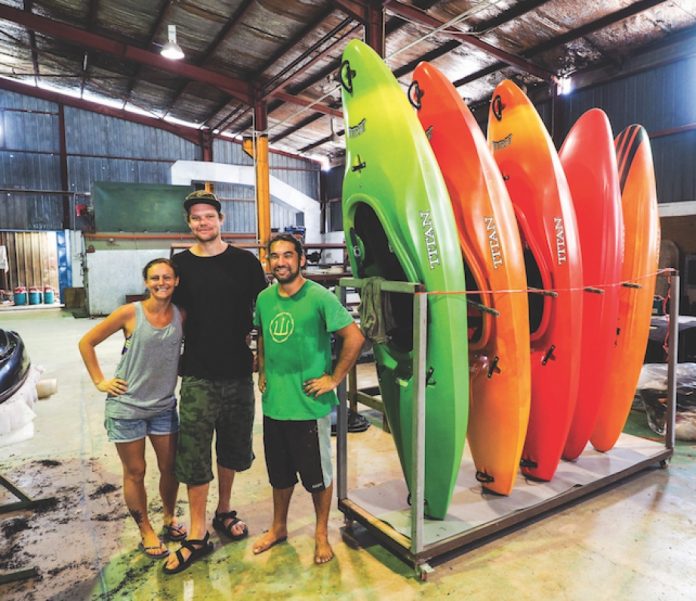
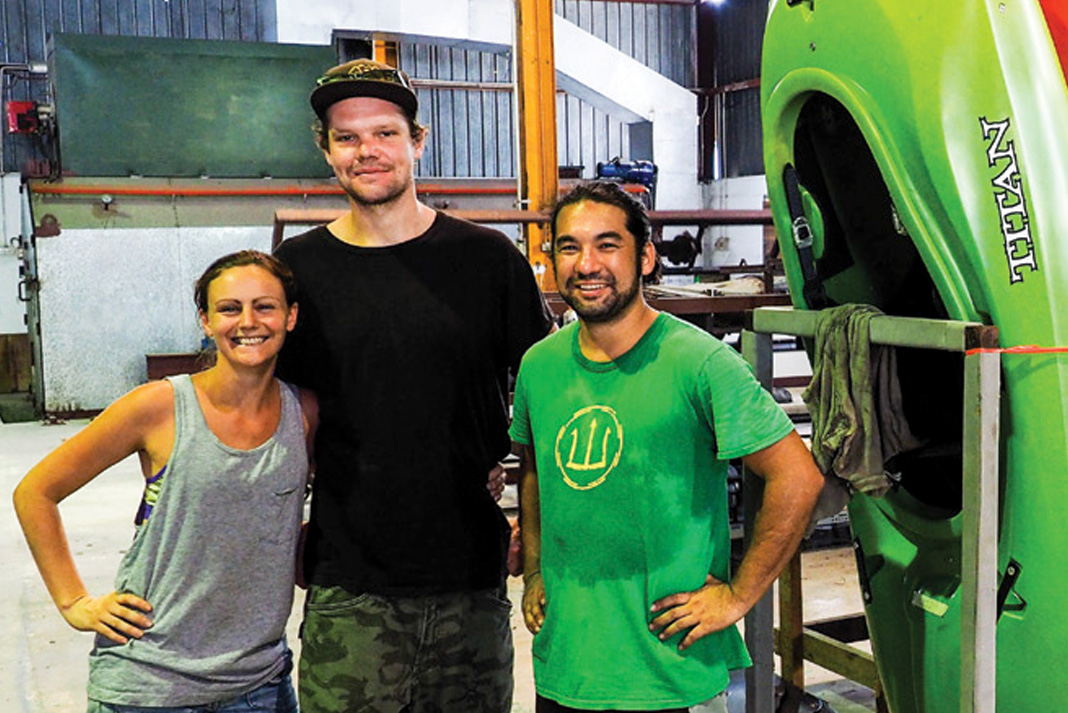
From high factory windows, tropical evening sunlight splashes across rows of candy-colored boats stacked neatly in racks. It’s after hours and the concrete floor of the Titan ‘Fantasy Factory’ is quiet; everyone has gone home except for owners Anthony Yap and Jackie Hennessy. In their office overlooking the factory, Jackie works on filling orders while Yap is in the research and design room—his favorite part of the building. Located on the edge of an industrial area in Kuala Lumpur, Malaysia, the Titan factory is only a 10-minute drive to the jungle, making the fantasy even more palpable.
{loadposition MidContent}
This international power couple are the brains and brawn behind the ever- growing Titan Kayaks. Hennessy, an Irish paddler, met Yap while he was competing at the Penrith Whitewater Stadium in Australia.
“We’ve worked 60- to 70-hour weeks for the past two years here in Malaysia setting up the factory,” says Hennessy. “Everything we have has gone into the company and it’s still just Anthony and I running the whole thing.” Yap’s name is usually the focus of attention and recognition when it comes to Titan because of his freestyle competition background, but he is quick to point the praises and credit toward his partner. “Jackie and I started it together,” he says, highlighting how the idea really came to fruition when they met.
With the new factory in action, Titan Kayaks are gaining momentum. “Our sales for the first three months in our new factory have doubled that of the last two years,” says Yap.
Titan sold their first boat in 2010, but Anthony began working on designs and prototypes years before that. The freestyle Genesis is by far their best seller, and can be found in outdoor stores around the world.
The company started production in Asia because Yap had family and connections in Malaysia. Titan Kayaks went from renting a small corner of another factory and third-party rotomolders to having their own custom-made equipment—including a new oven designed by Yap and created from scratch, specifically for making kayaks. Hennessy designed the layout of the factory with sections for modeling, assembly, packaging and storage. Together, they have developed the factory production line, trained their staff and even developed their own plastic. “We can finally have full control of quality and production times. Now, there’s nothing really stopping us,” she says.
Their next step is setting up a home base in Canada. “The dream is to have the Fantasy Factory in Malaysia that can build all the cool toys,” says Yap, “and have a design hub in Canada on the Ottawa.”
“The most satisfying moment of this work is seeing someone paddle into an eddy in your boat,” says Yap.
Yap and Hennessy can be seen on the factory floor in tank tops, shorts and sandals, going from admin to management and designer to laborer. Yap flies from one production stand to the next on his longboard. They may have a fancy new factory, but at its core, it’s still the same athlete-based company.
“We are kayakers making kayaks,” says Hennessy.
This article was originally published in Rapid, Volume 18 • Issue 3. Read this issue.
FROM A PASSION FOR PADDLING WORLD-CLASS WHITEWATER GREW THE DESIRE TO MAKE THE BEST DAMN BOATS POSSIBLE. ELEVEN WHITEWATER ENTREPRENEURS SHARE THEIR HOPES, DREAMS, FAILURES, AND WHAT IT’S LIKE TRYING TO MAKE IT AS AN INDEPENDENT KAYAK MANUFACTURER.
PHOTOS: LUIGI MAZZUCCHI
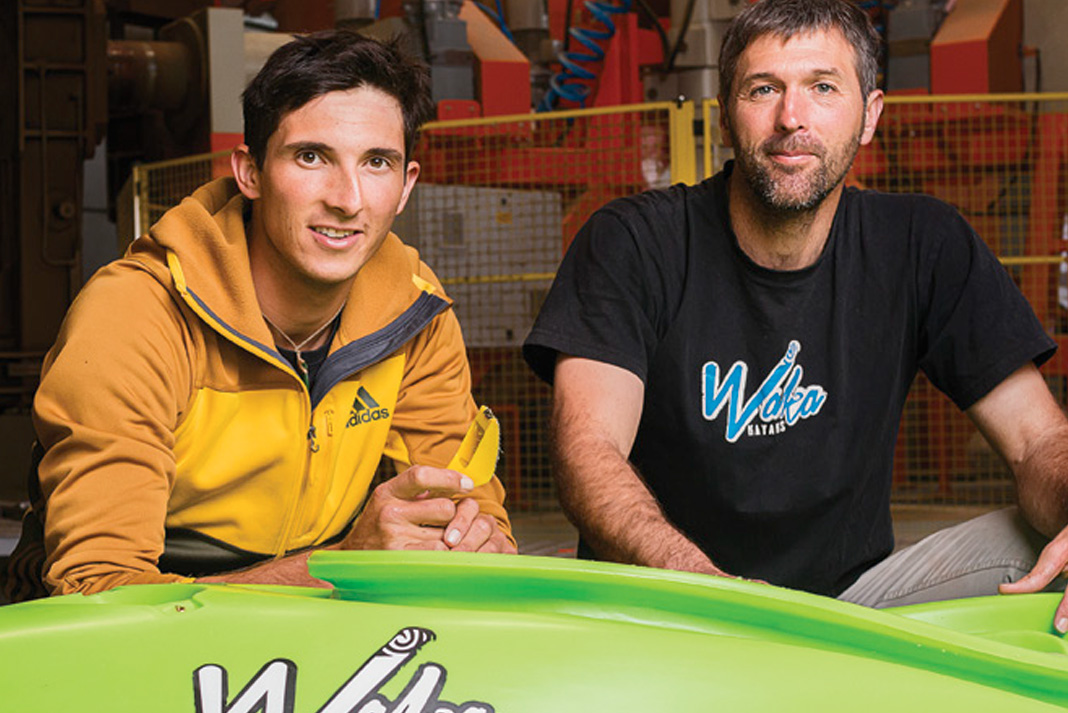
WAKA KAYAKS
SAM SUTTON AND KENNY MUTTON
THE SUN IS BARELY UP. Soft light touches the green water of the Kaituna River, making it sparkle. Giant fern trees, straight out of Jurassic Park, hang over the river as boat shaper Kenny Mutton and decorated freestyle athlete Sam Sutton slide from the riverbank into the water. Mutton and Sutton let whitewater take the sleep out of their eyes as they start their daily 6:30 a.m. lap of a river that is their backyard. If the roar of whitewater didn’t drown out their voices, a terrestrial bystander might know this isn’t just a leisurely paddle. It’s also a business meeting.
Good friends, good connections and good timing led to the creation of Waka Kayaks in 2013. Back then, Mutton and Sutton were discussing the idea of buying the Tuna mold from Bliss-Stick Kayaks and starting their own production.
“Both of us were a little out of money,” says Sutton. “I had enough to buy the mold, and Kenny paid for the set-up costs and airfreighting the mold. We both went in halves.” Mutton was the shaper of the original Bliss-Stick Tuna and Sutton helped with design and testing so it felt right that they were reunited with the design.
“Waka means canoe in Maori,” says Sutton. “We wanted to keep our Kiwi roots even though we weren’t going to manufacture the boats in New Zealand.”
Designed and tested on the warm water of the Kaituna, Waka’s rotomolded boats were manufactured for three years in the cold north of the Czech Republic. The two paddlers had contacts in the Czech making the start-up easier and knew it was close to their largest market, which meant saving money on shipping costs.
At that rural Czech factory, the building was camouflaged with no signs for Waka Kayaks out front. The houses butted up against each other along the street, giving way to a massive roller-style garage door that opened up into what used to be an old pig farm.
In May 2016, the factory moved to Italy, 40 kilometers south of Milan. “We had a bit of a supply issue at the old location when it came to production—the move has been an awesome step forward for Waka and its future,” says Sutton. “Plus, the food is really great in Italy.”
“We have only just figured out how much running a business costs, and it’s more in buying materials for full-scale production. Some things you need to buy three years supply,” says Sutton. “That makes a big impact on balancing cash and at the end of the day you are still unsure you will get a single dollar from the year.”
Using a third party for manufacturing means Mutton and Sutton have less control of production times and supply. The biggest challenge Waka has faced is keeping up with the demand of boats, says Sutton. “People knew who I was in Europe and Kenny was the man at shaping so it was easy to market the boat straight away,” he says.
When Sutton is paddling and racing around the world, it’s satisfying for him to turn up at a river and see a fleet of Wakas at the put-in. It’s even more rewarding when he hears that his boats help paddlers progress their ability. He talks about a 50-year-old Tutea paddler who fired up a run she’d only done once in her life. “She said it took her a grade above her previous ability,” says Sutton. “Giving her the chance to paddle harder whitewater again was cool.”
A handful of professional kayakers, including Aniol Serrasolses and Evan Garcia, have turned down money from other companies to paddle for Waka for free, says Sutton. “As soon as they tried it, they didn’t want to paddle anything else,” he adds. “We just want to make a boat that we love racing down in the morning and that makes you feel like a gangsta.” —Carmen Kuntz
FEATHERWEIGHT KAYAKS
BEN FRASER
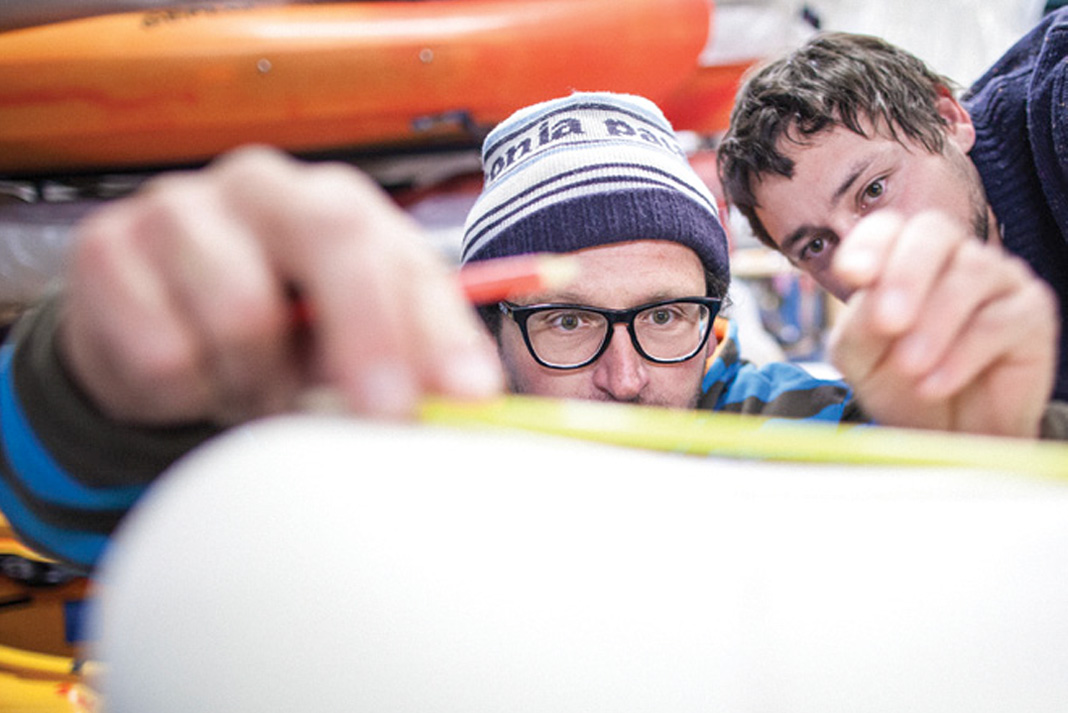
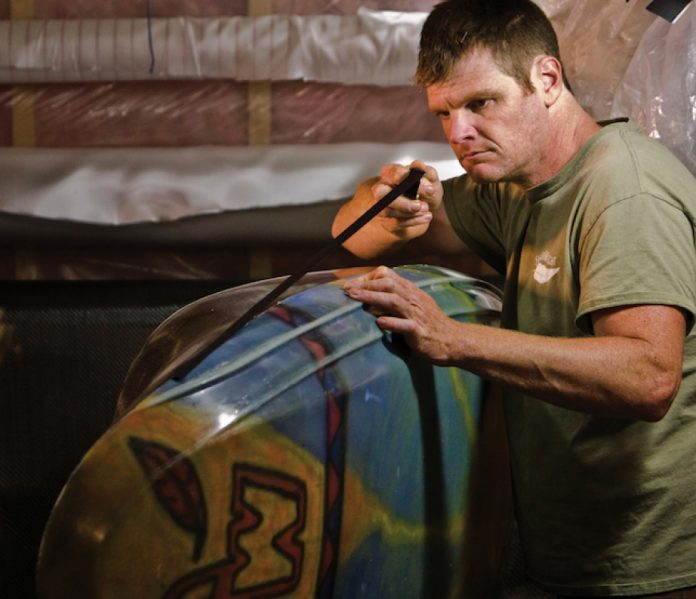
IF THE HAND-DRAWN, custom art decorating the bottom of the boat doesn’t give away a FeatherWeight kayak, the amount of air between the boat and the water will. The kayaks are designed, built and tested in the Ottawa Valley, where owner Ben Fraser often takes his lunch break at Buseater. When the bright blue Marlin on the bottom of his boat is visible, it means his session is going well.
FeatherWeight’s origin story is simple. “Basically, it’s just a couple dudes who love to kayak. We wanted our own boats to be the best they could be and people liked them. There was demand so we started making them,” says Fraser.
Ottawa Valley local and freestyle authority, Dave Nieuwenhuis, and Fraser worked side by side to combine the characteristics they liked from different boats. “I missed the edges from my O-Fish but loved the forgiving rides of the Superstar,” Fraser says. The two paddlers created a Frankenstein prototype that had the whole package. Nieuwenhuis is no longer a part of the handson production but is still the creative genius behind the brand’s hand-drawn artwork.
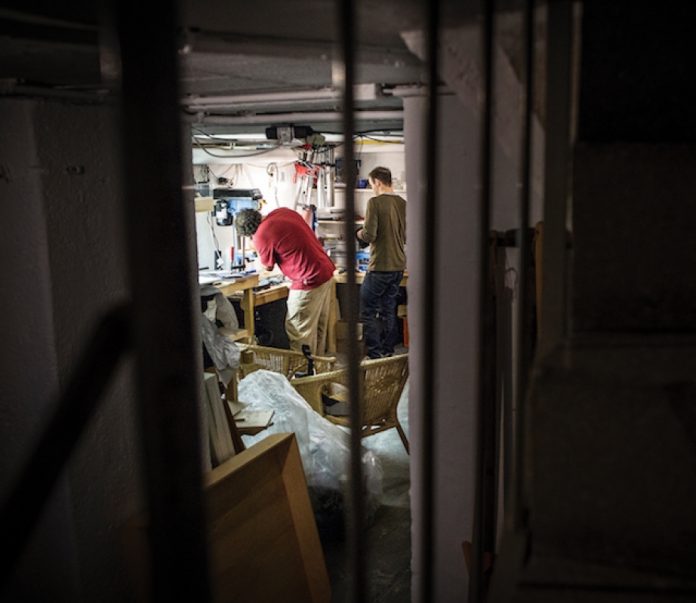
FeatherWeight boats currently come out of an unlikely location: a small, 10by 10-foot shop in an ordinary south Ottawa neighborhood. The long hallway leading into the workspace is lined with molds piled up along the wall. A single workstation occupies the center of the room and boats, molds and materials lean against the walls and sit stacked in corners. Past workshop locations have included garages and the Nieuwenhuis family barn near the Ottawa River, but this suburban shop is much warmer during Canadian winters.
Fraser has always been self-employed, so the transition from carpentry to boat builder was a fluid one. “It wasn’t so much a one-time investment as a cumulative investment and putting in lots and lots of time,” say Fraser, who now works fulltime on boats. Fraser takes home money for the labor of each kayak but admits it’s sometimes a struggle to finance large purchases like rolls of carbon fiber cloth.
“When I can afford to build another mold I do,” he says. “I’ve managed to feed myself and keep a roof over my head. It’s starting to feel quite successful.”
Despite FeatherWeight’s growing popularity, each boat is built with impeccable attention to detail. Six FeatherWeight boats were flying high on Garborator during the Freestyle World Championships in 2015.
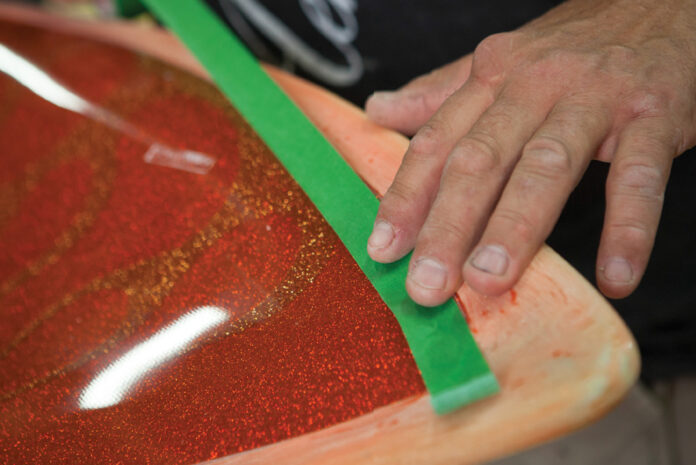
Materials and design are key to FeatherWeight performance. “I think both the construction—aerospace grade carbon with premium epoxy—as well as the design of the boat itself, sets us apart,” he says. “And, of course, the custom artwork.” A fully outfitted FeatherWeight goes for $3,200 CAD. Over the last year FeatherWeight has sold 30 boats.
Fraser compares paddling a carbon boat to riding a top-of-the-line mountain N bike. The all-round performance translates to a better experience. It’s easier to catch the wave, and easier to get a good bounce, which translates to easier airtime because you have a lighter boat over your head.
Positive feedback from paddlers fuels Fraser during those long days and
nights in the shop. He loves seeing others having great surfs and epic days on the water. “For me, the most rewarding part is seeing so many people having their best boating days ever.” —Carmen Kuntz
PHOTOS: JENS KLATT
SPADE KAYAKS
HANS MAYER, OLLI GRAU, MATZE BRUSTMANN, JAN HALUSZKA AND JENS KLATT
WHILE SPADE KAYAKS may be new to the game, the guys behind it are not. Together they have over a century of experience. The German and Austrian company was created from a lifelong passion and dedication to whitewater kayaking.
Founder and CEO Hans Mayer is a long-time innovator of the European kayak market; he worked with Prijon in the ‘90s, ran a kayak shop for over a decade and was a European distributor for Confluence. He always dreamed of owning a kayak company, so when he realized most kayaks weighed over 55 pounds and thought they satisfied profit margins more than paddlers, he decided something needed to be done.
The idea percolated for a while and in 2014 all those years in the industry paid off. Knowing all the right people, he was able to assemble his dream team: Matze Brustmann, renowned whitewater kayaker and extreme skier, came on board as a product tester. Jan Haluszka contributed his 3-D modeling skills. Jens Klatt became the company’s graphic designer and photographer. And the founder of Eskimo Kayaks, Edi Schnappinger, is advising.
Mayer knew that much of his kayak company’s success would come from its designer so he enlisted one of the best. Designer Olli Grau was a freestyle champion in 1995 and literally wrote the book on the sport, White Water Kayaking: The New School of Modern White Water Kayaking. He has worked with other boat manufacturers in the past, creating such classics as the Dagger RPM and the Necky Blunt. Grau’s focus is as much on ergonomics and weight optimization as it is on creating a boat that can handle the rigors of aggressive paddling.
To improve performance and reduce weight, Spade opted to use blow molding to manufacture their kayaks. According to Spade this creates a much denser and significantly stiffer hull while reducing the overall weight of the model by 10 percent when compared with a similarly sized rotomolded hull.
The only boat in Spade Kayaks’ lineup so far is the Ace, also known as the Ace of Spades (see our review on page 51). Grau and the rest of the Spade team created a sturdy cockpit featuring a direct interface between paddler and hull. The footrest, thigh braces, seat, hip pads and backrest are tailored to the ergonomics of a paddler. The design team consulted orthopaedists to ensure the seat directly connects the paddler to the boat in a way that isn’t tiring, cramped or forced.
“Everybody in the company is a paddler at heart,” confirms Jens Klatt—at the end of the day, they just want to make the best boats possible.
With no external investors, Spade Kayaks is entirely funded privately, which means this quintet can do whatever they like so long as they keep their customers happy. And so far so good—Spade has manufactured, and sold out, approximately 500 kayaks to date. For now, distribution remains primarily in Europe.
“Since our investment in the molds was so immense—blow molding is expensive!—all of us are working for free at the moment,” says Klatt. “That means we need other jobs to make a living. Therefore, the time we can spend in Spade is limited and it could be dangerous for us to grow too fast.”
So, what will the future bring for Spade?
“Good question,” says Klatt. “Slow growth with a close focus on quality is our motto at the moment. But we will keep on trying to reduce every gram we can without losing stiffness and safety features.” —Colin Field
PHOTO: HARRY GILS
ED SKRZYPKOWSKI
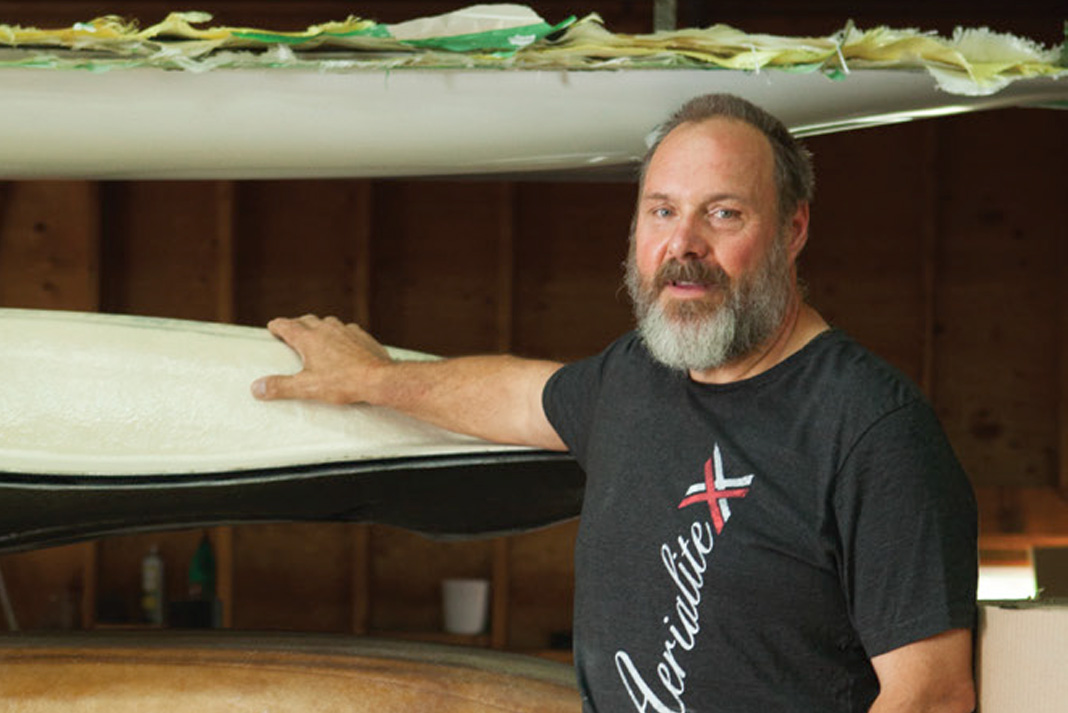
WHEN IT COMES TO squirt boats, surf kayaks and freestyle kayaks, you wouldn’t exactly call Binbrook, Ontario, the world epicenter of the sport. But just 27 minutes from steel-town Hamilton, resides Murky Water Kayaks; a place many of the world’s best paddlers look to when they need a custom boat.
Owner Ed Skrzypkowski is the shaper, builder, marketer and CEO of Murky Water and his passion for building boats was born of his passion for paddling them.
“We spent every weekend up on the Ottawa,” he says. “We did paddling trips down to West Virginia, Colorado, Idaho and you always wanted to design something of your own that you thought would be better. That’s how I got into building.”
He built his first boat about 30 years ago. “I bought an old slalom boat, cut it up, shortened it, flattened it, made a deck for it, and then it was my own personal design.” Skrzypkowski then spent five years working at Upstream Kayaks in nearby Guelph, Ontario.
“I kept playing around with my own boats, as Upstream Kayaks grew, but then I realized there’s no market in producing your own boats,” he recalls. “You’re better off having well-known designers and just building their boats. I also thought it would be better to be smaller and more customized.”
So he left Upstream Kayaks and incorporated Murky Waters in 1994.
“I got permission from Jim Snyder to build his squirt boat design. Then I had other designers like Ian Thompson; he came up with the Departure when he was competing for the Canadian team. We did a lot of work with Corran Addison too when he first started up with Riot.”
“More recently we were approached by Jackson to build their competition boats; the carbon fiber All Star and the Rock Star. We basically pay them a royalty for every boat we build.”
Today Skrzypkowski is still working with the same basic precepts. Producing 40 to 70 boats per year, he runs the operation with his wife on their own property. Murky Water offers a seemingly limitless range of boat construction and designs. You can customize size, shape, graphics and materials. He hand crafts boats in his 2,500-square-foot shop using carbon, polyester or Kevlar. He’ll work with you to beef up the areas that need beefing up, or lighten the lay-up where it’s appropriate. But the custom attention to detail doesn’t mean it’ll be the most expensive boat you’ll ever buy.
“My aim has always been to build the lightest and strongest boats, but also the most affordable,” he says. “I think to keep the sport going, you have to make sure the products are affordable.”
As for the future of Murky Water Kayaks?
“This is going to be a deciding year,” says Skrzypkowski. “I’ve had some issues with health the past couple of years and I realized we’re actually turning away work because I physically can’t keep working seven days a week. I’d like to see the business go into younger minds, younger hands, that can keep the products going. I’m always canvassing; wanna learn a new trade? Especially if you’re a kayaker. You have an advantage because you understand the forces these boats go through.”
As for Ed, he obviously doesn’t get enough time on the water anymore, but he hopes to change that. “I haven’t kayaked seriously for about 15 years,” he says. “I got into building because I love kayaking. Before I do the ultimate mystery move into the ground, I’d like to get a few more years in the kayak and run a few rivers again.” —Colin Field
PHOTO: HAMISH IAN MACKELLAR
TITAN KAYAKS
ANTHONY YAP AND JACKIE HENNESSY
IF DREAMING up your own kayak design doesn’t sound like enough of a challenge, imagine also planning, engineering and building your own kayak manufacturing equipment; and then constructing a factory to put it in. And when that’s all done, producing boats, marketing them and running the entire business.
From high factory windows, tropical evening sunlight splashes across rows of candy-colored boats stacked neatly in racks. It’s after hours and the concrete floor of the Titan ‘Fantasy Factory’ is quiet; everyone has gone home except for owners Anthony Yap and Jackie Hennessy. In their office overlooking the factory, Jackie works on filling orders while Yap is in the research and design room—his favorite part of the building. Located on the edge of an industrial area in Kuala Lumpur, Malaysia, the Titan factory is only a 10-minute drive to the jungle, making the fantasy even more palpable.
This international power couple are the brains and brawn behind the evergrowing Titan Kayaks. Hennessy, an Irish paddler, met Yap while he was competing at the Penrith Whitewater Stadium in Australia.
“We’ve worked 60to 70-hour weeks for the past two years here in Malaysia setting up the factory,” says Hennessy. “Everything we have has gone into the company and it’s still just Anthony and I running the whole thing.” Yap’s name is usually the focus of attention and recognition when it comes to Titan because of his freestyle competition background, but he is quick to point the praises and credit toward his partner. “Jackie and I started it together,” he says, highlighting how the idea really came to fruition when they met.
With the new factory in action, Titan Kayaks are gaining momentum. “Our sales for the first three months in our new factory have doubled that of the last two years,” says Yap.
Titan sold their first boat in 2010, but Anthony began working on designs and prototypes years before that. The freestyle Genesis is by far their best seller, and can be found in outdoor stores around the world.
The company started production in Asia because Yap had family and connections in Malaysia. Titan Kayaks went from renting a small corner of another factory and third-party rotomolders to having their own custom-made equipment—including a new oven designed by Yap and created from scratch, specifically for making kayaks.
Hennessy designed the layout of the factory with sections for modeling, assembly, packaging and storage. Together, they have developed the factory production line, trained their staff and even developed their own plastic. “We can finally have full control of quality and production times. Now, there’s nothing really stopping us,” she says.
Their next step is setting up a home base in Canada. “The dream is to have the Fantasy Factory in Malaysia that can build all the cool toys,” says Yap, “and have a design hub in Canada on the Ottawa.”
“The most satisfying moment of this work is seeing someone paddle into an eddy in your boat,” says Yap.
Yap and Hennessy can be seen on the factory floor in tank tops, shorts and sandals, going from admin to management and designer to laborer. Yap flies from one production stand to the next on his longboard. They may have a fancy new factory, but at its core, it’s still the same athlete-based company. “We are kayakers making kayaks,” says Hennessy. —Carmen Kuntz
This article originally appeared in the Rapid Summer/Fall 2016 issue.
Subscribe to Paddling Magazine and get 25 years of digital magazine archives including our legacy titles: Rapid, Adventure Kayak and Canoeroots.
While Spade Kayaks may be new to the game, the guys behind it are not. Together they have over a century of experience. The German and Austrian company was created from a lifelong passion and dedication to whitewater kayaking.
Founder and CEO Hans Mayer is a long-time innovator of the European kayak market; he worked with Prijon in the ‘90s, ran a kayak shop for over a decade and was a European distributor for Confluence. He always dreamed of owning a kayak company, so when he realized most kayaks weighed over 55 pounds and thought they satisfied profit margins more than paddlers, he decided something needed to be done.
The idea percolated for a while and in 2014 all those years in the industry paid off. Knowing all the right people, he was able to assemble his dream team: Matze Brustmann, renowned whitewater kayaker and extreme skier, came on board as a product tester. Jan Haluszka contributed his 3-D modeling skills. Jens Klatt became the company’s graphic designer and photographer. And the founder of Eskimo Kayaks, Edi Schnappinger, is advising.
Mayer knew that much of his kayak company’s success would come from its de- signer so he enlisted one of the best. Designer Olli Grau was a freestyle champion in 1995 and literally wrote the book on the sport, White Water Kayaking: The New School of Modern White Water Kayaking. He has worked with other boat manufac- turers in the past, creating such classics as the Dagger RPM and the Necky Blunt. Grau’s focus is as much on ergonomics and weight optimization as it is on creat- ing a boat that can handle the rigors of aggressive paddling.
{loadposition MidContent}
To improve performance and reduce weight, Spade opted to use blow molding to manufacture their kayaks. According to Spade this creates a much denser and significantly stiffer hull while reducing the overall weight of the model by 10 per- cent when compared with a similarly sized rotomolded hull.
The only boat in Spade Kayaks’ lineup so far is the Ace, also known as the Ace of Spades (Rapid’s review here). Grau and the rest of the Spade team createda sturdy cockpit featuring a direct interface between paddler and hull. The footrest, thigh braces, seat, hip pads and backrest are tailored to the ergonomics of a paddler. The design team consulted orthopaedists to ensure the seat directly connects the paddler to the boat in a way that isn’t tiring, cramped or forced.
“Everybody in the company is a paddler at heart,” confirms Jens Klatt—at the end of the day, they just want to make the best boats possible.
With no external investors, Spade Kayaks is entirely funded privately, which means this quintet can do whatever they like so long as they keep their customers happy. And so far so good—Spade has manufactured, and sold out, approximately 500 kayaks to date. For now, distribution remains primarily in Europe.
“Since our investment in the molds was so immense—blow molding is expensive!—all of us are working for free at the moment,” says Klatt. “That means we need other jobs to make a living. Therefore, the time we can spend in Spade is limited and it could be dangerous for us to grow too fast.”
So, what will the future bring for Spade?
“Good question,” says Klatt. “Slow growth with a close focus on quality is our motto at the moment. But we will keep on trying to reduce every gram we can without losing stiffness and safety features.”
This article was originally published in Rapid, Volume 18 • Issue 3. Read this issue.
FeatherWeight Kayaks' Ben Fraser working on a boat
If the hand-drawn, custom art decorating the bottom of the boat doesn’t give away a FeatherWeight kayak, the amount of air between the boat and the water will. The kayaks are designed, built and tested in the Ottawa Valley, where owner Ben Fraser often takes his lunch break at Buseater. When the bright blue Marlin on the bottom of his boat is visible, it means his session is going well.
FeatherWeight’s origin story is simple. “Basically, it’s just a couple dudes who love to kayak. We wanted our own boats to be the best they could be and people liked them. There was demand so we started making them,” says Fraser.
Ottawa Valley local and freestyle authority, Dave Nieuwenhuis, and Fraser worked side by side to combine the characteristics they liked from different boats. “I missed the edges from my O-Fish but loved the forgiving rides of the Superstar,” Fraser says. The two paddlers created a Frankenstein prototype that had the whole package. Nieuwenhuis is no longer a part of the hands- on production but is still the creative genius behind the brand’s hand-drawn artwork.
{loadposition MidContent}
FeatherWeight boats currently come out of an unlikely location: a small, 10-by-10-foot shop in an ordinary south Ottawa neighborhood. The long hallway leading into the workspace is lined with molds piled up along the wall. A single workstation occupies the center of the room and boats, molds and materials lean against the walls and sit stacked in corners. Past workshop locations have included garages and the Nieuwenhuis family barn near the Ottawa River, but this suburban shop is much is much warmer during Canadian winters.
Fraser has always been self-employed, so the transition from carpentry to boat builder was a fluid one. “It wasn’t so much a one-time investment as a cumulative investment and putting in lots and lots of time,” say Fraser, who now works fulltime on boats. Fraser takes home money for the labor of each kayak but admits it’s sometimes a struggle to finance large purchases like rolls of carbon fiber cloth.
“When I can afford to build another mold I do,” he says. “I’ve managed to feed myself and keep a roof over my head. It’s starting to feel quite successful.”
Despite FeatherWeight’s growing popularity, each boat is built with impeccable attention to detail. Six FeatherWeight boats were flying high on Garborator during the Freestyle World Championships in 2015. Materials and design are key to FeatherWeight performance. “I think both the construction—aerospace grade carbon with premium epoxy—as well as the design of the boat itself, sets us apart,” he says. “And, of course, the custom artwork.” A fully outfitted FeatherWeight goes for $3,200 CAD.
Over the last year FeatherWeight has sold 30 boats. Fraser compares paddling a carbon boat to riding a top-of-the-line mountain bike. The all-round performance translates to a better experience. It’s easier to catch the wave, and easier to get a good bounce, which translates to easier airtime because you have a lighter boat over your head.
Positive feedback from paddlers fuels Fraser during those long days and nights in the shop. He loves seeing others having great surfs and epic days on the water. “For me, the most rewarding part is seeing so many people having their best boating days ever.”
This article was originally published in Rapid, Volume 18 • Issue 3. Read this issue.
I’ve spent a solid quarter of my life teaching kayak school—the kindergarten of whitewater. Just like grade school kindergarten, there is a Zen quality to immersing oneself in the very basics of anything. A seemingly complex and dynamic activity like navigating a little boat down a moving river can really be boiled down to just a few key elements. These elements become the rules of whitewater paddling, and may also become the rules by which to live one’s life. I propose that all you really need to know about life you already learned in kayak school:
Everyone feels awkward putting on a skirt for the first time.
Wet exits are good for you. Practice makes perfect.
No, these boats are not supposed to go straight.
Say you’re sorry when you bump into somebody.
The butterflies you feel before you get in your boat will never go away.
You will grow to appreciate them.
Always make sure your spray skirt tab is out.
Water shouldn’t be forced up your nose.
Your head always comes up last.
Swimming is a part of paddling. So is walking. Smart people know this.
Even though all whitewater boats look the same, some people will argue for hours about their subtle different qualities. Stay away from these people.
When in doubt, scout.
Throw rescue ropes to friends in need. Don’t let go.
Thanks to the late, great William Nealy, scouting and spitting will forever be related.
Look where you want to go.
Always pack a healthy lunch. Stay hydrated.
Always have a plan.
Always have a backup plan.
Don’t overthink it. But don’t under-think it either.
Going with the flow is all hippie and cool, but at some point you have to take control and impose your will upon your direction (Newton’s First Law).
When you are unsure of what to do, lean forward and paddle (Newton’s Second Law… sort of).
For every action, there is an equal and opposite reaction (Newton’s Third Law).
Rely on yourself. Be there for others.
Point positive.
Eddies are the calm spots, but at some point you have to get back into the current.
You get to decide for yourself the meaning of success.
We are all between swims.
Take care of rivers—these things are special.
Enjoy the ride.
Always take a minute to look back upstream to appreciate what you’ve accomplished.
This article originally appeared in the Rapid Summer/Fall 2016 issue.
Subscribe to Paddling Magazine and get 25 years of digital magazine archives including our legacy titles: Rapid, Adventure Kayak and Canoeroots.
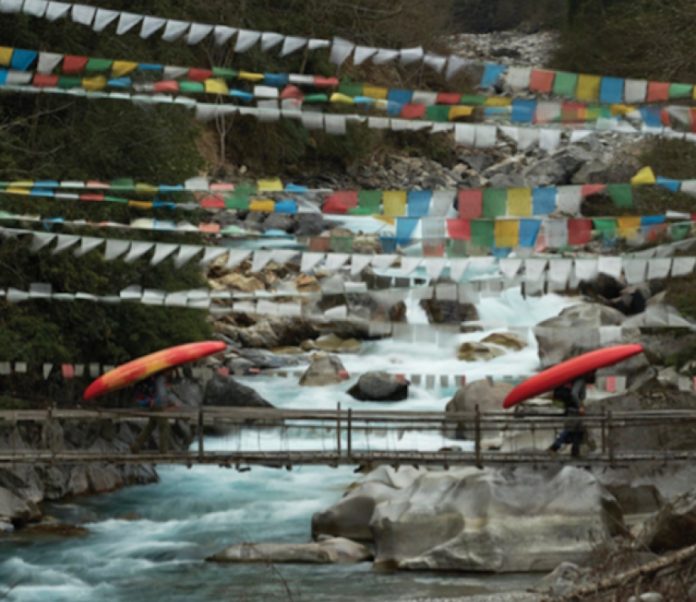
Ben Stookesberry's walks along a bridge over a whitewater river under flags in Myanmar.
A first descent, source to sea on a river considered one of the cradles of civilization. Paddling the raging headwaters of Myanmar’s Irawaddy River down to its coastal flats was to be a different sort of journey of a lifetime for whitewater dream team Ben Stookesberry and Chris Korbulic. Instead, Stookesberry’s trip report on the failed expedition is a meditation on the extreme challenges that sunk the trip. After frustrating delays and a 10-day portage, the twosome finally put their boats on water three weeks into their month-long journey. Just 200 miles later, they were forced to pull off the river or risk being shot. While formulating a Plan B, their boats went missing. Frustrated yet undeterred, the duo known for their successful descents of unrunnable whitewater bought a local, leaky canoe. With just 75 miles behind them they were then stopped by secret police and detained for a week. So, what went wrong?
When did things start to go awry?
As soon as we got to Yagong in Myanmar our idealized plan started to unravel. The domestic flight was not going to put our boats on the plane. The country’s mentality is very strict. We paid $3,000 and had to wait a week for our boats to be transported to us. Tourist permits are very controlled and our time was running out.
What attracted you to the Irrawaddy?
It’s so remote. There’s world-class whitewater, but also this sense of a journey, traversing so many different climates and cultures, alpine to tropics. This is one of the last undammed, truly free-flowing rivers in Asia. Knowing that the government is actively pursuing large-scale dams, this was an opportunity to see it before it’s changed forever.
What firsts did you experience on the trip?
We wanted to explore more than just the so- called class VI sections of a river and I think that’ll remain part of our motivation in the future. It was the longest hike with a kayak we’ve ever done. Eighty-five miles to the put-in carrying well over 130 pounds each. It was a 10-day hike with supplies for a full month up a 4,000-foot pass. It was miserable.
How does this compare to other trips?
The difficulty with logistics was unprecedented. We knew that Myanmar has the longest running civil conflict and a military beholden to none, financed by the jade and heroin trade. The logistics didn’t seem to us to be too big of a step from boating in other places with their own unpleasant situations but this became the crux. It ended our trip.
Who killed the Mission?
After our kayaks disappeared [and Plan B with them] we bought a local boat. Covered in sun gear, we felt invisible in our 16-foot leaky canoe. For 24 hours and 75 miles it was like a boyhood dream. Then a big boat rammed us. It was military, immigration and special police. They said we didn’t have proper permits and we were put under hotel arrest.
What happens next?
This trip might have only been the first chapter. The best expeditions don’t necessarily happen right off the bat. It’s a special place. I could see world class kayaking and eco tourism creating an economy that would stand opposed to a dam or diverting the river. But for us to go back the political situation will need to change.
This article originally appeared in the Rapid Summer/Fall 2016 issue.
Subscribe to Paddling Magazine and get 25 years of digital magazine archives including our legacy titles: Rapid, Adventure Kayak and Canoeroots.
MALCOLM MACGREGOR,
1943-2016. | PHOTO: SCOTT MACGREGOR
The most common way youth are introduced to whitewater is by their families, usually their parents. Which makes sense, right? Mom and Dad love rivers and they wish to share that passion with their children. It seems only natural. Obvious. Indisputable.
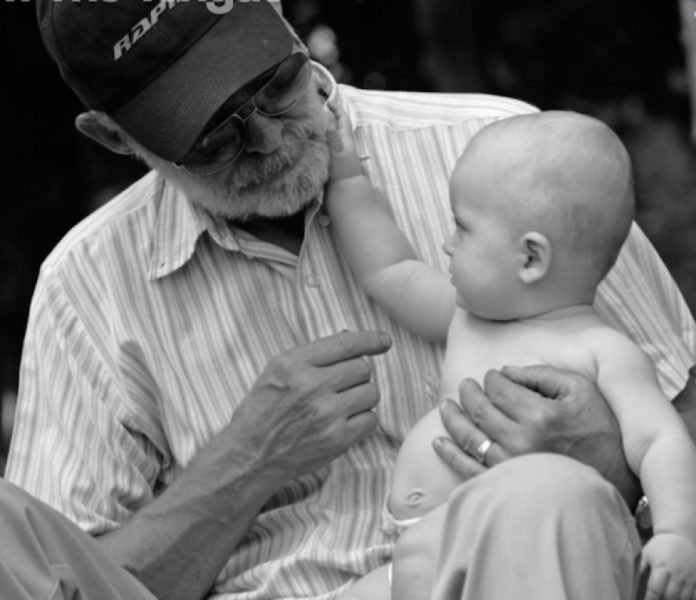
Malcolm MacGregor didn’t paddle. He didn’t even swim. I don’t remember my dad ever sleeping in a tent. Instead, as a boy he was drawn to the bush with a .22-caliber lever-action Remington and a beagle named Suzie. In high school my dad won blue ribbons show jumping horses. He later rode the rails moving boxcars of cattle from Canada to Mexico. Around the time I was born he was breeding state champion bluetick coonhound hunting dogs. When a car accident in the late ‘70s left his leg a mess and his ankle fused solid, his buddies got him into bow hunting. Dad bounced his ATV close enough to the deer stand so he could crutch the rest of the way to the tree. He was not a paddler but he had the adventurous stubborn spirit of a voyageur.
During the proofing of this issue of Rapid my dad had a stroke. The week I’m usually a world away from him in my riverside office correcting spelling and writing pithy cover lines, I spent in the Hamilton General Hospital at his bedside watching his body slowly shut itself down.
On the monitors above, my dad’s heart rate trickled across the screens like standing waves in a slowly dying river. The crests and valleys became more shallow and closer together until finally their energies cancelled out for the last time. The river lay flat and motionless. I doubt my dad had any regrets. He was too pragmatic. As far as I know he’d never taken the time to think about things he couldn’t fix.
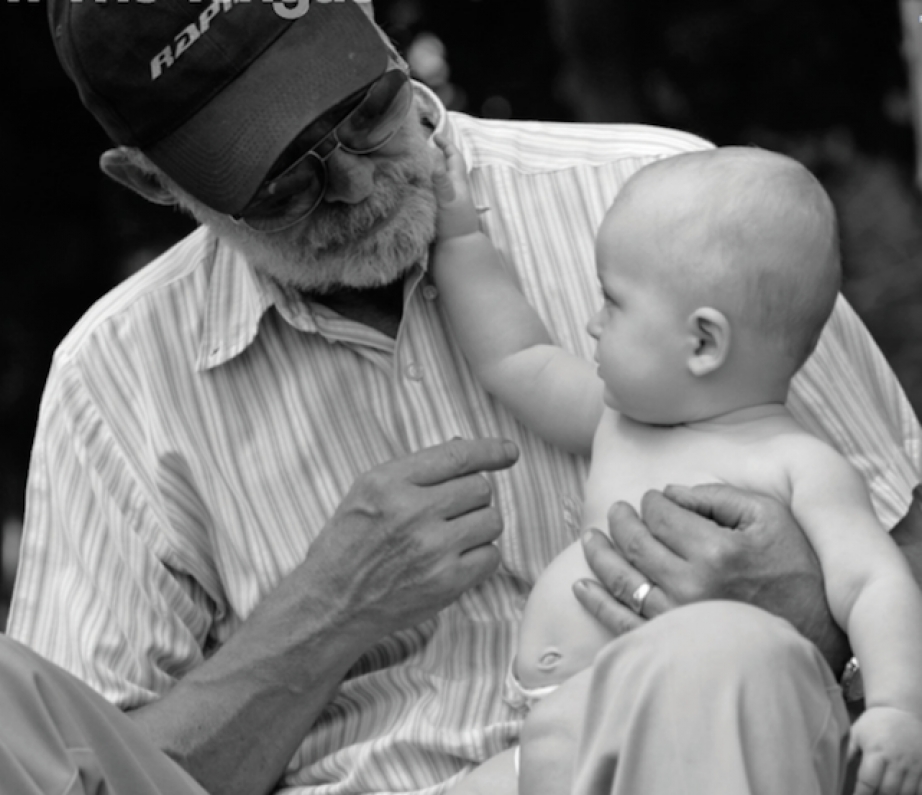
MALCOLM MACGREGOR, 1943-2016. | PHOTO: SCOTT MACGREGOR
I have regrets. I regret not taking him down a river. I regret not insisting that we spend more time together. I regret never sharing with him what was so important to me and what sucked me away from my family, away from his trucking company and away from a wonderful home.
I could have taken him, of course. Over the years I’ve guided hundreds of non-swimming fathers down rivers. I even own my own raft.
I’d think of it from time to time and call him from airport terminals after red-eye flights to somewhere. We’d make half-assed plans to get together soon. Then there were always reasons to postpone the trip until another time. Bullshit reasons like deadlines, water levels and brake jobs.
Everything in the past 25 years of my adult life has been about moving water. My children learned to swim in rapids. My dad died having never seen me paddle.
Scott MacGregor is the founder and publisher of Rapid. Telling his dad how much he loved him isthe hardest thing he never did.
This article originally appeared in the Rapid Summer/Fall 2016 issue.
Subscribe to Paddling Magazine and get 25 years of digital magazine archives including our legacy titles: Rapid, Adventure Kayak and Canoeroots.


 This article was first published in the Summer/Fall 2016 issue of Rapid Magazine.