It’s every paddler and backcountry camper’s worst nightmare: you’re snuggled to your sleeping bag after a long day of paddling when you wake to the long and constant drum of thunder. Soon, the sky is lit with lightning so bright you could mistake it for daylight. Then, you hear the crack of falling trees.
For many campers on June 21, 2025 this nightmare was a reality when a sudden storm ripped through southeastern Ontario trapping and injuring campers throughout the region. More than 15,000 were without power, roads were washed out and local municipalities declared a state of emergency.
The storm was part of an outbreak of severe thunderstorms that swept across the Plains and Great Lakes producing tornados and baseball-sized hail over the Plains states, and a suspected meteotsunami on Lake Superior.
Backcountry rescues prompted throughout Algonquin Provincial Park to rescue trapped campers
In the wake of the storm, multiple backcountry rescue efforts were launched to evacuate campers. Near North Depot Lake in Algonquin Provincial Park a boy was seriously injured when a tree fell on his tent while he was camping with his mother. The mother sent out an SOS signal on a device that shared their coordinates with first responders.
Storm damage at a campsite in Algonquin Park, Ontario. Feature Image: CBC News | YouTube
First responders used handsaws, then chainsaws when they arrived to clear fallen trees and debris to access the lake, then paddled in to the mother and son to begin first aid. A float plane was then dispatched to transport the pair to the hospital, Ontario Provincial Police – East Region shared on social media.
Throughout the region dozens of others were injured or stranded and one camper was killed when a tree fell on his tent in the night. The Mattawa Fire Department shared on Facebook that crews responded to a multiple casualty incident after the storm and began to search for trapped and injured campers, evacuating over 100 individuals from Samuel De Champlain Provincial Park in southeastern Ontario, the park having been hit particularly hard.
While many reports initially suspected a tornado, researchers from the Northern Tornadoes Project shared with CBC News that a downburst, not a tornado, was likely responsible for much of the damage in the region. Researchers shared that this incident was the largest downburst recorded in years and downed trees over an area spanning more than 100 square kilometres.
While tornados are rotating winds that rise up into the storm with a narrow path of destruction, downbursts are powerful winds that descend from the thunderstorm and spread out, resulting in widespread damage from generally the same direction. Downbursts are also sometimes called straight-line winds.
What should you do if caught in a thunderstorm while camping?
While the most recommended course of action while camping during a severe thunderstorm is to seek shelter indoors, that may not always be possible on a paddle-in camping trip, and it may not always be possible to anticipate severe storms, especially one that develops overnight.
Consider carrying a way to call for help in an emergency without cell service like a SAT phone or a two-way GPS communication device, and set up tents away from dead or dying trees. Check the nearby trees for “widow makers”, or partially-broken, suspended or dead branches that are more likely to fall in the night. Additionally, it’s good practice to pitch your tent away from the water’s edge and away from the tops of hills for protection from wind and lightning.
Beyond wind, lightning can also be a concern for backcountry paddlers. The best things you can do to survive lightning storms in the backcountry are getting off the water, staying low, assuming lightning position and spreading your group out.
Still, one of the best ways to prepare for inclement weather while camping is to carry a radio or device that can access the most recent weather forecasts and warnings, and an understanding of what those forecasts and warnings mean for the area you are travelling in.
Andrew Hughes on a training run. | Feature photo: Marcos Felipe Terra
When Andrew Hughes arrived at the crater lake on Tres Cruces Norte, he was on the verge of heartbreak. Along the edges of the brilliant blue body of water high in the Atacama Desert of Chile, salt rings marked the dry volcanic rock—evidence of evaporation and a shrinking pool.
Just hours earlier, the Seattle-based mountaineer had stuffed 38 pounds of inflatable paddleboard gear along with his expedition equipment into a pack. He and his team climbed loose scree to Tres Cruces Norte’s 19,780-foot summit, then descended to the lake to launch his board.
Hughes expected to find the surface of the wind-whipped pool lapping against the rocks at an elevation of 19,406 feet above sea level. Why was his exact vertical distance from an ocean so critical? Because Hughes was here to set the world record for the highest elevation ever SUPed.
Andrew Hughes on a training run. | Feature photo: Marcos Felipe Terra
Pushing SUP to new heights
After years of poring over satellite imagery and securing permits with the local Indigenous community, and after days acclimating to the high desert mountains of Chile, he now stood at the edge of a pool that might have fallen just short of setting the record. Hughes anxiously paced the crater’s edge, watching his Garmin: 19,364 feet. The water level was 40 feet lower than he anticipated yet still six feet higher than the previous world record.
By The Numbers
19,364 ft: World record altitude for paddleboarding
50%: Amount of oxygen relative to sea level
13 minutes: Time spent paddling the crater lake
4th: Rank among Earth’s highest water bodies
2 inches: Average annual precipitation in the Atacama
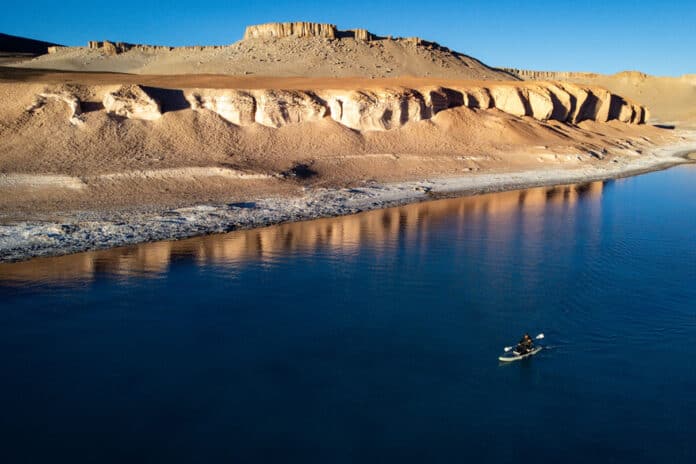
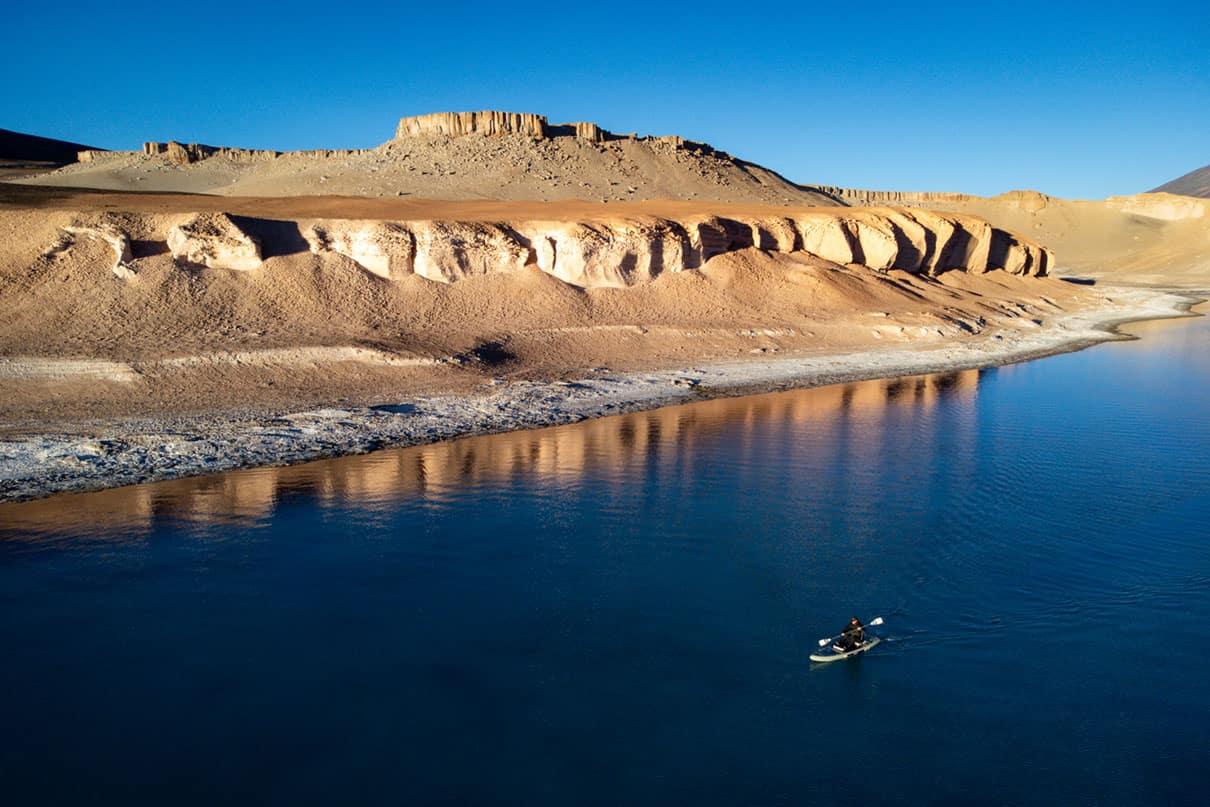
While the others set camp, Hughes spent nearly half an hour pumping up his ISLE Switch to reach pressure in the thin air. The wind gusts funneling around the crater didn’t help. During acclimation, Hughes had faced 60-mile-per-hour winds, forcing him to train on Laguna Verde (pictured) before dawn when the air was still. During the record attempt, he struggled to stand up on the board without being blown over. The rules of the record allowed him to kneel, and so he did. Even among the howling, the new record holder relished the 13 minutes on the board.
“It was exactly what I had dreamed of years before,” Hughes said of the experience inspired by his previous climbing trips to the Atacama Desert. “There are very few places that feel so otherworldly as the Atacama. It has a Martian-looking landscape, and these incredible pools of water where the blues just pop.”
High-altitude lakes are remote, difficult to study, and often only viewed by satellite imagery. The crater lake of Tres Cruces Norte is considered the fourth-highest body of water on Earth. Hughes first aimed for Ojos del Salado’s lake (also in Chile and over 20,000 feet), but it remained frozen all year. The second- and third-highest water bodies are in Tibet—but these glacial-fed lakes are thought to be extinct.
That left Tres Cruces Norte, yet even it proved a shrinking option. The moment of lakeside anxiety stuck with Hughes after the expedition, not only because of the near-end to his record bid but also his proximity to vanishing high-altitude lakes—whether lost to disappearing glaciers, natural processes, or drained by resource interests like lithium mining.
“I would love to be able to create a system of monitoring that future guides and people can implement to keep track of what’s happening with these high bodies of waters as things change,” expressed Hughes, who has since started the Peak Paddle Project to combine paddling the highest waters on each continent with scientific research. “It’s very easy with these high and distant places to forget they are canaries in the coal mine,” he says.
In August 2024, just a few months after his Chile expedition, Andrew Hughes paddled Africa’s highest lake—Harris Tarn (14,941 feet) on Mount Kenya—gathering climate data with Kenyan and U.S. researchers.
This article was first published in Issue 73 of Paddling Magazine. Subscribe to Paddling Magazine’s print and digital editions, or browse the archives.
Andrew Hughes on a training run. | Feature photo: Marcos Felipe Terra
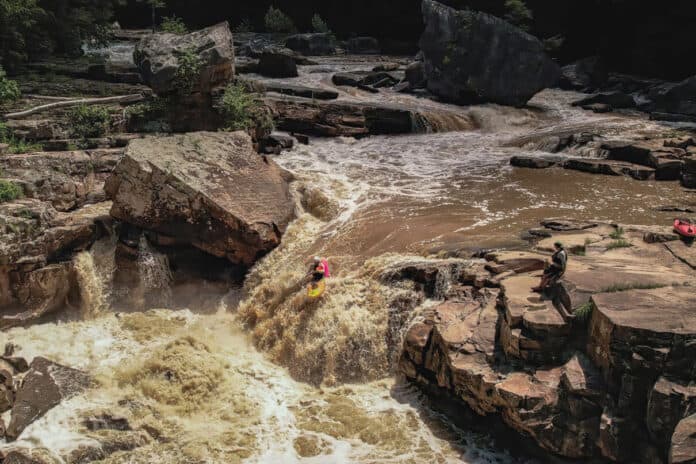
Shane McManus running Big Splat on the Lower Big Sandy in 2022. | Feature photo: Justin Harris
Shane McManus reckons he’s run Big Splat on the Lower Big Sandy 500 times. Almost every time he runs the West Virginia classic, he sends the signature class V waterfall three times—once for himself, once for his best friend who moved out of state, and once more to lead others down.
No one knows Big Splat better than McManus, but if you roll the dice often enough, eventually they come up snake eyes.
Accident debrief: Inside a veteran boater’s scary swim
Such was the case on December 18, 2024, when the 36-year-old Morgantown, West Virginia, boater met friends for an after-work lap on the Lower Big Sandy. They were an experienced crew of paddlers spanning three generations, from 19-year-old up-and-comer James Malek to Jim Murtha, who, at 72, is still a regular on the Upper Yough. Josh Martin, 40, had run the Lower Big Sandy about 50 times, but always portaged Big Splat. A self-described conservative boater, Martin had so far chosen not to tackle the tricky and consequential class V drop, which features a technical lead-in, an undercut cave on river right, and a seemingly magnetic piton rock at the bottom.
During the shuttle though, Martin told the crew today might be the day.
“We get on the river, and everything was crisp and just really good lines the whole way down,” says Martin, a U.S. Army sergeant with three combat tours in Iraq and Afghanistan.
By the time they reached Big Splat after two miles of fun class III-IV and a clean huck of 18-foot Wonder Falls, a plan was in place: McManus would make his customary first run, then hike back up to lead Martin down in Blue Angel formation, with Malek following in sweep position. Murtha and a fifth boater, John Rooke, set safety on the so-called seal-launch rock overlooking the main drop on river left.
Shane McManus running Big Splat on the Lower Big Sandy in 2022. | Feature photo: Justin Harris
While the 16-foot plunge gives Big Splat its name and reputation, the ledge drop just above is nothing to be trifled with. Here the river funnels right into a nasty horseshoe hole, requiring a hard-driving boof into a river-left pool a couple of dozen feet above the main drop. This is where McManus pulled his paddle a little too far past his hip and it caught, pulling him off balance. In hindsight, he thinks he could have stayed upright with a hard brace, but in the moment, he opted for a quick back deck roll. As he attempted the roll, his hip slipped out of his outfitting, robbing him of the leverage he needed to roll up. As this was happening, he felt the horseshoe hole pull him in and then flush him downstream.
When he felt himself slam into the guard rock immediately above the big drop, McManus knew exactly where he was heading, and the grip of the swift current confirmed the worst.
“I felt myself speeding up, and then I just felt myself drop—boom!—into this stern piton, and I felt this crack happen all the way up my body,” he says. “Just everything popped in all these different ways.”
Rescuers spring into action
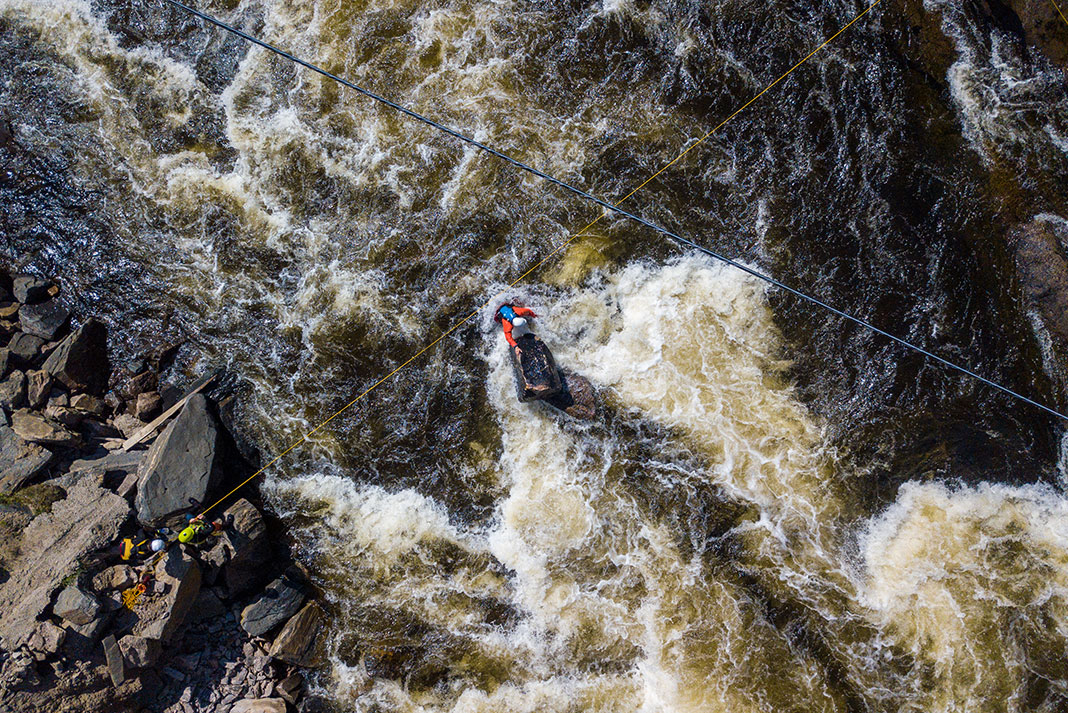
From the seal launch rock on river left, Murtha and Rooke watched McManus’ kayak disappear into the drop’s deepest seam and stay down. They knew he hadn’t had a breath since flipping in the entrance. Murtha couldn’t get a rope to McManus from where he was standing, so he began to count off the seconds. Had he reached 180, Murtha said later, the team would have to slow down and reassess the situation.
Martin hadn’t seen McManus go over—the horizon line blocked his view—and he caught the eddy above the main drop as planned. Meanwhile, Malek, who had seen everything, shot past toward the lip.
Suddenly Martin, who moments before had been comfortably flanked by experienced paddlers, found himself alone in the middle of a consequential drop he’d chosen prudently to avoid for years—with Rooke hollering that McManus had gone over the falls, upside down.
“When I heard that, it was like, ‘All right, I’ve gotta run this drop,’” Martin says. “I gotta go get my friend.”
The feeling took him back to the firefights he’d experienced in Afghanistan’s Helmand Province. So much was the same—the adrenaline dump, the reliance on others, and the stark recognition lives depend on you playing your part under extreme stress.
“I’ve said this a lot over the years. Whitewater kayaking is the closest thing to combat, because it’s your ability to act under pressure that determines the outcome of the event,” he says. “If you tuck your head between your legs in a firefight, things are going to get worse. Do something to improve your outcome, and things will get better.”
Martin immediately peeled out, hard on the heels of Malek, who had adjusted his launch angle to avoid the possibility of hitting McManus, landed in a seam, and flipped.
“I roll up, and for probably five, 10, 15, 20 seconds, I don’t see him,” Malek says. “So I’m trying to get to a spot where I can get out and get a rope to him because I know under and behind the curtain is super undercut.” Just then, Martin landed cleanly next to Malek, and both boaters saw McManus come to the surface.
“I see him pop out without a helmet or any of his gear. He had his life jacket on, thank God, but helmet, boat, paddle, shoes—they’re all gone,” says Malek, who towed McManus to a nearby rock where he lay splayed out, regaining his breath. By Murtha’s count, he’d been underwater for well over a minute.
Malek, an EMT studying nursing at West Virginia University in Morgantown, performed a quick assessment of his friend. “I checked his airway, breathing and circulation. He was breathing all right and I didn’t see any bleeding. So those three things tell me this is not going to be a 9-1-1 where we need to get evacuated with a helicopter,” Malek says.
He asked McManus what he needed.
“Get my boat,” was the reply.
Martin had already recovered McManus’ helmet, and Rooke soon emerged from downstream with his well-loved Rivrstyx paddle. Rooke then produced a short NRS strap to stand in for the broken helmet strap. As McManus regained his senses, Rooke peppered him with cognitive questions: “What’s your birthday? Who’s your fiancé? Where are we?”
“I’ve said this a lot over the years. Whitewater kayaking is the closest thing to combat because it’s your ability to act under pressure that determines the outcome of the event.”
—Josh Martin
McManus was safe for the time being, and the crew next faced the consequential decision of how to get him out. Though he aced the cognitive tests, McManus’ vision was blurry in his left eye, suggesting a concussion, and the pain in his chest and snapping sounds on impact meant he’d likely cracked or even broken some ribs. In fact, he’d broken 10 ribs (four left, six right) and his L2 vertebra, on top of a wicked concussion.
McManus could stand and walk only with difficulty and the hike out was about two miles of rugged terrain. After a short discussion, Martin voiced his opinion: “Hey folks, I think the fastest way out of here is down. Even if we portage every rapid, it’s still faster.” The group nodded their assent and started the three-mile paddle out.
They traveled in close formation, with Malek leading, Murtha and Rooke flanking McManus, and Martin running sweep. McManus walked class IV First Island using a pair of paddles like crutches and paddled the rest of the way using what Malek called “little ducky strokes” to avoid twisting his damaged torso.
“The paddle out, let me tell you, you’ve never been part of something more eerie than that,” Martin recalls. “No one said a word other than to ask Shane how he was. No one boofed, no one surfed—it was just paddle the raft lines to the bottom of each rapid, ask Shane how he is, and then continue.”
After the last named rapid, Malek sprinted ahead to get his car warm and ready. The temperature was in the high 30s or low 40s, and though McManus was wearing a drysuit and layers he’d also endured a long swim and significant trauma. Maintaining his body temperature and getting him to a hospital as soon as possible was essential. As Martin and Malek helped their friend into the car, they compared notes on the information they would convey to the medical team. With their shared backgrounds in emergency medical care—Martin is also an EMT and teaches search and extraction at the Army’s premier disaster response school—Martin and Malek knew how important this handoff would be. Malek drove straight to Ruby Hospital in Morgantown, where a trauma team got to work.
Reflecting on a run gone wrong
Eight weeks later, McManus is well on the way to a full recovery, but the fact he ended a routine after-work run in a hospital bed says a lot about the nature of river running. Whitewater doesn’t feel like much of a team sport on those blue-sky days when you can’t place a stroke wrong, and the only help you need is someone to drive shuttle. But in ways that truly matter, whitewater forges deep bonds, tempered by the joy we experience, the accomplishments we share, and, occasionally, the unbearable stress of life and death hanging in the balance.
In a description of the accident, Malek wrote the moral of the story is anything can happen on class V, even to people who have run a rapid hundreds of times at every level. Surely that’s true. But the corollary is it’s up to each of us—whether we paddle class II or class V—to develop the skills to play our part when things do go sideways.
There’s no greater expression of teamwork than having the skills and composure to hold your end of such a bargain. We should ask nothing less of ourselves and can ask nothing more from those we paddle with. That natural back and forth is why McManus takes an extra lap on Big Splat for his friend who can’t be there. It’s the reason he mentors Malek in small ways and shows up to roll sessions with a smile.
Anyone who knows McManus will tell you he gives more on the river than he asks, but the fact help was there for him when he needed it most speaks to the beauty of our sport—an element that goes beyond the joy we share on the river and the beautiful places it takes us.
Jeff Moag is the former editor of Canoe & Kayak magazine. Debrief is a new column, deconstructing paddling accidents and the lessons we learn from them.
This article was first published in Issue 73 of Paddling Magazine. Subscribe to Paddling Magazine’s print and digital editions, or browse the archives.
Shane McManus running Big Splat on the Lower Big Sandy in 2022. | Feature photo: Justin Harris
Deek Heykamp still remembers his first whitewater kayak, one he brought home from the annual Outdoor Retailer trade show to his new outdoor store in Southeast Portland in the late 90s.
“It was an Eskimo Diablo,” Heykamp recalls. “We had just started the business, and we hired a guy who is still my close friend, and he said he would teach me how to roll if I bought a kayak.”
Heykamp grew up paddling Oregon lakes and whitewater in an aluminum canoe during a time when fiberglass whitewater kayaks were taking over the river scene. At the time, kayaking eluded him, but two decades later, once he had a hold of the Diablo, Heykamp’s relationship with paddling took a turn many are familiar with. “It consumed me,” he says.
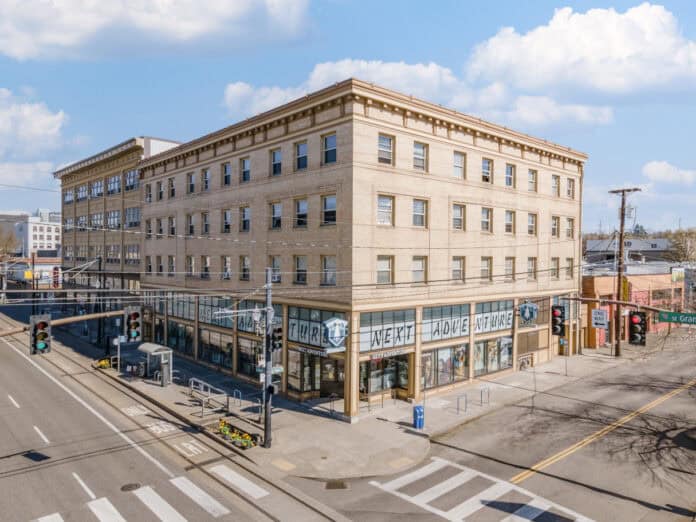
The new business Heykamp had opened with his childhood friend Bryan Knudsen in 1997 was Next Adventure, and from those early days, the store on the corner of Grand Avenue and Stark Street has grown to become an institution in Portland—with shopping hauls even included in the skits on the satirical Portlandia—and one of the largest independent outdoor retailers on the West Coast.
In May 2025, Heykamp and Knudsen announced their imminent retirement from the 28-year-old retail company, and with it, the closure of four physical retail spaces. This includes two paddlesports centers, serving the Portland, Oregon metropolitan area. The announcement adds Next Adventure to an accumulating list of generational shop owners retiring with no option to hand over the reins of their legacy establishments, and opens questions surrounding the future of retail for one of the largest paddling communities in the country.
The owners of Next Adventure, Bryan Knudsen (left) and Deek Heykamp (right). | Photo: Next Adventure
Next Adventure owners to retire and close stores
Following the announcement, Heykamp and Knudsen spoke with outlets across local media channels, sharing what they viewed as the best opportunity for themselves to embrace the fruits of retirement and for the business to call it a good run.
“I’m 60 years old, and I’m young, and I’m healthy enough, I want to really enjoy the outdoors and really enjoy my retirement,” says Heykamp. “Currently, in the business climate, there’s some challenges that we face for sure. And looking at the commitment that it’s going to take to really excel in business in the coming decade… the fact is that now is a good time that we can go out on our own terms. We can leave all of the people who have supported us in a good place, and we can go enjoy what we love to do.”
Retailers across the country are facing mounting high jumps, which Heykamp alludes to along with state-specific circumstances of liability insurance for outdoor activities as well as the paddling industry’s own growing pains. Across the area, fans of the store have predictably voiced their desire for Next Adventure not to close and instead find a buyer, however, looking at the adversities a new owner would face presents a daunting undertaking in the market and within the community.
“We certainly had talked to some people about it [selling the business], but the appetite for investing in retail, especially retail of our size, wasn’t real big,” Heykamp explains. “Since we’ve gone public with our retirement plans, people have come and we’ve started talking with people about different parts and pieces of the business they might want to take on. And I’m hopeful that someone will step up and continue some of that. But the fact is, with the general retail climate, a lot of the uncertainty nationwide, what’s going on with tariffs and insurance, and etc. All of those things add up to this was a better decision. We had more control of our decision in our retirement by doing a liquidation.”
The story behind a 28-year business
According to the company, to start Next Adventure, Heykamp sold his shoe repair business with 12 locations in two states, while Knudsen sold his home in Bellingham, Washington and left his job of 11 years with Les Schwab Tires. In July 1997, the friends who had grown up embarking on outdoor escapades were now business partners, showing up at a 1,600-square-foot space on the corner of SE Grand Avenue with two truckloads of used gear to set up shop in Southeast Portland. From there, Next Adventure grew.
They would eventually open a retail location in the nearby town of Sandy. On the paddling front, Next Adventure would open two dedicated locations. One, the Portland Paddle Sports Center, just a few blocks away from the flagship store, and the Scappoose Bay Paddle Sports Center, located 25 miles from Portland on the Columbia River.
Staff outside the Portland Paddle Sports Center, which was formerly an auto repair shop, and has since become one of the largest paddling-dedicated retail spaces on the West Coast. | Photo: Next Adventure
What the end of Next Adventure means for Pacific Northwest paddlesports
The two centers have produced one of the largest paddlesports magnets on the West Coast over the last decade. Their Portland and Scappoose locations have offered numerous brands in sprawling spaces for every activity from whitewater kayaking to touring, canoeing, recreational kayaking, standup paddleboarding, kayak fishing and rafting. They’ve offered rentals from both locations, and the Scappoose Bay site offers direct access to the lower Columbia River. Next Adventure also began a service for custom rigging fishing kayaks—an emerging aspect of the angling industry. Over the years, the store has also played a role in sponsoring local paddling events including the Northwest Creeking Competition and the PDX Kayaker Film Festival.
With Next Adventure’s closure in motion, Portland is not, however, an area without paddling retail, but it is an area where those options have been declining. In 2023, the owners of a neighboring store on SE Grand popular with river runners, Andy and Bax, also retired and shuttered. And Portland’s downtown REI closed in 2024 following 20 years in business.
Still, there is Alder Creek Kayak and Canoe, which has been operating since 1986. For standup paddleboarders, Gorge Performance holds a deep inventory of boards and gear, especially for touring and surfing. Portland Kayak Company, in Northwest Portland, houses a mixed inventory of boats and boards available by appointment. There is also a limited inventory of paddling gear at a newer retailer, Foster Outdoor, as well as smaller retailers who are an hour or more drive from the city.
These options appear plentiful compared to most regions in the U.S., however it’s worth bearing in mind that the Pacific Northwest represents one of the largest paddling demographics in the country according to the the Outdoor Foundation’s last special report on the category in 2019, including the second largest holding of whitewater kayakers and rafters behind only the Southeast. Next Adventure has been centrally located and relatively easy to pop into for most of the metropolitan area, and, for whitewater kayaking especially, has held the region’s physical retail of many of the most widely distributed brands.
The Scappoose Bay Paddle Sports Center provides access to the Columbia River, and was formerly Scappoose Bay Kayaking, owned by Steve and Bonnie Gibson before transitioning to Heykamp and Knudsen in 2013. | Photo: Next Adventure
Gaping void or new beginnings
“Losing such a great retailer is a huge hole. They did an amazing job transcending from retailer to member of the community,” shared Anna Bruno, the marketing communications manager of Northwest River Supply. “We have nothing but gratitude for their 28 years…The big thing for me, is nothing can fully replace a brick and mortar store; it’s important for the community and industry.”
Bruno notes that NRS is fortunate to still have diverse physical retailers of their products in the area. However, Bruno, who also lives in the community an hour east of the city in the Hood River-White Salmon paddle-troplis, mentions there will not be a convenient whitewater retailer for these destinations, a fact others in the industry acknowledge also.
“Next Adventure was huge in getting people into not only paddling, but the outdoors in general,” Dave Fusilli of Pyranha Kayaks said. “As far as Pyranha is concerned, they were a large account for us and for most whitewater brands. We now have no kayak shops in what I believe is the most kayaker-populated place in the country,” added Fusilli who serves in roles of sales, distribution and content for Pyranha, and also lives in the Hood River-White Salmon area. With these factors in mind, Fusilli believes someone is bound to step in.
“I’m pretty damn optimistic, but at this current moment, I don’t know where you will buy a kayak in the area. My closest stores are north to Seattle or south to Eugene or Bend.”
Fusilli’s comments echo a topic now circulating in the Portland whitewater community—whether Next Adventure’s exit will produce an opportunity for emerging businesses in the region to flourish.
“We have such a soft industry right now, and losing a retailer like this is a major hit,” expressed Luke Spencer, owner of Clackamas River Outfitters and a former Next Adventure employee. Spencer has technically been a competitor with Next Adventure since opening his own store outside of the city in Estacada in 2015. He acknowledges the resources, community and connections that Next Adventure produced. However, outside of the current economic climate, Spencer also believes from a general standpoint that the local juggernaut’s closure will ultimately open a path for others.
“They had all the major lines locked down and this creates the potential for other folks to carry some of that gear,” Spencer shared. “We’ve already had folks [brands] asking us—so there are opportunities waiting. Spencer is cautious to say how retail will shape up in the city in the near future, and believes it’s healthy for the city to have at least one good shop for people to visit, but that doesn’t have to come in the form of one massive business. “Ultimately, having diversity in who sells gear is a good thing.”
At its peak, the Portland outdoor store founded by two childhood friends employed 200 people, generated $24 million in annual sales, and outfitted thousands of local residents for outdoor adventure.
“I certainly would like people to know how privileged I feel and how honored I am to have been a part of the community and to be given the opportunity to do the things that Brian and I have in the outdoor space. It’s a dream. It’s what you start a business hoping you get to do,” says Heykamp. “We come from such a place of gratitude for what the community has given back to us.”
Now, Heykamp and Knudsen are starting a new adventure in retirement. In the meantime, a blowout retirement sale is underway, running until the stores close by the fall of 2025.
Charles Ruechel… in his element. | Feature photo: Scott MacGregor
I’d already introduced myself to Emily. When you see another solo whitewater canoe on your street in an interior British Columbia ski town, you notice these things. It probably went something like, “Hey, is that your Dagger Quake leaning against the garage?”
The next time I saw Emily was in the local grocery store. She had a long list and two buggies full of carrots, zucchini, broccoli and steaks.
Emily said she was shopping for last-minute fresh stuff for six days on the Kootenay River. She is a canoe instructor and guide for Elements Adventure Company. Tell me more.
“You should write a story about Charles. You should join the 4 Rivers In 4 Days trip this fall,” she said.
And that’s how one minute I’m complaining about the price of eggs—this was before the price of eggs was a broken campaign promise—and the next I’m on my cell phone pitching a feature story about some guy and his unlikely adventure business creating a community of canoeists, in the Okanagan Valley of all places.
“There’s a whitewater canoeing scene in the Okanagan?” asked Kaydi Pyette, editor of this magazine.
“Apparently.”
Two months and two days later, I’m helping unload tandem and solo canoes out of the back of an enclosed trailer, setting them in the grass of a community park beside the Thompson River. It’s the first river on the first day of four.
How one guide built a whitewater scene from the ground up
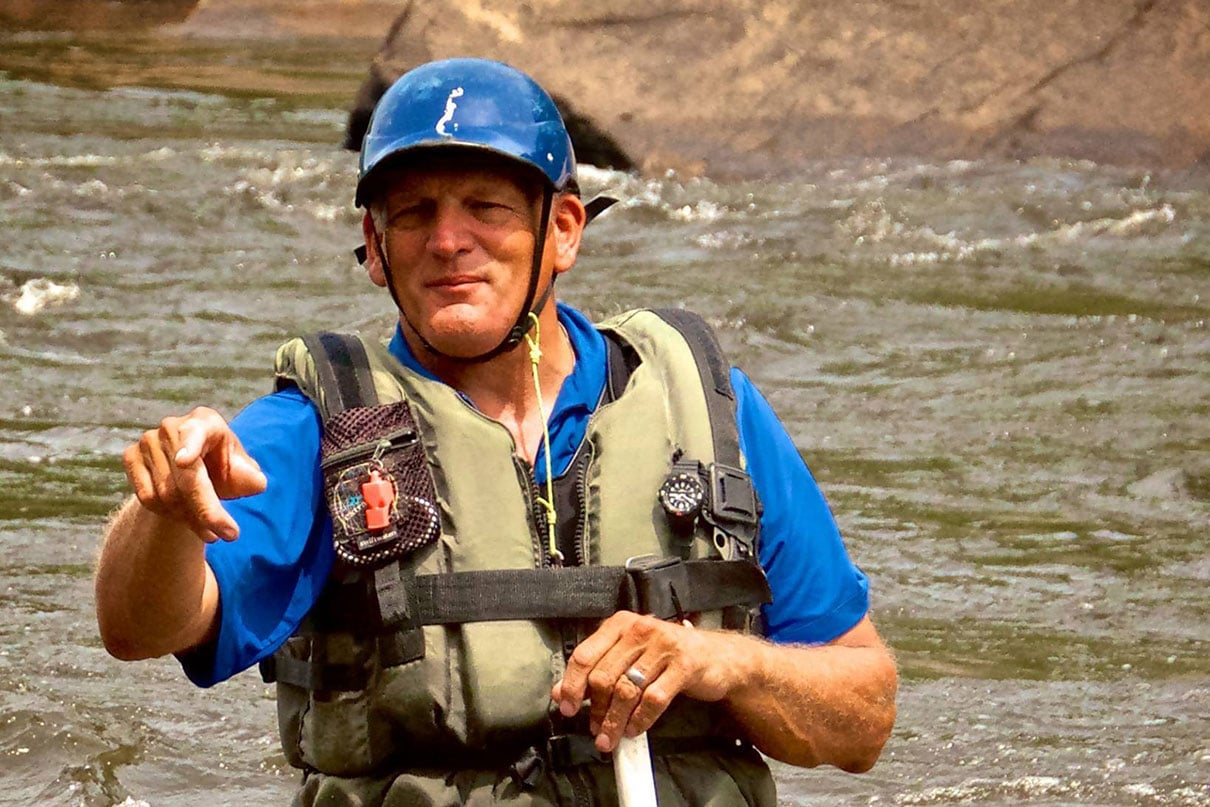
Charles Ruechel is the owner of Elements, and he looks the part. Tall, fit, handsome, one day unshaven. Sweet Protection Strutter paddling helmet, sun-faded Astral GreenJacket, Werner Bandit paddle—the blade worn round at the tip as they get after hundreds of days. It was obvious to me this guy likes moving boats around and calculating shuttle logistics.
Elements’ 4 Rivers In 4 Days program follows the best flows. In spring, we would be unloading boats on the Coldwater, Tulameen, Similkameen, Upper Similkameen, Nicola and Shuswap rivers in B.C.’s southern region. In the summer, we’d be off on what they call the Great White Bull Adventure because they paddle the White and Bull Rivers. Clever.
Charles Ruechel… in his element. | Feature photo: Scott MacGregor
We’re in the Central Interior on two sections of the Thompson and the Clearwater. If water levels were different, we had options. Every other fall, 4 Rivers In 4 Days bounces to the Cariboo/Chilcotin region and includes sections of the Horsefly, Chilcotin, Chilko or Cariboo rivers—whatever makes the most sense for the group at the time.
The popularity of this program makes sense. Who doesn’t want to improve their paddling skills with professional instruction on new rivers? Who doesn’t want the company of adventurous, dynamic people, all the while knowing at the end of the day, Emily will be preparing a steak stir-fry over an open fire?
In the beginning, Charles thought he would do longer river expeditions in remote places. Elements does run longer trips on the Upper and Lower Stikine, Jennings, Bonnet Plume and Turnagain rivers. This year, there are plans to add two more seldom-paddled rivers to the list: the Taku River Exploratory Canoeing Expedition and the Gataga River Exploratory Expedition. Never heard of the Taku or Gataga? I’m not surprised. Nobody else is running them commercially.
While exploring new northern routes is pretty cool, paddling four rivers in four days was easier for me to make work.
Chasing freight trains through Black Canyon on the Thompson. | Photo: Scott MacGregor
“I think that’s one of the reasons why it’s so popular,” says Charles. “Four Rivers In 4 Days fits into busy schedules and tighter budgets. We provide gear, or not, if our guests have their own.” I brought my gear but opted for the fully catered meal plan.
The other reason Four Rivers is so popular became very clear, very quickly, by the amount of chirping each other around the campfire.
If everyone in this group wasn’t already friends, they were friends of friends. I was the only one who hadn’t already done at least one course or trip with Elements. I listened as they told stories of rivers they’d paddled—sometimes together—with guides they all knew.
Taken some river skills courses but want to experience new rivers? the 4 Rivers In 4 Days program is for you. | Photo: Scott MacGregor
I’m sure everyone leaves these programs with improved skills from paddling new rivers, but around the campfire, in our little campground nestled between the rumble of freight trains on one side and the white noise of the Thompson, there were more stories of adventure than critiques of proper techniques.
Charles’ story is a good one.
In 2010, he decided to leave his family farm and the world of agricultural sciences. He gave himself a gap year to figure out what he was going to do next. He traveled with his wife to Nepal, India, Peru and Europe. In a hotel room in Rome, on the very last night before he was to fly home, he decided to apply to the NOLS outdoor instructor program, focusing on backpacking and whitewater canoeing. After three seasons at NOLS, in the fall of 2013, he ran his first Elements Adventure Company program, a community river cleanup.
“When I started the business, I thought I’d focus on trips and just do a few courses to get people prepared,” Charles remembers.
After his second season, he flew across the country for a week-long skills course with Andrew and Carol Westwood at the Madawaska Kanu Centre. “At first, I didn’t realize I’d have such a passion for teaching canoeing, not just the tripping. I also didn’t realize there’d be such an interest and need for canoeing skills and courses in the Okanagan and Shuswap regions.”
The flowchart on the Elements website reminds me of those Instagram memes beginning with “Should I go canoeing?” After a series of arrows and boxes, all paths, whether you initially answered yes or no, eventually lead back to “Yes.”
So much time is spent around boardroom tables at outdoor industry gatherings, asking each other how we should grow paddlesports best. Like there is one new, easy, magical way that’s going to get more people into canoes and kayaks. Sure, some good ideas get scribbled on whiteboards. But when we look back 50 years, it’s passionate people like Charles who do most of the heavy lifting.
Payson and Aurelia Kennedy bought a motel and gas station on the banks of the Nantahala River in western North Carolina, creating the Nantahala Outdoor Center. Canadian paddling champions Christa and Hermann Kerchhoff established a lodge and paddling center on the Madawaska River in the Ottawa Valley. Wally Schaber and Chris Harris created Black Feather as a sideline to their Ottawa-based outdoor retail store, Trailhead. These are just three examples of people and their companies building generations of paddling communities and professionals. Forty years later, Charles is doing the same on B.C.’s interior rivers.
By our last night together the friendly banter had gotten worse, or better, depending on how you look at it. We’d just paddled the lower section of the Clearwater River, our most technical of the trip so far and a run pushing the limits of open canoes. Spirits were high despite the cool fall rain pooling on the tarp above our circle of camp chairs.
Eleven good reasons why canoeing is growing in B.C.’s okanagan and Shuswap regions. | Photo: Scott MacGregor
Emily reeled us in with a round of Rose, Thorn and Bud. She asked us to reflect on our time together on the rivers and identify positives, challenges and opportunities for growth.
I’m thankful there are farm kids like Charles Ruechel who, when they grow up, are willing to roll up their sleeves and get the job done—the job of cleaning up rivers, teaching skills—beginner and advanced—and inspiring the sense of adventure and feeding enthusiasm to those of us who have been kicking around rivers even longer than he has. That’s how you grow paddlesports. Scribble this on the whiteboard: 1. Inspire new paddlers. 2. Keep giving paddling enthusiasts reasons to stay in their boats.
It’s not easy, but it works.
Scott MacGregor is the founder of Paddling Magazine.
This article was first published in Issue 73 of Paddling Magazine. Subscribe to Paddling Magazine’s print and digital editions, or browse the archives.
Charles Ruechel… in his element. | Feature photo: Scott MacGregor
If you’ve seen one tandem sit-on-top kayak you’ve seen them all, or so someone may say who has yet to meet the Lekker Albatross. The Albatross is like the bird it’s named for—sizable and ready for a journey. The boat is 14 feet long and capable of covering ground, yet is easy to turn. The seating puts the paddlers in an engaged position. It has two sealed hatches to store gear below deck. And, it has a high bow to ride over waves and through rapids.
The Albatross is a double kayak that is just plain fun, especially for coastal areas and rivers with mild to moderate whitewater. In short, it’s a boat that feels like what a tandem kayak was meant for: setting off on an adventure with a paddling buddy.
The Albatross features a high bow, rounded edges and a tapered stern. It’s a double kayak ready for adventure. | Photo: Owen Roth
Review of the Lekker Albatross tandem sit-on-top kayak
The Albatross is Lekker’s first tandem kayak, but it wasn’t born from a lack of experience. Lekker’s founder and boat designer, Celliers Kruger, also started Fluid Kayaks in South Africa in 2002 and Vagabond Kayaks in 2018. The Albatross is an evolution of previous tandem sit-ons Kruger has built. His first, the Fluid Synergy, and the more recent Vagabond Mazowe. The Mazowe especially has been a hit with outfitters and adventure racers since its release—two interesting crowds to look toward for a sit-on-top’s seal of approval. Outfitters need durable, forgiving and straightforward boats for inexperienced kayakers to paddle, and adventure racers need a boat with speed capable of handling a variety of water conditions, including waves and whitewater.
According to Kruger, the Albatross has taken the positives of his previous tandems and combined them with feedback he’s also received from outfitters and paddlers to incorporate into this new tandem. When Kruger started Lekker in 2024, a big goal was to focus on improving the performance of recreational kayaks—boats intended for casual outings in sheltered waterways. Lekker has labeled the Albatross a rec kayak, which seems like it undersells this kayak in an attempt to not scare off new paddlers. But this is exactly Kruger’s point: recreational kayaks have been overlooked when it comes to innovation, and in his view, are in need of some tweaking to offer a more enjoyable experience.
The Lekker Albatross diverges from most sit-on-tops by moving most of the storage space below deck. | Photo: Owen Roth
The footbraces of the Albatross are closer together than your average sit-on, creating a comfortable and engaged seated position. | Photo: Owen Roth
Rethinking the sit-on-top kayak seat
A major way in which the Albatross sets out to accomplish the goal of a better paddling experience is with the inclusion of design elements more often seen on high-performance kayaks, and which the Lekker team believes every paddler would benefit from having on their boat.
The cockpit seating area is where kayakers spend their time, and one of the first places I noticed the Albatross differentiates itself from other tandem kayaks. Two-person kayaks and canoes are commonly called divorce boats for a reason—getting where you want to go can be a true test of teamwork, conflict resolution and emotional intelligence. One of the common causes of strife is the clanking of unchoreographed paddles. To address this, the seating position of the Albatross places the paddlers far enough away from one another to alleviate it.
The molded-in seat of the kayak is built to be a standalone piece of outfitting, without additional framing or pads inserted, and puts the paddler into an active and engaged position for strokes. I felt like the plastic seat of the Albatross was comfortable enough as is, and keeps the need for attached pieces of outfitting to near nonexistence. However, if you prefer more padding, Lekker does have an optional kayak seat made to clip into the boat.
When it comes to legroom, sit-on-tops often put a small day-storage hatch right between the paddler’s legs. This seems convenient for keeping personal effects handy; however, I sometimes find this puts my legs in an awkward, frog-legged position. The Albatross has no storage between the legs, and with the free space, they’ve put the foot braces closer together. I found this comfortable, and combined with the seat, puts the paddler in a good paddling posture.
If there is something about the Albatross seat positions to consider, it is if you try to paddle it alone from the rear, the position of the back seat causes the bow to wheelie a fair bit. It is after all a tandem kayak meant for a pair, but the trim in general seems to lean toward the stern and it is noticeable when the front seat is empty.
Speaking of paddling, alongside each seat, the Albatross includes what are referred to as paddle cutaways on the deck. These are areas where the surface of the deck bevels. This makes it easier to reach the water to place paddle strokes. It’s a feature more commonly found in the shape of high-performance sit-on-top racing kayaks called surfskis that let the paddler reach, sink and pull their paddle through the water closer along the kayak more effectively. In this case it also helps avoid smashed fingers.
Extra pieces of outfitting on the Albatross are minimal, and what is included is well thought out, including offset carry handles and sliding footbraces. | Photo: Owen Roth
Ease to paddle and steer
The shape of the kayak makes it a fun tandem to paddle. The boat is 14 feet long, has a keeled shape under the bow and stern, and transitions to a relatively flat-bottom center of the hull with two channels running most of the length underneath. The sides of the kayak round gently as they transition from the bottom to the sides of the kayak, which gives the boat secondary stability when it rocks toward one side or another. The boat also has a high bow rising up from the waterline.
The length and keel at the bow and stern help the boat carry speed and track in a straight line. What was surprising though was how well the boat turned for its size, especially from the bow paddler position. With the Albatross, while seated in the bow, it felt like I could slide the boat around into different directions rather easily without my paddling partner in the back helping out. A boat this size doesn’t always have such a slick, quick-turning hull, and I believe this is attributed to a few things on the Albatross, including a less pronounced keel that ends early and transitions to the flat surface area under the paddler that lets the hull spin more freely.
On flatwater, the ease of turning could be helpful, but where this aspect of the Albatross will really show is on rivers and tackling mild rapids, where you want a kayak that can change direction quickly. The high bow will also help the kayak punch over waves or paddle into surf with less nose diving, making it a fun tandem to enjoy around the coast. And, if you plan to paddle the Albatross in open water, there is also the option to add a rudder to the stern to further improve tracking and steering in rolling seas.
Additional features
Building on what makes the Lekker Albatross stand out are a few more parts of the kayak.
For starters are the two deck hatches for storage. Most sit-on-top kayaks have tankwells on the surface of the kayak—recessed open areas where you strap down your gear. The Alabatross all but eliminates exterior storage and instead has two large hatches for dry storage compartments near each paddler. The result is a less cluttered deck space with all the gear stowed lower in the boat and tucked away from exposure to the water.
The Albatross does still have very shallow deck storage spaces with bungees at the bow and stern in case you want to keep a small bag or layer nearby. It also has two slots on the deck near each set of foot pegs to lay down a paddle. This integrated paddle holder that is part of the plastic shape rather than a screwed-on piece of plastic is a useful little touch that keeps the boat streamlined.
There are two more small features on the Albatross I appreciate. The first are the bungee straps for a water bottle underneath the seat of each kayaker. And the other is the included scupper plugs attached to the kayak with accessory cord for the five pairs of drain holes. The scuppers, or drain holes, are what allow water to empty out of the boat when it splashes in; however, in flatwater you want these plugs sealed to keep water from lapping up under your legs and butt. By having plastic plugs attached to the kayak, they can live in the Albatross and always be there when you need them.
Each feature on the Albatross appears meticulously thought over and integrated into the boat’s construction itself when possible. This keeps the overall cost of the kayak down, and also in many ways makes for a better setup with fewer pieces of add-on metal and plastic to snag or break.
Where to buy the Lekker Albatross
Lekker is a relatively new company based in South Africa, expanding its North American distribution. Currently, Lekker Kayaks are available at two U.S. paddlesports dealers, Lodi Paddlesports in Lodi, California, and Headwaters Adventure Company in Redding, California. The kayaks are also available through direct sales, and you can learn more about the Albatross and their other models, including the Piper kid’s kayak and Osprey touring model, at Lekker Kayaks.
Coming soon to a theater near you. | Feature photo: Gary Luhm
For years, backpackers have challenged themselves on North America’s Triple Crown of long-distance trails. Meanwhile, sea kayakers—whose adventures often demand greater skill—have watched from the sidelines as backpacking gets the pop culture recognition.
Backpackers have movie deals—like Wild and A Walk in the Woods—based on bestselling books and endless media coverage. The result is that long-distance backpacking looks cool and has grown from a fringe activity to more than 3,000 people a year attempting to thru-hike the Appalachian Trail.
To help sea kayaking become North America’s coolest outdoor sport, I propose we create our own Triple Crown.
Sea kayakers deserve their own Triple Crown
What’s a Triple Crown? It’s a collection of three classic challenges that define the pinnacle of achievement in a sport. Backpackers have the Appalachian Trail, Pacific Crest Trail, and Continental Divide Trail. Bikepackers have the Arizona Trail, Great Divide Mountain Bike Route, and Colorado Trail. Even horse racing has the Kentucky Derby, Preakness Stakes, and Belmont Stakes.
Coming soon to a theater near you. | Feature photo: Gary Luhm
For sea kayakers, our Triple Crown should test seamanship, endurance and adventurous spirit across some of North America’s most ambitious waterways. To be considered, a route must meet several key criteria. It needs to cover a significant distance or be remote enough that the isolation amplifies the challenge—700 miles is a good baseline. Every section must be completed under human power, with no motors allowed. The route should have clout, meaning it’s already paddled annually and has at least one book or movie documenting a previous journey. It should be tough but achievable, doable by motivated paddlers and not just elite athletes. The trips must also be independent, meaning they aren’t undertaken as part of a race or organized event. And finally, they must be continuous, completed as a thru-paddle in a single push.
With that in mind, I propose the following trips to form the Triple Crown of sea kayaking in North America.
The Mississippi River
At over 2,300 miles, the Mississippi is North America’s longest river, flowing from Minnesota to the Gulf of Mexico. Many aspire to paddle its full length, and every year, several parties achieve this goal. There are records for oldest, youngest, and fastest descents, among others. The river varies from a small stream interspersed with large lakes near the source to a massive river full of freighters near its mouth.
Lake Superior
A sea kayak circumnavigation of Lake Superior—the world’s largest freshwater lake by surface area—spans Minnesota, Wisconsin, Michigan, and Ontario. Clayton White and Duane Klinge hold an unofficial speed record tie at 29 days and 926 miles. As Reverend George Grant wrote in 1872, “Though its waters are fresh and crystal, Superior is a sea. It breeds storms, and rain and fogs, like the sea. It is cold in mid-summer as the Atlantic. It is wild, masterful, and dreaded as the Black Sea.”
The Inside Passage
A 1,300-mile coastal route from Washington to Alaska. It’s so classic there’s even a guidebook about kayaking it, which describes the route as “a holy grail for contemporary sea kayakers.” It’s widely recognized as one of the most scenic and challenging paddling trips in North America. (Interested? Read more on page 86.)
A Triple Crown of the Mississippi River, Lake Superior, and the Inside Passage offers a river trip, a big freshwater trip, and a challenging saltwater trip. Tough? Absolutely. But each of these trips is achievable in the same way that the AT, PCT, and CDT are for backpackers. Paddlers who accomplish all three could be crowned as some of the best around. So far, I know of just one person who has done all three. Dave Freeman thru-paddled these routes. He and his wife, Amy, have written two books about their paddling experiences.
Could a kayaking Triple Crown inspire a new generation of paddlers? I think so. There’s something about official challenges that sparks the imagination. Give people a crown to chase, and more just might pick up a paddle.
Think we missed a worthy route? Send us your nominations at editor@paddlingmag.com.
This article was first published in Issue 73 of Paddling Magazine. Subscribe to Paddling Magazine’s print and digital editions, or browse the archives.
Coming soon to a theater near you. | Feature photo: Gary Luhm
Two teens were rescued from Puget Sound on June 13, 2025 after their canoe overturned on the way to Blake Island. Riley Mueller and Blake Butherus were on their way to the island around eight in the evening to meet family and camp overnight when the incident occurred.
Walla Walla ferry rescues two teens from capsized canoe near Port Orchard, Washington
While the route was familiar to the pair, both 18 years old, the canoe was new to them and Mueller shared with Komo News that the higher seats made the canoe less stable than the pair was used to. The teens also shared that the water was calm throughout their paddle and the capsize occurred when they decided to practice a new stroke in preparation for an upcoming canoe trip in Canada. With both paddlers leaned to one side, the canoe flipped.
“We immediately flipped it, which we were not ready for at all,” Butherus shared in an interview with Komo News.
The teens shared that they were wearing their life jackets and were able to get back in their canoe but it filled with water and they flipped again. Critically, the teens shared that they had forgotten a bailer to get the water out of the canoe.
Now in the water, Mueller and Butherus held on to the canoe and swam but were beginning to get cold in the waning sunlight. The teens were spotted in the water and someone called for help.
Two teens were rescued on Puget Sound after their canoe overturned. Feature Image: Komo News | YouTube
“I heard ambulances…I’m like, I wonder if those are for us,” said Riley Mueller to Komo News. “Then…we see the big ferry just turn straight for us.”
From the water the teens saw the Walla Walla ferry angled for them. The ferry launched a rescue boat and pulled the pair out of the water. On the shore in Bremerton, the teens were treated for hypothermia and met by family.
Walla Walla crew rescues multiple paddlers in 2025
According to a report by Second Mate James Kuijper, upon receiving the radio call from the U.S. Coast Guard requesting assistance in rescuing two people in the water from an upturned canoe the Walla Walla changed course to respond and prepped a rescue boat and gathered emergency supplies. Passengers with medical training offered to help and a plan was made to treat victims for hypothermia.
The teens were quickly and carefully pulled from the water and wrapped in emergency blankets and firefighter jackets in the rescue boat.
“They kept shivering uncontrollably until emergency medical services took them ashore in Bremerton. They were awake, responsive and thankful — though a bit embarrassed,” wrote Second Mate James Kuijper.
The rescue of the teens isn’t the first time the Walla Walla crew rescued a paddler in 2025; in mid-May near Rich Passage, the crew of the Walla Walla successfully rescued a kayaker after passengers spotted a partially submerged kayak and alerted the crew.
According to King 5 News, Washington State ferry crews assisted in as many as 115 rescues in 2024.
Editor’s Note: initial copy has been updated to reflect that the date of the incident as June 13, 2025 rather than July 13, 2025.
Sometimes the best way to assist another paddler is to give them a helping hand in the form of a tow. Towing a weaker boat isn’t always part of a rescue scenario. You may decide to put a kayak under tow to help a tired paddler make headway against strong currents or high winds.
Towing is also a great way to deal with an injured or seasick paddler. Other times, a tow can be just the ticket for quickly extracting another kayaker from a dangerous situation.
How to kayak tow your friends out of trouble
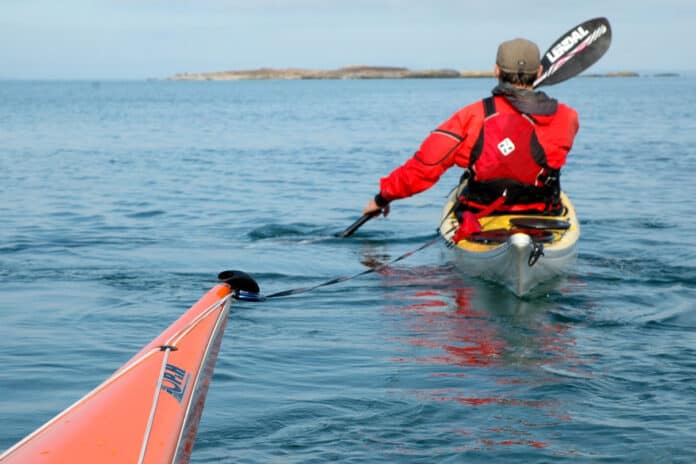
The most basic towing formation is the inline tow. In this system, the towing paddler simply clips a line to the bow of the boat to be towed and then pulls it along behind their kayak.
Tow the line. | Feature photo: Alex Matthews
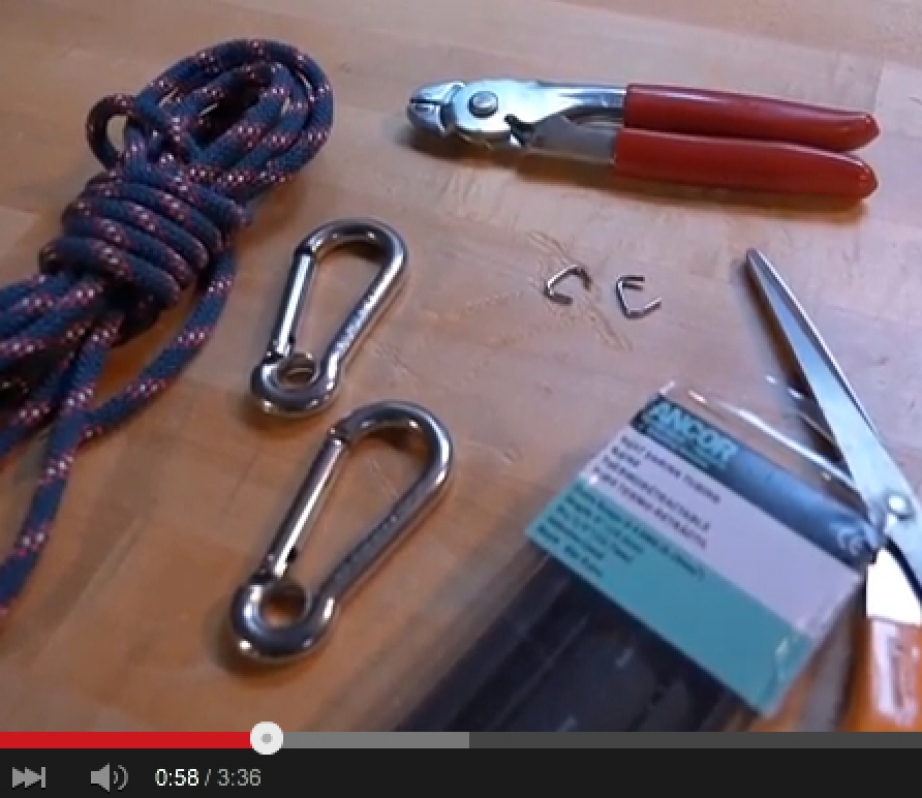
To effectively tow another kayak using an inline tow, you’ll need some dedicated gear in the form of a towline. Towlines consist of a length of webbing or line with an attachment system at each end. Most have a carabiner for clipping onto a kayak’s grab loop and a quick-release belt that lets the rescuer ditch the system with a flick of the wrist.
My favorite tow setup tucks the integrated line into a PFD. That way the system is always on your body, not an extra bit of gear to forget or decide not to don. A PFD-mounted tow also keeps the quick-release buckle fixed in place and easy to reach. Waist-worn tow belts can rotate and be tricky to manage in an emergency. Boat-mounted systems are great for long-distance tows—they’re easier on the towing paddler’s body, since the kayak takes the strain.
The basic portion of the tow system can be short or long. Short towlines or “cow tails,” around one to three meters long (three to 10 feet), are quick to deploy but only suited for very short-distance tows and can cause frequent, sometimes violent collisions between boats.
Long leashes, around 10 to 15 meters (30 to 45 feet), are better for longer distances. They provide enough space to reduce the risk of collision—especially in following seas where the towed boat can surf down a wave and ram the lead kayak. Many systems integrate some shock absorption—usually shock cord—to soften the load and reduce jarring.
Towing is physically taxing. The decision to tow another kayak over a long distance shouldn’t be taken lightly. In rough conditions or when fighting current or wind, it’s truly exhausting. Deploying long towlines in surf or rapids should be strongly discouraged due to the risk of entanglement.
This article was first published in Issue 73 of Paddling Magazine. Subscribe to Paddling Magazine’s print and digital editions, or browse the archives.
When it comes to a pair of kayaking shoes, there seems to be two extremes to choose from: pricey high-performance ones ready for anything, and cheap box-store pairs with thin mesh uppers and a clunky sole that are lucky to make it a week at summer camp let alone a season of a paddler’s use. Level Six’s new Tidal Shoe sets out to provide paddlers with another option—a pair of shoes that will protect your feet and hold up to use, yet be a relatively low-cost.
Construction of the Level Six Tidal Shoe
The Tidal Shoe comes in at a minimalist design compared to the other footwear in the Level Six catalog including the River Boot 2.0 and Creek Boot 2.0. According to Level Six founder Stig Larsson, the Tidal Shoe is inspired by the whitewater playboating crowd—a group that needs something low-profile and functional on their feet in order to be able to fit inside the limited space of a low volume kayak deck. Larsson says, others like paddleboarders and general water users will appreciate the slenderness of the shoes design as well.
The upper is constructed of a polished-looking 1.5 millimeter-thick, heathered neoprene for an enclosed, secure fit that provides both thermal and protective layering. Level Six has brought the rolled cuff cut up toward the top of the ankle to prevent rocks and sticks from getting inside. Meanwhile, a wide rubber band runs across the top of the foot to keep the shoe in place without the added bulk of laces or velcro straps.
Underneath the shoe, the sole is constructed with a vulcanized rubber, and has a thinner, climbing shoe like profile that even includes section of rubber wrapping over the toes for added protection around your lower digits.
For those paddling recreationally, without long carries to and from the water, or whose paddling outings don’t involve skipping around treacherous terrain, the Level Six Tidal Shoe looks to be a capable water shoe that sets you back less than $50 USD. Learn where to find a pair at levelsix.com.



 This article was first published in Issue 73 of Paddling Magazine.