As the stories in this issue fell together from scattered corners of the globe, I found myself thinking often about a woman I knew when I was small.
She wore heels and flowing, hand-sewn skirts and pedaled a mountain bike (often at the same time); she inhaled a liter of diet Coke daily and served fruit salads for supper; she’d joined the military but despised conflict; she rode her Harley-Davidson Sportster to Fabricland; she used to skydive but gave it up after one too many close calls. She was self-taught and skilled in home construction, family law and Grade 12 algebra, although she never made a dime off building, lawyering or teaching. Her glamorous sensibility, her decadent frugality, her untrained discipline, her cautious recklessness, her stubborn open-mindedness, her clothes, her motorcycle—all of it captivated my impressionable young mind.
In an issue dedicated to mothers and grandmothers, daughters and sisters, it seemed only fitting that I dedicate this column to my own dear mom. She’s championed my adventures, even when I didn’t invite her; waited anxiously for SPOT signals with SAR on her speed dial; and when I became obsessed with a sport she had never tried, she didn’t mourn our cycling years—she bought a sea kayak.
When I was young, I thought her marvelous contradictions were hers alone. I attributed my own peculiar yens and conflicted tendencies to her whimsical influence.
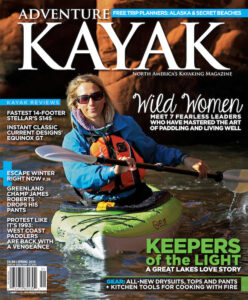
Years later, I’ve come to the realization that we are both members of an equally enigmatic tribe. A tribe whose members, like quirky cottager Maureen Robertson (“Keepers of the Light”) and the adventurous spirits in “Water Women”, so often embody an extraordinary ordinariness. A tribe not bounded by borders, traditions, politics, race or religion. A tribe headstrong and heedless of so-called limitations: strength, size, resources, influence, experience.
Collecting reward miles. Photo: Virginia Marshall
Among us are pioneers and visionaries; artists and educators; nomads and migrants; leaders and supporters; idealists, advocates and ambassadors. We are both dreamers and doers. We have defied stereotypes—that we’d sooner confer than act; that compassion makes us weak, caution holds us back—and set records: first, fastest, youngest.
“What we most regret are not the errors we make, but the things we didn’t do.”
Why do we do it? Why travel around countries, continents and even the planet under our own power; why abandon the familiar in favor of the unknown; why face impossible challenges alone, with only our wits and will? The stories in this issue attempt to answer those questions, and hopefully inspire you to embrace your own apprehensive adventurousness.
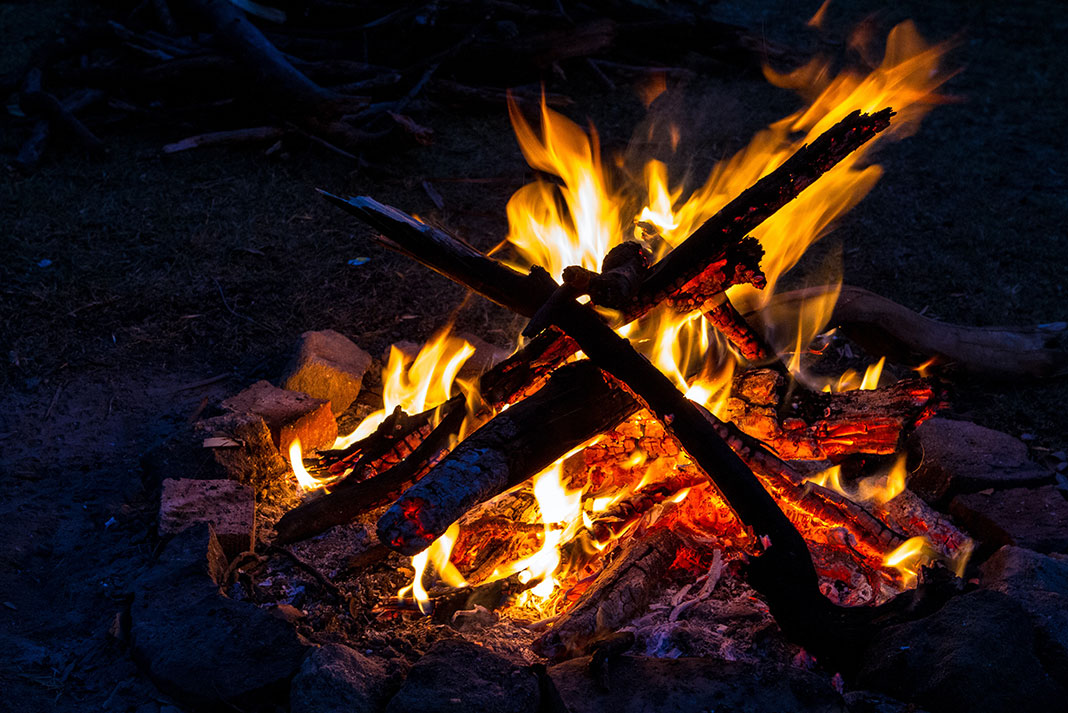
“The only real security is…the ability to build your own fires and find your own peace,” advises Audrey Sutherland, who speaks with the wisdom of more than nine decades exploring our watery globe. “What we most regret are not the errors we make, but the things we didn’t do.”
“As you get older, you need not worry; your playful spirit will keep you young at heart.”
Recently, my mom shared her own advice: “As you get older, you need not worry; your playful spirit will keep you young at heart.” That nebulous quality, she said, is our true source of strength.
You cannot vote or buy or even earn your way into this tribe. You are born to it, as I count myself fortunate to have been. Its rewards—and its paradoxes—last a lifetime.
Adventure Kayak editor Virginia Marshall shamelessly apologizes to all those excluded from her tribe.
This article first appeared in the Spring 2015 issue of Adventure Kayak magazine. Subscribe to Paddling Magazine and get 25 years of digital magazine archives including our legacy titles: Rapid, Adventure Kayak and Canoeroots.
For an effective sea kayak rescue when you have a flooded hatch and no way of landing to shore, Cleopatra’s Needle, also known as the curl rescue, is a reliable way to ensure you are on your way. If the front or rear compartment of your kayak floods after you hit a rock, blow out your hatch cover or experience a leaking skeg box, the standard T-rescue is useless to solve this problem. Master the curl rescue and you’ll be equipped to handle this situation. It’s super fun to practice too. In this episode, Leon Sommé of Body Boat Blade demonstrates how to perform this useful rescue.
Stay tuned for more skills videos with Body Boat Blade International in this series, presented by Adventure Kayak, and watch more techniques on our YouTube channel.
There’s a simmering conflict along North American rivers. Unlucky paddlers accessing the hundreds of thousands of miles flowing through private lands have been charged, threatened and even shot. Neil Schulman dives into the murky waters of river access.
On July 20th, 2013, Paul Dart, Jr., 48, and a group of family members rented canoes and paddled a stretch of Missouri’s Meramec River. Five hours into their trip, Dart and three others pulled ashore on a gravel bar. Believing Dart and the other men were trespassing, riverfront property owner James Crocker confronted the group with a 9mm pistol. An argument ensued, tempers escalated, and Crocker shot Dart in the face at point-blank range. Dart died en route to the hospital.
The riverside tragedy was a violent boiling-over of a conflict between river users and property owners that had been simmering for years—and not just on the Meramec.
Due to unclear laws, poor communication and cultural divides, waterway conflicts have festered across the nation. If you paddle outside public lands, you’ve likely experienced access issues in some form: a no trespassing sign along the water’s edge, a chain across a portage route, or a creek choked with barbed wire.
In North America, hundreds of thousands of miles of river flow through private lands. Many of those miles are contested. The Meramec murder was shocking for its violence, but not for the nature of the debate.
Crocker believed he was defending his property rights. “It’s my property and I was going to protect it,” Crocker told police. Last spring Crocker was sentenced to 25 years in prison for second-degree murder.
If you paddle outside public lands, you’ve likely experienced river access issues in some form. | Feature photo: iStock
According to the Missouri Conservation Department, Crocker owned the land extending to the center of the riverbed. However, in Missouri, navigable waterways come with an easement that allows the public to use the river, much like a public road or a sidewalk on private property. This easement includes the right to go ashore below the high-water mark, including the gravel bar where Dart was shot.
These legal nuances vary state by state and can be hard to grasp by paddlers, property owners and even law enforcement. Just look at the evidence.
In New York, a lawsuit is resolved after five years in court. At the center of the debate was a canoeist paddling on a creek through private property that connects two parts of a state forest preserve.
In North Carolina, landowners stretched a cattle fence topped with razor wire across the North Fork of the Chattooga, a designated National Wild and Scenic River.
The right to float the South Fork of the Saluda River in South Carolina continues to work its way through the courts. Paddlers have received trespassing citations on New York’s famed Au Sable River, only to have the charges dropped. Disputes have also led to the arrests of fishermen on both the classic John Day and Trask rivers in Oregon.
When streams flow through public land, the situation is simple. Unfortunately, most rivers in North America flow through some private property, where they can become tangled in a legal netherworld, awaiting clear rulings or the settlement of lawsuits.
Legal eddies
The public’s right to use rivers rests on a legal concept called navigability. In the legal sense of the word, the principle is that navigable rivers are akin to roads. Even if the riverbed is privately owned, the water is owned by the state, and the public has a right to use navigable rivers.
If that seems simple, it’s not.
“There are four types of navigability, and different tests, laws and lots of confusion [when applying the concept],” says Kevin Colburn, stewardship director of American Whitewater, a national body that promotes conservation and river access.
In Oregon, for example, the Division of State Lands asserts that a navigable river is “a river that was or could have been used to transport people or goods” at the time of Oregon’s statehood in 1859.
If that evokes visions of barges plying the Columbia, Mississippi and St. Lawrence, that’s not the case, says Eric Leaper of the National Association for Rivers. “A small steep river or creek, where a canoe could carry beaver pelts or small sections of logs, is navigable. It could be ankle deep and might not even be kayakable in today’s world. The Supreme Court has said that counts.”
Bureaucracy has dragged far behind the upward trend of river use across North America. Of Oregon’s 236 rivers and creeks, navigability rulings have been made on just 12 since statehood. The other 200-plus disputable rivers await navigability studies at an expected cost of over $10 million.
Who’s in charge
Confusion arises because whether state or federal law applies is open to debate. Leaper contends that a federally-established right of the public to use rivers stems from Supreme Court rulings ranging from 1789 to 1981.
“Landowners and their lawyers want you to believe that it’s a state-by-state issue because they think they have decent chance to win in state court,” says Leaper. Other river advocate groups read the legal landscape in different ways.
“It’s a terrible, time-consuming and conflict-based way to resolve the issue, with personal costs to people.”
Since trespassing charges generally fall under local jurisdictions and navigability rulings are done by states, state courts have ended up handling most river access cases. “A state court typically won’t get into federal law unless the river users say that is what their right is based on,” Leaper says. State laws and courts tend to mirror their state’s political culture. Politically conservative states tend to treat property rights as sacrosanct, while states with progressive voters and strong outdoor recreation culture tend to be more sympathetic to paddlers, fishermen and public use.
In Canada, the right to access waterways through private land is also complicated. “Anyone can paddle on the waterways. There is often a shoreline public right-of-way, 66 feet deep, that is public access,” says Graham Ketcheson, executive director of Paddle Canada. “But in the last 35 years, in the province of Ontario, people have been able to buy the frontage from some municipal governments and own it right down to the high waterline. That’s where it gets complicated. How does a paddler know what is public or private when they want to stop?”
Phil Brown recently resolved a five-year-long river access lawsuit. | Photo: Susan Bibeau
Nobody knows
In the U.S., where there is a right to float, river users are also allowed to use the riverbed below the high-water mark, as Dart did on the Meramec. But what about scouting and portaging, which often involve stepping above the high water mark? Those laws vary. In Montana, it’s legal. In North Carolina, the law isn’t clear, says Leaper.
The legal morass doesn’t end there. Many states are awash in deeds that show property lines running to the low-water mark or centerlines of rivers. This means landowners are paying property tax on land that is underwater, and, if the public can use the river, over which they have little control. Some landowners worry about liability from public use of their property, or the effects on ranching operations.
Where’s it headed?
As river use in North America grows, comprehensive legal rulings have remained elusive. “A certain amount of court cases will slowly work their way through the system,” says Colburn. “It’s a terrible, time-consuming and conflict-based way to resolve the issue, with personal costs to people.”
In 2009, Phil Brown, a magazine editor from Saranac Lake, New York, paddled a short stretch of Shingle Shanty Brook through private land as part of a two-day trip through the William C. Whitney Wilderness, a state forest preserve. His trip was done to make a point.
“I believed I had the right to paddle the short section through private land, even though it was posted,” says Brown.
The year after, state officials determined that the waterway was open to the public. However, that didn’t stop the landowners from serving Brown a trespass lawsuit in 2010. The court dismissed the suit, but the landowners appealed the decision and put up cameras. A final ruling was made on January 15, almost six years after the trip that launched the dispute. The court ruled in Brown’s favor 3-2.
“I’m grateful to New York State officials for taking my side in this case,” he adds. “It gives me hope that, in this state at least, paddlers’ rights will be defended. With luck, New York will set an example for other states.” The landowners may yet appeal the ruling.
Phil Brown paddling on Shingle Shanty Brook on a portion that flows through posted private land. | Photo: Susan Bibeau
Heart of conflict
Amidst these muddied waters, two things are clear. First, the legal aspects can be befuddling to everyday river users, with few avenues for resolution.
“It’s difficult to get [these disputes] settled out of court by normal people. But normal people paddle rivers and normal people own land,” says Colburn. Even the most basic rule of thumb—don’t trespass where posted—can create problems, since landowners may assert rights they don’t actually have.
“The no trespassing guideline is useful if you want to avoid conflicts, but it’s not useful if you are within your rights and want to assert them,” says Colburn.
“We encourage paddlers to not turn a blind eye to others who are setting a bad example.”
Like Brown, paddlers can be forced to make individual choices about when to assert what they believe are their rights or when to turn the other cheek. When paddlers avoid conflict, they may leave property owners with mistaken belief that they have the right to restrict access to rivers or gravel bars.
Second, river conflicts often mirror larger fault lines that divide North American society: rural and urban, progressive and conservative, rich and poor, and divisions between environmental advocates and land-based industries.
“Urban paddlers in modern boats can seem like an invasion to a rural landowner,” says Leaper, adding that this is especially true where past conflicts have put urban and rural concerns at odds. The simultaneous rise in outdoor recreation and property-rights rhetoric has only intensified the fervor.
Paddlers’ behavior can also make relations worse. Rivers that fill with drunken revelers in summer, like Oregon’s Clackamas and to a lesser extent, the Meramec, tend to have more conflict. And what may seem like normal river behavior to some paddlers—discretely changing clothes at the put-in or a pee break on a gravel bar—can irk locals.
The communication gap
When taken as individual issues, fences, noise, scouting rapids, and a lack of decorum sound like minor disagreements that can be resolved in conversation without lawsuits, let alone guns. So why does it get out of hand?
One factor is the decentralized cultures of both sides. Most disputes originate with individual landowners, of whom there are millions. Paddling clubs and fishing organizations, the strongest partners in communicating with landowners, represent a small fraction of river users. Few mechanisms exist to communicate when problems arise. Subtle behavior changes that could reduce tension—changing parking locations, adding a garbage bin at the take-out, or scouting from river left—often aren’t communicated to the masses.
This lack of communication means a lot of missed opportunities. Colburn cites an instance where a landowner blocked a river with a fence to keep livestock on his land.
“There are ways to keep cattle from moving that leave the river open and are no inconvenience to paddlers,” Colburn says. As an example on the other side of the debate, “if paddlers changing clothes is an issue, let’s build a changing house.” Poor communication leaves both sides frustrated and entrenched.
When communication happens early, tensions often ease. Advocacy group Whitewater Ontario works to resolve access concerns before they can snowball.
Neil Schulman is a paddler and conservationist living in Portland, Oregon.
This article was first published in the Spring 2015 issue of Canoeroots Magazine. Subscribe to Paddling Magazine’s print and digital editions, or browse the archives.
If you paddle outside public lands, you’ve likely experienced river access issues in some form. | Feature photo: iStock
LISTENING TO HER INNER GUIDE.
| PHOTO: SAMO VIDIC/RED BULL CONTENT POOL
“You’re always seeking that perfect moment, that perfect run,” says Nouria Newman. “It’s the thing I like the most about slalom, and it’s also the most frustrating.”
I ask her what it feels like when that perfect moment happens.
“It never really does,” Newman answers, but later mentions that she catches glimpses of it now and then on a training run. “It’s…it’s a lot like dropping a waterfall,” she says.
The comparison isn’t one most people can relate to, but it makes sense coming from Newman, a rare link between the ultra-competitive European slalom scene and the cool kid crowd of creeking and extreme races.
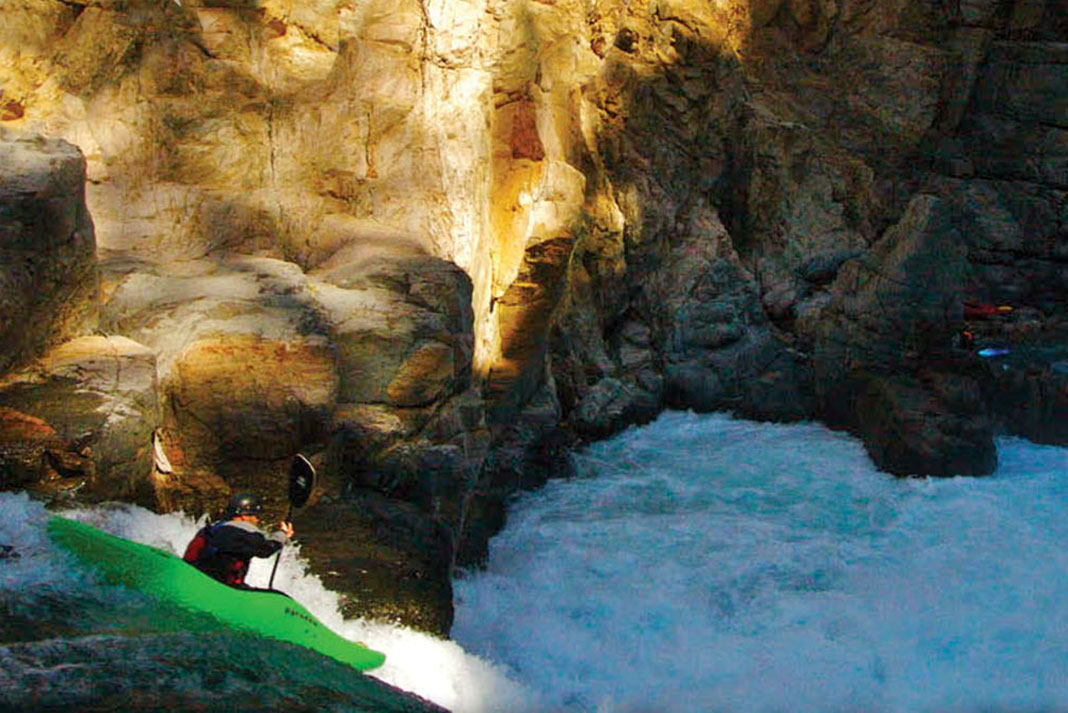
Not just anyone can bridge that gap, but in 2014 Newman trained for and made the French national slalom team, competed in 15 slalom competitions, notched off the first full female descent of the class V Grand Canyon of the Stikine River and won the Sickline Extreme Kayak World Championship, all while working through a master’s degree, traveling the globe and nursing an injured shoulder.
When I ask her what she considers the biggest accomplishment of the year, she hesitates. “It’s hard to measure an accomplishment,” she says. “I’m probably most proud of just looking at what I like to do and really going for it without thinking about the result.”
LISTENING TO HER INNER GUIDE. | PHOTO: SAMO VIDIC/RED BULL CONTENT POOL
It’s not something I can imagine many slalom competitors saying. In fact, in a recent interview, Newman told me about her pre-race ritual of sitting in her boat, eyes closed, visualizing each and every gate, boof and stroke, picturing the results with precision.
The fast friends, meet-you-at-the-put-in vibe of the river running world is in sharp contrast to the training regime of slalom’s elite. People have their eyes on the 2016 Rio Olympics. It’s competitive, on and off the water, and Newman enjoys interspersing that intensity with other adventures.
“In creeking even if you compete, you don’t really care,” she says. “You just care about having your friends safe at the bottom of the course.”
It’s not that Newman doesn’t have her eye on Rio, it’s just that she’s not willing to make it her one and only goal.
“It’s hard to measure an accomplishment. “I’m probably most proud of just looking at what I like to do and really going for it without thinking about the result.”
“I don’t do slalom because I want to go to the Olympics. I do slalom because I like it,” Newman says. “If I make it my main goal, I wouldn’t be true with myself and with what I want to do with kayaking.”
She explains this with another analogy revealing of her deep immersion in all things kayaking. “When I went to the Stikine, I never planned to run Site Zed,” says Newman—it’s the river’s notorious crux, a rapid no one touched until Ben Marr’s 2012 descent. But as she stood there scouting, everything fell into place. “I had a good crew. I saw the line. I was feeling good,” she says.
The descent put her run in the record books and left us with a question we’re always asking when it comes to Newman: what will she do next?
As it turns out, she’s wondering the same thing.
“You have this little voice in your head, that’s like ‘sweet, it’s all good to go,’” says Newman. It’s taken her a long time to tune into it, she says, but she plans to listen to that voice as she decides what to do next.
This article first appeared in the Spring 2015 issue of Rapid magazine.
Subscribe to Paddling Magazine and get 25 years of digital magazine archives including our legacy titles: Rapid, Adventure Kayak and Canoeroots.
Rapid Media publisher Scott MacGregor catches up with Pyranha’s Brian Day to get a look at the first sit-on-top crossover kayak on the market—the Pyranha Fusion SOT. This whole new category of kayak will allow anyone to hop on and go enjoy local lakes and rivers of far flung expeditions.
Many years ago a Cree man came south from Hudson Bay to take a course with me. He was not an experienced paddler and I taught him many strokes. There was one in particular he loved; he practiced it a lot and by the time he left he was looking good. Shortly after, he got in touch with me and he told me an amazing story.
When he returned home he demonstrated his new skills to his extended family. He finished off with his favorite stroke and as he paddled to shore he noticed that his Grandmother was crying. He asked her, “Grandma, why are you crying?” She told him that she remembered her grandfather doing that exact stroke many years ago. The stroke was what my Dad called the Indian Stroke.
The Indian Stroke, also called a Rolling J and Silent Stroke, is ancient. It’s ideal for traveling quietly, without splashing and the sound of droplets falling from the blade. This is the stealth version of a J-stroke. It’s great when there is wildlife nearby that you don’t want to disturb, and also for traveling quietly in a relaxed and unhurried manner.
Silent canoe stroke in 5 steps
Photo: Reid McLachlan
1 Perpendicular paddle
Start with your paddle blade perpendicular to the canoe, and in the water just in front of your knees.
Photo: Reid McLachlan
2Initiate a J-stroke
Take a gentle forward stroke and as the blade reaches your hips, initiate a J-stroke by turning your grip hand thumb down then pushing away from the hull.
Photo: Reid McLachlan
3 Do the palm roll
As the J-stroke finishes, relax your grip hand and flip that hand’s position so that your thumb is now facing you. This is the palm roll and it is the most important and prettiest part of the stroke.
Photo: Reid McLachlan
4 Return your blade
Now slice the blade forward, keeping it in the water and parallel to the canoe.
Photo: Reid McLachlan
5 Slight bow draw to steer
As you set up for the next stroke, you will find it natural to start with a slight bow draw to help with steering and to connect seamlessly into the next forward stroke.
Silent canoe stroke tips
The power face of the paddle changes because of the palm roll at the end of each stroke.
The palm rotations are done slowly, like gently rubbing oil into the grip with the palm of your hand.
Keep the throat of the paddle just above the waterline throughout the stroke. This reduces splashes and gurgles, and increases efficiency.
If you are trying to get close to wildlife slow your movements and minimize your reach. Your stroke can be as short as six inches and still be effective.
This article was published in the Summer 2022 issue of Paddling Magazine. Subscribe to Paddling Magazine’s print and digital editions, or browse the archives.
Pocket-sized and powerful, Zippo’s Hand Warmer is a welcome treat at the takeout. The fill cup measures enough lighter fluid to produce heat for 12 hours without smell or smoke. Slim enough to slip into a mitt, this is a coveted heat source on icy spring days.
Oblio Paddles let you paddle your SUP like a Kayak
Rapid Media’s Scott MacGregor discovers how Oblio Paddles let you paddle your SUP like a kayak, or retrofit custom grips on your current kayak paddle for a more ergonomic stroke.
Review your technique for creating mechanical advantage rope and pulley systems. Be prepared for river rescue situations! This video from Boreal River Rescue covers simple 3:1 (z-drag) and 5:1 and compound 9:1 mechanical advantage systems with rope to unpin boats and for use in transportation systems. See more information at Boreal River Rescue’s website.
Paddle farther and faster with less effort using these expert SUP forward stroke tips from Peter DeMoss at Muskoka Outfitters. Performed well, the SUP forward stroke is an unbeatable, fun core workout. Watch it, then try it!
Stay tuned for more great paddling skill videos, including canoeing, kayaking and whitewater techniques, brought to you in partnership with Rapid Media and Ontario Tourism.