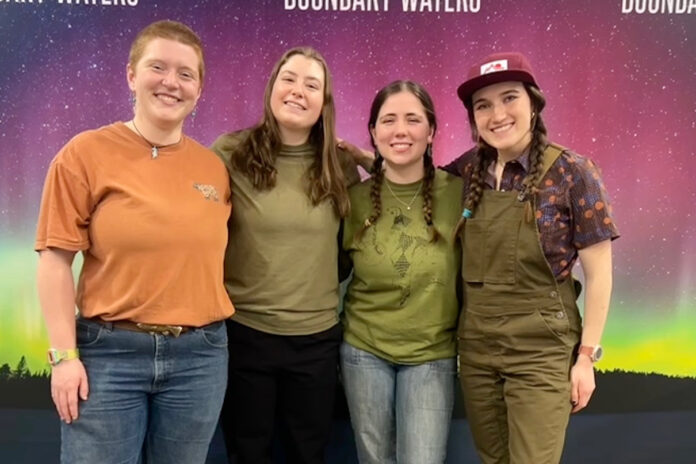
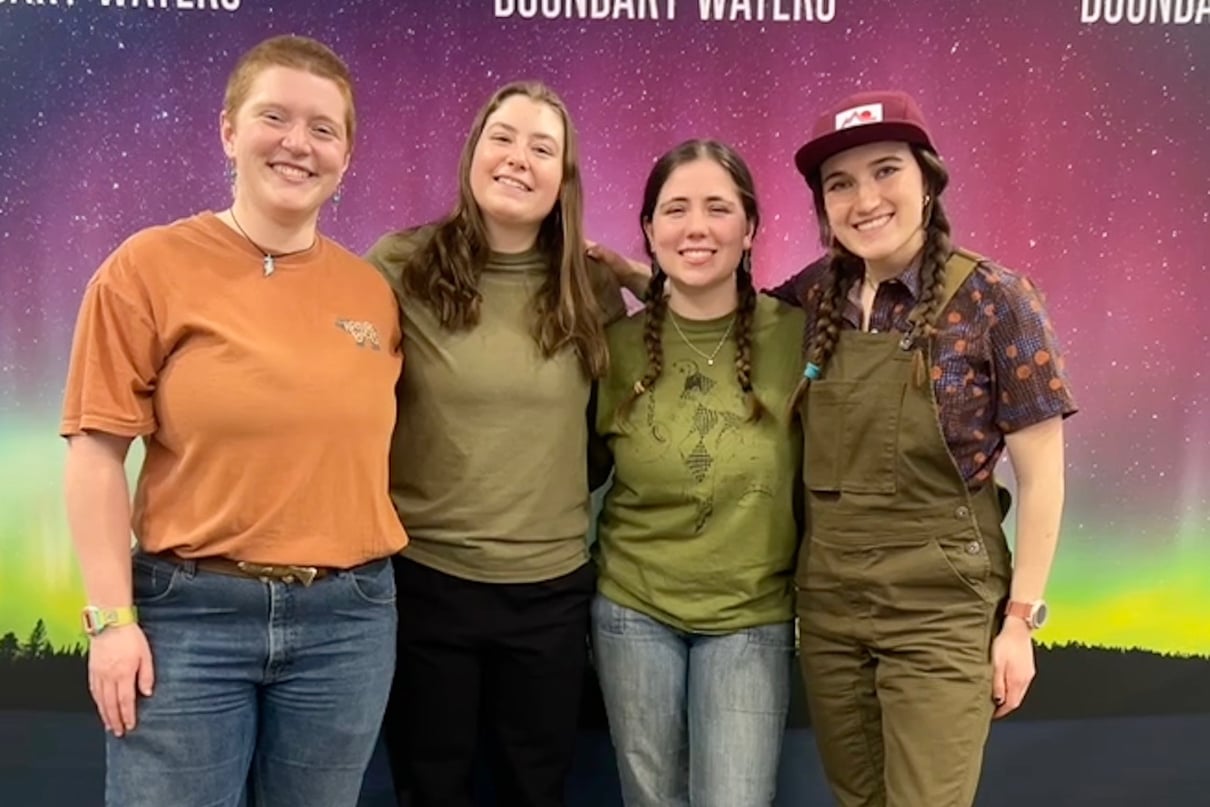
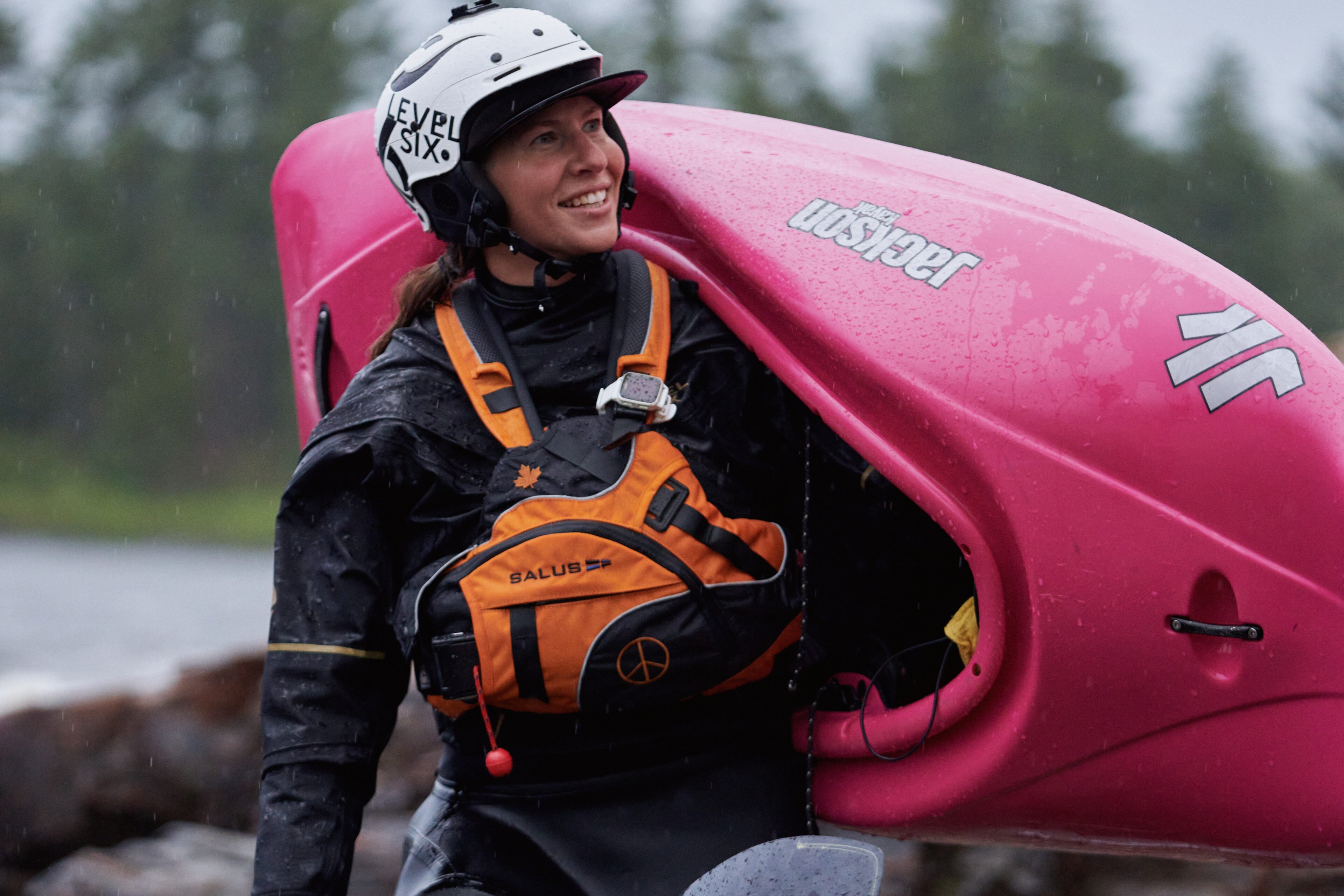
From left to right Emma Brackett, Abby Cichocki, Helena Karlstrom, and Olivia Bledsoe at Canoecopia 2025. Feature image courtesy Hudson Bay Girls.
The historic route from Minnesota to the Hudson Bay has long captured the attention of canoeists. In summer 2025, four student paddlers and Girl Scout Alumni plan to tackle the over one thousand-mile route through large lakes, rivers, rapids and polar bear country to inspire young girls and women in paddlesports.
Abby Cichocki, Emma Brackett, Helena Karlstrom and Olivia Bledsoe met through their various roles in the Girl Scouts and Scouting America programs, all four with experience in professional guiding programs. This summer, the all-female team plans to tackle the historic expedition canoe route from the waters of Lake Superior at Grand Portage to York Factory on the Hudson Bay, calling themselves and their expedition the Hudson Bay Girls.
Hudson Bay Girls prepare to canoe from Lake Superior to the Hudson Bay
While prepping for this several-month long canoe expedition, the four have also been attending college. Cichocki is a junior at UW Madison, Brackett a senior at Clark University, Beldsoe a sophomore at Virginia Tech, and Karlstrom a senior at Ohio University. Planning for the trip as students has been like another full-time job.
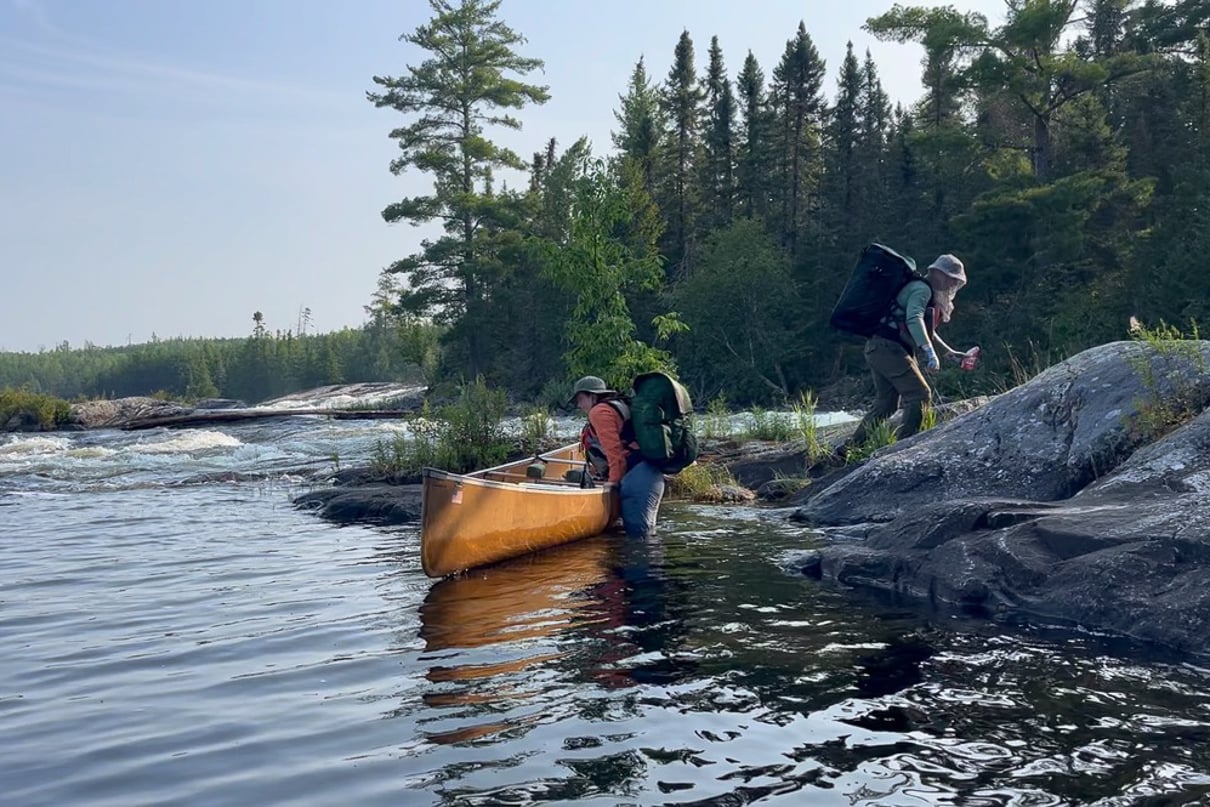
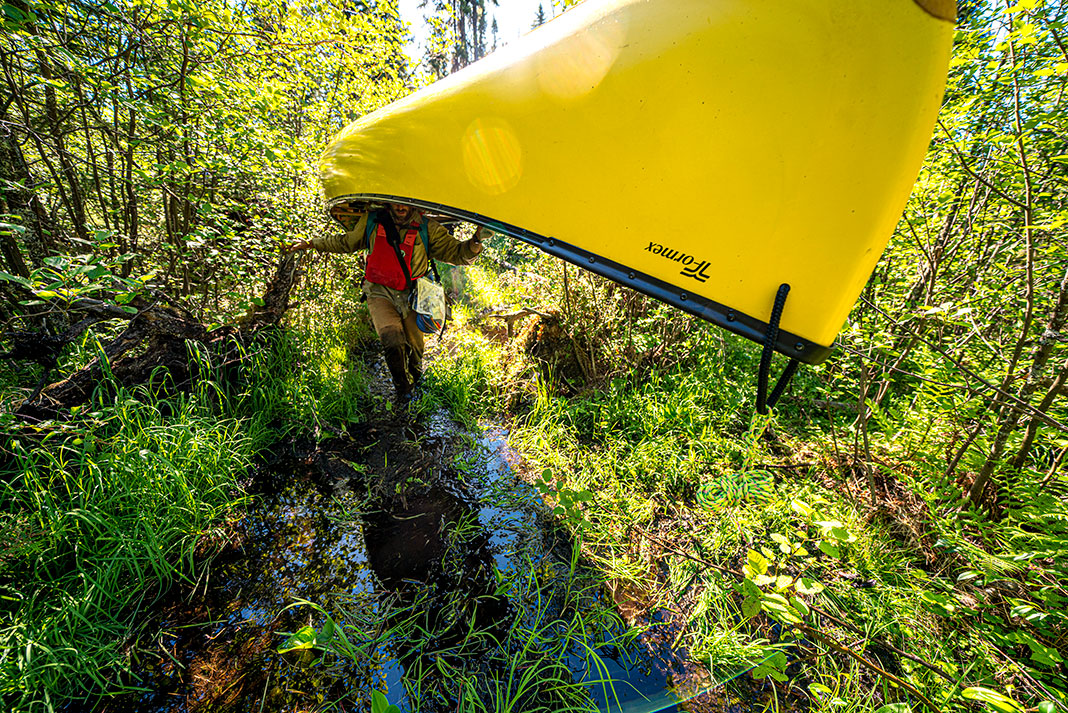
Preparing for portanging on a canoe trip. Image courtesy Hudson Bay Girls | Abby Cichocki
“We meet every week, typically for a few hours. We text every single day. We are in constant communication and we’re all constantly doing work on top of our schoolwork,” explained Karlstrom.
The team will begin their journey with the 8.5-mile portage from Lake Superior to the Pigeon River. From there, the Hudson Bay Girls will travel along the Border Route through the Boundary Waters Canoe Area Wilderness toward International Falls, where they’ll then turn north and begin the trek through Lake of the Woods. From here, the team will head up the Winnipeg River then spend an estimated three to four weeks working their way up Lake Winnipeg’s eastern shore.
The final leg of the trip will include three and a half weeks on the Hayes River and conclude at York Factory on the Hudson Bay– a route popularized in Eric Sevareid’s 1935 Canoeing With The Cree.
The route includes the traditional and cultural homelands of the Anishinabee and Cree First Nations.
Hudson Bay Girls aim to inspire more young women in paddlesports
The team was inspired to tackle this particular route by Natalie Warren’s Hudson Bay Bound, which followed the expedition of Warren and Ann Raiho as the first-documented female duo to complete the route.
“Just hearing about Natalie and Anne’s story as the first two women to publicly paddle that route was just so inspiring,” shared Bledsoe. “I don’t think it had ever occurred to me that I could be on an all-female expedition.”
From left to right Emma Brackett, Abby Cichocki, Helena Karlstrom, and Olivia Bledsoe at Canoecopia 2025. Feature image courtesy Hudson Bay Girls.
Just as the Hudson Bay Girls were inspired by Warren and Raiho, the Hudson Bay Girls hope to use their trip to encourage other young women to participate in paddlespots. On their expedition website, the Hudson Bay Girls write that “is that a girl under there?” is one of the most common things they hear on the portage trail as female canoe guides and trippers.
A 2019 report from the American Canoe Association found that the percentage of female canoeists fell by six percent from 2013-2018. For the Hudson Bay Girls, Girl Scouts and youth programming acted as a gateway into the outdoors and canoe trips.
“Girl Scouts was one of the most impactful experiences I had throughout my entire life,” shared Cichocki. “I moved around as a kid, but Girl Scouts was one thing that was always constant and it was always supportive. Whenever I do something hard, I say to myself, ‘it’s not as hard as carrying an Alumacraft canoe over a two mile portage.’”
Hudson Bay Girls on what makes a successful expedition
When asked about what challenges they expect to face on their 1,200-mile paddle, the Hudson Bay Girls agreed that they expected the biggest challenges to be mental rather than physical.
“I feel like when people think about challenges, we tend to really gravitate towards the material,” shared Bledsoe. “Expeditions fall apart based on what happens in your head first.”
While the Hudson Bay Girls’ expedition has a concrete end at York Factory, the paddlers agreed that for the team the intangible markers of a successful expedition were more important than a finish line.
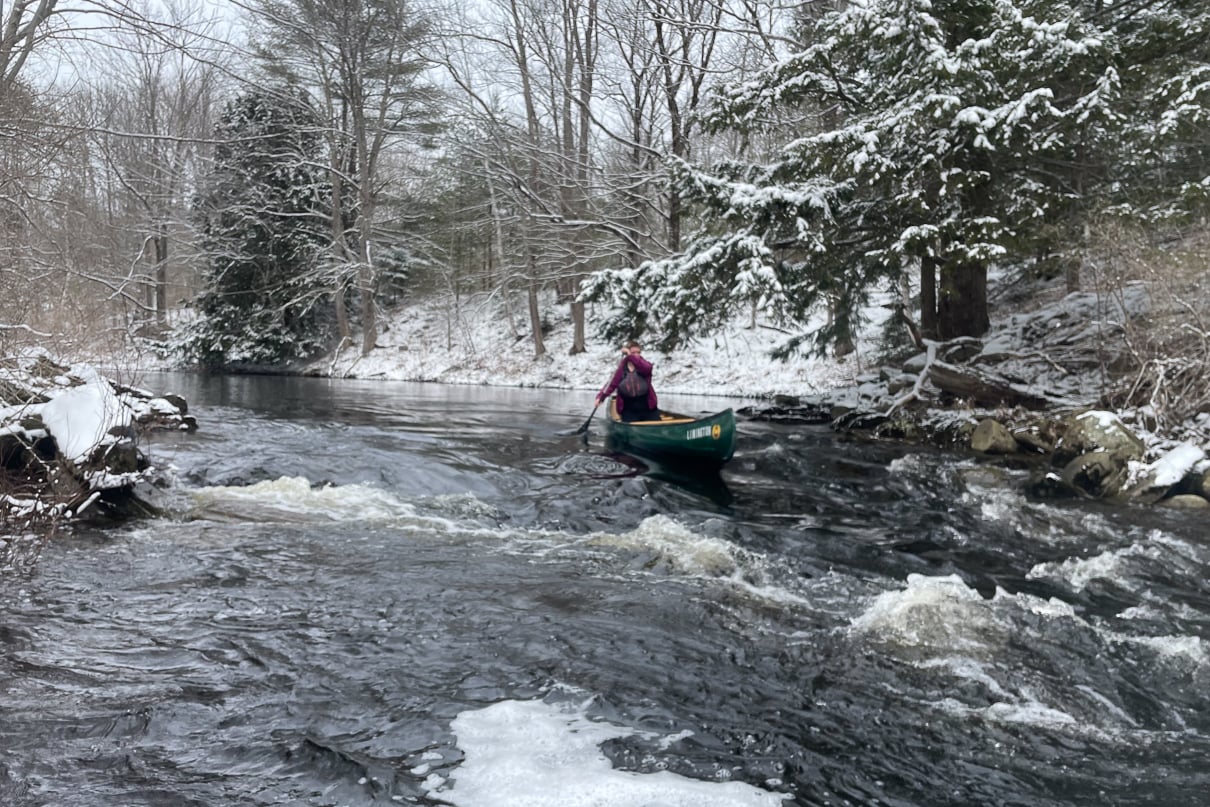
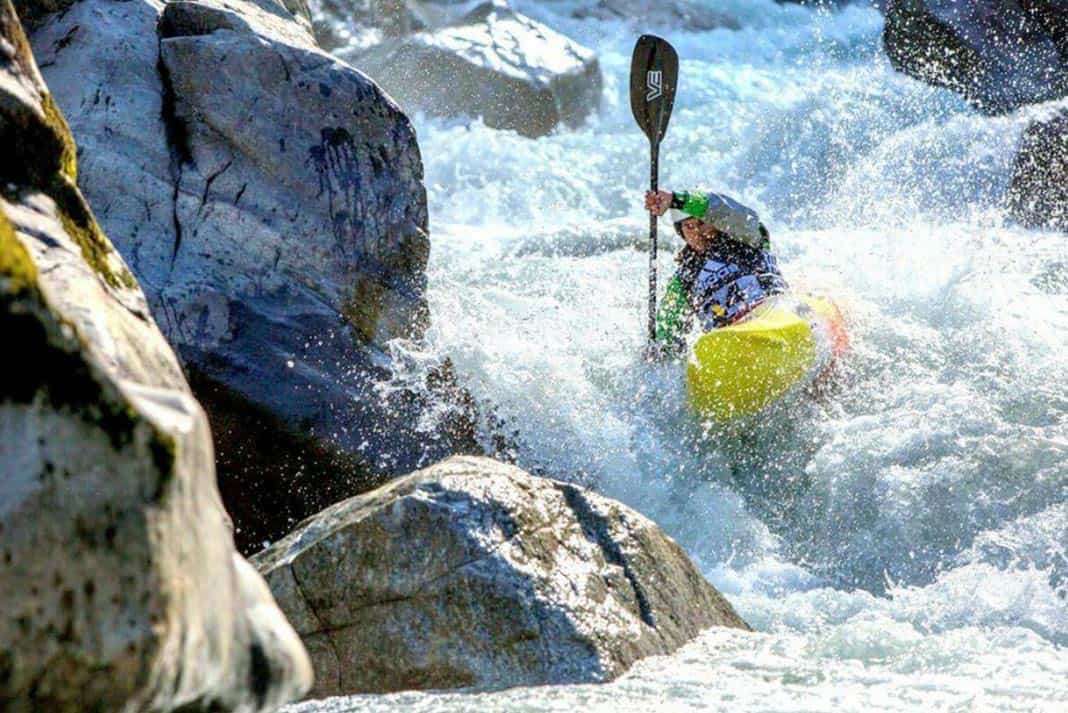
Emma Brackett of the Hudson Bay Girls above rapids in a canoe. Image courtesy Hudson Bay Girls | Emma Brackett
“I would say a successful trip is one where we come out the other side, all of us together and we’re still talking to each other, we are still friends and we’ve grown and we’ve become better, more interesting people because of it,” explained Cichocki.
“If we can change one person’s life and have one young girl look up at us and think maybe I can do that too, I think that would be a success for us,” added Karlstrom.
With an estimated 85-days of canoe tripping to look forward to, the Hudson Bay Girls are excited for everything from traveling north and watching the terrain change to laying on rocks in the sun like lizards.
“I’m so excited for the food because it’s going to be so good,” shared Brackett. “Abby’s parents have been making so much food and helping us dehydrate and freeze dry.”
The team at Level Six were sitting around the office, mulling over an infamous issue for an essential piece of whitewater kayaking gear when CEO Stig Larsson found inspiration in his morning coffee.
In whitewater kayaking, it’s not uncommon for athletes pushing the boundaries of the sport, running towering drops, to have the sprayskirt detach from the cockpit on impact. After years of roundtable talks and reviewing footage with team athletes, Level Six made an interesting discovery. These skirts were not necessarily imploding inward on drops due to the force of water hitting the exterior, but instead pushing outward from inside.
“We noticed some of their skirts were actually exploding off the boats when they would land—displaced by the air in their cockpit,” Alex Lowman, marketing manager at Level Six explained in an interview introducing the Class 6 skirt.
The exploding sprayskirt problem
Imagine for a moment you have an empty milk jug lying on its side, closed at the top with one of those snap-on plastic caps. Now, take your fist or a large mallet and slam it into the milk jug. The snap-on cap likely flew across the room. When a paddler plummets off a 100-foot waterfall and their kayak makes impact with the frothing, boiling base of the drop, the same force can occur. Your boat is the milk jug, the river a sledging mallet.
A sprayskirt blowing off like a bottle cap is, to understate it, not ideal in the middle of a river gorge. Level Six believes though, after years of R&D discourse and the morning coffee moment of enlightenment, they’ve finally found the solution.
A eureka moment for the Class 6
Stig Larsson was brewing up a pot of coffee in one of their design meetings on the topic when he took note of the bag in front of him. On it’s outside was a one-way degassing valve which allows carbon dioxide emitting from the roasted beans out without letting oxygen in. According to Alex Lowman, Larsson pointed it out to the team and said, “Why don’t we put a relief valve on there similar to a coffee bag?”
The coffee bag idea led to a more advanced built-out relief valve inserted on the deck of the Class 6 Sprayskirt. The valve is a medical-grade surgical valve screwed on to a silicone patch and reinforced with additional neoprene. According to Lowman, it is also serviceable. If you get sand in the valve you can take it out and clean it.
The innovative sturdiness of the Class 6 sprayskirt doesn’t stop with the relief valve to prevent skirt explosions. Level Six also included a memory rand made with a stiff rubber compound, which once broken-in takes the shape of a kayak’s cockpit rim. The skirt is also made with a limestone-based neoprene and includes markings to trim the tunnel to your desired length.
The Class 6 is built for the highest demands of whitewater kayaking. However, as with most gear innovations, Lowman and the team at Level Six see the Class 6 as just the beginning of where the new relief valve can be implemented on sprayskirt designs.
Two kayakers are considered “lucky to be alive” after they went over the Dock Street Dam in Harrisburg, Pennsylvania on Sunday, April 20, 2025.
A WGAL8 news report shared that the pair were thrown from their kayaks and struggling in turbulent water when good samaritan fishermen helped the kayakers until a water rescue craft arrived.
Low-head dams: a drowning machine
Both kayakers sustained minor injuries. While an inflatable kayak was pulled from the river, a hard-bodied kayak remains to be recovered, still circulating in the dam.
Dock Street Dam is a low-head dam, or a dam with strong recirculating currents that can push victims under water. Often called a “drowning machine,” low-head dams are nearly impossible to escape.
To avoid low-head dams while paddling, research your route beforehand. Lowhead dams are manmade structures generally featured on maps and guides to water trails. Kayakers should always steer clear of low head dams and portage around them when traveling downstream. Check water levels and wind before you head out as both water levels and wind can make finding a take-out challenging. Be sure to both wear a PFD and bring a throw bag. When in doubt, choose a different route.
Hidden danger on the Susquehanna River’s Dock Street Dam
According to a recent report by PennLive, the rescue comes after a federal lawsuit was filed against the city of Harrisburg by Elizabeth Hibble, wife of Michael Brook. Brook died in a boating accident at the Dock Street Dam in 2023 when his fishing boat stalled and drifted downriver, and unbeknownst to Brook, toward the dangerous dam. Brook, his friend Elijah Rothell, and the boat went over the dam.
Both Brook and Rothell’s life jackets were ripped off by the force of the dam. Rothell was rescued while Brook died from hypothermia and freshwater drowning.
The lawsuit claims that the city violated the Dam Safety Act by not having required warning buoys in place and that the city knew how dangerous the dam was and did not do enough to protect boaters.
Additionally, a PennLive investigation found that 31 people have died at the Dock Street Dam since 1913.
After being swept over the Dock Street Dam in Harrisburg, Pennsylvania, two kayakers are safe and one of the two boats has been recovered. Feature Image: ABC27 News | YouTube
You don’t have to break the bank to get into kayaking. There are plenty of cheap kayaks on the market that will grant you painless entry into the paddling world. Recreational kayaks best suit the needs of both entry-level paddlers and those working within a conservative budget. For that reason, the focus of this article will largely be on recreational kayaks that fall under the $500 mark.
Keep in mind the prices of kayaks vary, with higher performance boats having higher price tags on average, and so even their cheapest models will be priced above $500. That being said, the points below can be applied generally to all boats that fall on the cheaper end of the spectrum for a given type of kayak.
So, are you wondering what to look for in an affordable kayak? We’ve polled experts to help answer all your questions about what to look for in a good budget-friendly kayak, including their strengths, weaknesses, typical user and where to find the best kayak selection and prices.
Wear A Life Jacket
Everyone, even strong swimmers, needs to wear a life jacket at all times when on the water. It is extremely difficult to put a life jacket on once you fall into the water. Even a light wind can blow any paddlecraft away from you, faster than you can swim.
Always wear a USCG-approved Level 70 or Type III life jacket designed for paddling.
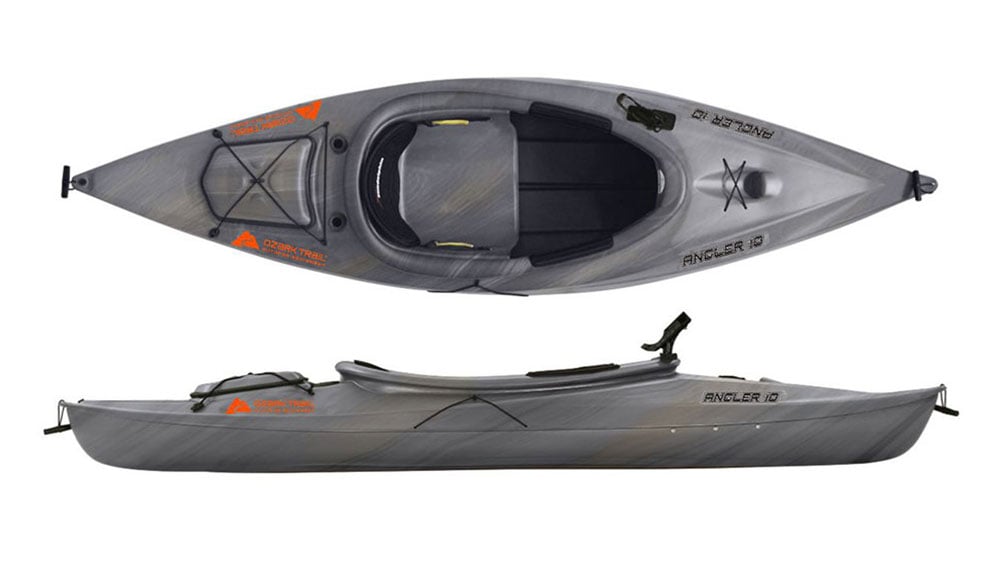
Great for lakes and rivers and to get to those excluded fishing spots The Ozark Trail Angler 10 Sit-In Fishing Kayak is perfect for your next adventure. It is ideal for lakes and rivers and to get to those excluded fishing spots. Weighing only 41 pounds, it is lightweight enough for most adults to carry with ease. The Ozark Trail Angler 10 Sit-In Kayak features a large, comfortable seating area with protective thigh pads and adjustable foot braces. You have plenty of room for your gear with the covered storage compartment with bungee cords in the front and back. It is constructed from rugged UV-stabilized High Density Polyethylene. The Ozark Trail Angler 1010 Sit-In Kayak tracks and paddles with ease providing you with maximum stability while in the water.
The ARGO 100XP ANGLER is specifically tailored to the paddler looking to regularly use their kayak fishing or on recreational expeditions. It is also great for a family of kayaking enthusiasts, each with their own preference on how to spend their time on the water. With ergonomic carrying handles and at only 41 lb., you will be able to easily carry the ARGO 100XP Angler to wherever you decide to go!
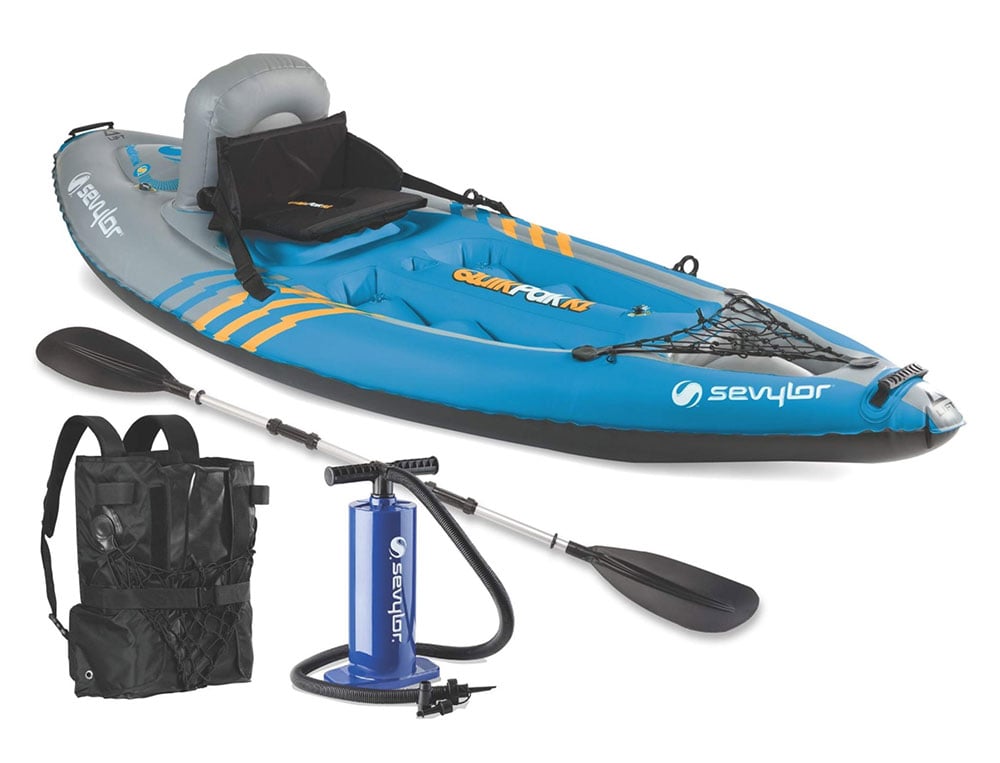
Explore alpine lakes or remote waters with the Sevylor K1 QuikPak Kayak. This compact one-person boat inflates in minutes with the included hand pump and packs down into the included backpack for travel. As you paddle along the shore, the cargo net on top of the kayak keeps your gear close at hand and a drink holder can hold a water bottle to keep you hydrated. A durable, tarpaulin bottom is built for durability, while a clever design with multiple air chambers means that the boat will not fully deflate if it gets a single puncture. A backrest and multiposition footrest makes for comfortable paddling or floating.
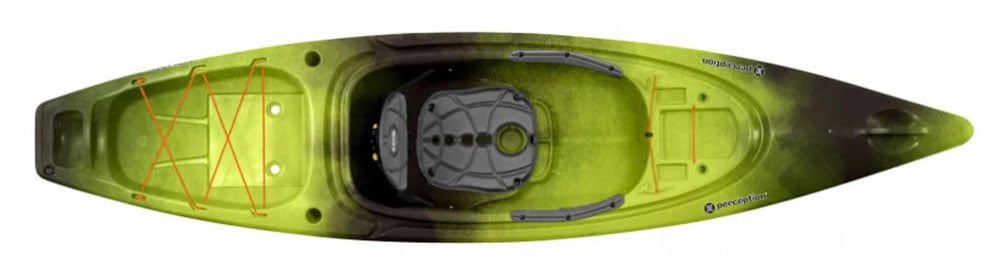
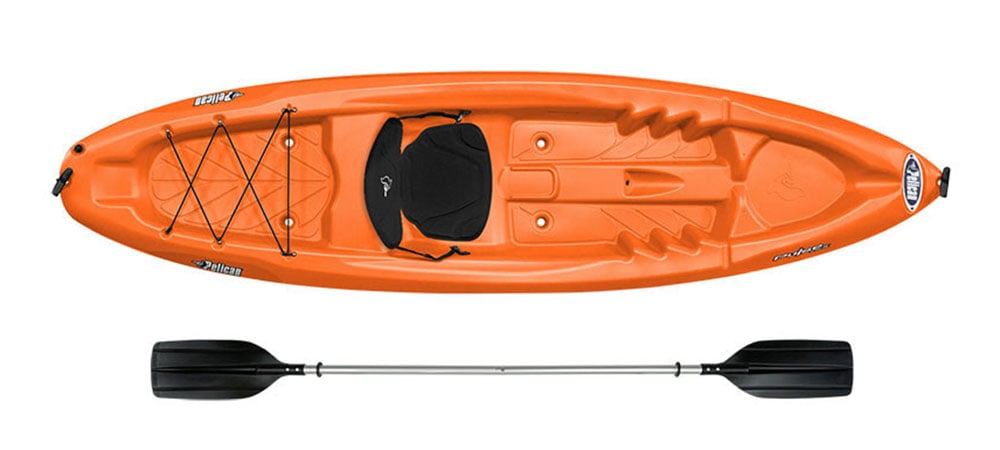
The Sound kayak makes paddling and fishing easy with the perfect combo of comfort, features, and light weight portability. Built to explore quiet, slow-moving waters, the Sound’s tri-keel hull creates ultimate stability and smooth steering to track straight and stay on course with minimal effort. Value-packed and feature-rich, the Sound includes a dashboard with mounting points for accessories, two molded-in rod holders, and a spacious rear storage zone with bungee.
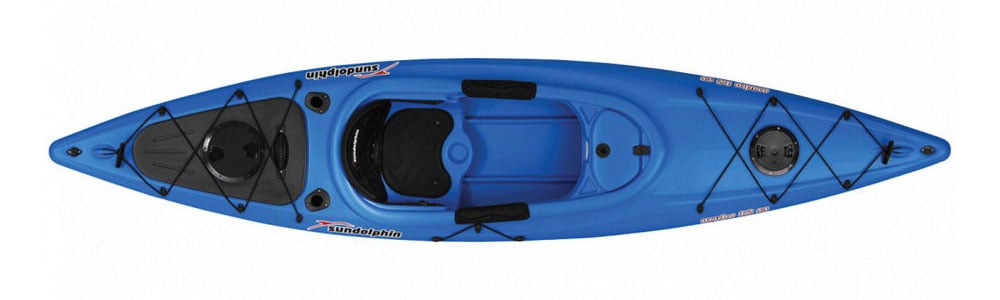
The dynamic styling along with the many convenience features will make your paddling experience comfortable and enjoyable. The feature packed Aruba 12 ss includes a unique and removable P.A.C. (Portable Accessory Carrier) that can be used as extra storage. Other features include large comfortable seating, covered console, protective thigh pads, adjustable foot braces, storage compartment, shock cord deck rigging, retractable carrying handles, paddle holder and two flush mount fishing rod holders all at an affordable price. Made from extremely durable dent-resistant High Density Polyethylene.
The Pulse 100X is a self-bailing recreational kayak built on a twin tunnel multi-chine hull providing superior stability and maneuvrability. This sit-on-top kayak includes molded footrests, an adjustable ERGOFORM G2™ seat, a tank well with bungee cords to store your personal items and a bottle holder.
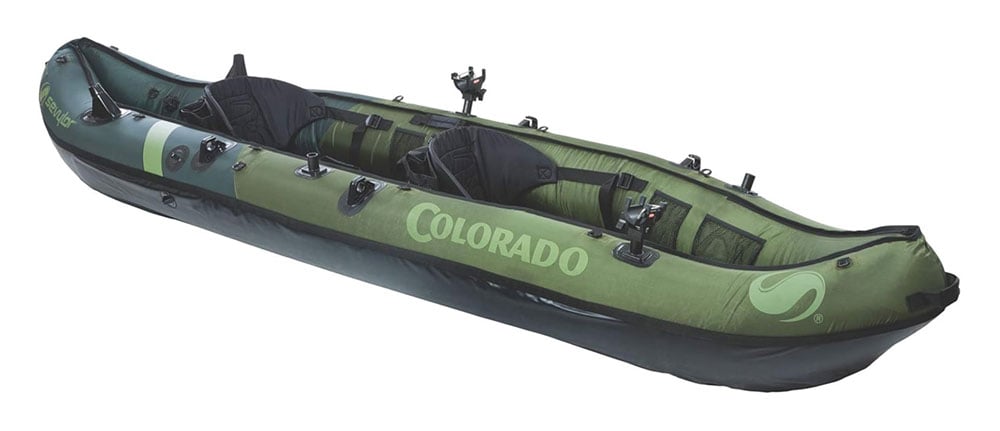
Take home your catch limit with a buddy after a day in the Sevylor Colorado 2-Person inflatable kayak. With 18-Gauge Pvc, a thick tarpaulin bottom and a tough nylon cover, this kayak is durable enough to get you to your favorite out-Of-The-Way fishing hole. Just in case, though, the multiple air chambers will help you get back to shore. The adjustable seats will keep you paddling comfortably the whole trip. But if you want to move more easily, you can always add the Sevylor trolling motor and store your paddles in the convenient holders. The Berkley quick set rod holders let you adjust your pole angle for the ultimate hands-Free fishing experience. With your hands free, it’s easier to take care of your gear, which stores nicely in the Sevylor Colorado 2-Person inflatable kayak mesh pockets or attached to d-rings.
Paddle Sober And Smart
Never mix alcohol and paddling. Coast Guard and state BUI (boating under the influence) laws apply to all vessels. This includes canoes, kayaks, SUPs and rafts.
Shopping for cheap used kayaks
There are lots of good cheap kayaks on the new and used market. The considerations of what is a good cheap kayak are the same whether you’re buying used from a paddling shop or privately. Of course, your first step is to do a bit of homework on the specific attributes of the make and model of kayak you’re considering.
Once you’ve narrowed down your selection to a few cheap used kayaks, heed the following advice to get the best boat for your buck.
Overall condition
Don’t buy a piece of junk, unless the price is too good to pass up! Examine the deck and hull of the kayak for deep gouges more than 1/8th of an inch or 3 mm deep; obvious abrasion (especially if the worn areas are a different color from the rest of the kayak); deformities (which will make the kayak paddle less efficiently); and fading (indicating prolonged exposure to the elements).
Remember, plastic kayaks are extremely durable and able to withstand plenty of abuse; some damage is fine, especially if the shape of the kayak remains intact.
Outfitting
Outfitting elements are found at the places where the paddler’s body touches the kayak—think seat, back support, thigh rests and footrests. Is everything included with the cheap used kayak? Sit in the boat before you buy it and make sure you feel comfortable. A supportive and padded seat is obvious; make sure you also check the adjustability of the kayak’s footrests and back support, both of which are essential for more efficient and ergonomic paddling.
One of the drawbacks of many cheap kayaks is substandard outfitting. Take a close look and consider investing in a more expensive kayak if you plan on more serious paddling. Outfitting is easily modified with some glue, foam and DIY time so, if you’re handy, consider any upgrades you could make.
On the water
It’s always best to try before you buy to make sure the kayak fits and performs as you expect. Arrange a meeting place with the seller that allows you to take a few moments on the water. Bring your usual paddle and dress in what you plan to wear while paddling.
Make a deal
In general (that is, before Covid-19) the typical starting point for a used kayak in moderate condition was about half its retail price. Boat shortages brought on by the pandemic have changed that, but you can use it as a starting point in haggling for an acceptable price.
Add some accessories
Ask the seller if they’re willing to throw in a paddle, sprayskirt or PFD (make sure it fits and is Coast Guard-approved for the location you’ll be paddling). Or, maybe you can save a few dollars if you have your own paddling gear.
For more tips on what to look for when selecting a used kayak, read our article on How To Buy A Used Kayak.
How to get a cheap kayak
Wondering what you need to know when looking for a cheap kayak? That simple question is often a starting point for so many more. Here are expert answers to the most common questions for those looking to buy a cheap kayak.
Where to buy cheap kayaks
Look no further than big box stores if you’re wondering where to get cheap kayaks. Outlets like Walmart, Dunham’s, Dick’s Sporting Goods, Canadian Tire and Academy Sports all sell cheap kayaks. With so many prospective buyers searching “Where can I get a cheap kayak” these large distributors are sure to turn up first on Google.
At the same time, big box stores sell a lot of junky kayaks and the sales staff often lack expertise. Take a look at paddling specialty stores if you’re more serious about paddling and want expert advice on buying a cheap kayak that best meets your needs.
Cheap kayaks online
It’s also possible to find cheap kayaks online. Check out Amazon if you’re looking for a new kayak, especially if you have a specific model in mind. Of course, online is also the best spot to find cheap used kayaks; search buy-and-sell platforms like Craigslist, Kijiji and Facebook Marketplace.
How much is a cheap kayak?
For the purpose of this article, a “cheap kayak” is under $500, since it’s specific to entry-level kayaks. However, cheap is a relative term and prices go up along with performance and quality (often related to considerations like length, construction and materials)—a bargain price light touring kayak will sell for $1,000 or less and a cheap sea kayak is under $1,500.
Are kayaks cheaper in winter?
In general, you’ll find better deals on last year’s stock and used kayaks if you’re shopping in the winter months—however, selection will be limited. Supply shortages brought on by the Covid-19 pandemic have upended this trend; kayaking is popular right now and it’s a seller’s market regardless of the time of year.
Best cheap kayak brands
The easiest way to find the best cheap kayak brands is to look to the manufacturers of higher-end, light-touring and sea kayaks and scan their price lists for the cheapest models. Browse paddling specialty shops and talk to experts to find what’s right for you.
In general, manufacturers of high-end kayaks like Wilderness Systems, Perception, Dagger and Delta will incorporate better performance features, design and outfitting in their cheaper models—however the price will be somewhat higher than the mass-produced kayaks available at big box stores.
If you’re on a tight budget and must shop at a big box store, it’s best to choose a kayak that’s made in North America. Our Paddling Buyer’s Guide will set you on the right course.
Cheap vs expensive kayaks
There are big differences between cheap and expensive kayaks. Performance is the obvious place to begin. Cheap kayaks are often mass-produced, sometimes even shaped for the most economical transportation or display options in big box stores (rather than for paddling efficiency).
Expensive kayaks, on the other hand, are carefully designed and tested before going to market to achieve certain performance goals. Similarly, cheap kayaks often feature bare-bones or cheaply made seats, back supports, thigh braces and footrests—key pieces of outfitting that connect the paddler and boat. The old adage, “buy the best you can afford” is a good tenet to live by when shopping for a kayak. There are some exceptions, but most often you get what you pay for.
Education: Get Some!
Take a paddling safety course from the American Canoe Association (ACA), your local paddling shop or outfitter, or other reputable source.
Take a boating safety course from the U.S. Coast Guard Auxiliary, U.S. Power Squadrons® or your own state’s boating agency.
Take on-the-water skills training.
Cheap kayak reviews
Maybe your cursory online searching has yielded a short list of kayak results? Or perhaps you’re standing in the aisle of a big box store, facing a wall of choices and turning to your phone and Googling, “What is a good cheap kayak” to buy.
Our cheap kayak reviews are your best online resource for complete specifications, design features and impartial criticism of the strengths and weaknesses of dozens of cheap recreational kayaks, including head-to-head comparisons and lists of the best kayaks depending on your paddling aspirations.
The Grand Canyon is a quintessential American National Park with layers of red rock sandstone, dramatic vistas from both rims, and of course, world-class whitewater paddling. This dramatic section of the Colorado River is a bucket-list paddle for many adventure lovers, but what does the trip actually look like from inside the canyon?
From the first unsupported sea kayakers to tackle the Grand Canyon to epic carnage, check out the best Grand Canyon whitewater videos on the internet:
Grand Canyon by Sea Kayak
More than ten years after four Canadian sea kayakers and an open canoeist paddled the Grand Canyon in what many claim was the first unsupported group of sea kayakers to tackle the canyon, the video has finally been released in 2025 on YouTube!
In addition to the historic sea kayak descent, James Manke is likely the first to paddle the river with a traditional Greenland paddle. The initial descent took place late December 2012 to early January 2013.
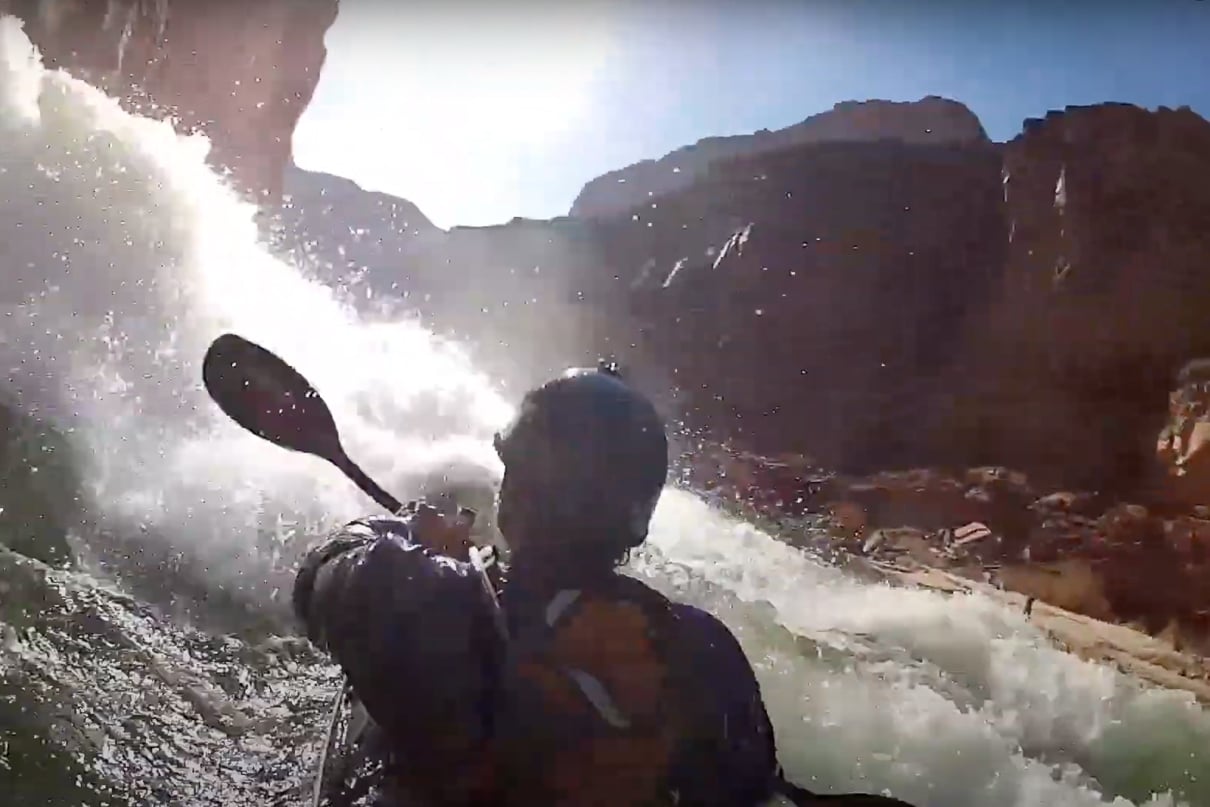
A sea kayaker descends into the rapids of the Grand Canyon. Feature Image: James Manke | YouTube
Also a key part of the trip was expedition paddler Jamie Sharp, who kayaked the Grand Canyon in a tandem sea kayak in a later journey.
Hance Rapids carnage
“Hance Rapid is a Class 8. The biggest we’d seen yet on the expedition,” wrote Randolph Hencken on YouTube.
Differing from the standard International Scale of River Difficulty (ISRD) most commonly used as a rapid classification system, the Grand Canyon has its own rating system ranging from 1 to 10. In the Grand Canyon’s rating system, a Class 10 roughly corresponds to a class IV+ on the ISRD.
“This video shows Sherwood “Woody” pointing at the pour-over moments before I ejected myself into the waters,” continued Hencken. “It shows Maria in the background running the rapid properly while coaching Woody what to do in the absence of his pilot.”
The only thing better than a video showing the beauty of the Grand Canyon and clean lines is a video showing some fun, casualty-free carnage.
“Not an instructional video, enjoy the carnage,” wrote Nate Taylor on YouTube about his curfuffle at Horn Creek, a Class 8, found around the 5:56 mark in the video.
The scene begins in a very relatable moment when a friend asks Taylor if he’s ready.
“Not really,” Taylor replies.
Who among us hasn’t been there at some point? Commenters note that Taylor is hard on himself, the rapids were run well, and offer words of encouragement.
Kayaking all the major rapids on the Grand Canyon
Rafting videos tend to be shot from a higher vantage point than a kayak, flatting out the rapids on the screen so YouTuber Life of Spud set out to make a video showing every rapid in the Grand Canyon from the perspective of a kayaker.
This is easily one of the best videos to watch to gauge the size of the rapids on the Colorado River in the Grand Canyon.
If you were to drop a pin in the center of Curry County, Oregon, along the border of the Rogue River-Siskiyou National Forest, you would be able to reach five waterways designated as U.S. Wild and Scenic Rivers within 40 miles of each other—the Rogue, Illinois, Chetco, Smith, and Elk rivers. It’s the highest concentration of any one county within the contiguous United States. It says as much for the quality of the rivers on the South Coast of Oregon as it does of the mountains that cut such dramatic relief to produce them.
Rivers runners have heard of the whitewater runs of the Lower Rogue River Gorge, Illinois, Upper Chetco, the Smith River on the California border, and probably less so of the Elk River. What’s easy to forget though is that none of these rivers, or any other in this corner of the state, ends with its whitewater. As they continue toward the Pacific they slow, meandering beneath gorge walls and along forested corridors before opening into fertile estuaries swaying with the tides. The lower reaches of Oregon’s coastal rivers are not only equally remarkable to their interior whitewater gorges—the rewards are also accessible to all abilities, have multiple trip length options, and are located near some of Oregon’s most eclectic coastal towns.
Here are three of the best ways you can visit the rivers of the South Coast with a paddlecraft of your own or along with an outfitter.
3 river destinations on the South Coast of Oregon
Lower Rogue River. | Photo: South Coast Tours
The Rogue River’s Copper Canyon
The 35-mile stretch of the Rogue River from Grave Creek to Foster Bar is one of the most renowned multi-day river trips in the country. But it’s far from the only way to relish in the majesty of the Lower Rogue River Gorge. Beginning in Agness, Oregon at the confluence with the also wild Illinois, the Rogue enters a 13-mile section called Copper Canyon, a lesser talked about but equally scenic section. After Agness, the national forest road moves away from the gorge and won’t return again until the takeout at Quasatana Campground.
Copper Canyon requires no lottery permit, works well as a day trip, and has no sizeable whitewater rapids. The water temperature is also relatively mild in summer. These attributes make Copper Canyon a moving water section of the Rogue anyone can launch on with a kayak, paddleboard, or canoe. So lean back and admire the temperate rainforest of Oregon’s coastal mountains.
How to paddle it
If you have your own equipment, set shuttle from Quasatana Campground up to the Agness Bar Access. South Coast Tours also provides guided kayak trips down the section. Going with an outfitter brings the added benefits of lunch and a knowledgeable guide to point out the history, geology and wildlife of Copper Canyon.
Worth the stop
The closest major hub to the Lower Rogue is the coastal town of Gold Beach. Once you hit Highway 101 head south. In town, near the corner of 3rd and Stewart Street is the Old Agness Store. The red barn-style shop will be hard to miss. The Old Agness Store was formerly upstream in Agness. If you’re wondering, it wasn’t carried here by the river. Owners Steve and Michele decided to make Gold Beach home and adopted the red barn storefront. Grab a post-river mortadella and provolone sandwich, pulled roasted chicken, or an Olympia Provisions bratwurst. Or skip straight to a treat with one of their housemade brownies warmed with a scoop of ice cream.
Typical scenery on the Chetco River. | Photo: Oregon Coast Visitors Association
The mesmerizing Lower Chetco
Just five miles north of the California border, the Chetco River empties from its headwaters in the Kalmiopsis Wilderness into the Pacific at the port town of Brookings. The 55-mile Chetco is known for having some of the most outstanding water quality on the Oregon Coast.
In its lower reaches, paddlers glide along boulder-strewn, forested river banks. Looking downward you can peer deep through the brilliant-blue, clear water at passing rock bars below. Right up to its mouth, the water quality remains superb, and impossible to take your eyes from. The birds cruising over the estuary searching for a meal agree—few waterways rival the Chetco’s quality.
How to Paddle It
South Coast Tours offers three-mile kayak trips on the lowest section of the Chetco as an out-and-back from the harbor upstream. Expect to see pelicans gulping down fish, kingfishers fluttering overhead, and sea lions catching some sun. The trip is less than two hours, offering a remarkable initiation to paddling the Oregon Coast.
Worth the stop
Celebrate a day on the Chetco with a visit to the river’s namesake brewery. Chetco Brewing Company’s tap room is less than a mile from the river’s edge as the pelican flies. They have a robust offering of decadent porters and stouts among their diverse tap list with something for every palette. The tap room is an expansive open-hanger garage with casual seating that feels like you’re hanging out at a friend’s place. They also have regular musical acts, and a savory Reuben offered at their on-site food truck.
The Northwest Pacific estuary—where evergreens and swaying marsh grasses meet. | Photo: Oregon Coast Visitors Association
The long tidal run up the Coquille River estuary
The Coquille isn’t designated as Wild and Scenic, but it showcases the diverse opportunities of paddling along the South Coast with remarkable natural and cultural sites. The Coquille is just north of Curry County, entering the Pacific at the town of Bandon. What makes the Coquille stand out is the tidal influence stretching 30 miles upstream, second in the state to only the mighty Columbia. This means paddlers seeking a scenic trip up can let the tide do most of the work traveling both directions. The mazing estuary is a mix of swaying marsh grasses, migrating birds, 19th- and 20th-century industrial history, and the millennia-spanning culture of the local Coquille Tribe.
From the Old Town Bandon waterfront, you could travel tens of miles up the Coquille, but a popular option is a seven-mile trip upstream to the top of mile-long Randolph Island. At the start you’re likely to spot the Coquille lighthouse and sandy beaches along the north bank. Once you’ve entered the mazeways of the Bandon Marsh U.S. Fish and Wildlife National Reserve, keep your eyes out for not only migrating birds but remnants of mills, fish processing plants, and more remarkably, the historic fishing weirs of the Coquille Tribe which have been dated to be as much as 3,000 years old. At Randolph Island, take the mile-long channel up the north side, then rejoin the Coquille. When the tide turns, ride the outgoing back to Bandon.
Understanding the tides and wind forecasts will be key to this trip. If you’re uncertain, South Coast Tours has guided options for groups of three or more.
Worth the stop
It’s recommended most summer trips up the Coquille get a morning start when winds are down. Fortunately, the Bandon Coffee Cafe is just a few blocks from the boat ramp in Old Town. They open at 6 a.m., ready with steaming coffee, fresh croissants and satisfying slices of quiche.
We can only speculate what may have happened to McAuley. | Feature photo: courtesy Vicki McAuley
The storm blew relentlessly, transforming the southern ocean into a heaving sea of mercury. An endless procession of waves appeared on one horizon and vanished on the other, their tops blown sideways into a stinging spray by the howling wind. Amidst the tyranny of the ocean Andrew McAuley’s touring kayak struggled to hold its own.
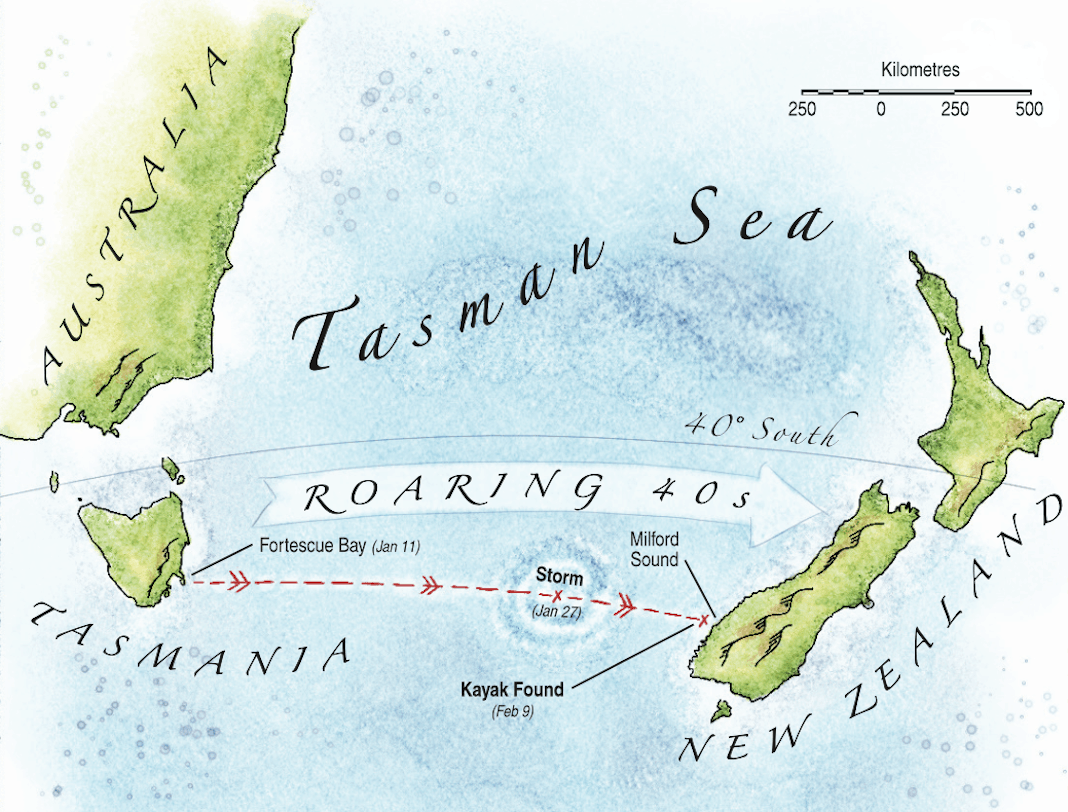
Inside the kayak, McAuley fought his own battle to stay calm. One night at the end of January, 2007, two-thirds through a 1,600-kilometre (1,000-mile) open ocean crossing between the east coast of Tasmania and New Zealand’s South Island, McAuley entered the 28th hour locked up in his kayak as the storm raged.
Many days later, with the nightmare storm behind him, the seas relatively calm, and the mountaintops of New Zealand’s southern Alps close enough to see on the horizon, McAuley disappeared. His family, friends and the worldwide paddling community were left with a mystery. Why did such an experienced paddler, so close to the finish of such a difficult journey, allow himself to be caught off guard? What could have happened?
From here to there. | Map by Robert Biron
Andrew McAuley disappears on sea kayak trip
McAuley made no false pretences about what motivated him to cross the Tasman sea alone in a conventional touring kayak. It was an adventure for adventure’s sake, a response to a deeply felt inner voice. He told ABC radio before the journey:
“I guess I’m really drawn to a journey like this—it’s a real personal challenge. There’s a great deal of satisfaction in coming up with an adventure that’s unlikely and improbable.”
The crossing was not a frivolous notion; only two previous attempts had been made, both by New Zealander Paul Caffyn, both unsuccessful.
McAuley spent nearly 10 years preparing for the trip, paddling a series of impressive kayaking expeditions. He completed three crossings from Australia to Tasmania via the notorious Bass Strait, as well as a solo, seven-day traverse of Australia’s treacherous Gulf of Carpentaria, earning him Australian Geographic’s 2005 Adventurer of the Year Award. On the surface, McAuley, a 39-year-old IT consultant from suburban Sydney, seemed an unlikely candidate for the award. Scratch deeper, however, and you would find a determined and diversified adventurer. Prior to catching the kayaking bug on a late-1990s trip in the Chilean fjords, McAuley devoted his considerable energies to mountaineering, making first ascents in Pakistan, Patagonia and Australia.
McAuley was not without his critics. Tasmanian police and Australia’s search and rescue service cautioned against the trip. Said an AusSAR spokesperson: “We had strongly advised against the trip to start with because we believed it was inherently dangerous.” Authorities went so far as to test McAuley’s equipment, capsizing his kayak and assessing its self-righting properties; they ultimately concluded that the boat was seaworthy.
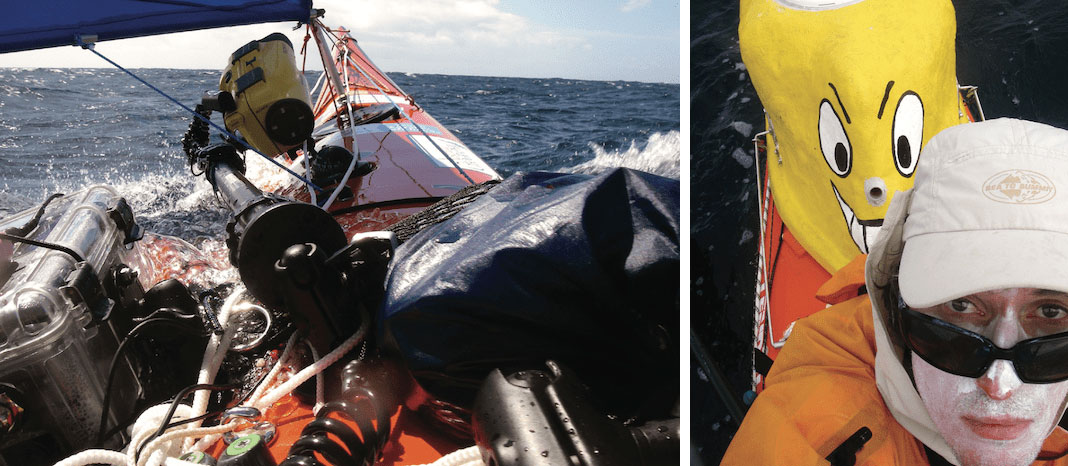
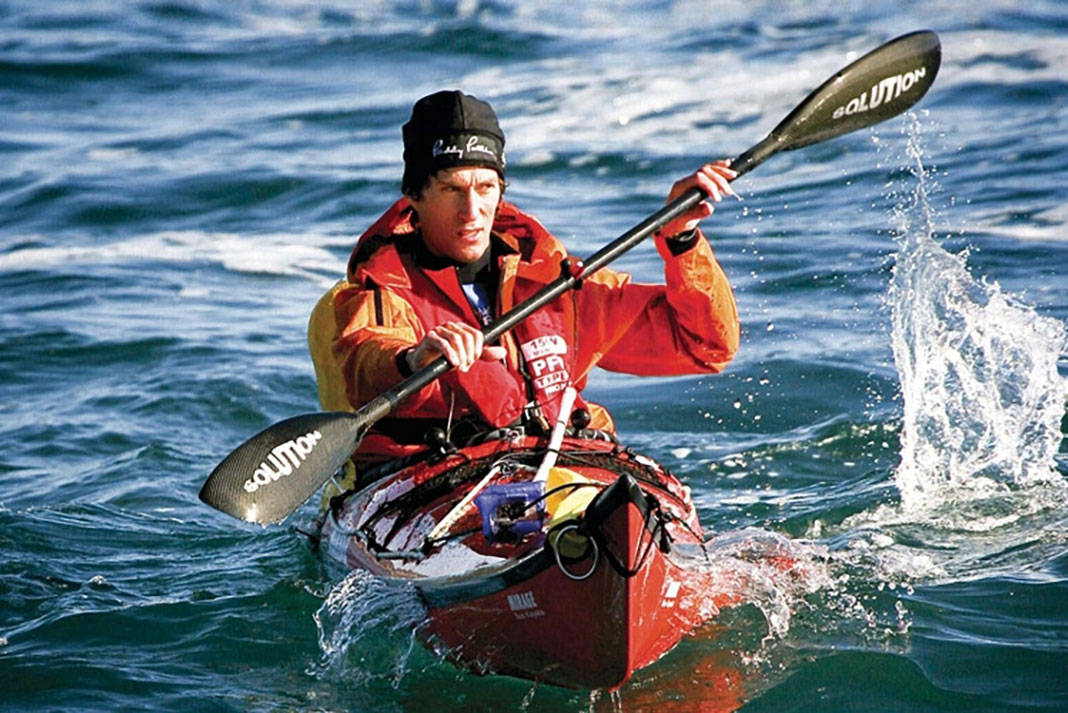
The vessel was a standard touring kayak, a 19-foot Mirage, modified for sleeping inside the cockpit. A yellow fibreglass canopy carried on the back deck—whimsically painted with a cartoon face and nicknamed “Casper”—could be clamped down onto the cockpit for sleeping, providing self-righting capability and protection from the roughest storms. A yacht ventilator atop the canopy breathed when upright and kept water out when submerged.
The fact that McAuley was permitted on the water at all speaks volumes of his preparedness. Paul Caffyn’s late-’80s attempt was summarily prohibited before his kayak even touched Australian waters. Well aware of his critics, McAuley told the Sydney Morning Herald, “When you do [a trip like this], you are exposing yourself to criticism. I take risks, but they are calculated risks, and I want to be beyond criticism.”
McAuley’s January departure from Tasmania was his second attempt. He set out in December but turned back after just 48 hours when he found his sleeping arrangement to be too cold. “Responsible adventure is character-building and good for people, but I felt that to continue on this occasion was not on,” McAuley wrote on his blog. “Without wanting to sound too melodramatic…making the right decisions in situations like this can save your life.” After some modifications, he launched a second time.
The journey’s end, in photos recovered from Andrew McAuley’s found kayak. | Photos: Courtesy Vicky McAuley
McAuley’s chilling last words
Andrew McAuley’s entire route travelled below the 40th parallel, the heart of the Roaring Forties feared by sailors for its treacherous weather and unforgiving storms. Two-thirds into his voyage, McAuley endured a 40-knot gale that knocked out his spare satellite phone and tracking beacon. The conditions were possibly the worst experienced in the region since the storm that decimated the 1998 Sydney to Hobart regatta, sinking five yachts and killing six crewmen.
Enclosed in the cockpit as the kayak plunged nine metres (30 feet) between waves, McAuley had already endured two stomach-churning barrel rolls. The sea anchor he deployed at the approach of the storm kept the kayak’s bow into the weather most of the time, but in seas this large, even this was not always effective. For a third time, the kayak slid up the face of a monstrous wave, perched perilously on edge, then inverted and slowly righted once more.
He survived the storm and travelled several hundred more kilometres to within sight of his destination. On Thursday, February 8, with only 120 kilometres (100 miles) to go, he sent a triumphant text message to his wife, Vicki, and 3-year-old son, Finlay, who were already waiting in New Zealand: “See you 9 a.m. Sunday!” The weather forecast promised a benign end to a harrowing journey.
Vicki and Finlay gathered with friends and family in Milford Sound to celebrate. The legendary sea kayaker Paul Caffyn would be there in person to congratulate the man who accomplished what he’d failed to do. Caffyn told ABC radio, “We were planning to paddle out…and wait there until Andrew came in…with a bottle of whisky and ginger beer.”
At 7 p.m. on Friday, February 9, New Zealand Coast Guard received a scrambled, unintelligible radio call. McAuley’s family suspected the radio message was a hoax, or perhaps an attempt by Andrew to make his nightly check-in by radio now that his sat phone batteries were dead. A small search was launched, but nobody really believed McAuley could be in trouble.
We can only speculate what may have happened to McAuley. | Feature photo: courtesy Vicki McAuley
By Saturday morning, analysis of the radio message deciphered some chilling words. Among them: “help” and “sinking.” A full-scale search began. Planes combed 25,000 square kilometres of wind-tossed ocean. On Saturday night, Rescue Coordination Centre New Zealand found McAuley’s upturned kayak in near-perfect condition just 54 kilometres (34 miles) offshore of Milford Sound. It was missing only the cockpit canopy. The paddle, satellite phone, GPS, and emergency position-indicating radio beacon (EPIRB)—not activated—were all in working order inside the kayak.
On Monday, February 12, after three days of waiting and hoping to find McAuley alive, the search was called off.
Speculation on Andrew McAuley’s fate
Paul Hewitson of Mirage Kayaks, the boat’s designer and builder, inspected the kayak and some of the retrieved video footage. His best guess about what happened: McAuley capsized while the cockpit cover was not in place and was unable to get back in his kayak. Then, somehow, paddler and kayak became separated.
McAuley had reported capsizing twice before and described the re-entry procedure as “gnarly,” complicated by the cockpit cover, video camera and other gear mounted on the deck. He hoped not to capsize again.An oversized cockpit and lack of a standard seat made it impossible to roll. Removing the seat was a necessary modification for sleeping and for accessing gear. Andrew sat on a beanbag, which doubled as a pillow, and retrieved gear in the rear compartment by lying down and rolling onto his stomach, using strings to pull his gear forward through a hatch in the bulkhead.
Hewitson guessed that McAuley was probably getting tired and, with the mountains in sight, would be eager to reach land. He may have pushed too hard. When a small cold front came through, he possibly didn’t think it necessary to put on his drysuit—which he’d planned to put on anytime there was rough weather—and would have been reluctant to trade making the miles for holing up beneath the canopy. Sadly, disaster has a proven habit of striking those who have almost reached safety—nearly all mountaineering tragedies occur on the return from the peak, when muscles burn and concentration is narrowly focused on the goal.
After the capsize, McAuley may have unscrewed the rear hatch to access his VHF radio and drysuit. Perhaps while struggling into the drysuit, he got separated from his kayak and, with it, the EPIRB. Some have wondered why he didn’t trigger the EPIRB right away.
“Andrew thinks the same as I do on this subject,” writes Tasmanian kayaker Laurie Ford on his website. “[The EPIRB] is a last resort. It is far better (if possible) to make contact by phone or radio and let people know the exact situation—rather than the huge panic and search that an EPIRB generates. Having said that, I’m quite sure that he would have intended to set it off (as I would) once he was in the drysuit. It was the separation from the kayak that brought him undone.”
Unfortunately, McAuley had overlooked the critical detail of attaching the EPIRB to himself, not the boat. Ford also speculates that if McAuley had carried a strobe light, he might have been spotted by rescuers on the first night of the search.
In his final days, McAuley conceded he may have miscalculated and pushed the boundaries too far. A self-portrait taken near the end of his journey bears scant resemblance to the confident, athletic face that appears in other photographs. His eyes are wild, cheeks drawn under a ghostly sheen of zinc oxide. At a memorial service held under grey skies at Sydney’s Macquarie Lighthouse, on a high cliff overlooking the Tasman, 400 friends, family and members of the kayaking and mountaineering communities listened to a haunting message recovered from McAuley’s kayak where he admitted, “I may have bitten off more than I can chew.”
“This really is extreme,” he said. “It’s full on. I really could die.”
But if Andrew McAuley had his doubts, his family does not. In the face of the inevitable public criticism about the perceived selfishness or stupidity of extreme adventuring, Vicki McAuley stresses that it was Andrew’s drive to explore his limits that made him who he was. On his website she posted a quote from André Gide that sums up the spirit of adventure so integral to Andrew’s life and the sport he loved: “Man cannot discover new oceans unless he has the courage to lose sight of the shore.”
Editor’s note:
Nearly 18 years after Andrew McAuley’s disappearance, his story remains relevant and captivating to readers, both making rounds on the internet and in risk management discussions. Since McAuley’s near-crossing of the Tasman Sea, there have been several successful crossings of the Tasman including Justin Jones and James Castrission in 2008, Scott Davidson in 2018 and Richard Barnes in 2023. McAuley’s wife, Vicki, went on to write Solo about McAuley’s journey and disappearance in both her words and his, pulled from his journals. Vicky emphasizes that McAuley ultimately accomplished his goal of crossing the Tasman Sea with Milford Sound within sight at the time of his disappearance; whether or not he reached shore is a technicality. The kayak he used in the crossing is on display at the Australian National Maritime Museum.
In September 2007 Andrew McAuley was posthumously awarded the National Geographic Adventurer of the Year Award. His son, Finlay, is now in his early 20s.
We can only speculate what may have happened to McAuley. | Feature photo: courtesy Vicki McAuley
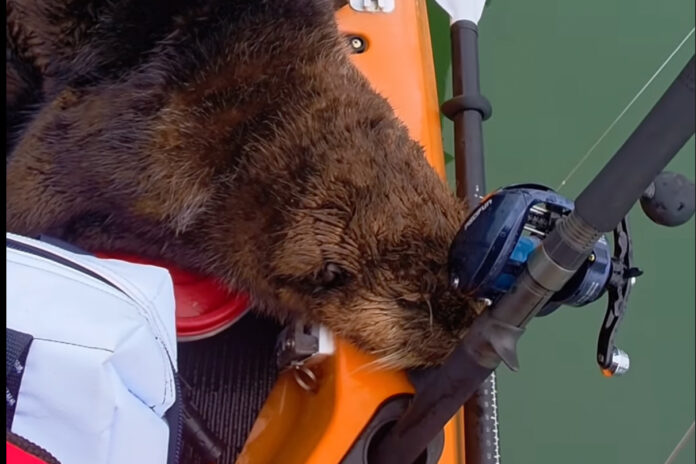
While out on a mission to catch fish, kayaker Kyle Borkes picked up a marine mammal hitchhiker. On a cloudy British Columbia day, a sea otter crawled on to Borkes’ kayak and took a nap; an incredible and adorable encounter caught on film.
Sea otter hitchhikes on kayak on Vancouver Island
Kyle Borkes of KC Kayak Fishing, a husband and wife duo based in Nanaimo, British Columbia, encountered the sea otter after wrapping up fishing for the day when the critter hopped up into his kayak!
“You’re not staying here forever,” Borkes warned the sea otter in the video. Not intimidated by Borkes’ warning, the otter proceeded to gnaw on some rods and reels, and shred the foam of the camera booms.
“That’s like 400 bucks. That you’re eating,” Borkes tried to explain to the sea otter. Unbothered and not to be reasoned with, the otter took a nap.
“You’re a menace,” Borkes told the other, naming him Dennis. Eventually as Borkes made his way to shore, the otter washed off the back of the kayak and swam back out to sea, bringing an end to one of the cutest filmed wildlife encounters in British Columbia.
Sea otters in British Columbia
While the framing of the video makes it initially appear that Dennis the sea otter was brought out to sea from shore, the caption of the video assures viewers that was not the case: Dennis hopped onto Borkes’ kayak while he was still paddling and after he had finished fishing.
The caption also noted that sea otters and all marine mammals should be avoided when paddling, but when a marine mammal decides it would like to investigate you that can be a challenge. Borkes explained that he tried for 20 minutes to get the otter out of his kayak before opting to head back to shore.
“Don’t harass the wildlife? What if the wildlife is harassing me?” one commenter joked.
According to Discover Vancouver Island, there are about 5000 sea otters in British Columbia, most often seen in kelp beds. Sea otters are larger than their cousins river otters, and are distinct in their short tails and fluffy fur as well as size. Additionally, sea otters are rarely seen on land.
Marine wildlife is protected in British Columbia by the Species at Risk Act, and Marine Mammal Regulations under the Fisheries Act; it is against the law to disturb a marine mammal.
In this incredible video Zack Mutton, a world champion in extreme freestyle kayaking, makes the 92-foot drop down Abiqua Falls in Oregon to the cheers of paddlers below.
The New Zealander is one of few to run the iconic falls, a feat previously accomplished by Dane Jackson several times as well as the first successful descent by Jesse Coombs who sustained a collapsed lung in the descent.
Behind the viral video of the Abiqua Falls send
The incredible footage of Mutton’s descent of Abiqua Falls might appear to be shot with skilled dronework, but videographer Steve Donovan uses a different method. Instead of a drone, Donovan shot the waterfall descent footage on an FPoleV camera pole with an Insta360 camera attached to the end.
Extreme Kayaker Zach Mutton plunges over the nearly 100-ft Abiqua Falls in Oregon. Steven Donovan | CP24 YouTube
The FPoleV camera pole was created by Donovan himself in order to create smooth action footage using cameras like GoPros and 360 cameras–small cameras designed for high-intensity action sports with lots of motion. The setup was inspired by traditional boom shots, in which a camera is mounted to a crane for smooth movements, but adapted and slimmed down to meet the challenges of capturing action sports like whitewater kayaking.
Donovan’s FPoleV camera pole extends up to 24-feet, making it possible to extend a camera over a paddler and follow them smoothly as they make the plunge into the pool below. The method lent to a new perspective on Mutton’s epic drop of Abiqua Falls, beyond the usual paddler point-of-view GoPro footage or footage shot from cameramen on the sidelines.
It's rare for a shark to attack a kayak, but it's still a good idea to take precautions.
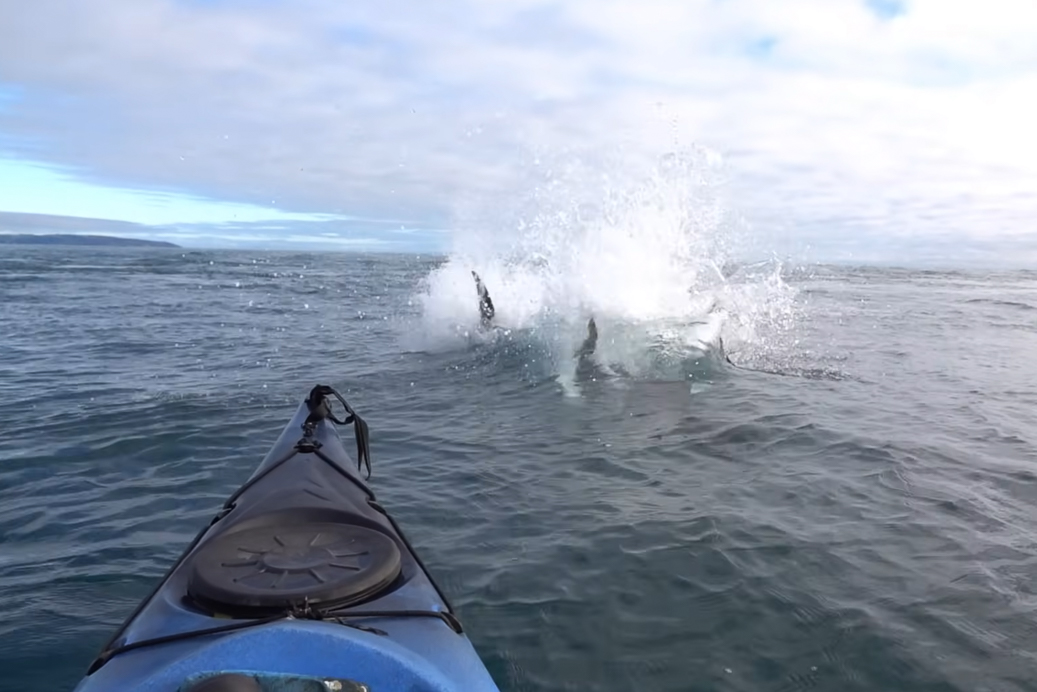
A handful of well-publicized shark encounters in the waters off some of our favorite coasts have left sea kayakers watching their dorsals. Headline stories like Great White Shark Menaces Kayakers suggest “a disturbing trend” of increasing attack frequency in paddling hotspots like Southern California and Australia’s Surf Coast.
Reality is a lot less sensational. According to statistics from a six-year period analyzed by the University of Florida’s International Shark Attack File, beach attendance and shark attacks increased in nearly exact parallel. The so-called trend likely reflects the increasing number of paddlers on the water rather than a rise in aggressive behavior among shark populations.
Still, there’s undeniable drama in such reports. Witness expedition paddler Sean Morley’s terrifying pursuit—“it was like a cat with a mouse”—by a suspected blue shark on his solo crossing in SoCal’s Channel Islands. Or the great white, also in California, that chomped local distance paddler Duane Strosaker’s wooden kayak and held it in its jaws for a few seconds before “gently letting go.”
Shark facts & precautions you can take
Encounters vs. attacks
Victoria Scott, a marine biologist, experienced shark diver and Director of Education with the Canadian Shark Conservation Society, says “shark encounter” is a more precise way to describe these marine muggings. “Sharks are incredibly effective hunters. If one was to attack a sea kayaker there is no doubt the shark would win every time,” she says.
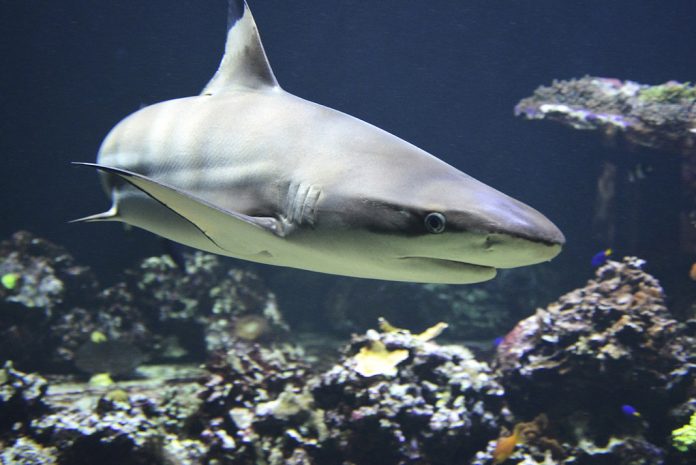
The two most common culprits in shark attacks and encounters—great whites and tigers—hunt from below. To these sharks, a sea kayaker on the surface may look like a seal or sea lion. Scott says sharks will usually investigate before deciding to attack. This is where the bumping and sometimes nibbling come in. Sharks use their mouths to determine if something is potentially edible. Kayaks, and even humans, are usually discarded as not tasty.
Strosaker’s encounter was a classic example of this bite and test behavior. “There wasn’t a hard impact… its mouth wrapped halfway around the hull. It seemed relaxed,” Strosaker recalls.
Do sharks attack kayaks?
Though they are rare, true shark attacks on kayaks do happen. According to the Global Shark Attack File, 21 have been recorded since the early 1900s. The only fatalities in that period were Malibu, California, paddlers Tamara McAllister and Roy Stoddard, who may have paddled into an area where sharks were feeding and been confused with prey.
Practice these precautions to stay shark-safe: Avoid blood in the water and slicks from fishing boats. Keep away from cloudy river mouths and suspect waters at dusk and dawn—prime hunting times. To avoid being mistaken for a meal, stay away from large groups of fish, seals or sea lions.
If you do see a shark, don’t try to paddle away. Your splashing paddle could make you look like an injured seal and attract more attention. If a shark is becoming aggressive, a sharp rap on the snout with your paddle may deter it.
“The very remote possibility of a shark encounter should not outweigh the adventure and beauty of paddling on the ocean,” Scott summarizes. “If you are investigated by one of these animals, paddle away with the knowledge that you have experienced something very special.”
Editor’s Note and 2025 Update:
While rare, shark attacks on kayakers have occurred but more often to kayak fishermen than sea kayakers. In 2024, kayak angler Ryan Howell was attacked by a great white shark that left bite marks on his kayak twice in the same day. In 2025, kayak angler Matt Wells was followed by a large shark who appeared to play with his rudder for a terrifyingly long time before disappearing into the deep.
After the incident, Wells went on to explain in an interview that he didn’t think the shark was hunting him at all, rather just curious and learning about a foreign object—Wells’ kayak—by observing. In the moment, Wells took care to paddle calmly away from the shark and not panic so as not to imitate prey.
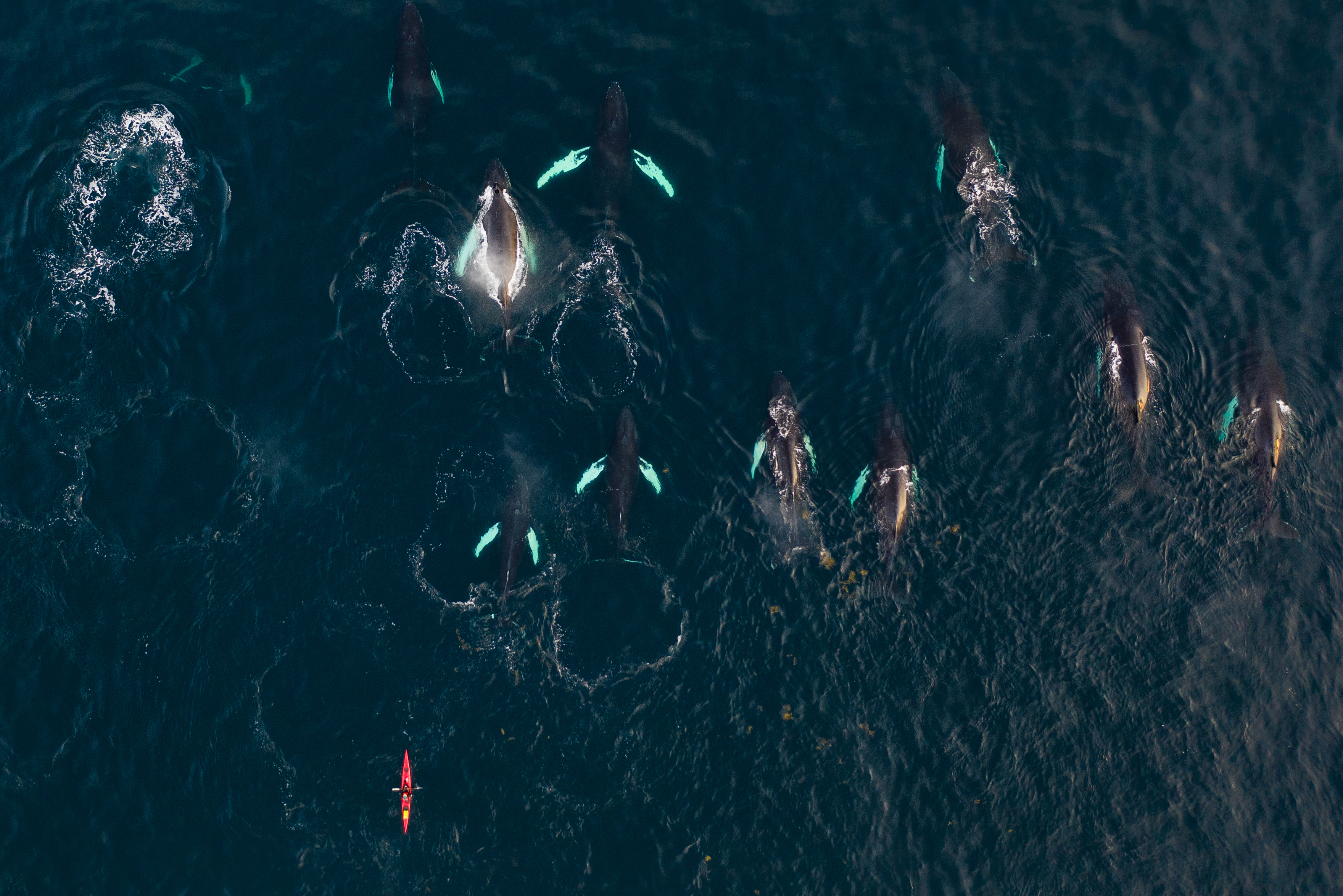
Also in 2025 off the coast of Chilean California a packrafter found himself briefly engulfed by a humpback whale. Humpback whales primarily eat krill or small schools of fish such as capelin or herring– kayaker is most definitely not on the menu. Nonetheless, this fluke encounter goes to show that regardless of predator status, kayaking on the ocean runs the risk of encountering residents of said ocean up close and personal.