Home Blog Page 283

How A Moisie Misadventure Helped Nathan Warren Master The Art Of Serenity Under Stress

PRAYER #3946, #3947. | PHOTO: DAVE BEST

I was chanting the serenity prayer before I’d even gotten off the train.

“Grant me the serenity to accept the things I cannot change,
The courage to change the things I can,
And wisdom to know the difference.”

I’d left my New Hampshire home behind and was headed north to paddle 250 miles of the Moisie River. Solo.

As the train approached my stop—a debris-filled dirt lot beside a pothole-ridden, one-and-one-half lane dirt road—the conductor explained that the road was engulfed by forest fire and I could not disembark.

Learning from an elderly passenger that I could access an easily navigable tributary and cut my expedition down to a four-day paddle back to my car, I hopped off the train and settled into a six-by-12-foot shack next to the all-but-abandoned tracks.

To get to the river the next morning, I trekked through a hellacious forest packed with downed conifers and foot-entrapping marshland with rapacious mosquitos easily infiltrating my head net.

As I approached, the horizon line that came into focus caused a sinking feeling of fuck-my-life.

The 100-foot cascading waterfall landed on rocks before descending into a continuous section of gorged-in whitewater. There was no way I could paddle out from here.

It took three hours to trudge back to the shack.

Since the next train wouldn’t pass for days, I turned to my satellite communicator—this was still a situation I could control. A quick message would tell my mother and two kayaking friends I was in need of non-urgent help to get out.

“ERROR,” was the device’s only response, until six hours later when I heard an unmistakable sound.

Shooting up over the horizon, the helicopter hovered over my head before landing softly by the tracks.

Shit.

My message had sent, and while my buddies were working on a plan, my mom had called the police.

The pilot explained that I already owed a substantial fee and, though he wouldn’t elaborate on the amount, if I got on the helicopter the price would go up. And he couldn’t carry my boat.

Declining the ride, I begged him to ensure the next train would stop for me.
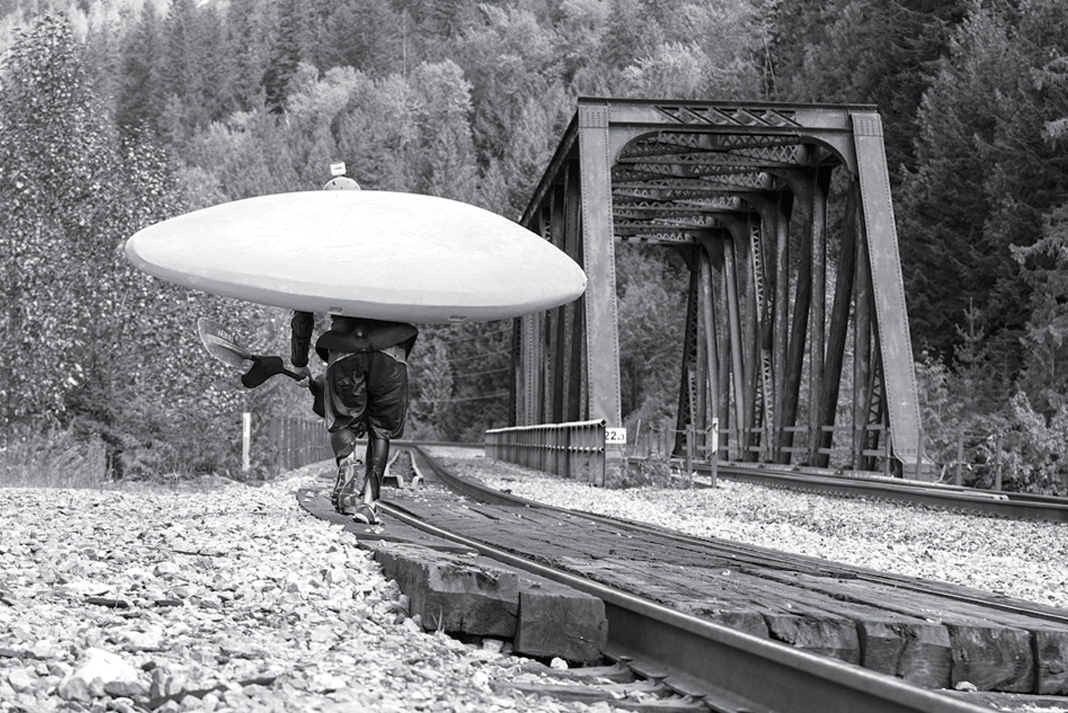
PRAYER #3946, #3947. | PHOTO: DAVE BEST

UTTERLY POWERLESS

For three days I rotated between chanting the serenity prayer and cursing the mountains, skies and blackflies.

Had my text cost me $10,000 or $50,000? The realization that I was utterly powerless did little to quell my rage.

On the day the train would come, I prepared for its 4 p.m. arrival, awaiting the steel stallion that would save me from myself.

I paced the tracks—100 yards south of my gear, then 100 yards north, back to check the time, then another lap. Then another and another. As the sun set after 8 p.m., I threw my head back and screamed.

Grant me the serenity to accept the things I cannot change.

Returning to my shack, I started reading my only book, Paulo Coelho’s The Alchemist, for the third time.

Then I saw the light. About a mile up the rails and heading towards me.

Scrambling onto the tracks, I flashed my dying headlamp and yelled to the conductor as if he’d hear me. Screeching, it slowed and a cargo door opened.

Perpetually failing, stranded, in debt and scaring my friends and family, I had been forced to accept my reality and adjust my mind to each change in circumstance. Tensing up and fighting a situation only makes it worse. Through the uncertainty, monotony and solitude, the same lessons I’d learned many years prior as a beginner paddler had been tested outside my boat.

In the year since his Moisie misadventure, Nathan Warren has mastered the art of serenity under stress. Now he’s just trying to hold on to it for more than five seconds. He was billed $2,000 for the visit.

This article on introducing friends to whitewater was published in the Summer/Fall 2014 issue of Rapid magazine.This article first appeared in the Summer/Fall 2014 issue of Rapid Magazine. Subscribe to Paddling Magazine’s print and digital editions, or browse the archives.
Growing the Sport of Whitewater With Friends

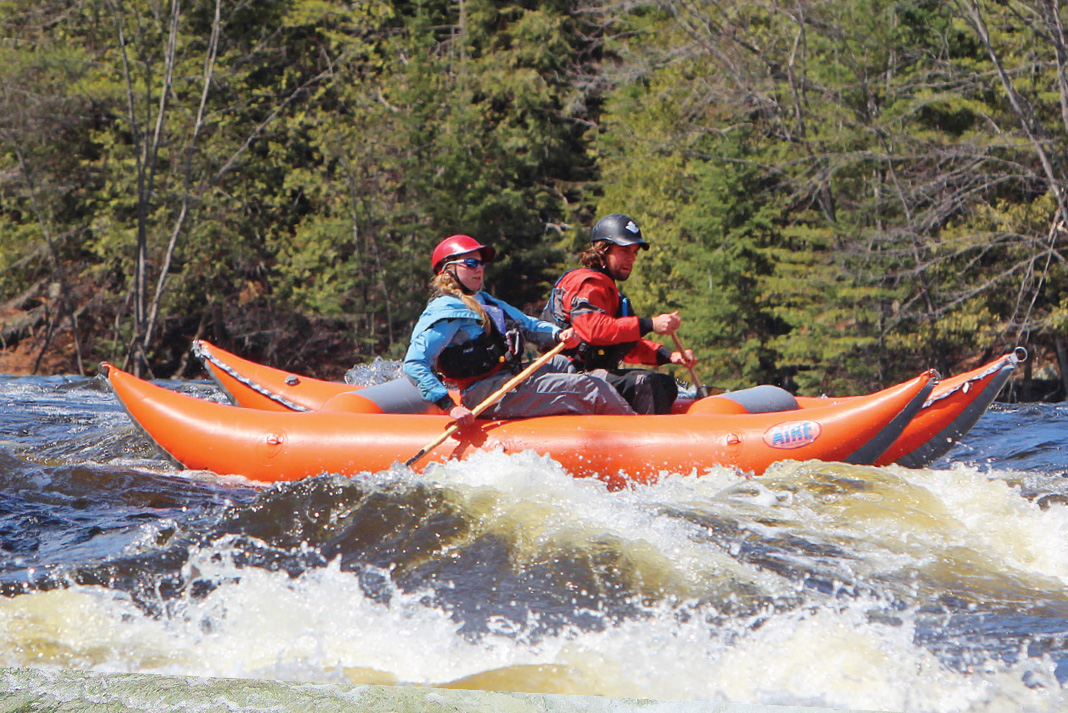
Inflatable Friends | Photo: Robert Faubert

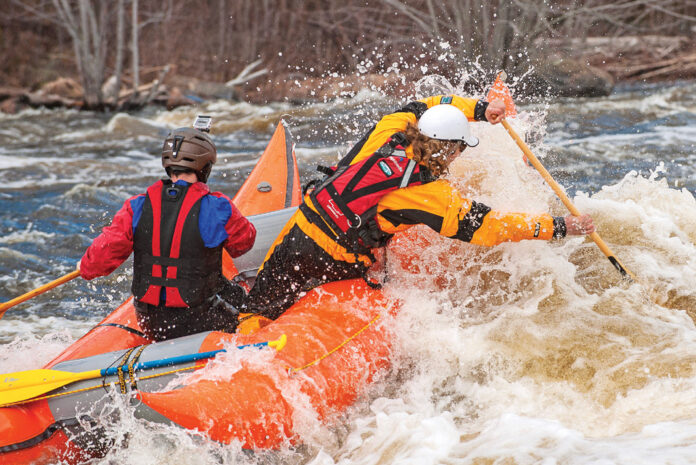
The guy beside me in this photo is Patrick Hagg, a web analyst at the federal Institute of Health Research. He has a degree from a good school. He is married and has three beautiful children. His family runs, skis, snowshoes, spins and is training for alpine trekking. They are going to climb Bishorn, a 4,153-meter mountain in the Pennine Alps in Switzerland where he will celebrate his 40th birthday.

Demographically speaking, the Haggs should be a whitewater family. Except Patrick’s never paddled whitewater before.

Patrick followed my friend, photographer and longtime raft guide, Rob Faubert out of the city. Rob and Patrick work in the same department, two desks away from each other. I’d roped Rob into coming to the Hell or High Water festival to shoot some photos and help me test the new Aire Sabertooth.

Patrick spent his youth dreaming of being a National Geographic photographer and came along to shoot the action to add to his portfolio. At the last minute he threw in his diving wetsuit and a downhill ski helmet.

Where the Petawawa River snakes through the town of the same name, there’s a perfect venue for a large-scale whitewater event. The municipal walking and biking path winds past a perfect amphitheater rock right beside Lovers—the most exciting and biggest rapid of the section.

Crowds gather to cheer racers, secretly hoping for carnage in the Windigo Hole or the three raft-munching waves below.

After Rob and I had ran the Sabertooth inflatable cataraft down a few times we told Patrick to get his gear out of his car.

Inflatable Friends | Photo: Robert Faubert

GROWING THE SPORT OF WHITEWATER

We paddlers talk a lot about growing the sport and getting new people into whitewater. Truth is, it’s not easy.

You either take them to quiet class I and II and spend your precious weekend teaching strokes and maneuvers in a friendly, safe and boring environment, or you run them down bigger sections of rivers you’d rather paddle. They swim lots. Anxiety and exhaustion overrides excitement and exhilaration. Real learning is low. Very few return.

Patrick, however, is hooked.

“I think first hand exposure is what did it. Being able to go down these huge rapids in a small two-person raft as a newbie gave me an incredible feeling. I played a role in successfully riding the rapids.”

We ran him through big rapids, but didn’t send him by himself. He learned about reading water, because I was right there to teach him. It was exciting for him, yet not too scary.

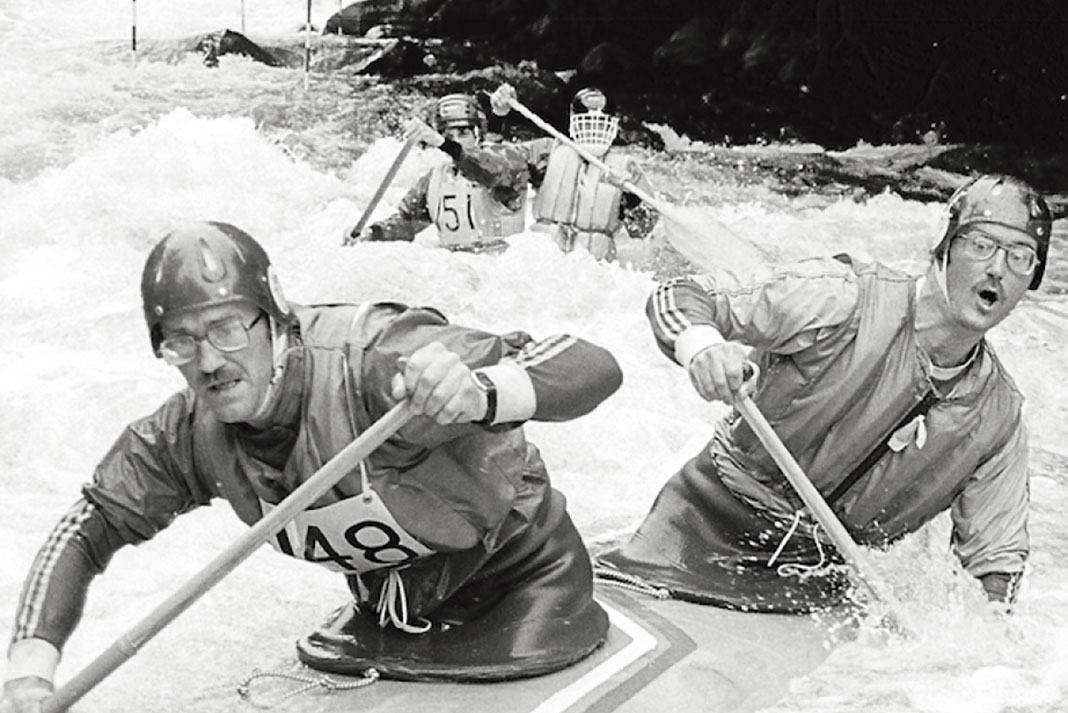
Whitewater tandem canoes in capable hands can work the same way.

Inflatable ducky kayaks are very stable and confidence inspiring. No cockpit means no skirt and no fear of being stuck inside. Self-rescues are easy.

We just received for review a shipment of Fluid Kayaks’ Do It Now sit-on-tops, which offer this same freedom but paddle like hard shell whitewater kay- aks. Industry rumors suggest we’ll see more of this type of boat on the market in 2015. I don’t care if we’re creating a whole new category of whitewater boats or if they’ll be stepping stones.

If not for the Sabertooth, Patrick and his family wouldn’t be joining us at the Upper Gatineau Whitewater Festival. If not for a boat that made him feel safe enough and excited enough, he would still only be dreaming of riding the rapids.

Scott MacGregor is the founder and publisher of Rapid magazine. Soon he will let Patrick know that we don’t call it riding the rapids. Baby steps. 


This article on introducing friends to whitewater was published in the Summer/Fall 2014 issue of Rapid magazine.This article first appeared in the Summer/Fall 2014 issue of Rapid Magazine. Subscribe to Paddling Magazine’s print and digital editions, or browse the archives.

Chasing Waves: Hunting For Surf In British Columbia

person paddles a sea kayak in British Columbia's Kyuquot Sound while towing a board for surfing
Feature photo: Ben Haggar

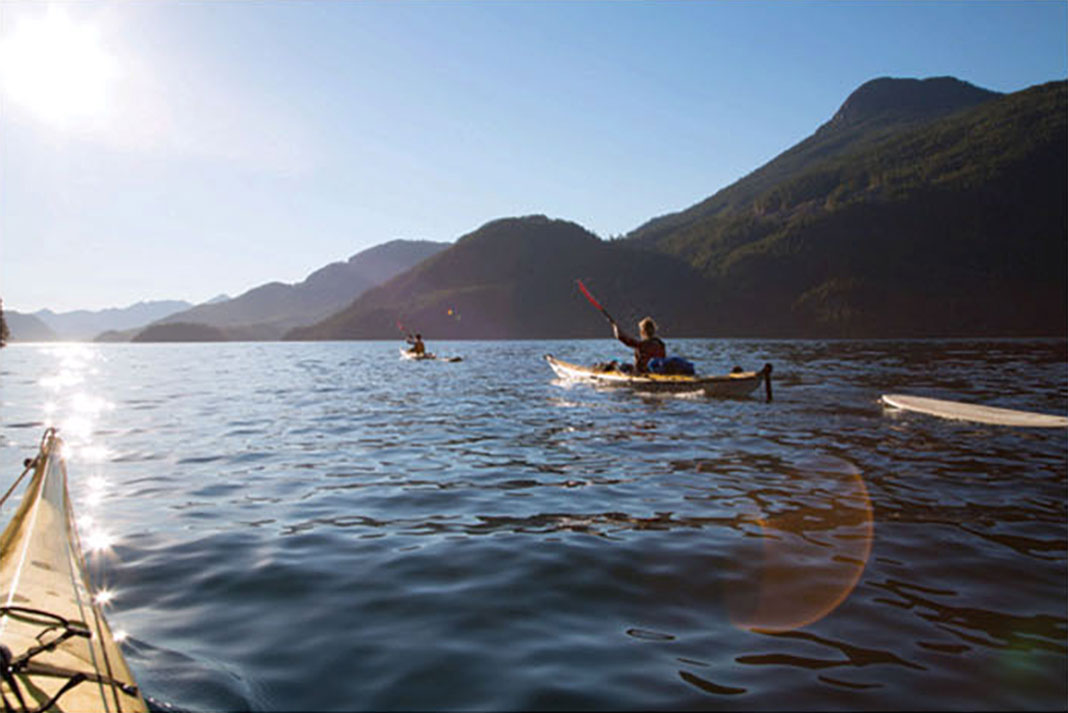
For some paddlers, kayaks are both a means and an end—a vessel to access the best surf and then play in it. But for me and three friends, it was a love of surfing boards, not boats, that drew us to a remote stretch of northwest Vancouver Island coastline in search of untapped breaks. Rather than zipping back and forth in a powerboat blitzing waves and disrupting the region’s natural vibe, we wanted a more adventurous, eco- and budget-friendly trip. Sea kayaks were the obvious choice. Our journey focused as much on self-reliance and careful scouting as it did on scoring new surf.

Chasing waves: Hunting for surf in British Columbia

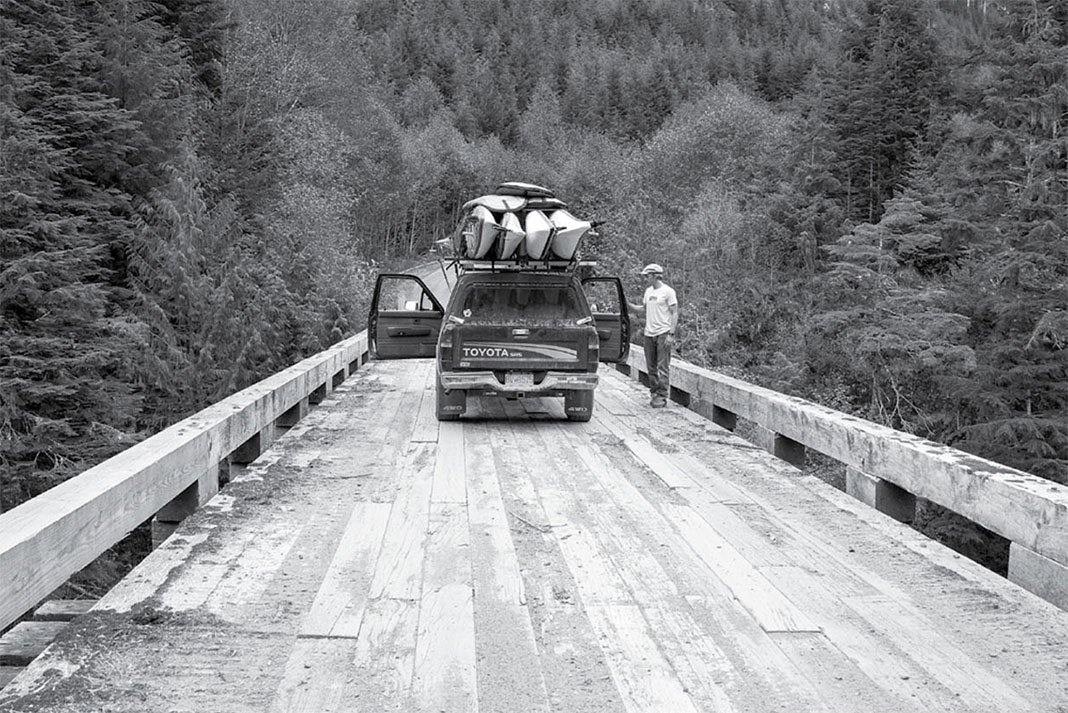
vehicle with kayaks on top on bridge
Photo: Ben Haggar

Onwards to Kyuquot Sound

A loud crack breaks the concentration needed to navigate the harrowing tentacles of the Artlish River valley’s forestry roads. More than seven hours and nearly 500 kilometers out of Tofino, we pull to the roadside to take stock of my 20-year-old Tacoma. Loaded with four people, a canopy full to the brim with food and gear, and four kayaks and surfboards strapped to a homemade wooden rack, it’s difficult to tell from where the ominous sound originated. Fortunately, the aged truck’s protests are merely a bluff and we continue our laborious descent to the coast.

Logging trucks piled high with old growth cedars speed past, trailing choking clouds of dust. Where the once towering trees have been felled and hauled from the rolling slopes of these coastal mountains, alder thickets crowd the narrow trail of washboard gravel that leads to the innermost reaches of Kyuquot Sound.

Much of Vancouver Island’s outer coast is rugged and remote, and Kyuquot Sound—where our trip begins—is no exception. With virtually no land access to its outer extremities, a boat is a necessity.

Although we can cover less water than a powerboat, our kayaks provide the flexibility to search out new breaks on offshore reefs and islands as well as those tucked in along the unforgiving coast. Crossing the exposed mouth of the sound provides the first gentle rise and fall of a small groundswell, hinting at the waves we are hoping to find hiding beyond Rugged Point on the storm-battered outer coast.

surfing at sunset on remote Vancouver Island
Photo: Ben Haggar

Rewarded with good weather

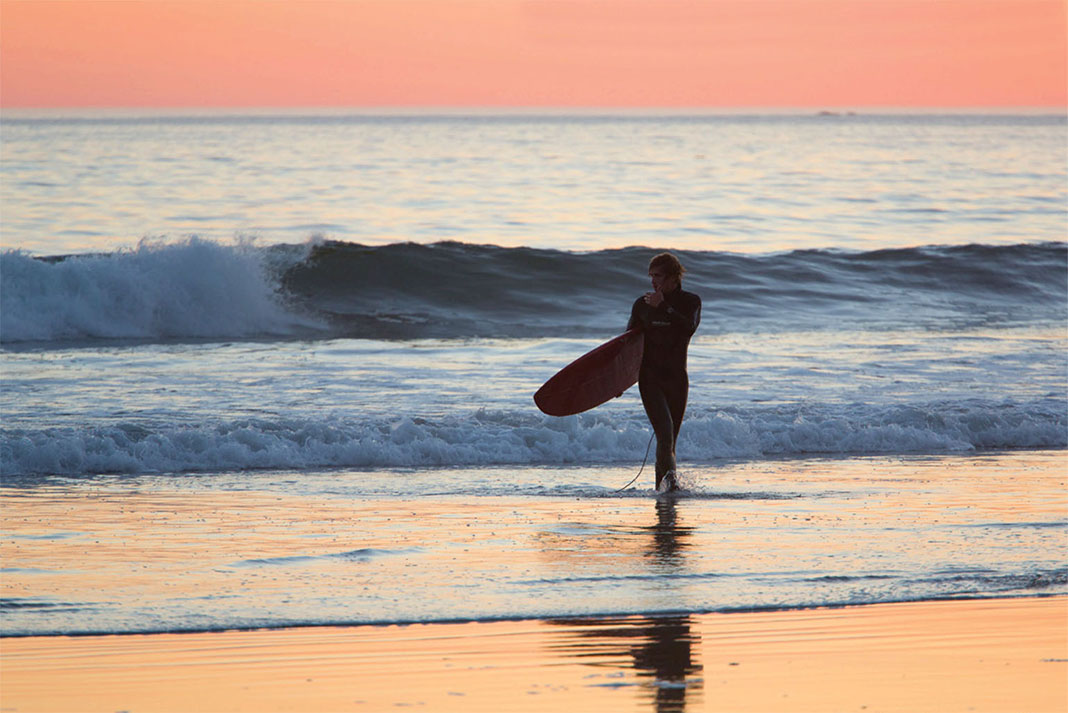
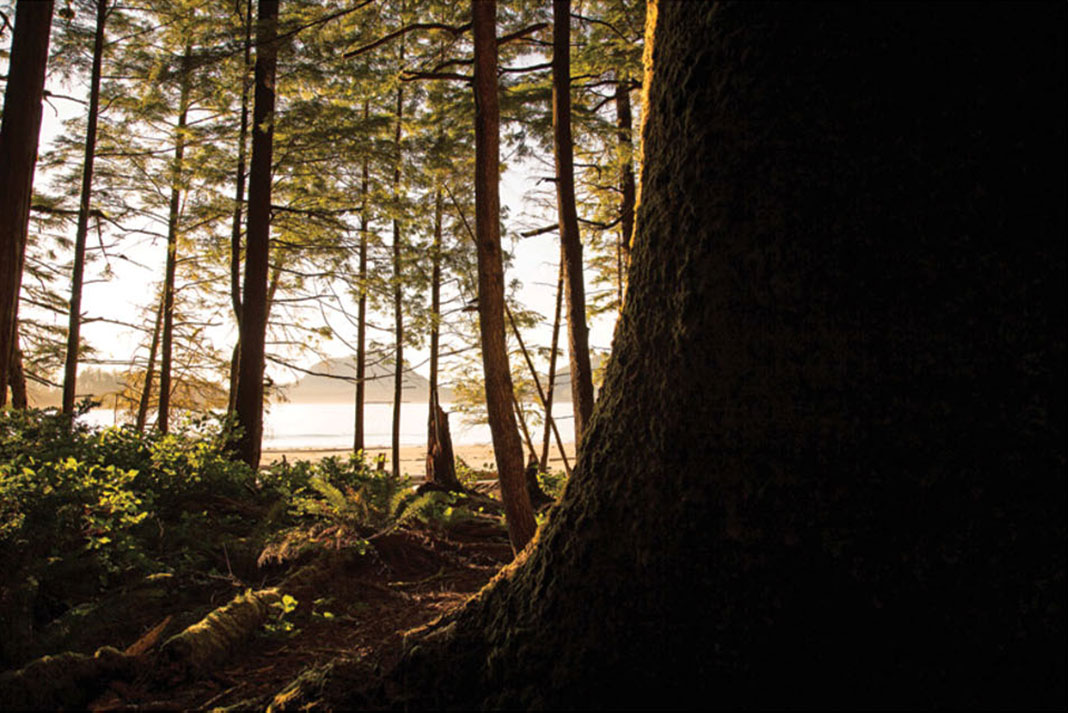
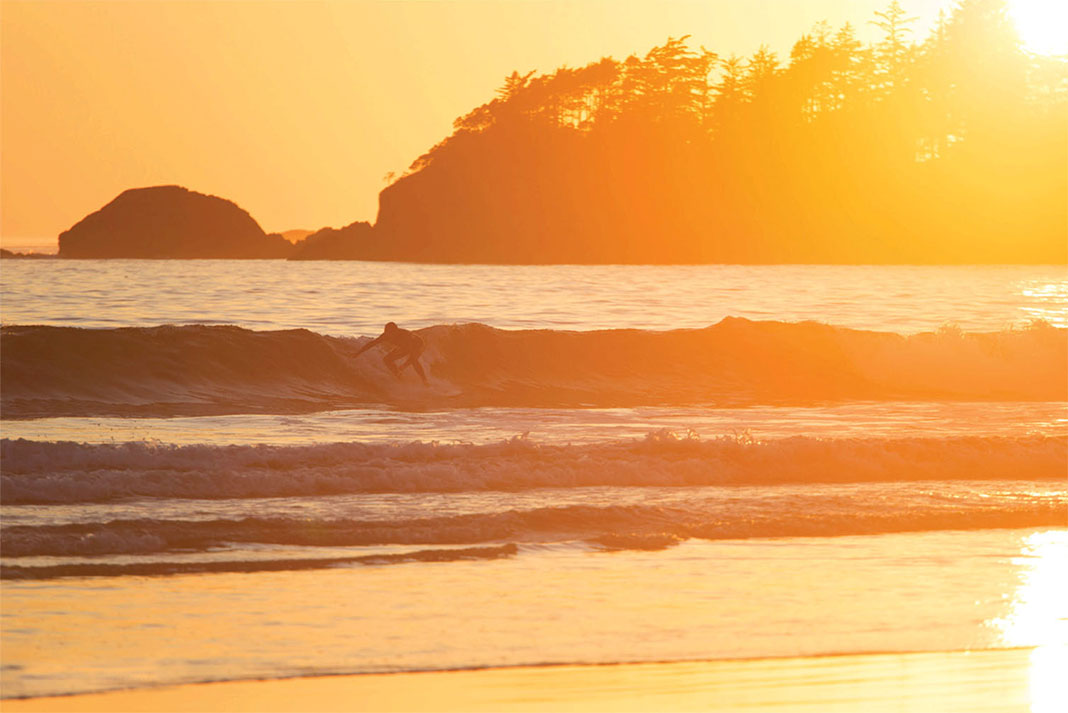
Landing on a golden sandy beach on the protected eastern side of the point, we race excitedly down the narrow trail through thick waxy leaves of salal, dodging bear scat and scrambling up steep, muddy slopes. Bursting from the cloak of dense old growth forest into the brilliant afternoon sun bathing the outer coast, we gaze upon a natural surfing paradise. With the vast Pacific as a sparkling backdrop, small clean peaks peel off a sandbank in the middle of a crescent-shaped bay ringed by white sand and bleached driftwood.

The warm waters of Kyuquot Sound have wrapped around to the outer coast and amazingly, at nearly 50 degrees latitude, we can surf sans wetsuit, unheard of in our backyard surf playground of Tofino. Our first evening rewards us with a short, playful surf session as the unseasonably hot September sun sets and an amazing orange moon and bright Milky Way rise over our camp.

sun through trees leading to beach
Photo: Ben Haggar

The multi-day trip routine: surf, fish, explore

The beauty of a multi-day kayak trip is that it sharpens your sense of adaptation and self-reliance, leaving you more in command of your own experience. This journey was the first time any of us had kayaked on the open coast, but our surfing experience served us well.

Reading the waves, I learned to time a burst of paddle strokes to safely land my boat through surf. Once ashore, I could wade out into the water and assist my girlfriend, Caroline, as it was her very first kayaking adventure. Meanwhile, our German companions, Anja and Uwe, handled their long boats like seasoned veterans, gliding effortlessly onto the exposed beaches.

The days blurred as we settled into a routine of surfing, fishing and exploration. One of our daily activities involved identifying fresh animal tracks in the sand including bear, cougar and, one morning, translating a story involving a deer and a very large timber wolf.

With the kayaks, we scoped potential reef breaks and other beaches for waves. The swell filled in as forecasted and the extra size opened up a speedy river mouth right-hander. But we had yet to explore the outer reef shelves that had piqued my interest while pouring over marine charts and Google Earth months earlier.

person surfing at sunset on Vancouver Island's Kyuquot Sound
Photo: Ben Haggar

Loving the unknowns

The roulette wheel of searching for remote surf spots by kayak could be a fickle affair. Re-checking a break on a different tide wasn’t really an option with the large distances between spots, but when you hit it right, you could hit it big.

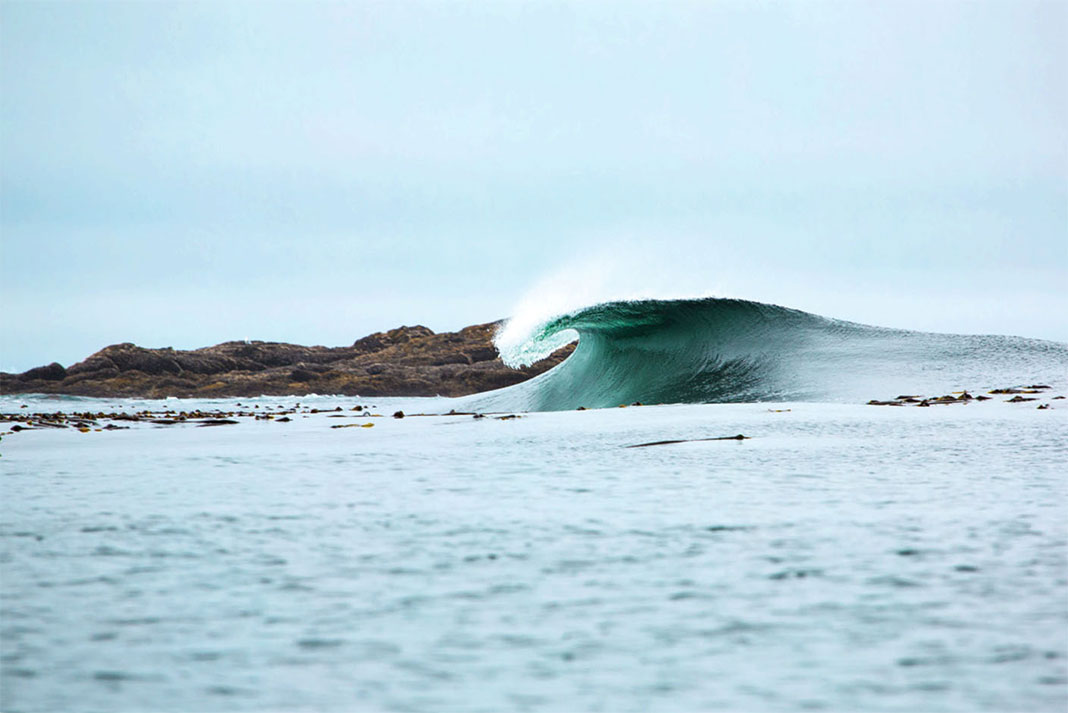
We paddled past plenty of reefs when the tumultuous variables of swell direction and tide failed to produce surfable waves. Then we saw them: the reeling green backs of waves jacking up on the horizon. On closer inspection, the slabby left-hander sucked most of the water from the reef, threw a thick green lip and carved an angry path through a dense mat of bull kelp.

I love the unknowns of surfing a new break and one this remote and wild had me nearly jumping out of my kayak. The only information we had was what we were staring at in that very moment.

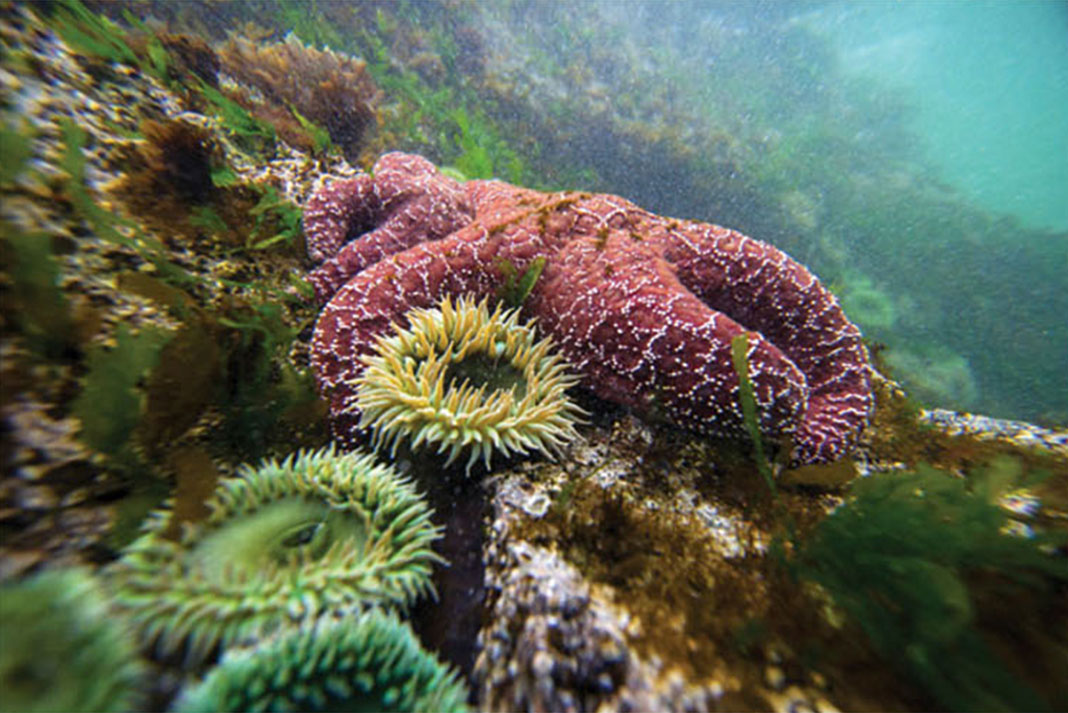
Now I know a lot more: I am intimate with the impenetrable beds of mussels covering every inch of the treacherous rocks. I can picture the brightly colored eelgrass, sea stars and anemones that crowd the reef. And I know that if you miss your drop, you’re going to get a closer look at the creatures below and battle through foamy kelp on your way back to the surface.

waves on coast
Photo: Ben Haggar

One final treat

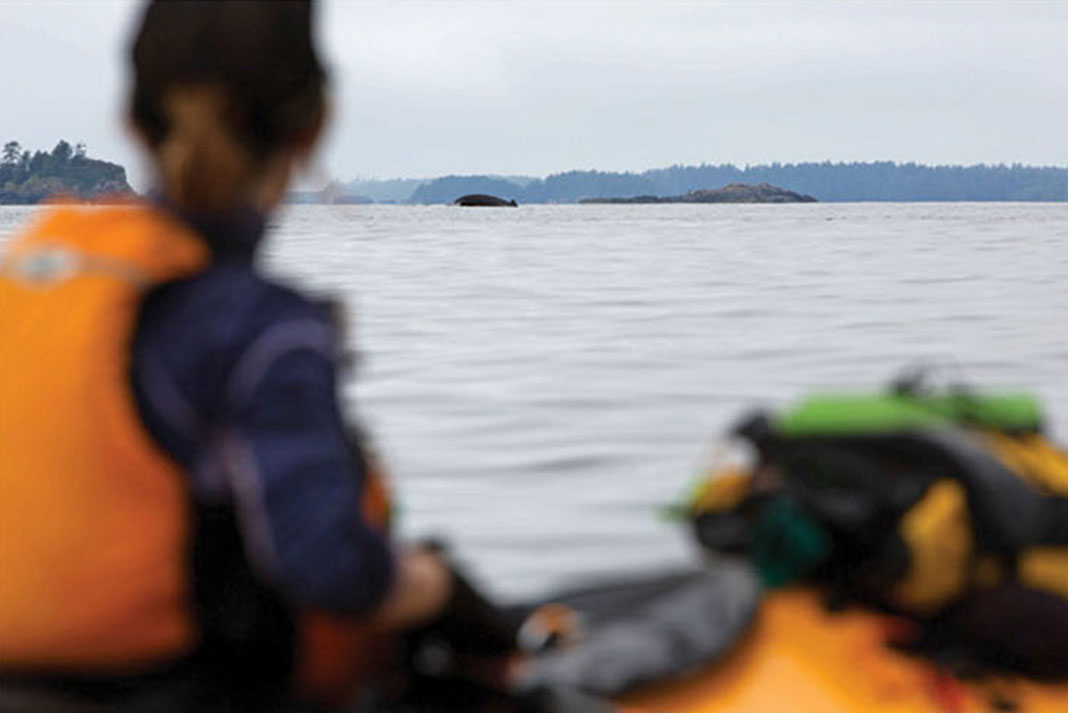
Inevitably, dense coastal fog rolled in, obscuring the peaks and the sun and seeming to add hours to the 25-kilometer paddle back into the sound. Mother and calf grey whales escorted us for much of the morning, and the silence was absolute apart from our rhythmic paddle strokes and the whales’ sharp exhalations echoing between the islands.

As night fell on our last campsite, one final treat came in the unexpected form of bioluminescent phytoplankton glowing bright blue in the shallows and on the seawater-saturated pebble beach. With childlike excitement, we skipped luminous blue stones and ran with electric footprints down the beach.

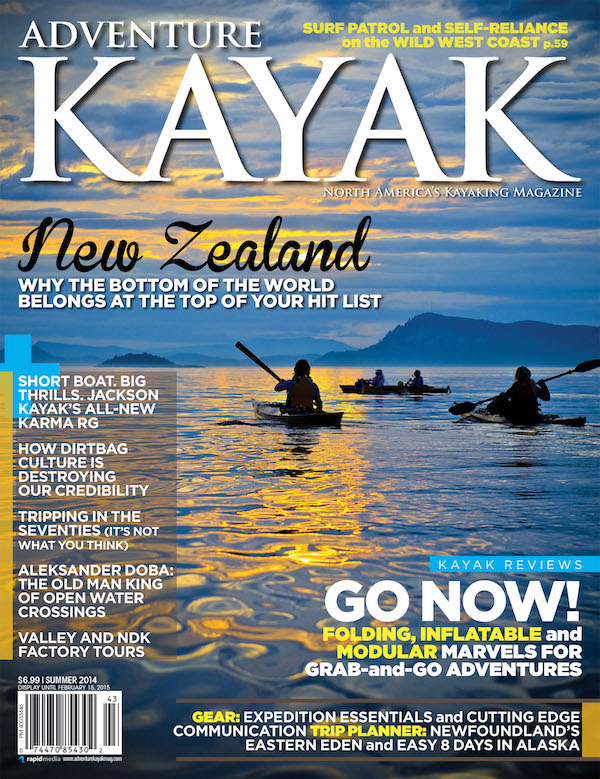
Cover of the Summer 2014 issue of Adventure Kayak magazineThis article was first published in the Summer 2014 issue of Adventure Kayak Magazine. Subscribe to Paddling Magazine’s print and digital editions, or browse the archives.


Feature photo: Ben Haggar


Dirty Jobs, Beautiful Boats: Kayak Manufacturing in the UK

All photos this page: Alex Bloyd-Peshkin
Dirty Jobs, Beautiful Boats: Kayak Manufacturing in the UK

Every time we settle into
our kayaks, we see the stickers announcing their provenance: Anglesey, Wales, for our Sea Kayaking UK Pilgrim; Nottingham, England, for our Valley Avocet LV. The place names conjure images of rugged coast and rough water, of grey skies and green meadows. So when the opportunity arises, we jump at the chance to actually visit the birthplaces of our boats.

It’s not exactly Sherwood Forest or the Shire. Valley
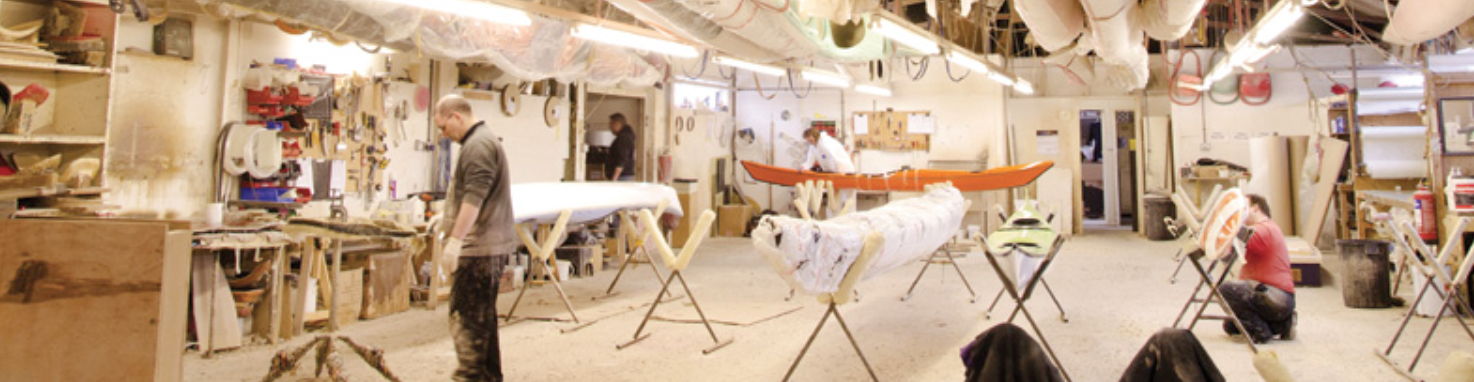
and Sea Kayaking UK both occupy factories in nondescript industrial areas. But don’t let the term factory mislead you. These aren’t cavernous buildings with deafening, automated machinery cranking out identical objects at a frantic pace. Rather, they are modest metal sheds where kayaks are handmade by skilled workers in a labor-intensive, multi-step process.

Nottingham lies landlocked in the middle of England. On the outskirts of the bustling city, where the nearby River Trent winds out of crowded suburbia into a lush quilt of tidy fields, tinny Black Sabbath plays over too-small speakers in the Valley factory. Boats-in-progress rest on sawhorses and the sharp smell of solvents fills the air. Cans of gel coat and resin line the shelves and tools, brushes and tape hang from the walls.

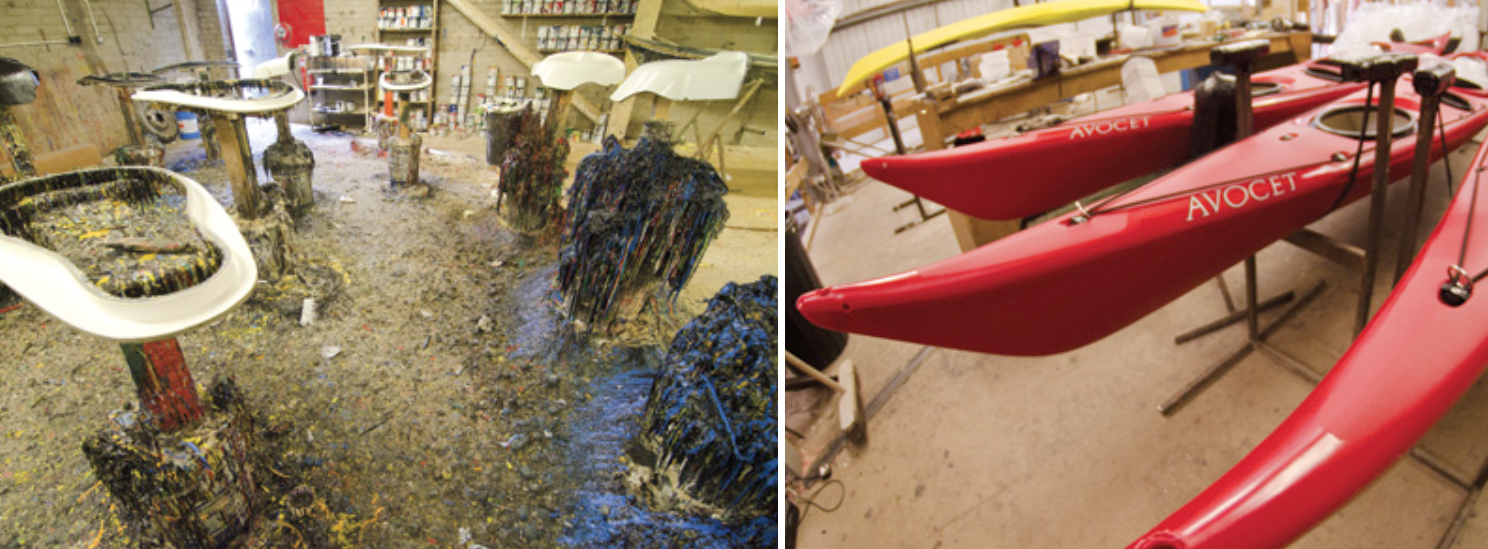
Many of Valley’s 20 full-time employees have worked here for more than two decades. A Mick Jagger look-alike leans intently over a brilliant orange kayak. Several other men in gel coat-stained coveralls or spotless white Tyvek suits move the kayaks through their stations: painting the molds with gel coat, layering in the fiberglass and resin, glassing in the coaming, bulkheads and skeg box. For composite kayaks, the time from mold to final inspection is about a week.

Inside a kayak workshop in UK

PRIDE IN KAYAK CRAFTMANSHIP

Three hundred kilometers to the west, surrounded by cliffs and currents, Holy Island lies like a severed pinky off the mitt of Anglesey Island. The Sea Kayaking UK factory sits just south of Holyhead’s Old Harbour and the town’s busy seaport. Inside, seat and coaming molds stand amid years of resin stalagmites, like a Technicolor petrified forest. Reels of fiberglass hang above workstations, where work orders list each kayak’s customization and destination: Japan, Finland, Israel.

At both factories, there’s tremendous pride in production, and a lot of cross-pollination of technique, shape, process and even people. Valley co-owners Jason Buxton and Peter Orton are both former members of the British freestyle team. Buxton went on to work for Pyranha and Orton for P&H. When the two companies merged, Buxton and Orton found themselves colleagues once more. They later purchased Valley, which produced its first boat, the Pintail, for Nigel Dennis’ paddling center. Dennis, in turn, founded Nigel Dennis Kayaks, now Sea Kayaking UK.

While the owners are serious long-time paddlers, the dedicated workers who built our kayaks—and perhaps yours as well—generally are not. Rather, they are craftsmen who appreciate the steady work creating respected products. It might 
be a dirty job, but the result is undeniably beautiful.

“It’s quite nice to create something,” says Buxton. “We’ve lost more workers to retirement than anything else—we’re passionate about what we do.”

Inside a kayak workshop in UK

Sharon and Alec Bloyd-Peshkin are the founders of Chicago-based Have Kayaks, Will Travel Paddlesport Coaching (www.havekayakswilltravel.com).


This article first appeared in the Summer 2014 issue of Adventure Kayak Magazine.  Subscribe to Paddling Magazine and get 25 years of digital magazine archives including our legacy titles: Rapid, Adventure Kayak and Canoeroots.

Skills: Golden Rules for Great Canoe Strokes

man and woman in canoe demonstrate 3 golden rules of canoeing

Andrew Westwood looks at the 3 Golden Rules of Canoeing, which are a set of rules that define how to make all your canoeing strokes as effective and efficient as possible.

AIRE Sabertooth Raft Review

AIRE Sabertooth Raft Review | PHOTO: KAYDI PYETTE

The Sabertooth 12 is AIRE’s new inflatable frameless go-anywhere river animal. We’d never have guessed that a raft 12.5 feet long and five and a half feet wide, with 20.5-inch diameter tubes could arrive in a FedEx box not much bigger than a tailgate cooler.

AIRE Sabertooth 12
Length: 12.5′
Width: 5.5′
Tube Diameter: 20.5″
Bow/Stern Rise: 29″
Waterline: 7’9″
Air Chambers: 4
Weight: 80 LBS
MSRP: $2,699 (no thwart) / $2,934 (one thwart)
www.aire.com

Rolled out by the river we went to work blowing the four chambers—two on each side. The welded-in cross tubes fill with the side compartments as we watch the Sabertooth take shape. AIRE’s two-layer AIREcell system boosts durability by protecting the inner air chambers with an outer orange or white PVC fabric.

The Sabertooth floor comes pre-laced and is raised above the waterline. It drains instantly, doesn’t stretch and won’t catch in the water to slow you down. At one end of the floor there are foot cups serving as a firm anchor point.

The Sabertooth can be ordered with or without a removable thwart that’s positioned using a simple pin and clip system—no lacing or finicky cam straps. For $250 extra it offers more options for seating, paddling and packing.

Everyone in the Rapid office has has different rivers in mind for the Sabertooth. Our publisher, Scott MacGregor, has had it pegged as the perfect mid-summer float tripper. Others are talking creeky big water runs like the Upper Petawawa (“Finding Flow,” Rapid, Summer 2002).

“We designed it for the people really wanting to get after it in whitewater,” says Sheena Coles, marketing manager at AIRE. “It’ll go big. Class IV and V for the experienced paddlers. It’s meant for big water but it’s also great for families.”

The Sabertooth has a 7.75- foot waterline that responds to every stroke. As soon as we launched from shore, we noticed this raft’s speed and agility.

The tubes have continuous curve, meaning their round bottoms have little surface area, which increases the hull speed by minimizing drag. Compared to a traditional raft, the Sabertooth feels like it moves over the water, instead of pushing through it, which also means less scraping on shallow river bottoms and slides.

AIRE Sabertooth Raft Review | PHOTO: KAYDI PYETTE

Sitting side by side, we each jammed a river shoe into the foot cups. This allowed me to push myself back towards the center thwart into a solid paddling position, far enough out on the tube to take aggressive strokes but wedged-in enough to feel stable and confident.

After a few minutes of forward paddling above our first set, we balanced our strokes and found our rhythm. The Sabertooth made short work of our early spring runs, pouncing over holes and leaping from eddy to eddy.

We were on the river during a guiding company’s staff training. When we were inflating the Sabertooth, a few older guides wandered over; they said it looked sort of like an old Shredder. Some of the younger guides were snickering, but only until they gave it a go. The Sabertooth is serious fun.

At just 80 pounds, the Sabertooth is an easy carry. Between the tubes at the bow and stern, two D-ring handles are perfectly spaced and comfortably shaped to grab and go for run after run, or for the long walk out of the Gauley.

We don’t do a lot of rafting here at the Rapid office and we don’t get to keep every boat we review, but we’re not going to let the FedEx driver anywhere near this one. EMMA DRUDGE


This article first appeared in the Early Summer 2014 issue of Rapid Magazine. Subscribe to Paddling Magazine’s print and digital editions, or browse the archives.


Video: AIRE Sabertooth Raft Review

Photo: Screen capture AIRE Sabertooth Raft Review
Video: AIRE Sabertooth Raft Review

This agile, inflatable, frameless raft is a go-anywhere river animal.

Rivers Of Change: Roger Parsons And The Minden Wildwater Preserve

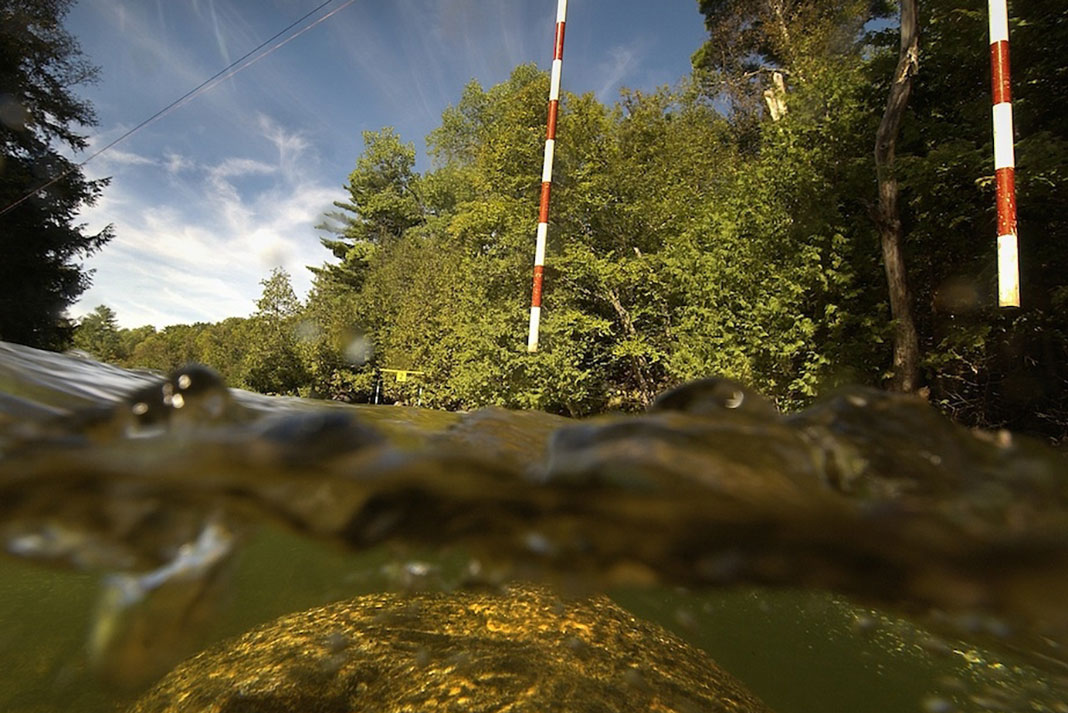
semi-submerged photo of the kayak training course at Minden Whitewater Preserve
Time may change me; But I can’t trace time. —David Bowie | Feature photo: Rick Matthews

Building a river used to be a simple process. All it took to create the world’s best whitewater freestyle river was the weight of a slowly receding glacier compressing the Ottawa Valley to below sea level.

When the ice sheet slowly left town the area filled with seawater. As the land eventually bounced back the salt water accumulated in the oceans where it belongs. Fresh water began falling through the deepest of the remaining ditches, forming the Ottawa River and its tributaries we paddle today. There was nobody proposing these changes and nobody fighting to preserve the ice age as it was.

Rivers of change: Roger Parsons and the Minden Wildwater Preserve

About 175 million years later in May of 1977, Roger Parsons discovered a for sale sign on the land alongside the unpaddleable upper rapids of the Gull River. Money was raised, wheels where greased and permits obtained. A large bulldozer and giant backhoe descended into the river.

“Major renovations were made to the stream bed to make it like an alpine river and allow it to be navigable throughout its length,” wrote Parsons. They created a levee, eddies, chutes and pools.

semi-submerged photo of the kayak training course at Minden Whitewater Preserve
Time may change me; But I can’t trace time. —David Bowie | Feature photo: Rick Matthews

Above all, Roger Parsons created a level of trust with the various levels of government, convincing them that his dream of a whitewater training base would provide tourism and local economic benefits.

Reeve Sinc Nesbitt officially opened the Minden Wildwater Preserve on September 13, 1980. I was only nine years old.

Thousands of adults and camp kids have learned to paddle whitewater at the Gull. In addition, the Preserve has hosted the Pan American Championships, three World Cups, dozens of national slalom championships, two national freestyle championships, hundreds of regional slalom races, 34 Gull River Open Canoe Slalom races and one ACA National Open Canoe Slalom race. When Toronto won the bid to host the 2015 Pan Am Games the Gull River was the obvious venue.

Coming to terms with a changing course

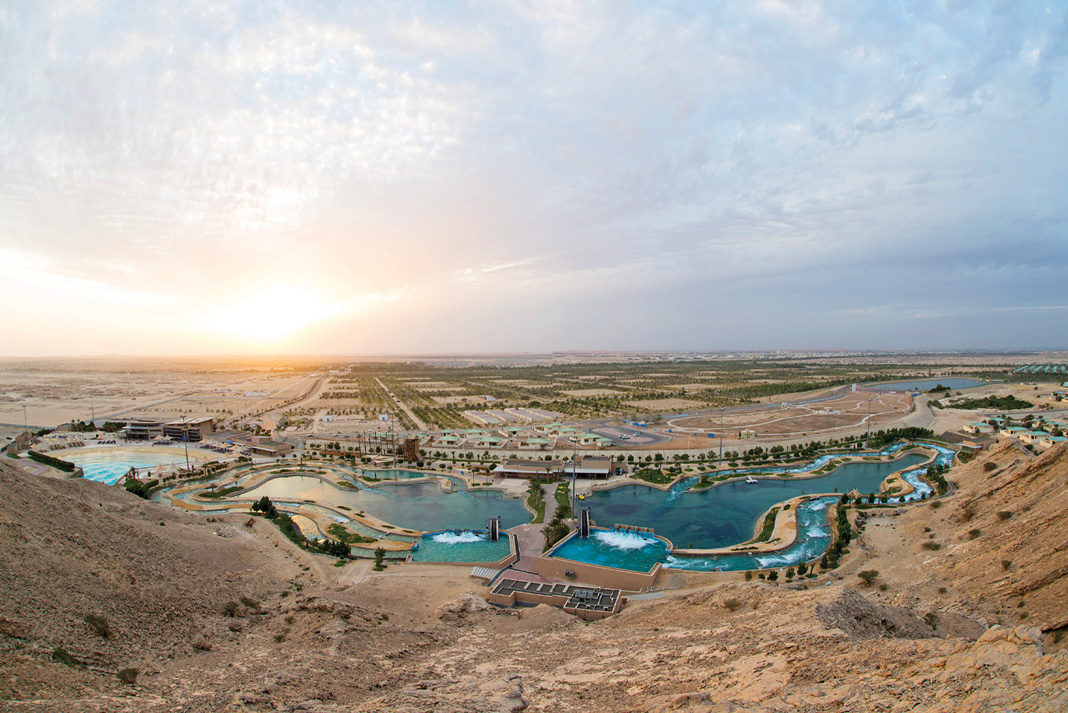
The last World Cup slalom event at the Gull was in 1993. Compared to the ASCI whitewater center and Wadi Adventure the Gull River feels quaint, wild and natural. Many of us who regularly paddle the Gull like it that way. Others dream of a better racecourse and a better training facility and the Pan Am Games is their goose that laid the golden egg.

When the local municipality and Pan Am committee proposed walkways, improved channeling and permanent slalom gate structures my kneejerk reaction was to resist change.

I’m young and naive enough to have believed that it’s always been this way.

Until I read the book Building a River…Following a Dream: The Roger Parsons Story I had no idea how dramatically the Gull River was changed from its truly natural state. I’m young and naive enough to have believed that it’s always been the way I’ve always known it to be. Reading the story, I learned how a river changes over time, sometimes naturally and sometimes with a little help from a couple guys in Caterpillars.

The thousands who learn to paddle at the Gull after the Pan Am Games won’t remember the river any other way. They will only remember learning, training, racing and playing. They will remember snuggling into the riverside campground Roger and his friends carved out of the woods for us. They will remember falling asleep to the sound of water falling from higher ground, just like it has for millions of years.

[ Paddling Buyer’s Guide: View all freestyle kayaks ]

Scott MacGregor is the founder and publisher of Rapid. In 2008, the Preserve’s training center building was renamed the Roger Parsons Centre. Parsons was presented with his own set of keys.

Cover of Early Summer 2014 issue of Rapid MagazineThis article was first published in the Early Summer 2014 issue of Rapid Magazine. Subscribe to Paddling Magazine’s print and digital editions, or browse the archives.

Time may change me; But I can’t trace time. —David Bowie | Feature photo: Rick Matthews


Solo Interrupted

Photo: Hillebrand Steve, U.S. Fish and Wildlife Service
Solo Interrupted

This article was first published in the Spring 2008 issue of Canoeroots magazine—get it at the links below. 


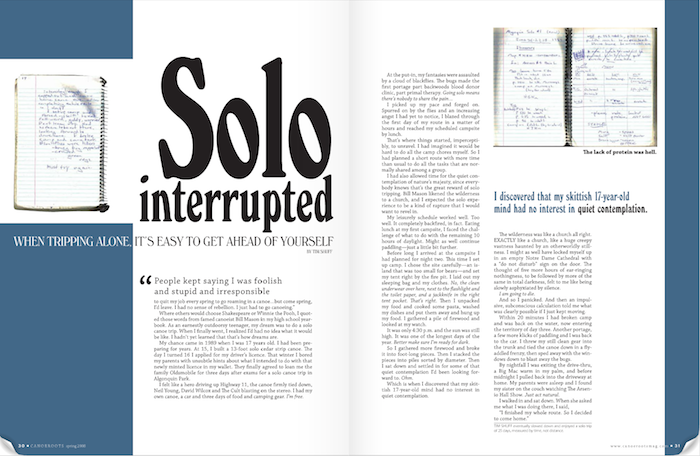
“… The wilderness was like a church alright. EXACTLY like a church, like a huge creepy vastness haunted by an otherworldly stillness. I might as well have locked myself up in an empty Notre Dame Cathedral with a “do not disturb” sign on the door. The thought of five more hours of ear-ringing nothingness, to be followed by more of the same in total darkness, felt to me like being slowly asphyxiated by silence. 


I am going to die. 


And so I panicked…”


Screen_Shot_2014-07-17_at_3.59.50_PM.pngGet the full article in the digital edition of Canoeroots and Family Camping, Spring 2008, on our free iPad/iPhone/iPod Touch App or Android App or read it on your desktop here.

Homemade Buoyancy Aid

Photo: Courtesy Ashley Grittner/NRS
Homemade Buoyancy Aid

These days there are hundreds of life jackets to choose from. They’re extensively tested to earn Coast Guard approval and designed to be perfectly comfortable, whatever your water sport.

It wasn’t always this way.

I started boating in the mid-70s when a coworker invited me on a day float on Idaho’s North Fork of the Clearwater River. I was hooked from that first trip and had my own raft by the following year. Even the best life jackets of that era were crappy—ill fitting, flimsy or bulky. And not much of a swimmer.

After seeing a horse collar vest rip off a friend getting maytagged in a hydraulic and a big “Mae West” jacket come untied, I went looking for alternatives. My criteria: a secure fit, durability and lots of flotation. I looked in local stores but didn’t find it.

Boating magazines of the day carried ads for Wildwater Designs, a company owned by Charlie Walbridge. Charlie is a whitewater safety expert, coauthor of the pioneering Whitewater Rescue Manual and one of the original inductees in the Whitewater Hall of Fame.

One of the products he carried was the Hi-Float Life Vest Kit. That’s right, I said kit—a sew-it-yourself life jacket package.

I ordered my kit by mail in early 1980 for $24.50. I still have the receipt. It contained precut panels of burly nylon fabric, strips of soft buoyant foam, a heavy-duty zipper, nylon thread and complete instructions containing this troubling note:

Some people have complained that these life vests trap water. If yours does you can allow for drainage in this way. Get a nail, a candle, and a pair of pliers. Light the candle, grasp the nail with the pliers, and heat it until it is quite hot. Use the nail to punch holes in the bottom of each foam compartment. The heat will seal the edges of the hole.

I didn’t know how to run a sewing machine, but wanted to put it together myself. My wife, an excellent seamstress, coached me through the process. The result was a tough, snug-fitting, high-flotation jacket. The pounds of buoyancy it advertised were well up in the twenties. You could fold up the portion below the waist tie to make it more compact, or wear it down full length. At some point, I added a between-the-legs strap to make it even more secure.

That jacket saved my bacon many times, down hundreds of river miles, including all of Idaho’s crown jewel rivers and on far-away floats like the Grand Canyon. I had some classic swims but it always bobbed me to the surface.

I wore my Hi-Float for almost 20 years, until the zipper finally failed.

When I saw Charlie at a swiftwater rescue clinic in 2004, I brought out the old jacket to show him and he thought I was trying to get it warranted!

Charlie eventually sold the design to Extrasport, whose current Swiftwater Ranger Rescue Jacket is a child of the Hi-Float.

It could get hot, it wasn’t adjustable and it didn’t carry any certification, but I made it myself, it was custom-sized, I trusted it with my life.

Clyde Nicely’s chief passion is multi-day rafting. He strings words together for a living as the e-News editor at NRS.

Cover of the Volume 16, Issue 2 of Rapid MagazineThis article was first published in Issue 16, Volume 2 of Rapid Magazine. Subscribe to Paddling Magazine’s print and digital editions, or browse the archives.
Feature photo: Courtesy Ashley Grittner/NRS