Home Blog Page 291

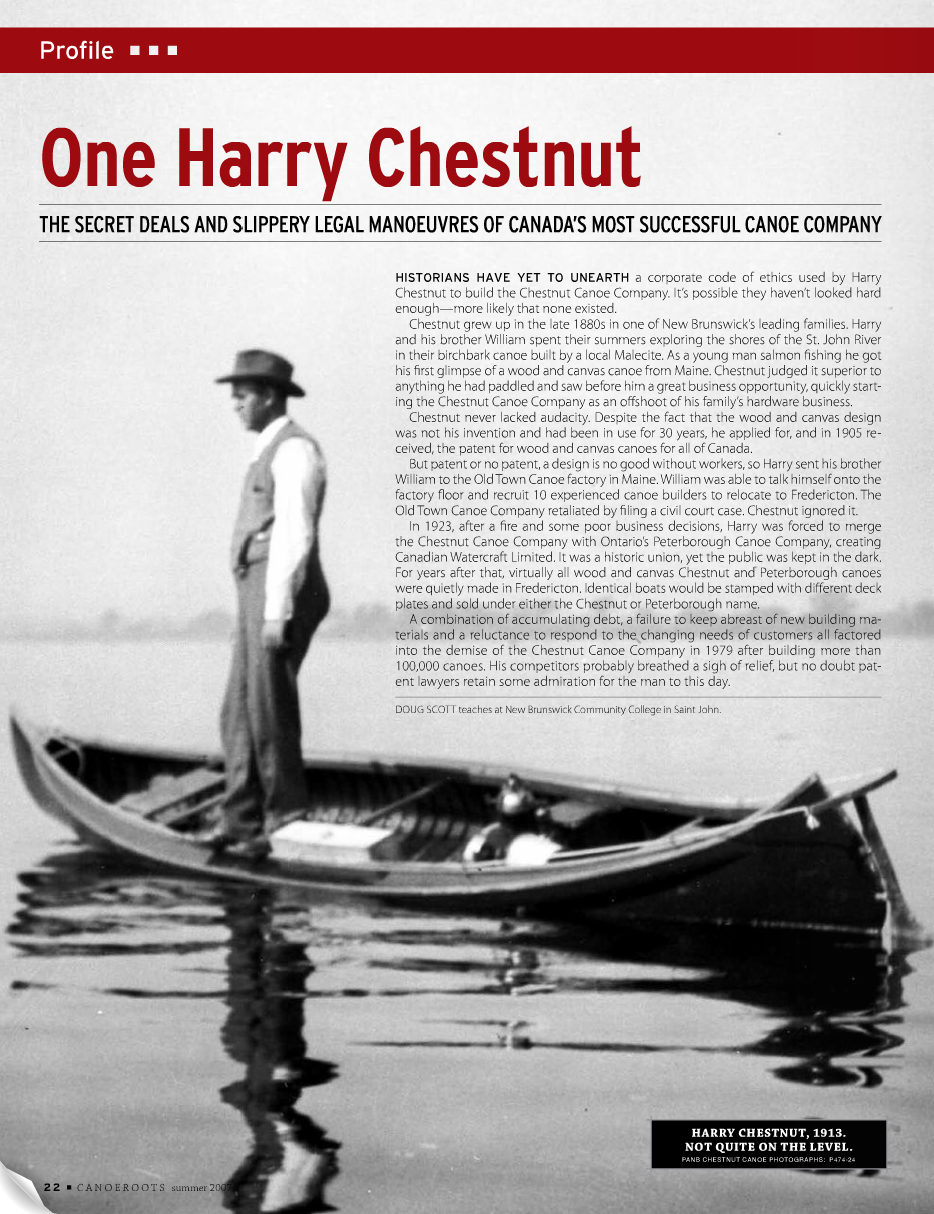
Boats: One Harry Chestnut

Photo: Chestnut Canoe Company
Chestnut Canoe Company


Historians have yet to unearth a corporate code of ethics used by Harry Chestnut to build the Chestnut Canoe Company. It’s possible they haven’t looked hard enough—more likely that none existed. 

Chestnut grew up in the late 1880s in one of New Brunswick’s leading families. Harry and his brother William spent their summers exploring the shores of the St. John River in their birchbark canoes built by a locale Malecite. As a young man salmon fishing he got his first glimpse of a wood and canvas canoe from Maine. Chestnut judged it superior to anything he had paddled and saw before him a great business opportunity, quickly starting the Chestnut Canoe Compnay as an offshoot to the family’s hardware business.


Screen_Shot_2014-06-27_at_9.51.38_AM.png  Continue reading this article in the digital edition of Canoeroots and Family Camping, Early Summer 2007, on our free iPad/iPhone/iPod Touch App or Android App or read it on your desktop here.


Photo: Icy Horizons

"The conditions dictated we concentrated on paddling rather than trying to take pictures!" Photo: Peter Lavigne
"The conditions dictated we concentrated on paddling rather than trying to take pictures!"

“These quick pictures are from a trip we recently finished up along the northeast coast of Newfoundland,” said Adventure Kayak reader Peter Lavigne. “The first couple days were spent out running the ice pack and the icebergs were like trail markers along the way. Unfortunately, the best pics were never taken, as the conditions dictated we concentrated on paddling rather than trying to take pictures!”

Peter Lavigne body 1

Want more reader photos? Check out this shot, “Paddler’s Morning.”

VIDEO: Heel Hook Assisted Rescue

Learn how to perform a heel hook assisted rescue. Photo: Screen Grab
Learn how to perform a heel hook assisted rescue.
[iframe width=”560″ height=”315″ src=”//www.youtube.com/embed/j-zpJQeiaNc” frameborder=”0″ allowfullscreen ]
Gordon Brown/Paddling.net

Learn how to perform a heel hook assisted rescue from Gordon Brown in this excerpt from the Gordon Brown Sea Kayaking Volume 2 DVD. “The heel hook takes advantage of the strength in leg muscles to make for an easy re-entry into your kayak.”

Want more kayak skills? Learn these marine VHF essential skills.

VIDEO: High Dock Landing

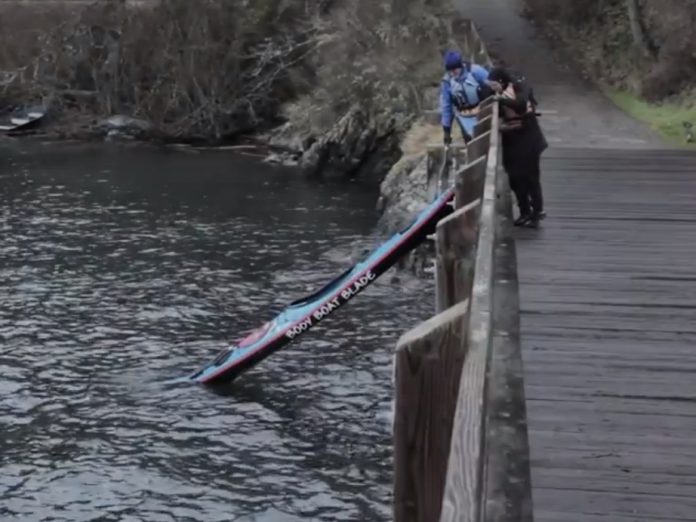
It'll be fine...right? Photo: Screen Grab
It'll be fine...right?
[iframe width=”560″ height=”315″ src=”//www.youtube.com/embed/Di69trQlxTg” frameborder=”0″ allowfullscreen ]
Body Boat Blade International

You pull up to the beach to launch your kayak from a new beach and are surprised when you see a high dock as the only means of access. How are you supposed to safely and effectively launch and land your boat? Check out this quick video from Body Boat Blade International’s Leon Somme and Shawna Franklin, as they show you how it’s done.

Want more sea kayaking videos? Check out this video, “Crazy Kayak Surfing.”

Video: Marine VHF Radio Essentials

Image: Adventure Kayak TV
Video: Marine VHF Radio Essentials

Every open water paddler should carry and know how to use a marine VHF radio for routine and emergency communication on the water. Watch this quick how-to video from Adventure Kayak magazine to learn the basics of making a call to the Coast Guard or other vessels.


Watch more technique videos and other awesome films at Adventure Kayak TV’s YouTube channel, here.


Video: Kevin Callan’s Wilderness Values

Video: Kevin Callan

Kevin Callan takes out a birchbark canoe with friend Tim Foley from the Canadian Outdoor Equipment store and explores today’s wilderness values. The traditional canoe was made by Robert Corradi from the UK.

Video: Sea Kayak Towing Tips

Image: Screen Capture Gordon Brown
Sea kayak instructor Gordon Brown demonstrates an on-land example of attaching a tow line

When sea kayaking in challenging conditions, reaction time is everything. The contact tow for is a very effective on-the-water rescue to get a paddling partner out of trouble. BCU kayak coach Gordon Brown demonstrates the tow and some of the variations and equipment you can use. Watch the video to learn how it’s done.


Get more kayak instruction films at Sea Kayak with Gordon Brown. DVDs and downloads here.


Skill Video: How To Roll A Kayak

Photo: Screen Capture
A whitewater kayak instructor stands in the water to help a kayaker practice a kayak roll.

As I progress as a teacher, my progressions adapt and change to the diversity of my students. It makes me revisit several of my previous ideas and build upon them. I have always had a how-come? approach to my teaching instead of a this is how it’s done, so do it approach.

If you break down the physics of a skill like rolling, you are hit upon all the important information a student needs to learn to understand, then execute the move. 

This video is an update on my previous roll video—it reviews previous concepts and builds upon them.


Chris Wing has been an instructor for as long as he has been a kayaker. He started H2o Dreams out of a desire to spur growth and reverence for paddle sports education all while providing a different spin to the presentation of familiar topics. Visit www.whitewaterdreams.com for more info.

Cool Camper Kit for Your Car

Photo: SwissRoomBox
Cool Camper Kit for Your Car


We love nifty gadgets, so when this new innovation from Switzerland came across the editorial desk, we just had to share!

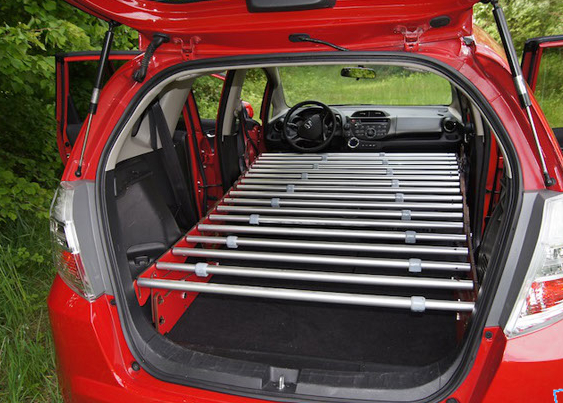
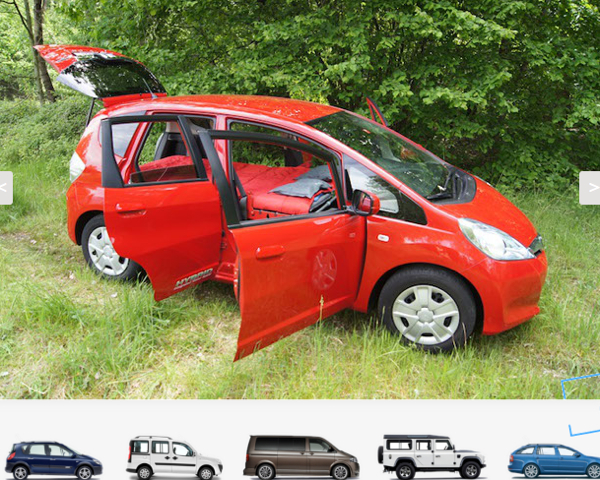
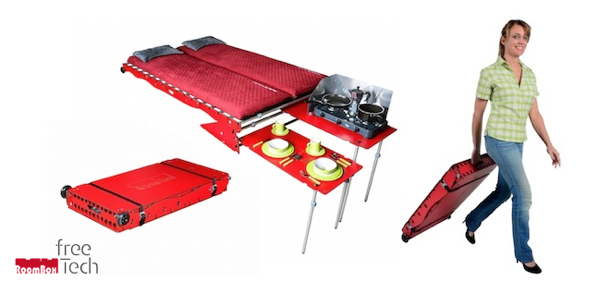
An incredible fusion between the simplicity of a suitcase, the ingenuity of a Swiss Army knife and the essentials of a motorhome, the SwissRoomBox freeTech is a compact and affordable conversion kit that fits nearly any compact car, SUV or minivan.

Thanks to the clever folding concept of this modular system, you can take the RoomBox with you while traveling and, in 5 minutes, transform your car into a motorhome for sleeping, cooking and eating.

For just 1,645–2,220 Euros, the RoomBox freeTech makes motorhomes accessible to any car owner. You can even pack it along as airline luggage and convert your rental car when traveling.

Check out the pics below, or visit http://www.swissroombox.com to learn more. Here’s hoping this cool kit makes it across the pond this summer!

SwissRoom1SwissRoom2SwissRoom3


Easy Underwater Photography Tips

Photo: Goh Iromoto
Easy Underwater Photography Tips

You don’t need a $10,000 housing to get underwater images like this one, says Toronto adventure photographer Goh Iromoto. For paddling photography, lighter is better. He uses a waterproof camera dry bag made by EWA-Marine to protect his Canon 5D Mark III. “It weighs just 400 grams compared to the 30-pound camera system I use for commercial underwater photography,” he says. “It’s so handy, I often leave it on when I’m kayaking. I’ve even jumped off a cliff with it, shooting as I fell into the water.”

Split images trick the camera’s autofocus into focusing on the waterline, rather than the scene beyond, warns Iromoto. Before dunking the camera, focus on your subject, set the camera to aperture-priority mode and use a wide aperture like F/2.8 or F/3.5. Then it’s just a matter of making sure the lens is half in, half out of the water. “Use your intuition and watch the subject,” rather than keeping your eye glued to the viewfinder, suggests Iromoto. Shooting with an ultra-wide angle lens and getting to know how it “sees” also help. “Knowing my lens means I know instinctively what will be in the frame,” he adds, “then I can just enjoy the scene.”

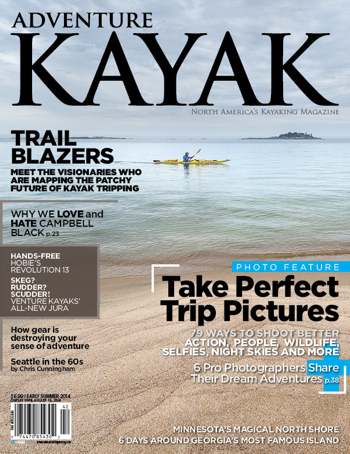
AKv14i2-CoverClick here for tons more paddling photography tips in the Early Summer 2014 issue of Adventure Kayak, or download our free iPad/iPhone/iPod Touch App or Android App.