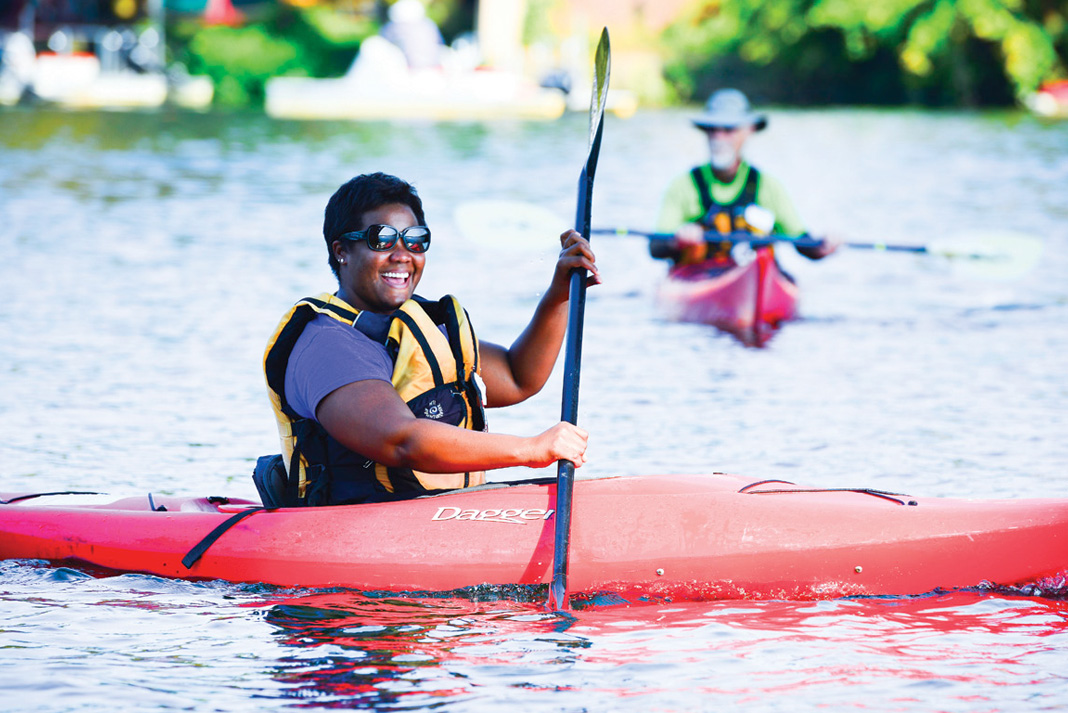
Team River Runner organizes social events like this fun race in D.C. for vets and their families. | Photo: courtesy of Team River Runner // Robb Sharetg
A desperate man stands in a room with a shotgun, a fishing rod and a choice. One tool represents despair, the other hope. He chooses life—the fishing rod—and goes kayaking.
A woman is run down at the side of the road in Iraq while changing the tire on her Humvee. She wakes up from a two-year coma, able to function in every way but without the ability to remember anything from day to day. Then she goes kayaking, and that becomes the first thing she remembers in three years.
“The experience was so positive that it cracked the shell on all the bad stuff,” explains Jim Dolan, who tells me these stories as examples of the many lives he’s seen kayaking save.
Dolan is the founder and director of Heroes on the Water (HOW), an organization that takes wounded U.S. veterans out kayak fishing. Dolan, an avid kayak angler who flew for the U.S. Air Force for 13 years before a career as an American Airlines captain, saw helping wounded veterans as a call to duty.
“We owe these guys our best,” he says. “They have given so many pieces of themselves. We need to help get them up and running again. Kayak fishing is a great way to do it.”
Lately I’ve been thinking a lot about the therapeutic connection between kayaking and post-traumatic stress disorder (PTSD).
I’m preoccupied by some disturbing news that emerged in Canada last year: the suicides of eight military veterans in as many weeks. This led to my reading the excellent book by the Iraq war journalist David Finkle, Thank You For Your Service, which gives an intimate look into the lives of a few U.S. veterans and the extreme challenges they face getting healed.
Kayak therapy: inexpensive and effective
Who is doing anything about this? Kayakers, it turns out, are playing a vital role.
Dolan describes kayaking as physiotherapy, occupational therapy and mental therapy rolled into one. It’s remarkably effective and also damn cheap.
“There are organizations that spend five grand to take a guy or gal to Montana to go fly fishing, but for five grand I can take 100 guys out and do it in their backyard,” explains Dolan. “I can take them out tomorrow. It’s immediate, it’s inexpensive, it’s now and it’s local. It’s extremely simple.”
HOW often works with veterans who have been injured in explosions, suffering brain injury and mental stress. As Dolan describes it, the brain essentially shuts down for self-protection.
“They come back wound tight as a drum. They have hypervigilance, TBI (traumatic brain injury), post-traumatic stress. Until they can unwind, getting back to their family or their job or their education is very, very tough. We get them out in the water, get them to relax and teach them they don’t need to be wound as tight as they are over there.”
[ Paddling Trip Guide: View all kayaking instructional and skills clinics ]
That feeling after a good day on the water, that all is right with the world—every kayaker can understand its healing power. Now there’s empirical evidence to back it up. A 2013 study of HOW’s program in Pensacola, Florida, found that participants experienced a huge reduction in PTSD symptoms: a 78 percent reduction in overall stress; 77 percent in hypervigilance; 63 percent in avoidance behavior.
TEAM RIVER RUNNER ORGANIZES SOCIAL EVENTS LIKE THIS FUN RACE IN D.C. FOR VETS AND THEIR FAMILIES. | PHOTO: COURTESY TEAM RIVER RUNNER/ROBB SCHARETG
This shouldn’t come as a surprise. Symmetrical, repetitive activities like cross-country skiing and inline skating are widely recognized as particularly effective therapy for PTSD. Kayaking’s steady left-right-left-right tempo works in the same way, enabling both halves of the brain to work together to process traumatic memories.
An equally important factor in the success of these programs is the social network and support system they create.
Beginning in Texas in 2007, HOW has grown to 43 locations in 24 states, with affiliates in the U.K., Australia and New Zealand. Another U.S. veterans’ therapeutic kayaking program, team River Runner, which offers whitewater and flatwater kayaking without the fishing, started at Walter Reed army Medical Center in Washington, D.C., in 2004 and now has over 40 chapters across the U.S. with more than 2,000 participants a year.
But with an estimated 24 million cases of PTSD in the United States alone, the need is much greater.
Kayaking as preventative medicine
There are also many PTSD sufferers outside the military.
In 2011, recreation therapist and musician Zac Crouse kayaked and bicycled home from eastern Ontario to Halifax, Nova Scotia, as self-treatment for PTSD he developed after seeing his best friend die whitewater kayaking. He documented the 82-day journey in the film and accompanying album, Paddle to the Ocean (Best Sea Kayaking Film, 2014 Reel Paddling Film Festival). As a result of the trip, he found the frequency and intensity of his symptoms went way down—echoing the Pensacola findings.
“In the simplest terms, doing physical activity every day is an essential part of being human. We’ve gotten away from that and it’s killing us,” says Crouse.
It just makes sense that reintroducing physical activity will promote healing. Traveling under our own power opens us up to the world in ways that our mechanized and virtual lives do not, encouraging a healing attentiveness akin to meditation.
“There is no instant remedy for mental health,” Crouse acknowledges, “but living a healthier, active lifestyle is part of that process.”
As a firefighter I’ve coped with my own minor symptoms of acute post-traumatic stress after bad calls. And I have colleagues with full-blown PTSD who’ve had to take extended leaves of absence or retire early. I’m starting to think of my kayaking less as a hobby and more as a vital dose of preventative medicine.
Maybe my next step will be to take Dolan’s lead and find a way to share that with others. As he says, “this is a hobby, but it’s also a cause. There is an absolute need.”
Waterlines columnist Tim Shuff is a former editor at Adventure Kayak and embraces both the playful and serious sides of paddling.
This article first appeared in the Early Summer 2014 issue of Adventure Kayak Magazine. Subscribe to Paddling Magazine and get 25 years of digital magazine archives including our legacy titles: Rapid, Adventure Kayak and Canoeroots.
A couple hours at the International Boat Show affirmed that everything old is new again.
The indoor, arena-sized pond hosted everything from paddlesports instruction to motorboat trials to crazy wakeboarding and water stunts throughout the weeklong show. I took the organizers up on a chance to try standup paddleboarding for the first time.
I admit it, from one canoeist to another, I was skeptical of the sport.
SUPs have been the wunderkind of the paddlesports world and a much-needed financial boom for manufacturers over the past five years. According to the Outdoor Industry Association, it was also the fastest growing sport in the United States last year.
At first, I thought SUP was a gimmick. “This will blow over,” we conventional canoeists told ourselves. The truth is far from it. “They’re out-selling canoes two-to-one,” a cheerful whippersnapper in a wetsuit told me, handing over a paddle. Fad or not, I was ready to dump my canoe—temporarily, of course—to have a go and see what the hubbub was about.
Waiver signed, PFD secured, watch and wallet tucked into my shoes on the makeshift dock, I should have accepted the counsel of the young man who suggested I begin on my knees and work up from there. (“A lot of the ladies are doing yoga on standup paddleboards these days,” he said brightly, “but it takes a minute to get your balance.”)
Not Captain Canoe, of course—being a gunwale-bobber from way back, I stepped right on and very nearly swam.
I began by J-stroking but changed to rhythmically switching the extra-long paddle from side to side to keep straight. Looking down at my bare feet, images from early days growing up with my faithful retriever, Princess, on the banks of the mighty Speed River came flooding back. Déjà vu.
In look, the SUP was more like a Carl-Wilson-autographed surfboard but in feel, it was a raft—childhood’s first vehicle of exploration, made of logs, bailer twine and old fencing wire—with improved hull shape and hydrodynamics. Here we go again, Huck Finn!
Lost in my raft revelry, I paddled easily, building up speed with every pull and push. Hoisting an imaginary Jolly Roger, I was again Bluebeard on the bounding main or Captain Hattaras on my way to the North Pole. The 21st-century design didn’t fool me—this was my paddlecraft of yore.
Of course, with little storage, no secondary stability and the requirement of standing all the time, the SUP remains an inferior craft to the canoe—but the child in me won’t hear of it.
Don’t worry, James Raffan hasn’t given up his canoe, but he is considering an Arctic SUP trip with raft support. He asks you not to be too disappointed.
Get the full article in the digital edition of Canoeroots Early Summer 2014. Subscribe to Paddling Magazine’s print and digital editions, or browse the archives.
If you’ve been living under a rock rather than scraping over them, you may not know that Royalex canoes are in short supply.
Manufacturer PolyOne announced last summer that it was calling it quits on the long-time favored hull material of whitewater and recreational canoes. Production of Royalex sheets ceased in March. The announcement sent the paddling community into a Royalex-boat-buying frenzy. Outfitters are bulking up their fleets while enthusiasts are buying backups of favorite models. Everyone is wondering about the future of the sport.
Jacques Chassé, owner of Esquif Canoes, thinks he has the magic bullet.
Beginning this fall, Esquif will begin replacing Royalex in its canoe line with a brand-new, in-house-made material they are calling T-Formex.
According to Chassé, paddlers can expect the same indestructability and performance of Royalex for approximately the same price. And he claims T-Formex will be 10 percent lighter and 20 times more abrasion resistant than Royalex.
“Seventy-five to 80 percent of our boats are now made from Royalex. We had no choice but to innovate,” says Chassé. “It’s not a secret I had been asking the manufacturer to improve their material but they weren’t interested. They’d been making Royalex for the last 35 years and there’s a lot of new plastic and new technology.”
Chassé is building a 6,000-square-foot T-Formex factory within Esquif’s existing 15,000-square-foot warehouse in southern Quebec.
“Because so many of our canoes were made from Royalex, we needed to find a material that could be used in the same molding stations in which the Royalex boats are shaped,” says Chassé. Switching to T-Formex will not require any re-tooling of this boat building operation. The same workshop will be able to produce the usual 20 to 25 canoes per day.
Like Royalex, T-Formex is manufactured into sheets using foam core, ABS plastic and another outer material Chassé won’t disclose. These are layered together to create a reinforced, multi-laminate sandwich that can withstand years of abuse.
At the time of publication, Chassé had just recently approached other canoe manufacturers. Before going public he wanted to let them know he had a new material coming and is hoping that T-Formex will replace Royalex in their canoe lines as well. No commitments had been made at the time of printing this issue of Canoeroots. In the meantime, Chassé is completing his factory-within-a-factory and setting up his operation to manufacture the T-Formex sheets needed to supply Esquif’s fleet.
“T-Formex is the only alternative to Royalex I know about,” says Chassé, adding that his first T-Formex prototype canoe hit the water mid-April. “I have very modest forecasts, but I’m pretty sure once the manufacturers and public see the properties of the material, everyone will step up and want to work with it. It’s the much improved material we’ve been waiting for.”
This article first appeared in the Early Summer 2014 issue of Canoeroots Magazine.
“One has only matured in the sport of paddling when you can discover as much adventure in exploring a local swamp or marsh by canoe as running rapids or traveling to far-off lands.” —Ralph Frese (1926–2012), prominent canoe maker, conservationist and canoe culture icon.
To the average paddler, swamps conjure up visions of oppressive heat, treacherous mud, tangled vegetation, fetid water and creatures that creep, crawl, sting and bite. It’s a menacing, mysterious place with the power to suck an unwary traveler into its bowels.
At least that’s what horror movies like Curse of the Swamp Creature, Terror in the Swamp and Swamp Zombies, just to name a few, would have you believe. Maybe it’s Hollywood’s creepy and inaccurate stereotyping that causes many canoeists to shy away. But I believe swamps are fascinating treasure troves.
North America’s swamps vary in size from oasis-like bogs surrounded by steel and concrete to vast tracts of wilderness wetlands, the largest of which in the U.S. is Okefenokee Swamp’s 700 square miles. Tiny or immense, these oft-misunderstood liquid lands offer some of the most enchanting backdrops paddlers can hope for.
Swamps are a dream for wildlife lovers and botanists alike—lining the serpentine channels and tea-colored ponds are curtains of towering cypress, magnolia and water tupelo trees, their ranks broken only by patchy marshes and grassy prairies. If you’re lucky, you may spot a bald eagle snatching a fish out of the water and river otters at play. There’s a cacophony of unfamiliar insects, repetitive croaking of frogs and clamorous hooting of birds.
I’ve been smitten by swamps since buying my first canoe nearly 40 years ago. Whether on an overnight trip or weeklong journey into the labyrinth of brackish creeks and backwaters, I always feel like an explorer embarking into the unknown. Lakes and rivers don’t offer the same feeling of primordial exploration, the chance to paddle slowly and come face-to-face with wild growth around each bend and in every nook.
Henry David Thoreau, one of America’s most beloved and influential writers of the 19th century, was the patron saint of swamps. In an essay called Walking, he wrote, “hope and the future for me are not in lawns and cultivated fields, not in towns and cities, but in the impervious and quaking swamps…that was the jewel which dazzled me.”
Venture with Thoreau into the wildest and richest gardens and expect to be dazzled.
This article first appeared in the Early Summer 2014 issue of Canoeroots Magazine.
Identfying river features and knowing how to manage them is the key to paddling safe lines and having fun. If your next tripping route has sections of swift flowing water or rapids, these are some of the most common features and obstacles you need to be aware of before taking the plunge.
TONGUE
When considering where to enter a rapid look for the tongue—clear and fast moving dark water that forms a V-shape pointing downstream. Usually it marks the channel of deepest water and can indicate a safe place to enter. Tongues sometimes end in wave trains, three or more similarly sized and evenly spaced waves, often dark in color with crashing white tops.
ROCKS
Moving water wouldn’t be much fun without rocks to create river features, but sometimes they get in the way. If you hit a rock, control the collision by keeping your paddle in the water for stability and redirect your bow back into current. If you find yourself broad side to a rock, lean and tilt your canoe towards it and slide around. Don’t lean upstream, this will swamp your boat and could cause it to wrap. Beware of lone waves in the river as they can indicate a rock is hiding below the surface.
HYDRAULICS
Also known as holes, these river features recirculate water downstream of ledges. Hydraulics can be fun play spots, but larger ones can be nasty sticking points for boats or, worse, paddlers. If you miss your intend- ed route and have to paddle through one, point your boat downstream and keep pad- dling. The key to avoiding a capsize or get- ting stuck is to pierce the hydraulic with the bow of your boat and maintain momentum.
EDDIES
Downstream of exposed rocks and river bends, calm pools called eddies form where the water recirculates back behind the obstacle. They can give canoeists a chance to pull out of the current to rest or scout the next section of river. To enter or exit you’ll need to cross the eddyline—where the main flow meets the calm pool—with momentum.
STRAINERS
Created by trees that have fallen into current, the hazard is caused by water rushing amongst branches and through unyielding limbs. The force of water can trap paddlers and their gear and make rescue and recovery very difficult and extremely dangerous.
The first step to avoiding them is ensuring you have a clear view downstream before running a rapid. If you spot a strainer, choose a line that matches a deep-water current that directs well away. Take no chances, if there’s not a line that gives you a wide berth, get out and portage.
Paddling whitewater is a specialized skill and there are plenty of other hazards to be aware of if you’re taking on big rapids, including undercuts, recirculating eddies and sieves. There’s no substitute for on-water instruction by a trained paddler to ensure your river journey is a fun and safe one.
Andrew Westwood is an open canoe instructor at the Madawaska Kanu Centre, member of Team Esquif and author of The Essential Guide to Canoeing. Find him at www.westwoodoutdoors.ca.
This article first appeared in the Early Summer 2014 issue of Canoeroots Magazine. For more great content, subscribe to Canoeroots’ print and digital editions here.
“Mr. MacGregor?” A short, stern-looking woman wearing a lab coat and holding a clipboard motioned me into a small room. She closed the door behind her.
Half an hour earlier I’d carried my six-year-old daughter, Kate, into the emergency department of the hospital. After a few words with the doctor on duty Kate had been wheeled off to the X-ray room.
Kate, the stern-looking woman told me, had a spiral fracture of her tibia, the large bone between her knee and her ankle. This type of injury is common in cases of child abuse, she said. It happens, she continued, when children are forcefully dragged in directions they don’t want to go. The stern look and clipboard were beginning to make sense.
It gets worse.
I’d told the receptionist that Kate had fallen down. In the X-ray room the radiologist asked Kate where she was when it happened. Kate said, “Whitewater canoeing.” Our stories where not matching up.
Later I learned that when Kate was asked about her mommy she replied, “She left early this morning with my brother.” It was a Thursday and both kids should have been in school.
For the past two years, my son, Doug, and I have been racing in the junior-senior division at the Gull River Open Canoe Slalom Race. My wife, Tanya, and Doug did leave early that morning to set up our campsite. Kate and I had stopped at a river on the way for a few hours of training. This was to be her first race.
We’d grabbed every eddy in the 300-meter, class II lower set of rapids and even back surfed the wave at the bottom. We’d carried up to the upper chute and shadowed a solo boat test course in our 14-foot tandem. An instructor high-fived Kate and told her she’d just passed her level two. She smiled and asked me if the snacks were in the truck.
I was dumping the water out of the canoe when Kate ran back to the beach in a sundress, juice box in one hand and a granola bar in the other. One moment Kate was hopping on top of a rock shouting that she had a sliver in her foot, the next she was laying on the beach screaming her little heart out. Her sandy foot must have slipped into a crack in the rock and her body fell the other way creating the spiral fracture.
It took phone calls to my wife and the public school before I was downgraded from abusive parent to irresponsible parent. In this woman’s eyes it was pretty much the same thing. Children anywhere near whitewater rivers were a big mistake, she said. I was just asking for trouble.
All the while Kate’s leg was being casted I argued the report not read that it was a whitewater canoeing injury. She hadn’t even gotten wet, I pleaded. “If she’d been in school this wouldn’t have happened would it, Mr. MacGregor?”
As I carried Kate out of the hospital she asked, “You didn’t like that lady, did you?” I said I didn’t. I told her that the nurse thought I was a bad father. She hugged me and asked if I would like to sign her cast.
Scott MacGregor is the founder and publisher of Canoeroots. At the next Gull River Open Canoe Slalom Race, Kate and Scott placed second. Kate can’t remember which leg was broken.
This article first appeared in the Early Summer 2014 issue of Canoeroots Magazine. For more great content, subscribe to Canoeroots’ print and digital editions here.
Nocturnal animals, which are only active from dusk until dawn, usually have spe- cially adapted senses. For example, owls have extra keen vision for hunting in the dark and a rabbit’s extra large ears help it avoid becoming a midnight snack.
The night is not truly black. A complete lack of light is interpreted by the brain as eigengrau, a German word meaning intrinsic gray. Contrast is important to the human eye, which is why this color appears lighter than a black-colored object under normal lighting conditions.
The night got a lot brighter after Homo erectus, the earliest human species known to have controlled fire, first lit up the dark between 125,000 and 400,000 years ago.
Today the phrase fly-by-night refers to a shady operation or fraudulent business but it was originally an ac- cusation of witchcraft, referencing flying on a broomstick at night.
To achieve optimal night vision, eat lots of dark leafy greens, sweet potatoes and carrots, which are all high in vitamin A—a deficiency can lead to night blindness. Expect to spend 20 to 30 minutes in the dark to allow your eyes to fully adjust.
In the northern hemisphere, the longest night of the year is around December 21 and the shortest night of the year around June 21. The difference in duration is due to a 23.5-degree wobble in the Earth’s axis as it rotates around the sun.
Nights on the planet Venus are the lon- gest of any planet’s in the solar system; there it takes 224 Earth days to com- plete one day-night cycle. Night falls ev- ery 9 hours and 56 minutes on Jupiter.
“Wimoweh, wimoweh,” is the beginning of the pop hit “The Lion Sleeps Tonight,” made famous by The Lion King movie. Wimoweh is the phonetic spelling of a Zulu word that means lion.
This article first appeared in the Early Summer 2014 issue of Canoeroots Magazine. For more great content, subscribe to Canoeroots’ print and digital editions here.
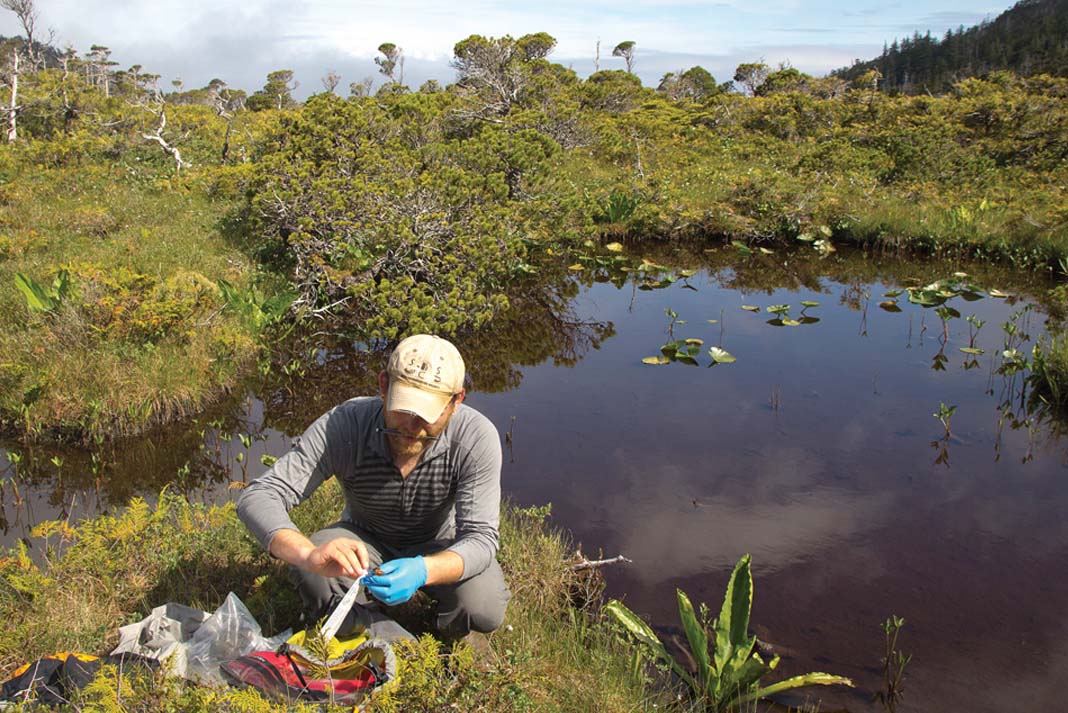
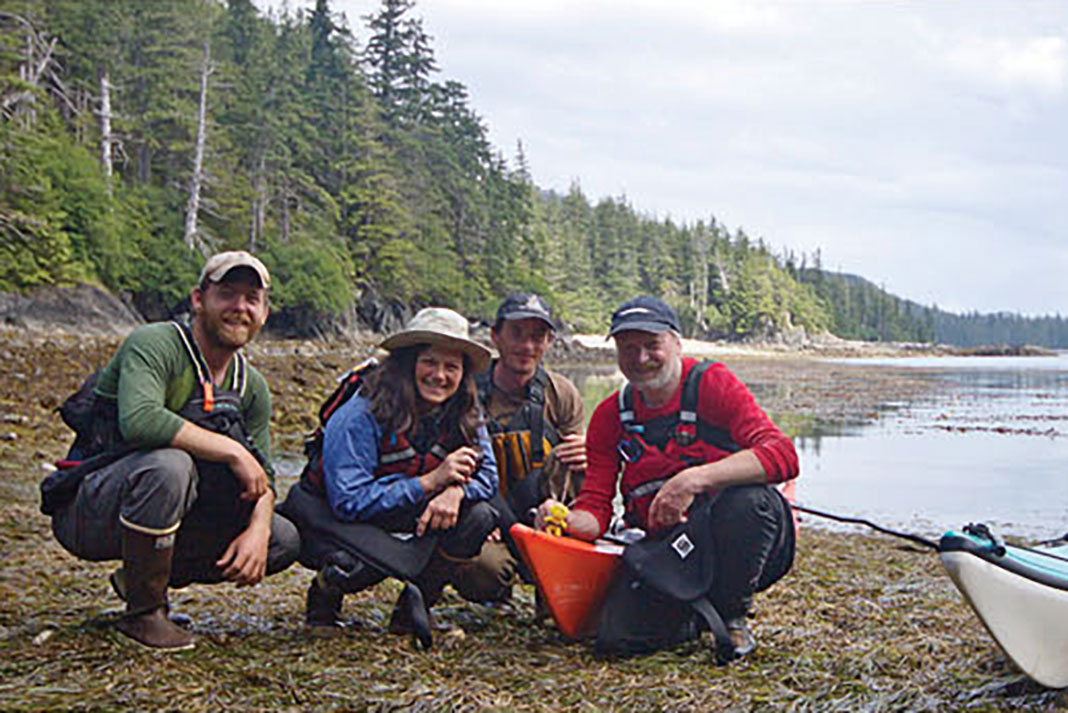
The Outer Island Survey team landed on every beach to collect data no one else could. On Coronation Island, Paul Norwood makes a botanical inventory. | Feature photo: Adam Andis
Want to know if the deadly fungus Batrachochytrium dendrobatidis is affecting the Boreal toads and rough-skinned newts on Alaska’s Coronation Island? To find out is no beginner-friendly bit of citizen science. Here’s what you have to do:
Kayak the foggy and swell-battered outer coast for six days. Land through surf and wrestle with maddening thickets of devil’s club and alder to reach the alpine zone. Catch the elusive amphibians in chilly ponds. Rub a swab along the squirming creature’s belly, then break off the swab’s tip and attempt to air-dry it for five minutes in the notoriously soggy climate. Place the swab in a tube and label it. Bushwhack back down to the coast and launch through the surf. Paddle another 10 days to reach a post office. Mail the samples to a lab in Ohio for analysis.
In Alaska, kayakers go to extreme measures for citizen science
The hardships of conducting field ecology in remote and rugged places like Alaska are legendary. But that same ruggedness draws kayakers from all over the world. The brainchild of Adam Andis, Wilderness Stewardship Director of the Sitka Conservation Society (SCS), the Outer Island Survey partnered experienced kayakers with the Society and the U.S. Forest Service. The expedition represents part of a growing strategy for extending science into wild places using sea kayaks as the vehicles.
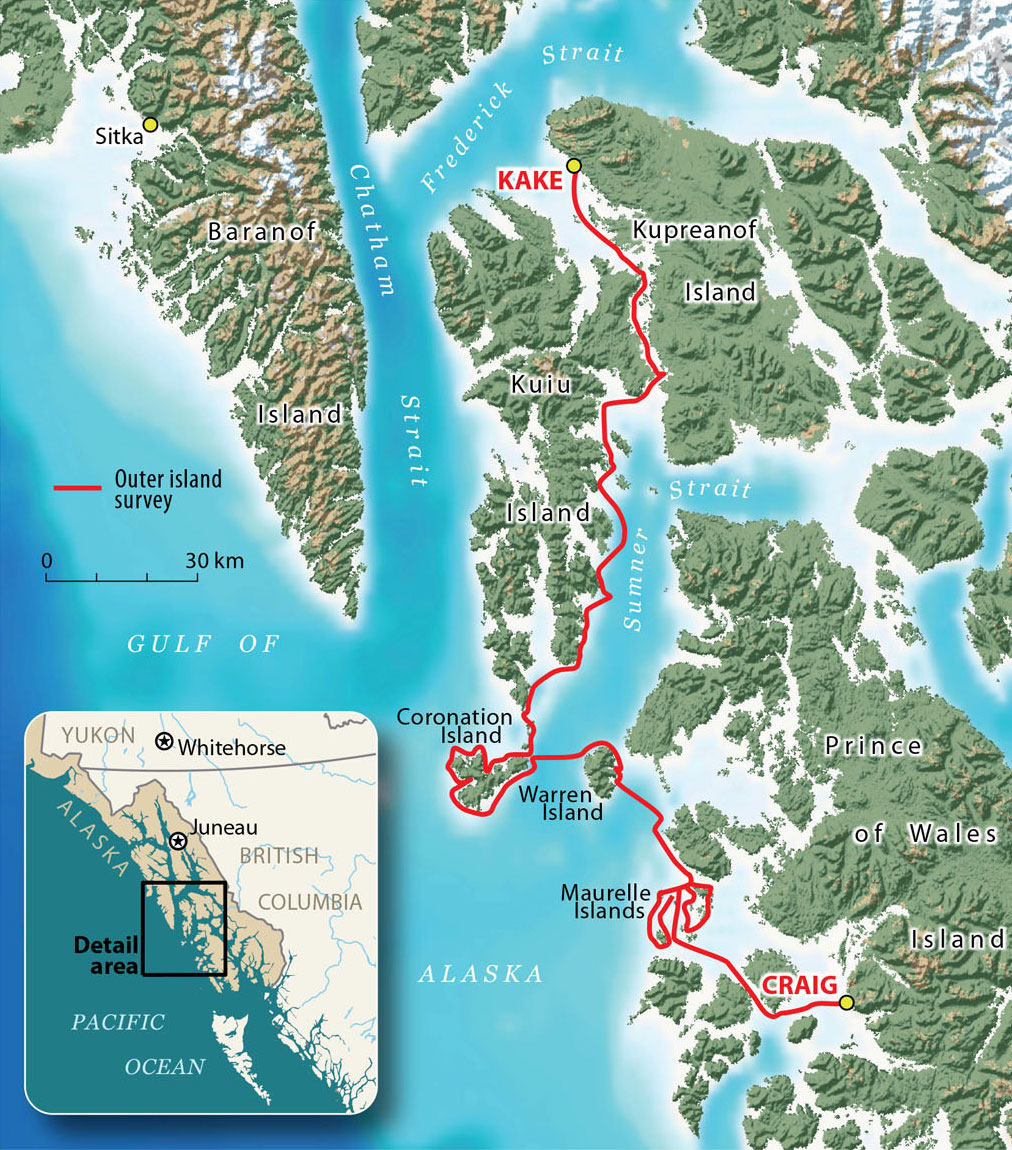
Map: Chris Brackley
A thick braid of current-swept channels and mountainous islands, Alaska’s panhandle may be small by the standards of the 49th state, but it is still a vast wilderness. The panhandle is dominated by the Tongass National Forest, a single forest larger than the state of Maine. Hemmed between icefields and the North Pacific, travel is by floatplane and boat. The season is short. Weather delays are as common as rain.
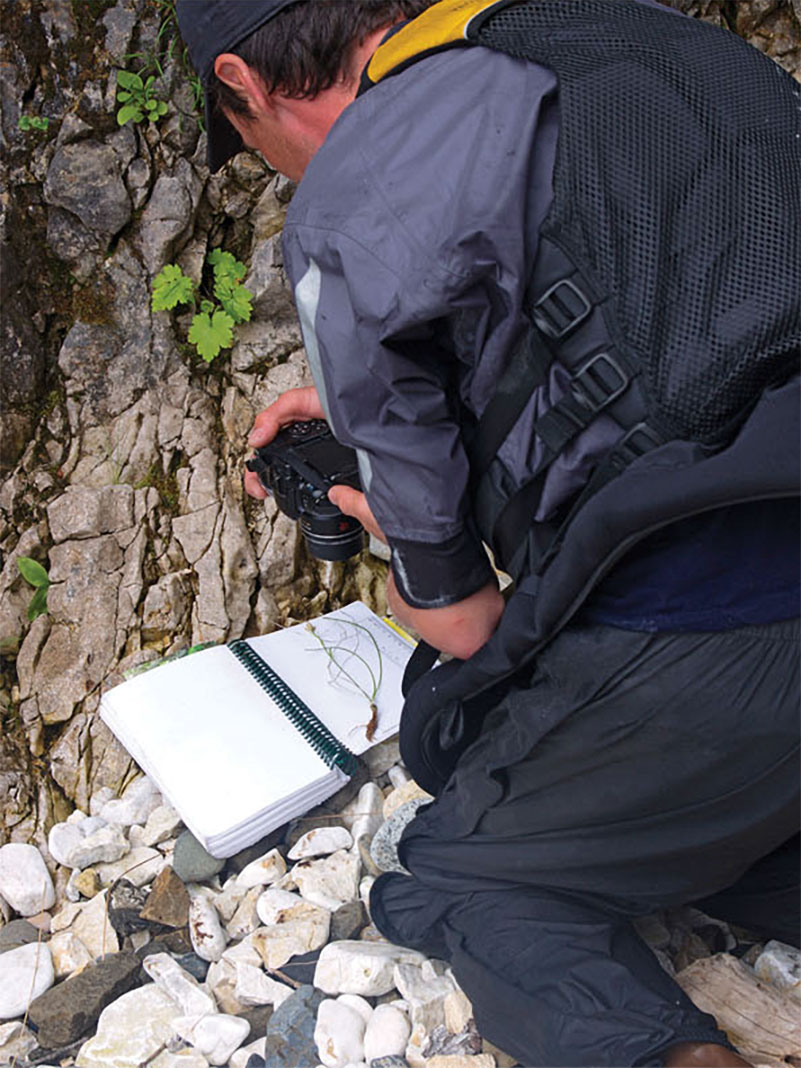
On Coronation Island, Paul Norwood makes a botanical inventory. | Photo: Adam Andis
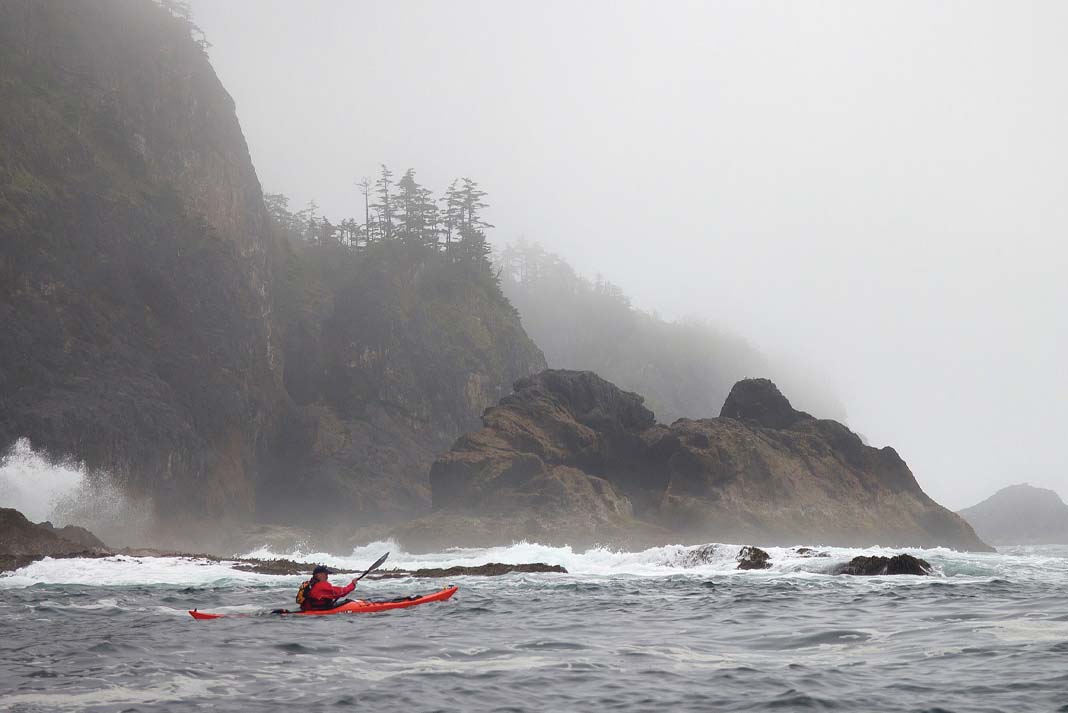
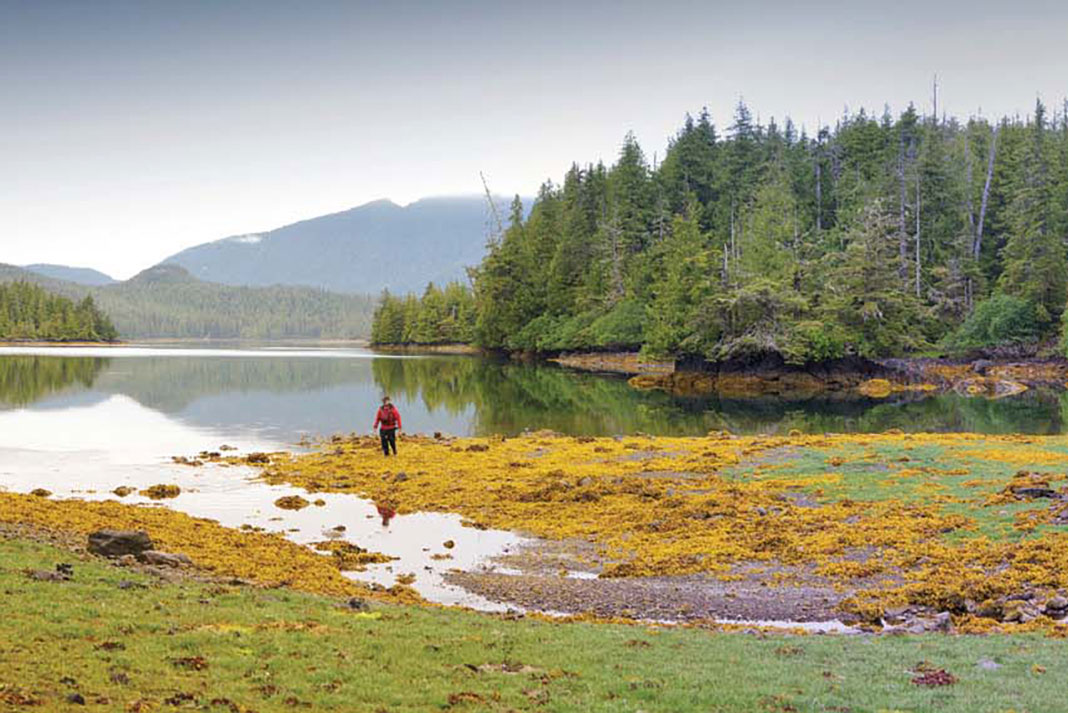
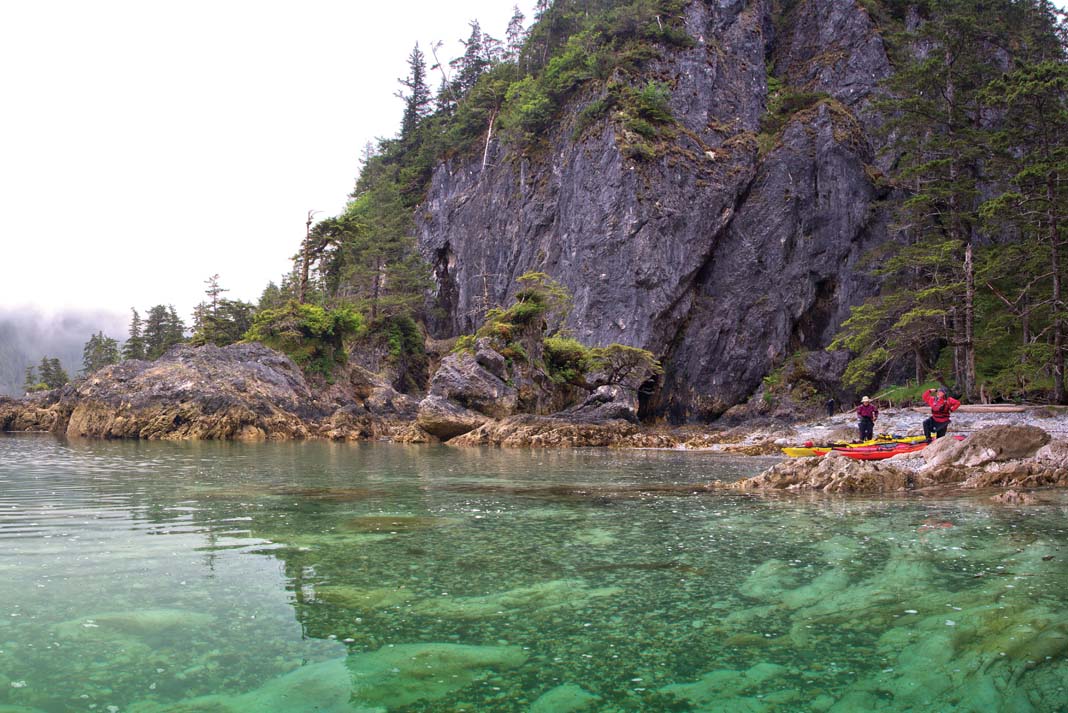
The Kuiu, Coronation Island, Warren Island and Maurelle Islands wildernesses lie in one of the most isolated parts of this already-remote area, clinging to the southwest edge of the panhandle, exposed to the stormy Gulf of Alaska and the massive tidal exchanges of Chatham Strait. In June 2013, the Outer Island Survey team spent 16 days tracing every nook and cranny along 230 miles of this wild coastline, collecting data no one else could.
Working from 6 a.m. until well after sundown, they surveyed alpine plants, swabbed amphibians and landed on every single beach to check for invasive plants and signs of human use, from modern campsites to centuries old culturally modified trees. They recorded birdsongs, mammal tracks and every human encounter, including distant fishing boats and airplane flyovers. After dark, they hiked into the woods to play owl calls and listen for responses.
The results of Andis and his team’s efforts will help shape an accurate picture of ecological well-being and human use on these islands, allowing conservationists and land managers to create strategy based on facts on the ground. “We can use the data from the Outer Island Survey to inform management decisions and assess what’s a reasonable carrying capacity for outfitter permits in the wilderness,” says Tory Houser, a Recreation Planner for the Forest Service. The data will also provide a baseline for a 2018 Forest Plan update.
The hardships of conducting field ecology in remote and rugged places like Alaska are legendary. But that same ruggedness draws kayakers from all over the world.
Recruiting skilled ocean paddlers
This rubber-boots-on-the-ground approach to ecology is essential in remote landscapes like Alaska’s Southeast. Far from the watching eyes of land managers, these areas can easily suffer from benign neglect during the long intervals between visits. Camps and boat traffic can intrude into areas meant to be refuges. Sensitive species can decline before anyone notices.
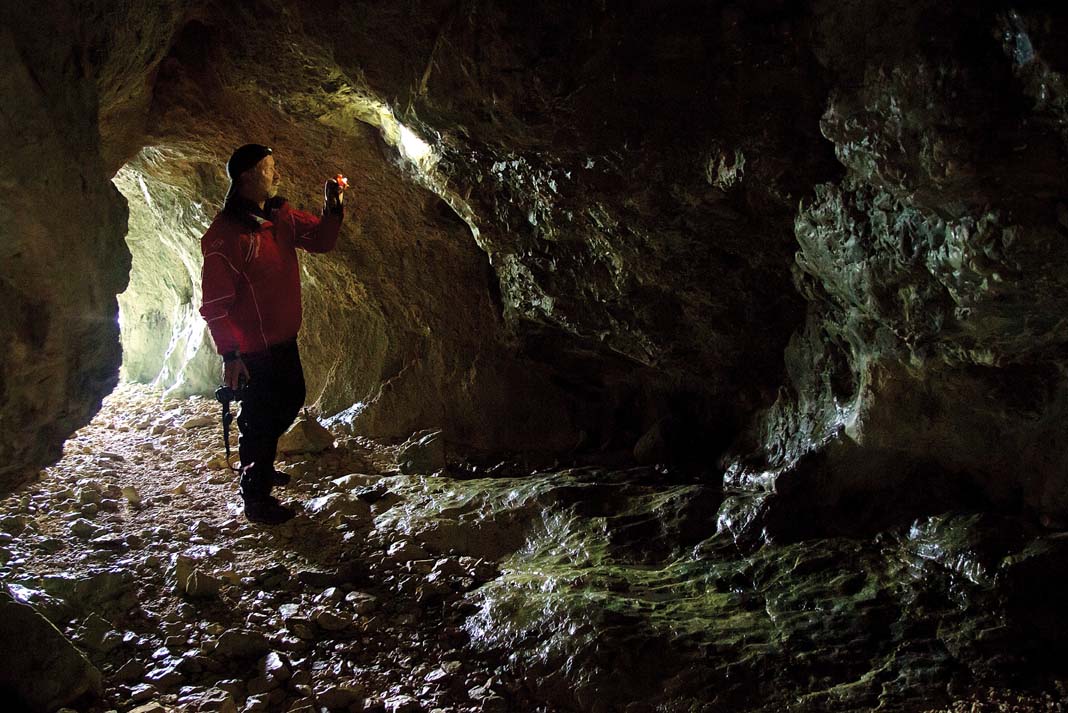
Rob Avery explores a living cave on Coronation Island; the rock formations inside are actively growing. | Photo: Adam Andis
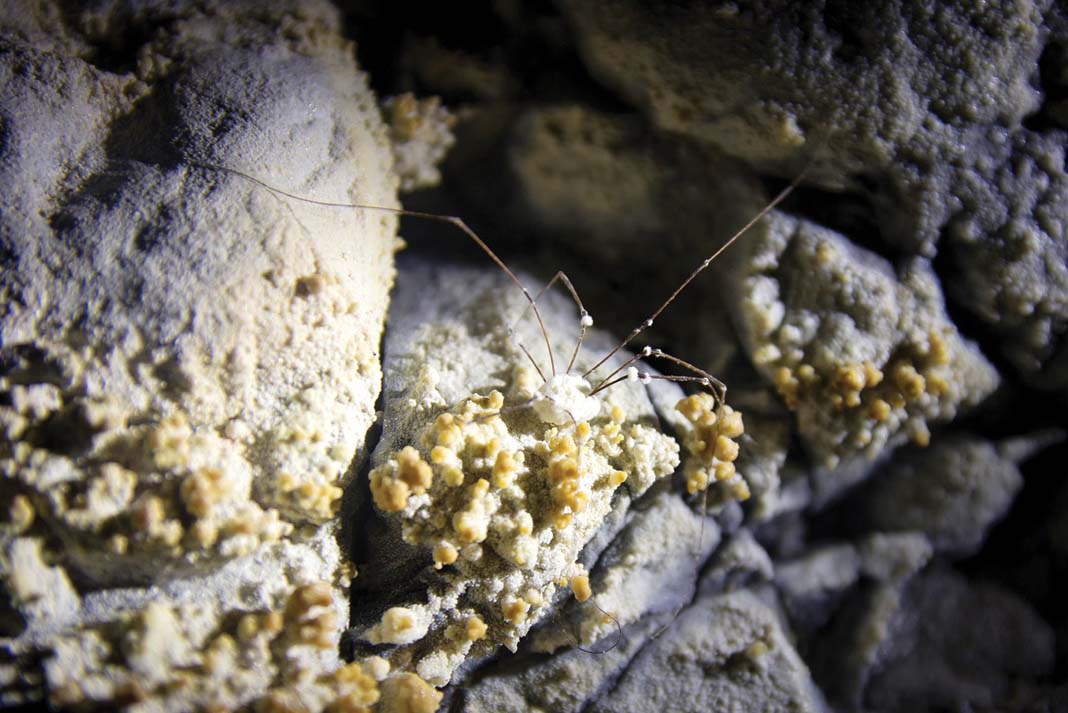
In one cave, the team discovered daddy long-legs entombed in cave-growing fungi. | Photo: Adam Andis
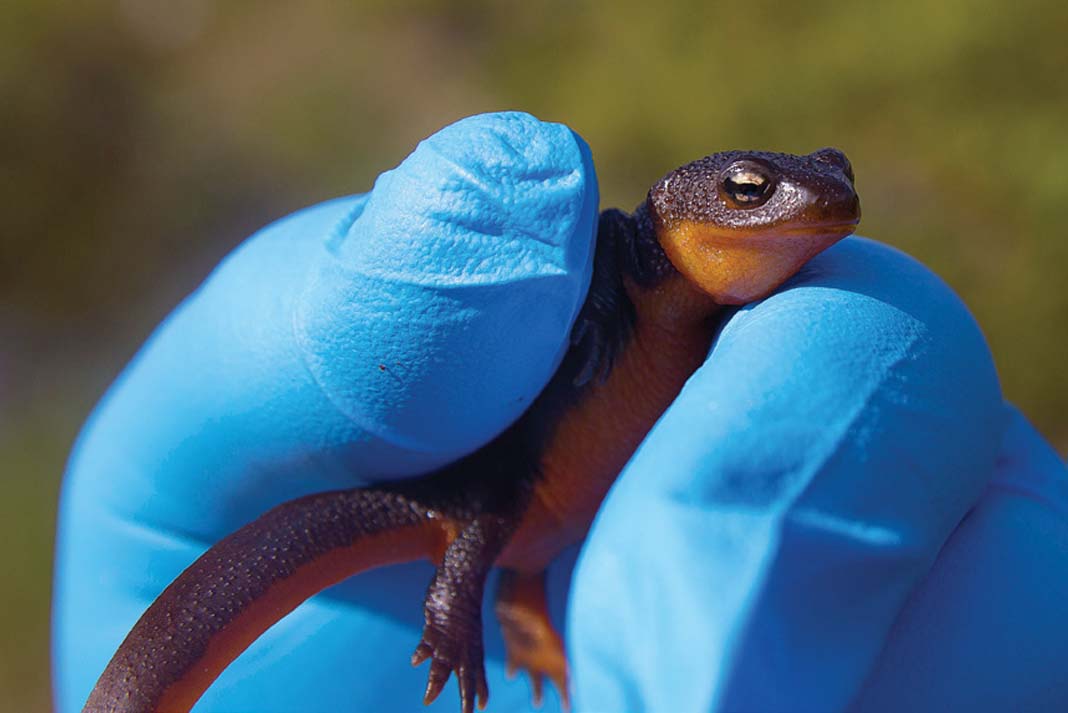
A rough-skinned newt awaits swabbing on Warren Island. | Photo: Adam Andis
Southeast’s particular geography makes studying the region as critical as it is difficult. Islands like Coronation, far out to sea, will be the last to feel the disruptive effects of invasive species that are spreading across the globe. But if invasive species do make it to Coronation, they will spread like wildfire thanks to the isolated biogeography of small islands.
Southeast Alaska is also the northern limit for many plant species. “We expect forests to move northward with warming trends,” says Lauren Oakes, a researcher at Stanford University who used kayaks to study Alaska yellow-cedar decline, “so the latitudinal margins are a critical laboratory for understanding the effects of climate change.”
Declining Forest Service budgets in the sprawling Southeast have taken “spreading thin” to the point of gross understatement. “We’re lucky if we can get out there once a year,” says Houser. “You charter a boat months in advance, and then you get held up by weather. We couldn’t put in the time you can from a kayak, seeing the shoreline on a slow, intimate level.”
Nor can satellite imagery, LIDAR and Geographic Information Systems provide answers. These gizmos can’t reliably tell a stand of Alaska yellow-cedar from hemlock, let alone distinguish native from invasive plants in the alpine zone where a whole botanical community exists in a single square foot. Satellites can’t spot outlaw cabins hidden under trees, swab newts or measure the elusive feeling defined as “wilderness character” that includes everything from the sound of aircraft to footprints on a beach.
The Sitka Conservation Society has long tapped local paddlers, hikers, hunters and fishermen to report on-the-ground conditions, but the Outer Islands’ pounding surf, open-water crossings, powerful wind and thick fog demanded a more experienced team. Andis, an advanced American Canoe Association instructor and former Alaska sea kayak guide, sought out skilled ocean paddlers from the broader sea kayak community. He recruited Rob Avery, a Seattle-based BCU five-star paddler and veteran of Alaskan expeditions; Cris Lewis, who hails from California’s Half Moon Bay and cut her teeth in the rock gardens of Cape Mendocino; and Paul Norwood, a 13-year Sitka resident, SCS intern and botanist.
The outer coast of Coronation Island is exposed to the full fury of the Pacific, eroding the limestone cliffs into massive rock gardens, canyons and caves. | Photo: Adam Andis
“Nobody but seasoned sea kayakers could go where we went,” notes Avery, “A trip like this requires interpreting the weather and currents, reading the barometer and knowing what the sea will be doing.”
Adding a scientific workload to an already challenging expedition took its toll on the group. Wind slowed their pace, and two expedition members fell ill from the daily grind. On top of coping with sea conditions, complex navigation and camping in bear country, there were data sheets to keep track of, plant presses to keep dry and extra batteries to haul around.
Decisions had to be made for science. “Do we want to paddle six more miles up that inlet and back to survey that beach—yes, we have to,” explains Avery. “You’re not on a pleasure trip. There’s a job to be done and we’re going to do it right.”
Alaska’s natural bounty
There’s another critical element to the hands-on-science done by outdoors lovers: a deep and complex relationship with wilderness. It’s been central to Alaska ever since William Seward scraped together $7.2 million in 1867 to buy 586,412 square miles of wilderness from the Russian Empire.
Alaska’s natural bounty is its raison d’etre. Everyone who comes here, for a week or a lifetime, comes either for the natural environment, for a job related to the natural environment or for a job providing infrastructure to those who are here for the natural environment. As a tourism report dryly notes, “Very few people visit Alaska for the culture or the built environment.” The conflicts that have polarized Alaska over the decades have been about the best use of this bounty: as board feet, fish, solitude or science.
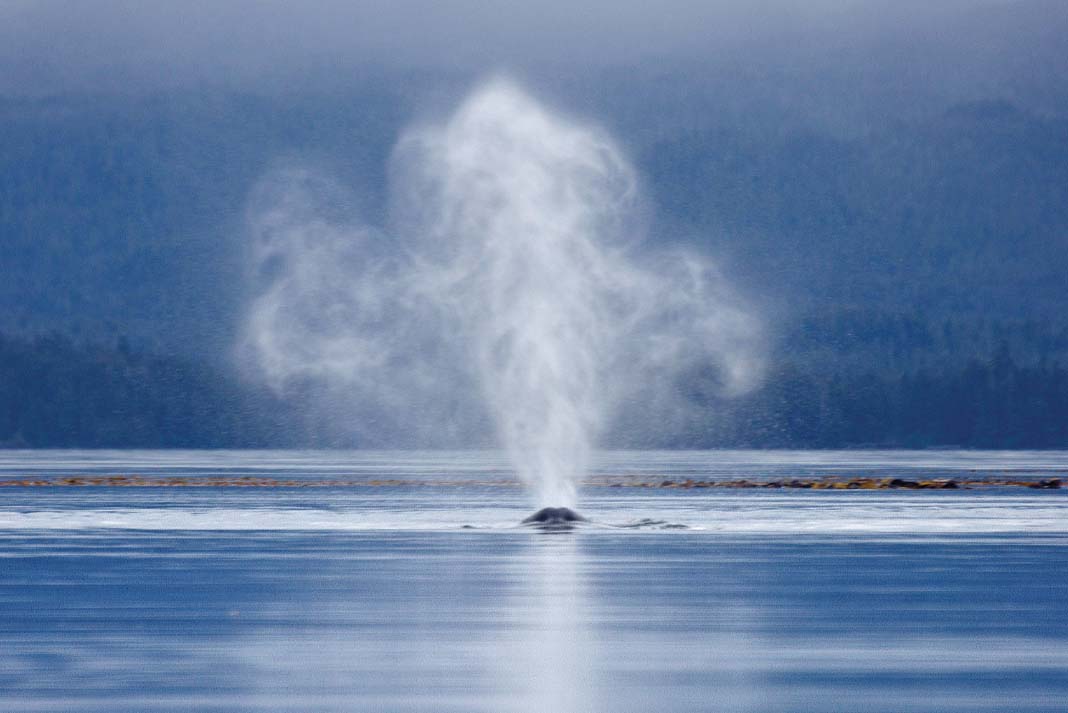
The team paddled with humpback whales in the Maurelle Islands. | Photo: Adam Andis
In Southeast, 50-year contracts between the Forest Service and the timber industry after World War II built an economy on logging old-growth trees from public lands and feeding massive pulp mills. Commercial and recreational fishing made up the rest. Conservation gathered steam with the environmental laws of the 1970s, culminating in the Alaska National Interest Lands Conservation Act in 1980, which spawned the state’s vast network of parks and wilderness areas.
By the late ‘80s, both sides in the logging versus environment debate had dug in. Conservation organizations saw the Forest Service as favoring logging and settled on two strategies: litigation and lobbying. Then the ground began to shift under their feet. Tourism overtook timber, then fishing, in job creation and economic impact. As the economic tide turned, wilderness science offered a path to common ground amongst Alaskans who loved the land.
Today, conservation groups still litigate and lobby, but SCS also fights for the Forest Service’s budget, trying to stave off a 50 percent cut in wilderness management and redirect funds from large timber operations toward science and stewardship.
“We’re surrounded by public lands, and we depend on them for subsistence, for our fish and deer and beach asparagus,” says Andis. “All the tourism operators understand viewsheds and pristine areas. They have to.”
In addition to local paddlers ground-truthing proposed timber sales in preparation for appeals, in 2009 the Sitka Conservation Society began running wilderness expeditions to provide the Forest Service with data for management. Two years later, they also helped the Southeast Alaska Conservation Council create similar trips. By 2013, SCS was running 21 expeditions to nine wilderness areas, including nine paddle trips.
Adventurers and scientists for conservation
The trend of paddlers donning lab coats under their PFDs reaches well beyond the borders of Southeast Alaska. “In the sea kayak community, people have always gone on expeditions to raise awareness of one thing or another, but now we’re seeing more involvement in hard science,” says Steve Weileman, who founded The Ikkatsu Project in 2012 with partner Ken Campbell. Through expeditions and films, The Ikkatsu Project monitors and raises awareness of tsunami debris and plastic pollution on the Olympic and Aleutian coasts. Weileman and Campbell conduct beach surveys and water sampling and share their findings with NOAA and other scientific organizations.
Over a demanding 16 days, the Outer Island Survey team hiked to alpine ponds and collected samples from amphibian populations. | Photo: Adam Andis
The Outer Island Survey team posed on a remote beach. | Photo: Adam Andis
On the Maurelle Islands, intertidal fields of edible beach asparagus supplemented the team’s meals. | Photo: Adam Andis
SCS runs more paddle-based expeditions each year. But the surface has barely been scratched. “Kayakers, climbers and hikers have the potential to gather data scientists need but can’t access,” says Gregg Treinish, founder of Adventurers & Scientists for Conservation, a Bozeman, Montana-based organization that has been matching adventurers with scientists since 2011. “There’s a potential army of outdoor enthusiasts all around the globe—we have over 1,400 adventurers collecting data for 130 scientists on everything from ocean microplastics to ice worms.”
Nor is a rugged expedition required. “We have samples collected by the world’s best mountaineers and by people going for an afternoon spin across Lake Washington,” notes Treinish.
One of the challenges with citizen science is collecting data accurate enough to be useful. Few paddlers with skills for the open coast can also tell invasive Timothy grass, Phleum pretense, from the native Phleum alpinum, or recognize the song of a Eurasian Collared Dove. The Outer Island Survey team was built to address both. Andis and Norwood’s deep ecological knowledge helped Avery and Lewis recognize and collect useful data. “Paul would say, ‘We’re looking for this plant, here’s where it grows, see if you can find it,’” recalls Avery. “If you have good powers of observation and can be detail-oriented, a non-scientist can contribute.” Andis agrees, “Anyone can take photos, report problem areas, fill out simple data sheets and record GPS points.”
Citizen science closes the gap between trained scientists and outdoor enthusiasts. Anyone can take photos, report problem areas, fill out data sheets and record GPS points.
Matchmaking groups like Adventurers & Scientists for Conservation offer another window onto how to close the gap between trained scientists and outdoor enthusiasts. When someone going on a trip contacts them, ASC scours the scientific literature for related projects. When a scientist wants samples from a particular spot, ASC looks for someone headed there. Scientists use Skype to train adventurers on sampling and surveying techniques, and ASC confirms results with labs and looks for large data sets.
Outer Island Survey member Cris Lewis says there’s another reason to embrace your inner scientist. “If you want to learn the [local] ecology, what better way to do it?” she asks, “That education was part of the magic.”
What drives paddle-powered science
Budding wilderness stewards may well have an even greater impact than paddle-wielding science nerds. During a debate about protecting Southeast’s salmon streams, veterans of the Sitka Conservation Society’s science expeditions generated 60 letters and several hundred postcards. The potential is huge. “Americans spend about the same amount of money on outdoor recreation as we do on cars and gasoline every year,” Andis says, “We just need to put our mouth where our money is.”
The rubber-boots-on-the-ground approach to ecology is essential in remote landscapes like Alaska’s Southeast. | Photo: Peter Mather
Ultimately, a deep love for wilderness drives paddle-powered science. “I suppose I could have done something in my backyard, but in the larger sense, places like Coronation are my backyard,” muses Avery. Andis is philosophical about his chosen craft. “I think doing our work by kayak rather than by floatplane or motorboat is what the writers of the Wilderness Act would have wanted,” he says.
Even as SCS continues to disseminate the Outer Island Survey findings, fundraising is underway for upcoming expeditions. Meanwhile, on Coronation Island, mysteries remain. “Some years we see tons of wolf sign, and then nothing for five years,” notes the Forest Service’s Tory Houser. “What happens? Does the population crash? Do they swim to other islands?” Someday, someone will find out. They might arrive by kayak. One of them might be you.
Extreme citizen science tips
1 Do your research
Make finding scientific opportunities a part of your trip planning. “Is there a friends group? Is there a land manager? Usually the answer is yes, but most people don’t plan ahead or make contact,” says conservationist Adam Andis.
2 Don’t be intimidated
“We were afraid we wouldn’t be taken seriously,” says Steve Weileman of The Ikkatsu Project. “All of a sudden, there were seven PhDs who wanted to meet with us. They thought we were rock stars.”
The Outer Island Survey team landed on every beach to collect data no one else could. | Feature photo: Adam Andis
3 Make it a party
“It’s harder to work with individuals than with groups, for reasons ranging from communication to liability,” says the Forest Service’s Tory Houser. Working with clubs and shops can provide people power and a social component.
4 Use your voice
Let decision makers know you value wild places. “Any time you visit public land, write a quick email that says you appreciate that place and send it to two people: the land manager and your elected official,” says Andis.
Scientists in sprayskirts
From urban waterways to the planet’s most remote coasts, paddlers turned citizen scientists are using kayaks to bring back findings no one else can. Here are a few to look out for:
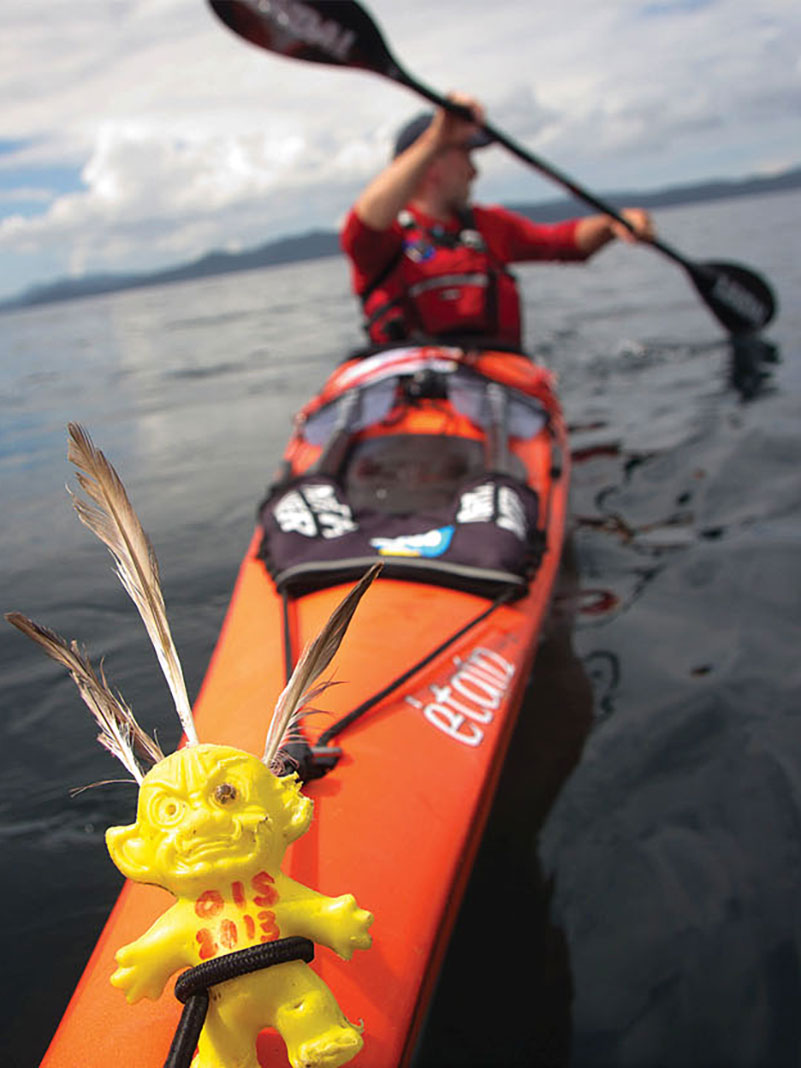
Outer Island Survey team member Rob Avery’s ghoulish alter ego. | Photo: Adam Andis
Adventurers & Scientists for Conservation matches outdoor recreationists with scientists who need data from the field.
Center for Coastal Margin Observation & Prediction uses a sensor-laden kayak to collect data on water quality and algae blooms in the Columbia River Estuary.
The Ikkatsu Project tracks tsunami debris for NOAA on the Olympic and Aleutian coasts.
The Kamchatka Project, a crack kayak team led by Bryan Smith, collected hydrologic and water quality data on pristine rivers in the Russian Far East in 2010.
U.S. Forest Service Kayak Rangers in Tracy Arm-Ford’s Terror Wilderness near Juneau, Alaska, monitor air quality emissions from cruise ships.
Margo Pelligrino, a self-styled “stay-at-home mom who paddles for the ocean,” collected microplastic samples on outrigger journeys along the Atlantic, Gulf and Pacific coasts between 2007 and 2010.
Forest Succession Study at Stanford University used sea kayaks in the summer of 2012 to study the ripple effects of Alaska yellow-cedar decline linked to climate change.
The Cetacean Society and Bay Area Sea Kayakers collect observations of harbor porpoises, which have returned to San Francisco Bay after a 65-year absence.
Willamette Riverkeeper volunteer paddlers monitor water quality on Oregon’s Willamette River.
Neil Schulman is a kayaker, writer and co-founder of the Confluence Environmental Center in Oregon. He lived in Southeast Alaska long before cellphones or Google Earth.
This article was first published in the Spring 2014 issue of Adventure Kayak Magazine. Subscribe to Paddling Magazine’s print and digital editions, or browse the archives.
The Outer Island Survey team landed on every beach to collect data no one else could. On Coronation Island, Paul Norwood makes a botanical inventory. | Feature photo: Adam Andis
The term professional athlete elicits images of the elite—pros that get paid to train and compete at the highest level, making a living doing what they love. In the world of whitewater there are only a handful of athletes who can paddle year round without having to get their hands dirty.
The truth for many of today’s top kayakers is that their days of extreme racing, waterfall hucking and freestyle combos are earned with weeks of hard work slinging beer, pouring concrete, digging holes or saving lives. Take a look at the double lives of these pros to see how top kayakers divide their time between work and whitewater.
How whitewater pros get paid and paddle
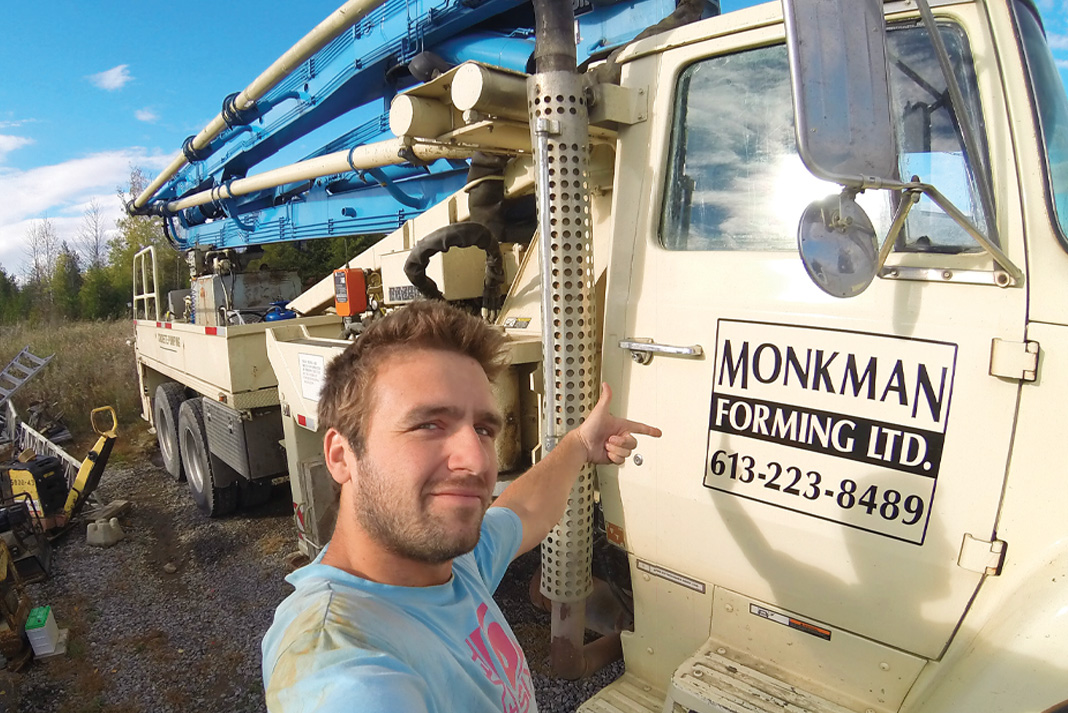
Tyler Fox, Concrete Laborer. | Photo: Courtesy Tyler Fox
1 Tyler Fox, Concrete Laborer
Tyler Fox doesn’t try to combine his paddling time with a job that pays his bills.
“I typically enjoy buckling down and pounding out a month or so of solid concrete work followed by a couple months of traveling and extensive paddling,” he says.
When the work is hard and the weather is unforgiving, Fox daydreams of paddling. “On really long, hard, shitty days at work, I like to think about getting paid in enjoyment. For example, instead of getting paid x amount of dollars that day, I like to think about how many days of traveling or paddling I can get out of the money that I make during that day.”
Fox supplements his seasonal concrete work with on-water jobs, including kayak instructing, raft guiding and photography, and is currently in New Zealand training hard for the upcoming season of extreme racing.
“I put concrete into places that need concrete in them,” explains Fox, of his less-than thrilling work for Ontario-based company, Monkman Forming. “The crew of people I work with makes it much more enjoyable,” he says of the other kayakers among his concrete co-workers.
“It’s just a quick month here and there to boost the bank account, so that I can head off on another adventure.”
Dream job
“Fireman.”
Wisdom from the workforce
“We need to own money, but we don’t have to let that money own us. If you’re struggling to go kayaking because of your work and you don’t enjoy your job, get one that allows you to do what you really want. You can always go back to your stink-ass job if you can’t handle having all that fun.”
Kelsey Thompson has made the transition from professional paddler to full-time filmmaker.
“I started shooting video of myself paddling to help improve my technique for competition,” says Thompson. As time went on though, he spent more time on shore shooting his friends kayaking, and soon Thompson discovered that it was the filming itself he had passion for. “When I started shooting cool sticks and leaves I knew something had changed.”
A former Canadian Freestyle Champion, Thompson’s work-to-play ratio has shifted. Though competitive kayaking has taken the back burner, paddling is an integral part of his nine-to-five.
“I shoot and edit films of all kinds, but 90 percent of the content is paddling related,” says Thompson. “I pretty much always paddle when I work.”
His job as an independent filmmaker is a dream come true. “Over the years I’ve learned to love shooting video as much as paddling. I’d say that’s what I like most about my job, the fact that I actually enjoy doing it!”
Dream job
“Filming some other outdoor sport” (skiing is his first love).
Wisdom from the workforce
“A lot of people associate work-life balance with sacrifice but if I have to work an eight-hour day I almost always have time to do something before or afterwards. For me it comes down to motivation—I just need to get up and do it!”
Nicole Mansfield, Server. | Photo: Tommy Hood
3 Nicole Mansfield, Server
After a day of whitewater in the Pacific Northwest, Nicole Mansfield isn’t sitting back enjoying a cold one—she’s serving them. The hours and flexibility of slinging beer and serving tables at a brewpub in White Salmon, Washington, allows Mansfield to kayak competitively.
“I try to make it to most of the local competitions,” Mansfield says, “but as a trade-off, I usually miss the after party.”
The evening hours of beer pouring fit perfectly around her paddling plans.
“I have a full day for kayaking, skiing, hiking or whatever else before showing up for dinner service at 5
One of the toughest parts of her daily aquatic to terrestrial transformation is telling customers how she got her newest collection of stitches, Mansfield says. “Explaining how I split my forehead open ‘rafting’ Metlako [a nearby waterfall] gets old.”
Dream job
“Big mountain skier, garbage man or helicopter pilot.”
Wisdom from the workforce
“Find a job that allows you to paddle frequently and doesn’t stress you out too much. Set goals for yourself; I find it easier to go to work if I have trips I’m saving for.”
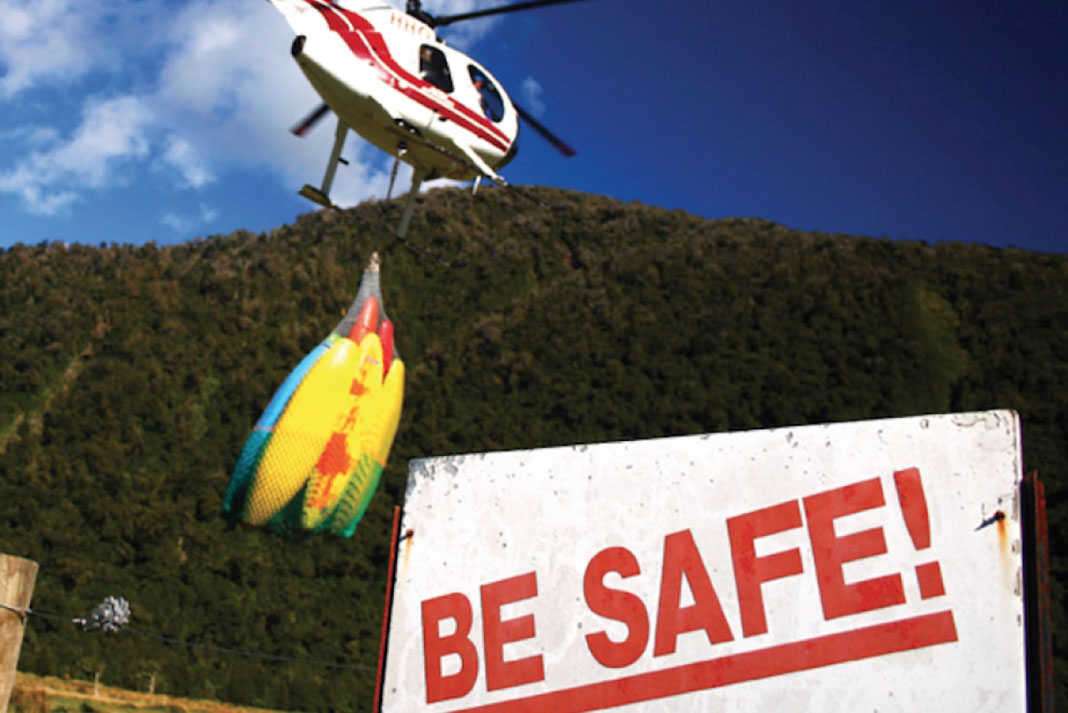
Tyler Curtis, Heli Ski Guide. | Photo: Patrik Trädgårdh
4 Tyler Curtis, Heli Ski Guide
Tyler Curtis works on and off the water to sustain himself year-round. National coach for the Norwegian Paddle Federation, sales agent for Sweet Protection, author, private kayak coach and international paddling guide, Curtis is fully immersed in kayaking.
Recently, though, Curtis has spent his off-seasons submerged in snow instead of water. As a lead helicopter ski guide 200 kilometers from the Arctic Circle in Kittelfjäll, Sweden, his day job has high stakes.
Each day Curtis monitors snow conditions, briefs clients on helicopter safety, plans trip logistics and chooses safe terrain for each heli ski group’s adventure.
The five-time Canadian Freestyle Champion has transferred paddling skills to each new job. “The biggest thing I have gained through kayaking, which I apply to everyday life, is communication and having the social skills to deal with people,” he says. “This comes in handy when working in the tourism and customer service industry.”
Curtis’ lifestyle allows him to continue to be competitive in the freestyle and extreme racing scene. “By focusing on a lifestyle that allows me to work with the things I love, I don’t really see any of it as being work but rather living life to the fullest.”
Dream job
“Owning and operating a timbering company.”
Wisdom from the workforce
“Use your job to facilitate your paddling. Picture kayaking in your future and work toward it—don’t sacrifice everything for paddling today and miss out on a lifetime of paddling.”
Evan Garcia, Filmmaker. | Photo: Eric Parker
5 Evan Garcia, Filmmmaker
While many paddlers toil away on land, there are some who have made the river their office. Evan Garcia is one of those lucky people. As a professional filmmaker, Garcia has established himself as a whitewater storyteller—he’s worked his way into getting paid to paddle every day.
“My job is to kayak at a high level and make films about whitewater and the lifestyle of us river people,” says Garcia.
Though he’s well known for his smooth racing style, waterfall running and filming of remote and exotic multi-day river expeditions, Garcia says it wasn’t easy to get where he is now.
He maintains what he calls a gypsy-kayaker lifestyle by managing his spending. “I don’t buy things I don’t need, splurge, or waste money…money is my one-way ticket to the river,” he says.
Garcia’s dedication has paid off. “I’m proud of myself for making the life choices that brought me here,” he says. “I knew that if I put everything I had into my paddling, maybe someday I could be one of those people that call the river their occupation.”
Dream job
“Owner of a tiki bar on the shores of the South Pacific.”
Wisdom from the workforce
“When I was working outside of the paddling scene I felt something special, every time I got on the water I was so stoked! Don’t lose that spark—when you get out on the river, soak it all in.”
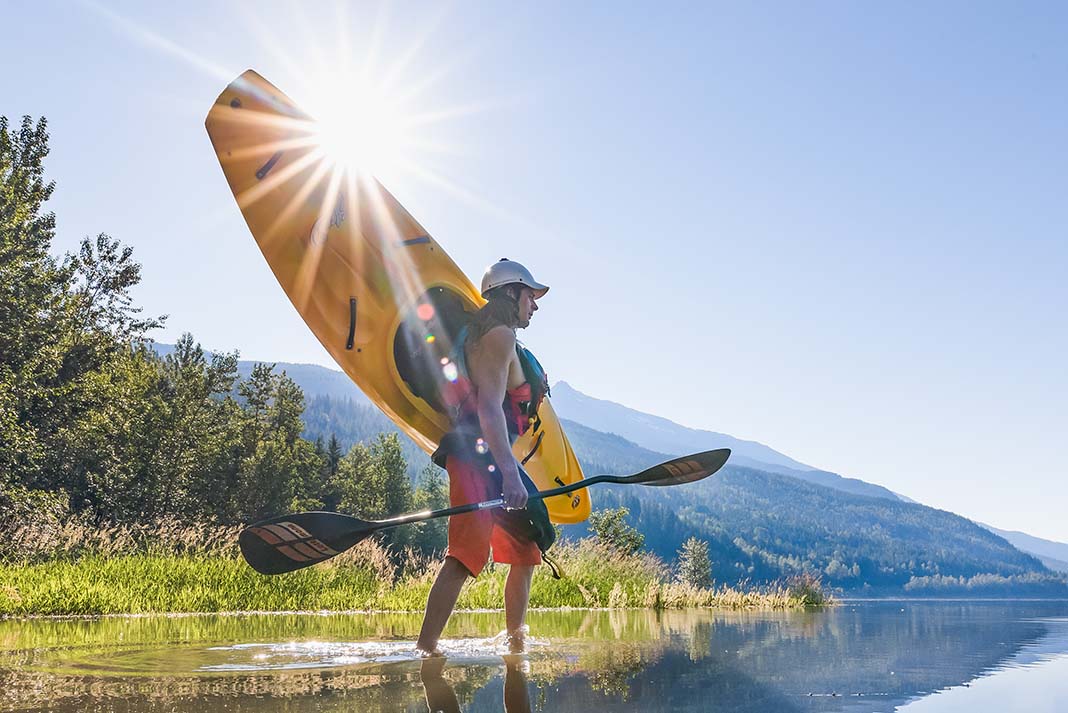
Ben Marr, Manual Laborer/Driller. | Feature photo: Ryan Creary
6 Ben Marr, Manual Laborer/Driller
Ben Marr knows work and play go hand in hand. “Hard work for money, hard work for the take-out,” he says, comparing his off-season work to his big water boating.
When he’s not on the water, Marr is drilling holes and planting dynamite for a geo seismic exploration company in Grand Prairie, Alberta.
“My job is physically intense and demanding,” says Marr. “My pay is production based, so the more efficient and speedy I am, the better. I like that.”
He was introduced to the job by fellow paddlers who, like him, saw it as an opportunity to make money and have the flexibility to travel and kayak.
Marr does feel some of the perks of being a pro. “I could support a decent paddling season with my job but because paddling is priority número uno, I take off a lot of time to shred,” he says. That’s where sponsorships come in, providing a financial boost that helps Marr spend more time paddling than digging holes.
Dream job
“Rally car driver or professional lawn mower.”
Wisdom from the workforce
“Move to a place where kayaking is more accessible so you can cut down on time spent getting to and from the river. Make kayaking your priority. If you want it bad enough, you’ll find a way to make it happen.”
“The biggest skill I was able to take from kayaking and apply to my job is staying calm under pressure,” says Shannon Carroll. “I’m basically paid not to get excited when shit hits the fan. Instead, I have to perform.”
As an ER nurse in Grass Valley, California, she deals with everything from heart attacks to gunshot wounds.
Carroll had been kayaking professionally for eight years when she realized she was tired of being broke every fall.
Since becoming a nurse, Carroll has found “more financial freedom to focus my kayak energies on the specific type of kayaking that is my passion, creek boating,” she says.
The shift work that comes with the job allows Carroll chunks of time off to paddle— she’s currently training for an all-female paddling expedition to Brazil—and working in healthcare has helped her appreciate those opportunities more than ever.
“You can’t put a price on your health,” she says. “I see people everyday, young and old, being diagnosed with life altering diseases and I’m thankful that I’ve had the opportunity to lead the life that I’ve lived.”
Dream job
“Professional singer.”
Wisdom from the workforce
“Whatever you do, put your happiness and health first. Work and school will always be there—travel and live life to its fullest.”
Mariann Saether, School Teacher. | Photo: Martina Wegman
8 Mariann Saether, School Teacher
Well-established in the whitewater world, who knew Mariann Saether is equally proficient in her professional life? With a Masters degree in Medieval History, Saether teaches history, social science, English, Norwegian and math at a secondary school in Norway.
“It is an amazing feeling to be able to guide the youngsters through a pretty important phase of their lives,” she says. She acts as a mentor for many of her students who compete in skiing at a high level, helping them balance training with academics— a feeling she’s familiar with.
“I hope to make it to the Grand Prix in Quebec, but it is the same period as 60 of my students have their exams so it is not likely,” she says.
With an already-lengthy list of paddling accomplishments from freestyle to first descents, Saether is feeling the pull towards competitive paddling.
“The challenge,” she admits, “is to get enough time to paddle, which has left me pretty close to showing up to some of my classes still in my kayaking gear.”
Dream job
“Author.”
Wisdom from the workforce
“Have an end goal but break everyday life down to smaller goals. Do not be too hard on yourself if you cannot do it all every day.”
This article was first published in Volume 16, Issue 1 of Rapid Magazine. Subscribe to Paddling Magazine’s print and digital editions, or browse the archives.
Ben Marr, Manual Laborer/Driller. | Feature photo: Ryan Creary
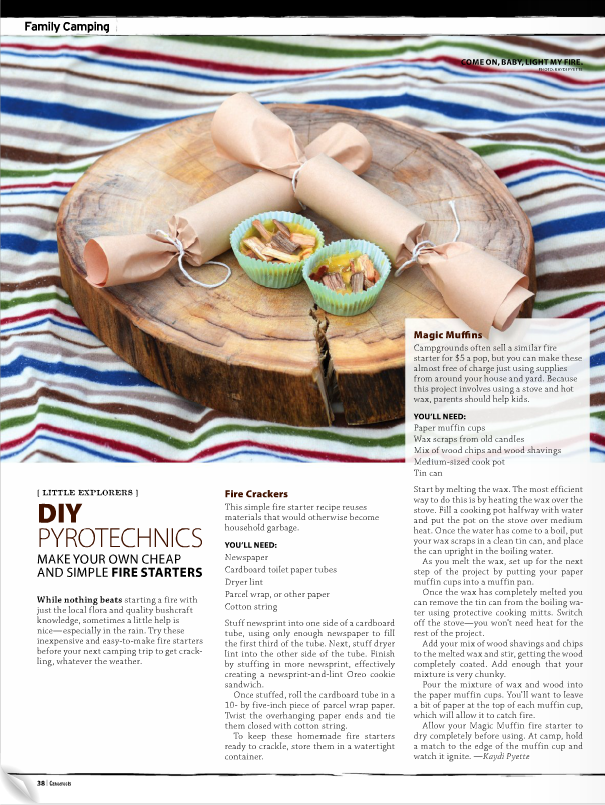
This campcraft article about how to make homemade fire starters was first published in Canoeroots and Family Camping magazine.
While nothing beats starting a fire with nothing but the local flora and quality bushcraft knowledge, sometimes a little help is nice—especially in the rain. Try these inexpensive and easy-to-make fire starters before your next camping trip to get crackling, whatever the weather.
Fire Crackers
This simple fire starter recipe reuses materials that would otherwise become household garbage.
You’ll need:
Newspaper
Cardboard toilet paper tubes
Dryer lint
Parcel wrap
Cotton string
Stuff newsprint into one side of a cardboard tube, using only enough newspaper to fill the first third of the tube. Next, stuff dryer lint into the other side of the tube. Finish by stuffing in more newsprint on that side, effectively creating a newsprint and lint Oreo cookie sandwich.
Once stuffed, roll the cardboard tube in a 10- by five-inch piece of parcel wrap paper. Twist the overhanging paper ends and tie them closed with paper string. Ta da—your fire starter is complete.
Magic Muffins
Campgrounds often sell a similar fire starter for $5 a pop, but you can make these almost free of charge just using ingredients from around your house and yard. Because this project involves using a stove and hot wax, parents should help kids.
You’ll need:
Paper muffin cups
Wax scraps from old candles
Mix of wood chips and wood shavings
Medium-sized cook pot
Tin can
Start by melting the wax…
Continue reading this article in the digital edition of Canoeroots and Family Camping, Spring 2014, on our free iPad/iPhone/iPod Touch App or Android App or read it on your desktop here.



 This article first appeared in the Early Summer 2014 issue of Adventure Kayak Magazine. Subscribe to Paddling Magazine and get 25 years of digital magazine archives including our legacy titles: Rapid, Adventure Kayak and Canoeroots.
 Get the full article in the digital edition of Canoeroots Early Summer 2014.
 This article first appeared in the Early Summer 2014 issue of Canoeroots Magazine.

 This article first appeared in the Early Summer 2014 issue of Canoeroots Magazine. For more great content, subscribe to Canoeroots’ print and digital editions


 This article was first published in the Spring 2014 issue of Adventure Kayak Magazine.




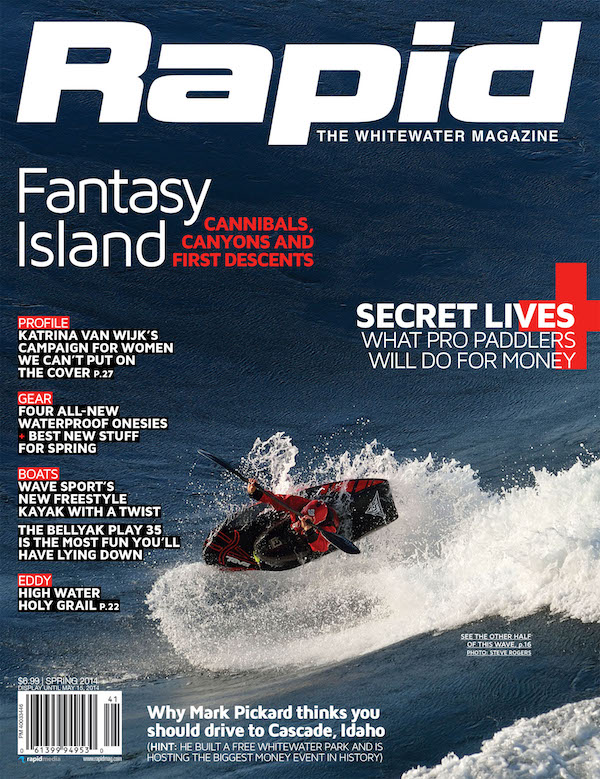 This article was first published in Volume 16, Issue 1 of Rapid Magazine.
 Continue reading this article in the digital edition of Canoeroots and Family Camping, Spring 2014, on our free



