Home Blog Page 299

Leverage Techniques for Canoes

Photo: Jim Coffey
Whitewater canoe

This whitewater open boat technique article originally appeared in Rapid magazine.

Over the years I’ve picked up some lesser-known canoeing techniques that have allowed me to do awesome things in shorter canoes like the L’Edge. I discovered most of these tricks a decade ago when I was paddling a Spanish Fly. The smaller the canoe you paddle, the more important it becomes to leverage your upper body weight to create momentum. Here are some techniques I use that will help you on everything from your local class III river to highly technical class V runs.

If you’re running continuous creeks in a canoe, your boat is going to fill up with water, making it tough to catch eddies. One trick I use is to aggressively throw my upper body forward to help punch strong eddylines. It makes a huge difference if you have a canoe full of water and are worried about getting rejected and slipping into the next rapid backwards. The key is to throw your weight forward as you approach the eddy from a perpendicular angle. Once your body weight is through the eddyline, your stern will follow.

Another way you can use your upper body weight is by leaning forward on big, fast, bouncy slides—a move David “Psycho” Simpson taught me 12 years ago, the first time I ran Oceana on the Tallulah Gorge. Your natural instinct is to lean back on a slide. But if you hit a rut and take a funny bounce, your canoe can easily get off line and send you in a direction you don’t want to go. Shift your weight forward on fast bouncy slides and your canoe will track better and take you where you want to go.

Upper body momentum can also keep you dry in big wave trains. Lean forward going into a wave and then aggressively throw your upper body back to raise your bow. This helps keep your boat dry on waves where most boats take on water. That leaves you in a better position for the rest of the rapid. Less time spent stopping to dump out water means more time for playing.

When your canoe is completely full of water, you can also use upper body weight and momentum to punch large holes. Generally, I try to avoid large holes altogether. However, when your boat is full of water, skirting a hole may not be an option. If you’re full, throw your upper body weight forward aggressively as you enter a large unavoidable hole. If you commit with your weight forward and you’re carrying good downstream momentum, you will punch the hole and come through right side up more times than not.

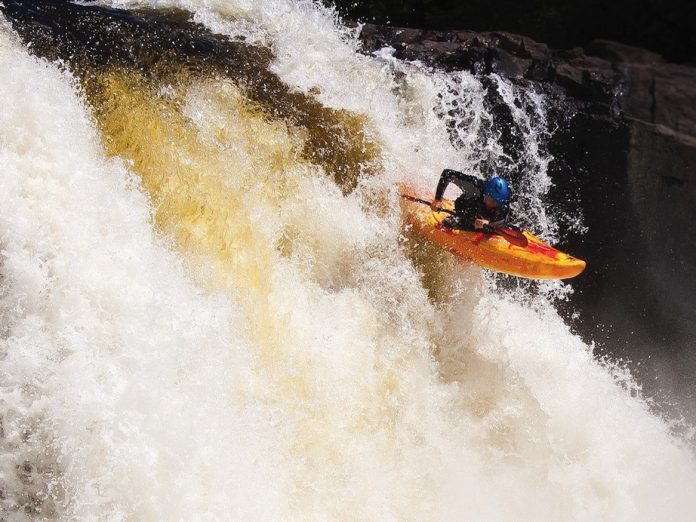
Upper body weight also comes into play running waterfalls. I like to go off waterfalls slightly faster than the current. I spot my landing visually, plant my paddle and take a quarter-strength boof stroke, count to one and then throw my upper body forward and tuck. If I find myself flipping to my onside, I tighten my core, arch my back and use my upper body lean to get the boat back under me.


For more ways to boost your whitewater game, click here. 

Dooley Tombras is a Tennessee native known for shattering perceptions of what can be accomplished in an open boat.

This article originally appeared in Rapid, Fall 2012. Download our free iPad/iPhone/iPod Touch App or Android App or read it here.
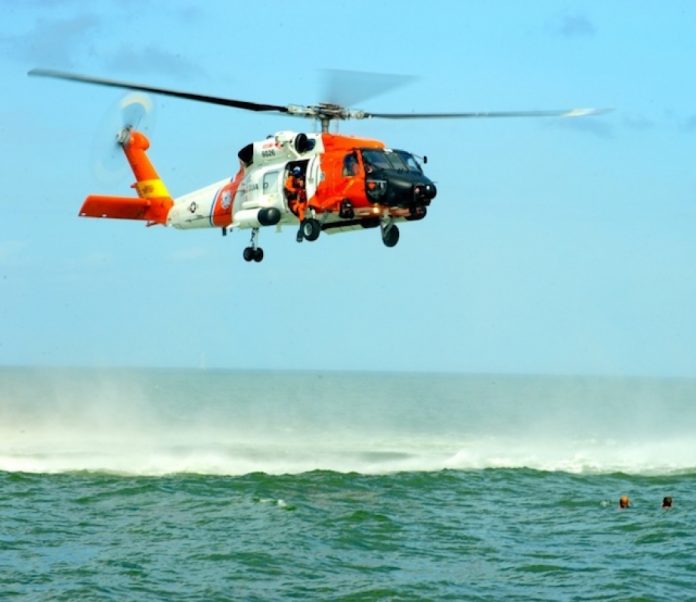
Lost and Found

Photo: courtesy U.S. Coast Guard
Lost and Found

Floating in the water, holding onto their tandem sea kayak for dear life, Robert Beltram and Judith Gotlieb knew they were in trouble. More than halfway through a four-week trip on Lake Superior, they had capsized in high waves. Within minutes, the kayak was swamped and the pair was starting to feel the lethargic effects of the cold water despite their wet suits.

Beltram activated their personal locator distress beacon and two and a half hours later a Canadian Coast Guard C-130 search plane spotted them. Another 30 minutes, and they were both plucked from the water by a Coast Guard helicopter and transported to a local hospital for hypothermia treatment.

Up until the early 20th century, large rescue operations were highly unorganized and often ineffective. It wasn’t until the sinking of the Titanic in 1912 that the international community was galvanized to put a greater importance on safety at sea. The first draft of the International Convention for the Safety of Life at Sea, or SOLAS, was signed in 1914.

The development and acceptance of the SOLAS treaty was a fundamental turning point in maritime safety. Governments began to research safety infrastructure, leading to the development of early ship to shore radio communication networks and more accurate and standardized mapping technology.

One of the greatest advancements in search and rescue technology was the development of the Cospas-Sarsat (Search And Rescue Satellite) system. Jointly conceived and funded by Canada, France, the United States and the former Soviet Union in 1979, the Cospas-Sarsat system consists of five geosynchronous satellites called GEOSARs and six low-earth polar orbit satellites called LEOSARs. Together, the satellites work to pinpoint your location and transmit the necessary information to authorities.

Once a distress signal from a personal locator beacon, satellite messenger or EPIRB is activated, the signal is relayed from these satellites to one of 66 ground stations. The ground station processes the message and generates the distress alert, which is automatically passed along to one of 31 Mission Control Centers scattered around the world. The Canadian Mission Control Centre is in Trenton, Ontario, while U.S. emergencies are sent to the United States Mission Control Center in Silver Spring, Maryland. Mission Control confirms the location and reports the emergency to the local Search and Rescue point of contact.

In Canada, search and rescue falls primarily under the responsibility of the Canadian Coast Guard. Responsibility for marine emergencies stateside falls to the U.S. Coast Guard, while if the emergency occurs on inland waters or wilderness areas, the Department of the Interior or the National Park Service takes charge.

Keep in mind that after you activate your PLB it can take up to 45 minutes before your signal is picked up by satellites and passed along to your local rescue team. Depending on location, sea state and weather, it could be several hours or even the next day before help arrives.

Beltram and Gotleib were lucky. As a great symbol of international cooperation, it isn’t unheard of for the United States and Canada to share rescue resources. It was a HH-65 Dolphin rescue helicopter from Traverse City, Michigan, that was sent to pluck them from the icy waters. At the end of the day, it’s about getting the help there quickly—and sorting out who’s going to foot the bill later. 

David Johnston is the founder of www.PaddlingHQ.com. He also teaches kayaking, organizes the Georgian Bay Storm Gathering and, incredibly, holds down an actual real job as a public servant.

 AKv13i301.jpg

This article first appeared in Adventure Kayak, Early Summer 2013. Download our free iPad/iPhone/iPod Touch App or Android App or read it on your desktop here. 


Essay: Child of the Yukon

Photo: Mike Beedell
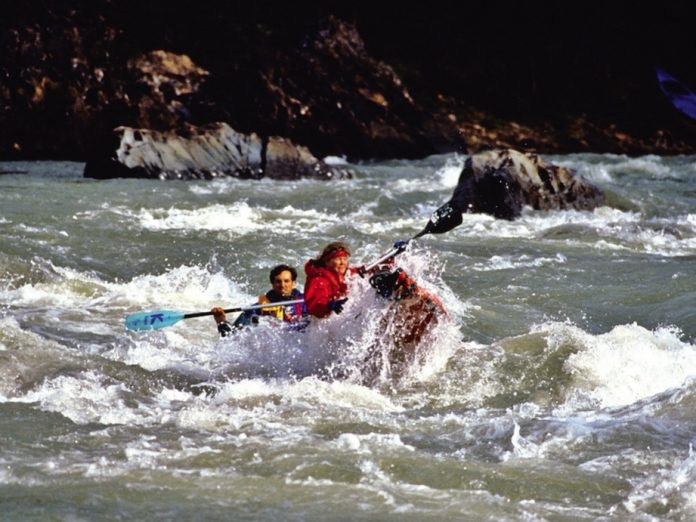
Whitewater in the Yukon.


A haystack in the middle of the river; that’s my first challenge of the day. It’s a metre-high mound of churning water that will knock our boat right over if we hit it in the wrong place.

“We” are eight paddlers from the south, transplanted to the Wernecke Mountains of the eastern Yukon. Our highway is the Bonnet Plume River, 320 kilometres of class I to VI rapids, dangerous sweepers and frigid water temperatures. And always the current. This is a river in a mad rush to reach the Arctic.

To come on this river, I’ve had a crash course in whitewater paddling. And I’ve lucked into Mark as a canoe partner. He’s calm, instructive and quick with his praise, which I shamelessly eat up. I’ve forgotten I’m a strong, independent woman who runs her own business and no longer needs any- one’s approval—and who certainly doesn’t like being told what to do. I’m depending on Mark’s instructions, eager to do as he tells me, relieved he never loses his temper. A part of me is standing back, shaking my head in disbelief. I seem to have gone careening back to childhood.

Tightening the sprayskirt around my waist, I’m as excited and nervous as a little kid.

“Don’t forget to smile,” our guide calls out as Mark and I eddy into the current. I plaster a grin on my face.

At first it’s genuine enough. Mark steers us into the black tongue to take us past the rocks and boulders on our left. I’m digging my pad- dle in hard under his calm instruction.

We plow through our first standing wave. A great weight of cold water is heaved onto my lap. Another swell of water is in front of me, and I’m grinning my way through it. But, suddenly, the canoe is veering left and straight ahead is a roiling wall of water towering over me. Where did this come from?

I don’t want to be here.

The bow rears up and the world goes cockeyed. The next instant I’m gasping in the frigid water beside the canoe. I grab hold of the gunwale, and the canoe carries me relentlessly downstream.

There’s only one problem: I don’t know how to get to shore. I’m going to be carried down the river forever.

Panic. Keening sobs rising inside me. I can’t breathe. No, this isn’t going to help. Calm down. Sur- prise when my body obeys. Though maybe it’s respond- ing to the sight of our guide’s bright yellow jacket as he runs along the shore.

Our guide throws a rope and I stop the canoe’s determined down- stream progress and am pulled to safety.

I want comforting arms around me; I want a soothing voice telling me it wasn’t my fault, there was nothing I could do.

“What happened?” I gasp.

“You did a classic air brace,” comes the wry reply, and I’m sent away to run up and down the shore to get warm.


It’s 10:30 by the time we finally make camp. The day has been a 12- hour adrenaline rush. After our guide has gone off to bed, I discover the lunch bucket I was using to do the dishes has completely melted on one side—I left it too close to the fire.

I’m stricken with little-girl fear. Our guide will be furious. We seem to be losing or ruining his equipment, piece by piece.

The others wander off to their tents, and I’m alone in the night. Not ready for sleep. The long hours of sunlight have wreaked havoc with my internal clock. I sit on a rock on the gravel beach and look across the river to the black spruce tree silhouetted against the faint blue glow of the sky and, silently, I sob.

I weep because I’m sure I’m going to be in trouble over the bucket. I weep because I’m alone and so out of my element. But I also weep for the spruce trees. Tonight they look like people trudging resolutely up the mountainside. Pilgrims seeking wisdom.

I thought I’d found wisdom, a modicum anyway. I thought I’d left behind my childhood need for approval and attention, and my fear of being rebuked. And yet here I am, sitting on a rock in the Yukon, and I’m a little girl sobbing her heart out. No more secure, no wiser than that little girl I thought I’d grown out of long ago. And the spruce trees on the other side of the river seem tonight to be all the other sad souls of the earth.


It’s our last day on the Bonnet Plume, and we’ve left behind the big canyons and big water. The river here is braided into many channels, separated by gravel bars of amazing symmetry and strewn with spruce and birch tree sweepers that are a deadly trap for an unwary canoe.

There’s no slackening in the speed of the river; if anything it’s fast- er. There is a sense of urgency, of momentum being gained, of being rushed, inevitably, to some conclusion.

I look at the trees lining the shore, many of them leaning at pre- carious angles, some of them, through no will of their own, about to plunge into the river, others already lying dead in the current, and I realize why on this trip I seem to be reliving my childhood: I’m one of those spruce trees. They seem to be trying to escape the river, but can’t—like me trying to escape that little girl I thought I’d outgrown. I thought I could free myself of her. Only to find myself seemingly right back where I started.

But I’m not where I started. In fact, I’m nowhere I’ve ever been be- fore—doing things, like navigating rapids and hiking mountains, that were never, even in my imagination, a part of my childhood. I can no more help my childlike reactions in this unfamiliar new world than spruce trees can avoid tumbling into the river.

And so, as we navigate the last kilometres of the messy, rushing Bonnet Plume, I am filled with a compassion for myself I’ve never felt before. And a quiet joy in being me.


Brenda Missen lives, writes and stores her canoe on the banks of Ontario’s Madawaska River. Her memoir recounting a decade of solo canoe trips is called If Jesus Were an Algonquin Park Bear. This is an excerpt from an earlier work.


This article first appeared in the 2009 Late Summer issue of Canoeroots and Family Camping magazine. Read the issue in our free iPad/iPhone/iPod Touch App or Android App or read it online here.


2600 Above 60

Join four men on a 2600-mile canoe journey through blizzards, frozen lakes and mountains as they travel for 130 days from the Alaskan coast to the Hudson Bay. From the challenge of paddling up the Rocky Mountains to the stark beauty of the tundra, this film is an adventure through North America’s last great wilderness.

This film has been entered in the 2014 Reel Paddling Film Festival—find more great paddling films here.

Expedition Kayak Review: Current Designs Infinity

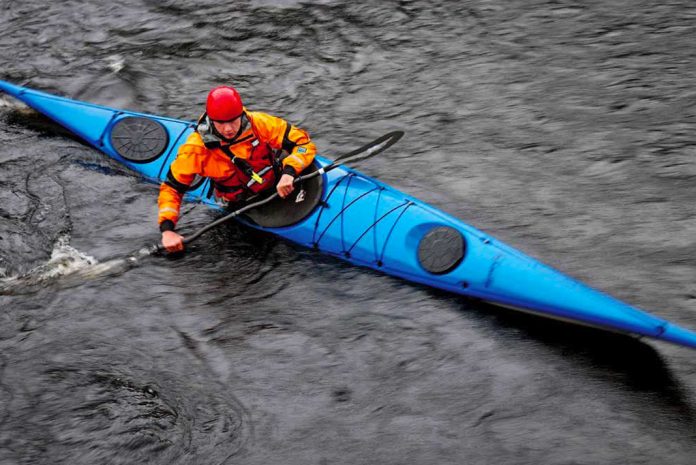
Man in blue sea kayak
Ready for any expedition. | Photo: Tim Shuff

Current Designs has long made touring kayaks in all shapes and sizes, but lacked a British-style expedition kayak to complete their lineup. The Infinity fills the void.

The Infinity extrapolates the design of CD’s smaller Willow and Cypress kayaks into the high-volume realm for larger paddlers. But not only larger paddlers. Although spacious, the deck and thigh braces are low enough to fit mid-sized paddlers comfortably.

[ Paddling Buyer’s Guide: View all expedition kayaks ]

Regarding that age-old tradeoff, speed versus maneuverability, the CD design team clearly prefers to beat the playboaters to the campsite. The Infinity’s long waterline and low rocker profile translate into excellent tracking and speed. Yet turning performance is reasonable for a boat of this length and very predictable. The Infinity responds nicely to an edge for subtle course corrections.

Current Designs Infinity Specs
Length: 17′ 9″
Width: 22″
Weight: 52 lbs
 (fiberglass) / 50 lbs (Kevlar)
Price: $3,399 USD (fiberglass)  / $3,799 USD (Kevlar)

www.cdkayak.com


Another speedy feature of the Infinity is the soft, rounded cross-section of the shallow-arch hull; it’s curved like a racing kayak’s and you can feel this in the low initial stability, though less so when fully loaded. A confident paddler can effortlessly roll on edge and smoothly recover from any amount of lean—or from being upside down.

Another upshot of the speed/tracking proficiency is almost completely neutral response to crosswind, translating into control in rough conditions and skeg non-dependence, though dropping the fin helps when quartering into strong winds or running downwind with a following sea.

Current Designs crafts beautiful kayaks, and it is perhaps the parent company Wenonah’s expertise with lightweight tripping and racing canoes that allowed our Kevlar demo to weigh in at less than 50 pounds. Peering through the layers of the translucent hull gives you a sense of CD’s composite wizardry and careful attention to which areas get reinforcement, like the hull and skeg box, and where material is pared to save weight, like the deck and bulkheads.

Attention to detail also shows in such features as the skeg cable routing, which was well clear of the rear hatch opening so we could fearlessly cram gear into the hatch and fill the spaces around the skeg box.

CD describes the Infinity as a “large expedition sea kayak” that will “comfortably accommodate larger paddlers,” but it’s really a big boat that doesn’t feel big, or trade off super-smooth performance for carrying capacity. The Infinity is excellently suited for any midsized to large paddler whose primary concerns are speed, efficiency, carrying capacity, light weight and long-distance touring performance.

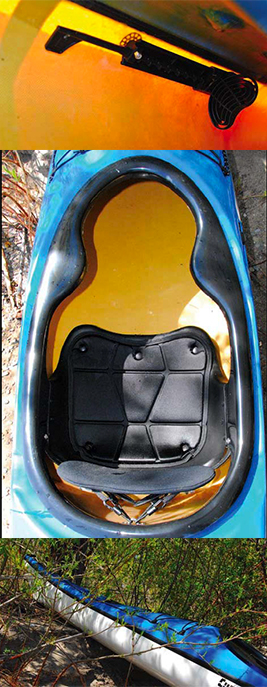
Different parts of blue sea kayak

Kevlar, Kevlar everywhere (top)

Current Designs affixes the foot rails to a metal bracket moulded into the Kevlar hull, providing strength without through-hull holes. a heavier duty Kevlar fabric reinforces the hull under the cockpit. The bulkheads are lightweight Kevlar too.

Big without feeling it (middle)

We like the fit and layout of the cockpit and the positioning of the rear bulkhead close to the seat to maximize day hatch space. The front deck and simple, effective moulded-in thigh braces are high enough for large paddlers without sacrificing performance fit.

Don’t rocker the boat (bottom)

Sleek and speedy rule the day, as demonstrated by the sharp entry line, long waterline, low rocker, and rounded chines and bottom.

This article originally appeared in Adventure Kayak‘s Summer/Fall 2009 issue. Subscribe to Paddling Magazine’s print and digital editions here, or browse the archives here.


Ready for any expedition. | Photo: Tim Shuff

Butt End: Sympathy for the Devil

Photo: Kevin Callan
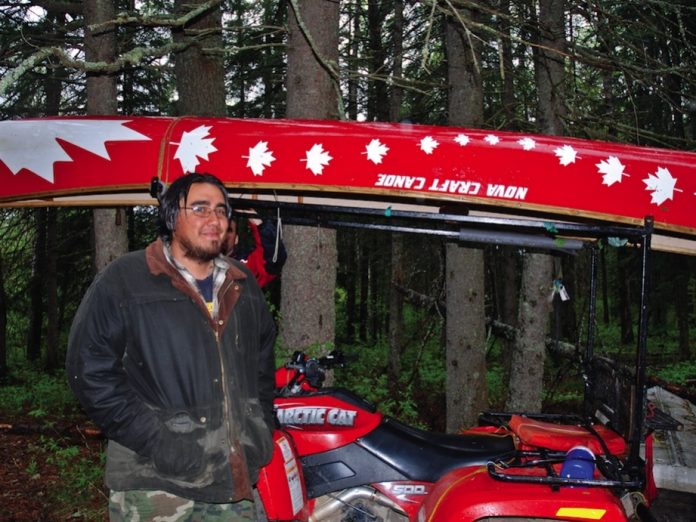
Canoe and ATVs

My father always told me never to judge a book by its cover. Well, that’s not exactly what he said. My dad was a professional boxer and he actually said you shouldn’t judge a fighter by the colour of his trunks. But you get the picture.

I was reminded of his wisdom last week. Some tripmates and I were finishing up a remote route through Ontario’s Penokean Hills region. It’s a network of aqua blue lakes and clear streams north of Lake Huron’s North Channel that’s alive with feisty trout. It was a perfect trip, one that was to come to a tidy end when we reached the fishing lodge where we had scheduled a bush plane to pick us up. Poor weather made that impossible the first day, then the second, then the third. When rain changed to snow, we began looking for an alternate means of escape. That’s when the guides at the lodge, Chris Moose and Peter Roberts, suggested they drive us out by ATV.

Imagine, a bunch of snobby canoeists being rescued by ATV, the devil’s own bush buggy, the arch nemesis of canoeing. ATVs emit more greenhouse gases then any car on the road, their noise pollution ranks down there with personal watercraft and car alarms and those complaints are nothing compared to the way they tear up the ground while breaking down the barriers that keep remote areas remote.

The problem was, we all had jobs and families to get back to and waiting for another couple of days until the snow disappeared didn’t seem to be an option. So we took deep breaths and two-stepped over to the four-strokes for a ride back to civilization.

It wasn’t a pleasant trip. The so-called trail was 28 bone-jiggling kilometres long. Three hours later it ended at a river we had to ferry across before Moose could hitchhike down a dirt road to pick up his truck, a 1991 Ford with no working tail lights, tires that were balder than Bruce Willis and a stereo that had to be hit twice on the left and three times on the right before it would pump out a mix of Culture Club and Pet Shop Boys.

Arduous as the effort was, it worked. We got back to our own vehicle and made the seven- hour drive back to our jobs and families.

Moral of the story? Yes, ATVs can be a menace to wilderness areas. But so can canoeists trying to squeeze in wilderness adventures between strictly scheduled bush plane flights. It’s not the way you enter the wilderness but how you interact with it while you’re there that’s important. That’s another thing my father tried to teach me. Don’t look upon wilderness trips as something to squeeze in between appointments you aren’t prepared to miss.

We got to know the drivers of the malevolent machines during our joyless ride out to civilization. It was obvious that both guides loved the Penokean Hills region and would be dedicated to preserving it long after we had left. Moose and Roberts aren’t jockeying for the devil; they are the boxers who wear camo trunks and end up knocking down their arrogant opponent in the first round.


This article first appeared in the 2009 Late Summer issue of Canoeroots and Family Camping magazine. Read the issue in our free iPad/iPhone/iPod Touch App or Android App or read it online here.


Roll your Kayak Anywhere

Photo: Maximillian Kniewasser
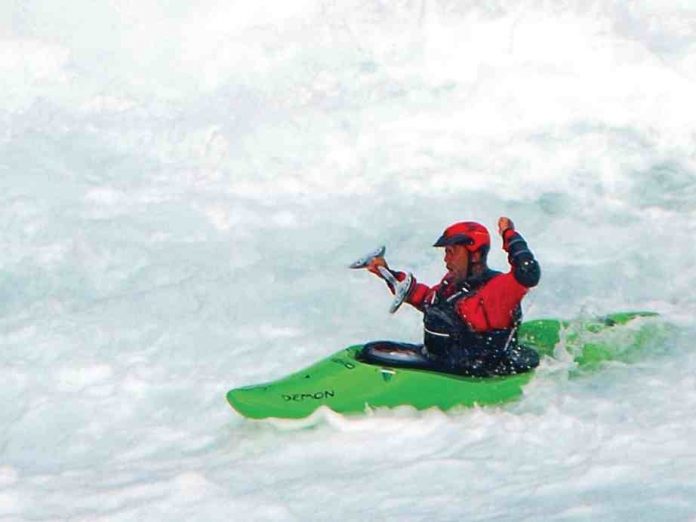
A kayaker celebrates after rolling in whitewater.

It may take a little practice and adjustment to being upside down, but with these tips from the pros, you will be rolling your kayak anywhere.

When Rapid asked two-time Green River Narrows Race champion An­drew Holcombe to recall his most memorable roll, he replied, “Man, that’s all of them, ‘cause anytime you roll it means you’re not swimming!” Quite right.

In the spirit of not swimming, we bring you advice from three seasoned pros on which rolls work best in the gnarliest places. In cheese grater rock gardens, continuous steeps, relentlessly retentive holes and minibus-eating boils. Even in the pounding fury at the base of a towering waterfall. Here’s how to roll anywhere.

Super Shallow Rock Garden

In shallow, class II–III rapids, the sweep roll is your safest bet. Thin water usually means lots of rocks in very close proximity to your head. The sweep roll’s setup position keeps your body close to the surface and protects your face and shoulders, allowing your helmet and PFD to take the brunt of any impacts. Over the years, this roll has saved me a lot of skin and a lot of swims. —Simon Coward

Bottom of Gorilla on the Green

On a continuous, difficult creek like the Green, reac­tion time is critical. The sweep roll is quick under a wide variety of conditions. Less time upside down generally equals fewer encounters with rocks and means you’ll be upright before the next must-make move or drop. For me, the only exception to auto­matically setting up for a sweep is if I feel like I can exploit the natural momentum of a flip by doing a back deck roll. — Andrew Holcombe

Stuck in a High Volume Hole

When running big water, it is only a question of time before you get stuck in a retentive hole. In such un­fortunate circumstances, my go-to is a back deck roll. Contrary to popular belief, this roll is the safest for your shoulders. When you flip, lean back, keep your elbows tight to your body and wait for pres­sure on your downstream blade. This technique also tends to keep you higher in the foam pile, which makes it easier to get control and orientation—two things needed to find a way out of the hole. This is how I escaped the Hole that Ate Chicago on the Sti­kine. —Maximillian Kniewasser

Monster Boils

In powerful boils, lean forward while rolling or you will go right back over. Try to roll through to the other side of the boil, where there is usually more upward water movement. If your first roll doesn’t work, tuck forward and test which side feels better. Boily water changes constantly. A traditional C-to-C combat roll gives a good compromise of leverage and the ability to change sides quickly while leaning forward. Below the big falls on Callaghan Creek, this roll gets me up time and again. — Maximillian Kniewasser

This article originally appeared in Rapid, Spring 2011. Download our free iPad/iPhone/iPod Touch App or Android App or read it here.
Rock the Boat: Paddle Clubs that Don’t Suck

Illustration: Lorenzo Del Bianco
Rock the Boat: Paddle Clubs that Don't Suck

It’s the height of the paddling season and I’m chomping at the bit. I check the calendar of a local paddling club and find…nothing. Zilch. Naught. Nada. By contrast, a casual social media group has four paddles scheduled—all beginner flatwater.

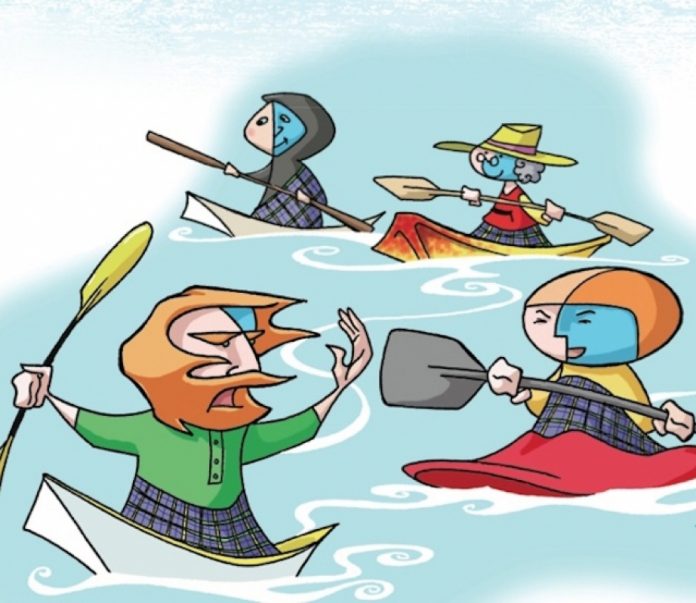
Paddling clubs are dinosaurs. Their stereotype is that of a fusty group watching slideshows about paddling, while not actually getting on the water all that much. They’ll cite cumbersome procedures, declining participation and tempest-in-a-teapot internal politics. Caught between the devil of liability and a sea of seat-of- the-pants social media invites, paddling clubs occupy the netherworld between professional instruction and friends going out for a paddle, with the benefits of neither. It’s time to re-envision paddling clubs. It’s time to become Scottish.

I Googled my old paddling club from when I lived on Scot- land’s east coast. They offer two weekly pool sessions, river trips, weekly surf sessions, kayak polo and slalom tams, two formal balls and they take over a local pub twice a week. They supply the gear, just bring lunch and your “paddling costume.” This, in a town of 17,000 souls, compared to my current home of 2.2 million.

At their best, paddling clubs play three functions. They generate new paddlers, connect existing paddlers to other paddlers and disciplines, and build a social bond.

Social media formats like Meetup.com work for novice-friendly paddles, but become problematic when they venture beyond easy trips. Their spontaneous nature seldom vets skills properly, putting too much pressure on organizers. Unlike clubs, casual get-togethers can’t insure their leaders or subsidize skill development. Paddlers will grow out of them if they aspire to more than flatwater.

Even formal clubs, which often succeed at turning new paddlers into more frequent or better paddlers, usually fail at attracting new recruits. If we want the sport to grow, this is precisely what we need. In Scotland, with no gear, the fact that all I needed to provide was a sandwich allowed me to participate in a sport I couldn’t afford. Two decades later, I’m still thoroughly addicted — to paddling, not sandwiches.

North American clubs could mimic this initiation by establishing a fleet of boats and gear, partnering with paddling shops to provide storage, bulk rentals and instruction—things shops do already. Like clubs, shops have a direct interest in getting the vast numbers of hikers, cyclists, fitness enthusiasts and skiers to add paddling to their quiver.

My city has three separate clubs, one each for sea kayakers, whitewater canoeists and whitewater kayakers. Each has its own vibe, but it means paying multiple dues to join all or missing out on experiences. Paddling clubs should merge, or at least collaborate. The multi-disciplinary Scottish club gave me a chance to paddle whitewater, ocean, surf, and play polo, as well as meet people passionate about each. Combining also offers economies of scale on storage, classes, equipment and insurance.

Let’s take a cue from the Scots. Let’s trade our spray skirts for kilts, speak in thick brogues and make our clubs what they should be: the epicenter of paddling culture.

Neil Schulman lives in Portland, Oregon, and is a regular contributor to Adventure Kayak. He first paddled whitewater on the Tay River in Scotland many years ago. After a long swim, he ended up borrowing a paddling costume.

 PaddlingBG2014

This article first appeared in the 2014 Annual Paddling Buyer’s GuideDownload our free iPad/iPhone/iPod Touch App or Android App or read it on your desktop here. 


Q&A with Chris Hayward

Photo courtesy Chris Hayward
Q&A with Chris Hayward

Adventurer Paul Everitt speaks with expedition paddler, Chris Hayward, who in 2012 became the youngest person to kayak down the full length of Australia’s longest river, the Murray. Hayward is now attempting the first full ascent of the river, starting at the mouth in the Southern Ocean in early December and kayaking 2,520 km upstream before hiking the last 236 km to the source of the Murray and on to the summit of Mt. Kosciuszko. To read the full interview, click here, and to learn more about Everitt and other adventurers around the world, visit Going Solo.

What kayak are you using to take on the Murray River during your Sea to Source expedition? 
Chris – I am using a Wilderness Systems Tempest 170, it is the same model as I used on my previous trip and after kayaking over 3,000 km in these kayaks I can honestly say I love them!

How long will the Sea to Source to Summit expedition take?
Chris – I estimate between 4 – 6 months depending on flow. They have just released another 6,000 ML but it should reside in February.

 
You are no stranger to the Murray River due to successfully completing a Source to Sea kayaking expedition in which you became the youngest person to do this. What did that expedition teach you in experience that will be invaluable for this current expedition?
Chris Preparation is key! Last year I jumped into the deep end with no skill, barely any practice and very little research and I paid for it. This year it has been meticulously planned and trained for. The other thing is to have fun.

 
 Australia has so many deadly creatures that live on the land and even water surrounding your entire journey. Is there anything that worries you that might possibly creep up on you as you settle into camp for the night?
Chris One of the worst things to do in the Aussie bush if you want to avoid encounters with the wildlife is stay still! I have had four Eastern Brown Snakes at my feet just because I was reading. Am I worried? Not at all. The wildlife in Australia is safe with common sense. The people are incredibly friendly and laid back.
 
 Top 5 bits of kit for your kayaking expedition.
1- iPod, music is a luxury I like
2- My trusty Lifestraw
3- Spoon, it’s the little things that really help
4- My camera, nothing worse than missing that awesome shot

5- A sense of adventure and a pinch of insanity. It always gets you through the day!

 
What’s next for you after this expedition? 
Chris – Well I have always dreamt of Antarctica and would love to trek solo and unsupported from the rim to the South Pole and then summit Mt. Vincent. But no official plans have been announced just yet. 

What advice would you give to someone who wishes to follow your strokes upriver, or maybe the more traveled route downriver?
Chris – My advice would be go for it! Even if other people have done it, no one ever has the same experience so make it your own and enjoy!

 
To learn more about Chris and his adventures, visit http://www.chrishayward.com.au/.

The Risk Formula

Photo: Francois Brassard
Whitewater risk management

 I raced one of mountain biking’s crown jewels this summer. One hundred and one miles of roots and rocks, hour-long climbs and jack hammer descents left me with two numb hands and unable to climb stairs for two weeks. It was hard. When I was younger, I rock climbed a lot—that was hard too.

The semi-objective rating scale used by climbers made difficulty easier to measure than a 101-mile slog, but, like most action sports, “hard” is a relative term where enthusiasts find their own frontier. Whitewater is different—hard means unforgiving. More difficult means inherently more dangerous.

A simple way to understand and assess risk is: Risk = Probability x Consequence.

Probability is the likelihood of something going wrong—going off line or getting pinned, or going over your handlebars or taking a lead fall.

Consequence estimates how bad the situation will be if the above is realized—broken gear, a broken body or death.

Multiply them together and a relative risk rating is created. It’s an approximation at best, but provides language to deal with these ambiguous dangers. This formula illustrates why whitewater carries more risk than almost any other sport.

For the majority of action sports, consequence is more or less fixed regardless of difficulty. Serious injury is the exception, not the rule.

Consequence is always present, but generally realized at low to mod­erate levels. For example, the potential severity of going over the bars is the same whether the mountain bike is going fast or slow—a bro­ken collarbone. The consequence of a climber’s lead fall is the same regardless of an easy or hard route—a short fall arrested by bolts and harness. Likewise, these consequences are the same whether a novice or expert—falling is falling.

Probability on the other hand, does change with difficulty. We are more likely to fall off of a difficult climb than an easy one. It’s also in probability that novices differ from experts. High skill levels suggest less probability of a negative outcome. Only at the extremes of these activities does this break down.

Whitewater paddling is different. For each increase in the difficulty of rapids, both probability and consequence rise in lock step. Difficult rapids imply both more chance of something going wrong and worse outcomes when something does. The multiplying effect of the for­mula cranks up whitewater risk much more quickly than other sports.

In other sports, the individual defines when things get hard. For us, the river tells us when it’s hard. At class IV and above, things can unravel quickly regardless of skill. A hard river is an unforgiving one.

For aspiring paddlers, this lesson may be hard learned. While difficult rock climbs keep novices away because they can’t get off the ground, anyone can drop into a class IV rapid. And they do.

New paddlers may tempt difficult rapids and realize their limits with a thumping, but I see advanced paddlers falling into a similar trap. So focused on whether they can make the line, they mistake confidence for low probability. Confidence in being able to make a line does not change the odds of it going wrong, or the consequences. At the extreme, elite paddlers are merely rolling the dice on whether consequence will be realized or not.

In whitewater, hard means unforgiving, but we can find challenge wherever we choose. Given a target level of risk and consequence dic­tated by the river grade, it’s our decision-making and skill set that manage the probability of something going right. In whitewater, the reward of putting it all together is harder earned.


Jeff Jackson is a professor of Outdoor Adventure at Algonquin College and is the co-author of Managing Risk: Systems Planning for Outdoor Adventure Programs. His Alchemy column appears in every issue of Rapid. 

This editorial originally appeared in the 2013 Paddling Buyer’s Guide. Download our free iPad/iPhone/iPod Touch App or Android App or read it on your desktop here.